Services
Procurement
Are You Seeing
the Big Picture?
2INTERNAL© 2017 SAP SE or an SAP affiliate company. All rights reserved. ǀ
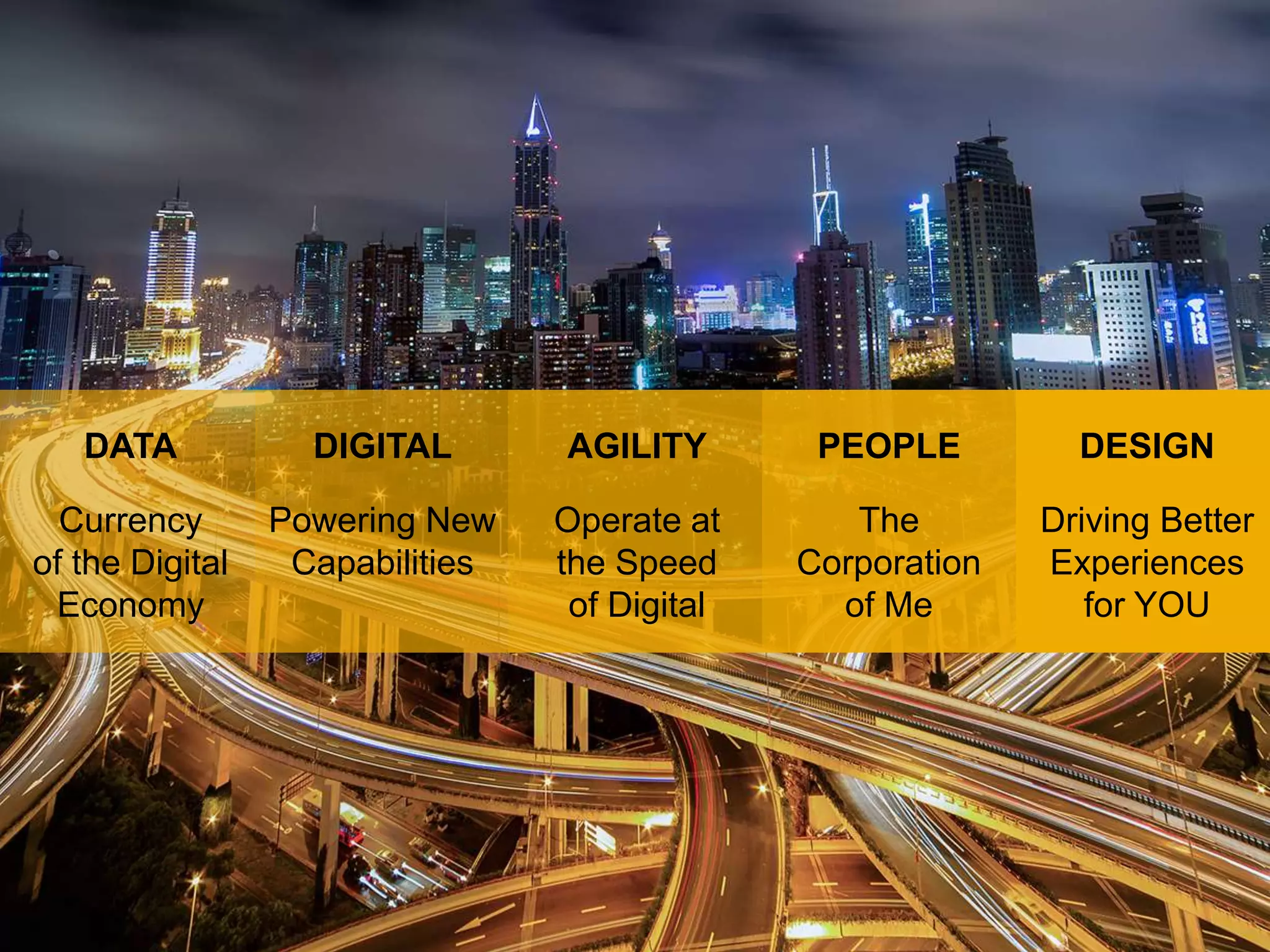
DATA
Currency
of the Digital
Economy
DIGITAL
Powering New
Capabilities
AGILITY
Operate at
the Speed
of Digital
PEOPLE
The
Corporation
of Me
DESIGN
Driving Better
Experiences
for YOU
People
The corporation of me
User-centered Design
Improving the way work gets done
External talent is key
6INTERNAL© 2017 SAP SE or an SAP affiliate company. All rights reserved. ǀ
Strike a balance
Between lead
time, quality
and cost
7INTERNAL© 2017 SAP SE or an SAP affiliate company. All rights reserved. ǀ
Launch
New products
or services
8INTERNAL© 2017 SAP SE or an SAP affiliate company. All rights reserved. ǀ
Source talent fast
Locate hard-to-find talent before
someone else snaps them up
Total Spend
Management
SAP Ariba + SAP
Fieldglass
Thank you.
Address and relevant info here
Contact information

The Future of How Work Gets Done: Are You Seeing the Big Picture?

Editor's Notes

  • #2 [MIKAIL] Hello everyone. It’s great to be here with you today. In our time together, we’d like to share our thoughts about where the market is headed and how digital is changing the world—your world, in external talent and services procurement. My colleague, Brian Cicirello, will come up in a few minutes to talk about innovation and how we at SAP Fieldglass are exploiting digital and innovating for our customers. [If possible, comment on an earlier presentation at CWS, and how it’s relevant, and/or make an observation about the European market]
  • #3 I’d like to talk about five things today that are transforming how WORK GETS DONE. DATA – the currency of the digital economy. We hear a lot about data these days, and big data (which is just more data), and how we are able to draw insights from larger data sets to make better decisions and drive better business outcomes. Digital technologies are the rocket fuel. AI and its many forms – machine learning, deep learning – and NLP, etc. These technologies on their own are powerful, and they are also used in combination to power new capabilities, and even new business models. Data + Digital = Agility. Organizations are looking to digital technologies for speed and agility to become more competitive. The pace of change is faster. We all experience this in our own lives. Tapping into external workforces gives companies the ability to be flexible and agile and move at speed. People. There had been a profound shift in the workforce. We have all heard of the “Gig Economy.” Digital is enabling this – opening opportunities and changing the career picture. It’s the “Corporation of me.” And then, DESIGN. There’s a lot of innovation in the market today around user-centered design. It’s about driving better experiences for YOU, as a consumer and enterprise worker. Yet, it needs to go much further. It’s about bringing work to you where you are in the world - bringing experiences to you, extending to more devices, how you want to work. These together are helping to transform HOW WORK GETS DONE. It is going to continue to make your lives easier and “more simple” – driving better experiences.   Now, I’ll unpack these a bit and tie them back to our space.
  • #4 As I stated earlier, the dynamic at work is changing. No longer do many employees want to work for company x for 30-40 years. It’s a generational mindset shift. Today’s workers don’t feel like they need to have the same career trajectory or journey. Many want to be untethered. Millennials work differently and want to have a more dynamic role. They are looking for experiences rather than moving up the ladder at one company. Digital is changing the entire career picture for people – they have the opportunity to have different experiences that might not have been there a few years before.
  • #5 There is a lot of focus in the market today around design thinking or user-centered design – to make how we all work more intuitive and engaging. We experience this in our consumer lives with our phones and apps, yet the workplace has been far behind. Companies today are working to put the user first – in the center – before they start to design their applications and systems. This means that YOUR work experience will change for the better. You will be able to focus less on the mechanics of getting work done, and more on using insights to make a more strategic impact on your organization. I’d like to introduce my colleague, Brian Cicirello, who will talk with you about how we at SAP Fieldglass are continuously innovating and exploiting digital to improve our platform and services to drive better business outcomes and create better experiences for our customers. He’s a tech and data geek and loves this stuff. Brian, come on up.
  • #6 Let’s circle back to what brings us all together at CWS – harnessing and managing the external workforce. Think of why you employ external talent and how strategic it can be to your enterprise. It could be to more quickly capitalize on new opportunities, launch a new product or service, or respond to a competitive threat. And, as we all are experiencing, the external workforce is increasing significantly. Add stats on growth of external talent IF POSSIBLE. So, we invest in capabilities to help our customers better manage this key asset, and become more agile and improve their competitiveness.
  • #7 Say you work for a major retailer and back-to-school season is approaching. You know you will need to bulk-hire employees for this busy time of year. With our service, you can look at seasonally-adjusted labor demand to determine the optimal time to release your requisitions. This gives you ample time to build a strong bench of talent. It also helps your organization account for onboarding and training so that your talent is ready to hit the ground running during an important time of year. You can also assess your rates compared to the market so you can answer questions like: Do I have room to bring down my bill rate while maintaining an attractive offer? Or, on the flip side, have I struggled to bring talent on board because my rates are comparatively lower? So you can plan, simulate, predict and engage … striking a balance between lead time and cost to ensure a successful peak period.
  • #8 Say you need to stand up a capability to launch a new product or service, and you do not have these skills in house. You can locate this capability anywhere – you just need to know where. You can determine where pools of available talent reside, the time to fill, and the going rates, as well as benchmark against third-party data and BLS data. You will gain insights as to where to locate this new capability.
  • #9 Say you are looking for hard-to-find talent such as data scientists, bio-engineers or cyber security experts—and you need them NOW. You need information regarding where these skills are available today. With our service, you can see who is available today and the rates they are getting paid, to enable you to create compelling offers. If you have flexibility in your location, you can run scenarios and compare and contrast different cities, time to hire, and labor cost, and inform your decision. Then, you can immediately source this talent.
  • #10 Just think about what the future will hold, as we harness these digital technologies. You could get an alert to say that the cost for one of your talent types is predicted to increase, or is becoming scarcer. You would be prompted with options – do you want to requisition more resources? Here are two locations that have the highest quality talent, available with the quickest lead time. Do you want to requisition them now? These “learning” technologies become smarter, the more you engage with them, as they will look for patterns to inform recommendations. We are working with SAP’s machine learning group, which is building in triggers for invoicing – when an invoice comes in and it meets certain exception criteria it will flag it. Think of how this could be applied to timesheets, labor law compliance issues, etc. Anticipating and predicting probable exceptions based on historical data – in an automated way, served up to the user – helps to get ahead of it and improve the way work gets done. Resume matching and job skills matching is yet another example of how we can benefit from machine learning. You would say, “here’s what I need” and it will cull through the data and serve up what it gave you in the past- looking at heuristics and other inputs. Job titles may be different yet it gets past that given rules that have been established. I could go on. It’s really a great time to be in this business. This is some pretty interesting stuff and it really will change your day in a big way. Now, I’ll turn it back to Mikael. I’m happy to talk with you all more if you like at our booth. I will be there xxx.
  • #11 Mikail joins Brian on stage, asks for questions. Invites them to come to our booth to talk with us. Thank you!