The Future of Connectivity:
Li-Fi and Gi-Fi
• Introducing Li-Fi and Gi-Fi
• Advantages of Li-Fi and Gi-Fi
• Applications of Li-Fi and Gi-Fi
• Limitations of Li-Fi and Gi-Fi
• Future of Li-Fi and Gi-Fi
• Conclusion
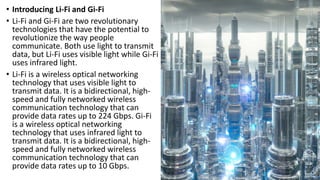
• Introducing Li-Fi and Gi-Fi
• Li-Fi and Gi-Fi are two revolutionary
technologies that have the potential to
revolutionize the way people
communicate. Both use light to transmit
data, but Li-Fi uses visible light while Gi-Fi
uses infrared light.
• Li-Fi is a wireless optical networking
technology that uses visible light to
transmit data. It is a bidirectional, high-
speed and fully networked wireless
communication technology that can
provide data rates up to 224 Gbps. Gi-Fi
is a wireless optical networking
technology that uses infrared light to
transmit data. It is a bidirectional, high-
speed and fully networked wireless
communication technology that can
provide data rates up to 10 Gbps.
• Advantages of Li-Fi and Gi-Fi
• Li-Fi and Gi-Fi have many advantages
over traditional radio frequency-based
wireless technologies. They are both
much faster than Wi-Fi, have lower
latency, and are less susceptible to
interference. Additionally, Li-Fi and Gi-Fi
are more secure than Wi-Fi, as the light
waves used to transmit data cannot
penetrate walls.
• Li-Fi and Gi-Fi also have a smaller
environmental impact than Wi-Fi, as
they do not produce electromagnetic
radiation. Additionally, Li-Fi and Gi-Fi
are more energy efficient than Wi-Fi, as
they require less power to transmit
data.
• Applications of Li-Fi and Gi-Fi
• Li-Fi and Gi-Fi can be used in a variety of
applications, including home and office
networks, medical and industrial
applications, vehicle-to-vehicle
communication, and military
applications. Additionally, Li-Fi and Gi-Fi
can be used in public places, such as
airports, stadiums, and museums, to
provide high-speed internet access.
• Li-Fi and Gi-Fi can also be used for smart
home applications, such as controlling
lights and appliances, and for smart city
applications, such as traffic monitoring
and public safety. Additionally, Li-Fi and
Gi-Fi can be used for augmented reality
and virtual reality applications.
• Limitations of Li-Fi and Gi-Fi
• Li-Fi and Gi-Fi are not without their
limitations. The main limitation of Li-Fi
and Gi-Fi is that they require line-of-
sight, meaning that the light waves used
to transmit data must be able to travel
directly from the transmitter to the
receiver. Additionally, Li-Fi and Gi-Fi are
not yet widely available, as they are still
in the early stages of development.
• Li-Fi and Gi-Fi also require special
hardware, such as lightbulbs and
receivers, which can be expensive.
Additionally, Li-Fi and Gi-Fi are not as
reliable as Wi-Fi, as they can be affected
by changes in light intensity and
interference from other light sources.
• Future of Li-Fi and Gi-Fi
• The future of Li-Fi and Gi-Fi looks very
promising. As the technology matures, it
is likely that Li-Fi and Gi-Fi will become
more widely available, and more reliable.
Additionally, Li-Fi and Gi-Fi are likely to
become more energy efficient, and more
secure.
• It is also likely that Li-Fi and Gi-Fi will be
used in a variety of new applications,
such as autonomous vehicles and smart
homes. Additionally, Li-Fi and Gi-Fi are
likely to become more affordable, as the
cost of the necessary hardware
decreases.
• Conclusion
• Li-Fi and Gi-Fi are two revolutionary
technologies that have the potential to
revolutionize the way people
communicate. They are both much
faster than Wi-Fi, have lower latency,
and are less susceptible to interference.
Additionally, Li-Fi and Gi-Fi are more
secure than Wi-Fi, as the light waves
used to transmit data cannot penetrate
walls.
• The future of Li-Fi and Gi-Fi looks very
promising. As the technology matures, it
is likely that Li-Fi and Gi-Fi will become
more widely available, and more
reliable. Additionally, Li-Fi and Gi-Fi are
likely to become more energy efficient,
and more secure.

The Future of Connectivity.pptx

  • 1.
    The Future ofConnectivity: Li-Fi and Gi-Fi
  • 2.
    • Introducing Li-Fiand Gi-Fi • Advantages of Li-Fi and Gi-Fi • Applications of Li-Fi and Gi-Fi • Limitations of Li-Fi and Gi-Fi • Future of Li-Fi and Gi-Fi • Conclusion
  • 3.
    • Introducing Li-Fiand Gi-Fi • Li-Fi and Gi-Fi are two revolutionary technologies that have the potential to revolutionize the way people communicate. Both use light to transmit data, but Li-Fi uses visible light while Gi-Fi uses infrared light. • Li-Fi is a wireless optical networking technology that uses visible light to transmit data. It is a bidirectional, high- speed and fully networked wireless communication technology that can provide data rates up to 224 Gbps. Gi-Fi is a wireless optical networking technology that uses infrared light to transmit data. It is a bidirectional, high- speed and fully networked wireless communication technology that can provide data rates up to 10 Gbps.
  • 4.
    • Advantages ofLi-Fi and Gi-Fi • Li-Fi and Gi-Fi have many advantages over traditional radio frequency-based wireless technologies. They are both much faster than Wi-Fi, have lower latency, and are less susceptible to interference. Additionally, Li-Fi and Gi-Fi are more secure than Wi-Fi, as the light waves used to transmit data cannot penetrate walls. • Li-Fi and Gi-Fi also have a smaller environmental impact than Wi-Fi, as they do not produce electromagnetic radiation. Additionally, Li-Fi and Gi-Fi are more energy efficient than Wi-Fi, as they require less power to transmit data.
  • 5.
    • Applications ofLi-Fi and Gi-Fi • Li-Fi and Gi-Fi can be used in a variety of applications, including home and office networks, medical and industrial applications, vehicle-to-vehicle communication, and military applications. Additionally, Li-Fi and Gi-Fi can be used in public places, such as airports, stadiums, and museums, to provide high-speed internet access. • Li-Fi and Gi-Fi can also be used for smart home applications, such as controlling lights and appliances, and for smart city applications, such as traffic monitoring and public safety. Additionally, Li-Fi and Gi-Fi can be used for augmented reality and virtual reality applications.
  • 6.
    • Limitations ofLi-Fi and Gi-Fi • Li-Fi and Gi-Fi are not without their limitations. The main limitation of Li-Fi and Gi-Fi is that they require line-of- sight, meaning that the light waves used to transmit data must be able to travel directly from the transmitter to the receiver. Additionally, Li-Fi and Gi-Fi are not yet widely available, as they are still in the early stages of development. • Li-Fi and Gi-Fi also require special hardware, such as lightbulbs and receivers, which can be expensive. Additionally, Li-Fi and Gi-Fi are not as reliable as Wi-Fi, as they can be affected by changes in light intensity and interference from other light sources.
  • 7.
    • Future ofLi-Fi and Gi-Fi • The future of Li-Fi and Gi-Fi looks very promising. As the technology matures, it is likely that Li-Fi and Gi-Fi will become more widely available, and more reliable. Additionally, Li-Fi and Gi-Fi are likely to become more energy efficient, and more secure. • It is also likely that Li-Fi and Gi-Fi will be used in a variety of new applications, such as autonomous vehicles and smart homes. Additionally, Li-Fi and Gi-Fi are likely to become more affordable, as the cost of the necessary hardware decreases.
  • 8.
    • Conclusion • Li-Fiand Gi-Fi are two revolutionary technologies that have the potential to revolutionize the way people communicate. They are both much faster than Wi-Fi, have lower latency, and are less susceptible to interference. Additionally, Li-Fi and Gi-Fi are more secure than Wi-Fi, as the light waves used to transmit data cannot penetrate walls. • The future of Li-Fi and Gi-Fi looks very promising. As the technology matures, it is likely that Li-Fi and Gi-Fi will become more widely available, and more reliable. Additionally, Li-Fi and Gi-Fi are likely to become more energy efficient, and more secure.