THE FULBRIGHT
PROGRAM:
Is It Really
Public Diplomacy?
César Corona
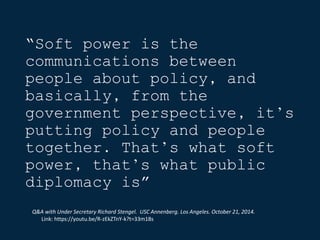
“Soft power is the
communications between
people about policy, and
basically, from the
government perspective, it’s
putting policy and people
together. That’s what soft
power, that’s what public
diplomacy is”
Q&A with Under Secretary Richard Stengel. USC Annenberg. Los Angeles. October 21, 2014.
Link: https://youtu.be/R-zEkZTnY-k?t=33m18s
SARTORI, GIOVANNI. Guidelines for concept analysis. In: COLLIER, DAVID; GERRING, JOHN. Concepts and method
in social science: The tradition of Giovanni Sartori. (pp. 97-150). Routledge. New York. 2009. p. 120.
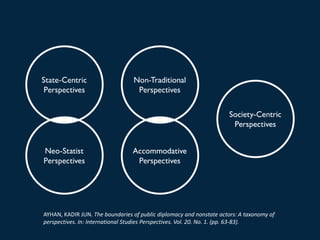
AYHAN, KADIR JUN. The boundaries of public diplomacy and nonstate actors: A taxonomy of
perspectives. In: International Studies Perspectives. Vol. 20. No. 1. (pp. 63-83).
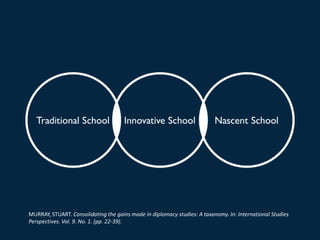
MURRAY, STUART. Consolidating the gains made in diplomacy studies: A taxonomy. In: International Studies
Perspectives. Vol. 9. No. 1. (pp. 22-39).
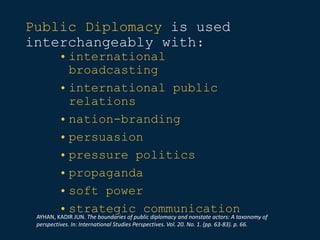
• international
broadcasting
• international public
relations
• nation-branding
• persuasion
• pressure politics
• propaganda
• soft power
• strategic communication
Public Diplomacy is used
interchangeably with:
AYHAN, KADIR JUN. The boundaries of public diplomacy and nonstate actors: A taxonomy of
perspectives. In: International Studies Perspectives. Vol. 20. No. 1. (pp. 63-83). p. 66.
Public Diplomacy is a
defective concept
Why is public diplomacy a
defective concept?
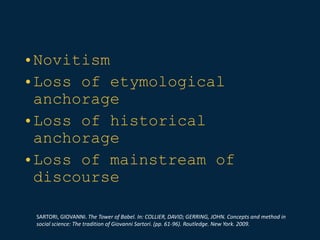
•Novitism
•Loss of etymological
anchorage
•Loss of historical
anchorage
•Loss of mainstream of
discourse
SARTORI, GIOVANNI. The Tower of Babel. In: COLLIER, DAVID; GERRING, JOHN. Concepts and method in
social science: The tradition of Giovanni Sartori. (pp. 61-96). Routledge. New York. 2009.
• 1.5 Track Military
Diplomacy
• Baseball Diplomacy
• Brand Diplomacy
• Business Diplomacy
• Celebrity Diplomacy
• Citizen Diplomacy
• Culinary Diplomacy
• Diaspora Diplomacy
• Digital Diplomacy
• Diplogastronomy
• Disarmament Diplomacy
• Dollar Diplomacy
• Drug Diplomacy
• E-Diplomacy
• Economic Diplomacy
• Emoji Diplomacy
• Fashion Diplomacy
• Female Sports
Diplomacy
• Gastrodiplomacy
• Guerrilla Diplomacy
• Gunboat Diplomacy
• Health Diplomacy
• Hip Hop Diplomacy
• Horticultural
Diplomacy
• Internet Diplomacy
• Jazz Diplomacy
• Jewelry-Box Diplomacy
• Koala Diplomacy
• Neighborhood
Diplomacy
• NGO Diplomacy
• Niche Diplomacy
• Panda Diplomacy
• People-To-People
Diplomacy
• Ping-Pong Diplomacy
• Political Party
Diplomacy
• Science Diplomacy
• Shuttle Diplomacy
• Side-Eye Diplomacy
• Skateboard Diplomacy
• Soap Opera Diplomacy
• Soft Shoe Diplomacy
• Sports Diplomacy
• Tango Diplomacy
• Track II Diplomacy
• Triplomacy
• Twiplomacy
• Wife Diplomacy
• Wikiplomacy
• …
BROWN, JOHN. Diplomacies, from public to pubic. Huffington Post. March 23, 2016. [Accessed: January 2, 2018].
Link: https://www.huffingtonpost.com/john-brown/diplomacies-from-public-to-public_b_9530412.html
BROWN, JOHN. Ongoing updating of article, "Diplomacies, from Public to Pubic" (updated, 4/9/2016). John Brown's Public Diplomacy Press and Blog Review. April 1, 2016.
Link: http://publicdiplomacypressandblogreview.blogspot.com/2016/04/ongoing-updating-of-article-diplomacies_1.html
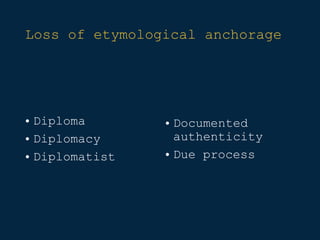
Loss of etymological anchorage
• Diploma
• Diplomacy
• Diplomatist
• Documented
authenticity
• Due process
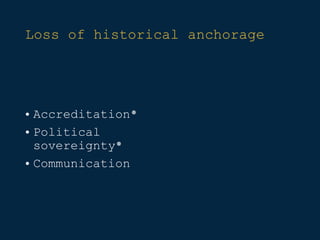
Loss of historical anchorage
• Accreditation*
• Political
sovereignty*
• Communication
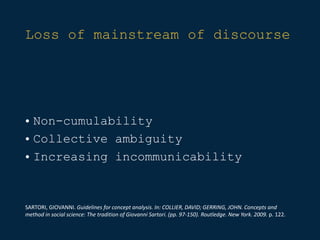
Loss of mainstream of discourse
• Non-cumulability
• Collective ambiguity
• Increasing incommunicability
SARTORI, GIOVANNI. Guidelines for concept analysis. In: COLLIER, DAVID; GERRING, JOHN. Concepts and
method in social science: The tradition of Giovanni Sartori. (pp. 97-150). Routledge. New York. 2009. p. 122.
Reconstructing the
concept Public Diplomacy
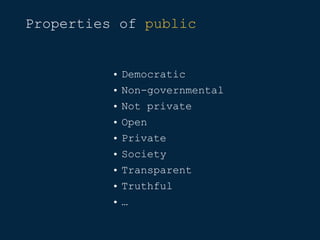
Properties of public
• Democratic
• Non-governmental
• Not private
• Open
• Private
• Society
• Transparent
• Truthful
• …
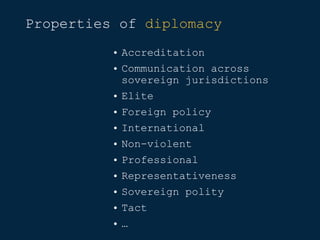
Properties of diplomacy
• Accreditation
• Communication across
sovereign jurisdictions
• Elite
• Foreign policy
• International
• Non-violent
• Professional
• Representativeness
• Sovereign polity
• Tact
• …
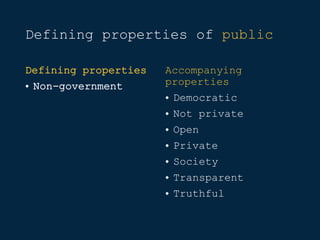
Defining properties of public
Defining properties
• Non-government
Accompanying
properties
• Democratic
• Not private
• Open
• Private
• Society
• Transparent
• Truthful
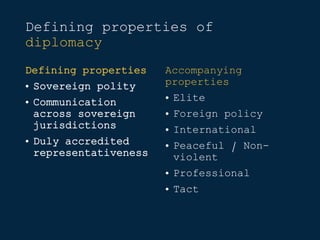
Defining properties of
diplomacy
Defining properties
• Sovereign polity
• Communication
across sovereign
jurisdictions
• Duly accredited
representativeness
Accompanying
properties
• Elite
• Foreign policy
• International
• Peaceful / Non-
violent
• Professional
• Tact
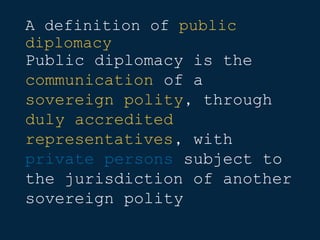
A definition of public
diplomacy
Public diplomacy is the
communication of a
sovereign polity, through
duly accredited
representatives, with
private persons subject to
the jurisdiction of another
sovereign polity
How does this relate to
the Fulbright Program?
Fulbright Program for U.S.
citizens
Fulbright Distinguished Awards in Teaching Program
Fulbright English Teaching Assistant (ETA) Program
Fulbright European Union Scholar-in-Residence (EUSIR)
Program
Fulbright Specialist Program
Fulbright U.S. Scholar Program
Fulbright U.S. Student Program
Fulbright-Hays Doctoral Dissertation Research Abroad Program
Fulbright-Hays Program
Fulbright-Hays Seminars Abroad--Bilateral Projects
Fulbright-Hays--Group Projects Abroad Program
Fulbright-mtvU Fellowships
Fulbright-National Geographic Storytelling Fellowship
The Fulbright Program: Program summaries. Bureau of Educational and Cultural Affairs, Department of State.
Washington (D. C.). [Accessed: October 15, 2019].
Link: https://eca.state.gov/fulbright/fulbright-programs/program-summaries
Fulbright Program for non-U.S.
citizens
• Fulbright Distinguished Awards in Teaching Program
• Fulbright European Union Scholar-in-Residence (EUSIR)
Program
• Fulbright Foreign Language Teaching Assistant Program
• Fulbright Foreign Student Program
• Fulbright Visiting Scholar Program
• Hubert H. Humphrey Program
The Fulbright Program: Program summaries. Bureau of Educational and Cultural Affairs, Department of State.
Washington (D. C.). [Accessed: October 15, 2019].
Link: https://eca.state.gov/fulbright/fulbright-programs/program-summaries
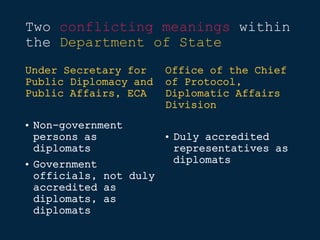
Two conflicting meanings within
the Department of State
Under Secretary for
Public Diplomacy and
Public Affairs, ECA
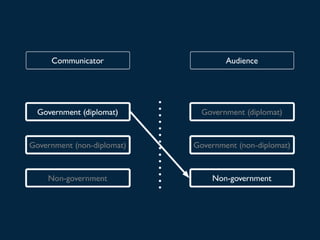
• Non-government
persons as
diplomats
• Government
officials, not duly
accredited as
diplomats, as
diplomats
Office of the Chief
of Protocol,
Diplomatic Affairs
Division
• Duly accredited
representatives as
diplomats
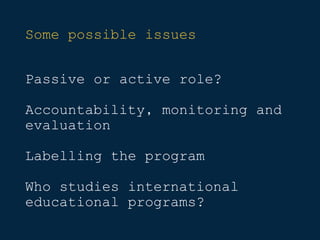
Passive or active role?
Accountability, monitoring and
evaluation
Labelling the program
Who studies international
educational programs?
Some possible issues
“[…] the defect is not in the
multiplicity of the meanings
of each word per se (out of
context) but resides in their
entanglement, in the fact that
it is unclear (in context)
which meaning is intended”
Giovanni Sartori
The Fulbright Program:
Is It Really
Public Diplomacy?
César Corona
cesarcorona@cesarcorona.com
Resources
https://2009-2017.state.gov/documents/organization/149734.pdf

The Fulbright Program: Is it really public diplomacy?

  • 2.
    THE FULBRIGHT PROGRAM: Is ItReally Public Diplomacy? César Corona
  • 4.
    “Soft power isthe communications between people about policy, and basically, from the government perspective, it’s putting policy and people together. That’s what soft power, that’s what public diplomacy is” Q&A with Under Secretary Richard Stengel. USC Annenberg. Los Angeles. October 21, 2014. Link: https://youtu.be/R-zEkZTnY-k?t=33m18s
  • 5.
    SARTORI, GIOVANNI. Guidelinesfor concept analysis. In: COLLIER, DAVID; GERRING, JOHN. Concepts and method in social science: The tradition of Giovanni Sartori. (pp. 97-150). Routledge. New York. 2009. p. 120.
  • 6.
    AYHAN, KADIR JUN.The boundaries of public diplomacy and nonstate actors: A taxonomy of perspectives. In: International Studies Perspectives. Vol. 20. No. 1. (pp. 63-83).
  • 7.
    MURRAY, STUART. Consolidatingthe gains made in diplomacy studies: A taxonomy. In: International Studies Perspectives. Vol. 9. No. 1. (pp. 22-39).
  • 8.
    • international broadcasting • internationalpublic relations • nation-branding • persuasion • pressure politics • propaganda • soft power • strategic communication Public Diplomacy is used interchangeably with: AYHAN, KADIR JUN. The boundaries of public diplomacy and nonstate actors: A taxonomy of perspectives. In: International Studies Perspectives. Vol. 20. No. 1. (pp. 63-83). p. 66.
  • 9.
    Public Diplomacy isa defective concept
  • 12.
    Why is publicdiplomacy a defective concept?
  • 13.
    •Novitism •Loss of etymological anchorage •Lossof historical anchorage •Loss of mainstream of discourse SARTORI, GIOVANNI. The Tower of Babel. In: COLLIER, DAVID; GERRING, JOHN. Concepts and method in social science: The tradition of Giovanni Sartori. (pp. 61-96). Routledge. New York. 2009.
  • 14.
    • 1.5 TrackMilitary Diplomacy • Baseball Diplomacy • Brand Diplomacy • Business Diplomacy • Celebrity Diplomacy • Citizen Diplomacy • Culinary Diplomacy • Diaspora Diplomacy • Digital Diplomacy • Diplogastronomy • Disarmament Diplomacy • Dollar Diplomacy • Drug Diplomacy • E-Diplomacy • Economic Diplomacy • Emoji Diplomacy • Fashion Diplomacy • Female Sports Diplomacy • Gastrodiplomacy • Guerrilla Diplomacy • Gunboat Diplomacy • Health Diplomacy • Hip Hop Diplomacy • Horticultural Diplomacy • Internet Diplomacy • Jazz Diplomacy • Jewelry-Box Diplomacy • Koala Diplomacy • Neighborhood Diplomacy • NGO Diplomacy • Niche Diplomacy • Panda Diplomacy • People-To-People Diplomacy • Ping-Pong Diplomacy • Political Party Diplomacy • Science Diplomacy • Shuttle Diplomacy • Side-Eye Diplomacy • Skateboard Diplomacy • Soap Opera Diplomacy • Soft Shoe Diplomacy • Sports Diplomacy • Tango Diplomacy • Track II Diplomacy • Triplomacy • Twiplomacy • Wife Diplomacy • Wikiplomacy • … BROWN, JOHN. Diplomacies, from public to pubic. Huffington Post. March 23, 2016. [Accessed: January 2, 2018]. Link: https://www.huffingtonpost.com/john-brown/diplomacies-from-public-to-public_b_9530412.html BROWN, JOHN. Ongoing updating of article, "Diplomacies, from Public to Pubic" (updated, 4/9/2016). John Brown's Public Diplomacy Press and Blog Review. April 1, 2016. Link: http://publicdiplomacypressandblogreview.blogspot.com/2016/04/ongoing-updating-of-article-diplomacies_1.html
  • 15.
    Loss of etymologicalanchorage • Diploma • Diplomacy • Diplomatist • Documented authenticity • Due process
  • 16.
    Loss of historicalanchorage • Accreditation* • Political sovereignty* • Communication
  • 17.
    Loss of mainstreamof discourse • Non-cumulability • Collective ambiguity • Increasing incommunicability SARTORI, GIOVANNI. Guidelines for concept analysis. In: COLLIER, DAVID; GERRING, JOHN. Concepts and method in social science: The tradition of Giovanni Sartori. (pp. 97-150). Routledge. New York. 2009. p. 122.
  • 18.
  • 19.
    Properties of public •Democratic • Non-governmental • Not private • Open • Private • Society • Transparent • Truthful • …
  • 20.
    Properties of diplomacy •Accreditation • Communication across sovereign jurisdictions • Elite • Foreign policy • International • Non-violent • Professional • Representativeness • Sovereign polity • Tact • …
  • 21.
    Defining properties ofpublic Defining properties • Non-government Accompanying properties • Democratic • Not private • Open • Private • Society • Transparent • Truthful
  • 22.
    Defining properties of diplomacy Definingproperties • Sovereign polity • Communication across sovereign jurisdictions • Duly accredited representativeness Accompanying properties • Elite • Foreign policy • International • Peaceful / Non- violent • Professional • Tact
  • 25.
    A definition ofpublic diplomacy Public diplomacy is the communication of a sovereign polity, through duly accredited representatives, with private persons subject to the jurisdiction of another sovereign polity
  • 26.
    How does thisrelate to the Fulbright Program?
  • 27.
    Fulbright Program forU.S. citizens Fulbright Distinguished Awards in Teaching Program Fulbright English Teaching Assistant (ETA) Program Fulbright European Union Scholar-in-Residence (EUSIR) Program Fulbright Specialist Program Fulbright U.S. Scholar Program Fulbright U.S. Student Program Fulbright-Hays Doctoral Dissertation Research Abroad Program Fulbright-Hays Program Fulbright-Hays Seminars Abroad--Bilateral Projects Fulbright-Hays--Group Projects Abroad Program Fulbright-mtvU Fellowships Fulbright-National Geographic Storytelling Fellowship The Fulbright Program: Program summaries. Bureau of Educational and Cultural Affairs, Department of State. Washington (D. C.). [Accessed: October 15, 2019]. Link: https://eca.state.gov/fulbright/fulbright-programs/program-summaries
  • 28.
    Fulbright Program fornon-U.S. citizens • Fulbright Distinguished Awards in Teaching Program • Fulbright European Union Scholar-in-Residence (EUSIR) Program • Fulbright Foreign Language Teaching Assistant Program • Fulbright Foreign Student Program • Fulbright Foreign Student Program • Fulbright Visiting Scholar Program • Hubert H. Humphrey Program The Fulbright Program: Program summaries. Bureau of Educational and Cultural Affairs, Department of State. Washington (D. C.). [Accessed: October 15, 2019]. Link: https://eca.state.gov/fulbright/fulbright-programs/program-summaries
  • 31.
    Two conflicting meaningswithin the Department of State Under Secretary for Public Diplomacy and Public Affairs, ECA • Non-government persons as diplomats • Government officials, not duly accredited as diplomats, as diplomats Office of the Chief of Protocol, Diplomatic Affairs Division • Duly accredited representatives as diplomats
  • 32.
    Passive or activerole? Accountability, monitoring and evaluation Labelling the program Who studies international educational programs? Some possible issues
  • 33.
    “[…] the defectis not in the multiplicity of the meanings of each word per se (out of context) but resides in their entanglement, in the fact that it is unclear (in context) which meaning is intended” Giovanni Sartori
  • 34.
    The Fulbright Program: IsIt Really Public Diplomacy? César Corona cesarcorona@cesarcorona.com
  • 36.

Editor's Notes

  • #2 Cesar Corona The Fulbright Program: Is It Really Public Diplomacy?
  • #3 What this presentation is not about: Efficiency of the Fulbright Program What this presentation is about: Public diplomacy is a defective concept: It has different meanings within the same context. Reconstructing public diplomacy as a concept. How that relates to international educational programs like the Fulbright Program Based on Giovanni Sartori’s work on concept reconstruction for social sciences
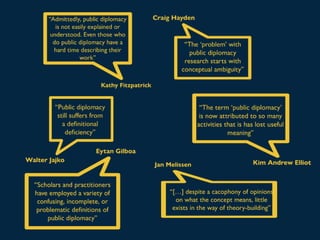
  • #4 Concepts are the building blocks of theory Public diplomacy is a defective concept Public diplomacy has weak theoretical foundations “The term ‘public diplomacy’ is now attributed to so many activities that is has lost useful meaning.”—International Broadcasting expert Kim Andrew Elliott (October 7, 2010), who is adamant about keeping public diplomacy and US International Broadcasting separate. (Brown: https://publicdiplomacypressandblogreview.blogspot.com/search?q=public) References: GILBOA, EYTAN. Searching for a theory of public diplomacy. In: The Annals of the American Academy of Political and Social Science. No. 616. (pp. 55-77). March, 2008. p. 57. HAYDEN, CRAIG. Envisioning a multidisciplinary research agenda for public diplomacy. e-International Relations. [Consulta: January 15, 2013]. Enlace: http://www.e-ir.info/2013/01/11/envisioning-a-multidisciplinary-research-agenda-for-public-diplomacy/ JAJKO, WALTER. Discussion. In: STAAR, RICHARD FELIX. Public diplomacy: USA versus USSR. (pp. 62-68). Hoover Institution Press, Stanford University. Stanford. 1986. p. 63.
  • #5 What this presentation is not about: Efficiency of the Fulbright Program What this presentation is about: Public diplomacy has different meanings within the same context How that relates to international educational programs like the Fulbright Program Based on Giovanni Sartori’s work on concept reconstruction for social sciences
  • #7 Unclear meaning of a concept when used in the same context At this point, articles on public diplomacy need a definition to know what the author means. State-centric Neo-statist Non-traditional Accommodative Society-centric References: AYHAN, KADIR JUN. The boundaries of public diplomacy and nonstate actors: A taxonomy of perspectives. In: International Studies Perspectives. Vol. 20. No. 1. (pp. 63-83).
  • #8 Unclear meaning of a concept when used in the same context At this point, articles on public diplomacy need a definition to know what the author means. Traditional: State-centric Nascent: Non-state Innovative: Middle point References: MURRAY, STUART. Consolidating the gains made in diplomacy studies: A taxonomy. In: International Studies Perspectives. Vol. 9. No. 1. (pp. 22-39).
  • #9 Kadir Ayhan studied the 185 most-cited articles (cited five or more times as of 30 July 2017) with the exact term “public diplomacy” in the title, keywords and/or abstracts 25 articles were not used. 160 articles on public diplomacy. SCOPUS: Scopus is Elsevier’s abstract and citation database launched in 2004. Scopus covers nearly 36,377 titles from approximately 11,678 publishers, of which 34,346 are peer-reviewed journals in top-level subject fields. (Wikipedia) References: AYHAN, KADIR JUN. The boundaries of public diplomacy and nonstate actors: A taxonomy of perspectives. In: International Studies Perspectives. Vol. 20. No. 1. (pp. 63-83). p. 3. Top
  • #10 What this presentation is not about: Efficiency of the Fulbright Program What this presentation is about: Public diplomacy has different meanings within the same context How that relates to international educational programs like the Fulbright Program Based on Giovanni Sartori’s work on concept reconstruction for social sciences
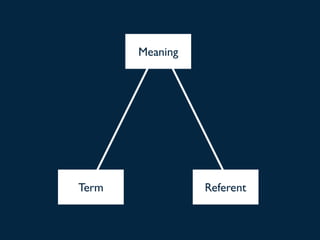
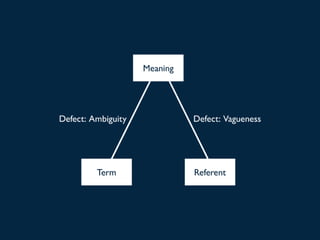
  • #11 Graph (triangle with meaning, term, referent) Meaning-term relation Meaning-referent relation Intension (connotation) Extension (denotation): Establishing the boundaries; sorting out the membership; deciding the cut-off point vis-à-vis marginal entities Vague (indefinite): Defective meaning-referent relation Ambiguous (going in different directions): Defective meaning-term relation Glossary: Meaning What is predicated or conveyed by a word or term. Vulgarly: any mental content. Extension The referent or referents to which a term applies. ST: denotation. Intension The ensemble of characteristics of (included in) a concept. Vulgarly: the associations a word has in the mind of its users. ST: connotation. The intension may be extensionally opaque. Definition In natural language, any conveyance of meaning expressed as an equivalence between a definiendum and a definiens. Ostensive and operational definitions convey meaning but are not definitions in the sense defined above. Definitions a contrario also require a definition of their own. In a formalized or uninterpreted language, definitions do not convey meaning: they determine the notational system. See also: Declarative definition, Denotative definition, Precising definition, Per genus et differentiam. Declarative definition A definition that simply declares the meaning that is intended. ST: declaratory definition. Definiendum What is to be defined. Definiens Whatever serves to define. TM: expression giving the characteristics of a concept that follows the symbol of definitional equality. Defining characteristic A characteristic or property in the absence of which a word is not applicable: we are unable to decide to what it applies. Defining properties The necessary characteristics of a concept (in its definition).
  • #12 Graph (triangle with meaning, term, referent) Meaning-term relation Meaning-referent relation Intension (connotation) Extension (denotation): Establishing the boundaries; sorting out the membership; deciding the cut-off point vis-à-vis marginal entities Vague (indefinite): Defective meaning-referent relation Ambiguous (going in different directions): Defective meaning-term relation Glossary: Meaning What is predicated or conveyed by a word or term. Vulgarly: any mental content. Extension The referent or referents to which a term applies. ST: denotation. Intension The ensemble of characteristics of (included in) a concept. Vulgarly: the associations a word has in the mind of its users. ST: connotation. The intension may be extensionally opaque. Definition In natural language, any conveyance of meaning expressed as an equivalence between a definiendum and a definiens. Ostensive and operational definitions convey meaning but are not definitions in the sense defined above. Definitions a contrario also require a definition of their own. In a formalized or uninterpreted language, definitions do not convey meaning: they determine the notational system. See also: Declarative definition, Denotative definition, Precising definition, Per genus et differentiam. Declarative definition A definition that simply declares the meaning that is intended. ST: declaratory definition. Definiendum What is to be defined. Definiens Whatever serves to define. TM: expression giving the characteristics of a concept that follows the symbol of definitional equality. Defining characteristic A characteristic or property in the absence of which a word is not applicable: we are unable to decide to what it applies. Defining properties The necessary characteristics of a concept (in its definition).
  • #13 Novitism Hyphenated diplomacy Loss of etymological anchorage Diploma Diplomatists Loss of historical anchorage Sovereign polities Duly accredited representatives Rules Loss of mainstream of discourse
  • #14 Novitism Hyphenated diplomacy Loss of etymological anchorage Diploma Diplomatists Loss of historical anchorage Sovereign polities Duly accredited representatives Rules Loss of mainstream of discourse
  • #15 Hyphenated diplomacies Concept +/- adjective References: BROWN, JOHN. Diplomacies, from public to pubic. Huffington Post. March 23, 2016. [Accessed: January 2, 2018]. Link: https://www.huffingtonpost.com/john-brown/diplomacies-from-public-to-public_b_9530412.html BROWN, JOHN. Ongoing updating of article, "Diplomacies, from Public to Pubic" (updated, 4/9/2016). John Brown's Public Diplomacy Press and Blog Review. April 1, 2016. Link: http://publicdiplomacypressandblogreview.blogspot.com/2016/04/ongoing-updating-of-article-diplomacies_1.html
  • #16 Diploma: Folded object Academic diplomas Passports
  • #17 Diplomacy Folded document: Accreditation (credibility, legitimacy) Diplomatics: Authentication of documents Political sovereignty: (Documented from Amarna Letters to today) Communication: Accreditation (due process): State vs non-state actors. Communication of a sovereign polity beyond its jurisdiction through duly accredited representatives
  • #18 “Amidst the resulting state of non-cumulability, collective ambiguity, and increasing incommunicability, it is imperative to restore or attempt to restore the conceptual foundations of the edifice. This is not to say that an exercise in conceptual reconstruction will restore consensus -we are far too disbanded for that. However, if the exercise succeeds, it will restore intelligibility”. Sartori “[...] "terms" are the carriers of the stability of language and of the cumulability of knowledge".
  • #19 What this presentation is not about: Efficiency of the Fulbright Program What this presentation is about: Public diplomacy has different meanings within the same context How that relates to international educational programs like the Fulbright Program Based on Giovanni Sartori’s work on concept reconstruction for social sciences
  • #20 Parsimony: confine your defining to the necessary properties. Settling for minimal definitions: exclude from your defining the accompanying properties. (Sartori. p. 126) Glossary: Defining properties are those that bound the concept extensionally. (Sartori. p. 126) Property See: Characteristic. TM: a property is either (1) an attribute of the referent, or (2) a second-order metaconcept for what can be said about a concept.
  • #21 Parsimony: confine your defining to the necessary properties. Settling for minimal definitions: exclude from your defining the accompanying properties. (Sartori. p. 126) Glossary: Defining properties are those that bound the concept extensionally. (Sartori. p. 126) Property See: Characteristic. TM: a property is either (1) an attribute of the referent, or (2) a second-order metaconcept for what can be said about a concept.
  • #22 Parsimony: confine your defining to the necessary properties. Settling for minimal definitions: exclude from your defining the accompanying properties. (Sartori. p. 126) Glossary: Defining properties are those that bound the concept extensionally. (Sartori. p. 126) Property See: Characteristic. TM: a property is either (1) an attribute of the referent, or (2) a second-order metaconcept for what can be said about a concept.
  • #23 Parsimony: confine your defining to the necessary properties. Settling for minimal definitions: exclude from your defining the accompanying properties. (Sartori. p. 126) Glossary: Defining properties are those that bound the concept extensionally. (Sartori. p. 126) Property See: Characteristic. TM: a property is either (1) an attribute of the referent, or (2) a second-order metaconcept for what can be said about a concept.
  • #24 What this presentation is not about: Efficiency of the Fulbright Program What this presentation is about: Public diplomacy has different meanings within the same context How that relates to international educational programs like the Fulbright Program Based on Giovanni Sartori’s work on concept reconstruction for social sciences
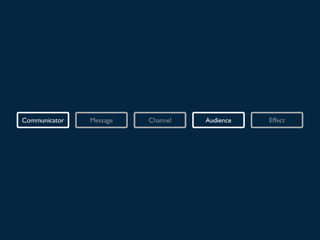
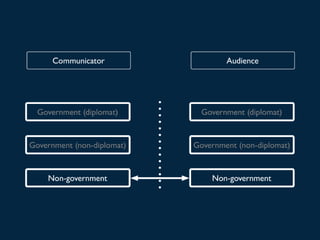
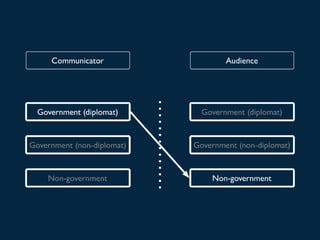
  • #25 Diplomat as communicator (source) Public as audience (recipient)
  • #26 Communication in public diplomacy may be bi-directional, but only communication where a diplomat is the source and the public is the audience is public diplomacy.
  • #27 What this presentation is not about: Efficiency of the Fulbright Program What this presentation is about: Public diplomacy has different meanings within the same context How that relates to international educational programs like the Fulbright Program Based on Giovanni Sartori’s work on concept reconstruction for social sciences
  • #28 Glossary: International educational program refers to a series of related activities with a particular long-term aim (programs), whose main purpose is education (educational) and involve the movement of persons across sovereign borders (international) People-to-people Mutual understanding Citizen diplomacy Grants - For Students For U.S. Students to Go Abroad The Fulbright U.S. Student Program offers fellowships for U.S. graduating college seniors, graduate students, young professionals and artists to study, conduct research, and/or teach English abroad. The Fulbright English Teaching Assistant (ETA) Program places recent college graduates and young professionals as English teaching assistants in primary and secondary schools or universities overseas-- improving foreign students’ English language abilities and knowledge of the United States while increasing the U.S. student's own language skills and knowledge of the host country. ETAs may also pursue individual study/research plans in addition to their teaching.responsibilities. The Fulbright-mtvU Fellowships center around research on an aspect of international musical culture and focus on contemporary or popular music as a cultural force for expression. Along with the study of music in a specific cultural context, projects include other music-related fields, including music and social activism, music in learning, music and the community, and musical performance. The Fulbright-National Geographic Storytelling Fellowship provides opportunities for selected Fulbright U.S. Student grantees to participate in an academic year of storytelling on a globally significant theme, with training and support. This Fellowship is made possible through a partnership between the U.S. Department of State and the National Geographic Society. The Fulbright-Hays Doctoral Dissertation Research Abroad Program awards grants to individual U.S. K-14 pre-teachers, teachers and administrators, pre-doctoral students and postdoctoral faculty, as well as to U.S. institutions and organizations. The Fulbright-Hays Program is funded by a Congressional appropriation to the United States Department of Education. Funding supports research and training efforts overseas, which focus on non-Western foreign languages and area studies. For Non-U.S. Students to Come to the United States The Fulbright Foreign Student Program The Fulbright Foreign Student Program offers opportunities for foreign graduate students, young professionals and artists from abroad to study, conduct research, and/or teach their native language in the U.S. The Fulbright Foreign Language Teaching Assistant Program places early career educators as Foreign Language Teaching Assistants at U.S. colleges and universities -- improving U.S. students’ foreign language abilities and knowledge of other countries. In addition to performing teaching duties, FLTAs engage in coursework, conduct language and cultural activities in their host communities, and improve their English language skills and knowledge of the United States. - For Scholars For U.S. Scholars to Go Abroad The Fulbright U.S. Scholar Program sends American scholars, artists, faculty, and professionals abroad to lecture and/or conduct research for up to a year. The Fulbright Specialist Program sends U.S. faculty and professionals to serve as expert consultants on curriculum, faculty development, institutional planning, and related subjects at academic institutions abroad for a period of 2 to 6 weeks. The Fulbright-Hays Program -- a Fulbright Program funded by a Congressional appropriation to the United States Department of Education-- awards grants to individual U.S. K-14 pre-teachers, teachers and administrators, pre-doctoral students and postdoctoral faculty, as well as to U.S. institutions and organizations. Funding supports research and training efforts overseas, which focus on non-Western foreign languages and area studies For Non-U.S. Scholars to Come to the United States The Fulbright Visiting Scholar Program provides grants to approximately 900 foreign scholars from over 100 countries to conduct post-doctoral research at U.S. institutions from an academic semester to a full academic year. - For Teachers The Fulbright Distinguished Awards in Teaching Program sends teachers abroad for a semester to pursue individual projects, conduct research, and lead master classes or seminars. Opportunities available for both U.S. and non-U.S. participants. Fulbright-Hays Seminars Abroad--Bilateral Projects, -- a Fulbright Program funded by a Congressional appropriation to the United States Department of Education-- awards grants to individual U.S. K-14 pre-teachers, teachers and administrators, pre-doctoral students and postdoctoral faculty, as well as to U.S. institutions and organizations. Funding supports research and training efforts overseas, which focus on non-Western foreign languages and area studies. - For Professionals Grants for U.S. Professionals to Go Abroad The Fulbright U.S. Scholar Program offers opportunities for American scholars, artists and professionals to conduct research, lecture, and/or consult with other scholars and institutions abroad The Fulbright Specialist Program The Fulbright Specialist Program, a short-term complement to the Fulbright U.S. Scholar Program, sends U.S. faculty and professionals to serve as expert consultants on curriculum, faculty development, institutional planning and related subjects at overseas academic institutions for a period of 2 to 6 weeks. The Fulbright U.S. Student Program offers fellowships for U.S. young professionals and artists to study abroad for one academic year. The Program also includes an English Teaching Assistant component. Fulbright European Union Scholar-in-Residence (EUSIR) Program The Fulbright EUSIR Program aims to strengthen U.S. expertise in EU Affairs. The program brings scholars and professionals from EU countries to U.S. college and university campuses for semester-long grants to give guest lectures and seminars, consult with faculty and students on research, engage in collaborative study and provide outreach to neighboring institutions and the local community. Grants for Non-U.S. Professionals to Come to the United States The Hubert H. Humphrey Program brings 200 outstanding mid-career professionals from countries in states of development or transition to the United States to engage in non-degree study and related professional experiences at select American universities. The Fulbright Foreign Student Program offers opportunities for foreign graduate students, young professionals and artists from abroad to study, conduct research, and/or teach their native language in the U.S. Fulbright European Union Scholar-in-Residence (EUSIR) Program The Fulbright EUSIR Program aims to strengthen U.S. expertise in EU Affairs. The program brings scholars and professionals from EU countries to U.S. college and university campuses for semester-long grants to give guest lectures and seminars, consult with faculty and students on research, engage in collaborative study and provide outreach to neighboring institutions and the local community. - For Groups Fulbright-Hays--Group Projects Abroad Program, sponsored by the U.S. Department of Education, provides support for overseas projects in training, research, and curriculum development in modern foreign languages and area studies for U.S. teachers, students, and faculty engaged in a common endeavor. Projects may include short-term seminars, curriculum development, group research or study, or advanced intensive language programs.
  • #29 Glossary: International educational program refers to a series of related activities with a particular long-term aim (programs), whose main purpose is education (educational) and involve the movement of persons across sovereign borders (international) Grants - For Students For U.S. Students to Go Abroad The Fulbright U.S. Student Program offers fellowships for U.S. graduating college seniors, graduate students, young professionals and artists to study, conduct research, and/or teach English abroad. The Fulbright English Teaching Assistant (ETA) Program places recent college graduates and young professionals as English teaching assistants in primary and secondary schools or universities overseas-- improving foreign students’ English language abilities and knowledge of the United States while increasing the U.S. student's own language skills and knowledge of the host country. ETAs may also pursue individual study/research plans in addition to their teaching.responsibilities. The Fulbright-mtvU Fellowships center around research on an aspect of international musical culture and focus on contemporary or popular music as a cultural force for expression. Along with the study of music in a specific cultural context, projects include other music-related fields, including music and social activism, music in learning, music and the community, and musical performance. The Fulbright-National Geographic Storytelling Fellowship provides opportunities for selected Fulbright U.S. Student grantees to participate in an academic year of storytelling on a globally significant theme, with training and support. This Fellowship is made possible through a partnership between the U.S. Department of State and the National Geographic Society. The Fulbright-Hays Doctoral Dissertation Research Abroad Program awards grants to individual U.S. K-14 pre-teachers, teachers and administrators, pre-doctoral students and postdoctoral faculty, as well as to U.S. institutions and organizations. The Fulbright-Hays Program is funded by a Congressional appropriation to the United States Department of Education. Funding supports research and training efforts overseas, which focus on non-Western foreign languages and area studies. For Non-U.S. Students to Come to the United States The Fulbright Foreign Student Program The Fulbright Foreign Student Program offers opportunities for foreign graduate students, young professionals and artists from abroad to study, conduct research, and/or teach their native language in the U.S. The Fulbright Foreign Language Teaching Assistant Program places early career educators as Foreign Language Teaching Assistants at U.S. colleges and universities -- improving U.S. students’ foreign language abilities and knowledge of other countries. In addition to performing teaching duties, FLTAs engage in coursework, conduct language and cultural activities in their host communities, and improve their English language skills and knowledge of the United States. - For Scholars For U.S. Scholars to Go Abroad The Fulbright U.S. Scholar Program sends American scholars, artists, faculty, and professionals abroad to lecture and/or conduct research for up to a year. The Fulbright Specialist Program sends U.S. faculty and professionals to serve as expert consultants on curriculum, faculty development, institutional planning, and related subjects at academic institutions abroad for a period of 2 to 6 weeks. The Fulbright-Hays Program -- a Fulbright Program funded by a Congressional appropriation to the United States Department of Education-- awards grants to individual U.S. K-14 pre-teachers, teachers and administrators, pre-doctoral students and postdoctoral faculty, as well as to U.S. institutions and organizations. Funding supports research and training efforts overseas, which focus on non-Western foreign languages and area studies For Non-U.S. Scholars to Come to the United States The Fulbright Visiting Scholar Program provides grants to approximately 900 foreign scholars from over 100 countries to conduct post-doctoral research at U.S. institutions from an academic semester to a full academic year. - For Teachers The Fulbright Distinguished Awards in Teaching Program sends teachers abroad for a semester to pursue individual projects, conduct research, and lead master classes or seminars. Opportunities available for both U.S. and non-U.S. participants. Fulbright-Hays Seminars Abroad--Bilateral Projects, -- a Fulbright Program funded by a Congressional appropriation to the United States Department of Education-- awards grants to individual U.S. K-14 pre-teachers, teachers and administrators, pre-doctoral students and postdoctoral faculty, as well as to U.S. institutions and organizations. Funding supports research and training efforts overseas, which focus on non-Western foreign languages and area studies. - For Professionals Grants for U.S. Professionals to Go Abroad The Fulbright U.S. Scholar Program offers opportunities for American scholars, artists and professionals to conduct research, lecture, and/or consult with other scholars and institutions abroad The Fulbright Specialist Program The Fulbright Specialist Program, a short-term complement to the Fulbright U.S. Scholar Program, sends U.S. faculty and professionals to serve as expert consultants on curriculum, faculty development, institutional planning and related subjects at overseas academic institutions for a period of 2 to 6 weeks. The Fulbright U.S. Student Program offers fellowships for U.S. young professionals and artists to study abroad for one academic year. The Program also includes an English Teaching Assistant component. Fulbright European Union Scholar-in-Residence (EUSIR) Program The Fulbright EUSIR Program aims to strengthen U.S. expertise in EU Affairs. The program brings scholars and professionals from EU countries to U.S. college and university campuses for semester-long grants to give guest lectures and seminars, consult with faculty and students on research, engage in collaborative study and provide outreach to neighboring institutions and the local community. Grants for Non-U.S. Professionals to Come to the United States The Hubert H. Humphrey Program brings 200 outstanding mid-career professionals from countries in states of development or transition to the United States to engage in non-degree study and related professional experiences at select American universities. The Fulbright Foreign Student Program offers opportunities for foreign graduate students, young professionals and artists from abroad to study, conduct research, and/or teach their native language in the U.S. Fulbright European Union Scholar-in-Residence (EUSIR) Program The Fulbright EUSIR Program aims to strengthen U.S. expertise in EU Affairs. The program brings scholars and professionals from EU countries to U.S. college and university campuses for semester-long grants to give guest lectures and seminars, consult with faculty and students on research, engage in collaborative study and provide outreach to neighboring institutions and the local community. - For Groups Fulbright-Hays--Group Projects Abroad Program, sponsored by the U.S. Department of Education, provides support for overseas projects in training, research, and curriculum development in modern foreign languages and area studies for U.S. teachers, students, and faculty engaged in a common endeavor. Projects may include short-term seminars, curriculum development, group research or study, or advanced intensive language programs.
  • #30 Public as communicator (source) Public as audience (recipient)
  • #31 Diplomat as communicator (source) Public as audience (recipient)
  • #32 Chief of Protocol “Administratively determines eligibility of bilateral chiefs of mission, heads of delegation, charges d affaires and deputy chiefs of mission and their dependents with respect to rights, privileges, immunities, and certifies their immunity to law enforcement, judicial authorities, and to other relevant entities.” (1 FAM 020) https://2009-2017.state.gov/documents/organization/149734.pdf
  • #33 Funding Outsourcing Facilitating vs Communicating Mediating Contribution vs Attribution
  • #34 “[…] the defect is not in the multiplicity of the meanings of each word per se (out of context) but resides in their entanglement, in the fact that it is unclear (in context) which meaning is intended” (Sartori) Public diplomacy is a defective concept Declaring a definition is not enough; social scientists need to justify it A weak definition affects and communicability
  • #35 What this presentation is not about: Efficiency of the Fulbright Program What this presentation is about: Public diplomacy has different meanings within the same context How that relates to international educational programs like the Fulbright Program Based on Giovanni Sartori’s work on concept reconstruction for social sciences
  • #37 Concepts are the building blocks of theory Public diplomacy is a defective concept Public diplomacy has weak theoretical foundations Fitzpatrick Gilboa (Theory) “The term ‘public diplomacy’ is now attributed to so many activities that is has lost useful meaning.”—International Broadcasting expert Kim Andrew Elliott (October 7, 2010), who is adamant about keeping public diplomacy and US International Broadcasting separate. (Brown: https://publicdiplomacypressandblogreview.blogspot.com/search?q=public) References: GILBOA, EYTAN. Searching for a theory of public diplomacy. In: The Annals of the American Academy of Political and Social Science. No. 616. (pp. 55-77). March, 2008. p. 57. HAYDEN, CRAIG. Envisioning a multidisciplinary research agenda for public diplomacy. e-International Relations. [Consulta: January 15, 2013]. Enlace: http://www.e-ir.info/2013/01/11/envisioning-a-multidisciplinary-research-agenda-for-public-diplomacy/ JAJKO, WALTER. Discussion. In: STAAR, RICHARD FELIX. Public diplomacy: USA versus USSR. (pp. 62-68). Hoover Institution Press, Stanford University. Stanford. 1986. p. 63.