Expanding the Parameters of Research on News Media & the Other: The Faisal Shahzad Case Study and ‘Homegrown’ TerrorismAngie Chuang & Robin Chin RoemerAmerican University School of Communication
May 3, 2010: Faisal Shahzad, 30, attempts to detonate a car bomb in New York’s Times Square.“[A] new kind of attacker, who’s already here, able to hide in plain sight …” – Sen. Dianne Feinstein
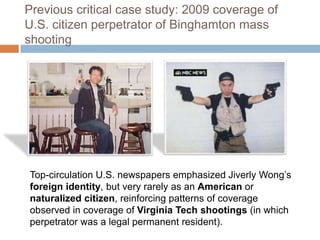
Previous critical case study: 2009 coverage of U.S. citizen perpetrator of Binghamton mass shootingTop-circulation U.S. newspapers emphasized Jiverly Wong’s foreign identity, but very rarely as an American or naturalized citizen, reinforcing patterns of coverage observed in coverage of Virginia Tech shootings (in which perpetrator was a legal permanent resident).
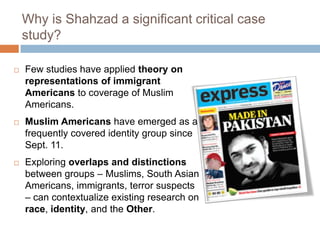
Why is Shahzad a significant critical case study?Few studies have applied theory on representations of immigrant Americans to coverage of Muslim Americans.Muslim Americans have emerged as a frequently covered identity group since Sept. 11.Exploring overlaps and distinctions between groups – Muslims, South Asian Americans, immigrants, terror suspects – can contextualize existing research on race, identity, and the Other.
Orientalism and Constructions of the Other“…A style of thought based upon the ontological and epistemological distinction made between ‘the Orient’ and … ‘the Occident’,” in which the West is constructed in opposition, and superior, to the Orient.” – Edward Said, 1979● Concept applied to coverage of the 1979 Iranian Revolution and post-September 11 coverage of Muslims (Said, Powell).● Recent research elaborates on mass media’srole as a powerful vehicle for dissemination of Orientalist representations of the Other● Mass media’s attempts to fix connotative meaning actively reinforce dominant culture order, resulting in a “racialized regime of representation” (Hall, 1980).
Other relevant theoretical constructions of immigration and race ● Conflation of ethnic with foreign as a product of disparate patterns of assimilation for immigrant groups (Oscar H. Gandy, 1998)● Parallels between Kerner-era coverage of black Americans and post-9/11 coverage of Muslim Americans (Brigitte L. Nacos & Oscar Torres-Reyna, 2007)“Fear and apprehension of racial unrest and violence are deeply rooted in American society” (Kerner).“Fear and apprehension of terrorism and violence by Muslims and Arabs are part of the American psyche since the attacks of Sept. 11, 2001” (Nacos & Torres-Reyna).
Research QuestionsRQ1: How was Shahzad’s identity as a Pakistani immigrant and a U.S. citizen represented by newspapers?RQ2: Which aspects of Shahzad’s life and identity were emphasized by newspapers as they developed a post-arrest profile of him, and how were the tensions between “homegrown” and “terrorist” characterized? RQ3: How did newspapers attempt to explain, if they did at all, Shahzad’s reasons for planning and attempting to carry out the attack? RQ4: Did newspapers try to place Shahzad in the context of other homegrown terrorists, like NidalMalikHasan or NajibullahZazi?
Study MethodologyTextual analysis of newspaper depictions of ShahzadExplicit representations (denotative), such as immigration status, nationality, ethnicity, religion, and citizenship status.Implicit representations (connotative), such as references to lifestyle, family, social status, personality, and employment.Article emphasis (e.g. Shahzad, political ramifications, policy, etc.)Top 5 newspapers by circulation in 2010: The Wall Street Journal, USA Today, The New York Times, Los Angeles Times, and The Washington Post● 197 articles referencing “Faisal Shahzad”, excluding duplicates● Articles published in May 2010 & June 2010● 2 coders and 22 coding categories
Mixed methods data analysis“The use of quantitative and qualitative analytical techniques, either concurrently or sequentially, at some stage beginning with the data collection process, from which interpretations are made in either a parallel, an integrated, or an iterative manner” - Onwuegbuzie & Teddlie, 2003● Content analysis with quantitative elements: code categories, intercoder reliability, numerical data● Qualitative textual analysis of articles to better understand results of content analysis● Breadth and depth, “representation and legitimation”
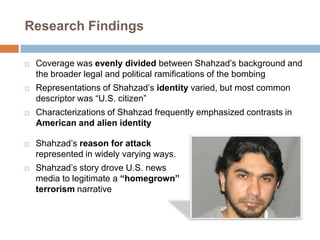
Research FindingsCoverage was evenly divided between Shahzad’s background and the broader legal and political ramifications of the bombingRepresentations of Shahzad’sidentity varied, but most common descriptor was “U.S. citizen”Characterizations of Shahzad frequently emphasized contrasts in American and alien identityShahzad’sreason for attack represented in widely varying ways.
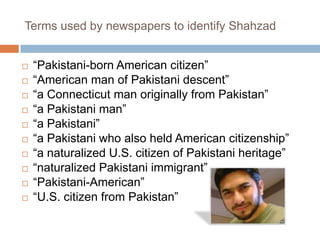
Shahzad’sstory drove U.S. news media to legitimate a “homegrown” terrorism narrativeTerms used by newspapers to identify Shahzad“Pakistani-born American citizen”“American man of Pakistani descent”“a Connecticut man originally from Pakistan”“a Pakistani man”“a Pakistani”“a Pakistani who also held American citizenship”“a naturalized U.S. citizen of Pakistani heritage”“naturalized Pakistani immigrant”“Pakistani-American”“U.S. citizen from Pakistan”
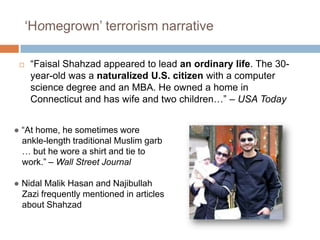
‘Homegrown’ terrorism narrative“Faisal Shahzad appeared to lead an ordinary life. The 30-year-old was a naturalized U.S. citizen with a computer science degree and an MBA. He owned a home in Connecticut and has wife and two children…” – USA Today●“At home, he sometimes wore ankle-length traditional Muslim garb … but he wore a shirt and tie to work.” – Wall Street Journal●NidalMalikHasan and NajibullahZazi frequently mentioned in articles about Shahzad
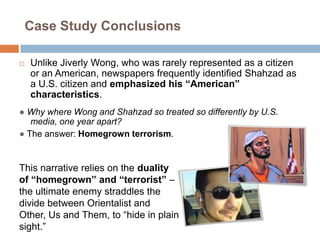
Case Study ConclusionsUnlike Jiverly Wong, who was rarely represented as a citizen or an American, newspapers frequently identified Shahzad as a U.S. citizen and emphasized his “American” characteristics.●Why where Wong and Shahzad so treated so differently by U.S. media, one year apart?●The answer: Homegrown terrorism. This narrative relies on the duality of “homegrown” and “terrorist” – the ultimate enemy straddles the divide between Orientalist and Other, Us and Them, to “hide in plain sight.”
Limitations and opportunities for future studyStudy could be expanded to broadcast and online-only mediaCoding for Shahzad’s grievances against the United States found to be too vague to apply to existing research on representations of domestic terroristsStudy could be applied to existing research and theory on Muslim immigrants and national identity, assimilation vs. multiculturalism (Europe and U.K.) Future critical case studies could further explore the concepts of American vs. Other identity with other prominently covered identity groups, e.g. Latino immigrants
Contact informationAngie ChuangAssistant Professor of JournalismAmerican University School of Communicationchuang@american.eduRobin Chin RoemerCommunication LibrarianAmerican University Libraryrobincr@american.eduWe would like to thank Bianca Rainwater (M.A. ’11, American University) for her assistance with data collection.

AEJMC Chuang Chin

  • 1.
    Expanding the Parametersof Research on News Media & the Other: The Faisal Shahzad Case Study and ‘Homegrown’ TerrorismAngie Chuang & Robin Chin RoemerAmerican University School of Communication
  • 2.
    May 3, 2010:Faisal Shahzad, 30, attempts to detonate a car bomb in New York’s Times Square.“[A] new kind of attacker, who’s already here, able to hide in plain sight …” – Sen. Dianne Feinstein
  • 3.
    Previous critical casestudy: 2009 coverage of U.S. citizen perpetrator of Binghamton mass shootingTop-circulation U.S. newspapers emphasized Jiverly Wong’s foreign identity, but very rarely as an American or naturalized citizen, reinforcing patterns of coverage observed in coverage of Virginia Tech shootings (in which perpetrator was a legal permanent resident).
  • 4.
    Why is Shahzada significant critical case study?Few studies have applied theory on representations of immigrant Americans to coverage of Muslim Americans.Muslim Americans have emerged as a frequently covered identity group since Sept. 11.Exploring overlaps and distinctions between groups – Muslims, South Asian Americans, immigrants, terror suspects – can contextualize existing research on race, identity, and the Other.
  • 5.
    Orientalism and Constructionsof the Other“…A style of thought based upon the ontological and epistemological distinction made between ‘the Orient’ and … ‘the Occident’,” in which the West is constructed in opposition, and superior, to the Orient.” – Edward Said, 1979● Concept applied to coverage of the 1979 Iranian Revolution and post-September 11 coverage of Muslims (Said, Powell).● Recent research elaborates on mass media’srole as a powerful vehicle for dissemination of Orientalist representations of the Other● Mass media’s attempts to fix connotative meaning actively reinforce dominant culture order, resulting in a “racialized regime of representation” (Hall, 1980).
  • 6.
    Other relevant theoreticalconstructions of immigration and race ● Conflation of ethnic with foreign as a product of disparate patterns of assimilation for immigrant groups (Oscar H. Gandy, 1998)● Parallels between Kerner-era coverage of black Americans and post-9/11 coverage of Muslim Americans (Brigitte L. Nacos & Oscar Torres-Reyna, 2007)“Fear and apprehension of racial unrest and violence are deeply rooted in American society” (Kerner).“Fear and apprehension of terrorism and violence by Muslims and Arabs are part of the American psyche since the attacks of Sept. 11, 2001” (Nacos & Torres-Reyna).
  • 7.
    Research QuestionsRQ1: Howwas Shahzad’s identity as a Pakistani immigrant and a U.S. citizen represented by newspapers?RQ2: Which aspects of Shahzad’s life and identity were emphasized by newspapers as they developed a post-arrest profile of him, and how were the tensions between “homegrown” and “terrorist” characterized? RQ3: How did newspapers attempt to explain, if they did at all, Shahzad’s reasons for planning and attempting to carry out the attack? RQ4: Did newspapers try to place Shahzad in the context of other homegrown terrorists, like NidalMalikHasan or NajibullahZazi?
  • 8.
    Study MethodologyTextual analysisof newspaper depictions of ShahzadExplicit representations (denotative), such as immigration status, nationality, ethnicity, religion, and citizenship status.Implicit representations (connotative), such as references to lifestyle, family, social status, personality, and employment.Article emphasis (e.g. Shahzad, political ramifications, policy, etc.)Top 5 newspapers by circulation in 2010: The Wall Street Journal, USA Today, The New York Times, Los Angeles Times, and The Washington Post● 197 articles referencing “Faisal Shahzad”, excluding duplicates● Articles published in May 2010 & June 2010● 2 coders and 22 coding categories
  • 9.
    Mixed methods dataanalysis“The use of quantitative and qualitative analytical techniques, either concurrently or sequentially, at some stage beginning with the data collection process, from which interpretations are made in either a parallel, an integrated, or an iterative manner” - Onwuegbuzie & Teddlie, 2003● Content analysis with quantitative elements: code categories, intercoder reliability, numerical data● Qualitative textual analysis of articles to better understand results of content analysis● Breadth and depth, “representation and legitimation”
  • 10.
    Research FindingsCoverage wasevenly divided between Shahzad’s background and the broader legal and political ramifications of the bombingRepresentations of Shahzad’sidentity varied, but most common descriptor was “U.S. citizen”Characterizations of Shahzad frequently emphasized contrasts in American and alien identityShahzad’sreason for attack represented in widely varying ways.
  • 11.
    Shahzad’sstory drove U.S.news media to legitimate a “homegrown” terrorism narrativeTerms used by newspapers to identify Shahzad“Pakistani-born American citizen”“American man of Pakistani descent”“a Connecticut man originally from Pakistan”“a Pakistani man”“a Pakistani”“a Pakistani who also held American citizenship”“a naturalized U.S. citizen of Pakistani heritage”“naturalized Pakistani immigrant”“Pakistani-American”“U.S. citizen from Pakistan”
  • 12.
    ‘Homegrown’ terrorism narrative“FaisalShahzad appeared to lead an ordinary life. The 30-year-old was a naturalized U.S. citizen with a computer science degree and an MBA. He owned a home in Connecticut and has wife and two children…” – USA Today●“At home, he sometimes wore ankle-length traditional Muslim garb … but he wore a shirt and tie to work.” – Wall Street Journal●NidalMalikHasan and NajibullahZazi frequently mentioned in articles about Shahzad
  • 13.
    Case Study ConclusionsUnlikeJiverly Wong, who was rarely represented as a citizen or an American, newspapers frequently identified Shahzad as a U.S. citizen and emphasized his “American” characteristics.●Why where Wong and Shahzad so treated so differently by U.S. media, one year apart?●The answer: Homegrown terrorism. This narrative relies on the duality of “homegrown” and “terrorist” – the ultimate enemy straddles the divide between Orientalist and Other, Us and Them, to “hide in plain sight.”
  • 14.
    Limitations and opportunitiesfor future studyStudy could be expanded to broadcast and online-only mediaCoding for Shahzad’s grievances against the United States found to be too vague to apply to existing research on representations of domestic terroristsStudy could be applied to existing research and theory on Muslim immigrants and national identity, assimilation vs. multiculturalism (Europe and U.K.) Future critical case studies could further explore the concepts of American vs. Other identity with other prominently covered identity groups, e.g. Latino immigrants
  • 15.
    Contact informationAngie ChuangAssistantProfessor of JournalismAmerican University School of Communicationchuang@american.eduRobin Chin RoemerCommunication LibrarianAmerican University Libraryrobincr@american.eduWe would like to thank Bianca Rainwater (M.A. ’11, American University) for her assistance with data collection.

Editor's Notes

  • #7 Fears surrounding turn-of-century immigration in western Europe and U.S. – Oscar Gandy, Communcation and Race: A Structural perspective; root of Yellow Peril images in Hollywood, which in turn has its roots in hegemonic constructions of Other in Edward Said’sOrientalismand Roland Barthes’ Empire of Signs. More practically, 1968 Kerner Commission report after Watts riots concluded news media predominanly from white perspective.
  • #9 WSJ, USAT, NYT, LAT, WP
  • #10 WSJ, USAT, NYT, LAT, WP