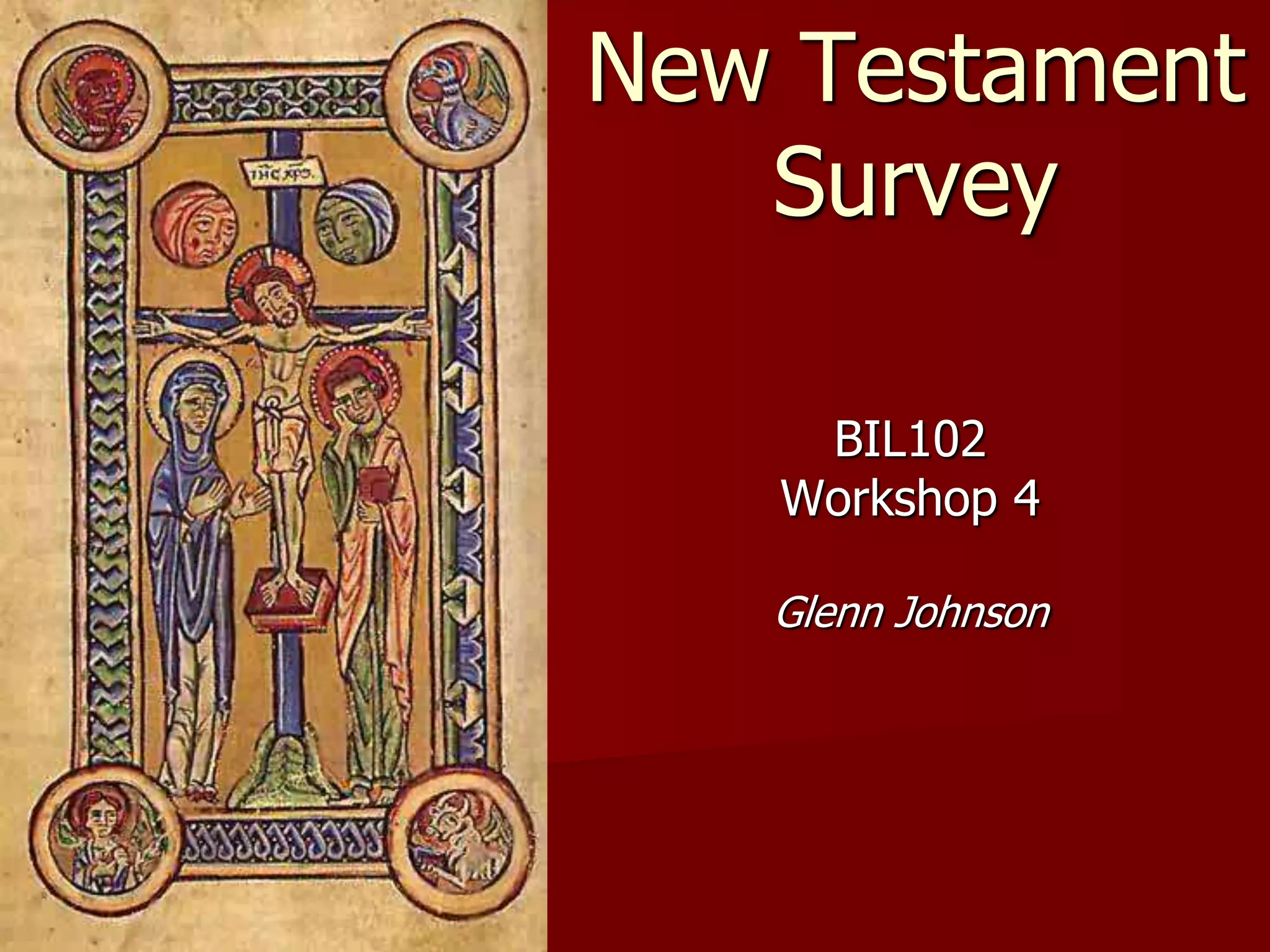
New Testament
Survey
BIL102
Workshop 4
Glenn Johnson
New Testament
Survey
Devotion & Prayer
For the word of God is full of
living power. It is sharper than
the sharpest knife, cutting deep
into our innermost thoughts
and desires. It exposes us for
what we really are.
Nothing in all creation can hide
from him. Everything is naked
and exposed before his eyes.
This is the God to whom we
must explain all that we have
done.
(Heb. 4:12-13)
New Testament
Survey
CHECK UP/UPDATES/QUESTIONS/TONIGHT
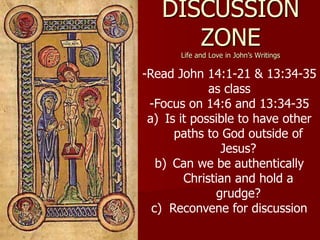
DISCUSSION
ZONE
Life and Love in John’s Writings
-Read John 14:1-21 & 13:34-35
as class
-Focus on 14:6 and 13:34-35
a) Is it possible to have other
paths to God outside of
Jesus?
b) Can we be authentically
Christian and hold a
grudge?
c) Reconvene for discussion
-emphasis on good works that justify or save.
-seeiming contradiction between James who says
that works do justify (Js. 2:14-26) and Paul who
says that works do not justify a person (Rom.
4:1-25).
-There is a vast difference between works of law
that do not justify a person and works of faith
which do.
-Another distinctive feature is the similarity of
James with Jesus' Sermon on the Mount. Consider
the following parallels: 2:5 with Mt. 5:3; 3:10-12
with Mt. 7:15-20; 3:18 with Mt. 5:9; 5:2-3 with
Mt. 6:19-20; 5:12 with Mt. 5:33-37.
Distinctive Features of James
There are many memorable passages in such a
short book.
(James 1:2-4) "consider it pure joy“
(1:19) "quick to listen, slow to speak, slow to
become angry“
(1:27) "religion that God our Father accepts“
(3:8) "no man can tame the tongue“
(4:7) "resist the devil and he will flee from you“
(5:16) "the prayer of a righteous man is powerful
and effective."
Distinctive Features of James
1. 1 Peter is among the most theological books of the New
Testament.
2. spotlights the sufferings of Christ. The verb for "suffering" appears
twelve times in 1 Peter (2:19, 20, 21, 23; 3:14, 17, 18;4:1[2], 15, 19; 5:10)
whereas it is used only eleven times in all of the other epistles combined.
There are many memorable verses in 1 Peter.
Peter speaks of the Christian's inexpressible joy (1:8-9).
He challenges the Christian to set Christ apart as Lord, and always be ready
with an answer for the hope he has (3:15).
The substitutionary atonement of Christ is spoken of with wonderful clarity,
followed by an obscure reference to Christ's preaching to the spirits
in prison (3:18-22).
Peter in memorable fashion gives us instruction concerning how to deal
with anxiety (5:7) and Satan (5:8-9).
Distinctive Features of 1 Peter
1. Emphasis on the importance for the Christian to grow in knowledge.
-The letter opens with a greeting which comes "through the knowledge of
God and of Jesus our Lord" (1:2).
-In his list of virtues that the Christian should strive to incorporate into one's
life, he is to add knowledge to goodness (1:5).
- His letter closes with the challenge to "grow in the grace and knowledge of
our Lord and Savior Jesus Christ" (2 Peter 3:18).
2. 2 Peter provides us with a classic view of Scripture.
-The inspiration of the Scriptures is asserted in memorable fashion in 2 Peter
1:19-21. To the inspired OT Peter also includes the writings of Paul as NT
Scripture (2 Peter 3:15-16).
3. 2 Peter shares with Jude a very strong denunciation of false teachers and
their teaching.
-2 Peter, Chapter 2, minces no words when it comes to the character of some
false teachers and how Christians should view them.
4. 2 Peter also supplies us with one of the most important passages in the
New Testament detailing some of the significant issues related to Christ's
second coming (2 Peter 3:3-13).
Distinctive Features of 2 Peter
1. One distinguishing feature is the large
amount of material in common with 2 Peter
(Jude 4-16; 2 Pet. 2:1-3:3).
2. Jude apparently quotes or draws
information from two Jewish apocryphal
books,
-Assumption of Moses (9) and the Apocalypse
of Enoch (14).
-Paul was not afraid to refer to non-biblical
Greek works (Acts 17:28 [Arams]; 1 Cor.
15:33 [Menander]; Tit. 1:12 [Epimenides]),
so it would not be totally unexpected for
someone like Jude to quote non-biblical
Jewish writings.
3. Jude does not refute the false teachers
per se, but he does denounce them in
terms even stronger than those Peter uses.
See, for example, 8-13, 16, 18-19.
4. The conclusion or benediction of Jude's
book has distinctive theological depth and
practical encouragement (24-25).
Distinctive Features of Jude
THE GENERAL LETTERS OF JOHN
Distinctive Features of 1 John
1. Some form of the word love appears in the neighborhood of sixty times in this
short book.
2. The Greek word "meno", which means "abide" or "remain" is used over 20 times in
the middle three chapters. The issue of remaining or abiding in Christ may be the central
theme of this letter.
3. The term "antichrist" appears five times in the New Testament, four in 1 John
(2:18[2],22; 4:3) and once in 2 John 7.
4. 1 John is distinctive in its effort to provide the Christian a solid basis for the assurance
of salvation and answered prayer.
-John provides us with three practical tests that can assure us that we are on the
right track.
-John understands eternal life in terms of knowing God and Christ (Jn. 17:3). There are three
ways we can remain sure that we really know the Father and Son:
a. By continuing to obey God's commands (1 Jn. 2:3; 1 Jn. 3:6).
b. By continuing to listen to the apostles and eyewitnesses of the Lord (1 Jn. 4:6).
c. By continuing to demonstrate love (1 Jn. 4:7-8).
5. John's assurance to the believer concerning answered prayer is found in 1 John 5:14-
15.
6. 1 John 5:19….who’s behind the evil in the world? Who dictates what happens behind the
scenes?
THE GENERAL LETTERS OF JOHN
Distinctive Features of 2 John
1. John does not refer to himself by name but simply as "The elder" (1:1).
2. The designation of the recipient is unique in literature of the New
Testament. If this letter is viewed as being written to a Christian lady, it is the only
such letter in the New Testament. If it is seen as written to a local congregation, it is
the only church addressed by the designation "chosen [elect] lady.“
3. 2 John is the second shortest book in the New Testament (and Bible)
4. 2 John is one of only two books that refer to the antichrist and his
definition of antichrist could challenge some popular notions about this
biblical concept
THE GENERAL LETTERS OF JOHN
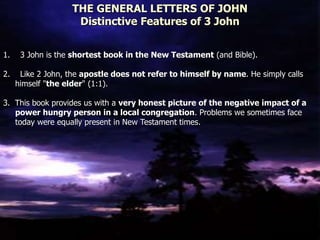
Distinctive Features of 3 John
1. 3 John is the shortest book in the New Testament (and Bible).
2. Like 2 John, the apostle does not refer to himself by name. He simply calls
himself "the elder" (1:1).
3. This book provides us with a very honest picture of the negative impact of a
power hungry person in a local congregation. Problems we sometimes face
today were equally present in New Testament times.
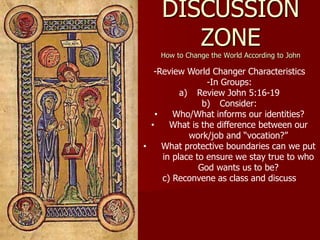
DISCUSSION
ZONE
How to Change the World According to John
-Review World Changer Characteristics
-In Groups:
a) Review John 5:16-19
b) Consider:
• Who/What informs our identities?
• What is the difference between our
work/job and “vocation?”
• What protective boundaries can we put
in place to ensure we stay true to who
God wants us to be?
c) Reconvene as class and discuss
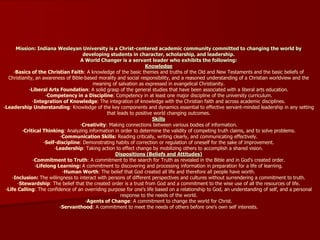
Mission: Indiana Wesleyan University is a Christ-centered academic community committed to changing the world by
developing students in character, scholarship, and leadership.
A World Changer is a servant leader who exhibits the following:
Knowledge
-Basics of the Christian Faith: A knowledge of the basic themes and truths of the Old and New Testaments and the basic beliefs of
Christianity, an awareness of Bible-based morality and social responsibility, and a reasoned understanding of a Christian worldview and the
meaning of salvation as expressed in evangelical Christianity.
-Liberal Arts Foundation: A solid grasp of the general studies that have been associated with a liberal arts education.
-Competency in a Discipline: Competency in at least one major discipline of the university curriculum.
-Integration of Knowledge: The integration of knowledge with the Christian faith and across academic disciplines.
-Leadership Understanding: Knowledge of the key components and dynamics essential to effective servant-minded leadership in any setting
that leads to positive world changing outcomes.
Skills
-Creativity: Making connections between various bodies of information.
-Critical Thinking: Analyzing information in order to determine the validity of competing truth claims, and to solve problems.
-Communication Skills: Reading critically, writing clearly, and communicating effectively.
-Self-discipline: Demonstrating habits of correction or regulation of oneself for the sake of improvement.
-Leadership: Taking action to effect change by mobilizing others to accomplish a shared vision.
Dispositions (Beliefs and Attitudes)
-Commitment to Truth: A commitment to the search for Truth as revealed in the Bible and in God's created order.
-Lifelong Learning: A commitment to discovering and processing information in preparation for a life of learning.
-Human Worth: The belief that God created all life and therefore all people have worth.
-Inclusion: The willingness to interact with persons of different perspectives and cultures without surrendering a commitment to truth.
-Stewardship: The belief that the created order is a trust from God and a commitment to the wise use of all the resources of life.
-Life Calling: The confidence of an overriding purpose for one's life based on a relationship to God, an understanding of self, and a personal
response to the needs of the world.
-Agents of Change: A commitment to change the world for Christ.
-Servanthood: A commitment to meet the needs of others before one's own self interests.

BIL102Workshop4

  • 1.
  • 2.
    New Testament Survey Devotion &Prayer For the word of God is full of living power. It is sharper than the sharpest knife, cutting deep into our innermost thoughts and desires. It exposes us for what we really are. Nothing in all creation can hide from him. Everything is naked and exposed before his eyes. This is the God to whom we must explain all that we have done. (Heb. 4:12-13)
  • 3.
  • 4.
    DISCUSSION ZONE Life and Lovein John’s Writings -Read John 14:1-21 & 13:34-35 as class -Focus on 14:6 and 13:34-35 a) Is it possible to have other paths to God outside of Jesus? b) Can we be authentically Christian and hold a grudge? c) Reconvene for discussion
  • 5.
    -emphasis on goodworks that justify or save. -seeiming contradiction between James who says that works do justify (Js. 2:14-26) and Paul who says that works do not justify a person (Rom. 4:1-25). -There is a vast difference between works of law that do not justify a person and works of faith which do. -Another distinctive feature is the similarity of James with Jesus' Sermon on the Mount. Consider the following parallels: 2:5 with Mt. 5:3; 3:10-12 with Mt. 7:15-20; 3:18 with Mt. 5:9; 5:2-3 with Mt. 6:19-20; 5:12 with Mt. 5:33-37. Distinctive Features of James
  • 6.
    There are manymemorable passages in such a short book. (James 1:2-4) "consider it pure joy“ (1:19) "quick to listen, slow to speak, slow to become angry“ (1:27) "religion that God our Father accepts“ (3:8) "no man can tame the tongue“ (4:7) "resist the devil and he will flee from you“ (5:16) "the prayer of a righteous man is powerful and effective." Distinctive Features of James
  • 7.
    1. 1 Peteris among the most theological books of the New Testament. 2. spotlights the sufferings of Christ. The verb for "suffering" appears twelve times in 1 Peter (2:19, 20, 21, 23; 3:14, 17, 18;4:1[2], 15, 19; 5:10) whereas it is used only eleven times in all of the other epistles combined. There are many memorable verses in 1 Peter. Peter speaks of the Christian's inexpressible joy (1:8-9). He challenges the Christian to set Christ apart as Lord, and always be ready with an answer for the hope he has (3:15). The substitutionary atonement of Christ is spoken of with wonderful clarity, followed by an obscure reference to Christ's preaching to the spirits in prison (3:18-22). Peter in memorable fashion gives us instruction concerning how to deal with anxiety (5:7) and Satan (5:8-9). Distinctive Features of 1 Peter
  • 8.
    1. Emphasis onthe importance for the Christian to grow in knowledge. -The letter opens with a greeting which comes "through the knowledge of God and of Jesus our Lord" (1:2). -In his list of virtues that the Christian should strive to incorporate into one's life, he is to add knowledge to goodness (1:5). - His letter closes with the challenge to "grow in the grace and knowledge of our Lord and Savior Jesus Christ" (2 Peter 3:18). 2. 2 Peter provides us with a classic view of Scripture. -The inspiration of the Scriptures is asserted in memorable fashion in 2 Peter 1:19-21. To the inspired OT Peter also includes the writings of Paul as NT Scripture (2 Peter 3:15-16). 3. 2 Peter shares with Jude a very strong denunciation of false teachers and their teaching. -2 Peter, Chapter 2, minces no words when it comes to the character of some false teachers and how Christians should view them. 4. 2 Peter also supplies us with one of the most important passages in the New Testament detailing some of the significant issues related to Christ's second coming (2 Peter 3:3-13). Distinctive Features of 2 Peter
  • 9.
    1. One distinguishingfeature is the large amount of material in common with 2 Peter (Jude 4-16; 2 Pet. 2:1-3:3). 2. Jude apparently quotes or draws information from two Jewish apocryphal books, -Assumption of Moses (9) and the Apocalypse of Enoch (14). -Paul was not afraid to refer to non-biblical Greek works (Acts 17:28 [Arams]; 1 Cor. 15:33 [Menander]; Tit. 1:12 [Epimenides]), so it would not be totally unexpected for someone like Jude to quote non-biblical Jewish writings. 3. Jude does not refute the false teachers per se, but he does denounce them in terms even stronger than those Peter uses. See, for example, 8-13, 16, 18-19. 4. The conclusion or benediction of Jude's book has distinctive theological depth and practical encouragement (24-25). Distinctive Features of Jude
  • 10.
    THE GENERAL LETTERSOF JOHN Distinctive Features of 1 John 1. Some form of the word love appears in the neighborhood of sixty times in this short book. 2. The Greek word "meno", which means "abide" or "remain" is used over 20 times in the middle three chapters. The issue of remaining or abiding in Christ may be the central theme of this letter. 3. The term "antichrist" appears five times in the New Testament, four in 1 John (2:18[2],22; 4:3) and once in 2 John 7. 4. 1 John is distinctive in its effort to provide the Christian a solid basis for the assurance of salvation and answered prayer. -John provides us with three practical tests that can assure us that we are on the right track. -John understands eternal life in terms of knowing God and Christ (Jn. 17:3). There are three ways we can remain sure that we really know the Father and Son: a. By continuing to obey God's commands (1 Jn. 2:3; 1 Jn. 3:6). b. By continuing to listen to the apostles and eyewitnesses of the Lord (1 Jn. 4:6). c. By continuing to demonstrate love (1 Jn. 4:7-8). 5. John's assurance to the believer concerning answered prayer is found in 1 John 5:14- 15. 6. 1 John 5:19….who’s behind the evil in the world? Who dictates what happens behind the scenes?
  • 11.
    THE GENERAL LETTERSOF JOHN Distinctive Features of 2 John 1. John does not refer to himself by name but simply as "The elder" (1:1). 2. The designation of the recipient is unique in literature of the New Testament. If this letter is viewed as being written to a Christian lady, it is the only such letter in the New Testament. If it is seen as written to a local congregation, it is the only church addressed by the designation "chosen [elect] lady.“ 3. 2 John is the second shortest book in the New Testament (and Bible) 4. 2 John is one of only two books that refer to the antichrist and his definition of antichrist could challenge some popular notions about this biblical concept
  • 12.
    THE GENERAL LETTERSOF JOHN Distinctive Features of 3 John 1. 3 John is the shortest book in the New Testament (and Bible). 2. Like 2 John, the apostle does not refer to himself by name. He simply calls himself "the elder" (1:1). 3. This book provides us with a very honest picture of the negative impact of a power hungry person in a local congregation. Problems we sometimes face today were equally present in New Testament times.
  • 13.
    DISCUSSION ZONE How to Changethe World According to John -Review World Changer Characteristics -In Groups: a) Review John 5:16-19 b) Consider: • Who/What informs our identities? • What is the difference between our work/job and “vocation?” • What protective boundaries can we put in place to ensure we stay true to who God wants us to be? c) Reconvene as class and discuss
  • 14.
    Mission: Indiana WesleyanUniversity is a Christ-centered academic community committed to changing the world by developing students in character, scholarship, and leadership. A World Changer is a servant leader who exhibits the following: Knowledge -Basics of the Christian Faith: A knowledge of the basic themes and truths of the Old and New Testaments and the basic beliefs of Christianity, an awareness of Bible-based morality and social responsibility, and a reasoned understanding of a Christian worldview and the meaning of salvation as expressed in evangelical Christianity. -Liberal Arts Foundation: A solid grasp of the general studies that have been associated with a liberal arts education. -Competency in a Discipline: Competency in at least one major discipline of the university curriculum. -Integration of Knowledge: The integration of knowledge with the Christian faith and across academic disciplines. -Leadership Understanding: Knowledge of the key components and dynamics essential to effective servant-minded leadership in any setting that leads to positive world changing outcomes. Skills -Creativity: Making connections between various bodies of information. -Critical Thinking: Analyzing information in order to determine the validity of competing truth claims, and to solve problems. -Communication Skills: Reading critically, writing clearly, and communicating effectively. -Self-discipline: Demonstrating habits of correction or regulation of oneself for the sake of improvement. -Leadership: Taking action to effect change by mobilizing others to accomplish a shared vision. Dispositions (Beliefs and Attitudes) -Commitment to Truth: A commitment to the search for Truth as revealed in the Bible and in God's created order. -Lifelong Learning: A commitment to discovering and processing information in preparation for a life of learning. -Human Worth: The belief that God created all life and therefore all people have worth. -Inclusion: The willingness to interact with persons of different perspectives and cultures without surrendering a commitment to truth. -Stewardship: The belief that the created order is a trust from God and a commitment to the wise use of all the resources of life. -Life Calling: The confidence of an overriding purpose for one's life based on a relationship to God, an understanding of self, and a personal response to the needs of the world. -Agents of Change: A commitment to change the world for Christ. -Servanthood: A commitment to meet the needs of others before one's own self interests.