The Evolution of Computers 2 generaionof computer.pptx
1.
The Evolution ofComputers
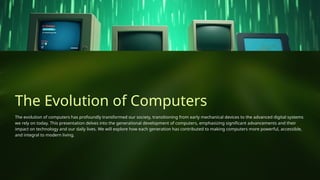
The evolution of computers has profoundly transformed our society, transitioning from early mechanical devices to the advanced digital systems
we rely on today. This presentation delves into the generational development of computers, emphasizing significant advancements and their
impact on technology and our daily lives. We will explore how each generation has contributed to making computers more powerful, accessible,
and integral to modern living.
2.
First Generation: VacuumTubes
The first generation of computers (1940-1956) relied on vacuum tubes, which were essential for circuitry. These large machines were primarily
designed for military operations and academic data processing. Among them, the Electronic Numerical Integrator and Computer (ENIAC) stood
out for its immense size and electricity consumption, while early programming relied on complex machine language.
1 Introduction of Vacuum
Tubes
The first generation of computers
(1940-1956) utilized vacuum tubes
for circuitry.
2 ENIAC Example
ENIAC occupied a large room and
performed thousands of
calculations per second.
3 Programming Languages
Early computers used machine
language for intricate and skilled
programming.
3.
Second Generation: Transistors
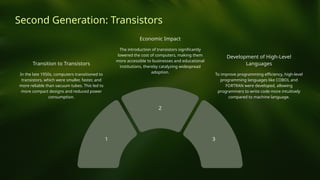
Transitionto Transistors
In the late 1950s, computers transitioned to
transistors, which were smaller, faster, and
more reliable than vacuum tubes. This led to
more compact designs and reduced power
consumption.
Economic Impact
The introduction of transistors significantly
lowered the cost of computers, making them
more accessible to businesses and educational
institutions, thereby catalyzing widespread
adoption.
1
2
Development of High-Level
Languages
To improve programming efficiency, high-level
programming languages like COBOL and
FORTRAN were developed, allowing
programmers to write code more intuitively
compared to machine language.
3
4.
Third Generation: IntegratedCircuits
1
Advent of Integrated Circuits
The use of integrated circuits (ICs) combined multiple transistors into a single chip, decreasing size
and power consumption.
2
Multiprogramming
These advancements enabled multiple applications to run simultaneously, significantly improving
resource utilization.
3
Commercial Applications
Computers began appearing in various industries, reflecting their importance in business operations
and data management.
5.
Fourth Generation: Microprocessors
Introductionof Microprocessors
The fourth generation, beginning in the
1970s, was characterized by the
development of microprocessors, which
placed the entire CPU on a single chip,
revolutionizing computer design.
Personal Computers
The emergence of personal computers
(PCs) such as the Apple II and IBM PC
made computing accessible to the general
public, transforming personal and
professional environments.
Graphical User Interface (GUI)
The introduction of GUIs allowed users to
interact with computers through visual
elements, making technology more
intuitive and user-friendly, thus expanding
the user base.
6.
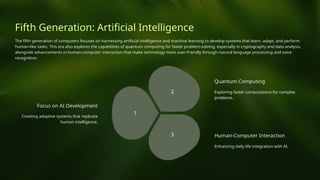
Fifth Generation: ArtificialIntelligence
The fifth generation of computers focuses on harnessing artificial intelligence and machine learning to develop systems that learn, adapt, and perform
human-like tasks. This era also explores the capabilities of quantum computing for faster problem-solving, especially in cryptography and data analysis,
alongside advancements in human-computer interaction that make technology more user-friendly through natural language processing and voice
recognition.
Focus on AI Development
Creating adaptive systems that replicate
human intelligence.
1
2
3
Quantum Computing
Exploring faster computations for complex
problems.
Human-Computer Interaction
Enhancing daily life integration with AI.
7.
Conclusion: Impact ofComputer Generations
1
Societal Transformation
Each generation of computers has
drastically changed society, enhancing
efficiency, communication, and access to
information.
2
Future Innovations
Future generations of computers will
likely bring unforeseen innovations,
integrating further into our lives.
3
Continued Research and
Development
Ongoing investment in research and
technology is crucial for realizing the
potential of future computer generations.


![Getting Started with Apache Spark: Big Data Made Simple [Free Meetup]](https://cdn.slidesharecdn.com/ss_thumbnails/apachesparkgettingstarted-260203175547-8361bcc3-thumbnail.jpg?width=640&height=640&fit=bounds)


