The Evolution of Anime
Harry Adkins-Pennington
Katsudō Shashin
• The first piece of anime was a 3 second clip at sixteen frames per second, 50 frames,
called Katsudo Shashin that was released in 1907 with no information on who the
creator is.
• The video consists of a young boy in a sailor suit writing 活動写真 (Katsudō Shashin
which roughly translates to motion picture) onto the background, removing his hat and
bowing to the audience.
• The piece is thought to have been destroyed in either the Great Kanto Earthquake in
1923 or in the bombings during World War 2.
• The film was rediscovered in December 2004 by a second-hand dealer in Kyoto (name
unknown) who contacted Natsuki Matsumoto who is an expert in iconology at
the Osaka University of Arts. The dealer had obtained a collection of films and
projectors from an old family who lived in Kyoto and Matsumoto retrieved them about
a month afterwards. The collection included three projectors, eleven 35 mm films, and
thirteen glass magic lantern slides.
• The filmstrip used to make Katsudō Shashin was in poor condition in the collection
• Reference: Wikipiedia, RightStuf, StackExchange
Dekobou Shingachou: Meian no Shippai
• Dekobou Shingachou: Meian no Shippai by Hekoten (or Outen)
Shimokawa is currently regarded as the oldest confirmed Japanese
animation film, having been released in February 1917.
• Okinawa-born Shimokawa (1892–1973) was a disciple of manga artist
Rakuten Kitazawa and worked for the film production company
Tennenshoku Katsudou Shashin. He was 24 years old when Dekobou was
first released.
• In March 2008, a short film was found in an antique shop in Osaka.
• The 4-minute short silent film tells the story of a samurai who purchases a
dull sword and figures out why he cannot kill anything with it. The film was
thought to have been released on July 30, 1917
• https://www.youtube.com/watch?v=PTkcRxXWHkI
• Reference: AnimeNewsNetwork
Namakura Gatana
How anime has evolved throughout
the years
Anime Is More Than 100 Years Old
• Since it first appeared in 1917, anime — or Japanese animation — has grown as both a commercial industry and
an art form.
• The evolution of anime occurred in stages, starting with cutout animation and silent short films, expanding
through government-sanctioned propaganda, then moving toward longer, more creative works influenced by
Disney, but that took on looks of their own.
• With the introduction of new genres like sports and mecha anime, animation techniques like CGI, changes in art
style trends, and the global access of online streaming available to today's viewers, anime has evolved into a
dynamic and progressive media form.
• Anime may seem like a modern invention, but it actually has a history stretching back more than 100 years to the
early part of the 20th century. The first anime, Namakura Gatana (The Dull Sword) made by artist Jun'ichi
Kōuchi went into production in 1917 during the era of silent film. The artist created it using experimental cutout
animation techniques.
• Soon other artists followed suit; animated short films from France and the USA inspired many of the early
Japanese works. While they were generally considered to be quite well done, they were expensive and time-
consuming to make. Moreover, they didn't gain the popularity that, for example, Disney animations did, in part
because they were still mostly silent and in black and white when other media moved to color and sound.
• Link: http://cartoonresearch.com/index.php/the-first-japanese-animation-films-in-1917/
Early Anime Was Heavily Influenced By Disney
• Some of the of the earliest titles in the anime canon were Seitaro Kitayama's Momotaro, in 1918, and Chikara To
Onna No Yononaka, which debuted 14 years later in 1932 and was the first anime film to use voices. These were
both short films, made during a period where mostpeople didn't believe animation could be used to tell longer
stories.
• These restrictive views changed when Disney's Snow White and the Seven Dwarfs met with astonishing success
on its 1937 debut. Animators all over the world — particularly throughout the fledgling anime industry — were
encouraged to seek longer formats.
• Disney influenced more than just films' running times. OsamuTezuka, who is considered one of the founding
fathers of anime and reportedly created more than 700 manga throughout his career, grew up watching Disney
films. Those movies heavily impacted his style; most notably, he borrowed the round, childlike features and large
eyes that Disney used to signify cuteness. This artistic trend became nearly synonymous with anime as the craft
evolved.
Osamu Tezuka
• Osamu Tezuka (手塚 治虫) is a manga author and creator of many of the first
Japanese animation. While Tezuka’s best known creation is, thought to be, the
world-renowned children’s series Astro Boy (1952-68), he drew more
than 150,000 pages of manga in his lifetime – touching on every style and genre.
He wrote for every age-group, from young children to mature audiences, and
single-handedly created the majority of the genres and character-types we see in
manga and anime today.
• Osamu Tezuka is credited with creating more than 400 individual manga series,
the great majority of which have not been translated into English.
Start of Tōei Animation
• It was during these years, as Japan began to recover from the disastrous war, that ŌkawaHiroshi, president of the
Tōei film company, saw Disney’s Snow White (1937). He was overwhelmed by the gorgeous color of the film. In
1956, he built a modern studio—a white-walled palace with air conditioning, as people called it—and founded
Tōei Dōga (now Tōei Animation).
• Tōei Dōga chose Hakujaden (The Legend of the White Snake) as their first film. They sent a research team to the
United States and invited several experts to travel to Japan as mentors. As a result, they were able to master the
Disney system of “assembly-line production.” They hired a team of new employees who honed their skills while
they produced the film under the supervision of veteran animators like Mori Yasuji and Daikuhara Akira.
• With jobs hard to come by in the postwar Japan, the new companywas able to attract an outstanding team of
young talent happy to work for relatively low starting salaries. It was a typical labor-intensive company. However,
as the government’s drive to double people’s incomes started to take effect, wages shot up and the company soon
found itself in the red.
• Attendances at the World Masterpiece Fairy Tale Anime Series, a “mangafestival” held every year during the
springtime school holidays (and, in later years, during the summer vacation as well), were falling. The company’s
financial future was uncertain. The labor movement was also gaining momentum, bringing frequent labor
disputes and labor-management clashes.
• Takahata Isao and Miyazaki Hayao, now with Studio Ghibli, began their careers at Tōei Dōga (Takahata entered the
company in 1959, Miyazakiin 1963). Both were active members of the labor union, Takahata serving as vice-
chairman and Miyazakias secretary-general.
Japan Made Anime Propaganda Films During WWII
• During the WWII era, Japan used its burgeoning anime industry to its full
propagandistic advantage, creating short cartoon films attacking Western politics
and later, promoting the war effort. Beginning in 1936 in response to America's
trade block against Japan, propaganda anime captured the nationalist fervor of
the times. These shorts castigated American/Western forces through cute and
clever animation that not-so-subtly played on the reigning symbol of America:
Mickey Mouse.
• In the 1940s, Japanese propaganda anime famously created a cast of characters
called Momotaro's Sea Eagles for films produced by the Japanese Imperial Navy.
Momotaro's Sea Eagles appeared in multiple propaganda projects, including
the first-ever feature-length anime, which detailed a successful attack on Allied
forces by the Imperial Navy.
1963's 'Astro Boy' Was The First Televised Anime
• Because the arrival of anime predated the invention of television, the first anime
to make it onto the small screen was far from the first anime to exist. But what
was that milestone series? Tetsuwan Atomu, known to American audiences
as Astro Boy, aired on Fuji Television on January 1, 1963.
• For its time, Astro Boy was pretty incredible, but it could have been a lot better.
Unfortunately, because the studio was so poorly funded, the show's creators had
to do whatever they could to minimize the number of drawings and lines
required, and to create a sense of movement through sound and dialogue as
opposed to actually having the characters move. This was far from ideal, but it
did display the creativity that carried the anime industry into the future.
• https://www.youtube.com/watch?time_continue=41&v=d3UbaB7oPTw This is a
trailer for the original Astro Boy
Anime Ideas Traditionally Came From Classic Novels
And Manga
• Ideas for anime have always come from a variety of places. In the 1960s and '70s,
it was common to base anime on works of classic literature, especially Western
literature. Alps no Shojo Heidi (Heidi, Girl of the Alps) is a classic '70s
example. While this still occurs, modern anime is far more likely to use manga,
light novels, or video games as its source material. Anime studios also come up
with wholly unique ideas that sometimes even turn into entire genres.
• Anime from the 2000s branches out in ways that would have been impossible in
the past. One-Punch Man, one of the most popular anime to appear in recent
years, takes its inspiration from a webcomic.
Anime Gained An Overseas Following Through
Rigorous Marketing Tactics
• Anime is wildly popular outside of Japan; in 2008, overseas revenue from anime
was ¥13.3 billion (approximately $12 billion). But it didn't get that way by
accident.
• Anime gained a following outside of Japan thanks to zealous marketing strategies
on the part of industry giants like animators Osamu Tezuka and Hayao Miyazaki.
Tezuka's work focused heavily on character development and storyline,
while Miyazaki's work showcased complex, beautiful settings that elevated the
genre in the eyes of the overseas market. But it wasn't until the advent of the
internet in the '90s that anime took off in America; shows like Sailor
Moon and Dragon Ball Z became household names.
• Although the anime industry continues to thrive, profits in the digital age have
declined due to piracy, which means creators have a harder time finding investors
to back their work. This problem began in the early 2000s, and while the nature
of piracy has changed, it hasn't gone away.
Sports Anime, Mecha Anime, And Other Genres
Were Established In The 1970s and '80s
• There's something unique about every anime series, but most of them do fall into
distinct genres. Sports anime was first introduced with Captain Tsubasa in 1983.
This series focuses on a school soccer team and contains themes of teamwork
and the bonds between players. Its structure which involves a training period,
followed by a heart-pounding competition sets the standard for a diverse set
of future sports anime, including volleyball, as portrayed in shows
like Haikyuu!! and cycling, as seen in Yowamushi Pedal.
• Another manga series that spawned a new genre was Mazinger Z, which first
aired as anime in 1972. This was the first anime to use mecha giant robots piloted
by human beings who are actually inside the robot. Later examples of mecha
anime include the Gundam franchise, Neon Genesis Evangelion, Fafner in the
Azure, and Code Geass.
Gender-Based Marketing Began To Decrease In
The 1990s
• Up until around the mid-1990s, anime was typically marketed toward strict male
and female audiences. Anime like Sailor Moon were meant to be enjoyed by
females, while shows like Yu Yu Hakusho were aimed at a male audience. This of
course doesn't mean that there aren't boys who enjoy Sailor Moon or girls who
enjoy Yu Yu Hakusho there absolutely are, but the shows were not designed with
co-ed, mass appeal in mind.
• While there were still plenty of shows designed to appeal to one gender or
another, anime with crossover appeal began to proliferate. In the
'90s, Pokémon combined action-packed battles with relationship building,
ensuring mass appeal across the genders. In 2010, Puella Magi Madoka
Magica gained fans across the gender spectrum, despite being a described as
a "magical girl anime" perhaps because it was a dark deconstruction of the genre,
and an update to the timeless fairytale construct.
Mature And Thought-Provoking Content Became
Popular In The Late '90s
• While anime has always contained storylines that appeal to adults, many earlier
anime series were geared toward children. In the '90s and early 2000s, anime
with complex and mature themes began to proliferate.
• Neon Genesis Evangelion exploded onto the scene in 1995, offering deep
philosophical questions for viewers to ponder as well as nuanced psychological
portraits of people whose morality could not be easily judged. Then there's the
2006 anime Death Note, a series that posed a genuine moral dilemma: does any
one person have the right to decide who lives and who dies?
• This type of anime proved to be wildly popular, and new examples continue to
appear every year.
"Moe" Style Helped Describe The Overwhelming
Cuteness Of Characters
• "Moe" is a Japanese word with a wide range of meanings, all of which boil down
to a way of describing ridiculously cute characters who make you want to cuddle
and protect them. Various things can generate that feeling, but in anime, the
most distinctive moe characters are typically young girls, often high school age.
They have soft, round features, big eyes, and exude innocence and purity.
• Exactly how the term originated is unclear, but what is clear is that both the
concept of moe and anime with increasingly adorable art began to appear in the
1990s. While some people feel this development is a positive one, others aren't
so sure. Moe characters can sometimes be overly sexualized, and the
connection between sexuality with childlike innocence can be unsettling.
Furthermore, some find the portrayal of female characters as cute and in need of
protection to be anti-feminist.
Animation Techniques Evolved With Changing
Technology
• As new techniques were created, the way in which anime is produced began to
change. At first, cutout animation a form of stop-motion animation typically using
flat paper cutouts was the preferred method, which only makes sense,
considering the well-known quality of Japanese paper. It was simple, but
groundbreaking as a visual medium in the early 20th century. Later, hand-drawn
animation dominated the field.
• In 1983, CGI, or computer-generated imagery, was used in anime for the first
time. TMS Entertainment used the technique to animate the movement of
helicopters in Golgo 13. This was actually the first noteworthy use of CGI
worldwide.
• Anime is still finding its footing with this technology. In some cases, like with the
2017 anime Land of the Lustrous, it creates smooth and beautiful animation, but
in other cases, like in the 2016 version of Berserk, it can appear awkward.
Access To Anime Exploded With Video Streaming
Services
• If you're a new anime fan, you may be accustomed to being able to watch your
favorite series on streaming sites like Netflix or Hulu. This wasn't always the
case as recently as 2008, American access to anime was completely different.
• Before anime was widely available on the internet, most Americans either
watched the limited number of shows that were available on Toonami or WB
Kids, or bought or rented video cassettes, and later, DVDs. These might be
imported, and therefore risk being region locked, overpriced, or
containing unreliable subtitles. Because anime was so hard to get, many people
resorted to piracy, which naturally caused serious financial problems for the
industry.
• Nowadays, most anime fans get their anime on the internet from paid streaming
and subscription services. As a result, some streaming platforms like Netflix
actually create their own anime.
The Art Style Of Anime Continues To Change
• While there's no one art style that completely defines anime today or in the
past, certain artistic trends were popular at different times. A popular image on
2chan, translated by Kotaku, broke down some of the differences between
anime that came out in 2010 versus anime in the '90s. Even over only the
course of two decades or so, the styles changed visibly.
• In the '90s, characters tended to have L-shaped noses, mouths high on their
face, high-volume hair, and black pupils. They were drawn with thick, bold lines,
and high-contrast shadows. By 2010, however, much of this had changed. Noses
became tiny and barely visible, mouths sat lower on the face, hair became
flatter, and pupils were lighter and rounder. The line work became softer, and
the highlights less intense. The face shape also changed; in the '90s, there was a
ridge indicating the cheeks, but by 2010 that was less prominent.
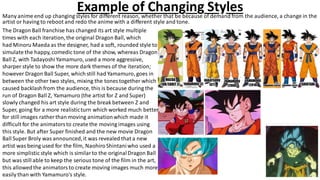
Example of Changing StylesMany anime end up changing styles for different reason, whether that be because of demand from the audience, a change in the
artist or having to reboot and redo the anime with a different style and tone.
The Dragon Ball franchise has changed its art style multiple
times with each iteration,the original Dragon Ball, which
had Minoru Maeda as the designer, had a soft, rounded style to
simulate the happy, comedic tone of the show, whereas Dragon
Ball Z, with Tadayoshi Yamamuro, used a more aggressive,
sharper style to show the more dark themes of the iteration;
however Dragon Ball Super, which still had Yamamuro, goes in
between the other two styles, mixing the tones together which
caused backlashfrom the audience, this is because during the
run of Dragon Ball Z, Yamamuro (the artist for Z and Super)
slowly changed his art style during the break between Z and
Super, going for a more realisticturn which worked much better
for still images rather than moving animationwhich made it
difficult for the animatorsto create the moving images using
this style. But after Super finished and the new movie Dragon
Ball Super Broly was announced,it was revealed that a new
artist was being used for the film, NaohiroShintaniwho used a
more simplistic style which is similarto the originalDragon Ball
but was still able to keep the serious tone of the film in the art,
this allowedthe animatorsto create moving images much more
easily than with Yamamuro's style.
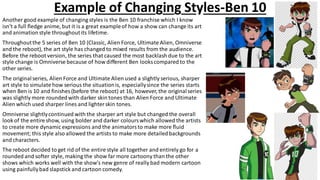
Example of Changing Styles-Ben 10
Another good example of changing styles is the Ben 10 franchise which I know
isn't a full fledge anime, but it is a great exampleof how a show can change its art
and animationstyle throughoutits lifetime.
Throughoutthe 5 series of Ben 10 (Classic, Alien Force, Ultimate Alien, Omniverse
and the reboot), the art style has changed to mixed results from the audience.
Before the reboot version, the series that caused the most backlash due to the art
style change is Omniverse because of how different Ben looks compared to the
other series.
The originalseries, Alien Force and Ultimate Alien used a slightly serious, sharper
art style to simulate how serious the situationis, especiallysince the series starts
when Ben is 10 and finishes (before the reboot) at 16, however, the originalseries
was slightly more roundedwith darker skin tones than Alien Force and Ultimate
Alien which used sharper lines and lighterskin tones.
Omniverse slightlycontinued with the sharper art style but changed the overall
look of the entire show, using bolder and darker colourswhich allowed the artists
to create more dynamic expressions and the animatorsto make more fluid
movement; this style also allowed the artists to make more detailedbackgrounds
and characters.
The reboot decided to get rid of the entire style all together and entirely go for a
rounded and softer style, making the show far more cartoony than the other
shows which works well with the show's new genre of really bad modern cartoon
using painfullybad slapstick and cartoon comedy.
Anime Is Remaking Its Early Global Hits For New
Generations
• Anime has made some significant changes over the decades, but that doesn't
mean there's nothing to learn from its past. Old anime are getting remakes left
and right. In 2014, the 1992 classic Sailor Moon received an update in the form
of Sailor Moon Crystal, which gives the series an updated look, and sticks more
closely to the manga than the original series. In 2016, Studio GEMBA came out
with Berserk, a continuation of the 1997 series by the same name.
• Older manga series are also being used as source material. Banana Fish, which
was first published in 1985, debuts as an anime in summer 2018.
• Reference: ranker.com
Anime that target towards children
but acceptable to all
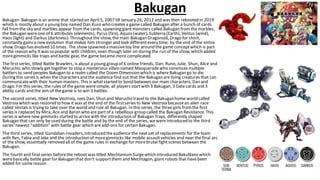
Bakugan
Bakugan- Bakugan is an anime that started on April 5, 2007 till January 26, 2012 and was then rebooted in 2019
which is mostly about a young boy named Dan Kuso who creates a game called Bakugan after a bunch of cards
fall fromthe sky and marbles appear fromthe cards, spawning giantmonsters called Bakugan fromthe marbles;
the Bakugan wereone of 6 attributes (elements), Pyrus (fire), Aquos (water), Subterra (Earth), Ventus (wind),
Haos (light) and Darkus (darkness). Throughoutthe show, the main Bakugan Dragonoid, Drago for short,
constantly gains a new evolution that makes him stronger and look differentevery time; by the end of the entire
show, Drago has evolved 10 times. The show spawned a massivetoy line around the game conceptwhich is part
of the reason why it was so popular with children, even though later on during the run of the show, which added
moregimmicks like traps and battle gear, the game became more complicated.
The firstseries, titled Battle Brawlers, is about a young group of 6 online friends, Dan, Runo, Julie, Shun, Alice and
Marucho, who slowly get together to stop a mysterious villain named Masqueradewho convinces multiple
battlers to send peoples Bakugan to a realm called the Doom Dimension which is where Bakugan go to die.
During this series is when the characters and the audience find out that the Bakugan are living creatures that can
communicatewith their human masters. This is whatstarted to bond between our main characters, Dan and
Drago. For this series, the rules of the game weresimple, all players startwith 3 Bakugan, 3 Gate cards and 3
ability cards and the aim of the game is to win 3 battles.
The second series, titled New Vestroia, sees Dan, Shun and Marucho travel to the Bakuganhome world called
Vestroia which was restored to how it was at the end of the firstseries to New Vestroia becausean alien race
called Vestals is trying to take over the world and rule all Bakugan. In this series, the three girls fromthe first
series is replaced by Mira, Ace and Baron who are part of a rebellious group called the Bakugan Resistance. This
series is wherenew gimmicks started to arrivewith the introduction of Bakugan Traps, differently shaped
Bakugan that can only be used during the battle and by the end of the series, wewere introduced to the third
series'newest "addition" with battle gear which are add-ons for certain Bakugan.
The third series, titled Gundalian Invaders, introduced theaudience the next set of replacements for the team
with Ren, Fabia and Jake and the introduction of moregimmicks like mobile assaultvehicles and near the final arc
of the show, essentially removed all of the game rules in exchange for morebrutal fight scenes between the
Bakugan.
The fourth and final series beforethe reboot was titled Mechtanium Surgewhich introduced BakuNano which
werebasically battle gear for Bakugan that don't supportthem and Mechtagon, giant robots that havebeen
added for somereason

The evolution of anime

  • 1.
    The Evolution ofAnime Harry Adkins-Pennington
  • 2.
    Katsudō Shashin • Thefirst piece of anime was a 3 second clip at sixteen frames per second, 50 frames, called Katsudo Shashin that was released in 1907 with no information on who the creator is. • The video consists of a young boy in a sailor suit writing 活動写真 (Katsudō Shashin which roughly translates to motion picture) onto the background, removing his hat and bowing to the audience. • The piece is thought to have been destroyed in either the Great Kanto Earthquake in 1923 or in the bombings during World War 2. • The film was rediscovered in December 2004 by a second-hand dealer in Kyoto (name unknown) who contacted Natsuki Matsumoto who is an expert in iconology at the Osaka University of Arts. The dealer had obtained a collection of films and projectors from an old family who lived in Kyoto and Matsumoto retrieved them about a month afterwards. The collection included three projectors, eleven 35 mm films, and thirteen glass magic lantern slides. • The filmstrip used to make Katsudō Shashin was in poor condition in the collection • Reference: Wikipiedia, RightStuf, StackExchange
  • 3.
    Dekobou Shingachou: Meianno Shippai • Dekobou Shingachou: Meian no Shippai by Hekoten (or Outen) Shimokawa is currently regarded as the oldest confirmed Japanese animation film, having been released in February 1917. • Okinawa-born Shimokawa (1892–1973) was a disciple of manga artist Rakuten Kitazawa and worked for the film production company Tennenshoku Katsudou Shashin. He was 24 years old when Dekobou was first released. • In March 2008, a short film was found in an antique shop in Osaka. • The 4-minute short silent film tells the story of a samurai who purchases a dull sword and figures out why he cannot kill anything with it. The film was thought to have been released on July 30, 1917 • https://www.youtube.com/watch?v=PTkcRxXWHkI • Reference: AnimeNewsNetwork Namakura Gatana
  • 4.
    How anime hasevolved throughout the years
  • 5.
    Anime Is MoreThan 100 Years Old • Since it first appeared in 1917, anime — or Japanese animation — has grown as both a commercial industry and an art form. • The evolution of anime occurred in stages, starting with cutout animation and silent short films, expanding through government-sanctioned propaganda, then moving toward longer, more creative works influenced by Disney, but that took on looks of their own. • With the introduction of new genres like sports and mecha anime, animation techniques like CGI, changes in art style trends, and the global access of online streaming available to today's viewers, anime has evolved into a dynamic and progressive media form. • Anime may seem like a modern invention, but it actually has a history stretching back more than 100 years to the early part of the 20th century. The first anime, Namakura Gatana (The Dull Sword) made by artist Jun'ichi Kōuchi went into production in 1917 during the era of silent film. The artist created it using experimental cutout animation techniques. • Soon other artists followed suit; animated short films from France and the USA inspired many of the early Japanese works. While they were generally considered to be quite well done, they were expensive and time- consuming to make. Moreover, they didn't gain the popularity that, for example, Disney animations did, in part because they were still mostly silent and in black and white when other media moved to color and sound. • Link: http://cartoonresearch.com/index.php/the-first-japanese-animation-films-in-1917/
  • 6.
    Early Anime WasHeavily Influenced By Disney • Some of the of the earliest titles in the anime canon were Seitaro Kitayama's Momotaro, in 1918, and Chikara To Onna No Yononaka, which debuted 14 years later in 1932 and was the first anime film to use voices. These were both short films, made during a period where mostpeople didn't believe animation could be used to tell longer stories. • These restrictive views changed when Disney's Snow White and the Seven Dwarfs met with astonishing success on its 1937 debut. Animators all over the world — particularly throughout the fledgling anime industry — were encouraged to seek longer formats. • Disney influenced more than just films' running times. OsamuTezuka, who is considered one of the founding fathers of anime and reportedly created more than 700 manga throughout his career, grew up watching Disney films. Those movies heavily impacted his style; most notably, he borrowed the round, childlike features and large eyes that Disney used to signify cuteness. This artistic trend became nearly synonymous with anime as the craft evolved.
  • 7.
    Osamu Tezuka • OsamuTezuka (手塚 治虫) is a manga author and creator of many of the first Japanese animation. While Tezuka’s best known creation is, thought to be, the world-renowned children’s series Astro Boy (1952-68), he drew more than 150,000 pages of manga in his lifetime – touching on every style and genre. He wrote for every age-group, from young children to mature audiences, and single-handedly created the majority of the genres and character-types we see in manga and anime today. • Osamu Tezuka is credited with creating more than 400 individual manga series, the great majority of which have not been translated into English.
  • 8.
    Start of TōeiAnimation • It was during these years, as Japan began to recover from the disastrous war, that ŌkawaHiroshi, president of the Tōei film company, saw Disney’s Snow White (1937). He was overwhelmed by the gorgeous color of the film. In 1956, he built a modern studio—a white-walled palace with air conditioning, as people called it—and founded Tōei Dōga (now Tōei Animation). • Tōei Dōga chose Hakujaden (The Legend of the White Snake) as their first film. They sent a research team to the United States and invited several experts to travel to Japan as mentors. As a result, they were able to master the Disney system of “assembly-line production.” They hired a team of new employees who honed their skills while they produced the film under the supervision of veteran animators like Mori Yasuji and Daikuhara Akira. • With jobs hard to come by in the postwar Japan, the new companywas able to attract an outstanding team of young talent happy to work for relatively low starting salaries. It was a typical labor-intensive company. However, as the government’s drive to double people’s incomes started to take effect, wages shot up and the company soon found itself in the red. • Attendances at the World Masterpiece Fairy Tale Anime Series, a “mangafestival” held every year during the springtime school holidays (and, in later years, during the summer vacation as well), were falling. The company’s financial future was uncertain. The labor movement was also gaining momentum, bringing frequent labor disputes and labor-management clashes. • Takahata Isao and Miyazaki Hayao, now with Studio Ghibli, began their careers at Tōei Dōga (Takahata entered the company in 1959, Miyazakiin 1963). Both were active members of the labor union, Takahata serving as vice- chairman and Miyazakias secretary-general.
  • 9.
    Japan Made AnimePropaganda Films During WWII • During the WWII era, Japan used its burgeoning anime industry to its full propagandistic advantage, creating short cartoon films attacking Western politics and later, promoting the war effort. Beginning in 1936 in response to America's trade block against Japan, propaganda anime captured the nationalist fervor of the times. These shorts castigated American/Western forces through cute and clever animation that not-so-subtly played on the reigning symbol of America: Mickey Mouse. • In the 1940s, Japanese propaganda anime famously created a cast of characters called Momotaro's Sea Eagles for films produced by the Japanese Imperial Navy. Momotaro's Sea Eagles appeared in multiple propaganda projects, including the first-ever feature-length anime, which detailed a successful attack on Allied forces by the Imperial Navy.
  • 10.
    1963's 'Astro Boy'Was The First Televised Anime • Because the arrival of anime predated the invention of television, the first anime to make it onto the small screen was far from the first anime to exist. But what was that milestone series? Tetsuwan Atomu, known to American audiences as Astro Boy, aired on Fuji Television on January 1, 1963. • For its time, Astro Boy was pretty incredible, but it could have been a lot better. Unfortunately, because the studio was so poorly funded, the show's creators had to do whatever they could to minimize the number of drawings and lines required, and to create a sense of movement through sound and dialogue as opposed to actually having the characters move. This was far from ideal, but it did display the creativity that carried the anime industry into the future. • https://www.youtube.com/watch?time_continue=41&v=d3UbaB7oPTw This is a trailer for the original Astro Boy
  • 11.
    Anime Ideas TraditionallyCame From Classic Novels And Manga • Ideas for anime have always come from a variety of places. In the 1960s and '70s, it was common to base anime on works of classic literature, especially Western literature. Alps no Shojo Heidi (Heidi, Girl of the Alps) is a classic '70s example. While this still occurs, modern anime is far more likely to use manga, light novels, or video games as its source material. Anime studios also come up with wholly unique ideas that sometimes even turn into entire genres. • Anime from the 2000s branches out in ways that would have been impossible in the past. One-Punch Man, one of the most popular anime to appear in recent years, takes its inspiration from a webcomic.
  • 12.
    Anime Gained AnOverseas Following Through Rigorous Marketing Tactics • Anime is wildly popular outside of Japan; in 2008, overseas revenue from anime was ¥13.3 billion (approximately $12 billion). But it didn't get that way by accident. • Anime gained a following outside of Japan thanks to zealous marketing strategies on the part of industry giants like animators Osamu Tezuka and Hayao Miyazaki. Tezuka's work focused heavily on character development and storyline, while Miyazaki's work showcased complex, beautiful settings that elevated the genre in the eyes of the overseas market. But it wasn't until the advent of the internet in the '90s that anime took off in America; shows like Sailor Moon and Dragon Ball Z became household names. • Although the anime industry continues to thrive, profits in the digital age have declined due to piracy, which means creators have a harder time finding investors to back their work. This problem began in the early 2000s, and while the nature of piracy has changed, it hasn't gone away.
  • 13.
    Sports Anime, MechaAnime, And Other Genres Were Established In The 1970s and '80s • There's something unique about every anime series, but most of them do fall into distinct genres. Sports anime was first introduced with Captain Tsubasa in 1983. This series focuses on a school soccer team and contains themes of teamwork and the bonds between players. Its structure which involves a training period, followed by a heart-pounding competition sets the standard for a diverse set of future sports anime, including volleyball, as portrayed in shows like Haikyuu!! and cycling, as seen in Yowamushi Pedal. • Another manga series that spawned a new genre was Mazinger Z, which first aired as anime in 1972. This was the first anime to use mecha giant robots piloted by human beings who are actually inside the robot. Later examples of mecha anime include the Gundam franchise, Neon Genesis Evangelion, Fafner in the Azure, and Code Geass.
  • 14.
    Gender-Based Marketing BeganTo Decrease In The 1990s • Up until around the mid-1990s, anime was typically marketed toward strict male and female audiences. Anime like Sailor Moon were meant to be enjoyed by females, while shows like Yu Yu Hakusho were aimed at a male audience. This of course doesn't mean that there aren't boys who enjoy Sailor Moon or girls who enjoy Yu Yu Hakusho there absolutely are, but the shows were not designed with co-ed, mass appeal in mind. • While there were still plenty of shows designed to appeal to one gender or another, anime with crossover appeal began to proliferate. In the '90s, Pokémon combined action-packed battles with relationship building, ensuring mass appeal across the genders. In 2010, Puella Magi Madoka Magica gained fans across the gender spectrum, despite being a described as a "magical girl anime" perhaps because it was a dark deconstruction of the genre, and an update to the timeless fairytale construct.
  • 15.
    Mature And Thought-ProvokingContent Became Popular In The Late '90s • While anime has always contained storylines that appeal to adults, many earlier anime series were geared toward children. In the '90s and early 2000s, anime with complex and mature themes began to proliferate. • Neon Genesis Evangelion exploded onto the scene in 1995, offering deep philosophical questions for viewers to ponder as well as nuanced psychological portraits of people whose morality could not be easily judged. Then there's the 2006 anime Death Note, a series that posed a genuine moral dilemma: does any one person have the right to decide who lives and who dies? • This type of anime proved to be wildly popular, and new examples continue to appear every year.
  • 16.
    "Moe" Style HelpedDescribe The Overwhelming Cuteness Of Characters • "Moe" is a Japanese word with a wide range of meanings, all of which boil down to a way of describing ridiculously cute characters who make you want to cuddle and protect them. Various things can generate that feeling, but in anime, the most distinctive moe characters are typically young girls, often high school age. They have soft, round features, big eyes, and exude innocence and purity. • Exactly how the term originated is unclear, but what is clear is that both the concept of moe and anime with increasingly adorable art began to appear in the 1990s. While some people feel this development is a positive one, others aren't so sure. Moe characters can sometimes be overly sexualized, and the connection between sexuality with childlike innocence can be unsettling. Furthermore, some find the portrayal of female characters as cute and in need of protection to be anti-feminist.
  • 17.
    Animation Techniques EvolvedWith Changing Technology • As new techniques were created, the way in which anime is produced began to change. At first, cutout animation a form of stop-motion animation typically using flat paper cutouts was the preferred method, which only makes sense, considering the well-known quality of Japanese paper. It was simple, but groundbreaking as a visual medium in the early 20th century. Later, hand-drawn animation dominated the field. • In 1983, CGI, or computer-generated imagery, was used in anime for the first time. TMS Entertainment used the technique to animate the movement of helicopters in Golgo 13. This was actually the first noteworthy use of CGI worldwide. • Anime is still finding its footing with this technology. In some cases, like with the 2017 anime Land of the Lustrous, it creates smooth and beautiful animation, but in other cases, like in the 2016 version of Berserk, it can appear awkward.
  • 18.
    Access To AnimeExploded With Video Streaming Services • If you're a new anime fan, you may be accustomed to being able to watch your favorite series on streaming sites like Netflix or Hulu. This wasn't always the case as recently as 2008, American access to anime was completely different. • Before anime was widely available on the internet, most Americans either watched the limited number of shows that were available on Toonami or WB Kids, or bought or rented video cassettes, and later, DVDs. These might be imported, and therefore risk being region locked, overpriced, or containing unreliable subtitles. Because anime was so hard to get, many people resorted to piracy, which naturally caused serious financial problems for the industry. • Nowadays, most anime fans get their anime on the internet from paid streaming and subscription services. As a result, some streaming platforms like Netflix actually create their own anime.
  • 19.
    The Art StyleOf Anime Continues To Change • While there's no one art style that completely defines anime today or in the past, certain artistic trends were popular at different times. A popular image on 2chan, translated by Kotaku, broke down some of the differences between anime that came out in 2010 versus anime in the '90s. Even over only the course of two decades or so, the styles changed visibly. • In the '90s, characters tended to have L-shaped noses, mouths high on their face, high-volume hair, and black pupils. They were drawn with thick, bold lines, and high-contrast shadows. By 2010, however, much of this had changed. Noses became tiny and barely visible, mouths sat lower on the face, hair became flatter, and pupils were lighter and rounder. The line work became softer, and the highlights less intense. The face shape also changed; in the '90s, there was a ridge indicating the cheeks, but by 2010 that was less prominent.
  • 20.
    Example of ChangingStylesMany anime end up changing styles for different reason, whether that be because of demand from the audience, a change in the artist or having to reboot and redo the anime with a different style and tone. The Dragon Ball franchise has changed its art style multiple times with each iteration,the original Dragon Ball, which had Minoru Maeda as the designer, had a soft, rounded style to simulate the happy, comedic tone of the show, whereas Dragon Ball Z, with Tadayoshi Yamamuro, used a more aggressive, sharper style to show the more dark themes of the iteration; however Dragon Ball Super, which still had Yamamuro, goes in between the other two styles, mixing the tones together which caused backlashfrom the audience, this is because during the run of Dragon Ball Z, Yamamuro (the artist for Z and Super) slowly changed his art style during the break between Z and Super, going for a more realisticturn which worked much better for still images rather than moving animationwhich made it difficult for the animatorsto create the moving images using this style. But after Super finished and the new movie Dragon Ball Super Broly was announced,it was revealed that a new artist was being used for the film, NaohiroShintaniwho used a more simplistic style which is similarto the originalDragon Ball but was still able to keep the serious tone of the film in the art, this allowedthe animatorsto create moving images much more easily than with Yamamuro's style.
  • 21.
    Example of ChangingStyles-Ben 10 Another good example of changing styles is the Ben 10 franchise which I know isn't a full fledge anime, but it is a great exampleof how a show can change its art and animationstyle throughoutits lifetime. Throughoutthe 5 series of Ben 10 (Classic, Alien Force, Ultimate Alien, Omniverse and the reboot), the art style has changed to mixed results from the audience. Before the reboot version, the series that caused the most backlash due to the art style change is Omniverse because of how different Ben looks compared to the other series. The originalseries, Alien Force and Ultimate Alien used a slightly serious, sharper art style to simulate how serious the situationis, especiallysince the series starts when Ben is 10 and finishes (before the reboot) at 16, however, the originalseries was slightly more roundedwith darker skin tones than Alien Force and Ultimate Alien which used sharper lines and lighterskin tones. Omniverse slightlycontinued with the sharper art style but changed the overall look of the entire show, using bolder and darker colourswhich allowed the artists to create more dynamic expressions and the animatorsto make more fluid movement; this style also allowed the artists to make more detailedbackgrounds and characters. The reboot decided to get rid of the entire style all together and entirely go for a rounded and softer style, making the show far more cartoony than the other shows which works well with the show's new genre of really bad modern cartoon using painfullybad slapstick and cartoon comedy.
  • 22.
    Anime Is RemakingIts Early Global Hits For New Generations • Anime has made some significant changes over the decades, but that doesn't mean there's nothing to learn from its past. Old anime are getting remakes left and right. In 2014, the 1992 classic Sailor Moon received an update in the form of Sailor Moon Crystal, which gives the series an updated look, and sticks more closely to the manga than the original series. In 2016, Studio GEMBA came out with Berserk, a continuation of the 1997 series by the same name. • Older manga series are also being used as source material. Banana Fish, which was first published in 1985, debuts as an anime in summer 2018. • Reference: ranker.com
  • 23.
    Anime that targettowards children but acceptable to all
  • 24.
    Bakugan Bakugan- Bakugan isan anime that started on April 5, 2007 till January 26, 2012 and was then rebooted in 2019 which is mostly about a young boy named Dan Kuso who creates a game called Bakugan after a bunch of cards fall fromthe sky and marbles appear fromthe cards, spawning giantmonsters called Bakugan fromthe marbles; the Bakugan wereone of 6 attributes (elements), Pyrus (fire), Aquos (water), Subterra (Earth), Ventus (wind), Haos (light) and Darkus (darkness). Throughoutthe show, the main Bakugan Dragonoid, Drago for short, constantly gains a new evolution that makes him stronger and look differentevery time; by the end of the entire show, Drago has evolved 10 times. The show spawned a massivetoy line around the game conceptwhich is part of the reason why it was so popular with children, even though later on during the run of the show, which added moregimmicks like traps and battle gear, the game became more complicated. The firstseries, titled Battle Brawlers, is about a young group of 6 online friends, Dan, Runo, Julie, Shun, Alice and Marucho, who slowly get together to stop a mysterious villain named Masqueradewho convinces multiple battlers to send peoples Bakugan to a realm called the Doom Dimension which is where Bakugan go to die. During this series is when the characters and the audience find out that the Bakugan are living creatures that can communicatewith their human masters. This is whatstarted to bond between our main characters, Dan and Drago. For this series, the rules of the game weresimple, all players startwith 3 Bakugan, 3 Gate cards and 3 ability cards and the aim of the game is to win 3 battles. The second series, titled New Vestroia, sees Dan, Shun and Marucho travel to the Bakuganhome world called Vestroia which was restored to how it was at the end of the firstseries to New Vestroia becausean alien race called Vestals is trying to take over the world and rule all Bakugan. In this series, the three girls fromthe first series is replaced by Mira, Ace and Baron who are part of a rebellious group called the Bakugan Resistance. This series is wherenew gimmicks started to arrivewith the introduction of Bakugan Traps, differently shaped Bakugan that can only be used during the battle and by the end of the series, wewere introduced to the third series'newest "addition" with battle gear which are add-ons for certain Bakugan. The third series, titled Gundalian Invaders, introduced theaudience the next set of replacements for the team with Ren, Fabia and Jake and the introduction of moregimmicks like mobile assaultvehicles and near the final arc of the show, essentially removed all of the game rules in exchange for morebrutal fight scenes between the Bakugan. The fourth and final series beforethe reboot was titled Mechtanium Surgewhich introduced BakuNano which werebasically battle gear for Bakugan that don't supportthem and Mechtagon, giant robots that havebeen added for somereason