Embedding children & young people’s
participation in health services and
research
Louca-Mai
Brady
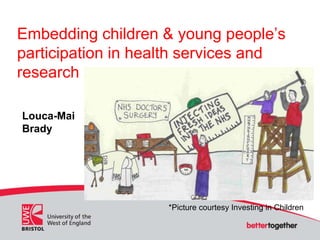
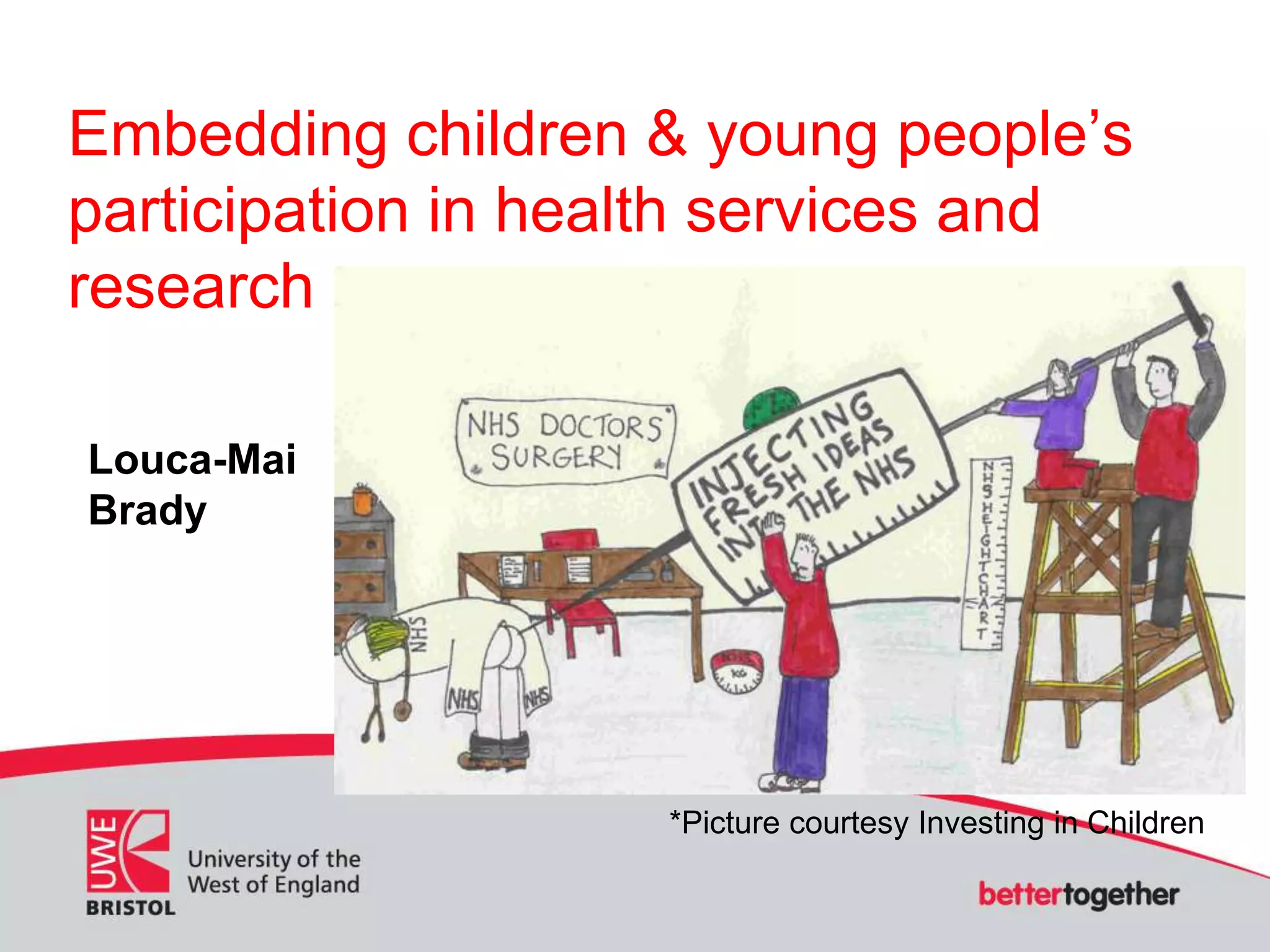
*Picture courtesy Investing in Children
My background
• PhD: embedding CYP’s participation in
health services and research
• Freelance researcher, including work on
PPI
• Background in applied social research,
including leading on CYP’s involvement at
NCB Research Centre
• Member of INVOLVE
Key issues
• Despite increasing profile of CYP’s
participation, there’s a lack of evidence
about how to ensure it is meaningful,
effective and sustained
• Limited examples of how guidance is
applied in practice
• Variable understanding of how principles
and practice of public involvement,
engagement and CYP’s participation
intersect
Where I want to get to:
Embedding children and young
people’s participation in health
services and research:
• How is CYP’s participation defined and operationalised?
• What does it mean to ‘embed’ CYP’s participation within
health services and research?
• What needs to be in place for participation to be
meaningful, effective and sustainable - at different levels,
for different groups and in different settings?
• What are the barriers and challenges to meaningful,
effective and sustainable participation and how can
these be addressed?
The journey
• Literature
• Critical inquiries
• Action research in
two case studies
Navigating the landscape
• Health & Social Care & Children and Families Acts
• New NHS structures and processes – Healthwatch,
CCGs, NHS England, Public Health England & changes
to public health & local authorities
• Continued NIHR commitment to public involvement
• Children and young people’s participation, rights and the
UNCRC
• Campaigning work of organisations working with CYPs
• Sociology of childhood
• Growth of citizenship and public engagement as issues
in policy and practice
“If the fundamental purpose of the
Government’s proposed changes to
the NHS – putting the patient first – is
to be made a reality, the system that
emerges must be grounded in
systematic patient involvement to the
extent that shared decision making is
the norm.”
NHS Future Forum Patient
Involvement and Public Accountability
Report (June 2011).
Children’s Health Outcomes Forum:
Recommendation: All health organisations must
demonstrate how they have listened to the voice of
children and young people, and how this will improve
their health outcomes
Government response: The Government’s
modernisation of the health and care systems will improve
the quality and efficiency of the services children, young
people, and their families receive …with children young
people and their families involved in decisions about their
care and the design of services
• Article 12 . Every child and young person has the
right to express his or her views freely in all matters
affecting them
• Article 13. Every child and young person has the
right to freedom of expression, including the right to
all kinds of information and ideas
• Article 24. Children have the right to good quality
health care and information to help them stay
healthy
UN Convention on the Rights
of the Child (UNCRC)
General comment
Article 12 highlights the importance of children’s participation...This
includes their views on all aspects of health provisions, including,
for example, what services are needed, how and where they are
best provided, barriers to accessing or using services, the quality
of the services and the attitudes of health professionals, how to
strengthen children’s capacities to take increasing levels of
responsibility for their own health and development, and how to
involve them more effectively in the provision of services, as peer
educators. States are encouraged to conduct regular participatory
consultations, which are adapted to the age and maturity of the child,
and research with children, and to do this separately with their
parents, in order to learn about their health challenges, developmental
needs and expectations as a contribution to the design of effective
interventions and health programmes” (UN, 2013).
Key issues from July workshop:
who is involved and how?
• Equality of opportunity and reflecting
diversity
• Creating opportunities for participation
• Making participation appealing and
relevant to CYP
• Roles and responsibilities for participation
• Support for staff
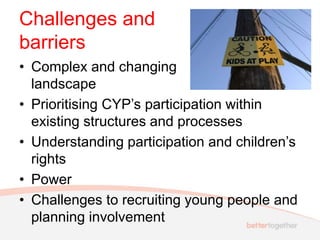
Challenges and
barriers
• Complex and changing
landscape
• Prioritising CYP’s participation within
existing structures and processes
• Understanding participation and children’s
rights
• Power
• Challenges to recruiting young people and
planning involvement
Case studies:
• NHS Trust working with a voluntary sector
organisation to support CYP’s participation
in the development and delivery of a
Community Children’s Health Partnership
• Young people’s involvement in an
adaptation and feasibility study of an
intervention for young people who misuse
alcohol and drugs
Characteristics of action
research
• Research in action, rather than research
about action
• Collaborative democratic partnership
• Research concurrent with action
• Sequence of events and an approach to
problem solving
Coghlan and Brannick, 2010
Community Children’s Health
Partnership
• Working collaboratively with groups of
staff, young people who have been
involved in participation activity and other
stakeholders, through a series of
workshops and other activities
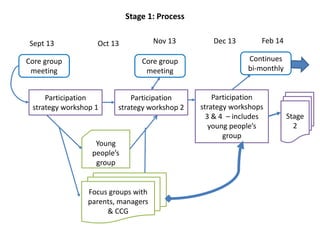
• First cycle: developing a strategy
• Second cycle: putting strategy into
practice
Stage 1: Process
Sept 13 Oct 13 Nov 13
Core group
meeting
Continues
bi-monthly
Core group
meeting
Participation
strategy workshop 1
Participation
strategy workshop 2
Participation
strategy workshops
3 & 4 – includes
young people’s
group
Dec 13
Stage
2
Young
people’s
group
Focus groups with
parents, managers
& CCG
Feb 14
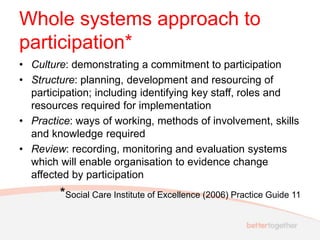
Whole systems approach to
participation*
• Culture: demonstrating a commitment to participation
• Structure: planning, development and resourcing of
participation; including identifying key staff, roles and
resources required for implementation
• Practice: ways of working, methods of involvement, skills
and knowledge required
• Review: recording, monitoring and evaluation systems
which will enable organisation to evidence change
affected by participation
*Social Care Institute of Excellence (2006) Practice Guide 11
Involving young people in a
clinical trial
Plan A…
• Recruit an advisory group of 10-12 young
people who had previously used drug and
alcohol services and would be actively
engaged throughout the project.
• Members of this group, along with parent
representatives, would then be supported
to attend trial steering committee
meetings.
What have the meetings involved?
1. Commenting on project leaflet and information sheet.
2. Flipchart exercise to think about the important people in YPs
life and why they are helpful/supporting or
unhelpful/unsupportive.
3. Card sort exercise about what YP find helpful, or what are
barriers, to YP engaging with services.
4. Writing an open letter to an important person about what
it’s like to have a problem with alcohol or drugs, and how YP
would like that person to help them.
5. Drawing YPs social network so we can have ‘real’ examples
in the Y-SBNT intervention.
6. Commenting on a worksheet (which will be used in the Y-
SBNT intervention) which looks at which areas of life YP
might want to work on during treatment sessions.
7. Giving ideas for what’s important to include in a newsletter
for YP involved with the project.
8. Meeting with the 2 trial researchers to test all the
questionnaires.
What we’ve learned
• YP’s involvement has been extremely helpful and has
informed key elements of the intervention.
• Managing sensitive nature of topics discussed.
• Relationship between Researcher & YP.
• Complex needs & range of services accessed by this
group of YP – e.g. mental health problems.
• This is a seldom heard and group of YP who can be
difficult to access and to keep engaged.
• Traditional advisory group model in one location does
not seem to be effective.
• Flexible, local and YP-centred engagement has worked
better but YP also want to meet the whole team and
each other!
• Different understanding and expectations about what is
possible for YP’s involvement– also influenced by time &
other resources.
Plan B
• Shift from a traditional Advisory Group
model to something more localised & led by YP.
• On-going recruitment.
• More workshops or consultations with YP in services
they use and/or near where they live.
• If YP are then interested in on-going involvement in the
project will be given opportunity to be involved in smaller
and more flexible young advisors group.
• Options for input via email, text, Skype & social media
(eg Facebook) as well as face-to-face.
• Report to trial steering committee with input
from/attendance by YP if interested.
‘Embedded’ participation is…?
• Integrated and integral
• Meaningful
• Well-supported
• Inclusive and flexible
• Realistic
• Collaborative and sharing learning
• Demonstrates impact
Young Health Participation
• Blog about CYP’s participation in health
and social care, including presentations
and reports from recent workshops:
www.younghealthparticipation.com
@louca_mai

Lm brady uc lan seminar

  • 1.
    Embedding children &young people’s participation in health services and research Louca-Mai Brady *Picture courtesy Investing in Children
  • 2.
    My background • PhD:embedding CYP’s participation in health services and research • Freelance researcher, including work on PPI • Background in applied social research, including leading on CYP’s involvement at NCB Research Centre • Member of INVOLVE
  • 3.
    Key issues • Despiteincreasing profile of CYP’s participation, there’s a lack of evidence about how to ensure it is meaningful, effective and sustained • Limited examples of how guidance is applied in practice • Variable understanding of how principles and practice of public involvement, engagement and CYP’s participation intersect
  • 4.
    Where I wantto get to: Embedding children and young people’s participation in health services and research: • How is CYP’s participation defined and operationalised? • What does it mean to ‘embed’ CYP’s participation within health services and research? • What needs to be in place for participation to be meaningful, effective and sustainable - at different levels, for different groups and in different settings? • What are the barriers and challenges to meaningful, effective and sustainable participation and how can these be addressed?
  • 5.
    The journey • Literature •Critical inquiries • Action research in two case studies
  • 6.
    Navigating the landscape •Health & Social Care & Children and Families Acts • New NHS structures and processes – Healthwatch, CCGs, NHS England, Public Health England & changes to public health & local authorities • Continued NIHR commitment to public involvement • Children and young people’s participation, rights and the UNCRC • Campaigning work of organisations working with CYPs • Sociology of childhood • Growth of citizenship and public engagement as issues in policy and practice
  • 7.
    “If the fundamentalpurpose of the Government’s proposed changes to the NHS – putting the patient first – is to be made a reality, the system that emerges must be grounded in systematic patient involvement to the extent that shared decision making is the norm.” NHS Future Forum Patient Involvement and Public Accountability Report (June 2011).
  • 8.
    Children’s Health OutcomesForum: Recommendation: All health organisations must demonstrate how they have listened to the voice of children and young people, and how this will improve their health outcomes Government response: The Government’s modernisation of the health and care systems will improve the quality and efficiency of the services children, young people, and their families receive …with children young people and their families involved in decisions about their care and the design of services
  • 9.
    • Article 12. Every child and young person has the right to express his or her views freely in all matters affecting them • Article 13. Every child and young person has the right to freedom of expression, including the right to all kinds of information and ideas • Article 24. Children have the right to good quality health care and information to help them stay healthy UN Convention on the Rights of the Child (UNCRC)
  • 10.
    General comment Article 12highlights the importance of children’s participation...This includes their views on all aspects of health provisions, including, for example, what services are needed, how and where they are best provided, barriers to accessing or using services, the quality of the services and the attitudes of health professionals, how to strengthen children’s capacities to take increasing levels of responsibility for their own health and development, and how to involve them more effectively in the provision of services, as peer educators. States are encouraged to conduct regular participatory consultations, which are adapted to the age and maturity of the child, and research with children, and to do this separately with their parents, in order to learn about their health challenges, developmental needs and expectations as a contribution to the design of effective interventions and health programmes” (UN, 2013).
  • 11.
    Key issues fromJuly workshop: who is involved and how? • Equality of opportunity and reflecting diversity • Creating opportunities for participation • Making participation appealing and relevant to CYP • Roles and responsibilities for participation • Support for staff
  • 12.
    Challenges and barriers • Complexand changing landscape • Prioritising CYP’s participation within existing structures and processes • Understanding participation and children’s rights • Power • Challenges to recruiting young people and planning involvement
  • 13.
    Case studies: • NHSTrust working with a voluntary sector organisation to support CYP’s participation in the development and delivery of a Community Children’s Health Partnership • Young people’s involvement in an adaptation and feasibility study of an intervention for young people who misuse alcohol and drugs
  • 14.
    Characteristics of action research •Research in action, rather than research about action • Collaborative democratic partnership • Research concurrent with action • Sequence of events and an approach to problem solving Coghlan and Brannick, 2010
  • 15.
    Community Children’s Health Partnership •Working collaboratively with groups of staff, young people who have been involved in participation activity and other stakeholders, through a series of workshops and other activities • First cycle: developing a strategy • Second cycle: putting strategy into practice
  • 16.
    Stage 1: Process Sept13 Oct 13 Nov 13 Core group meeting Continues bi-monthly Core group meeting Participation strategy workshop 1 Participation strategy workshop 2 Participation strategy workshops 3 & 4 – includes young people’s group Dec 13 Stage 2 Young people’s group Focus groups with parents, managers & CCG Feb 14
  • 17.
    Whole systems approachto participation* • Culture: demonstrating a commitment to participation • Structure: planning, development and resourcing of participation; including identifying key staff, roles and resources required for implementation • Practice: ways of working, methods of involvement, skills and knowledge required • Review: recording, monitoring and evaluation systems which will enable organisation to evidence change affected by participation *Social Care Institute of Excellence (2006) Practice Guide 11
  • 20.
    Involving young peoplein a clinical trial
  • 21.
    Plan A… • Recruitan advisory group of 10-12 young people who had previously used drug and alcohol services and would be actively engaged throughout the project. • Members of this group, along with parent representatives, would then be supported to attend trial steering committee meetings.
  • 22.
    What have themeetings involved? 1. Commenting on project leaflet and information sheet. 2. Flipchart exercise to think about the important people in YPs life and why they are helpful/supporting or unhelpful/unsupportive. 3. Card sort exercise about what YP find helpful, or what are barriers, to YP engaging with services. 4. Writing an open letter to an important person about what it’s like to have a problem with alcohol or drugs, and how YP would like that person to help them. 5. Drawing YPs social network so we can have ‘real’ examples in the Y-SBNT intervention. 6. Commenting on a worksheet (which will be used in the Y- SBNT intervention) which looks at which areas of life YP might want to work on during treatment sessions. 7. Giving ideas for what’s important to include in a newsletter for YP involved with the project. 8. Meeting with the 2 trial researchers to test all the questionnaires.
  • 23.
    What we’ve learned •YP’s involvement has been extremely helpful and has informed key elements of the intervention. • Managing sensitive nature of topics discussed. • Relationship between Researcher & YP. • Complex needs & range of services accessed by this group of YP – e.g. mental health problems. • This is a seldom heard and group of YP who can be difficult to access and to keep engaged. • Traditional advisory group model in one location does not seem to be effective. • Flexible, local and YP-centred engagement has worked better but YP also want to meet the whole team and each other! • Different understanding and expectations about what is possible for YP’s involvement– also influenced by time & other resources.
  • 24.
    Plan B • Shiftfrom a traditional Advisory Group model to something more localised & led by YP. • On-going recruitment. • More workshops or consultations with YP in services they use and/or near where they live. • If YP are then interested in on-going involvement in the project will be given opportunity to be involved in smaller and more flexible young advisors group. • Options for input via email, text, Skype & social media (eg Facebook) as well as face-to-face. • Report to trial steering committee with input from/attendance by YP if interested.
  • 25.
    ‘Embedded’ participation is…? •Integrated and integral • Meaningful • Well-supported • Inclusive and flexible • Realistic • Collaborative and sharing learning • Demonstrates impact
  • 26.
    Young Health Participation •Blog about CYP’s participation in health and social care, including presentations and reports from recent workshops: www.younghealthparticipation.com @louca_mai