The Effect of Precommitment on Student
Achievement within a Project-Based Learning
Environment
Hao, Q., Branch, M. R., & Jensen, L.
Learning, Design and Technology
University of Georgia
Purpose of This Study
Precommitment
Precommitment refers to a mechanism wherein people set up goals that
might have costly consequences if unreached (Ariely & Wertenbroch, 2002).
Purpose of This Study
Precommitment
Precommitment refers to a mechanism wherein people set up goals that
might have costly consequences if unreached (Ariely & Wertenbroch, 2002).
Purpose of This Study
Goal Setting
Goal setting is defined as setting the standard of proficiency, usually with a
specified time limit (Locke & Latham, 2002; van Den Hurk, 2006; Zimmerman,
2008).
Purpose of This Study
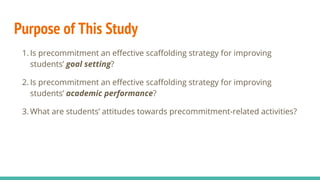
1. Is precommitment an effective scaffolding strategy for improving
students’ goal setting?
2. Is precommitment an effective scaffolding strategy for improving
students’ academic performance?
3. What are students’ attitudes towards precommitment-related activities?
Participants of This Study
Participants:
41 undergraduate students enrolled in a course on instructional technology in
University of Georgia
Context:
Project-based Learning Environments
Participants of This Study
Research Design
Single group repeated-measure design
Project 1
Project 2
Precommitment
1. Instruction on effective goal setting
2. Making weekly goals public to all classmates and the
instructor
3. Weekly presentation on goals and actual progress
Setting weekly goals online
Survey
Research Design
Single group repeated-measure design
Project 1
Project 2
Precommitment
1. Instruction on effective goal setting
2. Making weekly goals public to all classmates and the
instructor
3. Weekly presentation on goals and actual progress
Setting weekly goals online
Survey
Research Design
Research Design
Single group repeated-measure design
Project 1
Project 2
Precommitment
1. Instruction on effective goal setting
2. Making weekly goals public to all classmates and the
instructor
3. Weekly presentation on goals and actual progress
Setting weekly goals online
Survey
Research Design
Data Collection:
1. Weekly goals
2. Grades of students’ two projects
3. Survey: Intrinsic Motivation Inventory (McAuley, Duncan, & Tammen,
1989; Deci & Ryan, 2000)
Research Design
Research Design
Data Collection:
1. Weekly goals (Pearson’s r = .751)
2. Grades of students’ two projects
3. Survey: Intrinsic Motivation Inventory (McAuley, Duncan, & Tammen,
1989; Deci & Ryan, 2000)
Results
Results
Student A:
“I want to keep the website simple and not overly artisy but pretty
professional. I will also write an opening "blurb" on the front page.”
----------------------------
“I plan to do the three following things in this coming week: 1). Develop the
default theme for teaching and learning multimedia repository pages, 2)
Research on how to use PowToon to develop basic multimedia products, and
3) Publish a 3-minute PowToon multimedia product. Of course, I will make
sure to have the theme and product on my website.”
Results
Student B:
“I'll be honest, I'm a little scared of prototyping my app. I know that I'm a bit of a
perfectionist and that I want to create a prototype that is as close as I can make it to a
usable product. I look forward to using some tools to help me create a decent
prototype.”
----------------------------
“I will write a product comparison summary based on the 4 scheduling web services that
I found. Doodle is probably the best, but there are some other good sites out there. I
will also need to decide whether I am going to include a feature that locks users out of
their social media outlets. I will write a benefit and cost analysis on this feature.”
Results
Conclusions
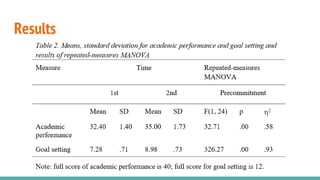
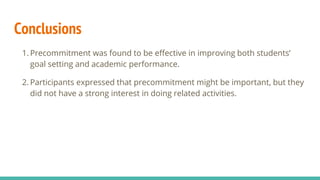
1. Precommitment was found to be effective in improving both students’
goal setting and academic performance.
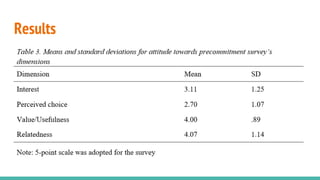
2. Participants expressed that precommitment might be important, but they
did not have a strong interest in doing related activities.
References
Ariely, D., & Wertenbroch, K. (2002). Procrastination, deadlines, and performance: Self-control by precommitment.
Psychological science, 13(3), 219-224.
Deci, E. L., & Ryan, R. M. (2000). The" what" and" why" of goal pursuits: Human needs and the self-determination of
behavior. Psychological inquiry,11(4), 227-268.
Locke, E. A., & Latham, G. P. (2002). Building a practically useful theory of goal setting and task motivation: A 35-year
odyssey. American psychologist, 57(9), 705-717.
McAuley, E., Duncan, T., & Tammen, V. V. (1989). Psychometric properties of the Intrinsic Motivation Inventory in a
competitive sport setting: A confirmatory factor analysis. Research Quarterly for Exercise and Sport, 60(1), 48-58.
van Den Hurk, M. (2006). The relation between self-regulated strategies and individual study time, prepared
participation and achievement in a problem-based curriculum. Active Learning in Higher Education, 7(2), 155-169.
Zimmerman, B. J. (2000). Self-Efficacy: An Essential Motive to Learn. Contemporary Educational Psychology, 25(1), 82-
91.
Zimmerman, B. J. (2008). Goal-setting: a key proactive source of self-regulated learning. In D. H. Schunk, & B. J.
Zimmerman (Eds.), Motivation and Self-Regulated Learning: Theory, Research, and Applications, (pp. 267-296). New
York, NY: Taylor & Francis.

The effect of precommitment on student achievement within a project-based learning environment

  • 1.
    The Effect ofPrecommitment on Student Achievement within a Project-Based Learning Environment Hao, Q., Branch, M. R., & Jensen, L. Learning, Design and Technology University of Georgia
  • 2.
    Purpose of ThisStudy Precommitment Precommitment refers to a mechanism wherein people set up goals that might have costly consequences if unreached (Ariely & Wertenbroch, 2002).
  • 3.
    Purpose of ThisStudy Precommitment Precommitment refers to a mechanism wherein people set up goals that might have costly consequences if unreached (Ariely & Wertenbroch, 2002).
  • 4.
    Purpose of ThisStudy Goal Setting Goal setting is defined as setting the standard of proficiency, usually with a specified time limit (Locke & Latham, 2002; van Den Hurk, 2006; Zimmerman, 2008).
  • 5.
    Purpose of ThisStudy 1. Is precommitment an effective scaffolding strategy for improving students’ goal setting? 2. Is precommitment an effective scaffolding strategy for improving students’ academic performance? 3. What are students’ attitudes towards precommitment-related activities?
  • 6.
    Participants of ThisStudy Participants: 41 undergraduate students enrolled in a course on instructional technology in University of Georgia Context: Project-based Learning Environments
  • 7.
  • 8.
    Research Design Single grouprepeated-measure design Project 1 Project 2 Precommitment 1. Instruction on effective goal setting 2. Making weekly goals public to all classmates and the instructor 3. Weekly presentation on goals and actual progress Setting weekly goals online Survey
  • 9.
    Research Design Single grouprepeated-measure design Project 1 Project 2 Precommitment 1. Instruction on effective goal setting 2. Making weekly goals public to all classmates and the instructor 3. Weekly presentation on goals and actual progress Setting weekly goals online Survey
  • 10.
  • 11.
    Research Design Single grouprepeated-measure design Project 1 Project 2 Precommitment 1. Instruction on effective goal setting 2. Making weekly goals public to all classmates and the instructor 3. Weekly presentation on goals and actual progress Setting weekly goals online Survey
  • 12.
    Research Design Data Collection: 1.Weekly goals 2. Grades of students’ two projects 3. Survey: Intrinsic Motivation Inventory (McAuley, Duncan, & Tammen, 1989; Deci & Ryan, 2000)
  • 13.
  • 14.
    Research Design Data Collection: 1.Weekly goals (Pearson’s r = .751) 2. Grades of students’ two projects 3. Survey: Intrinsic Motivation Inventory (McAuley, Duncan, & Tammen, 1989; Deci & Ryan, 2000)
  • 15.
  • 16.
    Results Student A: “I wantto keep the website simple and not overly artisy but pretty professional. I will also write an opening "blurb" on the front page.” ---------------------------- “I plan to do the three following things in this coming week: 1). Develop the default theme for teaching and learning multimedia repository pages, 2) Research on how to use PowToon to develop basic multimedia products, and 3) Publish a 3-minute PowToon multimedia product. Of course, I will make sure to have the theme and product on my website.”
  • 17.
    Results Student B: “I'll behonest, I'm a little scared of prototyping my app. I know that I'm a bit of a perfectionist and that I want to create a prototype that is as close as I can make it to a usable product. I look forward to using some tools to help me create a decent prototype.” ---------------------------- “I will write a product comparison summary based on the 4 scheduling web services that I found. Doodle is probably the best, but there are some other good sites out there. I will also need to decide whether I am going to include a feature that locks users out of their social media outlets. I will write a benefit and cost analysis on this feature.”
  • 18.
  • 19.
    Conclusions 1. Precommitment wasfound to be effective in improving both students’ goal setting and academic performance. 2. Participants expressed that precommitment might be important, but they did not have a strong interest in doing related activities.
  • 20.
    References Ariely, D., &Wertenbroch, K. (2002). Procrastination, deadlines, and performance: Self-control by precommitment. Psychological science, 13(3), 219-224. Deci, E. L., & Ryan, R. M. (2000). The" what" and" why" of goal pursuits: Human needs and the self-determination of behavior. Psychological inquiry,11(4), 227-268. Locke, E. A., & Latham, G. P. (2002). Building a practically useful theory of goal setting and task motivation: A 35-year odyssey. American psychologist, 57(9), 705-717. McAuley, E., Duncan, T., & Tammen, V. V. (1989). Psychometric properties of the Intrinsic Motivation Inventory in a competitive sport setting: A confirmatory factor analysis. Research Quarterly for Exercise and Sport, 60(1), 48-58. van Den Hurk, M. (2006). The relation between self-regulated strategies and individual study time, prepared participation and achievement in a problem-based curriculum. Active Learning in Higher Education, 7(2), 155-169. Zimmerman, B. J. (2000). Self-Efficacy: An Essential Motive to Learn. Contemporary Educational Psychology, 25(1), 82- 91. Zimmerman, B. J. (2008). Goal-setting: a key proactive source of self-regulated learning. In D. H. Schunk, & B. J. Zimmerman (Eds.), Motivation and Self-Regulated Learning: Theory, Research, and Applications, (pp. 267-296). New York, NY: Taylor & Francis.