Jumping Hurdles to Technology
Integration
Lisa Durff PhD
Online Adjunct Faculty
Grand Canyon University
20 minute roadmap
5 mins a review of the literature – recent studies have identified barriers to technology integration that
impact teachers. My study revealed how administrators can get teachers over these
6 mins (Think-Pair-Share) Today’s participants share how they can influence educators to overcome hurdles
where they are (higher ed, secondary, primary, admins, teachers, students, parents).
5 mins Post ideas to a pollyeverywhere using phones and displayed on front whiteboard if available
2 mins Questions?
Slideshare link to slides -> https://www.slideshare.net/secret/mkwj7wTOeDJ7Ru
In a Nutshell
In this qualitative multiple case study, I
interviewed 3 groups of educators to determine
how some teachers successfully overcame
barriers to technology integration. Each case
contained 2 or 3 teachers, 1 administrator, & 1
technology support person in one school in a
rural northeastern district.
Problem
The use of technology engages and
increases academic achievement for K-5
students (Tamin, Bernard, Brookhovski,
Abrami, and Schmid,2011), but teachers
face attitudinal, social/cultural, and
pedagogical barriers when they integrate
technology for student learning. Although
some teachers can overcome these
barriers, it remains unclear how.
What do we know about barriers?
• Barriers prevent teachers from integrating technology
• There are 2 types of barriers
• First order barriers have been overcome in the USA according to Ertmer (1999)
• Second order barriers are especially tenacious
The Literature Says…
Hurdles prevent teachers from integrating technology into their classrooms,
even though research demonstrates student achievement is improved when
using technology in the learning process (Elliot & Mikulas, 2012; Zielezinski
& Darling-Hammond, 2016).
There are 2 types of barriers identified by Ertmer (1999).
First-order barriers or external barriers and
Second-order barriers or internal barriers
Purpose
The purpose of my qualitative multiple case study
was to analyze the attitudes and behaviors of 3
groups to determine how some teachers
successfully overcame barriers to technology
integration.
Relevant
Literature
The conceptual framework for this research study
included the social cognitive theory of Bandura
(1986) and groundwork by Ertmer (1999) on
barriers to technology integration. Bandura’s
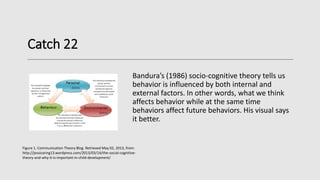
theory can be visualized as a triangular model
with personal, behavioral, environmental factors
interacting to determine a person’s actions. The
barriers to technology integration perceived by
educators are influenced by these same factors
Bandura delineated in his social cognitive theory.
Catch 22
Bandura’s (1986) socio-cognitive theory tells us
behavior is influenced by both internal and
external factors. In other words, what we think
affects behavior while at the same time
behaviors affect future behaviors. His visual says
it better.
Figure 1. Communication Theory Blog. Retrieved May 02, 2013, from:
http://jessicaring13.wordpress.com/2013/03/14/the-social-cognitive-
theory-and-why-it-is-important-in-child-development/
What are the
barriers?
First-order barriers include extrinsic influences
like Internet access, sufficient bandwidth, and
access to technology hardware.
Second-order barriers include internal influences
like attitudes, beliefs, and practices. These 2nd
order barriers are influenced not only by personal
attitudes, but also by social contexts, cultural
landscapes, and learned pedagogical practices
(Ertmer, 1999; Saxena, 2017).
Pernicious
Barriers
Because recent studies found that 2nd order
barriers like social/cultural surroundings,
attitudes, and pedagogical considerations worked
together to influence how teachers integrated
technology (Grosser, 2017; Heath, 2017; Magana,
2016), AND because the use of technology in the
classroom has the potential to engage students
and positively influence learning, the question
becomes….
Data Analysis
I examined the internal attitudes, the external
social context or cultural landscape, and the
pedagogical barriers which teachers overcame
when integrating technology into their
classrooms.
Findings
The findings revealed that teachers who
overcame barriers to technology integration did
so in three areas namely they overcame
attitudinal barriers, social/cultural barriers, and
pedagogical barriers. During the interviews, the
following themes emerged for
• Research Question 1: Adaptability, Evolution of
Tech Skills, Peer Support, and Professional
Training.
• Research Question 2: Required Software, Status
Quo, and Unvalued.
• Research Question 3: Continual Change,
Appropriate Resources, and Preparing Students.
Conclusions
In my study, it was found that administrators who
wished to support teachers in successfully
overcoming barriers to technology integration
supported and encouraged their teachers. This
support helped teachers successfully overcome
obstacles to technology integration.
What’s an
admin to do?
Administrators can propel their teachers over barriers
to successful integration of technology by:
• Providing professional development in school
workshops, conference attendance, and online
courses
• Encouraging collegial sharing, mentor relationships,
and offering technical support to teachers without
requiring specific software or hardware used
• Allowing time for teachers’ technology skills to
evolve, valuing the use of technology for
educational purposes, and encouraging teachers to
break out of the status quo of traditional, lecture-
based lessons and move towards student-centered
instruction
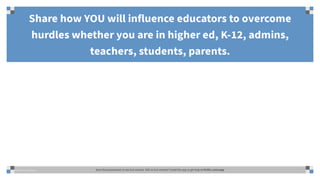
Think-Pair-
Share
Are you an administrator, K-12 teacher, higher ed
faculty or administrator, parent?
Share with those around you how you can
influence educators to overcome hurdles.
Collaborate to generate at least one idea to share
with everyone. You have 6 minutes.
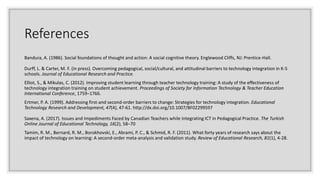
References
Bandura, A. (1986). Social foundations of thought and action: A social cognitive theory. Englewood Cliffs, NJ: Prentice-Hall.
Durff, L. & Carter, M. F. (in press). Overcoming pedagogical, social/cultural, and attitudinal barriers to technology integration in K-5
schools. Journal of Educational Research and Practice.
Elliot, S., & Mikulas, C. (2012). Improving student learning through teacher technology training: A study of the effectiveness of
technology integration training on student achievement. Proceedings of Society for Information Technology & Teacher Education
International Conference, 1759–1766.
Ertmer, P. A. (1999). Addressing first-and second-order barriers to change: Strategies for technology integration. Educational
Technology Research and Development, 47(4), 47-61. http://dx.doi.org/10.1007/BF02299597
Saxena, A. (2017). Issues and Impediments Faced by Canadian Teachers while Integrating ICT in Pedagogical Practice. The Turkish
Online Journal of Educational Technology, 16(2), 58–70
Tamim, R. M., Bernard, R. M., Borokhovski, E., Abrami, P. C., & Schmid, R. F. (2011). What forty years of research says about the
impact of technology on learning: A second-order meta-analysis and validation study. Review of Educational Research, 81(1), 4-28.

Jumping Hurdles to Technology Integration

  • 1.
    Jumping Hurdles toTechnology Integration Lisa Durff PhD Online Adjunct Faculty Grand Canyon University
  • 2.
    20 minute roadmap 5mins a review of the literature – recent studies have identified barriers to technology integration that impact teachers. My study revealed how administrators can get teachers over these 6 mins (Think-Pair-Share) Today’s participants share how they can influence educators to overcome hurdles where they are (higher ed, secondary, primary, admins, teachers, students, parents). 5 mins Post ideas to a pollyeverywhere using phones and displayed on front whiteboard if available 2 mins Questions? Slideshare link to slides -> https://www.slideshare.net/secret/mkwj7wTOeDJ7Ru
  • 3.
    In a Nutshell Inthis qualitative multiple case study, I interviewed 3 groups of educators to determine how some teachers successfully overcame barriers to technology integration. Each case contained 2 or 3 teachers, 1 administrator, & 1 technology support person in one school in a rural northeastern district.
  • 4.
    Problem The use oftechnology engages and increases academic achievement for K-5 students (Tamin, Bernard, Brookhovski, Abrami, and Schmid,2011), but teachers face attitudinal, social/cultural, and pedagogical barriers when they integrate technology for student learning. Although some teachers can overcome these barriers, it remains unclear how.
  • 5.
    What do weknow about barriers? • Barriers prevent teachers from integrating technology • There are 2 types of barriers • First order barriers have been overcome in the USA according to Ertmer (1999) • Second order barriers are especially tenacious
  • 6.
    The Literature Says… Hurdlesprevent teachers from integrating technology into their classrooms, even though research demonstrates student achievement is improved when using technology in the learning process (Elliot & Mikulas, 2012; Zielezinski & Darling-Hammond, 2016). There are 2 types of barriers identified by Ertmer (1999). First-order barriers or external barriers and Second-order barriers or internal barriers
  • 7.
    Purpose The purpose ofmy qualitative multiple case study was to analyze the attitudes and behaviors of 3 groups to determine how some teachers successfully overcame barriers to technology integration.
  • 8.
    Relevant Literature The conceptual frameworkfor this research study included the social cognitive theory of Bandura (1986) and groundwork by Ertmer (1999) on barriers to technology integration. Bandura’s theory can be visualized as a triangular model with personal, behavioral, environmental factors interacting to determine a person’s actions. The barriers to technology integration perceived by educators are influenced by these same factors Bandura delineated in his social cognitive theory.
  • 9.
    Catch 22 Bandura’s (1986)socio-cognitive theory tells us behavior is influenced by both internal and external factors. In other words, what we think affects behavior while at the same time behaviors affect future behaviors. His visual says it better. Figure 1. Communication Theory Blog. Retrieved May 02, 2013, from: http://jessicaring13.wordpress.com/2013/03/14/the-social-cognitive- theory-and-why-it-is-important-in-child-development/
  • 10.
    What are the barriers? First-orderbarriers include extrinsic influences like Internet access, sufficient bandwidth, and access to technology hardware. Second-order barriers include internal influences like attitudes, beliefs, and practices. These 2nd order barriers are influenced not only by personal attitudes, but also by social contexts, cultural landscapes, and learned pedagogical practices (Ertmer, 1999; Saxena, 2017).
  • 11.
    Pernicious Barriers Because recent studiesfound that 2nd order barriers like social/cultural surroundings, attitudes, and pedagogical considerations worked together to influence how teachers integrated technology (Grosser, 2017; Heath, 2017; Magana, 2016), AND because the use of technology in the classroom has the potential to engage students and positively influence learning, the question becomes….
  • 12.
    Data Analysis I examinedthe internal attitudes, the external social context or cultural landscape, and the pedagogical barriers which teachers overcame when integrating technology into their classrooms.
  • 13.
    Findings The findings revealedthat teachers who overcame barriers to technology integration did so in three areas namely they overcame attitudinal barriers, social/cultural barriers, and pedagogical barriers. During the interviews, the following themes emerged for • Research Question 1: Adaptability, Evolution of Tech Skills, Peer Support, and Professional Training. • Research Question 2: Required Software, Status Quo, and Unvalued. • Research Question 3: Continual Change, Appropriate Resources, and Preparing Students.
  • 14.
    Conclusions In my study,it was found that administrators who wished to support teachers in successfully overcoming barriers to technology integration supported and encouraged their teachers. This support helped teachers successfully overcome obstacles to technology integration.
  • 15.
    What’s an admin todo? Administrators can propel their teachers over barriers to successful integration of technology by: • Providing professional development in school workshops, conference attendance, and online courses • Encouraging collegial sharing, mentor relationships, and offering technical support to teachers without requiring specific software or hardware used • Allowing time for teachers’ technology skills to evolve, valuing the use of technology for educational purposes, and encouraging teachers to break out of the status quo of traditional, lecture- based lessons and move towards student-centered instruction
  • 16.
    Think-Pair- Share Are you anadministrator, K-12 teacher, higher ed faculty or administrator, parent? Share with those around you how you can influence educators to overcome hurdles. Collaborate to generate at least one idea to share with everyone. You have 6 minutes.
  • 18.
    References Bandura, A. (1986).Social foundations of thought and action: A social cognitive theory. Englewood Cliffs, NJ: Prentice-Hall. Durff, L. & Carter, M. F. (in press). Overcoming pedagogical, social/cultural, and attitudinal barriers to technology integration in K-5 schools. Journal of Educational Research and Practice. Elliot, S., & Mikulas, C. (2012). Improving student learning through teacher technology training: A study of the effectiveness of technology integration training on student achievement. Proceedings of Society for Information Technology & Teacher Education International Conference, 1759–1766. Ertmer, P. A. (1999). Addressing first-and second-order barriers to change: Strategies for technology integration. Educational Technology Research and Development, 47(4), 47-61. http://dx.doi.org/10.1007/BF02299597 Saxena, A. (2017). Issues and Impediments Faced by Canadian Teachers while Integrating ICT in Pedagogical Practice. The Turkish Online Journal of Educational Technology, 16(2), 58–70 Tamim, R. M., Bernard, R. M., Borokhovski, E., Abrami, P. C., & Schmid, R. F. (2011). What forty years of research says about the impact of technology on learning: A second-order meta-analysis and validation study. Review of Educational Research, 81(1), 4-28.

Editor's Notes

  • #2 Welcome Who I am
  • #3 Read this slide 20 minute roadmap 5 mins review 6 mins think-pair-share 5 mins polleverywhere 2 mins qts
  • #4 In this qualitative multiple case study, I interviewed 3 groups of educators to determine how some teachers successfully overcame barriers to technology integration. Each case contained 2 or 3 teachers, 1 administrator, & 1 technology support person in one school in a rural northeastern district. There were three schools in the study – so three data points within each of three datapoints.
  • #5 The problem identified was the use of technology engages students and increases academic achievement But hurdles prevent teachers from integrating technology. There are three types of 2nd order barriers Attitudinal Social/Cultural Pedagogical
  • #6 They prevent teachers from integrating technology into their classrooms. And we know they there are two types of barriers that have been identified. There are first-order barriers or the external ones and there are second-order barriers or the internal ones. Second order barriers include things like attitudes, social environments, cultural landscapes, and pedagogical methods, which are taught in preservice undergraduate methods courses. While access to technology tools has increased in this country, many teachers are continuing not to integrate technology tools into classroom teaching. The second-order barriers are continuing to stop this. And so, this whole study is looking at these second-order barriers.
  • #7 In the literature, it is revealed that teachers have difficulty overcoming second-order barriers. And the question is then why? The gap that I identified was how elementary teachers can integrate technology but identifying how this population overcame these barriers, administrators in similar schools can be better equipped to encourage teachers in overcoming these barriers.
  • #8  The purpose of the qualitative multiple case study was to identify how elementary school teachers in one rural northeastern district overcome attitudinal, social/cultural, and pedagogical barriers(2nd order) that prevented them from integrating technology into their classrooms for student learning.
  • #9 A review of the literature found a plethora of information about barriers. The National Center for Education Statistics reported in 2006 that 100% of public schools in the United States had connectivity (Wells, Lewis, & Greene, 2006). One group of barriers down. Ertmer et al. (2012) turned attention to second-order barriers which include personal attitudes, the social and cultural climate surrounding a teacher, and the pedagogical beliefs held by a teacher.
  • #10 Bandura used a threefold reciprocal model. All points in the model acted upon each other simultaneously resulting in behavior.
  • #11 We know there are two types of barriers that have been identified. There are first-order barriers or the external ones and there are second-order barriers or the internal ones. Second order barriers include things like attitudes, social environments, cultural landscapes, and pedagogical methods, which are taught in preservice undergraduate methods courses.
  • #12 While access to technology tools has increased in this country, many teachers are continuing not to integrate technology tools into classroom teaching. Because 2nd order barriers are the issue, this study looked at how K-5 educators could overcome these barriers.
  • #13  The data were coded for the themes, patterns, and categories according to the research questions. The words of study participants were used to formulate general conclusions about overcoming barriers to technology integration.
  • #14 The findings of the study revealed that teachers who overcame barriers to technology integration did so in three areas namely they overcame attitudinal barriers, social/cultural barriers, and pedagogical barriers. During the interviews, the following themes emerged for Research Question 1: Adaptability, Evolution of Tech Skills, Peer Support, and Professional Training. Research Question 2: Required Software, Status Quo, and Unvalued. Research Question 3: Continual Change, Appropriate Resources, and Preparing Students.
  • #15 The results of the study may prove useful to administrators looking for ways to have teachers in their schools overcome barriers to technology integration as well as to educators seeking to overcome barriers on their own.
  • #16 School administrators can: • Provide professional development in school workshops, pay for conference attendance, and provide paid time for online courses • Encourage collegial sharing, mentor relationships, and provide technical support to teachers (tech coaches) without requiring specific software or hardware • Allow time for teachers’ technology skills to evolve, show that they value the use of technology for educational purposes, and encourage teachers to break out of the status quo of traditional, lecture-based lessons and move towards student-centered instruction
  • #17 Share with those around you how you can influence educators to overcome hurdles. Collaborate to generate at least one idea to share with everyone. You have 6 minutes.
  • #18  Poll Title: Share how YOU will influence educators to overcome hurdles whether you are in higher ed, K-12, admins, teachers, students, parents. https://www.polleverywhere.com/free_text_polls/7XQ9pKEDlMJ2o8LsekDtT