The Dynamic Brain An Exploration Of Neuronal
Variability And Its Functional Significance 1st
Edition Mingzhou Ding Phd download
https://ebookbell.com/product/the-dynamic-brain-an-exploration-
of-neuronal-variability-and-its-functional-significance-1st-
edition-mingzhou-ding-phd-4672804
Explore and download more ebooks at ebookbell.com
Here are some recommended products that we believe you will be
interested in. You can click the link to download.
Mutable Brain Dynamic And Plastic Features Of The Developing And
Mature Brain 1st Edition Jon H Kaas
https://ebookbell.com/product/mutable-brain-dynamic-and-plastic-
features-of-the-developing-and-mature-brain-1st-edition-jon-h-
kaas-1354686
Dynamic Coordination In The Brain From Neurons To Mind Ernst
Strungmann Forum 5th 2009 Frankfurt Am Main
https://ebookbell.com/product/dynamic-coordination-in-the-brain-from-
neurons-to-mind-ernst-strungmann-forum-5th-2009-frankfurt-am-
main-36375142
From Brain Dynamics To The Mind Spatiotemporal Neuroscience Georg
Northoff
https://ebookbell.com/product/from-brain-dynamics-to-the-mind-
spatiotemporal-neuroscience-georg-northoff-58457906
Draw It With Me The Dynamic Female Figure Anatomical Gestural Comic
Fine Art Studies Of The Female Form In Dramatic Poses Brian C Hailes
https://ebookbell.com/product/draw-it-with-me-the-dynamic-female-
figure-anatomical-gestural-comic-fine-art-studies-of-the-female-form-
in-dramatic-poses-brian-c-hailes-57040884
Draw It With Me The Dynamic Female Figure Anatomical Gestural Comic
Fine Art Studies Of The Female Form In Dramatic Poses Brian C Hailes
Hailes
https://ebookbell.com/product/draw-it-with-me-the-dynamic-female-
figure-anatomical-gestural-comic-fine-art-studies-of-the-female-form-
in-dramatic-poses-brian-c-hailes-hailes-33467296
Draw It With Me The Dynamic Female Figure Anatomical Gestural Comic
Fine Art Studies Of The Female Form In Dramatic Poses Brian C Hailes
https://ebookbell.com/product/draw-it-with-me-the-dynamic-female-
figure-anatomical-gestural-comic-fine-art-studies-of-the-female-form-
in-dramatic-poses-brian-c-hailes-32697630
Draw It With Me The Dynamic Female Figure Anatomical Gestural Comic
Fine Art Studies Of The Female Form In Dramatic Poses Brian C Hailes
https://ebookbell.com/product/draw-it-with-me-the-dynamic-female-
figure-anatomical-gestural-comic-fine-art-studies-of-the-female-form-
in-dramatic-poses-brian-c-hailes-33393478
Catholics And Politics The Dynamic Tension Between Faith And Power 1st
Edition Kristin E Heyer Adrian Pantoja Mark J Rozell Michael A
Genovese Margaret Ross Sammon Gregory Allen Smith Mark M Gray Mary E
Bendyna Matthew J Streb Brian Frederick
https://ebookbell.com/product/catholics-and-politics-the-dynamic-
tension-between-faith-and-power-1st-edition-kristin-e-heyer-adrian-
pantoja-mark-j-rozell-michael-a-genovese-margaret-ross-sammon-gregory-
allen-smith-mark-m-gray-mary-e-bendyna-matthew-j-streb-brian-
frederick-51636076
Micro Meso And Macrodynamics Of The Brain 1st Edition Gyrgy Buzski
https://ebookbell.com/product/micro-meso-and-macrodynamics-of-the-
brain-1st-edition-gyrgy-buzski-5483402
The Dynamic Brain
This page intentionally left blank
The Dynamic Brain
An Exploration of Neuronal
Variability and Its Functional
Significance
Edited by
MINGZHOU DING, PhD
The J. Crayton Pruitt Family
Department of Biomedical Engineering
University of Florida
Gainesville, FL
DENNIS L. GLANZMAN, PhD
Theoretical and Computational Neuroscience Program
National Institute of Mental Health
Bethesda, MD
1
2011
3
Oxford University Press, Inc., publishes works that further
Oxford University’s objective of excellence
in research, scholarship, and education.
Oxford New York
Auckland Cape Town Dar es Salaam Hong Kong Karachi
Kuala Lumpur Madrid Melbourne Mexico City Nairobi
New Delhi Shanghai Taipei Toronto
With offices in
Argentina Austria Brazil Chile Czech Republic France Greece
Guatemala Hungary Italy Japan Poland Portugal Singapore
South Korea Switzerland Thailand Turkey Ukraine Vietnam
Copyright © 2011 by Oxford University Press, Inc.
Published by Oxford University Press, Inc.
198 Madison Avenue, New York, New York 10016
www.oup.com
Oxford is a registered trademark of Oxford University Press
All rights reserved. No part of this publication may be reproduced,
stored in a retrieval system, or transmitted, in any form or by any means,
electronic, mechanical, photocopying, recording, or otherwise,
without the prior permission of Oxford University Press.
Library of Congress Cataloging-in-Publication Data
The dynamic brain : an exploration of neuronal variability and its functional significance /
edited by Mingzhou Ding, Dennis L. Glanzman.
p.; cm.
Includes bibliographical references and index.
ISBN 978-0-19-539379-8
1. Neural circuitry. 2. Neural networks (Neuroibology) 3. Evoked potentials (Electrophysiology)
4. Variability (Psychometrics) I. Ding, Mingzhou. II. Glanzman, Dennis.
[DNLM: 1. Neurons—physiology. 2. Brain—physiology. 3. Models, Neurological. 4. Nerve Net—physiology.
WL 102.5 D9966 2011]
QP363.3.D955 2011
612.8′2–dc22
2010011278
ISBN-13 9780195393798
9 8 7 6 5 4 3 2 1
Printed in the United States of America
on acid-free paper
To our families
This page intentionally left blank
vii
Preface
Neuronal responses to identical stimuli vary significantly from
trial to trial. This variability has been conventionally attributed to
noise at various levels from single signaling proteins to overt
behavior, and was often dealt with simply by using signal averag-
ing techniques. Recent work is changing our perspective on this
issue. For example, attempts to measure the information content
of single neuron spike trains have revealed that a surprising
amount of information can be coded in spike trains, even in the
presence of trial-to-trial variability. In learning, trial-to-trial vari-
ability appears to be exploited by the brain as it provides a larger
range of input–output options (generalizability). In the absence of
stimulation, spontaneous synaptic activity can in many cases be
shown to be well-organized both in time and in space, and can
have a significant impact on stimulus processing. Clinically, dis-
ruptions of normal variability may play a role in neurological and
neuropsychiatric disorders. For example, the greater variability
seen in clinically weaker muscles may account for differences in
patients with bulbar palsy and classical amyotrophic lateral sclerosis.
Functional connectivity analysis with fMRI examines interre-
gional correlations in neuronal variability, and disruptions in
these correlations have been demonstrated in patients with schizo-
phrenia. To bring together various disciplines where the issue of
neuronal variability plays an important role, a conference entitled
“Dynamical Neuroscience XVI: Neuronal Variability and Noise”
was held in November 2008 in Washington, DC. This book,
viii PREFACE
which had its origin in that meeting, is organized along four broadly defined
themes: (1) characterizing neuronal variability, (2) dynamics of neuronal
ensembles, (3) neuronal variability and cognition, and (4) neuronal variability
and brain disorders.
Characterizing Neuronal Variability
A recurring theme throughout this volume is that spontaneous neuronal activ-
ity is stochastic and stimulus-evoked neuronal responses are extremely vari-
able. Development of methods to characterize such variability is thus an
important pursuit in neuroscience. Three chapters are devoted to this topic.
Coleman et al., propose to evaluate the dynamics of learning by applying state
space models to analyze neuronal spike trains. The model was tested on a sim-
ulation example and on simultaneously recorded neuronal spiking data and
behavioral data from a monkey performing a sensorimotor association task.
The significance of the new insights revealed by the approach is highlighted.
Miller and Katz note that traditional approaches such as averaging at once
remove variability as well as the potential information contained in it. After a
critical review of such commonly used methods of spike train analysis as the
PSTH, they propose a hidden Markov model to analyze the state transitions in
multiple single neuron recordings. Two computational systems are used to test
the method: (1) taste processing and (2) decision making. Stein and Everaert
consider sensory representation from several perspectives, including informa-
tion theory, rate coding and temporal coding. Using examples from sensory
physiology, they show that neuronal variability may play an essential role in
increasing a neuron’s sensitivity to different profiles of temporal input; and for
precise timing inference, both temporal code and rate code are employed by
sensory neurons. A brief historic review of Shannon information theory and its
adoption in neuroscience is included.
Dynamics of Neuronal Ensembles
A neuronal ensemble may refer to a group of interconnected cells or a popula-
tion of cells embedded in a large network. Its dynamics can be studied both
experimentally and from a computational point of view. Abbott et al. examine
how intrinsic ongoing network dynamics impacts stimulus processing.
Computational models are used to simulate both chaotic and non-chaotic
spontaneous activities. They find that the spatiotemporal patterns of ongoing
PREFACE ix
activity can help explain stimulus selectivity as well as trial-to-trial variability.
They further point out that the methods used for analyzing model data should
be equally applicable to the analysis of experimental data. Hung et al. recorded
from pairs of single neurons in the visual cortex of the cat during baseline
and during stimulus processing. Synchronous activity was revealed by a cross
correlation analysis and shown to be different between the two conditions.
A possible gain modulation mechanism during the baseline period is sug-
gested. Achuthan et al. studied oscillatory activity and synchronization in the
nervous system. Both model circuits and hybrid circuits consisting of model
neurons and biological neurons are considered. In particular, these authors
showed that a mathematical technique called the phase resetting curve can be
applied to predict phase locking between different neuronal oscillators and
assess its robustness to random noise perturbation. Prinz et al. note the tre-
mendous animal-to-animal variability in cellular properties. They then proceed
to pose the following question: Why, despite several-fold ranges of animal-to-
animal variability in many biological parameters, does the level and temporal
patterning of electrical activity in neuronal networks stay remarkably consis-
tent? Both experimental and modeling perspectives are employed to address
this question. Abarbanel et al. write that biophysically-realistic computational
models contain multiple tunable parameters, and how to choose the values
of these parameters for a given neural system remains a challenging problem.
These authors address the problem by proposing a new method, called dynam-
ical parameter estimation (DPE), to estimate model parameter values from
observed membrane voltage data. It was proven effective when tested on two
network models of neurons.
Neuronal Variability and Cognition
The origins of neuronal variability and behavioral variability and how these two
are related to each other are not well understood. Four chapters are devoted
to this topic in the context of cognitive operations in humans and non-human
primates. The chapter by Tang et al. attempts to analyze the context upon which
such variability arises. These authors identify the state of the brain prior to stim-
ulus onset as a possible physiological correlate of context and propose to use
EEG as an appropriate experimental tool for quantifying such states in humans.
Various techniques used for EEG analysis are introduced and applied to both
lab and real world experiments. Sajda et al. directly addresses the link between
neuronal and behavioral variability. After pointing out the inability of the
averaging method in accomplishing this objective, they propose a framework
x PREFACE
in which advanced signal processing methods are combined with EEG and
fMRI recordings to explain reaction time variability in terms of single-trial
brain activity in human decision making. Turning to primate studies, Gray and
Goodell note that neuronal activity in individual areas of the brain is noisy,
highly variable and only weakly correlated with behavior and external events.
They hypothesize that spatially distributed patterns of synchronous activity
play a fundamental role in cognitive brain function. Preliminary data from a
macaque monkey viewing natural images are presented to support the hypoth-
esis. Also employing primate subjects, Lee and Seo explore the neural basis
of stochastic decision making as a strategy to achieve optimal performance in
competitive environments. Single neuron activities are recorded from multiple
brain areas while the animal performed a computer-simulated mixed strategy
game. It is found that neuronal variability exceeds that predicted by a Poisson
model and some of the variability can be explained by behavioral events.
Neuronal Variability and Brain Disorders
While characterizing variability in spike trains in the normal brain helps
us understand the neuronal basis of cognition, characterizing the variability
associated with brain disorders may be essential to understanding disease
pathophysiology and designing effective therapeutic strategies. Schiff reviews
patient data on variability in treatment outcomes following severe brain inju-
ries and recovery from unconsciousness (coma, vegetative state, etc.). A circuit
theory consistent with the observed clinical manifestations is proposed in
which the key role played by the central thalamus is emphasized. A case study
involving an unconscious patient receiving central thalamus deep brain stimu-
lation (DBS) is presented. Mandell et al. consider resting state MEG data from
10 patients suffering from schizophrenia and 10 controls. Applying a wide vari-
ety of analysis techniques, including spectral measures and nonlinear mea-
sures, they test the hypothesis that randomly fluctuating MEG time series
during rest can be used to differentiate global states of dysfunction from that
of normal operation in humans. Lane argues that it is possible to attribute
observed neuronal variability to the effect of some underlying state variable
and modeling the root cause of neuronal variability using the theory of latent
variables can produce highly informative outcome. He proceeds to develop a
Bayesian inference framework and apply it to neuroimaging data from clinical
populations. While much work remains to validate the approach, the prelimi-
nary data nonetheless is promising.
PREFACE xi
Summary
The role of variability in neuronal responses is receiving increased attention
at national and international meetings where neuroscientists, statisticians,
engineers, physicists, mathematicians and computer scientists congregate.
We now have a general appreciation of variability at all organizational levels of
the nervous system. The use of computational models provides a foundation
for further enhancing our ability to understand how the brain continues to
function dependably, despite the lack of consistent performance in the very
elements from which it is composed. Chapters in this book serve as a starting
point for an exploration of this emerging research direction.
–M.D. and D.L.G.
This page intentionally left blank
xiii
Contents
Contributors xv
PART 1: Characterizing Neuronal Variability
1. A Mixed-Filter Algorithm for Dynamically Tracking
Learning from Multiple Behavioral and
Neurophysiological Measures 3
Todd P. Coleman, Marianna Yanike, Wendy A. Suzuki,
and Emery N. Brown
2. Stochastic Transitions between States of Neural Activity 29
Paul Miller and Donald B. Katz
3. Neural Coding: Variability and Information 47
Richard B. Stein and Dirk G. Everaert
PART 2: Dynamics of Neuronal Ensembles
4. Interactions between Intrinsic and Stimulus-Evoked
Activity in Recurrent Neural Networks 65
Larry F. Abbott, Kanaka Rajan, and Haim Sompolinsky
5. Inherent Biases in Spontaneous Cortical Dynamics 83
Chou P. Hung, Benjamin M. Ramsden, and Anna Wang Roe
6. Phase Resetting in the Presence of Noise and
Heterogeneity 104
Srisairam Achuthan, Fred H. Sieling, Astrid A. Prinz,
and Carmen C. Canavier
xiv CONTENTS
7. Understanding Animal-to-Animal Variability in
Neuronal and Network Properties 119
Astrid A. Prinz, Tomasz G. Smolinski, and Amber E. Hudson
8. Dynamical Parameter and State Estimation in Neuron Models 139
Henry D.I. Abarbanel, Paul H. Bryant, Philip E. Gill, Mark Kostuk,
Justin Rofeh, Zakary Singer, Bryan Toth, and Elizabeth Wong
PART 3: Neuronal Variability and Cognition
9. Capturing “Trial-to-Trial” Variations in Human Brain
Activity: From Laboratory to Real World 183
Akaysha C. Tang, Matthew T. Sutherland, and Zhen Yang
10. Linking Neuronal Variability to Perceptual Decision
Making via Neuroimaging 214
Paul Sajda, Marios G. Philiastides, Hauke Heekeren, and Roger Ratcliff
11. Spatiotemporal Dynamics of Synchronous Activity across
Multiple Areas of the Visual Cortex in the Alert Monkey 233
Charles M. Gray and Baldwin Goodell
12. Behavioral and Neural Variability Related to Stochastic Choices
during a Mixed-Strategy Game 255
Daeyeol Lee and Hyojung Seo
PART 4: Neuronal Variability and Brain Disorders
13. Circuit Mechanisms Underlying Behavioral Variability during
Recovery of Consciousness following Severe Brain Injury 279
Nicholas D. Schiff
14. Intermittent Vorticity, Power Spectral Scaling, and Dynamical
Measures on Resting Brain Magnetic Field Fluctuations:
A Pilot Study 296
Arnold J. Mandell, Karen A. Selz, Tom Holroyd, Lindsay Rutter,
and Richard Coppola
15. Population Variability and Bayesian Inference 338
Terran Lane
Index 367
xv
Contributors
Henry D.I. Abarbanel, PhD
Department of Physics; and
Marine Physical Laboratory
(Scripps Institution of
Oceanography)
University of California,
San Diego
La Jolla, CA
Larry F. Abbott, PhD
Departments of Neuroscience
and Physiology and Cellular
Biophysics
Columbia University College
of Physicians and Surgeons
New York, NY
Srisairam Achuthan, PhD
Neuroscience Center of
Excellence
LSU Health Sciences Center
School of Medicine
New Orleans, LA
Emery N. Brown, MD, PhD
Department of Brain &
Cognitive Sciences
Massachusetts Institute of
Technology
Cambridge, MA
Paul H. Bryant, PhD
Institute for Nonlinear
Science
University of California,
San Diego
La Jolla, CA
Carmen C. Canavier, PhD
Departments of
Ophthalmology and
Neuroscience
Neuroscience Center of
Excellence
LSU Health Sciences Center
School of Medicine
New Orleans, LA
xvi CONTRIBUTORS
Todd P. Coleman, PhD
Department of Electrical and
Computer Engineering
University of Illinois at
Urbana-Champaign
Urbana, IL
Richard Coppola, DSc
NIMH Core MEG Laboratory
Bethesda, MD
Dirk G. Everaert, PhD
Department of Physiology
Centre for Neuroscience
University of Alberta
Edmonton, AB
Canada
Philip E. Gill, PhD
Department of Mathematics
University of California
San Diego
La Jolla, CA
Baldwin Goodell, MSEE
Department of Cell Biology
and Neuroscience
Center for Computational
Biology
Montana State University
Bozeman, MT
Charles M. Gray, PhD
Department of Cell Biology and
Neuroscience
Center for Computational
Biology
Montana State University
Bozeman, MT
Hauke Heekeren, MD, PhD
Max Planck Institute for
Human Development
Berlin, Germany
Tom Holroyd, PhD
NIMH Core MEG Laboratory
Bethesda, MD
Amber E. Hudson, BS
Department of Biomedical
Engineering,
Emory University and Georgia
Institute of Technology,
Atlanta, GA
Chou P. Hung, PhD
Institute of Neuroscience
and Brain Research Center
National Yang Ming University
Taipei, Taiwan
Donald B. Katz, PhD
Department of Psychology and Volen
Center for Complex Systems
Brandeis University
Waltham, MA
Mark Kostuk, PhD
Department of Physics; and
Institute for Nonlinear Science
University of California
San Diego
La Jolla, CA
Terran Lane, PhD
Department of Computer Science
University of New Mexico
Albuquerque, NM
CONTRIBUTORS xvii
Daeyeol Lee, PhD
Department of Neurobiology
Yale University School of Medicine
New Haven, CT
Arnold J. Mandell, MD
Cielo Institute, Inc.
Asheville, NC
Paul Miller, PhD
Department of Biology and Volen
Center for Complex Systems
Brandeis University
Waltham, MA
Marios G. Philiastides, PhD
Max Planck Institute for
Human Development
Berlin, Germany
Astrid A. Prinz, PhD
Department of Biology
Emory University
Atlanta, GA
Kanaka Rajan, PhD
Lewis-Sigler Institute for Integrative
Genomics, Carl Icahn Laboratories
Princeton University
Princeton, NJ
Benjamin M. Ramsden, PhD
Department of Neurobiology
and Anatomy
West Virginia University School
of Medicine
Morgantown, WV
Roger Ratcliff, PhD
Department of Psychology
Ohio State University
Columbus, OH
Anna Wang Roe, PhD
Department of Psychology
Vanderbilt University
Nashville, TN
Justin Rofeh
Department of Physics
University of California
La Jolla, CA
Lindsay Rutter, BS
Undergraduate Fellow
NIMH Core MEG Laboratory
Bethesda, MD
Paul Sajda, PhD
Department of Biomedical
Engineering
Columbia University
New York, NY
Nicholas D. Schiff, MD
Laboratory of Cognitive
Neuromodulation
Department of Neurology and
Neuroscience
Weill Cornell Medical College
New York, NY
Karen A. Selz, PhD
Cielo Institute, Inc.
Asheville, NC
xviii CONTRIBUTORS
Hyojung Seo, PhD
Department of Neurobiology
Yale University School of Medicine
New Haven, CT
Fred H. Sieling, PhD
Department of Biology
Emory University; and
The Georgia Institute
of Technology
Atlanta, GA
Zakary Singer
Department of Bioengineering
University of California
La Jolla, CA
Tomasz G. Smolinski, PhD
Department of Computer and
Information Sciences,
Delaware State University,
Dover, DE
Haim Sompolinsky, PhD
Racah Institute of Physics
Interdisciplinary Center for
Neural Computation
Hebrew University
Jerusalem, Israel
Richard B. Stein, DPhil
Department of Physiology
Centre for Neuroscience
University of Alberta
Edmonton, AB
Canada
Matthew T. Sutherland, PhD
Neuroimaging Research Branch
National Institute on Drug Abuse–
Intramural Research Program
NIH/DHHS
Baltimore, MD
Wendy A. Suzuki, PhD
Center for Neural Science
New York University
New York, NY
Akaysha C. Tang, PhD
Department of Psychology
University of New Mexico
Albuquerque, NM
Bryan Toth
Department of Physics
University of California
La Jolla, CA
Elizabeth Wong
Department of Mathematics
University of California
La Jolla, CA
Zhen Yang
Department of Psychology
University of New Mexico
Albuquerque, NM
Marianna Yanike, PhD
Department of Neuroscience
Columbia University
New York, NY
Part 1: Characterizing
Neuronal Variability
This page intentionally left blank
3
1
A Mixed-Filter Algorithm
for Dynamically
Tracking Learning from
Multiple Behavioral and
Neurophysiological Measures
Todd P. Coleman, Marianna Yanike,
Wendy A. Suzuki, and Emery N. Brown
Introduction
Learning is a dynamic process generally defined as a change in
behavior as a result of experience (Barnes et al., 2004, Jog et al.,
1999; Wirth et al., 2003; Gallistel, 2008; Siegel and Castellano,
1988; Smith et al. 2004; Smith et al., 2010).Understanding how
processes at the molecular and neuronal levels integrate so that
an organism can learn is a central question in neuroscience. Most
learning experiments consist of a sequence of trials. During each
trial, a subject is given a fixed amount of time to execute a task and
the resulting performance is recorded. During each trial, perfor-
mance can be measured with a continuous variable (i.e. reaction
time) as well as a binary one (whether or not the subject executes
task correctly). The spiking behavior of certain neurons can also
be used to characterize learning (Wirth et al., 2003; Yanike et al.,
2009; Chiu et al., 2009).Learning is usually illustrated by using
the behavioral variables to show that the subject has successfully
4 THE DYNAMIC BRAIN
performed the previously unfamiliar task with greater reliability than would
be predicted by chance. When neural activity is recorded at the same time as
the behavioral measures, an important question is the extent to what neural
correlates can be associated with the changes in behavior.
We have developed a state–space model to analyze binary behavioral data
(Wirth et al., 2003; Smith et al., 2004; Smith et al., 2010; Smith and Brown,
2003). The model has been successfully applied in a number of learning stud-
ies (Wirth et al, 2003; Law et al., 2005; Williams and Eskander, 2006; Karlsson
and Frank, 2008; Smith et al, 2005). Recently, we have extended this model to
analyze simultaneously recorded continuous and binary measures of behavior
(Precau et al., 2008; Precau et al., 2009). An open problem is the analysis in
a state–space framework of simultaneously recorded continuous and binary
performance measures along with neural spiking activity modeled as a point
process.
To develop a dynamic approach to analyzing data from learning experi-
ments in which continuous and binary and responses are simultaneously
recorded along with neural spiking activity, we extend our previously devel-
oped state–space model of learning to include a lognormal probability model
for the continuous measurements, a Bernoulli probability model for the binary
measurements and a point process model for the neural spiking activity. We
estimate the model using an approximate EM algorithm (Smith and Brown,
2003; Smith et al., 2004; Rrecau et al., 2009) to conduct the model fitting.
We illustrate our approach in the analysis of a simulated learning experiment,
and an actual learning experiment, in which a monkey rapidly learns new asso-
ciations within a single session.
A State–Space Model of Learning
We assume that learning is a dynamic process that can be analyzed with the
well-known state–space framework used in engineering, statistics and com-
puter science . The state–space model is comprised of two equations: the state
equation and the observation equation. The state equation defines the tempo-
ral evolution of an unobservable process. State models with unobservable pro-
cesses are also referred to as latent process or hidden Markov models (Durbin
and Koopman, 2001; Doucet et al., 2001; Fahrmeir et al, 2001; Kitagawa and
Gersch, 1996; Mendel, 1995; Smith and Brown, 2003). The subject’s under-
standing of the task. We track the evolution of this cognitive state across the
trials in the experiment. We formulate our model so that as learning occurs, the
state increases, and when learning does not occur, it decreases. The observation
1: A MIXED-FILTER ALGORITHM 5
equation relates the observed data to the cognitive state process. The data
we observe in the learning experiment are the neural spiking activity and the
continuous and binary responses. Our objective is to characterize learning
by estimating the cognitive state process using simultaneously all three types
of data.
To develop our model we extend the work in (Precau et al, 2008; Precau
et al., 2009) and consider a learning experiment consisting of K trials in which
on each trial, a continuous reaction time, neural spiking activity, and a binary
response measurement of performance are recorded. Let Zk
and Mk
be respec-
tively the values of the continuous and binary measurements on trial k for
k = 1…., K. We assume that the cognitive state model is the first-order autore-
gressive process:
X X V
k k
X k
V
V
+
−1
(1)
where r ∈( , )
0 1
, represents a forgetting factor, g is a learning rate, and the Vk
’s
are independent, zero mean, Gaussian random variables with variance. s2 v.
Let X X XK
[ , , ]
1 be the unobserved cognitive state process for the entire
experiment.
For the purpose of exposition, we assume that the continuous measure-
ments are reaction times and that the observation model for the reaction times
is given by
Z hX W
h
k k
hX
h
h k
W
W (2)
where Zk
is the logarithm of the reaction time on the Kth trial, and the Wk
W
W ’s
are independent zero mean Gaussian random variables with variance s2
w .
We assume that h < 0 to insure that on average, as the cognitive state Xk
increaseswithlearning,thenthereactiontimedecreases.Welet Z Z ZK
[ , , ]
1
be the reaction times on all K trials.
We assume that the observation model for the binary responses, the Mk ‘s
obey a Bernoulli probability model
P p p
k
pm
k
m
(1 )1
( )
M X x
k k
X k
= |
m
m = x − −
(3)
where m = 1 if the response is correct and 0 if the response is incorrect. We
take pk to be the probability of a correct response on trial k , defined in terms
of the unobserved cognitive state process xk as
pk =
( )
xk
+
+ ( )
xk
+
exp
e p
+
+
1 (4)
6 THE DYNAMIC BRAIN
Formulation of pk as a logistic function of the cognitive state process (4)
ensures that the probability of a correct response on each trial is constrained to
lie between 0 and 1, and that as the cognitive state increases, the probability
of a correct responses approaches 1.
Assume that each of the K trials lasts T seconds. Divide each trial into
J
T
=
Δ
bins of width Δ so that there is at most one spike per bin. Let Nk j = 1
if there is a spike on trial k in bin j and 0 otherwise for j T and
k K
, , . Let N N N
k k
N k J
, , ]
,1 be the spikes recorded on trial k , and
N N N
k
k
[ , , ]
1 be the spikes observed from trial 1 to k . We assume that the
probability of a spike on trial k in bin j may be expressed as
P N n x N n N n N
j k j
k k
x k k
n k k
n k j j
k
( =
Nk j | =
Xk
, =
N , =
Nk , , = )
nk j
k
= (
j k
j
1
k
n , ,1 1
j j
j
k
1 j
l ,
, )
j
nk j
, k j
e
Δ
Δ
−l (5)
and thus the joint probability mass function of Nk on trial k is
P N n x
k
n k k
x
j
J
k j k j
( =
Nk | =
Xk
) =
=1
k
ex l
p og
∑ ( )
k j
j
⎛
⎝
⎛
⎛ ⎞
⎠
⎟
⎞
⎞
⎠
⎠
l
nk j
)
k j − Δ
(6)
where (6) follows from the likelihood of a point process (Brown et al., 2002).
We define the conditional intensity function lk j as
logl y b
k j k
s
S
s k j s
g n
=1
, .
bs k j s
n
y k
gx
+ +
gxk
gx ∑b
b
∑b
b
(7)
The state model (1) provides a stochastic continuity constraint (Kitagawa and
Gersch, 1998) so that the current cognitive state, reaction time (2), probability of a
correct response (4), and the conditional intensity function (7) all depend on the
prior cognitive state. In this way, the state–space model provides a simple, plausi-
ble framework for relating performance on successive trials of the experiment.
We denote all of our observations at trial k as Y M N Z
k k
Y M
Y k k
Z
( ,Nk ). Because
X is unobservable, and because q ( )
g r s a y
r a
a s m h
h
s
s
a s is a set of
unknown parameters, we use the Expectation-Maximization (EM) algorithm to
estimate them by maximum likelihood (Smith et al., 2004; Smith et al., 2005;
Smith and Brown, 2003; Fahrmeir et al., 2001; Percau et al., 2009). The EM
algorithm is a well-known procedure for performing maximum likelihood
estimation when there is an unobservable process or missing observations.
The EM algorithm has been used to estimate state–space models from point
process and binary observations with linear Gaussian state processes (Dempster
et al., 1977). The current EM algorithm combines features of the ones in
1: A MIXED-FILTER ALGORITHM 7
(Shumway and Stoffer, 1982; Smith et al., 2004; Smith et al., 2005).The key
technical point that allows implementation of this algorithm is the combined
filter algorithm in (8)-(12). Its derivation is given in Appendix A.
Discrete-Time Recursive Estimation Algorithms
In this section, we develop a recursive, causal estimation algorithm to estimate
the state at trial k, Xk , given the observations up to and including time k ,
Y y
k k
y . Define
x E Y y
k
k
k k
y
| [ |
Xk ]
′ ′
k
=

sk k k
k k
Xk y
|
2
| =
k
Y
′
′ ′
k
⎡
⎣
⎡
⎡ ⎤
⎦
⎤
⎤
 var
as well as pk k
| and lk k j
, |
j by (4) and (7), respectively, with with xk replaced
by xk k
| .
In order to derive closed form expressions, we develop a Gaussian approx-
imation to the posterior, and as such, assume that the posterior distribution on
X at time k given Y y
k k
y is the Gaussian density with mean xk k
| and vari-
ance sk k
|
2
. Using the Chapman-Kolmogorov equations (25) with the Gaussian
approximation to the posterior density, i.e. Xk given yk
, we obtain the follow-
ing recursive filter algorithm:
One Step P
e rediction
x x
k k k
| 1
k 1| 1
k
1 −
+
g r
+ (8)
One Step P
e rediction Varianc
V
V e
s r s s
k k k V
| 1
k
2 2
r | 1
2 2
s
r k − (9)
Gain Coefficien
e t
C
h
k
k
k W
=
| 1
k
2
2
| 1
k
2 2
s
s s
k| 1
k
2
(10)
Posterior Mode
x C h
C
k k k h
j
J
k W
| |
x
k k |
W k
( )
p k
|
p
k
m k
= +
x k
|
xk ( )
z h
k
z k|k + (m
mk
m
⎡
⎣
⎤
⎦
⎤
⎤
+
−
=
∑C
1 k k k k
1 Ck h
+ k
z
k k
2
1
2
)
hx +
hxk k
k k
s g
g
g j j j
( )
nk j k j j
j
j k | ,
k
⎡
⎣
⎡
⎡ ⎤
⎦
⎤
⎤
l Δ
(11)
8 THE DYNAMIC BRAIN
Posterior Varianc
V
V e
s
s s
h l
k k
k W
k k
j
J
k k j
h
pk g
|
2
| 1
k
2
2
2
2
| |
k k
p
k
=1
2
, |
j
=
1
)
+ +
2
⎡
⎣
⎢
⎡
⎡
⎢
⎣
⎣
⎢
⎢
⎤
⎦
∑g Δ⎥
⎥
⎤
⎤
⎤
⎤
⎥
⎦
⎦
⎥
⎥
⎥
⎥
−1
(12)
Details can be found in Appendix A. Because there are three observation
processes, (11) has a continuous-valued innovation term, ( )
|
h , a
binary innovation term, ( )
| , and a point-process innovation term,
( )
| ,
j
, j
, j
,
l Δ . As is true in the Kalman filter, the continuous-valued innovation
compares the observation zk with its one-step prediction. The binary innova-
tion compares the binary observation mk with pk k
| , the probability of a correct
response at trial k . Finally, the point process innovation compares the nk j ,
whether or not a spike occurred in bin j on trial k, with the expected number
of occurrences, lk k j
, |
j Δ. As in the Kalman filter, Ck in (10), is a time-dependent
gain coefficient. At trial k, the amount by which the continuous-valued innova-
tion term affects the update is determined by C h
k , the amount by which the
binary innovation affects the update is determined by Ck W
hs2
, and the amount
by which the point process innovation for neuron j affects the update is deter-
mined by the sum of C g
W
2
. Unlike in the Kalman filter algorithm, the left and
right hand sides of the posterior mode (11) and the posterior variance (12) depend
on the state estimate xk k
| . That is, because pk k
| and lk k j
, |
j depend on xk k
|
through (4) and (7). Therefore, at each step k of the algorithm, we use Newton’s
methods (developed in Appendix A) to compute xk k
| in (11).
An Expectation-Maximization Algorithm for
Efficient Maximum Likelihood Estimation
We next define an EM algorithm (Dempster et al., 1977) to compute jointly the
state and model parameter estimates. To do so, we combine the recursive filter
given in the previous section with the fixed interval smoothing algorithm and
the covariance smoothing algorithms to efficiently evaluate the E-step.
E-Step
The E-step of the EM algorithm only requires the calculation of the posterior
f
f
k | ( )
x y
k
x | . As mentioned in Section 3, we use a Gaussian approximation to the
posterior. Although in general this is a multi-dimensional Gaussian, we need only
compute the mean and certain components of the covariance of this distribution.
1: A MIXED-FILTER ALGORITHM 9
E-STEP I: NONLINEAR RECURSIVE FILTER
The nonlinear recursive filter is given in (8) through (12).
E-STEP II: FIXED INTERVAL SMOOTHING (FIS) ALGORITHM
Given the sequence of posterior mode estimates xk k
| and the variance sk k
|
2
, we
use the fixed interval smoothing algorithm [20, 3] to compute xk K
| and sk K
|
2
Ak
k k
k k
 r
s
s
|
2
1|
2 (13)
x x A
k k k
| |
x
K k + A ( )
x
k
x K k
x k
| 1|
−
xk
x K
1|K k
x
1|K
1| (14)
s s
k K k k k
|
2
|
2 2
A
+ k
A2
A ( )
s
k
s K k
s k
|
2
1|
2
−
s
s2
K k
s
1| (15)
for k K 1
K , ,1 with initial conditions xK K
| and sK K
|
2
computed from the last
step in (8) through (12).
E-STEP III: STATE–SPACE COVARIANCE ALGORITHM
The conditional covariance, sk K
, |
k′ , can be computed from the state–space
covariance algorithm and is given for 1 ≤ ′ ≤
k k
≤ K by
s s
k K k k k K
A
, |
k , |
′ (16)
Thus the covariance terms required for the E-step are

W x x
k
W
W k K k
x K
, 1
k , 1
k | |
x
K k
x 1|
k
1 k + (17)

W x
k k
W
W K k
x K
|
2
|
2
(18)
M-Step
The M-step requires maximization of the expected log likelihood given the
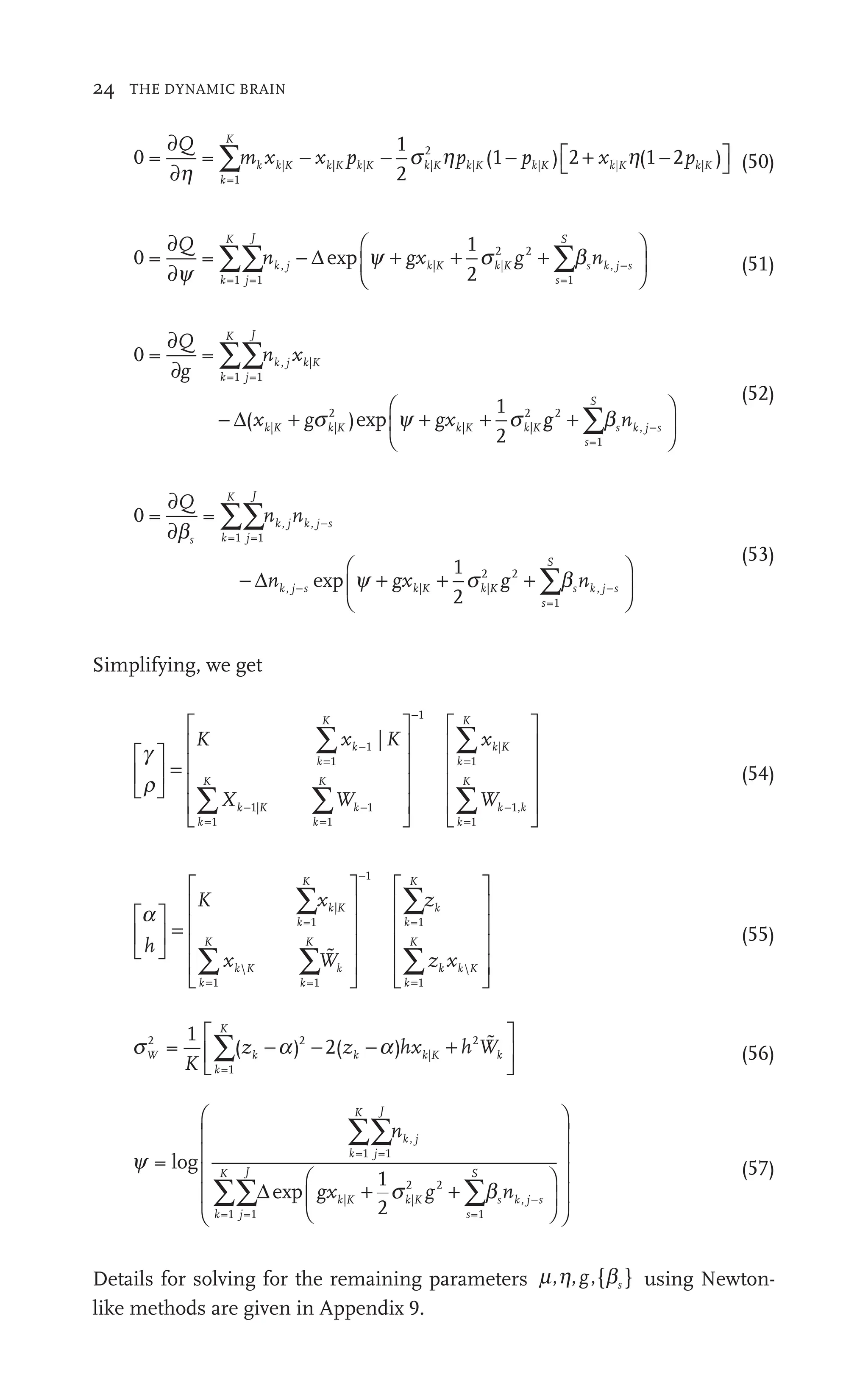
observed data. Appendix B gives the computations that lead to the following
approximate update equations:
g
r
⎡
⎣
⎢
⎡
⎡
⎣
⎣
⎤
⎦
⎥
⎤
⎤
⎦
⎦
=
⎡
⎣
⎢
⎡
⎡
⎢
⎢
⎢
⎢
⎢
⎢
⎢
⎣
⎣
⎢
⎢
⎤
⎦
⎥
⎤
⎤
⎥
⎥
⎥
⎥
⎥
⎥
⎥
⎦
⎦
⎥
⎥
=
=
−
=
∑
∑ ∑
K x
∑
W
∑
x
k K
−
k
K
−
k
K
k
W
W
k
K
k K
1
1
1
1
|
|
|

k
k
K
k k
k
K
Wk
=
=
∑
∑
⎡
⎣
⎢
⎡
⎡
⎢
⎢
⎢
⎢
⎢
⎢
⎢
⎣
⎣
⎢
⎢
⎤
⎦
⎥
⎤
⎤
⎥
⎥
⎥
⎥
⎥
⎥
⎥
⎦
⎦
⎥
⎥
1
1
 ,
(19)
10 THE DYNAMIC BRAIN
a
h
K x
W
z
Z
k
K
k K
k
K
k
K
k
W
W
k
K
k
⎡
⎣
⎢
⎡
⎡
⎣
⎣
⎤
⎦
⎥
⎤
⎤
⎦
⎦
⎡
⎣
⎢
⎡
⎡
⎢
⎢
⎢
⎢
⎢
⎢
⎢
⎣
⎣
⎢
⎢
⎤
⎦
⎥
⎤
⎤
⎥
⎥
⎥
⎥
⎥
⎥
⎥
⎦
⎦
⎥
⎥
∑x
∑ ∑
xk K W
∑z
=
−
=
=1
|
1 =
k 1
1
=1

z x
z
z
k
K
k k
x K

=
∑
⎡
⎣
⎢
⎡
⎡
⎢
⎢
⎢
⎢
⎢
⎢
⎢
⎣
⎣
⎢
⎢
⎤
⎦
⎥
⎤
⎤
⎥
⎥
⎥
⎥
⎥
⎥
⎥
⎦
⎦
⎥
⎥
1
(20)
s a
W
k
K
k k K k
K
z hx h Wk
2
=1
2
|
2
1
( )
a
k a
a
a 2( )
∑ a +
k K
hx
−a |
)
⎡
⎣
⎢
⎡
⎡
⎣
⎣
⎤
⎦
⎥
⎤
⎤
⎦
⎦

(21)
y
s b
=
1
2
=1 =1
=1 =1
| |
s
2
2 2
=1
log
exp
k
K
j
J
k j
,
k
K
j
J
k| K
|
s
S
k
n
gx n
b
g s
∑∑n
∑∑ ∑b
b
b
+ s
s
Δ
∑
∑ ,
, j s
⎛
⎝
⎜
⎛
⎛
⎝
⎝
⎞
⎠
⎟
⎞
⎞
⎠
⎠
⎛
⎝
⎜
⎛
⎛
⎜
⎜
⎜
⎜
⎜
⎜
⎜
⎝
⎝
⎜
⎜
⎞
⎠
⎟
⎞
⎞
⎟
⎟
⎟
⎟
⎟
⎟
⎟
⎠
⎠
⎟
⎟ (22)
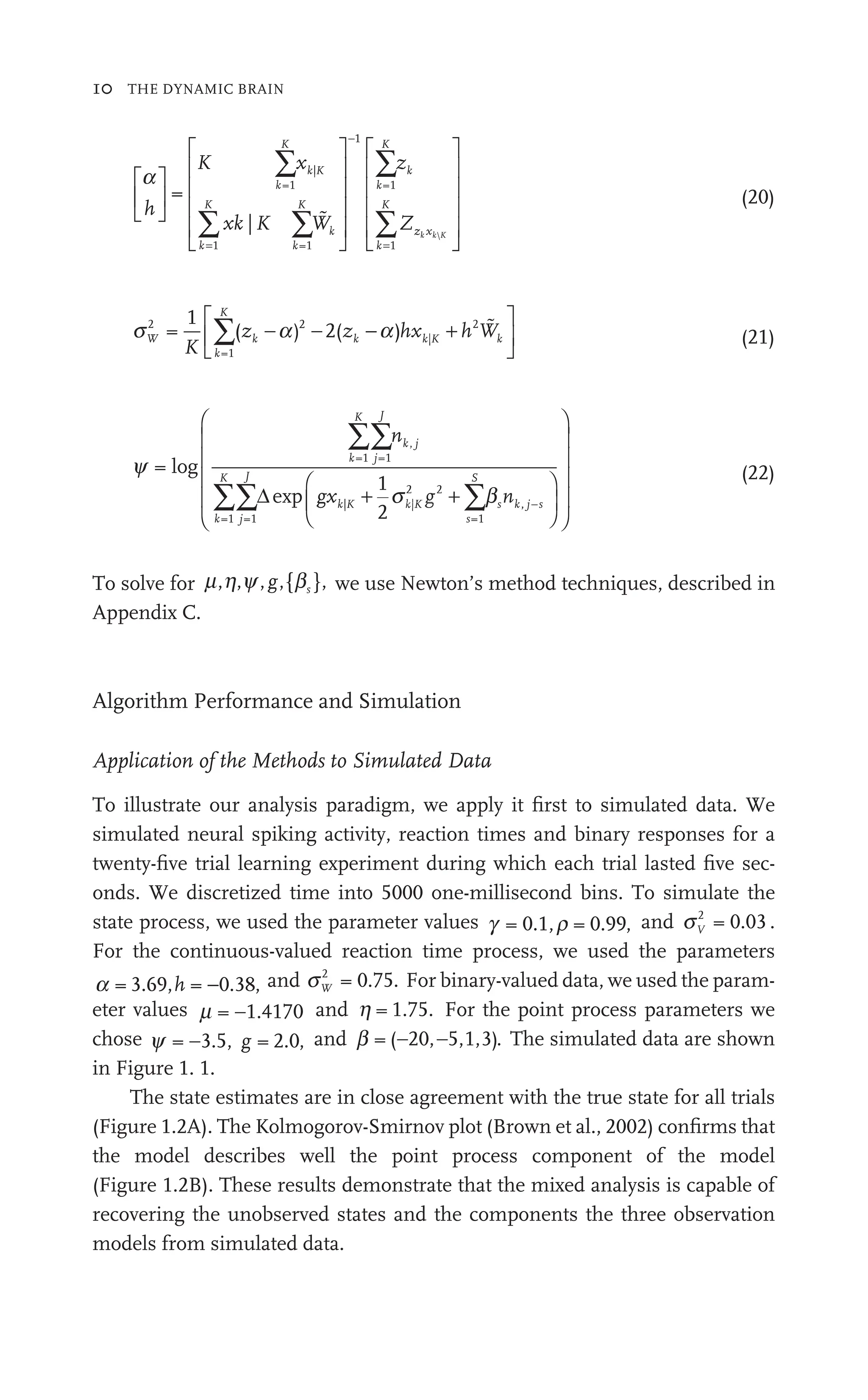
To solve for m h y
,
h { }
b ,
g we use Newton’s method techniques, described in
Appendix C.
Algorithm Performance and Simulation
Application of the Methods to Simulated Data
To illustrate our analysis paradigm, we apply it first to simulated data. We
simulated neural spiking activity, reaction times and binary responses for a
twenty-five trial learning experiment during which each trial lasted five sec-
onds. We discretized time into 5000 one-millisecond bins. To simulate the
state process, we used the parameter values g r
0 1 = 0.99, and sV
2
= 0.03 .
For the continuous-valued reaction time process, we used the parameters
a = 3.69, = 0.38
h − , and sW
2
= 0.75. For binary-valued data, we used the param-
eter values m = 1.4170
− and h = 1.75. For the point process parameters we
chose y = 3.5, = 2.0
− g , and b = ( 20, 5,1,3)
− −
20 . The simulated data are shown
in Figure 1. 1.
The state estimates are in close agreement with the true state for all trials
(Figure 1.2A). The Kolmogorov-Smirnov plot (Brown et al., 2002) confirms that
the model describes well the point process component of the model
(Figure 1.2B). These results demonstrate that the mixed analysis is capable of
recovering the unobserved states and the components the three observation
models from simulated data.
0 2 4 6 8 10 12
x 104
0
0.5
1
Spiking
activity
t
0 5 10 15 20 25
0
0.5
1
trial k
Binary
response
0 5 10 15 20 25
0
2
4
6
trial k
Log
reaction
time
0
(A)
(B)
(C)
(D) 5 10 15 20 25
0
1
2
3
trial k
Cognitive
state
FIGURE 1.1 Visualization of the simulated data. Panel A shows the simulated spiking
activity. Panel B shows the binary responses, with blue (red) corresponding to correct
(incorrect) responses. Panel C shows the log reaction times. Panel D shows the
cognitive state.
0
(A)
(B)
5 10 15 20 25
−0.5
0
0.5
1
1.5
2
2.5
3
trial k
Cognitive
state
x
0 0.1 0.2 0.3 0.4 0.5 0.6 0.7 0.8 0.9 1
0
0.2
0.4
0.6
0.8
1
Theoretical
quantiles
Empirical quantiles
FIGURE 1.2 (A): performance of the recursive estimation procedure. The true cognitive
state is given in black, while estimates are given in red. 95% Confidence intervals are
given with the red dashed lines. (B): Kolmogorov-Smirnov plot confirms that the
model describes well the point process component of the model.
11
12 THE DYNAMIC BRAIN
Application of the Methods to Experimental Data
In this section we apply the analysis paradigm to an actual learning experiment
in which neural spiking activity was recorded along with binary and continu-
ous performance measures as a rhesus monkey executed a location-scene asso-
ciation task described in detail in (Wirth et al., 2003). The experiment consists
of forty-five trials with each trial lasting 3,300 msec. In this task, each trial
started with a baseline period (0 to 400 msec) during which the monkey fixated
on a cue presented on a computer screen. The animal was then presented with
three identical targets (north, east, and west) superimposed on a novel visual
scene (401 to 900 msec). The scene disappeared and the targets remained on
the screen during a delay period (901 to 1600 msec). At the end of the
delay period, the fixation point disappeared cueing the animal to make an eye-
movement to one of the three targets (1,600 to 3,300 msec). For each scene,
only one target was rewarded and three novel scenes were typically learned
simultaneously. Trials of novel scenes were interspersed with trials in which
three well-learned scenes were presented. The probability of a correct response
occurring by chance was 0.33 because there were three locations the monkey
could choose as a response. To characterize learning we reported for all trials
the reaction times (time from the go-cue to the response), the correct and incor-
rect responses, and neural spiking activity recorded in the perirhinal cortex.
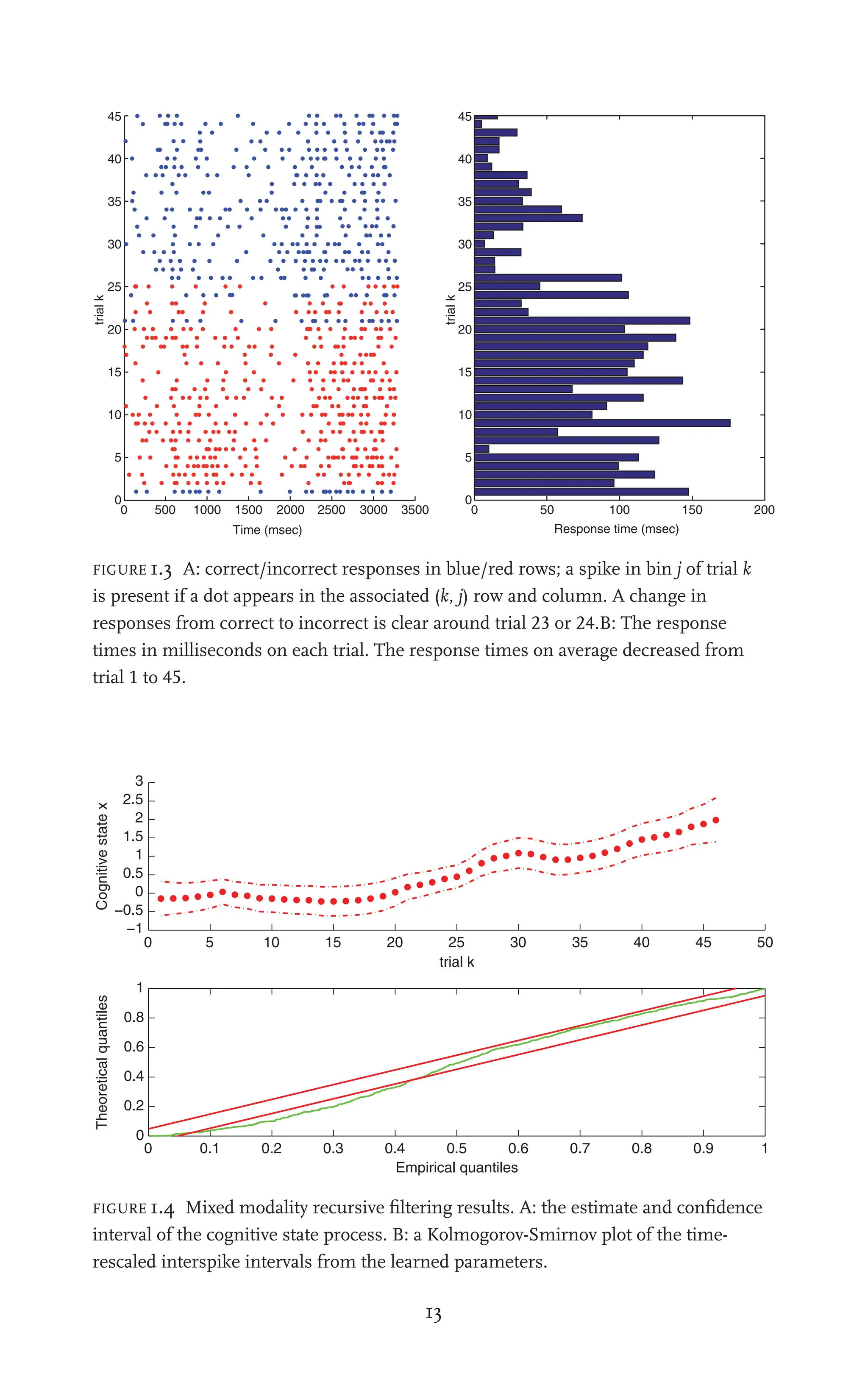
The correct and incorrect responses and neural spiking activity are shown
in Figure 1.3A for one scene. The spiking activity on a trial is red if the behav-
ioral response was incorrect on that trial and blue if the response was correct.
The response times are shown in Figure 1.3B. The animal clearly showed a
change in responses from all incorrect to correct around trial 23 or 24. The
response time decreased from trial 1 to 45. The spiking rate of the neural firing
increased with learning. To analyze the spiking activity we used one millisec-
onds time bins and chose the order of the autoregressive for the spiking activity
equal to 10 milliseconds.
The cognitive state estimates in Figure 1.4A are consistent with the animal
learning the task. The KS plot in Figure 1.4B suggests that the point process
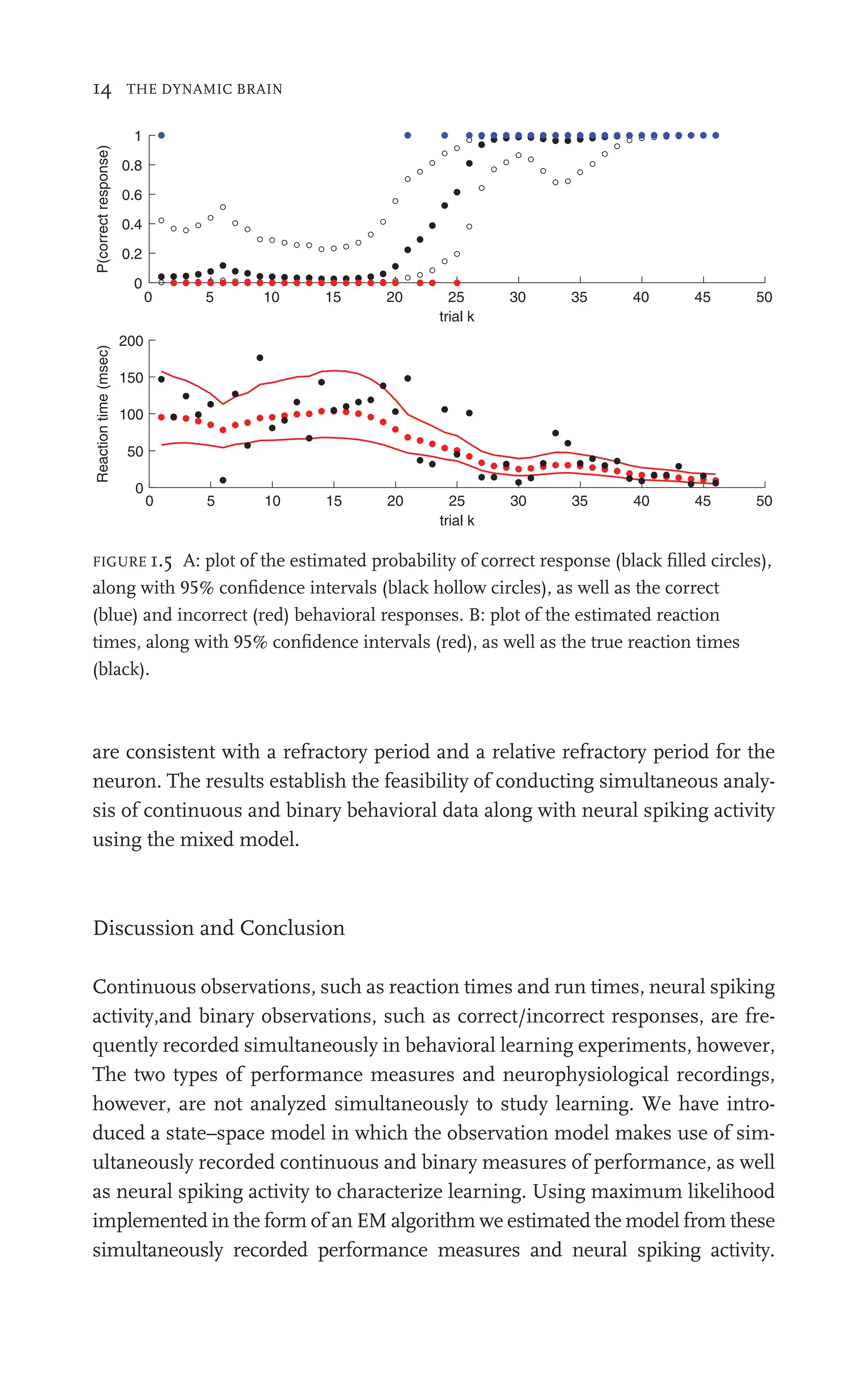
component of the model describes the neural spiking activity well. The learn-
ing curve plot of the probability of correct response, overlayed with the binary
responses, is given by techniques in (Precau, 2009) and shown in Figure 1.5A.
This information, as well as the decrease in the reaction time of Figure 1.5B, is
consistent with learning. The estimated value of the parameter ĝ = 0.0232 is
consistent with increasing spiking activity as the animal learned whereas the
estimated coefficients
b̂ = ( 3.0278, 2.3581, 0.4836, 0.9458, 0.1914, 0.3884,
0.769
− − − − − −
2 3581 0 4836 0 9458 0 1914
− 0,
0
0 0.1783, 0.4119,0.1066)
−
0
0
5
10
20
trial
k
25
30
35
40
45
15
500 1000 1500 2000
Time (msec)
2500 3500
3000 0
0
5
10
20
trial
k
25
30
35
40
45
15
50 100 150 200
Response time (msec)
FIGURE 1.3 A: correct/incorrect responses in blue/red rows; a spike in bin j of trial k
is present if a dot appears in the associated (k, j) row and column. A change in
responses from correct to incorrect is clear around trial 23 or 24.B: The response
times in milliseconds on each trial. The response times on average decreased from
trial 1 to 45.
0 5 10 15 20 25 30 35 40 45 50
−1
−0.5
0
0.5
1
1.5
2
2.5
3
trial k
Cognitive
state
x
0 0.1 0.2 0.3 0.4 0.5 0.6 0.7 0.8 0.9 1
0
0.2
0.4
0.6
0.8
1
Theoretical
quantiles
Empirical quantiles
FIGURE 1.4 Mixed modality recursive filtering results. A: the estimate and confidence
interval of the cognitive state process. B: a Kolmogorov-Smirnov plot of the time-
rescaled interspike intervals from the learned parameters.
13
14 THE DYNAMIC BRAIN
are consistent with a refractory period and a relative refractory period for the
neuron. The results establish the feasibility of conducting simultaneous analy-
sis of continuous and binary behavioral data along with neural spiking activity
using the mixed model.
Discussion and Conclusion
Continuous observations, such as reaction times and run times, neural spiking
activity,and binary observations, such as correct/incorrect responses, are fre-
quently recorded simultaneously in behavioral learning experiments, however,
The two types of performance measures and neurophysiological recordings,
however, are not analyzed simultaneously to study learning. We have intro-
duced a state–space model in which the observation model makes use of sim-
ultaneously recorded continuous and binary measures of performance, as well
as neural spiking activity to characterize learning. Using maximum likelihood
implemented in the form of an EM algorithm we estimated the model from these
simultaneously recorded performance measures and neural spiking activity.
0 5 10 15 20 25 30 35 40 45 50
0
0.2
0.4
0.6
0.8
1
trial k
P(correct
response)
0 5 10 15 20 25 30 35 40 45 50
0
50
100
150
200
trial k
Reaction
time
(msec)
FIGURE 1.5 A: plot of the estimated probability of correct response (black filled circles),
along with 95% confidence intervals (black hollow circles), as well as the correct
(blue) and incorrect (red) behavioral responses. B: plot of the estimated reaction
times, along with 95% confidence intervals (red), as well as the true reaction times
(black).
1: A MIXED-FILTER ALGORITHM 15
We illustrated the new model and algorithm in the analysis of simulated data
and data from an actual learning experiment.
The computational innovation that enabled our combined model analysis
is the recursive filter algorithm for mixed observation processes, i.e. continu-
ous, point process and binary observations, the fixed-interval smoothing algo-
rithm, and an approximate EM algorithm for combined cognitive state and
model parameter estimation. Our mixed recursive filter algorithm (Smith
et al., 2004) combines the well-known Kalman filter with a recently developed
binary filter (Precau et al., 2008) and the point process filter (Brown et al., 1998;
Barbieri et al., 2004; Eden et al., 2004). In this way, the mixed filter makes pos-
sible simultaneous dynamic analysis of behavioral performance data and
neural spiking activity.
Several extensions of the current work are possible to more complex
models of performance and neural spiking data. These model extensions could
be fit by constructing the appropriate extensions of our EM algorithm. An alter-
native approach would be to formulate the model parameter estimation as
a Bayesian question and take advantage of readily available Bayesian analysis
software packages such as BUGS to conduct the model fitting (Smith et al.,
2007).
The question we have studied here of simultaneously analyzing perfor-
mance data and neural spiking activity offers a solution to the now ubiquitous
problem of combining information dynamically from different measurement
types. Possible extensions of this paradigm in neuroscience include combining
information from local field potentials and ensemble neural spiking activity to
devise algorithms for neural prosthetic control. Another extension of this
approach is to functional neural imaging studies in which combinations of
functional magnetic resonance imaging, electroencephalographic and magne-
toencephalographic recordings are made simultaneously or in sequence.
Again, the state–space modeling framework provides an optimal strategy for
combining the information from the various sources. We will investigate these
theoretical and applied problems in future investigations.
Acknowledgments
Support was provided by National Institutes of Health Grants DA-015644
to E. N. Brown and W. Suzuki; DPI0D003646, MH-59733, and MH-071847
to E. N. Brown; and by the AFOSR Complex Networks Program via Award
No. FA9550-08-1-0079 to T. P. Coleman.
16 THE DYNAMIC BRAIN
REFERENCES
Barbieri, R., Frank, L.M., Nguyen, D.P., Quirk, M.C., Solo, V., Wilson, M. A. and
Brown, E.N. (2004). Dynamic analyses of information encoding by neural
ensembles. Neural Computation, 16, 2: 277–308.
Barnes, T.D., Kubota, Y., Hu, D., Jin, D.Z., and Graybiel, A.M. (2005). Activity of
striatal neurons reflects dynamic encoding and recoding of procedural memories.
Nature, 437 (7062), 1158–1161.
Brown, E.N., Frank, L.M., Tang, L.M., Quirk, M.C. and Wilson, M. (1998). A statistical
paradigm for neural spike train decoding applied to position prediction from
ensemble firing patterns of rat hippocampal place cells. J of Neuroscience, 18,
7411–7425.
Brown, E.N., Barbieri, R., Kass, R.E., and Frank, L.M. (2002) The time-rescaling
theorem and its application to neural spike train data analysis. Neural
Computation, 14, 2, 325–346.
Chiu, C.C., Varun, S., Smith, A.C., Brown, E.N., Suzuki, W.A., Wirth, S. and Avsar, E.
(2009). Trial outcome and associative learning signals in the monkey
hippocampus. Neuron, 61, 6, 930–940.
Dempster, A.P., Laird, N.M., Rubin, D.B. (1977). Maximum likelihood from
incomplete data via the EM algorithm. J of the Royal Statistical Society. Series B
(Methodological), 39, 1, 1–38.
Doucet, A., De Freitas, N., and Gordon, N. (2001). Sequential Monte Carlo methods in
practice. New York, NY: Springer Verlag.
Durbin, J. and Koopman, S.J. (2001). Time series analysis by state space methods.
Oxford, UK: Oxford University Press.
Eden, U.T., Frank, L.M., Barbieri, R., Solo, V. and Brown, E.N. (2004). Dynamic
analyses of neural encoding by point process adaptive filtering. Neural
Computation, 16, 5, 971–998.
Fahrmeir, L., Tutz, G., and Hennevogl, W. (2001). Multivariate statistical modeling based
on generalized linear models. New York, NY: Springer Verlag.
Gallistel, C.R. (2008). Learning and representation. Learning and memory: A
comprehensive reference. Maryland Heights, MO: Elsevier, 2008.
Jog, M.S., Kubota, Y., Connolly, C.I., Hillegaart, V. and Graybiel, V. (1999). Building
neural representations of habits. Science, 286, 5445, 1745–1749.
Karlsson, M.P. and Frank, L.M. Network dynamics underlying the formation
of sparse, informative representations in the hippocampus. J of Neuroscience,
28, 52, 14271.
Kitagawa, G. and Gersch, W. (1996). Smoothness priors analysis of time series. New York,
NY: Springer Verlag.
Law, J.R., Flanery, M.A., Wirth, S., Yanike, M., Smith, A.C., Frank, L.M., Suzuki, W.A.,
Brown, E.N. and Stark, C.E.L. (2005). Functional magnetic resonance imaging
1: A MIXED-FILTER ALGORITHM 17
activity during the gradual acquisition and expression of paired-associate memory.
J of Neuroscience, 25, 24, 5720–5729.
Mendel, J.M. (1995). Lessons in estimation theory for signal processing,
communications, and control. Englewood Cliffs, N.J.: Prentice Hall.
Prerau, M.J., Smith, A.C., Eden U.T., Kubota, Y., Yanike, M., Suzuki, W.,
Graybiel, A.M., and Brown, E.N. (2009). Characterizing learning by simultaneous
analysis of continuous and binary measures of performance. J of Neurophysiology,
3060–3072.
Prerau, M.J., Smith, A.C., Eden, U.T., Yanike, M., Suzuki, W.A. and Brown, E.N.
(2008). A mixed filter algorithm for cognitive state estimation from
simultaneously recorded continuous and binary measures of performance.
Biological Cybernetics, 99, 1, 1–14.
Shumway, R.H. and Stoffer, D.S. (1982). An approach to time series smoothing and
forecasting using the EM algorithm. J of Time Series Analysis, 3, 4, 253–264.
Siegel, S. and Castellan, N. J. (1988). Nonparametric statistics for the behavioral sciences.
New York: McGraw-Hill.
Smith, A.C. and Brown, E.N. (2003). Estimating a state–space model from point
process observations. Neural Computation, 15, 965–991.
Smith, A.C., Frank, L. M., Wirth, S., Yanike, M., Hu, D., Kubota, Y., Graybiel, A. M.,
Suzuki, W. and Brown, E. N. (2004). Dynamic analysis of learning in behavioral
experiments. J of Neuroscience, 24, 2, 447–461, 2004. E.N.
Smith, A.C., Scalon, J. D., Wirth, S., Yanike, M., Suzuki, W. A. and Brown, E. N. (2010).
State–space algorithms for estimating spike rate functions. Computational Intelligence
and Neuroscienc, vol. 2010, article ID 426539, 14 pages. doi:10.1155/2010/426539.
Smith, A.C., Stefani, M. R., Moghaddam, B., and Brown, E. N. (2005). Analysis and
design of behavioral experiments to characterize population learning. J of
Neurophysiology, 93, 1776–1792.
Smith, A.C., Wirth, S., Suzuki, W.A. and Brown, E.N. (2007). Bayesian analysis of
interleaved learning and response bias in behavioral experiments. J of
Neurophysiology, 97, 3, 2516–2524.
Williams, Z.M., and Eskandar, E.N. (2006). Selective enhancement of associative
learning by microstimulation of the anterior caudate. Nature Neuroscience, 9, 4,
562–568.
Wirth,S., Yanike, M., Frank, L.M., Smith, A.C., Brown, E.N. and Suzuki, W.A. Single
neurons in the monkey hippocampus and learning of new associations. Science,
300, 5625, 1578–1581.
Yanike, M., Wirth, S., Smith, A.C., Brown, E.N. and Suzuki, W.A. (2009). Comparison
of associative learning-related signals in the macaque perirhinal cortex and
hippocampus. Cerebral Cortex, 19, 5, 1064–1078.
18 THE DYNAMIC BRAIN
APPENDIX
A Details of the Recursive Filter
In this section, we provide details of the derivation of equations (8)-(12). Our
objective is to construct a recursive filter to estimate the state Xk at trial k
from Yk
{ }
Z M N
k
Z k k
N
,
Z , . The standard approach to deriving such a filter is to
express recursively the probability density of the state given the observations.
For events { }
A B C
, ,
B , we have from Bayes’ rule that
P B C
P A
P C
P C P B C
P C
( |
A , )
C =
( , | )
B C
( |
B )
=
( |
A ) (
P | ,
A )
( |
B )
(23)
Denote A according to { }
X x
k k
x , B according to { }
Y y
k k
Y y
Y , and C accord-
ing to { }
Y y
k k
yk
y −
k . Then we have
f
f
f
X
f
f
k Y
X
f
f
k Y k k
Y
f
f
k
Y
Y Y
|
| |
|
=
fY
f
f
k
Y
Y Xk
|
( )
xk
x k
| yk
( )
xk
x k 1
| yk 1
( )
xk
x
|
yk
( )
y y
k
y k
| −1
1
=
| | | |
f
|
P |
f
X
f
f
k Y 1 Mk k k Xk k k
( )
| 1
xk
x k
( )
|
| x
|
|
|
| ( )
|
nk | ( )
| x
| k
| x
|
Y
Y
f
f
f
f
k
Y
Y Yk
|
( )
k
k
y y
k
1
| −
∝ ( ) ( ) ( ) ( )
f ( P (
X
f
f
k Y
(
− Mk k k Xk k k
| | |
( )P
k N
P
P
k |
) (
P
) M
P
P
k | (
Xk
) (
f
) Z
f
f
k Xk
| (24)
and the associated one-step prediction probability density or Chapman-
Kolmogorov equation is
f f d
X
f
f
k Y X
f
f
k Yk k k
| 1| | 1
f
f
f
− −
( )
xk
x k 1
| yk 1
( )
xk
x k
1
k
x 1
| yk 1
( )
xk
x 1
|
xk −
∫f x
xk−1 (25)
Together (24) and (25) define a recursion that can be used to compute the
probability of the state given the observations.
We derive the mixed filter algorithm by computing a Gaussian approxima-
tion to the posterior density f x
X
f
f
k Y
k
|
|
( )
x y
k
x k
| in (24). At time k, we assume the
one-step prediction density (25) is the Gaussian density
f
X
f
f
k Y
|
.
( )
xk
x k 1
| yk 1
( )
k
| | 1
k
2
,
xk| 1
k k k
,
1
N (26)
1: A MIXED-FILTER ALGORITHM 19
To evaluate xk k
| −1 and sk k
| ,
−1
2
we note that they follow in a straightforward
manner:
x X Y y x
k
k k
y k
| |
X Y y x
k k k
|Y
X Y
Xk |
⎡
⎣ ⎤
⎦
⎤
⎤ = +
1
k
y −
k
1
k−
k
E r
+ (27)
sk| 1
k
2
= var
var ( )
k k
Y y
k
k
Yk 1
|
k
X
X −
k
(28)
= ( )
| = 1
Y
| y
k k
1
y
1
(29)
= 2
1| 1
2 2
r s
2
s
k k
1| V
−
k
1| + (30)
Substituting all these equations together, then we have that the posterior
density can be expressed as
f
X
f
f
k Y
k
k
|
2
| 1
k
2
1
{
( )
x x
k k
x | 1
k
2
[ (
k
p 1 )
pk ]
( )
xk
x k
| yk
[ (
pk
p 1 +
−
l
m
|
2
{
( )
k k| 1
k
2
−
{ + m g
s
lo
l
l g(1 )
− pk
− + ( )
∑
( )
2
}
2
2
=1
(
h
− −
n
∑
∑
W j
J
k j
, k j
,
s
l
)−
log Δ
⇒ ( )
− + −
log
l g
f (
C y m p
X
f
f
k Y
(
k
k
k g
og k
|
|
2
| 1
−
k
2
= (
C )
( )
x x
−
k k
x | 1
−
k
2
[ (
k
p 1
s
) ]
)
) (1 )
1
−
(1
+ log pk
(31)
− + ( )
∑
( )
2
2
2
=1
(
h
− −
n
∑
∑
W j
J
k j
, k j
,
s
l
)−
log Δ (32)
Now we can compute the maximum-a-posteriori estimate of xk and its
associated variance estimate. To do this, we compute the first and second deriv-
atives of the log posterior density with respect to xk , which are respectively
0 = =
( ) ( )
| |
| 1
2 2
∂ ( )
|
∂
− + +
log f
|
(
x
h z
( h
X
f
f
k Y
(
k k| W
s s
h
h( )
+∑
j
J
j j
g
∑
∑
=1
j
( )
−
k j k j
n j k
l Δ
20 THE DYNAMIC BRAIN
∂ ( )
∂
− − − ∑
2
|
2
| 1
2
2
2
2
=1
2
=
1
( )
log f (
|
x
h
p g
∑
X
f
f
k Y
(
k k W
1
−
k k
( p
(
j
J
s s
| 1
2
k 1
h l
− ∑
2 2
(1 )
p p
−
(1 g
∑
∑
k
p
(1 k j
k
k Δ
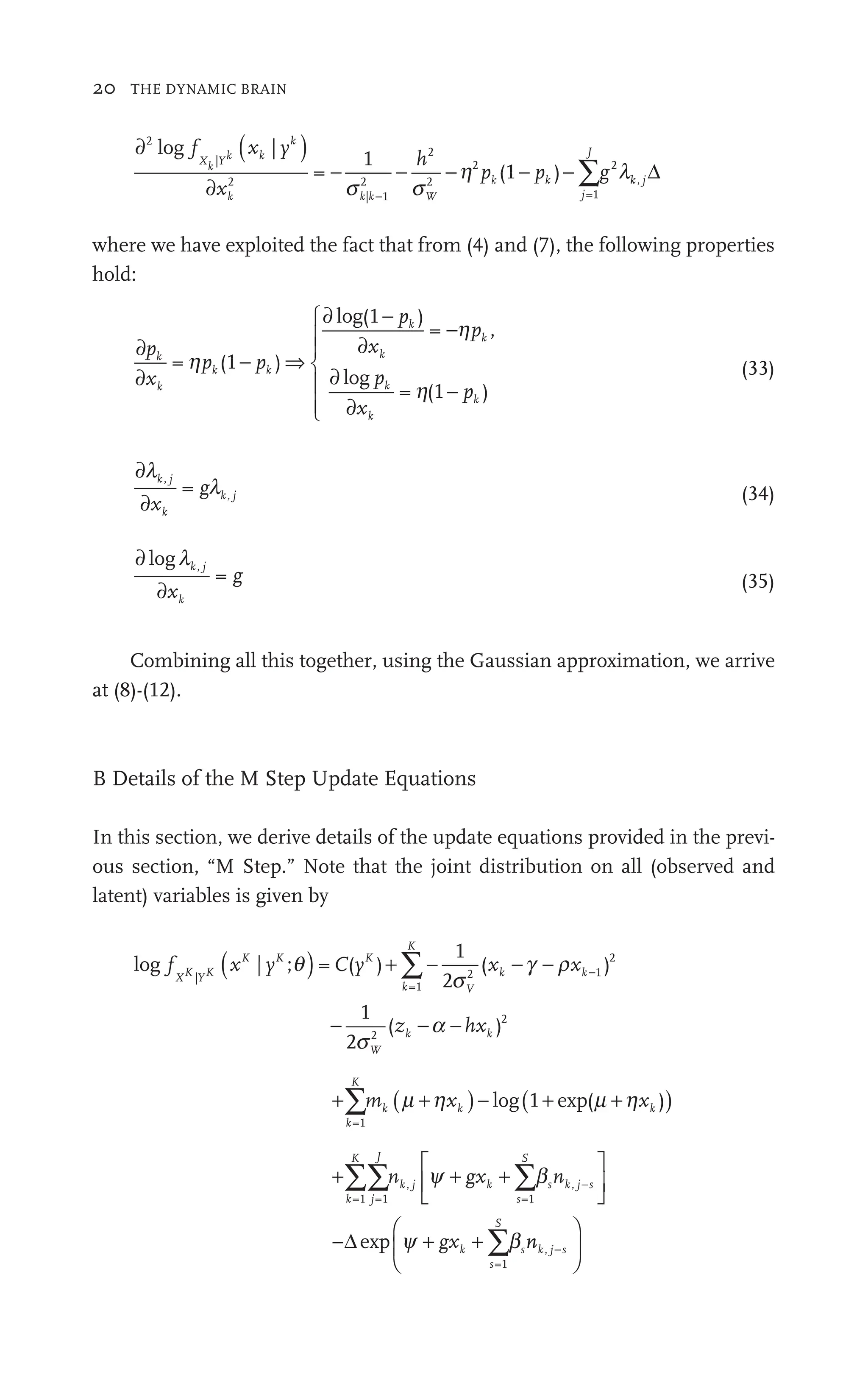
where we have exploited the fact that from (4) and (7), the following properties
hold:
∂
∂
⇒
∂ −
∂
∂
∂
⎧
⎨
⎪
⎧
⎧
⎪
⎨
⎨
⎪
⎪
⎩
p
∂
x
p
x
p
p
x
k
k
k
k
k
k
k
= (
pk 1 )
−
− k
p
( )
,
pk
= −
= (1 )
− pk
h
g
log
⎪
⎪
⎨
⎨
⎨
⎨
⎪
⎩
⎩
⎪
⎪
⎪
⎪
(33)
∂
∂
l
l
k j
k
k j
x
gl
l
= (34)
∂
∂
loglk j
k
x
g
= (35)
Combining all this together, using the Gaussian approximation, we arrive
at (8)-(12).
B Details of the M Step Update Equations
In this section, we derive details of the update equations provided in the previ-
ous section, “M Step.” Note that the joint distribution on all (observed and
latent) variables is given by
log f C y
z
X
f
f
Y
K
k
K
V
W
k
|
=1
2
2
2
= (
C )
1
2
( )
x x
k k
x 1
1
2
(
s
s
( )
xK K
| ;
yK
y q +
−
∑
∑
− −
−
−a hxk )2
+ ( )
+ − ( )
+
∑
k
K
k (
m
∑ k (
=1
+
+
+
+ +
log( +
+
⎡
⎣
⎡
⎡
⎣
⎣
⎤
⎦
⎥
⎤
⎤
⎦
⎦
−
∑∑ ∑
∑
k
K
j
J
j k
s
S
s k j s
−
k
s
S
s
n g
⎣
⎢
⎣
⎣
∑ k j n
s
g
=1 =1 =1
,
=1
b
∑
∑
k
y b
+ + ∑
g
+ x + ∑
k
g
g
y b
+ + ∑
∑
k
gx
Δexp n
nk j s
−
⎛
⎝
⎜
⎛
⎛
⎝
⎝
⎞
⎠
⎟
⎞
⎞
⎠
⎠
1: A MIXED-FILTER ALGORITHM 21
Note that the expected log-likelihood
Q  { }
Y y
X Y
K K
y
f
X
f
f K YK
f |
|
f K K ( )
K K
|
K
;
YK
Y
|
xK
; has linear terms inE Yk k
y
[ |
Xk = ]
yk
y
along with quadratic terms involving  
W 
k j
W
W ,
E{ }
X X
k j
X K K
|Y y
K K
y except for a
couple of terms, including E Y
gx k k
y
[ |
e
gxk
= ]
yk
y . We note that if  ∼
X N ( )
m s2
then
its moment generating function M t E ext
( )
t [ ]
ext
 
is given by
M t e
ut t
( )
t = .
e
1
2
2 2
t
+ s
(36)
With this, we have
Q C X X y
Z
K
k
K
V
K K
y
W
k
( )
y
1
2
( )
X X
k k
X | =
YK
1
2
(
=1
2
2
2
q
s
s
a
X
⎡
⎣ ⎤
⎦
⎤
⎤
−
Z
(
− −
∑
∑ E
E hX
h
h Y y
k
k k
y
) |
2
⎡
⎣
⎡
⎡ ⎤
⎦
⎤
⎤
+ ( )
+ − ( )
+
⎡
⎣
⎡
⎡ ⎤
⎦
⎤
⎤
∑
k
K
k ( ) ⎡
⎣
⎡
⎡ k k
m
∑ k ( Y y
=1
+ |
)
) =
+
+
+ +
+
E l g(
( +
+
(37)
+
⎛
⎝
⎞
⎠
⎟
⎞
⎞
⎠
⎠
−
∑ ∑
⎛
⎛
⎛
∑
k
K
s
S
s k j s
−
k
s
S
s k
∑ n
s
g n
=1
|
⎝
⎝
⎝
⎝
j
⎝
⎜
⎝
⎝ =1
,
=1
,
b
∑
∑b
∑
+ +
+ ∑
+
+
y b
+ + ∑
∑
k
gX
E e p j
j s
K K
y
−
⎛
⎝
⎜
⎛
⎛
⎝
⎝
⎞
⎠
⎟
⎞
⎞
⎠
⎠
⎡
⎣
⎢
⎡
⎡
⎣
⎣
⎤
⎦
⎥
⎤
⎤
⎦
⎦
Δ | =
K
YK
(38)
= ( )
1
2
2 2 2
2
=1
| 1,
2
1|
2
1
C y
( W 2 1
W x
2
2
W
K
V k
K
k k
W
W 2 k k K k
W
W
W
− 2 W 1 +
2
∑W
∑W
W 1 k −
s
|
k
x 2
2
2 2
2
2 r
1|
k
x K +
1|
xk
x K
−
k
  
⎡
⎡
⎣
⎢
⎡
⎡
⎡
⎡
⎣
⎣
⎤
⎦
⎥
⎤
⎤
⎦
⎦
− +
⎡
⎣
⎢
⎡
⎡
⎣
⎣
⎤
⎦
⎥
⎤
⎤
⎦
⎦
∑
1
2
( ) 2( )
2
=1
2
|
2
s
a
−
) 2(
2
W k
K
k
) (
) ( k K
| k
− −
) 2(
2
) 2( hx h W
2
k

+ ( )
+ − ( )
+
⎡
⎣
⎡
⎡ ⎤
⎦
⎤
⎤
∑
k
K
k ( ) ⎡
⎣
⎡
⎡ K K
m
∑ k ( Y y
=1
+ |
)
) =
+
+
+ +
+
E l g(
( +
+ (39)
+
⎛
⎝
⎞
⎠
⎟
⎞
⎞
⎠
⎠
− + +
∑ ∑
⎛
⎛
⎛
k
K
s
S
s k j s
−
k K
∑ n
s
g g
=1
|
⎝
⎝
⎝
⎝
j
⎝
⎜
⎝
⎝ =1
,
|
k
|K
2
1
2
b
∑
∑b
∑
+ +
+ ∑
+
+
y s
+ +
k
gx | +
K
Δe p 2
2
=1
,
+
⎛
⎝
⎜
⎛
⎛
⎝
⎝
⎞
⎠
⎟
⎞
⎞
⎠
⎠
∑
s
S
s k j s
−
n
b
∑
∑
(40)
where in going from (38) to (40), we have used the (36).
22 THE DYNAMIC BRAIN
We now rely upon the Taylor series approximation around xk K
|
E X Y
k
K K
K
[ ( )| = ]
yK
( )
xk
1
2
( )
xk K
| |
k
)
K
2
2
|
r
X Y
k
( )| ]
yK
y s r
K
k
2
+ ′′
Let us now consider the conditional expectation term involves
log( )
1 (
exp )
+
(
exp +
r
m m h
1( ) =
( )
m h
1 ( )
= ,
x
p
k
k

∂ ( )
m h
( )
xk
+
1 +
∂ +
m
(
g(1
1 exp
(41)
r
h m h
2( ) =
( )
m h
1 ( )
=
x (m h
x
x p
k (m h
(m h
k
k k
p

∂ ( )
m h
( )
xk
+
1 +
∂ +
m
(
g(1
1 e p
(42)
Note from before that
′ −
r1
2
( ) = (
h 1 )
− = (
h )
h p
) = (
h p
) =
) = h k
) (p
) = (
h k
⇒ ′′
r h h
1 ( ) = [
h (1 ) 2 (1 )]
−
p − p p
−
(1
k k k
( ) p
p
( ) k k
( p
(1
= (1 )(1 2 )
2
p
(1 k
( p
(1 −
)(1
p
Thus we have that
f m Y y
k
K
k
K K
y
f
f
=1
|
m
∂
∂
( )
xk
x K
|
m h
+ ( )
Xk
X
1 ( )
⎡
⎣ ⎤
⎦
⎤
⎤
⎧
⎨
⎧
⎧
∑m
m E l g(
⎩
⎩
⎨
⎨
⎨
⎨
⎫
⎬
⎫
⎫
⎭
⎬
⎬ (43)
= ∑
k
K
k k
K K
m X
−
∑
∑ k YK
=1
( )| = ]
K
y
E (44)

k
K
k k K k K
m p
k p p
k
=1
| |
K k
2 2
| |
K k
p
K |
1
2
(1 )(1
)(1 2 )
k K
p |
∑m −
p −
p )(1
s h
K
|
k
2
(45)
Let us now consider r2( ) x
) = p
k
) x
) = k . Note from (42) that
′ ′
r r
2 1
r
( ) [ ( )]
k
)
= ( ) ( )
) x
k
(
( k
′( )
)
x
( k
(x
(
(
1: A MIXED-FILTER ALGORITHM 23
⇒ ′′ ′ ′ ′′
r2( ) = (
′
r ) (
+ ′
r1 ) (
+ ′′
r
+ 1
r )
x
(
r + x
k
) (
1
r x
(
r1
r k )+
+ k
= 2 ( ) ( )
1 1
(
′ + ′′
r r
( )
1( +
)+ k
)
)
)
)
)+
= 2 (1 ) (1 )(1 2 )
2
h (1 )
p (1 p )(1 2
k k
( p
(
(1 k )( 2
)(1 2
)
) − p )(1
= (1 )
(1 )
(1
(
(
(1 )
)[ ]
2 (1 2 )
2 p
(1 2 k
( p
(1 2
2
2
Thus we have that
f m Y y
k
K
k
K K
y
f
f
=1
|
h
∂
∂
( )
xk
x K
|
m h
+ ( )
xk
x
1 ( )
m h
1 +
⎡
⎣
⎡
⎡ ⎤
⎦
⎤
⎤
⎧
⎨
⎧
⎧
∑m
m E l g(1
1
⎩
⎩
⎨
⎨
⎨
⎨
⎫
⎬
⎫
⎫
⎭
⎬
⎬ (46)
= [ ( )| = ]
=1
| 2
[
k
K
k k (
2
[ K K
)| y
∑ E r (47)

k
K
k k K k K k K k
m x
k x p
K pk xk
=1
| |
K k
xk | |
K k
2
| |
K k
K | |
K
K
1
2
(1 ) 2 (1 2 )
K
p |
k
p
∑m − −
x p +
2
− K
p |
k
p )
s h
K
|
k
2
h
⎡
⎡
⎣ ⎤
⎦
⎤
⎤ (48)
Thus we differentiate to find a local minimum
0 = =
1
2
=1
| 1|
∂
∂
− − + +
⎡
⎣
⎢
⎡
⎡
⎣
⎣
⎤
⎦
⎥
⎤
⎤
⎦
⎦
∑
Q
x x
| +
V k
K
k|
| K
1|
g s
r
+
+
0 = =
1
2
=1
, | 1
∂
∂
− − +
⎡
⎣
⎢
⎡
⎡
⎣
⎣
⎤
⎦
⎥
⎤
⎤
⎦
⎦
∑ −
Q
W x
+ W
V k
K
k k
1,
−1
W
W 1 k K
1| k
W
W
r s
g r
+
|
xk K
1|
1|
−
 
0 = =
1
2
=1
|
∂
∂
− −
⎡
⎣
⎢
⎡
⎡
⎣
⎣
⎤
⎦
⎥
⎤
⎤
⎦
⎦
∑
Q
z h
+ x
W k
K
k k
h
+ x K
a s
a
∑
∑
0 = =
1
( )
2
=1
|
∂
∂
− − +
) |
⎡
⎣
⎢
⎡
⎡
⎣
⎣
⎤
⎦
⎥
⎤
⎤
⎦
⎦
∑
Q
h
) hW
W k
K
k
)x
)
) K k
+ hW
W
s

0 = =
1
]
( ) 2( )
2 2
2[ 2
2
=1
2
|
2
∂
∂
− −
)
⎡
⎣
⎢
⎡
⎡
⎣
⎣
⎤
∑
Q
(
K 2
+
2
∑ z h
)
− ) x h
+
| W
W W
[
W
k
K
k
) 2(z k K
|
|
| k
W
W
s s
2[
2
2[
W 2[
s (
∑(
+
2
∑
W a 
⎦
⎦
⎥
⎤
⎤
⎦
⎦
⎦
⎦
0 = =
1
2
(1 )(1 2 )
=1
| |
2
2 2
| |
( |
∂
∂
− −
)(1
∑
Q
m p
−
∑
∑ p p
(1
| (1−
k
K
k k
p
2
K k
p (
(1 K )(1 2
m
s h
|
2
K (49)
24 THE DYNAMIC BRAIN
0 = =
1
2
(1 ) 2 (1
=1
| | | |
2
2
| |
( |
∂
∂
− − − +
) 2
| −
∑
Q
m x
∑
∑ x p
|
x p p (1
| (1− x
k
K
k k
x K k
p
2
K k
p (
(1 k
2 +
2 x
K )
) K
h
s h
|
2
K h 2 )
2
2 |
⎡
⎣ ⎤
⎦
⎤
⎤ (50)
0 = =
1
2
=1 =1
, | |
2 2
=1
,
∂
∂
+ + +
2 2
⎛
∑∑ ∑
Q
n , −
∑
∑ g
2
| |
|
2
n
k
K
j
J
,
, | |
|
s
S
s k
n j s
−
y
+ +
g
+ x
2
| +
g
g | b
∑
∑
Δ
⎝
⎝
⎛
⎛ ⎞
⎠
⎟
⎞
⎞
⎠
⎠
(51)
0 = =
( )
1
2
=1 =1
, |
| |
2
| |
2
2
∂
∂
− ( + +
|
∑∑
Q
g
∂
n x
∑
∑
gx
k
K
j
J
k, K
|
k|
| K
|
Δ y
) s
p g n
g
g
s
S
k
n j s
2
=1
,
+
⎛
⎝
⎛
⎛
⎝
⎝
⎞
⎠
⎟
⎞
⎞
⎠
⎠
∑b
∑
(52)
0 = =
1
2
=1 =1
| |
2 2
∂
∂
− + + +
2 2
∑∑ −
Q
n n
∑
∑
n g
2
| |
|
2
s k
K
j
J
k j
, k j
, s
j
,
,
2 s
b
+ +
g
+ x | +
g
g
2
+
Δ
=1
=
=
,
S
s k j s
n
∑
⎛
⎝
⎛
⎛ ⎞
⎠
⎟
⎞
⎞
⎠
⎠
b
∑
∑
(53)
Simplifying, we get
g
r
⎡
⎣
⎢
⎡
⎡
⎣
⎣
⎤
⎦
⎥
⎤
⎤
⎦
⎦
=
⎡
⎣
⎢
⎡
⎡
⎢
⎢
⎢
⎢
⎢
⎢
⎢
⎣
⎣
⎢
⎢
⎤
⎦
⎥
⎤
⎤
⎥
⎥
⎥
⎥
⎥
⎥
⎥
⎦
⎦
⎥
⎥
−
=
=
−
=
−
∑
∑ ∑
K x
∑ K
W
∑
x
k
k
K
−
k
K
k
W
W
k
K
k
1
1
1
1
1
1
|
|
|K
K
k
K
k k
k
K
Wk
=
=
∑
∑
⎡
⎣
⎢
⎡
⎡
⎢
⎢
⎢
⎢
⎢
⎢
⎢
⎣
⎣
⎢
⎢
⎤
⎦
⎥
⎤
⎤
⎥
⎥
⎥
⎥
⎥
⎥
⎥
⎦
⎦
⎥
⎥
1
1
,
(54)
a
h
K x
W
z
z
k
K
k K
k
K
k
K
k
W
W
k
K
k
⎡
⎣
⎢
⎡
⎡
⎣
⎣
⎤
⎦
⎥
⎤
⎤
⎦
⎦
=
⎡
⎣
⎢
⎡
⎡
⎢
⎢
⎢
⎢
⎢
⎢
⎢
⎣
⎣
⎢
⎢
⎤
⎦
⎥
⎤
⎤
⎥
⎥
⎥
⎥
⎥
⎥
⎥
⎦
⎦
⎥
⎥
∑x
∑ ∑
x W
k K
∑z
=
−
=1
|
1 =
k 1
1
=1


k k
k
k K
k
K
x 
=
∑
⎡
⎣
⎢
⎡
⎡
⎢
⎢
⎢
⎢
⎢
⎢
⎢
⎣
⎣
⎢
⎢
⎤
⎦
⎥
⎤
⎤
⎥
⎥
⎥
⎥
⎥
⎥
⎥
⎦
⎦
⎥
⎥
1
(55)
s a
W
k
K
k k K k
K
z hx h Wk
2
=1
2
|
2
1
( )
a
k a
a
a 2( )
∑ a +
k K
hx
−a |
)
⎡
⎣
⎢
⎡
⎡
⎣
⎣
⎤
⎦
⎥
⎤
⎤
⎦
⎦

(56)
y
s b
=
1
2
=1 =1
=1 =1
| |
s
2
2 2
=1
log
exp
k
K
j
J
k j
,
k
K
j
J
k| K
|
s
S
k
n
gx n
b
g s
∑∑n
∑∑ ∑b
b
b
+ s
s
Δ
∑
∑ ,
, j s
⎛
⎝
⎜
⎛
⎛
⎝
⎝
⎞
⎠
⎟
⎞
⎞
⎠
⎠
⎛
⎝
⎜
⎛
⎛
⎜
⎜
⎜
⎜
⎜
⎜
⎜
⎝
⎝
⎜
⎜
⎞
⎠
⎟
⎞
⎞
⎟
⎟
⎟
⎟
⎟
⎟
⎟
⎠
⎠
⎟
⎟ (57)
Details for solving for the remaining parameters m h b
,
h ,{ }
g s using Newton-
like methods are given in Appendix 9.
1: A MIXED-FILTER ALGORITHM 25
C Newton Algorithms to Solve Fixed Point Equations
Newton Algorithm for the Posterior Update
We note that xk k
| as defined in (11) is the root of the function r :
r( ) = (
hs )
| |
) |
2
|
C h p
W k
(m k k
|
( )
a |
h −
(
hs m
(m
⎡
⎣
⎤
⎦
⎤
⎤
+ ⎡
⎣ ⎤
⎦
⎤
⎤
∑
j
J
W j j j
C g
⎡
⎣
⎡
⎡
∑ k W
=1
2
j | ,
( )
k j k j j
j k | ,
k
l
⎡g
⎡
⎡
⎡
W
2
( −
k j
n Δ
⇒ ′
⎡
⎣
⎢
⎣
⎣
⎤
⎦
⎥
⎤
⎤
⎦
⎦
∑
r s h l
− + ∑
( ) )
|
2 2
⎡
⎢
⎡
⎡
h | |
(
=1
2
, |
C
−
) 1
− p −
( g
∑
∑
∑
k W
s k|
| k
|
j
J
k j
, k j
, Δ
Either the previous state estimate, xk k−
k
1| 1 , or the one-step prediction estimate,
xk| 1
k , can provide a reliable starting guess.
Binary Parameters
In this section we develop derivatives of the functions f3
f
f and f4
f
f for the
purpose of enabling a Newton-like algorithm to find the fixed point pertaining
to (49)–(50). Define:
f m p p p
k
K
k k
p K
k k k
p
3
f
f
=1
|
2 2
1
2
(1 )(
)(1 2 )
pk
∑m
m − p − p
s2
f m x x p p x
k
K
k k
x K k
p k K k k
p k K
f
f
=1
| |
x
K k
x |
2
|
1
2
(1 )
) 2 (1 2 )
pk
∑m
m x p +
− p
p ) 2 −
⎡
⎣ ⎤
⎦
⎤
⎤
s h
2
h
We arrive at the Jacobian:
∂
∂
{ } + −
⎡
⎣
⎡
⎡ ⎤
⎦
⎤
⎤
⎡
⎣
⎡
⎡
⎣
⎣
∑
m
p
} ∑ + −
⎡
⎣
⎡
⎡
⎡
⎣
⎢
⎡
⎡
⎣
⎣
s h
k
K
K
k
=1
|
2 2 2
(
p
−∑
∑ k 1 )
− pk
p 1
1
2
(1 2 )
pk 2 (
pk
p 1 )
p
− k
⎤
⎤
⎦
⎥
⎤
⎤
⎤
⎤
⎦
⎦
∂
∂
{ }
+ + −
∑
h
h
p
} ∑
x + −
h x
k
K
k K k
x K
=1
| |
+ s
K k
2 2 2
| |
+
K k
+s2
(
p
−∑
∑ k 1 )
− pk
p
1
2
(1 2 )
pk [1 2 (
2
2 1 )]
| (1
(1
⎡
⎣
⎢
⎡
⎡
⎣
⎣
⎤
⎦
⎥
⎤
⎤
⎦
⎦
26 THE DYNAMIC BRAIN
∂
∂
{ }
+ + − −
∑
m
+
p
} ∑
x + −
k
K
k K k
s
+ Kh
=1
| |
+s
K k
2
|
2 2 2
(
p
−∑
∑ k 1 )
− pk
p
(1 2 )
pk
1
2
(1 2 )
pk
p 2 (
2
2 1 )
(1
(1
(1
⎡
⎣
⎡
⎡ ⎤
⎦
⎤
⎤
⎡
⎣
⎢
⎡
⎡
⎣
⎣
⎤
⎦
⎥
⎤
⎤
⎦
⎦
∂
∂
{ } ⎡
⎣ ⎤
⎦
⎤
⎤
∑
h
p
} ∑ p
k
K
k
=1
|
2
|
2
|
(
p
−∑
∑ k 1 )
− pk
p [ (
+ ⎡
⎣
s h
⎡
⎣
⎡
⎡
x x
k K k K k K
|
2
|
2
| 1 2
− ) 1
+
+ ( )+
⎡
⎣
⎤
⎦
⎤
⎤
1
2
2 ( − ( 2 )
|
2
| (
⎣
2 2
(1 2 ) |
s )+
−
k K
|
| k| ) ( 2 k K
|
−
(
⎣
⎣
k|
| −2
2
)+
) (1 2
h
)+ x
Spiking Parameters
Finding g
In this section we develop derivatives of the functions f5
f
f and f6
f
f for the pur-
pose of enabling a Newton-like algorithm to find the fixed point pertaining
to (52). From (57), note that
y
s b
=
1
2
=1 =1
=1 =1
| |
s
2
2 2
=1
log
exp
k
K
j
J
k j
,
k
K
j
J
k| K
|
s
S
k
n
gx n
b
g s
∑∑n
∑∑ ∑b
b
b
+ s
s
Δ
∑
∑ ,
, j s
⎛
⎝
⎜
⎛
⎛
⎝
⎝
⎞
⎠
⎟
⎞
⎞
⎠
⎠
⎛
⎝
⎜
⎛
⎛
⎜
⎜
⎜
⎜
⎜
⎜
⎜
⎝
⎝
⎜
⎜
⎞
⎠
⎟
⎞
⎞
⎟
⎟
⎟
⎟
⎟
⎟
⎟
⎠
⎠
⎟
⎟
or Δexp
exp
( ) =
1
2
=1 =1
=1 =1
| |
2
2 2
=1
k
K
j
J
k j
,
k
K
j
J
k| K
|
s
S
n
gx g
∑∑n
∑∑ ∑
+ +
|
2 2
s K
| g b
b
∑
∑
∑
∑ s k j s
n ,
⎛
⎝
⎜
⎛
⎛
⎝
⎝
⎞
⎠
⎟
⎞
⎞
⎠
⎠
(58)
Define:
f
Q
g
n x
gx
k
K
j
J
k K
k K
5
f
f
=1 =1
, |
x
j k
| |
2
| |
K k
= =
( )
x g
2 1
2
∂
∂g
g
(x
− + +
gxk|K
∑∑n
Δ y
)
g
2
s
p 2 2
2
2
=1
,
g n
2
s
S
k
n j s
+
⎛
⎝
⎛
⎛
⎝
⎝
⎞
⎠
⎟
⎞
⎞
⎠
⎠
∑b
∑
=
=1 =1
, |
k
K
j
J
k, K
|
n x
k
∑∑n
⎛
⎝
⎜
⎛
⎛
⎝
⎝
⎞
⎠
⎟
⎞
⎞
⎠
⎠
1: A MIXED-FILTER ALGORITHM 27
−
⎛
⎝
⎜
⎛
⎛
⎝
⎝
⎞
⎠
⎞
⎞
+
∑∑
∑∑
k
K
j
J
k
K
j
J
k k
n
⎞
⎟
⎞
⎞
∑
∑ k g
=1 =1
=1 =1
, |
⎠
⎟
⎠
⎠
j ⎟
j |
2
| |
K k
)
K g
( +
K k
x )
|
k
x |
2 1
2
s
+
k
gx
g +
K
k K g K
K
s
S
k j s
k
K
j
J
k K
s
S
g n
s
gx g
2 2
g
=1
,
=1 =1
| |
K k
2 2
=1
1
2
+
⎛
⎝
⎛
⎛
⎝
⎝
⎞
⎠
⎟
⎞
⎞
⎠
⎠
+ +
K g
|
k
2 2
g
∑
∑∑
b
∑
exp ∑
∑
⎛
⎝
⎜
⎛
⎛
⎝
⎝
⎞
⎠
⎟
⎞
⎞
⎠
⎠
b
∑
∑
∑ s k j s
−
n ,
=
( )
)
=1
|
=1
k
K
k
K
k j
,
n
a g
(
b g
(
∑ ∑
|
k, K
|
n x
k n
⎛
⎝
⎜
⎛
⎛
⎝
⎝
⎞
⎠
⎛
⎝
⎞
⎠
⎟
⎞
⎞
⎠
⎠
⎛
⎝
⎜
⎛
⎛
⎝
⎝
⎞
⎠
⎟
⎞
⎞
⎠
⎠
⇒ ′ −
⎛
⎝
⎜
⎛
⎛
⎝
⎝
⎞
⎠
⎟
⎞
⎞
⎠
⎠
∂
∂
⎧
⎨
⎧
⎧
⎩
⎨
⎨
⎫
⎬
⎫
⎫
⎭
⎬
⎬ −
∑∑ ∑∑
f g
′ n
∑
∑ g
∂
a
b g
k
K
j
J
k j
k
K
j
J
5
f
f
=1 =1 =1 =1
( )
g =
( )
g
( )
g
= n
n
∑
∑
∑
∑
b g a a b g
b g
k j 2
( )
g ( )
g ( )
g ( )
g
( )
g
⎛
⎝
⎜
⎛
⎛
⎝
⎝
⎞
⎠
⎟
⎞
⎞
⎠
⎠
′ − ′
a g g n
k
K
j
J
k K
s
S
k
n j
( )
g ( )
x g
1
2
=1 =1
| |
2
| |
K k
2
2 2
g
=1
,
 ∑∑ ∑
) + +
s
gxk K
)
g +
gxk|K
)
g b
∑
p −
−
⎛
⎝
⎛
⎛
⎝
⎝
⎞
⎠
⎟
⎞
⎞
⎠
⎠
s
b g gx g n
k
K
j
J
k K
s
S
k
n j s
( )
g
1
2
=1 =1
| |
K k
2
2 2
=1
,
 ∑∑ ∑
+
⎛
⎝
⎜
⎛
⎛
⎝
⎝
⎞
⎠
⎟
⎞
⎞
⎠
⎠
exp s b
g
K
k
2 2
∑
+
g
K
|
k
2 2
g
′ ( )
+ +
⎡
⎣
⎡
⎡
⎡
⎡
⎣
⎣
⎡
⎡
⎡
⎡ ⎤
⎦
⎤
⎤
⎤
⎦
⎦
⎤
⎤
⎤
⎤ + +
∑
a + gx g
k
K
k K k K
s
( )
g =
1
2
=1
+
2
|
2
| |
+
K k
2
2 2
=
s
) + exp
1
1
,
S
s k j s
n
∑
⎛
⎝
⎜
⎛
⎛
⎝
⎝
⎞
⎠
⎟
⎞
⎞
⎠
⎠
b
∑
∑
′ ( ) ⎛
⎝
∑ ∑
( )
+ + +
⎛
⎝
b g
′ + n
∑
+
k
K
s
S
k
n j s
−
( )
g =
1
2
=1
+ | |
2 =1
,
+
⎛
+
) b
∑
∑
∑
⎝
⎝
⎝
⎝
⎛
⎛
⎛
⎛
⎛
⎛
⎛
⎛ ⎞
⎠
⎟
⎞
⎞
⎠
⎠
= ( )
a g
(
⇒
⎛
⎝
⎜
⎛
⎛
⎝
⎝
⎞
⎠
⎛
⎝
⎞
⎠
⎟
⎞
⎞
⎠
⎠
∑ ∑
⎞
⎠
⎟
⎞
⎞
⎠
⎠
−
⎛
⎝
⎜
⎛
⎛
⎝
⎝
∑
f g
f g
′
∑
∑ n
∑
∑
k
K
k
K
j
J
k j
f
f
f
f
=1
|
j
=1 =1
( )
g
( )
g
=
a
a
a b g
n
k
K
j
J
k j
( )
g ( )
g
=1 =1
∑∑n
⎛
⎝
⎜
⎛
⎛
⎝
⎝
⎞
⎠
⎟
⎞
⎞
⎠
⎠
( )
a g b a
( )
g ( )
g ( )
g
2
′
Finding bs
In this section we develop the derivative of the functions f6
f
f to find the fixed
point pertaining to (53). Note that the equation for ∂
∂
=
Q
s
b
0 in (53) can be
expressed as
f6 5
f
f 5
f
f
f
f
f
f5
f
f
f
f
( )
b ( )
s
( )
f b

= ( ),
0 s
f b
(
28 THE DYNAMIC BRAIN
f b
( )
b = ,
) exp( )
b
bs
b
b
⇒ ′ ′ ( )
f ′ s
6
f
f 1
(
′ )
b f
a
a
− 1
a
a b − (
a
s 1
) = p
where
a n n
k
K
j
J
k j k j s
0
=1 =1
j k ,
n n
k j k j s
∑∑n
n
a n
k j nk j s s s
s k
n j s
:
j =1
| | ,
1
2
−
′≠
′ ′
∑ ∑
gx g
g | |
2 2
g
1
⎛
⎝
⎞
⎠
gx
g
gx
g
g b
∑
∑ ⎟
⎟
⎞
⎞
⎞
⎞
⎠
⎠
⎠
⎠
Note that since each a0 0
≥ , a1  0 , and f  0 , it follows that f ′
6
f
f ( )
s  0
b
and thus f is monotonically decreasing. Moreover, since f6
f
f (0) 0 , it follows
that f has a unique zero x * and thus a unique fixed point bs
*
, when consid-
ering all other parameters b ′
s fixed.
29
2
Stochastic Transitions
between States of
Neural Activity
Paul Miller and Donald B. Katz
Introduction
Measurements of neural spike trains, particularly in vivo mea-
surements, reveal strong variability across successive trials that
persist despite scientists’ best efforts to hold all external variables
fixed (Arieli et al., 1996; Holt et al., 1996; Shadlen and Newsome,
1998; Kisley and Gerstein, 1999). Such trial-to-trial variability in
the brain of a living creature may not be surprising from an eco-
logical or evolutionary perspective: our brains evolved in nonsta-
tionary environments, predictability puts one at a competitive
disadvantage, and a lack of variability can prevent one from dis-
covering better responses. Such variability, however, renders non-
trivial the analysis of neural responses to environmental stimuli.
In the face of point processes with Poisson-like variability, the
traditional solution is to assume the brain produces an identical
underlying response to each stimulus presentation—the response
code—such that by averaging across trials one removes only unde-
sirable variability within individual spike trains. Such trial averag-
ing into peri-stimulus time histograms (PSTHs) for individual
cells has been at the heart of neural analysis, because traditionally
30 THE DYNAMIC BRAIN
it has been essential to combine information across trials to obtain sufficient
statistical power.
Nowadays, of course, multiple electrode recordings are more common-
place, so such trial averaging is not necessary. This has allowed for the recent
development of state–space generalized linear models (Truccolo et al., 2005;
Czanner et al., 2008), which prove to be particularly useful for real-time decod-
ing of spike trains (Lawhern et al., 2010). Analysis via PSTHs remains the
norm, however, so the typical method for analyzing data from multiple cells is
to first average cell responses individually across trials (which are assumed
identical) before carrying out a more sophisticated analysis such as Principle
Components Analysis (PCA). In the absence of a clearly superior alternative or
strong evidence that any important information is lost by such trial averaging,
the use of PSTHs as the basis for neural data analysis remains de rigueur.
In this chapter we describe a method for analysis of data from multiple
simultaneously recorded neurons that does not assume identical behavior
across trials, but, indeed, uses the trial-to-trial variability to extract correlations
and produce states of network activity. This method, Hidden Markov modeling
(HMM), produces a description of neural taste responses in gustatory cortex
that performs significantly better than other techniques, such as PSTH and
PCA. We begin by recapitulating some of these results in the next section.
HMM assumes that network activity proceeds through distinct states, with
relatively sharp transitions between them. It is important to note that while
states are fixed, the transitions between them can vary across trials. If the data
match these assumptions—if transitions are inherently sharp but not set in
their timing from trial to trial—then the HMM solution will differ from PSTH-
based analyses in important ways: HMM will detect these sharp transitions,
whereas standard analyses will interpret the data as containing gradually
changing and ramping activity. We demonstrate these properties in a model
attractor-based network, which reproduces the key features of cortical activity
during taste processing: simulated taste input causes activity to progress
through a reliable, taste-specific sequence of states of distributed cortical activ-
ity, with high trial-to-trial variability in the timing of transitions between the
states (Miller and Katz, 2010).
In the final sections of the chapter, we consider a role for stochastic transi-
tions between neural states (Deco et al., 2009) in decision-making (Deco and
Romo, 2008; Sakai et al., 2006) and in timing (Okamoto and Fukai, 2001). We
show that stochastic transitions can, using an appropriate measure of reliabil-
ity of decision making, perform better than standard models of decision
making based on integration of inputs. In a similar network designed to repro-
duce timing behavior, we show that stochastic transitions between discrete
2: STOCHASTIC TRANSITIONS BETWEEN STATES OF NEURAL ACTIVITY 31
states naturally lead to a standard deviation proportional to the mean time to
reach a particular state of the system. Such proportionality between standard
deviation and mean is well known as Weber’s law of timing, which formalizes
the high trial-to-trial variability in timing of mental responses (Gibbon, 1977). In
fact, the conceptual beauty of models based on stochastic transitions between
discrete states arises because the one process that produces the system’s dynam-
ics also accounts for its variability. Thus the between-trial variability of perception
can be explained without the need for adding any “extra” unbeneficial noise.
Hidden Markov Modeling (HMM)
HMM is a statistical method most commonly used in speech recognition
software in engineering and for analysis of DNA sequences in biology. Use
of HMM in neuroscience has been infrequent to date, particularly with regard
to the purpose described here (Abeles et al., 1995; Seidemann et al., 1996;
Jones et al., 2007).
HMM assumes the presence of two Markov processes, each of which, by
definition, depends only on the current state of the system and is independent
of the history of prior states. When applied to neural spike trains, one of the
Markov processes is the emission of spikes by a neuron at any point in time.
The Markov assumption for spike emission assumes that spike trains follow a
Poisson process at a fixed mean rate, given a particular state of the system. The
state of the system is defined by the mean rates of each neuron within the state
(see Figure 2.1). The second Markov assumption pertains to the state of the
system itself and assumes that when the system is in a specific state, its prob-
ability of transition to another state is both independent of prior states and
constant in time.
It is important to note that this procedure is at best a first approximation
to the possible coherent population process—in fact, the Markov assumptions
contained within the statistical model do not match the neural data, as neither
state durations nor inter-spike-intervals within a state are distributed exponen-
tially, as they would be for Poisson processes which perfectly obey the Markov
assumptions. The non-Poissonian nature of real data arises from biological
processes with real time constants. In principle, these extra time constants
could be incorporated into an HMM analysis, but doing so would render it
non-Markovian and would add hand-picked parameters, perhaps making
it less simple and unbiased than the standard historyless Markovian method.
We find that the standard HMM method is of sufficient benefit to be used even
without including specific temporal aspects of the real data. In fact, we suggest
Another Random Document on
Scribd Without Any Related Topics
Mr. Walker. Closer to McDonald. He was sitting in the third seat
from McDonald's aisle.
Mr. Belin. All right, then, what happened?
Mr. Walker. McDonald approached him, and he said, I don't know
exactly, I assumed he said, Stand up! And Oswald stood up.
Mr. Belin. Did you hear Oswald say anything?
Mr. Walker. No.
Mr. Belin. Was Oswald facing you as he stood up?
Mr. Walker. No; he faced McDonald.
Mr. Belin. All right.
Mr. Walker. He put his hand up, not exactly as you would raise
your hands to be searched, but more or less showing off his
muscles, what I call it, kind of hunching his shoulders at the same
time, and McDonald put his hand down to Oswald's pocket, it looked
like to me, and McDonald's head was tilted slightly to the right,
looking down in the right hand.
Mr. Belin. Looking in whose?
Mr. Walker. McDonald's right hand as he was searching, and he
felt of his pocket, and Oswald then hit him, it appeared, with his left
hand first, and then with his right hand. They was scuffling there,
and Officer Hutson and I ran toward the back of Oswald and Hutson
threw his arm around his neck, and I grabbed his left arm, and we
threw him back over the seat.
At this time I didn't see any gun that was involved. I don't know
whether we pulled Oswald away from McDonald for a split second or
what, but he was thrown back against the seat, and then the next
thing I saw, Oswald's hand was down on the gun in his belt there,
and McDonald had came forward again and was holding his,
Oswald's hand.
Mr. Belin. When you saw Oswald's hand by his belt, which hand
did you see by his belt?
Mr. Walker. I saw his right hand. I had his left hand, you see.
Mr. Belin. When you saw Oswald's hand by his belt, which hand
did you see then?
Mr. Walker. He had ahold of the handle of it.
Mr. Belin. Handle of what?
Mr. Walker. The revolver.
Mr. Belin. Was there a revolver there?
Mr. Walker. Yes; there was.
Mr. Belin. All right.
Mr. Walker. And it stayed there for a second or two. He didn't get
it out. McDonald had come forward and was holding his hand.
Ray Hawkins was behind me to my left at that time, and
whether or not he came at the same time we did or not, but he was
there, and there was a detective.
Oswald had ahold of my shirt and he practically pulled off my
nameplate by gripping it with his hand, and I was bent over, and I
was in an awkward position, and I could see several hands on the
gun.
The gun finally got out of his belt, and it was about waist high
and pointed out at about a 45° angle.
I turned around and I was holding Oswald trying to get his arm
up behind him in a hammerlock, and I heard it click. I turned around
and the gun was still pointing at approximately a 45° angle. Be
pointed slightly toward the screen, what I call.
Now Hawkins was in the general direction of the gun.
Mr. Belin. When you heard a click, what kind of click was it?
Mr. Walker. A real light click, real light.
Mr. Belin. Was it a click of the seat?
Mr. Walker. Well, I assume it was a click of a revolver on the
shell, and that is when the gun was doing the most moving around.
It was moving around in the general area, and they were still
fighting. And some one said, Let go of the gun, and Oswald said,
I can't.
And a detective, I don't recall who it was, there were so many
people around by that time, the area was bursting with policemen,
and it appeared to me that he reached over and pulled the gun away
from everybody, pulled it away from everyone, best I can recall.
Mr. Belin. Okay, what happened then?
Mr. Walker. Ray Hawkins was on my left. He said, Bring his arm
around, and said, I have the handcuffs.
He said, Bring his arm around so I can get the cuffs on him.
I finally got his left arm around and I snapped the cuffs on it,
and Hawkins went over the seat there and picked up, someone
pulled his right arm around there, and Hawkins snapped the
handcuffs on him, and turned him around and faced him, Oswald,
north.
And Detective Bentley got on his left arm and I took his right
arm, and we went out the aisle that I, which would be the left aisle,
that I had came in, with Oswald, and walked him out the front.
He was hollering, I protest this police brutality.
Mr. Belin. All right. Let me ask you this. What is the fact as to
whether you had seen police officers hitting Oswald?
Mr. Walker. The only person I saw was McDonald. They were
exchanging blows, and if he actually came in contact. He was to my
back.
Mr. Belin. Did you see anyone other than McDonald hit Oswald?
Mr. Walker. No; I didn't.
Mr. Belin. Did you hit Oswald?
Mr. Walker. No; I didn't.
Mr. Belin. Did Hutson hit Oswald?
Mr. Walker. No, sir; he didn't.
Mr. Belin. All right, go ahead. Did Oswald say, I am not resisting
arrest? Do you remember him saying that at all, or don't you
remember?
Mr. Walker. The only thing he said later, I know, was, I fought
back there, but I know I wasn't supposed to be carrying a gun.
Mr. Belin. In any event, you brought him down the lobby of the
theatre?
Mr. Walker. When we went out the front door, he started
hollering, I protest this police brutality.
People out there were hollering, Kill the s.o.b. Let us have
him. We want him.
Mr. Belin. At that time, did anyone connect him with the
assassination of the President?
Mr. Walker. Not unless the crowd had assumed that is who we
were after, I don't know.
Mr. Belin. When you were after him, you were after him for
what?
Mr. Walker. For the killing of Officer Tippit.
Mr. Belin. All right, go ahead.
Mr. Walker. There was a plain car, police car out in front. The
right door was open, and Bentley went in first, and Oswald come
and then I. We sat in the back seat with him.
Sgt. Jerry Hill in the front, and two more detectives that I don't
know who they were, that rode down, too.
There were five officers and Oswald in the car. We took him
down.
Mr. Belin. Any conversation take place? First of all, anything up
until the time you got in the car that you think is important in any
way?
Mr. Walker. Not that I recall, no.
Mr. Belin. All right, you got in the car and went down to the
police station?
Mr. Walker. As we were driving down there, yes; he said——
Mr. Belin. Who was he?
Mr. Walker. Oswald said, What is this all about? He was relating
this all the time. He said, I know my rights. That is what he was
saying, I know my rights.
And we told him that the police officer, that he was under arrest
because the police officer, he was suspected in the murder of a
police officer.
And he said, Police officer been killed?
And nobody said nothing. He said, I hear they burn for murder.
And I said, You might find out.
And he said, Well, they say it just takes a second to die.
And that is all I recall.
Now we talked some more going down, but that is the thing that
I recall.
Mr. Belin. Do you recall any other conversation that you had with
him, or not?
Mr. Walker. No; he was just denying it, and he was saying that
all he did was carry a gun, and the reason he fought back in the
theatre is, he knew he wasn't supposed to be carrying a gun, and he
had never been to jail.
Mr. Belin. Did he say anything about why he was at the theatre?
Mr. Walker. No.
Mr. Belin. Did he say why he was carrying the gun?
Mr. Walker. No; he didn't.
Mr. Belin. Do you remember what clothes he had on?
Mr. Walker. He had on a white T-shirt under a brown shirt, and a
pair of black pants.
Mr. Belin. How would you describe Oswald? About how tall?
Mr. Walker. About 5'8 about 150 pounds, or 155 pounds,
something like that.
Mr. Belin. What color hair?
Mr. Walker. I would say sandy, the best I can recall.
Mr. Belin. Sandy, by that, you mean blond?
Mr. Walker. Darker than blonde. I just don't recall this for sure.
Mr. Belin. Some shade of brown?
Mr. Walker. It wasn't what you call blond. It was darker than
blond, in my opinion.
Mr. Belin. Was it some shade of brown?
Mr. Walker. Yes; the best I can recall.
Mr. Belin. Anything else about him on your way to the police
station?
Mr. Walker. He was real calm. He was extra calm. He wasn't a bit
excited or nervous or anything. That was all the conversation I can
recall going down.
Mr. Belin. After you got down there, what did you do with him?
Mr. Walker. We took him up the homicide and robbery bureau,
and we went back there, and one of the detectives said put him in
this room.
I put him in the room, and he said, Let the uniform officers stay
with him. And I went inside, and Oswald sat down, and he was
handcuffed with his hands behind him.
I sat down there, and I had his pistol, and he had a card in there
with a picture of him and the name A. J. Hidell on it.
Mr. Belin. Do you remember what kind of card it was?
Mr. Walker. Just an identification card. I don't recall what it was.
Mr. Belin. All right.
Mr. Walker. And I told him, That is your real name, isn't it?
Mr. Belin. He—had he earlier told you his name was Lee Harvey
Oswald?
Mr. Walker. I believe he had.
Mr. Belin. All right.
Mr. Walker. And he said, No, that is not my real name.
And I started talking to him and I asked him, I said, Why did
you kill the officer?
And he just looked at me. And I said, Did you kill the officer
because you were scared of being arrested for something?
And he said, I am not ascared of anything. Do I look like I am
scared now?
Mr. Belin. Did he look like he was scared?
Mr. Walker. No; he didn't look like he was scared. He was calm.
Not a bit nervous.
Mr. Belin. Any other thing that you can remember that took place
during that time that he was with you?
Mr. Walker. No; I can't recall.
Mr. Belin. Were you asked ever to make a report of any
conversation you had with him?
Mr. Walker. No; they called me on the phone a couple of days
after, and some supervisor asked me, there had been a rumor got
out that Oswald had said, Well, I got me a President and a cop. I
should have got me two more. Or something like that.
But that conversation was never said, because I was with him
from the time that he was arrested until the time the detectives took
him over.
I made a written report on the arrest about a week after it
happened, and that is the only conversation I had with anyone.
Mr. Belin. In that report you didn't put any conversation that
Oswald had, did you?
Mr. Walker. No; I didn't put any conversation. I just put the
details of the arrest.
Mr. Belin. Were you asked just to make a report on your arrest of
Oswald?
Mr. Walker. That is normal procedure, just what we call a Dear
Chief letter.
Just describe the arrest and other officers involved, and we
never did put what conversation we had.
Mr. Belin. Anything else that Oswald said in your presence, or
that you said to him?
Mr. Walker. Not that I recall.
Mr. Belin. At any time prior to the time you left him, did you find
out he was a suspect in the assassination?
Mr. Walker. When I got to the jail office and talk was going there
that he was the suspect.
Mr. Belin. Did you ask him any questions about the
assassination?
Mr. Walker. No; I didn't tie him in at that time with the actual
killing of the President.
Mr. Belin. Is there anything else you can think of now that might
be relevant?
Mr. Walker. No.
Mr. Belin. Now we chatted a little bit at the beginning prior to
this deposition, and you said that you knew Officer Tippit, is that
correct?
Mr. Walker. Yes.
Mr. Belin. How long had you known Officer Tippit?
Mr. Walker. Ever since I have been on the police department.
When I first came to work, I was assigned to the Oak Cliff substation
and worked there until I went to traffic investigation, and he was
there all the time.
I am sure I worked with him when I first started out and was
training and stuff like that. But I had worked with him prior to his
death for, I know, maybe 2 or 3 years.
Mr. Belin. Now at the time of the Tippit shooting, there had been
no call for Lee Harvey Oswald as an individual, although there was a
call for—I mean there was an announcement of a general
description of the suspect in the assassination?
Mr. Walker. Yes.
Mr. Belin. Just from your knowledge of the way Tippit operated,
do you have any reason to think whether that general call might
have affected his perhaps stopping this man on the street at the
time of the shooting?
Mr. Walker. I believe the type of officer Tippit was, that he was
suspicious of him as a suspect.
Mr. Belin. Why do you believe that?
Mr. Walker. Well, Officer Tippit was an exceptional officer. He
made good arrests. It was known around the station that he was
exceptionally good with investigative work and just general police
work. He was above normal.
Mr. Belin. Why do you think he stopped this man?
Mr. Walker. I believe that the description given on the radio, that
he probably stopped just to check him out as a general procedure,
as we do.
Mr. Belin. Well, if he stopped him for that reason, this man, he
would have stopped him because the man was a suspect for perhaps
the assassination, why wouldn't he have had his gun out when he
stopped him?
Mr. Walker. Well, there are a lot of people of that description,
and it is just not police practice to pull your gun on a person
because he fits the description of someone, unless you are positive
almost that it is the suspect. You just don't do it.
Mr. Belin. Let me ask you, did you have anything to do on
November 22, or anything more to do on November 22, with either
the Tippit shooting or investigation or apprehension of Oswald or the
assassination of the President's investigation?
Mr. Walker. No. I stayed down in Captain Westbrook's office for a
while until I got off.
Mr. Belin. How about November 23, did you have anything to do
that day?
Mr. Walker. That would have been Saturday.
Mr. Belin. Or did you work on Saturday?
Mr. Walker. Yes, I worked on Saturday. I didn't follow up on any
investigation of any kind.
Mr. Belin. Were you going back to accident investigation?
Mr. Walker. Yes, I went back to the accident investigation.
Mr. Belin. You didn't have anything to do with anything
connected with the assassination after November 22?
Mr. Walker. No.
Mr. Belin. Is there anything that we haven't covered here that
you can think of at this time, Officer Walker?
Mr. Walker. Not that I can think of. It's been a long time, and I
just don't recall. I think there was more conversation with Oswald,
but I can't recall all of it. I just remember what I considered the high
points of it.
Mr. Belin. Did he ever ask for a lawyer in your presence?
Mr. Walker. I don't recall. I think he said—I know he was
repeating, I know my rights. I don't recall him actually asking for a
lawyer.
Mr. Belin. Did he say where he got the gun?
Mr. Walker. No, he didn't say where he got the gun.
Mr. Belin. Did he admit that it was his gun?
Mr. Walker. Never did ask him actually whether it was his gun.
He said he knew he was carrying a gun and he wasn't supposed to,
so I assumed it was his gun.
Mr. Belin. Well, we certainly appreciate your taking the time to
come down here to testify before us, and we want to thank you very
much for your cooperation.
Mr. Walker. Okay. I know you've got a problem here.
Mr. Belin. Have I asked you whether or not you care to read the
deposition? I don't believe I have. You have an opportunity here to
either read the deposition and then sign it, or else waive the signing
of it and have the court reporter, Helen Laidrich, send it directly to
us in Washington?
Mr. Walker. I will go ahead and sign it.
Mr. Belin. All right, Miss Laidrich will get in touch with you at the
Dallas Police Department, I assume.
Mr. Walker. Yes. Do you want me to sign it now?
Mr. Belin. I am talking about when she gets it typed up. Do you
want to read it or have her send it to us directly?
Mr. Walker. Do I have to come, down here to read it here?
Mr. Belin. Yes, you have to come down and read it here.
Mr. Walker. I will come down and read it and sign it.
Mr. Belin. All right, fine. Thank you, sir.
TESTIMONY OF GERALD LYNN HILL
The testimony of Gerald Lynn Hill was taken at 4:15 p.m., on
April 8, 1964, in the office of the U.S. attorney, 301 Post Office
Building, Bryan and Ervay Streets, Dallas, Tex., by Mr. David W.
Belin, assistant counsel of the President's Commission.
Mr. Belin. Sergeant, would you stand and raise your right hand,
please.
Do you solemnly swear to tell the truth, the whole truth, and
nothing but the truth, so help you God?
Mr. Hill. I do.
Mr. Belin. All right. Sergeant, could you please state your name.
Mr. Hill. Gerald Lynn Hill.
Mr. Belin. What is your occupation?
Mr. Hill. Sergeant in the Dallas Police Department.
Mr. Belin. How long have you been with the Dallas Police
Department?
Mr. Hill. Since March 7, 1955.
Mr. Belin. How old are you, Sergeant Hill?
Mr. Hill. Thirty-four.
Mr. Belin. Where were you born?
Mr. Hill. Ferris, Tex.
Mr. Belin. Did you go to school there?
Mr. Hill. No, sir; I went to school in Dallas.
Mr. Belin. How far did you get through school?
Mr. Hill. Went through high school.
Mr. Belin. Then what did you do when you got out of high
school?
Mr. Hill. Went to work for the Dallas Times Herald. Worked there
from January of 1948 until April of 1954.
At the time I resigned there, I was radio-television editor for the
paper.
Went from there to the Dallas Bureau of WBAP-TV in Fort Worth,
and worked for them until March the 21st, 1958.
The last 2 weeks I was working for them, I was attending the
police academy for the police department.
Mr. Belin. Then you went in the police department?
Mr. Hill. I went with the police prior to quitting. I turned in my
notice with WBAP and they let me work it out while I attended the
police school, because I was actually hired on a Saturday, and the
police school started on Monday, and I wanted to leave on good
terms with one place and start to school on time with the other, so
they worked out an agreement with me.
Mr. Belin. Were you on duty on November 22, 1963?
Mr. Hill. Yes, sir; I was.
Mr. Belin. Where were you on duty?
Mr. Hill. I was on special assignment, detached from the police
patrol division, and assigned to the police personnel office
investigating applicants for the police department.
Mr. Belin. Where was this?
Mr. Hill. On that particular day, I was at the city hall in the
personnel office, and did not have an assignment of any kind
pertaining to the President's trip or any other function other than the
investigation of police applicants.
Mr. Belin. When did you leave the city hall?
Mr. Hill. The President had passed the corner of Commerce or—
excuse me, Main and Harwood, turned off Harwood onto Main, and
proceeded west on Main.
I had watched it from the personnel office window, which is on
the third floor of the police and courts building, and Capt. W. R.
Westbrook, who was my commander, had apparently been on the
streets watching the parade, and he came back in and we were
discussing some facts about how fast it passed and the police unit in
it, and we had seen the chief's car in it, and how Mrs. Kennedy was
dressed, and we were sitting in the office when a lady by the name
of Kemmey, I believe is the way she spelled it, came in and said that
the President had been shot at Main and Lamar.
Our first reaction was one of disbelief, but a minute later—she
just made the statement and walked out—and a minute later
Captain Westbrook said, She wasn't kidding.
And I said, When she you mean?
And he said, When she is kidding, she can't keep a straight
face.
And figuring it was true, the dispatcher's office would be packed
to the gills, so I walked down to the far end of the hall on the third
floor where there is an intercom box connected to the radio from the
dispatcher's office, and also you can hear the field side of the
intercom of anything that is said to the police radio, and this is down
in the press room.
I stood there for a minute and I heard a voice which I am almost
sure was Inspector Sawyer—but being I didn't see a broadcast, I
couldn't say for sure—saying we think we have located the building
where the shots were fired from at Elm and Houston Streets, and
send us some help.
At this time I went back to the personnel office and told the
captain that Inspector Sawyer requested assistance at Elm and
Houston Streets. The captain said, Go ahead and go.
And he turned to another man in the office named Joe Fields
and told him to get on down there.
I got on the elevator on the third floor and went to the
basement and saw a uniformed officer named Jim M. Valentine, and
I asked Jim what he was doing, and he said, Nothing in particular.
And I said, I need you to take me down to Elm Street.
The President has been shot.
We started out of the basement to get in his car, and a boy
named Jim E. Well, with the Dallas Morning News, had parked his
car in the basement and was walking up and asked what was going
on, and we told him the President was shot.
And he said, Where are you going?
And we said, Down to Elm and Houston where they think the
shots came from.
And he said, Could I go with you?
So we took him in the back seat of the car. And I don't
remember what the number was.
We came out of the basement on Commerce, went to Central,
turned left, went over on Elm, ran into a traffic jam on Elm, went
down as far as Pearl Street and turned back to the left on Pearl and
went to Jackson Street, went west on Jackson to Houston Street,
and turned back to the right and pulled up in front of the Book
Depository at Elm and Houston, jumped out of the car and Inspector
Sawyer was there.
I asked him did he have enough men outside to cover the
building properly, and he said, Yes; I believe so.
And I said, Are you ready for us to go in and shake it down?
And he said, Yes, let's go in and check it out.
About this time Captain Fritz and two or three more detectives
from homicide, a boy named Roy Westphal, who works for the
special service bureau, and a couple of uniformed officers, and a
couple of deputy sheriffs came up.
Now you identified them to me the other day, the two boys that
were on the sixth floor from the sheriff's office.
Mr. Belin. I think when we chatted briefly the other day, I believe
I said Boone and Mooney. Does that sound familiar?
Mr. Hill. I wouldn't know, but I know they identified themselves
to us as deputy sheriffs, and some more people knew them.
So we went into the building, and Captain Fritz and his men said
they would start at the first floor and work up, and they asked
several of us to go to the top floor and work down.
We went up to the seventh floor on the elevator and I believe
the elevator ran to the sixth, and we cut around the stairway and
got to seven and shook it down.
At this time there were the two deputy sheriffs and I and one
uniformed officer up there.
Mr. Belin. You went to the top floor of the building?
Mr. Hill. Right.
Mr. Belin. Do you know whether or not the elevator went all the
way up, or did you climb?
Mr. Hill. I think we climbed a flight of stairs. In fact, I am almost
sure.
Mr. Belin. Do you think you climbed a flight of stairs because the
elevator went no further?
Mr. Hill. I think it either went to fifth or sixth, but I am almost
positive it didn't go to seventh. I may be wrong, but I didn't
particularly take notice.
But I think they told us we were going to have to walk up a
couple of flights because the elevator didn't go all the way.
Mr. Belin. Where did you take this elevator?
Mr. Hill. Walked in the front door of the Book Depository and
turned to the right. Took the passenger elevator. We did not take the
freight elevator. The freight elevator goes all the way, I believe.
Mr. Belin. You took a passenger elevator?
Mr. Hill. Yes.
Mr. Belin. When you got off the passenger elevator, what did you
do?
Mr. Hill. We asked them where the stairway was to the top floor,
and if this was on the fifth, we walked through—there is a little
office section near the elevator. We walked over past it and through
a large room to the stairway, and then went all the way as high as
the stairway would take us, which would have been on seven.
In the middle of the floor on the seventh floor there was a
ladder leading up into an area they called the penthouse, which was
used mainly for storage.
Westphal went up this ladder, I know, and the uniformed officer
went up it.
The rest of us were checking around the boxes and books.
So on file we verified that there was not anyone on the seventh
floor, and we didn't find any indication that the shots had been fired
from there.
Mr. Belin. Then what did you do?
Mr. Hill. Left the uniformed officer there, and these two deputies
and I went down to sixth.
I started to the right side of the building.
Mr. Belin. When you say the right side, you mean——
Mr. Hill. Well, it would have been the west side.
Mr. Belin. All right, they moved over to the east side?
Mr. Hill. We hadn't been there but a minute until someone
yelled, Here it is, or words to that effect.
I moved over and found they had found an area where the
boxes had been stacked in sort of a triangle shape with three sides
over near the window.
Two small boxes with Roller books on the side of the carton were
stacked near the east side of the window.
Mr. Belin. Let's talk about which window now, sir. First of all,
what side of the building? Was it on the north, east, south, or west?
Mr. Hill. It would have been on the south side near the east
wall. It would have been the window on the southeast corner of the
building facing south.
Mr. Belin. Would it have been the first window next to the east
wall or the second window, or what, if you remember?
Mr. Hill. As near as I can remember, it was the first window next
to the east wall, but here again it is—I stayed up there such a short
time that—yes, that is the one I am going to have to say it was,
because as near as I can remember, that is the one it was.
Mr. Belin. What did you see over there?
Mr. Hill. There was the boxes. The boxes were stacked in sort of
a three-sided shield.
That would have concealed from general view, unless somebody
specifically walked up and looked over them, anyone who was in a
sitting or crouched position between them and the window. In front
of this window and to the left or east corner of the window, there
were two boxes, cardboard boxes that had the words Roller books,
on them.
On top of the larger stack of boxes that would have been used
for concealment, there was a chicken leg bone and a paper sack
which appeared to have been about the size normally used for a
lunch sack. I wouldn't know what the sizes were. It was a sack, I
would say extended, it would probably be 12 inches high, 10 inches
long, and about 4 inches thick.
Then, on the floor near the baseboard or against the baseboard
of the south wall of the building, in front of the second window, in
front of the, well, we would have to say second window from the
east corner, were three spent shells.
This is actually the jacket that holds the powder and not the
slug. At this point, I asked the deputy sheriff to guard the scene, not
to let anybody touch anything, and I went over still further west to
another window about the middle of the building on the south side
and yelled down to the street for them to send us the crime lab. Not
knowing or not getting any indication from the street that they heard
me, I asked the deputies again to guard the scene and I would go
down and make sure that the crime lab was en route.
When I got toward the back, at this time I heard the freight
elevator moving, and I went back to the back of the building to
either catch the freight elevator or the stairs, and Captain Fritz and
his men were coming up on the elevator.
I told him what we found and pointed out the general area,
pointed out the deputies to them, and told him also that I was going
to make sure the crime lab was en route.
About the time I got to the street, Lieutenant Day from the
crime lab was arriving and walking up toward the front door. I told
him that the area we had found where the shots were fired from
was on the sixth floor on the southeast corner, and that they were
guarding the scene so nobody would touch anything until he got
there. And he said, All right.
And he went on into the building, and I went over to tell
Inspector Sawyer, who was standing almost directly in front of the
building across the little service drive there at what would actually
be Elm and Houston. About this time I saw a firetruck come up, but
I didn't pay any attention.
I was talking to Inspector Sawyer, telling him what we found,
when Sgt. C. B. Owens of Oak Cliff—he was the senior sergeant out
there that day, and actually acting lieutenant—came up and wanted
to know what we wanted him to do, being that he had been
dispatched to the scene.
Mr. Belin. Let me stop you right there. Who dispatched him to
the scene?
Mr. Hill. Apparently the dispatcher. Now his call number that day
could have been 19.
Mr. Belin. Okay, go ahead, Sergeant Hill.
Mr. Hill. We were standing there with Inspector Sawyer and
Assistant District Attorney Bill Alexander came up to us, and we had
been standing there for a minute when we heard the strange voice
on the police radio that said something to the effect that, if I
remember right, either the first call that came out said that they
were in the 400 block of East Jefferson, and that an officer had been
shot, and the voice on the radio, whoever it was, said he thought he
was dead.
At this point Sergeant Owens said something to the effect that
this would have been one of his men. And prior, on our way to the
location from the city hall, a description had been broadcast of a
possible suspect in the assassination.
With the description, as I remember, it was a white male, 5'8,
160 pounds, wearing a jacket, a light shirt, dark trousers, and sort of
bushy brown hair. Captain Sawyer said, Well, as much help as we
have here, why don't you go with Sergeant Owens to Oak Cliff on
that detail. And Bill Alexander said, Well, if it is all right, I will go
with you. And the reporter, Jim Ewell, came up, and I said an officer
had been shot in Oak Cliff, and he wanted to go with us also.
In the process of getting the location straight, and I think it was
at this point I was probably using 19 call number, because I was
riding with him, we got the information correctly that the shooting
had actually been on East 10th, and we were en route there.
We crossed the Commerce Street viaduct and turned, made a
right turn to go under the viaduct on North Beckley to go up to 10th
Street. As we passed, just before we got to Colorado on Beckley, an
ambulance with a police car behind it passed us en route to
Methodist Hospital.
We went on to the scene of the shooting where we found a
squad car parked against the right or the south curb on 10th Street,
with a pool of blood on the left-hand side of it near the side of the
car.
Tippit had already been removed. The first man that came up to
me, he said, The man that shot him was a white male about 5'10,
weighing 160 to 170 pounds, had on a jacket and a pair of dark
trousers, and brown bushy hair.
At this point the first squad rolled up, and that would have been
squad 105, which had been dispatched from downtown. An officer
named Joe Poe, and I believe his partner was a boy named Jez.
I told him to stay at the scene and guard the car and talk to as
many witnesses as they could find to the incident, and that we were
going to start checking the area.
Mr. Belin. Now, let me interrupt you here, sergeant. Do you
remember the name of the person that gave you the description?
Mr. Hill. No. I turned him over to Poe, and I didn't even get his
name.
Mr. Belin. Had anyone at anytime given you any cartridge cases
of any kind?
Mr. Hill. No; they had not. This came much later.
Mr. Belin. Go ahead if you would, please.
Mr. Hill. All right, I took the key to Poe's car. Another person
came up, and we also referred him to Poe, that told us the man had
run over into the funeral home parking lot. That would be Dudley
Hughes' parking lot in the 400 block of East Jefferson—and taken off
his jacket.
Mr. Belin. You turned this man over to Poe, too?
Mr. Hill. Yes, sir.
Mr. Belin. I notice in the radio log transcript, which is marked
Sawyer Deposition Exhibit A, that at 1:26 p.m., between 1:26 p.m.,
and 1:32 p.m., there was a call from No. 19 to 531. 531 is your
home number, I believe? Your radio home station?
Mr. Hill. Yes.
Mr. Belin. That says, One of the men here at the service station
that saw him seems to think he is in this block, 400 block East
Jefferson, behind his service station. Give me some more squads
over here. Several squads check out. Was that you?
Mr. Hill. That was Owens.
Mr. Belin. Were you calling in at all?
Mr. Hill. No. That is Bud Owens.
Mr. Belin. You had left Owens' car at this time?
Mr. Hill. I left Owens' car and had 105 car at this time.
Mr. Belin. Where did you go?
Mr. Hill. At this time, about the time this broadcast came out, I
went around and met Owens. I whipped around the block. I went
down to the first intersection east of the block where all this incident
occurred, and made a right turn, and traveled one block, and came
back up on Jefferson.
Mr. Belin. All right.
Mr. Hill. And met Owens in front of two large vacant houses on
the north side of Jefferson that are used for the storage of
secondhand furniture.
By then Owens had information also that some citizen had seen
the man running towards these houses.
At this time Sergeant Owens was there; I was there; Bill
Alexander was there; it was probably about this time that C. T.
Walker, an accident investigator got there; and with Sergeant Owens
and Walker and a couple more officers standing outside, Bill
Alexander and I entered the front door of the house that would have
been to the west—it was the farthest to the west of the two—shook
out the lower floor, made sure nobody was there, and made sure
that all the entrances from either inside or outside of the building to
the second floor were securely locked.
Then we went back over to the house next door, which would
have been the first one east of this one, and made sure it was
securely locked, both upstairs and downstairs. There was no
particular sign of entry on this building at all. At this point we came
back out to the street, and I asked had Owens received any
information from the hospital on Tippit.
And he said they had just told him on channel 2 that he was
dead. I got back in 105's car, went back around to the original
scene, gave him his car keys back, and left his car there, and at this
point he came up to me with a Winston cigarette package.
Mr. Belin. Who was this?
Mr. Hill. This was Poe.
Mr. Belin. You went back to the Tippit scene?
Mr. Hill. Right.
Mr. Belin. You went back to 400 East 10th Street?
Mr. Hill. Right. And Poe showed me a Winston cigarette package
that contained three spent jackets from shells that he said a citizen
had pointed out to him where the suspect had reloaded his gun and
dropped these in the grass, and that the citizen had picked them up
and put them in the Winston package.
I told Poe to maintain the chain of evidence as small as possible,
for him to retain these at that time, and to be sure and mark them
for evidence, and then turn them over to the crime lab when he got
there, or to homicide.
The next place I went was, I walked up the street about half a
block to a church. That would have been on the northeast corner of
10th Street in the 400 block, further west of the shooting, and was
preparing to go in when there were two women who came out and
said they were employees inside and had been there all the time. I
asked them had they seen anybody enter the church, because we
were still looking for possible places for the suspect to hide. And
they said nobody passed them, nobody entered the church, but they
invited us to check the rest of the doors and windows and go inside
if we wanted to.
An accident investigator named Bob Apple was at the location at
that time, and we were standing there together near his car when
the call came out that the suspect had been seen entering the Texas
Theatre.
Mr. Belin. What did you do then?
Mr. Hill. We both got in Apple's car and went to Jefferson, made
a right on Jefferson, headed west from our location, and pulled up
as close to the front of the theatre as we could. There were already
two or three officers at the location. I asked if it was covered off at
the back.
They said, We got the building completely covered off.
I entered the right or the east most door to the south side of the
theatre, and in the process or in the meantime, from the time we
heard the first call to the time we got to the theatre, the call came
on over the radio that the suspect was believed to be in the balcony.
We went up to the balcony, ran up the stairs, which would have
been also on the east side. And the picture was still on. I remember
yelling to either the manager or the assistant manager or an
employee, maybe just an usher, to turn on as many lights as they
could. Went up to the balcony, and Detective Bentley was up there,
and a uniform officer, and here again there was another deputy
sheriff. He was a uniform man.
There were some six people in the balcony, and we checked
them out and none of them appeared to fit the physical description
that we had of the man that shot Tippit.
I went over and opened the fire escape door or fire exit door
and stepped out on the fire escape, and Capt. C. E. Talbert was
down on the ground. He said, Did you find anything?
And I said, Not up here.
He said, Have you checked the roof?
There was a ladder leading from the fire escape that goes on up
to the top of the roof, and the deputy sheriff said, I will get that for
you. And he started up it.
The captain said words to the effect that, Make sure you don't
overlook him in there. So we went back inside and we didn't find
him in the balcony. We started downstairs and these would have
been the west stairs on the west side of the balcony. About the time
I got to the lower floor, I heard a shout similar to a I've got him,
which came from the lower floor. And I ran through the west door
from the lobby into the downstairs part of the theatre proper.
Mr. Belin. Let me stop you right there. When you say it is the
west door, as I remember this theatre, the entrance faces to the
south, is that correct?
Mr. Hill. Right.
Mr. Belin. But then when you walked in, you walked in straight
headed north, and then you had to turn to the right?
Mr. Hill. So once you turned, I went up. That would have made
me come down the north, go up the south stairway to the balcony,
and come down the north stairway.
Mr. Belin. All right. Now, you got down to the first floor. As you
go in to face the screen, the right side of the theatre when you are
facing the screen, you are facing roughly east?
Mr. Hill. Right side of the theatre would have been south.
Mr. Belin. South as you face the screen. All right, now.
Mr. Hill. So I went through the north lower door.
Mr. Belin. All right.
Mr. Hill. Came down the north stairway, and the commotion
would have been to my right or just south of the center of the
theatre near the back. Went over, and as I ran to them I saw some
officers struggling with a white male.
I reached out and grabbed the left arm of the suspect, and just
before I got to him I heard somebody yell, Look out, he's got a
gun.
I was on the same row with the suspect. The man on the row
immediately behind him was an officer named Hutson. McDonald
was on the other side of the suspect from me in the same aisle.
Two officers, C. T. Walker and Ray Hawkins, were in the row in
front of us holding the suspect from the front and forcing him
backwards and down into the seat. And to McDonald's right reaching
over, and I don't recall which row he was on, was an officer named
Bob Carroll. And then Paul Bentley and K. E. Lyons, who was
Carroll's partner, they were both in the special service bureau, also
was there. They came up at various intervals while all this was going
on.
Welcome to our website – the perfect destination for book lovers and
knowledge seekers. We believe that every book holds a new world,
offering opportunities for learning, discovery, and personal growth.
That’s why we are dedicated to bringing you a diverse collection of
books, ranging from classic literature and specialized publications to
self-development guides and children's books.
More than just a book-buying platform, we strive to be a bridge
connecting you with timeless cultural and intellectual values. With an
elegant, user-friendly interface and a smart search system, you can
quickly find the books that best suit your interests. Additionally,
our special promotions and home delivery services help you save time
and fully enjoy the joy of reading.
Join us on a journey of knowledge exploration, passion nurturing, and
personal growth every day!
ebookbell.com

The Dynamic Brain An Exploration Of Neuronal Variability And Its Functional Significance 1st Edition Mingzhou Ding Phd

  • 1.
    The Dynamic BrainAn Exploration Of Neuronal Variability And Its Functional Significance 1st Edition Mingzhou Ding Phd download https://ebookbell.com/product/the-dynamic-brain-an-exploration- of-neuronal-variability-and-its-functional-significance-1st- edition-mingzhou-ding-phd-4672804 Explore and download more ebooks at ebookbell.com

  • 2.
    Here are somerecommended products that we believe you will be interested in. You can click the link to download. Mutable Brain Dynamic And Plastic Features Of The Developing And Mature Brain 1st Edition Jon H Kaas https://ebookbell.com/product/mutable-brain-dynamic-and-plastic- features-of-the-developing-and-mature-brain-1st-edition-jon-h- kaas-1354686 Dynamic Coordination In The Brain From Neurons To Mind Ernst Strungmann Forum 5th 2009 Frankfurt Am Main https://ebookbell.com/product/dynamic-coordination-in-the-brain-from- neurons-to-mind-ernst-strungmann-forum-5th-2009-frankfurt-am- main-36375142 From Brain Dynamics To The Mind Spatiotemporal Neuroscience Georg Northoff https://ebookbell.com/product/from-brain-dynamics-to-the-mind- spatiotemporal-neuroscience-georg-northoff-58457906 Draw It With Me The Dynamic Female Figure Anatomical Gestural Comic Fine Art Studies Of The Female Form In Dramatic Poses Brian C Hailes https://ebookbell.com/product/draw-it-with-me-the-dynamic-female- figure-anatomical-gestural-comic-fine-art-studies-of-the-female-form- in-dramatic-poses-brian-c-hailes-57040884
  • 3.
    Draw It WithMe The Dynamic Female Figure Anatomical Gestural Comic Fine Art Studies Of The Female Form In Dramatic Poses Brian C Hailes Hailes https://ebookbell.com/product/draw-it-with-me-the-dynamic-female- figure-anatomical-gestural-comic-fine-art-studies-of-the-female-form- in-dramatic-poses-brian-c-hailes-hailes-33467296 Draw It With Me The Dynamic Female Figure Anatomical Gestural Comic Fine Art Studies Of The Female Form In Dramatic Poses Brian C Hailes https://ebookbell.com/product/draw-it-with-me-the-dynamic-female- figure-anatomical-gestural-comic-fine-art-studies-of-the-female-form- in-dramatic-poses-brian-c-hailes-32697630 Draw It With Me The Dynamic Female Figure Anatomical Gestural Comic Fine Art Studies Of The Female Form In Dramatic Poses Brian C Hailes https://ebookbell.com/product/draw-it-with-me-the-dynamic-female- figure-anatomical-gestural-comic-fine-art-studies-of-the-female-form- in-dramatic-poses-brian-c-hailes-33393478 Catholics And Politics The Dynamic Tension Between Faith And Power 1st Edition Kristin E Heyer Adrian Pantoja Mark J Rozell Michael A Genovese Margaret Ross Sammon Gregory Allen Smith Mark M Gray Mary E Bendyna Matthew J Streb Brian Frederick https://ebookbell.com/product/catholics-and-politics-the-dynamic- tension-between-faith-and-power-1st-edition-kristin-e-heyer-adrian- pantoja-mark-j-rozell-michael-a-genovese-margaret-ross-sammon-gregory- allen-smith-mark-m-gray-mary-e-bendyna-matthew-j-streb-brian- frederick-51636076 Micro Meso And Macrodynamics Of The Brain 1st Edition Gyrgy Buzski https://ebookbell.com/product/micro-meso-and-macrodynamics-of-the- brain-1st-edition-gyrgy-buzski-5483402
  • 6.
  • 7.
  • 8.
    The Dynamic Brain AnExploration of Neuronal Variability and Its Functional Significance Edited by MINGZHOU DING, PhD The J. Crayton Pruitt Family Department of Biomedical Engineering University of Florida Gainesville, FL DENNIS L. GLANZMAN, PhD Theoretical and Computational Neuroscience Program National Institute of Mental Health Bethesda, MD 1 2011
  • 9.
    3 Oxford University Press,Inc., publishes works that further Oxford University’s objective of excellence in research, scholarship, and education. Oxford New York Auckland Cape Town Dar es Salaam Hong Kong Karachi Kuala Lumpur Madrid Melbourne Mexico City Nairobi New Delhi Shanghai Taipei Toronto With offices in Argentina Austria Brazil Chile Czech Republic France Greece Guatemala Hungary Italy Japan Poland Portugal Singapore South Korea Switzerland Thailand Turkey Ukraine Vietnam Copyright © 2011 by Oxford University Press, Inc. Published by Oxford University Press, Inc. 198 Madison Avenue, New York, New York 10016 www.oup.com Oxford is a registered trademark of Oxford University Press All rights reserved. No part of this publication may be reproduced, stored in a retrieval system, or transmitted, in any form or by any means, electronic, mechanical, photocopying, recording, or otherwise, without the prior permission of Oxford University Press. Library of Congress Cataloging-in-Publication Data The dynamic brain : an exploration of neuronal variability and its functional significance / edited by Mingzhou Ding, Dennis L. Glanzman. p.; cm. Includes bibliographical references and index. ISBN 978-0-19-539379-8 1. Neural circuitry. 2. Neural networks (Neuroibology) 3. Evoked potentials (Electrophysiology) 4. Variability (Psychometrics) I. Ding, Mingzhou. II. Glanzman, Dennis. [DNLM: 1. Neurons—physiology. 2. Brain—physiology. 3. Models, Neurological. 4. Nerve Net—physiology. WL 102.5 D9966 2011] QP363.3.D955 2011 612.8′2–dc22 2010011278 ISBN-13 9780195393798 9 8 7 6 5 4 3 2 1 Printed in the United States of America on acid-free paper
  • 10.
  • 11.
  • 12.
    vii Preface Neuronal responses toidentical stimuli vary significantly from trial to trial. This variability has been conventionally attributed to noise at various levels from single signaling proteins to overt behavior, and was often dealt with simply by using signal averag- ing techniques. Recent work is changing our perspective on this issue. For example, attempts to measure the information content of single neuron spike trains have revealed that a surprising amount of information can be coded in spike trains, even in the presence of trial-to-trial variability. In learning, trial-to-trial vari- ability appears to be exploited by the brain as it provides a larger range of input–output options (generalizability). In the absence of stimulation, spontaneous synaptic activity can in many cases be shown to be well-organized both in time and in space, and can have a significant impact on stimulus processing. Clinically, dis- ruptions of normal variability may play a role in neurological and neuropsychiatric disorders. For example, the greater variability seen in clinically weaker muscles may account for differences in patients with bulbar palsy and classical amyotrophic lateral sclerosis. Functional connectivity analysis with fMRI examines interre- gional correlations in neuronal variability, and disruptions in these correlations have been demonstrated in patients with schizo- phrenia. To bring together various disciplines where the issue of neuronal variability plays an important role, a conference entitled “Dynamical Neuroscience XVI: Neuronal Variability and Noise” was held in November 2008 in Washington, DC. This book,
  • 13.
    viii PREFACE which hadits origin in that meeting, is organized along four broadly defined themes: (1) characterizing neuronal variability, (2) dynamics of neuronal ensembles, (3) neuronal variability and cognition, and (4) neuronal variability and brain disorders. Characterizing Neuronal Variability A recurring theme throughout this volume is that spontaneous neuronal activ- ity is stochastic and stimulus-evoked neuronal responses are extremely vari- able. Development of methods to characterize such variability is thus an important pursuit in neuroscience. Three chapters are devoted to this topic. Coleman et al., propose to evaluate the dynamics of learning by applying state space models to analyze neuronal spike trains. The model was tested on a sim- ulation example and on simultaneously recorded neuronal spiking data and behavioral data from a monkey performing a sensorimotor association task. The significance of the new insights revealed by the approach is highlighted. Miller and Katz note that traditional approaches such as averaging at once remove variability as well as the potential information contained in it. After a critical review of such commonly used methods of spike train analysis as the PSTH, they propose a hidden Markov model to analyze the state transitions in multiple single neuron recordings. Two computational systems are used to test the method: (1) taste processing and (2) decision making. Stein and Everaert consider sensory representation from several perspectives, including informa- tion theory, rate coding and temporal coding. Using examples from sensory physiology, they show that neuronal variability may play an essential role in increasing a neuron’s sensitivity to different profiles of temporal input; and for precise timing inference, both temporal code and rate code are employed by sensory neurons. A brief historic review of Shannon information theory and its adoption in neuroscience is included. Dynamics of Neuronal Ensembles A neuronal ensemble may refer to a group of interconnected cells or a popula- tion of cells embedded in a large network. Its dynamics can be studied both experimentally and from a computational point of view. Abbott et al. examine how intrinsic ongoing network dynamics impacts stimulus processing. Computational models are used to simulate both chaotic and non-chaotic spontaneous activities. They find that the spatiotemporal patterns of ongoing
  • 14.
    PREFACE ix activity canhelp explain stimulus selectivity as well as trial-to-trial variability. They further point out that the methods used for analyzing model data should be equally applicable to the analysis of experimental data. Hung et al. recorded from pairs of single neurons in the visual cortex of the cat during baseline and during stimulus processing. Synchronous activity was revealed by a cross correlation analysis and shown to be different between the two conditions. A possible gain modulation mechanism during the baseline period is sug- gested. Achuthan et al. studied oscillatory activity and synchronization in the nervous system. Both model circuits and hybrid circuits consisting of model neurons and biological neurons are considered. In particular, these authors showed that a mathematical technique called the phase resetting curve can be applied to predict phase locking between different neuronal oscillators and assess its robustness to random noise perturbation. Prinz et al. note the tre- mendous animal-to-animal variability in cellular properties. They then proceed to pose the following question: Why, despite several-fold ranges of animal-to- animal variability in many biological parameters, does the level and temporal patterning of electrical activity in neuronal networks stay remarkably consis- tent? Both experimental and modeling perspectives are employed to address this question. Abarbanel et al. write that biophysically-realistic computational models contain multiple tunable parameters, and how to choose the values of these parameters for a given neural system remains a challenging problem. These authors address the problem by proposing a new method, called dynam- ical parameter estimation (DPE), to estimate model parameter values from observed membrane voltage data. It was proven effective when tested on two network models of neurons. Neuronal Variability and Cognition The origins of neuronal variability and behavioral variability and how these two are related to each other are not well understood. Four chapters are devoted to this topic in the context of cognitive operations in humans and non-human primates. The chapter by Tang et al. attempts to analyze the context upon which such variability arises. These authors identify the state of the brain prior to stim- ulus onset as a possible physiological correlate of context and propose to use EEG as an appropriate experimental tool for quantifying such states in humans. Various techniques used for EEG analysis are introduced and applied to both lab and real world experiments. Sajda et al. directly addresses the link between neuronal and behavioral variability. After pointing out the inability of the averaging method in accomplishing this objective, they propose a framework
  • 15.
    x PREFACE in whichadvanced signal processing methods are combined with EEG and fMRI recordings to explain reaction time variability in terms of single-trial brain activity in human decision making. Turning to primate studies, Gray and Goodell note that neuronal activity in individual areas of the brain is noisy, highly variable and only weakly correlated with behavior and external events. They hypothesize that spatially distributed patterns of synchronous activity play a fundamental role in cognitive brain function. Preliminary data from a macaque monkey viewing natural images are presented to support the hypoth- esis. Also employing primate subjects, Lee and Seo explore the neural basis of stochastic decision making as a strategy to achieve optimal performance in competitive environments. Single neuron activities are recorded from multiple brain areas while the animal performed a computer-simulated mixed strategy game. It is found that neuronal variability exceeds that predicted by a Poisson model and some of the variability can be explained by behavioral events. Neuronal Variability and Brain Disorders While characterizing variability in spike trains in the normal brain helps us understand the neuronal basis of cognition, characterizing the variability associated with brain disorders may be essential to understanding disease pathophysiology and designing effective therapeutic strategies. Schiff reviews patient data on variability in treatment outcomes following severe brain inju- ries and recovery from unconsciousness (coma, vegetative state, etc.). A circuit theory consistent with the observed clinical manifestations is proposed in which the key role played by the central thalamus is emphasized. A case study involving an unconscious patient receiving central thalamus deep brain stimu- lation (DBS) is presented. Mandell et al. consider resting state MEG data from 10 patients suffering from schizophrenia and 10 controls. Applying a wide vari- ety of analysis techniques, including spectral measures and nonlinear mea- sures, they test the hypothesis that randomly fluctuating MEG time series during rest can be used to differentiate global states of dysfunction from that of normal operation in humans. Lane argues that it is possible to attribute observed neuronal variability to the effect of some underlying state variable and modeling the root cause of neuronal variability using the theory of latent variables can produce highly informative outcome. He proceeds to develop a Bayesian inference framework and apply it to neuroimaging data from clinical populations. While much work remains to validate the approach, the prelimi- nary data nonetheless is promising.
  • 16.
    PREFACE xi Summary The roleof variability in neuronal responses is receiving increased attention at national and international meetings where neuroscientists, statisticians, engineers, physicists, mathematicians and computer scientists congregate. We now have a general appreciation of variability at all organizational levels of the nervous system. The use of computational models provides a foundation for further enhancing our ability to understand how the brain continues to function dependably, despite the lack of consistent performance in the very elements from which it is composed. Chapters in this book serve as a starting point for an exploration of this emerging research direction. –M.D. and D.L.G.
  • 17.
  • 18.
    xiii Contents Contributors xv PART 1:Characterizing Neuronal Variability 1. A Mixed-Filter Algorithm for Dynamically Tracking Learning from Multiple Behavioral and Neurophysiological Measures 3 Todd P. Coleman, Marianna Yanike, Wendy A. Suzuki, and Emery N. Brown 2. Stochastic Transitions between States of Neural Activity 29 Paul Miller and Donald B. Katz 3. Neural Coding: Variability and Information 47 Richard B. Stein and Dirk G. Everaert PART 2: Dynamics of Neuronal Ensembles 4. Interactions between Intrinsic and Stimulus-Evoked Activity in Recurrent Neural Networks 65 Larry F. Abbott, Kanaka Rajan, and Haim Sompolinsky 5. Inherent Biases in Spontaneous Cortical Dynamics 83 Chou P. Hung, Benjamin M. Ramsden, and Anna Wang Roe 6. Phase Resetting in the Presence of Noise and Heterogeneity 104 Srisairam Achuthan, Fred H. Sieling, Astrid A. Prinz, and Carmen C. Canavier
  • 19.
    xiv CONTENTS 7. UnderstandingAnimal-to-Animal Variability in Neuronal and Network Properties 119 Astrid A. Prinz, Tomasz G. Smolinski, and Amber E. Hudson 8. Dynamical Parameter and State Estimation in Neuron Models 139 Henry D.I. Abarbanel, Paul H. Bryant, Philip E. Gill, Mark Kostuk, Justin Rofeh, Zakary Singer, Bryan Toth, and Elizabeth Wong PART 3: Neuronal Variability and Cognition 9. Capturing “Trial-to-Trial” Variations in Human Brain Activity: From Laboratory to Real World 183 Akaysha C. Tang, Matthew T. Sutherland, and Zhen Yang 10. Linking Neuronal Variability to Perceptual Decision Making via Neuroimaging 214 Paul Sajda, Marios G. Philiastides, Hauke Heekeren, and Roger Ratcliff 11. Spatiotemporal Dynamics of Synchronous Activity across Multiple Areas of the Visual Cortex in the Alert Monkey 233 Charles M. Gray and Baldwin Goodell 12. Behavioral and Neural Variability Related to Stochastic Choices during a Mixed-Strategy Game 255 Daeyeol Lee and Hyojung Seo PART 4: Neuronal Variability and Brain Disorders 13. Circuit Mechanisms Underlying Behavioral Variability during Recovery of Consciousness following Severe Brain Injury 279 Nicholas D. Schiff 14. Intermittent Vorticity, Power Spectral Scaling, and Dynamical Measures on Resting Brain Magnetic Field Fluctuations: A Pilot Study 296 Arnold J. Mandell, Karen A. Selz, Tom Holroyd, Lindsay Rutter, and Richard Coppola 15. Population Variability and Bayesian Inference 338 Terran Lane Index 367
  • 20.
    xv Contributors Henry D.I. Abarbanel,PhD Department of Physics; and Marine Physical Laboratory (Scripps Institution of Oceanography) University of California, San Diego La Jolla, CA Larry F. Abbott, PhD Departments of Neuroscience and Physiology and Cellular Biophysics Columbia University College of Physicians and Surgeons New York, NY Srisairam Achuthan, PhD Neuroscience Center of Excellence LSU Health Sciences Center School of Medicine New Orleans, LA Emery N. Brown, MD, PhD Department of Brain & Cognitive Sciences Massachusetts Institute of Technology Cambridge, MA Paul H. Bryant, PhD Institute for Nonlinear Science University of California, San Diego La Jolla, CA Carmen C. Canavier, PhD Departments of Ophthalmology and Neuroscience Neuroscience Center of Excellence LSU Health Sciences Center School of Medicine New Orleans, LA
  • 21.
    xvi CONTRIBUTORS Todd P.Coleman, PhD Department of Electrical and Computer Engineering University of Illinois at Urbana-Champaign Urbana, IL Richard Coppola, DSc NIMH Core MEG Laboratory Bethesda, MD Dirk G. Everaert, PhD Department of Physiology Centre for Neuroscience University of Alberta Edmonton, AB Canada Philip E. Gill, PhD Department of Mathematics University of California San Diego La Jolla, CA Baldwin Goodell, MSEE Department of Cell Biology and Neuroscience Center for Computational Biology Montana State University Bozeman, MT Charles M. Gray, PhD Department of Cell Biology and Neuroscience Center for Computational Biology Montana State University Bozeman, MT Hauke Heekeren, MD, PhD Max Planck Institute for Human Development Berlin, Germany Tom Holroyd, PhD NIMH Core MEG Laboratory Bethesda, MD Amber E. Hudson, BS Department of Biomedical Engineering, Emory University and Georgia Institute of Technology, Atlanta, GA Chou P. Hung, PhD Institute of Neuroscience and Brain Research Center National Yang Ming University Taipei, Taiwan Donald B. Katz, PhD Department of Psychology and Volen Center for Complex Systems Brandeis University Waltham, MA Mark Kostuk, PhD Department of Physics; and Institute for Nonlinear Science University of California San Diego La Jolla, CA Terran Lane, PhD Department of Computer Science University of New Mexico Albuquerque, NM
  • 22.
    CONTRIBUTORS xvii Daeyeol Lee,PhD Department of Neurobiology Yale University School of Medicine New Haven, CT Arnold J. Mandell, MD Cielo Institute, Inc. Asheville, NC Paul Miller, PhD Department of Biology and Volen Center for Complex Systems Brandeis University Waltham, MA Marios G. Philiastides, PhD Max Planck Institute for Human Development Berlin, Germany Astrid A. Prinz, PhD Department of Biology Emory University Atlanta, GA Kanaka Rajan, PhD Lewis-Sigler Institute for Integrative Genomics, Carl Icahn Laboratories Princeton University Princeton, NJ Benjamin M. Ramsden, PhD Department of Neurobiology and Anatomy West Virginia University School of Medicine Morgantown, WV Roger Ratcliff, PhD Department of Psychology Ohio State University Columbus, OH Anna Wang Roe, PhD Department of Psychology Vanderbilt University Nashville, TN Justin Rofeh Department of Physics University of California La Jolla, CA Lindsay Rutter, BS Undergraduate Fellow NIMH Core MEG Laboratory Bethesda, MD Paul Sajda, PhD Department of Biomedical Engineering Columbia University New York, NY Nicholas D. Schiff, MD Laboratory of Cognitive Neuromodulation Department of Neurology and Neuroscience Weill Cornell Medical College New York, NY Karen A. Selz, PhD Cielo Institute, Inc. Asheville, NC
  • 23.
    xviii CONTRIBUTORS Hyojung Seo,PhD Department of Neurobiology Yale University School of Medicine New Haven, CT Fred H. Sieling, PhD Department of Biology Emory University; and The Georgia Institute of Technology Atlanta, GA Zakary Singer Department of Bioengineering University of California La Jolla, CA Tomasz G. Smolinski, PhD Department of Computer and Information Sciences, Delaware State University, Dover, DE Haim Sompolinsky, PhD Racah Institute of Physics Interdisciplinary Center for Neural Computation Hebrew University Jerusalem, Israel Richard B. Stein, DPhil Department of Physiology Centre for Neuroscience University of Alberta Edmonton, AB Canada Matthew T. Sutherland, PhD Neuroimaging Research Branch National Institute on Drug Abuse– Intramural Research Program NIH/DHHS Baltimore, MD Wendy A. Suzuki, PhD Center for Neural Science New York University New York, NY Akaysha C. Tang, PhD Department of Psychology University of New Mexico Albuquerque, NM Bryan Toth Department of Physics University of California La Jolla, CA Elizabeth Wong Department of Mathematics University of California La Jolla, CA Zhen Yang Department of Psychology University of New Mexico Albuquerque, NM Marianna Yanike, PhD Department of Neuroscience Columbia University New York, NY
  • 24.
  • 25.
  • 26.
    3 1 A Mixed-Filter Algorithm forDynamically Tracking Learning from Multiple Behavioral and Neurophysiological Measures Todd P. Coleman, Marianna Yanike, Wendy A. Suzuki, and Emery N. Brown Introduction Learning is a dynamic process generally defined as a change in behavior as a result of experience (Barnes et al., 2004, Jog et al., 1999; Wirth et al., 2003; Gallistel, 2008; Siegel and Castellano, 1988; Smith et al. 2004; Smith et al., 2010).Understanding how processes at the molecular and neuronal levels integrate so that an organism can learn is a central question in neuroscience. Most learning experiments consist of a sequence of trials. During each trial, a subject is given a fixed amount of time to execute a task and the resulting performance is recorded. During each trial, perfor- mance can be measured with a continuous variable (i.e. reaction time) as well as a binary one (whether or not the subject executes task correctly). The spiking behavior of certain neurons can also be used to characterize learning (Wirth et al., 2003; Yanike et al., 2009; Chiu et al., 2009).Learning is usually illustrated by using the behavioral variables to show that the subject has successfully
  • 27.
    4 THE DYNAMICBRAIN performed the previously unfamiliar task with greater reliability than would be predicted by chance. When neural activity is recorded at the same time as the behavioral measures, an important question is the extent to what neural correlates can be associated with the changes in behavior. We have developed a state–space model to analyze binary behavioral data (Wirth et al., 2003; Smith et al., 2004; Smith et al., 2010; Smith and Brown, 2003). The model has been successfully applied in a number of learning stud- ies (Wirth et al, 2003; Law et al., 2005; Williams and Eskander, 2006; Karlsson and Frank, 2008; Smith et al, 2005). Recently, we have extended this model to analyze simultaneously recorded continuous and binary measures of behavior (Precau et al., 2008; Precau et al., 2009). An open problem is the analysis in a state–space framework of simultaneously recorded continuous and binary performance measures along with neural spiking activity modeled as a point process. To develop a dynamic approach to analyzing data from learning experi- ments in which continuous and binary and responses are simultaneously recorded along with neural spiking activity, we extend our previously devel- oped state–space model of learning to include a lognormal probability model for the continuous measurements, a Bernoulli probability model for the binary measurements and a point process model for the neural spiking activity. We estimate the model using an approximate EM algorithm (Smith and Brown, 2003; Smith et al., 2004; Rrecau et al., 2009) to conduct the model fitting. We illustrate our approach in the analysis of a simulated learning experiment, and an actual learning experiment, in which a monkey rapidly learns new asso- ciations within a single session. A State–Space Model of Learning We assume that learning is a dynamic process that can be analyzed with the well-known state–space framework used in engineering, statistics and com- puter science . The state–space model is comprised of two equations: the state equation and the observation equation. The state equation defines the tempo- ral evolution of an unobservable process. State models with unobservable pro- cesses are also referred to as latent process or hidden Markov models (Durbin and Koopman, 2001; Doucet et al., 2001; Fahrmeir et al, 2001; Kitagawa and Gersch, 1996; Mendel, 1995; Smith and Brown, 2003). The subject’s under- standing of the task. We track the evolution of this cognitive state across the trials in the experiment. We formulate our model so that as learning occurs, the state increases, and when learning does not occur, it decreases. The observation
  • 28.
    1: A MIXED-FILTERALGORITHM 5 equation relates the observed data to the cognitive state process. The data we observe in the learning experiment are the neural spiking activity and the continuous and binary responses. Our objective is to characterize learning by estimating the cognitive state process using simultaneously all three types of data. To develop our model we extend the work in (Precau et al, 2008; Precau et al., 2009) and consider a learning experiment consisting of K trials in which on each trial, a continuous reaction time, neural spiking activity, and a binary response measurement of performance are recorded. Let Zk and Mk be respec- tively the values of the continuous and binary measurements on trial k for k = 1…., K. We assume that the cognitive state model is the first-order autore- gressive process: X X V k k X k V V + −1 (1) where r ∈( , ) 0 1 , represents a forgetting factor, g is a learning rate, and the Vk ’s are independent, zero mean, Gaussian random variables with variance. s2 v. Let X X XK [ , , ] 1 be the unobserved cognitive state process for the entire experiment. For the purpose of exposition, we assume that the continuous measure- ments are reaction times and that the observation model for the reaction times is given by Z hX W h k k hX h h k W W (2) where Zk is the logarithm of the reaction time on the Kth trial, and the Wk W W ’s are independent zero mean Gaussian random variables with variance s2 w . We assume that h < 0 to insure that on average, as the cognitive state Xk increaseswithlearning,thenthereactiontimedecreases.Welet Z Z ZK [ , , ] 1 be the reaction times on all K trials. We assume that the observation model for the binary responses, the Mk ‘s obey a Bernoulli probability model P p p k pm k m (1 )1 ( ) M X x k k X k = | m m = x − − (3) where m = 1 if the response is correct and 0 if the response is incorrect. We take pk to be the probability of a correct response on trial k , defined in terms of the unobserved cognitive state process xk as pk = ( ) xk + + ( ) xk + exp e p + + 1 (4)
  • 29.
    6 THE DYNAMICBRAIN Formulation of pk as a logistic function of the cognitive state process (4) ensures that the probability of a correct response on each trial is constrained to lie between 0 and 1, and that as the cognitive state increases, the probability of a correct responses approaches 1. Assume that each of the K trials lasts T seconds. Divide each trial into J T = Δ bins of width Δ so that there is at most one spike per bin. Let Nk j = 1 if there is a spike on trial k in bin j and 0 otherwise for j T and k K , , . Let N N N k k N k J , , ] ,1 be the spikes recorded on trial k , and N N N k k [ , , ] 1 be the spikes observed from trial 1 to k . We assume that the probability of a spike on trial k in bin j may be expressed as P N n x N n N n N j k j k k x k k n k k n k j j k ( = Nk j | = Xk , = N , = Nk , , = ) nk j k = ( j k j 1 k n , ,1 1 j j j k 1 j l , , ) j nk j , k j e Δ Δ −l (5) and thus the joint probability mass function of Nk on trial k is P N n x k n k k x j J k j k j ( = Nk | = Xk ) = =1 k ex l p og ∑ ( ) k j j ⎛ ⎝ ⎛ ⎛ ⎞ ⎠ ⎟ ⎞ ⎞ ⎠ ⎠ l nk j ) k j − Δ (6) where (6) follows from the likelihood of a point process (Brown et al., 2002). We define the conditional intensity function lk j as logl y b k j k s S s k j s g n =1 , . bs k j s n y k gx + + gxk gx ∑b b ∑b b (7) The state model (1) provides a stochastic continuity constraint (Kitagawa and Gersch, 1998) so that the current cognitive state, reaction time (2), probability of a correct response (4), and the conditional intensity function (7) all depend on the prior cognitive state. In this way, the state–space model provides a simple, plausi- ble framework for relating performance on successive trials of the experiment. We denote all of our observations at trial k as Y M N Z k k Y M Y k k Z ( ,Nk ). Because X is unobservable, and because q ( ) g r s a y r a a s m h h s s a s is a set of unknown parameters, we use the Expectation-Maximization (EM) algorithm to estimate them by maximum likelihood (Smith et al., 2004; Smith et al., 2005; Smith and Brown, 2003; Fahrmeir et al., 2001; Percau et al., 2009). The EM algorithm is a well-known procedure for performing maximum likelihood estimation when there is an unobservable process or missing observations. The EM algorithm has been used to estimate state–space models from point process and binary observations with linear Gaussian state processes (Dempster et al., 1977). The current EM algorithm combines features of the ones in
  • 30.
    1: A MIXED-FILTERALGORITHM 7 (Shumway and Stoffer, 1982; Smith et al., 2004; Smith et al., 2005).The key technical point that allows implementation of this algorithm is the combined filter algorithm in (8)-(12). Its derivation is given in Appendix A. Discrete-Time Recursive Estimation Algorithms In this section, we develop a recursive, causal estimation algorithm to estimate the state at trial k, Xk , given the observations up to and including time k , Y y k k y . Define x E Y y k k k k y | [ | Xk ] ′ ′ k = sk k k k k Xk y | 2 | = k Y ′ ′ ′ k ⎡ ⎣ ⎡ ⎡ ⎤ ⎦ ⎤ ⎤ var as well as pk k | and lk k j , | j by (4) and (7), respectively, with with xk replaced by xk k | . In order to derive closed form expressions, we develop a Gaussian approx- imation to the posterior, and as such, assume that the posterior distribution on X at time k given Y y k k y is the Gaussian density with mean xk k | and vari- ance sk k | 2 . Using the Chapman-Kolmogorov equations (25) with the Gaussian approximation to the posterior density, i.e. Xk given yk , we obtain the follow- ing recursive filter algorithm: One Step P e rediction x x k k k | 1 k 1| 1 k 1 − + g r + (8) One Step P e rediction Varianc V V e s r s s k k k V | 1 k 2 2 r | 1 2 2 s r k − (9) Gain Coefficien e t C h k k k W = | 1 k 2 2 | 1 k 2 2 s s s k| 1 k 2 (10) Posterior Mode x C h C k k k h j J k W | | x k k | W k ( ) p k | p k m k = + x k | xk ( ) z h k z k|k + (m mk m ⎡ ⎣ ⎤ ⎦ ⎤ ⎤ + − = ∑C 1 k k k k 1 Ck h + k z k k 2 1 2 ) hx + hxk k k k s g g g j j j ( ) nk j k j j j j k | , k ⎡ ⎣ ⎡ ⎡ ⎤ ⎦ ⎤ ⎤ l Δ (11)
  • 31.
    8 THE DYNAMICBRAIN Posterior Varianc V V e s s s h l k k k W k k j J k k j h pk g | 2 | 1 k 2 2 2 2 | | k k p k =1 2 , | j = 1 ) + + 2 ⎡ ⎣ ⎢ ⎡ ⎡ ⎢ ⎣ ⎣ ⎢ ⎢ ⎤ ⎦ ∑g Δ⎥ ⎥ ⎤ ⎤ ⎤ ⎤ ⎥ ⎦ ⎦ ⎥ ⎥ ⎥ ⎥ −1 (12) Details can be found in Appendix A. Because there are three observation processes, (11) has a continuous-valued innovation term, ( ) | h , a binary innovation term, ( ) | , and a point-process innovation term, ( ) | , j , j , j , l Δ . As is true in the Kalman filter, the continuous-valued innovation compares the observation zk with its one-step prediction. The binary innova- tion compares the binary observation mk with pk k | , the probability of a correct response at trial k . Finally, the point process innovation compares the nk j , whether or not a spike occurred in bin j on trial k, with the expected number of occurrences, lk k j , | j Δ. As in the Kalman filter, Ck in (10), is a time-dependent gain coefficient. At trial k, the amount by which the continuous-valued innova- tion term affects the update is determined by C h k , the amount by which the binary innovation affects the update is determined by Ck W hs2 , and the amount by which the point process innovation for neuron j affects the update is deter- mined by the sum of C g W 2 . Unlike in the Kalman filter algorithm, the left and right hand sides of the posterior mode (11) and the posterior variance (12) depend on the state estimate xk k | . That is, because pk k | and lk k j , | j depend on xk k | through (4) and (7). Therefore, at each step k of the algorithm, we use Newton’s methods (developed in Appendix A) to compute xk k | in (11). An Expectation-Maximization Algorithm for Efficient Maximum Likelihood Estimation We next define an EM algorithm (Dempster et al., 1977) to compute jointly the state and model parameter estimates. To do so, we combine the recursive filter given in the previous section with the fixed interval smoothing algorithm and the covariance smoothing algorithms to efficiently evaluate the E-step. E-Step The E-step of the EM algorithm only requires the calculation of the posterior f f k | ( ) x y k x | . As mentioned in Section 3, we use a Gaussian approximation to the posterior. Although in general this is a multi-dimensional Gaussian, we need only compute the mean and certain components of the covariance of this distribution.
  • 32.
    1: A MIXED-FILTERALGORITHM 9 E-STEP I: NONLINEAR RECURSIVE FILTER The nonlinear recursive filter is given in (8) through (12). E-STEP II: FIXED INTERVAL SMOOTHING (FIS) ALGORITHM Given the sequence of posterior mode estimates xk k | and the variance sk k | 2 , we use the fixed interval smoothing algorithm [20, 3] to compute xk K | and sk K | 2 Ak k k k k r s s | 2 1| 2 (13) x x A k k k | | x K k + A ( ) x k x K k x k | 1| − xk x K 1|K k x 1|K 1| (14) s s k K k k k | 2 | 2 2 A + k A2 A ( ) s k s K k s k | 2 1| 2 − s s2 K k s 1| (15) for k K 1 K , ,1 with initial conditions xK K | and sK K | 2 computed from the last step in (8) through (12). E-STEP III: STATE–SPACE COVARIANCE ALGORITHM The conditional covariance, sk K , | k′ , can be computed from the state–space covariance algorithm and is given for 1 ≤ ′ ≤ k k ≤ K by s s k K k k k K A , | k , | ′ (16) Thus the covariance terms required for the E-step are W x x k W W k K k x K , 1 k , 1 k | | x K k x 1| k 1 k + (17) W x k k W W K k x K | 2 | 2 (18) M-Step The M-step requires maximization of the expected log likelihood given the observed data. Appendix B gives the computations that lead to the following approximate update equations: g r ⎡ ⎣ ⎢ ⎡ ⎡ ⎣ ⎣ ⎤ ⎦ ⎥ ⎤ ⎤ ⎦ ⎦ = ⎡ ⎣ ⎢ ⎡ ⎡ ⎢ ⎢ ⎢ ⎢ ⎢ ⎢ ⎢ ⎣ ⎣ ⎢ ⎢ ⎤ ⎦ ⎥ ⎤ ⎤ ⎥ ⎥ ⎥ ⎥ ⎥ ⎥ ⎥ ⎦ ⎦ ⎥ ⎥ = = − = ∑ ∑ ∑ K x ∑ W ∑ x k K − k K − k K k W W k K k K 1 1 1 1 | | | k k K k k k K Wk = = ∑ ∑ ⎡ ⎣ ⎢ ⎡ ⎡ ⎢ ⎢ ⎢ ⎢ ⎢ ⎢ ⎢ ⎣ ⎣ ⎢ ⎢ ⎤ ⎦ ⎥ ⎤ ⎤ ⎥ ⎥ ⎥ ⎥ ⎥ ⎥ ⎥ ⎦ ⎦ ⎥ ⎥ 1 1 , (19)
  • 33.
    10 THE DYNAMICBRAIN a h K x W z Z k K k K k K k K k W W k K k ⎡ ⎣ ⎢ ⎡ ⎡ ⎣ ⎣ ⎤ ⎦ ⎥ ⎤ ⎤ ⎦ ⎦ ⎡ ⎣ ⎢ ⎡ ⎡ ⎢ ⎢ ⎢ ⎢ ⎢ ⎢ ⎢ ⎣ ⎣ ⎢ ⎢ ⎤ ⎦ ⎥ ⎤ ⎤ ⎥ ⎥ ⎥ ⎥ ⎥ ⎥ ⎥ ⎦ ⎦ ⎥ ⎥ ∑x ∑ ∑ xk K W ∑z = − = =1 | 1 = k 1 1 =1 z x z z k K k k x K = ∑ ⎡ ⎣ ⎢ ⎡ ⎡ ⎢ ⎢ ⎢ ⎢ ⎢ ⎢ ⎢ ⎣ ⎣ ⎢ ⎢ ⎤ ⎦ ⎥ ⎤ ⎤ ⎥ ⎥ ⎥ ⎥ ⎥ ⎥ ⎥ ⎦ ⎦ ⎥ ⎥ 1 (20) s a W k K k k K k K z hx h Wk 2 =1 2 | 2 1 ( ) a k a a a 2( ) ∑ a + k K hx −a | ) ⎡ ⎣ ⎢ ⎡ ⎡ ⎣ ⎣ ⎤ ⎦ ⎥ ⎤ ⎤ ⎦ ⎦ (21) y s b = 1 2 =1 =1 =1 =1 | | s 2 2 2 =1 log exp k K j J k j , k K j J k| K | s S k n gx n b g s ∑∑n ∑∑ ∑b b b + s s Δ ∑ ∑ , , j s ⎛ ⎝ ⎜ ⎛ ⎛ ⎝ ⎝ ⎞ ⎠ ⎟ ⎞ ⎞ ⎠ ⎠ ⎛ ⎝ ⎜ ⎛ ⎛ ⎜ ⎜ ⎜ ⎜ ⎜ ⎜ ⎜ ⎝ ⎝ ⎜ ⎜ ⎞ ⎠ ⎟ ⎞ ⎞ ⎟ ⎟ ⎟ ⎟ ⎟ ⎟ ⎟ ⎠ ⎠ ⎟ ⎟ (22) To solve for m h y , h { } b , g we use Newton’s method techniques, described in Appendix C. Algorithm Performance and Simulation Application of the Methods to Simulated Data To illustrate our analysis paradigm, we apply it first to simulated data. We simulated neural spiking activity, reaction times and binary responses for a twenty-five trial learning experiment during which each trial lasted five sec- onds. We discretized time into 5000 one-millisecond bins. To simulate the state process, we used the parameter values g r 0 1 = 0.99, and sV 2 = 0.03 . For the continuous-valued reaction time process, we used the parameters a = 3.69, = 0.38 h − , and sW 2 = 0.75. For binary-valued data, we used the param- eter values m = 1.4170 − and h = 1.75. For the point process parameters we chose y = 3.5, = 2.0 − g , and b = ( 20, 5,1,3) − − 20 . The simulated data are shown in Figure 1. 1. The state estimates are in close agreement with the true state for all trials (Figure 1.2A). The Kolmogorov-Smirnov plot (Brown et al., 2002) confirms that the model describes well the point process component of the model (Figure 1.2B). These results demonstrate that the mixed analysis is capable of recovering the unobserved states and the components the three observation models from simulated data.
  • 34.
    0 2 46 8 10 12 x 104 0 0.5 1 Spiking activity t 0 5 10 15 20 25 0 0.5 1 trial k Binary response 0 5 10 15 20 25 0 2 4 6 trial k Log reaction time 0 (A) (B) (C) (D) 5 10 15 20 25 0 1 2 3 trial k Cognitive state FIGURE 1.1 Visualization of the simulated data. Panel A shows the simulated spiking activity. Panel B shows the binary responses, with blue (red) corresponding to correct (incorrect) responses. Panel C shows the log reaction times. Panel D shows the cognitive state. 0 (A) (B) 5 10 15 20 25 −0.5 0 0.5 1 1.5 2 2.5 3 trial k Cognitive state x 0 0.1 0.2 0.3 0.4 0.5 0.6 0.7 0.8 0.9 1 0 0.2 0.4 0.6 0.8 1 Theoretical quantiles Empirical quantiles FIGURE 1.2 (A): performance of the recursive estimation procedure. The true cognitive state is given in black, while estimates are given in red. 95% Confidence intervals are given with the red dashed lines. (B): Kolmogorov-Smirnov plot confirms that the model describes well the point process component of the model. 11
  • 35.
    12 THE DYNAMICBRAIN Application of the Methods to Experimental Data In this section we apply the analysis paradigm to an actual learning experiment in which neural spiking activity was recorded along with binary and continu- ous performance measures as a rhesus monkey executed a location-scene asso- ciation task described in detail in (Wirth et al., 2003). The experiment consists of forty-five trials with each trial lasting 3,300 msec. In this task, each trial started with a baseline period (0 to 400 msec) during which the monkey fixated on a cue presented on a computer screen. The animal was then presented with three identical targets (north, east, and west) superimposed on a novel visual scene (401 to 900 msec). The scene disappeared and the targets remained on the screen during a delay period (901 to 1600 msec). At the end of the delay period, the fixation point disappeared cueing the animal to make an eye- movement to one of the three targets (1,600 to 3,300 msec). For each scene, only one target was rewarded and three novel scenes were typically learned simultaneously. Trials of novel scenes were interspersed with trials in which three well-learned scenes were presented. The probability of a correct response occurring by chance was 0.33 because there were three locations the monkey could choose as a response. To characterize learning we reported for all trials the reaction times (time from the go-cue to the response), the correct and incor- rect responses, and neural spiking activity recorded in the perirhinal cortex. The correct and incorrect responses and neural spiking activity are shown in Figure 1.3A for one scene. The spiking activity on a trial is red if the behav- ioral response was incorrect on that trial and blue if the response was correct. The response times are shown in Figure 1.3B. The animal clearly showed a change in responses from all incorrect to correct around trial 23 or 24. The response time decreased from trial 1 to 45. The spiking rate of the neural firing increased with learning. To analyze the spiking activity we used one millisec- onds time bins and chose the order of the autoregressive for the spiking activity equal to 10 milliseconds. The cognitive state estimates in Figure 1.4A are consistent with the animal learning the task. The KS plot in Figure 1.4B suggests that the point process component of the model describes the neural spiking activity well. The learn- ing curve plot of the probability of correct response, overlayed with the binary responses, is given by techniques in (Precau, 2009) and shown in Figure 1.5A. This information, as well as the decrease in the reaction time of Figure 1.5B, is consistent with learning. The estimated value of the parameter ĝ = 0.0232 is consistent with increasing spiking activity as the animal learned whereas the estimated coefficients b̂ = ( 3.0278, 2.3581, 0.4836, 0.9458, 0.1914, 0.3884, 0.769 − − − − − − 2 3581 0 4836 0 9458 0 1914 − 0, 0 0 0.1783, 0.4119,0.1066) −
  • 36.
    0 0 5 10 20 trial k 25 30 35 40 45 15 500 1000 15002000 Time (msec) 2500 3500 3000 0 0 5 10 20 trial k 25 30 35 40 45 15 50 100 150 200 Response time (msec) FIGURE 1.3 A: correct/incorrect responses in blue/red rows; a spike in bin j of trial k is present if a dot appears in the associated (k, j) row and column. A change in responses from correct to incorrect is clear around trial 23 or 24.B: The response times in milliseconds on each trial. The response times on average decreased from trial 1 to 45. 0 5 10 15 20 25 30 35 40 45 50 −1 −0.5 0 0.5 1 1.5 2 2.5 3 trial k Cognitive state x 0 0.1 0.2 0.3 0.4 0.5 0.6 0.7 0.8 0.9 1 0 0.2 0.4 0.6 0.8 1 Theoretical quantiles Empirical quantiles FIGURE 1.4 Mixed modality recursive filtering results. A: the estimate and confidence interval of the cognitive state process. B: a Kolmogorov-Smirnov plot of the time- rescaled interspike intervals from the learned parameters. 13
  • 37.
    14 THE DYNAMICBRAIN are consistent with a refractory period and a relative refractory period for the neuron. The results establish the feasibility of conducting simultaneous analy- sis of continuous and binary behavioral data along with neural spiking activity using the mixed model. Discussion and Conclusion Continuous observations, such as reaction times and run times, neural spiking activity,and binary observations, such as correct/incorrect responses, are fre- quently recorded simultaneously in behavioral learning experiments, however, The two types of performance measures and neurophysiological recordings, however, are not analyzed simultaneously to study learning. We have intro- duced a state–space model in which the observation model makes use of sim- ultaneously recorded continuous and binary measures of performance, as well as neural spiking activity to characterize learning. Using maximum likelihood implemented in the form of an EM algorithm we estimated the model from these simultaneously recorded performance measures and neural spiking activity. 0 5 10 15 20 25 30 35 40 45 50 0 0.2 0.4 0.6 0.8 1 trial k P(correct response) 0 5 10 15 20 25 30 35 40 45 50 0 50 100 150 200 trial k Reaction time (msec) FIGURE 1.5 A: plot of the estimated probability of correct response (black filled circles), along with 95% confidence intervals (black hollow circles), as well as the correct (blue) and incorrect (red) behavioral responses. B: plot of the estimated reaction times, along with 95% confidence intervals (red), as well as the true reaction times (black).
  • 38.
    1: A MIXED-FILTERALGORITHM 15 We illustrated the new model and algorithm in the analysis of simulated data and data from an actual learning experiment. The computational innovation that enabled our combined model analysis is the recursive filter algorithm for mixed observation processes, i.e. continu- ous, point process and binary observations, the fixed-interval smoothing algo- rithm, and an approximate EM algorithm for combined cognitive state and model parameter estimation. Our mixed recursive filter algorithm (Smith et al., 2004) combines the well-known Kalman filter with a recently developed binary filter (Precau et al., 2008) and the point process filter (Brown et al., 1998; Barbieri et al., 2004; Eden et al., 2004). In this way, the mixed filter makes pos- sible simultaneous dynamic analysis of behavioral performance data and neural spiking activity. Several extensions of the current work are possible to more complex models of performance and neural spiking data. These model extensions could be fit by constructing the appropriate extensions of our EM algorithm. An alter- native approach would be to formulate the model parameter estimation as a Bayesian question and take advantage of readily available Bayesian analysis software packages such as BUGS to conduct the model fitting (Smith et al., 2007). The question we have studied here of simultaneously analyzing perfor- mance data and neural spiking activity offers a solution to the now ubiquitous problem of combining information dynamically from different measurement types. Possible extensions of this paradigm in neuroscience include combining information from local field potentials and ensemble neural spiking activity to devise algorithms for neural prosthetic control. Another extension of this approach is to functional neural imaging studies in which combinations of functional magnetic resonance imaging, electroencephalographic and magne- toencephalographic recordings are made simultaneously or in sequence. Again, the state–space modeling framework provides an optimal strategy for combining the information from the various sources. We will investigate these theoretical and applied problems in future investigations. Acknowledgments Support was provided by National Institutes of Health Grants DA-015644 to E. N. Brown and W. Suzuki; DPI0D003646, MH-59733, and MH-071847 to E. N. Brown; and by the AFOSR Complex Networks Program via Award No. FA9550-08-1-0079 to T. P. Coleman.
  • 39.
    16 THE DYNAMICBRAIN REFERENCES Barbieri, R., Frank, L.M., Nguyen, D.P., Quirk, M.C., Solo, V., Wilson, M. A. and Brown, E.N. (2004). Dynamic analyses of information encoding by neural ensembles. Neural Computation, 16, 2: 277–308. Barnes, T.D., Kubota, Y., Hu, D., Jin, D.Z., and Graybiel, A.M. (2005). Activity of striatal neurons reflects dynamic encoding and recoding of procedural memories. Nature, 437 (7062), 1158–1161. Brown, E.N., Frank, L.M., Tang, L.M., Quirk, M.C. and Wilson, M. (1998). A statistical paradigm for neural spike train decoding applied to position prediction from ensemble firing patterns of rat hippocampal place cells. J of Neuroscience, 18, 7411–7425. Brown, E.N., Barbieri, R., Kass, R.E., and Frank, L.M. (2002) The time-rescaling theorem and its application to neural spike train data analysis. Neural Computation, 14, 2, 325–346. Chiu, C.C., Varun, S., Smith, A.C., Brown, E.N., Suzuki, W.A., Wirth, S. and Avsar, E. (2009). Trial outcome and associative learning signals in the monkey hippocampus. Neuron, 61, 6, 930–940. Dempster, A.P., Laird, N.M., Rubin, D.B. (1977). Maximum likelihood from incomplete data via the EM algorithm. J of the Royal Statistical Society. Series B (Methodological), 39, 1, 1–38. Doucet, A., De Freitas, N., and Gordon, N. (2001). Sequential Monte Carlo methods in practice. New York, NY: Springer Verlag. Durbin, J. and Koopman, S.J. (2001). Time series analysis by state space methods. Oxford, UK: Oxford University Press. Eden, U.T., Frank, L.M., Barbieri, R., Solo, V. and Brown, E.N. (2004). Dynamic analyses of neural encoding by point process adaptive filtering. Neural Computation, 16, 5, 971–998. Fahrmeir, L., Tutz, G., and Hennevogl, W. (2001). Multivariate statistical modeling based on generalized linear models. New York, NY: Springer Verlag. Gallistel, C.R. (2008). Learning and representation. Learning and memory: A comprehensive reference. Maryland Heights, MO: Elsevier, 2008. Jog, M.S., Kubota, Y., Connolly, C.I., Hillegaart, V. and Graybiel, V. (1999). Building neural representations of habits. Science, 286, 5445, 1745–1749. Karlsson, M.P. and Frank, L.M. Network dynamics underlying the formation of sparse, informative representations in the hippocampus. J of Neuroscience, 28, 52, 14271. Kitagawa, G. and Gersch, W. (1996). Smoothness priors analysis of time series. New York, NY: Springer Verlag. Law, J.R., Flanery, M.A., Wirth, S., Yanike, M., Smith, A.C., Frank, L.M., Suzuki, W.A., Brown, E.N. and Stark, C.E.L. (2005). Functional magnetic resonance imaging
  • 40.
    1: A MIXED-FILTERALGORITHM 17 activity during the gradual acquisition and expression of paired-associate memory. J of Neuroscience, 25, 24, 5720–5729. Mendel, J.M. (1995). Lessons in estimation theory for signal processing, communications, and control. Englewood Cliffs, N.J.: Prentice Hall. Prerau, M.J., Smith, A.C., Eden U.T., Kubota, Y., Yanike, M., Suzuki, W., Graybiel, A.M., and Brown, E.N. (2009). Characterizing learning by simultaneous analysis of continuous and binary measures of performance. J of Neurophysiology, 3060–3072. Prerau, M.J., Smith, A.C., Eden, U.T., Yanike, M., Suzuki, W.A. and Brown, E.N. (2008). A mixed filter algorithm for cognitive state estimation from simultaneously recorded continuous and binary measures of performance. Biological Cybernetics, 99, 1, 1–14. Shumway, R.H. and Stoffer, D.S. (1982). An approach to time series smoothing and forecasting using the EM algorithm. J of Time Series Analysis, 3, 4, 253–264. Siegel, S. and Castellan, N. J. (1988). Nonparametric statistics for the behavioral sciences. New York: McGraw-Hill. Smith, A.C. and Brown, E.N. (2003). Estimating a state–space model from point process observations. Neural Computation, 15, 965–991. Smith, A.C., Frank, L. M., Wirth, S., Yanike, M., Hu, D., Kubota, Y., Graybiel, A. M., Suzuki, W. and Brown, E. N. (2004). Dynamic analysis of learning in behavioral experiments. J of Neuroscience, 24, 2, 447–461, 2004. E.N. Smith, A.C., Scalon, J. D., Wirth, S., Yanike, M., Suzuki, W. A. and Brown, E. N. (2010). State–space algorithms for estimating spike rate functions. Computational Intelligence and Neuroscienc, vol. 2010, article ID 426539, 14 pages. doi:10.1155/2010/426539. Smith, A.C., Stefani, M. R., Moghaddam, B., and Brown, E. N. (2005). Analysis and design of behavioral experiments to characterize population learning. J of Neurophysiology, 93, 1776–1792. Smith, A.C., Wirth, S., Suzuki, W.A. and Brown, E.N. (2007). Bayesian analysis of interleaved learning and response bias in behavioral experiments. J of Neurophysiology, 97, 3, 2516–2524. Williams, Z.M., and Eskandar, E.N. (2006). Selective enhancement of associative learning by microstimulation of the anterior caudate. Nature Neuroscience, 9, 4, 562–568. Wirth,S., Yanike, M., Frank, L.M., Smith, A.C., Brown, E.N. and Suzuki, W.A. Single neurons in the monkey hippocampus and learning of new associations. Science, 300, 5625, 1578–1581. Yanike, M., Wirth, S., Smith, A.C., Brown, E.N. and Suzuki, W.A. (2009). Comparison of associative learning-related signals in the macaque perirhinal cortex and hippocampus. Cerebral Cortex, 19, 5, 1064–1078.
  • 41.
    18 THE DYNAMICBRAIN APPENDIX A Details of the Recursive Filter In this section, we provide details of the derivation of equations (8)-(12). Our objective is to construct a recursive filter to estimate the state Xk at trial k from Yk { } Z M N k Z k k N , Z , . The standard approach to deriving such a filter is to express recursively the probability density of the state given the observations. For events { } A B C , , B , we have from Bayes’ rule that P B C P A P C P C P B C P C ( | A , ) C = ( , | ) B C ( | B ) = ( | A ) ( P | , A ) ( | B ) (23) Denote A according to { } X x k k x , B according to { } Y y k k Y y Y , and C accord- ing to { } Y y k k yk y − k . Then we have f f f X f f k Y X f f k Y k k Y f f k Y Y Y | | | | = fY f f k Y Y Xk | ( ) xk x k | yk ( ) xk x k 1 | yk 1 ( ) xk x | yk ( ) y y k y k | −1 1 = | | | | f | P | f X f f k Y 1 Mk k k Xk k k ( ) | 1 xk x k ( ) | | x | | | | ( ) | nk | ( ) | x | k | x | Y Y f f f f k Y Y Yk | ( ) k k y y k 1 | − ∝ ( ) ( ) ( ) ( ) f ( P ( X f f k Y ( − Mk k k Xk k k | | | ( )P k N P P k | ) ( P ) M P P k | ( Xk ) ( f ) Z f f k Xk | (24) and the associated one-step prediction probability density or Chapman- Kolmogorov equation is f f d X f f k Y X f f k Yk k k | 1| | 1 f f f − − ( ) xk x k 1 | yk 1 ( ) xk x k 1 k x 1 | yk 1 ( ) xk x 1 | xk − ∫f x xk−1 (25) Together (24) and (25) define a recursion that can be used to compute the probability of the state given the observations. We derive the mixed filter algorithm by computing a Gaussian approxima- tion to the posterior density f x X f f k Y k | | ( ) x y k x k | in (24). At time k, we assume the one-step prediction density (25) is the Gaussian density f X f f k Y | . ( ) xk x k 1 | yk 1 ( ) k | | 1 k 2 , xk| 1 k k k , 1 N (26)
  • 42.
    1: A MIXED-FILTERALGORITHM 19 To evaluate xk k | −1 and sk k | , −1 2 we note that they follow in a straightforward manner: x X Y y x k k k y k | | X Y y x k k k |Y X Y Xk | ⎡ ⎣ ⎤ ⎦ ⎤ ⎤ = + 1 k y − k 1 k− k E r + (27) sk| 1 k 2 = var var ( ) k k Y y k k Yk 1 | k X X − k (28) = ( ) | = 1 Y | y k k 1 y 1 (29) = 2 1| 1 2 2 r s 2 s k k 1| V − k 1| + (30) Substituting all these equations together, then we have that the posterior density can be expressed as f X f f k Y k k | 2 | 1 k 2 1 { ( ) x x k k x | 1 k 2 [ ( k p 1 ) pk ] ( ) xk x k | yk [ ( pk p 1 + − l m | 2 { ( ) k k| 1 k 2 − { + m g s lo l l g(1 ) − pk − + ( ) ∑ ( ) 2 } 2 2 =1 ( h − − n ∑ ∑ W j J k j , k j , s l )− log Δ ⇒ ( ) − + − log l g f ( C y m p X f f k Y ( k k k g og k | | 2 | 1 − k 2 = ( C ) ( ) x x − k k x | 1 − k 2 [ ( k p 1 s ) ] ) ) (1 ) 1 − (1 + log pk (31) − + ( ) ∑ ( ) 2 2 2 =1 ( h − − n ∑ ∑ W j J k j , k j , s l )− log Δ (32) Now we can compute the maximum-a-posteriori estimate of xk and its associated variance estimate. To do this, we compute the first and second deriv- atives of the log posterior density with respect to xk , which are respectively 0 = = ( ) ( ) | | | 1 2 2 ∂ ( ) | ∂ − + + log f | ( x h z ( h X f f k Y ( k k| W s s h h( ) +∑ j J j j g ∑ ∑ =1 j ( ) − k j k j n j k l Δ
  • 43.
    20 THE DYNAMICBRAIN ∂ ( ) ∂ − − − ∑ 2 | 2 | 1 2 2 2 2 =1 2 = 1 ( ) log f ( | x h p g ∑ X f f k Y ( k k W 1 − k k ( p ( j J s s | 1 2 k 1 h l − ∑ 2 2 (1 ) p p − (1 g ∑ ∑ k p (1 k j k k Δ where we have exploited the fact that from (4) and (7), the following properties hold: ∂ ∂ ⇒ ∂ − ∂ ∂ ∂ ⎧ ⎨ ⎪ ⎧ ⎧ ⎪ ⎨ ⎨ ⎪ ⎪ ⎩ p ∂ x p x p p x k k k k k k k = ( pk 1 ) − − k p ( ) , pk = − = (1 ) − pk h g log ⎪ ⎪ ⎨ ⎨ ⎨ ⎨ ⎪ ⎩ ⎩ ⎪ ⎪ ⎪ ⎪ (33) ∂ ∂ l l k j k k j x gl l = (34) ∂ ∂ loglk j k x g = (35) Combining all this together, using the Gaussian approximation, we arrive at (8)-(12). B Details of the M Step Update Equations In this section, we derive details of the update equations provided in the previ- ous section, “M Step.” Note that the joint distribution on all (observed and latent) variables is given by log f C y z X f f Y K k K V W k | =1 2 2 2 = ( C ) 1 2 ( ) x x k k x 1 1 2 ( s s ( ) xK K | ; yK y q + − ∑ ∑ − − − −a hxk )2 + ( ) + − ( ) + ∑ k K k ( m ∑ k ( =1 + + + + + log( + + ⎡ ⎣ ⎡ ⎡ ⎣ ⎣ ⎤ ⎦ ⎥ ⎤ ⎤ ⎦ ⎦ − ∑∑ ∑ ∑ k K j J j k s S s k j s − k s S s n g ⎣ ⎢ ⎣ ⎣ ∑ k j n s g =1 =1 =1 , =1 b ∑ ∑ k y b + + ∑ g + x + ∑ k g g y b + + ∑ ∑ k gx Δexp n nk j s − ⎛ ⎝ ⎜ ⎛ ⎛ ⎝ ⎝ ⎞ ⎠ ⎟ ⎞ ⎞ ⎠ ⎠
  • 44.
    1: A MIXED-FILTERALGORITHM 21 Note that the expected log-likelihood Q { } Y y X Y K K y f X f f K YK f | | f K K ( ) K K | K ; YK Y | xK ; has linear terms inE Yk k y [ | Xk = ] yk y along with quadratic terms involving W k j W W , E{ } X X k j X K K |Y y K K y except for a couple of terms, including E Y gx k k y [ | e gxk = ] yk y . We note that if ∼ X N ( ) m s2 then its moment generating function M t E ext ( ) t [ ] ext is given by M t e ut t ( ) t = . e 1 2 2 2 t + s (36) With this, we have Q C X X y Z K k K V K K y W k ( ) y 1 2 ( ) X X k k X | = YK 1 2 ( =1 2 2 2 q s s a X ⎡ ⎣ ⎤ ⎦ ⎤ ⎤ − Z ( − − ∑ ∑ E E hX h h Y y k k k y ) | 2 ⎡ ⎣ ⎡ ⎡ ⎤ ⎦ ⎤ ⎤ + ( ) + − ( ) + ⎡ ⎣ ⎡ ⎡ ⎤ ⎦ ⎤ ⎤ ∑ k K k ( ) ⎡ ⎣ ⎡ ⎡ k k m ∑ k ( Y y =1 + | ) ) = + + + + + E l g( ( + + (37) + ⎛ ⎝ ⎞ ⎠ ⎟ ⎞ ⎞ ⎠ ⎠ − ∑ ∑ ⎛ ⎛ ⎛ ∑ k K s S s k j s − k s S s k ∑ n s g n =1 | ⎝ ⎝ ⎝ ⎝ j ⎝ ⎜ ⎝ ⎝ =1 , =1 , b ∑ ∑b ∑ + + + ∑ + + y b + + ∑ ∑ k gX E e p j j s K K y − ⎛ ⎝ ⎜ ⎛ ⎛ ⎝ ⎝ ⎞ ⎠ ⎟ ⎞ ⎞ ⎠ ⎠ ⎡ ⎣ ⎢ ⎡ ⎡ ⎣ ⎣ ⎤ ⎦ ⎥ ⎤ ⎤ ⎦ ⎦ Δ | = K YK (38) = ( ) 1 2 2 2 2 2 =1 | 1, 2 1| 2 1 C y ( W 2 1 W x 2 2 W K V k K k k W W 2 k k K k W W W − 2 W 1 + 2 ∑W ∑W W 1 k − s | k x 2 2 2 2 2 2 r 1| k x K + 1| xk x K − k ⎡ ⎡ ⎣ ⎢ ⎡ ⎡ ⎡ ⎡ ⎣ ⎣ ⎤ ⎦ ⎥ ⎤ ⎤ ⎦ ⎦ − + ⎡ ⎣ ⎢ ⎡ ⎡ ⎣ ⎣ ⎤ ⎦ ⎥ ⎤ ⎤ ⎦ ⎦ ∑ 1 2 ( ) 2( ) 2 =1 2 | 2 s a − ) 2( 2 W k K k ) ( ) ( k K | k − − ) 2( 2 ) 2( hx h W 2 k + ( ) + − ( ) + ⎡ ⎣ ⎡ ⎡ ⎤ ⎦ ⎤ ⎤ ∑ k K k ( ) ⎡ ⎣ ⎡ ⎡ K K m ∑ k ( Y y =1 + | ) ) = + + + + + E l g( ( + + (39) + ⎛ ⎝ ⎞ ⎠ ⎟ ⎞ ⎞ ⎠ ⎠ − + + ∑ ∑ ⎛ ⎛ ⎛ k K s S s k j s − k K ∑ n s g g =1 | ⎝ ⎝ ⎝ ⎝ j ⎝ ⎜ ⎝ ⎝ =1 , | k |K 2 1 2 b ∑ ∑b ∑ + + + ∑ + + y s + + k gx | + K Δe p 2 2 =1 , + ⎛ ⎝ ⎜ ⎛ ⎛ ⎝ ⎝ ⎞ ⎠ ⎟ ⎞ ⎞ ⎠ ⎠ ∑ s S s k j s − n b ∑ ∑ (40) where in going from (38) to (40), we have used the (36).
  • 45.
    22 THE DYNAMICBRAIN We now rely upon the Taylor series approximation around xk K | E X Y k K K K [ ( )| = ] yK ( ) xk 1 2 ( ) xk K | | k ) K 2 2 | r X Y k ( )| ] yK y s r K k 2 + ′′ Let us now consider the conditional expectation term involves log( ) 1 ( exp ) + ( exp + r m m h 1( ) = ( ) m h 1 ( ) = , x p k k ∂ ( ) m h ( ) xk + 1 + ∂ + m ( g(1 1 exp (41) r h m h 2( ) = ( ) m h 1 ( ) = x (m h x x p k (m h (m h k k k p ∂ ( ) m h ( ) xk + 1 + ∂ + m ( g(1 1 e p (42) Note from before that ′ − r1 2 ( ) = ( h 1 ) − = ( h ) h p ) = ( h p ) = ) = h k ) (p ) = ( h k ⇒ ′′ r h h 1 ( ) = [ h (1 ) 2 (1 )] − p − p p − (1 k k k ( ) p p ( ) k k ( p (1 = (1 )(1 2 ) 2 p (1 k ( p (1 − )(1 p Thus we have that f m Y y k K k K K y f f =1 | m ∂ ∂ ( ) xk x K | m h + ( ) Xk X 1 ( ) ⎡ ⎣ ⎤ ⎦ ⎤ ⎤ ⎧ ⎨ ⎧ ⎧ ∑m m E l g( ⎩ ⎩ ⎨ ⎨ ⎨ ⎨ ⎫ ⎬ ⎫ ⎫ ⎭ ⎬ ⎬ (43) = ∑ k K k k K K m X − ∑ ∑ k YK =1 ( )| = ] K y E (44) k K k k K k K m p k p p k =1 | | K k 2 2 | | K k p K | 1 2 (1 )(1 )(1 2 ) k K p | ∑m − p − p )(1 s h K | k 2 (45) Let us now consider r2( ) x ) = p k ) x ) = k . Note from (42) that ′ ′ r r 2 1 r ( ) [ ( )] k ) = ( ) ( ) ) x k ( ( k ′( ) ) x ( k (x ( (
  • 46.
    1: A MIXED-FILTERALGORITHM 23 ⇒ ′′ ′ ′ ′′ r2( ) = ( ′ r ) ( + ′ r1 ) ( + ′′ r + 1 r ) x ( r + x k ) ( 1 r x ( r1 r k )+ + k = 2 ( ) ( ) 1 1 ( ′ + ′′ r r ( ) 1( + )+ k ) ) ) ) )+ = 2 (1 ) (1 )(1 2 ) 2 h (1 ) p (1 p )(1 2 k k ( p ( (1 k )( 2 )(1 2 ) ) − p )(1 = (1 ) (1 ) (1 ( ( (1 ) )[ ] 2 (1 2 ) 2 p (1 2 k ( p (1 2 2 2 Thus we have that f m Y y k K k K K y f f =1 | h ∂ ∂ ( ) xk x K | m h + ( ) xk x 1 ( ) m h 1 + ⎡ ⎣ ⎡ ⎡ ⎤ ⎦ ⎤ ⎤ ⎧ ⎨ ⎧ ⎧ ∑m m E l g(1 1 ⎩ ⎩ ⎨ ⎨ ⎨ ⎨ ⎫ ⎬ ⎫ ⎫ ⎭ ⎬ ⎬ (46) = [ ( )| = ] =1 | 2 [ k K k k ( 2 [ K K )| y ∑ E r (47) k K k k K k K k K k m x k x p K pk xk =1 | | K k xk | | K k 2 | | K k K | | K K 1 2 (1 ) 2 (1 2 ) K p | k p ∑m − − x p + 2 − K p | k p ) s h K | k 2 h ⎡ ⎡ ⎣ ⎤ ⎦ ⎤ ⎤ (48) Thus we differentiate to find a local minimum 0 = = 1 2 =1 | 1| ∂ ∂ − − + + ⎡ ⎣ ⎢ ⎡ ⎡ ⎣ ⎣ ⎤ ⎦ ⎥ ⎤ ⎤ ⎦ ⎦ ∑ Q x x | + V k K k| | K 1| g s r + + 0 = = 1 2 =1 , | 1 ∂ ∂ − − + ⎡ ⎣ ⎢ ⎡ ⎡ ⎣ ⎣ ⎤ ⎦ ⎥ ⎤ ⎤ ⎦ ⎦ ∑ − Q W x + W V k K k k 1, −1 W W 1 k K 1| k W W r s g r + | xk K 1| 1| − 0 = = 1 2 =1 | ∂ ∂ − − ⎡ ⎣ ⎢ ⎡ ⎡ ⎣ ⎣ ⎤ ⎦ ⎥ ⎤ ⎤ ⎦ ⎦ ∑ Q z h + x W k K k k h + x K a s a ∑ ∑ 0 = = 1 ( ) 2 =1 | ∂ ∂ − − + ) | ⎡ ⎣ ⎢ ⎡ ⎡ ⎣ ⎣ ⎤ ⎦ ⎥ ⎤ ⎤ ⎦ ⎦ ∑ Q h ) hW W k K k )x ) ) K k + hW W s 0 = = 1 ] ( ) 2( ) 2 2 2[ 2 2 =1 2 | 2 ∂ ∂ − − ) ⎡ ⎣ ⎢ ⎡ ⎡ ⎣ ⎣ ⎤ ∑ Q ( K 2 + 2 ∑ z h ) − ) x h + | W W W [ W k K k ) 2(z k K | | | k W W s s 2[ 2 2[ W 2[ s ( ∑( + 2 ∑ W a ⎦ ⎦ ⎥ ⎤ ⎤ ⎦ ⎦ ⎦ ⎦ 0 = = 1 2 (1 )(1 2 ) =1 | | 2 2 2 | | ( | ∂ ∂ − − )(1 ∑ Q m p − ∑ ∑ p p (1 | (1− k K k k p 2 K k p ( (1 K )(1 2 m s h | 2 K (49)
  • 47.
    24 THE DYNAMICBRAIN 0 = = 1 2 (1 ) 2 (1 =1 | | | | 2 2 | | ( | ∂ ∂ − − − + ) 2 | − ∑ Q m x ∑ ∑ x p | x p p (1 | (1− x k K k k x K k p 2 K k p ( (1 k 2 + 2 x K ) ) K h s h | 2 K h 2 ) 2 2 | ⎡ ⎣ ⎤ ⎦ ⎤ ⎤ (50) 0 = = 1 2 =1 =1 , | | 2 2 =1 , ∂ ∂ + + + 2 2 ⎛ ∑∑ ∑ Q n , − ∑ ∑ g 2 | | | 2 n k K j J , , | | | s S s k n j s − y + + g + x 2 | + g g | b ∑ ∑ Δ ⎝ ⎝ ⎛ ⎛ ⎞ ⎠ ⎟ ⎞ ⎞ ⎠ ⎠ (51) 0 = = ( ) 1 2 =1 =1 , | | | 2 | | 2 2 ∂ ∂ − ( + + | ∑∑ Q g ∂ n x ∑ ∑ gx k K j J k, K | k| | K | Δ y ) s p g n g g s S k n j s 2 =1 , + ⎛ ⎝ ⎛ ⎛ ⎝ ⎝ ⎞ ⎠ ⎟ ⎞ ⎞ ⎠ ⎠ ∑b ∑ (52) 0 = = 1 2 =1 =1 | | 2 2 ∂ ∂ − + + + 2 2 ∑∑ − Q n n ∑ ∑ n g 2 | | | 2 s k K j J k j , k j , s j , , 2 s b + + g + x | + g g 2 + Δ =1 = = , S s k j s n ∑ ⎛ ⎝ ⎛ ⎛ ⎞ ⎠ ⎟ ⎞ ⎞ ⎠ ⎠ b ∑ ∑ (53) Simplifying, we get g r ⎡ ⎣ ⎢ ⎡ ⎡ ⎣ ⎣ ⎤ ⎦ ⎥ ⎤ ⎤ ⎦ ⎦ = ⎡ ⎣ ⎢ ⎡ ⎡ ⎢ ⎢ ⎢ ⎢ ⎢ ⎢ ⎢ ⎣ ⎣ ⎢ ⎢ ⎤ ⎦ ⎥ ⎤ ⎤ ⎥ ⎥ ⎥ ⎥ ⎥ ⎥ ⎥ ⎦ ⎦ ⎥ ⎥ − = = − = − ∑ ∑ ∑ K x ∑ K W ∑ x k k K − k K k W W k K k 1 1 1 1 1 1 | | |K K k K k k k K Wk = = ∑ ∑ ⎡ ⎣ ⎢ ⎡ ⎡ ⎢ ⎢ ⎢ ⎢ ⎢ ⎢ ⎢ ⎣ ⎣ ⎢ ⎢ ⎤ ⎦ ⎥ ⎤ ⎤ ⎥ ⎥ ⎥ ⎥ ⎥ ⎥ ⎥ ⎦ ⎦ ⎥ ⎥ 1 1 , (54) a h K x W z z k K k K k K k K k W W k K k ⎡ ⎣ ⎢ ⎡ ⎡ ⎣ ⎣ ⎤ ⎦ ⎥ ⎤ ⎤ ⎦ ⎦ = ⎡ ⎣ ⎢ ⎡ ⎡ ⎢ ⎢ ⎢ ⎢ ⎢ ⎢ ⎢ ⎣ ⎣ ⎢ ⎢ ⎤ ⎦ ⎥ ⎤ ⎤ ⎥ ⎥ ⎥ ⎥ ⎥ ⎥ ⎥ ⎦ ⎦ ⎥ ⎥ ∑x ∑ ∑ x W k K ∑z = − =1 | 1 = k 1 1 =1 k k k k K k K x = ∑ ⎡ ⎣ ⎢ ⎡ ⎡ ⎢ ⎢ ⎢ ⎢ ⎢ ⎢ ⎢ ⎣ ⎣ ⎢ ⎢ ⎤ ⎦ ⎥ ⎤ ⎤ ⎥ ⎥ ⎥ ⎥ ⎥ ⎥ ⎥ ⎦ ⎦ ⎥ ⎥ 1 (55) s a W k K k k K k K z hx h Wk 2 =1 2 | 2 1 ( ) a k a a a 2( ) ∑ a + k K hx −a | ) ⎡ ⎣ ⎢ ⎡ ⎡ ⎣ ⎣ ⎤ ⎦ ⎥ ⎤ ⎤ ⎦ ⎦ (56) y s b = 1 2 =1 =1 =1 =1 | | s 2 2 2 =1 log exp k K j J k j , k K j J k| K | s S k n gx n b g s ∑∑n ∑∑ ∑b b b + s s Δ ∑ ∑ , , j s ⎛ ⎝ ⎜ ⎛ ⎛ ⎝ ⎝ ⎞ ⎠ ⎟ ⎞ ⎞ ⎠ ⎠ ⎛ ⎝ ⎜ ⎛ ⎛ ⎜ ⎜ ⎜ ⎜ ⎜ ⎜ ⎜ ⎝ ⎝ ⎜ ⎜ ⎞ ⎠ ⎟ ⎞ ⎞ ⎟ ⎟ ⎟ ⎟ ⎟ ⎟ ⎟ ⎠ ⎠ ⎟ ⎟ (57) Details for solving for the remaining parameters m h b , h ,{ } g s using Newton- like methods are given in Appendix 9.
  • 48.
    1: A MIXED-FILTERALGORITHM 25 C Newton Algorithms to Solve Fixed Point Equations Newton Algorithm for the Posterior Update We note that xk k | as defined in (11) is the root of the function r : r( ) = ( hs ) | | ) | 2 | C h p W k (m k k | ( ) a | h − ( hs m (m ⎡ ⎣ ⎤ ⎦ ⎤ ⎤ + ⎡ ⎣ ⎤ ⎦ ⎤ ⎤ ∑ j J W j j j C g ⎡ ⎣ ⎡ ⎡ ∑ k W =1 2 j | , ( ) k j k j j j k | , k l ⎡g ⎡ ⎡ ⎡ W 2 ( − k j n Δ ⇒ ′ ⎡ ⎣ ⎢ ⎣ ⎣ ⎤ ⎦ ⎥ ⎤ ⎤ ⎦ ⎦ ∑ r s h l − + ∑ ( ) ) | 2 2 ⎡ ⎢ ⎡ ⎡ h | | ( =1 2 , | C − ) 1 − p − ( g ∑ ∑ ∑ k W s k| | k | j J k j , k j , Δ Either the previous state estimate, xk k− k 1| 1 , or the one-step prediction estimate, xk| 1 k , can provide a reliable starting guess. Binary Parameters In this section we develop derivatives of the functions f3 f f and f4 f f for the purpose of enabling a Newton-like algorithm to find the fixed point pertaining to (49)–(50). Define: f m p p p k K k k p K k k k p 3 f f =1 | 2 2 1 2 (1 )( )(1 2 ) pk ∑m m − p − p s2 f m x x p p x k K k k x K k p k K k k p k K f f =1 | | x K k x | 2 | 1 2 (1 ) ) 2 (1 2 ) pk ∑m m x p + − p p ) 2 − ⎡ ⎣ ⎤ ⎦ ⎤ ⎤ s h 2 h We arrive at the Jacobian: ∂ ∂ { } + − ⎡ ⎣ ⎡ ⎡ ⎤ ⎦ ⎤ ⎤ ⎡ ⎣ ⎡ ⎡ ⎣ ⎣ ∑ m p } ∑ + − ⎡ ⎣ ⎡ ⎡ ⎡ ⎣ ⎢ ⎡ ⎡ ⎣ ⎣ s h k K K k =1 | 2 2 2 ( p −∑ ∑ k 1 ) − pk p 1 1 2 (1 2 ) pk 2 ( pk p 1 ) p − k ⎤ ⎤ ⎦ ⎥ ⎤ ⎤ ⎤ ⎤ ⎦ ⎦ ∂ ∂ { } + + − ∑ h h p } ∑ x + − h x k K k K k x K =1 | | + s K k 2 2 2 | | + K k +s2 ( p −∑ ∑ k 1 ) − pk p 1 2 (1 2 ) pk [1 2 ( 2 2 1 )] | (1 (1 ⎡ ⎣ ⎢ ⎡ ⎡ ⎣ ⎣ ⎤ ⎦ ⎥ ⎤ ⎤ ⎦ ⎦
  • 49.
    26 THE DYNAMICBRAIN ∂ ∂ { } + + − − ∑ m + p } ∑ x + − k K k K k s + Kh =1 | | +s K k 2 | 2 2 2 ( p −∑ ∑ k 1 ) − pk p (1 2 ) pk 1 2 (1 2 ) pk p 2 ( 2 2 1 ) (1 (1 (1 ⎡ ⎣ ⎡ ⎡ ⎤ ⎦ ⎤ ⎤ ⎡ ⎣ ⎢ ⎡ ⎡ ⎣ ⎣ ⎤ ⎦ ⎥ ⎤ ⎤ ⎦ ⎦ ∂ ∂ { } ⎡ ⎣ ⎤ ⎦ ⎤ ⎤ ∑ h p } ∑ p k K k =1 | 2 | 2 | ( p −∑ ∑ k 1 ) − pk p [ ( + ⎡ ⎣ s h ⎡ ⎣ ⎡ ⎡ x x k K k K k K | 2 | 2 | 1 2 − ) 1 + + ( )+ ⎡ ⎣ ⎤ ⎦ ⎤ ⎤ 1 2 2 ( − ( 2 ) | 2 | ( ⎣ 2 2 (1 2 ) | s )+ − k K | | k| ) ( 2 k K | − ( ⎣ ⎣ k| | −2 2 )+ ) (1 2 h )+ x Spiking Parameters Finding g In this section we develop derivatives of the functions f5 f f and f6 f f for the pur- pose of enabling a Newton-like algorithm to find the fixed point pertaining to (52). From (57), note that y s b = 1 2 =1 =1 =1 =1 | | s 2 2 2 =1 log exp k K j J k j , k K j J k| K | s S k n gx n b g s ∑∑n ∑∑ ∑b b b + s s Δ ∑ ∑ , , j s ⎛ ⎝ ⎜ ⎛ ⎛ ⎝ ⎝ ⎞ ⎠ ⎟ ⎞ ⎞ ⎠ ⎠ ⎛ ⎝ ⎜ ⎛ ⎛ ⎜ ⎜ ⎜ ⎜ ⎜ ⎜ ⎜ ⎝ ⎝ ⎜ ⎜ ⎞ ⎠ ⎟ ⎞ ⎞ ⎟ ⎟ ⎟ ⎟ ⎟ ⎟ ⎟ ⎠ ⎠ ⎟ ⎟ or Δexp exp ( ) = 1 2 =1 =1 =1 =1 | | 2 2 2 =1 k K j J k j , k K j J k| K | s S n gx g ∑∑n ∑∑ ∑ + + | 2 2 s K | g b b ∑ ∑ ∑ ∑ s k j s n , ⎛ ⎝ ⎜ ⎛ ⎛ ⎝ ⎝ ⎞ ⎠ ⎟ ⎞ ⎞ ⎠ ⎠ (58) Define: f Q g n x gx k K j J k K k K 5 f f =1 =1 , | x j k | | 2 | | K k = = ( ) x g 2 1 2 ∂ ∂g g (x − + + gxk|K ∑∑n Δ y ) g 2 s p 2 2 2 2 =1 , g n 2 s S k n j s + ⎛ ⎝ ⎛ ⎛ ⎝ ⎝ ⎞ ⎠ ⎟ ⎞ ⎞ ⎠ ⎠ ∑b ∑ = =1 =1 , | k K j J k, K | n x k ∑∑n ⎛ ⎝ ⎜ ⎛ ⎛ ⎝ ⎝ ⎞ ⎠ ⎟ ⎞ ⎞ ⎠ ⎠
  • 50.
    1: A MIXED-FILTERALGORITHM 27 − ⎛ ⎝ ⎜ ⎛ ⎛ ⎝ ⎝ ⎞ ⎠ ⎞ ⎞ + ∑∑ ∑∑ k K j J k K j J k k n ⎞ ⎟ ⎞ ⎞ ∑ ∑ k g =1 =1 =1 =1 , | ⎠ ⎟ ⎠ ⎠ j ⎟ j | 2 | | K k ) K g ( + K k x ) | k x | 2 1 2 s + k gx g + K k K g K K s S k j s k K j J k K s S g n s gx g 2 2 g =1 , =1 =1 | | K k 2 2 =1 1 2 + ⎛ ⎝ ⎛ ⎛ ⎝ ⎝ ⎞ ⎠ ⎟ ⎞ ⎞ ⎠ ⎠ + + K g | k 2 2 g ∑ ∑∑ b ∑ exp ∑ ∑ ⎛ ⎝ ⎜ ⎛ ⎛ ⎝ ⎝ ⎞ ⎠ ⎟ ⎞ ⎞ ⎠ ⎠ b ∑ ∑ ∑ s k j s − n , = ( ) ) =1 | =1 k K k K k j , n a g ( b g ( ∑ ∑ | k, K | n x k n ⎛ ⎝ ⎜ ⎛ ⎛ ⎝ ⎝ ⎞ ⎠ ⎛ ⎝ ⎞ ⎠ ⎟ ⎞ ⎞ ⎠ ⎠ ⎛ ⎝ ⎜ ⎛ ⎛ ⎝ ⎝ ⎞ ⎠ ⎟ ⎞ ⎞ ⎠ ⎠ ⇒ ′ − ⎛ ⎝ ⎜ ⎛ ⎛ ⎝ ⎝ ⎞ ⎠ ⎟ ⎞ ⎞ ⎠ ⎠ ∂ ∂ ⎧ ⎨ ⎧ ⎧ ⎩ ⎨ ⎨ ⎫ ⎬ ⎫ ⎫ ⎭ ⎬ ⎬ − ∑∑ ∑∑ f g ′ n ∑ ∑ g ∂ a b g k K j J k j k K j J 5 f f =1 =1 =1 =1 ( ) g = ( ) g ( ) g = n n ∑ ∑ ∑ ∑ b g a a b g b g k j 2 ( ) g ( ) g ( ) g ( ) g ( ) g ⎛ ⎝ ⎜ ⎛ ⎛ ⎝ ⎝ ⎞ ⎠ ⎟ ⎞ ⎞ ⎠ ⎠ ′ − ′ a g g n k K j J k K s S k n j ( ) g ( ) x g 1 2 =1 =1 | | 2 | | K k 2 2 2 g =1 , ∑∑ ∑ ) + + s gxk K ) g + gxk|K ) g b ∑ p − − ⎛ ⎝ ⎛ ⎛ ⎝ ⎝ ⎞ ⎠ ⎟ ⎞ ⎞ ⎠ ⎠ s b g gx g n k K j J k K s S k n j s ( ) g 1 2 =1 =1 | | K k 2 2 2 =1 , ∑∑ ∑ + ⎛ ⎝ ⎜ ⎛ ⎛ ⎝ ⎝ ⎞ ⎠ ⎟ ⎞ ⎞ ⎠ ⎠ exp s b g K k 2 2 ∑ + g K | k 2 2 g ′ ( ) + + ⎡ ⎣ ⎡ ⎡ ⎡ ⎡ ⎣ ⎣ ⎡ ⎡ ⎡ ⎡ ⎤ ⎦ ⎤ ⎤ ⎤ ⎦ ⎦ ⎤ ⎤ ⎤ ⎤ + + ∑ a + gx g k K k K k K s ( ) g = 1 2 =1 + 2 | 2 | | + K k 2 2 2 = s ) + exp 1 1 , S s k j s n ∑ ⎛ ⎝ ⎜ ⎛ ⎛ ⎝ ⎝ ⎞ ⎠ ⎟ ⎞ ⎞ ⎠ ⎠ b ∑ ∑ ′ ( ) ⎛ ⎝ ∑ ∑ ( ) + + + ⎛ ⎝ b g ′ + n ∑ + k K s S k n j s − ( ) g = 1 2 =1 + | | 2 =1 , + ⎛ + ) b ∑ ∑ ∑ ⎝ ⎝ ⎝ ⎝ ⎛ ⎛ ⎛ ⎛ ⎛ ⎛ ⎛ ⎛ ⎞ ⎠ ⎟ ⎞ ⎞ ⎠ ⎠ = ( ) a g ( ⇒ ⎛ ⎝ ⎜ ⎛ ⎛ ⎝ ⎝ ⎞ ⎠ ⎛ ⎝ ⎞ ⎠ ⎟ ⎞ ⎞ ⎠ ⎠ ∑ ∑ ⎞ ⎠ ⎟ ⎞ ⎞ ⎠ ⎠ − ⎛ ⎝ ⎜ ⎛ ⎛ ⎝ ⎝ ∑ f g f g ′ ∑ ∑ n ∑ ∑ k K k K j J k j f f f f =1 | j =1 =1 ( ) g ( ) g = a a a b g n k K j J k j ( ) g ( ) g =1 =1 ∑∑n ⎛ ⎝ ⎜ ⎛ ⎛ ⎝ ⎝ ⎞ ⎠ ⎟ ⎞ ⎞ ⎠ ⎠ ( ) a g b a ( ) g ( ) g ( ) g 2 ′ Finding bs In this section we develop the derivative of the functions f6 f f to find the fixed point pertaining to (53). Note that the equation for ∂ ∂ = Q s b 0 in (53) can be expressed as f6 5 f f 5 f f f f f f5 f f f f ( ) b ( ) s ( ) f b = ( ), 0 s f b (
  • 51.
    28 THE DYNAMICBRAIN f b ( ) b = , ) exp( ) b bs b b ⇒ ′ ′ ( ) f ′ s 6 f f 1 ( ′ ) b f a a − 1 a a b − ( a s 1 ) = p where a n n k K j J k j k j s 0 =1 =1 j k , n n k j k j s ∑∑n n a n k j nk j s s s s k n j s : j =1 | | , 1 2 − ′≠ ′ ′ ∑ ∑ gx g g | | 2 2 g 1 ⎛ ⎝ ⎞ ⎠ gx g gx g g b ∑ ∑ ⎟ ⎟ ⎞ ⎞ ⎞ ⎞ ⎠ ⎠ ⎠ ⎠ Note that since each a0 0 ≥ , a1 0 , and f 0 , it follows that f ′ 6 f f ( ) s 0 b and thus f is monotonically decreasing. Moreover, since f6 f f (0) 0 , it follows that f has a unique zero x * and thus a unique fixed point bs * , when consid- ering all other parameters b ′ s fixed.
  • 52.
    29 2 Stochastic Transitions between Statesof Neural Activity Paul Miller and Donald B. Katz Introduction Measurements of neural spike trains, particularly in vivo mea- surements, reveal strong variability across successive trials that persist despite scientists’ best efforts to hold all external variables fixed (Arieli et al., 1996; Holt et al., 1996; Shadlen and Newsome, 1998; Kisley and Gerstein, 1999). Such trial-to-trial variability in the brain of a living creature may not be surprising from an eco- logical or evolutionary perspective: our brains evolved in nonsta- tionary environments, predictability puts one at a competitive disadvantage, and a lack of variability can prevent one from dis- covering better responses. Such variability, however, renders non- trivial the analysis of neural responses to environmental stimuli. In the face of point processes with Poisson-like variability, the traditional solution is to assume the brain produces an identical underlying response to each stimulus presentation—the response code—such that by averaging across trials one removes only unde- sirable variability within individual spike trains. Such trial averag- ing into peri-stimulus time histograms (PSTHs) for individual cells has been at the heart of neural analysis, because traditionally
  • 53.
    30 THE DYNAMICBRAIN it has been essential to combine information across trials to obtain sufficient statistical power. Nowadays, of course, multiple electrode recordings are more common- place, so such trial averaging is not necessary. This has allowed for the recent development of state–space generalized linear models (Truccolo et al., 2005; Czanner et al., 2008), which prove to be particularly useful for real-time decod- ing of spike trains (Lawhern et al., 2010). Analysis via PSTHs remains the norm, however, so the typical method for analyzing data from multiple cells is to first average cell responses individually across trials (which are assumed identical) before carrying out a more sophisticated analysis such as Principle Components Analysis (PCA). In the absence of a clearly superior alternative or strong evidence that any important information is lost by such trial averaging, the use of PSTHs as the basis for neural data analysis remains de rigueur. In this chapter we describe a method for analysis of data from multiple simultaneously recorded neurons that does not assume identical behavior across trials, but, indeed, uses the trial-to-trial variability to extract correlations and produce states of network activity. This method, Hidden Markov modeling (HMM), produces a description of neural taste responses in gustatory cortex that performs significantly better than other techniques, such as PSTH and PCA. We begin by recapitulating some of these results in the next section. HMM assumes that network activity proceeds through distinct states, with relatively sharp transitions between them. It is important to note that while states are fixed, the transitions between them can vary across trials. If the data match these assumptions—if transitions are inherently sharp but not set in their timing from trial to trial—then the HMM solution will differ from PSTH- based analyses in important ways: HMM will detect these sharp transitions, whereas standard analyses will interpret the data as containing gradually changing and ramping activity. We demonstrate these properties in a model attractor-based network, which reproduces the key features of cortical activity during taste processing: simulated taste input causes activity to progress through a reliable, taste-specific sequence of states of distributed cortical activ- ity, with high trial-to-trial variability in the timing of transitions between the states (Miller and Katz, 2010). In the final sections of the chapter, we consider a role for stochastic transi- tions between neural states (Deco et al., 2009) in decision-making (Deco and Romo, 2008; Sakai et al., 2006) and in timing (Okamoto and Fukai, 2001). We show that stochastic transitions can, using an appropriate measure of reliabil- ity of decision making, perform better than standard models of decision making based on integration of inputs. In a similar network designed to repro- duce timing behavior, we show that stochastic transitions between discrete
  • 54.
    2: STOCHASTIC TRANSITIONSBETWEEN STATES OF NEURAL ACTIVITY 31 states naturally lead to a standard deviation proportional to the mean time to reach a particular state of the system. Such proportionality between standard deviation and mean is well known as Weber’s law of timing, which formalizes the high trial-to-trial variability in timing of mental responses (Gibbon, 1977). In fact, the conceptual beauty of models based on stochastic transitions between discrete states arises because the one process that produces the system’s dynam- ics also accounts for its variability. Thus the between-trial variability of perception can be explained without the need for adding any “extra” unbeneficial noise. Hidden Markov Modeling (HMM) HMM is a statistical method most commonly used in speech recognition software in engineering and for analysis of DNA sequences in biology. Use of HMM in neuroscience has been infrequent to date, particularly with regard to the purpose described here (Abeles et al., 1995; Seidemann et al., 1996; Jones et al., 2007). HMM assumes the presence of two Markov processes, each of which, by definition, depends only on the current state of the system and is independent of the history of prior states. When applied to neural spike trains, one of the Markov processes is the emission of spikes by a neuron at any point in time. The Markov assumption for spike emission assumes that spike trains follow a Poisson process at a fixed mean rate, given a particular state of the system. The state of the system is defined by the mean rates of each neuron within the state (see Figure 2.1). The second Markov assumption pertains to the state of the system itself and assumes that when the system is in a specific state, its prob- ability of transition to another state is both independent of prior states and constant in time. It is important to note that this procedure is at best a first approximation to the possible coherent population process—in fact, the Markov assumptions contained within the statistical model do not match the neural data, as neither state durations nor inter-spike-intervals within a state are distributed exponen- tially, as they would be for Poisson processes which perfectly obey the Markov assumptions. The non-Poissonian nature of real data arises from biological processes with real time constants. In principle, these extra time constants could be incorporated into an HMM analysis, but doing so would render it non-Markovian and would add hand-picked parameters, perhaps making it less simple and unbiased than the standard historyless Markovian method. We find that the standard HMM method is of sufficient benefit to be used even without including specific temporal aspects of the real data. In fact, we suggest
  • 55.
    Another Random Documenton Scribd Without Any Related Topics
  • 56.
    Mr. Walker. Closerto McDonald. He was sitting in the third seat from McDonald's aisle. Mr. Belin. All right, then, what happened? Mr. Walker. McDonald approached him, and he said, I don't know exactly, I assumed he said, Stand up! And Oswald stood up. Mr. Belin. Did you hear Oswald say anything? Mr. Walker. No. Mr. Belin. Was Oswald facing you as he stood up? Mr. Walker. No; he faced McDonald. Mr. Belin. All right. Mr. Walker. He put his hand up, not exactly as you would raise your hands to be searched, but more or less showing off his muscles, what I call it, kind of hunching his shoulders at the same time, and McDonald put his hand down to Oswald's pocket, it looked like to me, and McDonald's head was tilted slightly to the right, looking down in the right hand. Mr. Belin. Looking in whose? Mr. Walker. McDonald's right hand as he was searching, and he felt of his pocket, and Oswald then hit him, it appeared, with his left hand first, and then with his right hand. They was scuffling there, and Officer Hutson and I ran toward the back of Oswald and Hutson threw his arm around his neck, and I grabbed his left arm, and we threw him back over the seat. At this time I didn't see any gun that was involved. I don't know whether we pulled Oswald away from McDonald for a split second or what, but he was thrown back against the seat, and then the next thing I saw, Oswald's hand was down on the gun in his belt there, and McDonald had came forward again and was holding his, Oswald's hand.
  • 57.
    Mr. Belin. Whenyou saw Oswald's hand by his belt, which hand did you see by his belt? Mr. Walker. I saw his right hand. I had his left hand, you see. Mr. Belin. When you saw Oswald's hand by his belt, which hand did you see then? Mr. Walker. He had ahold of the handle of it. Mr. Belin. Handle of what? Mr. Walker. The revolver. Mr. Belin. Was there a revolver there? Mr. Walker. Yes; there was. Mr. Belin. All right. Mr. Walker. And it stayed there for a second or two. He didn't get it out. McDonald had come forward and was holding his hand. Ray Hawkins was behind me to my left at that time, and whether or not he came at the same time we did or not, but he was there, and there was a detective. Oswald had ahold of my shirt and he practically pulled off my nameplate by gripping it with his hand, and I was bent over, and I was in an awkward position, and I could see several hands on the gun. The gun finally got out of his belt, and it was about waist high and pointed out at about a 45° angle. I turned around and I was holding Oswald trying to get his arm up behind him in a hammerlock, and I heard it click. I turned around and the gun was still pointing at approximately a 45° angle. Be pointed slightly toward the screen, what I call. Now Hawkins was in the general direction of the gun. Mr. Belin. When you heard a click, what kind of click was it? Mr. Walker. A real light click, real light.
  • 58.
    Mr. Belin. Wasit a click of the seat? Mr. Walker. Well, I assume it was a click of a revolver on the shell, and that is when the gun was doing the most moving around. It was moving around in the general area, and they were still fighting. And some one said, Let go of the gun, and Oswald said, I can't. And a detective, I don't recall who it was, there were so many people around by that time, the area was bursting with policemen, and it appeared to me that he reached over and pulled the gun away from everybody, pulled it away from everyone, best I can recall. Mr. Belin. Okay, what happened then? Mr. Walker. Ray Hawkins was on my left. He said, Bring his arm around, and said, I have the handcuffs. He said, Bring his arm around so I can get the cuffs on him. I finally got his left arm around and I snapped the cuffs on it, and Hawkins went over the seat there and picked up, someone pulled his right arm around there, and Hawkins snapped the handcuffs on him, and turned him around and faced him, Oswald, north. And Detective Bentley got on his left arm and I took his right arm, and we went out the aisle that I, which would be the left aisle, that I had came in, with Oswald, and walked him out the front. He was hollering, I protest this police brutality. Mr. Belin. All right. Let me ask you this. What is the fact as to whether you had seen police officers hitting Oswald? Mr. Walker. The only person I saw was McDonald. They were exchanging blows, and if he actually came in contact. He was to my back. Mr. Belin. Did you see anyone other than McDonald hit Oswald? Mr. Walker. No; I didn't.
  • 59.
    Mr. Belin. Didyou hit Oswald? Mr. Walker. No; I didn't. Mr. Belin. Did Hutson hit Oswald? Mr. Walker. No, sir; he didn't. Mr. Belin. All right, go ahead. Did Oswald say, I am not resisting arrest? Do you remember him saying that at all, or don't you remember? Mr. Walker. The only thing he said later, I know, was, I fought back there, but I know I wasn't supposed to be carrying a gun. Mr. Belin. In any event, you brought him down the lobby of the theatre? Mr. Walker. When we went out the front door, he started hollering, I protest this police brutality. People out there were hollering, Kill the s.o.b. Let us have him. We want him. Mr. Belin. At that time, did anyone connect him with the assassination of the President? Mr. Walker. Not unless the crowd had assumed that is who we were after, I don't know. Mr. Belin. When you were after him, you were after him for what? Mr. Walker. For the killing of Officer Tippit. Mr. Belin. All right, go ahead. Mr. Walker. There was a plain car, police car out in front. The right door was open, and Bentley went in first, and Oswald come and then I. We sat in the back seat with him. Sgt. Jerry Hill in the front, and two more detectives that I don't know who they were, that rode down, too.
  • 60.
    There were fiveofficers and Oswald in the car. We took him down. Mr. Belin. Any conversation take place? First of all, anything up until the time you got in the car that you think is important in any way? Mr. Walker. Not that I recall, no. Mr. Belin. All right, you got in the car and went down to the police station? Mr. Walker. As we were driving down there, yes; he said—— Mr. Belin. Who was he? Mr. Walker. Oswald said, What is this all about? He was relating this all the time. He said, I know my rights. That is what he was saying, I know my rights. And we told him that the police officer, that he was under arrest because the police officer, he was suspected in the murder of a police officer. And he said, Police officer been killed? And nobody said nothing. He said, I hear they burn for murder. And I said, You might find out. And he said, Well, they say it just takes a second to die. And that is all I recall. Now we talked some more going down, but that is the thing that I recall. Mr. Belin. Do you recall any other conversation that you had with him, or not? Mr. Walker. No; he was just denying it, and he was saying that all he did was carry a gun, and the reason he fought back in the theatre is, he knew he wasn't supposed to be carrying a gun, and he had never been to jail.
  • 61.
    Mr. Belin. Didhe say anything about why he was at the theatre? Mr. Walker. No. Mr. Belin. Did he say why he was carrying the gun? Mr. Walker. No; he didn't. Mr. Belin. Do you remember what clothes he had on? Mr. Walker. He had on a white T-shirt under a brown shirt, and a pair of black pants. Mr. Belin. How would you describe Oswald? About how tall? Mr. Walker. About 5'8 about 150 pounds, or 155 pounds, something like that. Mr. Belin. What color hair? Mr. Walker. I would say sandy, the best I can recall. Mr. Belin. Sandy, by that, you mean blond? Mr. Walker. Darker than blonde. I just don't recall this for sure. Mr. Belin. Some shade of brown? Mr. Walker. It wasn't what you call blond. It was darker than blond, in my opinion. Mr. Belin. Was it some shade of brown? Mr. Walker. Yes; the best I can recall. Mr. Belin. Anything else about him on your way to the police station? Mr. Walker. He was real calm. He was extra calm. He wasn't a bit excited or nervous or anything. That was all the conversation I can recall going down. Mr. Belin. After you got down there, what did you do with him? Mr. Walker. We took him up the homicide and robbery bureau, and we went back there, and one of the detectives said put him in
  • 62.
    this room. I puthim in the room, and he said, Let the uniform officers stay with him. And I went inside, and Oswald sat down, and he was handcuffed with his hands behind him. I sat down there, and I had his pistol, and he had a card in there with a picture of him and the name A. J. Hidell on it. Mr. Belin. Do you remember what kind of card it was? Mr. Walker. Just an identification card. I don't recall what it was. Mr. Belin. All right. Mr. Walker. And I told him, That is your real name, isn't it? Mr. Belin. He—had he earlier told you his name was Lee Harvey Oswald? Mr. Walker. I believe he had. Mr. Belin. All right. Mr. Walker. And he said, No, that is not my real name. And I started talking to him and I asked him, I said, Why did you kill the officer? And he just looked at me. And I said, Did you kill the officer because you were scared of being arrested for something? And he said, I am not ascared of anything. Do I look like I am scared now? Mr. Belin. Did he look like he was scared? Mr. Walker. No; he didn't look like he was scared. He was calm. Not a bit nervous. Mr. Belin. Any other thing that you can remember that took place during that time that he was with you? Mr. Walker. No; I can't recall.
  • 63.
    Mr. Belin. Wereyou asked ever to make a report of any conversation you had with him? Mr. Walker. No; they called me on the phone a couple of days after, and some supervisor asked me, there had been a rumor got out that Oswald had said, Well, I got me a President and a cop. I should have got me two more. Or something like that. But that conversation was never said, because I was with him from the time that he was arrested until the time the detectives took him over. I made a written report on the arrest about a week after it happened, and that is the only conversation I had with anyone. Mr. Belin. In that report you didn't put any conversation that Oswald had, did you? Mr. Walker. No; I didn't put any conversation. I just put the details of the arrest. Mr. Belin. Were you asked just to make a report on your arrest of Oswald? Mr. Walker. That is normal procedure, just what we call a Dear Chief letter. Just describe the arrest and other officers involved, and we never did put what conversation we had. Mr. Belin. Anything else that Oswald said in your presence, or that you said to him? Mr. Walker. Not that I recall. Mr. Belin. At any time prior to the time you left him, did you find out he was a suspect in the assassination? Mr. Walker. When I got to the jail office and talk was going there that he was the suspect. Mr. Belin. Did you ask him any questions about the assassination?
  • 64.
    Mr. Walker. No;I didn't tie him in at that time with the actual killing of the President. Mr. Belin. Is there anything else you can think of now that might be relevant? Mr. Walker. No. Mr. Belin. Now we chatted a little bit at the beginning prior to this deposition, and you said that you knew Officer Tippit, is that correct? Mr. Walker. Yes. Mr. Belin. How long had you known Officer Tippit? Mr. Walker. Ever since I have been on the police department. When I first came to work, I was assigned to the Oak Cliff substation and worked there until I went to traffic investigation, and he was there all the time. I am sure I worked with him when I first started out and was training and stuff like that. But I had worked with him prior to his death for, I know, maybe 2 or 3 years. Mr. Belin. Now at the time of the Tippit shooting, there had been no call for Lee Harvey Oswald as an individual, although there was a call for—I mean there was an announcement of a general description of the suspect in the assassination? Mr. Walker. Yes. Mr. Belin. Just from your knowledge of the way Tippit operated, do you have any reason to think whether that general call might have affected his perhaps stopping this man on the street at the time of the shooting? Mr. Walker. I believe the type of officer Tippit was, that he was suspicious of him as a suspect. Mr. Belin. Why do you believe that?
  • 65.
    Mr. Walker. Well,Officer Tippit was an exceptional officer. He made good arrests. It was known around the station that he was exceptionally good with investigative work and just general police work. He was above normal. Mr. Belin. Why do you think he stopped this man? Mr. Walker. I believe that the description given on the radio, that he probably stopped just to check him out as a general procedure, as we do. Mr. Belin. Well, if he stopped him for that reason, this man, he would have stopped him because the man was a suspect for perhaps the assassination, why wouldn't he have had his gun out when he stopped him? Mr. Walker. Well, there are a lot of people of that description, and it is just not police practice to pull your gun on a person because he fits the description of someone, unless you are positive almost that it is the suspect. You just don't do it. Mr. Belin. Let me ask you, did you have anything to do on November 22, or anything more to do on November 22, with either the Tippit shooting or investigation or apprehension of Oswald or the assassination of the President's investigation? Mr. Walker. No. I stayed down in Captain Westbrook's office for a while until I got off. Mr. Belin. How about November 23, did you have anything to do that day? Mr. Walker. That would have been Saturday. Mr. Belin. Or did you work on Saturday? Mr. Walker. Yes, I worked on Saturday. I didn't follow up on any investigation of any kind. Mr. Belin. Were you going back to accident investigation? Mr. Walker. Yes, I went back to the accident investigation.
  • 66.
    Mr. Belin. Youdidn't have anything to do with anything connected with the assassination after November 22? Mr. Walker. No. Mr. Belin. Is there anything that we haven't covered here that you can think of at this time, Officer Walker? Mr. Walker. Not that I can think of. It's been a long time, and I just don't recall. I think there was more conversation with Oswald, but I can't recall all of it. I just remember what I considered the high points of it. Mr. Belin. Did he ever ask for a lawyer in your presence? Mr. Walker. I don't recall. I think he said—I know he was repeating, I know my rights. I don't recall him actually asking for a lawyer. Mr. Belin. Did he say where he got the gun? Mr. Walker. No, he didn't say where he got the gun. Mr. Belin. Did he admit that it was his gun? Mr. Walker. Never did ask him actually whether it was his gun. He said he knew he was carrying a gun and he wasn't supposed to, so I assumed it was his gun. Mr. Belin. Well, we certainly appreciate your taking the time to come down here to testify before us, and we want to thank you very much for your cooperation. Mr. Walker. Okay. I know you've got a problem here. Mr. Belin. Have I asked you whether or not you care to read the deposition? I don't believe I have. You have an opportunity here to either read the deposition and then sign it, or else waive the signing of it and have the court reporter, Helen Laidrich, send it directly to us in Washington? Mr. Walker. I will go ahead and sign it.
  • 67.
    Mr. Belin. Allright, Miss Laidrich will get in touch with you at the Dallas Police Department, I assume. Mr. Walker. Yes. Do you want me to sign it now? Mr. Belin. I am talking about when she gets it typed up. Do you want to read it or have her send it to us directly? Mr. Walker. Do I have to come, down here to read it here? Mr. Belin. Yes, you have to come down and read it here. Mr. Walker. I will come down and read it and sign it. Mr. Belin. All right, fine. Thank you, sir.
  • 68.
    TESTIMONY OF GERALDLYNN HILL The testimony of Gerald Lynn Hill was taken at 4:15 p.m., on April 8, 1964, in the office of the U.S. attorney, 301 Post Office Building, Bryan and Ervay Streets, Dallas, Tex., by Mr. David W. Belin, assistant counsel of the President's Commission. Mr. Belin. Sergeant, would you stand and raise your right hand, please. Do you solemnly swear to tell the truth, the whole truth, and nothing but the truth, so help you God? Mr. Hill. I do. Mr. Belin. All right. Sergeant, could you please state your name. Mr. Hill. Gerald Lynn Hill. Mr. Belin. What is your occupation? Mr. Hill. Sergeant in the Dallas Police Department. Mr. Belin. How long have you been with the Dallas Police Department? Mr. Hill. Since March 7, 1955. Mr. Belin. How old are you, Sergeant Hill? Mr. Hill. Thirty-four. Mr. Belin. Where were you born? Mr. Hill. Ferris, Tex.
  • 69.
    Mr. Belin. Didyou go to school there? Mr. Hill. No, sir; I went to school in Dallas. Mr. Belin. How far did you get through school? Mr. Hill. Went through high school. Mr. Belin. Then what did you do when you got out of high school? Mr. Hill. Went to work for the Dallas Times Herald. Worked there from January of 1948 until April of 1954. At the time I resigned there, I was radio-television editor for the paper. Went from there to the Dallas Bureau of WBAP-TV in Fort Worth, and worked for them until March the 21st, 1958. The last 2 weeks I was working for them, I was attending the police academy for the police department. Mr. Belin. Then you went in the police department? Mr. Hill. I went with the police prior to quitting. I turned in my notice with WBAP and they let me work it out while I attended the police school, because I was actually hired on a Saturday, and the police school started on Monday, and I wanted to leave on good terms with one place and start to school on time with the other, so they worked out an agreement with me. Mr. Belin. Were you on duty on November 22, 1963? Mr. Hill. Yes, sir; I was. Mr. Belin. Where were you on duty? Mr. Hill. I was on special assignment, detached from the police patrol division, and assigned to the police personnel office investigating applicants for the police department. Mr. Belin. Where was this?
  • 70.
    Mr. Hill. Onthat particular day, I was at the city hall in the personnel office, and did not have an assignment of any kind pertaining to the President's trip or any other function other than the investigation of police applicants. Mr. Belin. When did you leave the city hall? Mr. Hill. The President had passed the corner of Commerce or— excuse me, Main and Harwood, turned off Harwood onto Main, and proceeded west on Main. I had watched it from the personnel office window, which is on the third floor of the police and courts building, and Capt. W. R. Westbrook, who was my commander, had apparently been on the streets watching the parade, and he came back in and we were discussing some facts about how fast it passed and the police unit in it, and we had seen the chief's car in it, and how Mrs. Kennedy was dressed, and we were sitting in the office when a lady by the name of Kemmey, I believe is the way she spelled it, came in and said that the President had been shot at Main and Lamar. Our first reaction was one of disbelief, but a minute later—she just made the statement and walked out—and a minute later Captain Westbrook said, She wasn't kidding. And I said, When she you mean? And he said, When she is kidding, she can't keep a straight face. And figuring it was true, the dispatcher's office would be packed to the gills, so I walked down to the far end of the hall on the third floor where there is an intercom box connected to the radio from the dispatcher's office, and also you can hear the field side of the intercom of anything that is said to the police radio, and this is down in the press room. I stood there for a minute and I heard a voice which I am almost sure was Inspector Sawyer—but being I didn't see a broadcast, I couldn't say for sure—saying we think we have located the building
  • 71.
    where the shotswere fired from at Elm and Houston Streets, and send us some help. At this time I went back to the personnel office and told the captain that Inspector Sawyer requested assistance at Elm and Houston Streets. The captain said, Go ahead and go. And he turned to another man in the office named Joe Fields and told him to get on down there. I got on the elevator on the third floor and went to the basement and saw a uniformed officer named Jim M. Valentine, and I asked Jim what he was doing, and he said, Nothing in particular. And I said, I need you to take me down to Elm Street. The President has been shot. We started out of the basement to get in his car, and a boy named Jim E. Well, with the Dallas Morning News, had parked his car in the basement and was walking up and asked what was going on, and we told him the President was shot. And he said, Where are you going? And we said, Down to Elm and Houston where they think the shots came from. And he said, Could I go with you? So we took him in the back seat of the car. And I don't remember what the number was. We came out of the basement on Commerce, went to Central, turned left, went over on Elm, ran into a traffic jam on Elm, went down as far as Pearl Street and turned back to the left on Pearl and went to Jackson Street, went west on Jackson to Houston Street, and turned back to the right and pulled up in front of the Book Depository at Elm and Houston, jumped out of the car and Inspector Sawyer was there.
  • 72.
    I asked himdid he have enough men outside to cover the building properly, and he said, Yes; I believe so. And I said, Are you ready for us to go in and shake it down? And he said, Yes, let's go in and check it out. About this time Captain Fritz and two or three more detectives from homicide, a boy named Roy Westphal, who works for the special service bureau, and a couple of uniformed officers, and a couple of deputy sheriffs came up. Now you identified them to me the other day, the two boys that were on the sixth floor from the sheriff's office. Mr. Belin. I think when we chatted briefly the other day, I believe I said Boone and Mooney. Does that sound familiar? Mr. Hill. I wouldn't know, but I know they identified themselves to us as deputy sheriffs, and some more people knew them. So we went into the building, and Captain Fritz and his men said they would start at the first floor and work up, and they asked several of us to go to the top floor and work down. We went up to the seventh floor on the elevator and I believe the elevator ran to the sixth, and we cut around the stairway and got to seven and shook it down. At this time there were the two deputy sheriffs and I and one uniformed officer up there. Mr. Belin. You went to the top floor of the building? Mr. Hill. Right. Mr. Belin. Do you know whether or not the elevator went all the way up, or did you climb? Mr. Hill. I think we climbed a flight of stairs. In fact, I am almost sure. Mr. Belin. Do you think you climbed a flight of stairs because the elevator went no further?
  • 73.
    Mr. Hill. Ithink it either went to fifth or sixth, but I am almost positive it didn't go to seventh. I may be wrong, but I didn't particularly take notice. But I think they told us we were going to have to walk up a couple of flights because the elevator didn't go all the way. Mr. Belin. Where did you take this elevator? Mr. Hill. Walked in the front door of the Book Depository and turned to the right. Took the passenger elevator. We did not take the freight elevator. The freight elevator goes all the way, I believe. Mr. Belin. You took a passenger elevator? Mr. Hill. Yes. Mr. Belin. When you got off the passenger elevator, what did you do? Mr. Hill. We asked them where the stairway was to the top floor, and if this was on the fifth, we walked through—there is a little office section near the elevator. We walked over past it and through a large room to the stairway, and then went all the way as high as the stairway would take us, which would have been on seven. In the middle of the floor on the seventh floor there was a ladder leading up into an area they called the penthouse, which was used mainly for storage. Westphal went up this ladder, I know, and the uniformed officer went up it. The rest of us were checking around the boxes and books. So on file we verified that there was not anyone on the seventh floor, and we didn't find any indication that the shots had been fired from there. Mr. Belin. Then what did you do? Mr. Hill. Left the uniformed officer there, and these two deputies and I went down to sixth.
  • 74.
    I started tothe right side of the building. Mr. Belin. When you say the right side, you mean—— Mr. Hill. Well, it would have been the west side. Mr. Belin. All right, they moved over to the east side? Mr. Hill. We hadn't been there but a minute until someone yelled, Here it is, or words to that effect. I moved over and found they had found an area where the boxes had been stacked in sort of a triangle shape with three sides over near the window. Two small boxes with Roller books on the side of the carton were stacked near the east side of the window. Mr. Belin. Let's talk about which window now, sir. First of all, what side of the building? Was it on the north, east, south, or west? Mr. Hill. It would have been on the south side near the east wall. It would have been the window on the southeast corner of the building facing south. Mr. Belin. Would it have been the first window next to the east wall or the second window, or what, if you remember? Mr. Hill. As near as I can remember, it was the first window next to the east wall, but here again it is—I stayed up there such a short time that—yes, that is the one I am going to have to say it was, because as near as I can remember, that is the one it was. Mr. Belin. What did you see over there? Mr. Hill. There was the boxes. The boxes were stacked in sort of a three-sided shield. That would have concealed from general view, unless somebody specifically walked up and looked over them, anyone who was in a sitting or crouched position between them and the window. In front of this window and to the left or east corner of the window, there
  • 75.
    were two boxes,cardboard boxes that had the words Roller books, on them. On top of the larger stack of boxes that would have been used for concealment, there was a chicken leg bone and a paper sack which appeared to have been about the size normally used for a lunch sack. I wouldn't know what the sizes were. It was a sack, I would say extended, it would probably be 12 inches high, 10 inches long, and about 4 inches thick. Then, on the floor near the baseboard or against the baseboard of the south wall of the building, in front of the second window, in front of the, well, we would have to say second window from the east corner, were three spent shells. This is actually the jacket that holds the powder and not the slug. At this point, I asked the deputy sheriff to guard the scene, not to let anybody touch anything, and I went over still further west to another window about the middle of the building on the south side and yelled down to the street for them to send us the crime lab. Not knowing or not getting any indication from the street that they heard me, I asked the deputies again to guard the scene and I would go down and make sure that the crime lab was en route. When I got toward the back, at this time I heard the freight elevator moving, and I went back to the back of the building to either catch the freight elevator or the stairs, and Captain Fritz and his men were coming up on the elevator. I told him what we found and pointed out the general area, pointed out the deputies to them, and told him also that I was going to make sure the crime lab was en route. About the time I got to the street, Lieutenant Day from the crime lab was arriving and walking up toward the front door. I told him that the area we had found where the shots were fired from was on the sixth floor on the southeast corner, and that they were guarding the scene so nobody would touch anything until he got there. And he said, All right.
  • 76.
    And he wenton into the building, and I went over to tell Inspector Sawyer, who was standing almost directly in front of the building across the little service drive there at what would actually be Elm and Houston. About this time I saw a firetruck come up, but I didn't pay any attention. I was talking to Inspector Sawyer, telling him what we found, when Sgt. C. B. Owens of Oak Cliff—he was the senior sergeant out there that day, and actually acting lieutenant—came up and wanted to know what we wanted him to do, being that he had been dispatched to the scene. Mr. Belin. Let me stop you right there. Who dispatched him to the scene? Mr. Hill. Apparently the dispatcher. Now his call number that day could have been 19. Mr. Belin. Okay, go ahead, Sergeant Hill. Mr. Hill. We were standing there with Inspector Sawyer and Assistant District Attorney Bill Alexander came up to us, and we had been standing there for a minute when we heard the strange voice on the police radio that said something to the effect that, if I remember right, either the first call that came out said that they were in the 400 block of East Jefferson, and that an officer had been shot, and the voice on the radio, whoever it was, said he thought he was dead. At this point Sergeant Owens said something to the effect that this would have been one of his men. And prior, on our way to the location from the city hall, a description had been broadcast of a possible suspect in the assassination. With the description, as I remember, it was a white male, 5'8, 160 pounds, wearing a jacket, a light shirt, dark trousers, and sort of bushy brown hair. Captain Sawyer said, Well, as much help as we have here, why don't you go with Sergeant Owens to Oak Cliff on that detail. And Bill Alexander said, Well, if it is all right, I will go
  • 77.
    with you. Andthe reporter, Jim Ewell, came up, and I said an officer had been shot in Oak Cliff, and he wanted to go with us also. In the process of getting the location straight, and I think it was at this point I was probably using 19 call number, because I was riding with him, we got the information correctly that the shooting had actually been on East 10th, and we were en route there. We crossed the Commerce Street viaduct and turned, made a right turn to go under the viaduct on North Beckley to go up to 10th Street. As we passed, just before we got to Colorado on Beckley, an ambulance with a police car behind it passed us en route to Methodist Hospital. We went on to the scene of the shooting where we found a squad car parked against the right or the south curb on 10th Street, with a pool of blood on the left-hand side of it near the side of the car. Tippit had already been removed. The first man that came up to me, he said, The man that shot him was a white male about 5'10, weighing 160 to 170 pounds, had on a jacket and a pair of dark trousers, and brown bushy hair. At this point the first squad rolled up, and that would have been squad 105, which had been dispatched from downtown. An officer named Joe Poe, and I believe his partner was a boy named Jez. I told him to stay at the scene and guard the car and talk to as many witnesses as they could find to the incident, and that we were going to start checking the area. Mr. Belin. Now, let me interrupt you here, sergeant. Do you remember the name of the person that gave you the description? Mr. Hill. No. I turned him over to Poe, and I didn't even get his name. Mr. Belin. Had anyone at anytime given you any cartridge cases of any kind?
  • 78.
    Mr. Hill. No;they had not. This came much later. Mr. Belin. Go ahead if you would, please. Mr. Hill. All right, I took the key to Poe's car. Another person came up, and we also referred him to Poe, that told us the man had run over into the funeral home parking lot. That would be Dudley Hughes' parking lot in the 400 block of East Jefferson—and taken off his jacket. Mr. Belin. You turned this man over to Poe, too? Mr. Hill. Yes, sir. Mr. Belin. I notice in the radio log transcript, which is marked Sawyer Deposition Exhibit A, that at 1:26 p.m., between 1:26 p.m., and 1:32 p.m., there was a call from No. 19 to 531. 531 is your home number, I believe? Your radio home station? Mr. Hill. Yes. Mr. Belin. That says, One of the men here at the service station that saw him seems to think he is in this block, 400 block East Jefferson, behind his service station. Give me some more squads over here. Several squads check out. Was that you? Mr. Hill. That was Owens. Mr. Belin. Were you calling in at all? Mr. Hill. No. That is Bud Owens. Mr. Belin. You had left Owens' car at this time? Mr. Hill. I left Owens' car and had 105 car at this time. Mr. Belin. Where did you go? Mr. Hill. At this time, about the time this broadcast came out, I went around and met Owens. I whipped around the block. I went down to the first intersection east of the block where all this incident occurred, and made a right turn, and traveled one block, and came back up on Jefferson.
  • 79.
    Mr. Belin. Allright. Mr. Hill. And met Owens in front of two large vacant houses on the north side of Jefferson that are used for the storage of secondhand furniture. By then Owens had information also that some citizen had seen the man running towards these houses. At this time Sergeant Owens was there; I was there; Bill Alexander was there; it was probably about this time that C. T. Walker, an accident investigator got there; and with Sergeant Owens and Walker and a couple more officers standing outside, Bill Alexander and I entered the front door of the house that would have been to the west—it was the farthest to the west of the two—shook out the lower floor, made sure nobody was there, and made sure that all the entrances from either inside or outside of the building to the second floor were securely locked. Then we went back over to the house next door, which would have been the first one east of this one, and made sure it was securely locked, both upstairs and downstairs. There was no particular sign of entry on this building at all. At this point we came back out to the street, and I asked had Owens received any information from the hospital on Tippit. And he said they had just told him on channel 2 that he was dead. I got back in 105's car, went back around to the original scene, gave him his car keys back, and left his car there, and at this point he came up to me with a Winston cigarette package. Mr. Belin. Who was this? Mr. Hill. This was Poe. Mr. Belin. You went back to the Tippit scene? Mr. Hill. Right. Mr. Belin. You went back to 400 East 10th Street?
  • 80.
    Mr. Hill. Right.And Poe showed me a Winston cigarette package that contained three spent jackets from shells that he said a citizen had pointed out to him where the suspect had reloaded his gun and dropped these in the grass, and that the citizen had picked them up and put them in the Winston package. I told Poe to maintain the chain of evidence as small as possible, for him to retain these at that time, and to be sure and mark them for evidence, and then turn them over to the crime lab when he got there, or to homicide. The next place I went was, I walked up the street about half a block to a church. That would have been on the northeast corner of 10th Street in the 400 block, further west of the shooting, and was preparing to go in when there were two women who came out and said they were employees inside and had been there all the time. I asked them had they seen anybody enter the church, because we were still looking for possible places for the suspect to hide. And they said nobody passed them, nobody entered the church, but they invited us to check the rest of the doors and windows and go inside if we wanted to. An accident investigator named Bob Apple was at the location at that time, and we were standing there together near his car when the call came out that the suspect had been seen entering the Texas Theatre. Mr. Belin. What did you do then? Mr. Hill. We both got in Apple's car and went to Jefferson, made a right on Jefferson, headed west from our location, and pulled up as close to the front of the theatre as we could. There were already two or three officers at the location. I asked if it was covered off at the back. They said, We got the building completely covered off. I entered the right or the east most door to the south side of the theatre, and in the process or in the meantime, from the time we
  • 81.
    heard the firstcall to the time we got to the theatre, the call came on over the radio that the suspect was believed to be in the balcony. We went up to the balcony, ran up the stairs, which would have been also on the east side. And the picture was still on. I remember yelling to either the manager or the assistant manager or an employee, maybe just an usher, to turn on as many lights as they could. Went up to the balcony, and Detective Bentley was up there, and a uniform officer, and here again there was another deputy sheriff. He was a uniform man. There were some six people in the balcony, and we checked them out and none of them appeared to fit the physical description that we had of the man that shot Tippit. I went over and opened the fire escape door or fire exit door and stepped out on the fire escape, and Capt. C. E. Talbert was down on the ground. He said, Did you find anything? And I said, Not up here. He said, Have you checked the roof? There was a ladder leading from the fire escape that goes on up to the top of the roof, and the deputy sheriff said, I will get that for you. And he started up it. The captain said words to the effect that, Make sure you don't overlook him in there. So we went back inside and we didn't find him in the balcony. We started downstairs and these would have been the west stairs on the west side of the balcony. About the time I got to the lower floor, I heard a shout similar to a I've got him, which came from the lower floor. And I ran through the west door from the lobby into the downstairs part of the theatre proper. Mr. Belin. Let me stop you right there. When you say it is the west door, as I remember this theatre, the entrance faces to the south, is that correct? Mr. Hill. Right.
  • 82.
    Mr. Belin. Butthen when you walked in, you walked in straight headed north, and then you had to turn to the right? Mr. Hill. So once you turned, I went up. That would have made me come down the north, go up the south stairway to the balcony, and come down the north stairway. Mr. Belin. All right. Now, you got down to the first floor. As you go in to face the screen, the right side of the theatre when you are facing the screen, you are facing roughly east? Mr. Hill. Right side of the theatre would have been south. Mr. Belin. South as you face the screen. All right, now. Mr. Hill. So I went through the north lower door. Mr. Belin. All right. Mr. Hill. Came down the north stairway, and the commotion would have been to my right or just south of the center of the theatre near the back. Went over, and as I ran to them I saw some officers struggling with a white male. I reached out and grabbed the left arm of the suspect, and just before I got to him I heard somebody yell, Look out, he's got a gun. I was on the same row with the suspect. The man on the row immediately behind him was an officer named Hutson. McDonald was on the other side of the suspect from me in the same aisle. Two officers, C. T. Walker and Ray Hawkins, were in the row in front of us holding the suspect from the front and forcing him backwards and down into the seat. And to McDonald's right reaching over, and I don't recall which row he was on, was an officer named Bob Carroll. And then Paul Bentley and K. E. Lyons, who was Carroll's partner, they were both in the special service bureau, also was there. They came up at various intervals while all this was going on.
  • 83.
    Welcome to ourwebsite – the perfect destination for book lovers and knowledge seekers. We believe that every book holds a new world, offering opportunities for learning, discovery, and personal growth. That’s why we are dedicated to bringing you a diverse collection of books, ranging from classic literature and specialized publications to self-development guides and children's books. More than just a book-buying platform, we strive to be a bridge connecting you with timeless cultural and intellectual values. With an elegant, user-friendly interface and a smart search system, you can quickly find the books that best suit your interests. Additionally, our special promotions and home delivery services help you save time and fully enjoy the joy of reading. Join us on a journey of knowledge exploration, passion nurturing, and personal growth every day! ebookbell.com