www.thedollarbusiness.com Vol.4 Issue 08 August 2017 100 $2
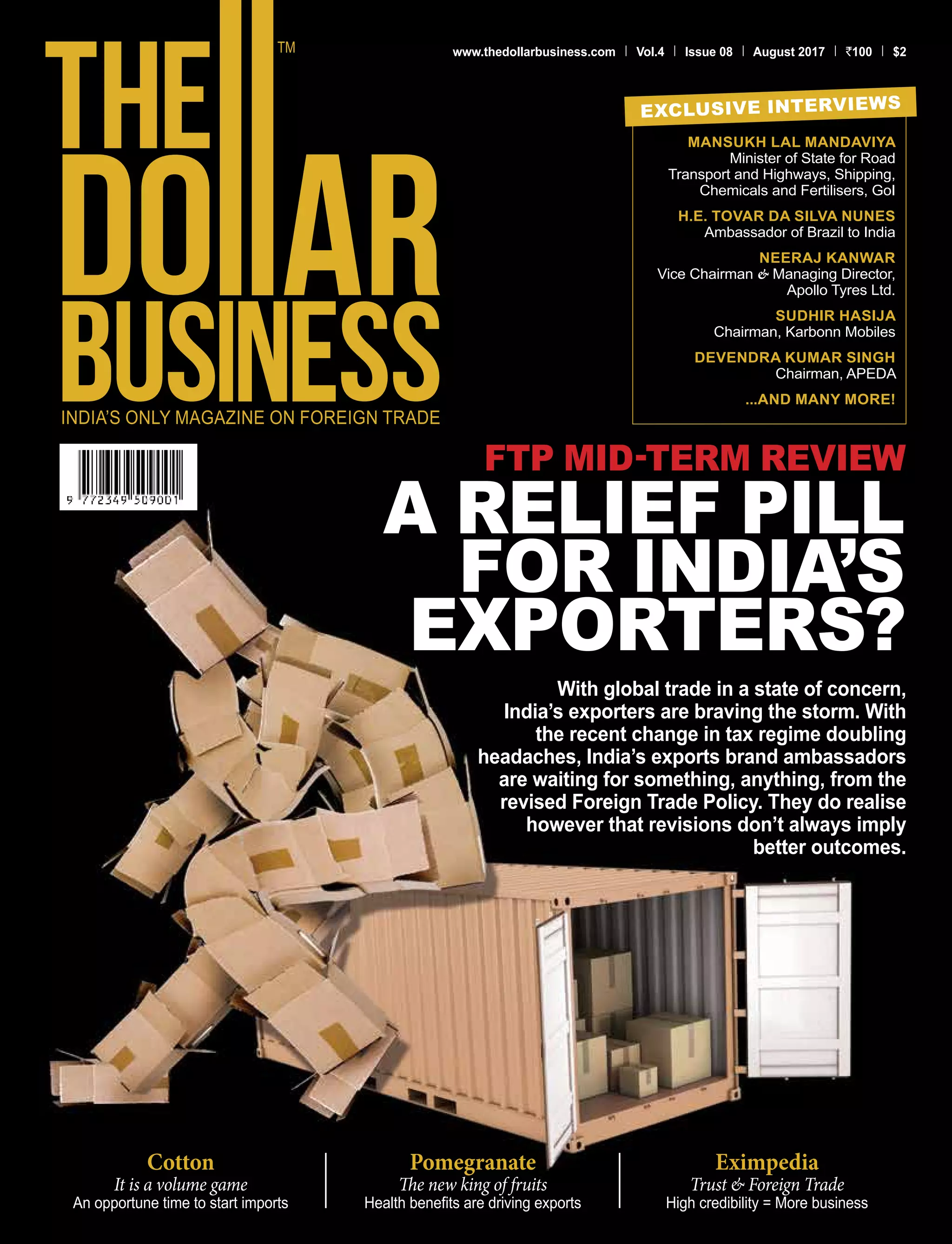
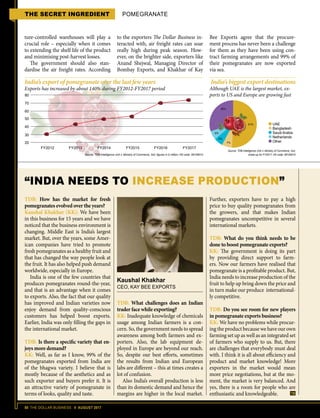
With global trade in a state of concern,
India’s exporters are braving the storm. With
the recent change in tax regime doubling
headaches, India’s exports brand ambassadors
are waiting for something, anything, from the
revised Foreign Trade Policy. They do realise
however that revisions don’t always imply
better outcomes.
FTP MID-TERM REVIEW
A RELIEF PILL
FOR INDIA’S
EXPORTERS?
MANSUKH LAL MANDAVIYA
Minister of State for Road
Transport and Highways, Shipping,
Chemicals and Fertilisers, GoI
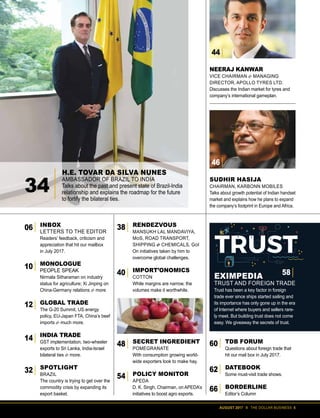
H.E. TOVAR DA SILVA NUNES
Ambassador of Brazil to India
NEERAJ KANWAR
Vice Chairman & Managing Director,
Apollo Tyres Ltd.
SUDHIR HASIJA
Chairman, Karbonn Mobiles
DEVENDRA KUMAR SINGH
Chairman, APEDA
...AND MANY MORE!
EXCLUSIVE INTERVIEWS
Cotton
It is a volume game
An opportune time to start imports
Pomegranate
The new king of fruits
Health benefits are driving exports
Eximpedia
Trust & Foreign Trade
High credibility = More business
CHENNAI: Annanagar Adyar ECR Ispahani for Appointments: 7811903903
BANGALORE: Lavelle Road Koramangala Indiranagar Kammanhalli JP Nagar BEL Road
Whitefield Sahakar Nagar VR Bengaluru Jayanagar for Appointments: 8880903903
HYDERABAD: Jubilee Hills Inorbit Mall Banjara Hills for Appointments: 7601903903
MUMBAI: Inorbit Mall, Malad for Appointments: 022-49713243
AUGUST 2017 II THE DOLLAR BUSINESS 3
LETTER FROM THE EDITOR–IN–CHIEF
C
risis in world trade seems to be evolving into big opportunities. And since March
this year, the air seems far pleasant than it did during a punishing 2016. The situa-
tion is akin to construction cranes once again stippling the skyline over buildings
left unfinished. The excitement is obvious.
But the momentary relief does not indicate that our brush with uncertainty is over. And
that’s the bitter truth about foreign trade. There are far too many countries, product and ser-
vice categories, sanctions, sovereign rules and mindsets to consider. In this territory, ‘being
at peace only symbolises living in denial’. No pre-tested fact, formula or notion is permanent.
Here, old ways don’t survive.
Consider this observation – why exports grew at a furious pace until 2008, then got silent
for two years before it picked up again and then, since mid-2014 has been relatively sluggish
is an occurrence not many have well-based theories to explain. And those who do will ei-
ther link it to financial market sentiments or China! But where’s the time-tested truth that
explains this gyration? There is none. In foreign trade, no fact or theory validated in the past
remains constant. There is always change in the making. One such theory is on technology.
Traditionally, it was believed that technology cannot disrupt global trade and exports.
(Affect it will. Not disrupt.) Today, it has and how! Gone are the days when Indian farmers
would sow seeds depending on whether the skies look blacker than grey. From supplies to
logistics to generation and processing of shipping bills – technology is fast emerging the
cruel-but-honest decider in the war between labour and capital. Even in the manufacturing
value chain, the tale is no different. 50 years ago, about 70% of global productivity could be
attributed to labour. Today, its share is down to 58%. With a 42% share, capital-aided tech-
nology is gradually eating into the human share across manufacturing and services sectors.
There was a time when China, as a relatively labour-abundant economy, opened up to
trade. It did well for three decades. Today, even within its borders, machines have replaced
humans, and robotics and technology are at the forefront of decision-making and imple-
mentation. Today, China’s strength clearly isn’t humans. Globally, automation will possibly
account for more than half of the manufacturing and services output by 2025, and this will
have a bearing on global trade, and especially on how a developing market like India deals
with this issue of technology taking charge of the production cycle. In the long run, you
could find the low cost-advantage of a manufacturing hotspot like India fading due to greater
automation of manufacturing processes in the First World markets. As costs of automation
fall relative to manufacturing wages and global industrial production becomes more tech-
nology-dependent, a hub like India will have to write-off advantages that it currently counts
on. So EU and USA could well become the ‘new low-cost centres’ in manufacturing in the
next decade. For exporters in India, China and Vietnam, this could mean 'new competition'.
While India’s policymakers are working to include revisions in its Foreign Trade Policy,
they will have to consider the ongoing battle against stagnation that India’s exporters are
engaged in. Thought needs to be spared for the fact that there is nothing more elastic than a
nation’s exports during a time when Trump and China are sending mixed signals on a daily
basis, and when technology may enable a return of Europe and America’s factories which
will help them relive the erstwhile glory days of the Industrial Revolution. (Imagine technol-
ogy rewinding the prowess of exporting nations to the early 19th
century days!)
India’s revised FTP will have to be made liberal enough to enable that big leap for its
exports in case ‘trade protectionism’ and ‘technology ghosts’ get harsh-
er. Pre-2008, trade was easier perhaps. No real reason why, but it was.
Today is a different ballgame.
www.thedollarbusiness/blogs/steven
EU and US could well
become the ‘new low-cost
centres’ in manufacturing
in the next decade. For
exporters in India, China
Vietnam and other devel-
oping nations, this could
mean 'new competition'.
LIVING IN DENIAL
Steven Philip Warner
President (VMPL) & Editor-in-Chief,
The Dollar Business
steven@thedollarbusiness.com
@SPWarner www.tumblr.com/blog/steven-p-warner
4 THE DOLLAR BUSINESS II AUGUST 2017
President (VMPL) : Steven Philip Warner
& Editor-in-Chief
EDITORIAL & RESEARCH
Editor : Manish K. Pandey
Executive Editor : Indranil Das
Associate Editor (Print) : Andres Meren Molier
Associate Editor (Online) : Sheela Mamidenna
Senior Editor (Print) : Niladri S. Nath
Assistant Editors (Print) : Ahmad Shariq Khan, Anishaa Kumar
Assistant Editor (Online) : Aamir Hussain Kaki
EDITORIAL CONSULTING BOARD
Founder & Editor : Anil Goyal
Publisher : Avnish Goyal
Chief Consulting Editor : Dr.A. K. Sengupta
ADVERTISEMENT SALES & MARKETING
Deputy Managers : Payal Kapoor, Rahul Jain
SeniorExecutives : Ayesha Fatima, Ankit Kharbanda
InternationalRepresentatives
Seoul(SouthKorea) : Justin Yoon (+82-2-6241-4256)
London(UK) : S. Puri (+44 207 376 1996)
ART & PHOTOGRAPHY
Art Director : Sujesh Kumar G.
Senior Designer : Gopal Ganesh Reddy
Photographer : Dileep Kumar
THE DOLLAR BUSINESS ONLINE
Project Managers : Sridhar Bodla, Omar Larzi
Digital Marketing Manager : Mohammed Imran
SEO Specialist : Y. Lakshman Varma
Deputy Manager (EXIM Opp.): Lakshmi Kondaveeti
Asst. Manager (EXIM Opp.) : G Bhanu Prasad
Asst.Managers(Data&Metrics) : Sharath Chandra Murthy Macha,
Santosh Hale, Ramesh Babu Lalam,
Mohd Abdul Nadeem
CIRCULATION, SUBSCRIPTION & DISTRIBUTION
Manager : M. Vinay Kumar
ALLIANCES & COMMUNICATIONS
Sr. Manager : Rasanpreet Kaur
Deputy Manager : Anupama Polasa
Asst. Managers : Sravya Palakuru, Asmita Mitra
FINANCE & ADMIN
Manager : V. Srikanth Tumati
SeniorExecutive : Krishna Prasad
SeniorExecutive : Chandra Mouli Poduli
PRINTER
Kala Jyothi Process Pvt. Ltd.,
1-1-60/5, RTC Cross Road, Musheerabad, Hyderabad,
Telangana 500020, IN
PUBLISHED AT
5-2-198/4, Distillery Road, Ranigunj, Secunderabad,
Telangana 500003, IN
FOR EDITORIAL/CONTENT
Email: editorial@thedollarbusiness.com
FOR ADVERTISEMENT
Email: ads@thedollarbusiness.com
FOR SUBSCRIPTION
Email: subscription@thedollarbusiness.com . +91-40-67609999
For queries / comments you can send us an SMS at +91-888-633-1947
© Copyright 2017
No part of this magazine may be reproduced in whole or in part without an ex-
pressed permission of the publisher. The information on this magazine is for
information purpose only. Manish K. Pandey, Editor, The Dollar Business, is re-
sponsible for the selection of news and content under PRB Act. Vimbri Media Pvt.
Ltd. assumes no liability or responsibility for any inaccurate, delayed or incomplete
information, or for any actions taken in reliance thereon. The information contained
about each individual, event or organisation has been provided by such individual,
event organisers or organisation without verification by us. All disputes are subject
to exclusive jurisdiction of competent courts and forums in Hyderabad, Telangana.
Printed and published by Avnish Goyal for Vimbri Media Pvt. Ltd. Published at
5-2-198/4, Distillery Road, Ranigunj, Secunderabad - 500 003, Telangana.
Printedat:KalaJyothiProcessPvt.Ltd.,1-1-60/5,RTCCrossRoads,Musheerabad,
Hyderabad - 500 020, Telangana.
Volume: 04 Issue: 08 August 2017
www.thedollarbusiness.com
facebook.com/tdbIndia
twitter.com/TheDollarBiz
linkedin.com/company/thedollarbusiness
COVER STORY16
Since the Union Budget 2017-18 had hardly anything for them,
exporters had build their hopes around the mid-term review of
the FTP 2015-2020 to address their issues. But soon after the
DGFT began deliberations with stakeholders, exporters were
hit with an even larger challenge – the implementation of the
blockbuster GST. The fineprint in the GST threw a spanner in
the works for exporters through the implementation of a pay-
now-get-refund-later mechanism as well as a high tax rate on
scrips. While exporters wait for the unveiling of the new policy,
we spoke to them about their expectations from the review.
FTP MID-TERM REVIEW
WILL
EXPORTERS’
WOES
CONTINUE?
AUGUST 2017 II THE DOLLAR BUSINESS 5
INBOX
LETTERS TO THE EDITOR
Readers’ feedback, criticism and
appreciation that hit our mailbox
in July 2017.
MONOLOGUE
PEOPLE SPEAK
Nirmala Sitharaman on industry
status for agriculture; Xi Jinping on
China-Germany relations & more
GLOBAL TRADE
The G-20 Summit, US energy
policy, EU-Japan FTA, China’s beef
imports & much more.
INDIA TRADE
GST implementation, two-wheeler
exports to Sri Lanka, India-Israel
bilateral ties & more.
SPOTLIGHT
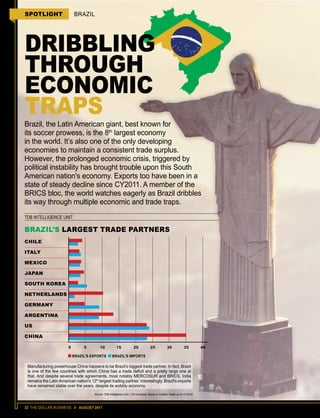
BRAZIL
The country is trying to get over the
commodity crisis by expanding its
export basket.
RENDEZVOUS
MANSUKH LAL MANDAVIYA,
MoS, ROAD TRANSPORT,
SHIPPING & CHEMICALS, GoI
On initiatives taken by him to
overcome global challenges.
IMPORT’ONOMICS
COTTON
While margins are narrow, the
volumes make it worthwhile.
SECRET INGREDIENT
POMEGRANATE
With consumption growing world-
wide exporters look to make hay.
POLICY MONITOR
APEDA
D. K. Singh, Chairman, on APEDA’s
initiatives to boost agro exports.
TDB FORUM
Questions about foreign trade that
hit our mail box in July 2017.
DATEBOOK
Some must-visit trade shows.
BORDERLINE
Editor’s Column
EXIMPEDIA
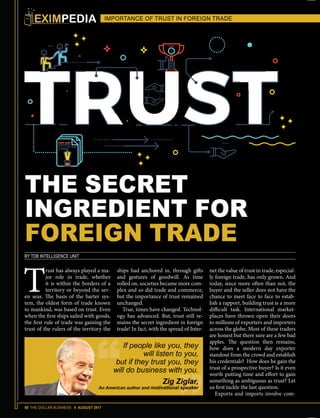
TRUST AND FOREIGN TRADE
Trust has been a key factor in foreign
trade ever since ships started sailing and
its importance has only gone up in the era
of Internet where buyers and sellers rare-
ly meet. But building trust does not come
easy. We giveaway the secrets of trust.
H.E. TOVAR DA SILVA NUNES
AMBASSADOR OF BRAZIL TO INDIA
Talks about the past and present state of Brazil-India
relationship and explains the roadmap for the future
to fortify the bilateral ties.
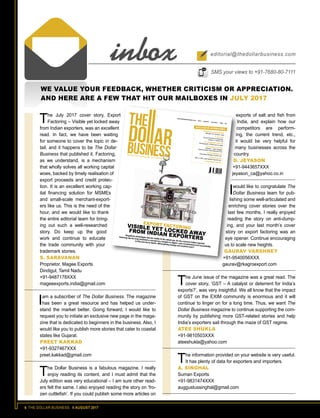
SUDHIR HASIJA
CHAIRMAN, KARBONN MOBILES
Talks about growth potential of Indian handset
market and explains how he plans to expand
the company’s footprint in Europe and Africa.
NEERAJ KANWAR
VICE CHAIRMAN & MANAGING
DIRECTOR, APOLLO TYRES LTD.
Discusses the Indian market for tyres and
company’s international gameplan.
06
12
38
40
48
54
14
32
10
34
60
62
66
46
44
6 THE DOLLAR BUSINESS II AUGUST 2017
WE VALUE YOUR FEEDBACK, WHETHER CRITICISM OR APPRECIATION.
AND HERE ARE A FEW THAT HIT OUR MAILBOXES IN JULY 2017
The July 2017 cover story, Export
Factoring – Visible yet locked away
from Indian exporters, was an excellent
read. In fact, we have been waiting
for someone to cover the topic in de-
tail; and it happens to be The Dollar
Business that published it. Factoring,
as we understand, is a mechanism
that wholly solves all working capital
woes, backed by timely realisation of
export proceeds and credit protec-
tion. It is an excellent working cap-
ital financing solution for MSMEs
and small-scale merchant-export-
ers like us. This is the need of the
hour, and we would like to thank
the entire editorial team for bring-
ing out such a well-researched
story. Do keep up the good
work and continue to educate
the trade community with your
trademark stories.
S. SARAVANAN
Proprietor, Magee Exports
Dindigul, Tamil Nadu
+91-9487178XXX
mageeexports.india@gmail.com
Iam a subscriber of The Dollar Business. The magazine
has been a great resource and has helped us under-
stand the market better. Going forward, I would like to
request you to initiate an exclusive new page in the maga-
zine that is dedicated to beginners in the business. Also, I
would like you to publish more stories that cater to coastal
states like Gujarat.
PREET KAKKAD
+91-9327467XXX
preet.kakkad@gmail.com
The Dollar Business is a fabulous magazine. I really
enjoy reading its content, and I must admit that the
July edition was very educational – I am sure other read-
ers felt the same. I also enjoyed reading the story on ‘fro-
zen cuttlefish’. If you could publish some more articles on
www.thedollarbusiness.comVol.4Issue07July2017100$2RNI:APENG/2014/54643
www.thedollarbusiness.com Vol.4 Issue 07 July 2017 100 $2
MANOHAR AZGAONKARMinister for Tourism, Goa
A. M. NAIKGroup Executive Chairman,Larsen & Toubro Ltd.H.E. MOHAMED MALIKIAmbassador of Morocco to India
LEE KHENG LEONGDirector - Asia Chapter,Factors Chain International (FCI)
V. DHARMARAJANExecutive Director, ECGC Ltd.
TUSHAR BUCH
MD & CEO, SBI Global Factors Ltd.
...AND MANY MORE!
EXCLUSIVE INTERVIEWS
Despite its advantages that are visible to the naked eye, for the common Indian exporter,
factoring has for long remained a concept too complex to digest. Lack of awareness and accessibility
to this tool are to blame. Will anything change and anytime soon?
EXPORT FACTORINGVISIBLE YET LOCKED AWAY
FROM INDIAN EXPORTERS
inbox editorial@thedollarbusiness.com
SMS your views to +91-7680-80-7111
exports of salt and fish from
India, and explain how our
competitors are perform-
ing, the current trend, etc.,
it would be very helpful for
many businesses across the
country.
D. JEYASON
+91-9443657XXX
jeyason_ca@yahoo.co.in
Iwould like to congratulate The
Dollar Business team for pub-
lishing some well-articulated and
enriching cover stories over the
last few months. I really enjoyed
reading the story on anti-dump-
ing, and your last month’s cover
story on export factoring was an
eye opener. Continue encouraging
us to scale new heights.
GAURAV VARSHNEY
+91-9540056XXX
gaurav@rkagroexport.com
The June issue of the magazine was a great read. The
cover story, ‘GST – A catalyst or deterrent for India’s
exports?’, was very insightful. We all know that the impact
of GST on the EXIM community is enormous and it will
continue to linger on for a long time. Thus, we want The
Dollar Business magazine to continue supporting the com-
munity by publishing more GST-related stories and help
India’s exporters sail through the maze of GST regime.
ATEE SHUKLA
+91-9810503XXX
ateeshukla@yahoo.com
The information provided on your website is very useful.
It has plenty of data for exporters and importers.
A. SINGHAL
Suman Exports
+91-9831474XXX
auggustussinghal@gmail.com
10 THE DOLLAR BUSINESS II AUGUST 2017
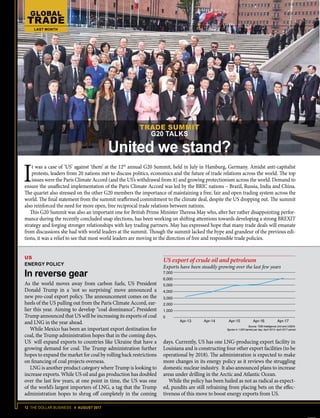
Agriculture is going to be
the biggest component
of our exports and therefore,
yes, I would be in favour of
agriculture being accorded
industry status.
NIRMALA SITHARAMAN
INDIAN COMMERCE AND INDUSTRY
MINISTER
On industry status for agriculture
Chinese-German relations
are now about to have a
new start where we need new
breakthroughs.
XI JINPING
CHINESE PRESIDENT
On international cooperation between
China and Germany
Source: Reuters
THE RISE IN PROTECTIONISM THREATENS
THE GAINS FROM GLOBALISATION.
NARENDRA MODI
INDIAN PRIME MINISTER
while talking about protectionism during his speech at the G20 Summit
Source:ReutersUKSource:PTI
We’re working on a trade
deal which will be a
very, very big deal, a very
powerful deal, great for both
countries.
DONALD TRUMP
PRESIDENT OF THE UNITED
STATES OF AMERICA
On US-UK trade relations
Our relationship needs to
be based on searching
for ways to generate mutual
respect, build confidence
and work with a positive
attitude. I can say that I saw
that willingness in President
Trump.
ENRIQUE PEÑA NIETO
MEXICAN PRESIDENT
On US-Mexico relations
While we are looking at the possibilities
of cooperation to benefit everyone,
globalisation is seen by the American
administration more as a process that is not
about a win-win situation but about winners
and losers.
ANGELA MERKEL
GERMAN CHANCELLOR
On the US approach to globalisation
Source:www.ft.comSource:PTI
Source:CNNSource:IMF
Just as the global crisis generated the
momentum for effective multilateral action,
we too must use the global economic recovery
to continue our collaboration to address risks
and ensure strong, sustainable, balanced and
inclusive growth.
CHRISTINE LAGARDE
MANAGING DIRECTOR, IMF
On strengthening the global economy
monologue
SMS TDB MONEY TO 56161
SAY GOODBYE TO ALL YOUR WORKING
CAPITAL WOES WITH
DON’T MISS OUT ON AN
EXPORT OPPORTUNITY
JUST BECAUSE YOU ARE
RUNNING SHORT OF CASH
SHIP.
RECEIVE.
CELEBRATE.
12 THE DOLLAR BUSINESS II AUGUST 2017
GLOBAL
TRADE
LAST MONTH
GLOBAL
TRADE
LAST MONTH
I
t was a case of ‘US’ against ‘them’ at the 12th
annual G20 Summit, held in July in Hamburg, Germany. Amidst anti-capitalist
protests, leaders from 20 nations met to discuss politics, economics and the future of trade relations across the world. The top
issues were the Paris Climate Accord (and the US’s withdrawal from it) and growing protectionism across the world. Demand to
ensure the unaffected implementation of the Paris Climate Accord was led by the BRIC nations – Brazil, Russia, India and China.
The quartet also stressed on the other G20 members the importance of maintaining a free, fair and open trading system across the
world. The final statement from the summit reaffirmed commitment to the climate deal, despite the US dropping out. The summit
also reinforced the need for more open, free reciprocal trade relations between nations.
This G20 Summit was also an important one for British Prime Minister Theresa May who, after her rather disappointing perfor-
mance during the recently concluded snap elections, has been working on shifting attentions towards developing a strong BREXIT
strategy and forging stronger relationships with key trading partners. May has expressed hope that many trade deals will emanate
from discussions she had with world leaders at the summit. Though the summit lacked the hype and grandeur of the previous edi-
tions, it was a relief to see that most world leaders are moving in the direction of free and responsible trade policies.
US
ENERGY POLICY
In reverse gear
As the world moves away from carbon fuels, US President
Donald Trump in a ‘not so surprising’ move announced a
new pro-coal export policy. The announcement comes on the
heels of the US pulling out from the Paris Climate Accord, ear-
lier this year. Aiming to develop “coal dominance”, President
Trump announced that US will be increasing its exports of coal
and LNG in the year ahead.
While Mexico has been an important export destination for
coal, the Trump administration hopes that in the coming days,
US will expand exports to countries like Ukraine that have a
growing demand for coal. The Trump administration further
hopes to expand the market for coal by rolling back restrictions
on financing of coal projects overseas.
LNG is another product category where Trump is looking to
increase exports. While US oil and gas production has doubled
over the last few years, at one point in time, the US was one
of the world’s largest importers of LNG, a tag that the Trump
administration hopes to shrug off completely in the coming
US export of crude oil and petroleum
Exports have been steadily growing over the last few years
7,000
6,000
5,000
4,000
3,000
2,000
1,000
0
Apr-13 Apr-14 Apr-15 Apr-16 Apr-17
Source: TDB Intelligence Unit and USEIA;
figures in 1,000 barrels per day; April 2013- April 2017 period
days. Currently, US has one LNG-producing export facility in
Louisiana and is constructing four other export facilities (to be
operational by 2018). The administration is expected to make
more changes in its energy policy as it reviews the struggling
domestic nuclear industry. It also announced plans to increase
areas under drilling in the Arctic and Atlantic Ocean.
While the policy has been hailed as not as radical as expect-
ed, pundits are still refraining from placing bets on the effec-
tiveness of this move to boost energy exports from US.
TRADE SUMMIT
G20 TALKS
United we stand?
TRADE SUMMIT
G20 TALKS
United we stand?
News & Analysis
AUGUST 2017 II THE DOLLAR BUSINESS 13
News & Analysis
US
TRADE DEFICIT
On the path to glory
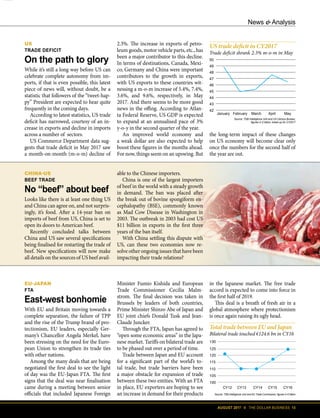
While it’s still a long way before US can
celebrate complete autonomy from im-
ports, if that is even possible, this latest
piece of news will, without doubt, be a
statistic that followers of the “tweet-hap-
py” President are expected to hear quite
frequently in the coming days.
According to latest statistics, US trade
deficit has narrowed, courtesy of an in-
crease in exports and decline in imports
across a number of sectors.
US Commerce Department data sug-
gests that trade deficit in May 2017 saw
a month-on-month (m-o-m) decline of
EU-JAPAN
FTA
East-west bonhomie
With EU and Britain moving towards a
complete separation, the failure of TPP
and the rise of the Trump brand of pro-
tectionism, EU leaders, especially Ger-
many’s Chancellor Angela Merkel, have
been stressing on the need for the Euro-
pean Union to strengthen its trade ties
with other nations.
Among the many deals that are being
negotiated the first deal to see the light
of day was the EU-Japan FTA. The first
signs that the deal was near finalisation
came during a meeting between senior
officials that included Japanese Foreign
Total trade between EU and Japan
Bilateral trade touched €124.6 bn in CY16
130
125
120
115
110
105
100
CY12 CY13 CY14 CY15 CY16
Source: TDB Intelligence Unit and EU Trade Commission; figures in € billion
Minister Fumio Kishida and European
Trade Commissioner Cecilia Malm-
strom. The final decision was taken in
Brussels by leaders of both countries,
Prime Minister Shinzo Abe of Japan and
EU joint chiefs Donald Tusk and Jean-
Claude Juncker.
Through the FTA, Japan has agreed to
“open some economic areas” in the Japa-
nese market. Tariffs on bilateral trade are
to be phased out over a period of time.
Trade between Japan and EU account
for a significant part of the world’s to-
tal trade, but trade barriers have been
a major obstacle for expansion of trade
between these two entities. With an FTA
in place, EU exporters are hoping to see
an increase in demand for their products
in the Japanese market. The free trade
accord is expected to come into force in
the first half of 2019.
This deal is a breath of fresh air in a
global atmosphere where protectionism
is once again raising its ugly head.
US trade deficit in CY2017
Trade deficit shrank 2.3% m-o-m in May
50
49
48
47
46
45
44
43
42
January February March April May
Source: TDB Intelligence Unit and US Census Bureau;
figures in $ billion; break-up for CY2017
2.3%. The increase in exports of petro-
leum goods, motor vehicle parts, etc., has
been a major contributor to this decline.
In terms of destinations, Canada, Mexi-
co, Germany and China were important
contributors to the growth in exports,
with US exports to these countries wit-
nessing a m-o-m increase of 5.4%, 7.4%,
3.6%, and 9.6%, respectively, in May
2017. And there seems to be more good
news in the offing. According to Atlan-
ta Federal Reserve, US GDP is expected
to expand at an annualised pace of 3%
y-o-y in the second quarter of the year.
An improved world economy and
a weak dollar are also expected to help
boost these figures in the months ahead.
For now, things seem on an upswing. But
the long-term impact of these changes
on US economy will become clear only
once the numbers for the second half of
the year are out.
CHINA-US
BEEF TRADE
No “beef” about beef
Looks like there is at least one thing US
and China can agree on, and not surpris-
ingly, it’s food. After a 14-year ban on
imports of beef from US, China is set to
open its doors to American beef.
Recently concluded talks between
China and US saw several specifications
being finalised for restarting the trade of
beef. New specifications will now make
all details on the sources of US beef avail-
able to the Chinese importers.
China is one of the largest importers
of beef in the world with a steady growth
in demand. The ban was placed after
the break out of bovine spongiform en-
cephalopathy (BSE), commonly known
as Mad Cow Disease in Washington in
2003. The outbreak in 2003 had cost US
$11 billion in exports in the first three
years of the ban itself.
With China settling this dispute with
US, can these two economies now re-
solve other ongoing issues that have been
impacting their trade relations?
14 THE DOLLAR BUSINESS II AUGUST 2017
INDIA
TRADE
LAST MONTH
A
fter months of agonising debates and discussions, India
finally stepped into the GST-era, amidst much pomp and
grandeur! While India is not the first country to introduce
such a tax structure, the tax reform is the biggest since indepen-
dence. It wasn’t surprising though to see that from the get-go GST
wasatthereceivingendofitsownshareof bouquetsandbrickbats.
The new unified, four-tier tax system, according to its makers,
is expected to help increase the competitiveness of Indian prod-
ucts and services in the global market. While there has been some
cheer regarding the replacement of numerous taxes and exclusion
of products from sectors such as agriculture from GST, many sec-
tors which have products in the 18% and 28% slab have expressed
concerns on its impact and its complicated compliance require-
ments. For the foreign trade community, while Indian exports are
zero-rated, the inclusion of imports under IGST and the issue of
restricting the use of duty scrips to certain duties have been sore
points. Scrips from various export incentives and duty remission
schemes can now be applied for only at a later date and can be
used only for paying customs duty. While the Commerce Ministry
has promised a quick 7-day processing of these requests, it’s safe to
say that the trade community is not so certain. Exporters also fear
that MEIS and SEIS rates may undergo a downward revision, but it
seems they will have to wait till September for more clarity, as that
is when the mid-term review of the FTP is expected to be released.
Talks on GST in India have crossed borders too and now neigh-
bouring countries such as Nepal are also feeling the impact. In-
dian ports like Kolkata are import ports for many goods coming
into Nepal. Under GST, as imports will be taxed, Nepali traders are
concerned about the increase in prices for goods brought into the
land-locked nation through India.
ports of vehicles to Sri Lanka from var-
ious destinations had seen a decline over
the last year due to an increase in import
duty. The move was made to promote
manufacturing in the country.
Despite the hike in import duties, Sri
Lanka remains an attractive market for
Indian two-wheeler manufacturers. In-
dia’s leading two-wheeler makers Honda
Motorcycle and Scooters India and Bajaj
Auto consider the island nation to be
one of their key export markets. Yamaha
India has also announced that they have
started exporting their mid-range Yama-
ha FZ 25 to Sri Lanka this financial year.
Now, if Piaggio manages to strike gold
in exports to Sri Lanka, will this move
open doors for more exports of mid to
higher-end two wheelers from India?
Well, if Piaggio’s success in India is any-
India’s exports of vehicles
Two-wheelers account for a 67% share
Passenger vehicle Commercial vehicle
Three wheeler Two wheeler
Source: TDB Intelligence Unit & SIAM; break-up for FY2017
67%
22%
3%
8%
thing to go by it is more than likely that
they will succeed in Sri Lanka unless
they fall prey to protectionist policies.
GST
TAX POLICY
A long road ahead…
INDIA-SRI LANKA
TWO-WHEELER EXPORTS
A smart leap?
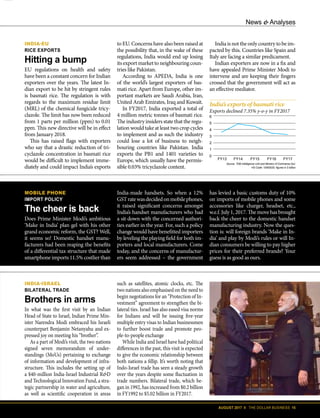
Conceptualised in Italy, ‘Made in India’,
driven in Sri Lanka seems to be the latest
mantra for Piaggio, makers of popular
two-wheeler brands such as the classic
Vespa and modern-day Aprilia. Piaggio
which has a manufacturing unit in In-
dia has begun exporting its India-made
two-wheelers to Sri Lanka.
Through this move, the Italian
two-wheeler maker is hoping to expand
its reach within the region by using India
and its existing manufacturing facility as
a springboard. The Indian manufactur-
ing unit, which is located in Baramati,
Maharashtra, was inaugurated in 2012.
However, it’s worth noting that ex-
News & Analyses
AUGUST 2017 II THE DOLLAR BUSINESS 15
In what was the first visit by an Indian
Head of State to Israel, Indian Prime Min-
ister Narendra Modi embraced his Israeli
counterpart Benjamin Netanyahu and ex-
pressed joy on meeting his “brother”.
As a part of Modi’s visit, the two nations
signed seven memorandum of under-
standings (MoUs) pertaining to exchange
of information and development of infra-
structure. This includes the setting up of
a $40-million India-Israel Industrial R&D
and Technological Innovation Fund, a stra-
tegic partnership in water and agriculture,
as well as scientific cooperation in areas
such as satellites, atomic clocks, etc. The
two nations also emphasised on the need to
begin negotiations for an “Protection of In-
vestment” agreement to strengthen the bi-
lateral ties. Israel has also eased visa norms
for Indians and will be issuing five-year
multiple entry visas to Indian businessmen
to further boost trade and promote peo-
ple-to-people exchange
While India and Israel have had political
differences in the past, this visit is expected
to give the economic relationship between
both nations a fillip. It’s worth noting that
Indo-Israel trade has seen a steady growth
over the years despite some fluctuation in
trade numbers. Bilateral trade, which be-
gan in 1992, has increased from $0.2 billion
in FY1992 to $5.02 billion in FY2017.
INDIA-ISRAEL
BILATERAL TRADE
Brothers in arms
MOBILE PHONE
IMPORT POLICY
The cheer is back
Does Prime Minister Modi’s ambitious
‘Make in India’ plan gel with his other
grand economic reform, the GST? Well,
it seems so! Domestic handset manu-
facturers had been reaping the benefits
of a differential tax structure that made
smartphone imports 11.5% costlier than
India-made handsets. So when a 12%
GSTratewasdecidedonmobilephones,
it raised significant concerns amongst
India’s handset manufacturers who had
a sit down with the concerned authori-
ties earlier in the year. For, such a policy
change would have benefitted importers
by leveling the playing field for both im-
porters and local manufacturers. Come
today, and the concerns of manufactur-
ers seem addressed – the government
INDIA-EU
RICE EXPORTS
Hitting a bump
EU regulations on health and safety
have been a constant concern for Indian
exporters over the years. The latest In-
dian export to be hit by stringent rules
is basmati rice. The regulation is with
regards to the maximum residue limit
(MRL) of the chemical fungicide tricy-
clazole. The limit has now been reduced
from 1 parts per million (ppm) to 0.01
ppm. This new directive will be in effect
from January 2018.
This has raised flags with exporters
who say that a drastic reduction of tri-
cyclazole concentration in basmati rice
would be difficult to implement imme-
diately and could impact India’s exports
News & Analyses
India’s exports of basmati rice
Exports declined 7.35% y-o-y in FY2017
6
5
4
3
2
1
0
FY13 FY14 FY15 FY16 FY17
Source: TDB Intelligence Unit and Ministry of Commerce,GoI;
HS Code: 10063020; figures in $ billion
has levied a basic customs duty of 10%
on imports of mobile phones and some
accessories like charger, headset, etc.,
w.e.f. July 1, 2017. The move has brought
back the cheer to the domestic handset
manufacturing industry. Now the ques-
tion is: will foreign brands ‘Make in In-
dia’ and play by Modi’s rules or will In-
dian consumers be willing to pay higher
prices for their preferred brands? Your
guess is as good as ours.
to EU. Concerns have also been raised at
the possibility that, in the wake of these
regulations, India would end up losing
its export market to neighbouring coun-
tries like Pakistan.
According to APEDA, India is one
of the world’s largest exporters of bas-
mati rice. Apart from Europe, other im-
portant markets are Saudi Arabia, Iran,
United Arab Emirates, Iraq and Kuwait.
In FY2017, India exported a total of
4 million metric tonnes of basmati rice.
The industry insiders state that the regu-
lation would take at least two crop cycles
to implement and as such the industry
could lose a lot of business to neigh-
bouring countries like Pakistan. India
exports the PB1 and 1401 varieties to
Europe, which usually have the permis-
sible 0.03% tricyclazole content.
India is not the only country to be im-
pacted by this. Countries like Spain and
Italy are facing a similar predicament.
Indian exporters are now in a fix and
have appealed Prime Minister Modi to
intervene and are keeping their fingers
crossed that the government will act as
an effective mediator.
16 THE DOLLAR BUSINESS II AUGUST 2017
COVER STORY FTP 2015-2020 MID-TERM REVIEW
FTP 2015-2020
MID-TERM
REVIEW
WILL IT
BE A 'POLICY
REVISION'
WORTH THE
WAIT AND
EXPECTATIONS?
AUGUST 2017 II THE DOLLAR BUSINESS 17
TDB INTELLIGENCE UNIT
India's exporters got little from this year's
Union Budget. The recently implemented
Goods and Services Tax (GST) further left
them confused. They now can't wait to learn
what 'happy surprises' the mid-term review
of the Foreign Trade Policy has in store for
them. And not to say, their expectations
from the mid-term review have changed
in the past weeks. [It's just getting bigger!]
The Dollar Business reaches out to India's
EXIM community to learn what it desires
from the FTP revision and how GST has
impacted its wishlist.
T
he good news is that over
the last few months, ex-
ports from India are on
the rise. The not so good
news is that while exports
moved up y-o-y by 5.33% to $276.28 bil-
lion in FY2017, it is still way below the
$314 billion mark touched in FY2014
and a far cry from the $900 billion target
that FTP 2015-2020 had set for FY2020.
While there is no doubt that the For-
eign Trade Policy (FTP) 2015-2020 went
a long way in simplifying procedures
and improving ease of doing business, its
impact on the growth of India's exports
has been at best limited. And the govern-
ment, not blind to this fact, is presently
undertaking a midterm review of FTP,
which, following deliberations with all
stakeholders, is expected to be unveiled
in September this year. And high time
too! Between the beginning of the delib-
erations on the review and now, the 'big-
gest tax reform' in India – the Goods and
Services Tax (GST) – was implemented
on July 1, 2017. And it brought forth
many new challenges for the exporters.
So much so that when The Dollar Busi-
ness questioned exporters on issues
even unrelated to the new tax regime,
they replied saying most of their pres-
ent challenges emanate from the GST
and more than anything else, that is
what they want addressed in the review.
Sure there are other long pending de-
mands related to Advanced Authorisa-
tion Scheme, changes to SION and the
usual suspects like increasing the rates of
incentives and remissions, but challenges
that have arisen due to the GST seem to
be bothering exporters the most.
THE GST CONUNDRUM
Back in May 2015, after FTP 2015-2020
was released with much fanfare, the-then
Director General of Foreign Trade, Pra-
vir Kumar, had told The Dollar Business,
“We have removed all the confusion and
overlapping that existed in FTP 2009-
2014. We have clubbed together various
schemes; and most importantly, the new
policy has liberalised the utilisation of
duty credit scrips.” Well, implementation
of the GST seems to have brought back
the confusion and managed to deliber-
alise the utilisation of duty scrips at one
fell swoop.
Let us first talk about the limitations
that the implementation of GST has im-
posed on the usage of duty scrips, be-
cause that seems to be a pain point that
all Export Promotion Council (EPC)
heads that The Dollar Business spoke to
share. For the uninitiated, duty scrips
are incentives offered to exporters by
The Directorate General of Foreign
Trade (DGFT) under export promotion
schemes – Merchandise Exports from In-
dia Scheme (MEIS) and Services Exports
from India Scheme (SEIS) – which can be
used to offset various taxes that exporters
18 THE DOLLAR BUSINESS II AUGUST 2017
COVER STORY FTP 2015-2020 MID-TERM REVIEW
need to pay. Earlier the scrips could have
been utilised to pay customs duties, ex-
cise duties and service tax. Now, with the
implementation of GST the only avenue
for utilisation of the scrips is to offset ba-
sic customs duty (BCD) as the other du-
ties have been subsumed under GST.
The scrips cannot be used for pay-
ment of Integrated GST (IGST) and GST
Compensation Cess which is levied on
imports, and Central GST (CGST), State
GST (SGST), IGST and GST Compen-
sation Cess on domestic procurements.
The concern therefore is that exporters
may not be able to completely use the
scrips within the validity period of 24
months. Agreeing to the fact, Satish W.
Wagh, Chairman, Basic Chemicals, Cos-
metics & Dyes Export Promotion Coun-
cil (CHEMEXCIL) says, “We would like
the government to lift the limitation on
TDB: What suggestions has AEPC given to the government
with respect to the FTP mid-term review?
Ashok G. Rajani (AGR): AEPC have requested the govern-
ment to revise the MEIS rates and increase the incentives to
5%. This can help exporters offset the compliance burden aris-
ing out of GST. We have also asked the government to increase
the Rebate of State Levies (RoSL) rate to 5% as GST will lead
to an increase in transaction cost. As RoSL is not a part of the
FTP, we are taking the matter of continuation of RoSL with the
relevant authorities as its continuation is critical for the growth
of the industry. Post GST, MEIS srips can be used only for pay-
ment of Basic Customs Duty. We hope the FTP mid-term re-
view will help change the policy so that the scrip can be used to
off-set other export-related expenditure that are not presently
under the refund-route in the GST scheme – like import duty
on capital goods, construction of new units in apparel parks,
etc. The sectors biggest concerns are presently related to GST.
TDB: Would you want any change in SION?
AGR: Standard Input Output Norms (SION) is an area of con-
cern. We want SION to be updated to include new products
and categories which have come up since they were formulated.
TDB: Does the export target of $900 billion by FY2020 seem
feasible at all at this time?
AGR: After two years of stagnation, India’s exports in FY2017
clocked a positive growth of 2.9%. Schemes like RoSL, interest
subvention, duty drawback and extension of EPCG scheme,
have helped our sector. Speaking about the export target for
the apparel industry, the target is $35 billion by 2018, which
is steep. But, the industry has reacted very positively to the
special package, and has grown at a rate of over 30% last year.
Though the industry will need a lot of support to tide over the
impact of GST, nothing is unachievable.
TDB: What would be the impact of GST on the sector?
AGR: Calculations based on pre- and post-GST rates suggest
that t-shirts, shirts, trousers, dresses and blouses would be
cheaper under GST – provided they are branded and are priced
above Rs.1,000. But, in case of unbranded garments there will
be no change because the GST rate is 5%, the same as the erst-
while VAT. Raw cotton will be a little cheaper, but cotton yarn
will be more expensive since it falls under 5% GST. Similarly,
exports of cotton yarn will be a little expensive. Since the input
tax credit is available, composite mills will benefit.
ASHOK G. RAJANI, CHAIRMAN, APPAREL EXPORT PROMOTION COUNCIL (AEPC)
“WE NEED GOVERNMENT SUPPORT
TO TIDE OVER THE GST IMPACT”
Although India's exports has been rising over the last few months, the target of $900 billion in
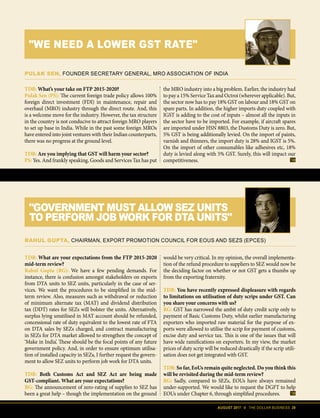
exports by FY2020 still seems like a pipe dream.
AUGUST 2017 II THE DOLLAR BUSINESS 19
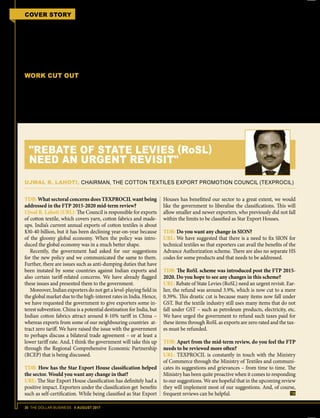
TDB: What are your expectations from the FTP 2015-2020
mid-term review?
Ajay Sahai (AS): The mid-term review is being done at a
time when the global situation looks very uncertain. Emerg-
ing economies are facing a downturn, advanced economies
are embracing protectionism and there is extreme volatility in
currencies. On the domestic front, while GST has come as a
harbinger of new India, the new regime has posed many chal-
lenges for exporters. Export growth has been good in last nine
months or so, but we are still far from the $300 billion that we
achieved in FY2012. Also, recently, there has been an upsurge
in imports increasing our trade deficit by over 100% in the first
quarter of this fiscal year. India has ratified the Trade Facilita-
tion Agreement which has come into operation this year. So,
with these in the background, exporters are expecting a lot
from the mid-term review. I think the government must adjust
the exports target based on the state of the global economy and
India’s manufacturing growth rate. Also, many of the schemes
introduced in the FTP 2015-2020, with the solitary exception
of SEZ, have lost their charm with the imposition of IGST on
imports. The mid-term review of the policy must address the
concerns of exporters emanating from the GST regime.
TDB: Exporters are concerned about how GST has limited
the avenues for utilisation of duty credit scrips. How do you
see this impacting the exporting fraternity?
AS: The premium on the scrips has already declined and there
are question marks over the utilisation of the scrips. On a BCD
of 5% and additional duties of 18%, the exporters could utilise
the scrip within a period of one year. Now, the same exporters
would require four years time to utilise the same. The validity
being two years, the exporter has no other option but to sell/
transfer the scrip. The rate of GST on such transfer is expected
to be 18%. But, we have argued for a zero GST rate on trans-
fer/sale of scrip or at best at 5%. If the premium on the scrip
comes down, it will be a loss to the exporter. Assuming that the
premium comes down to 80%, the exporter will get 80% of the
due while the final importer will get 100%. This is not a fair sit-
uation for exporters. We, therefore, urge that the government
to allow utilisation of the scrip for payment of CGST, if states
are not agreeing for payment of IGST. Moreover, DGFT should
look for new avenues for utilisation of the scrip while simulta-
neously extending its validity to a period of at least three years.
If exporters are forced to go for distress sale of scrips it may
bring down the premium further.
AJAY SAHAI, DIRECTOR GENERAL & CEO, FEDERATION OF INDIAN EXPORT ORGANISATIONS (FIEO)
"WE'VE ARGUED FOR A ZERO GST RATE
ON TRANSFER AND SALE OF SCRIPS"
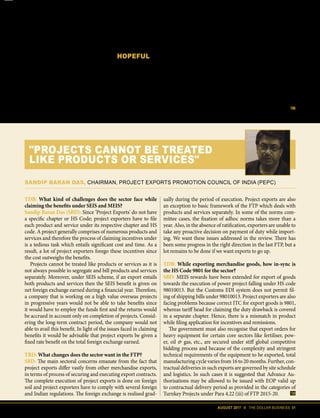
TDB: What are the key expectations of plastics exporters
from the mid-term review of FTP 2015-2020?
Pradip Thakkar (PT): Implementation of Goods and Services
Tax (GST), with applicable tax rates of 18% and 28% on plastic
products, will create unnecessary fund blockage. Although the
government has promised to refund 90% of the IGST within
a week, it will add to the cost in terms of the interest on the
working capital loans. Further, we also want the government
to relax the limitations it has imposed on the utilisation of duty
credit scrips granted as rewards under MEIS.
TDB: Would you also want any change in the value addition
norms under Advance Authorisation and DFIA schemes?
PT:Manyatimethereisahighturnoverofproductswhichhave
lower value-addition, but these products can’t be ignored
as the volumes are phenomenal. As long as the export-
ers are adding value on a regular basis, they should be al-
lowed to avail the Advance Authorisation scheme. In sec-
tors like chemicals and fabrics, there are many products
with minimal value addition. For example, in our sector,
the process of converting the plastic granules into film or sheets
is not very capital intensive and the value addition achieved is
also low. But these products are important to our export basket.
Hence, the value addition clause needs to be relaxed.
PRADIP THAKKAR, CHAIRMAN, THE PLASTICS EXPORT PROMOTION COUNCIL (PLEXCONCIL)
“THERE IS AN URGENT NEED TO
RELAX VALUE ADDITION NORMS”
20 THE DOLLAR BUSINESS II AUGUST 2017
COVER STORY FTP 2015-2020 MID-TERM REVIEW
utilisation of duty credit scrips in the up-
coming Midterm Review.”
Giving an example of how the lim-
itation on the utilisation of scrips will
impact exporters, Ajay Sahai, CEO &
Director General of Federation of In-
dian Export Organisations (FIEO) tells
The Dollar Business, "With a BCD of 5%
and other duties like CVD and ACD of
18%, the exporters could utilise the scrip
within a period of one year. Now, the
same exporters would require four years
time to utilise the scrips." In a situation
like this, exporters will be compelled to
sell or transfer their scrips in the open
market, and herein lies another major
obstacle since the GST on sale of scrips
will now attract a duty of 18%, as they fall
under the residual category [the DGFT
in a tweet though has said that scrips un-
der Chapter 3 of the FTP will attract 12%
duty under HSN classification 4907, sub-
ject to clarification by the Tax Research
Unit (TRU). The question is who will get
the clarification issued – the DGFT or
individual exporters?] against the earlier
VAT incidence of 4%.
Scrips are typically traded at a dis-
count. So if we take the discounted mar-
ket value of a Rs.100 scrip to be Rs.92,
in the VAT regime the buyer would
have paid a total of Rs.95.68 (Rs 92 plus
Rs.3.68 as VAT), while in the GST re-
gime, the buyer of the scrip will end up
paying Rs.108.56 (Rs.92 plus Rs.16.56 as
GST). The second situation is clearly less
attractive. Also, purchase of duty scrips
will become a viable option for the buy-
ers only if they can claim the Input Tax
Credit (equivalent to GST paid while
procuring the scrip). All such complica-
tions with tradability of scrips could fur-
ther pull down the premium (read price)
of the scrips.
FIEO's Sahai estimates that under this
situation a Rs.100 scrip is likely to sell for
Rs.80 in open market. O. P. Prahladka,
Chairman, Export Promotion Council
for Handicrafts (EPCH), agreeing with
the estimates says, “GST will compro-
mise at least 20% of the premium on
MEIS scrips." Clearly, this will put ex-
porters at a disadvantage as without more
avenues for offsetting the scrips, export-
ers will have to sell their scrips at a deep
discount. This in turn, will significantly
eat into the charm of MEIS and SEIS, the
flagship schemes promulgated in the FTP
2015-2020. Exporters in such a situation
will also be forced to pass on the costs
to buyers, which is then likely to hurt
the competitiveness of their products in
global markets, and ultimately result in a
decline in exports from India.
Several EPCs have requested the gov-
ernment to increase the avenues for util-
isation of the scrips and increase their
validity period. In fact, FIEO has also
requested that trading of scrips be ex-
empt from GST or at the most attract 5%
GST. The other suggestion that has been
offered to the government is that trading
of scrips be treated in the same way that
trading of securities are treated. Export-
ers hope that the review will consider
these suggestions and give exporters a
solution that will not suck the lives out
of flagship schemes of the current FTP.
The other major issue that has ema-
nated from the implementation of GST is
the withdrawal of exemptions under Ad-
vance Authorisation (AA) and Duty Free
Import Authorisation (DFIA) schemes.
Under the GST regime, while exemption
from payment of import duties, includ-
ing BCD, anti-dumping duty, safeguard
duties and customs cesses continue, there
is no exemption from payment of IGST
and GST Compensation Cess for im-
ports under AA and DFIA. Previously,
an exporter need not have funded the tax
portion of imports for production of the
goods. That will be necessary under GST.
While the government has said that 90%
of refund/ credit on these taxes paid will
be issued within seven days of filing all
necessary documents, exporters fear that
this is impractical. "Under GST regime,
only BCD will be exempted and IGST
will have to be paid. This would make
Advance Authorisation completely unvi-
able as duties will be paid upfront at the
time of import. We have suggested the
new norm be waived off. Otherwise ex-
ports will drop," says T. S. Bhasin, Chair-
man, Engineering Exports Promotion
Council (EEPC).
What's more? The Advance Release
Order (ARO) facility available for do-
mestic procurement of inputs under AA
has been restricted only to certain inputs
[listed in the Fourth Schedule of CentralSource: TDB Intelligence Unit and Ministry of Commerce,GoI; figures in $ billion
India’s merchandise exports since April 2014
Between FY2015 and FY2017 India's exports has gone down by about 11%
30
25
20
15
10
05
00
Apr May Jun Jul Aug Sep Oct Nov Dec Jan Feb Mar
FY2015 FY2016 FY2017
LIMITATIONS ON
SCRIP UTILISATION
WILL RESULT IN A
DECLINE IN SCRIP
PREMIUMS
Most exporters are not happy with the Ad-
vance Authorisation Scheme as they believe
that the Standard Input Output Norms are
completely flawed.
AUGUST 2017 II THE DOLLAR BUSINESS 21
Excise Act, 1944 (CE Act)] such as tobac-
co and petroleum products. Therefore,
AA cannot be used for domestic procure-
ment of other inputs. What will therefore
happen is that a significant portion of an
exporter's working capital will remain
blocked with the government, thus rais-
ing his cost of capital. With cost of capital
already high in India, when compared to
other exporting nations, this could have a
negative effect on the competitiveness of
Indian goods and services in the interna-
tional marketplace.
The treatment for EPCG is simi-
lar. EPCG scheme was formulated to
encourage manufacturer exporters to
import capital goods including spares
for pre-production, production and
post-production activities at zero duty
subject to an export obligation (EO) of
six times of duty saved on capital goods
imported under the EPCG scheme, to
be fulfilled in six years from the authori-
sation issue date. This was expected to
give a boost to exports of high-value
and value-added products from India,
something that the government has
been trying to promote. Under GST, the
exemption from import duties under
Manish Karajia
Chairman, Jute Products Development & Export Promotion
Council (JPDEPC)
As scrip utilisation will go down, we believe most exporters will have to
invest 15-20% extra working capital in the business. And, there is a lot of
uncertainty in the refund process as of now. I think the reverse charge mech-
anism under GST is unnecessary. Add to that the fact that an exporter is now
liable to pay taxes on the supply of goods and services from unregistered suppliers. Since job
work is quite extensive in our sector, a 5% GST on job work that has been imposed on items
from yarn to fabric has put us at a disadvantage. One must keep in mind that almost 60%
of the job work in our sector is done by the unorganised cottage industry players and hence
exporters would now end up paying the taxes for the job work. We believe, 4% of the capital
will have to be spent on paying taxes on job work. Another issue we are currently facing is
that the jute shopping bag has been clubbed in the 18% GST slab with luxury handbag. We
want the FTP to revisit these issues.
Puran Dawar
President, Agra Footwear Manufacturers & Exporters
Chamber (AFMEC)
Exports from the footwear sector is already under pressure, and as such
it has huge expectations from the FTP review. We hope the review re-
lieves the sector from some of the GST related compliance and teething
issues. As for drawbacks, I believe, we were already under incentivised. Be-
fore GST, utilising AIR norms, we used to get 9.5% duty drawback – of which about 50% could
be said to be our actual costs and 50% would be incentives. But now, we are paid only for the
actual. To cover GST-related compliance costs, we need at least 2% increment in benefits
under MEIS. Also under the FTP review, deemed duties should be generously taken care of
because in many of our products the share of deemed duties is quite significant.
TDB: What are the key issues that the FTP 2015-2020 mid-
term review must revisit?
Mukesh Bhatnagar (MB): The dictum of exports is ‘export
goods and not taxes’. So, any tax incurred during the produc-
tion of goods or during exports must be rebated through a sim-
ple, transparent and acceptable procedure. Speaking of GST,
the pay-first-and-get-a-refund-later mechanism under GST is
creating a hassle because exporters don’t know if the refund
will happen as promised. I believe FEIO has been raising the
issue with the government for some time and there has been an
emphasis on developing a mechanism to give exporters some
form of a rebate. If we look at other countries and their expe-
riences, we will find that they have a system of refund of taxes
which go into the production of goods and there is a system
whereby, if they are under a VAT regime, the goods that are
taxed at the input stage are refunded. This is what we should do
in India too. But the bigger problem is the availability of export
credit at a competitive rate. Indian exporters have a disadvan-
tage in the international market because the cost of borrowing
is high. And, when the high borrowing cost is coupled with the
lack of infrastructure and the high turnaround time, exporters
lose competitiveness. The FTP needs to consider introducing
more competitive and more liberal borrowing schemes.
TDB: The export incentives will eventually be phased out.
What would you suggest?
MB: This is an obligation which is eventually going to come
to India. The government has been gradually sensitising the
exporters that export subsidies are not going to be there forev-
er. But, there can be other incentives, say production subsidy
with which the government can continue to subsidise
the exporters.
MUKESH BHATNAGAR, PROFESSOR, INDIAN INSTITUTE OF FOREIGN TRADE (IIFT)
“FTP MUST CONSIDER INTRODUCING
MORE LIBERAL BORROWING SCHEMES”
22 THE DOLLAR BUSINESS II AUGUST 2017
COVER STORY FTP 2015-2020 MID-TERM REVIEW
EPCG does not extend to IGST and is re-
stricted to only BCD. Further, the ARO
facility for domestic procurement of cap-
ital goods has been discontinued. EPCG
scheme now, sounds less sweeter than
EPCG scheme then!
Not only have these schemes been se-
verely restricted, there is immense dis-
parity between what the FTP allows and
what DGFT notifications mean. Under
the FTP 2015-2020 the facility of domes-
tic procurement continues to be available
under EPCG and AA via the invalidation
letter route. While GST is payable on
such deemed exports against invalidation
letters, according to DGFT the customs
portion of the duty drawback can be
claimed back. Interestingly, the FTP does
not allow this benefit for supplies against
invalidation letters, opening up the issue
to interpretations and litigation.
Export Oriented Units (EOUs) have
also been at the receiving end of the fall-
out from the implementation of GST. In
GST regime, though exemption has been
given to imports from customs duty,
IGST and compensation cess is payable
on these imports. GST is also payable on
domestic procurement (of goods covered
uder GST), which was earlier exempted
ab initio. Only procurement of goods
covered under Fourth Schedule of the
Central Excise Act will continue to en-
joy the ab initio exemption from central
excise duty. Further, the transfer/ supply
of goods from one unit of EOU/ EHTP/
STP/ BTP to another has been made li-Source: TDB Intelligence Unit & RBI; figures in $ billion
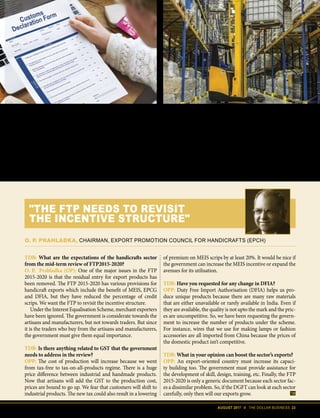
India’s service exports since April 2015
Although services exports have been growing, the pace has been slow
14
12
10
08
06
04
02
00
Apr May Jun Jul Aug Sep Oct Nov Dec Jan Feb Mar
FY2016 FY2017
TDB: CAPEXIL had concerns over unavailability of duty
scrips under MEIS for some products like cement that are
widely exported to our neighbouring countries. Is the Coun-
cilexpectingthistoberevisitedduringthemid-termreview?
Ramesh Kumar Mittal (RKM): Yes, this is one of our key con-
cerns and we are hoping that the issue will be resolved during
the mid-term review. Exports of these products to countries
like Bangladesh, Pakistan, Sri Lanka, etc., have been growing
over the years – and at a much faster pace than to other coun-
tries. And, since these markets are evolving, we need the MEIS
incentives to remain competitive. Cement is exported in large
volumes to Sri Lanka, Nepal and Maldives, but exporters do
not enjoy any incentives on the product. In fact, total exports of
cement was close to $300 million in the last fiscal.
TBD:Therehavebeenconcernsraisedbythemembersabout
Advance Authorisation scheme. Can you please elaborate?
RKM: The plywood products segment has issues with regards
to value-addition. Exports of the product have to achieve 30%
value-addition to be eligible for the Advance Authorisation
scheme, whereas for most of the other products the eligibility
criteria is only 15%. So, we have been requesting the govern-
ment to align this segment with the rest.
TDB: What other issues do you think the government must
address in the mid-term review?
RKM: The FTP 2015-2020 mid-term review should address
the inverted duty structure prevalent across product categories.
For instance, imports of natural rubber that is used for manu-
facturing of auto tyres attracts 25% duty, whereas imports of
finished auto tyres is taxed at 7%. Alongside, the government
must think of ways to support value-added manufacturing –
say by incentivising or giving remissions for imports of capital
goods to manufacturers to set up production units. And that
way, we can truly introduce ease of doing business in the coun-
try and get an upper hand in the global market.
Also, in the revised FTP 2015-2020, we need provisions to
set off all duties and taxes incurred during the production pro-
cess. The government must also think of ways to subsidise the
interest rate for exporters because it is very high at the mo-
ment. The Market Development Assistance (MDA) scheme
should be standardised to help even the small exporters – in
order to comply with the rules and regulations, they sometimes
miss out on various global events and exhibitions.
RAMESH KUMAR MITTAL, CHAIRMAN, CHEMICAL AND ALLIED EXPORT PROMOTION COUNCIL OF INDIA
"THE GOVERNMENT MUST SUPPORT
VALUE-ADDED MANUFACTURING"
AUGUST 2017 II THE DOLLAR BUSINESS 23
able to GST, as these constitute “supply”
under the GST law. Quite a body blow to
EOUs!
Deemed exports too have not been
able to escape the wrath of GST. Deemed
Export Drawback benefits have been re-
stricted to refund of BCD only under the
GSTregime.TerminalExciseDuty(TED)
refund has been made available only for
goods covered under Fourth Schedule
of the Central Excise Act, subject to eli-
gibility of the supply of such products as
deemed exports, thus significantly reduc-
ing the scope of the scheme.
The Duty Drawback Scheme has also
been dealt a body blow. While draw-
back was earlier calculated based on all
taxes suffered, since GST has subsumed
all taxes other than customs duty, draw-
backs will now be available on just BCD.
The government however has provided a
transition period of three months, start-
ing July 1, 2017, during which exporters
can claim higher rate of duty drawback
TDB: What are the expectations of the handicrafts sector
from the mid-term review of FTP2015-2020?
O. P. Prahladka (OP): One of the major issues in the FTP
2015-2020 is that the residual entry for export products has
been removed. The FTP 2015-2020 has various provisions for
handicraft exports which include the benefit of MEIS, EPCG
and DFIA, but they have reduced the percentage of credit
scrips. We want the FTP to revisit the incentive structure.
Under the Interest Equalisation Scheme, merchant exporters
have been ignored. The government is considerate towards the
artisans and manufacturers, but not towards traders. But since
it is the traders who buy from the artisans and manufacturers,
the government must give them equal importance.
TDB: Is there anything related to GST that the government
needs to address in the review?
OPP: The cost of production will increase because we went
from tax-free to tax-on-all-products regime. There is a huge
price difference between industrial and handmade products.
Now that artisans will add the GST to the production cost,
prices are bound to go up. We fear that customers will shift to
industrial products. The new tax could also result in a lowering
of premium on MEIS scrips by at least 20%. It would be nice if
the government can increase the MEIS incentive or expand the
avenues for its utilisation.
TDB: Have you requested for any change in DFIA?
OPP: Duty Free Import Authorisation (DFIA) helps us pro-
duce unique products because there are many raw materials
that are either unavailable or rarely available in India. Even if
they are available, the quality is not upto the mark and the pric-
es are uncompetitive. So, we have been requesting the govern-
ment to increase the number of products under the scheme.
For instance, wires that we use for making lamps or fashion
accessories are all imported from China because the prices of
the domestic product isn’t competitive.
TDB: What in your opinion can boost the sector’s exports?
OPP: An export-oriented country must increase its capaci-
ty building too. The government must provide assistance for
the development of skill, design, training, etc. Finally, the FTP
2015-2020 is only a generic document because each sector fac-
es a dissimilar problem. So, if the DGFT can look at each sector
carefully, only then will our exports grow.
O. P. PRAHLADKA, CHAIRMAN, EXPORT PROMOTION COUNCIL FOR HANDICRAFTS (EPCH)
"THE FTP NEEDS TO REVISIT
THE INCENTIVE STRUCTURE"
The pay-first-take-refund-later system under GST regime is bound to create a cash flow crisis for small and medium sized exporters.
24 THE DOLLAR BUSINESS II AUGUST 2017
COVER STORY FTP 2015-2020 MID-TERM REVIEW
(composite AIR) subject to conditions
that no input tax credit of CGST/ IGST
is claimed, no refund of IGST paid on ex-
port goods is claimed and no CENVAT
credit is carried forward.
This was initially subject to a no objec-
tion certificate issued by a jurisdictional
GST officer. This clause has however been
removed and now exporters can avail the
old rates of duty drawback through self
certification. But from October 1, 2017,
drawback will only be available on the
BCD component. Exporters naturally are
up in arms against this ruling. Their con-
tention is that they also consume goods
and services that are not within the ambit
of GST and hence drawbacks should be
calculated taking these inputs into con-
sideration. Exporters in fact, want the
ambit of drawback to be extended to in-
puts procured even domestically.
While EPCs and individual exporters
have welcomed GST with open arms and
agree that the GST regime will result in
more transparency and ease of doing
business, their concerns with respect to
issues arising out of the implementation
of GST are real and can have far reach-
ing implications on India's exports. If the
mid-term review of the FTP does not ad-
dress these issues, it is more than likely
that the momentum gained by exporters
in the last few months will be impacted
and India's exports growth will suffer a
reversal in the medium term.
THE USUAL SUSPECTS
Every time the Foreign Trade Policy is
revised or reviewed, the recurring de-
mand from exporters is to increase in-
centives. Exporters have extolled the
FTP 2015-2020 predominantly because
of two schemes that it had introduced;
Merchandise Exports from India Scheme
(MEIS) and Services Exports from India
Scheme(SEIS).Boththeschemeshaveei-
ther merged or replaced several schemes
that were earlier mentioned under FTP
2009-2014 with the intent to simplify the
process and give exports a boost. In fact,
for the first time, MEIS was extended to
special economic zones (SEZs) and SEIS
incentives were made available for both
domestic and international companies
operating and based out of India.
The benefits under MEIS were initially
divided into three brackets 2%, 3% and
5%, based on country group-wise desti-
nation. However, the country group-wise
division was withdrawn in May 2016,
making the incentives equal for every
country. Similarly, SEIS incentives are
divided into two brackets, 3% (offered
to services from hotels, restaurants, etc.)
and 5% (offered to R&D, hospital ser-
vices, professional services, etc.).
UNDER GST, THE
DUTY DRAWBACK
SCHEME HAS ALSO
BEEN DEALT A
BODY BLOW
TDB : What are the key issues that EEPC wants the govern-
ment to address during the mid-term review?
T. S. Bhasin (TSB): The MEIS and SEIS scrips should be utilis-
able for border taxes, customs duties as well as Goods and Ser-
vices Tax (GST) paid for domestic procurement of inputs and
goods, including capital goods. They should also cover pay-
ment of duties that are mentioned under Para 3.18 of the FTP
2015-2020. Also, MEIS and SEIS scrips, which used to attract
5% VAT now attract 18% GST because the scrips fall under the
residual category. This issue must be addressed, otherwise GST
will sharply reduce the incentive aspect of these scrips.
Further, European Union (EU) has struck down some prod-
ucts from the Generalised Scheme of Preferences (GSP) list.
Thus, the government must increase the MEIS rates for all en-
gineering products that are no longer a part of EU GSP.
TDB: How has GST impacted your sector's growth?
TSB: The sector’s growth in FY2017 was about 5-6%. But ever
since the implementation of GST, both merchant exporters and
service providers have been raising several concerns – and be-
cause of this, we are not forecasting any growth for the next
quarter. In fact, the industrial production growth decreased
3.1% y-o-y in April this year due to sluggish output from the
manufacturing, mining and power sectors.
TDB: What has been the sector’s reaction on impact of GST
on Advance Authorisation scheme?
TSB: It is not good! Till now, imports under Advance Authori-
sation scheme were exempted from all duties including BCD,
CVD, AED, AD and/ or Safeguard Duty as the advance au-
thorisation of import is subject to the actual user condition.
But under the GST regime, only BCD will be exempted and
IGST will have to be paid. This would make Advance Authori-
sation scheme completely unviable as duties will be paid up-
front at the time of import. We have suggested the new norm
be waived off – otherwise exports will drop.
T. S. BHASIN, CHAIRMAN, ENGINEERING EXPORT PROMOTION COUNCIL (EEPC)
"EXPORTERS HAVE RAISED SEVERAL
CONCERNS ON GST IMPLEMENTATION"
AUGUST 2017 II THE DOLLAR BUSINESS 25
While exporters have requested the
DGFT to consider higher rates of incen-
tives, the terrifying truth about MEIS and
SEIS is that India must soon phase out
the export-related incentives that clash
with World Trade Organisation (WTO)
regime. Mukesh Bhatnagar, Professor,
Centre for WTO Studies, Indian Institute
of Foreign Trade (IIFT) explains, “Incen-
tives will eventually phase out in India
and the government has been gradually
sensitising the exporters about this re-
ality. But, there can be other incentives,
say production subsidy and continue to
subsidise the exporters.” We would agree.
This probably is then the hour to max-
imise and expand the incentive umbrella
– while we still can. During the last two
and a half years, MEIS has gone through
several changes which includes expan-
sion of tariff lines as well as equalisation
of incentives across countries. But with
the changes GST has introduced and the
not-so-pleasant global economy, EPCs
are almost duty-bound to demand higher
Sanjeev Agarwal,
CEO, Gitanjali Export Corporation Ltd.
Because of the GST, the working capital requirement of jewellery export-
ers has gone up by 3%. Earlier, the exporters used to get gold on con-
signment from the bank for a period of 180 days. The gold rate and the 1%
VAT used to be fixed. That way, the exporters were not shouldering any gold
price risk. However, after the introduction of GST, banks have to pay 3%
GST at the time of import and the bank straightaway charges that 3% GST to the exporter
at the time of lending the gold. This will adversely affect the sector which is extremely capital
intensive. Secondly, the interest rate on lending of gold in dollar terms in India is 6-7% and
in rupee term is 9-10%. Whereas Chinese exporters, our competitors, get gold loan at 2-3%
interest rate. We need lower interest rates if we want to remain competitive.
D. K. SAREEN
Executive Director, Electronics and Computer Software,
Export Promotion Council (ESC)
While we believe that the government is proactively trying to undo some
of the irritants like inverted duty structure etc., we wish that FTP re-
view encourages more investment into the sector to build capacities. There
are many global majors such as Apple, Foxconn and LeEco that are keenly
exploring the possibility of setting up manufacturing base in India. Thus, the FTP should lever-
age the FDI policy framework to capitalise on this renewed interest in the Indian electronics
sector. India enjoys a strategic advantage being equidistant from the West and the East, and
can supply products and services to both regions efficiently.
TDB: What schemes mentioned in FTP 2015-2020 should
the government necessarily revisit in the mid-term review?
Satish W. Wagh (SWW): In my opinion, the Advance Authori-
sation scheme needs to be streamlined. There is a need for fast-
er fixation of norms. At the moment, due to delays, exporters
are unable to get the Export Obligation Discharge Certificate
(EODC) and are therefore placed in the Denied Entities List
(DEL) even when they are not at fault. Moreover, the incentives
under Chapter 3 have come down from 3-5% to 2% on most
products. Unless the government addresses these issue, we will
continue to see a negative impact on the sector.
TDB: What other crucial issues does Chemexcil want the
government to address during the review?
SWW: We have requested the government to increase the ben-
efits under MEIS. It will help us in making our products more
competitive in the global market. And, this is one issue that
exporters in the sector are really hopeful that the government
will consider with generosity. In addition, we have requested
the government to allow us to import technical pesticides from
unregistered sources against Advance Authorisation. Faster
fixation of SION, smooth functioning of IceGate and DGFT
servers, expansion of Interest Equalisation Scheme, etc., will
also help the industry. We have also urged the government to
lift the limitation on utilisation of duty credit scrips in the up-
coming mid-term review.
TDB: How has implementation of Goods and Services Tax
(GST) impacted the sector?
SWW: The GST rate for most chemical products is 18%, with
the exception of select items falling under Chapter 15, 28, 33,
34, 38, etc. However, the main worry is that the exemptions
that were earlier available under excise are not available under
GST. Exporters believe that this will impact their liquidity and
add to their costs. In addition, the lack of clarity on export pro-
cedures has been a hassle and is impacting our exports.
SATISH W. WAGH, CHAIRMAN, CHEMEXCIL
"LIMITATIONS ON UTILISATION OF
DUTY CREDIT SCRIPS MUST BE LIFTED"
26 THE DOLLAR BUSINESS II AUGUST 2017
COVER STORY FTP 2015-2020 MID-TERM REVIEW
rates of incentives and further expansion
of tariff lines eligible for MEIS.
While Narain Agarwal, Chairman of
Synthetic and Rayon Export Promotion
Council (SRTEPC), says, “Man-made
fibre is a major contributor of revenue
to the national exchequer and we want
this to be included under MEIS. This will
not only help us increase employment
generation, but will add to our exports
revenue.” Ramesh Kumar Mittal, Chair-
man of Chemicals & Allied Products
Export Promotion Council (CAPEXIL),
wants the government to extend MEIS
benefits to cement exports. Mukhtarul
Amin, Chairman, Council for Leather
Exports (CLE), too argues in favour of
higher incentives for his sector. "We want
the MEIS benefits to be increased for
finished leather and leather products &
footwear to 3% and 5% – from 2% and
3% – respectively. The duty credit for
leather garments and safety footwear
must also be increased to 6% from 3%,"
says Amin.
However, the case of project exports
from India is peculiar as project exports
do not fall under any particular HS
Code classification. Sandip Baran Das,
Chairman, Project Exports Promotion
Council (PEPC), explains, "Since proj-
ect exports do not have a specific chap-
ter or HS Code; project exporters have
to file each product and service under
its respective chapter and HS code. A
project generally comprises of numerous
TDB: What key issues does GJEPC want the government to
address in the mid-term review of FTP 2015-2020?
Praveen Shankar Pandya (PSP): Well, there are many. To be-
gin with, as per the FTP 2015-2020 provisions, jewellery ex-
porters are entitled to procure duty-free precious metals for
jewellery exports. However, it is difficult to establish a one-to-
one correlation between the procured precious metals and the
exported jewellery made from those imported metals as re-
quired by CBEC as per Circular No.27/2016 issued on June 10,
2016. Hence, we have suggested some necessary amendments
in the Para 4.41 of the FTP 2015-2020.
Also, Para 4.45 of the FTP 2015-2020 and Para 4.77 of the
Handbook of Procedures (HBoP) 2015-2020 allow foreign
buyers to supply gold, silver, platinum, etc., in advance to man-
ufacture and export jewellery to nominated agencies, status
holders and exporters of three years standing with an annual
average turnover of Rs.5 crore in the last three financial years
without any duties. So, we have requested the government to
allow us to use raw materials from our stock without any duty,
manufacture and export, after which the buyer can send us the
raw material to replenish our stocks.
TDB: What other measures can be included in the FTP to
boost exports from the sector?
PSP: We want imports of gold, silver and platinum from an
Organisation for Economic Cooperation and Development
(OECD) compliant refinery or the London Bullion Market
(LBMA)-accredited refinery to be made mandatory. This is be-
causeallinternationaljewelleryplayersseektoensureresponsi-
ble global sourcing practices by setting due diligence principles
and processes for international bullion companies. Also, we
want the inclusion of Gemological Institute of America (GIA)
laboratories in Japan and Israel in the list of overseas accredited
laboratories to export cut and polished diamonds for certifica-
tion/ grading and duty-free re-import of the same – overseas
buyersinsistongradingofdiamondsfromspecificinternational
laboratories.
In addition, the facility to export for certification or grading
and re-import the same should be extended to precious and
semi-precious gemstones and pearls since India is regarded as
a prominent international market for these products.
Given the sluggish global economy, there is a strong need
to aggressively promote gems and jewellery exports. Howev-
er, the upper limit of the value of gems and jewellery allowed
to be carried for participating in overseas exhibitions has been
stipulated at $5 million. We would like the cap to be increased
to $15 million to aggressively promote exports from our sector.
TDB: Has the Council requested the government to extend
the replenishment scheme to consignment exports? Any
comments on the sector's omission from MEIS?
PSP: Para 4.80 of the HBoP 2015-2020 talks about replen-
ishment scheme for exports of gems and jewellery through
overseas exhibitions, export promotion tours and branded
jewellery. Meanwhile, in the case of consignment exports, ex-
porters usually use their own stock to manufacture and export
precious metals to be sold in foreign market on a consignment
basis. When you look at these two procedures, they are very
similar. So, the replenishment scheme as mentioned in Para
4.82 must be allowed for consignment exports. As of now, the
sector is omitted from MEIS. We need interest subvention and
MEIS on value-added products to remain competitive.
PRAVEEN SHANKAR PANDYA, CHAIRMAN, GEM JEWELLERY EXPORT PROMOTION COUNCIL (GJEPC)
"WE WANT FTP MID-TERM REVIEW TO
REVISIT THE REPLENISHMENT SCHEME"
AUGUST 2017 II THE DOLLAR BUSINESS 27
products and services and therefore the
process of claiming incentives under it
is a tedious task which entails significant
cost and time. As a result, a lot of project
exporters forgo these incentives since the
cost outweighs the benefits." He suggests
that the government should decide on a
fixed rate of incentives for projects based
on net foreign exchange earned. With
project exports facing a difficult global
economy, this suggestion can possibly
give the much-needed boost to exports
from this sector.
With the impact of GST already be-
coming a burden for exporters, the mid-
term review probably should consider
these suggestions with generosity.
THE SION STORY
Another issue that exporters want the
government to revisit during this mid-
term review is the way Standard Input
Output Norms (SION) are formulated
and updated. For instance, Ashok G. Ra-
jani, Chairman, Apparel Export Promo-
tion Council (AEPC), says that SION is
an area of concern because it’s outdated.
“We want SION to be updated and in-
clude new products and categories which
have come up since the norms were for-
mulated,” adds Rajani. And he is right
in saying that. There are many products
for which no such norms have been de-
signed – a case in point could be cars.
Then, in many cases, several key elements
are missing from the very list of ingredi-
TDB: Can you share the Council’s expectation from the FTP
2015-2020 mid-term review?
Mukhtarul Amin (MA): We want the MEIS benefits to be in-
creased for finished leather and leather products & footwear to
3% and 5%, from 2% and 3%, respectively. The duty credit for
leather garments and safety footwear must also be increased
to 6% from 3%. We also want the government to increase the
interest subvention to 5%, as against the current 3%, for at least
six months – from July to December 2017. Most importantly,
since the industry depends a lot on Duty Free Import Scheme
(DFIS) to import products that are crucial for the industry, the
duty-free limit under DFIS for leather garments must be in-
creased to 5% from 3%.
TDB: What are the implications of GST on the sector and
how will it impact exports?
MA: CLE wholeheartedly welcomes GST, but there are issues
that we want the government to resolve during the FTP 2015-
2020 mid-term review. For instance, prior to GST, finished
leather was exempted from both excise duty and import duty.
But now it attracts 12% GST, which is a burden. We have re-
quested the government to reduce the tax to 5% to help the
industry and also to avoid product classification problem –
because crust leather (semi-finished leather) falls under 5%
whereas finished leather is taxed 12% GST.
Adding to these concerns is the existing All Industry Rates of
duty drawback, which is available only for three months – from
July to September. Going forward from October, the drawback
will be restricted only to Basic Customs Duty portion.
The industry is also not happy because all duty credit scrips
issued under the FTP 2015-2020, including MEIS, EPCG and
Advance Authorisation scheme, will be taxable.
The higher rate of GST and upfront payment of tax will block
money for exporters for at least 2-3 months. This will cause im-
mense financial strain on the exporters and will lead to loss of
price competitiveness, and an eventual decline in exports.
TDB: Many EPCs have spoken against the limitations im-
posed on utilisation of duty credit scrips and the pay-first-
and-get-refund-later mechanism under GST. Do you expect
the review to address these issues?
MA: MEIS, EPCG and DFIS under FTP 2015-2020 have cer-
tainly increased price competitiveness of the leather industry.
At present, most of the leather products receive 3% scrip under
MEIS, while most categories under finished leather receive 2%
scrip. But, the fact that GST exempts only the Basic Customs
Duty, exporters will be unable to utilise the scrips within the
stipulated time and will face a lower sale value on transferabil-
ity. The FTP hence, must reconsider enhancing the scrip value
and grant IGST exemption. And alternately, the scrips can be
divided into Customs Portion and Virtual Credit Ledger for
payment of GST.
As for the EPCG scheme, procurement of machinery used
in leather and footwear sector under this scheme now attracts
18% GST. Earlier under the scheme, both Basic Customs Duty
plus CVD and SAD were exempted on imports and Central
Excise duty was exempted on domestic purchase. The value of
machinery used in the sector is usually high, so upfront pay-
ment of such a huge GST incidence on machinery will signifi-
cantly affect the industry. Instead of paying tax and then apply-
ing for a refund, upfront exemption on GST may be considered
for the schemes under FTP.
MUKHTARUL AMIN, CHAIRMAN, COUNCIL FOR LEATHER EXPORTS (CLE)
“LIMIT UNDER DFIS FOR LEATHER
GARMENTS MUST BE RAISED TO 5%”
28 THE DOLLAR BUSINESS II AUGUST 2017
COVER STORY FTP 2015-2020 MID-TERM REVIEW
ents mentioned in SION – for instance,
as per current SION, sugar is not a part of
ingredients that goes into the making of
fruit juice and instant coffee, and PVC/
PU leather cloth is the only input that
goes into the making of soccer balls.
Duty Drawback and Advance Authori-
sation schemes are entirely dependent on
All India Rates (AIR), which are nothing
but HS Code-wise drawback percent-
ages with caps based on SION. Hence,
the authorities need to update SION, if
they really want the EXIM community
to believe in the 'Make in India' concept.
Pradip Thakkar, Chairman, Plastics Ex-
ports Promotion Council (PLEXCON-
CIL), further explains, “Manufacturer
exporters in our sector use additional
materials to improve the quality of the
products or add value to them. But these
materials are not covered under SION.
Hence, every time the exporters have to
use the tedious Brand Rate mechanism to
claim back the refund of the duty suffered
while importing the materials.”
Sanjiv Sawla, Chairman, Indian Oil-
seeds and Produce Export Promotion
Council (IOPEPC), echoes a similar
opinion and says, "We aren’t happy with
the Advance Authorisation Scheme be-
cause the SION is completely flawed. We
have been asking the government for the
last two years to change the norms, but
there has been no progress."
Hence, it goes without saying that the
mid-term review of the FTP while add-
ing new materials to SION should also
come up with a simplified procedure for
regular updation of SION.
INVERTED STRUCTURE
While the government has left no stone
unturned to promote the 'Make in In-
dia' initiative, the ground reality remains
that our duty structure is not supportive
of the initiative. Across sectors, be it au-
tomobiles or electronics, chemicals or
tyres, the present duty structure in India
promotes the imports of finished prod-
ucts rather than that of raw materials or
intermediate goods, essentially putting to
ground any chances of making in India
a reality. Mittal of CAPEXIL elaborates,
"The FTP 2015-2020 mid-term review
should address the inverted duty struc-
ture prevalent in the auto tyres and tubes
product panel. Imports of natural rubber
that is used for manufacturing of auto
tyres attracts 25% duty, whereas imports
of finished auto tyres is taxed at 7%."
That's not the only case. This anomaly
is prevalent across sectors and product
categories. In fact, this seems like a case
TDB: Currently, the sector is not in sync with ‘Make in India’
because of various restrictions. What are your thoughts?
Sanjiv Sawla (SS): In that sense, we are at the bottom of the
pyramid. We have been requesting the government to liberalise
the imports of oil seeds because, at this point of time, the duty
structure is inverted – in the sense, the duty on oils is lower
than on oilseeds, which does not make sense. So, if we real-
ly have to ‘Make in India’, the import duty on oil seeds has to
be reconsidered. We should import the seeds and make the oil
and other finished product locally. This is a logical request and
will give a big boost to ‘Make in India’.
TDB: We are now more than two years into the FTP 2015-
2020. Has it helped the sector?
SS: Yes, it has. It has brought in considerable ease in doing busi-
ness and processes are being now streamlined to a certain ex-
tent. But then, the request to further liberalise the infrastructure
schemes hasn’t been realised and the incentives remain restrict-
ed only for manufacturers – whereas most people in the agri
sector are small merchant-exporters and not manufacturers.
TDB: What are your thoughts on the current exports target
of $900 billion by 2020?
SS: It would be practical and realistic to lower the target during
the mid-term review of the Foreign Trade Policy. There are a
lot of anomalies and distortions in India, and we need to put
our house in order first. Issues with regards to infrastructure,
ease of doing business, red tapism, etc., must be addressed first.
A 10-15% year-on-year growth is healthy and realistic for any
industry, anything above that would be an anomaly.
TDB: What issues would the Council want to be addressed
in the mid-term review of the FTP?
SS: Issues such as liberalising of oilseeds imports and SION
must be given a second thought. We are in talks with the gov-
ernment with regards to imports from some least developed
countries (LDCs) and have requested them to include oilseeds
to the list of products which can come in duty-free. As far as our
industry is concerned, if that happens, it will be very helpful for
us and do away with advanced licensing and SION norms, etc.
We aren’t happy with the Advance Authorisation Scheme be-
cause the norms are completely flawed. Also, we have been ask-
ing the government for the last two years to change the norms,
but there has been no progress.
SANJIV SAWLA, CHAIRMAN, INDIAN OILSEEDS & PRODUCE EXPORT PROMOTION COUNCIL (IOPEPC)
"STANDARD INPUT OUTPUT
NORMS ARE FLAWED"
AUGUST 2017 II THE DOLLAR BUSINESS 29
TDB: What are your expectations from the FTP 2015-2020
mid-term review?
Rahul Gupta (RG): We have a few pending demands. For
instance, there is confusion amongst stakeholders on exports
from DTA units to SEZ units, particularly in the case of ser-
vices. We want the procedures to be simplified in the mid-
term review. Also, measures such as withdrawal or reduction
of minimum alternate tax (MAT) and dividend distribution
tax (DDT) rates for SEZs will bolster the units. Alternatively,
surplus lying unutilised in MAT account should be refunded,
concessional rate of duty equivalent to the lowest rate of FTA
on DTA sales by SEZs charged, and contract manufacturing
in SEZs for DTA market allowed to strengthen the concept of
‘Make in India’. These should be the focal points of any future
government policy. And, in order to ensure optimum utilisa-
tion of installed capacity in SEZs, I further request the govern-
ment to allow SEZ units to perform job work for DTA units.
TDB: Both Customs Act and SEZ Act are being made
GST-compliant. What are your expectations?
RG: The announcement of zero-rating of supplies to SEZ has
been a great help – though the implementation on the ground
would be very critical. In my opinion, the overall implementa-
tion of the refund procedure to suppliers to SEZ would now be
the deciding factor on whether or not GST gets a thumbs up
from the exporting fraternity.
TDB: You have recently expressed displeasure with regards
to limitations on utilisation of duty scrips under GST. Can
you share your concerns with us?
RG: GST has narrowed the ambit of duty credit scrip only to
payment of Basic Customs Duty, whilst earlier manufacturing
exporters who imported raw material for the purpose of ex-
ports were allowed to utilise the scrip for payment of customs,
excise duty and service tax. This is one of the issues that will
have wide ramifications on exporters. In my view, the market
prices of duty scrip will be reduced drastically if the scrip utili-
sation does not get integrated with GST.
TDB: So far, EoUs remain quite neglected. Do you think this
will be revisited during the mid-term review?
RG: Sadly, compared to SEZs, EOUs have always remained
under-supported. We would like to request the DGFT to help
EOUs under Chapter 6, through simplified procedures.
RAHUL GUPTA, CHAIRMAN, EXPORT PROMOTION COUNCIL FOR EOUS AND SEZS (EPCES)
"GOVERNMENT MUST ALLOW SEZ UNITS
TO PERFORM JOB WORK FOR DTA UNITS"
TDB: What’s your take on FTP 2015-2020?
Pulak Sen (PS): The current foreign trade policy allows 100%
foreign direct investment (FDI) in maintenance, repair and
overhaul (MRO) industry through the direct route. And, this
is a welcome move for the industry. However, the tax structure
in the country is not conducive to attract foreign MRO players
to set up base in India. While in the past some foreign MROs
have entered into joint ventures with their Indian counterparts,
there was no progress at the ground level.
TDB: Are you implying that GST will harm your sector?
PS: Yes. And frankly speaking, Goods and Services Tax has put
the MRO industry into a big problem. Earlier, the industry had
to pay a 15% Service Tax and Octroi (wherever applicable). But,
the sector now has to pay 18% GST on labour and 18% GST on
spare parts. In addition, the higher imports duty coupled with
IGST is adding to the cost of inputs – almost all the inputs in
the sector have to be imported. For example, if aircraft spares
are imported under HSN 8803, the Dustoms Duty is zero. But,
5% GST is being additionally levied. On the import of paints,
varnish and thinners, the import duty is 28% and IGST is 5%.
On the import of other consumables like adhesives etc, 18%
duty is levied along with 5% GST. Surely, this will impact our
competitiveness.
PULAK SEN, FOUNDER SECRETARY GENERAL, MRO ASSOCIATION OF INDIA
"WE NEED A LOWER GST RATE"
30 THE DOLLAR BUSINESS II AUGUST 2017
COVER STORY FTP 2015-2020 MID-TERM REVIEW
of the left hand not knowing what the
right hand is up to! The mid-term review
needs to urgently address this issue or
India can kiss its dream of being the next
manufacturing hub goodbye.
WORK CUT OUT
Of course, this is not the complete wish-
list of the exporting community. There is
the long-pending demand of rescinding
of DGFT Public Notice 35. According
to exporters, the notice directly contra-
dicts the provisions of FTP. The notice
also seeks to implement its effect with
retrospect by enforcing the conditions of
DGFT Notification No. 31, dated August
1, 2013, which said “the name/ descrip-
tion of the input used (or to be used) in
the Authorisation must match exactly the
name/ description endorsed in the ship-
ping bill,” and “at the time of redemption,
Regional Authorities (RA) shall allow
only those inputs which have been spe-
cifically indicated in the shipping bill.”
(by itself a rather impractical require-
ment) even on DFIA licences issued pri-
or to the issuance of Notification No. 31/
(RE-2013). The issuance of guidance with
retrospective effect goes against the char-
acter of natural justice, and in this case
it is a case of justice delayed and denied.
Some exporters have been so frustrated
about the lack of progress on this issue
that they have given up hope of any reso-
lution. This is not the only case, there are
multiple ongoing litigations between ex-
TDB: What sectoral concerns does TEXPROCIL want being
addressed in the FTP 2015-2020 mid-term review?
Ujwal R. Lahoti (URL): The Council is responsible for exports
of cotton textile, which covers yarn, cotton fabrics and made-
ups. India’s current annual exports of cotton textiles is about
$30-40 billion, but it has been declining year-on-year because
of the gloomy global economy. When the policy was intro-
duced the global economy was in a much better shape.
Recently, the government had asked for our suggestions
for the new policy and we communicated the same to them.
Further, there are issues such as anti-dumping duties that have
been instated by some countries against Indian exports and
also certain tariff-related concerns. We have already flagged
these issues and presented them to the government.
Moreover, Indian exporters do not get a level-playing field in
the global market due to the high-interest rates in India. Hence,
we have requested the government to give exporters some in-
terest subvention. China is a potential destination for India, but
Indian cotton fabrics attract around 8-10% tariff in China –
whereas exports from some of our neighbouring countries at-
tract zero tariff. We have raised the issue with the government
to perhaps discuss a bilateral trade agreement – or at least a
lower tariff rate. And, I think the government will take this up
through the Regional Comprehensive Economic Partnership
(RCEP) that is being discussed.
TDB: How has the Star Export House classification helped
the sector. Would you want any change in that?
URL: The Star Export House classification has definitely had a
positive impact. Exporters under the classification get benefits
such as self-certification. While being classified as Star Export
Houses has benefitted our sector to a great extent, we would
like the government to liberalise the classifications. This will
allow smaller and newer exporters, who previously did not fall
within the limits to be classified as Star Export Houses.
TDB: Do you want any change in SION?
URL: We have suggested that there is a need to fix SION for
technical textiles so that exporters can avail the benefits of the
Advance Authorization scheme. There are also no separate HS
codes for some products and that needs to be addressed.
TDB: The RoSL scheme was introduced post the FTP 2015-
2020. Do you hope to see any changes in this scheme?
URL: Rebate of State Levies (RoSL) need an urgent revisit. Ear-
lier, the refund was around 3.9%, which is now cut to a mere
0.39%. This drastic cut is because many items now fall under
GST. But the textile industry still uses many items that do not
fall under GST – such as petroleum products, electricity, etc.
We have urged the government to refund such taxes paid for
these items through RoSL as exports are zero rated and the tax-
es must be refunded.
TDB: Apart from the mid-term review, do you feel the FTP
needs to be reviewed more often?
URL: TEXPROCIL is constantly in touch with the Ministry
of Commerce through the Ministry of Textiles and communi-
cates its suggestions and grievances – from time to time. The
Ministry has been quite proactive when it comes to responding
to our suggestions. We are hopeful that in the upcoming review
they will implement most of our suggestions. And, of course,
frequent reviews can be helpful.
UJWAL R. LAHOTI, CHAIRMAN, THE COTTON TEXTILES EXPORT PROMOTION COUNCIL (TEXPROCIL)
"REBATE OF STATE LEVIES (RoSL)
NEED AN URGENT REVISIT"
AUGUST 2017 II THE DOLLAR BUSINESS 31
porters and the DGFT because of a lack
of clarity in notifications and circulars.
There is also the issue of Rebate of
State Levies (RoSL) scheme, which was
launched with much fanfare last year but
whose scrip value has been now reduced
to 10% of its pre-GST value. RoSL seeks
to refund levies imposed by the state gov-
ernment and exporters are at a loss to un-
derstand why the incentive rate has been
so drastically reduced as they will still be
paying duties on important inputs like
petroleum and electricity which are be-
yond the purview of GST.
HOPEFUL
We understand that enumerating the
wishlist of exporters would take more
than just a few pages, but it is imperative
that the government understands that a
double-trouble issue like a limitation on
utilisation of scrips and tax imposed on
the same, have in effect nullified the im-
pact of the flagship schemes of the FTP
2015-2020. And, while exporters under-
stand that GST will bring in transparen-
cy, the fact remains that the pay-first-get-
refund-later method of GST can wreck
havoc on their cash flows.
At a time when the global economy
is increasingly turning protectionist, we
can't afford to leave our exporters to their
fates without arming them. It is our hope
and belief that the revised FTP will give
enough ammunition to our exporters to
go out and conquer world trade.
TDB: What kind of challenges does the sector face while
claiming the benefits under SEIS and MEIS?
Sandip Baran Das (SBD): Since ‘Project Exports’ do not have
a specific chapter or HS Code; project exporters have to file
each product and service under its respective chapter and HS
code. A project generally comprises of numerous products and
services and therefore the process of claiming incentives under
is a tedious task which entails significant cost and time. As a
result, a lot of project exporters forego these incentives since
the cost outweighs the benefits.
Projects cannot be treated like products or services as it is
not always possible to segregate and bill products and services
separately. Moreover, under SEIS scheme, if an export entails
both products and services then the SEIS benefit is given on
net foreign exchange earned during a financial year. Therefore,
a company that is working on a high value overseas projects
in progressive years would not be able to take benefits since
it would have to employ the funds first and the returns would
be accrued in account only on completion of projects. Consid-
ering the long-term contract period, the company would not
able to avail this benefit. In light of the issues faced in claiming
benefits it would be advisable that project exports be given a
fixed rate benefit on the total foreign exchange earned.
TBD: What changes does the sector want in the FTP?
SBD: The main sectoral concerns emanate from the fact that
project exports differ vastly from other merchandise exports,
in terms of process of securing and executing export contracts.
The complete execution of project exports is done on foreign
soil and project exporters have to comply with several foreign
and Indian regulations. The foreign exchange is realised grad-
ually during the period of execution. Project exports are also
an exception to basic framework of the FTP which deals with
products and services separately. In some of the norms com-
mittee cases, the fixation of adhoc norms takes more than a
year. Also, in the absence of ratification, exporters are unable to
take any proactive decision on payment of duty while import-
ing. We want these issues addressed in the review. There has
been some progress in the right direction in the last FTP, but a
lot remains to be done if we want exports to go up.
TDB: While exporting merchandise goods, how in-sync is
the HS Code 9801 for the sector?
SBD: MEIS rewards have been extended for export of goods
towards the execution of power project falling under HS code
98010013. But the Customs EDI system does not permit fil-
ing of shipping bills under 98010013. Project exporters are also
facing problems because correct ITC for export goods is 9801,
whereas tariff head for claiming the duty drawback is covered
in a separate chapter. Hence, there is a mismatch in product
while filing application for incentives and remissions.
The government must also recognise that export orders for
heavy equipment for certain core sectors like fertiliser, pow-
er, oil & gas, etc., are secured under stiff global competitive
bidding process and because of the complexity and stringent
technical requirements of the equipment to be exported, total
manufacturing cycle varies from 16 to 20 months. Further, con-
tractual deliveries in such exports are governed by site schedule
and logistics. In such cases it is suggested that Advance Au-
thorisations may be allowed to be issued with EOP valid up
to contractual delivery period as provided in the categories of
Turnkey Projects under Para 4.22 (iii) of FTP 2015-20.
SANDIP BARAN DAS, CHAIRMAN, PROJECT EXPORTS PROMOTION COUNCIL OF INDIA (PEPC)
"PROJECTS CANNOT BE TREATED
LIKE PRODUCTS OR SERVICES"
32 THE DOLLAR BUSINESS II AUGUST 2017
SPOTLIGHT BRAZIL
TDB INTELLIGENCE UNIT
Source: TDB Intelligence Unit & UN Comtrade; figures in $ billion; break-up for CY2016
BRAZIL’S LARGEST TRADE PARTNERS
Brazil, the Latin American giant, best known for
its soccer prowess, is the 8th
largest economy
in the world. It’s also one of the only developing
economies to maintain a consistent trade surplus.
However, the prolonged economic crisis, triggered by
political instability has brought trouble upon this South
American nation's economy. Exports too have been in a
state of steady decline since CY2011. A member of the
BRICS bloc, the world watches eagerly as Brazil dribbles
its way through multiple economic and trade traps.
Manufacturing powerhouse China happens to be Brazil’s biggest trade partner. In fact, Brazil
is one of the few countries with which China has a trade deficit and a pretty large one at
that. And despite several trade agreements, most notably MERCOSUR and BRICS, India
remains the Latin American nation's 12th
largest trading partner. Interestingly, Brazil's exports
have remained stable over the years, despite its wobbly economy.
CHILE
ITALY
MEXICO
JAPAN
SOUTH KOREA
NETHERLANDS
GERMANY
ARGENTINA
US
CHINA
0 5 10 15 20 25 30 35 40
BRAZIL'S EXPORTS BRAZIL'S IMPORTS
DRIBBLING
THROUGH
ECONOMIC
TRAPS
AUGUST 2017 II THE DOLLAR BUSINESS 33
CY07 CY08 CY09 CY10 CY11 CY12 CY13 CY14 CY15 CY16
BRAZIL’S IMPORTS FROM INDIA
Brazil mostly imports machinery, mechanical and electrical appliances,
mineral fuels, vehicles & parts thereof and organic chemicals. In fact, in
CY2016, these products together constituted 48% of its total imports.
In FY2017 the Latin American nation imported a significant amount
of pesticides and fungicides from India. The country also imports a
large volumes of organic chemicals, medicines, automobile parts and
accessories, mechanical appliances and synthetic yarns from India.
Brazil’s exports used to be highly dependent on ores, slag & ash, and mineral
fuels, oils & products of their distillation. However, in the recent years,
products such as soya beans, bovine meat, and wood and its articles &
charcoal have become a significant part of its exports basket.
BRAZIL’S MERCHANDISE TRADE BRAZIL-INDIA MERCHANDISE TRADE
Brazil typically enjoys a trade surplus. In CY2016, despite a y-o-y drop of
roughly 11% in its total trade, trade surplus closed at $25.74 billion – the
largest in the last decade. Having said that, Brazil's exports have been on
a decline since CY2011 due to a drop in exports of commodities.
The bilateral trade between Brazil and India has grown by about 88.15%
over the last decade. The trade balance between the two though has
seen many reversals. Surprisingly, bilateral trade has been witnessing a
sharp decline after reaching a record high of $11.36 billion in FY2015.
Source: TDB Intelligence Unit & Ministry of Commerce, GoI; figures in $ billion
Source: TDB Intelligence Unit & Ministry of Commerce, GoI; break-up for FY2017
Source: TDB Intelligence Unit & UN Comtrade; break-up for CY2016 Source: TDB Intelligence Unit & UN Comtrade; break-up for CY2016
BRAZIL’S IMPORTS
FROM THE WORLD
Source: TDB Intelligence Unit & UN Comtrade; figures in $ billion
300
250
200
150
100
50
0
Brazil's imports Brazil's exports
8.00
6.00
4.00
2.00
0
FY08 FY09 FY10 FY11 FY12 FY13 FY14 FY15 FY16 FY17
Brazil's imports from India Brazil's exports to India
Machinery & mechanical appliances Electrical machinery & accessories
Mineral fuels, oils & products Vehicles & parts thereof
Pharma products Other
50%
15% 12% 11%
7% 5%
10%
51%
Other
9%
7%
6%
6%
6%
5%
Ores of iron, copper,
aluminium, etc.
Meat of bovine animals
Mineral fuels,
oils & products
Vehicles &
parts thereof
Machinery &
mechanical
appliances
Sugar
Soya beans
BRAZIL’S EXPORTS
TO THE WORLD
Insecticides,
fungicides, etc.
Organic chemicals
Synthetic
filament yarn
Pharma products
Machinery,
mechanical
appliances
& parts thereof
Parts & accessories
of vehicles
Other
BRAZIL’S EXPORTS TO INDIA
2%
7%
9%
23%
25%
34%
Organic
chemicals
Soya oil Sugar
Iron, copper,
aluminium &
other ores
Other Crude oil
& gas
In FY2017 mineral fuel and sugar and its confectioneries formed the
largest chunk of Brazil's total exports to India. India has also been
sourcing a large volume of soya oil and mineral ores from Brazil.
Source: TDB Intelligence Unit & Ministry of Commerce, GoI; Break-up for FY2017
15%
41%
13%
9%
8%
7%7%
34 THE DOLLAR BUSINESS II AUGUST 2017
OVERSEAS
TALK H. E. TOVAR DA SILVA NUNES, AMBASSADOR OF BRAZIL TO INDIA
TDB: Do you see any similarities be-
tween Brazil and India?
H. E. Tovar Da Silva Nunes (TSN): In-
dia and Brazil are developing countries
of great territorial and demographic
dimensions, with vibrant ethnic, cultur-
al and religious diversity. Today, both
countries are placed amongst the 10
largest economies in the world and both
share similarities that point to the neces-
sity of a strategic partnership.
India and Brazil are co-founders and
members of many extra-regional dip-
lomatic groupings such as G-4, IBSA
and BRICS, and there is a considerable
convergence in their geo-political poli-
cy frameworks. The countries also face
similar challenges as both suffer from
a degree of social inequality that today
necessitates productivity to be increased
while generating new jobs at the same
time. In that regard, I believe, mutual
collaborations in areas such as science
and technology as well as agricultural
research can benefit the two nations.
TDB: Would you agree that diversify-
ing our trade basket can result in a win-
win proposition for both countries?
TSN: I agree that India and Brazil need
to diversify their bilateral trade basket.
And, in the recent times, both nations
have proactively worked in this direc-
tion. During the last Presidential meet-
ing in 2016, the two sides reached a
common understanding on this.
Given the recent trends in global
trade flows, going forward, I strongly
believe both India and Brazil have much
to gain by enhancing and diversifying
their current trade basket. Brazil has
enormous experience in agribusiness
and the energy sector, and we feel, that
it is important to further our economic
interaction with India along these lines.
I believe that Indian businessmen are
already aware of this and have been ex-
ploring opportunities in Brazil. We also
have expertise in defence and banking
software development among others.
On the other hand, India has been
doing research and development in ar-
eas of great interest to us. For instance,
Indian companies have been heavily in-
vesting in pharmaceutical R&D. Other
sectors that can offer a win-win prop-
ositions include IT, aerospace & aero-
nautics, automobiles and spare parts
industry, oil & natural gas, steel, chemi-
cals, fertilisers, textiles, processed foods,
medical equipment, etc.
TDB: How do you see trade between
Brazil and India progressing?
TSN: Between January and May 2017,
Brazil was India’s 11th
most important
trading partner. Studies also indicate
that exports from Brazil to India will
continue growing at a CAGR of 5% till
2020. In the following decade, this rate
will probably double, elevating India to
become the 4th
largest importer from
Brazil. Likewise, India will also be the
3rd
largest exporter to Brazil, with an
annual growth rate of 10% in its exports
between 2020 and 2030. This reflects the
dynamic development of trade relations
between our countries.
TDB: How is BRICS helping the two
nations foster better economic ties?
TSN: India and Brazil are committed to
utilise all fora to enhance bilateral eco-
nomic relations – that includes BRICS,
under which we have many promis-
ing initiatives such as the BRICS Busi-
ness Forum. The forum has provided a
valuable platform for exchange of in-
formation, and for businessmen of the
countries involved to understand each
other better. The New Development
Bank (NDB) is another initiative that
will aid a more comprehensive econom-
ic relationship amongst BRICS nations. I
am hopeful that the upcoming dialogue
between the BRICS Business Council
and the NDB would be fruitful in boost-
ing trade among member countries, es-
pecially between Brazil and India.
TDB: Many Indian companies are op-
erating in Brazil. What makes Brazil
an ideal investment destination?
TSN: Brazil is an attractive destination
because of its efficient and robust eco-
nomic environment. Despite the reces-
sion that had hit us recently, the UNC-
TAD ranked Brazil as the sixth largest
investment destination in the world. We
INTERVIEW BY AHMAD SHARIQ KHAN
“WEMUSTDIVERSIFY
BILATERAL TRADE”
Brazil and India have many things in common – from enormous economies to vibrant
cultures. The two are also members of the BRICS trade bloc and are working towards
improving bilateral ties. In an interaction with The Dollar Business, H. E. Tovar Da
Silva Nunes, the Brazilian Ambassador to India, discusses at length the past and
present state of relationship, and the roadmap for the future to fortify bilateral ties.
INDIA AND BRAZIL
ARE COMMITTED TO
UTILISE ALL FORA TO
STRENGTHEN THEIR
RELATIONSHIP
AUGUST 2017 II THE DOLLAR BUSINESS 35
36 THE DOLLAR BUSINESS II AUGUST 2017
OVERSEAS
TALK H. E. TOVAR DA SILVA NUNES, AMBASSADOR OF BRAZIL TO INDIA
expect the economy to grow by 2.7%
in the fourth quarter of 2017. Over the
last 12 months, the net inflow of FDI to
Brazil has reached $84.4 billion, which is
equivalent to 4.59% of the GDP. Brazil’s
foreign exchange reserves are also high,
at a level close to $375.3 billion – almost
at par with India’s $366.7 billion. These
factors show the strength and resilience
of our economy.
Brazil is always open to trade and
there is $269 billion worth of invest-
ment opportunities mapped for the next
three years. This, we believe, will help
the economy recover from the reces-
sion. Worth mentioning here is the role
played by our “Projeto Crescer” (Grow
Project) which aims at offering opportu-
nities to foreign investors. Brazil offers a
host of opportunities to the private sec-
tor to invest in sectors such as transport,
ports, civil aviation, energy, sanitation,
and oil & gas. Going forward, Brazil will
invite investments in its strategic assets
and sectors that are the pillars of our
economy to enable high-level growth.
TDB: How do you view initiatives such
as ‘Make in India’? How can Brazilian
companies take advantage of them?
TSN: Initiatives such as ‘Make in India’
and ‘Skill India’ are evidence of the Indi-
an government and its society’s ability to
take steps to modernise their industrial
base with a strategic and long-term per-
spective. We admire the initiatives and
are disseminating information about the
plethora of opportunities generated out
of the ‘Make in India’ initiative, especial-
ly for the processed food and agri-busi-
nesss sectors, amongst the Brazilian
business community.
We also believe that India and Bra-
zil can mutually benefit from the ‘Skill
India’ initiative through student and
teacher exchange programmes by lever-
aging Brazil’s distinctive style of consol-
idated learning.
TDB: What are your thoughts when it
comes to India’s pro-FDI stance?
TSN: Brazil’s direct investments in In-
dia is estimated to reach $1 billion this
year while India’s investment in Brazil
currently stand at around $5 billion. In
my opinion, Indian government’s recent
major FDI reforms, especially those re-
lating to the Indian retail sector, would
now allow more Brazilian companies
to invest in India. That said, I believe
the most challenging aspects of attract-
ing FDI into any country has less to do
with government policy and more to do
with the very dynamics of foreign capi-
tal, which tends to choose its preferred
destination according to its own unique
logic that may or may not always corre-
spond to a nation’s developmental strat-
egies. So far, on the FDI front, taking
this perspective into account, the Indian
government has acted in a very prudent
manner, creating and executing attrac-
tive inward FDI policies. India has also
been proactive in using its diplomatic
channels at multilateral forums such as
WTO to negotiate investment policies
favourable to developing countries.
TDB: The India-MERCOSUR Pref-
erential Trade Agreement (PTA) has
been successful to some extent in in-
creasing bilateral trade. Is Brazil sat-
isfied with the outcome or did you ex-
pect more out of the PTA?
TSN: We believe the overall trade be-
tween India and Brazil should now in-
crease further. However, our bilateral
trade has so far been volatile due to sig-
nificant concentration of commodities
in our bilateral trade. And, I believe the
same rationale can also be extended to
India’s trade with other Latin American
Countries (LAC) too. But, I must men-
tion that if we stick only to trade figures,
a part of the story is left untold. Today,
an important element in the relationship
between India and Latin America is bi-
lateral investments.
Over the last few decades, Indian in-
vestment flow abroad has undergone
considerable transformation in terms
of magnitude, geographical distribu-
tion and sectoral composition. While
high-tech exporting countries are still
preferred destinations for Indian in-
vestment abroad, accelerated econom-
ic growth in LAC region has raised the
attractiveness of many food-exporting
and energy rich countries such as Bra-
zil’s standing as preferred investment
destinations. And, I am optimistic that
this trend will continue.
TDB: We understand MERCOSUR and
India are aiming to increase the num-
ber of tariff lines under preferential ac-
cess. What has been the progress?
TSN: We greatly value the role played by
the PTA in expanding Brazil-India trade,
but the PTA presently covers only 450
tariff lines on each side. Since May 2016,
negotiations have been on to increase
the number of covered tariff lines and
preferential tariffs. We believe that this
PTA holds the promise of promoting bi-
lateral trade without compromising the
sensitive and fragile sectors of our do-
mestic markets, and will result in many
business opportunities for all stakehold-
ers. An expansion of this agreement also
makes a lot of sense in the light of our
increased trade flows. Lowering tariffs
is certainly an important element in the
promotion of trade and both sides are
keen to work towards this.
TDB: Are you satisfied with the level of
engagement between India and Brazil?
TSN: After India and Brazil established
diplomatic relations in 1948, the mu-
tual level of engagement has grown at
a steady rate. At that time, who could
have imagined that over a 70-year jour-
ney, our coordination would take place
through a set of institutions as com-
prehensive as BRICS, IBSA and G4?
So, from that perspective, I’m satisfied.
But, as Brazil and India are countries
marked by huge futuristic ambition, I
also think that it is now time to deepen
the mechanisms, treaties, agreements,
declarations of intention and forums
that we created over these last seventy
years. The October 2016 declaration at
the BRICS Summit in Goa establishes a
clear work agenda, defined by the Pres-
ident of Brazil and the Prime Minister
of India, detailing the ways in which we
must enhance our relations to help both
countries attain their true potential.
IT’S TIME TO DEEPEN
OUR TREATIES
AND AGREEMENTS
TO INCREASE
BILATERAL TRADE
WHATEVER YOU MANUFACTURE.
WHATEVER YOU SELL.
THERE’S A MARKET FOR IT OVERSEAS!
THE MOST POWERFUL
BUYER AND COMPETITION ANALYSIS TOOL
FOR INDIAN EXPORTERS
TRY IT TO BELIEVE IT
SMS TDB MAPS TO 56161 FOR A DEMO
203,197,000,135
buyer records
processed
in 3.01
seconds!
38 THE DOLLAR BUSINESS II AUGUST 2017
RENDEZVOUS MANSUKH LALMANDAVIYA, MoS , ROAD TRANSPORT, SHIPPING & CHEMICALS
TDB: What have been the biggest
achievements of the Ministry of Road
Transport and Highways?
Mansukh Lal Mandaviya (MLM): The
Ministry of Road Transport and High-
ways has set an ambitious target of com-
pleting 2,00,000 km of national highways
over the next five years. The country
presently has more than 1,14,000 km
of national highways, and the Ministry
has, in principle, approved construction
of another 46,000 km of the same. The
Ministry has also received the approval
of the Cabinet Committee on Econom-
ic Affairs (CCEA) for implementing the
Toll-Operate-Transfer (TOT) model in
75 public-funded national highway proj-
ects. We are also planning to construct
multi-modal logistics parks under the
Logistic Efficiency Enhancement Pro-
gramme (LEEP) to improve freight and
passenger mobility.
TDB: Can you throw some light on the
latest projects of NHAI?
MLM: As of now, the National Highways
Authority of India (NHAI) has taken up
three projects under the Special Accel-
erated Road Development Programme
for the North-Eastern Region (SARDP-
NE). These projects will cover 6,418 km
of highways, out of which contracts for
5,215 km have been awarded. So far,
2,221 km of roads under this programme
has already been constructed.
TDB: How is the Ministry encouraging
the private sector to participate in the
development of highway projects?
MLM: In the highway sector, the Min-
istry is encouraging participation in
projects through public-private partner-
ship (PPP) route. At the moment, the
build-operate-transfer-toll (BOT-Toll)
mode remains the preferred mode of
project delivery, but the Ministry is en-
couraging PPP with hybrid annuity and
toll-operate-transfer models.
TDB: What are your top priorities
when it comes to the shipping sector?
MLM: In the shipping sector, developing
inland waterways is a priority. The Par-
liament has already passed the National
Waterways Act, 2016, for the develop-
ment and maintenance of the five ex-
“INLAND
WATERWAYS
WILL HELP
DECONGEST
RAIL & ROAD”
In an exclusive interaction with The Dollar Business,
Mansukh Lal Mandaviya, Minister of State for Road
Transport and Highways, Shipping, Chemicals and
Fertilisers, discusses at length the initiatives taken up
by his government to create an enabling environment
for these sectors and how he plans to overcome the
global challenges hampering their growth.
INTERVIEW BY AHMAD SHARIQ KHAN & NILADRI S. NATH
AUGUST 2017 II THE DOLLAR BUSINESS 39
TDB: What significant initiatives have
the Ministry of Chemicals & Fertilisers
undertaken since you took charge?
MLM: So far, the Pradhan Mantri Bhar-
tiya Jan Aushadhi Pariyojana (PMBJP),
the flagship scheme of the Department
of Pharmaceuticals (DoP), has made
significant progress – today there are
more than 1,600 PMBJP stores across the
country. Also, coronary stents have been
included in the National List of Essential
Medicines (NLEM). The National Phar-
maceutical Pricing Authority (NPPA),
under the DoP, has capped the ceiling
price of these stents as per the provisions
in Drug (Prices Control) Order, 2013 –
reducing the cost of stents by up to 85%.
Also, thanks to the 100% neem coat-
ing on urea fertilisers, the instances of di-
version of urea for commercial usage has
become negligible and hence there has
been no instances of shortage of urea.
The reduction in prices of diammoni-
um phosphate (DAP), muriate of potash
(MOP), and nitrogen, phosphorus and
potash (NPK) fertilisers has led to bal-
anced fertilisation. The implementation
of the Direct Benefit Transfer (DBT) has
been a success. The department is plan-
ning to introduce DBT across the coun-
try. The Ministry is also working towards
the development of Petroleum, Chemi-
cals and Petrochemicals Investment Re-
gions (PCPIRs), Central Institute of Plas-
tics Engineering & Technology (CIPET)
and National Institute of Pharmaceutical
Education and Research (NIPER).
TDB: In what ways will PCPIRs benefit
India’s economy?
MLM: The concept of PCPIR is based
on the cluster approach. These special
investment regions facilitate large-scale
manufacturing of petroleum, chemical
and petrochemicals in an integrated and
environment-friendly manner. Hence,
the government is promoting PCPIRs to
give a fillip to the sector.
As per the data provided by the states,
in December 2016, a total investment of
about Rs.1.75 lakh crore has been made
infourPCPIRs:Visakhapatnam-Kakina-
da in Andhra Pradesh, Dahej in Gujarat,
Paradip in Odisha and Cuddalore-Naga-
pattinam in Tamil Nadu. These PCPIRs
have also generated employment for ap-
proximately 2.74 lakh people.
TDB: What is the latest development
on the reverse SEZ in Iran?
MLM: The government has expressed
interest in setting up chemical and petro-
chemical industries at the Chabahar Free
Trade-Industrial Zone in Iran. However,
this is subject to Iran offering rich gases
such as ethane, propane, etc., at a com-
petitive price to us on a long-term basis.
TDB: What are you doing to reduce
our dependence on active pharmaceu-
tical ingredients (APIs) imports?
MLM: India is a signatory to the
Trade-Related Aspects of Intellectual
Property Rights (TRIPs) agreement. As
a result, import restrictions were re-
moved. Thereafter imports made on the
basis of economic parameters have led
to the dependence on imports. As India
today manufactures and exports several
APIs and bulk drugs, the government
is adopting various policy initiatives to
discourage imports. One measure is the
withdrawal of exemption of customs
duties extended to certain categories of
drugs. Our objective is to provide a level
playing field to our manufacturers.
TDB: How are you handling the con-
cerns about eco-hazards of the chemi-
cal and fertiliser industry?
MLM: The Department of Chemicals
and Petrochemicals is imparting train-
ing to upgrade skills of workers in this
industry. Through seminars and work-
shops, we are creating awareness on
waste management.
Perceptions regarding polluting char-
acteristic of plastics is being addressed
by promoting effective collection, seg-
regation and adoption of recycling tech-
nologies and sensitising all stakehold-
ers, including concerned municipal and
industry associations.
isting and 106 new national waterways.
And we are now implementing the Act.
TDB: In what ways will the inland wa-
terways benefit India?
MLM: Inland water transport is cost ef-
fective, logistically efficient and environ-
ment-friendly, and will help in diverting
traffic from our over-congested roads
and railways. Compared to movement
by road or rail, the cost per tonne-kilo-
metre of cargo movement is likely to be
60-80% less through coastal shipping or
inland waterway routes. At present, rail-
way’s modal share in cargo movement is
31%, whereas the combined modal share
of coastal shipping and inland waterways
is only 6%. If we look at the case of coal
transportation in India, as much as 90%
of the rail routes relevant to coal move-
ment are running at over 100% capaci-
ty. And, with the expected ramp-up in
coal production, the country may need
to move 1,000 to 1,200 million metric
tonne (MMT) of coal per annum across
the country by 2025. This will put tre-
mendous pressure on our already con-
gested railways. Not to say, inland wa-
terways will be a sustainable solution to
this cargo challenge. Additionally, inland
waterways will provide a dependable in-
vestment option to the private sector.
TDB: What is the Ministry’s roadmap
for port-led industrialisation?
MLM: The Ministry has developed an
integrated and comprehensive plan for
port-led industrialisation, which will
leverage the growth potential of the port-
linked industries, competitive locations
as well as connectivity to industrial areas.
The programme will be implemented
through coastal economic zones (CEZs)
and industrial clusters.
TDB: Shipping Ministry recently held
a review meeting on the performance
of ports. Could you elaborate on that?
MLM: The key topics discussed were en-
suring cashless transactions at all ports
and setting a target for reducing fixed
costs. These will help us prepare a com-
mon implementation plan to enhance
port productivity. We will link the com-
mon plan with berthing policy at ports
and enhance rail connectivity to ports.
THE GOVERNMENT
IS ADOPTING
INITIATIVES TO
DISCOURAGE API
IMPORTS
40 THE DOLLAR BUSINESS II AUGUST 2017
India is the second-largest exporter of cotton in the world. Interestingly, it is also
one of the largest importers of the product. An anomaly, you may think. But there
are a multitude of reasons to explain this. The growth of the textile industry and the
demand for extra long staple cotton has resulted in a massive increase in imports.
In fact, implementation of GST is further expected to give its imports a boost.
The Dollar Business investigates if now is a good time to start importing cotton.
BY ANDRES M. MOLIER
COTTON ON TO
THIS EXPORTS IDEA
I
ndia, we all know is a major global
player when it comes to textiles and
apparels, especially those made of
cotton. To put matters into perspec-
tive, in FY2017 alone, India’s exports of
cotton and textiles & clothing clocked
$6.63 billion and $36.66 billion, respec-
tively. We also know that India is a ma-
jor producer of cotton. What many of
us may not know though is that India's
textiles and apparel industry is highly
import dependent. Of course, the usual
reason applies – we consume more than
we produce. But then, there's is another
angle to it and that is India cannot grow
a few varieties of cotton – especially a va-
riety that is known as extra-long staple
(ELS) cotton or ‘extra-ordinary cotton’.
And what is ELS cotton? It is an ex-
tra-fine cotton that is used for making
superior cotton fabrics. In fact, it’s quite
easy to identify ELS-made fabrics in the
market because they look more white,
smooth, strong and above all are expen-
sive than others. But, other than ELS
cotton, India also imports all other staple
lengths of cotton. In fact, in FY2017, In-
dia’s total imports of cotton (of all staple
length, combed or uncombed) witnessed
a y-o-y jump of 142%. And, this indicates
that importing cotton is a big business!
A SEASONAL AFFAIR
“India is the second-largest produc-
er of cotton in the world. But, we must
also understand that India is also the
second-largest exporter of cotton in
the world and our domestic consump-
tion is also one of the largest,” explains
G. Rathakrishna, Director of Coim-
batore-based Shree MTK Textiles Pri-
vate Limited. Rathakrishna continues,
“Irrespective of our production, in the
first half of each Market Year (MY),
which is from November to March, In-
dia exports so much of cotton that there
is not enough cotton to feed the domes-
tic mills. So, in the second half, which is
from May to September, we depend on
imports to feed our mills.”
Sanjeev Kumar Mittal, Managing Di-
rector, Raghunath Agrotech Pvt. Ltd.,
agrees, “I have noticed that over the last
few years, the export movement is high
during the first half and slows during the
second half.”
The trend is likely to continue as ex-
IMPORT’ONOMICS COTTON
AUGUST 2017 II THE DOLLAR BUSINESS 41
porters know that the government is un-
likely to impose a ban or limit on exports
– and with production of textiles on the
rise imports are destined to grow.
A GIANT LEAP
Over the last few years though the busi-
ness of cotton imports has witnessed
many ups and down, overall it has shown
an upward trend. In fact, in FY2017, cot-
ton imports leaped to $939.85 million
– from $388.51 million in FY2016. Ex-
plaining the situation, Mekala Mallappan
Chockalingam, Chairman & Managing
Director, The Cotton Corporation of In-
dia Ltd., says, “Every year, our produc-
tion exceeds the target amount. But in
MY2017, production was not up to the
mark. Our expectation was around 360
lakh bale whereas the harvest was only
around 351 lakh bale. However, the main
reason for growth in imports is because
imported cotton can be at times cheap-
er, and there are some varieties that have
huge demand in the Indian market like
ELS that we hardly grow.”
Shashidhar Stalekar, Vice President –
Cotton Division of Mumbai-based Sagar
Group of Enterprises, echoes a similar
opinion. “Last year, the yield was low.
As a result, the prices of cotton went up
in the domestic market, which naturally
resulted in more imports,” he elucidates.
But is the demand here to stay? Stalekar,
and many other importers, believe that
the imports will decline in FY2018 on
the back of higher domestic production,
but the dependency on imports will con-
tinue. Stalekar explains, “Demand for
short and long stable cotton will drop.
But, I am certain that the year-on-year
demand for ELS will keep increasing.”
EXTRA-LONG NICHE
The world over, various types of cotton
are cultivated. And, for any trader, the
profits depends on the length of the cot-
ton staple that they trade in. “There are
three major types of cotton, short (up
to 1-1/8-inch), long (between 1-1/8 and
1-1/4-inch) and extra-long staple (be-
tween 1-3/8-inch and 2 inches). The lon-
ger the fibre, the more durable and softer
it is. This also means more profits for
traders,” explains Chockalingam.
India imports all three types of cot-
ton, but the demand is mostly for ELS.
Chockalingam continues, “The scope for
short and long staple cotton in India is
low because India is one of the largest
producers of these cotton staples. What
India needs is ELS. As per our annual
survey, India’s current requirement for
ELS cotton is over 12 lakh bale, whereas
our domestic production is less than 4
lakh bale per annum. So, I see a lot of op-
portunities in this space, especially when
the textile industry is looking to grow.”
A DROP IN THE OCEAN
History tells us that since the usage of
cotton started, the short staple cotton va-
riety has been the most used. But, once
the long staple cotton was introduced it
completely revolutionised the textile in-
dustry. However, in the 1990s, an even
better variety of cotton, the extra long
staple gained currency due to its superi-
or quality and became the darling of the
textile and apparel industry.
Farmers in India soon began cultivat-
ing ELS, only to realise that the Indian
climate isn’t suitable for ELS. Mittal says,
“Indian soil and climate isn’t good for
ELS cultivation. There are only some ar-
eas where ELS can be grown, and it has
been reported that the geographic area
under ELS cultivation has been shrink-
ing over the years.”
Further, farmers too shy from grow-
ing ELS because of the duration it takes
to mature. According to experts, it takes
around 95 days to harvest short and long
staple cotton, whereas ELS takes over
130 days to mature and the yield is com-
parable or less than other cotton types.
“Farmers have started to look at ELS as
a non-profitable crop. Thus, the year-on-
year production of ELS is rapidly drop-
ping in India,” affirms Chockalingam.
Concurring to the statements, a recent
report submitted by USDA Foreign Ag-
ricultural Services explains that ELS pro-
duction in India has been on a continu-
ous decline since MY2012. It states that
farmers prefer growing hybrid medium
and long staple cotton because of better
results. Records also reveal that India’s
current production of ELS is only 1% of
the total domestic production, while ESL
consumption has been growing rapidly.
A NEW OPPORTUNITY
That said, be it short and long cotton or
ELS cotton, India will continue to im-
port. And, going forward, what looks ex-
citing are the opportunities that Goods
and Services Tax (GST) has opened for
new and small traders. Cotton imports
are duty free. “Earlier, importers could
store cotton in bonded warehouses up
Profit estimates for extra-long
staple (ELS) cotton imports
Margins can range between 2% and
3%, depending on the variant
Cost of Cotton ($/MT)* 2,728.00
Freight & Insurance ($/MT) ** 25.00
CIF ($/MT) 2,753.30
CIF (Rs./Kg) *** 176.76
BD (0%) 0.00
CIF + BD 176.76
Cess (0%) 00.00
CIF + BD + Cess 176.76
IGST (5%) 8.83
Final Cost 185.59
Selling Price in India # 190.60
Profit 5.01
ProfitMargin(%) 2.63
* ELS Pima Cotton; HS Code 52010020; ** Freight and
insurance cost from New York Port to Mumbai Port;
Minimum order quantity (MOQ): 20 MT;
*** Assuming USD/INR at 64.20;
# Wholesale price (TDB Intelligence Unit);
Note: Profitability ignores brand equity
Please note that zero basic customs duty (BCD) is applica-
ble on cotton imports but an IGST of 5% needs to be paid
which can be claimed back.
Important disclaimer: Profitability has been calculated based on time-bound
indicative prices (prevalent during the third week of July 2017). Prices may vary
during a different time period, resulting in profit fluctuation. Factors like brand
value, supply chain-related costs like warehousing and logistics, administrative
costs, sales and advertising costs, etc., have not been included in the cost of
procurement. Margins have been calculated considering government policies
(announcements, notifications, etc.) as on July 20, 2017. Risk factors and cur-
rency fluctuations have to be considered while importing. Calculations have
been provided for informational purposes only; The Dollar Business takes no
responsibility for any loss resulting from investments in the said commodity/
product. Though all efforts have been made to ensure the accuracy of the con-
tent stated herewith, the same should not be considered a statement of law or
used for any legal purposes. Prior permission is required before calculations
stated herein are published or quoted in a third party web or print property.
INDIA PRODUCES
4 LAKH BALE
OF ELS COTTON
AGAINST AN
ANNUAL DEMAND
12 LAKH BALE
42 THE DOLLAR BUSINESS II AUGUST 2017
IMPORT’ONOMICS COTTON
to 30 days without paying customs duty,”
shares Mittal. And owing to frequent
fluctuations in price, there were times
when importers had to sell cotton at
narrow margins to avoid crossing the
30-day limit. This gave a big advantage
to large traders as they could afford to
work on narrow or no margins, which
a small trader would find difficult to do.
But now, irrespective of the origin of cot-
ton, all cottons attract a 5% GST, thus
levelling the playing field. Rathakrish-
na explains, “Only big companies could
trade cotton because it used to be a time-
bound business and attracted indirect tax
G. Rathakrishna
DIRECTOR,
SHREE MTK TEXTILES PVT. LTD.
GST WILL GIVE A BOOST TO SMALL TRADERS”
TDB: Why does India import cotton
despite being the 2nd
largest producer?
G. Rathakrishna (GR): India is the sec-
ond-largest producer in the world, but we
must also understand that India is also
the second-largest exporter of cotton in
the world and our domestic consumption
is very high too. What happens is that, in
the first half of each market year, which is
from November to March, India exports
so much of cotton that there isn’t enough
cotton to feed the domestic mills. So, in
the second half, which is from May to
September, we depend on imports.
TDB: What type of cotton does India
import and what are our major sourc-
ing countries?
GR: We import all three staples of cot-
ton; short, long and extra-long staple
(ELS) cotton. But, we mostly import long
and ELS. Currently, US, Egypt and Spain
are our largest sourcing destinations.
TDB: Is it true that India’s production
of ELS is slowly declining?
GR: Yes, it's sad, but very true. Farmers
are quickly shifting from growing ELS to
medium and long cotton. The reason is
because the usual cotton staples, short
and long, take about 95 days to mature
while ELS takes more than 125 days.
government to increase the hold-time 90
days, which I believe will become a reali-
ty in a month or so.
TDB: And why couldn’t smaller traders
get into the business earlier?
GR: Companies like Cargill, Ecom and
Barnhardt Cotton are the largest cotton
traders in the world. But of late, some
Indian companies such as Raghunath
Cotton and Dharmdeep Cotton have
started trading cotton. The business was
favourable only for the bigger compa-
nies because of the many complications
in the tax structure. The government
levies tax if the cotton isn’t sold within
30 days. Bigger companies can afford to
sometimes sell on or below the purchas-
ing price to avoid this tax but smaller
companies couldn’t afford to do that. But
now with the implementation of GST the
playing field has been levelled.
TDB: Are there any imports-related
challenges one must be aware of?
GR: So far, the trade is free from all
obstacles. There is no import duty and
there is no logistical or infrastructural
challenge. The only thing that one needs
to be careful is the purchasing price in
the international market. Lest we forget,
India is a price-sensitive market.
TDB: Cotton trading is ruled by large
companies. Is there any scope for small
and medium players?
GR: Under the new tax regime, Goods 
Services Tax (GST), everyone will have
to pay a refundable 5% GST. So, any-
body can now import cotton, store and
sell it. Also, one can now adjust the im-
port credit against their output tax in the
chain upward, and that way they don’t
lose any money while buying. This will
greatly increase the volume of business
for the small traders. Also, at the mo-
ment, the maximum hold-time of a con-
tainer is 30 days. But we are pushing the
World’sleadingcottonimporters
China continues to be the largest importer
World’slargestcottonexporters
India ranks second only to US
India’smajorsourcesofcotton
Over 60% is coming from US  Australia
Source: TDB Intelligence Unit  UN Comtrade;
break-up for CY2016; HS Code: 520100
Source: TDB Intelligence Unit  UN Comtrade;
break-up for CY2016; HS Code: 520100
Source: TDB Intelligence Unit  Ministry of Commerce, GoI;
break-up for FY2017; HS Code: 52010020
30%
6%
6%
3%
31%
24%
13%12%
11%
4%
3% 37%
20%15%
13%
32%
12%
10%10%
8%
China
Vietnam
Turkey
Indonesia
Bangladesh
India
Other
US
India
Brazil
Australia
Burkina Faso
Greece
Other
US
Australia
Mali
Egypt
Cote d’ Ivoire
Other
AUGUST 2017 II THE DOLLAR BUSINESS 43
Sanjeev Kumar Mittal
MANAGING DIRECTOR,
RAGHUNATH AGROTECH PVT. LTD.
DOMESTIC CONSUMPTION IS RISING STEADILY
TDB: What drove India's demand for
imported cotton in FY2017?
Sanjeev Kumar Mittal (SKM): We have
been in the business for over 50 years
now and have noticed that when there
is an opportunity, everyone jumps into
it – which is what happened last year
because domestic production dropped
while consumption went up. Also, when
demonetisation was announced in No-
vember, the cotton season had just start-
ed in India and it had a negative impact
triggering the increase in price. And,
since our production fluctuates a lot, we
depend on imported cotton. However,
no one can assure that this pattern will
continue in the future.
TDB: Is it true that India exports a lot
of cotton in the first half of the year?
SKM: In a way, yes. We have been notic-
ing that over the last few years, the ex-
port movement is high during the first
half and slows down during the second
half. What happens is that Indian cotton
is one of the cheapest in terms of price
– especially during the first half of the
market year. Thus, buyers from China,
Bangladesh, Vietnam, etc., our largest
buyers, rush to India.
TDB: How has GST changed the busi-
tax free for 30 days as long as the cotton
was stored within a bonded warehouse.
But now, importers will have to pay 5%
GST irrespective of where the cotton is
stored. So, even smaller importers can
now think about stocking, provided
there is an opportunity. Earlier, trading
cotton attracted only the big players be-
cause it was a time-bound business and
it attracted many indirect taxes. Now, all
that is required is to keep an eye on the
market, both domestic and internation-
al, and analyse what will score better in
terms of profits – exports or imports –
and then embark on the trade.
TDB: Do you think the special package
of Rs.6,000 crore to the textile and ap-
parel industry will propel the demand
for cotton?
SK: The special incentive will definitely
boost the textile sector in the short and
medium term. If our products are be-
coming competitive in the global market,
it will certainly have a direct impact on
cotton consumption too. And, over the
months, we have seen that consumption
of cotton in India has gone up, which is
a positive trend. Currently, our margin
is around 2%. Perhaps, who knows, the
margin may also increase simultaneous-
ly with demand.
ness for cotton importers?
SKM: GST has a negative impact on im-
porters. Before GST, there was no tax on
importers, but now, we have to pay a re-
fundable 5% GST. This has put importers
at a disadvantage. Earlier, millers used to
pay a non-refundable 2% Central Sales
Tax (CST) while buying domestic cotton
from another state. So, imported cotton
had a 2% advantage over domestic cot-
ton. But now everyone will have to pay a
refundable 5% GST
However, I believe, GST will also open
many new opportunities for cotton trad-
ers. Prior to GST, imported cotton was
US Foreign Agricultural
Services reports that ELS
production in India has been
on a continuous decline.
complications. Now, we have a 5% GST,
but importers can adjust this tax against
their output tax in the chain upward. And
that way, they don’t lose any money while
buying. The opportunity is now huge.”
Agrees Mittal, “GST will open many
new opportunities, especially for bud-
ding and small traders. Importers can
now think of stocking cotton, provid-
ed there is an opportunity.” Importers
though have lost an advantage over do-
mestic traders who earlier paid a Central
Sales Tax (CST) of 2% that imports of
cotton were not subject to.
THE RIGHT TIME
While the 2% advantage has been erased,
importers still enjoy an effective zero
rate of duty. And the best part is that
unlike other sectors, there is neither lo-
gistical nor infrastructural problems.
The only thing that an importer needs
to be careful about is the purchasing
price of the commodity in internation-
al market as domestic consumers are
price sensitive.
Nevertheless, the fact of the matter is
that cultivation of ELS cotton in India
is on a continuous decline – while con-
sumption is on the rise. Further, not to
say, the special package of Rs.6,000 crore,
which was announced last year, for the
textile and apparel sector is bound to
give a fillip to cotton consumption.
Well, all these facts point in just one
direction – importing cotton seems to be
an idea whose time has come!
44 THE DOLLAR BUSINESS II AUGUST 2017
NEERAJ KANWAR, VICE CHAIRMAN  MD, APOLLO TYRES LTD.
EXCLUSIVE
INTERVIEW
TDB: Apollo Tyres has been increas-
ingly focussing on international
growth. Where did the journey start?
Neeraj Kanwar (NK): In 2006, Apollo
Tyres became the first Indian tyre major
to successfully conclude an international
acquisition – Dunlop Tyres Internation-
al, South Africa. This was followed by
the acquisition of Vredestein Banden BV,
Netherlands, in 2009. The company was
also the first to start selling India-made
tyres in the European market, which is
considered to be the most advanced au-
tomotive market. The inauguration of
the greenfield facility in Hungary was
again a first for an Indian tyre compa-
ny. With our significant investments in
RD, manufacturing and brand-build-
ing activities, we are now poised to be a
major force in key international markets.
TDB: Why did you choose Hungary as
the location for your new plant. What
are your revenue expectations?
NK: Hungary was chosen over some of
the neighbouring central and east Euro-
pean countries after considering various
factors. The factors that we considered
before shortlisting and finalising the
location are the ease of doing business,
manufacturing costs, availability of the
skilled manpower, government policies,
logistics cost, proximity to highways and
a variety of softer factors. We have just
inaugurated the facility in Hungary and
it would be too early to comment on
the revenue contribution of that facility.
We are hoping that in a couple of years,
when the plant reaches its phase 1 termi-
nal capacity, the revenue distribution ra-
tio would be 45% from offshore facilities
and 55% from India.
TDB: Was derisking the Indian busi-
ness a major factor behind this aggres-
sive internationalisation strategy?
NK: To be a global player, one needs to
be present in the biggest and the most
challenging markets across geographies.
Our growth journey at the global level
has indeed helped us derisk our reliance
on our Indian business, but more impor-
tantly has helped us become a significant
industry player with a global presence.
In 2006, 100% of our revenue was from
domestic operations. Now, 40% of the
revenue comes from outside India.
TDB: In 2015, Apollo Tyres acquired
Reifencom GmbH to expand its retail
network in Europe and sell tyres online
in key markets outside Europe. How
beneficial has that acquisition been?
NK: Our acquisition of Reifencom
GmbH, one of the largest tyre distribu-
tors in Germany, has helped us stay one
step ahead of our competitors in Germa-
ny, which also happens to be the largest
tyre market in Europe, and get closer to
the end-consumers. The acquisition has
helped drive Apollo’s entry into the car
tyre space as a brand and complements
Vredestein’s distribution through both
B2B and B2C channels.
TDB: In FY2016, the company’s annual
revenue from South Africa and Europe
saw a decline. Are you considering any
change in strategy for these markets?
NK: Considering the potential of the
market, we are continuing with our
trading operations in South Africa, sell-
ing our two global brands, Apollo and
Vredestein. But, we don’t manufacture
there anymore due to factors related to
the economic viability and the dumping
of Chinese tyres into the country. But in
the case of Europe, the revenue saw a dip
because we faced some teething issues
with the implementation of SAP. But the
issues were solved a few quarters back.
TDB: Apollo Tyres made an unsuccess-
ful bid to acquire Ohio-based Cooper
Tire  Rubber Company. Are you still
looking to enter the US market?
NK: Now that our greenfield facility in
Hungary is up and running, the next
target for us is the US market. While
we already have a small presence there
through Apollo Vredestein, we are look-
ing at expanding our presence in the
world’s biggest automotive market. Our
RD team is now working towards de-
veloping products specific to that market.
TDB: What’s your growth outlook for
ASEAN and Asian markets?
NK: Our sales offices in Thailand, Dubai,
South Africa and Australia are doing
well. We are hoping to see an increased
demand from these markets in the future.
INTERVIEW BY NILADRI S. NATH
“WE AIM TO
INCREASE
OUR MARKET
SHARE IN EU”
Apollo Tyres has been aggressively expanding its
global footprint for quite some time now. The company
recently made headlines when production began at its
first greenfield facility outside India. The Dollar Business
caught up with the man behind this internationalisation
strategy, Neeraj Kanwar, Vice Chairman  Managing
Director of Apollo Tyres Ltd., to understand the
company’s international market gameplan.
AUGUST 2017 II THE DOLLAR BUSINESS 45
TDB: Tyres for trucks and passenger
vehicles contributed about 47.3% and
34.8%, respectively, to your topline in
FY2016. Are you looking at entering
any new segment?
NK: These are the two major revenue
generators for us – the rest coming
from farm, industrial, off-highway and
two-wheeler segments – and this pattern
will continue even in the future. With
that said, our RD team is always work-
ing towards creating better and tech-
nologically advanced products for our
customers worldwide. In fact, several re-
search projects are underway in collabo-
ration with many raw material suppliers
and universities. These focused efforts
have allowed us to secure a leading po-
sition in radial tyre technology in India,
across categories.
Gaining a majority share in the orig-
inal equipment manufacturers (OEMs)
market, in terms of new products,
would be the key goal for our RD ef-
forts, going forward. To support the
OEMs and achieve competitiveness in
passenger car tyres, new technologi-
cal developments are underway, spe-
cifically focused on offering extended
mobility and fuel saving. Parallelly, our
Advanced Engineering Department is
working towards developing new sys-
tems, technologies and tyre sensors to
enhance tyre management and facilitate
integration between tyre and vehicle
electronic systems.
TDB: What is your take on low-cost
Chinese truck tyres imports into India
and its impact on the Indian tyre man-
ufacturing industry?
NK: In India, Truck  Bus Radials (TBR)
has been the fastest growing segment in
the tyre industry. Radialisation in heavy
commercial vehicles in India started late,
but has now gained momentum. The In-
dian tyre manufacturing industry how-
ever had started enhancing manufactur-
ing capacities to be ahead of the demand
curve for TBR.
These capacity enhancement involved
huge investments. And, as the capacities
reached the production stage, Chinese
TBRs started landing in India in hordes.
From imports of 40,000 units per month
three years ago, imports have now
reached approximately 1.5 lakh units per
month, occupying around 30% of the re-
placement market for these type of tyres.
So, if the government decides to levy an-
ti-dumping duty on these low-cost truck
tyres, the decision will definitely help the
industry’s topline.
TDB: Will the radialisation trend in
the truck-bus segment hurt companies
with higher nylon capacity?
NK: The TBR segment has been growing
at a fast pace and has impacted the bias
(nylon) tyre capacities. We did anticipate
this slackness in demand for truck bias
capacities well in advance and started
converting them gradually to off-high-
way tyres in one of our plants and to 4x4
tyres in another plant.
TDB: Reports suggest that the OEM
tyre demand is expected to outstrip the
replacement tyre demand during 2016-
2021. How will this impact business?
NK: Being the leader, in terms of sup-
plies to the OEMs in India, and having
been supplying to 16 of the top 20 pas-
senger car OEMs in India, we would be
more than happy if this comes true.
In my opinion, this could be true in
the passenger vehicle segment where
tyre replacement happens, on an aver-
age, after three or more years. The same
is unlikely in the commercial vehicle seg-
ment, where tyres are usually replaced
within a year.
WE ARE NOW WELL
POSITIONED AS A
MAJOR FORCE IN
KEY TYRE MARKETS
46 THE DOLLAR BUSINESS II AUGUST 2017
GLOBAL
MANAGER SUDHIR HASIJA, CHAIRMAN, KARBONN MOBILES
TDB: You have had an interesting ca-
reer graph — from managing distrib-
utorship of several telecom companies
to owning one of India’s largest mobile
phone companies. What prompted you
to start Karbonn Mobiles?
Sudhir Hasija (SH): Right from the be-
ginning, I was driven by an ambition to
startmyownventure.Ileftmyhometown
Meerut (in Uttar Pradesh) after complet-
ing my Class 10 exams and moved to
Hyderabad, where I spent three years in
a machine tools company. Later, with a
very small amount of savings, I managed
to set up my own business of selling TV
accessories like antennas and trolleys
in Chennai. Back then, I was managing
most of the business myself – and that
included climbing rooftops of buildings
to install antennas!
Eventually, the business expanded to
other south Indian cities as well. Soon,
I was managing the entire South Indian
region as a distributor for Samsung be-
fore finally giving it up in 2009 to start
my own venture, Karbonn. The name
Karbonn was coined as the company
was Karnataka-born and the additional
‘n’ was added for numerological reasons.
And, it has worked out well for us!
 
TDB: China-based handset makers
have upped the ante by grabbing a 51%
market share in the January-March
quarter of 2017, primarily at the cost
TDB INTELLIGENCE UNIT
Sudhir Hasija, a first-generation entrepreneur and the Chairman of Karbonn
Mobiles, always longed to create a brand with an expansive reach. And, when
he saw a few home-grown companies cashing in on opportunities in the mobile
phone market, he knew that the time was right to take the plunge. Hasija takes
The Dollar Business through the company’s origins and future expansion plans.
“WE PLAN TO EXPAND
OUR FOOTPRINT TO
65 COUNTRIES”
of Indian players. Where did domestic
handset makers go wrong?
SH: While creating your own space in
such a highly competitive environment
is always difficult, the complexity is mag-
nified when there is a strong existing
brand-connect with the audience. There
is a need to meet their ever-changing ex-
pectations, which is not easy at the best
of times. The reason for the recent dip
in the sales of the Indian manufacturers
is primarily because of the sudden shift
to 4G handsets – thanks to the telecom
companies. While China-based vendors
had shifted to 4G handsets sometime
back, our homegrown vendors had per-
haps not anticipated this shift to happen
so soon – and hence suffered inevitable
losses. However, we have now cleared
our 3G smartphone stocks and have
made the switch to 4G devices. Soon, we
will gain back the lost marketshare. We
are vigorously focusing on 4G devices
and are optimistic about the response
from customers.
 
TDB: Unlike other handset manufac-
turers, you chose to stay away from di-
versification. Do you plan to expand to
other categories in the future?
SH: We wanted to mainly concentrate
on our mobile business and make it our
forte before venturing into anything else.
We have ventured a bit into the tablet
space but that is still a minuscule part of
the business. We plan to get into televi-
sions in the future. That said, currently,
we want to scale up the production of
4G phones. The mix right now for us, in
terms of sales, is 72% feature phones and
28% smartphones. Eventually, we plan
to make it 50% for both the segments.
Feature phone is a high-volume busi-
ness – we make 12 lakh feature phone
handsets every month as against 3 lakh
smartphones.
TDB: Is the company planning to ramp
up its exports? If yes, which new mar-
kets would you be exploring?
SH: Currently, Karbonn is creating a
strategic presence in over 40 countries,
spread across the geographies of Africa,
South-East Asia and Middle East. But
soon, we intend to expand to 65 coun-
tries by initiating country-specific part-
nerships. We are in the process of part-
nering with national distribution chains
and operators alike, in line with coun-
try-specific strategies, as we expand our
footprint worldwide.
WE WANTED TO
CONCENTRATE ON
MOBILE PHONE
BUSINESS AND
MAKE IT OUR FORTE
AUGUST 2017 II THE DOLLAR BUSINESS 47
We have been quite encouraged by
the response that we have been receiving
from Spain, of late. We are also looking
at some eastern European markets like
Romania, Poland and Hungary. I recent-
ly returned from a trip to Ghana and saw
that the market has immense potential.
The kind of business opportunities that
can be tapped in African markets is enor-
mous. At present, exports contribute to
about 7% of our total revenues and we
plan to increase this share to about 20%
by the year 2018.
 
TDB: At the moment, Karbonn im-
ports components from China and
Taiwan, and then the handsets are as-
sembled in India. Are there any plans
for more localisation?
SH: We import semiconductors and pro-
cessors from China and Taiwan. We al-
ready have two plants in Noida and one
in Haryana. The fourth one is coming
up in Tirupati, Andhra Pradesh, at an
investment of Rs.200 crore and the facil-
ity will have surface-mount technology
(SMT) production and assembly lines,
along with charger and battery man-
ufacturing units. The plant will have a
manufacturing capacity of 500,000 units
a month. And, going forward, in a span
of few years, we intend to produce up to
70% of the components locally.
TDB: What challenges do Indian hand-
set manufacturers face?
SH: There are at least 21 departments
that we need to communicate with! It all
becomes extremely tedious. I am hopeful
that GST will bring in the much-needed
ease of doing business. A more stream-
lined approach is the need of the hour.
I must also add that unless India has
fabrication plants, we cannot become a
100% made-in-India enterprise. Cur-
rently, processors and circuit boards, for
instance, cannot be made in India due to
a lack of the requisite fabrication facili-
ties. Even though the talks of having fab-
rication units in India have been going on
since 2008, the ground reality is different.
TDB: How many mobile phones do
you sell every month? Are there any in-
novations in the offing?
SH: The company sells about 7,10,000
feature phones and 2,90,000 smart-
phones every month. Karbonn feature
phones are relatively low priced (in
the range of Rs.600-1,200 per piece) as
against smartphones that cost around
Rs.5,000 -15,000, and that makes the fea-
ture phone business a high volume one
for us. I think there is a lot of potential
for price-friendly and quality mobiles in
our target markets.
In addition to the plans to expand
our presence to 65 countries and set up
a manufacturing unit in Tirupati, we
would be focussing on value addition.
For instance, last year, we partnered
with artificial intelligence (AI) company,
Staqu Technologies, and came up with
an AI-enabled fashion search features
in a bid to attract more youngsters. In
the past, we have also introduced some
smartphones with virtual reality glasses
to give the user a grand, theatrical feel
while watching a video. We plan to keep
adding new and fresh features.
TDB: Do you see India becoming a
global manufacturing hub like China?
SH: ‘Make in India’, ‘Digital India’ and
other such initiatives by the government
would surely go a long way in making
India the next manufacturing hub. Ac-
cording to a report by IIM Bengaluru
and market research firm Counterpoint
Research, India will consume $80 bil-
lion worth of mobile phone components
over the next five years. However, we
also need to simultaneously focus on
fabrication facilities and RD. If that is
done, India will surely find a place on the
global manufacturing map.
48 THE DOLLAR BUSINESS II AUGUST 2017
THE NEW KING OF
HEALTHY FRUITS
Pomegranate is slowly gaining popularity worldwide – thanks to the increasing
awareness about its health benefits. Alongside, the Government of India is doing
its best to promote the fruit internationally and has been encouraging farmers to
produce more. Result: Exports from India have been growing steadily. The Dollar
Business analyses the pros and cons of the business of exporting pomegranates.
BY ANISHAA KUMAR
THE SECRET INGREDIENT POMEGRANATE
While India is the largest
producer of pomegranates,
varieties of the fruit grown in
India are smaller in size than those
grown across most other countries.
AUGUST 2017 II THE DOLLAR BUSINESS 49
M
y mother used to push me
to have pomegranates for
breakfast with the notion
that the red fruit was good
for the heart. The cynic in me had al-
ways put it down to another of her old
wives’ tale. Seems she was not altogether
wrong and I owe her an apology! Doc-
tors, of late, are encouraging their pa-
tients to eat fresh pomegranates. Here
is why – Pomegranates have been found
to contain high levels of anti-oxidants,
Vitamins A, C  K, folic acid and po-
tassium and eating pomegranate seeds
or drinking pomegranate juice can low-
er the risk of stomach disorders, heart
problems, diabetes, cancer and a host of
other diseases. Naturally, the world over,
pomegranate is fast becoming a popular
ingredient in every day diet.
The numbers also corroborate the
fact that the demand for pomegranates
is on the rise. According to a report by
Prospectiva 2020, the global demand for
pomegranate has been steadily growing
over the last few years with its prices
rising at a CAGR of 33% since CY2012.
And this has created a great business op-
portunity for Indian growers and export-
ers, as pomegranates are native to India
with the country being the world’s larg-
est producer of the fruit.
IT’S ALL ABOUT HEALTH
In fact, India’s exports of fresh pome-
granates has also been growing at a rapid
clip. In FY2017 India exported pome-
granates worth $73.16 million, up 140%
from the $30.45 million worth it had ex-
ported in FY2012. Revealing the reasons
how pomegranate exports has become a
profitable business opportunity, Nagesh
Shetty, Owner of Mumbai-based Deccan
Edibles Pvt. Ltd. an exporter of the fruit,
says that an increase in awareness about
health benefits of the fruit has been driv-
ing its demand across the world.
“Other than Middle East, Europe,
Russia, and even East Asia for that mat-
ter, have emerged as lucrative export
destinations. All thanks to the health
awareness programmes across the
globe,” explains Shetty. In fact, India’s
pomegranate exports to US in FY2017
was more than double of that in FY2016.
Another factor that gives Indian ex-
porters an edge over competition is that
India is one of the few countries that
produces quality pomegranates around
the year. Kaushal Khakhar of Kay Bee
Exports, a Thane-based exporter of the
fruit, says, “The reason for the sudden
rise in the exports is because other ex-
porting countries produce pomegranate
for only 3-4 months in a year, whereas
India produces pomegranates all-round-
the-year. In the past, India used to fill
only the market gaps. But now, foreign
buyers are approaching Indian exporters
because of the improved fruit quality.”
A FRIEND INDEED
The government too has been a dear!
Exporters of fresh pomegranate receive a
5% reward under the Merchandise from
India Export Scheme (MEIS) in addition
to 1% duty drawback. Apart from incen-
tives, the government has also been di-
rectly supporting pomegranate farmers
through training and subsidies for irri-
gation. “The government is doing its part
by supporting the farmers, who are now
beginning to find pomegranate to be a
profitable product,” says Khakhar. These
initiatives should ultimately result in in-
creasing production and reducing the
procurement price of the product and
help exporters gain further marketshare.
Government agencies like Agricultur-
al and Processed Food Products Export
Development Authority (APEDA) have
also introduced several recognised pack
houses across the country. “Using such
established pack houses helps us main-
tain a certain level of quality. And even
if there is any increase in cost owing to
this, it is offset by the benefits,” states
Khakhar. In addition, the government
has established several labs across the
country and by using the facility, export-
ers can now reduce the number of rejec-
tions by the importing countries.
Shetty though says, “It’s not the incen-
tive from the government but smart cul-
tivation that will give a fillip to the busi-
ness. If the government can introduce
a better variety of pomegranate, it will
benefit everyone including exporters.”
SIZE MATTERS
But why is the variety important? Ex-
porters explain that this is a business
POMEGRANATE
PRICES IN GLOBAL
MARKET HAVE BEEN
RISING AT A CAGR OF
33% SINCE CY2012
where size plays a huge role. Shetty says,
“The basic problem is that our fruits are
smaller than those grown in other ex-
porting nations. Despite the arils of our
pomegranates being of very high quality,
importers prefer larger fruits.”
Another major issue exporters want
the government to address urgently
is the procurement price. Manoj Ba-
rai, Proprietor of Mumbai-based MK
Exports, elucidates that sometimes the
high domestic prices make the Indian
produce uncompetitive globally. “Farm-
ers think that exporters make more
money. So, they tend to quote a high-
er price to us,” adds Barai. This hap-
pens mostly when the availability goes
down. Hence, exporters want the gov-
ernment to intervene by standardising
the price.
The government also needs to re-
consider the existing infrastructure and
logistic systems. Pomegranate is a per-
ishable product. Thus, proper tempera-
Cost of Production (INR/Kg) 65.0
FOB Value (INR/Kg) 70.0
Operating Profit 5.0
Operating Margin (%) 7.1
Pomegranate (Bhagwa variety); HS code: 08109010; Min-
imum order quantity (MOQ): 100 cartons of 4.5 kg each;
FOB Nhava Sheva Port; The cost of production excludes
government subsidies (like duty drawback of 0.15%) and
incentives (like 5% reward under MEIS); Please note:
Cost of production here means cost of procurement from
farmers and not cost of cultivation.
Profit estimates for export of
pomegranate
Subsidies and incentives ensure
a healthy margin for exporters
Important disclaimer: Profitability has been calculated based on time-bound indicative prices
(prevalent during the third week of July 2017). Prices may vary during a different time period,
resulting in profit fluctuation. Factors like brand value, supply chain-related costs like ware-
housing and logistics, administrative costs, sales and advertising costs, etc., have not been
included in the cost of procurement. Margins have been calculated considering government
policies (announcements, notifications, etc.) as on July 20, 2017. Risk factors and currency
fluctuations have to be considered while exporting. Duty drawbacks have not been factored in
while calculating indicative profitability. Calculations are provided for informational purposes
only; The Dollar Business takes no responsibility for any loss resulting from investments in the
said commodity/product. Though all efforts have been made to ensure the accuracy of the
content stated herewith, the same should not be considered a statement of law or used for any
legal purposes. Prior permission is required before calculations stated herein are published or
quoted in a third party web or print property.
50 THE DOLLAR BUSINESS II AUGUST 2017
THE SECRET INGREDIENT POMEGRANATE
ture-controlled warehouses will play a
crucial role – especially when it comes
to extending the shelf life of the product
and minimising post-harvest losses.
The government should also stan-
dardise the air freight rates. According
to the exporters The Dollar Business in-
teracted with, air freight rates can soar
really high during peak season. How-
ever, on the brighter side, exporters like
Anand Shejwal, Managing Director of
Bombay Exports, and Khakhar of Kay
Bee Exports agree that the procure-
ment process has never been a challenge
for them as they have been using con-
tract farming arrangements and 99% of
their pomegranates are now exported
via sea.
TDB: What challenges does an Indian
trader face while exporting?
KK: Inadequate knowledge of chemicals
usage among Indian farmers is a con-
cern. So, the government needs to spread
awareness among both farmers and ex-
porters. Also, the lab equipment de-
ployed in Europe are beyond our reach.
So, despite our best efforts, sometimes
the results from Indian and European
labs are different – this at times creates a
lot of confusion.
Also India’s overall production is less
than its domestic demand and hence the
margins are higher in the local market.
“INDIA NEEDS TO INCREASE PRODUCTION”
Kaushal Khakhar
CEO, KAY BEE EXPORTS
TDB: How has the market for fresh
pomegranates evolved over the years?
Kaushal Khakhar (KK): We have been
in this business for 15 years and we have
noticed that the business environment is
changing. Middle East is India’s largest
market. But, over the years, some Amer-
ican companies have tried to promote
fresh pomegranates as a healthy fruit and
that has changed the way people look at
the fruit. It has also helped push demand
worldwide, especially in Europe.
India is one of the few countries that
produces pomegranates round-the-year,
and that is an advantage when it comes
to exports. Also, the fact that our quality
has improved and Indian varieties now
enjoy demand from quality-conscious
customers has helped boost exports.
Earlier, India was only filling the gaps in
the international market.
TDB: Is there a specific variety that en-
joys more demand?
KK: Well, as far as I know, 99% of the
pomegranates exported from India are
of the bhagwa variety. I believe that is
mostly because of the aesthetics and as
such exporter and buyers prefer it. It is
an attractive variety of pomegranate in
terms of looks, quality and taste.
Further, exporters have to pay a high
price to buy quality pomegranates from
the growers, and that makes Indian
pomegranates uncompetitive in several
international markets.
TDB: What do you think needs to be
done to boost pomegranate exports?
KK: The government is doing its part
by providing direct support to farm-
ers. Now our farmers have realised that
pomegranate is a profitable product. But,
India needs to increase production of the
fruit to help up bring down the price and
in turn make our produce international-
ly competitive.
TDB: Do you see room for new players
in pomegranate exports business?
KK: We have no problems while procur-
ing the product because we have our own
farming set up as well as an integrated set
of farmers who supply to us. But, there
are challenges that everybody must deal
with. I think it is all about efficiency and
product and market knowledge! More
exporters in the market would mean
more price negotiations, but at the mo-
ment, the market is very balanced. And
yes, there is a room for people who are
enthusiastic and knowledgeable.
India’s export of pomegranate over the last few years
Exports has increased by about 140% during FY2012-FY2017 period
Source: TDB Intelligence Unit  Ministry of Commerce, GoI; figures in $ million; HS code: 08109010
80
70
60
50
40
30
20
FY2012 FY2013 FY2014 FY2015 FY2016 FY2017
India’s biggest export destinations
Although UAE is the largest market, ex-
ports to US and Europe are growing fast
Source: TDB Intelligence Unit  Ministry of Commerce, GoI;
break-up for FY2017; HS code: 08109010
UAE
Bangladesh
Saudi Arabia
Netherlands
Other
30%
51%
7%
6%
6%
SMS TDB MONEY TO 56161
SAY GOODBYE TO ALL YOUR WORKING
CAPITAL WOES WITH
DON’T MISS
OUT ON AN
EXPORT
OPPORTUNITY
JUST BECAUSE
YOU ARE
LOCKED AWAY
FROM CASH
52 THE DOLLAR BUSINESS II AUGUST 2017
THE SECRET INGREDIENT POMEGRANATE
BEING ONLINE HELPS
Despite sectoral challenges, the future
seems to hold promise for India’s pome-
granate exporters. Exporters agree that
the demand for Indian pomegranate has
never been an issue for them and all they
need is a little help from the government
with respect to maintaining quality.
In fact, accordingly, APEDA has been
proactively working towards cutting
down usage of chemicals in pomegran-
ates with an aim to increase exports of
high-qualitypomegranatetoEU–amar-
ket that has a huge potential. APEDA is
also approaching importers in emerging
markets like US to boost exports.
The penetration of technology in all
corners of the world has also helped ex-
porters. Exporters mostly have their own
websites and are registered on various
online market platforms and have no
difficulties finding buyers. Barai shares,
“Online buying and selling platforms
are important because they provide us
access to more customers. There is no
guarantee that all enquiries will convert
into business, but conversion rate of 1
out of 10 is still a healthy number.”
Exporters also believe that a strong
online presence can cut down on sales
costs and turnaround time thus increas-
ing their margins beyond the 5-10% lev-
els that they currently work on.
PROMISING FUTURE
What’s more? The ICAR-National Re-
search Centre on Pomegranate (NRCP)
believes that the price of pomegranate
in the domestic market will drop in the
next few years as India’s production of
the fruit increases. In fact, as per Nation-
al Horticulture Board data, the annual
production of pomegranate in FY2016
has gone up 29.98% y-o-y, to 23.06 lakh
MT from 17.74 lakh MT in FY2015.
NRCP further estimates that exports of
the product will increase by 2.5 lakh MT
to 3 lakh MT per annum.
All these numbers suggest that Indian
exporters will scale new heights – sooner
rather than later. And encouragingly im-
porters from China and Japan too have
now started looking at India as a reliable
sourcing destination. With demand and
production on the rise and margins set to
go up, pomegranate exports does seem
like a healthy business to get into.
TDB: Is the demand for Indian pome-
granates seasonal in nature?
Nagesh Shetty (NS): Yes, to some extent.
Indian pomegranates are slightly more
expensive than pomegranates from oth-
er countries and enjoy a healthy demand
between January and April, especially in
Russia and Europe as that’s when supply
from other countries decline.
TDB: How has the business evolved?
NS: The Gulf region has always been our
largest buyer. But as the awareness about
health benefits of pomegranate is slowly
growing, demand from Europe, Russia,
East Asia and other regions, is increas-
ing. Earlier it was the fresh pomegranate
fruit that dominated the export basket,
but now there is demand for juice too.
TDB: What’s the biggest challenge for
Indian exporters?
NS: That would be the size of the pome-
granate. Pomegranates grown in other
countries weigh about 350-400 gms,
while ours are lighter and smaller. For
instance, if it takes 10 of their pome-
granates to fill a box, it will take over
15 Indian pomegranates to fill the same
box. Having said that, the arils of Indian
pomegranate rank very high on quality
and people who are aware about this pre-
fer the Indian variant.
TDB: Can you think of ways the govern-
ment can help the sector?
NS: The government currently provides
5% reward under Merchandise Exports
from India Scheme and 1% duty draw-
back. But if the government can also help
farmers produce better variants, it will
give a fillip to the sector. In my opinion,
if we do not change the variety, we won’t
progress much. Exports from India is
growing year-on-year and I have a good
feeling that exporters will drive the busi-
ness. And this year you will find exports
rising as prices in India have dropped
because of an increase in cultivation.
TDB: Is it true that the profit margins
are low and in the region of 5%?
NS: Well, you are right to an extent. But
profit margin depends on the export
destination. For instance, in the last few
months, we have exported six containers
totheGulfregion.But,sinceourbusiness
in this region is based on market-driven
price, which is always low, the margin
isn’t alluring and can even be negative
at times. However, when it comes to
Russian and European markets, the sce-
nario is totally different – even if the sale
is based on market prices, an exporter
can expect a 5% margin. Higher domes-
tic production can also influence our
margin in a positive way.
TDB: Wouldyourecommendabudding
entrepreneur to join the business?
NS: This is a good product to consider.
But since this is a seasonal business, there
are many ifs and buts. Also, one may not
be able to get the desired volumes to sus-
tain. However, product diversification
will help – and hence our company also
exports many other agro products.
Nagesh Shetty
DIRECTOR, DECCAN EDIBLES
“BETTER VARIANTS CAN BOOST EXPORTS”
54 THE DOLLAR BUSINESS II AUGUST 2017
POLICY
MONITOR DEVENDRA KUMAR SINGH, CHAIRMAN, APEDA
INTERVIEW BY AHMAD SHARIQ KHAN  NILADRI S. NATH
“EXPORTERS FIND IT
TOUGH TO HONOUR HIGH
VOLUME COMMITMENTS”
TDB: How did Indian agricultural and
processed food sector perform on the
export front last fiscal and what was
APEDA’s contribution to it?
Devendra Kumar Singh (DKS): Ac-
cording to the Directorate General of
Commercial Intelligence and Statistics
(DGCIS), in FY2017, exports of agricul-
tural products contributed about 12% to
India’s total exports ($33.38 billion out
of India’s total of $276.28 billion). Out of
this $33.38 billion, about $16.25 billion
was under APEDA’s supervision.
A lot of positive developments took
place in FY2017. For instance, grape ex-
ports went up by 37% y-o-y with grape
exporters gaining market access to Can-
ada. APEDA also undertook several
initiatives to boost exports of mango by
arranging visits of quarantine officials
from US, Japan and South Korea to the
irradiation and vapour heat treatment
centres located in Lasalgaon and Vashi
in Maharashtra, Bengaluru in Karnataka
and Tirupati in Andhra Pradesh.
In addition, we received approvals
from the General Administration of
Quality Supervision, Inspection and
Quarantine (AQSIQ) of China for 25 of
our Hot Water Treatment (HWT) facil-
ities for the disinfestation of mangoes –
this will boost exports to China. Vietnam
too has lifted the ban on imports of pea-
nuts from India. Additionally, exports to
Russia are also expected to begin soon as
they have agreed to accept health certifi-
cates issued by Indian authorities.
TDB: What are the other initiatives that
the government has taken to promote
agricultural exports from India?
DKS: To start with, the government has
introduced some amendments in the
organic products segment. For instance,
the quota for export of organic pulses and
lentils has now been increased to 50,000
metric tonne (MT) from 10,000 MT, and
the cap on the exports of organic wheat
and sugar has been removed. The gov-
ernment has also been actively trying to
boost cultivation of lychee in Bihar and
kiwi in the north-eastern region of India.
Additionally, the government is making
efforts to promote exports of pomegran-
ate to countries like US. State govern-
ments of Gujarat, Karnataka, Kerala, Tel-
angana, etc., in association with APEDA,
have been working to promote horticul-
ture, which we believe holds immense
untapped potential for exports.
TDB: We understand that exporters are
still facing market access issues in sev-
eral countries. How is APEDA helping?
DKS: We have been taking up the issue
with countries like Vietnam, US, Austra-
lia, New Zealand and South Africa for the
exports of grapes; China for the export of
millets, bovine meats and rice; South Af-
rica for exports of mango; US and EU for
the exports of rice; and Russia for the ex-
port of dairy products. Each department
is putting in its best effort to fulfil the
requirements of these countries.
TDB:Foodsafetyregulationshavebeen
a challenge for Indian exporters. What
is APEDA doing to facilitate exports?
DKS: Globally, there are growing con-
cerns on food safety, especially with
respect to sanitary aspects such as pes-
ticide residues. APEDA has been work-
ing constantly on these aspects and has
developed a residue monitoring plan
(RMP) for grapes, pomegranates,
groundnuts and some other key produc-
es. We have also introduced the concept
of clusters, which is efficient because it
offers an organised way of disseminat-
ing information and procuring produce
from registered farmers. Speaking about
non-tariffbarriers,oneofthemajorissues
is the stringent residue levels prescribed
by several countries – especially EU.
It has become mandatory for the ex-
porting country to deploy latest tech-
nology and equipment to detect residue
levels, which is an expensive process.
APEDA has been assisting laboratories
to acquire the requisite state-of-the art
equipment.
TDB: Are you focussing on some par-
ticular countries to increase exports?
DKS:We are focussing on mango exports
to South Korea and Iran. This year, our
efforts, in conjunction with the National
Plant Protection Organisation (NPPO) of
Agricultural and Processed Food Products Export Development Authority (APEDA),
established in 1985, has been instrumental in identifying new markets and providing
better support systems to exporters of agricultural and processed food products. In a
tête-à-tête with The Dollar Business, Devendra Kumar Singh, Chairman of APEDA,
throws light on the various initiatives that APEDA is taking up to give exports a boost.
AUGUST 2017 II THE DOLLAR BUSINESS 55
56 THE DOLLAR BUSINESS II AUGUST 2017
POLICY
MONITOR DEVENDRA KUMAR SINGH, CHAIRMAN, APEDA
the Ministry of Agriculture and Farmers
Welfare, have resulted in exporters gain-
ing market access to South Korea for ex-
port of mangoes.
The Commonwealth of Independent
States (CIS) is also an important mar-
ket for India’s agricultural products. In
FY2017, exports of agricultural and pro-
cessed food products under APEDA’s
supervision to CIS countries was $279.6
million. The value has decreased com-
pared to previous years, and APEDA has
been making efforts to boost exports by
engaging in bilateral discussions.
TDB: APEDA has been quite proactive
in infrastructure development, product
quality enhancement, etc. Can you shed
some more light on such initiatives?
DKS: Infrastructure is the key to
success and can help us export high-qual-
ity produce. APEDA has been encour-
aging state agencies and registered ex-
porters to develop robust infrastructure
for exports. In the last two decades,
APEDA has financially assisted more
than 100 common infrastructure proj-
ects with funding support of about
Rs.450 crore. This has not only helped
in improving the shelf-life of our export
products but also augmented their ability
to withstand the journey to their export
destinations.
APEDA has also assisted industry
stakeholders in developing more than
250 pack houses for horticulture prod-
ucts. Fruits and vegetables, which are
being shipped to EU, are now processed
at APEDA-recognised pack houses. We
have also assisted exporters in setting
up in-house laboratories. The 41 APE-
DA-recognised laboratories now carry
out sophisticated testing to detect af-
latoxins and pesticides residues in the
product. Additionally, APEDA has been
offering exporters financial assistance
for implementing quality management
systems such as ISO, Hazard Analysis
Critical Control Points (HACCP), Good
Agricultural Practices (GAP) and more.
TDB: What is APEDA doing to boost
exports of ready-to-eat products?
DKS: Ready-to-eat (RTE) products, such
as biscuits, confectionery, breakfast ce-
reals, etc., have an enormous export po-
tential because of changing lifestyles the
world over. Several Indian exporters have
set up state-of-the-art RTE production
units and exports from this segment has
been witnessing year-on-year growth. In
FY2015, total exports of RTE products
was $512 million, which grew to about
$550 million in FY2017. And since this
is a huge opportunity, APEDA has been
helping exporters by facilitating their
participation in international trade fairs.
TDB: What is APEDA doing to stem
the decline in basmati rice exports?
DKS: It is really disappointing that bas-
mati exports have been witnessing a de-
cline – from $4,518 million in FY2015
to $3,230.25 million in FY2017. To ar-
rest this decline, APEDA is developing a
web-based traceability system to register
farmers, millers, merchant exporters and
traders. The Council is developing a cer-
tification system – a logo which will work
as a trademark – that is in harmony with
standards of Export Inspection Council
of India (EIC) and Food Safety and Stan-
dards Authority of India (FSSAI).
TDB: Do you think the government’s
recent decision to ban the sale of cattle
for slaughter will impact exports?
DKS: Yes, I think the policy will impact
meat exports in the short run. The de-
velopment can also have wide-ranging
ramifications on our future exports. Any
disruption in the exports supply chain
can impact our global market share and
it may be difficult for us to recapture lost
ground. To protect the interest of export-
ers, we have shared their concerns with
the relevant authorities.
That said, India has a 20% share in the
global market for bovine meat. But, the
competition is heating up with coun-
tries like Brazil and Australia in markets
like Egypt, Thailand, Kuwait, Qatar, etc.,
where our footprints are relatively small.
We have to look for ways to improve our
quality, which is the key differentiator.
TDB: Of late, the government has been
actively promoting exports of organic
products. How is APEDA pitching in?
DKS: Organic farming is taking roots
in the country at a rapid clip. Currently,
there are 10.92 lakh farmers registered
under APEDA TraceNet System, who are
classified into more than 3,300 grower
groups and 1,512 individual growers. Be-
sides, there are 80-85 processors and 898
traders who are certified operators under
National Programme for Organic Pro-
duction (NPOP). Last financial year, the
total exports of organic products from
India was around $370 million.
Currently, 28 certification bodies are
engaged in issuing certificates for or-
ganic crop, livestock, aquaculture, etc.,
and recently, four more categories have
been added to the list viz. mushrooms,
seaweeds, aquatic plants and greenhouse
crops. To give a fillip to the sector, APE-
DA has facilitated recognition agree-
ments with EU, US and Switzerland, and
negotiations for such bilateral recogni-
tion arrangements with Japan, Korea,
Canada and Taiwan are in the final leg.
TDB: Is price volatility in global mar-
kets affecting India’s grain exports?
DKS: As of now, the volume of our grain
exports is small. The prices of most of
the grains are based on the domestic
minimum support price (MSP), which
does not change often. So, when the in-
ternational prices change, Indian grains
become uncompetitive in the global mar-
ket. As a result, Indian exporters find it
difficult to honour long-term and high
volume export commitments.
TDB: Do you have any suggestions for
the FTP 2015-2020 mid-term review?
DKS: We expect stability in the pol-
icy and continuity in the schemes.
Also, there is need to create separate HS
codes for fruit products such as makha-
na, lotus seeds, etc. And, presently, us-
ing pack house is mandatory only while
exporting to EU and developed coun-
tries. Using APEDA-recognised pack
houses can be made mandatory for all
agri-exports.
THERE IS A NEED TO
CREATE SEPARATE
HS CODES FOR
SEVERAL FRUIT
PRODUCTS
58 THE DOLLAR BUSINESS II AUGUST 2017
THE SECRET
INGREDIENT FOR
FOREIGN TRADE
BY TDB INTELLIGENCE UNIT
T
rust has always played a ma-
jor role in trade, whether
it is within the borders of a
territory or beyond the sev-
en seas. The basis of the barter sys-
tem, the oldest form of trade known
to mankind, was based on trust. Even
when the first ships sailed with goods,
the first rule of trade was gaining the
trust of the rulers of the territory the
IMPORTANCE OF TRUST IN FOREIGN TRADE
ships had anchored in, through gifts
and gestures of goodwill. As time
rolled on, societies became more com-
plex and so did trade and commerce,
but the importance of trust remained
unchanged.
True, times have changed. Technol-
ogy has advanced. But, trust still re-
mains the secret ingredient in foreign
trade! In fact, with the spread of Inter-
net the value of trust in trade, especial-
ly foreign trade, has only grown. And
today, since more often than not, the
buyer and the seller does not have the
chance to meet face to face to estab-
lish a rapport, building trust is a more
difficult task. International market-
places have thrown open their doors
to millions of exporters and importers
across the globe. Most of these traders
are honest but there sure are a few bad
apples. The question then remains,
how does a modern day exporter
standout from the crowd and establish
his credentials? How does he gain the
trust of a prospective buyer? Is it even
worth putting time and effort to gain
something as ambiguous as trust? Let
us first tackle the last question.
Exports and imports involve com-
If people like you, they
will listen to you,
but if they trust you, they
will do business with you.
Zig Ziglar,
An American author and motivational speaker
IMPORTANCE OF TRUST IN FOREIGN TRADE
AUGUST 2017 II THE DOLLAR BUSINESS 59
01Flaunt your loyal customers
to your prospects.
Studies prove that over 90% custom-
ers make it a point to read the reviews
before associating with any business
and over 72% customers act only after
reading a positive review! How does
this information help you? To become
a successful exporter and garner trust
in your potential customers, the first
step you need to take is to ensure that
your business has positive reviews.
Showcase your strengths. Highlight
your accomplishments. Turn the spot-
light on the positive aspects of your
business. Positive reviews act like a
powerful tool by making a long-last-
ing first impression on your buyer.
And, if you have a buyer who is willing
to give you a testimonial and allows
you to use him as a reference, noth-
ing like it. Your loyal buyers will help
you generate much more new business
than any other marketing effort.
02Consistency is of paramount
importance.
As an exporter, you are usually expect-
ed to send out a sample to the buyer to
plex documentation procedures and
cargo handling arrangements. These
can be very taxing and stressful. If
guidelines are not followed, there can
be discrepancies which subsequent-
ly lead to complications. Attention to
detail is of paramount importance in
foreign trade and even minor issues
can stall the entire proceedings and
push deadlines. Not only do traders
incur more charges but such delays
also have the potential to sour deals;
not to mention nullifying the future
possibility of working together.
Because these situations creep up all
the time, importers prefer to deal with
exporters who have a proven track re-
cord of delivering on promises, in oth-
er words, exporters who have gained
the trust of the buyer. These export-
ers ensure smooth transaction which
results in less headaches for buyers.
Naturally, buyers prefer to work with
sellers who they know can take a
transaction to its justified end without
causing hassles. And this is not sub-
jective, research proves that customers
prefer to deal with trusted exporters.
In fact, studies have observed that
over 70% customers prefer trusted ex-
porters over other key factors. 20% go
for the lowest quote and the rest chose
exporters based on a multitude of oth-
er factors including proximity.
Surely, trust pays more dividends
than any other factor. Now that we
have established how crucial trust is in
the realm of foreign trade, let us look
at the various ways that an exporter
can gain trust. Gaining trust has never
been easy at the best of times, but suc-
cessful traders have been able to build
trust through various avenues. Allow
us to give you a few pointers that will
go a long way in establishing your cre-
dentials and help you succeed in the
competitive world of foreign trade.
WHAT DO CUSTOMERS WANT?
TRUSTED EXPORTERS 70%
LOWEST QUOTE 20%
OTHERS 10%
help him decide. It is important that
the sample be of supreme quality. If
you land the order based on the qual-
ity of the sample, you need to deliver
exactly the same quality. Exporters
who maintain this and are flexible to
cater to customisable needs become
the choice of every buyer. Eventually,
you get recognised for the quality and
consistency of your products and ser-
vices. A sure fire way to gain trust!
03A picture is worth a thousand
words.
When customers see photos and vid-
eos of high-quality products on your
website, it fosters trust in them. Being
able to witness the actual products
even before placing an order helps
customers to gain an understanding
regarding the quality and look of the
product and helps you close the deal
faster. Also, when a customer receives
a sample of the product as seen in
the photos and videos online, it takes
him/ her one step closer to a positive
review. A word of warning though. In-
vest in good quality photographs and
videos but do not mislead your buyer.
For, misleading is the quickest way of
losing trust.
04Offer your customers a tour
of your facilities.
Whenever you offer a potential cus-
tomer a tour of your factory, it helps
solidify their faith in you as an ex-
porter. This is because you are inviting
them to have a look at everything you
do and stand for. It is first-hand verifi-
cation. It helps them gauge your qual-
ity. A visit to your manufacturing unit
also helps them to build a rapport with
you. And in a situation where you are
unable to give your buyer a physi-
cal tour, try the virtual route. Today’s
technology can make virtual tours ev-
ery bit as real as physical tours. Spruce
it up with a live video chat!
05Lay out your cards
on the table.
Make sure you come across transpar-
ent in your profile. Have all the rele-
vant documentation and paper work
about your products available on your
website. Take special care to ensure
that your certifications are highlighted
and your credit ratings are available
to your prospects. This leads the cus-
tomers to believe that you have noth-
ing to hide. In case of any awards and
recognition, a display of such docu-
ments helps the buyers judge your
past performance. This makes it easier
for them to understand what to expect
from you as their seller.
06Give your business the seal
of trust.
When advertising your product on
online marketplaces, make it a point
to go through their policies to get
their ‘trusted’ badge. This brands you
as a trusted or verified exporter. Hav-
ing acquired such a badge on your
profile makes you stand out and takes
you one step closer in the trust depart-
ment. When an exporter successfully
transitions into a trusted exporter, he
enables his business to multiply.
Follow these small suggestions and
win customers like never before!
60 THE DOLLAR BUSINESS II AUGUST 2017
TDBFORUM
My client has received advance pay-
ment (forex) from a foreign buyer
but has not remitted equivalent
goods/ services within one year
from the receipt of funds. I wanted
to check if he has made a non-com-
pliance. If yes, is there a way out,
either pre- or post-approval or any
other provision, under law where-
in he can be a compliant entity?
(Akash, adarsha.aakash@gmail.com)
Dear Aakash: Since your client (ex-
porter) has been unable to make the
shipment within one year from the
date of receipt of advance payment,
In the world of export-import,
each shipment counts.
And you cannot afford to
make any “uninformed
investment”. So, if you have
any doubt or a question,
ask us. Our team of experts
at The Dollar Business
Intelligence Unit will be
happy to answer your
queries. Your question(s),
if approved, will also
be published on www.
thedollarbusiness.com, and/
or in the forthcoming issue
of The Dollar Business
AskaQuestion
Response by:
Steven Philip Warner
President (VMPL)
 Editor-in-Chief,
The Dollar Business
I am interested in importing es-
sential oils and agricultural prod-
ucts from United States to India.
Do I require to obtain any license
or permits from the Government
of India? (Kirat Patel, President, Goji
Snacks Inc., +91-8306252XXX, kirtapa-
tel2020@gmail.com)
Dear Kirat: We are glad to know
that you want to import essential oils
and agricultural products. The im-
port of essential oils is free under the
Foreign Trade Policy. However, the
provisions relating to Drugs  Cos-
metics Act and Food Safety Standard
Authority of India (FSSAI) Regu-
lations needs to be complied while
importing, depending on the usage
of the essential oil.
When it comes to agriculture
products, you need to specify what
products you plan to import as tech-
nically all products falling under
Chapter 1 to 24 of ITC (HS) Code
are broadly described as agricultural
products. Most agricultural prod-
ucts are freely importable but some
of them are restricted and would
require an authorisation before the
imports. Such imports are also sub-
ject to Plant Quarantine regulations.
Response by:
Ajay Sahai
Director General  CEO,
Federation of Indian Export
Organisations (FIEO)
any remittance towards refund of
the advance payment or payment of
interest to the foreign buyer should
be made only after the prior approv-
al of RBI. Please refer to Notification
No.FEMA 23(R)/2015-RB dated
January 12, 2016 [Foreign Exchange
Management (Export of Goods 
Services) Regulations, 2015]. We
hope we’ve been able to respond ap-
propriately to your query. In case you
have any further question, please feel
free to write to us. We look forward
to hearing from you.
AUGUST 2017 II THE DOLLAR BUSINESS 61
TDBFORUM
You can log on to www.thedollarbusiness.com/tdb-forum and submit your foreign trade-related queries, or write across to our experts at
editorial@thedollarbusiness.com. Every question matters – to your business, to The Dollar Business.
Response by:
Manish K. Pandey
Editor,
The Dollar Business
What are the rates of reward under
Merchandise Exports from India
Scheme (MEIS) for products fall-
ing under HS Codes 56079010 and
56072900? (Siddharth Jhawar, +91-
9234668XXX, crwplaccts.ranchi@gmail.
com)
Dear Siddharth: While a 5% re-
ward (for all export destinations)
is available for coir, cordage and
ropes, other than of cotton falling
under HS Code: 56079010 under
MEIS, exports of other twine, rope,
etc., of sisal or other textile fibres of
genus agave falling under tariff line
56072900 is entitled for 2% reward
under the said scheme for all export
destinations. In case you have fur-
ther queries, do write back to us.
I am a new generation entrepre-
neur and want to learn about the
spices business, particularly ex-
ports. How can you help me? (Shub-
ham Sureka, shubham613@gmail.com)
Dear Shubham: First, our congrat-
ulations for having decided on a
certain product category to export.
Most entrepreneurs fail to take their
business global because they are
forever stuck with the question of
“which product?”. We are confident
that since you’ve made up your mind
on the product already, you are well
on your way to achieving greatness
in exports. By the way, the product
category that you have chosen is ex-
tremely lucrative. Did you know that
in FY2017, a total of 9,47,790 metic
tonne of spices and spice products
valued Rs.17,664.61 crore were ex-
ported from India? This year, we are
looking at exports value that’s much
above the Rs.20,000-crore mark!
You could well have a decent size
of that exports... So cheers to your
Response by:
Dr. A. K. Sengupta
Chief Consulting Editor,
The Dollar Business
Response by:
Indranil Das
Executive Editor,
The Dollar Business
Is it safe to get an order for coco-
nut with 100% irrevocable Letter
of Credit (LC) at sight from Mau-
ritius? What are the things that I
should take into consideration for
secure/ safe payment and transac-
tion? (Jay, Marketing Manager, Shree
Exports, +91-9500077XXX, shreeex-
portz@gmail.com)
Dear Jay: It’s usually safe as an irre-
vocable Letter of Credit, which once
accepted by the seller, cannot be al-
tered or cancelled without the con-
sent of the seller. However, it should
be noted that an irrevocable Letter
of Credit is in effect only for a stip-
ulated time period and expires at a
pre-determined date. Further, you
need to ensure that the documen-
tation of each consignment needs
to be as per the conditions of LC at
sight, otherwise the buyer’s bank has
the right to reject payment on any vi-
olation of such documentation.
choice.
Second, yes, we will be of com-
plete assistance to you. We have a
fantastic solution that helps Indian
exporters of spices find overseas
buyers. It’s a platform called EXI-
MAPS, which is the most powerful
buyer and competitor analysis tool
for Indian exporters. We can discov-
er buyers and give you their detailed
profiles and purchase habits from
across some 190 countries for your
specific product (You can read more
on EXIMAPS on https://www.the-
dollarbusiness.com/exim-maps).
62 THE DOLLAR BUSINESS II AUGUST 2017
Have a product to showcase? Want to learn what
your rivals are up to? Here is a list of trade fairs you
shouldn’t miss in August and September 2017.
FLORA TECH INDIA
August 28-29
Bangalore
www.floratechipmindia.com
The Flora Tech India is an international
exhibition on floriculture, plants and land-
scaping technologies. This is one of In-
dia’s largest trade shows that displays a
comprehensive collection of plants, trees,
palms, greenhouse and landscape equip-
ment. It is often considered to be the gate-
way to enter the South Asian market and
offers a platform to prospective buyers and
sellers to network and do business. Visitors
can also visit Agri Tech India (a trade fair
that displays seeds, chemicals, machinery,
etc. for agricultural use), which will be held
alongside Flora Tech at the same venue.
INDIA FOODEX
August 28-30
Bangalore
www.indiafoodex.com
India Food Exhibition is an annual trade
fair celebrated amongst the food retailing,
processing, packaging, machinery and al-
lied industries. The event will be held con-
currently with Grain Tech India 2017, Dairy
Tech India 2017, Meat Tech Asia 2017, In-
dia Food Park Expo 2017 and SnackBev
India 2017 at the Bangalore International
Exhibition Centre. The expected footfall is
around 35,000 visitors. Around 400 exhib-
itors are likely to participate in the event.
The 2017 edition will also host confer-
ences, conduct buyer-seller meets, work-
shops and other programmes.
AGRI ASIA
September 01-03
Gandhinagar
www.agriasia.in
Agri Asia is one of India's biggest exhibi-
tions on agriculture technology. Held every
year in Gandhinagar, Gujarat, it connects
domestic companies and traders with
buyers from countries like Germany, Ja-
pan, Israel, Netherlands and many more.
It attracts policymakers, corporate deci-
sion-makers, experts and practitioners
from the agri sector, making this fair a
must-visit affair for every stakeholder.
IMEX
September 08-10
Mumbai
www.imexonline.com
IMEX is an international trade exhibition
for machine tools and allied products. This
platform offers an opportunity to both na-
tional and international manufacturers and
suppliers to showcase their latest products
and developments. The 2017 edition will
focus on facilitating effective interaction
amongst the makers of machine tools, au-
tomation, cutting tools and user industries
and enable visitors to explore the best re-
sources available in the country under one
roof. IMEX will be held parallel to five other
major trade events including TECHINDIA
(engineering and manufacturing industry)
and UMEX (used machinery industry).
ANUTEC
August 21-23
New Delhi
www.foodtecindia.com
ANUTEC – International FoodTec India is
one of the country's most important trade
platforms for the food and drink industry.
The fair is held concurrently with PackEx
India, Sweet  SnackTec India and Dairy
Universe India trade fairs that cater to the
sweet  snack processing and dairy pack-
aging industries. This year, in its 12th
edition,
the show is expected to attract around 400
exhibitors and about 10,000 visitors from 33
countries including Sri Lanka, Nepal, Ban-
gladesh and Myanmar.
A file photo of Automation Expo 2016
AUTOMATION EXPO 2017
August 09-12, Mumbai, www.automationindiaexpo.com
Automation Expo is a unique business platform and is considered as South-East
Asia's largest automation trade fair. This annual event garners over 50,000 visitors,
900 exhibitors and 20,000 products. It helps visitors and participants interact face-
to-face through workshops, seminars, conferences and other interactive sessions –
besides showcasing India’s latest developments in technologies. Events such as the
MSME summit and India International Flow Expo will be held concurrently.
[India]
SUBSCRIBE
NOW!The Dollar Business magazine
Read this exclusive platform on foreign trade and get an unbeatable edge
in the business of exports-imports. Welcome to globalisation!
1. This is a limited period offer.
2. The Dollar Business and Vimbri Media Pvt. Ltd. will not be held responsible in case of any
postal / courier delay in delivery of any issue of the magazine.
3. The Dollar Business and Vimbri Media Pvt. Ltd. will not be held responsible in case of any
production delay that leads to late delivery of any issue to its subscriber(s).
4. If for any reason, a certain issue of The Dollar Business is not published, the subscription
will automatically be extended by a month.
5. The Dollar Business and Vimbri Media Pvt. Ltd. reserve the right to terminate any
subscription or accept or reject any request for subscription.
6. Disputes, if any, are subject to the exclusive jurisdiction of courts in Hyderabad only.
7. Any change in periodicity of The Dollar Business magazine may apply to existing
subscribers. They will continue receiving the same number of issues they had originally
subscribed to. They duration between issues may however stand duly altered.
8. Any change in the cover price of The Dollar Business magazine will not apply to existing
subscribers. They will continue receiving the same number of issues they had originally
subscribed to.
9. It is the sole responsibility of the subscriber(s) to report delay in delivery of any issue of
the magazine to the subscription department of The Dollar Business within 14 days of the
issue release date.
10. It is the sole responsibility of the subscriber(s) to report non-receipt of any issue of the
magazine to the subscription department of The Dollar Business within 30 days of the issue
release date.
11. Terms and conditions may be altered without notice to the subscribers.
12. For Delivery, Return and Refund Policies, and for more information on Subscriptions,
please log on to www.thedollarbusiness.com
No additional delivery charges apply to India-based subscribers. **Rates exclusive of airmail charges for all international subscribers.
[Applicable annual additional charges: $50 for all international subscribers.] Issues wil be despatched using regular India Post international
mail service. Vimbri Media Pvt. Ltd. is not liable for postal delays. NOTE: All approved subscriptions include both Print  e-Magazine offers.
For subscription-related queries, please write to us at subscription@thedollarbusiness.com or call us on +91 40 67609999. We’d love to hear from you!
You can also write to us at: The Dollar Business, Vimbri Media Pvt. Ltd., Level III  IV, 8-2-542/A, Road No. 7, Banjara Hills, Hyderabad 500 034, Telangana, IN
TERMS  CONDITIONS
SIMPLY ENCLOSE YOUR BUSINESS CARD
OR FILL THE BELOW-MENTIONED FIELDS TO SUBSCRIBE
Mr. Ms. Dr.
Name:
Address:
City:
State: Pin code:
Telephone no.(s):
Email:
Date of Birth (DD/MM/YYYY):
Company: Industry:
Subscription for 1 Year (12 issues) 2 Year (24 issues) 3 Year (36 issues)
INR 1,080 / USD 24** INR 1,920 / USD 43** INR 2,520 / USD 58**
SUBSCRIBE BY LOGGING ON TO
WWW.THEDOLLARBUSINESS.COM AND PAYING ONLINE
(MANDATORY FOR ALL INTERNATIONAL SUBSCRIBERS)
OR FILL THE BELOW-MENTIONED PARTICULARS OF
PAYMENT THROUGH CHEQUE / DD MODE
I am enclosing a Cheque / DD No:..................................
dated drawn on.........................................
.........................................................................................
for INR1,080 / INR1,920 / INR2,520
favouring Vimbri Media Pvt. Ltd. payable at Hyderabad
Add Rs.50 for non-Hyderabad cheques (not required for At Par cheques).
Please write your name and address on the reverse of the cheque/DD.
Do not send cash. Please send the filled form to:
The Dollar Business, Vimbri Media Pvt. Ltd., Level III  IV, 8-2-542/A,
Road No. 7, Banjara Hills, Hyderabad 500 034, Telangana, IN
SUBSCRIPTION REQUESTS CAN BE PLACED BY LOGGING ON TO WWW.THEDOLLARBUSINESS.COM, FILLING-IN NECESSARY DETAILS IN THE APPLICATION FORM GIVEN AND
MAKING PAYMENTS USING CREDIT CARDS/ DEBIT CARDS OR VIA NET BANKING
Print version INR USD
No. of Issues 12 24 36 12 24 36
Cover Price 1,200 2,400 3,600 24 48 72
e-Magazine INR USD
No. of Issues 12 24 36 12 24 36
Cover Price 1,200 2,400 3,600 24 48 72
Total Price 2,400 4,800 7,200 48 96 144
Discount 55% 60% 65% 50% 55% 60%
You pay 1,080 1,920 2,520 24** 43** 58**
SPECIALOFFER!GET UP TO 65%
DISCOUNT ON
SUBSCRIPTIONS
CUTTHEDOTTED
LINE
CUTTHEDOTTED
LINE
To advertise / subscribe, please call us on +91 40 67609999
or write to us directly on reachus@thedollarbusiness.com or log on to www.thedollarbusiness.com
**Rates exclusive of airmail charges for all international subscribers. All international subscribers are requested to add applicable annual additional charges of $50
I WANT TO RECEIVE MY MAGAZINE COPY THROUGH COURIER AND AGREE TO PAY AN ADDITIONAL CHARGE OF INR 360 A YEAR TO COVER FOR THE SERVICEOVER AND
ABOVE THE ABOVEMENTIONED SUBSCRIPTION PRICE (EG. FOR A 1 YR. SUBSCRIPTION, TOTAL CHARGES INCLUSIVE OF COURIER IS INR 1,440)
FOLD HERE
FOLDHERECUTOUTTHEDOTTEDLINE
CUTTHEDOTTED
LINE
CUTOUTTHEDOTTEDLINEFOLDHERE
 FOLD HERE 
AFFIX
POSTAGE
STAMP
HERE
BUSINESS REPLY MAIL
The Dollar Business
Vimbri Media Pvt. Ltd.
Level III  IV, 8-2-542/A, Road No. 7, Banjara Hills,
Hyderabad, Telangana – 500 034, IN
To:
From
Pleasefillthisformandmailitwithyourremittanceto:
TheDollarBusiness
VimbriMediaPvt.Ltd.
LevelIIIIV,8-2-542/A,RoadNo.7,
BanjaraHills,Hyderabad,Telangana–500034,IN
Tel:+91-40-67609999
Email:subscription@thedollarbusiness.com
www.thedollarbusiness.com
CUTTHEDOTTED
LINE
AUGUST 2017 II THE DOLLAR BUSINESS 65
Log on to www.thedollarbusiness.com
for more events and details.
[Global]
MIMS AUTOMECHANIKA
August 21-24
Moscow, Russia
http://www.mims.ru/en-GB/
MIMS Automechanika Moscow is one of
the most comprehensive trade fairs in
Russia. It caters to people from the auto
components industry. The expo offers a
platform to both Russian and foreign man-
ufacturers and suppliers of auto parts,
automotive components, equipment and
products for the maintenance of cars to
showcasing their products. The floor ex-
hibition is divided theme-wise: Auto Parts,
Repair  Maintenance, Sink  Equipment
for Service Stations, Electrical  Electron-
ics, Accessories  Tuning, and Manage-
ment  IT.
CHINA ADHESIVE
August 23-25
Shanghai, China
en.chinaadhesive2000.com
The China International Adhesives and
Sealants Exhibition (China Adhesive) is a
professional event guided by ‘Made in Chi-
na 2025’. It brings together manufacturers
of adhesives, sealants, ink, PSA tape and
label products from around the world un-
der one roof. About 36 countries would be
participating in this year's edition including
India, Germany, US and Turkey. The exhi-
bition this year will also host 30 technical
seminars and expects about 500 exhibitors
and 25,000 visitors, including over 3,000
international buyers.
CTG
August 25-28
Phnom Penh, Cambodia,
www.camboexpo.com/CTG/
The Cambodia Textile and Garment Indus-
try Exhibition (CTG) is Cambodia’s largest
annual trade show that caters to sectors
like textiles, apparels, accessories, fibres,
fabrics, textile machinery and more. Each
year, over 200 exhibitors showcase thou-
sands of new products and more than 80%
of the visitors are decision makers from
over 15 countries – and this makes CTG a
popular platform to meet potential business
partners. The Cambodia International Ma-
chinery Industry Fair (CIMIF) will be held
alongside CTG. It is a platform that attracts
companies from industries like automotive
parts, plastics, food technology and oil 
gas products.
INTERAUTO
August 23-26
Moscow, Russia,
http://eng.interauto-expo.ru
INTERAUTO is a trade fair popular
amongst leading global players of the
transportation and logistics industry. Over
700 companies, from nearly 20 countries
will display a wide range of car accesso-
ries, components, maintenance equip-
ment, paints, coolants, oil, batteries and
much more. Participating countries include
Belgium, Germany, Spain, Italy, China,
Taiwan, US, Turkey, Japan, etc., making
INTERAUTO an ideal platform for profes-
sionals to strike transnational deals.
TUNNEL EXPO
September 01-04
Istanbul, Turkey
www.tunnelexpoturkey.com
Tunnel Expo is Turkey's largest special-
ised trade fair dedicated to drilling and
underground construction. It's an exhi-
bition that attracts construction compa-
nies, design firms, engineers, dealers of
machinery and technicians from across
the globe, and as such is an ideal plat-
form to find prospective business part-
ners and network with industry peers.
Currently in its third edition, the event
is considered as the perfect bridge be-
tween Eurasia and the rest of the world
for professionals from the sector.
THE GREEN EXPO
September 05-07
Mexico City, Mexico
www.thegreenexpo.com.mx
The Green Expo showcases solutions and
technologies focused on strengthening
the biological and industrial cycles of our
environment and ecosystem. Currently in
its 25th
edition, it has a growing roster of
companies and industry representatives
attending the event every year. Visitors will
get to see a wide display of energy saving
devices, biogas, recycling and solar equip-
ment, air compressors and many more
such eco-friendly technologies.
IFSEC
September 06-08
Kuala Lumpur, Malaysia
www.ifsec.events/sea/
IFSEC Southeast Asia is a prestigious
trade show that is much-celebrated
amongst members of the security, fire, and
safety industry. This is an annual event that
caters to over 10,000 professionals from
51 countries and showcases state-of-the-
art technologies such as access control
and biometrics, physical security, control
rooms, fire alarms, intruders alarms, cyber
security and much more. The trade show
is considered as a gateway to the growing
Southeast Asian safety equipment market.
A file photo of The Green Expo 2015.
66 THE DOLLAR BUSINESS II AUGUST 2017
BORDERLINE EDITOR’S COLUMN
HIGH HOPES
AND EXPECTATIONS
Manish K. Pandey
Editor,
The Dollar Business
T
he one thing that India’s foreign trade community
has been eagerly waiting for since the start of this fis-
cal [more than anything else, even the rollout of the
Goods and Services Tax (GST) – perhaps the most
radical and progressive tax reform the country has ever seen]
is the outcome of the mid-term review of the Foreign Trade
Policy 2015-2020. After all, it’s ‘the document’ that decides the
direction of India’s foreign trade and also, of course, the fate
of millions of exporters and importers! But thanks to the GST
rollout, they will have to wait a little longer.
Nevertheless, the hopes are high! So what does India’s ex-
porter-importer community expect from the review? One of
the biggest expectations that exporters, at least the ones whom
I have been interacting with on a regular basis, have from the
mid-term review of FTP 2015-2020 is nothing but to offset the
losses arising because of the implementation of GST. They have
their reasons.
While exports are zero-rated under GST and exporters will
indeed get input tax credit, they will have to pay taxes first and
apply for refunds later. And this ‘pay-first-and-get-a-refund-
later’ mechanism is what is going to hurt exporters who are al-
ready burdened with high cost of credit. Although policymak-
ers have assured 90% of the refund will be processed within
seven days, exporters are worried that this may not be feasible.
What’s more? Industry experts estimate that the competitive-
ness of Indian products will be eroded by about 2% as most
exporters, particularly MSMEs, will have to rely on loans and
borrowings to meet their working capital requirements or pay
advance taxes. The industry hence expects the government to
offset the loss arising out of this transition [from an exemption
model during pre-GST period to refund system under GST re-
gime] through some policy instrument, preferably incentives.
GST has also narrowed the ambit of duty credit scrip only to
payment of basic customs duty, whilst earlier the utilisation of
the scrip was allowed for the payment of customs duty, excise
duty and service tax. This is bound to have wide ramifications
on exporters. Also, MEIS and SEIS scrips, which used to attract
5% VAT now attract 18% GST because the scrips fall under the
residual category. This issue must be addressed, otherwise GST
will sharply reduce the incentive aspect of these scrips. If utili-
sation does not gets integrated with GST, the premium on these
scrips is also bound to go down drastically.
Then there has been a long-pending demand of the EXIM
community to rescind DGFT Public Notice No.31, dated
01.08.2013. This notification directly contradicts para 4.2.6 of
FTP, which deals with transferability. On one hand, para 4.2.6
allows transferability of the inputs imported against the authori-
sation, whereas notification 31 disallows and restricts an export-
er to import and use the products only in the export product.
So, the whole purpose of allowing transferability of Duty Free
Import Authorisation (DFIA) is defeated. The industry expects
the authorities to consider this matter during the ongoing FTP
mid-term review. And if the revocation is not at all possible, the
policymakers should at least do away with DGFT Public Notice
No.35, dated 30.10.2013, that enforces the conditions of DGFT
Notification No.31 even on DFIA licences issued prior to the
issuance of Notification No. 31/(RE-2013).
The industry feels that the Advance Authorisation Scheme
needs to be streamlined by faster fixation of Standard Input
Output Norms (SION) by the Norms Committee. Exporters
allege that currently, due to delays, they are not able to obtain
Export Obligation Discharge Certificate (EODC) and as such
are placed in the Denied Entities List (DEL). This impacts them
adversely. And not to say, this is one expectation that ranks high
on their wishlist.
The exporting community also wants the FTP 2015-2020
mid-term review to address the inverted duty structure prev-
alent across industries. Several cases exist in various sectors
where import duty on an intermediate product is higher than
that on the finished product, which make ‘Made in India’ cost-
lier than imported products. A case in point could be the tyre
industry – imports of natural rubber that is used for manufac-
turing of tyres attracts 25% duty, whereas imports of finished
auto tyres is taxed at 7%.
This kind of a situation not only discourages an entrepreneur
from setting up a manufacturing business, but also questions
the intention of the government with regards to initiatives like
‘Make in India’.
There are many such concerns that India’s exporters com-
munity expects the policymakers to address through a revised
and better FTP. And that’s not too much to ask for considering
that it’s them who are earning precious foreign exchange for the
country. But will their hopes meet reality this time?
Time will tell.
www.thedollarbusiness/blogs/manish @MK_Pandey
RNI: APENG/2014/54643; POSTAL REG. NO.: H/SD/486/17-19. Date of posting: 04th
- 05th
of this month. Date of Publication: 30/07/2017.

The Dollar Business August 2017 Issue

  • 1.
    www.thedollarbusiness.com Vol.4 Issue08 August 2017 100 $2 With global trade in a state of concern, India’s exporters are braving the storm. With the recent change in tax regime doubling headaches, India’s exports brand ambassadors are waiting for something, anything, from the revised Foreign Trade Policy. They do realise however that revisions don’t always imply better outcomes. FTP MID-TERM REVIEW A RELIEF PILL FOR INDIA’S EXPORTERS? MANSUKH LAL MANDAVIYA Minister of State for Road Transport and Highways, Shipping, Chemicals and Fertilisers, GoI H.E. TOVAR DA SILVA NUNES Ambassador of Brazil to India NEERAJ KANWAR Vice Chairman & Managing Director, Apollo Tyres Ltd. SUDHIR HASIJA Chairman, Karbonn Mobiles DEVENDRA KUMAR SINGH Chairman, APEDA ...AND MANY MORE! EXCLUSIVE INTERVIEWS Cotton It is a volume game An opportune time to start imports Pomegranate The new king of fruits Health benefits are driving exports Eximpedia Trust & Foreign Trade High credibility = More business
  • 2.
    CHENNAI: Annanagar AdyarECR Ispahani for Appointments: 7811903903 BANGALORE: Lavelle Road Koramangala Indiranagar Kammanhalli JP Nagar BEL Road Whitefield Sahakar Nagar VR Bengaluru Jayanagar for Appointments: 8880903903 HYDERABAD: Jubilee Hills Inorbit Mall Banjara Hills for Appointments: 7601903903 MUMBAI: Inorbit Mall, Malad for Appointments: 022-49713243
  • 3.
    AUGUST 2017 IITHE DOLLAR BUSINESS 3 LETTER FROM THE EDITOR–IN–CHIEF C risis in world trade seems to be evolving into big opportunities. And since March this year, the air seems far pleasant than it did during a punishing 2016. The situa- tion is akin to construction cranes once again stippling the skyline over buildings left unfinished. The excitement is obvious. But the momentary relief does not indicate that our brush with uncertainty is over. And that’s the bitter truth about foreign trade. There are far too many countries, product and ser- vice categories, sanctions, sovereign rules and mindsets to consider. In this territory, ‘being at peace only symbolises living in denial’. No pre-tested fact, formula or notion is permanent. Here, old ways don’t survive. Consider this observation – why exports grew at a furious pace until 2008, then got silent for two years before it picked up again and then, since mid-2014 has been relatively sluggish is an occurrence not many have well-based theories to explain. And those who do will ei- ther link it to financial market sentiments or China! But where’s the time-tested truth that explains this gyration? There is none. In foreign trade, no fact or theory validated in the past remains constant. There is always change in the making. One such theory is on technology. Traditionally, it was believed that technology cannot disrupt global trade and exports. (Affect it will. Not disrupt.) Today, it has and how! Gone are the days when Indian farmers would sow seeds depending on whether the skies look blacker than grey. From supplies to logistics to generation and processing of shipping bills – technology is fast emerging the cruel-but-honest decider in the war between labour and capital. Even in the manufacturing value chain, the tale is no different. 50 years ago, about 70% of global productivity could be attributed to labour. Today, its share is down to 58%. With a 42% share, capital-aided tech- nology is gradually eating into the human share across manufacturing and services sectors. There was a time when China, as a relatively labour-abundant economy, opened up to trade. It did well for three decades. Today, even within its borders, machines have replaced humans, and robotics and technology are at the forefront of decision-making and imple- mentation. Today, China’s strength clearly isn’t humans. Globally, automation will possibly account for more than half of the manufacturing and services output by 2025, and this will have a bearing on global trade, and especially on how a developing market like India deals with this issue of technology taking charge of the production cycle. In the long run, you could find the low cost-advantage of a manufacturing hotspot like India fading due to greater automation of manufacturing processes in the First World markets. As costs of automation fall relative to manufacturing wages and global industrial production becomes more tech- nology-dependent, a hub like India will have to write-off advantages that it currently counts on. So EU and USA could well become the ‘new low-cost centres’ in manufacturing in the next decade. For exporters in India, China and Vietnam, this could mean 'new competition'. While India’s policymakers are working to include revisions in its Foreign Trade Policy, they will have to consider the ongoing battle against stagnation that India’s exporters are engaged in. Thought needs to be spared for the fact that there is nothing more elastic than a nation’s exports during a time when Trump and China are sending mixed signals on a daily basis, and when technology may enable a return of Europe and America’s factories which will help them relive the erstwhile glory days of the Industrial Revolution. (Imagine technol- ogy rewinding the prowess of exporting nations to the early 19th century days!) India’s revised FTP will have to be made liberal enough to enable that big leap for its exports in case ‘trade protectionism’ and ‘technology ghosts’ get harsh- er. Pre-2008, trade was easier perhaps. No real reason why, but it was. Today is a different ballgame. www.thedollarbusiness/blogs/steven EU and US could well become the ‘new low-cost centres’ in manufacturing in the next decade. For exporters in India, China Vietnam and other devel- oping nations, this could mean 'new competition'. LIVING IN DENIAL Steven Philip Warner President (VMPL) & Editor-in-Chief, The Dollar Business steven@thedollarbusiness.com @SPWarner www.tumblr.com/blog/steven-p-warner
  • 4.
    4 THE DOLLARBUSINESS II AUGUST 2017 President (VMPL) : Steven Philip Warner & Editor-in-Chief EDITORIAL & RESEARCH Editor : Manish K. Pandey Executive Editor : Indranil Das Associate Editor (Print) : Andres Meren Molier Associate Editor (Online) : Sheela Mamidenna Senior Editor (Print) : Niladri S. Nath Assistant Editors (Print) : Ahmad Shariq Khan, Anishaa Kumar Assistant Editor (Online) : Aamir Hussain Kaki EDITORIAL CONSULTING BOARD Founder & Editor : Anil Goyal Publisher : Avnish Goyal Chief Consulting Editor : Dr.A. K. Sengupta ADVERTISEMENT SALES & MARKETING Deputy Managers : Payal Kapoor, Rahul Jain SeniorExecutives : Ayesha Fatima, Ankit Kharbanda InternationalRepresentatives Seoul(SouthKorea) : Justin Yoon (+82-2-6241-4256) London(UK) : S. Puri (+44 207 376 1996) ART & PHOTOGRAPHY Art Director : Sujesh Kumar G. Senior Designer : Gopal Ganesh Reddy Photographer : Dileep Kumar THE DOLLAR BUSINESS ONLINE Project Managers : Sridhar Bodla, Omar Larzi Digital Marketing Manager : Mohammed Imran SEO Specialist : Y. Lakshman Varma Deputy Manager (EXIM Opp.): Lakshmi Kondaveeti Asst. Manager (EXIM Opp.) : G Bhanu Prasad Asst.Managers(Data&Metrics) : Sharath Chandra Murthy Macha, Santosh Hale, Ramesh Babu Lalam, Mohd Abdul Nadeem CIRCULATION, SUBSCRIPTION & DISTRIBUTION Manager : M. Vinay Kumar ALLIANCES & COMMUNICATIONS Sr. Manager : Rasanpreet Kaur Deputy Manager : Anupama Polasa Asst. Managers : Sravya Palakuru, Asmita Mitra FINANCE & ADMIN Manager : V. Srikanth Tumati SeniorExecutive : Krishna Prasad SeniorExecutive : Chandra Mouli Poduli PRINTER Kala Jyothi Process Pvt. Ltd., 1-1-60/5, RTC Cross Road, Musheerabad, Hyderabad, Telangana 500020, IN PUBLISHED AT 5-2-198/4, Distillery Road, Ranigunj, Secunderabad, Telangana 500003, IN FOR EDITORIAL/CONTENT Email: editorial@thedollarbusiness.com FOR ADVERTISEMENT Email: ads@thedollarbusiness.com FOR SUBSCRIPTION Email: subscription@thedollarbusiness.com . +91-40-67609999 For queries / comments you can send us an SMS at +91-888-633-1947 © Copyright 2017 No part of this magazine may be reproduced in whole or in part without an ex- pressed permission of the publisher. The information on this magazine is for information purpose only. Manish K. Pandey, Editor, The Dollar Business, is re- sponsible for the selection of news and content under PRB Act. Vimbri Media Pvt. Ltd. assumes no liability or responsibility for any inaccurate, delayed or incomplete information, or for any actions taken in reliance thereon. The information contained about each individual, event or organisation has been provided by such individual, event organisers or organisation without verification by us. All disputes are subject to exclusive jurisdiction of competent courts and forums in Hyderabad, Telangana. Printed and published by Avnish Goyal for Vimbri Media Pvt. Ltd. Published at 5-2-198/4, Distillery Road, Ranigunj, Secunderabad - 500 003, Telangana. Printedat:KalaJyothiProcessPvt.Ltd.,1-1-60/5,RTCCrossRoads,Musheerabad, Hyderabad - 500 020, Telangana. Volume: 04 Issue: 08 August 2017 www.thedollarbusiness.com facebook.com/tdbIndia twitter.com/TheDollarBiz linkedin.com/company/thedollarbusiness COVER STORY16 Since the Union Budget 2017-18 had hardly anything for them, exporters had build their hopes around the mid-term review of the FTP 2015-2020 to address their issues. But soon after the DGFT began deliberations with stakeholders, exporters were hit with an even larger challenge – the implementation of the blockbuster GST. The fineprint in the GST threw a spanner in the works for exporters through the implementation of a pay- now-get-refund-later mechanism as well as a high tax rate on scrips. While exporters wait for the unveiling of the new policy, we spoke to them about their expectations from the review. FTP MID-TERM REVIEW WILL EXPORTERS’ WOES CONTINUE?
  • 5.
    AUGUST 2017 IITHE DOLLAR BUSINESS 5 INBOX LETTERS TO THE EDITOR Readers’ feedback, criticism and appreciation that hit our mailbox in July 2017. MONOLOGUE PEOPLE SPEAK Nirmala Sitharaman on industry status for agriculture; Xi Jinping on China-Germany relations & more GLOBAL TRADE The G-20 Summit, US energy policy, EU-Japan FTA, China’s beef imports & much more. INDIA TRADE GST implementation, two-wheeler exports to Sri Lanka, India-Israel bilateral ties & more. SPOTLIGHT BRAZIL The country is trying to get over the commodity crisis by expanding its export basket. RENDEZVOUS MANSUKH LAL MANDAVIYA, MoS, ROAD TRANSPORT, SHIPPING & CHEMICALS, GoI On initiatives taken by him to overcome global challenges. IMPORT’ONOMICS COTTON While margins are narrow, the volumes make it worthwhile. SECRET INGREDIENT POMEGRANATE With consumption growing world- wide exporters look to make hay. POLICY MONITOR APEDA D. K. Singh, Chairman, on APEDA’s initiatives to boost agro exports. TDB FORUM Questions about foreign trade that hit our mail box in July 2017. DATEBOOK Some must-visit trade shows. BORDERLINE Editor’s Column EXIMPEDIA TRUST AND FOREIGN TRADE Trust has been a key factor in foreign trade ever since ships started sailing and its importance has only gone up in the era of Internet where buyers and sellers rare- ly meet. But building trust does not come easy. We giveaway the secrets of trust. H.E. TOVAR DA SILVA NUNES AMBASSADOR OF BRAZIL TO INDIA Talks about the past and present state of Brazil-India relationship and explains the roadmap for the future to fortify the bilateral ties. SUDHIR HASIJA CHAIRMAN, KARBONN MOBILES Talks about growth potential of Indian handset market and explains how he plans to expand the company’s footprint in Europe and Africa. NEERAJ KANWAR VICE CHAIRMAN & MANAGING DIRECTOR, APOLLO TYRES LTD. Discusses the Indian market for tyres and company’s international gameplan. 06 12 38 40 48 54 14 32 10 34 60 62 66 46 44
  • 6.
    6 THE DOLLARBUSINESS II AUGUST 2017 WE VALUE YOUR FEEDBACK, WHETHER CRITICISM OR APPRECIATION. AND HERE ARE A FEW THAT HIT OUR MAILBOXES IN JULY 2017 The July 2017 cover story, Export Factoring – Visible yet locked away from Indian exporters, was an excellent read. In fact, we have been waiting for someone to cover the topic in de- tail; and it happens to be The Dollar Business that published it. Factoring, as we understand, is a mechanism that wholly solves all working capital woes, backed by timely realisation of export proceeds and credit protec- tion. It is an excellent working cap- ital financing solution for MSMEs and small-scale merchant-export- ers like us. This is the need of the hour, and we would like to thank the entire editorial team for bring- ing out such a well-researched story. Do keep up the good work and continue to educate the trade community with your trademark stories. S. SARAVANAN Proprietor, Magee Exports Dindigul, Tamil Nadu +91-9487178XXX mageeexports.india@gmail.com Iam a subscriber of The Dollar Business. The magazine has been a great resource and has helped us under- stand the market better. Going forward, I would like to request you to initiate an exclusive new page in the maga- zine that is dedicated to beginners in the business. Also, I would like you to publish more stories that cater to coastal states like Gujarat. PREET KAKKAD +91-9327467XXX preet.kakkad@gmail.com The Dollar Business is a fabulous magazine. I really enjoy reading its content, and I must admit that the July edition was very educational – I am sure other read- ers felt the same. I also enjoyed reading the story on ‘fro- zen cuttlefish’. If you could publish some more articles on www.thedollarbusiness.comVol.4Issue07July2017100$2RNI:APENG/2014/54643 www.thedollarbusiness.com Vol.4 Issue 07 July 2017 100 $2 MANOHAR AZGAONKARMinister for Tourism, Goa A. M. NAIKGroup Executive Chairman,Larsen & Toubro Ltd.H.E. MOHAMED MALIKIAmbassador of Morocco to India LEE KHENG LEONGDirector - Asia Chapter,Factors Chain International (FCI) V. DHARMARAJANExecutive Director, ECGC Ltd. TUSHAR BUCH MD & CEO, SBI Global Factors Ltd. ...AND MANY MORE! EXCLUSIVE INTERVIEWS Despite its advantages that are visible to the naked eye, for the common Indian exporter, factoring has for long remained a concept too complex to digest. Lack of awareness and accessibility to this tool are to blame. Will anything change and anytime soon? EXPORT FACTORINGVISIBLE YET LOCKED AWAY FROM INDIAN EXPORTERS inbox editorial@thedollarbusiness.com SMS your views to +91-7680-80-7111 exports of salt and fish from India, and explain how our competitors are perform- ing, the current trend, etc., it would be very helpful for many businesses across the country. D. JEYASON +91-9443657XXX jeyason_ca@yahoo.co.in Iwould like to congratulate The Dollar Business team for pub- lishing some well-articulated and enriching cover stories over the last few months. I really enjoyed reading the story on anti-dump- ing, and your last month’s cover story on export factoring was an eye opener. Continue encouraging us to scale new heights. GAURAV VARSHNEY +91-9540056XXX gaurav@rkagroexport.com The June issue of the magazine was a great read. The cover story, ‘GST – A catalyst or deterrent for India’s exports?’, was very insightful. We all know that the impact of GST on the EXIM community is enormous and it will continue to linger on for a long time. Thus, we want The Dollar Business magazine to continue supporting the com- munity by publishing more GST-related stories and help India’s exporters sail through the maze of GST regime. ATEE SHUKLA +91-9810503XXX ateeshukla@yahoo.com The information provided on your website is very useful. It has plenty of data for exporters and importers. A. SINGHAL Suman Exports +91-9831474XXX auggustussinghal@gmail.com
  • 10.
    10 THE DOLLARBUSINESS II AUGUST 2017 Agriculture is going to be the biggest component of our exports and therefore, yes, I would be in favour of agriculture being accorded industry status. NIRMALA SITHARAMAN INDIAN COMMERCE AND INDUSTRY MINISTER On industry status for agriculture Chinese-German relations are now about to have a new start where we need new breakthroughs. XI JINPING CHINESE PRESIDENT On international cooperation between China and Germany Source: Reuters THE RISE IN PROTECTIONISM THREATENS THE GAINS FROM GLOBALISATION. NARENDRA MODI INDIAN PRIME MINISTER while talking about protectionism during his speech at the G20 Summit Source:ReutersUKSource:PTI We’re working on a trade deal which will be a very, very big deal, a very powerful deal, great for both countries. DONALD TRUMP PRESIDENT OF THE UNITED STATES OF AMERICA On US-UK trade relations Our relationship needs to be based on searching for ways to generate mutual respect, build confidence and work with a positive attitude. I can say that I saw that willingness in President Trump. ENRIQUE PEÑA NIETO MEXICAN PRESIDENT On US-Mexico relations While we are looking at the possibilities of cooperation to benefit everyone, globalisation is seen by the American administration more as a process that is not about a win-win situation but about winners and losers. ANGELA MERKEL GERMAN CHANCELLOR On the US approach to globalisation Source:www.ft.comSource:PTI Source:CNNSource:IMF Just as the global crisis generated the momentum for effective multilateral action, we too must use the global economic recovery to continue our collaboration to address risks and ensure strong, sustainable, balanced and inclusive growth. CHRISTINE LAGARDE MANAGING DIRECTOR, IMF On strengthening the global economy monologue
  • 11.
    SMS TDB MONEYTO 56161 SAY GOODBYE TO ALL YOUR WORKING CAPITAL WOES WITH DON’T MISS OUT ON AN EXPORT OPPORTUNITY JUST BECAUSE YOU ARE RUNNING SHORT OF CASH SHIP. RECEIVE. CELEBRATE.
  • 12.
    12 THE DOLLARBUSINESS II AUGUST 2017 GLOBAL TRADE LAST MONTH GLOBAL TRADE LAST MONTH I t was a case of ‘US’ against ‘them’ at the 12th annual G20 Summit, held in July in Hamburg, Germany. Amidst anti-capitalist protests, leaders from 20 nations met to discuss politics, economics and the future of trade relations across the world. The top issues were the Paris Climate Accord (and the US’s withdrawal from it) and growing protectionism across the world. Demand to ensure the unaffected implementation of the Paris Climate Accord was led by the BRIC nations – Brazil, Russia, India and China. The quartet also stressed on the other G20 members the importance of maintaining a free, fair and open trading system across the world. The final statement from the summit reaffirmed commitment to the climate deal, despite the US dropping out. The summit also reinforced the need for more open, free reciprocal trade relations between nations. This G20 Summit was also an important one for British Prime Minister Theresa May who, after her rather disappointing perfor- mance during the recently concluded snap elections, has been working on shifting attentions towards developing a strong BREXIT strategy and forging stronger relationships with key trading partners. May has expressed hope that many trade deals will emanate from discussions she had with world leaders at the summit. Though the summit lacked the hype and grandeur of the previous edi- tions, it was a relief to see that most world leaders are moving in the direction of free and responsible trade policies. US ENERGY POLICY In reverse gear As the world moves away from carbon fuels, US President Donald Trump in a ‘not so surprising’ move announced a new pro-coal export policy. The announcement comes on the heels of the US pulling out from the Paris Climate Accord, ear- lier this year. Aiming to develop “coal dominance”, President Trump announced that US will be increasing its exports of coal and LNG in the year ahead. While Mexico has been an important export destination for coal, the Trump administration hopes that in the coming days, US will expand exports to countries like Ukraine that have a growing demand for coal. The Trump administration further hopes to expand the market for coal by rolling back restrictions on financing of coal projects overseas. LNG is another product category where Trump is looking to increase exports. While US oil and gas production has doubled over the last few years, at one point in time, the US was one of the world’s largest importers of LNG, a tag that the Trump administration hopes to shrug off completely in the coming US export of crude oil and petroleum Exports have been steadily growing over the last few years 7,000 6,000 5,000 4,000 3,000 2,000 1,000 0 Apr-13 Apr-14 Apr-15 Apr-16 Apr-17 Source: TDB Intelligence Unit and USEIA; figures in 1,000 barrels per day; April 2013- April 2017 period days. Currently, US has one LNG-producing export facility in Louisiana and is constructing four other export facilities (to be operational by 2018). The administration is expected to make more changes in its energy policy as it reviews the struggling domestic nuclear industry. It also announced plans to increase areas under drilling in the Arctic and Atlantic Ocean. While the policy has been hailed as not as radical as expect- ed, pundits are still refraining from placing bets on the effec- tiveness of this move to boost energy exports from US. TRADE SUMMIT G20 TALKS United we stand? TRADE SUMMIT G20 TALKS United we stand?
  • 13.
    News & Analysis AUGUST2017 II THE DOLLAR BUSINESS 13 News & Analysis US TRADE DEFICIT On the path to glory While it’s still a long way before US can celebrate complete autonomy from im- ports, if that is even possible, this latest piece of news will, without doubt, be a statistic that followers of the “tweet-hap- py” President are expected to hear quite frequently in the coming days. According to latest statistics, US trade deficit has narrowed, courtesy of an in- crease in exports and decline in imports across a number of sectors. US Commerce Department data sug- gests that trade deficit in May 2017 saw a month-on-month (m-o-m) decline of EU-JAPAN FTA East-west bonhomie With EU and Britain moving towards a complete separation, the failure of TPP and the rise of the Trump brand of pro- tectionism, EU leaders, especially Ger- many’s Chancellor Angela Merkel, have been stressing on the need for the Euro- pean Union to strengthen its trade ties with other nations. Among the many deals that are being negotiated the first deal to see the light of day was the EU-Japan FTA. The first signs that the deal was near finalisation came during a meeting between senior officials that included Japanese Foreign Total trade between EU and Japan Bilateral trade touched €124.6 bn in CY16 130 125 120 115 110 105 100 CY12 CY13 CY14 CY15 CY16 Source: TDB Intelligence Unit and EU Trade Commission; figures in € billion Minister Fumio Kishida and European Trade Commissioner Cecilia Malm- strom. The final decision was taken in Brussels by leaders of both countries, Prime Minister Shinzo Abe of Japan and EU joint chiefs Donald Tusk and Jean- Claude Juncker. Through the FTA, Japan has agreed to “open some economic areas” in the Japa- nese market. Tariffs on bilateral trade are to be phased out over a period of time. Trade between Japan and EU account for a significant part of the world’s to- tal trade, but trade barriers have been a major obstacle for expansion of trade between these two entities. With an FTA in place, EU exporters are hoping to see an increase in demand for their products in the Japanese market. The free trade accord is expected to come into force in the first half of 2019. This deal is a breath of fresh air in a global atmosphere where protectionism is once again raising its ugly head. US trade deficit in CY2017 Trade deficit shrank 2.3% m-o-m in May 50 49 48 47 46 45 44 43 42 January February March April May Source: TDB Intelligence Unit and US Census Bureau; figures in $ billion; break-up for CY2017 2.3%. The increase in exports of petro- leum goods, motor vehicle parts, etc., has been a major contributor to this decline. In terms of destinations, Canada, Mexi- co, Germany and China were important contributors to the growth in exports, with US exports to these countries wit- nessing a m-o-m increase of 5.4%, 7.4%, 3.6%, and 9.6%, respectively, in May 2017. And there seems to be more good news in the offing. According to Atlan- ta Federal Reserve, US GDP is expected to expand at an annualised pace of 3% y-o-y in the second quarter of the year. An improved world economy and a weak dollar are also expected to help boost these figures in the months ahead. For now, things seem on an upswing. But the long-term impact of these changes on US economy will become clear only once the numbers for the second half of the year are out. CHINA-US BEEF TRADE No “beef” about beef Looks like there is at least one thing US and China can agree on, and not surpris- ingly, it’s food. After a 14-year ban on imports of beef from US, China is set to open its doors to American beef. Recently concluded talks between China and US saw several specifications being finalised for restarting the trade of beef. New specifications will now make all details on the sources of US beef avail- able to the Chinese importers. China is one of the largest importers of beef in the world with a steady growth in demand. The ban was placed after the break out of bovine spongiform en- cephalopathy (BSE), commonly known as Mad Cow Disease in Washington in 2003. The outbreak in 2003 had cost US $11 billion in exports in the first three years of the ban itself. With China settling this dispute with US, can these two economies now re- solve other ongoing issues that have been impacting their trade relations?
  • 14.
    14 THE DOLLARBUSINESS II AUGUST 2017 INDIA TRADE LAST MONTH A fter months of agonising debates and discussions, India finally stepped into the GST-era, amidst much pomp and grandeur! While India is not the first country to introduce such a tax structure, the tax reform is the biggest since indepen- dence. It wasn’t surprising though to see that from the get-go GST wasatthereceivingendofitsownshareof bouquetsandbrickbats. The new unified, four-tier tax system, according to its makers, is expected to help increase the competitiveness of Indian prod- ucts and services in the global market. While there has been some cheer regarding the replacement of numerous taxes and exclusion of products from sectors such as agriculture from GST, many sec- tors which have products in the 18% and 28% slab have expressed concerns on its impact and its complicated compliance require- ments. For the foreign trade community, while Indian exports are zero-rated, the inclusion of imports under IGST and the issue of restricting the use of duty scrips to certain duties have been sore points. Scrips from various export incentives and duty remission schemes can now be applied for only at a later date and can be used only for paying customs duty. While the Commerce Ministry has promised a quick 7-day processing of these requests, it’s safe to say that the trade community is not so certain. Exporters also fear that MEIS and SEIS rates may undergo a downward revision, but it seems they will have to wait till September for more clarity, as that is when the mid-term review of the FTP is expected to be released. Talks on GST in India have crossed borders too and now neigh- bouring countries such as Nepal are also feeling the impact. In- dian ports like Kolkata are import ports for many goods coming into Nepal. Under GST, as imports will be taxed, Nepali traders are concerned about the increase in prices for goods brought into the land-locked nation through India. ports of vehicles to Sri Lanka from var- ious destinations had seen a decline over the last year due to an increase in import duty. The move was made to promote manufacturing in the country. Despite the hike in import duties, Sri Lanka remains an attractive market for Indian two-wheeler manufacturers. In- dia’s leading two-wheeler makers Honda Motorcycle and Scooters India and Bajaj Auto consider the island nation to be one of their key export markets. Yamaha India has also announced that they have started exporting their mid-range Yama- ha FZ 25 to Sri Lanka this financial year. Now, if Piaggio manages to strike gold in exports to Sri Lanka, will this move open doors for more exports of mid to higher-end two wheelers from India? Well, if Piaggio’s success in India is any- India’s exports of vehicles Two-wheelers account for a 67% share Passenger vehicle Commercial vehicle Three wheeler Two wheeler Source: TDB Intelligence Unit & SIAM; break-up for FY2017 67% 22% 3% 8% thing to go by it is more than likely that they will succeed in Sri Lanka unless they fall prey to protectionist policies. GST TAX POLICY A long road ahead… INDIA-SRI LANKA TWO-WHEELER EXPORTS A smart leap? Conceptualised in Italy, ‘Made in India’, driven in Sri Lanka seems to be the latest mantra for Piaggio, makers of popular two-wheeler brands such as the classic Vespa and modern-day Aprilia. Piaggio which has a manufacturing unit in In- dia has begun exporting its India-made two-wheelers to Sri Lanka. Through this move, the Italian two-wheeler maker is hoping to expand its reach within the region by using India and its existing manufacturing facility as a springboard. The Indian manufactur- ing unit, which is located in Baramati, Maharashtra, was inaugurated in 2012. However, it’s worth noting that ex-
  • 15.
    News & Analyses AUGUST2017 II THE DOLLAR BUSINESS 15 In what was the first visit by an Indian Head of State to Israel, Indian Prime Min- ister Narendra Modi embraced his Israeli counterpart Benjamin Netanyahu and ex- pressed joy on meeting his “brother”. As a part of Modi’s visit, the two nations signed seven memorandum of under- standings (MoUs) pertaining to exchange of information and development of infra- structure. This includes the setting up of a $40-million India-Israel Industrial R&D and Technological Innovation Fund, a stra- tegic partnership in water and agriculture, as well as scientific cooperation in areas such as satellites, atomic clocks, etc. The two nations also emphasised on the need to begin negotiations for an “Protection of In- vestment” agreement to strengthen the bi- lateral ties. Israel has also eased visa norms for Indians and will be issuing five-year multiple entry visas to Indian businessmen to further boost trade and promote peo- ple-to-people exchange While India and Israel have had political differences in the past, this visit is expected to give the economic relationship between both nations a fillip. It’s worth noting that Indo-Israel trade has seen a steady growth over the years despite some fluctuation in trade numbers. Bilateral trade, which be- gan in 1992, has increased from $0.2 billion in FY1992 to $5.02 billion in FY2017. INDIA-ISRAEL BILATERAL TRADE Brothers in arms MOBILE PHONE IMPORT POLICY The cheer is back Does Prime Minister Modi’s ambitious ‘Make in India’ plan gel with his other grand economic reform, the GST? Well, it seems so! Domestic handset manu- facturers had been reaping the benefits of a differential tax structure that made smartphone imports 11.5% costlier than India-made handsets. So when a 12% GSTratewasdecidedonmobilephones, it raised significant concerns amongst India’s handset manufacturers who had a sit down with the concerned authori- ties earlier in the year. For, such a policy change would have benefitted importers by leveling the playing field for both im- porters and local manufacturers. Come today, and the concerns of manufactur- ers seem addressed – the government INDIA-EU RICE EXPORTS Hitting a bump EU regulations on health and safety have been a constant concern for Indian exporters over the years. The latest In- dian export to be hit by stringent rules is basmati rice. The regulation is with regards to the maximum residue limit (MRL) of the chemical fungicide tricy- clazole. The limit has now been reduced from 1 parts per million (ppm) to 0.01 ppm. This new directive will be in effect from January 2018. This has raised flags with exporters who say that a drastic reduction of tri- cyclazole concentration in basmati rice would be difficult to implement imme- diately and could impact India’s exports News & Analyses India’s exports of basmati rice Exports declined 7.35% y-o-y in FY2017 6 5 4 3 2 1 0 FY13 FY14 FY15 FY16 FY17 Source: TDB Intelligence Unit and Ministry of Commerce,GoI; HS Code: 10063020; figures in $ billion has levied a basic customs duty of 10% on imports of mobile phones and some accessories like charger, headset, etc., w.e.f. July 1, 2017. The move has brought back the cheer to the domestic handset manufacturing industry. Now the ques- tion is: will foreign brands ‘Make in In- dia’ and play by Modi’s rules or will In- dian consumers be willing to pay higher prices for their preferred brands? Your guess is as good as ours. to EU. Concerns have also been raised at the possibility that, in the wake of these regulations, India would end up losing its export market to neighbouring coun- tries like Pakistan. According to APEDA, India is one of the world’s largest exporters of bas- mati rice. Apart from Europe, other im- portant markets are Saudi Arabia, Iran, United Arab Emirates, Iraq and Kuwait. In FY2017, India exported a total of 4 million metric tonnes of basmati rice. The industry insiders state that the regu- lation would take at least two crop cycles to implement and as such the industry could lose a lot of business to neigh- bouring countries like Pakistan. India exports the PB1 and 1401 varieties to Europe, which usually have the permis- sible 0.03% tricyclazole content. India is not the only country to be im- pacted by this. Countries like Spain and Italy are facing a similar predicament. Indian exporters are now in a fix and have appealed Prime Minister Modi to intervene and are keeping their fingers crossed that the government will act as an effective mediator.
  • 16.
    16 THE DOLLARBUSINESS II AUGUST 2017 COVER STORY FTP 2015-2020 MID-TERM REVIEW FTP 2015-2020 MID-TERM REVIEW WILL IT BE A 'POLICY REVISION' WORTH THE WAIT AND EXPECTATIONS?
  • 17.
    AUGUST 2017 IITHE DOLLAR BUSINESS 17 TDB INTELLIGENCE UNIT India's exporters got little from this year's Union Budget. The recently implemented Goods and Services Tax (GST) further left them confused. They now can't wait to learn what 'happy surprises' the mid-term review of the Foreign Trade Policy has in store for them. And not to say, their expectations from the mid-term review have changed in the past weeks. [It's just getting bigger!] The Dollar Business reaches out to India's EXIM community to learn what it desires from the FTP revision and how GST has impacted its wishlist. T he good news is that over the last few months, ex- ports from India are on the rise. The not so good news is that while exports moved up y-o-y by 5.33% to $276.28 bil- lion in FY2017, it is still way below the $314 billion mark touched in FY2014 and a far cry from the $900 billion target that FTP 2015-2020 had set for FY2020. While there is no doubt that the For- eign Trade Policy (FTP) 2015-2020 went a long way in simplifying procedures and improving ease of doing business, its impact on the growth of India's exports has been at best limited. And the govern- ment, not blind to this fact, is presently undertaking a midterm review of FTP, which, following deliberations with all stakeholders, is expected to be unveiled in September this year. And high time too! Between the beginning of the delib- erations on the review and now, the 'big- gest tax reform' in India – the Goods and Services Tax (GST) – was implemented on July 1, 2017. And it brought forth many new challenges for the exporters. So much so that when The Dollar Busi- ness questioned exporters on issues even unrelated to the new tax regime, they replied saying most of their pres- ent challenges emanate from the GST and more than anything else, that is what they want addressed in the review. Sure there are other long pending de- mands related to Advanced Authorisa- tion Scheme, changes to SION and the usual suspects like increasing the rates of incentives and remissions, but challenges that have arisen due to the GST seem to be bothering exporters the most. THE GST CONUNDRUM Back in May 2015, after FTP 2015-2020 was released with much fanfare, the-then Director General of Foreign Trade, Pra- vir Kumar, had told The Dollar Business, “We have removed all the confusion and overlapping that existed in FTP 2009- 2014. We have clubbed together various schemes; and most importantly, the new policy has liberalised the utilisation of duty credit scrips.” Well, implementation of the GST seems to have brought back the confusion and managed to deliber- alise the utilisation of duty scrips at one fell swoop. Let us first talk about the limitations that the implementation of GST has im- posed on the usage of duty scrips, be- cause that seems to be a pain point that all Export Promotion Council (EPC) heads that The Dollar Business spoke to share. For the uninitiated, duty scrips are incentives offered to exporters by The Directorate General of Foreign Trade (DGFT) under export promotion schemes – Merchandise Exports from In- dia Scheme (MEIS) and Services Exports from India Scheme (SEIS) – which can be used to offset various taxes that exporters
  • 18.
    18 THE DOLLARBUSINESS II AUGUST 2017 COVER STORY FTP 2015-2020 MID-TERM REVIEW need to pay. Earlier the scrips could have been utilised to pay customs duties, ex- cise duties and service tax. Now, with the implementation of GST the only avenue for utilisation of the scrips is to offset ba- sic customs duty (BCD) as the other du- ties have been subsumed under GST. The scrips cannot be used for pay- ment of Integrated GST (IGST) and GST Compensation Cess which is levied on imports, and Central GST (CGST), State GST (SGST), IGST and GST Compen- sation Cess on domestic procurements. The concern therefore is that exporters may not be able to completely use the scrips within the validity period of 24 months. Agreeing to the fact, Satish W. Wagh, Chairman, Basic Chemicals, Cos- metics & Dyes Export Promotion Coun- cil (CHEMEXCIL) says, “We would like the government to lift the limitation on TDB: What suggestions has AEPC given to the government with respect to the FTP mid-term review? Ashok G. Rajani (AGR): AEPC have requested the govern- ment to revise the MEIS rates and increase the incentives to 5%. This can help exporters offset the compliance burden aris- ing out of GST. We have also asked the government to increase the Rebate of State Levies (RoSL) rate to 5% as GST will lead to an increase in transaction cost. As RoSL is not a part of the FTP, we are taking the matter of continuation of RoSL with the relevant authorities as its continuation is critical for the growth of the industry. Post GST, MEIS srips can be used only for pay- ment of Basic Customs Duty. We hope the FTP mid-term re- view will help change the policy so that the scrip can be used to off-set other export-related expenditure that are not presently under the refund-route in the GST scheme – like import duty on capital goods, construction of new units in apparel parks, etc. The sectors biggest concerns are presently related to GST. TDB: Would you want any change in SION? AGR: Standard Input Output Norms (SION) is an area of con- cern. We want SION to be updated to include new products and categories which have come up since they were formulated. TDB: Does the export target of $900 billion by FY2020 seem feasible at all at this time? AGR: After two years of stagnation, India’s exports in FY2017 clocked a positive growth of 2.9%. Schemes like RoSL, interest subvention, duty drawback and extension of EPCG scheme, have helped our sector. Speaking about the export target for the apparel industry, the target is $35 billion by 2018, which is steep. But, the industry has reacted very positively to the special package, and has grown at a rate of over 30% last year. Though the industry will need a lot of support to tide over the impact of GST, nothing is unachievable. TDB: What would be the impact of GST on the sector? AGR: Calculations based on pre- and post-GST rates suggest that t-shirts, shirts, trousers, dresses and blouses would be cheaper under GST – provided they are branded and are priced above Rs.1,000. But, in case of unbranded garments there will be no change because the GST rate is 5%, the same as the erst- while VAT. Raw cotton will be a little cheaper, but cotton yarn will be more expensive since it falls under 5% GST. Similarly, exports of cotton yarn will be a little expensive. Since the input tax credit is available, composite mills will benefit. ASHOK G. RAJANI, CHAIRMAN, APPAREL EXPORT PROMOTION COUNCIL (AEPC) “WE NEED GOVERNMENT SUPPORT TO TIDE OVER THE GST IMPACT” Although India's exports has been rising over the last few months, the target of $900 billion in exports by FY2020 still seems like a pipe dream.
  • 19.
    AUGUST 2017 IITHE DOLLAR BUSINESS 19 TDB: What are your expectations from the FTP 2015-2020 mid-term review? Ajay Sahai (AS): The mid-term review is being done at a time when the global situation looks very uncertain. Emerg- ing economies are facing a downturn, advanced economies are embracing protectionism and there is extreme volatility in currencies. On the domestic front, while GST has come as a harbinger of new India, the new regime has posed many chal- lenges for exporters. Export growth has been good in last nine months or so, but we are still far from the $300 billion that we achieved in FY2012. Also, recently, there has been an upsurge in imports increasing our trade deficit by over 100% in the first quarter of this fiscal year. India has ratified the Trade Facilita- tion Agreement which has come into operation this year. So, with these in the background, exporters are expecting a lot from the mid-term review. I think the government must adjust the exports target based on the state of the global economy and India’s manufacturing growth rate. Also, many of the schemes introduced in the FTP 2015-2020, with the solitary exception of SEZ, have lost their charm with the imposition of IGST on imports. The mid-term review of the policy must address the concerns of exporters emanating from the GST regime. TDB: Exporters are concerned about how GST has limited the avenues for utilisation of duty credit scrips. How do you see this impacting the exporting fraternity? AS: The premium on the scrips has already declined and there are question marks over the utilisation of the scrips. On a BCD of 5% and additional duties of 18%, the exporters could utilise the scrip within a period of one year. Now, the same exporters would require four years time to utilise the same. The validity being two years, the exporter has no other option but to sell/ transfer the scrip. The rate of GST on such transfer is expected to be 18%. But, we have argued for a zero GST rate on trans- fer/sale of scrip or at best at 5%. If the premium on the scrip comes down, it will be a loss to the exporter. Assuming that the premium comes down to 80%, the exporter will get 80% of the due while the final importer will get 100%. This is not a fair sit- uation for exporters. We, therefore, urge that the government to allow utilisation of the scrip for payment of CGST, if states are not agreeing for payment of IGST. Moreover, DGFT should look for new avenues for utilisation of the scrip while simulta- neously extending its validity to a period of at least three years. If exporters are forced to go for distress sale of scrips it may bring down the premium further. AJAY SAHAI, DIRECTOR GENERAL & CEO, FEDERATION OF INDIAN EXPORT ORGANISATIONS (FIEO) "WE'VE ARGUED FOR A ZERO GST RATE ON TRANSFER AND SALE OF SCRIPS" TDB: What are the key expectations of plastics exporters from the mid-term review of FTP 2015-2020? Pradip Thakkar (PT): Implementation of Goods and Services Tax (GST), with applicable tax rates of 18% and 28% on plastic products, will create unnecessary fund blockage. Although the government has promised to refund 90% of the IGST within a week, it will add to the cost in terms of the interest on the working capital loans. Further, we also want the government to relax the limitations it has imposed on the utilisation of duty credit scrips granted as rewards under MEIS. TDB: Would you also want any change in the value addition norms under Advance Authorisation and DFIA schemes? PT:Manyatimethereisahighturnoverofproductswhichhave lower value-addition, but these products can’t be ignored as the volumes are phenomenal. As long as the export- ers are adding value on a regular basis, they should be al- lowed to avail the Advance Authorisation scheme. In sec- tors like chemicals and fabrics, there are many products with minimal value addition. For example, in our sector, the process of converting the plastic granules into film or sheets is not very capital intensive and the value addition achieved is also low. But these products are important to our export basket. Hence, the value addition clause needs to be relaxed. PRADIP THAKKAR, CHAIRMAN, THE PLASTICS EXPORT PROMOTION COUNCIL (PLEXCONCIL) “THERE IS AN URGENT NEED TO RELAX VALUE ADDITION NORMS”
  • 20.
    20 THE DOLLARBUSINESS II AUGUST 2017 COVER STORY FTP 2015-2020 MID-TERM REVIEW utilisation of duty credit scrips in the up- coming Midterm Review.” Giving an example of how the lim- itation on the utilisation of scrips will impact exporters, Ajay Sahai, CEO & Director General of Federation of In- dian Export Organisations (FIEO) tells The Dollar Business, "With a BCD of 5% and other duties like CVD and ACD of 18%, the exporters could utilise the scrip within a period of one year. Now, the same exporters would require four years time to utilise the scrips." In a situation like this, exporters will be compelled to sell or transfer their scrips in the open market, and herein lies another major obstacle since the GST on sale of scrips will now attract a duty of 18%, as they fall under the residual category [the DGFT in a tweet though has said that scrips un- der Chapter 3 of the FTP will attract 12% duty under HSN classification 4907, sub- ject to clarification by the Tax Research Unit (TRU). The question is who will get the clarification issued – the DGFT or individual exporters?] against the earlier VAT incidence of 4%. Scrips are typically traded at a dis- count. So if we take the discounted mar- ket value of a Rs.100 scrip to be Rs.92, in the VAT regime the buyer would have paid a total of Rs.95.68 (Rs 92 plus Rs.3.68 as VAT), while in the GST re- gime, the buyer of the scrip will end up paying Rs.108.56 (Rs.92 plus Rs.16.56 as GST). The second situation is clearly less attractive. Also, purchase of duty scrips will become a viable option for the buy- ers only if they can claim the Input Tax Credit (equivalent to GST paid while procuring the scrip). All such complica- tions with tradability of scrips could fur- ther pull down the premium (read price) of the scrips. FIEO's Sahai estimates that under this situation a Rs.100 scrip is likely to sell for Rs.80 in open market. O. P. Prahladka, Chairman, Export Promotion Council for Handicrafts (EPCH), agreeing with the estimates says, “GST will compro- mise at least 20% of the premium on MEIS scrips." Clearly, this will put ex- porters at a disadvantage as without more avenues for offsetting the scrips, export- ers will have to sell their scrips at a deep discount. This in turn, will significantly eat into the charm of MEIS and SEIS, the flagship schemes promulgated in the FTP 2015-2020. Exporters in such a situation will also be forced to pass on the costs to buyers, which is then likely to hurt the competitiveness of their products in global markets, and ultimately result in a decline in exports from India. Several EPCs have requested the gov- ernment to increase the avenues for util- isation of the scrips and increase their validity period. In fact, FIEO has also requested that trading of scrips be ex- empt from GST or at the most attract 5% GST. The other suggestion that has been offered to the government is that trading of scrips be treated in the same way that trading of securities are treated. Export- ers hope that the review will consider these suggestions and give exporters a solution that will not suck the lives out of flagship schemes of the current FTP. The other major issue that has ema- nated from the implementation of GST is the withdrawal of exemptions under Ad- vance Authorisation (AA) and Duty Free Import Authorisation (DFIA) schemes. Under the GST regime, while exemption from payment of import duties, includ- ing BCD, anti-dumping duty, safeguard duties and customs cesses continue, there is no exemption from payment of IGST and GST Compensation Cess for im- ports under AA and DFIA. Previously, an exporter need not have funded the tax portion of imports for production of the goods. That will be necessary under GST. While the government has said that 90% of refund/ credit on these taxes paid will be issued within seven days of filing all necessary documents, exporters fear that this is impractical. "Under GST regime, only BCD will be exempted and IGST will have to be paid. This would make Advance Authorisation completely unvi- able as duties will be paid upfront at the time of import. We have suggested the new norm be waived off. Otherwise ex- ports will drop," says T. S. Bhasin, Chair- man, Engineering Exports Promotion Council (EEPC). What's more? The Advance Release Order (ARO) facility available for do- mestic procurement of inputs under AA has been restricted only to certain inputs [listed in the Fourth Schedule of CentralSource: TDB Intelligence Unit and Ministry of Commerce,GoI; figures in $ billion India’s merchandise exports since April 2014 Between FY2015 and FY2017 India's exports has gone down by about 11% 30 25 20 15 10 05 00 Apr May Jun Jul Aug Sep Oct Nov Dec Jan Feb Mar FY2015 FY2016 FY2017 LIMITATIONS ON SCRIP UTILISATION WILL RESULT IN A DECLINE IN SCRIP PREMIUMS Most exporters are not happy with the Ad- vance Authorisation Scheme as they believe that the Standard Input Output Norms are completely flawed.
  • 21.
    AUGUST 2017 IITHE DOLLAR BUSINESS 21 Excise Act, 1944 (CE Act)] such as tobac- co and petroleum products. Therefore, AA cannot be used for domestic procure- ment of other inputs. What will therefore happen is that a significant portion of an exporter's working capital will remain blocked with the government, thus rais- ing his cost of capital. With cost of capital already high in India, when compared to other exporting nations, this could have a negative effect on the competitiveness of Indian goods and services in the interna- tional marketplace. The treatment for EPCG is simi- lar. EPCG scheme was formulated to encourage manufacturer exporters to import capital goods including spares for pre-production, production and post-production activities at zero duty subject to an export obligation (EO) of six times of duty saved on capital goods imported under the EPCG scheme, to be fulfilled in six years from the authori- sation issue date. This was expected to give a boost to exports of high-value and value-added products from India, something that the government has been trying to promote. Under GST, the exemption from import duties under Manish Karajia Chairman, Jute Products Development & Export Promotion Council (JPDEPC) As scrip utilisation will go down, we believe most exporters will have to invest 15-20% extra working capital in the business. And, there is a lot of uncertainty in the refund process as of now. I think the reverse charge mech- anism under GST is unnecessary. Add to that the fact that an exporter is now liable to pay taxes on the supply of goods and services from unregistered suppliers. Since job work is quite extensive in our sector, a 5% GST on job work that has been imposed on items from yarn to fabric has put us at a disadvantage. One must keep in mind that almost 60% of the job work in our sector is done by the unorganised cottage industry players and hence exporters would now end up paying the taxes for the job work. We believe, 4% of the capital will have to be spent on paying taxes on job work. Another issue we are currently facing is that the jute shopping bag has been clubbed in the 18% GST slab with luxury handbag. We want the FTP to revisit these issues. Puran Dawar President, Agra Footwear Manufacturers & Exporters Chamber (AFMEC) Exports from the footwear sector is already under pressure, and as such it has huge expectations from the FTP review. We hope the review re- lieves the sector from some of the GST related compliance and teething issues. As for drawbacks, I believe, we were already under incentivised. Be- fore GST, utilising AIR norms, we used to get 9.5% duty drawback – of which about 50% could be said to be our actual costs and 50% would be incentives. But now, we are paid only for the actual. To cover GST-related compliance costs, we need at least 2% increment in benefits under MEIS. Also under the FTP review, deemed duties should be generously taken care of because in many of our products the share of deemed duties is quite significant. TDB: What are the key issues that the FTP 2015-2020 mid- term review must revisit? Mukesh Bhatnagar (MB): The dictum of exports is ‘export goods and not taxes’. So, any tax incurred during the produc- tion of goods or during exports must be rebated through a sim- ple, transparent and acceptable procedure. Speaking of GST, the pay-first-and-get-a-refund-later mechanism under GST is creating a hassle because exporters don’t know if the refund will happen as promised. I believe FEIO has been raising the issue with the government for some time and there has been an emphasis on developing a mechanism to give exporters some form of a rebate. If we look at other countries and their expe- riences, we will find that they have a system of refund of taxes which go into the production of goods and there is a system whereby, if they are under a VAT regime, the goods that are taxed at the input stage are refunded. This is what we should do in India too. But the bigger problem is the availability of export credit at a competitive rate. Indian exporters have a disadvan- tage in the international market because the cost of borrowing is high. And, when the high borrowing cost is coupled with the lack of infrastructure and the high turnaround time, exporters lose competitiveness. The FTP needs to consider introducing more competitive and more liberal borrowing schemes. TDB: The export incentives will eventually be phased out. What would you suggest? MB: This is an obligation which is eventually going to come to India. The government has been gradually sensitising the exporters that export subsidies are not going to be there forev- er. But, there can be other incentives, say production subsidy with which the government can continue to subsidise the exporters. MUKESH BHATNAGAR, PROFESSOR, INDIAN INSTITUTE OF FOREIGN TRADE (IIFT) “FTP MUST CONSIDER INTRODUCING MORE LIBERAL BORROWING SCHEMES”
  • 22.
    22 THE DOLLARBUSINESS II AUGUST 2017 COVER STORY FTP 2015-2020 MID-TERM REVIEW EPCG does not extend to IGST and is re- stricted to only BCD. Further, the ARO facility for domestic procurement of cap- ital goods has been discontinued. EPCG scheme now, sounds less sweeter than EPCG scheme then! Not only have these schemes been se- verely restricted, there is immense dis- parity between what the FTP allows and what DGFT notifications mean. Under the FTP 2015-2020 the facility of domes- tic procurement continues to be available under EPCG and AA via the invalidation letter route. While GST is payable on such deemed exports against invalidation letters, according to DGFT the customs portion of the duty drawback can be claimed back. Interestingly, the FTP does not allow this benefit for supplies against invalidation letters, opening up the issue to interpretations and litigation. Export Oriented Units (EOUs) have also been at the receiving end of the fall- out from the implementation of GST. In GST regime, though exemption has been given to imports from customs duty, IGST and compensation cess is payable on these imports. GST is also payable on domestic procurement (of goods covered uder GST), which was earlier exempted ab initio. Only procurement of goods covered under Fourth Schedule of the Central Excise Act will continue to en- joy the ab initio exemption from central excise duty. Further, the transfer/ supply of goods from one unit of EOU/ EHTP/ STP/ BTP to another has been made li-Source: TDB Intelligence Unit & RBI; figures in $ billion India’s service exports since April 2015 Although services exports have been growing, the pace has been slow 14 12 10 08 06 04 02 00 Apr May Jun Jul Aug Sep Oct Nov Dec Jan Feb Mar FY2016 FY2017 TDB: CAPEXIL had concerns over unavailability of duty scrips under MEIS for some products like cement that are widely exported to our neighbouring countries. Is the Coun- cilexpectingthistoberevisitedduringthemid-termreview? Ramesh Kumar Mittal (RKM): Yes, this is one of our key con- cerns and we are hoping that the issue will be resolved during the mid-term review. Exports of these products to countries like Bangladesh, Pakistan, Sri Lanka, etc., have been growing over the years – and at a much faster pace than to other coun- tries. And, since these markets are evolving, we need the MEIS incentives to remain competitive. Cement is exported in large volumes to Sri Lanka, Nepal and Maldives, but exporters do not enjoy any incentives on the product. In fact, total exports of cement was close to $300 million in the last fiscal. TBD:Therehavebeenconcernsraisedbythemembersabout Advance Authorisation scheme. Can you please elaborate? RKM: The plywood products segment has issues with regards to value-addition. Exports of the product have to achieve 30% value-addition to be eligible for the Advance Authorisation scheme, whereas for most of the other products the eligibility criteria is only 15%. So, we have been requesting the govern- ment to align this segment with the rest. TDB: What other issues do you think the government must address in the mid-term review? RKM: The FTP 2015-2020 mid-term review should address the inverted duty structure prevalent across product categories. For instance, imports of natural rubber that is used for manu- facturing of auto tyres attracts 25% duty, whereas imports of finished auto tyres is taxed at 7%. Alongside, the government must think of ways to support value-added manufacturing – say by incentivising or giving remissions for imports of capital goods to manufacturers to set up production units. And that way, we can truly introduce ease of doing business in the coun- try and get an upper hand in the global market. Also, in the revised FTP 2015-2020, we need provisions to set off all duties and taxes incurred during the production pro- cess. The government must also think of ways to subsidise the interest rate for exporters because it is very high at the mo- ment. The Market Development Assistance (MDA) scheme should be standardised to help even the small exporters – in order to comply with the rules and regulations, they sometimes miss out on various global events and exhibitions. RAMESH KUMAR MITTAL, CHAIRMAN, CHEMICAL AND ALLIED EXPORT PROMOTION COUNCIL OF INDIA "THE GOVERNMENT MUST SUPPORT VALUE-ADDED MANUFACTURING"
  • 23.
    AUGUST 2017 IITHE DOLLAR BUSINESS 23 able to GST, as these constitute “supply” under the GST law. Quite a body blow to EOUs! Deemed exports too have not been able to escape the wrath of GST. Deemed Export Drawback benefits have been re- stricted to refund of BCD only under the GSTregime.TerminalExciseDuty(TED) refund has been made available only for goods covered under Fourth Schedule of the Central Excise Act, subject to eli- gibility of the supply of such products as deemed exports, thus significantly reduc- ing the scope of the scheme. The Duty Drawback Scheme has also been dealt a body blow. While draw- back was earlier calculated based on all taxes suffered, since GST has subsumed all taxes other than customs duty, draw- backs will now be available on just BCD. The government however has provided a transition period of three months, start- ing July 1, 2017, during which exporters can claim higher rate of duty drawback TDB: What are the expectations of the handicrafts sector from the mid-term review of FTP2015-2020? O. P. Prahladka (OP): One of the major issues in the FTP 2015-2020 is that the residual entry for export products has been removed. The FTP 2015-2020 has various provisions for handicraft exports which include the benefit of MEIS, EPCG and DFIA, but they have reduced the percentage of credit scrips. We want the FTP to revisit the incentive structure. Under the Interest Equalisation Scheme, merchant exporters have been ignored. The government is considerate towards the artisans and manufacturers, but not towards traders. But since it is the traders who buy from the artisans and manufacturers, the government must give them equal importance. TDB: Is there anything related to GST that the government needs to address in the review? OPP: The cost of production will increase because we went from tax-free to tax-on-all-products regime. There is a huge price difference between industrial and handmade products. Now that artisans will add the GST to the production cost, prices are bound to go up. We fear that customers will shift to industrial products. The new tax could also result in a lowering of premium on MEIS scrips by at least 20%. It would be nice if the government can increase the MEIS incentive or expand the avenues for its utilisation. TDB: Have you requested for any change in DFIA? OPP: Duty Free Import Authorisation (DFIA) helps us pro- duce unique products because there are many raw materials that are either unavailable or rarely available in India. Even if they are available, the quality is not upto the mark and the pric- es are uncompetitive. So, we have been requesting the govern- ment to increase the number of products under the scheme. For instance, wires that we use for making lamps or fashion accessories are all imported from China because the prices of the domestic product isn’t competitive. TDB: What in your opinion can boost the sector’s exports? OPP: An export-oriented country must increase its capaci- ty building too. The government must provide assistance for the development of skill, design, training, etc. Finally, the FTP 2015-2020 is only a generic document because each sector fac- es a dissimilar problem. So, if the DGFT can look at each sector carefully, only then will our exports grow. O. P. PRAHLADKA, CHAIRMAN, EXPORT PROMOTION COUNCIL FOR HANDICRAFTS (EPCH) "THE FTP NEEDS TO REVISIT THE INCENTIVE STRUCTURE" The pay-first-take-refund-later system under GST regime is bound to create a cash flow crisis for small and medium sized exporters.
  • 24.
    24 THE DOLLARBUSINESS II AUGUST 2017 COVER STORY FTP 2015-2020 MID-TERM REVIEW (composite AIR) subject to conditions that no input tax credit of CGST/ IGST is claimed, no refund of IGST paid on ex- port goods is claimed and no CENVAT credit is carried forward. This was initially subject to a no objec- tion certificate issued by a jurisdictional GST officer. This clause has however been removed and now exporters can avail the old rates of duty drawback through self certification. But from October 1, 2017, drawback will only be available on the BCD component. Exporters naturally are up in arms against this ruling. Their con- tention is that they also consume goods and services that are not within the ambit of GST and hence drawbacks should be calculated taking these inputs into con- sideration. Exporters in fact, want the ambit of drawback to be extended to in- puts procured even domestically. While EPCs and individual exporters have welcomed GST with open arms and agree that the GST regime will result in more transparency and ease of doing business, their concerns with respect to issues arising out of the implementation of GST are real and can have far reach- ing implications on India's exports. If the mid-term review of the FTP does not ad- dress these issues, it is more than likely that the momentum gained by exporters in the last few months will be impacted and India's exports growth will suffer a reversal in the medium term. THE USUAL SUSPECTS Every time the Foreign Trade Policy is revised or reviewed, the recurring de- mand from exporters is to increase in- centives. Exporters have extolled the FTP 2015-2020 predominantly because of two schemes that it had introduced; Merchandise Exports from India Scheme (MEIS) and Services Exports from India Scheme(SEIS).Boththeschemeshaveei- ther merged or replaced several schemes that were earlier mentioned under FTP 2009-2014 with the intent to simplify the process and give exports a boost. In fact, for the first time, MEIS was extended to special economic zones (SEZs) and SEIS incentives were made available for both domestic and international companies operating and based out of India. The benefits under MEIS were initially divided into three brackets 2%, 3% and 5%, based on country group-wise desti- nation. However, the country group-wise division was withdrawn in May 2016, making the incentives equal for every country. Similarly, SEIS incentives are divided into two brackets, 3% (offered to services from hotels, restaurants, etc.) and 5% (offered to R&D, hospital ser- vices, professional services, etc.). UNDER GST, THE DUTY DRAWBACK SCHEME HAS ALSO BEEN DEALT A BODY BLOW TDB : What are the key issues that EEPC wants the govern- ment to address during the mid-term review? T. S. Bhasin (TSB): The MEIS and SEIS scrips should be utilis- able for border taxes, customs duties as well as Goods and Ser- vices Tax (GST) paid for domestic procurement of inputs and goods, including capital goods. They should also cover pay- ment of duties that are mentioned under Para 3.18 of the FTP 2015-2020. Also, MEIS and SEIS scrips, which used to attract 5% VAT now attract 18% GST because the scrips fall under the residual category. This issue must be addressed, otherwise GST will sharply reduce the incentive aspect of these scrips. Further, European Union (EU) has struck down some prod- ucts from the Generalised Scheme of Preferences (GSP) list. Thus, the government must increase the MEIS rates for all en- gineering products that are no longer a part of EU GSP. TDB: How has GST impacted your sector's growth? TSB: The sector’s growth in FY2017 was about 5-6%. But ever since the implementation of GST, both merchant exporters and service providers have been raising several concerns – and be- cause of this, we are not forecasting any growth for the next quarter. In fact, the industrial production growth decreased 3.1% y-o-y in April this year due to sluggish output from the manufacturing, mining and power sectors. TDB: What has been the sector’s reaction on impact of GST on Advance Authorisation scheme? TSB: It is not good! Till now, imports under Advance Authori- sation scheme were exempted from all duties including BCD, CVD, AED, AD and/ or Safeguard Duty as the advance au- thorisation of import is subject to the actual user condition. But under the GST regime, only BCD will be exempted and IGST will have to be paid. This would make Advance Authori- sation scheme completely unviable as duties will be paid up- front at the time of import. We have suggested the new norm be waived off – otherwise exports will drop. T. S. BHASIN, CHAIRMAN, ENGINEERING EXPORT PROMOTION COUNCIL (EEPC) "EXPORTERS HAVE RAISED SEVERAL CONCERNS ON GST IMPLEMENTATION"
  • 25.
    AUGUST 2017 IITHE DOLLAR BUSINESS 25 While exporters have requested the DGFT to consider higher rates of incen- tives, the terrifying truth about MEIS and SEIS is that India must soon phase out the export-related incentives that clash with World Trade Organisation (WTO) regime. Mukesh Bhatnagar, Professor, Centre for WTO Studies, Indian Institute of Foreign Trade (IIFT) explains, “Incen- tives will eventually phase out in India and the government has been gradually sensitising the exporters about this re- ality. But, there can be other incentives, say production subsidy and continue to subsidise the exporters.” We would agree. This probably is then the hour to max- imise and expand the incentive umbrella – while we still can. During the last two and a half years, MEIS has gone through several changes which includes expan- sion of tariff lines as well as equalisation of incentives across countries. But with the changes GST has introduced and the not-so-pleasant global economy, EPCs are almost duty-bound to demand higher Sanjeev Agarwal, CEO, Gitanjali Export Corporation Ltd. Because of the GST, the working capital requirement of jewellery export- ers has gone up by 3%. Earlier, the exporters used to get gold on con- signment from the bank for a period of 180 days. The gold rate and the 1% VAT used to be fixed. That way, the exporters were not shouldering any gold price risk. However, after the introduction of GST, banks have to pay 3% GST at the time of import and the bank straightaway charges that 3% GST to the exporter at the time of lending the gold. This will adversely affect the sector which is extremely capital intensive. Secondly, the interest rate on lending of gold in dollar terms in India is 6-7% and in rupee term is 9-10%. Whereas Chinese exporters, our competitors, get gold loan at 2-3% interest rate. We need lower interest rates if we want to remain competitive. D. K. SAREEN Executive Director, Electronics and Computer Software, Export Promotion Council (ESC) While we believe that the government is proactively trying to undo some of the irritants like inverted duty structure etc., we wish that FTP re- view encourages more investment into the sector to build capacities. There are many global majors such as Apple, Foxconn and LeEco that are keenly exploring the possibility of setting up manufacturing base in India. Thus, the FTP should lever- age the FDI policy framework to capitalise on this renewed interest in the Indian electronics sector. India enjoys a strategic advantage being equidistant from the West and the East, and can supply products and services to both regions efficiently. TDB: What schemes mentioned in FTP 2015-2020 should the government necessarily revisit in the mid-term review? Satish W. Wagh (SWW): In my opinion, the Advance Authori- sation scheme needs to be streamlined. There is a need for fast- er fixation of norms. At the moment, due to delays, exporters are unable to get the Export Obligation Discharge Certificate (EODC) and are therefore placed in the Denied Entities List (DEL) even when they are not at fault. Moreover, the incentives under Chapter 3 have come down from 3-5% to 2% on most products. Unless the government addresses these issue, we will continue to see a negative impact on the sector. TDB: What other crucial issues does Chemexcil want the government to address during the review? SWW: We have requested the government to increase the ben- efits under MEIS. It will help us in making our products more competitive in the global market. And, this is one issue that exporters in the sector are really hopeful that the government will consider with generosity. In addition, we have requested the government to allow us to import technical pesticides from unregistered sources against Advance Authorisation. Faster fixation of SION, smooth functioning of IceGate and DGFT servers, expansion of Interest Equalisation Scheme, etc., will also help the industry. We have also urged the government to lift the limitation on utilisation of duty credit scrips in the up- coming mid-term review. TDB: How has implementation of Goods and Services Tax (GST) impacted the sector? SWW: The GST rate for most chemical products is 18%, with the exception of select items falling under Chapter 15, 28, 33, 34, 38, etc. However, the main worry is that the exemptions that were earlier available under excise are not available under GST. Exporters believe that this will impact their liquidity and add to their costs. In addition, the lack of clarity on export pro- cedures has been a hassle and is impacting our exports. SATISH W. WAGH, CHAIRMAN, CHEMEXCIL "LIMITATIONS ON UTILISATION OF DUTY CREDIT SCRIPS MUST BE LIFTED"
  • 26.
    26 THE DOLLARBUSINESS II AUGUST 2017 COVER STORY FTP 2015-2020 MID-TERM REVIEW rates of incentives and further expansion of tariff lines eligible for MEIS. While Narain Agarwal, Chairman of Synthetic and Rayon Export Promotion Council (SRTEPC), says, “Man-made fibre is a major contributor of revenue to the national exchequer and we want this to be included under MEIS. This will not only help us increase employment generation, but will add to our exports revenue.” Ramesh Kumar Mittal, Chair- man of Chemicals & Allied Products Export Promotion Council (CAPEXIL), wants the government to extend MEIS benefits to cement exports. Mukhtarul Amin, Chairman, Council for Leather Exports (CLE), too argues in favour of higher incentives for his sector. "We want the MEIS benefits to be increased for finished leather and leather products & footwear to 3% and 5% – from 2% and 3% – respectively. The duty credit for leather garments and safety footwear must also be increased to 6% from 3%," says Amin. However, the case of project exports from India is peculiar as project exports do not fall under any particular HS Code classification. Sandip Baran Das, Chairman, Project Exports Promotion Council (PEPC), explains, "Since proj- ect exports do not have a specific chap- ter or HS Code; project exporters have to file each product and service under its respective chapter and HS code. A project generally comprises of numerous TDB: What key issues does GJEPC want the government to address in the mid-term review of FTP 2015-2020? Praveen Shankar Pandya (PSP): Well, there are many. To be- gin with, as per the FTP 2015-2020 provisions, jewellery ex- porters are entitled to procure duty-free precious metals for jewellery exports. However, it is difficult to establish a one-to- one correlation between the procured precious metals and the exported jewellery made from those imported metals as re- quired by CBEC as per Circular No.27/2016 issued on June 10, 2016. Hence, we have suggested some necessary amendments in the Para 4.41 of the FTP 2015-2020. Also, Para 4.45 of the FTP 2015-2020 and Para 4.77 of the Handbook of Procedures (HBoP) 2015-2020 allow foreign buyers to supply gold, silver, platinum, etc., in advance to man- ufacture and export jewellery to nominated agencies, status holders and exporters of three years standing with an annual average turnover of Rs.5 crore in the last three financial years without any duties. So, we have requested the government to allow us to use raw materials from our stock without any duty, manufacture and export, after which the buyer can send us the raw material to replenish our stocks. TDB: What other measures can be included in the FTP to boost exports from the sector? PSP: We want imports of gold, silver and platinum from an Organisation for Economic Cooperation and Development (OECD) compliant refinery or the London Bullion Market (LBMA)-accredited refinery to be made mandatory. This is be- causeallinternationaljewelleryplayersseektoensureresponsi- ble global sourcing practices by setting due diligence principles and processes for international bullion companies. Also, we want the inclusion of Gemological Institute of America (GIA) laboratories in Japan and Israel in the list of overseas accredited laboratories to export cut and polished diamonds for certifica- tion/ grading and duty-free re-import of the same – overseas buyersinsistongradingofdiamondsfromspecificinternational laboratories. In addition, the facility to export for certification or grading and re-import the same should be extended to precious and semi-precious gemstones and pearls since India is regarded as a prominent international market for these products. Given the sluggish global economy, there is a strong need to aggressively promote gems and jewellery exports. Howev- er, the upper limit of the value of gems and jewellery allowed to be carried for participating in overseas exhibitions has been stipulated at $5 million. We would like the cap to be increased to $15 million to aggressively promote exports from our sector. TDB: Has the Council requested the government to extend the replenishment scheme to consignment exports? Any comments on the sector's omission from MEIS? PSP: Para 4.80 of the HBoP 2015-2020 talks about replen- ishment scheme for exports of gems and jewellery through overseas exhibitions, export promotion tours and branded jewellery. Meanwhile, in the case of consignment exports, ex- porters usually use their own stock to manufacture and export precious metals to be sold in foreign market on a consignment basis. When you look at these two procedures, they are very similar. So, the replenishment scheme as mentioned in Para 4.82 must be allowed for consignment exports. As of now, the sector is omitted from MEIS. We need interest subvention and MEIS on value-added products to remain competitive. PRAVEEN SHANKAR PANDYA, CHAIRMAN, GEM JEWELLERY EXPORT PROMOTION COUNCIL (GJEPC) "WE WANT FTP MID-TERM REVIEW TO REVISIT THE REPLENISHMENT SCHEME"
  • 27.
    AUGUST 2017 IITHE DOLLAR BUSINESS 27 products and services and therefore the process of claiming incentives under it is a tedious task which entails significant cost and time. As a result, a lot of project exporters forgo these incentives since the cost outweighs the benefits." He suggests that the government should decide on a fixed rate of incentives for projects based on net foreign exchange earned. With project exports facing a difficult global economy, this suggestion can possibly give the much-needed boost to exports from this sector. With the impact of GST already be- coming a burden for exporters, the mid- term review probably should consider these suggestions with generosity. THE SION STORY Another issue that exporters want the government to revisit during this mid- term review is the way Standard Input Output Norms (SION) are formulated and updated. For instance, Ashok G. Ra- jani, Chairman, Apparel Export Promo- tion Council (AEPC), says that SION is an area of concern because it’s outdated. “We want SION to be updated and in- clude new products and categories which have come up since the norms were for- mulated,” adds Rajani. And he is right in saying that. There are many products for which no such norms have been de- signed – a case in point could be cars. Then, in many cases, several key elements are missing from the very list of ingredi- TDB: Can you share the Council’s expectation from the FTP 2015-2020 mid-term review? Mukhtarul Amin (MA): We want the MEIS benefits to be in- creased for finished leather and leather products & footwear to 3% and 5%, from 2% and 3%, respectively. The duty credit for leather garments and safety footwear must also be increased to 6% from 3%. We also want the government to increase the interest subvention to 5%, as against the current 3%, for at least six months – from July to December 2017. Most importantly, since the industry depends a lot on Duty Free Import Scheme (DFIS) to import products that are crucial for the industry, the duty-free limit under DFIS for leather garments must be in- creased to 5% from 3%. TDB: What are the implications of GST on the sector and how will it impact exports? MA: CLE wholeheartedly welcomes GST, but there are issues that we want the government to resolve during the FTP 2015- 2020 mid-term review. For instance, prior to GST, finished leather was exempted from both excise duty and import duty. But now it attracts 12% GST, which is a burden. We have re- quested the government to reduce the tax to 5% to help the industry and also to avoid product classification problem – because crust leather (semi-finished leather) falls under 5% whereas finished leather is taxed 12% GST. Adding to these concerns is the existing All Industry Rates of duty drawback, which is available only for three months – from July to September. Going forward from October, the drawback will be restricted only to Basic Customs Duty portion. The industry is also not happy because all duty credit scrips issued under the FTP 2015-2020, including MEIS, EPCG and Advance Authorisation scheme, will be taxable. The higher rate of GST and upfront payment of tax will block money for exporters for at least 2-3 months. This will cause im- mense financial strain on the exporters and will lead to loss of price competitiveness, and an eventual decline in exports. TDB: Many EPCs have spoken against the limitations im- posed on utilisation of duty credit scrips and the pay-first- and-get-refund-later mechanism under GST. Do you expect the review to address these issues? MA: MEIS, EPCG and DFIS under FTP 2015-2020 have cer- tainly increased price competitiveness of the leather industry. At present, most of the leather products receive 3% scrip under MEIS, while most categories under finished leather receive 2% scrip. But, the fact that GST exempts only the Basic Customs Duty, exporters will be unable to utilise the scrips within the stipulated time and will face a lower sale value on transferabil- ity. The FTP hence, must reconsider enhancing the scrip value and grant IGST exemption. And alternately, the scrips can be divided into Customs Portion and Virtual Credit Ledger for payment of GST. As for the EPCG scheme, procurement of machinery used in leather and footwear sector under this scheme now attracts 18% GST. Earlier under the scheme, both Basic Customs Duty plus CVD and SAD were exempted on imports and Central Excise duty was exempted on domestic purchase. The value of machinery used in the sector is usually high, so upfront pay- ment of such a huge GST incidence on machinery will signifi- cantly affect the industry. Instead of paying tax and then apply- ing for a refund, upfront exemption on GST may be considered for the schemes under FTP. MUKHTARUL AMIN, CHAIRMAN, COUNCIL FOR LEATHER EXPORTS (CLE) “LIMIT UNDER DFIS FOR LEATHER GARMENTS MUST BE RAISED TO 5%”
  • 28.
    28 THE DOLLARBUSINESS II AUGUST 2017 COVER STORY FTP 2015-2020 MID-TERM REVIEW ents mentioned in SION – for instance, as per current SION, sugar is not a part of ingredients that goes into the making of fruit juice and instant coffee, and PVC/ PU leather cloth is the only input that goes into the making of soccer balls. Duty Drawback and Advance Authori- sation schemes are entirely dependent on All India Rates (AIR), which are nothing but HS Code-wise drawback percent- ages with caps based on SION. Hence, the authorities need to update SION, if they really want the EXIM community to believe in the 'Make in India' concept. Pradip Thakkar, Chairman, Plastics Ex- ports Promotion Council (PLEXCON- CIL), further explains, “Manufacturer exporters in our sector use additional materials to improve the quality of the products or add value to them. But these materials are not covered under SION. Hence, every time the exporters have to use the tedious Brand Rate mechanism to claim back the refund of the duty suffered while importing the materials.” Sanjiv Sawla, Chairman, Indian Oil- seeds and Produce Export Promotion Council (IOPEPC), echoes a similar opinion and says, "We aren’t happy with the Advance Authorisation Scheme be- cause the SION is completely flawed. We have been asking the government for the last two years to change the norms, but there has been no progress." Hence, it goes without saying that the mid-term review of the FTP while add- ing new materials to SION should also come up with a simplified procedure for regular updation of SION. INVERTED STRUCTURE While the government has left no stone unturned to promote the 'Make in In- dia' initiative, the ground reality remains that our duty structure is not supportive of the initiative. Across sectors, be it au- tomobiles or electronics, chemicals or tyres, the present duty structure in India promotes the imports of finished prod- ucts rather than that of raw materials or intermediate goods, essentially putting to ground any chances of making in India a reality. Mittal of CAPEXIL elaborates, "The FTP 2015-2020 mid-term review should address the inverted duty struc- ture prevalent in the auto tyres and tubes product panel. Imports of natural rubber that is used for manufacturing of auto tyres attracts 25% duty, whereas imports of finished auto tyres is taxed at 7%." That's not the only case. This anomaly is prevalent across sectors and product categories. In fact, this seems like a case TDB: Currently, the sector is not in sync with ‘Make in India’ because of various restrictions. What are your thoughts? Sanjiv Sawla (SS): In that sense, we are at the bottom of the pyramid. We have been requesting the government to liberalise the imports of oil seeds because, at this point of time, the duty structure is inverted – in the sense, the duty on oils is lower than on oilseeds, which does not make sense. So, if we real- ly have to ‘Make in India’, the import duty on oil seeds has to be reconsidered. We should import the seeds and make the oil and other finished product locally. This is a logical request and will give a big boost to ‘Make in India’. TDB: We are now more than two years into the FTP 2015- 2020. Has it helped the sector? SS: Yes, it has. It has brought in considerable ease in doing busi- ness and processes are being now streamlined to a certain ex- tent. But then, the request to further liberalise the infrastructure schemes hasn’t been realised and the incentives remain restrict- ed only for manufacturers – whereas most people in the agri sector are small merchant-exporters and not manufacturers. TDB: What are your thoughts on the current exports target of $900 billion by 2020? SS: It would be practical and realistic to lower the target during the mid-term review of the Foreign Trade Policy. There are a lot of anomalies and distortions in India, and we need to put our house in order first. Issues with regards to infrastructure, ease of doing business, red tapism, etc., must be addressed first. A 10-15% year-on-year growth is healthy and realistic for any industry, anything above that would be an anomaly. TDB: What issues would the Council want to be addressed in the mid-term review of the FTP? SS: Issues such as liberalising of oilseeds imports and SION must be given a second thought. We are in talks with the gov- ernment with regards to imports from some least developed countries (LDCs) and have requested them to include oilseeds to the list of products which can come in duty-free. As far as our industry is concerned, if that happens, it will be very helpful for us and do away with advanced licensing and SION norms, etc. We aren’t happy with the Advance Authorisation Scheme be- cause the norms are completely flawed. Also, we have been ask- ing the government for the last two years to change the norms, but there has been no progress. SANJIV SAWLA, CHAIRMAN, INDIAN OILSEEDS & PRODUCE EXPORT PROMOTION COUNCIL (IOPEPC) "STANDARD INPUT OUTPUT NORMS ARE FLAWED"
  • 29.
    AUGUST 2017 IITHE DOLLAR BUSINESS 29 TDB: What are your expectations from the FTP 2015-2020 mid-term review? Rahul Gupta (RG): We have a few pending demands. For instance, there is confusion amongst stakeholders on exports from DTA units to SEZ units, particularly in the case of ser- vices. We want the procedures to be simplified in the mid- term review. Also, measures such as withdrawal or reduction of minimum alternate tax (MAT) and dividend distribution tax (DDT) rates for SEZs will bolster the units. Alternatively, surplus lying unutilised in MAT account should be refunded, concessional rate of duty equivalent to the lowest rate of FTA on DTA sales by SEZs charged, and contract manufacturing in SEZs for DTA market allowed to strengthen the concept of ‘Make in India’. These should be the focal points of any future government policy. And, in order to ensure optimum utilisa- tion of installed capacity in SEZs, I further request the govern- ment to allow SEZ units to perform job work for DTA units. TDB: Both Customs Act and SEZ Act are being made GST-compliant. What are your expectations? RG: The announcement of zero-rating of supplies to SEZ has been a great help – though the implementation on the ground would be very critical. In my opinion, the overall implementa- tion of the refund procedure to suppliers to SEZ would now be the deciding factor on whether or not GST gets a thumbs up from the exporting fraternity. TDB: You have recently expressed displeasure with regards to limitations on utilisation of duty scrips under GST. Can you share your concerns with us? RG: GST has narrowed the ambit of duty credit scrip only to payment of Basic Customs Duty, whilst earlier manufacturing exporters who imported raw material for the purpose of ex- ports were allowed to utilise the scrip for payment of customs, excise duty and service tax. This is one of the issues that will have wide ramifications on exporters. In my view, the market prices of duty scrip will be reduced drastically if the scrip utili- sation does not get integrated with GST. TDB: So far, EoUs remain quite neglected. Do you think this will be revisited during the mid-term review? RG: Sadly, compared to SEZs, EOUs have always remained under-supported. We would like to request the DGFT to help EOUs under Chapter 6, through simplified procedures. RAHUL GUPTA, CHAIRMAN, EXPORT PROMOTION COUNCIL FOR EOUS AND SEZS (EPCES) "GOVERNMENT MUST ALLOW SEZ UNITS TO PERFORM JOB WORK FOR DTA UNITS" TDB: What’s your take on FTP 2015-2020? Pulak Sen (PS): The current foreign trade policy allows 100% foreign direct investment (FDI) in maintenance, repair and overhaul (MRO) industry through the direct route. And, this is a welcome move for the industry. However, the tax structure in the country is not conducive to attract foreign MRO players to set up base in India. While in the past some foreign MROs have entered into joint ventures with their Indian counterparts, there was no progress at the ground level. TDB: Are you implying that GST will harm your sector? PS: Yes. And frankly speaking, Goods and Services Tax has put the MRO industry into a big problem. Earlier, the industry had to pay a 15% Service Tax and Octroi (wherever applicable). But, the sector now has to pay 18% GST on labour and 18% GST on spare parts. In addition, the higher imports duty coupled with IGST is adding to the cost of inputs – almost all the inputs in the sector have to be imported. For example, if aircraft spares are imported under HSN 8803, the Dustoms Duty is zero. But, 5% GST is being additionally levied. On the import of paints, varnish and thinners, the import duty is 28% and IGST is 5%. On the import of other consumables like adhesives etc, 18% duty is levied along with 5% GST. Surely, this will impact our competitiveness. PULAK SEN, FOUNDER SECRETARY GENERAL, MRO ASSOCIATION OF INDIA "WE NEED A LOWER GST RATE"
  • 30.
    30 THE DOLLARBUSINESS II AUGUST 2017 COVER STORY FTP 2015-2020 MID-TERM REVIEW of the left hand not knowing what the right hand is up to! The mid-term review needs to urgently address this issue or India can kiss its dream of being the next manufacturing hub goodbye. WORK CUT OUT Of course, this is not the complete wish- list of the exporting community. There is the long-pending demand of rescinding of DGFT Public Notice 35. According to exporters, the notice directly contra- dicts the provisions of FTP. The notice also seeks to implement its effect with retrospect by enforcing the conditions of DGFT Notification No. 31, dated August 1, 2013, which said “the name/ descrip- tion of the input used (or to be used) in the Authorisation must match exactly the name/ description endorsed in the ship- ping bill,” and “at the time of redemption, Regional Authorities (RA) shall allow only those inputs which have been spe- cifically indicated in the shipping bill.” (by itself a rather impractical require- ment) even on DFIA licences issued pri- or to the issuance of Notification No. 31/ (RE-2013). The issuance of guidance with retrospective effect goes against the char- acter of natural justice, and in this case it is a case of justice delayed and denied. Some exporters have been so frustrated about the lack of progress on this issue that they have given up hope of any reso- lution. This is not the only case, there are multiple ongoing litigations between ex- TDB: What sectoral concerns does TEXPROCIL want being addressed in the FTP 2015-2020 mid-term review? Ujwal R. Lahoti (URL): The Council is responsible for exports of cotton textile, which covers yarn, cotton fabrics and made- ups. India’s current annual exports of cotton textiles is about $30-40 billion, but it has been declining year-on-year because of the gloomy global economy. When the policy was intro- duced the global economy was in a much better shape. Recently, the government had asked for our suggestions for the new policy and we communicated the same to them. Further, there are issues such as anti-dumping duties that have been instated by some countries against Indian exports and also certain tariff-related concerns. We have already flagged these issues and presented them to the government. Moreover, Indian exporters do not get a level-playing field in the global market due to the high-interest rates in India. Hence, we have requested the government to give exporters some in- terest subvention. China is a potential destination for India, but Indian cotton fabrics attract around 8-10% tariff in China – whereas exports from some of our neighbouring countries at- tract zero tariff. We have raised the issue with the government to perhaps discuss a bilateral trade agreement – or at least a lower tariff rate. And, I think the government will take this up through the Regional Comprehensive Economic Partnership (RCEP) that is being discussed. TDB: How has the Star Export House classification helped the sector. Would you want any change in that? URL: The Star Export House classification has definitely had a positive impact. Exporters under the classification get benefits such as self-certification. While being classified as Star Export Houses has benefitted our sector to a great extent, we would like the government to liberalise the classifications. This will allow smaller and newer exporters, who previously did not fall within the limits to be classified as Star Export Houses. TDB: Do you want any change in SION? URL: We have suggested that there is a need to fix SION for technical textiles so that exporters can avail the benefits of the Advance Authorization scheme. There are also no separate HS codes for some products and that needs to be addressed. TDB: The RoSL scheme was introduced post the FTP 2015- 2020. Do you hope to see any changes in this scheme? URL: Rebate of State Levies (RoSL) need an urgent revisit. Ear- lier, the refund was around 3.9%, which is now cut to a mere 0.39%. This drastic cut is because many items now fall under GST. But the textile industry still uses many items that do not fall under GST – such as petroleum products, electricity, etc. We have urged the government to refund such taxes paid for these items through RoSL as exports are zero rated and the tax- es must be refunded. TDB: Apart from the mid-term review, do you feel the FTP needs to be reviewed more often? URL: TEXPROCIL is constantly in touch with the Ministry of Commerce through the Ministry of Textiles and communi- cates its suggestions and grievances – from time to time. The Ministry has been quite proactive when it comes to responding to our suggestions. We are hopeful that in the upcoming review they will implement most of our suggestions. And, of course, frequent reviews can be helpful. UJWAL R. LAHOTI, CHAIRMAN, THE COTTON TEXTILES EXPORT PROMOTION COUNCIL (TEXPROCIL) "REBATE OF STATE LEVIES (RoSL) NEED AN URGENT REVISIT"
  • 31.
    AUGUST 2017 IITHE DOLLAR BUSINESS 31 porters and the DGFT because of a lack of clarity in notifications and circulars. There is also the issue of Rebate of State Levies (RoSL) scheme, which was launched with much fanfare last year but whose scrip value has been now reduced to 10% of its pre-GST value. RoSL seeks to refund levies imposed by the state gov- ernment and exporters are at a loss to un- derstand why the incentive rate has been so drastically reduced as they will still be paying duties on important inputs like petroleum and electricity which are be- yond the purview of GST. HOPEFUL We understand that enumerating the wishlist of exporters would take more than just a few pages, but it is imperative that the government understands that a double-trouble issue like a limitation on utilisation of scrips and tax imposed on the same, have in effect nullified the im- pact of the flagship schemes of the FTP 2015-2020. And, while exporters under- stand that GST will bring in transparen- cy, the fact remains that the pay-first-get- refund-later method of GST can wreck havoc on their cash flows. At a time when the global economy is increasingly turning protectionist, we can't afford to leave our exporters to their fates without arming them. It is our hope and belief that the revised FTP will give enough ammunition to our exporters to go out and conquer world trade. TDB: What kind of challenges does the sector face while claiming the benefits under SEIS and MEIS? Sandip Baran Das (SBD): Since ‘Project Exports’ do not have a specific chapter or HS Code; project exporters have to file each product and service under its respective chapter and HS code. A project generally comprises of numerous products and services and therefore the process of claiming incentives under is a tedious task which entails significant cost and time. As a result, a lot of project exporters forego these incentives since the cost outweighs the benefits. Projects cannot be treated like products or services as it is not always possible to segregate and bill products and services separately. Moreover, under SEIS scheme, if an export entails both products and services then the SEIS benefit is given on net foreign exchange earned during a financial year. Therefore, a company that is working on a high value overseas projects in progressive years would not be able to take benefits since it would have to employ the funds first and the returns would be accrued in account only on completion of projects. Consid- ering the long-term contract period, the company would not able to avail this benefit. In light of the issues faced in claiming benefits it would be advisable that project exports be given a fixed rate benefit on the total foreign exchange earned. TBD: What changes does the sector want in the FTP? SBD: The main sectoral concerns emanate from the fact that project exports differ vastly from other merchandise exports, in terms of process of securing and executing export contracts. The complete execution of project exports is done on foreign soil and project exporters have to comply with several foreign and Indian regulations. The foreign exchange is realised grad- ually during the period of execution. Project exports are also an exception to basic framework of the FTP which deals with products and services separately. In some of the norms com- mittee cases, the fixation of adhoc norms takes more than a year. Also, in the absence of ratification, exporters are unable to take any proactive decision on payment of duty while import- ing. We want these issues addressed in the review. There has been some progress in the right direction in the last FTP, but a lot remains to be done if we want exports to go up. TDB: While exporting merchandise goods, how in-sync is the HS Code 9801 for the sector? SBD: MEIS rewards have been extended for export of goods towards the execution of power project falling under HS code 98010013. But the Customs EDI system does not permit fil- ing of shipping bills under 98010013. Project exporters are also facing problems because correct ITC for export goods is 9801, whereas tariff head for claiming the duty drawback is covered in a separate chapter. Hence, there is a mismatch in product while filing application for incentives and remissions. The government must also recognise that export orders for heavy equipment for certain core sectors like fertiliser, pow- er, oil & gas, etc., are secured under stiff global competitive bidding process and because of the complexity and stringent technical requirements of the equipment to be exported, total manufacturing cycle varies from 16 to 20 months. Further, con- tractual deliveries in such exports are governed by site schedule and logistics. In such cases it is suggested that Advance Au- thorisations may be allowed to be issued with EOP valid up to contractual delivery period as provided in the categories of Turnkey Projects under Para 4.22 (iii) of FTP 2015-20. SANDIP BARAN DAS, CHAIRMAN, PROJECT EXPORTS PROMOTION COUNCIL OF INDIA (PEPC) "PROJECTS CANNOT BE TREATED LIKE PRODUCTS OR SERVICES"
  • 32.
    32 THE DOLLARBUSINESS II AUGUST 2017 SPOTLIGHT BRAZIL TDB INTELLIGENCE UNIT Source: TDB Intelligence Unit & UN Comtrade; figures in $ billion; break-up for CY2016 BRAZIL’S LARGEST TRADE PARTNERS Brazil, the Latin American giant, best known for its soccer prowess, is the 8th largest economy in the world. It’s also one of the only developing economies to maintain a consistent trade surplus. However, the prolonged economic crisis, triggered by political instability has brought trouble upon this South American nation's economy. Exports too have been in a state of steady decline since CY2011. A member of the BRICS bloc, the world watches eagerly as Brazil dribbles its way through multiple economic and trade traps. Manufacturing powerhouse China happens to be Brazil’s biggest trade partner. In fact, Brazil is one of the few countries with which China has a trade deficit and a pretty large one at that. And despite several trade agreements, most notably MERCOSUR and BRICS, India remains the Latin American nation's 12th largest trading partner. Interestingly, Brazil's exports have remained stable over the years, despite its wobbly economy. CHILE ITALY MEXICO JAPAN SOUTH KOREA NETHERLANDS GERMANY ARGENTINA US CHINA 0 5 10 15 20 25 30 35 40 BRAZIL'S EXPORTS BRAZIL'S IMPORTS DRIBBLING THROUGH ECONOMIC TRAPS
  • 33.
    AUGUST 2017 IITHE DOLLAR BUSINESS 33 CY07 CY08 CY09 CY10 CY11 CY12 CY13 CY14 CY15 CY16 BRAZIL’S IMPORTS FROM INDIA Brazil mostly imports machinery, mechanical and electrical appliances, mineral fuels, vehicles & parts thereof and organic chemicals. In fact, in CY2016, these products together constituted 48% of its total imports. In FY2017 the Latin American nation imported a significant amount of pesticides and fungicides from India. The country also imports a large volumes of organic chemicals, medicines, automobile parts and accessories, mechanical appliances and synthetic yarns from India. Brazil’s exports used to be highly dependent on ores, slag & ash, and mineral fuels, oils & products of their distillation. However, in the recent years, products such as soya beans, bovine meat, and wood and its articles & charcoal have become a significant part of its exports basket. BRAZIL’S MERCHANDISE TRADE BRAZIL-INDIA MERCHANDISE TRADE Brazil typically enjoys a trade surplus. In CY2016, despite a y-o-y drop of roughly 11% in its total trade, trade surplus closed at $25.74 billion – the largest in the last decade. Having said that, Brazil's exports have been on a decline since CY2011 due to a drop in exports of commodities. The bilateral trade between Brazil and India has grown by about 88.15% over the last decade. The trade balance between the two though has seen many reversals. Surprisingly, bilateral trade has been witnessing a sharp decline after reaching a record high of $11.36 billion in FY2015. Source: TDB Intelligence Unit & Ministry of Commerce, GoI; figures in $ billion Source: TDB Intelligence Unit & Ministry of Commerce, GoI; break-up for FY2017 Source: TDB Intelligence Unit & UN Comtrade; break-up for CY2016 Source: TDB Intelligence Unit & UN Comtrade; break-up for CY2016 BRAZIL’S IMPORTS FROM THE WORLD Source: TDB Intelligence Unit & UN Comtrade; figures in $ billion 300 250 200 150 100 50 0 Brazil's imports Brazil's exports 8.00 6.00 4.00 2.00 0 FY08 FY09 FY10 FY11 FY12 FY13 FY14 FY15 FY16 FY17 Brazil's imports from India Brazil's exports to India Machinery & mechanical appliances Electrical machinery & accessories Mineral fuels, oils & products Vehicles & parts thereof Pharma products Other 50% 15% 12% 11% 7% 5% 10% 51% Other 9% 7% 6% 6% 6% 5% Ores of iron, copper, aluminium, etc. Meat of bovine animals Mineral fuels, oils & products Vehicles & parts thereof Machinery & mechanical appliances Sugar Soya beans BRAZIL’S EXPORTS TO THE WORLD Insecticides, fungicides, etc. Organic chemicals Synthetic filament yarn Pharma products Machinery, mechanical appliances & parts thereof Parts & accessories of vehicles Other BRAZIL’S EXPORTS TO INDIA 2% 7% 9% 23% 25% 34% Organic chemicals Soya oil Sugar Iron, copper, aluminium & other ores Other Crude oil & gas In FY2017 mineral fuel and sugar and its confectioneries formed the largest chunk of Brazil's total exports to India. India has also been sourcing a large volume of soya oil and mineral ores from Brazil. Source: TDB Intelligence Unit & Ministry of Commerce, GoI; Break-up for FY2017 15% 41% 13% 9% 8% 7%7%
  • 34.
    34 THE DOLLARBUSINESS II AUGUST 2017 OVERSEAS TALK H. E. TOVAR DA SILVA NUNES, AMBASSADOR OF BRAZIL TO INDIA TDB: Do you see any similarities be- tween Brazil and India? H. E. Tovar Da Silva Nunes (TSN): In- dia and Brazil are developing countries of great territorial and demographic dimensions, with vibrant ethnic, cultur- al and religious diversity. Today, both countries are placed amongst the 10 largest economies in the world and both share similarities that point to the neces- sity of a strategic partnership. India and Brazil are co-founders and members of many extra-regional dip- lomatic groupings such as G-4, IBSA and BRICS, and there is a considerable convergence in their geo-political poli- cy frameworks. The countries also face similar challenges as both suffer from a degree of social inequality that today necessitates productivity to be increased while generating new jobs at the same time. In that regard, I believe, mutual collaborations in areas such as science and technology as well as agricultural research can benefit the two nations. TDB: Would you agree that diversify- ing our trade basket can result in a win- win proposition for both countries? TSN: I agree that India and Brazil need to diversify their bilateral trade basket. And, in the recent times, both nations have proactively worked in this direc- tion. During the last Presidential meet- ing in 2016, the two sides reached a common understanding on this. Given the recent trends in global trade flows, going forward, I strongly believe both India and Brazil have much to gain by enhancing and diversifying their current trade basket. Brazil has enormous experience in agribusiness and the energy sector, and we feel, that it is important to further our economic interaction with India along these lines. I believe that Indian businessmen are already aware of this and have been ex- ploring opportunities in Brazil. We also have expertise in defence and banking software development among others. On the other hand, India has been doing research and development in ar- eas of great interest to us. For instance, Indian companies have been heavily in- vesting in pharmaceutical R&D. Other sectors that can offer a win-win prop- ositions include IT, aerospace & aero- nautics, automobiles and spare parts industry, oil & natural gas, steel, chemi- cals, fertilisers, textiles, processed foods, medical equipment, etc. TDB: How do you see trade between Brazil and India progressing? TSN: Between January and May 2017, Brazil was India’s 11th most important trading partner. Studies also indicate that exports from Brazil to India will continue growing at a CAGR of 5% till 2020. In the following decade, this rate will probably double, elevating India to become the 4th largest importer from Brazil. Likewise, India will also be the 3rd largest exporter to Brazil, with an annual growth rate of 10% in its exports between 2020 and 2030. This reflects the dynamic development of trade relations between our countries. TDB: How is BRICS helping the two nations foster better economic ties? TSN: India and Brazil are committed to utilise all fora to enhance bilateral eco- nomic relations – that includes BRICS, under which we have many promis- ing initiatives such as the BRICS Busi- ness Forum. The forum has provided a valuable platform for exchange of in- formation, and for businessmen of the countries involved to understand each other better. The New Development Bank (NDB) is another initiative that will aid a more comprehensive econom- ic relationship amongst BRICS nations. I am hopeful that the upcoming dialogue between the BRICS Business Council and the NDB would be fruitful in boost- ing trade among member countries, es- pecially between Brazil and India. TDB: Many Indian companies are op- erating in Brazil. What makes Brazil an ideal investment destination? TSN: Brazil is an attractive destination because of its efficient and robust eco- nomic environment. Despite the reces- sion that had hit us recently, the UNC- TAD ranked Brazil as the sixth largest investment destination in the world. We INTERVIEW BY AHMAD SHARIQ KHAN “WEMUSTDIVERSIFY BILATERAL TRADE” Brazil and India have many things in common – from enormous economies to vibrant cultures. The two are also members of the BRICS trade bloc and are working towards improving bilateral ties. In an interaction with The Dollar Business, H. E. Tovar Da Silva Nunes, the Brazilian Ambassador to India, discusses at length the past and present state of relationship, and the roadmap for the future to fortify bilateral ties. INDIA AND BRAZIL ARE COMMITTED TO UTILISE ALL FORA TO STRENGTHEN THEIR RELATIONSHIP
  • 35.
    AUGUST 2017 IITHE DOLLAR BUSINESS 35
  • 36.
    36 THE DOLLARBUSINESS II AUGUST 2017 OVERSEAS TALK H. E. TOVAR DA SILVA NUNES, AMBASSADOR OF BRAZIL TO INDIA expect the economy to grow by 2.7% in the fourth quarter of 2017. Over the last 12 months, the net inflow of FDI to Brazil has reached $84.4 billion, which is equivalent to 4.59% of the GDP. Brazil’s foreign exchange reserves are also high, at a level close to $375.3 billion – almost at par with India’s $366.7 billion. These factors show the strength and resilience of our economy. Brazil is always open to trade and there is $269 billion worth of invest- ment opportunities mapped for the next three years. This, we believe, will help the economy recover from the reces- sion. Worth mentioning here is the role played by our “Projeto Crescer” (Grow Project) which aims at offering opportu- nities to foreign investors. Brazil offers a host of opportunities to the private sec- tor to invest in sectors such as transport, ports, civil aviation, energy, sanitation, and oil & gas. Going forward, Brazil will invite investments in its strategic assets and sectors that are the pillars of our economy to enable high-level growth. TDB: How do you view initiatives such as ‘Make in India’? How can Brazilian companies take advantage of them? TSN: Initiatives such as ‘Make in India’ and ‘Skill India’ are evidence of the Indi- an government and its society’s ability to take steps to modernise their industrial base with a strategic and long-term per- spective. We admire the initiatives and are disseminating information about the plethora of opportunities generated out of the ‘Make in India’ initiative, especial- ly for the processed food and agri-busi- nesss sectors, amongst the Brazilian business community. We also believe that India and Bra- zil can mutually benefit from the ‘Skill India’ initiative through student and teacher exchange programmes by lever- aging Brazil’s distinctive style of consol- idated learning. TDB: What are your thoughts when it comes to India’s pro-FDI stance? TSN: Brazil’s direct investments in In- dia is estimated to reach $1 billion this year while India’s investment in Brazil currently stand at around $5 billion. In my opinion, Indian government’s recent major FDI reforms, especially those re- lating to the Indian retail sector, would now allow more Brazilian companies to invest in India. That said, I believe the most challenging aspects of attract- ing FDI into any country has less to do with government policy and more to do with the very dynamics of foreign capi- tal, which tends to choose its preferred destination according to its own unique logic that may or may not always corre- spond to a nation’s developmental strat- egies. So far, on the FDI front, taking this perspective into account, the Indian government has acted in a very prudent manner, creating and executing attrac- tive inward FDI policies. India has also been proactive in using its diplomatic channels at multilateral forums such as WTO to negotiate investment policies favourable to developing countries. TDB: The India-MERCOSUR Pref- erential Trade Agreement (PTA) has been successful to some extent in in- creasing bilateral trade. Is Brazil sat- isfied with the outcome or did you ex- pect more out of the PTA? TSN: We believe the overall trade be- tween India and Brazil should now in- crease further. However, our bilateral trade has so far been volatile due to sig- nificant concentration of commodities in our bilateral trade. And, I believe the same rationale can also be extended to India’s trade with other Latin American Countries (LAC) too. But, I must men- tion that if we stick only to trade figures, a part of the story is left untold. Today, an important element in the relationship between India and Latin America is bi- lateral investments. Over the last few decades, Indian in- vestment flow abroad has undergone considerable transformation in terms of magnitude, geographical distribu- tion and sectoral composition. While high-tech exporting countries are still preferred destinations for Indian in- vestment abroad, accelerated econom- ic growth in LAC region has raised the attractiveness of many food-exporting and energy rich countries such as Bra- zil’s standing as preferred investment destinations. And, I am optimistic that this trend will continue. TDB: We understand MERCOSUR and India are aiming to increase the num- ber of tariff lines under preferential ac- cess. What has been the progress? TSN: We greatly value the role played by the PTA in expanding Brazil-India trade, but the PTA presently covers only 450 tariff lines on each side. Since May 2016, negotiations have been on to increase the number of covered tariff lines and preferential tariffs. We believe that this PTA holds the promise of promoting bi- lateral trade without compromising the sensitive and fragile sectors of our do- mestic markets, and will result in many business opportunities for all stakehold- ers. An expansion of this agreement also makes a lot of sense in the light of our increased trade flows. Lowering tariffs is certainly an important element in the promotion of trade and both sides are keen to work towards this. TDB: Are you satisfied with the level of engagement between India and Brazil? TSN: After India and Brazil established diplomatic relations in 1948, the mu- tual level of engagement has grown at a steady rate. At that time, who could have imagined that over a 70-year jour- ney, our coordination would take place through a set of institutions as com- prehensive as BRICS, IBSA and G4? So, from that perspective, I’m satisfied. But, as Brazil and India are countries marked by huge futuristic ambition, I also think that it is now time to deepen the mechanisms, treaties, agreements, declarations of intention and forums that we created over these last seventy years. The October 2016 declaration at the BRICS Summit in Goa establishes a clear work agenda, defined by the Pres- ident of Brazil and the Prime Minister of India, detailing the ways in which we must enhance our relations to help both countries attain their true potential. IT’S TIME TO DEEPEN OUR TREATIES AND AGREEMENTS TO INCREASE BILATERAL TRADE
  • 37.
    WHATEVER YOU MANUFACTURE. WHATEVERYOU SELL. THERE’S A MARKET FOR IT OVERSEAS! THE MOST POWERFUL BUYER AND COMPETITION ANALYSIS TOOL FOR INDIAN EXPORTERS TRY IT TO BELIEVE IT SMS TDB MAPS TO 56161 FOR A DEMO 203,197,000,135 buyer records processed in 3.01 seconds!
  • 38.
    38 THE DOLLARBUSINESS II AUGUST 2017 RENDEZVOUS MANSUKH LALMANDAVIYA, MoS , ROAD TRANSPORT, SHIPPING & CHEMICALS TDB: What have been the biggest achievements of the Ministry of Road Transport and Highways? Mansukh Lal Mandaviya (MLM): The Ministry of Road Transport and High- ways has set an ambitious target of com- pleting 2,00,000 km of national highways over the next five years. The country presently has more than 1,14,000 km of national highways, and the Ministry has, in principle, approved construction of another 46,000 km of the same. The Ministry has also received the approval of the Cabinet Committee on Econom- ic Affairs (CCEA) for implementing the Toll-Operate-Transfer (TOT) model in 75 public-funded national highway proj- ects. We are also planning to construct multi-modal logistics parks under the Logistic Efficiency Enhancement Pro- gramme (LEEP) to improve freight and passenger mobility. TDB: Can you throw some light on the latest projects of NHAI? MLM: As of now, the National Highways Authority of India (NHAI) has taken up three projects under the Special Accel- erated Road Development Programme for the North-Eastern Region (SARDP- NE). These projects will cover 6,418 km of highways, out of which contracts for 5,215 km have been awarded. So far, 2,221 km of roads under this programme has already been constructed. TDB: How is the Ministry encouraging the private sector to participate in the development of highway projects? MLM: In the highway sector, the Min- istry is encouraging participation in projects through public-private partner- ship (PPP) route. At the moment, the build-operate-transfer-toll (BOT-Toll) mode remains the preferred mode of project delivery, but the Ministry is en- couraging PPP with hybrid annuity and toll-operate-transfer models. TDB: What are your top priorities when it comes to the shipping sector? MLM: In the shipping sector, developing inland waterways is a priority. The Par- liament has already passed the National Waterways Act, 2016, for the develop- ment and maintenance of the five ex- “INLAND WATERWAYS WILL HELP DECONGEST RAIL & ROAD” In an exclusive interaction with The Dollar Business, Mansukh Lal Mandaviya, Minister of State for Road Transport and Highways, Shipping, Chemicals and Fertilisers, discusses at length the initiatives taken up by his government to create an enabling environment for these sectors and how he plans to overcome the global challenges hampering their growth. INTERVIEW BY AHMAD SHARIQ KHAN & NILADRI S. NATH
  • 39.
    AUGUST 2017 IITHE DOLLAR BUSINESS 39 TDB: What significant initiatives have the Ministry of Chemicals & Fertilisers undertaken since you took charge? MLM: So far, the Pradhan Mantri Bhar- tiya Jan Aushadhi Pariyojana (PMBJP), the flagship scheme of the Department of Pharmaceuticals (DoP), has made significant progress – today there are more than 1,600 PMBJP stores across the country. Also, coronary stents have been included in the National List of Essential Medicines (NLEM). The National Phar- maceutical Pricing Authority (NPPA), under the DoP, has capped the ceiling price of these stents as per the provisions in Drug (Prices Control) Order, 2013 – reducing the cost of stents by up to 85%. Also, thanks to the 100% neem coat- ing on urea fertilisers, the instances of di- version of urea for commercial usage has become negligible and hence there has been no instances of shortage of urea. The reduction in prices of diammoni- um phosphate (DAP), muriate of potash (MOP), and nitrogen, phosphorus and potash (NPK) fertilisers has led to bal- anced fertilisation. The implementation of the Direct Benefit Transfer (DBT) has been a success. The department is plan- ning to introduce DBT across the coun- try. The Ministry is also working towards the development of Petroleum, Chemi- cals and Petrochemicals Investment Re- gions (PCPIRs), Central Institute of Plas- tics Engineering & Technology (CIPET) and National Institute of Pharmaceutical Education and Research (NIPER). TDB: In what ways will PCPIRs benefit India’s economy? MLM: The concept of PCPIR is based on the cluster approach. These special investment regions facilitate large-scale manufacturing of petroleum, chemical and petrochemicals in an integrated and environment-friendly manner. Hence, the government is promoting PCPIRs to give a fillip to the sector. As per the data provided by the states, in December 2016, a total investment of about Rs.1.75 lakh crore has been made infourPCPIRs:Visakhapatnam-Kakina- da in Andhra Pradesh, Dahej in Gujarat, Paradip in Odisha and Cuddalore-Naga- pattinam in Tamil Nadu. These PCPIRs have also generated employment for ap- proximately 2.74 lakh people. TDB: What is the latest development on the reverse SEZ in Iran? MLM: The government has expressed interest in setting up chemical and petro- chemical industries at the Chabahar Free Trade-Industrial Zone in Iran. However, this is subject to Iran offering rich gases such as ethane, propane, etc., at a com- petitive price to us on a long-term basis. TDB: What are you doing to reduce our dependence on active pharmaceu- tical ingredients (APIs) imports? MLM: India is a signatory to the Trade-Related Aspects of Intellectual Property Rights (TRIPs) agreement. As a result, import restrictions were re- moved. Thereafter imports made on the basis of economic parameters have led to the dependence on imports. As India today manufactures and exports several APIs and bulk drugs, the government is adopting various policy initiatives to discourage imports. One measure is the withdrawal of exemption of customs duties extended to certain categories of drugs. Our objective is to provide a level playing field to our manufacturers. TDB: How are you handling the con- cerns about eco-hazards of the chemi- cal and fertiliser industry? MLM: The Department of Chemicals and Petrochemicals is imparting train- ing to upgrade skills of workers in this industry. Through seminars and work- shops, we are creating awareness on waste management. Perceptions regarding polluting char- acteristic of plastics is being addressed by promoting effective collection, seg- regation and adoption of recycling tech- nologies and sensitising all stakehold- ers, including concerned municipal and industry associations. isting and 106 new national waterways. And we are now implementing the Act. TDB: In what ways will the inland wa- terways benefit India? MLM: Inland water transport is cost ef- fective, logistically efficient and environ- ment-friendly, and will help in diverting traffic from our over-congested roads and railways. Compared to movement by road or rail, the cost per tonne-kilo- metre of cargo movement is likely to be 60-80% less through coastal shipping or inland waterway routes. At present, rail- way’s modal share in cargo movement is 31%, whereas the combined modal share of coastal shipping and inland waterways is only 6%. If we look at the case of coal transportation in India, as much as 90% of the rail routes relevant to coal move- ment are running at over 100% capaci- ty. And, with the expected ramp-up in coal production, the country may need to move 1,000 to 1,200 million metric tonne (MMT) of coal per annum across the country by 2025. This will put tre- mendous pressure on our already con- gested railways. Not to say, inland wa- terways will be a sustainable solution to this cargo challenge. Additionally, inland waterways will provide a dependable in- vestment option to the private sector. TDB: What is the Ministry’s roadmap for port-led industrialisation? MLM: The Ministry has developed an integrated and comprehensive plan for port-led industrialisation, which will leverage the growth potential of the port- linked industries, competitive locations as well as connectivity to industrial areas. The programme will be implemented through coastal economic zones (CEZs) and industrial clusters. TDB: Shipping Ministry recently held a review meeting on the performance of ports. Could you elaborate on that? MLM: The key topics discussed were en- suring cashless transactions at all ports and setting a target for reducing fixed costs. These will help us prepare a com- mon implementation plan to enhance port productivity. We will link the com- mon plan with berthing policy at ports and enhance rail connectivity to ports. THE GOVERNMENT IS ADOPTING INITIATIVES TO DISCOURAGE API IMPORTS
  • 40.
    40 THE DOLLARBUSINESS II AUGUST 2017 India is the second-largest exporter of cotton in the world. Interestingly, it is also one of the largest importers of the product. An anomaly, you may think. But there are a multitude of reasons to explain this. The growth of the textile industry and the demand for extra long staple cotton has resulted in a massive increase in imports. In fact, implementation of GST is further expected to give its imports a boost. The Dollar Business investigates if now is a good time to start importing cotton. BY ANDRES M. MOLIER COTTON ON TO THIS EXPORTS IDEA I ndia, we all know is a major global player when it comes to textiles and apparels, especially those made of cotton. To put matters into perspec- tive, in FY2017 alone, India’s exports of cotton and textiles & clothing clocked $6.63 billion and $36.66 billion, respec- tively. We also know that India is a ma- jor producer of cotton. What many of us may not know though is that India's textiles and apparel industry is highly import dependent. Of course, the usual reason applies – we consume more than we produce. But then, there's is another angle to it and that is India cannot grow a few varieties of cotton – especially a va- riety that is known as extra-long staple (ELS) cotton or ‘extra-ordinary cotton’. And what is ELS cotton? It is an ex- tra-fine cotton that is used for making superior cotton fabrics. In fact, it’s quite easy to identify ELS-made fabrics in the market because they look more white, smooth, strong and above all are expen- sive than others. But, other than ELS cotton, India also imports all other staple lengths of cotton. In fact, in FY2017, In- dia’s total imports of cotton (of all staple length, combed or uncombed) witnessed a y-o-y jump of 142%. And, this indicates that importing cotton is a big business! A SEASONAL AFFAIR “India is the second-largest produc- er of cotton in the world. But, we must also understand that India is also the second-largest exporter of cotton in the world and our domestic consump- tion is also one of the largest,” explains G. Rathakrishna, Director of Coim- batore-based Shree MTK Textiles Pri- vate Limited. Rathakrishna continues, “Irrespective of our production, in the first half of each Market Year (MY), which is from November to March, In- dia exports so much of cotton that there is not enough cotton to feed the domes- tic mills. So, in the second half, which is from May to September, we depend on imports to feed our mills.” Sanjeev Kumar Mittal, Managing Di- rector, Raghunath Agrotech Pvt. Ltd., agrees, “I have noticed that over the last few years, the export movement is high during the first half and slows during the second half.” The trend is likely to continue as ex- IMPORT’ONOMICS COTTON
  • 41.
    AUGUST 2017 IITHE DOLLAR BUSINESS 41 porters know that the government is un- likely to impose a ban or limit on exports – and with production of textiles on the rise imports are destined to grow. A GIANT LEAP Over the last few years though the busi- ness of cotton imports has witnessed many ups and down, overall it has shown an upward trend. In fact, in FY2017, cot- ton imports leaped to $939.85 million – from $388.51 million in FY2016. Ex- plaining the situation, Mekala Mallappan Chockalingam, Chairman & Managing Director, The Cotton Corporation of In- dia Ltd., says, “Every year, our produc- tion exceeds the target amount. But in MY2017, production was not up to the mark. Our expectation was around 360 lakh bale whereas the harvest was only around 351 lakh bale. However, the main reason for growth in imports is because imported cotton can be at times cheap- er, and there are some varieties that have huge demand in the Indian market like ELS that we hardly grow.” Shashidhar Stalekar, Vice President – Cotton Division of Mumbai-based Sagar Group of Enterprises, echoes a similar opinion. “Last year, the yield was low. As a result, the prices of cotton went up in the domestic market, which naturally resulted in more imports,” he elucidates. But is the demand here to stay? Stalekar, and many other importers, believe that the imports will decline in FY2018 on the back of higher domestic production, but the dependency on imports will con- tinue. Stalekar explains, “Demand for short and long stable cotton will drop. But, I am certain that the year-on-year demand for ELS will keep increasing.” EXTRA-LONG NICHE The world over, various types of cotton are cultivated. And, for any trader, the profits depends on the length of the cot- ton staple that they trade in. “There are three major types of cotton, short (up to 1-1/8-inch), long (between 1-1/8 and 1-1/4-inch) and extra-long staple (be- tween 1-3/8-inch and 2 inches). The lon- ger the fibre, the more durable and softer it is. This also means more profits for traders,” explains Chockalingam. India imports all three types of cot- ton, but the demand is mostly for ELS. Chockalingam continues, “The scope for short and long staple cotton in India is low because India is one of the largest producers of these cotton staples. What India needs is ELS. As per our annual survey, India’s current requirement for ELS cotton is over 12 lakh bale, whereas our domestic production is less than 4 lakh bale per annum. So, I see a lot of op- portunities in this space, especially when the textile industry is looking to grow.” A DROP IN THE OCEAN History tells us that since the usage of cotton started, the short staple cotton va- riety has been the most used. But, once the long staple cotton was introduced it completely revolutionised the textile in- dustry. However, in the 1990s, an even better variety of cotton, the extra long staple gained currency due to its superi- or quality and became the darling of the textile and apparel industry. Farmers in India soon began cultivat- ing ELS, only to realise that the Indian climate isn’t suitable for ELS. Mittal says, “Indian soil and climate isn’t good for ELS cultivation. There are only some ar- eas where ELS can be grown, and it has been reported that the geographic area under ELS cultivation has been shrink- ing over the years.” Further, farmers too shy from grow- ing ELS because of the duration it takes to mature. According to experts, it takes around 95 days to harvest short and long staple cotton, whereas ELS takes over 130 days to mature and the yield is com- parable or less than other cotton types. “Farmers have started to look at ELS as a non-profitable crop. Thus, the year-on- year production of ELS is rapidly drop- ping in India,” affirms Chockalingam. Concurring to the statements, a recent report submitted by USDA Foreign Ag- ricultural Services explains that ELS pro- duction in India has been on a continu- ous decline since MY2012. It states that farmers prefer growing hybrid medium and long staple cotton because of better results. Records also reveal that India’s current production of ELS is only 1% of the total domestic production, while ESL consumption has been growing rapidly. A NEW OPPORTUNITY That said, be it short and long cotton or ELS cotton, India will continue to im- port. And, going forward, what looks ex- citing are the opportunities that Goods and Services Tax (GST) has opened for new and small traders. Cotton imports are duty free. “Earlier, importers could store cotton in bonded warehouses up Profit estimates for extra-long staple (ELS) cotton imports Margins can range between 2% and 3%, depending on the variant Cost of Cotton ($/MT)* 2,728.00 Freight & Insurance ($/MT) ** 25.00 CIF ($/MT) 2,753.30 CIF (Rs./Kg) *** 176.76 BD (0%) 0.00 CIF + BD 176.76 Cess (0%) 00.00 CIF + BD + Cess 176.76 IGST (5%) 8.83 Final Cost 185.59 Selling Price in India # 190.60 Profit 5.01 ProfitMargin(%) 2.63 * ELS Pima Cotton; HS Code 52010020; ** Freight and insurance cost from New York Port to Mumbai Port; Minimum order quantity (MOQ): 20 MT; *** Assuming USD/INR at 64.20; # Wholesale price (TDB Intelligence Unit); Note: Profitability ignores brand equity Please note that zero basic customs duty (BCD) is applica- ble on cotton imports but an IGST of 5% needs to be paid which can be claimed back. Important disclaimer: Profitability has been calculated based on time-bound indicative prices (prevalent during the third week of July 2017). Prices may vary during a different time period, resulting in profit fluctuation. Factors like brand value, supply chain-related costs like warehousing and logistics, administrative costs, sales and advertising costs, etc., have not been included in the cost of procurement. Margins have been calculated considering government policies (announcements, notifications, etc.) as on July 20, 2017. Risk factors and cur- rency fluctuations have to be considered while importing. Calculations have been provided for informational purposes only; The Dollar Business takes no responsibility for any loss resulting from investments in the said commodity/ product. Though all efforts have been made to ensure the accuracy of the con- tent stated herewith, the same should not be considered a statement of law or used for any legal purposes. Prior permission is required before calculations stated herein are published or quoted in a third party web or print property. INDIA PRODUCES 4 LAKH BALE OF ELS COTTON AGAINST AN ANNUAL DEMAND 12 LAKH BALE
  • 42.
    42 THE DOLLARBUSINESS II AUGUST 2017 IMPORT’ONOMICS COTTON to 30 days without paying customs duty,” shares Mittal. And owing to frequent fluctuations in price, there were times when importers had to sell cotton at narrow margins to avoid crossing the 30-day limit. This gave a big advantage to large traders as they could afford to work on narrow or no margins, which a small trader would find difficult to do. But now, irrespective of the origin of cot- ton, all cottons attract a 5% GST, thus levelling the playing field. Rathakrish- na explains, “Only big companies could trade cotton because it used to be a time- bound business and attracted indirect tax G. Rathakrishna DIRECTOR, SHREE MTK TEXTILES PVT. LTD. GST WILL GIVE A BOOST TO SMALL TRADERS” TDB: Why does India import cotton despite being the 2nd largest producer? G. Rathakrishna (GR): India is the sec- ond-largest producer in the world, but we must also understand that India is also the second-largest exporter of cotton in the world and our domestic consumption is very high too. What happens is that, in the first half of each market year, which is from November to March, India exports so much of cotton that there isn’t enough cotton to feed the domestic mills. So, in the second half, which is from May to September, we depend on imports. TDB: What type of cotton does India import and what are our major sourc- ing countries? GR: We import all three staples of cot- ton; short, long and extra-long staple (ELS) cotton. But, we mostly import long and ELS. Currently, US, Egypt and Spain are our largest sourcing destinations. TDB: Is it true that India’s production of ELS is slowly declining? GR: Yes, it's sad, but very true. Farmers are quickly shifting from growing ELS to medium and long cotton. The reason is because the usual cotton staples, short and long, take about 95 days to mature while ELS takes more than 125 days. government to increase the hold-time 90 days, which I believe will become a reali- ty in a month or so. TDB: And why couldn’t smaller traders get into the business earlier? GR: Companies like Cargill, Ecom and Barnhardt Cotton are the largest cotton traders in the world. But of late, some Indian companies such as Raghunath Cotton and Dharmdeep Cotton have started trading cotton. The business was favourable only for the bigger compa- nies because of the many complications in the tax structure. The government levies tax if the cotton isn’t sold within 30 days. Bigger companies can afford to sometimes sell on or below the purchas- ing price to avoid this tax but smaller companies couldn’t afford to do that. But now with the implementation of GST the playing field has been levelled. TDB: Are there any imports-related challenges one must be aware of? GR: So far, the trade is free from all obstacles. There is no import duty and there is no logistical or infrastructural challenge. The only thing that one needs to be careful is the purchasing price in the international market. Lest we forget, India is a price-sensitive market. TDB: Cotton trading is ruled by large companies. Is there any scope for small and medium players? GR: Under the new tax regime, Goods Services Tax (GST), everyone will have to pay a refundable 5% GST. So, any- body can now import cotton, store and sell it. Also, one can now adjust the im- port credit against their output tax in the chain upward, and that way they don’t lose any money while buying. This will greatly increase the volume of business for the small traders. Also, at the mo- ment, the maximum hold-time of a con- tainer is 30 days. But we are pushing the World’sleadingcottonimporters China continues to be the largest importer World’slargestcottonexporters India ranks second only to US India’smajorsourcesofcotton Over 60% is coming from US Australia Source: TDB Intelligence Unit UN Comtrade; break-up for CY2016; HS Code: 520100 Source: TDB Intelligence Unit UN Comtrade; break-up for CY2016; HS Code: 520100 Source: TDB Intelligence Unit Ministry of Commerce, GoI; break-up for FY2017; HS Code: 52010020 30% 6% 6% 3% 31% 24% 13%12% 11% 4% 3% 37% 20%15% 13% 32% 12% 10%10% 8% China Vietnam Turkey Indonesia Bangladesh India Other US India Brazil Australia Burkina Faso Greece Other US Australia Mali Egypt Cote d’ Ivoire Other
  • 43.
    AUGUST 2017 IITHE DOLLAR BUSINESS 43 Sanjeev Kumar Mittal MANAGING DIRECTOR, RAGHUNATH AGROTECH PVT. LTD. DOMESTIC CONSUMPTION IS RISING STEADILY TDB: What drove India's demand for imported cotton in FY2017? Sanjeev Kumar Mittal (SKM): We have been in the business for over 50 years now and have noticed that when there is an opportunity, everyone jumps into it – which is what happened last year because domestic production dropped while consumption went up. Also, when demonetisation was announced in No- vember, the cotton season had just start- ed in India and it had a negative impact triggering the increase in price. And, since our production fluctuates a lot, we depend on imported cotton. However, no one can assure that this pattern will continue in the future. TDB: Is it true that India exports a lot of cotton in the first half of the year? SKM: In a way, yes. We have been notic- ing that over the last few years, the ex- port movement is high during the first half and slows down during the second half. What happens is that Indian cotton is one of the cheapest in terms of price – especially during the first half of the market year. Thus, buyers from China, Bangladesh, Vietnam, etc., our largest buyers, rush to India. TDB: How has GST changed the busi- tax free for 30 days as long as the cotton was stored within a bonded warehouse. But now, importers will have to pay 5% GST irrespective of where the cotton is stored. So, even smaller importers can now think about stocking, provided there is an opportunity. Earlier, trading cotton attracted only the big players be- cause it was a time-bound business and it attracted many indirect taxes. Now, all that is required is to keep an eye on the market, both domestic and internation- al, and analyse what will score better in terms of profits – exports or imports – and then embark on the trade. TDB: Do you think the special package of Rs.6,000 crore to the textile and ap- parel industry will propel the demand for cotton? SK: The special incentive will definitely boost the textile sector in the short and medium term. If our products are be- coming competitive in the global market, it will certainly have a direct impact on cotton consumption too. And, over the months, we have seen that consumption of cotton in India has gone up, which is a positive trend. Currently, our margin is around 2%. Perhaps, who knows, the margin may also increase simultaneous- ly with demand. ness for cotton importers? SKM: GST has a negative impact on im- porters. Before GST, there was no tax on importers, but now, we have to pay a re- fundable 5% GST. This has put importers at a disadvantage. Earlier, millers used to pay a non-refundable 2% Central Sales Tax (CST) while buying domestic cotton from another state. So, imported cotton had a 2% advantage over domestic cot- ton. But now everyone will have to pay a refundable 5% GST However, I believe, GST will also open many new opportunities for cotton trad- ers. Prior to GST, imported cotton was US Foreign Agricultural Services reports that ELS production in India has been on a continuous decline. complications. Now, we have a 5% GST, but importers can adjust this tax against their output tax in the chain upward. And that way, they don’t lose any money while buying. The opportunity is now huge.” Agrees Mittal, “GST will open many new opportunities, especially for bud- ding and small traders. Importers can now think of stocking cotton, provid- ed there is an opportunity.” Importers though have lost an advantage over do- mestic traders who earlier paid a Central Sales Tax (CST) of 2% that imports of cotton were not subject to. THE RIGHT TIME While the 2% advantage has been erased, importers still enjoy an effective zero rate of duty. And the best part is that unlike other sectors, there is neither lo- gistical nor infrastructural problems. The only thing that an importer needs to be careful about is the purchasing price of the commodity in internation- al market as domestic consumers are price sensitive. Nevertheless, the fact of the matter is that cultivation of ELS cotton in India is on a continuous decline – while con- sumption is on the rise. Further, not to say, the special package of Rs.6,000 crore, which was announced last year, for the textile and apparel sector is bound to give a fillip to cotton consumption. Well, all these facts point in just one direction – importing cotton seems to be an idea whose time has come!
  • 44.
    44 THE DOLLARBUSINESS II AUGUST 2017 NEERAJ KANWAR, VICE CHAIRMAN MD, APOLLO TYRES LTD. EXCLUSIVE INTERVIEW TDB: Apollo Tyres has been increas- ingly focussing on international growth. Where did the journey start? Neeraj Kanwar (NK): In 2006, Apollo Tyres became the first Indian tyre major to successfully conclude an international acquisition – Dunlop Tyres Internation- al, South Africa. This was followed by the acquisition of Vredestein Banden BV, Netherlands, in 2009. The company was also the first to start selling India-made tyres in the European market, which is considered to be the most advanced au- tomotive market. The inauguration of the greenfield facility in Hungary was again a first for an Indian tyre compa- ny. With our significant investments in RD, manufacturing and brand-build- ing activities, we are now poised to be a major force in key international markets. TDB: Why did you choose Hungary as the location for your new plant. What are your revenue expectations? NK: Hungary was chosen over some of the neighbouring central and east Euro- pean countries after considering various factors. The factors that we considered before shortlisting and finalising the location are the ease of doing business, manufacturing costs, availability of the skilled manpower, government policies, logistics cost, proximity to highways and a variety of softer factors. We have just inaugurated the facility in Hungary and it would be too early to comment on the revenue contribution of that facility. We are hoping that in a couple of years, when the plant reaches its phase 1 termi- nal capacity, the revenue distribution ra- tio would be 45% from offshore facilities and 55% from India. TDB: Was derisking the Indian busi- ness a major factor behind this aggres- sive internationalisation strategy? NK: To be a global player, one needs to be present in the biggest and the most challenging markets across geographies. Our growth journey at the global level has indeed helped us derisk our reliance on our Indian business, but more impor- tantly has helped us become a significant industry player with a global presence. In 2006, 100% of our revenue was from domestic operations. Now, 40% of the revenue comes from outside India. TDB: In 2015, Apollo Tyres acquired Reifencom GmbH to expand its retail network in Europe and sell tyres online in key markets outside Europe. How beneficial has that acquisition been? NK: Our acquisition of Reifencom GmbH, one of the largest tyre distribu- tors in Germany, has helped us stay one step ahead of our competitors in Germa- ny, which also happens to be the largest tyre market in Europe, and get closer to the end-consumers. The acquisition has helped drive Apollo’s entry into the car tyre space as a brand and complements Vredestein’s distribution through both B2B and B2C channels. TDB: In FY2016, the company’s annual revenue from South Africa and Europe saw a decline. Are you considering any change in strategy for these markets? NK: Considering the potential of the market, we are continuing with our trading operations in South Africa, sell- ing our two global brands, Apollo and Vredestein. But, we don’t manufacture there anymore due to factors related to the economic viability and the dumping of Chinese tyres into the country. But in the case of Europe, the revenue saw a dip because we faced some teething issues with the implementation of SAP. But the issues were solved a few quarters back. TDB: Apollo Tyres made an unsuccess- ful bid to acquire Ohio-based Cooper Tire Rubber Company. Are you still looking to enter the US market? NK: Now that our greenfield facility in Hungary is up and running, the next target for us is the US market. While we already have a small presence there through Apollo Vredestein, we are look- ing at expanding our presence in the world’s biggest automotive market. Our RD team is now working towards de- veloping products specific to that market. TDB: What’s your growth outlook for ASEAN and Asian markets? NK: Our sales offices in Thailand, Dubai, South Africa and Australia are doing well. We are hoping to see an increased demand from these markets in the future. INTERVIEW BY NILADRI S. NATH “WE AIM TO INCREASE OUR MARKET SHARE IN EU” Apollo Tyres has been aggressively expanding its global footprint for quite some time now. The company recently made headlines when production began at its first greenfield facility outside India. The Dollar Business caught up with the man behind this internationalisation strategy, Neeraj Kanwar, Vice Chairman Managing Director of Apollo Tyres Ltd., to understand the company’s international market gameplan.
  • 45.
    AUGUST 2017 IITHE DOLLAR BUSINESS 45 TDB: Tyres for trucks and passenger vehicles contributed about 47.3% and 34.8%, respectively, to your topline in FY2016. Are you looking at entering any new segment? NK: These are the two major revenue generators for us – the rest coming from farm, industrial, off-highway and two-wheeler segments – and this pattern will continue even in the future. With that said, our RD team is always work- ing towards creating better and tech- nologically advanced products for our customers worldwide. In fact, several re- search projects are underway in collabo- ration with many raw material suppliers and universities. These focused efforts have allowed us to secure a leading po- sition in radial tyre technology in India, across categories. Gaining a majority share in the orig- inal equipment manufacturers (OEMs) market, in terms of new products, would be the key goal for our RD ef- forts, going forward. To support the OEMs and achieve competitiveness in passenger car tyres, new technologi- cal developments are underway, spe- cifically focused on offering extended mobility and fuel saving. Parallelly, our Advanced Engineering Department is working towards developing new sys- tems, technologies and tyre sensors to enhance tyre management and facilitate integration between tyre and vehicle electronic systems. TDB: What is your take on low-cost Chinese truck tyres imports into India and its impact on the Indian tyre man- ufacturing industry? NK: In India, Truck Bus Radials (TBR) has been the fastest growing segment in the tyre industry. Radialisation in heavy commercial vehicles in India started late, but has now gained momentum. The In- dian tyre manufacturing industry how- ever had started enhancing manufactur- ing capacities to be ahead of the demand curve for TBR. These capacity enhancement involved huge investments. And, as the capacities reached the production stage, Chinese TBRs started landing in India in hordes. From imports of 40,000 units per month three years ago, imports have now reached approximately 1.5 lakh units per month, occupying around 30% of the re- placement market for these type of tyres. So, if the government decides to levy an- ti-dumping duty on these low-cost truck tyres, the decision will definitely help the industry’s topline. TDB: Will the radialisation trend in the truck-bus segment hurt companies with higher nylon capacity? NK: The TBR segment has been growing at a fast pace and has impacted the bias (nylon) tyre capacities. We did anticipate this slackness in demand for truck bias capacities well in advance and started converting them gradually to off-high- way tyres in one of our plants and to 4x4 tyres in another plant. TDB: Reports suggest that the OEM tyre demand is expected to outstrip the replacement tyre demand during 2016- 2021. How will this impact business? NK: Being the leader, in terms of sup- plies to the OEMs in India, and having been supplying to 16 of the top 20 pas- senger car OEMs in India, we would be more than happy if this comes true. In my opinion, this could be true in the passenger vehicle segment where tyre replacement happens, on an aver- age, after three or more years. The same is unlikely in the commercial vehicle seg- ment, where tyres are usually replaced within a year. WE ARE NOW WELL POSITIONED AS A MAJOR FORCE IN KEY TYRE MARKETS
  • 46.
    46 THE DOLLARBUSINESS II AUGUST 2017 GLOBAL MANAGER SUDHIR HASIJA, CHAIRMAN, KARBONN MOBILES TDB: You have had an interesting ca- reer graph — from managing distrib- utorship of several telecom companies to owning one of India’s largest mobile phone companies. What prompted you to start Karbonn Mobiles? Sudhir Hasija (SH): Right from the be- ginning, I was driven by an ambition to startmyownventure.Ileftmyhometown Meerut (in Uttar Pradesh) after complet- ing my Class 10 exams and moved to Hyderabad, where I spent three years in a machine tools company. Later, with a very small amount of savings, I managed to set up my own business of selling TV accessories like antennas and trolleys in Chennai. Back then, I was managing most of the business myself – and that included climbing rooftops of buildings to install antennas! Eventually, the business expanded to other south Indian cities as well. Soon, I was managing the entire South Indian region as a distributor for Samsung be- fore finally giving it up in 2009 to start my own venture, Karbonn. The name Karbonn was coined as the company was Karnataka-born and the additional ‘n’ was added for numerological reasons. And, it has worked out well for us!   TDB: China-based handset makers have upped the ante by grabbing a 51% market share in the January-March quarter of 2017, primarily at the cost TDB INTELLIGENCE UNIT Sudhir Hasija, a first-generation entrepreneur and the Chairman of Karbonn Mobiles, always longed to create a brand with an expansive reach. And, when he saw a few home-grown companies cashing in on opportunities in the mobile phone market, he knew that the time was right to take the plunge. Hasija takes The Dollar Business through the company’s origins and future expansion plans. “WE PLAN TO EXPAND OUR FOOTPRINT TO 65 COUNTRIES” of Indian players. Where did domestic handset makers go wrong? SH: While creating your own space in such a highly competitive environment is always difficult, the complexity is mag- nified when there is a strong existing brand-connect with the audience. There is a need to meet their ever-changing ex- pectations, which is not easy at the best of times. The reason for the recent dip in the sales of the Indian manufacturers is primarily because of the sudden shift to 4G handsets – thanks to the telecom companies. While China-based vendors had shifted to 4G handsets sometime back, our homegrown vendors had per- haps not anticipated this shift to happen so soon – and hence suffered inevitable losses. However, we have now cleared our 3G smartphone stocks and have made the switch to 4G devices. Soon, we will gain back the lost marketshare. We are vigorously focusing on 4G devices and are optimistic about the response from customers.   TDB: Unlike other handset manufac- turers, you chose to stay away from di- versification. Do you plan to expand to other categories in the future? SH: We wanted to mainly concentrate on our mobile business and make it our forte before venturing into anything else. We have ventured a bit into the tablet space but that is still a minuscule part of the business. We plan to get into televi- sions in the future. That said, currently, we want to scale up the production of 4G phones. The mix right now for us, in terms of sales, is 72% feature phones and 28% smartphones. Eventually, we plan to make it 50% for both the segments. Feature phone is a high-volume busi- ness – we make 12 lakh feature phone handsets every month as against 3 lakh smartphones. TDB: Is the company planning to ramp up its exports? If yes, which new mar- kets would you be exploring? SH: Currently, Karbonn is creating a strategic presence in over 40 countries, spread across the geographies of Africa, South-East Asia and Middle East. But soon, we intend to expand to 65 coun- tries by initiating country-specific part- nerships. We are in the process of part- nering with national distribution chains and operators alike, in line with coun- try-specific strategies, as we expand our footprint worldwide. WE WANTED TO CONCENTRATE ON MOBILE PHONE BUSINESS AND MAKE IT OUR FORTE
  • 47.
    AUGUST 2017 IITHE DOLLAR BUSINESS 47 We have been quite encouraged by the response that we have been receiving from Spain, of late. We are also looking at some eastern European markets like Romania, Poland and Hungary. I recent- ly returned from a trip to Ghana and saw that the market has immense potential. The kind of business opportunities that can be tapped in African markets is enor- mous. At present, exports contribute to about 7% of our total revenues and we plan to increase this share to about 20% by the year 2018.   TDB: At the moment, Karbonn im- ports components from China and Taiwan, and then the handsets are as- sembled in India. Are there any plans for more localisation? SH: We import semiconductors and pro- cessors from China and Taiwan. We al- ready have two plants in Noida and one in Haryana. The fourth one is coming up in Tirupati, Andhra Pradesh, at an investment of Rs.200 crore and the facil- ity will have surface-mount technology (SMT) production and assembly lines, along with charger and battery man- ufacturing units. The plant will have a manufacturing capacity of 500,000 units a month. And, going forward, in a span of few years, we intend to produce up to 70% of the components locally. TDB: What challenges do Indian hand- set manufacturers face? SH: There are at least 21 departments that we need to communicate with! It all becomes extremely tedious. I am hopeful that GST will bring in the much-needed ease of doing business. A more stream- lined approach is the need of the hour. I must also add that unless India has fabrication plants, we cannot become a 100% made-in-India enterprise. Cur- rently, processors and circuit boards, for instance, cannot be made in India due to a lack of the requisite fabrication facili- ties. Even though the talks of having fab- rication units in India have been going on since 2008, the ground reality is different. TDB: How many mobile phones do you sell every month? Are there any in- novations in the offing? SH: The company sells about 7,10,000 feature phones and 2,90,000 smart- phones every month. Karbonn feature phones are relatively low priced (in the range of Rs.600-1,200 per piece) as against smartphones that cost around Rs.5,000 -15,000, and that makes the fea- ture phone business a high volume one for us. I think there is a lot of potential for price-friendly and quality mobiles in our target markets. In addition to the plans to expand our presence to 65 countries and set up a manufacturing unit in Tirupati, we would be focussing on value addition. For instance, last year, we partnered with artificial intelligence (AI) company, Staqu Technologies, and came up with an AI-enabled fashion search features in a bid to attract more youngsters. In the past, we have also introduced some smartphones with virtual reality glasses to give the user a grand, theatrical feel while watching a video. We plan to keep adding new and fresh features. TDB: Do you see India becoming a global manufacturing hub like China? SH: ‘Make in India’, ‘Digital India’ and other such initiatives by the government would surely go a long way in making India the next manufacturing hub. Ac- cording to a report by IIM Bengaluru and market research firm Counterpoint Research, India will consume $80 bil- lion worth of mobile phone components over the next five years. However, we also need to simultaneously focus on fabrication facilities and RD. If that is done, India will surely find a place on the global manufacturing map.
  • 48.
    48 THE DOLLARBUSINESS II AUGUST 2017 THE NEW KING OF HEALTHY FRUITS Pomegranate is slowly gaining popularity worldwide – thanks to the increasing awareness about its health benefits. Alongside, the Government of India is doing its best to promote the fruit internationally and has been encouraging farmers to produce more. Result: Exports from India have been growing steadily. The Dollar Business analyses the pros and cons of the business of exporting pomegranates. BY ANISHAA KUMAR THE SECRET INGREDIENT POMEGRANATE While India is the largest producer of pomegranates, varieties of the fruit grown in India are smaller in size than those grown across most other countries.
  • 49.
    AUGUST 2017 IITHE DOLLAR BUSINESS 49 M y mother used to push me to have pomegranates for breakfast with the notion that the red fruit was good for the heart. The cynic in me had al- ways put it down to another of her old wives’ tale. Seems she was not altogether wrong and I owe her an apology! Doc- tors, of late, are encouraging their pa- tients to eat fresh pomegranates. Here is why – Pomegranates have been found to contain high levels of anti-oxidants, Vitamins A, C K, folic acid and po- tassium and eating pomegranate seeds or drinking pomegranate juice can low- er the risk of stomach disorders, heart problems, diabetes, cancer and a host of other diseases. Naturally, the world over, pomegranate is fast becoming a popular ingredient in every day diet. The numbers also corroborate the fact that the demand for pomegranates is on the rise. According to a report by Prospectiva 2020, the global demand for pomegranate has been steadily growing over the last few years with its prices rising at a CAGR of 33% since CY2012. And this has created a great business op- portunity for Indian growers and export- ers, as pomegranates are native to India with the country being the world’s larg- est producer of the fruit. IT’S ALL ABOUT HEALTH In fact, India’s exports of fresh pome- granates has also been growing at a rapid clip. In FY2017 India exported pome- granates worth $73.16 million, up 140% from the $30.45 million worth it had ex- ported in FY2012. Revealing the reasons how pomegranate exports has become a profitable business opportunity, Nagesh Shetty, Owner of Mumbai-based Deccan Edibles Pvt. Ltd. an exporter of the fruit, says that an increase in awareness about health benefits of the fruit has been driv- ing its demand across the world. “Other than Middle East, Europe, Russia, and even East Asia for that mat- ter, have emerged as lucrative export destinations. All thanks to the health awareness programmes across the globe,” explains Shetty. In fact, India’s pomegranate exports to US in FY2017 was more than double of that in FY2016. Another factor that gives Indian ex- porters an edge over competition is that India is one of the few countries that produces quality pomegranates around the year. Kaushal Khakhar of Kay Bee Exports, a Thane-based exporter of the fruit, says, “The reason for the sudden rise in the exports is because other ex- porting countries produce pomegranate for only 3-4 months in a year, whereas India produces pomegranates all-round- the-year. In the past, India used to fill only the market gaps. But now, foreign buyers are approaching Indian exporters because of the improved fruit quality.” A FRIEND INDEED The government too has been a dear! Exporters of fresh pomegranate receive a 5% reward under the Merchandise from India Export Scheme (MEIS) in addition to 1% duty drawback. Apart from incen- tives, the government has also been di- rectly supporting pomegranate farmers through training and subsidies for irri- gation. “The government is doing its part by supporting the farmers, who are now beginning to find pomegranate to be a profitable product,” says Khakhar. These initiatives should ultimately result in in- creasing production and reducing the procurement price of the product and help exporters gain further marketshare. Government agencies like Agricultur- al and Processed Food Products Export Development Authority (APEDA) have also introduced several recognised pack houses across the country. “Using such established pack houses helps us main- tain a certain level of quality. And even if there is any increase in cost owing to this, it is offset by the benefits,” states Khakhar. In addition, the government has established several labs across the country and by using the facility, export- ers can now reduce the number of rejec- tions by the importing countries. Shetty though says, “It’s not the incen- tive from the government but smart cul- tivation that will give a fillip to the busi- ness. If the government can introduce a better variety of pomegranate, it will benefit everyone including exporters.” SIZE MATTERS But why is the variety important? Ex- porters explain that this is a business POMEGRANATE PRICES IN GLOBAL MARKET HAVE BEEN RISING AT A CAGR OF 33% SINCE CY2012 where size plays a huge role. Shetty says, “The basic problem is that our fruits are smaller than those grown in other ex- porting nations. Despite the arils of our pomegranates being of very high quality, importers prefer larger fruits.” Another major issue exporters want the government to address urgently is the procurement price. Manoj Ba- rai, Proprietor of Mumbai-based MK Exports, elucidates that sometimes the high domestic prices make the Indian produce uncompetitive globally. “Farm- ers think that exporters make more money. So, they tend to quote a high- er price to us,” adds Barai. This hap- pens mostly when the availability goes down. Hence, exporters want the gov- ernment to intervene by standardising the price. The government also needs to re- consider the existing infrastructure and logistic systems. Pomegranate is a per- ishable product. Thus, proper tempera- Cost of Production (INR/Kg) 65.0 FOB Value (INR/Kg) 70.0 Operating Profit 5.0 Operating Margin (%) 7.1 Pomegranate (Bhagwa variety); HS code: 08109010; Min- imum order quantity (MOQ): 100 cartons of 4.5 kg each; FOB Nhava Sheva Port; The cost of production excludes government subsidies (like duty drawback of 0.15%) and incentives (like 5% reward under MEIS); Please note: Cost of production here means cost of procurement from farmers and not cost of cultivation. Profit estimates for export of pomegranate Subsidies and incentives ensure a healthy margin for exporters Important disclaimer: Profitability has been calculated based on time-bound indicative prices (prevalent during the third week of July 2017). Prices may vary during a different time period, resulting in profit fluctuation. Factors like brand value, supply chain-related costs like ware- housing and logistics, administrative costs, sales and advertising costs, etc., have not been included in the cost of procurement. Margins have been calculated considering government policies (announcements, notifications, etc.) as on July 20, 2017. Risk factors and currency fluctuations have to be considered while exporting. Duty drawbacks have not been factored in while calculating indicative profitability. Calculations are provided for informational purposes only; The Dollar Business takes no responsibility for any loss resulting from investments in the said commodity/product. Though all efforts have been made to ensure the accuracy of the content stated herewith, the same should not be considered a statement of law or used for any legal purposes. Prior permission is required before calculations stated herein are published or quoted in a third party web or print property.
  • 50.
    50 THE DOLLARBUSINESS II AUGUST 2017 THE SECRET INGREDIENT POMEGRANATE ture-controlled warehouses will play a crucial role – especially when it comes to extending the shelf life of the product and minimising post-harvest losses. The government should also stan- dardise the air freight rates. According to the exporters The Dollar Business in- teracted with, air freight rates can soar really high during peak season. How- ever, on the brighter side, exporters like Anand Shejwal, Managing Director of Bombay Exports, and Khakhar of Kay Bee Exports agree that the procure- ment process has never been a challenge for them as they have been using con- tract farming arrangements and 99% of their pomegranates are now exported via sea. TDB: What challenges does an Indian trader face while exporting? KK: Inadequate knowledge of chemicals usage among Indian farmers is a con- cern. So, the government needs to spread awareness among both farmers and ex- porters. Also, the lab equipment de- ployed in Europe are beyond our reach. So, despite our best efforts, sometimes the results from Indian and European labs are different – this at times creates a lot of confusion. Also India’s overall production is less than its domestic demand and hence the margins are higher in the local market. “INDIA NEEDS TO INCREASE PRODUCTION” Kaushal Khakhar CEO, KAY BEE EXPORTS TDB: How has the market for fresh pomegranates evolved over the years? Kaushal Khakhar (KK): We have been in this business for 15 years and we have noticed that the business environment is changing. Middle East is India’s largest market. But, over the years, some Amer- ican companies have tried to promote fresh pomegranates as a healthy fruit and that has changed the way people look at the fruit. It has also helped push demand worldwide, especially in Europe. India is one of the few countries that produces pomegranates round-the-year, and that is an advantage when it comes to exports. Also, the fact that our quality has improved and Indian varieties now enjoy demand from quality-conscious customers has helped boost exports. Earlier, India was only filling the gaps in the international market. TDB: Is there a specific variety that en- joys more demand? KK: Well, as far as I know, 99% of the pomegranates exported from India are of the bhagwa variety. I believe that is mostly because of the aesthetics and as such exporter and buyers prefer it. It is an attractive variety of pomegranate in terms of looks, quality and taste. Further, exporters have to pay a high price to buy quality pomegranates from the growers, and that makes Indian pomegranates uncompetitive in several international markets. TDB: What do you think needs to be done to boost pomegranate exports? KK: The government is doing its part by providing direct support to farm- ers. Now our farmers have realised that pomegranate is a profitable product. But, India needs to increase production of the fruit to help up bring down the price and in turn make our produce international- ly competitive. TDB: Do you see room for new players in pomegranate exports business? KK: We have no problems while procur- ing the product because we have our own farming set up as well as an integrated set of farmers who supply to us. But, there are challenges that everybody must deal with. I think it is all about efficiency and product and market knowledge! More exporters in the market would mean more price negotiations, but at the mo- ment, the market is very balanced. And yes, there is a room for people who are enthusiastic and knowledgeable. India’s export of pomegranate over the last few years Exports has increased by about 140% during FY2012-FY2017 period Source: TDB Intelligence Unit Ministry of Commerce, GoI; figures in $ million; HS code: 08109010 80 70 60 50 40 30 20 FY2012 FY2013 FY2014 FY2015 FY2016 FY2017 India’s biggest export destinations Although UAE is the largest market, ex- ports to US and Europe are growing fast Source: TDB Intelligence Unit Ministry of Commerce, GoI; break-up for FY2017; HS code: 08109010 UAE Bangladesh Saudi Arabia Netherlands Other 30% 51% 7% 6% 6%
  • 51.
    SMS TDB MONEYTO 56161 SAY GOODBYE TO ALL YOUR WORKING CAPITAL WOES WITH DON’T MISS OUT ON AN EXPORT OPPORTUNITY JUST BECAUSE YOU ARE LOCKED AWAY FROM CASH
  • 52.
    52 THE DOLLARBUSINESS II AUGUST 2017 THE SECRET INGREDIENT POMEGRANATE BEING ONLINE HELPS Despite sectoral challenges, the future seems to hold promise for India’s pome- granate exporters. Exporters agree that the demand for Indian pomegranate has never been an issue for them and all they need is a little help from the government with respect to maintaining quality. In fact, accordingly, APEDA has been proactively working towards cutting down usage of chemicals in pomegran- ates with an aim to increase exports of high-qualitypomegranatetoEU–amar- ket that has a huge potential. APEDA is also approaching importers in emerging markets like US to boost exports. The penetration of technology in all corners of the world has also helped ex- porters. Exporters mostly have their own websites and are registered on various online market platforms and have no difficulties finding buyers. Barai shares, “Online buying and selling platforms are important because they provide us access to more customers. There is no guarantee that all enquiries will convert into business, but conversion rate of 1 out of 10 is still a healthy number.” Exporters also believe that a strong online presence can cut down on sales costs and turnaround time thus increas- ing their margins beyond the 5-10% lev- els that they currently work on. PROMISING FUTURE What’s more? The ICAR-National Re- search Centre on Pomegranate (NRCP) believes that the price of pomegranate in the domestic market will drop in the next few years as India’s production of the fruit increases. In fact, as per Nation- al Horticulture Board data, the annual production of pomegranate in FY2016 has gone up 29.98% y-o-y, to 23.06 lakh MT from 17.74 lakh MT in FY2015. NRCP further estimates that exports of the product will increase by 2.5 lakh MT to 3 lakh MT per annum. All these numbers suggest that Indian exporters will scale new heights – sooner rather than later. And encouragingly im- porters from China and Japan too have now started looking at India as a reliable sourcing destination. With demand and production on the rise and margins set to go up, pomegranate exports does seem like a healthy business to get into. TDB: Is the demand for Indian pome- granates seasonal in nature? Nagesh Shetty (NS): Yes, to some extent. Indian pomegranates are slightly more expensive than pomegranates from oth- er countries and enjoy a healthy demand between January and April, especially in Russia and Europe as that’s when supply from other countries decline. TDB: How has the business evolved? NS: The Gulf region has always been our largest buyer. But as the awareness about health benefits of pomegranate is slowly growing, demand from Europe, Russia, East Asia and other regions, is increas- ing. Earlier it was the fresh pomegranate fruit that dominated the export basket, but now there is demand for juice too. TDB: What’s the biggest challenge for Indian exporters? NS: That would be the size of the pome- granate. Pomegranates grown in other countries weigh about 350-400 gms, while ours are lighter and smaller. For instance, if it takes 10 of their pome- granates to fill a box, it will take over 15 Indian pomegranates to fill the same box. Having said that, the arils of Indian pomegranate rank very high on quality and people who are aware about this pre- fer the Indian variant. TDB: Can you think of ways the govern- ment can help the sector? NS: The government currently provides 5% reward under Merchandise Exports from India Scheme and 1% duty draw- back. But if the government can also help farmers produce better variants, it will give a fillip to the sector. In my opinion, if we do not change the variety, we won’t progress much. Exports from India is growing year-on-year and I have a good feeling that exporters will drive the busi- ness. And this year you will find exports rising as prices in India have dropped because of an increase in cultivation. TDB: Is it true that the profit margins are low and in the region of 5%? NS: Well, you are right to an extent. But profit margin depends on the export destination. For instance, in the last few months, we have exported six containers totheGulfregion.But,sinceourbusiness in this region is based on market-driven price, which is always low, the margin isn’t alluring and can even be negative at times. However, when it comes to Russian and European markets, the sce- nario is totally different – even if the sale is based on market prices, an exporter can expect a 5% margin. Higher domes- tic production can also influence our margin in a positive way. TDB: Wouldyourecommendabudding entrepreneur to join the business? NS: This is a good product to consider. But since this is a seasonal business, there are many ifs and buts. Also, one may not be able to get the desired volumes to sus- tain. However, product diversification will help – and hence our company also exports many other agro products. Nagesh Shetty DIRECTOR, DECCAN EDIBLES “BETTER VARIANTS CAN BOOST EXPORTS”
  • 54.
    54 THE DOLLARBUSINESS II AUGUST 2017 POLICY MONITOR DEVENDRA KUMAR SINGH, CHAIRMAN, APEDA INTERVIEW BY AHMAD SHARIQ KHAN NILADRI S. NATH “EXPORTERS FIND IT TOUGH TO HONOUR HIGH VOLUME COMMITMENTS” TDB: How did Indian agricultural and processed food sector perform on the export front last fiscal and what was APEDA’s contribution to it? Devendra Kumar Singh (DKS): Ac- cording to the Directorate General of Commercial Intelligence and Statistics (DGCIS), in FY2017, exports of agricul- tural products contributed about 12% to India’s total exports ($33.38 billion out of India’s total of $276.28 billion). Out of this $33.38 billion, about $16.25 billion was under APEDA’s supervision. A lot of positive developments took place in FY2017. For instance, grape ex- ports went up by 37% y-o-y with grape exporters gaining market access to Can- ada. APEDA also undertook several initiatives to boost exports of mango by arranging visits of quarantine officials from US, Japan and South Korea to the irradiation and vapour heat treatment centres located in Lasalgaon and Vashi in Maharashtra, Bengaluru in Karnataka and Tirupati in Andhra Pradesh. In addition, we received approvals from the General Administration of Quality Supervision, Inspection and Quarantine (AQSIQ) of China for 25 of our Hot Water Treatment (HWT) facil- ities for the disinfestation of mangoes – this will boost exports to China. Vietnam too has lifted the ban on imports of pea- nuts from India. Additionally, exports to Russia are also expected to begin soon as they have agreed to accept health certifi- cates issued by Indian authorities. TDB: What are the other initiatives that the government has taken to promote agricultural exports from India? DKS: To start with, the government has introduced some amendments in the organic products segment. For instance, the quota for export of organic pulses and lentils has now been increased to 50,000 metric tonne (MT) from 10,000 MT, and the cap on the exports of organic wheat and sugar has been removed. The gov- ernment has also been actively trying to boost cultivation of lychee in Bihar and kiwi in the north-eastern region of India. Additionally, the government is making efforts to promote exports of pomegran- ate to countries like US. State govern- ments of Gujarat, Karnataka, Kerala, Tel- angana, etc., in association with APEDA, have been working to promote horticul- ture, which we believe holds immense untapped potential for exports. TDB: We understand that exporters are still facing market access issues in sev- eral countries. How is APEDA helping? DKS: We have been taking up the issue with countries like Vietnam, US, Austra- lia, New Zealand and South Africa for the exports of grapes; China for the export of millets, bovine meats and rice; South Af- rica for exports of mango; US and EU for the exports of rice; and Russia for the ex- port of dairy products. Each department is putting in its best effort to fulfil the requirements of these countries. TDB:Foodsafetyregulationshavebeen a challenge for Indian exporters. What is APEDA doing to facilitate exports? DKS: Globally, there are growing con- cerns on food safety, especially with respect to sanitary aspects such as pes- ticide residues. APEDA has been work- ing constantly on these aspects and has developed a residue monitoring plan (RMP) for grapes, pomegranates, groundnuts and some other key produc- es. We have also introduced the concept of clusters, which is efficient because it offers an organised way of disseminat- ing information and procuring produce from registered farmers. Speaking about non-tariffbarriers,oneofthemajorissues is the stringent residue levels prescribed by several countries – especially EU. It has become mandatory for the ex- porting country to deploy latest tech- nology and equipment to detect residue levels, which is an expensive process. APEDA has been assisting laboratories to acquire the requisite state-of-the art equipment. TDB: Are you focussing on some par- ticular countries to increase exports? DKS:We are focussing on mango exports to South Korea and Iran. This year, our efforts, in conjunction with the National Plant Protection Organisation (NPPO) of Agricultural and Processed Food Products Export Development Authority (APEDA), established in 1985, has been instrumental in identifying new markets and providing better support systems to exporters of agricultural and processed food products. In a tête-à-tête with The Dollar Business, Devendra Kumar Singh, Chairman of APEDA, throws light on the various initiatives that APEDA is taking up to give exports a boost.
  • 55.
    AUGUST 2017 IITHE DOLLAR BUSINESS 55
  • 56.
    56 THE DOLLARBUSINESS II AUGUST 2017 POLICY MONITOR DEVENDRA KUMAR SINGH, CHAIRMAN, APEDA the Ministry of Agriculture and Farmers Welfare, have resulted in exporters gain- ing market access to South Korea for ex- port of mangoes. The Commonwealth of Independent States (CIS) is also an important mar- ket for India’s agricultural products. In FY2017, exports of agricultural and pro- cessed food products under APEDA’s supervision to CIS countries was $279.6 million. The value has decreased com- pared to previous years, and APEDA has been making efforts to boost exports by engaging in bilateral discussions. TDB: APEDA has been quite proactive in infrastructure development, product quality enhancement, etc. Can you shed some more light on such initiatives? DKS: Infrastructure is the key to success and can help us export high-qual- ity produce. APEDA has been encour- aging state agencies and registered ex- porters to develop robust infrastructure for exports. In the last two decades, APEDA has financially assisted more than 100 common infrastructure proj- ects with funding support of about Rs.450 crore. This has not only helped in improving the shelf-life of our export products but also augmented their ability to withstand the journey to their export destinations. APEDA has also assisted industry stakeholders in developing more than 250 pack houses for horticulture prod- ucts. Fruits and vegetables, which are being shipped to EU, are now processed at APEDA-recognised pack houses. We have also assisted exporters in setting up in-house laboratories. The 41 APE- DA-recognised laboratories now carry out sophisticated testing to detect af- latoxins and pesticides residues in the product. Additionally, APEDA has been offering exporters financial assistance for implementing quality management systems such as ISO, Hazard Analysis Critical Control Points (HACCP), Good Agricultural Practices (GAP) and more. TDB: What is APEDA doing to boost exports of ready-to-eat products? DKS: Ready-to-eat (RTE) products, such as biscuits, confectionery, breakfast ce- reals, etc., have an enormous export po- tential because of changing lifestyles the world over. Several Indian exporters have set up state-of-the-art RTE production units and exports from this segment has been witnessing year-on-year growth. In FY2015, total exports of RTE products was $512 million, which grew to about $550 million in FY2017. And since this is a huge opportunity, APEDA has been helping exporters by facilitating their participation in international trade fairs. TDB: What is APEDA doing to stem the decline in basmati rice exports? DKS: It is really disappointing that bas- mati exports have been witnessing a de- cline – from $4,518 million in FY2015 to $3,230.25 million in FY2017. To ar- rest this decline, APEDA is developing a web-based traceability system to register farmers, millers, merchant exporters and traders. The Council is developing a cer- tification system – a logo which will work as a trademark – that is in harmony with standards of Export Inspection Council of India (EIC) and Food Safety and Stan- dards Authority of India (FSSAI). TDB: Do you think the government’s recent decision to ban the sale of cattle for slaughter will impact exports? DKS: Yes, I think the policy will impact meat exports in the short run. The de- velopment can also have wide-ranging ramifications on our future exports. Any disruption in the exports supply chain can impact our global market share and it may be difficult for us to recapture lost ground. To protect the interest of export- ers, we have shared their concerns with the relevant authorities. That said, India has a 20% share in the global market for bovine meat. But, the competition is heating up with coun- tries like Brazil and Australia in markets like Egypt, Thailand, Kuwait, Qatar, etc., where our footprints are relatively small. We have to look for ways to improve our quality, which is the key differentiator. TDB: Of late, the government has been actively promoting exports of organic products. How is APEDA pitching in? DKS: Organic farming is taking roots in the country at a rapid clip. Currently, there are 10.92 lakh farmers registered under APEDA TraceNet System, who are classified into more than 3,300 grower groups and 1,512 individual growers. Be- sides, there are 80-85 processors and 898 traders who are certified operators under National Programme for Organic Pro- duction (NPOP). Last financial year, the total exports of organic products from India was around $370 million. Currently, 28 certification bodies are engaged in issuing certificates for or- ganic crop, livestock, aquaculture, etc., and recently, four more categories have been added to the list viz. mushrooms, seaweeds, aquatic plants and greenhouse crops. To give a fillip to the sector, APE- DA has facilitated recognition agree- ments with EU, US and Switzerland, and negotiations for such bilateral recogni- tion arrangements with Japan, Korea, Canada and Taiwan are in the final leg. TDB: Is price volatility in global mar- kets affecting India’s grain exports? DKS: As of now, the volume of our grain exports is small. The prices of most of the grains are based on the domestic minimum support price (MSP), which does not change often. So, when the in- ternational prices change, Indian grains become uncompetitive in the global mar- ket. As a result, Indian exporters find it difficult to honour long-term and high volume export commitments. TDB: Do you have any suggestions for the FTP 2015-2020 mid-term review? DKS: We expect stability in the pol- icy and continuity in the schemes. Also, there is need to create separate HS codes for fruit products such as makha- na, lotus seeds, etc. And, presently, us- ing pack house is mandatory only while exporting to EU and developed coun- tries. Using APEDA-recognised pack houses can be made mandatory for all agri-exports. THERE IS A NEED TO CREATE SEPARATE HS CODES FOR SEVERAL FRUIT PRODUCTS
  • 58.
    58 THE DOLLARBUSINESS II AUGUST 2017 THE SECRET INGREDIENT FOR FOREIGN TRADE BY TDB INTELLIGENCE UNIT T rust has always played a ma- jor role in trade, whether it is within the borders of a territory or beyond the sev- en seas. The basis of the barter sys- tem, the oldest form of trade known to mankind, was based on trust. Even when the first ships sailed with goods, the first rule of trade was gaining the trust of the rulers of the territory the IMPORTANCE OF TRUST IN FOREIGN TRADE ships had anchored in, through gifts and gestures of goodwill. As time rolled on, societies became more com- plex and so did trade and commerce, but the importance of trust remained unchanged. True, times have changed. Technol- ogy has advanced. But, trust still re- mains the secret ingredient in foreign trade! In fact, with the spread of Inter- net the value of trust in trade, especial- ly foreign trade, has only grown. And today, since more often than not, the buyer and the seller does not have the chance to meet face to face to estab- lish a rapport, building trust is a more difficult task. International market- places have thrown open their doors to millions of exporters and importers across the globe. Most of these traders are honest but there sure are a few bad apples. The question then remains, how does a modern day exporter standout from the crowd and establish his credentials? How does he gain the trust of a prospective buyer? Is it even worth putting time and effort to gain something as ambiguous as trust? Let us first tackle the last question. Exports and imports involve com- If people like you, they will listen to you, but if they trust you, they will do business with you. Zig Ziglar, An American author and motivational speaker IMPORTANCE OF TRUST IN FOREIGN TRADE
  • 59.
    AUGUST 2017 IITHE DOLLAR BUSINESS 59 01Flaunt your loyal customers to your prospects. Studies prove that over 90% custom- ers make it a point to read the reviews before associating with any business and over 72% customers act only after reading a positive review! How does this information help you? To become a successful exporter and garner trust in your potential customers, the first step you need to take is to ensure that your business has positive reviews. Showcase your strengths. Highlight your accomplishments. Turn the spot- light on the positive aspects of your business. Positive reviews act like a powerful tool by making a long-last- ing first impression on your buyer. And, if you have a buyer who is willing to give you a testimonial and allows you to use him as a reference, noth- ing like it. Your loyal buyers will help you generate much more new business than any other marketing effort. 02Consistency is of paramount importance. As an exporter, you are usually expect- ed to send out a sample to the buyer to plex documentation procedures and cargo handling arrangements. These can be very taxing and stressful. If guidelines are not followed, there can be discrepancies which subsequent- ly lead to complications. Attention to detail is of paramount importance in foreign trade and even minor issues can stall the entire proceedings and push deadlines. Not only do traders incur more charges but such delays also have the potential to sour deals; not to mention nullifying the future possibility of working together. Because these situations creep up all the time, importers prefer to deal with exporters who have a proven track re- cord of delivering on promises, in oth- er words, exporters who have gained the trust of the buyer. These export- ers ensure smooth transaction which results in less headaches for buyers. Naturally, buyers prefer to work with sellers who they know can take a transaction to its justified end without causing hassles. And this is not sub- jective, research proves that customers prefer to deal with trusted exporters. In fact, studies have observed that over 70% customers prefer trusted ex- porters over other key factors. 20% go for the lowest quote and the rest chose exporters based on a multitude of oth- er factors including proximity. Surely, trust pays more dividends than any other factor. Now that we have established how crucial trust is in the realm of foreign trade, let us look at the various ways that an exporter can gain trust. Gaining trust has never been easy at the best of times, but suc- cessful traders have been able to build trust through various avenues. Allow us to give you a few pointers that will go a long way in establishing your cre- dentials and help you succeed in the competitive world of foreign trade. WHAT DO CUSTOMERS WANT? TRUSTED EXPORTERS 70% LOWEST QUOTE 20% OTHERS 10% help him decide. It is important that the sample be of supreme quality. If you land the order based on the qual- ity of the sample, you need to deliver exactly the same quality. Exporters who maintain this and are flexible to cater to customisable needs become the choice of every buyer. Eventually, you get recognised for the quality and consistency of your products and ser- vices. A sure fire way to gain trust! 03A picture is worth a thousand words. When customers see photos and vid- eos of high-quality products on your website, it fosters trust in them. Being able to witness the actual products even before placing an order helps customers to gain an understanding regarding the quality and look of the product and helps you close the deal faster. Also, when a customer receives a sample of the product as seen in the photos and videos online, it takes him/ her one step closer to a positive review. A word of warning though. In- vest in good quality photographs and videos but do not mislead your buyer. For, misleading is the quickest way of losing trust. 04Offer your customers a tour of your facilities. Whenever you offer a potential cus- tomer a tour of your factory, it helps solidify their faith in you as an ex- porter. This is because you are inviting them to have a look at everything you do and stand for. It is first-hand verifi- cation. It helps them gauge your qual- ity. A visit to your manufacturing unit also helps them to build a rapport with you. And in a situation where you are unable to give your buyer a physi- cal tour, try the virtual route. Today’s technology can make virtual tours ev- ery bit as real as physical tours. Spruce it up with a live video chat! 05Lay out your cards on the table. Make sure you come across transpar- ent in your profile. Have all the rele- vant documentation and paper work about your products available on your website. Take special care to ensure that your certifications are highlighted and your credit ratings are available to your prospects. This leads the cus- tomers to believe that you have noth- ing to hide. In case of any awards and recognition, a display of such docu- ments helps the buyers judge your past performance. This makes it easier for them to understand what to expect from you as their seller. 06Give your business the seal of trust. When advertising your product on online marketplaces, make it a point to go through their policies to get their ‘trusted’ badge. This brands you as a trusted or verified exporter. Hav- ing acquired such a badge on your profile makes you stand out and takes you one step closer in the trust depart- ment. When an exporter successfully transitions into a trusted exporter, he enables his business to multiply. Follow these small suggestions and win customers like never before!
  • 60.
    60 THE DOLLARBUSINESS II AUGUST 2017 TDBFORUM My client has received advance pay- ment (forex) from a foreign buyer but has not remitted equivalent goods/ services within one year from the receipt of funds. I wanted to check if he has made a non-com- pliance. If yes, is there a way out, either pre- or post-approval or any other provision, under law where- in he can be a compliant entity? (Akash, adarsha.aakash@gmail.com) Dear Aakash: Since your client (ex- porter) has been unable to make the shipment within one year from the date of receipt of advance payment, In the world of export-import, each shipment counts. And you cannot afford to make any “uninformed investment”. So, if you have any doubt or a question, ask us. Our team of experts at The Dollar Business Intelligence Unit will be happy to answer your queries. Your question(s), if approved, will also be published on www. thedollarbusiness.com, and/ or in the forthcoming issue of The Dollar Business AskaQuestion Response by: Steven Philip Warner President (VMPL) Editor-in-Chief, The Dollar Business I am interested in importing es- sential oils and agricultural prod- ucts from United States to India. Do I require to obtain any license or permits from the Government of India? (Kirat Patel, President, Goji Snacks Inc., +91-8306252XXX, kirtapa- tel2020@gmail.com) Dear Kirat: We are glad to know that you want to import essential oils and agricultural products. The im- port of essential oils is free under the Foreign Trade Policy. However, the provisions relating to Drugs Cos- metics Act and Food Safety Standard Authority of India (FSSAI) Regu- lations needs to be complied while importing, depending on the usage of the essential oil. When it comes to agriculture products, you need to specify what products you plan to import as tech- nically all products falling under Chapter 1 to 24 of ITC (HS) Code are broadly described as agricultural products. Most agricultural prod- ucts are freely importable but some of them are restricted and would require an authorisation before the imports. Such imports are also sub- ject to Plant Quarantine regulations. Response by: Ajay Sahai Director General CEO, Federation of Indian Export Organisations (FIEO) any remittance towards refund of the advance payment or payment of interest to the foreign buyer should be made only after the prior approv- al of RBI. Please refer to Notification No.FEMA 23(R)/2015-RB dated January 12, 2016 [Foreign Exchange Management (Export of Goods Services) Regulations, 2015]. We hope we’ve been able to respond ap- propriately to your query. In case you have any further question, please feel free to write to us. We look forward to hearing from you.
  • 61.
    AUGUST 2017 IITHE DOLLAR BUSINESS 61 TDBFORUM You can log on to www.thedollarbusiness.com/tdb-forum and submit your foreign trade-related queries, or write across to our experts at editorial@thedollarbusiness.com. Every question matters – to your business, to The Dollar Business. Response by: Manish K. Pandey Editor, The Dollar Business What are the rates of reward under Merchandise Exports from India Scheme (MEIS) for products fall- ing under HS Codes 56079010 and 56072900? (Siddharth Jhawar, +91- 9234668XXX, crwplaccts.ranchi@gmail. com) Dear Siddharth: While a 5% re- ward (for all export destinations) is available for coir, cordage and ropes, other than of cotton falling under HS Code: 56079010 under MEIS, exports of other twine, rope, etc., of sisal or other textile fibres of genus agave falling under tariff line 56072900 is entitled for 2% reward under the said scheme for all export destinations. In case you have fur- ther queries, do write back to us. I am a new generation entrepre- neur and want to learn about the spices business, particularly ex- ports. How can you help me? (Shub- ham Sureka, shubham613@gmail.com) Dear Shubham: First, our congrat- ulations for having decided on a certain product category to export. Most entrepreneurs fail to take their business global because they are forever stuck with the question of “which product?”. We are confident that since you’ve made up your mind on the product already, you are well on your way to achieving greatness in exports. By the way, the product category that you have chosen is ex- tremely lucrative. Did you know that in FY2017, a total of 9,47,790 metic tonne of spices and spice products valued Rs.17,664.61 crore were ex- ported from India? This year, we are looking at exports value that’s much above the Rs.20,000-crore mark! You could well have a decent size of that exports... So cheers to your Response by: Dr. A. K. Sengupta Chief Consulting Editor, The Dollar Business Response by: Indranil Das Executive Editor, The Dollar Business Is it safe to get an order for coco- nut with 100% irrevocable Letter of Credit (LC) at sight from Mau- ritius? What are the things that I should take into consideration for secure/ safe payment and transac- tion? (Jay, Marketing Manager, Shree Exports, +91-9500077XXX, shreeex- portz@gmail.com) Dear Jay: It’s usually safe as an irre- vocable Letter of Credit, which once accepted by the seller, cannot be al- tered or cancelled without the con- sent of the seller. However, it should be noted that an irrevocable Letter of Credit is in effect only for a stip- ulated time period and expires at a pre-determined date. Further, you need to ensure that the documen- tation of each consignment needs to be as per the conditions of LC at sight, otherwise the buyer’s bank has the right to reject payment on any vi- olation of such documentation. choice. Second, yes, we will be of com- plete assistance to you. We have a fantastic solution that helps Indian exporters of spices find overseas buyers. It’s a platform called EXI- MAPS, which is the most powerful buyer and competitor analysis tool for Indian exporters. We can discov- er buyers and give you their detailed profiles and purchase habits from across some 190 countries for your specific product (You can read more on EXIMAPS on https://www.the- dollarbusiness.com/exim-maps).
  • 62.
    62 THE DOLLARBUSINESS II AUGUST 2017 Have a product to showcase? Want to learn what your rivals are up to? Here is a list of trade fairs you shouldn’t miss in August and September 2017. FLORA TECH INDIA August 28-29 Bangalore www.floratechipmindia.com The Flora Tech India is an international exhibition on floriculture, plants and land- scaping technologies. This is one of In- dia’s largest trade shows that displays a comprehensive collection of plants, trees, palms, greenhouse and landscape equip- ment. It is often considered to be the gate- way to enter the South Asian market and offers a platform to prospective buyers and sellers to network and do business. Visitors can also visit Agri Tech India (a trade fair that displays seeds, chemicals, machinery, etc. for agricultural use), which will be held alongside Flora Tech at the same venue. INDIA FOODEX August 28-30 Bangalore www.indiafoodex.com India Food Exhibition is an annual trade fair celebrated amongst the food retailing, processing, packaging, machinery and al- lied industries. The event will be held con- currently with Grain Tech India 2017, Dairy Tech India 2017, Meat Tech Asia 2017, In- dia Food Park Expo 2017 and SnackBev India 2017 at the Bangalore International Exhibition Centre. The expected footfall is around 35,000 visitors. Around 400 exhib- itors are likely to participate in the event. The 2017 edition will also host confer- ences, conduct buyer-seller meets, work- shops and other programmes. AGRI ASIA September 01-03 Gandhinagar www.agriasia.in Agri Asia is one of India's biggest exhibi- tions on agriculture technology. Held every year in Gandhinagar, Gujarat, it connects domestic companies and traders with buyers from countries like Germany, Ja- pan, Israel, Netherlands and many more. It attracts policymakers, corporate deci- sion-makers, experts and practitioners from the agri sector, making this fair a must-visit affair for every stakeholder. IMEX September 08-10 Mumbai www.imexonline.com IMEX is an international trade exhibition for machine tools and allied products. This platform offers an opportunity to both na- tional and international manufacturers and suppliers to showcase their latest products and developments. The 2017 edition will focus on facilitating effective interaction amongst the makers of machine tools, au- tomation, cutting tools and user industries and enable visitors to explore the best re- sources available in the country under one roof. IMEX will be held parallel to five other major trade events including TECHINDIA (engineering and manufacturing industry) and UMEX (used machinery industry). ANUTEC August 21-23 New Delhi www.foodtecindia.com ANUTEC – International FoodTec India is one of the country's most important trade platforms for the food and drink industry. The fair is held concurrently with PackEx India, Sweet SnackTec India and Dairy Universe India trade fairs that cater to the sweet snack processing and dairy pack- aging industries. This year, in its 12th edition, the show is expected to attract around 400 exhibitors and about 10,000 visitors from 33 countries including Sri Lanka, Nepal, Ban- gladesh and Myanmar. A file photo of Automation Expo 2016 AUTOMATION EXPO 2017 August 09-12, Mumbai, www.automationindiaexpo.com Automation Expo is a unique business platform and is considered as South-East Asia's largest automation trade fair. This annual event garners over 50,000 visitors, 900 exhibitors and 20,000 products. It helps visitors and participants interact face- to-face through workshops, seminars, conferences and other interactive sessions – besides showcasing India’s latest developments in technologies. Events such as the MSME summit and India International Flow Expo will be held concurrently. [India]
  • 63.
    SUBSCRIBE NOW!The Dollar Businessmagazine Read this exclusive platform on foreign trade and get an unbeatable edge in the business of exports-imports. Welcome to globalisation! 1. This is a limited period offer. 2. The Dollar Business and Vimbri Media Pvt. Ltd. will not be held responsible in case of any postal / courier delay in delivery of any issue of the magazine. 3. The Dollar Business and Vimbri Media Pvt. Ltd. will not be held responsible in case of any production delay that leads to late delivery of any issue to its subscriber(s). 4. If for any reason, a certain issue of The Dollar Business is not published, the subscription will automatically be extended by a month. 5. The Dollar Business and Vimbri Media Pvt. Ltd. reserve the right to terminate any subscription or accept or reject any request for subscription. 6. Disputes, if any, are subject to the exclusive jurisdiction of courts in Hyderabad only. 7. Any change in periodicity of The Dollar Business magazine may apply to existing subscribers. They will continue receiving the same number of issues they had originally subscribed to. They duration between issues may however stand duly altered. 8. Any change in the cover price of The Dollar Business magazine will not apply to existing subscribers. They will continue receiving the same number of issues they had originally subscribed to. 9. It is the sole responsibility of the subscriber(s) to report delay in delivery of any issue of the magazine to the subscription department of The Dollar Business within 14 days of the issue release date. 10. It is the sole responsibility of the subscriber(s) to report non-receipt of any issue of the magazine to the subscription department of The Dollar Business within 30 days of the issue release date. 11. Terms and conditions may be altered without notice to the subscribers. 12. For Delivery, Return and Refund Policies, and for more information on Subscriptions, please log on to www.thedollarbusiness.com No additional delivery charges apply to India-based subscribers. **Rates exclusive of airmail charges for all international subscribers. [Applicable annual additional charges: $50 for all international subscribers.] Issues wil be despatched using regular India Post international mail service. Vimbri Media Pvt. Ltd. is not liable for postal delays. NOTE: All approved subscriptions include both Print e-Magazine offers. For subscription-related queries, please write to us at subscription@thedollarbusiness.com or call us on +91 40 67609999. We’d love to hear from you! You can also write to us at: The Dollar Business, Vimbri Media Pvt. Ltd., Level III IV, 8-2-542/A, Road No. 7, Banjara Hills, Hyderabad 500 034, Telangana, IN TERMS CONDITIONS SIMPLY ENCLOSE YOUR BUSINESS CARD OR FILL THE BELOW-MENTIONED FIELDS TO SUBSCRIBE Mr. Ms. Dr. Name: Address: City: State: Pin code: Telephone no.(s): Email: Date of Birth (DD/MM/YYYY): Company: Industry: Subscription for 1 Year (12 issues) 2 Year (24 issues) 3 Year (36 issues) INR 1,080 / USD 24** INR 1,920 / USD 43** INR 2,520 / USD 58** SUBSCRIBE BY LOGGING ON TO WWW.THEDOLLARBUSINESS.COM AND PAYING ONLINE (MANDATORY FOR ALL INTERNATIONAL SUBSCRIBERS) OR FILL THE BELOW-MENTIONED PARTICULARS OF PAYMENT THROUGH CHEQUE / DD MODE I am enclosing a Cheque / DD No:.................................. dated drawn on......................................... ......................................................................................... for INR1,080 / INR1,920 / INR2,520 favouring Vimbri Media Pvt. Ltd. payable at Hyderabad Add Rs.50 for non-Hyderabad cheques (not required for At Par cheques). Please write your name and address on the reverse of the cheque/DD. Do not send cash. Please send the filled form to: The Dollar Business, Vimbri Media Pvt. Ltd., Level III IV, 8-2-542/A, Road No. 7, Banjara Hills, Hyderabad 500 034, Telangana, IN SUBSCRIPTION REQUESTS CAN BE PLACED BY LOGGING ON TO WWW.THEDOLLARBUSINESS.COM, FILLING-IN NECESSARY DETAILS IN THE APPLICATION FORM GIVEN AND MAKING PAYMENTS USING CREDIT CARDS/ DEBIT CARDS OR VIA NET BANKING Print version INR USD No. of Issues 12 24 36 12 24 36 Cover Price 1,200 2,400 3,600 24 48 72 e-Magazine INR USD No. of Issues 12 24 36 12 24 36 Cover Price 1,200 2,400 3,600 24 48 72 Total Price 2,400 4,800 7,200 48 96 144 Discount 55% 60% 65% 50% 55% 60% You pay 1,080 1,920 2,520 24** 43** 58** SPECIALOFFER!GET UP TO 65% DISCOUNT ON SUBSCRIPTIONS CUTTHEDOTTED LINE CUTTHEDOTTED LINE To advertise / subscribe, please call us on +91 40 67609999 or write to us directly on reachus@thedollarbusiness.com or log on to www.thedollarbusiness.com **Rates exclusive of airmail charges for all international subscribers. All international subscribers are requested to add applicable annual additional charges of $50 I WANT TO RECEIVE MY MAGAZINE COPY THROUGH COURIER AND AGREE TO PAY AN ADDITIONAL CHARGE OF INR 360 A YEAR TO COVER FOR THE SERVICEOVER AND ABOVE THE ABOVEMENTIONED SUBSCRIPTION PRICE (EG. FOR A 1 YR. SUBSCRIPTION, TOTAL CHARGES INCLUSIVE OF COURIER IS INR 1,440)
  • 64.
    FOLD HERE FOLDHERECUTOUTTHEDOTTEDLINE CUTTHEDOTTED LINE CUTOUTTHEDOTTEDLINEFOLDHERE FOLDHERE AFFIX POSTAGE STAMP HERE BUSINESS REPLY MAIL The Dollar Business Vimbri Media Pvt. Ltd. Level III IV, 8-2-542/A, Road No. 7, Banjara Hills, Hyderabad, Telangana – 500 034, IN To: From Pleasefillthisformandmailitwithyourremittanceto: TheDollarBusiness VimbriMediaPvt.Ltd. LevelIIIIV,8-2-542/A,RoadNo.7, BanjaraHills,Hyderabad,Telangana–500034,IN Tel:+91-40-67609999 Email:subscription@thedollarbusiness.com www.thedollarbusiness.com CUTTHEDOTTED LINE
  • 65.
    AUGUST 2017 IITHE DOLLAR BUSINESS 65 Log on to www.thedollarbusiness.com for more events and details. [Global] MIMS AUTOMECHANIKA August 21-24 Moscow, Russia http://www.mims.ru/en-GB/ MIMS Automechanika Moscow is one of the most comprehensive trade fairs in Russia. It caters to people from the auto components industry. The expo offers a platform to both Russian and foreign man- ufacturers and suppliers of auto parts, automotive components, equipment and products for the maintenance of cars to showcasing their products. The floor ex- hibition is divided theme-wise: Auto Parts, Repair Maintenance, Sink Equipment for Service Stations, Electrical Electron- ics, Accessories Tuning, and Manage- ment IT. CHINA ADHESIVE August 23-25 Shanghai, China en.chinaadhesive2000.com The China International Adhesives and Sealants Exhibition (China Adhesive) is a professional event guided by ‘Made in Chi- na 2025’. It brings together manufacturers of adhesives, sealants, ink, PSA tape and label products from around the world un- der one roof. About 36 countries would be participating in this year's edition including India, Germany, US and Turkey. The exhi- bition this year will also host 30 technical seminars and expects about 500 exhibitors and 25,000 visitors, including over 3,000 international buyers. CTG August 25-28 Phnom Penh, Cambodia, www.camboexpo.com/CTG/ The Cambodia Textile and Garment Indus- try Exhibition (CTG) is Cambodia’s largest annual trade show that caters to sectors like textiles, apparels, accessories, fibres, fabrics, textile machinery and more. Each year, over 200 exhibitors showcase thou- sands of new products and more than 80% of the visitors are decision makers from over 15 countries – and this makes CTG a popular platform to meet potential business partners. The Cambodia International Ma- chinery Industry Fair (CIMIF) will be held alongside CTG. It is a platform that attracts companies from industries like automotive parts, plastics, food technology and oil gas products. INTERAUTO August 23-26 Moscow, Russia, http://eng.interauto-expo.ru INTERAUTO is a trade fair popular amongst leading global players of the transportation and logistics industry. Over 700 companies, from nearly 20 countries will display a wide range of car accesso- ries, components, maintenance equip- ment, paints, coolants, oil, batteries and much more. Participating countries include Belgium, Germany, Spain, Italy, China, Taiwan, US, Turkey, Japan, etc., making INTERAUTO an ideal platform for profes- sionals to strike transnational deals. TUNNEL EXPO September 01-04 Istanbul, Turkey www.tunnelexpoturkey.com Tunnel Expo is Turkey's largest special- ised trade fair dedicated to drilling and underground construction. It's an exhi- bition that attracts construction compa- nies, design firms, engineers, dealers of machinery and technicians from across the globe, and as such is an ideal plat- form to find prospective business part- ners and network with industry peers. Currently in its third edition, the event is considered as the perfect bridge be- tween Eurasia and the rest of the world for professionals from the sector. THE GREEN EXPO September 05-07 Mexico City, Mexico www.thegreenexpo.com.mx The Green Expo showcases solutions and technologies focused on strengthening the biological and industrial cycles of our environment and ecosystem. Currently in its 25th edition, it has a growing roster of companies and industry representatives attending the event every year. Visitors will get to see a wide display of energy saving devices, biogas, recycling and solar equip- ment, air compressors and many more such eco-friendly technologies. IFSEC September 06-08 Kuala Lumpur, Malaysia www.ifsec.events/sea/ IFSEC Southeast Asia is a prestigious trade show that is much-celebrated amongst members of the security, fire, and safety industry. This is an annual event that caters to over 10,000 professionals from 51 countries and showcases state-of-the- art technologies such as access control and biometrics, physical security, control rooms, fire alarms, intruders alarms, cyber security and much more. The trade show is considered as a gateway to the growing Southeast Asian safety equipment market. A file photo of The Green Expo 2015.
  • 66.
    66 THE DOLLARBUSINESS II AUGUST 2017 BORDERLINE EDITOR’S COLUMN HIGH HOPES AND EXPECTATIONS Manish K. Pandey Editor, The Dollar Business T he one thing that India’s foreign trade community has been eagerly waiting for since the start of this fis- cal [more than anything else, even the rollout of the Goods and Services Tax (GST) – perhaps the most radical and progressive tax reform the country has ever seen] is the outcome of the mid-term review of the Foreign Trade Policy 2015-2020. After all, it’s ‘the document’ that decides the direction of India’s foreign trade and also, of course, the fate of millions of exporters and importers! But thanks to the GST rollout, they will have to wait a little longer. Nevertheless, the hopes are high! So what does India’s ex- porter-importer community expect from the review? One of the biggest expectations that exporters, at least the ones whom I have been interacting with on a regular basis, have from the mid-term review of FTP 2015-2020 is nothing but to offset the losses arising because of the implementation of GST. They have their reasons. While exports are zero-rated under GST and exporters will indeed get input tax credit, they will have to pay taxes first and apply for refunds later. And this ‘pay-first-and-get-a-refund- later’ mechanism is what is going to hurt exporters who are al- ready burdened with high cost of credit. Although policymak- ers have assured 90% of the refund will be processed within seven days, exporters are worried that this may not be feasible. What’s more? Industry experts estimate that the competitive- ness of Indian products will be eroded by about 2% as most exporters, particularly MSMEs, will have to rely on loans and borrowings to meet their working capital requirements or pay advance taxes. The industry hence expects the government to offset the loss arising out of this transition [from an exemption model during pre-GST period to refund system under GST re- gime] through some policy instrument, preferably incentives. GST has also narrowed the ambit of duty credit scrip only to payment of basic customs duty, whilst earlier the utilisation of the scrip was allowed for the payment of customs duty, excise duty and service tax. This is bound to have wide ramifications on exporters. Also, MEIS and SEIS scrips, which used to attract 5% VAT now attract 18% GST because the scrips fall under the residual category. This issue must be addressed, otherwise GST will sharply reduce the incentive aspect of these scrips. If utili- sation does not gets integrated with GST, the premium on these scrips is also bound to go down drastically. Then there has been a long-pending demand of the EXIM community to rescind DGFT Public Notice No.31, dated 01.08.2013. This notification directly contradicts para 4.2.6 of FTP, which deals with transferability. On one hand, para 4.2.6 allows transferability of the inputs imported against the authori- sation, whereas notification 31 disallows and restricts an export- er to import and use the products only in the export product. So, the whole purpose of allowing transferability of Duty Free Import Authorisation (DFIA) is defeated. The industry expects the authorities to consider this matter during the ongoing FTP mid-term review. And if the revocation is not at all possible, the policymakers should at least do away with DGFT Public Notice No.35, dated 30.10.2013, that enforces the conditions of DGFT Notification No.31 even on DFIA licences issued prior to the issuance of Notification No. 31/(RE-2013). The industry feels that the Advance Authorisation Scheme needs to be streamlined by faster fixation of Standard Input Output Norms (SION) by the Norms Committee. Exporters allege that currently, due to delays, they are not able to obtain Export Obligation Discharge Certificate (EODC) and as such are placed in the Denied Entities List (DEL). This impacts them adversely. And not to say, this is one expectation that ranks high on their wishlist. The exporting community also wants the FTP 2015-2020 mid-term review to address the inverted duty structure prev- alent across industries. Several cases exist in various sectors where import duty on an intermediate product is higher than that on the finished product, which make ‘Made in India’ cost- lier than imported products. A case in point could be the tyre industry – imports of natural rubber that is used for manufac- turing of tyres attracts 25% duty, whereas imports of finished auto tyres is taxed at 7%. This kind of a situation not only discourages an entrepreneur from setting up a manufacturing business, but also questions the intention of the government with regards to initiatives like ‘Make in India’. There are many such concerns that India’s exporters com- munity expects the policymakers to address through a revised and better FTP. And that’s not too much to ask for considering that it’s them who are earning precious foreign exchange for the country. But will their hopes meet reality this time? Time will tell. www.thedollarbusiness/blogs/manish @MK_Pandey
  • 68.
    RNI: APENG/2014/54643; POSTALREG. NO.: H/SD/486/17-19. Date of posting: 04th - 05th of this month. Date of Publication: 30/07/2017.