www.thedollarbusiness.com Vol.5 Issue 01 January 2018 100 $2
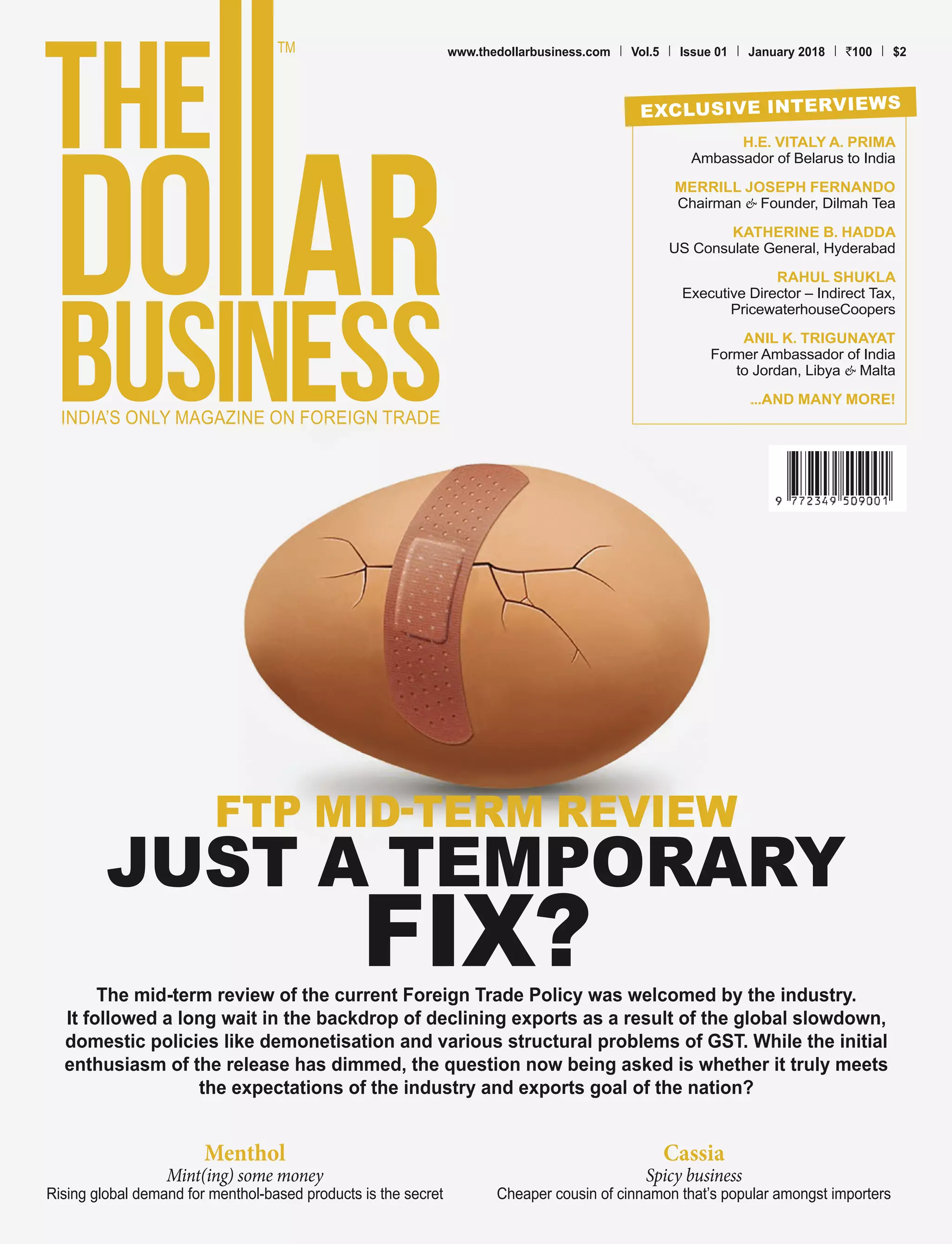
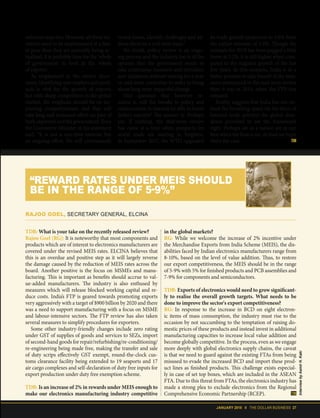
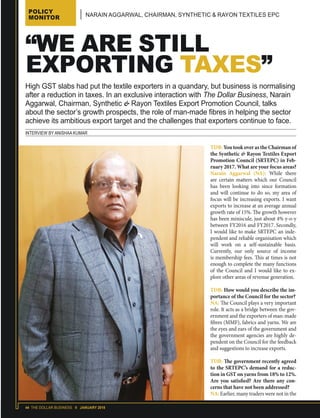
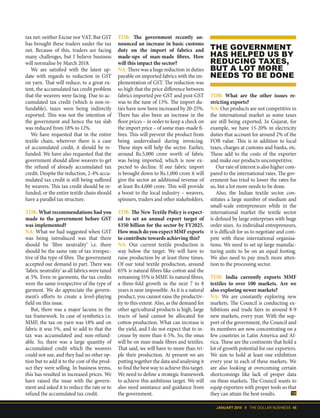
The mid-term review of the current Foreign Trade Policy was welcomed by the industry.
It followed a long wait in the backdrop of declining exports as a result of the global slowdown,
domestic policies like demonetisation and various structural problems of GST. While the initial
enthusiasm of the release has dimmed, the question now being asked is whether it truly meets
the expectations of the industry and exports goal of the nation?
FTP MID-TERM REVIEW
JUST A TEMPORARY
FIX?
H.E. VITALY A. PRIMA
Ambassador of Belarus to India
MERRILL JOSEPH FERNANDO
Chairman & Founder, Dilmah Tea
KATHERINE B. HADDA
US Consulate General, Hyderabad
RAHUL SHUKLA
Executive Director – Indirect Tax,
PricewaterhouseCoopers
ANIL K. TRIGUNAYAT
Former Ambassador of India
to Jordan, Libya & Malta
...AND MANY MORE!
EXCLUSIVE INTERVIEWS
Menthol
Mint(ing) some money
Rising global demand for menthol-based products is the secret
Cassia
Spicy business
Cheaper cousin of cinnamon that’s popular amongst importers
T H E A S O A P S
3-15-156, 2nd floor, Venkataramana Colony, Mallapur, Nacharam, Hyderabad-500076, Telangana. India
Mobile: +91-9949896254 / +91-9542786627 . Email: theasoaps@gmail.com, info@theasoaps.com, bulkorders@theasoaps.com
w w w . t h e a s o a p s . c o m
A genuine natural product, Thea Soaps, knows how to nurture your skin.
Free from all chemicals, whether it’s a moisturiser, body wash, face pack, or a simple soap bar,
our products are carefully handcrafted using only natural ingredients sourced from different parts
of the world.
Behind every stylish Beard there is always Beard Butter!
Beard Butter is a mix of oils and butters like Shea and Cocoa etc. The natural butters
used in beard butters are used to help lock in moisture whilst making sure the beard
remains soft and manageable. Butters also provide a light hold so that you can tame and
style your beard.
*All our products are 100% vegan / * All our products are 100% herbal extracts
THEA SOAPS
WE STAND FOR QUALITY
JANUARY 2018 II THE DOLLAR BUSINESS 3
LETTER FROM THE EDITOR–IN–CHIEF
A
cursory look at India’s exports numbers in the past 17 months, and a
casual observer could well brand it a ‘mini golden age’ of India’s per-
formance at the ports. India’s unusually vast tribe which thrives at con-
vincing foreign buyers with its produce is seemingly convinced about its
nation being a frontrunner to nudge past the $300 billion finish line this fiscal. It's
impressive that despite the multi-textured troubles (like demonetisation, a hurried
GSTimplementation,lackofdigitisation,failuretoimplement24x7clearancefacil-
ities at ports, delayed FTP revision, etc.), the anxieties are washed away by numbers
that indicate a bounceback to the 2013-14 days for India’s exports.
But a New Year presents newer challenges.
We saw some encouraging revisions to MEIS and SEIS announced in the month
of December last. WTO could have a problem with that, given its rules that al-
low a nation to give direct incentives to its exporters. This year itself, think tanks in
the government ranks should start formulating various ‘adjusted, indirect and yet
transferable’ incentives schemes that are (a) industry specific to avoid a one-size-
fits-all assumption, (b) as flexibile in terms of utility to the EXIM community as
the current ones, including transferability and usability, and (c) effective enough to
replace the ‘on-the-face’ incentives when the WTO comes knocking.
We have to get rid of the GST refund menace. A new year, but the same old
problem won’t do. As per some estimates, India’s exports community has begun
the year with a backlog of about Rs.1.85 lakh crore in pending IGST and ITC re-
funds. Of these two, ITC refunds account for about 85% of the total backlog, and it
is shocking that one significant reason why the refunds have not been processed is
the very ‘conflicting criteria for calculation of ITC refunds’. Such an inefficient, un-
sure mechanism jeopardises the present of India’s exporters, especially those lakhs
for whom these refund delay mean blockages of precious working capital.
Next come the states. For years now, we’ve witnessed a flurry of opinions and
announcements to make Indian states responsible for national exports. The states
were even advised to conclude on state-level export policies. So far, only 14 states
have prepared their drafts. The Niti Aayog must discuss and decide on a blueprint
for incentivising states that indulge proactively in growth of India’s exports. Special
subsidies can be offered to states who meet a minimum performance criteria. But
the question here is – who decides what criteria? Hopefully, the Centre has this
question sorted in its head.
Recent months have got the Indian exporters hopeful. The numbers – both per-
formance and revised FTP-related – have given them enough reasons to pin their
expectations on the Union Budget. It’s time for the Centre to shift focus slightly
away from fiscal prudence and provide tax sops and alternative incentives for ex-
porters through technological upgradation and modernisation schemes.
While the government has unleashed a battery of measures to aid India’s export-
ers and manufacturers in the past year, there is no denying the fact that 2017 has
been about a rise in exports despite scuttled plans and unexpected new realities.
Our exporters are paying the price of 'hurried changes' last year. 2018 will bring in
more 'stable hopes'. And with more hope comes more expectations.
Doubt you not – 2018 will be a consequential year for India’s foreign trade.
A government, chosen by popular vote five years back, has an opportunity to
become the popular champion of the common Indian exporter.
www.thedollarbusiness/blogs/steven
Recent months have got the
Indian exporters hopeful.
The numbers – performance
and FTP-related – have
given them reasons to pin
their expectations on the
Union Budget.
FROM 'HURRIED CHANGES'
TO 'STABLE HOPES'
@SPWarner www.tumblr.com/blog/steven-p-warner
Steven Philip Warner
President (VMPL) & Editor-in-Chief,
The Dollar Business
steven@thedollarbusiness.com
4 THE DOLLAR BUSINESS II JANUARY 2018
President (VMPL) : Steven Philip Warner
& Editor-in-Chief
EDITORIAL & RESEARCH
Editor : Manish K. Pandey
Executive Editor : Indranil Das
Senior Editor : Niladri S. Nath
Assistant Editors : Ahmad Shariq Khan, Anishaa Kumar,
Aamir Hussain Kaki
EDITORIAL CONSULTING BOARD
Founder & Editor : Anil Goyal
Publisher : Avnish Goyal
Chief Consulting Editor : Dr.A. K. Sengupta
ADVERTISEMENT SALES & MARKETING
Deputy Managers : Payal Kapoor, Rahul Jain
SeniorExecutive : Ayesha Fatima, Ankit Kharbanda
InternationalRepresentatives
Seoul(SouthKorea) : Justin Yoon
London(UK) : S. Puri
ART & PHOTOGRAPHY
Art Director : Sujesh Kumar G.
Senior Designer : Jayaprakash Reddy
Photographer : Dileep Kumar
THE DOLLAR BUSINESS ONLINE & RESEARCH
Project Managers : Sridhar Bodla, Omar Larzi
Web Designer : Purushothama Chary
SEO Specialist : Y. Lakshman Varma
Deputy Manager (EXIM Opp.): Lakshmi Kondaveeti
Asst. Managers (EXIM Opp.) : G Bhanu Prasad, Priyanka
Bhandekar, Sravanthi Bandhla
Senior Executive (EXIM Opp.) : Neetu Hotkar, A.V. Divya Madhuri,
Ravali Gali, Gunna Kavya Reddy
Executive (EXIM Opp.) : Vijayalakshmi Chittari, Radhika Nalluri,
Relangi Yamuna Santosh Kumari,
Habeeb Unnisa, N Lavanya,
Keerthi Sulakhe
Asst.Managers(Data&Metrics) : Sharath Chandra Murthy Macha,
Ramesh Babu Lalam
CIRCULATION, SUBSCRIPTION & DISTRIBUTION
Manager : M. Vinay Kumar
ALLIANCES & COMMUNICATIONS
Sr. Manager : Rasanpreet Kaur
Asst. Managers : Sravya Palakuru,
Aishwarya Ramarajan
FINANCE & ADMIN
Manager : V. Srikanth Tumati
Executive : Chandrakant Nawande
PRINTER
Rudra Graphic Designers
8-3-949/3, Beside Gold Spot Company, Punjagutta,
Hyderabad 500073, Telangana, IN
PUBLISHED AT
5-2-198/4, Distillery Road, Ranigunj, Secunderabad,
Telangana 500003, IN
FOR EDITORIAL/CONTENT
Email: editorial@thedollarbusiness.com
FOR ADVERTISEMENT
Email: ads@thedollarbusiness.com
FOR SUBSCRIPTION
Email: subscription@thedollarbusiness.com . +91-40-67609999
For queries / comments you can send us an SMS at +91-888-633-1947
© Copyright 2017
No part of this magazine may be reproduced in whole or in part without an ex-
pressed permission of the publisher. The information on this magazine is for
information purpose only. Manish K. Pandey, Editor, The Dollar Business, is re-
sponsible for the selection of news and content under PRB Act. Vimbri Media Pvt.
Ltd. assumes no liability or responsibility for any inaccurate, delayed or incomplete
information, or for any actions taken in reliance thereon. The information contained
about each individual, event or organisation has been provided by such individual,
event organisers or organisation without verification by us. All disputes are subject
to exclusive jurisdiction of competent courts and forums in Hyderabad, Telangana.
Printed and published byAvnish Goyal for Vimbri Media Pvt. Ltd.
Published at : 5-2-198/4, Distillery Road, Ranigunj, Secunderabad - 500 003,
Telangana.
Printedat:RudraGraphicDesigners,8-3-949/3,BesideGoldSpotCompany,Punjagutta,
Hyderabad - 500 073, Telangana.
Volume: 5 Issue: 01 January 2018
www.thedollarbusiness.com
facebook.com/tdbIndia
twitter.com/TheDollarBiz
in.linkedin.com/in/thedollarbusiness/
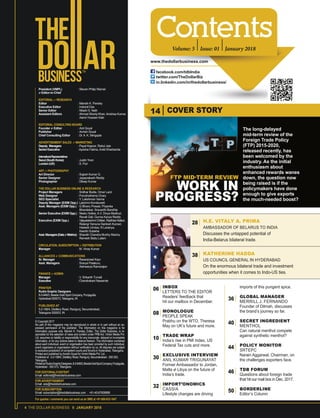
INBOX
LETTERS TO THE EDITOR
Readers’ feedback that
hit our mailbox in December.
MONOLOGUE
PEOPLE SPEAK
Prabhu on the WTO, Theresa
May on UK’s future and more.
TRADE WRAP
India’s rise in PMI Index, US
Federal Tax cuts and more.
EXCLUSIVE INTERVIEW
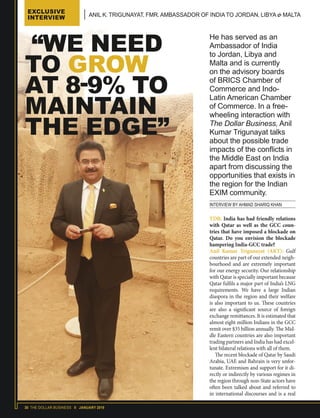
ANIL KUMAR TRIGUNAYAT
Former Ambassador to Jordan,
Malta & Libya on the future of
India’s trade.
IMPORT’ONOMICS
CASSIA
Lifestyle changes are driving
imports of this pungent spice.
GLOBAL MANAGER
MERRILL J. FERNANDO
Founder of Dilmah, discusses
the brand’s journey so far.
SECRET INGREDIENT
MENTHOL
Can natural menthol compete
against synthetic menthol?
POLICY MONITOR
SRTEPC
Narain Aggarwal, Chairman, on
the challenges exporters face.
TDB FORUM
Questions about foreign trade
that hit our mail box in Dec. 2017.
BORDERLINE
Editor’s Column
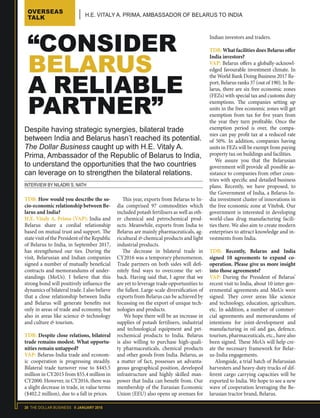
H.E. VITALY A. PRIMA
AMBASSADOR OF BELARUS TO INDIA
Discusses the untapped potential of
India-Belarus bilateral trade.
COVER STORY14
KATHERINE HADDA
US COUNCIL GENERAL IN HYDERABAD
On the enormous bilateral trade and investment
opportunities when it comes to Indo-US ties.
06
28
38
08
36
40
44
46
50
10
30
32
The long-delayed
mid-term review of the
Foreign Trade Policy
(FTP) 2015-2020,
released recently, has
been welcomed by the
industry. As the initial
enthusiasm about
enhanced rewards wanes
down, the question now
being raised is if the
policymakers have done
enough to give exports
the much-needed boost?
FTP MID-TERM REVIEW
WORK IN
PROGRESS?
CELEBRATING
50 GLORIOUS
YEARS OF
SERVING THE
INDIAN EXIM
COMMUNITY!
EMAIL US ON purchase@scripbazaar.com or buy@scripbazaar.com
DIAL +91-9885361000, +91-40-66323310, +91-40-27543312 or +91-40-27544008
ADDRESS 5-2-198/4, Distillery Road, Ranigunj,
Secunderabad,Telangana - 500003
GOEL ENTERPRISES
www.scripbazaar.com
MEIS
SEIS
DFIA
BUY&SELLMEIS,SEISANDOTHERTRANSFERABLESCRIPSONLINE
6 THE DOLLAR BUSINESS II JANUARY 2018
WE VALUE YOUR FEEDBACK, WHETHER CRITICISM OR APPRECIATION.
AND HERE ARE A FEW THAT HIT OUR MAILBOXES IN DECEMBER 2017
Afew months ago, I was lucky to come
across The Dollar Business magazine. I
must say, I was impressed with the quality
of the content. I believe that it is a first of
its kind endeavour in India. In my opinion,
such a publication can play a really con-
structive role in enhancing India’s trade
engagements with the rest of the world,
of course including my country, Holland.
All the very best!
H.E. ALPHONSUS STOELINGA
Ambassador of Netherlands to India
One of our main aims at Indian Im-
porters Chambers of Commerce
and Industries (IICCI) is to help foreign manufacturers
and investors find reliable partners in India. In this regard
The Dollar Business does a wonderful job. The magazine,
in my view, is an excellent publication that fills a critical
space and offers cutting-edge insights on multiple sectors
related to foreign trade. It caters excellently to the informa-
tional needs of wide-ranging stakeholders representing
the trading fraternity of the country. I wish the publication
all the success.
ATUL SAXENA
President,
Indian Importers Chambers of Commerce and Industries,
+91-11-26963XXX
iicci@indianimporterschambers.com
Ever since I got my hands on one of the issues of The
Dollar Business at one of the industry business meets,
I have become an avid reader. True to its tagline, India’s
only magazine on foreign trade, this publication, each
month, showcases stories related to Indian foreign trade
that are both well researched and insightful, not to mention
extremely well written. A must-read publication for anyone
interested in making a mark in the world of foreign trade.
DR. SAURABH AGARWAL
Professor,
Indian Institute of Finance
+91-120-6471XXX
sa@iif.edu
inbox editorial@thedollarbusiness.com
SMS your views to +91-7680-80-7111
The story on paper imports “Rolling in
the Money” in the December 2017 issue
was very informative. The point of view of
the industry was presented in a very elabo-
rate manner. It’s great to see someone high-
lighting the concerns of paper industry. I look
forward to reading such stories in the future.
TUSHAR GUPTA
Proprietor,
Om Shiv Packaging
+91-9873185XXX
We are a manufacturer and exporter of nat-
ural perfumery compounds, floral waters,
Indian vegetable seeds oils and other products.
It is good to see a magazine dedicated to exports
and imports. The content is well-researched and informa-
tive. The articles are interesting and insightful.
RAJAT MEHROTRA
Proprietor,
Meena Perfumery
+91-9839739XXX
Icame across the December issue of The Dollar Busi-
ness and it was very informative. Keep up the good work.
Could you send across a copy of the November issue?
RAJARAM SANGLE
Director,
Sangle Agro Processing Pvt. Ltd.,
+91-2532592XXX
sangle@alcomp.in
Ihave been a regular reader since 2015. Also, almost ev-
ery day, I browse the website. I recently noticed major
changes in the website, with new schemes for exporters.
I congratulate the team for introducing these initiatives. I
have recommended TDB to my colleagues and counter-
parts. I hope it will grow manifold in the future.
SAMAPIKA SANYAL
Officer – International Operations,
Kokuyo Camlin Ltd.
+91-9967893XXX
samapikasanyal8989@gmail.com
www.thedollarbusiness.com Vol.4 Issue 12 December 2017
100 $2
India’s rank in the World Bank’s Doing Business 2018 report jumped 30 places
from 2017 to reach 100. While this is a remarkable achievement, the country still
lags behind its peers on many important parameters like cross-border trade and
enforcing contracts. Is India really on its path to stardom or are we celebrating
too early? The Dollar Business analyses India’s new-found status.
R. S. SODHIManaging Director, AmulH.E. ALPHONSUS STOELINGAAmbassador of theNetherlands to IndiaCHARLOTTE NAN JIANG
Development Specialist, Doing
Business Group, World Bank
JULIUS SENAssociate Director – ITPU,
London School of Economics
MADAN SABNAVIS
Chief Economist, CARE Ratings
...AND MANY MORE!
EXCLUSIVE INTERVIEWS
Ribbon fishThe prize (by)catchThe fish is highly in demand amongst Chinese buyers
Paper & paperboardsRolling in profits
Growth in diverse applications is driving their imports
8 THE DOLLAR BUSINESS II JANUARY 2018
If we only discuss issues of in-
terest to a handful of developed
countries, then a multilateral body
like the WTO, with a majority of
developing countries, will become
irrelevant.
SURESH PRABHU
INDIAN MINISTER FOR TRADE
& COMMERCE
ON THE WTO STALEMATE
Source: IANS
We’ve been working on deepening our trade ties, opportunities for
small businesses, for Canadians to benefit from better access to the
Chinese market while standing up for our interests and jobs back home.
JUSTIN TRUDEAU
CANADIAN PRIME MINISTER
ON TRADE WITH CHINA
Source: AP
It calls for trade based on the
principles of fairness and
reciprocity. It calls for firm action
against unfair trade practices and
intellectual property theft. And it
calls for new steps to protect our
national security industrial and
innovation base.
DONALD TRUMP
US PRESIDENT
EMPHASISING THE ROLE OF
TRADE IN THE US NATIONAL
SECURITY STRATEGY
Source: The White House
The EU and Japan share a
common vision for an open
and rules-based world economy
that guarantees the highest stan-
dards. Today, we are sending a
message to other countries about
the importance of free and fair
trade, and of shaping
globalisation.
CECILIA MALMSTRÖM
EU COMMISSIONER FOR TRADE
ON EU-JAPAN TRADE DEAL
Source: European Commission
We will deliver on the will of
the British people and get
the best Brexit deal for our coun-
try – securing the greatest possi-
ble access to European markets,
boosting free trade with countries
across the world, and delivering
control over our borders, laws
and money.
THERESA MAY
BRITISH PRIME MINISTER
ON BRITAIN’S TRADE FUTURE
Source: Reuters
monologue
Thriving two-way trade and
investment is an integral part of
our vision for a strong partnership.
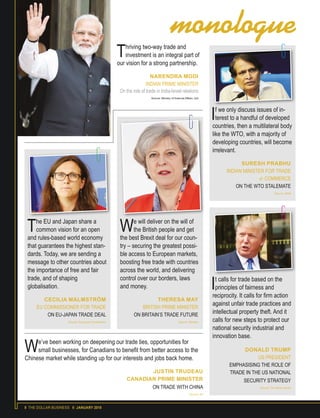
NARENDRA MODI
INDIAN PRIME MINISTER
On the role of trade in India-Israel relations
Source: Ministry of External Affairs, GoI
10 THE DOLLAR BUSINESS II JANUARY 2018
B
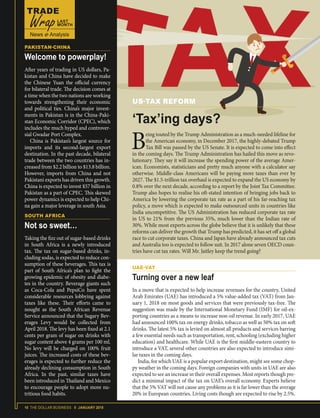
eing touted by the Trump Administration as a much-needed lifeline for
the American economy, in December 2017, the highly-debated Trump
Tax Bill was passed by the US Senate. It is expected to come into effect
in the coming days. The Trump Administration has hailed this move as revo-
lutionary. They say it will increase the spending power of the average Amer-
ican. Economists, statisticians and pretty much anyone with a calculator say
otherwise. Middle-class Americans will be paying more taxes than ever by
2027. The $1.5-trillion tax overhaul is expected to expand the US economy by
0.8% over the next decade, according to a report by the Joint Tax Committee.
Trump also hopes to realise his oft-stated intention of bringing jobs back to
America by lowering the corporate tax rate as a part of his far-reaching tax
policy, a move which is expected to make outsourced units in countries like
India uncompetitive. The US Administration has reduced corporate tax rate
in US to 21% from the previous 35%, much lower than the Indian rate of
30%. While most experts across the globe believe that it is unlikely that these
reforms can deliver the growth that Trump has predicted, it has set off a global
race to cut corporate taxes. China and Japan have already announced tax cuts
and Australia too is expected to follow suit. In 2017 alone seven OECD coun-
tries have cut tax rates. Will Mr. Jaitley keep the trend going?
US-TAX REFORM
‘Tax’ing days?
UAE-VAT
Turning over a new leaf
In a move that is expected to help increase revenues for the country, United
Arab Emirates (UAE) has introduced a 5% value-added tax (VAT) from Jan-
uary 1, 2018 on most goods and services that were previously tax-free. The
suggestion was made by the International Monetary Fund (IMF) for oil-ex-
porting countries as a means to increase non-oil revenue. In early 2017, UAE
had announced 100% tax on energy drinks, tobacco as well as 50% tax on soft
drinks. The latest 5% tax is levied on almost all products and services barring
a few essential needs such as transportation, rent, schooling (excluding higher
education) and healthcare. While UAE is the first middle-eastern country to
introduce a VAT, several other countries are also expected to introduce simi-
lar taxes in the coming days.
India, for which UAE is a popular export destination, might see some chop-
py weather in the coming days. Foreign companies with units in UAE are also
expected to see an increase in their overall expenses. Most reports though pre-
dict a minimal impact of the tax on UAE’s overall economy. Experts believe
that the 5% VAT will not cause any problems as it is far lower than the average
20% in European countries. Living costs though are expected to rise by 2.5%.
SOUTH AFRICA
Not so sweet…
Taking the fizz out of sugar-based drinks
in South Africa is a newly introduced
tax. The tax on sugar-based drinks, in-
cluding sodas, is expected to reduce con-
sumption of these beverages. This tax is
part of South Africa’s plan to fight the
growing epidemic of obesity and diabe-
tes in the country. Beverage giants such
as Coca-Cola and PepsiCo have spent
considerable resources lobbying against
taxes like these. Their efforts came to
nought as the South African Revenue
Service announced that the Sugary Bev-
erages Levy would be collected from
April 2018. The levy has been fixed at 2.1
cents per gram of sugar on drinks with
sugar content above 4 grams per 100 ml.
No levy will be charged on 100% fruit
juices. The increased costs of these bev-
erages is expected to further reduce the
already declining consumption in South
Africa. In the past, similar taxes have
been introduced in Thailand and Mexico
to encourage people to adopt more nu-
tritious food habits.
PAKISTAN-CHINA
Welcome to powerplay!
After years of trading in US dollars, Pa-
kistan and China have decided to make
the Chinese Yuan the official currency
for bilateral trade. The decision comes at
a time when the two nations are working
towards strengthening their economic
and political ties. China’s major invest-
ments in Pakistan is in the China-Paki-
stan Economic Corridor (CPEC), which
includes the much hyped and controver-
sial Gwadar Port Complex.
China is Pakistan’s largest source for
imports and its second-largest export
destination. In the past decade, bilateral
trade between the two countries has in-
creased from $2.2 billion to $13.8 billion.
However, imports from China and not
Pakistani exports has driven this growth.
China is expected to invest $57 billion in
Pakistan as a part of CPEC. This skewed
power dynamics is expected to help Chi-
na gain a major leverage in south Asia.
JANUARY 2018 II THE DOLLAR BUSINESS 11
PMI
Back on track?
According to the Nikkei Purchasing
Manager’s Index (PMI) for December
2017, Indian manufacturing rose to a
five-year high of 54.7 from 52.6 in No-
vember 2017. The index measures the
strength of a country’s “economic health”.
A reading above 50 on the index hints at
economic expansion while one below 50
indicates contraction. In July 2017 the
PMI saw a decline to 47.9 from 50.9 in
June 2017. The introduction of GST and
the demonetisation initiative, which re-
sulted in a slowdown in factory outputs,
were factored to be the main reason.
The report findings indicate that India
is recovering from the recent economic
reforms and is getting back on track to
being one of the fastest growing econo-
mies in the world.
INDIA-RUSSIA
Planning a win-win
During a recent meeting of the In-
dia-Russia Inter-Governmental Com-
mission on Trade, Economic, Tech-
nological and Cultural Cooperation
(IRGC-TEC), India and Russia reviewed
areas of economic cooperation, includ-
ing investments, energy and trade. As
a part of the meeting, working groups
were set up for removing barriers for
trade and increasing investments. In
FY2017, bilateral trade reached $7.4 bil-
lion. During Prime Minister Narendra
Modi’s visit to Russia, the two nations
further spoke about advancing discus-
sions on an Indo-Eurasia FTA which is
expected to provide India with a trade
potential of as high as $62 billion.
METHANOL
Saving the environment
In a move to help reduce India’s dependency on crude oil imports, NITI Aayog
is working on a ‘methanol policy’. By promoting methanol as an eco-friendly
alternative to carbon fuels, by 2030 the policy aims to reduce imports of crude
oil by $100 billion. The government is reportedly planning to set up a metha-
nol economy fund worth Rs.4,000-5,000 crore in order to promote domestic
methanol production. Under the plan, Coal India is expected to set up facili-
ties to convert high ash coal into fuel.
Mixing methanol with petroleum reduces the cost of fuel by 10%. This will
go a long way in making transportation cheaper in the country as Indian rail-
ways and ports are highly dependent on petroleum. Speaking during a Parlia-
ment session, Union Minister for Transport Nitin Gadkari said that around 50
ports and vessels will be refitted to use methanol in the coming days. Meth-
anol use can also help reduce fuel costs for railways which currently spends
Rs.15,000 crore per annum on diesel. It is worth noting that India is currently
the third-largest importer of petroleum in the world.
A
fter concerns about the long-term impact of the government reforms
and policies on India’s foreign trade, good news came in the form
of trade data. In November 2017, India’s exports grew by 30.55% to
$26.19 billion against $20.06 billion in November 2016. Exports rose by 13.4%
from October 2017. A y-o-y decline was seen in October 2017, when exports
fell to $23.09 billion from $23.36 billion in October 2016. The growth in ex-
ports, according to reports, has been due to the increase in global demand and
a simplification in taxation with the introduction of GST. Some sectors that
have shown improvements include engineering, gems and jewellery, petro-
leum, pharmaceuticals, chemicals, etc. For the period from April to Novem-
ber 2017, the cumulative exports increased by 12% y-o-y to $196.64 billion.
Despite the growth in exports, the country’s trade deficit continued to rise as
imports saw a y-o-y increase of 19.61% to $40 billion in November 2017. With
the government having announced higher incentives for exporters in the mid-
term FTP review, will the trade deficit now narrow down? Only time will tell.
GST
New Year cheer
14 THE DOLLAR BUSINESS II JANUARY 2018
COVER STORY FTP 2015-2020 MID-TERM REVIEW
FTP MIDTERM REVIEW
BULLISHLY
SERIOUS.
BARELY
SUFFICIENT.
JANUARY 2018 II THE DOLLAR BUSINESS 15
BY AAMIR H. KAKI
The long-awaited and much-delayed mid-term review
of the Foreign Trade Policy (FTP) 2015-2020, was
released by the Ministry of Commerce in December
last. While the government enhanced rewards
under its flagship export promotion schemes and
addressed some issues that had come into play after
the implementation of GST, there wasn't anything that
exceeded expectations of India's EXIM community. In
its zeal for ticking the right boxes, the review seems to
have given radical structural reforms a miss. Will the
revised FTP help deliver a 'sustained' export growth?
The Dollar Business takes stock.
T
he year 2017 ended on a
happy note for the Indi-
an exim community as the
much-awaited mid-term
review of the Foreign Trade
Policy (FTP) 2015-20 was released by
Minister of Commerce and Industry,
Suresh P. Prabhu on December 5, 2017.
The review comes at a time when the In-
dian EXIM community has been strug-
gling with internal issues such as the
impact of demonetisation and structural
problems post-GST as well as other (in-
cluding external) factors like appreciat-
ing rupee, lack of dollars amongst LatAm
and African nations, a sluggish global
market, etc.
The mid-term review of FTP, which
aims to promote and boost merchandise
and services exports from the country
was long overdue. In May 2017, the then
Commerce Minister Nirmala Sithara-
man had sown the seeds of hope when
she announced that the review of the
FTP would be released before the imple-
mentation of the Goods and Services Tax
(GST). That wasn't to be. The review was
delayed in order to include changes re-
quired post GST implementation.
The mid-term review at first sight
looks to be one that the industry needs
at this hour, but is it one the industry
deserves? Will the announcements have
a long-term impact on Indian exports?
Will the measures announced be able to
take Indian exporters up the value chain
and increase the popularity of Indian
products in the global market or are these
just temporary fixes for the visible dam-
ages from GST implementation?
TICKING THE BOXES
FTP 2015-2020 had set an ambitious tar-
THE FTP REVIEW
WAS INTRODUCED
WITH A PROMISE TO
GIVE A FILLIP TO
THE MSME SECTOR
16 THE DOLLAR BUSINESS II JANUARY 2018
COVER STORY FTP 2015-2020 MID-TERM REVIEW
get of $900 billion in exports by FY2020.
With the target looking extremely unre-
alistic half-way through the term, and the
implementation of GST throwing a span-
ner into the works, the government had
its work cut out. With the review, it has
tried to tick most of the boxes to alleviate
the concerns of exporters.
The focus of the mid-term review has
been on labour-intensive sectors and mi-
cro, small and medium enterprises (MS-
MEs), which contribute 45% of India's
manufacturing output, over 40% of total
exports and 8% of GDP. The segment has
faced the maximum brunt of the GST
implementation and demonetisation
drive. And, it was about time that their
issues were addressed and alleviated.
The major benefits for MSMEs (and
larger companies) came in the form of
enhancement of duty credit scrips by
2% across all sectors, under the flagship
schemes of Merchandise Exports from
India Scheme (MEIS) and Services Ex-
ports from India Scheme (SEIS). Overall,
the incentives under the two schemes
have been increased by Rs.8,450 crore,
which represent a 33.8% annual rise from
the prevailing Rs.25,000 crore.
The biggest beneficiary of this increase
in incentives seems to be the ready-made
garments and made-ups sector. The po-
tential additional annual cost to the gov-
ernmentbecauseoftheincreasedrewards
on exports of ready-made garments and
made-ups is expected to be Rs.2,743
crore. Similarly, the increased benefits for
exports by MSMEs and labour-incentive
industries such as agriculture, carpets,
leather, marine products, hand tools,
rubber products, sports goods, ceramics,
scientific and medical products and elec-
tronic and telecom components will cost
the exchequer Rs.4,567 crore, annually.
Under SEIS, higher incentives for ser-
vices such as software services, architec-
ture, legal accounting, hospital, engineer-
ing, education, hotels and restaurants will
cost the government around Rs.1,140
crore a year.
In addition, based on feedback from
the foreign trade community, the gov-
ernment has increased the validity of the
duty credit scrips from 18 months to 24
months in order to augment their utility
in the GST regime. The GST rate for the
transfer and sale of scrips has also been
cut down to zero from the earlier 12%. 
While the increase in the rate of re-
wards is expected to directly add to the
bottomline of exporters or at least defray
the monetary impact of GST implemen-
tation, the revision has also taken mea-
sures towards improving existing pol-
icies by easing re-export of goods that
are freely importable. In the same vein,
procedures have been simplified under
the Export Promotion Capital Goods
(EPCG) Scheme for extension of export
obligation (EO) period and shifting of
capital goods.
Similarly, the government has allowed
the import of second-hand goods for re-
pairing or refurbishing purpose, in order
to facilitate employment generation in
repair services sector. In addition, bene-
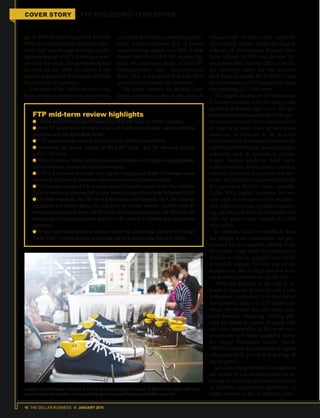
Leather and footwear industry is of the opinion that the increase in MEIS scrip value will help
in promoting innovation and improving price competitiveness of Indian exports.
FTP mid-term review highlights
Overall annual incentives increased by Rs.8,450 crore (a 33.8% increase).
The FTP would focus on micro, small and medium enterprises, labour-intensive
segments and the agriculture sector.
FTP incentives now cover 8,000 of the total 12,000 lines of items.
Incentives for goods exports is Rs.4,567 crore, and for services exports
is Rs.1,140 crore.
This is in addition to the recently announced incentives for ready-made garments.
Self-certification scheme for duty-free imports.
FTP is a dynamic document and regular changes are made to increase value
addition in the country, generate more employment and boost exports.
The review includes a 2% increase each in incentive rates of the Merchandise
Exports from India Scheme (MEIS) and Services Export from India Scheme (SEIS).
Of these incentives, Rs.749 crore is for leather and footwear, Rs.1,354 crore for
agriculture and related items, Rs.759 crore for marine exports, Rs.369 crore for
telecom and electronic items, Rs.921 crore for handmade carpets, Rs.193 crore for
medical and surgical equipment and Rs.1,140 crore is for textiles and readymade
garments.
A new trade data analytics division under the Directorate General of Foreign
Trade (DGFT) will be created to analyse real time data to help fine-tune policy.
JANUARY 2018 II THE DOLLAR BUSINESS 17
TDB: What is your take on the FTP mid-term review? Has
the government rightly identified policy gaps that have been
affecting the growth of the EoUs and SEZs this time around?
Dr. Vinay Sharma (VS): In many ways, the changes are wel-
come. However, structural loopholes that continue to plague
our sector need to be urgently addressed. There are many areas
where despite repeated reminders to concerned policymakers,
things have not moved at the desired pace. Isn’t it a fact that
we are responsible for 38-40% of country’s outward shipments?
And does that not show we must be doing something right for
the country’s economy? The government needs to play a more
proactive role for our cause. Policy unpredictability, the return
of cumbersome procedures and delays in decision-making
have marred the image of SEZs as investor-friendly hotspots.
TDB: Will the additional 2% incentives provided under
MEIS effectively help Indian exporters become more com-
petitive in the international market?
VS: This is undoubtedly a positive development. We believe
that such measures will help Indian exporters become more
competitive. Equally laudable is the extension of validity of
scrips from 18 months to 24 months along with the provision
of zero GST on the sale of scrips. Sectors such as textiles and
garments have been demanding the increase in rates of MEIS
reward along with RoSL and duty drawback for a long time.
Now, since the DGFT has enhanced the rates for garments and
made-ups to 4% of the value of exports under MEIS, many oth-
er sectors will ask for similar incentives.
With regards to whether these additional incentives serve
the need, I think, the benefits are in the acceptable range. As
a practice, dishing out too many doles is not a good idea. The
ultimate intention should be to make exports self-sustaining.
TDB: GST refunds have been a cause for concern amongst
traders and exporters. Your comments.
VS: Ever since the GST has been enforced, yet-to-be-disbursed
GST refunds is an issue that has been the Achilles heel of the
SEZs and EOUs community. Look at one paradox here. For tax
purposes, SEZ supplies are now treated as zero-rated. So, say,
if you bring material inside conclave, there is no GST applica-
ble. But then, operating out of an SEZ, if you offer a service,
you need to pay GST on it. Activities such as services exported
from SEZs paid in foreign currency to the foreign party are not
considered tax free. This paradox affects the gems and jewel-
lery segment which is certainly a big segment for us. There are
many players within SEZs who are entitled to input credits (IC)
if they get an order, say for diamond polishing. But then the
moment this 18% service tax is brought to the notice of the
foreign client, he starts looking for options (other cost-effective
destinations) – and we lose business. Likewise, the warehouse
industry is also being impacted by such an anomaly.
I would also like to add that the majority of Indian business-
men are not averse to paying taxes, but it’s the inbuilt compli-
ance cost in the tax mechanism that scares them. For instance,
while supplying goods, a supplier needs to have letter of under-
taking (LuT), which is system based. For this, one needs to go
to GST website and request an LuT and wait for its approval.
That eventually leaves him with two options: Either he should
pay tax and claim refunds himself or the other party applies for
input credit. Now being zero-rated, I cannot avail input cred-
its and the mentality of a regular supplier is such that unless
they have a volume business, they don’t bother about LuT as it
not only increases paperwork but ends up multiplying their tax
compliance cost. Such anomalies need to be fixed soon.
TDB: Can initiatives such as a trust-based, self-rectification
scheme for duty-free imports and creation of a new logistic
division prove to be a gamechanger for the sector?
VS: Yes, I think, the trust-based, self-rectification scheme for
duty-free imports and initiatives like the doing away with test-
ing of samples for drawback purpose as well as the introduc-
tion of e-sealing facility for exporters will help accelerate cargo
movement and lead to quick clearances of consignments.
With regards to self-certification, I would like to add that the
SEZ industry has already been following this norm all along.
Operating within a designated, regulated premise with a speci-
fied inlet and outlet gate, I believe that the majority of business
owners within SEZs are law-abiding people.
The creation of a logistics division is a good step as logistics
costs certainly take the sheen off our cost competitiveness in
many world markets. It’s too high at the moment and in fact, it
is higher than what the government agencies tell us. The cur-
rent on-the-road consignment movement is a serious night-
mare. Our ports such as JNPT are no better. The facilities there
are extremely overstretched. We need to emulate the best of
industry practices in this regard. We can learn a lot from China
here. They have manged to create a great mechanism for last
mile connectivity. In countries, smaller than ours, they have
no shortage of ports. Some big factories have their own ports
there. I do not understand why Indian law stipulates that a port
should be at least 50 km away from another. What if one of
them is inefficient to cater to our requirements?
“NOT MUCH WAS DONE TO ADDRESS
THE STRUCTURAL ISSUES”
DR. VINAY SHARMA, OFFICIATING CHAIRMAN, EXPORT PROMOTION COUNCIL FOR EOUs & SEZs (EPCES)
InterviewbyAhmadShariqKhan
18 THE DOLLAR BUSINESS II JANUARY 2018
COVER STORY FTP 2015-2020 MID-TERM REVIEW
fits have been restored under the export
promotion schemes of duty free imports
underAdvancedAuthorisation(AA),Ex-
port Promotion Capital Goods (EPCG)
and 100% Export Oriented Units (EOUs)
schemes, thus resolving the problem of
blocked working capital for exporters fol-
lowing the roll-out of GST. To address the
liquidity problem faced by exporters after
GST rollout, an ‘e-wallet’ system is likely
to be operational from April 1, 2018.
Taking cognizance of the fact that one
of the major factors that impact the com-
petitiveness of Indian products is our
high cost of logistics, a new Logistics Di-
vision will be set up in the Department of
Commerce for promoting the integrated
development of logistics sector.
Theotherlong-awaitedannouncement
has been that an advanced trade analytics
division will be created in the Director-
ate General of Foreign Trade (DGFT) to
help them take data-based policy actions.
Together with this, the Contact@DGFT
service has been launched on the DGFT
website as a single window contact point
for exporters and importers. The service
is expected to be a touch point that ex-
porters can access to resolve their issues
as well as give suggestions to the DGFT.
The Commerce Ministry is also in the
process of drafting a new agricultural ex-
port policy in order to boost exports of
value-added agri products. A new ser-
vices division too will be created in DGFT
to assess EXIM policies and procedures
to drive services exports. With regards to
policy direction, a major emphasis will be
put on exploring new markets and prod-
ucts in addition to increasing share in tra-
ditional markets and products.
THE ACCOLADES
As we said earlier, the government has
managedtotickmostboxes.Naturallyex-
porters, especially those from the MSME
sector, have welcomed the policy chang-
es, specifically the increase in incentives
under MEIS and SEIS. Ajay Sahai, Direc-
tor General & CEO, Federation of Indi-
an Export Organisations (FIEO), says,
“The review has taken a two-pronged
approach and focusses on sunrise sec-
tors of exports as well as on the employ-
ment-intensive traditional sectors. In line
with that, the review provides additional
incentives to sectors such as electronics,
pharmaceuticals, medical and diagnostic
equipment and high-technology sectors
as well as leather, marine, food process-
ing, sports goods, textiles, carpets and
handicrafts. The policy statement to a
large extent has identified the issues af-
fecting exports.”
The MSME sector believes that the
increase in MEIS rewards will definitely
have a positive impact on exports. Rep-
resenting the handicrafts exporters, and
a sector that mostly comprises MSMEs,
Rakesh Kumar, Executive Director, Ex-
port Promotion Council for Handicrafts
(EPCH), puts in, “Increase in MEIS rates
will certainly result in increasing exports
from MSMEs and labour-intensive in-
dustries including the handicrafts sector.”
Mukhtarul Amin, Chairman, Council
for Leather Exports (CLE), believes that
this increase in rewards will also signifi-
cantly benefit leather and footwear ex-
ports, a sector which has seen a decline
in exports over the last few months. The
increase, according to Amin, will play an
important role in promoting innovation
in the sector which will ultimately help
improve its position on the global stage.
“As the leather and footwear sectors are
fashion and consumer-oriented, there is
a need for continuous innovation lead-
ing to the creation of new products. For
this, the industry is required to procure
many critical inputs and components,
for which the MEIS scrip is very useful.
Hence, increase of MEIS scrip value will
help in increasing price competitiveness
of the sector,” explains Amin.
H. K. L. Magu, Chairman of Appar-
el Export Promotion Council (AEPC),
too believes that the FTP review has ad-
dressed several concerns of the sector. “I
believe the mid-term review of FTP has
covered many issues like enhancement
of MEIS, increase in validity of scrips,
zero duty on scrips, 24X7 facility to more
seaports, etc. The enhancement in MEIS
rates is a positive step. Besides this, the
other critical area that FTP review has
dealt with is trade facilitation and easing
our capital blockage,” says Magu.
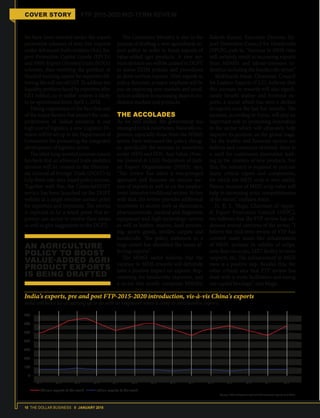
China's exports to the world India's exports to the world
Source: TDB Intelligence Unit and UN Comtrade; figures in $ billion
India's exports, pre and post FTP-2015-2020 introduction, vis-à-vis China's exports
India still has a lot of catching up to do with its neighbour when it come to merchandise exports
700
600
500
400
300
200
100
0
2014
Q-1
2014
Q-2
2014
Q-3
2014
Q-4
2015
Q-1
2015
Q-2
2015
Q-3
2015
Q-4
2016
Q-1
2016
Q-2
2016
Q-3
2016
Q-4
2017
Q-1
2017
Q-2
AN AGRICULTURE
POLICY TO BOOST
VALUE-ADDED AGRI
PRODUCT EXPORTS
IS BEING DRAFTED
JANUARY 2018 II THE DOLLAR BUSINESS 19
TDB: Are you satisfied with the FTP mid-term review?
Ajay Sahai (AS): The mid-term review reassured the exports
sector that intervention in the dynamic sector of international
trade would be initiated as and when required without wait-
ing for an annual or end-term correction. The review has taken
a two-pronged approach – it focusses both on sunrise sectors
of exports as well as on the employment-intensive traditional
sectors. In line with that, the review provides additional incen-
tives to sectors such as electronics, pharmaceuticals, medical
and diagnostic equipment and high-technology sectors as well
as leather, marine, food processing, sports goods, textiles, car-
pets and handicrafts. The policy statement to a large extent has
identified the issues affecting exports and I am sure that correc-
tive actions will be taken in the short, medium and long-term,
depending on the nature of the issue.
TDB: Do you think the additional 2% reward provided un-
der MEIS and SEIS will help exports grow?
AS: One of the challenges faced by the Indian export sector
is price sensitivity. The volatility in the exchange rate affects
Indian exports. The additional incentive will return some of
the competitive edge which was lost as the rupee strengthened
against foreign currencies while our competitors’ currencies
weakened against the US dollar and other major currencies.
TDB: Is the government's decision to focus on labour-inten-
sive industries and MSMEs in the right direction when the
world is moving up the value chain?
AS: The biggest challenge facing the economy is job creation.
The focus of the government therefore rightly is on MSMEs
as employment to capital ratio in the sector is extremely high.
MSMEs have the capability and flexibility to create jobs in the
short to medium-term. Labour-intensive sectors also assume
significance as they provide seasonal employment to the large
workforce traditionally engaged in agriculture. ‘Make in India’
may be led by large companies, but this initiative will create
huge opportunities for ancillaries in the MSME sector. There-
fore, I feel, government is right in adopting a strategy which is a
mix of focus on large companies and MSMEs. Moreover, large
industries are quite capable and already have their own proac-
tive ecosystem, while MSMEs may require some fiscal support.
TDB: What is your view on the new trust-based, self-recti-
fication scheme and the creation of a new logistics division?
Can these prove to be game-changers for the sector?
AS: We have to gradually move away from physical control to a
trust-based system. The FTP has encouraged this by introduc-
ing such a system for categories of exporters who have been
recognised as Authorised Economic Operators (AEO). Such a
recognition will also encourage exporters to opt for the AEO
Scheme which unfortunately has not received an enthusiastic
response. However, this is not enough, and the government
should aggressively market its new schemes and address pro-
cedural constraints, if any.
The creation of a Logistics Division, for the first time, will
provide a holistic view of the state of affairs of logistics. Un-
fortunately, logistics comes within the purview of different
ministries and each pursues its own policies and goals without
looking into the initiatives undertaken by the other ministries.
The Logistics Division will help in reducing the cost of logistics
in the country. This has been supplemented by giving infra-
structure status to logistics and implementation of GST which
entails e-way bills. All these initiatives will help the exports and
manufacturing sector. The creation of a single platform for all
logistics service providers will also provide competitive logis-
tics rates, transparency and predictability.
TDB: How has the implementation of GST affected the ex-
ports fraternity? What are the challenges that you are fac-
ing? How satisfied are you with the solutions proposed?
AS: Most of the challenges faced by the exporters in the GST
regime are procedural in nature. The technical glitches in the
GSTN, lack of awareness of the tax authorities towards export
refund, grey areas in the filing of regular returns have com-
pounded the problems of exporters. However, these are the
teething challenges. We are hopeful that these issues will be
addressed by March 2018. We also expect that the government
will continue to provide an exemption from IGST on inputs re-
quired for exports production and introduce a comprehensive
drawback scheme which provides a refund of both basic cus-
toms duty and GST. Once the GST regime stabilises, the sector
will surely gain from this tax reform.
TDB: In terms of a pro-trade FTP policy, what policy chang-
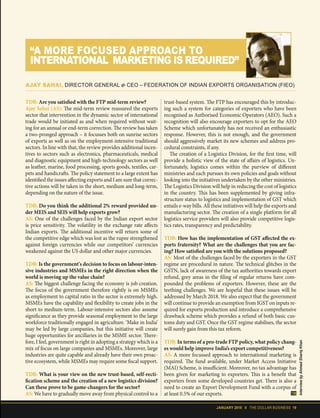
es would help improve India’s export competitiveness?
AS: A more focussed approach to international marketing is
required. The fund available, under Market Access Initiative
(MAI) Scheme, is insufficient. Moreover, no tax advantage has
been given for marketing to exporters. This is a benefit that
exporters from some developed countries get. There is also a
need to create an Export Development Fund with a corpus of
at least 0.5% of our exports.
“A MORE FOCUSED APPROACH TO
INTERNATIONAL MARKETING IS REQUIRED”
AJAY SAHAI, DIRECTOR GENERAL & CEO – FEDERATION OF INDIAN EXPORTS ORGANISATION (FIEO)
InterviewbyAhmadShariqKhan
20 THE DOLLAR BUSINESS II JANUARY 2018
COVER STORY FTP 2015-2020 MID-TERM REVIEW
Exporters from sectors like electron-
ics manufacturing also believe that the
increase in MEIS rates will be helpful for
the industry. “It is noteworthy that sev-
eral components and products, which
are of interest to electronics manufactur-
ers, are covered under the revised MEIS
rates,” says Rajoo Goel, Secretary Gen-
eral, ELCINA, an industry association of
electronics hardware manufacturers.
Further, it's not only the increase in
MEIS rates that the exporters are excit-
ed about. Other policy changes are also
a source of optimism for the community.
D. K. Sareen, Executive Director, Elec-
tronics & Computer Software Export
Promotion Council (ESC), says, “The re-
cently announced review contains many
policy incentives, particularly those that
boost exports of electronics and services
like healthcare, legal outsourcing, etc.
The focus on finding new markets and
new products as well as increasing In-
dia’s share in the traditional markets and
products is also noteworthy.”
According to Sareen, steps such as in-
crease in MEIS and SEIS incentive rates,
focus on ‘ease of trading’ across borders,
and additional annual incentive of Rs.
369 crore for telecom, electronic com-
ponents, will definitely help in boosting
exports from the country.
The renewed focus of the government
on agriculture-based products has also
recieved acclaim. Former Indian Oil-
seeds and Produce Export Promotion
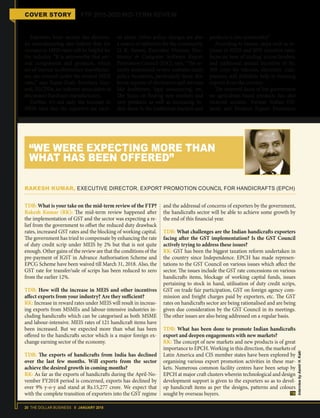
TDB: What is your take on the mid-term review of the FTP?
Rakesh Kumar (RK): The mid-term review happened after
the implementation of GST and the sector was expecting a re-
lief from the government to offset the reduced duty drawback
rates, increased GST rates and the blocking of working capital.
The government has tried to compensate by enhancing the rate
of duty credit scrip under MEIS by 2% but that is not quite
enough. Other gains of the review are that the conditions of the
pre-payment of IGST in Advance Authorisation Scheme and
EPCG Scheme have been waived till March 31, 2018. Also, the
GST rate for transfer/sale of scrips has been reduced to zero
from the earlier 12%.
TDB: How will the increase in MEIS and other incentives
affect exports from your industry? Are they sufficient?
RK: Increase in reward rates under MEIS will result in increas-
ing exports from MSMEs and labour-intensive industries in-
cluding handicrafts which can be categorised as both MSME
and labour-intensive. MEIS rates of 121 handicraft items have
been increased. But we expected more than what has been
offered to the handicrafts sector which is a major foreign ex-
change earning sector of the economy.
TDB: The exports of handicrafts from India has declined
over the last few months. Will exports from the sector
achieve the desired growth in coming months?
RK: As far as the exports of handicrafts during the April-No-
vember FY2018 period is concerned, exports has declined by
over 9% y-o-y and stand at Rs.15,277 crore. We expect that
with the complete transition of exporters into the GST regime
and the addressal of concerns of exporters by the government,
the handicrafts sector will be able to achieve some growth by
the end of this financial year.
TDB: What challenges are the Indian handicrafts exporters
facing after the GST implementation? Is the GST Council
actively trying to address these issues?
RK: GST has been the biggest taxation reform undertaken in
the country since Independence. EPCH has made represen-
tations to the GST Council on various issues which affect the
sector. The issues include the GST rate concessions on various
handicrafts items, blockage of working capital funds, issues
pertaining to stock in hand, utilisation of duty credit scrips,
GST on trade fair participation, GST on foreign agency com-
mission and freight charges paid by exporters, etc. The GST
rates on handicrafts sector are being rationalised and are being
given due consideration by the GST Council in its meetings.
The other issues are also being addressed on a regular basis.
TDB: What has been done to promote Indian handicrafts
export and deepen engagements with new markets?
RK: The concept of new markets and new products is of great
importance to EPCH. Working in this direction, the markets of
Latin America and CIS member states have been explored by
organising various export promotion activities in these mar-
kets. Numerous common facility centres have been setup by
EPCH at major craft clusters wherein technological and design
development support is given to the exporters so as to devel-
op handicraft items as per the designs, patterns and colours
sought by overseas buyers.
RAKESH KUMAR, EXECUTIVE DIRECTOR, EXPORT PROMOTION COUNCIL FOR HANDICRAFTS (EPCH)
“WE WERE EXPECTING MORE THAN
WHAT HAS BEEN OFFERED”
InterviewbyAamirH.Kaki
JANUARY 2018 II THE DOLLAR BUSINESS 21
Council (IOPEPC) Chairman Sanjiv
Sawla states, “We are happy to see that
the government is now specifically focus-
sing on exports of agri products. We are
facing many challenges such as non-tariff
barriers. Therefore, a strong agricultural
trade policy will be of great benefit.”
AND THE BRICKBATS
Even with all the positives steps in the
FTP mid-term review, in the wake of
the subdued export market, many feel
that the review fell short on the expecta-
tions of the industry. Many believe that
while short-term issues may have been
addressed, painting all sectors with the
same brush by enhancing rewards by 2%
could mean that the government did not
analyse sectoral problems.
Being a representative of a sector
which comprises mostly MSMEs, Magu
says that the AEPC was expecting much
more emphasis on their sector. “The sec-
tor was expecting enhanced duty draw-
back and rebate of state levies (RoSL) on
account of many embedded and blocked
taxes. The sector was also hoping for a
phased-out approach towards policy sup-
port rationalisation, post-GST. But that
didn't happen,” he adds.
Amin from CLE also says that the
leather industry was expecting a little
more. “The enhanced scrip will be avail-
able for exports made from November
1, 2017 to June 30, 2018. This enhanced
scrip should be made available for the
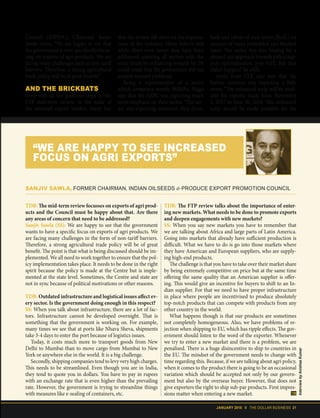
TDB: The mid-term review focusses on exports of agri prod-
ucts and the Council must be happy about that. Are there
any areas of concern that need to be addressed?
Sanjiv Sawla (SS): We are happy to see that the government
wants to have a specific focus on exports of agri products. We
are facing many challenges in the form of non-tariff barriers.
Therefore, a strong agricultural trade policy will be of great
benefit. The point is that what is being discussed should be im-
plemented. We all need to work together to ensure that the pol-
icy implementation takes place. It needs to be done in the right
spirit because the policy is made at the Centre but is imple-
mented at the state level. Sometimes, the Centre and state are
not in sync because of political motivations or other reasons.
TDB: Outdated infrastructure and logistical issues affect ev-
ery sector. Is the government doing enough in this respect?
SS: When you talk about infrastructure, there are a lot of fac-
tors. Infrastructure cannot be developed overnight. That is
something that the government is working on. For example,
many times we see that at ports like Nhava Sheva, shipments
take 3-4 days to enter the port because of logistics issues.
Today, it costs much more to transport goods from New
Delhi to Mumbai than to move cargo from Mumbai to New
York or anywhere else in the world. It is a big challenge.
Secondly, shipping companies tend to levy very high charges.
This needs to be streamlined. Even though you are in India,
they tend to quote you in dollars. You have to pay in rupees
with an exchange rate that is even higher than the prevailing
rate. However, the government is trying to streamline things
with measures like e-sealing of containers, etc.
TDB: The FTP review talks about the importance of enter-
ing new markets. What needs to be done to promote exports
and deepen engagements with new markets?
SS: When you say new markets you have to remember that
we are talking about Africa and large parts of Latin America.
Going into markets that already have sufficient production is
difficult. What we have to do is go into those markets where
they have American and European suppliers, who are supply-
ing high-end products.
The challenge is that you have to take over their market share
by being extremely competitive on price but at the same time
offering the same quality that an American supplier is offer-
ing. This would give an incentive for buyers to shift to an In-
dian supplier. For that we need to have proper infrastructure
in place where people are incentivised to produce absolutely
top-notch products that can compete with products from any
other country in the world.
What happens though is that our products are sometimes
not completely homogeneous. Also, we have problems of re-
jection when shipping to EU, which has ripple effects. The gov-
ernment should listen to the word of the exporter. Whenever
we try to enter a new market and there is a problem, we are
penalised. There is a huge disincentive to ship to countries in
the EU. The mindset of the government needs to change with
time regarding this. Because, if we are talking about agri policy,
when it comes to the product there is going to be an occasional
variation which should be accepted not only by our govern-
ment but also by the overseas buyer. However, that does not
give exporters the right to ship sub-par products. First impres-
sions matter when entering a new market.
“WE ARE HAPPY TO SEE INCREASED
FOCUS ON AGRI EXPORTS”
SANJIV SAWLA, FORMER CHAIRMAN, INDIAN OILSEEDS & PRODUCE EXPORT PROMOTION COUNCIL
InterviewbyAnishaaKumar
22 THE DOLLAR BUSINESS II JANUARY 2018
COVER STORY FTP 2015-2020 MID-TERM REVIEW
entire policy period, i.e. till 2020, as this
is extremely important to reverse the cur-
rent downtrend in exports and achieve
the envisaged 10% growth in exports.”
As far as textiles are concerned, Ujw-
al R. Lahoti, Chairman, TEXPROCIL, is
of the opinion that while the review has
increased incentives under the MEIS for
some sectors, other sectors in need of at-
tention have been overlooked.
“The sectors that have been excluded
are cotton yarn and cotton fabrics. MEIS
and interest equalisation schemes have
not been extended to cotton yarn. This
industry is struggling with issues like in-
ternational prices not being in line with
Indian prices, problems associated with
price instability, etc. Therefore, there is
a need to extend some kind of benefit to
this sector,” says Lahoti. However, he is
hopeful that the government will recon-
sider these sectors in the coming days.
While Goel from ELCINA welcomes
the policy initiatives, he is not happy
with the fact that many sector-specific
challenges remain unattended. “While
we welcome the additional 2% incentive
under MEIS, the disabilities faced by
Indian electronics manufacturers range
from 8-10%, based on the level of value
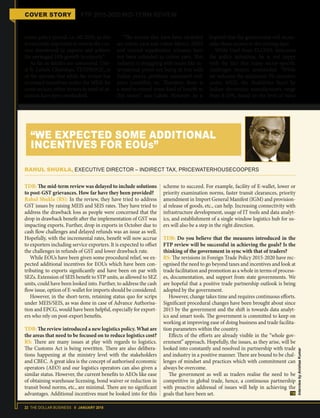
TDB: The mid-term review was delayed to include solutions
to post-GST grievances. How far have they been provided?
Rahul Shukla (RS): In the review, they have tried to address
GST issues by raising MEIS and SEIS rates. They have tried to
address the drawback loss as people were concerned that the
drop in drawback benefit after the implementation of GST was
impacting exports. Further, drop in exports in October due to
cash flow challenges and delayed refunds was an issue as well.
Hopefully, with the incremental rates, benefit will now accrue
to exporters including service exporters. It is expected to offset
the challenges in refunds of GST and lower drawback rate.
While EOUs have been given some procedural relief, we ex-
pected additional incentives for EOUs which have been con-
tributing to exports significantly and have been on par with
SEZs. Extension of SEIS benefit to STP units, as allowed to SEZ
units, could have been looked into. Further, to address the cash
flow issue, option of E-wallet for imports should be considered.
However, in the short-term, retaining status quo for scrips
under MEIS/SEIS, as was done in case of Advance Authorisa-
tion and EPCG, would have been helpful, especially for export-
ers who rely on post-export benefits.
TDB: The review introduced a new logistics policy. What are
the areas that need to be focused on to reduce logistics cost?
RS: There are many issues at play with regards to logistics.
The Customs Act is being rewritten. There are also delibera-
tions happening at the ministry level with the stakeholders
and CBEC. A great idea is the concept of authorised economic
operators (AEO) and our logistics operators can also given a
similar status. However, the current benefits to AEOs like ease
of obtaining warehouse licensing, bond waiver or reduction in
transit bond norms, etc., are minimal. There are no significant
advantages. Additional incentives must be looked into for this
scheme to succeed. For example, facility of E-wallet, lower or
priority examination norms, faster transit clearances, priority
amendment in Import General Manifest (IGM) and provision-
al release of goods, etc., can help. Increasing connectivity with
infrastructure development, usage of IT tools and data analyt-
ics, and establishment of a single window logistics hub for us-
ers will also be a step in the right direction.
TDB: Do you believe that the measures introduced in the
FTP review will be successful in achieving the goals? Is the
thinking of the government in sync with that of traders?
RS: The revisions in Foreign Trade Policy 2015-2020 have rec-
ognised the need to go beyond taxes and incentives and look at
trade facilitation and promotion as a whole in terms of process-
es, documentation, and support from state governments. We
are hopeful that a positive trade partnership outlook is being
adopted by the government.
However, change takes time and requires continuous efforts.
Significant procedural changes have been brought about since
2015 by the government and the shift is towards data analyt-
ics and smart tools. The government is committed to keep on
working at improving ease of doing business and trade facilita-
tion parameters within the country.
Effects of the efforts are already visible in the “whole gov-
ernment” approach. Hopefully, the issues, as they arise, will be
looked into constantly and resolved in partnership with trade
and industry in a positive manner. There are bound to be chal-
lenges of mindset and practices which with commitment can
always be overcome.
The government as well as traders realise the need to be
competitive in global trade, hence, a continuous partnership
with proactive addressal of issues will help in achieving the
goals that have been set.
RAHUL SHUKLA, EXECUTIVE DIRECTOR – INDIRECT TAX, PRICEWATERHOUSECOOPERS
“WE EXPECTED SOME ADDITIONAL
INCENTIVES FOR EOUs”
InterviewbyAnishaaKumar
JANUARY 2018 II THE DOLLAR BUSINESS 23
addition. To restore our export compet-
itiveness, MEIS should be in the range
of 5-9%, with 5% for finished products
and PCB assemblies and 7-9% for com-
ponents and semiconductors,” says Goel.
Having that said, Goel believes that
incentive is just one way of supporting
exports. The government needs to work
on creating a conducive ecosystem for
exporters. There are bottlenecks, in terms
of infrastructure, shipping delays, errat-
ic power supply, archaic labour laws, etc,
which act as a drag on Indian exports.
"These are the areas that require more
government attention,” adds Goel.
Ecohing similar sentiments, Sareen
of ESC India says, “Regarding services
exports, such as software and solutions,
the facilities extended are skewed. For
instance, only units located in SEZs can
avail the zero-rating of GST for supplies.
This should be extended to all units, irre-
spective of their location, since setting up
units in SEZs is costlier in terms of rent-
als and other costs.”
Dr. Vinay Sharma, Officiating Chair-
man, Export Promotion Council for
EOUs & SEZs (EPCES), believes that the
changes in the review are cosmetic. “In
many ways, the changes introduced this
TDB: What is your take on the recently released FTP mid-
term review? Are the incentives provided in the FTP review
in line with the industry’s expectations?
Ujwal R. Lahoti (URL): As far as the textile industry is con-
cerned, the government has increased incentives under MEIS
for most sectors which will no doubt be useful in increasing
exports, but some sectors have been overlooked and they re-
quire immediate attention. We are expecting reconsideration
of benefits for some sectors.
The overlooked sectors are cotton yarn and cotton fabrics.
MEIS and interest equalisation schemes have not been extend-
ed to cotton yarn. This sector is plagued by several issues such
as international prices not being in line with Indian prices,
problems associated with instability, etc. Therefore, there is a
need to extend some kind of benefit to this sector. Similarly, the
cotton fabrics sector also deserves some benefits in line with
those enjoyed by the home textiles and the garment industry.
These sectors should be given the benefit of refund of state
levies the way it's provided to the garments sector and should
be incentivised under MEIS at the same rate. This will help the
industry get on track and increase exports. We have already
flagged this issue and are hopeful that the government will re-
consider this in the coming days.
Of course, whatever benefits are given, they are welcome and
we expect them to definitely boost exports. But some of the
issues which were not addressed, if they are looked into, then
the cotton industry will definitely benefit.
TDB: Has the FTP review been able to tackle problems that
are procedural in nature like those arising out of GST?
URL: GST is definitely beneficial in the long-run. However,
there have been many operational problems and financial ob-
stacles for exporters since its implementation. The FTP review
has not really solved any of the issues. Overall, we understand
that the government has started looking into solving issues but
we need faster resolution. Many exporters have still not gotten
refunds of GST paid in the month of July.
TDB: In the review, the focus is on exploring new markets.
What needs to be done to promote textile exports in new and
untapped markets?
URL: The textile sector is trying to increase efforts to reach
new markets such as Africa and Latin America. Exporters are
working very hard to get more orders from these countries, but
the competitiveness of Indian products is lacking in terms of
price stability, quality, etc., when it comes to making inroads
into these markets.
The Textile Upgradation Fund Scheme (TUFS) has been in-
troduced by the government. Many exporters have put in in-
vestments under TUFS, but due to technological issues many
of them are not getting the benefits which were promised in the
policy. This issue requires immediate attention.
When it comes to raw material, we would like a policy
change such that the Indian cotton prices can be brought in
line with the international cotton prices. As our prices are vol-
atile, it is hard for exporters to be competitive.
TDB: The policy review also talks about increased focus on
digitisation. According to you, how important is digitisation
and what is the Council doing in this regard?
URL: The increase in digitisation is definitely in favour of ex-
porters. This helps in increasing awareness and helps all ex-
porters get the same and correct benefits. Of course, there
are many people who are not aware of the skill development
schemes being offered by the government towards digitisation,
but the Council is helping in creating awareness.
UJWAL R. LAHOTI, CHAIRMAN, TEXPROXCIL
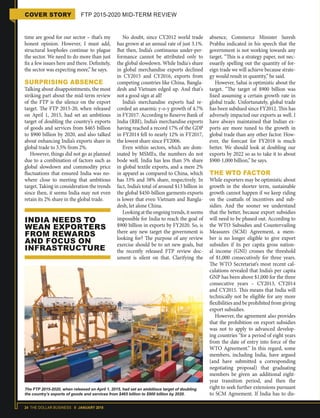
“FTP REVIEW HAS NOT REALLY SOLVED
ANY ISSUE ARISING DUE TO GST”
InterviewbyAnishaaKumar
24 THE DOLLAR BUSINESS II JANUARY 2018
COVER STORY FTP 2015-2020 MID-TERM REVIEW
time are good for our sector – that’s my
honest opinion. However, I must add,
structural loopholes continue to plague
the sector. We need to do more than just
fix a few issues here and there. Definitely,
the sector was expecting more,” he says.
SURPRISING ABSENCE
Talking about disappointments, the most
striking part about the mid-term review
of the FTP is the silence on the export
target. The FTP 2015-20, when released
on April 1, 2015, had set an ambitious
target of doubling the country’s exports
of goods and services from $465 billion
to $900 billion by 2020, and also talked
about enhancing India’s exports share in
global trade to 3.5% from 2%.
However, things did not go as planned
due to a combination of factors such as
global slowdown and commodity price
fluctuations that ensured India was no-
where close to meeting that ambitious
target. Taking in consideration the trends
since then, it seems India may not even
retain its 2% share in the global trade.
No doubt, since CY2012 world trade
has grown at an annual rate of just 3.1%.
But then, India’s continuous under-per-
formance cannot be attributed only to
the global slowdown. While India's share
in global merchandise exports declined
in CY2015 and CY2016, exports from
competing countries like China, Bangla-
desh and Vietnam edged up. And that's
not a good sign at all!
India’s merchandise exports had re-
corded an anaemic y-o-y growth of 4.7%
in FY2017. According to Reserve Bank of
India (RBI), India’s merchandise exports
having reached a record 17% of the GDP
in FY2014 fell to nearly 12% in FY2017,
the lowest share since FY2006.
Even within sectors, which are dom-
inated by MSMEs, the numbers do not
bode well. India has less than 5% share
in global textile exports, and a mere 2%
in apparel as compared to China, which
has 33% and 38% share, respectively. In
fact, India’s total of around $13 billion in
the global $450-billion garments exports
is lower that even Vietnam and Bangla-
desh, let alone China.
Lookingattheongoingtrends,itseems
impossible for India to reach the goal of
$900 billion in exports by FY2020. So, is
there any new target the government is
looking for? The purpose of any review
exercise should be to set new goals, but
the recently released FTP review doc-
ument is silent on that. Clarifying the
absence, Commerce Minister Suresh
Prabhu indicated in his speech that the
government is not working towards any
target. “This is a strategy paper, not nec-
essarily spelling out the quantity of for-
eign trade we will achieve because strate-
gy would result in quantity,” he said.
However, Sahai is optimistic about the
target. “The target of $900 billion was
fixed assuming a certain growth rate in
global trade. Unfortunately, global trade
has been subdued since FY2012. This has
adversely impacted our exports as well. I
have always maintained that Indian ex-
ports are more tuned to the growth in
global trade than any other factor. How-
ever, the forecast for FY2018 is much
better. We should look at doubling our
exports by 2022 so as to take it to about
$900-1,000 billion,” he says.
THE WTO FACTOR
While exporters may be optimistic about
growth in the shorter term, sustainable
growth cannot happen if we keep riding
on the coattails of incentives and sub-
sidies. And the sooner we understand
that the better, because export subsidies
will need to be phased out. According to
the WTO Subsidies and Countervailing
Measures (SCM) Agreement, a mem-
ber is no longer eligible to give export
subsidies if its per capita gross nation-
al income (GNI) crosses the threshold
of $1,000 consecutively for three years.
The WTO Secretariat’s most recent cal-
culations revealed that India’s per capita
GNP has been above $1,000 for the three
consecutive years – CY2013, CY2014
and CY2015. This means that India will
technically not be eligible for any more
flexibilities and be prohibited from giving
export subsidies.
However, the agreement also provides
that the prohibition on export subsidies
was not to apply to advanced develop-
ing countries “for a period of eight years
from the date of entry into force of the
WTO Agreement.” In this regard, some
members, including India, have argued
(and have submitted a corresponding
negotiating proposal) that graduating
members be given an additional eight-
year transition period, and then the
right to seek further extensions pursuant
to SCM Agreement. If India has to dis-
INDIA NEEDS TO
WEAN EXPORTERS
FROM REWARDS
AND FOCUS ON
INFRASTRUCTURE
The FTP 2015-2020, when released on April 1, 2015, had set an ambitious target of doubling
the country’s exports of goods and services from $465 billion to $900 billion by 2020.
JANUARY 2018 II THE DOLLAR BUSINESS 25
TDB: Has the review met your industry’s expectations?
Mukhtarul Amin (MA): CLE has been requesting the gov-
ernment to enhance the rate of reward under MEIS, in order
to increase price competitiveness and boost exports from the
sector which, at the moment, is facing intense global competi-
tion. As far as the review is concerned, a major announcement
made for the leather sector was an across-the-board increase of
2% in MEIS reward rates. However, this enhanced scrip will be
available for exports made from November 1, 2017 to June 30,
2018. It is our request that this enhanced rate should be made
available for the entire policy period, i.e. till 2020, as this is ex-
tremely important to reduce the current downtrend in exports
and achieve the envisaged 10% growth in exports.
As the leather and footwear sectors are fashion and consum-
er-oriented, there is a need for continuous innovation leading
to the creation of new products. For this, the industry is re-
quired to procure many critical inputs and components, for
which the MEIS scrip is very useful. Increase of MEIS scrip
value will help in increasing price competitiveness of the sector.
But here again, procurement under MEIS should be exempted
from Goods and Services Tax (GST).
Additionally, the new trust-based, self-ratification scheme
introduced to allow duty-free inputs for export production un-
der duty exemption schemes with a self-declaration will also
reduce the transaction costs for exporters. The mid-term re-
view document also mentions an increase in the validity period
of duty scrips (including MEIS) to 24 months and implemen-
tation of the E-wallet scheme from April 1, 2018, which will
eliminate upfront payment of GST. These are welcome steps.
TDB: Has the FTP review been able to effectively resolve the
issues rising out of the implementation of the GST such as
the blockage of working capital?
MA: Prior to GST, the leather and footwear industry was able
to avail benefits like Central Excise exemption for production
units with up to Rs.1.5 crore in turnover, Service Tax exemp-
tion for CETPs (Combined Effluent Treatment Plants), job
work units, etc., which are now not available under GST. Fur-
ther, CETPs and job work for procuring leather products and
footwear are now subject to 18% GST. CLE has submitted rep-
resentations to the government to reduce this to 5%.
The leather industry is grateful that the government recent-
ly reduced GST rates of several leather items. The rate cut on
finished leather and composition leather from 12% to 5%, and
on leather goods, leather garments and leather chemicals from
28% to 18% will benefit exporters tremendously.
Working capital blockage on account of requirement of pay-
ment of GST and delays in refunds are still major concerns.
More than 80% of the industry is concentrated in the MSME
segment and hence are unable to generate the huge require-
ment of funds for GST payment.
An announcement has been made in the mid-term review of
FTP about the implementation of the E-wallet scheme, which I
hope will eliminate upfront payment of GST.
TDB: What policy measures will help promote and increase
the scope of MSMEs?
MA: The Union Cabinet recently approved a special package
for leather and footwear sectors. The package involves imple-
mentation of Central Sector Scheme – Indian Footwear, Leath-
er and Accessories Development Programme (ILDP) – with
an approved expenditure of Rs.2,600 crore between FY2018
and FY2020. The major objective of ILDP is to augment raw
material base, enhance capacity, modernisation and up-grada-
tion of leather units, address environmental concerns, human
resource development, support to traditional leather artisans,
address infrastructure constraints and establish institutional
facilities. ILDP consists of six sub-schemes namely: Human
Resource Development (HRD); Mega Leather Cluster; Inte-
grated Development of Leather Sector (IDLS); Leather Tech-
nology, Innovation & Environmental Issues; Establishment of
Institutional Facilities; Support to Artisan. The scheme will
play a crucial role in achieving sustainable growth in the leath-
er and footwear sector and will immensely benefit the MSMEs.
TDB: Logistics sector has received a special focus in this re-
view. What, according to you, are areas that the government
needs to focus on to achieve logistics operational excellence?
MA: A major initiative by the government has been the de-
velopment of International North South Transport Corridor
(INSTC), which provides an alternate and shorter route for
shipments to Russia and other CIS countries. This is a proj-
ect which will help in increasing our exports to these regions.
There is currently a need to further develop the port and air-
port infrastructure and road connectivity in India in order to
enable faster transport of export/import cargo. Buyers now ex-
pect delivery at short notice and hence for India, developing lo-
gistics is very important. We also need to have direct shipment
facilities to the Far-East in order to help reduce the time taken
for product delivery and to help lower the shipment charges to
Europe as the charges from China are lower when compared to
the charges from Indian shores.
“INCREASE IN MEIS INCENTIVES WILL
BE EXTREMELY BENEFICIAL”
MUKHTARUL AMIN, CHAIRMAN, COUNCIL FOR LEATHER EXPORTS (CLE)
InterviewbyAnishaaKumar
26 THE DOLLAR BUSINESS II JANUARY 2018
COVER STORY FTP 2015-2020 MID-TERM REVIEW
continue the export promotion schemes
such as MEIS, SEIS, Advance Authorisa-
tion and EPCG, it should look at phasing
them out eventually while simultaneous-
ly replacing them with WTO compatible,
aternative schemes.
Clarifying WTO's rules, Sahai says,
“The special and differential treatment
available under Annex-VII will no longer
be available to us. However, this is some-
thing which we should not regret as we
are on our course to become a developed
economy. Moreover, even after gradu-
ating out of the threshold limit so as to
continue with a subsidy, WTO does al-
low countries to give subsidies for R&D,
adhering to the environmental norms
and promoting backward areas.”
Let us keep in mind that most subsi-
dies have been provided to do away with
the cost disability factor. The high cost
of credit, high logistics cost, increasing
transaction cost, infrastructure inade-
quacies, adversely affects India's export-
ers. The subsidy given by the government
to some extent offset these losses. "If the
government is in a position to address
these challenges in medium-term, Indi-
an exports may not require any subsidy,”
adds Sahai. He believes that it will work
in everyone's favour if the government
starts distancing exporters from rewards
and work towards structural reforms to
create a conducive business environment.
AN ONGOING EFFORT
The FTP 2015-2020 review was refresh-
ing to the extent that it has acknowledged
that the major hurdles to India’s compet-
itiveness were domestic, like infrastruc-
ture bottlenecks, complex procedures,
high logistics costs, etc. The govern-
ment has said that it will adopt a ‘whole
of government’ approach to deal with
these issues. In fact, measures that have
been taken by the government to address
these issues, like setting up of a logistics
division, a National Trade Facilitation
Committee under the Cabinet Secretary,
formulating a National Trade Facilitation
Action Plan, and launch of a Trade Infra-
structure for Export Scheme (TIES) are
TDB: What are your initial thoughts on the FTP mid-term
review document?
H. K. L. Magu (HKLM): The increase in the MEIS rates has
been a positive step. Besides this, the other critical areas that
the FTP review has dealt with is trade facilitation and easing
capital blockage. However, exporters presently need a level
playing field while competing with other countries. The post-
GST dilution of duty drawbacks and FTP benefits needs to be
looked into urgently.
TDB: Would you say that the mid-term review has addressed
most concerns raised by exporters ?
HKLM: I believe that the mid-term review of FTP has cov-
ered many issues like enhancement of MEIS, increased validity
of scrips, zero duty on scrips, 24x7 facility to more seaports,
no norms fixation, etc. These steps will positively impact the
industry. However, enhanced duty drawback, RoSL and wider
usage of MEIS scrips are the need of the hour to boost exports
and increase India’s competitiveness in international markets.
The trust-based certification is a big step forward and I hope
this is the start of a new era in ease of doing business.
TDB: India is nearing the WTO threshold which would re-
quire it to end direct subsidies on exports. Subsequently,
schemes such as the MEIS, EPCG and interest equalisation
scheme, as envisioned under the FTP, are likely to get im-
pacted. How do you plan to safeguard your sector’s interests?
HKLM: We have already submitted a proposal to the govern-
ment regarding alternative schemes that can be implemented
after the phase-out of subsidies. Both Drawback and RoSL are
WTO compatible schemes. Therefore, enhanced drawback and
RoSL will surely help the industry to retain the positive growth.
TDB: While the government’s focus is on MSMEs and assist-
ing the Make in India campaign, it however, did not accept
garments exporters’ demand for measures to improve mar-
ket access and cost competitiveness. Your comments.
HKLM: The garment industry was expecting enhanced duty
drawback and RoSL. It was hoping for a phased-out approach
towards policy support rationalisation, post-GST. The sudden
reduction in drawback and other support has detrimentally
impacted business planning and order book positions.
TDB: In a recent meeting with the Chief Economic Advisor
Dr. Arvind Subramanian, AEPC had expressed concerns
over decline in apparel exports due to capital blockage and
a sharp reduction in drawback rates post GST. Has any solu-
tion been proposed in the review?
HKLM: Yes, the Council has been proposing various alterna-
tives for easing the problems being faced due to capital block-
age and sudden reduction in drawback rates. We are hopeful of
a positive response in this matter.
H. K. L. MAGU, CHAIRMAN, APPAREL EXPORT PROMOTION COUNCIL (AEPC)
“TRUST-BASED CERTIFICATION IS A BIG
STEP IN THE RIGHT DIRECTION”
InterviewbyAhmadShariqKhan
JANUARY 2018 II THE DOLLAR BUSINESS 27
welcome steps too. However, all these ini-
tiatives need to be implemented at a fast-
er pace than they are presently being ac-
tualised. It is probably time for the 'whole
of government' to look at the 'whole
of exports'.
As emphasised in the review docu-
ment, identifying new markets and prod-
ucts is vital for the growth of exports
but with sharp competition in the global
market, the emphasis should be on im-
proving competitiveness and that will
take long and sustained effort on part of
both exporters and the government. Even
the Commerce Minister in his statement
said, “It is not a one-time exercise but
an ongoing effort. We will continuously
revisit issues, identify challenges and ad-
dress them on a real-time basis.”
No doubt, policy review is an ongo-
ing process and the industry too is of the
opinion that the government needs to
take continuous measures and introduce
new initiatives without waiting for a year
or mid-term correction in order to bring
about long-term impactful change.
One question that however re-
mains is, will the tweaks in policy and
enhancement in rewards be able to boost
India's exports? The answer is: Perhaps
yes. If nothing, the mid-term review
has come at a time when prospects for
world trade are starting to brighten.
In September 2017, the WTO upgraded
its trade growth projection to 3.6% from
the earlier estimate of 2.4%. Though the
estimate for 2018 has been pegged a little
lower at 3.2%, it is still higher when com-
pared to the stagnant growth of the last
few years. In this scenario, India is in a
better position to take benefit of the mea-
sures announced in the mid-term review
than it was in 2015, when the FTP was
released.
Reality suggests that India has not uti-
lised the breathing space (in the form of
lowered trade activity) the global slow-
down provided to set the framework
right. Perhaps we as a nation are at our
best when the heat is on. At least we hope
that's the case.
TDB: What is your take on the recently released review?
Rajoo Goel (RG): It is noteworthy that most components and
products which are of interest to electronics manufacturers are
covered under the revised MEIS rates. ELCINA believes that
this is an overdue and positive step as it will largely reverse
the damage caused by the reduction of MEIS rates across the
board. Another positive is the focus on MSMEs and manu-
facturing. This is important as benefits should accrue to val-
ue-added manufacturers. The industry is also enthused by
measures which will release blocked working capital and re-
duce costs. India’s FTP is geared towards promoting exports
very aggressively with a target of $900 billion by 2020 and there
was a need to support manufacturing with a focus on MSME
and labour-intensive sectors. The FTP review has also taken
several measures to simplify procedures for exporters.
Some other industry-friendly changes include zero rating
under GST of supplies of goods and services to SEZs, import
of second-hand goods for repair/refurbishing/re-conditioning/
re-engineering being made free, making the transfer and sale
of duty scrips effectively GST exempt, round-the-clock cus-
toms clearance facility being extended to 19 seaports and 17
air cargo complexes and self-declaration of duty free inputs for
export production under duty free exemption scheme.
TDB: Is an increase of 2% in rewards under MEIS enough to
make our electronics manufacturing industry competitive
in the global markets?
RG: While we welcome the increase of 2% incentive under
the Merchandise Exports from India Scheme (MEIS), the dis-
abilities faced by Indian electronics manufacturers range from
8-10%, based on the level of value addition. Thus, to restore
our export competitiveness, the MEIS should be in the range
of 5-9% with 5% for finished products and PCB assemblies and
7-9% for components and semiconductors.
TDB: Exports of electronics would need to grow significant-
ly to realise the overall growth targets. What needs to be
done to improve the sector's export competitiveness?
RG: In response to the increase in BCD on eight electron-
ic items of mass consumption, the industry must rise to the
occasion by not succumbing to the temptation of raising do-
mestic prices of these products and instead invest in additional
manufacturing capacities to increase local value addition and
become globally competitive. In the process, even as we engage
more deeply with global electronics supply chains, the caveat
is that we need to guard against the existing FTAs from being
misused to evade the increased BCD and import these prod-
uct lines as finished products. This challenge exists especial-
ly in case of set top boxes, which are included in the ASEAN
FTA. Due to this threat from FTAs, the electronics industry has
made a strong plea to exclude electronics from the Regional
Comprehensive Economic Partnership (RCEP).
RAJOO GOEL, SECRETARY GENERAL, ELCINA
“REWARD RATES UNDER MEIS SHOULD
BE IN THE RANGE OF 5-9%”
InterviewbyAamirH.Kaki
28 THE DOLLAR BUSINESS II JANUARY 2018
OVERSEAS
TALK H.E. VITALY A. PRIMA, AMBASSADOR OF BELARUS TO INDIA
TDB: How would you describe the so-
cio-economic relationship between Be-
larus and India?
H.E. Vitaly A. Prima (VAP): India and
Belarus share a cordial relationship
based on mutual trust and support. The
statevisitofthePresidentoftheRepublic
of Belarus to India, in September 2017,
has strengthened our ties. During the
visit, Belarusian and Indian companies
signed a number of mutually beneficial
contracts and memorandums of under-
standings (MoUs). I believe that this
strong bond will positively influence the
dynamics of bilateral trade. I also believe
that a close relationship between India
and Belarus will generate benefits not
only in areas of trade and economy, but
also in areas like science & technology
and culture & tourism.
TDB: Despite close relations, bilateral
trade remains modest. What opportu-
nities remain untapped?
VAP: Belarus-India trade and econom-
ic cooperation is progressing steadily.
Bilateral trade turnover rose to $445.5
million in CY2015 from $55.4 million in
CY2000. However, in CY2016, there was
a slight decrease in trade, in value terms
($402.2 million), due to a fall in prices.
This year, exports from Belarus to In-
dia comprised 97 commodities which
included potash fertilisers as well as oth-
er chemical and petrochemical prod-
ucts. Meanwhile, exports from India to
Belarus are mainly pharmaceuticals, ag-
ricultural & chemical products and light
industrial products.
The decrease in bilateral trade in
CY2016 was a temporary phenomenon.
Trade partners on both sides will defi-
nitely find ways to overcome the set-
back. Having said that, I agree that we
are yet to leverage trade opportunities to
the fullest. Large-scale diversification of
exports from Belarus can be achieved by
focussing on the export of unique tech-
nologies and products.
We hope there will be an increase in
supplies of potash fertilisers, industrial
and technological equipment and pet-
rochemical products to India. Belarus
is also willing to purchase high-quali-
ty pharmaceuticals, chemical products
and other goods from India. Belarus, as
a matter of fact, possesses an advanta-
geous geographical position, developed
infrastructure and highly skilled man-
power that India can benefit from. Our
membership of the Eurasian Economic
Union (EEU) also opens up avenues for
Indian investors and traders.
TDB: What facilities does Belarus offer
India investors?
VAP: Belarus offers a globally-acknowl-
edged favourable investment climate. In
the World Bank Doing Business 2017 Re-
port, Belarus ranks 37 (out of 190). In Be-
larus, there are six free economic zones
(FEZs) with special tax and customs duty
exemptions. The companies setting up
units in the free economic zones will get
exemption from tax for five years from
the year they turn profitable. Once the
exemption period is over, the compa-
nies can pay profit tax at a reduced rate
of 50%. In addition, companies having
units in FEZs will be exempt from paying
property tax on buildings and facilities.
We assure you that the Belarusian
government will provide all possible as-
sistance to companies from other coun-
tries with specific and detailed business
plans. Recently, we have proposed, to
the Government of India, a Belarus-In-
dia investment cluster of innovations in
the free economic zone at Vitebsk. Our
government is interested in developing
world-class drug manufacturing facili-
ties there. We also aim to create modern
enterprises to attract knowledge and in-
vestments from India.
TDB: Recently, Belarus and India
signed 10 agreements to expand co-
operation. Please give us more insight
into those agreements?
VAP: During the President of Belarus’
recent visit to India, about 10 inter-gov-
ernmental agreements and MoUs were
signed. They cover areas like science
and technology, education, agriculture,
etc. In addition, a number of commer-
cial agreements and memorandums of
intentions for joint-development and
manufacturing in oil and gas, defence,
tourism, pharmaceuticals, etc., have also
been signed. These MoUs will help cre-
ate the necessary framework for Belar-
us-India engagements.
Alongside, a trial batch of Belarusian
harvesters and heavy-duty trucks of dif-
ferent cargo carrying capacities will be
exported to India. We hope to see a new
wave of cooperation leveraging the Be-
larusian tractor brand, Belarus.
INTERVIEW BY NILADRI S. NATH
“CONSIDER
BELARUS
A RELIABLE
PARTNER”
Despite having strategic synergies, bilateral trade
between India and Belarus hasn’t reached its potential.
The Dollar Business caught up with H.E. Vitaly A.
Prima, Ambassador of the Republic of Belarus to India,
to understand the opportunities that the two countries
can leverage on to strengthen the bilateral relations.
JANUARY 2018 II THE DOLLAR BUSINESS 29
Moreover, Belarus is keen to con-
tribute to the Skill India initiative. We
believe that the extensive experience
Belarus has will be instrumental in sup-
porting various initiatives of the Indian
government in reducing unemployment
and upskilling workers. We are working
on several projects to open Centres of
Excellence in several states in India for
some cutting-edge industries.
MoUs have also been signed between
the Belarusian State Concern of Oil and
Chemistry and the Ministry of Petro-
leum and Natural Gas of the Govern-
ment of India, which will facilitate set-
tinguplarge-scalecollaborativeprojects.
Belarus is ready to offer Indian compa-
nies the most advanced technologies for
oil enhancement. The MoU signed be-
tween Belarus and India’s NBCC, opens
broad prospects for mutually-beneficial
cooperation and engagement in infra-
structure projects in Belarus and India,
as well as in other countries.
The cooperation in defence sector
has been initiated through the Joint Be-
larusian-Indian Commission on Mil-
itary-Technical Cooperation. We also
have regular exchange of delegations in
specialised exhibitions like MILEX and
DEFEXPO. Such exhibitions not only
maintain a constant exchange of infor-
mation, but also open up opportunities
for new areas of interaction.
TDB: India is currently negotiating a
free trade agreement (FTA) with EEU.
What kind of trade potential does the
FTA hold for India and Belarus ?
VAP: We welcome the progress in the
preparation of the draft FTA between
the Eurasian Economic Union (EEU)
and India. The agreement is intended to
contribute to the further development
of trade and economic cooperation be-
tween India and EEU members. The
FTA with EEU will facilitate free move-
ment of goods, services, capital and la-
bour as well as pursue a harmonised and
unified policy in the sectors determined
by the treaty and international agree-
ments within the Union. Nowadays,
every country needs to diversify into
new markets and EEU will give India
opportunities for profitable placement
of capital and seamless supply of manu-
factured goods to the vast market of the
five-member states – Armenia, Belarus,
Kazakhstan, Kyrgyzstan and Russia –
with a trade potential of up to $62 bil-
lion and a large number of consumers.
TDB: Together, both countries are con-
sidering a technology demonstration
centre to showcase Belarusian technol-
ogy. What’s the latest on that front?
VAP: In cooperation with the Depart-
ment of Science and Technology and
the International Advanced Research
Centre for Powder Metallurgy and
New Materials (ARCI), we are creating
a technology demonstration centre in
Hyderabad where Belarus will showcase
its latest technologies. The selection of
technologies is based on the demand of
the Indian businesses and is aimed at
giving them the necessary edge in the
highly-competitive domestic and inter-
national markets. We expect details of
this project to be finalised this year. The
project is likely to materialise soon.
TDB: What would you like to convey to
Indian policymakers and companies?
VAP: Indian policymakers are doing a
great job by creating an extremely at-
tractive environment in India for busi-
nesses from all across the world. We ap-
preciate the thoughtful and constructive
attitude of the government and private
bodies. There are close links between the
Belarusian Chamber of Commerce and
Industry and the Federation of Indian
Chambers of Commerce & Industry
(FICCI). We want Indian companies to
be more active and aggressive in pro-
moting innovative ideas and projects in
Belarus. They should consider us a reli-
able partner and friend.
BILATERAL TRADE
JUMPED TO $445.5
MILLION IN CY2015
FROM $55.4 MILLION
IN CY2000
30 THE DOLLAR BUSINESS II JANUARY 2018
ANIL K. TRIGUNAYAT, FMR. AMBASSADOR OF INDIA TO JORDAN, LIBYA & MALTA
EXCLUSIVE
INTERVIEW
INTERVIEW BY AHMAD SHARIQ KHAN
“WE NEED
TO GROW
AT 8-9% TO
MAINTAIN
THE EDGE”
TDB: India has had friendly relations
with Qatar as well as the GCC coun-
tries that have imposed a blockade on
Qatar. Do you envision the blockade
hampering India-GCC trade?
Anil Kumar Trigunayat (AKT): Gulf
countries are part of our extended neigh-
bourhood and are extremely important
for our energy security. Our relationship
with Qatar is specially important because
Qatar fulfils a major part of India’s LNG
requirements. We have a large Indian
diaspora in the region and their welfare
is also important to us. These countries
are also a significant source of foreign
exchange remittances. It is estimated that
almost eight million Indians in the GCC
remit over $35 billion annually. The Mid-
dle Eastern countries are also important
trading partners and India has had excel-
lent bilateral relations with all of them.
The recent blockade of Qatar by Saudi
Arabia, UAE and Bahrain is very unfor-
tunate. Extremism and support for it di-
rectly or indirectly by various regimes in
the region through non-State actors have
often been talked about and referred to
in international discourses and is a real
He has served as an
Ambassador of India
to Jordan, Libya and
Malta and is currently
on the advisory boards
of BRICS Chamber of
Commerce and Indo-
Latin American Chamber
of Commerce. In a free-
wheeling interaction with
The Dollar Business, Anil
Kumar Trigunayat talks
about the possible trade
impacts of the conflicts in
the Middle East on India
apart from discussing the
opportunities that exists in
the region for the Indian
EXIM community.
JANUARY 2018 II THE DOLLAR BUSINESS 31
threat. But the blockade may not solve
the problem. All regimes in the region,
while pursuing their own interests, are
also overtly committed to fighting ter-
rorism. Hopefully, in the near future, the
international community will be able to
do something to provide guidance and
clarity on the road ahead.
GCC and other Middle Eastern coun-
tries are our key trading partners, and
both our trade and investments have
been on the upswing in this region. Cur-
rently, there are dozens of Indian compa-
nies that have expanded their footprints
in Qatar and other countries. Although
the difficult situation in the region com-
bined with low petroleum prices may de-
press the demand for products and ser-
vices in these countries in the short run,
the scenario would not be India specific.
TDB: As a spillover of the blockade,
what newer challenges do you foresee
for Indian businesses in Qatar?
AKT: Many major Indian companies
have undertaken several crucial turnkey
projects in Qatar as well as other GCC
countries and are well entrenched there.
However, to hedge against the unsta-
ble situation, it is imperative for Indian
companies that have acquired adequate
expertise in doing business in the Arab
world to also explore markets beyond
GCC. For example, Jordan has a num-
ber of free trade agreements (FTAs), in-
cluding FTAs with US, EU, Greater Arab
Free Trade Area (GAFTA), and Indian
companies should explore export oppor-
tunities in markets like Jordan. The tex-
tile sector has been aggressively seeking
newer markets in the Middle-East, and
other sectors should also follow suit.
Soon, we will see massive reconstruc-
tion efforts in war-ravaged Iraq and Syria
and it is the right time for Indian busi-
nesses to position themselves strategical-
ly to make the most of this opportunity.
TDB: What opportunities does the
MENA region offer our exporters?
AKT: The Middle East and North Af-
rica (MENA) region is our major trade
and transit partner. It is also a region in
flux. The governments of these countries
have begun to understand the limita-
tions of a hydrocarbon-driven economy
and as such are rapidly diversifying their
economies. This is where Indian firms
can join hands with these regimes with
a long-term perspective. Renewable en-
ergy holds great potential for collabora-
tion and so does information technolo-
gy. Country-to-country collaborations,
especially in the agricultural sector, too
have immense potential. I believe, the
traditional buyer-seller relationship has
to be converted into a long-term strate-
gic partnership. GCC and Middle East-
ern companies can also diversify their
investments portfolios to cater to India’s
infrastructure development.
TDB: Was India ready for reforms like
GST and demonetisation at the time of
implementation?
AKT: The far-reaching economic re-
forms introduced by Prime Minister
Narendra Modi will have a lasting im-
pact in the long run. When and how to
introduce reforms is the prerogative of
the government and depends on several
factors. In some cases, one has to take the
bull by the horns and that is exactly what
the government did. Evidently, these re-
forms caused some pains but that is true
for all evolutionary policies.
India is one of the fastest growing ma-
jor economies in the world. Even though
there has been some deceleration in GDP
numbers of late, our fundamentals are
strong. One should not judge the impact
of such far-reaching reforms by looking
at data for just a few quarters. I am quite
confident that once the structural infir-
mities are rectified, the economy will
bounce back. Going forward, we have to
grow at 8-9% per annum to maintain the
edge and to provide for our billion plus
population. I believe both GST and de-
monetisation were good policy decisions,
but the implementation could have been
better and smoother to avoid the disrup-
tion and discomfort caused to ordinary
people and businesses.
TDB: What is your take on schemes
like ‘Make in India’ and ‘Digital India’?
AKT: These government schemes are
ambitious and are aimed at harnessing
India’s potential to its maximum. Ev-
ery year, over 12 million graduates join
the Indian workforce and both these
schemes can help generate employment.
‘Digital India’ will give a boost to the ser-
vices sector which is currently integral to
the well being of our economy. It will also
certainly contribute in bringing an attitu-
dinal change in the mindset of the public.
The manufacturing and agriculture
sectors are the real job providers. And
this is where iconic schemes like ‘Make
in India’ can help create employment for
the masses. I think the success and effi-
cacy of ‘Make in India’, both in terms of
employment and manufacturing growth,
can only be judged after a few years as
the gestation period in manufacturing
is long. However, the concerned govern-
ment departments and agencies should
keep reviewing the schemes after taking
feedback from the ground and tweak
them to make them more efficient.
TDB: India’s ease of doing business
rank has gone up significantly this year.
Do these ranks matter when it comes to
attracting foreign direct investments
and increasing exports?
AKT: India is an economic powerhouse
and an engine for global growth – there is
no doubting that. Since the economic re-
forms in 1991, India has evolved a lot and
the perception about the Indian market
has also changed. Today, the world per-
ceives India as a huge consumer mar-
ket, a reliable sourcing destination and a
behemoth when it comes to IT services
and talent. But, to attract investments we
need to maintain our edge at all times as
many countries are vying for the same
limited pool of FDI. Policies and their
implementation have to be smooth and
transparent. We have come a long way
from the red-tapism of the past, but we
can definitely do much better. I believe
that while our ease of doing business
ranking has improved significantly, we
need to go further up the ladder in this
competitive global economy.
INDIA NEEDS TO
MOVE FURTHER
UP THE LADDER IN
THE EASE OF DOING
BUSINESS RANKING
32 THE DOLLAR BUSINESS II JANUARY 2018
Cassia, a pungent spice used in many cuisines, has seen a surge in its imports over
the last few years. The facts that it is cheaper than cinnamon, a similar spice, and that
more and more consumables are using cassia as an ingredient are only driving the
demand for the spice forward. Despite controversies surrounding its usage in certain
medicaments, it continues to be a favourite amongst India’s spice importers.
BY ANISHAA KUMAR
SPICY BUSINESS,
SWEET STORY
F
rom turmeric to cinnamon, from
cumin to fennel, India is known
the world over for its spices that
find use across cuisines as well as
several home remedies. Surprisingly, de-
spite its ubiquitous presence in almost all
Indian households, cassia, better known
as taj in India, is hardly grown in India
and is almost entirely imported.
Cassia, whose bark is used as a spice,
is many a time mistaken for the cinna-
mon bark. The two spices are however
derived from two different plants of the
same genus. With their similar appear-
ance, you may ask what is in a name?
Well, there is a lot that differentiates the
two. While cinnamon, (often referred to
as Ceylon Cinnamon) found in Sri Lan-
ka, is derived from the branches or bark
of Cinnamomum Zeylanicum, cassia is
derived from the bark of Cinnamomum
Cassia. Cassia is also known as Chinese,
Vietnamese or Indonesian Cinnamon,
depending on its origin.
The other difference is that cassia is
more pungent and preferred in Indian
curries and bakery items. Cinnamon, on
the other hand, has both a sweeter taste
and aroma than its cousin. Cinnamon
finds use in several desserts as well as
pharmaceutical products.
Another difference between the two
is the controversial coumarin content.
Coumarin, according to Food Safety and
Standards Authority of India (FSSAI), is
a natural flavouring compound whose
high dose is believed to be harmful.
While cinnamon or ‘Ceylon Cinnamon’,
contains little to no trace of coumarin,
cassia contains high doses of the same.
Despite health concerns being raised,
there is still a large demand for cassia. So,
what makes the product popular in the
market and does the increasing demand
make importing it a lucrative business?
IT’S GETTING SPICIER
Globalisation has meant that there is
much more intermingling of cultures
now than in the past and that has meant
that people are more open to trying rec-
IMPORT’ONOMICS CASSIA (BARK)
Cassia is many a times mistaken for
cinnamon as they look very similar.
JANUARY 2018 II THE DOLLAR BUSINESS 33
ipes from other countries. That has in
tandem meant that import of spices has
increased across the globe. According
to a study by P&S Market Research, the
global demand for seasonings and spices
is expected to grow at a CAGR of 4.9%
between FY2015 and FY2020. The im-
ports of cassia by India has also kept pace
with the global trend and grown by al-
most 110.3% to $45.32 million between
FY2012 and FY2017. The volume of cas-
sia imported by India has also increased
by 20.07% during the same period. Even
when it comes to the total world im-
ports of cassia, imports by volume has
increased by over 80% between CY2012
and CY2016. Some big numbers, indeed!
Talking about the reasons behind the
increase in imports, Prashant Sethi of
Jaipur-based August Industries, an im-
porter of cassia, says, “There is a bit of
cassia being grown in India in the south-
ern part of the country, but the produc-
tion is not enough to fulfil the growing
domestic demand. As the usage increas-
es, we expect imports to grow further.”
Cassia, according to some, has also
benefitted from the confusion between
cinnamon and cassia. Cinnamon is used
in a variety of ayurvedic preparations to
lower blood pressure and control choles-
terol. But the cinnamon being referred to
here is Ceylon Cinnamon and not cassia.
The low price of cassia and the lack of
awareness about the difference between
both spices has allowed some unscru-
pulous manufacturers to substitute cin-
namon by cassia in ayurvedic products.
In reality, while cassia finds use in cook-
ing and baking, it does not possess the
healing properties that are characteristic
of cinnamon. As smaller quantities of
cassia are used in cooking, the harmful
effects of coumarin are not an issue.
Cassia and cinnamon have long been
under the watch of the Food Safety and
Standards Authority of India (FSSAI). In
fact, in November 2016, FSSAI released
a document highlighting the differences
between the two to avoid the confusion
amongst their users. According to the
document, to be classified as cinnamon
the coumarin content should not be
more than 0.3% by weight.
THE QUALITY CHALLENGE
India is currently the leading importer
of cassia in the world with a 30% share
in world imports followed by US, Ban-
gladesh and Japan. The biggest source
of imported cassia for India is Vietnam
– the country currently fulfils about 86%
of India’s total import requirement – fol-
lowed by China and Indonesia.
Even though there are large quantities
of cassia being imported into India, im-
porters like Gopaal Ahuja, Chairman of
the Mumbai-based Komal Exotic Spices,
says that finding exporters who follow
proper quality standards is a challenge.
He explains, “As an importer, I face the
challenge of getting my cassia cleared by
the FSSAI, as cassia are not completely
dried by some Chinese exporters before
shipping. And by the time the shipment
reaches us, the moisture from the prod-
ucts evaporates and recondenses on the
goods in the container, leading to the
formation of fungus. Fungus on vege-
table products leads to the formation
of aflatoxin which is a harmful carcin-
ogen.” This is one of the reasons, Ahuja
says, why many importers like him do
not prefer to import the commodity
from China. Exporters, he says, need to
adhere to the rules and regulations and
not resort to shortcuts. It is also difficult
to make out the quality in the consign-
ments that come from China as they are
bundled, pressed under a hydraulic press
and tied together with a belt. Many a
time, exporters say, they have found vari-
ous impurities including pieces of plastic
within the cassia consignment.
Imports from Vietnam, on the other
hand, do not have such issues as they
Cost ($/MT)* 1,700.0
Freight & Insurance ($/MT)** 72.0
CIF ($/MT) 1,772.0
CIF (Rs./MT)*** 1,16,012.8
BD (0%) 0
CIF + BD 1,16,012.8
Cess (0%) 0
CIF + BD + Cess 1,16,012.8
IGST (5%) 5,800.6
Final Cost 1,21,813.4
Selling Price in India# 1,29,000.0
Profit	 7,186.6
Profit	Margin																																5.57%
* Split cassia in bundles; HS Code: 09061910; ** Freight
and insurance cost from Ho Chi Minh City in Vietnam to
Mumbai in India; Minimum order quantity (MOQ): 1MT;
*** Assuming USDINR at 65.47; # Wholesale price (TDB
Intelligence Unit); Note: Profitabilty ignores brand equity;
No Cess and BD is applicable on imports from Vietnam
under the India-ASEAN FTA.
Important disclaimer: Profitability has been calculated based on time-bound
indicative prices (prevalent during the third week of December 2017). Prices
may vary during a different time period, resulting in profit fluctuation. Factors
like brand value, supply chain-related costs like warehousing and logistics, ad-
ministrative costs, sales and advertising costs, etc., have not been included in
the cost of procurement. Margins have been calculated considering govern-
ment policies (announcements, notifications, etc.) as on December 20, 2017.
Risk factors and currency fluctuations have to be considered while importing.
Calculations have been provided for informational purposes only; The Dollar
Business takes no responsibility for any loss resulting from investments in the
said commodity/product. Though all efforts have been made to ensure the ac-
curacy of the content stated herewith, the same should not be considered a
statement of law or used for any legal purposes. Prior permission is required
before calculations stated herein are published or quoted in a third party web
or print property.
Profit estimates for cassia
(bark) imports
Though import volumes are high, margin
in this business is usually low
CASSIA IMPORT, BY
VOLUME, INCREASED
BY 20.07% BETWEEN
FY2012 AND FY2017
Source: TDB Intelligence Unit & Ministry of Commerce, GoI;
break-up for FY2017; HS code: 09061910
India’ssourcingdestinations
Almost all of it is coming from Vietnam
Vietnam
China
Indonesia
Madagascar
85%
10%
1%
4%
Source: TDB Intelligence Unit & UN Comtrade;
break-up for CY2016; HS code: 09061910
World’sbiggestimportersofcassia
India boast of a 30% share in world imports
India
US
Bangladesh
Japan
Other
4% 41%
31%
15%
9%
34 THE DOLLAR BUSINESS II JANUARY 2018
IMPORT’ONOMICS CASSIA (BARK)
are packed in a transparent box and not
pressed into a bundle making it is easy to
inspect for impurities. He however adds,
“If Vietnam starts following China’s ex-
ample, we may be forced to find a new
supplier from Indonesia or may even re-
duce our imports.”
Rajiv Jaiswal, Head – Exports and
Imports, Raj Exports, differs and says
that when it comes to quality, there is
not much difference between the Viet-
namese and the Chinese products. Any
difference in quality, he says, has to do
with the supplier, as at the end of the day
the climate and geographical location of
both countries are similar.
Another reason why Vietnam is pre-
ferred over China has been the absence
of an import duty on imports from Viet-
nam. Under the FTA with the ASEAN
nations, Indian importers do not have
to pay an import duty while importing
from Vietnam and Indonesia which are
both members of ASEAN. Importing
from non-FTA countries like China on
the other hand means that the product
suffers a total duty of about 36%, making
Chinese variety of cassia uncompetitive
in the domestic market.
SPREADING AROMA
Despite the challenges arising out of
customs clearances and food safety reg-
ulations, importers are upbeat about the
future of the business. Ahuja says that
expectations for a growth in demand in
the future has a lot to do with the rise
in incomes and changing food habits of
people. The upwardly-mobile popula-
tion has taken to consuming a number
of sweet and savoury items that require
the use of cassia. Cassia is also a part of
many Chinese recipes that have found
favour with Indians.
Scant domestic availability, absence
of import duties, and ease of import in
addition to good marketing by Vietnam
has attracted more importers towards
cassia. “Many Indian traders, who were
earlier my clients, have started to import
cassia by themselves,” says Ahuja.
Currently, importers have to pay a 5%
IGST. Ahuja says that IGST has impact-
ed their working capital and hopes that
the government is able to introduce an
e-wallet scheme similar to the one that
is being introduced for exporters. He
explains, “The way the finance minister
has declared the creation of the e-wallet
for exporters, an e-wallet can be created
for importers as well. This way, the GST
credit, that we have, can be used to pay
IGST when we import the next consign-
TDB: Are there any challenges that you
face while importing cassia into India?
Gopaal Ahuja (GA): Yes, as an importer,
I face the challenge of getting our goods
cleared by the Food Safety and Standards
Authority of India (FSSAI). The other
challenge is that many a times, the cassia
are not completely dried by exporters be-
fore shipping, and by the time they reach
us, the moisture from the products evap-
orates and recondenses on the cassia in
the container, leading to the formation
of fungus. Fungus on vegetable products
lead to the formation of aflatoxin, which
is a harmful carcinogen.
So, this process of drying by the pack-
ers has to be thorough, but many Chi-
nese exporters do not follow this norm.
It is because of these reasons that China
has lost ground to Vietnam. Vietnam is
presently our preferred sourcing destina-
tion because of the quality of their prod-
uct. In order to build a good reputation
exporters should adhere to better quality
standards. Now, if Vietnamese exporters
too start flouting norms, maybe we will
have to find a new supplier from Indone-
sia or even reduce our imports.
TDB: Has GST impacted your imports?
Has it affected the pricing?
GA: GST has made my work a little more
difficult because I have to pay IGST at
the time of import. Earlier, I had to pay
VAT after selling the goods. So, I used
to literally get the tax from the custom-
ers, but now a part of my working cap-
ital goes toward IGST. So, my funds are
constrained. Ever since GST has been
implemented, my books are always in
the credit of GST. I am having to carry
this credit. Instead of doing that, the way
the finance minister has declared the
creation of the E-wallet for exporters,
an E-wallet can be created for importers
as well. This way, the GST credit that we
have, can be used to pay the IGST when
we import the next round of goods.
TDB: Apart from quality, what makes
Vietnam the preferred sourcing market?
GA: We have been importing cassia for
almost 30 years now. Earlier, we used to
import from China. Subsequently, the
Indo-ASEAN FTA was signed. So, cassia
from Vietnam became duty free. That is
one more reason to buy from Vietnam.
Gopaal Ahuja
CHAIRMAN, KOMAL EXOTIC SPICES
“GETTING FSSAI CLEARANCE
IS A BIG CHALLENGE”
Chinese cassia is more pungent and all
things being equal we would have pre-
ferred to import Chinese cassia. But the
import duty from China is a deal-break-
er. Also, Chinese packers and exporters
are less reliable as far as genuineness of
the material is concerned. Vietnamese
exporters are more reliable and their cas-
sia is packed loosely in boxes. So, detect-
ing adulteration is easy. Chinese cassia,
on the other hand, is pressed under a hy-
draulic press and then bundled up, mak-
ing detection of adulteration difficult.
Often, we have found pieces of plastic in
their packets.
JANUARY 2018 II THE DOLLAR BUSINESS 35
ment of goods.” Sethi however believes
that the introduction of GST has been
beneficial as it has reduced paperwork.
While profit margins are typically low,
importers believe that higher margins
can be garnered if the right product is
sold. Ahuja explains, “If I am selling to a
quality-conscious customer, then I do an
inspection and quality check even after
receiving the product in India. We also
grade the cassia and sell the better grades
to the more conscious client who is will-
ing to pay a higher price for better quality,
thus yielding better margins. But if I am
selling to traders who are not bothered
by impurities or minor issues in quality,
then the margins are obviously lower.”
Currently the domestic price of split
cassia hovers around $2,000-2,200 per
MT and broken cassia around $1,700
per MT. As the product is imported in
TDB: Wheredoyouimportcassiafrom?
Prashant Sethi (PS): We import from
Vietnam, and also from Indonesia. There
is a small quantity of cassia being grown
in the southern part of India, but the pro-
duction is not enough to fulfil the needs
of the population here. That is the reason
India imports from China and Vietnam.
Indonesia is also gradually becoming an
important sourcing market.
TDB: Many say that the quality from
China tends to be inferior. Your take?
PS: I have not imported directly from
China, but I have seen the quality in the
market. The quality depends more on
the exporter than the country. There can
be inferior quality from Vietnam too. All
types are available in the Indian markets.
You also get good quality from China but
the problem with China is that we have
to pay an import duty. For Vietnam and
Indonesia, there is no import duty and
cess because of the India-ASEAN FTA.
TDB: Do you face any problem while
importing cassia?
PS: The import of cassia is relatively eas-
Prashant Sethi
OWNER, AUGUST INDUSTRIES
“THE INDO-ASEAN FTA ALLOWS
DUTY-FREE IMPORTS”
ier if you have a good quality product.
The main issue is plant quarantine and
customs. Otherwise, it is a rather smooth
process. If you have fully paid values and
are not under-invoicing, there are no
hassles. When it comes to plant quar-
antine, they take out the samples and
if they are as per regulations then there
is no issue. Earlier it used to take 10-15
days for clearance, but now the process
is much quicker and more streamlined.
TDB: What factors influence the price
and demand of the product?
PS: The consumption is increasing ev-
ery year. We are also seeing an increase
in price. A lot depends on the environ-
mental conditions in China and Viet-
nam. When there is heavy rain in Viet-
nam it may impact the product quality
and price. A lot of shipments get held
up due to various factors and this also
impacts the quality and price. The Indi-
an market closely follows international
trends – and the supply and demand
situation impacts prices, as is the norm.
The prices of cassia also depend on the
variety of cassia that one is importing –
broken, split, smashed, etc. The selling
price in the domestic market starts from
Rs.140 a kilo and there is a year-round
demand.
TDB: Do you expect demand to change?
PS: We expect to see a growth in demand
and in our sales. You have to keep work-
ing in the business – and be on your toes.
Sometimes an importer may make loss-
es, but it is important to continue with
the business. That is how you build a rep-
utation and gain loyal customers. If you
stay on course, you will make profits and
see your business grow.
bulk, importers say that they are okay
with profit margins as low as 5%. Jaiswal
adds that cassia is one of the products
that needs to be stocked, even though the
profits may not be too high.
Sethi is confident of seeing a growth in
demand and says market trends suggest
that future is bright for cassia in India.
But he cautions that in order to be suc-
cessful one needs to keep a regular sup-
ply to earn the loyalty of clients even if
one makes a loss at times.
With India’s love for spices being a
constant and new cassia products be-
ing introduced, the demand for cassia is
bound to only grow in the near future.
If importers are able to secure reli-
able suppliers and maintain quality,
this pungent smelling spice can offer
sweet profits!
Vietnam, Indonesia and
China are some of the biggest
producers of cassia.
36 THE DOLLAR BUSINESS II JANUARY 2018
INTERVIEW BY ANISHAA KUMAR
When it comes to tea, one of the biggest
names in international markets is the
Sri Lanka-based Dilmah Tea. With a footprint
in around 104 countries, Dilmah Tea has in
the last 32 years established itself as a name to
reckon with when it comes to authentic Ceylon tea.
In an exclusive interaction with The Dollar Business,
Merrill Joseph Fernando, the Founder & Chairman of
Dilmah Tea, talks about entering the Indian market,
the importance of quality and innovation and the
need for combining business with social welfare.
“WE WANT TO
BE AT THE
TOP END
OF THE
MARKET”
TDB: What was your inspiration be-
hind entering the tea business?
Merrill Joseph Fernando (MJF): Sri
Lanka, formally known as Ceylon, pro-
duces some of the world’s best varieties of
tea. World over, colonial powers would
bring crops and agricultural products to
their colonies. They would then take the
produce as raw material to their coun-
tries – in the case of Sri Lanka during
the British empire it was mostly tea − to
blend, mix, package, brand and market.
Producers of the raw material − farmers
and workers in Sri Lanka – would put in
the hard work and produce the world’s
finest cup of tea but they would remain
poor while watching their labour enrich
foreign companies, making their own-
ers millionaires and billionaires. This is
because blending, mixing and packag-
ing are the most profitable segments of
the tea business. As a young student, I
saw the exploitation of the tea workers
in my country. I witnessed in countries
like England the raw material, which
was brought at what would currently be
around50centsakilofromtheproducers
in Sri Lanka, generating 4 to 6 times the
revenue as the processed product. How-
ever, none of these profits came back to
the farmers and workers. It was then that
I decided that some day I would start
my own brand of tea, for which profits
would come back to Sri Lanka and help
farmers and workers access a better life
and a secure future. When I started off
I received much ridicule from the peo-
ple of my own country, but I pursued my
dream regardless.
TDB: Dilmah has made a name for it-
self as a premium tea brand not only in
South Asia, but the world over. Could
you tell us about Dilmah’s journey?
MJF: Today, Dilmah tea is exported to
nearly 104 countries. I initially start-
ed exporting bulk tea, 66 years ago,
which foreign companies then branded
and marketed. I started my own brand,
Dilmah, 32 years ago. When I started
exporting 66 years ago, every country
in the world was already drinking Cey-
lon tea. So, I was selling to almost all
countries. In fact, at some point in time,
GLOBAL
MANAGER MERRILL JOSEPH FERNANDO, CHAIRMAN & FOUNDER, DILMAH TEA
JANUARY 2018 II THE DOLLAR BUSINESS 37
presence felt at the top end.
TDB: Did you face any regulatory chal-
lenges in entering India?
MJF: Yes! The government created many
problems because they did not want tea,
as a product, to be imported into India.
We had problems and issues with vari-
ous government bodies. These bodies
should actually support imports from Sri
Lanka, because in Sri Lanka we support
imports from India in a big way. We do
not receive that cooperation for our ex-
ports from the Indian side. But, slowly
things are changing for the better now.
TDB: Where does the brand stand
when it comes to Sri Lankan market?
MJF: I initially didn’t intend to get into
the domestic market because there were
too many small players and I didn’t
wanted to compete with them. I wanted
them to keep their market share. How-
ever, it was only when Dilmah start-
ed promoting Sri Lankan cricket – we
sponsored the Sri Lankan cricket team
for eight years – we realised that while
people abroad knew what Dilmah was,
in Sri Lanka not many had heard of the
tea brand. So, we were forced to launch
the brand in the domestic market too.
There are three or four other brands in
the domestic market, but we sell at the
highest prices. We now have a very good
market share. Like India has its own va-
riety of tea, so does Sri Lanka.
Our countrymen respect the Dilmah
brand of tea. People also respect the
brand for its philosophy of caring and
sharing. Today, we have a very big mar-
ket share and we must be the second
largest player in the domestic market.
Of course, there is a lot of difference be-
tween the number one and number two
brand in quality and price.
TDB: Dilmah has been actively work-
ing towards assisting and uplifting tea
growers. How important has this in-
volvement been for the company?
MJF: We, at Dilmah, are farmers. We
grow our product with love and care.
We want to give the consumers the best
deal for their money while caring for our
farmers. Our MJF Foundation does a lot
of work for the workers, their children
AT DILMAH, OUR
PRIMARY STRATEGY
HAS ALWAYS BEEN
TO EXPORT THE
FINEST QUALITY
CEYLON TEA
and the wider community. We can do
this because we market our own tea and
the profits come back to Sri Lanka.
TDB: When it comes to tea, innova-
tions, in terms of flavour and packag-
ing to cater to different markets and
consumers – from high-end hotels to
households, have become almost an es-
sential. How is Dilmah innovating?
MJF: When it was launched, Dilmah
brought a revolution to the tea sector.
Overthelast10years,Dilmahhasbeenat
the forefront of innovation. For instance,
we introduced the concept of serving tea
with food at a global event in Sri Lanka.
We have also set up Dilmah Tea lounges
around the world, where we serve ev-
erything made from tea. These lounges
are very popular. Many others are now
adopting these concepts. Though people
can copy the concept, they cannot copy
our heart and soul. No one can copy my
love and passion for tea. And this is the
reason we stand way ahead of everyone
else when it comes to tea.
TDB: Would Dilmah ever look into ex-
panding into other products like spices
or any other agricultural product?
MJF: We are producers of tea and would
like to continue to concentrate on the
production, branding and marketing of
tea. We have our hands full at the mo-
ment. But, my son Malik runs the leisure
department in our company. We have
three villa concept hotels in Sri Lanka.
That is a speciality business he looks af-
ter. Then we also have the best packaging
and printing company in Sri Lanka. We
also have other manufacturing facilities
that make products related to tea exports
like wooden boxes etc. Like Dilmah Tea,
each of those companies contribute 10%
of their profits (before taxes) to the MJF
Charitable Foundation.
I must have sold bulk Ceylon tea to ev-
ery international and multi-national tea
company. When I began exporting in
1988 under the Dilmah brand name, my
first market was Australia, as I had been
a supplier of bulk tea to Australia for
many years before I launched the brand.
TDB: What has been the driving force
behind Dilmah’s growing popularity in
the international market and is there
any difference in your marketing strat-
egy across countries?
MJF: Our primary strategy has been
to market the finest quality Ceylon tea
– grown, packaged, branded and mar-
keted by my family. Having our own tea
gardens and the required facilities for
packaging in our control gives us abso-
lute control on the quality and freshness
of our tea. This is the reason we are able
to sell our tea at relatively higher prices.
TDB: India is one of the largest
tea-drinking and tea-producing na-
tions in the world. How has Dilmah’s
journey in India been so far?
MJF: When we started our journey in
India, we partnered with Dabur as we
were an unknown brand then. But today,
we work in partnership with Amalgama-
tion Group, to pack and market our tea
in India. We have started distribution in
certain parts of the country. Understand-
ably, our tea is priced higher than most
Indian brands. But, the people of India
appreciate the quality and the wide va-
riety of teas we offer. And this is the rea-
son our business is growing in India. We
know we cannot be a big brand in India
because there are already many big tea
producers, but we do want to make our
38 THE DOLLAR BUSINESS II JANUARY 2018
FACE2FACE KATHERINE B. HADDA, US CONSUL GENERAL (HYDERABAD)
INTERVIEW BY AHMAD SHARIQ KHAN
HEALTHCARE,
TRAVEL AND
AGRIBUSINESS ARE
RIPE FOR GREATER
COLLABORATION
“INDIA AND US ARE
NATURAL ALLIES”
TDB: How would you define the cur-
rent state of US-India ties?
Katherine B. Hadda (KBH): During his
recent visit to New Delhi, US Secretary
of State Rex Tillerson described US and
India as natural allies. And that’s ex-
actly what I see on the ground, here in
Hyderabad, especially in terms of our
expanding trade relationship and peo-
ple-to-people ties. Over 130 American
companies are doing business in Hy-
derabad alone and most of the Indians I
meet here have a meaningful connection
with US. We continue to see incredible
visa demand and enthusiasm on both
sides. All this growth seems natural and
there’s even more that we can do to re-
alise the full potential of our strategic
partnership. Given India’s size, diversi-
ty, entrepreneurial spirit, and powerful
democratic system, US sees India as a
great economic partner and strategic ally
in the years to come.
TDB: What is the current level of bi-
lateral investment between the state of
Telangana and the United States?
KBH: Given the sheer scope and rapid
growth of the investment flows between
the US and India, it’s difficult to get a
precise handle on the numbers. But we
can safely say that about $3-4 billion in
investments has come from the United
States into Telangana, specifically. On
the other side, India is one of the fastest
growing sources of FDI into the United
States in terms of the number of projects
andemploymentgenerated.Ibelievethat
the total amount of FDI from across In-
dia into the US is now more than $11 bil-
lion. Some leading companies from the
states of Telangana and Andhra Pradesh
– including Cyient, Aurobindo and Dr.
Reddy’s – have grown rapidly in US. I
am excited to see that Mahindra plans to
open manufacturing facilities in Detroit.
I believe that these two-way investments
will grow, given the commitments at the
national and local levels to encourage in-
vestment and entrepreneurship.
TDB: What are your thoughts on In-
dia’s pro-FDI stance and improved ease
of doing business ranking?
KBH: Based on the enthusiasm from
American companies opening and ex-
panding operations in Hyderabad, the
effects of business-friendly national and
state-level policies are definitely being
felt. This is something that the World
Bank agrees with and has thus elevated
India’s place in their ease of doing busi-
ness rankings. Today, more than 600
American companies operate in India. 
It’s remarkable to think that not even 20
years ago, two-way trade between our
nations was less than $20 billion per year.
By the end of 2016, it had grown by more
than 500% to an annual $115 billion. I
think the number of American business-
es that are taking to increase their foot-
print in India speaks for itself.
TDB: How do you see the growing cul-
ture of startups in India? How can both
sides collaborate on mutually benefi-
cial propositions?
KBH: I’m fortunate to be in a part of In-
dia that has set a standard for how to fa-
cilitate and incubate a startup culture. It
seems almost every day I meet an entre-
preneur with a big idea and the structur-
al support to make it happen. Obviously,
the biggest sign of how closely aligned
our two governments are on support
for entrepreneurship is the recently
held Global Entrepreneurship Summit
(GES). And, my team at the Consul-
ate and I know that the governments of
India and Telangana are committed to
ensuring that we all harness the energy
that the GES brought in, now even after
the Summit has ended, to keep the mo-
mentum going with events that promote
entrepreneurship, especially for women,
and highlight both US and India as ideal
environments to grow businesses. 
TDB: Other than information technol-
ogy, R&D and defence, what sectors of-
fer potential for collaboration?
KBH: The sheer size and diversity of
The engagement between US and India, both at government and business levels,
has grown significantly over the last few years. In fact, the US Administration under
President Donald Trump has recognised India as a foremost foreign policy priority.
The Dollar Business caught up with Katherine B. Hadda, Consul General at the US
Consulate General in Hyderabad, to understand the dynamics of the ever-evolving
relationship between the two largest democracies of the world.
JANUARY 2018 II THE DOLLAR BUSINESS 39
our two economies demand that we do
more to realise the full potential of our
commercial partnership. There are many
sectors that we believe offer promising
opportunities for growth and synergies.
One of these is energy. Last year, in early
October, I was fortunate to witness the
arrival of shipments of US crude oil to
India at Paradip Port in the state of Odi-
sha. This was the first such shipment to
India since the United States stopped oil
exports in 1975, and follows recent com-
mitments to US oil purchases by Indian
Oil Corporation and Bharat Petroleum.
This was a significant milestone in the
growing partnership between the United
States and India in the oil and gas sector,
and it will enable India to diversify its
suppliers and bring down oil prices for
businesses and consumers. Beyond en-
ergy – including fossil fuels, renewable,
and nuclear energy – other sectors ripe
for expanded collaboration include envi-
ronmental technologies, travel and tour-
ism, healthcare and agribusiness.
TDB: President Trump’s ‘America
First’ stance has been a cause of con-
cern for many major economies. How
do you expect it to impact India?
KBH: It is important to remember that
the US maintains one of the lowest aver-
age applied tariff rates in the world and
is one of India’s biggest trading partners,
purchasing close to 20% of India’s total
goods and services exports. President
Trump’s focus on free, fair, and mutually
beneficial trade aims to highlight areas
in which the United States commitments
to free trade and open markets have not
been reciprocated by some of our trading
partners. It is also worth noting that In-
dia’s nearly $30 billion-dollar trade sur-
plus with the United States is its largest
trade surplus with any country.
TDB: The latest developments in the
H1-B US work visa system suggest that
it is being made a merit-based one.
What is the latest on this?
KBH: There are no immediate changes
to the H1-B visa programme and indi-
viduals with valid H1-B visa are free to
travel to the United States. The Executive
Order calls for proposals of reforms to
the H1-B visa programme. We are not in
a position to prejudge the outcome of the
review or speculate on any future chang-
es. This review is comprehensive and not
targeted to a specific country or sector. 
TDB: What, as per you, are the tariff
and non-tariff barriers that impede
seamless cross-border flow of services?
KH: United States and India are looking
at working together to improve the ease
of doing business and increasing bilater-
al trade. Services trade is incredibly im-
portant to both our nations. NASSCOM
estimates that US purchases over 60% of
India’s services exports. In fact, in 2016
alone, this amounted to nearly $15 bil-
lion. India has proposed a broader agree-
ment on services trade in WTO in Gene-
va, and the US and others are looking at
how we might engage in a substantive di-
alogue to improve this on a global level.
TDB: President Trump has gone all
out to promote brand America. What
makes US an attractive investment des-
tination for Indian businesses?
KBH: We are proud that we have ex-
panded bilateral trade to a record $115
billion, and two-way investment to $40
billion. For Indian companies, the Unit-
ed States offers a unified, highly-devel-
oped and prosperous consumer and
business market of some 320 million
people and hundreds of thousands of
companies, with many more markets
and consumers accessible from the US
through free trade agreements. We have
a highly-educated workforce and excel-
lent infrastructure. Add to this, there is
the advantage of low-energy costs and
a predictable legal and regulatory envi-
ronment. We welcome the interest and
investment by Indian companies, which
creates jobs and prosperity for both.
40 THE DOLLAR BUSINESS II JANUARY 2018
THE SECRET INGREDIENT MENTHOL
HOW ABOUT
‘MINT’ING
SOME MONEY?
People want their toothpastes, their chocolates, their
detergents and even their medicines to be minty
fresh – menthol has certainly found usage across
product categories and industries, globally. And with
India consolidating its leadership position in menthol
exports, as well as several menthol-based products,
many exporters are now making a shift towards this
minty material.
BY ANISHAA KUMAR
T
he ancient Greeks believed
that the nymph Minthe was
Hades’ lover. They used
leaves of the mint plant to
perform the last rites of their dead. An
aroma that can even overpower death
is quite something. In fact, people have
never quite gotten over the novelty of
menthol. Today, it is ubiquitous – it is in
our pastes, creams, powders, cupcakes...
well, the list goes on. Derived from the
plant Mentha Arvenis, menthol, is find-
ing ‘f(l)avour’ the world over. Currently,
India contributes to about 33% of the
world’s menthol exports, followed by
China. With its usage across sectors, it is
not surprising to find that going forward
the demand for mint and mint products
is expected to increase 3-5% year-on-
year [International Trade Centre report].
A study by Allied Market Research too
states that the global essential oil market,
of which mint oil forms a large part, is
expected to grow at a CAGR of 8.7% and
become a $11.5-billion market by 2022.
P.GuptaofNewDelhi-basedJDChem
India, a producer of menthol, states that
exporters are attracted towards menthol
because of its many uses – from cosmet-
ics to confectionery to pharmaceuticals.
Its varied uses makes it an attractive
proposition despite menthol exports be-
ing a low-margin business.
Mentha is currently cultivated across
northern India – from Himachal
Pradesh to Haryana, from Uttar Pradesh
to Bihar. According to an Internation-
al Trade Centre report, in CY2015, the
total production of the Mentha Arvensis
crop in India was around 31,000 metric
tonne (MT), which increased to around
35,500 MT in CY2016.
Exports of menthol from India are
currently placed under two different HS
Indian farmers are in desperate need of training and support to increase the yield of the plant
from which natural menthol is extracted.
JANUARY 2018 II THE DOLLAR BUSINESS 41
ly known for natural menthol that it pro-
duces and exports in large volumes.
“The demand for menthol is rising
worldwide because of its growing us-
age in a variety of end-products,” says
Himanshu Agarwal, Director of KV
Aromatics, an exporter of menthol. He
adds that the demand is usually in places
where there are manufacturing units for
the products they are used in, including
China and India which are also major
exporters of the end-products.
Coincidentally, China is also the larg-
est importer of menthol with India being
its main sourcing destination. In fact, in
FY2017, exports to China constituted
24.49%ofIndia’stotalexportsofmenthol
under HS Code 29061100. Overall, India
is currently the leader in exports under
HS code 29061100 (the variety that is
used in consumables) and the 10th
largest
exporter under HS code 30039021 (the
variety that is used in pharma products).
REGAINING MOMENTUM
If one looks at the exports of menthol
over the last five years, the numbers may
at first appear to be quite disheartening.
Since FY2013, India’s exports of menthol
(under HS code: 29061100) has declined
by about 52.34%. However, a closer look
at the numbers reveal that in FY2017 ex-
INDIA’S EXPORTS
OF MENTHOL
INCREASED 28.7%
Y-O-Y IN FY2017
codes based on the form and grade –
29061100 and 30039021. Explaining the
difference, Pankaj Somani of the New
Delhi-based Agson Global, says, “Gen-
erally speaking, if it is for human con-
sumption it is exported under HS Code
29061100.And,ifitisusedinthepharma
industry, it can be found under HS Code
30039021. Under 2906 falls the natural
form of menthol used in non-pharma
consumables and under 3003 you will
find the crystal form used by pharma-
ceutical companies. There is not much
difference between these varieties. It all
depends on what the end product is.”
When menthol is being produced as
a pharmaceutical bulk drug it can be
found as Menthol IP/EP/BP/JP/USP, etc.
The type of menthol and HS code used,
exporters say, varies according to clients’
demands. Interestingly, exporters often
are unaware of the end use of the prod-
uct they sell, and the HS code is decided
by the importer. That said, India is most-
Cost of Production (INR/kg) 1,600
FOB Value (INR/kg) 1,640
Operating Profit 40
Operating Margin (%) 2.44
Natural menthol; HS code: 29061100; FOB Nhava Sheva
Port, Mumbai; MOQ: 100 kg; Cost of production excludes
government subsidies (like duty drawback of 1.5%) and
incentives (like 5% reward under MEIS).
Profit estimates for exports
of natural menthol
Exporters can expect a profit
margin in the range of 2-5%
Important disclaimer: Profitability has been calculated based on time-bound indicative prices
(prevalent during the third week of December 2017). Prices may vary during a different time
period, resulting in profit fluctuation. Factors like brand value, supply chain-related costs like
warehousing and logistics, administrative costs, sales and advertising costs, etc., have not
been included in the cost of procurement. Margins have been calculated considering gov-
ernment policies (announcements, notifications, etc.) as on December 20, 2017. Risk factors
and currency fluctuations have to be considered while exporting. Duty drawbacks have not
been factored in while calculating indicative profitability. Calculations are provided for informa-
tional purposes only; The Dollar Business takes no responsibility for any loss resulting from
investments in the said commodity/product. Though all efforts have been made to ensure the
accuracy of the content stated herewith, the same should not be considered a statement of law
or used for any legal purposes. Prior permission is required before calculations stated herein
are published or quoted in a third party web or print property.
ports witnessed a dramatic jump – from
$144.44 million to $185.91 million, a
y-o-y increase of 28.7%. For FY2018,
exports of menthol till September 2017
stood at $114.93 million, reporting a
12.55% y-o-y growth. What’s more? The
month of September itself saw a y-o-y
exports growth of 74.19%.
Overall, India (with 33% share in
world exports) maintains its position as
the world’s largest exporter of menthol,
despite the fluctuations over the years.
India is closely followed by China (22%),
Germany (22%) and Japan (9%) as the
major exporters of menthol in the world.
Vaibhav Agrawal, Managing Director,
Norex Flavours Pvt. Ltd., a manufactur-
er of natural menthol, says, “Lower cost
of production and a climate suitable for
menthol production in northern India,
has made India a hub for production
of good quality mint oil and menthol.
Further, the demand for menthol is
price-driven. The demand for natural
menthol always depends on several fac-
tors including competition from syn-
thetic menthol, inventories in China, etc.
As there has been a shortage in the sup-
ply and production of synthetic menthol
for the last few months, the demand for
natural menthol is on the rise.”
Somani too adds that the demand for
natural menthol has been increasing for
some time now because some plants that
were producing synthetic menthol were
shut down recently and people went
back to using natural menthol. He fears
that this trend may not continue for long
and when the synthetic menthol plants
start producing again, the demand for
natural menthol is bound to decline.
SYNTHETIC VS. NATURAL
One of the main reasons for the fluctua-
tion in exports of natural menthol over
the years has been the growth in the pro-
duction of synthetic menthol. According
to International Trade Centre, the total
global production of synthetic menthol
is estimated to be around 15,000-20,000
MT per annum and is expected to rise at
double-digit pace going forward. Manu-
facturers such as Germany-based BASF
and Symrise and Japan-based Takasago
too have been ramping up their pro-
duction capacities to meet the rising de-
42 THE DOLLAR BUSINESS II JANUARY 2018
THE SECRET INGREDIENT MENTHOL
mand for synthetic menthol and in the
process have threatened the existence of
producers of natural menthol.
Further, the volatility in prices of
natural menthol also has been a major
challenge for the industry. “Since this is a
commodity that is listed on the MCX, we
see a lot of price fluctuations. Every com-
pany may have a different profit margin,
based on their optimisation of produc-
tion, but the change in prices play havoc
with our profitability. Overall, menthol
is one of the most competitive and low
profit margin products,” says Agrawal.
Currently, exporters say, the profit mar-
gin varies between 2% to 5%.
Abhilash Pandey of Ghaziabad-based
AOS Products Pvt. Ltd., a manufacturer
and exporter of menthol, has a different
view on the demand fluctuation of nat-
ural menthol. He believes the available
supply of synthetic menthol has little to
do with the demand for natural menthol
as the two products are used in com-
pletely different end-products. Accord-
ing to him, the demand for natural men-
thol is witnessing an upward trend as the
demand for non-pharma end-products
is on the rise.
NEED A HELPING HAND
Whatever be the reason for the fluctua-
tions in demand, exporters are in agree-
ment that the government has not been
of much help when it comes to promot-
ing menthol. Somani says, “Because we
do not contribute sizeable amount of for-
eign exchange, the government does not
listen to us. We have made many presen-
tations to the government, but nothing
has been done yet to resolve our issues.”
Some requests made to the govern-
ment include abolishing the mandi tax
and introducing more incentives. “The
Chinese government gives better in-
centives to their manufacturers and
exporters compared to the Indian gov-
ernment. If incentives are increased we
can survive and fight the competition
within this year itself. However, the vol-
ume has not changed much. After the
blast at BASF (the biggest producer of
synthetic menthol in the world) plant,
there is now more faith in the natural
product. While the prices may be higher
now, in the coming year, when produc-
tion rises, the prices will decline.
TDB: How has Goods and Services Tax
(GST) affected the industry?
HA: GST has had a big impact on the
industry as exporters and manufacturers
now have to pay taxes prior to the sale
and apply for refunds later. The menthol
industry works on long-term commit-
ments. We need to buy raw materials
well in advance to be able to meet our
long-term commitments. Now, after
implementation of GST, when we buy
Rs.100 worth of raw material to produce
the final product, we have to pay an addi-
tional 12% IGST. This has increased our
working capital cost as the refund is pro-
cessed only after exports are done, which
may be anything from six months to one
year, from the time of buying materials.
“GST HAS HAD A BIG IMPACT
ON THE MENTHOL INDUSTRY”
Himanshu Agarwal
DIRECTOR, K. V. AROMATICS
TDB: Which are your primary export
markets? What factors affect the de-
mand for menthol, the world over?
Himanshu Agarwal (HA): We have
been manufacturing menthol for the
last 21 years and have been exporting
the product since 2003. Our company
exports across the globe, to almost 25
countries – including US and EU. The
consumption and demand for menthol
changes according to the demand for the
product in which it is being used as an
input. The demand also depends on the
the production scenario of menthol in
the importing country. After all, menthol
is not an end product, it is used as a raw
material in many industries.
TDB: After peaking in FY2013, ex-
port revenue from menthol witnessed
a decline before increasing again in
FY2017. What were the reasons behind
the decline in menthol exports?
HA: The price of menthol has seen a
change between FY2016 and FY2017.
The price has actually increased by 50%,
and in some cases by as much as 100%,
So, our money is blocked against export
orders. Of course, they have postponed
the reverse charge mechanism till March
2018, but this is just a temporary relief.
Once it is implemented in April, it will
become a major concern for exporters.
TDB: What kind of margins can one
expect in menthol exports business?
HA:Mentholisaveryexpensiveproduct.
The profit margins usually range around
2-4% like most agricultural products and
depend upon factors like the raw materi-
al price, global market price, etc.
Source: TDB Intelligence Unit and Ministry of Commerce, GoI;
figure in $ million; HS Code: 29061100
India’s export of menthol
Exports are regaining momentum
FY’13 FY’14 FY’15 FY’16 FY’17
450
400
350
300
250
200
150
100
50
0
JANUARY 2018 II THE DOLLAR BUSINESS 43
coming from synthetic menthol. If the
prices of synthetic menthol and natural
menthol become the same, then people
will definitely prefer natural menthol.
We are working with different govern-
ment agencies to engineer better yields
from our crop. Once the yield improves,
farmers can sell their produce at a much
lower rate,” adds Somani. Exporters of
menthol, after the recent hike in incen-
tives in the midterm FTP review, receive
duty credit scrip of 5% under MEIS and
a duty drawback of 1.5%.
The introduction of Goods & Services
Tax (GST), according to exporters, has
also created new challenges for the in-
dustry. Earlier menthol used to attract
5% VAT, but now it’s subject to a 12%
GST. Agrawal explains, “Before GST,
there was no excise duty on menthol. It
was only subject to 5% VAT. Being an
agri-product, we were sure that it would
attract a 5% GST rate. However, we were
shocked when 18% tax was announced.
After much lobbying, we were provided
a partial relief by bringing the product in
12% tax bracket. This rate of tax is still a
burden and has had an adverse impact
on the industry. Currently, all the capital
that exporters have is deposited as GST
with the government. As evident to ev-
erybody, the government has not been
able to process refunds on time. A high
GST rate and no tax refunds have ham-
pered the growth of the industry.”
Pandey concurs and says that in or-
der to encourage the industry and boost
production and exports, the government
needs to speed up the process of refund.
The industry also needs to focus on in-
ternational food safety standards, GMP
compliance, etc., to be at par with global
competition. “There is a lack of aware-
ness about the procedures amongst
MSMEs,” says Agrawal. Exporters, how-
ever, encouragingly say that menthol,
compared to most other products, does
not present any major challenge when it
comes to clearance, certifications, etc.
The demand for natural menthol is
growing as it finds use in a variety of con-
sumables and exporters are hopeful that
with the right support for the domestic
growers, India’s natural menthol export-
ers will be able to put up a fight against
the producers of synthetic menthol. May
be it is time for this cool business to mint
some money!
TDB: Why is Indian menthol popular
amongst global importers and what
drives demand for the product?
Vaibhav Agrawal (VA): The low cost of
production and a climate suitable for
menthol cultivation in northern India
has made India a hub for production of
good quality mint oil and menthol. De-
mand for natural menthol is price-driv-
en as it is an agri product. The demand is
also governed by several factors includ-
ing competition from synthetic menthol,
inventories in China, etc. A recent short-
age of synthetic menthol is also the cause
for the increased demand.
TDB: Menthol is in the 12% GST slab.
How has this affected the industry?
VA: Before GST, there was no excise
duty on menthol. It was only subject to
5% VAT. Being an agri-product, we were
sure that it would attract a 5% GST rate.
However, we were shocked when 18%
tax was announced. After much lobby-
ing, we were provided a partial relief by
bringing the product in 12% tax bracket.
This rate of tax is still a burden and has
had an adverse impact on the industry.
Currently, all the capital that exporters
have is deposited as GST with the gov-
ernment. As evident to everybody, the
government has not been able to process
refunds on time. A high GST rate and no
tax refunds have hampered the growth of
the industry. While the new FTP is good
– an additional 2% incentive has been
provided under MEIS – a lot more needs
to be done to promote natural menthol.
TDB: What are the compliance require-
ments to export menthol?
VA: There are a lot of compliance re-
quirements in this sector. Menthol is a
product which is used widely as an im-
portant ingredient in food, pharma and
cosmetic products. Hence, manufactur-
ers and exporters of menthol need to
focus more on international food safety
standards, GMP compliance, etc., to be
at par with global competition. Howev-
er, there is a lack of awareness about the
procedures amongst MSMEs. Unfortu-
nately, our export promotion councils
are also not doing enough in this area.
TDB: What government assistance do
exporters receive? What needs to be
done to boost exports of menthol?
VA: The Government of Uttar Pradesh
provides nothing. In fact, it has made
the life of menthol producers and mint
farmers miserable by imposing a 1.5%
mandi tax on menthol and mint sellers.
The central government, as a part of
the FTP, provides some incentive under
MEIS. But then, that’s not enough sup-
port. We urge more assistance from the
government, particularly for farmers,
to increase productivity and become a
competition to synthetic menthol.
Vaibhav Agrawal
MD, NOREX FLAVOURS PVT. LTD.
“INDIA IS A SOURCING HUB
FOR MINT OIL AND MENTHOL”
EARLIER MENTHOL
USED TO ATTRACT
5% VAT, BUT NOW IT
SUFFERS A 12% GST
44 THE DOLLAR BUSINESS II JANUARY 2018
POLICY
MONITOR NARAIN AGGARWAL, CHAIRMAN, SYNTHETIC & RAYON TEXTILES EPC
INTERVIEW BY ANISHAA KUMAR
“WE ARE STILL
EXPORTING TAXES”
TDB: You took over as the Chairman of
the Synthetic & Rayon Textiles Export
Promotion Council (SRTEPC) in Feb-
ruary 2017. What are your focus areas?
Narain Aggarwal (NA): While there
are certain matters which our Council
has been looking into since formation
and will continue to do so, my area of
focus will be increasing exports. I want
exports to increase at an average annual
growth rate of 15%. The growth however
has been miniscule, just about 4% y-o-y
between FY2016 and FY2017. Secondly,
I would like to make SRTEPC an inde-
pendent and reliable organisation which
will work on a self-sustainable basis.
Currently, our only source of income
is membership fees. This at times is not
enough to complete the many functions
of the Council and I would like to ex-
plore other areas of revenue generation.
TDB: How would you describe the im-
portance of the Council for the sector?
NA: The Council plays a very important
role. It acts as a bridge between the gov-
ernment and the exporters of man-made
fibres (MMF), fabrics and yarns. We are
the eyes and ears of the government and
the government agencies are highly de-
pendent on the Council for the feedback
and suggestions to increase exports.
TDB: The government recently agreed
to the SRTEPC’s demand for a reduc-
tion in GST on yarns from 18% to 12%.
Are you satisfied? Are there any con-
cerns that have not been addressed?
NA: Earlier, many traders were not in the
High GST slabs had put the textile exporters in a quandary, but business is normalising
after a reduction in taxes. In an exclusive interaction with The Dollar Business, Narain
Aggarwal, Chairman, Synthetic & Rayon Textiles Export Promotion Council, talks
about the sector’s growth prospects, the role of man-made fibres in helping the sector
achieve its ambitious export target and the challenges that exporters continue to face.
JANUARY 2018 II THE DOLLAR BUSINESS 45
tax net: neither Excise nor VAT. But GST
has brought these traders under the tax
net. Because of this, traders are facing
many challenges, but I believe business
will normalise by March 2018.
We are satisfied with the latest up-
date with regards to reduction in GST
on yarn. That will reduce, to a great ex-
tent, the accumulated tax credit problem
that the weavers were facing. Due to ac-
cumulated tax credit (which is non-re-
fundable), taxes were being indirectly
exported. This was not the intention of
the government and hence the tax slab
was reduced from 18% to 12%.
We have requested that in the entire
textile chain, wherever there is a case
of accumulated credit, it should be re-
funded. We have also requested that the
government should allow weavers to get
the refund of already accumulated tax
credit. Despite the reduction, 2-4% accu-
mulated tax credit is still being suffered
by weavers. This tax credit should be re-
funded, or the entire textile chain should
have a parallel tax structure.
TDB: What recommendations had you
made to the government before GST
was implemented?
NA: What we had suggested when GST
was being introduced was that there
should be ‘fibre neutrality’ i.e. there
should be the same rate of tax irrespec-
tive of the type of fibre. The government
accepted our demand in part. There was
‘fabric neutrality’ as all fabrics were taxed
at 5%. Even in garments, the tax credits
were the same irrespective of the type of
garment. We do appreciate the govern-
ment’s efforts to create a level-playing
field on this issue.
But, there was a major lacuna in the
tax framework. In case of synthetics i.e.
MMF, the tax on yarn was 18% and on
fabric it was 5%, and to add to that the
tax was accumulated and non-refund-
able. So, there was a large quantity of
accumulated credit which the weavers
could not use, and they had no other op-
tion but to add it to the cost of the prod-
uct they were selling. In business terms,
this has resulted in increased prices. We
have raised the issue with the govern-
ment and asked it to reduce the rate or to
refund the accumulated tax credit.
THE GOVERNMENT
HAS HELPED US BY
REDUCING TAXES,
BUT A LOT MORE
NEEDS TO BE DONE
TDB: The government recently an-
nounced an increase in basic customs
duty on the import of fabrics and
made-ups of man-made fibres. How
will this impact the sector?
NA: There was a huge reduction in duties
payable on imported fabrics with the im-
plementation of GST. The reduction was
so high that the price difference between
fabrics imported pre-GST and post-GST
was to the tune of 13%. The import du-
ties have now been increased by 20-25%.
There has also been an increase in the
floor prices – in order to keep a check on
the import price – of some man-made fi-
bres. This will prevent the product from
being undervalued during invoicing.
These steps will help the sector. Earlier,
around Rs.5,000 crore worth of fabric
was being imported, which is now ex-
pected to decline. If our fabric import
is brought down to Rs.1,000 crore it will
give the sector an additional revenue of
at least Rs.4,000 crore. This will provide
a boost to the local industry – weavers,
spinners, traders and other stakeholders.
TDB: The New Textile Policy is expect-
ed to set an annual export target of
$350 billion for the sector by FY2025.
How much do you expect MMF exports
to contribute towards achieving this?
NA: Our current textile production is
way below the target. We will have to
raise production by at least three times.
Of our total textile production, around
65% is natural fibres like cotton and the
remaining 35% is MMF. In natural fibres,
a three-fold growth in the next 7 to 8
years is near impossible. As it is a natural
product, you cannot raise the productiv-
ity to this extent. Also, as the demand for
other agricultural products is high, large
tracts of land cannot be allocated for
cotton production. What can increase is
the yield, and I do not expect that to in-
crease by more than 4-5%. So, the onus
will be on man-made fibres and textiles.
That said, we will have to more than tri-
ple their production. At present we are
putting together the data and analysing it
to find the best way to achieve this target.
We need to define a strategic framework
to achieve this ambitious target. We will
also need assistance and guidance from
the government.
TDB: What are the other issues re-
stricting exports?
NA: Our products are not competitive in
the international market as some taxes
are still being exported. In Gujarat, for
example, we have 15-20% in electricity
duties that account for around 2% of the
FOB value. This is in addition to local
taxes, charges at customs and banks, etc.
These add to the costs of the exporter
and make our products uncompetitive.
Our rate of interest is also higher com-
pared to the international rates. The gov-
ernment has tried to lower the rates for
us, but a lot more needs to be done.
Also, the Indian textile sector con-
stitutes a large number of medium and
small-scale entrepreneurs while in the
international market the textile sector
is defined by large enterprises with huge
order sizes. As individual entrepreneurs,
it is difficult for us to negotiate and com-
pete with these international organisa-
tions. We need to set up large manufac-
turing units to be on an equal footing.
We also need to pay much more atten-
tion to the processing sector.
TDB: India currently exports MMF
textiles to over 100 markets. Are we
also exploring newer markets?
NA: We are constantly exploring new
markets. The Council is conducting ex-
hibitions and trade fairs in around 8-9
new markets, every year. With the sup-
port of the government, the Council and
its members are now concentrating on a
few countries in Latin America and Af-
rica. These are the continents that hold a
lot of growth potential for our exporters.
We aim to hold at least one exhibition
every year in each of these markets. We
are also looking at overcoming certain
shortcomings like lack of proper data
on these markets. The Council wants to
equip exporters with proper tools so that
they can attain the best results.
46 THE DOLLAR BUSINESS II JANUARY 2018
TDBFORUM
I want to export to Scandinavian
countries. Which Indian products
have the best export potential in
these countries. (Ashok Kumar, Pro-
prietor, ABI Exports, +91-9500636XXX,
ak@abiexports.co.in)
Dear Ashok: We are glad to know
that you want to start exporting to
Scandinavian countries. The main
items of export from India to Scan-
dinavian countries include chemi-
cal products, food products, items
related to transport equipment, ap-
parels, cotton yarn and fabrics, met-
als, non-metal mineral items, paper
products, cashew, furniture, travel
goods, leather items, coffee, tea,
spices, footwear and miscellaneous
manufactured and semi-manufac-
tured articles.
Of late, there has been a signifi-
cant growth in economic and com-
mercial relations between India and
Scandinavian countries in sectors
like oil & gas, shipping & maritime
industries, renewable energy, science
and technology, offshore projects
and IT & IT enabled services.
I believe that, in the near future,
products like chemicals, handicrafts,
food products, beverages, tobacco,
petroleum products and minerals as
well as Indian flowers, fruits and veg-
etables will continue to have good
export potential in these countries.
A word of caution from my side: It’s
extremely important to ensure high
product quality and timely delivery
to these countries as these are high-
ly sensitive markets and adhere to
strict timelines.
In view of para 3.14 of the current
(reviewed) Foreign Trade Poli-
cy, IGST should not be applicable
on licenses/scrips issued prior to
01-07-2017 and exports effected
before 01-07-2017 as that is the
date on which GST was notified.
Else IGST should be reimbursed
as IGST has subsumed the excise
duty, which was exempted earlier.
This para 3.14 existed in original
FTP 2015-2020 too. The transac-
tional arrangements in para 1.05
(a) mentions the same provision. I
believe if we request the DGFT to
have relook on the issue, we will
receive a negative response. Can a
Writ Petition be filed on a negative
reply from the DGFT? Please guide
me. (O. P. Marda, Director, Vivid Visions
Trexim Pvt. Ltd., +91-22-42440XXX, op-
marda@vvtpl.com)
Dear Mr. Marda: While the inten-
tion of the transitional provision
under paragraph 1.04 of the Foreign
Trade Policy is to continue to pro-
vide benefits, which were available
on the date of issuance of authori-
sation/scrips to an authorisation/
scrip holder, the same can’t apply
uniformly when the tax regime un-
dergoes a significant change as has
happened due to the introduction
of a new tax regime in the form of
In the world of export-import,
each shipment counts.
And you cannot afford to
make any “uninformed
investment”. So, if you have
any doubt or a question,
ask us. Our team of experts
at The Dollar Business
Intelligence Unit will be
happy to answer your
queries. Your question(s),
if approved, will also
be published on www.
thedollarbusiness.com, and/
or in the forthcoming issue
of The Dollar Business.
AskaQuestion
Goods and Services Tax (GST).
Moreover, since complete set-off of
the IGST paid on imports is avail-
able as Input Tax Credit (ITC) to
the importer and can be utilised for
paying outward tax liabilities, the
imposition of the tax, though it af-
fects the liquidity of importer, does
provide full compensation at a later
stage. Since the mechanism is fair, I
would not suggest that you go for a
Writ Petition. However, the compa-
ny so affected should take the final
call on this matter.
Response by:
Ajay Sahai
Director General & CEO,
Federation of Indian Export
Organisations (FIEO)
Response by:
Anil Kumar Trigunayat
Former Ambassador of India
to Jordan, Libya and Malta
SUBSCRIBE
NOW!The Dollar Business magazine
Read this exclusive platform on foreign trade and get an unbeatable edge
in the business of exports-imports. Welcome to globalisation!
1. This is a limited period offer.
2. The Dollar Business and Vimbri Media Pvt. Ltd. will not be held responsible in case of any
postal / courier delay in delivery of any issue of the magazine.
3. The Dollar Business and Vimbri Media Pvt. Ltd. will not be held responsible in case of any
production delay that leads to late delivery of any issue to its subscriber(s).
4. If for any reason, a certain issue of The Dollar Business is not published, the subscription
will automatically be extended by a month.
5. The Dollar Business and Vimbri Media Pvt. Ltd. reserve the right to terminate any
subscription or accept or reject any request for subscription.
6. Disputes, if any, are subject to the exclusive jurisdiction of courts in Hyderabad only.
7. Any change in periodicity of The Dollar Business magazine may apply to existing
subscribers. They will continue receiving the same number of issues they had originally
subscribed to. They duration between issues may however stand duly altered.
8. Any change in the cover price of The Dollar Business magazine will not apply to existing
subscribers. They will continue receiving the same number of issues they had originally
subscribed to.
9. It is the sole responsibility of the subscriber(s) to report delay in delivery of any issue of
the magazine to the subscription department of The Dollar Business within 14 days of the
issue release date.
10. It is the sole responsibility of the subscriber(s) to report non-receipt of any issue of the
magazine to the subscription department of The Dollar Business within 30 days of the issue
release date.
11. Terms and conditions may be altered without notice to the subscribers.
12. For Delivery, Return and Refund Policies, and for more information on Subscriptions,
please log on to www.thedollarbusiness.com
No additional delivery charges apply to India-based subscribers. **Rates exclusive of airmail charges for all international subscribers.
[Applicable annual additional charges: $50 for all international subscribers.] Issues wil be despatched using regular India Post international
mail service. Vimbri Media Pvt. Ltd. is not liable for postal delays. NOTE: All approved subscriptions include both Print & e-Magazine offers.
For subscription-related queries, please write to us at subscription@thedollarbusiness.com or call us on +91 40 67609999. We’d love to hear from you!
You can also write to us at: The Dollar Business, Vimbri Media Pvt. Ltd., Level III & IV, 8-2-542/A, Road No. 7, Banjara Hills, Hyderabad 500 034, Telangana, IN
TERMS & CONDITIONS
SIMPLY ENCLOSE YOUR BUSINESS CARD
OR FILL THE BELOW-MENTIONED FIELDS TO SUBSCRIBE
Mr. Ms. Dr.
Name:
Address:
City:
State: Pin code:
Telephone no.(s):
Email:
Date of Birth (DD/MM/YYYY):
Company: Industry:
Subscription for 1 Year (12 issues) 2 Year (24 issues) 3 Year (36 issues)
INR 1,080 / USD 24** INR 1,920 / USD 43** INR 2,520 / USD 58**
SUBSCRIBE BY LOGGING ON TO
WWW.THEDOLLARBUSINESS.COM AND PAYING ONLINE
(MANDATORY FOR ALL INTERNATIONAL SUBSCRIBERS)
OR FILL THE BELOW-MENTIONED PARTICULARS OF
PAYMENT THROUGH CHEQUE / DD MODE
I am enclosing a Cheque / DD No:..................................
dated drawn on.........................................
.........................................................................................
for INR1,080 / INR1,920 / INR2,520
favouring Vimbri Media Pvt. Ltd. payable at Hyderabad
Add Rs.50 for non-Hyderabad cheques (not required for At Par cheques).
Please write your name and address on the reverse of the cheque/DD.
Do not send cash. Please send the filled form to:
The Dollar Business, Vimbri Media Pvt. Ltd., Level III & IV, 8-2-542/A,
Road No. 7, Banjara Hills, Hyderabad 500 034, Telangana, IN
SUBSCRIPTION REQUESTS CAN BE PLACED BY LOGGING ON TO WWW.THEDOLLARBUSINESS.COM, FILLING-IN NECESSARY DETAILS IN THE APPLICATION FORM GIVEN AND
MAKING PAYMENTS USING CREDIT CARDS/ DEBIT CARDS OR VIA NET BANKING
Print version INR USD
No. of Issues 12 24 36 12 24 36
Cover Price 1,200 2,400 3,600 24 48 72
e-Magazine INR USD
No. of Issues 12 24 36 12 24 36
Cover Price 1,200 2,400 3,600 24 48 72
Total Price 2,400 4,800 7,200 48 96 144
Discount 55% 60% 65% 50% 55% 60%
You pay 1,080 1,920 2,520 24** 43** 58**
SPECIALOFFER!GET UP TO 65%
DISCOUNT ON
SUBSCRIPTIONS
<<CUTTHEDOTTED
LINE>>
<<CUTTHEDOTTED
LINE>>
To advertise / subscribe, please call us on +91 40 67609999
or write to us directly on reachus@thedollarbusiness.com or log on to www.thedollarbusiness.com
**Rates exclusive of airmail charges for all international subscribers. All international subscribers are requested to add applicable annual additional charges of $50
I WANT TO RECEIVE MY MAGAZINE COPY THROUGH COURIER AND AGREE TO PAY AN ADDITIONAL CHARGE OF INR 360 A YEAR TO COVER FOR THE SERVICEOVER AND
ABOVE THE ABOVEMENTIONED SUBSCRIPTION PRICE (EG. FOR A 1 YR. SUBSCRIPTION, TOTAL CHARGES INCLUSIVE OF COURIER IS INR 1,440)
<<FOLD HERE>>
<<FOLDHERE>><<CUTOUTTHEDOTTEDLINE>>
<<CUTTHEDOTTED
LINE>>
<<CUTOUTTHEDOTTEDLINE>><<FOLDHERE>>
<< FOLD HERE >>
AFFIX
POSTAGE
STAMP
HERE
BUSINESS REPLY MAIL
The Dollar Business
Vimbri Media Pvt. Ltd.
Level III & IV, 8-2-542/A, Road No. 7, Banjara Hills,
Hyderabad, Telangana – 500 034, IN
To:
From
Pleasefillthisformandmailitwithyourremittanceto:
TheDollarBusiness
VimbriMediaPvt.Ltd.
LevelIII&IV,8-2-542/A,RoadNo.7,
BanjaraHills,Hyderabad,Telangana–500034,IN
Tel:+91-40-67609999
Email:subscription@thedollarbusiness.com
www.thedollarbusiness.com
<<CUTTHEDOTTED
LINE>>
JANUARY 2018 II THE DOLLAR BUSINESS 49
TDBFORUM
I want to export live goat / sheep to
Dubai from India. Can you please
advise me on how to go about it?
Is it necessary to have an office set-
up and a trade license in Dubai to
export? [Khurram, Co-owner, Prakash
Agrotech, +91-8130716XXX, khurrami-
mam@gmail.com]
Dear Khurram: While exports of
live goat and sheep to Dubai is al-
lowed from India, there are certain
procedures that need to be followed
for the same. The first step of course
will be to obtain an Importer Export-
er Code (IEC). This can be obtained
from the Directorate General of For-
You can log on to www.thedollarbusiness.com/tdb-forum and submit your foreign trade-related queries, or write across to our experts at
editorial@thedollarbusiness.com. Every question matters – to your business, to The Dollar Business.
I want to export charcoal. What are
the countries that buy acacia wood
charcoal? (Rajesh, Rajesh Enterprise,
rajeshlakhani675@gmail.com)
Dear Rajesh: We assume you are in-
terested in exporting wood charcoal
falling under HS Code: 44029090.
Industry data reveals that India is
not a big exporter of wood charcoal
falling under the said HS Code. In
fact, India ranks 26th in the world
when it comes to exports of wood
charcoal and accounts for just 0.81%
share in global exports of the prod-
uct. India’s only significant export
destination for the product falling
under the said HS Code is Bhutan
(the country accounts for about 96%
of India’s total exports of the prod-
uct), though the country is also ex-
porting the product to Netherlands,
Czech Republic and Sri Lanka in
small quantities. Further, sadly, In-
dia’s exports under the HS Code:
44029090 has only been falling over
the last few years. More of such pure,
researched data is available to TDB
license holders. (You can read more
on https://www.thedollarbusiness.
com/memberships).
eign Trade. The Dollar Business will
be happy to help you in acquiring
the IEC. Further, for exporting live-
stock to Dubai, one needs to fulfill
the livestock health requirements of
the Emirate of Dubai and furnish
self-certified copies of health record,
including vaccination record, of
the animal. An Export Quarantine
Certificate will be issued by the An-
imal Quarantine and Certification
System of the Government of India
after physical examination/quaran-
tine observation of the animal 2-3
days prior to the shipment date. If
required, the animal may be referred
for detailed clinical examination in-
cluding testing. If the animal is not
healthy/fit, certificate is not issued.
The animal may be subject to testing
at the entry point in Dubai.
Coming to the second part of
your question, you don’t need an
office or license in Dubai to export
from India, however the buyer will
need a license to import into Dubai.
Response by:
Steven Philip Warner
President (VMPL)
& Editor-in-Chief,
The Dollar Business
I want to export surgical products
and sports goods from India. I al-
ready have an Importer Exporter
Code (IEC). How do I find overseas
buyers of these products? (Ankit Pra-
japati, Proprietor, Oso Contractor & Sup-
pliers, +91-9634113XXX, ankitk536@
gmail.com)
Dear Ankit: We are happy to hear of
your decision to head into the world
of foreign trade. You can approach
your concerned associations – Phar-
maceuticals Export Promotion
Council (PHARMEXCIL) for phar-
ma products and Sports Goods Ex-
port Promotion Council (SGEPC)
for sports goods – for assistance or
directly reach out to potential buyers
by posting your product informa-
tion on https://www.thedollarbusi-
ness.com/marketplace. From dis-
covering the best markets to source
from or supply to, to overcoming
statutory and procedural challeng-
es with respect to exports-imports
documentation, to identifying the
right logistics partners, Internation-
al Marketplace understands all your
requirements and accordingly con-
nects you with the right market and
partners so that you can make a for-
tune out of foreign trade.
Additionally, you can also explore
The Dollar Business CONQUER
Programme (You can read more on
TDB CONQUER Programme on
https://www.thedollarbusiness.com)
that gives an in-the-making super
successful exporter like you the ac-
cess to TDB EXIMAPS (https://
www.thedollarbusiness.com/ex-
im-maps), the most powerful buyer
discovery and competition analysis
tool for Indian exporters, which en-
sures you touch newer highs in glob-
al trade. In case you have further
queries, do write back to us.
Response by:
Manish K. Pandey
Editor,
The Dollar Business
Is there any export incentive
available under Merchandise Ex-
ports from India Scheme (MEIS)
for Indian Kabuli Chickpeas (HS
Code: 07132000)? (Bharat Parekh,
Director, Tricos Exports Pvt. Ltd., +91-
9820034XXX, tricosexports@gmail.com)
Dear Bharat: Indian Kabuli Chick-
peas (HS Code: 07132000) does not
qualify for MEIS benefit or any other
such benefit under the new Foreign
Trade Policy FY2015-2020.
Response by:
Dr. A. K. Sengupta
Chief Consulting Editor,
The Dollar Business
Response by:
Indranil Das
Executive Editor,
The Dollar Business
50 THE DOLLAR BUSINESS II JANUARY 2018
BORDERLINE EDITOR’S COLUMN
ALL EYES ARE ON YOU,
MR. FINANCE MINISTER
Manish K. Pandey
Editor,
The Dollar Business
C
ome February 01, 2018 and all eyes would be
on Finance Minister Arun Jaitley. After all, he
would be presenting the current government’s
first Budget post GST and probably the last
before the next Lok Sabha elections. And also because
this Budget would decide the fate of the various flagship
programmes of Prime Minister Narendra Modi’s govern-
ment – not to say, the most important of them all, the
Make in India programme.
When announced in 2014, just after the Modi-led
government took over the reins of power at the Cen-
tre, Make in India seemed a timely response to a chal-
lenging situation that posed a grave danger to India’s
manufacturing community. While the overall Index of
Industrial Production (IIP) was pointing towards a weak-
er-than-ever economy (overall IIP growth was down
from 8.2% in FY2011 to 1.1% and -0.9% in FY2013 and
FY2014, respectively), manufacturing sector growth had
slowed down to 1.3% in FY2014 from 8.9% in FY2011.
With Make in India, the objective was to arrest the fall
by boosting entrepreneurship (in both the manufactur-
ing and service sectors) in India. And how? By focusing
on “New Processes”, “New Infrastructure”, “New Sectors”
and “New Mindset” – the four basic pillars on which the
programme was based. And it did, to an extent. But has
the initiative really been able to deliver what it promised
is a question worth pondering.
If the recently released Economic Survey 2018 is any-
thing to go by, then perhaps we have an answer. We know
that boosting manufacturing and enhancing the sector’s
international competitiveness have been the twin goals of
the Make in India programme. While the share of manu-
facturing in GDP has improved slightly over the last few
years (Chart 1), the international competitiveness of man-
ufacturing has not made great strides and is clearly reflect-
ed in the declining manufacturing export-GDP ratio and
manufacturing trade balance (Chart 2).
Even when it comes to the share of manufacturing val-
ue added (MVA) in gross domestic product (GDP), India
stands nowhere close to its Asian peers. While countries
like China and Thailand can boast of over 27% MVA share
in GDP, India’s share of MVA in GDP is just 18.10%. In-
terestingly, the industries that dominate the manufactur-
ing sector in China are the same as those in the developed
nations, reflecting the dragon’s ability to displace local
producers in those markets. However, that’s not the case
with India, which still focuses on just a few sectors when it
comes to value-addition.
Interestingly, foreign direct investment (FDI) trends
too give an indication that the Make in India bandwagon
hasn’t jumped the track. According to ‘World Investment
Report 2017’ by the United Nations Conference on Trade
and Development, India received $44 billion as FDI in
CY2016, reporting a 29.41% rise from CY2014. Of course,
India has a long way to go before it catches up with China
that attracted $134 billion as FDI in CY2016.
On a positive side though, according to the Economic
Survey 2018, “high frequency indicators do suggest that a
robust recovery is taking hold as reflected in a variety of
indicators, including overall GVA, manufacturing GVA,
the IIP, gross capital formation and exports.” Agreed. But
not totally! While the indicators seem to be moving in the
right direction, India’s manufacturing sector continues to
operate below potential. And we have already discussed
the numbers. Will the Budget 2018 provide the sector the
much-needed push? Well, you will have the answer soon!
www.thedollarbusiness/blogs/manish @MK_Pandey
Chart1:ManufacturingGross
ValueAdded(%ofGDP)
Chart2:ManufacturingExports
TradeBalance(%ofGDP)
Source: Economic Survey 2018
RNI: APENG/2014/54643; POSTAL REG. NO.: H/SD/486/17-19. Date of posting: 21st
- 22nd
of every month. Date of Publication: 20th
of every month.

January 2018

  • 1.
    www.thedollarbusiness.com Vol.5 Issue01 January 2018 100 $2 The mid-term review of the current Foreign Trade Policy was welcomed by the industry. It followed a long wait in the backdrop of declining exports as a result of the global slowdown, domestic policies like demonetisation and various structural problems of GST. While the initial enthusiasm of the release has dimmed, the question now being asked is whether it truly meets the expectations of the industry and exports goal of the nation? FTP MID-TERM REVIEW JUST A TEMPORARY FIX? H.E. VITALY A. PRIMA Ambassador of Belarus to India MERRILL JOSEPH FERNANDO Chairman & Founder, Dilmah Tea KATHERINE B. HADDA US Consulate General, Hyderabad RAHUL SHUKLA Executive Director – Indirect Tax, PricewaterhouseCoopers ANIL K. TRIGUNAYAT Former Ambassador of India to Jordan, Libya & Malta ...AND MANY MORE! EXCLUSIVE INTERVIEWS Menthol Mint(ing) some money Rising global demand for menthol-based products is the secret Cassia Spicy business Cheaper cousin of cinnamon that’s popular amongst importers
  • 2.
    T H EA S O A P S 3-15-156, 2nd floor, Venkataramana Colony, Mallapur, Nacharam, Hyderabad-500076, Telangana. India Mobile: +91-9949896254 / +91-9542786627 . Email: theasoaps@gmail.com, info@theasoaps.com, bulkorders@theasoaps.com w w w . t h e a s o a p s . c o m A genuine natural product, Thea Soaps, knows how to nurture your skin. Free from all chemicals, whether it’s a moisturiser, body wash, face pack, or a simple soap bar, our products are carefully handcrafted using only natural ingredients sourced from different parts of the world. Behind every stylish Beard there is always Beard Butter! Beard Butter is a mix of oils and butters like Shea and Cocoa etc. The natural butters used in beard butters are used to help lock in moisture whilst making sure the beard remains soft and manageable. Butters also provide a light hold so that you can tame and style your beard. *All our products are 100% vegan / * All our products are 100% herbal extracts THEA SOAPS WE STAND FOR QUALITY
  • 3.
    JANUARY 2018 IITHE DOLLAR BUSINESS 3 LETTER FROM THE EDITOR–IN–CHIEF A cursory look at India’s exports numbers in the past 17 months, and a casual observer could well brand it a ‘mini golden age’ of India’s per- formance at the ports. India’s unusually vast tribe which thrives at con- vincing foreign buyers with its produce is seemingly convinced about its nation being a frontrunner to nudge past the $300 billion finish line this fiscal. It's impressive that despite the multi-textured troubles (like demonetisation, a hurried GSTimplementation,lackofdigitisation,failuretoimplement24x7clearancefacil- ities at ports, delayed FTP revision, etc.), the anxieties are washed away by numbers that indicate a bounceback to the 2013-14 days for India’s exports. But a New Year presents newer challenges. We saw some encouraging revisions to MEIS and SEIS announced in the month of December last. WTO could have a problem with that, given its rules that al- low a nation to give direct incentives to its exporters. This year itself, think tanks in the government ranks should start formulating various ‘adjusted, indirect and yet transferable’ incentives schemes that are (a) industry specific to avoid a one-size- fits-all assumption, (b) as flexibile in terms of utility to the EXIM community as the current ones, including transferability and usability, and (c) effective enough to replace the ‘on-the-face’ incentives when the WTO comes knocking. We have to get rid of the GST refund menace. A new year, but the same old problem won’t do. As per some estimates, India’s exports community has begun the year with a backlog of about Rs.1.85 lakh crore in pending IGST and ITC re- funds. Of these two, ITC refunds account for about 85% of the total backlog, and it is shocking that one significant reason why the refunds have not been processed is the very ‘conflicting criteria for calculation of ITC refunds’. Such an inefficient, un- sure mechanism jeopardises the present of India’s exporters, especially those lakhs for whom these refund delay mean blockages of precious working capital. Next come the states. For years now, we’ve witnessed a flurry of opinions and announcements to make Indian states responsible for national exports. The states were even advised to conclude on state-level export policies. So far, only 14 states have prepared their drafts. The Niti Aayog must discuss and decide on a blueprint for incentivising states that indulge proactively in growth of India’s exports. Special subsidies can be offered to states who meet a minimum performance criteria. But the question here is – who decides what criteria? Hopefully, the Centre has this question sorted in its head. Recent months have got the Indian exporters hopeful. The numbers – both per- formance and revised FTP-related – have given them enough reasons to pin their expectations on the Union Budget. It’s time for the Centre to shift focus slightly away from fiscal prudence and provide tax sops and alternative incentives for ex- porters through technological upgradation and modernisation schemes. While the government has unleashed a battery of measures to aid India’s export- ers and manufacturers in the past year, there is no denying the fact that 2017 has been about a rise in exports despite scuttled plans and unexpected new realities. Our exporters are paying the price of 'hurried changes' last year. 2018 will bring in more 'stable hopes'. And with more hope comes more expectations. Doubt you not – 2018 will be a consequential year for India’s foreign trade. A government, chosen by popular vote five years back, has an opportunity to become the popular champion of the common Indian exporter. www.thedollarbusiness/blogs/steven Recent months have got the Indian exporters hopeful. The numbers – performance and FTP-related – have given them reasons to pin their expectations on the Union Budget. FROM 'HURRIED CHANGES' TO 'STABLE HOPES' @SPWarner www.tumblr.com/blog/steven-p-warner Steven Philip Warner President (VMPL) & Editor-in-Chief, The Dollar Business steven@thedollarbusiness.com
  • 4.
    4 THE DOLLARBUSINESS II JANUARY 2018 President (VMPL) : Steven Philip Warner & Editor-in-Chief EDITORIAL & RESEARCH Editor : Manish K. Pandey Executive Editor : Indranil Das Senior Editor : Niladri S. Nath Assistant Editors : Ahmad Shariq Khan, Anishaa Kumar, Aamir Hussain Kaki EDITORIAL CONSULTING BOARD Founder & Editor : Anil Goyal Publisher : Avnish Goyal Chief Consulting Editor : Dr.A. K. Sengupta ADVERTISEMENT SALES & MARKETING Deputy Managers : Payal Kapoor, Rahul Jain SeniorExecutive : Ayesha Fatima, Ankit Kharbanda InternationalRepresentatives Seoul(SouthKorea) : Justin Yoon London(UK) : S. Puri ART & PHOTOGRAPHY Art Director : Sujesh Kumar G. Senior Designer : Jayaprakash Reddy Photographer : Dileep Kumar THE DOLLAR BUSINESS ONLINE & RESEARCH Project Managers : Sridhar Bodla, Omar Larzi Web Designer : Purushothama Chary SEO Specialist : Y. Lakshman Varma Deputy Manager (EXIM Opp.): Lakshmi Kondaveeti Asst. Managers (EXIM Opp.) : G Bhanu Prasad, Priyanka Bhandekar, Sravanthi Bandhla Senior Executive (EXIM Opp.) : Neetu Hotkar, A.V. Divya Madhuri, Ravali Gali, Gunna Kavya Reddy Executive (EXIM Opp.) : Vijayalakshmi Chittari, Radhika Nalluri, Relangi Yamuna Santosh Kumari, Habeeb Unnisa, N Lavanya, Keerthi Sulakhe Asst.Managers(Data&Metrics) : Sharath Chandra Murthy Macha, Ramesh Babu Lalam CIRCULATION, SUBSCRIPTION & DISTRIBUTION Manager : M. Vinay Kumar ALLIANCES & COMMUNICATIONS Sr. Manager : Rasanpreet Kaur Asst. Managers : Sravya Palakuru, Aishwarya Ramarajan FINANCE & ADMIN Manager : V. Srikanth Tumati Executive : Chandrakant Nawande PRINTER Rudra Graphic Designers 8-3-949/3, Beside Gold Spot Company, Punjagutta, Hyderabad 500073, Telangana, IN PUBLISHED AT 5-2-198/4, Distillery Road, Ranigunj, Secunderabad, Telangana 500003, IN FOR EDITORIAL/CONTENT Email: editorial@thedollarbusiness.com FOR ADVERTISEMENT Email: ads@thedollarbusiness.com FOR SUBSCRIPTION Email: subscription@thedollarbusiness.com . +91-40-67609999 For queries / comments you can send us an SMS at +91-888-633-1947 © Copyright 2017 No part of this magazine may be reproduced in whole or in part without an ex- pressed permission of the publisher. The information on this magazine is for information purpose only. Manish K. Pandey, Editor, The Dollar Business, is re- sponsible for the selection of news and content under PRB Act. Vimbri Media Pvt. Ltd. assumes no liability or responsibility for any inaccurate, delayed or incomplete information, or for any actions taken in reliance thereon. The information contained about each individual, event or organisation has been provided by such individual, event organisers or organisation without verification by us. All disputes are subject to exclusive jurisdiction of competent courts and forums in Hyderabad, Telangana. Printed and published byAvnish Goyal for Vimbri Media Pvt. Ltd. Published at : 5-2-198/4, Distillery Road, Ranigunj, Secunderabad - 500 003, Telangana. Printedat:RudraGraphicDesigners,8-3-949/3,BesideGoldSpotCompany,Punjagutta, Hyderabad - 500 073, Telangana. Volume: 5 Issue: 01 January 2018 www.thedollarbusiness.com facebook.com/tdbIndia twitter.com/TheDollarBiz in.linkedin.com/in/thedollarbusiness/ INBOX LETTERS TO THE EDITOR Readers’ feedback that hit our mailbox in December. MONOLOGUE PEOPLE SPEAK Prabhu on the WTO, Theresa May on UK’s future and more. TRADE WRAP India’s rise in PMI Index, US Federal Tax cuts and more. EXCLUSIVE INTERVIEW ANIL KUMAR TRIGUNAYAT Former Ambassador to Jordan, Malta & Libya on the future of India’s trade. IMPORT’ONOMICS CASSIA Lifestyle changes are driving imports of this pungent spice. GLOBAL MANAGER MERRILL J. FERNANDO Founder of Dilmah, discusses the brand’s journey so far. SECRET INGREDIENT MENTHOL Can natural menthol compete against synthetic menthol? POLICY MONITOR SRTEPC Narain Aggarwal, Chairman, on the challenges exporters face. TDB FORUM Questions about foreign trade that hit our mail box in Dec. 2017. BORDERLINE Editor’s Column H.E. VITALY A. PRIMA AMBASSADOR OF BELARUS TO INDIA Discusses the untapped potential of India-Belarus bilateral trade. COVER STORY14 KATHERINE HADDA US COUNCIL GENERAL IN HYDERABAD On the enormous bilateral trade and investment opportunities when it comes to Indo-US ties. 06 28 38 08 36 40 44 46 50 10 30 32 The long-delayed mid-term review of the Foreign Trade Policy (FTP) 2015-2020, released recently, has been welcomed by the industry. As the initial enthusiasm about enhanced rewards wanes down, the question now being raised is if the policymakers have done enough to give exports the much-needed boost? FTP MID-TERM REVIEW WORK IN PROGRESS?
  • 5.
    CELEBRATING 50 GLORIOUS YEARS OF SERVINGTHE INDIAN EXIM COMMUNITY! EMAIL US ON purchase@scripbazaar.com or buy@scripbazaar.com DIAL +91-9885361000, +91-40-66323310, +91-40-27543312 or +91-40-27544008 ADDRESS 5-2-198/4, Distillery Road, Ranigunj, Secunderabad,Telangana - 500003 GOEL ENTERPRISES www.scripbazaar.com MEIS SEIS DFIA BUY&SELLMEIS,SEISANDOTHERTRANSFERABLESCRIPSONLINE
  • 6.
    6 THE DOLLARBUSINESS II JANUARY 2018 WE VALUE YOUR FEEDBACK, WHETHER CRITICISM OR APPRECIATION. AND HERE ARE A FEW THAT HIT OUR MAILBOXES IN DECEMBER 2017 Afew months ago, I was lucky to come across The Dollar Business magazine. I must say, I was impressed with the quality of the content. I believe that it is a first of its kind endeavour in India. In my opinion, such a publication can play a really con- structive role in enhancing India’s trade engagements with the rest of the world, of course including my country, Holland. All the very best! H.E. ALPHONSUS STOELINGA Ambassador of Netherlands to India One of our main aims at Indian Im- porters Chambers of Commerce and Industries (IICCI) is to help foreign manufacturers and investors find reliable partners in India. In this regard The Dollar Business does a wonderful job. The magazine, in my view, is an excellent publication that fills a critical space and offers cutting-edge insights on multiple sectors related to foreign trade. It caters excellently to the informa- tional needs of wide-ranging stakeholders representing the trading fraternity of the country. I wish the publication all the success. ATUL SAXENA President, Indian Importers Chambers of Commerce and Industries, +91-11-26963XXX iicci@indianimporterschambers.com Ever since I got my hands on one of the issues of The Dollar Business at one of the industry business meets, I have become an avid reader. True to its tagline, India’s only magazine on foreign trade, this publication, each month, showcases stories related to Indian foreign trade that are both well researched and insightful, not to mention extremely well written. A must-read publication for anyone interested in making a mark in the world of foreign trade. DR. SAURABH AGARWAL Professor, Indian Institute of Finance +91-120-6471XXX sa@iif.edu inbox editorial@thedollarbusiness.com SMS your views to +91-7680-80-7111 The story on paper imports “Rolling in the Money” in the December 2017 issue was very informative. The point of view of the industry was presented in a very elabo- rate manner. It’s great to see someone high- lighting the concerns of paper industry. I look forward to reading such stories in the future. TUSHAR GUPTA Proprietor, Om Shiv Packaging +91-9873185XXX We are a manufacturer and exporter of nat- ural perfumery compounds, floral waters, Indian vegetable seeds oils and other products. It is good to see a magazine dedicated to exports and imports. The content is well-researched and informa- tive. The articles are interesting and insightful. RAJAT MEHROTRA Proprietor, Meena Perfumery +91-9839739XXX Icame across the December issue of The Dollar Busi- ness and it was very informative. Keep up the good work. Could you send across a copy of the November issue? RAJARAM SANGLE Director, Sangle Agro Processing Pvt. Ltd., +91-2532592XXX sangle@alcomp.in Ihave been a regular reader since 2015. Also, almost ev- ery day, I browse the website. I recently noticed major changes in the website, with new schemes for exporters. I congratulate the team for introducing these initiatives. I have recommended TDB to my colleagues and counter- parts. I hope it will grow manifold in the future. SAMAPIKA SANYAL Officer – International Operations, Kokuyo Camlin Ltd. +91-9967893XXX samapikasanyal8989@gmail.com www.thedollarbusiness.com Vol.4 Issue 12 December 2017 100 $2 India’s rank in the World Bank’s Doing Business 2018 report jumped 30 places from 2017 to reach 100. While this is a remarkable achievement, the country still lags behind its peers on many important parameters like cross-border trade and enforcing contracts. Is India really on its path to stardom or are we celebrating too early? The Dollar Business analyses India’s new-found status. R. S. SODHIManaging Director, AmulH.E. ALPHONSUS STOELINGAAmbassador of theNetherlands to IndiaCHARLOTTE NAN JIANG Development Specialist, Doing Business Group, World Bank JULIUS SENAssociate Director – ITPU, London School of Economics MADAN SABNAVIS Chief Economist, CARE Ratings ...AND MANY MORE! EXCLUSIVE INTERVIEWS Ribbon fishThe prize (by)catchThe fish is highly in demand amongst Chinese buyers Paper & paperboardsRolling in profits Growth in diverse applications is driving their imports
  • 8.
    8 THE DOLLARBUSINESS II JANUARY 2018 If we only discuss issues of in- terest to a handful of developed countries, then a multilateral body like the WTO, with a majority of developing countries, will become irrelevant. SURESH PRABHU INDIAN MINISTER FOR TRADE & COMMERCE ON THE WTO STALEMATE Source: IANS We’ve been working on deepening our trade ties, opportunities for small businesses, for Canadians to benefit from better access to the Chinese market while standing up for our interests and jobs back home. JUSTIN TRUDEAU CANADIAN PRIME MINISTER ON TRADE WITH CHINA Source: AP It calls for trade based on the principles of fairness and reciprocity. It calls for firm action against unfair trade practices and intellectual property theft. And it calls for new steps to protect our national security industrial and innovation base. DONALD TRUMP US PRESIDENT EMPHASISING THE ROLE OF TRADE IN THE US NATIONAL SECURITY STRATEGY Source: The White House The EU and Japan share a common vision for an open and rules-based world economy that guarantees the highest stan- dards. Today, we are sending a message to other countries about the importance of free and fair trade, and of shaping globalisation. CECILIA MALMSTRÖM EU COMMISSIONER FOR TRADE ON EU-JAPAN TRADE DEAL Source: European Commission We will deliver on the will of the British people and get the best Brexit deal for our coun- try – securing the greatest possi- ble access to European markets, boosting free trade with countries across the world, and delivering control over our borders, laws and money. THERESA MAY BRITISH PRIME MINISTER ON BRITAIN’S TRADE FUTURE Source: Reuters monologue Thriving two-way trade and investment is an integral part of our vision for a strong partnership. NARENDRA MODI INDIAN PRIME MINISTER On the role of trade in India-Israel relations Source: Ministry of External Affairs, GoI
  • 10.
    10 THE DOLLARBUSINESS II JANUARY 2018 B eing touted by the Trump Administration as a much-needed lifeline for the American economy, in December 2017, the highly-debated Trump Tax Bill was passed by the US Senate. It is expected to come into effect in the coming days. The Trump Administration has hailed this move as revo- lutionary. They say it will increase the spending power of the average Amer- ican. Economists, statisticians and pretty much anyone with a calculator say otherwise. Middle-class Americans will be paying more taxes than ever by 2027. The $1.5-trillion tax overhaul is expected to expand the US economy by 0.8% over the next decade, according to a report by the Joint Tax Committee. Trump also hopes to realise his oft-stated intention of bringing jobs back to America by lowering the corporate tax rate as a part of his far-reaching tax policy, a move which is expected to make outsourced units in countries like India uncompetitive. The US Administration has reduced corporate tax rate in US to 21% from the previous 35%, much lower than the Indian rate of 30%. While most experts across the globe believe that it is unlikely that these reforms can deliver the growth that Trump has predicted, it has set off a global race to cut corporate taxes. China and Japan have already announced tax cuts and Australia too is expected to follow suit. In 2017 alone seven OECD coun- tries have cut tax rates. Will Mr. Jaitley keep the trend going? US-TAX REFORM ‘Tax’ing days? UAE-VAT Turning over a new leaf In a move that is expected to help increase revenues for the country, United Arab Emirates (UAE) has introduced a 5% value-added tax (VAT) from Jan- uary 1, 2018 on most goods and services that were previously tax-free. The suggestion was made by the International Monetary Fund (IMF) for oil-ex- porting countries as a means to increase non-oil revenue. In early 2017, UAE had announced 100% tax on energy drinks, tobacco as well as 50% tax on soft drinks. The latest 5% tax is levied on almost all products and services barring a few essential needs such as transportation, rent, schooling (excluding higher education) and healthcare. While UAE is the first middle-eastern country to introduce a VAT, several other countries are also expected to introduce simi- lar taxes in the coming days. India, for which UAE is a popular export destination, might see some chop- py weather in the coming days. Foreign companies with units in UAE are also expected to see an increase in their overall expenses. Most reports though pre- dict a minimal impact of the tax on UAE’s overall economy. Experts believe that the 5% VAT will not cause any problems as it is far lower than the average 20% in European countries. Living costs though are expected to rise by 2.5%. SOUTH AFRICA Not so sweet… Taking the fizz out of sugar-based drinks in South Africa is a newly introduced tax. The tax on sugar-based drinks, in- cluding sodas, is expected to reduce con- sumption of these beverages. This tax is part of South Africa’s plan to fight the growing epidemic of obesity and diabe- tes in the country. Beverage giants such as Coca-Cola and PepsiCo have spent considerable resources lobbying against taxes like these. Their efforts came to nought as the South African Revenue Service announced that the Sugary Bev- erages Levy would be collected from April 2018. The levy has been fixed at 2.1 cents per gram of sugar on drinks with sugar content above 4 grams per 100 ml. No levy will be charged on 100% fruit juices. The increased costs of these bev- erages is expected to further reduce the already declining consumption in South Africa. In the past, similar taxes have been introduced in Thailand and Mexico to encourage people to adopt more nu- tritious food habits. PAKISTAN-CHINA Welcome to powerplay! After years of trading in US dollars, Pa- kistan and China have decided to make the Chinese Yuan the official currency for bilateral trade. The decision comes at a time when the two nations are working towards strengthening their economic and political ties. China’s major invest- ments in Pakistan is in the China-Paki- stan Economic Corridor (CPEC), which includes the much hyped and controver- sial Gwadar Port Complex. China is Pakistan’s largest source for imports and its second-largest export destination. In the past decade, bilateral trade between the two countries has in- creased from $2.2 billion to $13.8 billion. However, imports from China and not Pakistani exports has driven this growth. China is expected to invest $57 billion in Pakistan as a part of CPEC. This skewed power dynamics is expected to help Chi- na gain a major leverage in south Asia.
  • 11.
    JANUARY 2018 IITHE DOLLAR BUSINESS 11 PMI Back on track? According to the Nikkei Purchasing Manager’s Index (PMI) for December 2017, Indian manufacturing rose to a five-year high of 54.7 from 52.6 in No- vember 2017. The index measures the strength of a country’s “economic health”. A reading above 50 on the index hints at economic expansion while one below 50 indicates contraction. In July 2017 the PMI saw a decline to 47.9 from 50.9 in June 2017. The introduction of GST and the demonetisation initiative, which re- sulted in a slowdown in factory outputs, were factored to be the main reason. The report findings indicate that India is recovering from the recent economic reforms and is getting back on track to being one of the fastest growing econo- mies in the world. INDIA-RUSSIA Planning a win-win During a recent meeting of the In- dia-Russia Inter-Governmental Com- mission on Trade, Economic, Tech- nological and Cultural Cooperation (IRGC-TEC), India and Russia reviewed areas of economic cooperation, includ- ing investments, energy and trade. As a part of the meeting, working groups were set up for removing barriers for trade and increasing investments. In FY2017, bilateral trade reached $7.4 bil- lion. During Prime Minister Narendra Modi’s visit to Russia, the two nations further spoke about advancing discus- sions on an Indo-Eurasia FTA which is expected to provide India with a trade potential of as high as $62 billion. METHANOL Saving the environment In a move to help reduce India’s dependency on crude oil imports, NITI Aayog is working on a ‘methanol policy’. By promoting methanol as an eco-friendly alternative to carbon fuels, by 2030 the policy aims to reduce imports of crude oil by $100 billion. The government is reportedly planning to set up a metha- nol economy fund worth Rs.4,000-5,000 crore in order to promote domestic methanol production. Under the plan, Coal India is expected to set up facili- ties to convert high ash coal into fuel. Mixing methanol with petroleum reduces the cost of fuel by 10%. This will go a long way in making transportation cheaper in the country as Indian rail- ways and ports are highly dependent on petroleum. Speaking during a Parlia- ment session, Union Minister for Transport Nitin Gadkari said that around 50 ports and vessels will be refitted to use methanol in the coming days. Meth- anol use can also help reduce fuel costs for railways which currently spends Rs.15,000 crore per annum on diesel. It is worth noting that India is currently the third-largest importer of petroleum in the world. A fter concerns about the long-term impact of the government reforms and policies on India’s foreign trade, good news came in the form of trade data. In November 2017, India’s exports grew by 30.55% to $26.19 billion against $20.06 billion in November 2016. Exports rose by 13.4% from October 2017. A y-o-y decline was seen in October 2017, when exports fell to $23.09 billion from $23.36 billion in October 2016. The growth in ex- ports, according to reports, has been due to the increase in global demand and a simplification in taxation with the introduction of GST. Some sectors that have shown improvements include engineering, gems and jewellery, petro- leum, pharmaceuticals, chemicals, etc. For the period from April to Novem- ber 2017, the cumulative exports increased by 12% y-o-y to $196.64 billion. Despite the growth in exports, the country’s trade deficit continued to rise as imports saw a y-o-y increase of 19.61% to $40 billion in November 2017. With the government having announced higher incentives for exporters in the mid- term FTP review, will the trade deficit now narrow down? Only time will tell. GST New Year cheer
  • 14.
    14 THE DOLLARBUSINESS II JANUARY 2018 COVER STORY FTP 2015-2020 MID-TERM REVIEW FTP MIDTERM REVIEW BULLISHLY SERIOUS. BARELY SUFFICIENT.
  • 15.
    JANUARY 2018 IITHE DOLLAR BUSINESS 15 BY AAMIR H. KAKI The long-awaited and much-delayed mid-term review of the Foreign Trade Policy (FTP) 2015-2020, was released by the Ministry of Commerce in December last. While the government enhanced rewards under its flagship export promotion schemes and addressed some issues that had come into play after the implementation of GST, there wasn't anything that exceeded expectations of India's EXIM community. In its zeal for ticking the right boxes, the review seems to have given radical structural reforms a miss. Will the revised FTP help deliver a 'sustained' export growth? The Dollar Business takes stock. T he year 2017 ended on a happy note for the Indi- an exim community as the much-awaited mid-term review of the Foreign Trade Policy (FTP) 2015-20 was released by Minister of Commerce and Industry, Suresh P. Prabhu on December 5, 2017. The review comes at a time when the In- dian EXIM community has been strug- gling with internal issues such as the impact of demonetisation and structural problems post-GST as well as other (in- cluding external) factors like appreciat- ing rupee, lack of dollars amongst LatAm and African nations, a sluggish global market, etc. The mid-term review of FTP, which aims to promote and boost merchandise and services exports from the country was long overdue. In May 2017, the then Commerce Minister Nirmala Sithara- man had sown the seeds of hope when she announced that the review of the FTP would be released before the imple- mentation of the Goods and Services Tax (GST). That wasn't to be. The review was delayed in order to include changes re- quired post GST implementation. The mid-term review at first sight looks to be one that the industry needs at this hour, but is it one the industry deserves? Will the announcements have a long-term impact on Indian exports? Will the measures announced be able to take Indian exporters up the value chain and increase the popularity of Indian products in the global market or are these just temporary fixes for the visible dam- ages from GST implementation? TICKING THE BOXES FTP 2015-2020 had set an ambitious tar- THE FTP REVIEW WAS INTRODUCED WITH A PROMISE TO GIVE A FILLIP TO THE MSME SECTOR
  • 16.
    16 THE DOLLARBUSINESS II JANUARY 2018 COVER STORY FTP 2015-2020 MID-TERM REVIEW get of $900 billion in exports by FY2020. With the target looking extremely unre- alistic half-way through the term, and the implementation of GST throwing a span- ner into the works, the government had its work cut out. With the review, it has tried to tick most of the boxes to alleviate the concerns of exporters. The focus of the mid-term review has been on labour-intensive sectors and mi- cro, small and medium enterprises (MS- MEs), which contribute 45% of India's manufacturing output, over 40% of total exports and 8% of GDP. The segment has faced the maximum brunt of the GST implementation and demonetisation drive. And, it was about time that their issues were addressed and alleviated. The major benefits for MSMEs (and larger companies) came in the form of enhancement of duty credit scrips by 2% across all sectors, under the flagship schemes of Merchandise Exports from India Scheme (MEIS) and Services Ex- ports from India Scheme (SEIS). Overall, the incentives under the two schemes have been increased by Rs.8,450 crore, which represent a 33.8% annual rise from the prevailing Rs.25,000 crore. The biggest beneficiary of this increase in incentives seems to be the ready-made garments and made-ups sector. The po- tential additional annual cost to the gov- ernmentbecauseoftheincreasedrewards on exports of ready-made garments and made-ups is expected to be Rs.2,743 crore. Similarly, the increased benefits for exports by MSMEs and labour-incentive industries such as agriculture, carpets, leather, marine products, hand tools, rubber products, sports goods, ceramics, scientific and medical products and elec- tronic and telecom components will cost the exchequer Rs.4,567 crore, annually. Under SEIS, higher incentives for ser- vices such as software services, architec- ture, legal accounting, hospital, engineer- ing, education, hotels and restaurants will cost the government around Rs.1,140 crore a year. In addition, based on feedback from the foreign trade community, the gov- ernment has increased the validity of the duty credit scrips from 18 months to 24 months in order to augment their utility in the GST regime. The GST rate for the transfer and sale of scrips has also been cut down to zero from the earlier 12%.  While the increase in the rate of re- wards is expected to directly add to the bottomline of exporters or at least defray the monetary impact of GST implemen- tation, the revision has also taken mea- sures towards improving existing pol- icies by easing re-export of goods that are freely importable. In the same vein, procedures have been simplified under the Export Promotion Capital Goods (EPCG) Scheme for extension of export obligation (EO) period and shifting of capital goods. Similarly, the government has allowed the import of second-hand goods for re- pairing or refurbishing purpose, in order to facilitate employment generation in repair services sector. In addition, bene- Leather and footwear industry is of the opinion that the increase in MEIS scrip value will help in promoting innovation and improving price competitiveness of Indian exports. FTP mid-term review highlights Overall annual incentives increased by Rs.8,450 crore (a 33.8% increase). The FTP would focus on micro, small and medium enterprises, labour-intensive segments and the agriculture sector. FTP incentives now cover 8,000 of the total 12,000 lines of items. Incentives for goods exports is Rs.4,567 crore, and for services exports is Rs.1,140 crore. This is in addition to the recently announced incentives for ready-made garments. Self-certification scheme for duty-free imports. FTP is a dynamic document and regular changes are made to increase value addition in the country, generate more employment and boost exports. The review includes a 2% increase each in incentive rates of the Merchandise Exports from India Scheme (MEIS) and Services Export from India Scheme (SEIS). Of these incentives, Rs.749 crore is for leather and footwear, Rs.1,354 crore for agriculture and related items, Rs.759 crore for marine exports, Rs.369 crore for telecom and electronic items, Rs.921 crore for handmade carpets, Rs.193 crore for medical and surgical equipment and Rs.1,140 crore is for textiles and readymade garments. A new trade data analytics division under the Directorate General of Foreign Trade (DGFT) will be created to analyse real time data to help fine-tune policy.
  • 17.
    JANUARY 2018 IITHE DOLLAR BUSINESS 17 TDB: What is your take on the FTP mid-term review? Has the government rightly identified policy gaps that have been affecting the growth of the EoUs and SEZs this time around? Dr. Vinay Sharma (VS): In many ways, the changes are wel- come. However, structural loopholes that continue to plague our sector need to be urgently addressed. There are many areas where despite repeated reminders to concerned policymakers, things have not moved at the desired pace. Isn’t it a fact that we are responsible for 38-40% of country’s outward shipments? And does that not show we must be doing something right for the country’s economy? The government needs to play a more proactive role for our cause. Policy unpredictability, the return of cumbersome procedures and delays in decision-making have marred the image of SEZs as investor-friendly hotspots. TDB: Will the additional 2% incentives provided under MEIS effectively help Indian exporters become more com- petitive in the international market? VS: This is undoubtedly a positive development. We believe that such measures will help Indian exporters become more competitive. Equally laudable is the extension of validity of scrips from 18 months to 24 months along with the provision of zero GST on the sale of scrips. Sectors such as textiles and garments have been demanding the increase in rates of MEIS reward along with RoSL and duty drawback for a long time. Now, since the DGFT has enhanced the rates for garments and made-ups to 4% of the value of exports under MEIS, many oth- er sectors will ask for similar incentives. With regards to whether these additional incentives serve the need, I think, the benefits are in the acceptable range. As a practice, dishing out too many doles is not a good idea. The ultimate intention should be to make exports self-sustaining. TDB: GST refunds have been a cause for concern amongst traders and exporters. Your comments. VS: Ever since the GST has been enforced, yet-to-be-disbursed GST refunds is an issue that has been the Achilles heel of the SEZs and EOUs community. Look at one paradox here. For tax purposes, SEZ supplies are now treated as zero-rated. So, say, if you bring material inside conclave, there is no GST applica- ble. But then, operating out of an SEZ, if you offer a service, you need to pay GST on it. Activities such as services exported from SEZs paid in foreign currency to the foreign party are not considered tax free. This paradox affects the gems and jewel- lery segment which is certainly a big segment for us. There are many players within SEZs who are entitled to input credits (IC) if they get an order, say for diamond polishing. But then the moment this 18% service tax is brought to the notice of the foreign client, he starts looking for options (other cost-effective destinations) – and we lose business. Likewise, the warehouse industry is also being impacted by such an anomaly. I would also like to add that the majority of Indian business- men are not averse to paying taxes, but it’s the inbuilt compli- ance cost in the tax mechanism that scares them. For instance, while supplying goods, a supplier needs to have letter of under- taking (LuT), which is system based. For this, one needs to go to GST website and request an LuT and wait for its approval. That eventually leaves him with two options: Either he should pay tax and claim refunds himself or the other party applies for input credit. Now being zero-rated, I cannot avail input cred- its and the mentality of a regular supplier is such that unless they have a volume business, they don’t bother about LuT as it not only increases paperwork but ends up multiplying their tax compliance cost. Such anomalies need to be fixed soon. TDB: Can initiatives such as a trust-based, self-rectification scheme for duty-free imports and creation of a new logistic division prove to be a gamechanger for the sector? VS: Yes, I think, the trust-based, self-rectification scheme for duty-free imports and initiatives like the doing away with test- ing of samples for drawback purpose as well as the introduc- tion of e-sealing facility for exporters will help accelerate cargo movement and lead to quick clearances of consignments. With regards to self-certification, I would like to add that the SEZ industry has already been following this norm all along. Operating within a designated, regulated premise with a speci- fied inlet and outlet gate, I believe that the majority of business owners within SEZs are law-abiding people. The creation of a logistics division is a good step as logistics costs certainly take the sheen off our cost competitiveness in many world markets. It’s too high at the moment and in fact, it is higher than what the government agencies tell us. The cur- rent on-the-road consignment movement is a serious night- mare. Our ports such as JNPT are no better. The facilities there are extremely overstretched. We need to emulate the best of industry practices in this regard. We can learn a lot from China here. They have manged to create a great mechanism for last mile connectivity. In countries, smaller than ours, they have no shortage of ports. Some big factories have their own ports there. I do not understand why Indian law stipulates that a port should be at least 50 km away from another. What if one of them is inefficient to cater to our requirements? “NOT MUCH WAS DONE TO ADDRESS THE STRUCTURAL ISSUES” DR. VINAY SHARMA, OFFICIATING CHAIRMAN, EXPORT PROMOTION COUNCIL FOR EOUs & SEZs (EPCES) InterviewbyAhmadShariqKhan
  • 18.
    18 THE DOLLARBUSINESS II JANUARY 2018 COVER STORY FTP 2015-2020 MID-TERM REVIEW fits have been restored under the export promotion schemes of duty free imports underAdvancedAuthorisation(AA),Ex- port Promotion Capital Goods (EPCG) and 100% Export Oriented Units (EOUs) schemes, thus resolving the problem of blocked working capital for exporters fol- lowing the roll-out of GST. To address the liquidity problem faced by exporters after GST rollout, an ‘e-wallet’ system is likely to be operational from April 1, 2018. Taking cognizance of the fact that one of the major factors that impact the com- petitiveness of Indian products is our high cost of logistics, a new Logistics Di- vision will be set up in the Department of Commerce for promoting the integrated development of logistics sector. Theotherlong-awaitedannouncement has been that an advanced trade analytics division will be created in the Director- ate General of Foreign Trade (DGFT) to help them take data-based policy actions. Together with this, the Contact@DGFT service has been launched on the DGFT website as a single window contact point for exporters and importers. The service is expected to be a touch point that ex- porters can access to resolve their issues as well as give suggestions to the DGFT. The Commerce Ministry is also in the process of drafting a new agricultural ex- port policy in order to boost exports of value-added agri products. A new ser- vices division too will be created in DGFT to assess EXIM policies and procedures to drive services exports. With regards to policy direction, a major emphasis will be put on exploring new markets and prod- ucts in addition to increasing share in tra- ditional markets and products. THE ACCOLADES As we said earlier, the government has managedtotickmostboxes.Naturallyex- porters, especially those from the MSME sector, have welcomed the policy chang- es, specifically the increase in incentives under MEIS and SEIS. Ajay Sahai, Direc- tor General & CEO, Federation of Indi- an Export Organisations (FIEO), says, “The review has taken a two-pronged approach and focusses on sunrise sec- tors of exports as well as on the employ- ment-intensive traditional sectors. In line with that, the review provides additional incentives to sectors such as electronics, pharmaceuticals, medical and diagnostic equipment and high-technology sectors as well as leather, marine, food process- ing, sports goods, textiles, carpets and handicrafts. The policy statement to a large extent has identified the issues af- fecting exports.” The MSME sector believes that the increase in MEIS rewards will definitely have a positive impact on exports. Rep- resenting the handicrafts exporters, and a sector that mostly comprises MSMEs, Rakesh Kumar, Executive Director, Ex- port Promotion Council for Handicrafts (EPCH), puts in, “Increase in MEIS rates will certainly result in increasing exports from MSMEs and labour-intensive in- dustries including the handicrafts sector.” Mukhtarul Amin, Chairman, Council for Leather Exports (CLE), believes that this increase in rewards will also signifi- cantly benefit leather and footwear ex- ports, a sector which has seen a decline in exports over the last few months. The increase, according to Amin, will play an important role in promoting innovation in the sector which will ultimately help improve its position on the global stage. “As the leather and footwear sectors are fashion and consumer-oriented, there is a need for continuous innovation lead- ing to the creation of new products. For this, the industry is required to procure many critical inputs and components, for which the MEIS scrip is very useful. Hence, increase of MEIS scrip value will help in increasing price competitiveness of the sector,” explains Amin. H. K. L. Magu, Chairman of Appar- el Export Promotion Council (AEPC), too believes that the FTP review has ad- dressed several concerns of the sector. “I believe the mid-term review of FTP has covered many issues like enhancement of MEIS, increase in validity of scrips, zero duty on scrips, 24X7 facility to more seaports, etc. The enhancement in MEIS rates is a positive step. Besides this, the other critical area that FTP review has dealt with is trade facilitation and easing our capital blockage,” says Magu. China's exports to the world India's exports to the world Source: TDB Intelligence Unit and UN Comtrade; figures in $ billion India's exports, pre and post FTP-2015-2020 introduction, vis-à-vis China's exports India still has a lot of catching up to do with its neighbour when it come to merchandise exports 700 600 500 400 300 200 100 0 2014 Q-1 2014 Q-2 2014 Q-3 2014 Q-4 2015 Q-1 2015 Q-2 2015 Q-3 2015 Q-4 2016 Q-1 2016 Q-2 2016 Q-3 2016 Q-4 2017 Q-1 2017 Q-2 AN AGRICULTURE POLICY TO BOOST VALUE-ADDED AGRI PRODUCT EXPORTS IS BEING DRAFTED
  • 19.
    JANUARY 2018 IITHE DOLLAR BUSINESS 19 TDB: Are you satisfied with the FTP mid-term review? Ajay Sahai (AS): The mid-term review reassured the exports sector that intervention in the dynamic sector of international trade would be initiated as and when required without wait- ing for an annual or end-term correction. The review has taken a two-pronged approach – it focusses both on sunrise sectors of exports as well as on the employment-intensive traditional sectors. In line with that, the review provides additional incen- tives to sectors such as electronics, pharmaceuticals, medical and diagnostic equipment and high-technology sectors as well as leather, marine, food processing, sports goods, textiles, car- pets and handicrafts. The policy statement to a large extent has identified the issues affecting exports and I am sure that correc- tive actions will be taken in the short, medium and long-term, depending on the nature of the issue. TDB: Do you think the additional 2% reward provided un- der MEIS and SEIS will help exports grow? AS: One of the challenges faced by the Indian export sector is price sensitivity. The volatility in the exchange rate affects Indian exports. The additional incentive will return some of the competitive edge which was lost as the rupee strengthened against foreign currencies while our competitors’ currencies weakened against the US dollar and other major currencies. TDB: Is the government's decision to focus on labour-inten- sive industries and MSMEs in the right direction when the world is moving up the value chain? AS: The biggest challenge facing the economy is job creation. The focus of the government therefore rightly is on MSMEs as employment to capital ratio in the sector is extremely high. MSMEs have the capability and flexibility to create jobs in the short to medium-term. Labour-intensive sectors also assume significance as they provide seasonal employment to the large workforce traditionally engaged in agriculture. ‘Make in India’ may be led by large companies, but this initiative will create huge opportunities for ancillaries in the MSME sector. There- fore, I feel, government is right in adopting a strategy which is a mix of focus on large companies and MSMEs. Moreover, large industries are quite capable and already have their own proac- tive ecosystem, while MSMEs may require some fiscal support. TDB: What is your view on the new trust-based, self-recti- fication scheme and the creation of a new logistics division? Can these prove to be game-changers for the sector? AS: We have to gradually move away from physical control to a trust-based system. The FTP has encouraged this by introduc- ing such a system for categories of exporters who have been recognised as Authorised Economic Operators (AEO). Such a recognition will also encourage exporters to opt for the AEO Scheme which unfortunately has not received an enthusiastic response. However, this is not enough, and the government should aggressively market its new schemes and address pro- cedural constraints, if any. The creation of a Logistics Division, for the first time, will provide a holistic view of the state of affairs of logistics. Un- fortunately, logistics comes within the purview of different ministries and each pursues its own policies and goals without looking into the initiatives undertaken by the other ministries. The Logistics Division will help in reducing the cost of logistics in the country. This has been supplemented by giving infra- structure status to logistics and implementation of GST which entails e-way bills. All these initiatives will help the exports and manufacturing sector. The creation of a single platform for all logistics service providers will also provide competitive logis- tics rates, transparency and predictability. TDB: How has the implementation of GST affected the ex- ports fraternity? What are the challenges that you are fac- ing? How satisfied are you with the solutions proposed? AS: Most of the challenges faced by the exporters in the GST regime are procedural in nature. The technical glitches in the GSTN, lack of awareness of the tax authorities towards export refund, grey areas in the filing of regular returns have com- pounded the problems of exporters. However, these are the teething challenges. We are hopeful that these issues will be addressed by March 2018. We also expect that the government will continue to provide an exemption from IGST on inputs re- quired for exports production and introduce a comprehensive drawback scheme which provides a refund of both basic cus- toms duty and GST. Once the GST regime stabilises, the sector will surely gain from this tax reform. TDB: In terms of a pro-trade FTP policy, what policy chang- es would help improve India’s export competitiveness? AS: A more focussed approach to international marketing is required. The fund available, under Market Access Initiative (MAI) Scheme, is insufficient. Moreover, no tax advantage has been given for marketing to exporters. This is a benefit that exporters from some developed countries get. There is also a need to create an Export Development Fund with a corpus of at least 0.5% of our exports. “A MORE FOCUSED APPROACH TO INTERNATIONAL MARKETING IS REQUIRED” AJAY SAHAI, DIRECTOR GENERAL & CEO – FEDERATION OF INDIAN EXPORTS ORGANISATION (FIEO) InterviewbyAhmadShariqKhan
  • 20.
    20 THE DOLLARBUSINESS II JANUARY 2018 COVER STORY FTP 2015-2020 MID-TERM REVIEW Exporters from sectors like electron- ics manufacturing also believe that the increase in MEIS rates will be helpful for the industry. “It is noteworthy that sev- eral components and products, which are of interest to electronics manufactur- ers, are covered under the revised MEIS rates,” says Rajoo Goel, Secretary Gen- eral, ELCINA, an industry association of electronics hardware manufacturers. Further, it's not only the increase in MEIS rates that the exporters are excit- ed about. Other policy changes are also a source of optimism for the community. D. K. Sareen, Executive Director, Elec- tronics & Computer Software Export Promotion Council (ESC), says, “The re- cently announced review contains many policy incentives, particularly those that boost exports of electronics and services like healthcare, legal outsourcing, etc. The focus on finding new markets and new products as well as increasing In- dia’s share in the traditional markets and products is also noteworthy.” According to Sareen, steps such as in- crease in MEIS and SEIS incentive rates, focus on ‘ease of trading’ across borders, and additional annual incentive of Rs. 369 crore for telecom, electronic com- ponents, will definitely help in boosting exports from the country. The renewed focus of the government on agriculture-based products has also recieved acclaim. Former Indian Oil- seeds and Produce Export Promotion TDB: What is your take on the mid-term review of the FTP? Rakesh Kumar (RK): The mid-term review happened after the implementation of GST and the sector was expecting a re- lief from the government to offset the reduced duty drawback rates, increased GST rates and the blocking of working capital. The government has tried to compensate by enhancing the rate of duty credit scrip under MEIS by 2% but that is not quite enough. Other gains of the review are that the conditions of the pre-payment of IGST in Advance Authorisation Scheme and EPCG Scheme have been waived till March 31, 2018. Also, the GST rate for transfer/sale of scrips has been reduced to zero from the earlier 12%. TDB: How will the increase in MEIS and other incentives affect exports from your industry? Are they sufficient? RK: Increase in reward rates under MEIS will result in increas- ing exports from MSMEs and labour-intensive industries in- cluding handicrafts which can be categorised as both MSME and labour-intensive. MEIS rates of 121 handicraft items have been increased. But we expected more than what has been offered to the handicrafts sector which is a major foreign ex- change earning sector of the economy. TDB: The exports of handicrafts from India has declined over the last few months. Will exports from the sector achieve the desired growth in coming months? RK: As far as the exports of handicrafts during the April-No- vember FY2018 period is concerned, exports has declined by over 9% y-o-y and stand at Rs.15,277 crore. We expect that with the complete transition of exporters into the GST regime and the addressal of concerns of exporters by the government, the handicrafts sector will be able to achieve some growth by the end of this financial year. TDB: What challenges are the Indian handicrafts exporters facing after the GST implementation? Is the GST Council actively trying to address these issues? RK: GST has been the biggest taxation reform undertaken in the country since Independence. EPCH has made represen- tations to the GST Council on various issues which affect the sector. The issues include the GST rate concessions on various handicrafts items, blockage of working capital funds, issues pertaining to stock in hand, utilisation of duty credit scrips, GST on trade fair participation, GST on foreign agency com- mission and freight charges paid by exporters, etc. The GST rates on handicrafts sector are being rationalised and are being given due consideration by the GST Council in its meetings. The other issues are also being addressed on a regular basis. TDB: What has been done to promote Indian handicrafts export and deepen engagements with new markets? RK: The concept of new markets and new products is of great importance to EPCH. Working in this direction, the markets of Latin America and CIS member states have been explored by organising various export promotion activities in these mar- kets. Numerous common facility centres have been setup by EPCH at major craft clusters wherein technological and design development support is given to the exporters so as to devel- op handicraft items as per the designs, patterns and colours sought by overseas buyers. RAKESH KUMAR, EXECUTIVE DIRECTOR, EXPORT PROMOTION COUNCIL FOR HANDICRAFTS (EPCH) “WE WERE EXPECTING MORE THAN WHAT HAS BEEN OFFERED” InterviewbyAamirH.Kaki
  • 21.
    JANUARY 2018 IITHE DOLLAR BUSINESS 21 Council (IOPEPC) Chairman Sanjiv Sawla states, “We are happy to see that the government is now specifically focus- sing on exports of agri products. We are facing many challenges such as non-tariff barriers. Therefore, a strong agricultural trade policy will be of great benefit.” AND THE BRICKBATS Even with all the positives steps in the FTP mid-term review, in the wake of the subdued export market, many feel that the review fell short on the expecta- tions of the industry. Many believe that while short-term issues may have been addressed, painting all sectors with the same brush by enhancing rewards by 2% could mean that the government did not analyse sectoral problems. Being a representative of a sector which comprises mostly MSMEs, Magu says that the AEPC was expecting much more emphasis on their sector. “The sec- tor was expecting enhanced duty draw- back and rebate of state levies (RoSL) on account of many embedded and blocked taxes. The sector was also hoping for a phased-out approach towards policy sup- port rationalisation, post-GST. But that didn't happen,” he adds. Amin from CLE also says that the leather industry was expecting a little more. “The enhanced scrip will be avail- able for exports made from November 1, 2017 to June 30, 2018. This enhanced scrip should be made available for the TDB: The mid-term review focusses on exports of agri prod- ucts and the Council must be happy about that. Are there any areas of concern that need to be addressed? Sanjiv Sawla (SS): We are happy to see that the government wants to have a specific focus on exports of agri products. We are facing many challenges in the form of non-tariff barriers. Therefore, a strong agricultural trade policy will be of great benefit. The point is that what is being discussed should be im- plemented. We all need to work together to ensure that the pol- icy implementation takes place. It needs to be done in the right spirit because the policy is made at the Centre but is imple- mented at the state level. Sometimes, the Centre and state are not in sync because of political motivations or other reasons. TDB: Outdated infrastructure and logistical issues affect ev- ery sector. Is the government doing enough in this respect? SS: When you talk about infrastructure, there are a lot of fac- tors. Infrastructure cannot be developed overnight. That is something that the government is working on. For example, many times we see that at ports like Nhava Sheva, shipments take 3-4 days to enter the port because of logistics issues. Today, it costs much more to transport goods from New Delhi to Mumbai than to move cargo from Mumbai to New York or anywhere else in the world. It is a big challenge. Secondly, shipping companies tend to levy very high charges. This needs to be streamlined. Even though you are in India, they tend to quote you in dollars. You have to pay in rupees with an exchange rate that is even higher than the prevailing rate. However, the government is trying to streamline things with measures like e-sealing of containers, etc. TDB: The FTP review talks about the importance of enter- ing new markets. What needs to be done to promote exports and deepen engagements with new markets? SS: When you say new markets you have to remember that we are talking about Africa and large parts of Latin America. Going into markets that already have sufficient production is difficult. What we have to do is go into those markets where they have American and European suppliers, who are supply- ing high-end products. The challenge is that you have to take over their market share by being extremely competitive on price but at the same time offering the same quality that an American supplier is offer- ing. This would give an incentive for buyers to shift to an In- dian supplier. For that we need to have proper infrastructure in place where people are incentivised to produce absolutely top-notch products that can compete with products from any other country in the world. What happens though is that our products are sometimes not completely homogeneous. Also, we have problems of re- jection when shipping to EU, which has ripple effects. The gov- ernment should listen to the word of the exporter. Whenever we try to enter a new market and there is a problem, we are penalised. There is a huge disincentive to ship to countries in the EU. The mindset of the government needs to change with time regarding this. Because, if we are talking about agri policy, when it comes to the product there is going to be an occasional variation which should be accepted not only by our govern- ment but also by the overseas buyer. However, that does not give exporters the right to ship sub-par products. First impres- sions matter when entering a new market. “WE ARE HAPPY TO SEE INCREASED FOCUS ON AGRI EXPORTS” SANJIV SAWLA, FORMER CHAIRMAN, INDIAN OILSEEDS & PRODUCE EXPORT PROMOTION COUNCIL InterviewbyAnishaaKumar
  • 22.
    22 THE DOLLARBUSINESS II JANUARY 2018 COVER STORY FTP 2015-2020 MID-TERM REVIEW entire policy period, i.e. till 2020, as this is extremely important to reverse the cur- rent downtrend in exports and achieve the envisaged 10% growth in exports.” As far as textiles are concerned, Ujw- al R. Lahoti, Chairman, TEXPROCIL, is of the opinion that while the review has increased incentives under the MEIS for some sectors, other sectors in need of at- tention have been overlooked. “The sectors that have been excluded are cotton yarn and cotton fabrics. MEIS and interest equalisation schemes have not been extended to cotton yarn. This industry is struggling with issues like in- ternational prices not being in line with Indian prices, problems associated with price instability, etc. Therefore, there is a need to extend some kind of benefit to this sector,” says Lahoti. However, he is hopeful that the government will recon- sider these sectors in the coming days. While Goel from ELCINA welcomes the policy initiatives, he is not happy with the fact that many sector-specific challenges remain unattended. “While we welcome the additional 2% incentive under MEIS, the disabilities faced by Indian electronics manufacturers range from 8-10%, based on the level of value TDB: The mid-term review was delayed to include solutions to post-GST grievances. How far have they been provided? Rahul Shukla (RS): In the review, they have tried to address GST issues by raising MEIS and SEIS rates. They have tried to address the drawback loss as people were concerned that the drop in drawback benefit after the implementation of GST was impacting exports. Further, drop in exports in October due to cash flow challenges and delayed refunds was an issue as well. Hopefully, with the incremental rates, benefit will now accrue to exporters including service exporters. It is expected to offset the challenges in refunds of GST and lower drawback rate. While EOUs have been given some procedural relief, we ex- pected additional incentives for EOUs which have been con- tributing to exports significantly and have been on par with SEZs. Extension of SEIS benefit to STP units, as allowed to SEZ units, could have been looked into. Further, to address the cash flow issue, option of E-wallet for imports should be considered. However, in the short-term, retaining status quo for scrips under MEIS/SEIS, as was done in case of Advance Authorisa- tion and EPCG, would have been helpful, especially for export- ers who rely on post-export benefits. TDB: The review introduced a new logistics policy. What are the areas that need to be focused on to reduce logistics cost? RS: There are many issues at play with regards to logistics. The Customs Act is being rewritten. There are also delibera- tions happening at the ministry level with the stakeholders and CBEC. A great idea is the concept of authorised economic operators (AEO) and our logistics operators can also given a similar status. However, the current benefits to AEOs like ease of obtaining warehouse licensing, bond waiver or reduction in transit bond norms, etc., are minimal. There are no significant advantages. Additional incentives must be looked into for this scheme to succeed. For example, facility of E-wallet, lower or priority examination norms, faster transit clearances, priority amendment in Import General Manifest (IGM) and provision- al release of goods, etc., can help. Increasing connectivity with infrastructure development, usage of IT tools and data analyt- ics, and establishment of a single window logistics hub for us- ers will also be a step in the right direction. TDB: Do you believe that the measures introduced in the FTP review will be successful in achieving the goals? Is the thinking of the government in sync with that of traders? RS: The revisions in Foreign Trade Policy 2015-2020 have rec- ognised the need to go beyond taxes and incentives and look at trade facilitation and promotion as a whole in terms of process- es, documentation, and support from state governments. We are hopeful that a positive trade partnership outlook is being adopted by the government. However, change takes time and requires continuous efforts. Significant procedural changes have been brought about since 2015 by the government and the shift is towards data analyt- ics and smart tools. The government is committed to keep on working at improving ease of doing business and trade facilita- tion parameters within the country. Effects of the efforts are already visible in the “whole gov- ernment” approach. Hopefully, the issues, as they arise, will be looked into constantly and resolved in partnership with trade and industry in a positive manner. There are bound to be chal- lenges of mindset and practices which with commitment can always be overcome. The government as well as traders realise the need to be competitive in global trade, hence, a continuous partnership with proactive addressal of issues will help in achieving the goals that have been set. RAHUL SHUKLA, EXECUTIVE DIRECTOR – INDIRECT TAX, PRICEWATERHOUSECOOPERS “WE EXPECTED SOME ADDITIONAL INCENTIVES FOR EOUs” InterviewbyAnishaaKumar
  • 23.
    JANUARY 2018 IITHE DOLLAR BUSINESS 23 addition. To restore our export compet- itiveness, MEIS should be in the range of 5-9%, with 5% for finished products and PCB assemblies and 7-9% for com- ponents and semiconductors,” says Goel. Having that said, Goel believes that incentive is just one way of supporting exports. The government needs to work on creating a conducive ecosystem for exporters. There are bottlenecks, in terms of infrastructure, shipping delays, errat- ic power supply, archaic labour laws, etc, which act as a drag on Indian exports. "These are the areas that require more government attention,” adds Goel. Ecohing similar sentiments, Sareen of ESC India says, “Regarding services exports, such as software and solutions, the facilities extended are skewed. For instance, only units located in SEZs can avail the zero-rating of GST for supplies. This should be extended to all units, irre- spective of their location, since setting up units in SEZs is costlier in terms of rent- als and other costs.” Dr. Vinay Sharma, Officiating Chair- man, Export Promotion Council for EOUs & SEZs (EPCES), believes that the changes in the review are cosmetic. “In many ways, the changes introduced this TDB: What is your take on the recently released FTP mid- term review? Are the incentives provided in the FTP review in line with the industry’s expectations? Ujwal R. Lahoti (URL): As far as the textile industry is con- cerned, the government has increased incentives under MEIS for most sectors which will no doubt be useful in increasing exports, but some sectors have been overlooked and they re- quire immediate attention. We are expecting reconsideration of benefits for some sectors. The overlooked sectors are cotton yarn and cotton fabrics. MEIS and interest equalisation schemes have not been extend- ed to cotton yarn. This sector is plagued by several issues such as international prices not being in line with Indian prices, problems associated with instability, etc. Therefore, there is a need to extend some kind of benefit to this sector. Similarly, the cotton fabrics sector also deserves some benefits in line with those enjoyed by the home textiles and the garment industry. These sectors should be given the benefit of refund of state levies the way it's provided to the garments sector and should be incentivised under MEIS at the same rate. This will help the industry get on track and increase exports. We have already flagged this issue and are hopeful that the government will re- consider this in the coming days. Of course, whatever benefits are given, they are welcome and we expect them to definitely boost exports. But some of the issues which were not addressed, if they are looked into, then the cotton industry will definitely benefit. TDB: Has the FTP review been able to tackle problems that are procedural in nature like those arising out of GST? URL: GST is definitely beneficial in the long-run. However, there have been many operational problems and financial ob- stacles for exporters since its implementation. The FTP review has not really solved any of the issues. Overall, we understand that the government has started looking into solving issues but we need faster resolution. Many exporters have still not gotten refunds of GST paid in the month of July. TDB: In the review, the focus is on exploring new markets. What needs to be done to promote textile exports in new and untapped markets? URL: The textile sector is trying to increase efforts to reach new markets such as Africa and Latin America. Exporters are working very hard to get more orders from these countries, but the competitiveness of Indian products is lacking in terms of price stability, quality, etc., when it comes to making inroads into these markets. The Textile Upgradation Fund Scheme (TUFS) has been in- troduced by the government. Many exporters have put in in- vestments under TUFS, but due to technological issues many of them are not getting the benefits which were promised in the policy. This issue requires immediate attention. When it comes to raw material, we would like a policy change such that the Indian cotton prices can be brought in line with the international cotton prices. As our prices are vol- atile, it is hard for exporters to be competitive. TDB: The policy review also talks about increased focus on digitisation. According to you, how important is digitisation and what is the Council doing in this regard? URL: The increase in digitisation is definitely in favour of ex- porters. This helps in increasing awareness and helps all ex- porters get the same and correct benefits. Of course, there are many people who are not aware of the skill development schemes being offered by the government towards digitisation, but the Council is helping in creating awareness. UJWAL R. LAHOTI, CHAIRMAN, TEXPROXCIL “FTP REVIEW HAS NOT REALLY SOLVED ANY ISSUE ARISING DUE TO GST” InterviewbyAnishaaKumar
  • 24.
    24 THE DOLLARBUSINESS II JANUARY 2018 COVER STORY FTP 2015-2020 MID-TERM REVIEW time are good for our sector – that’s my honest opinion. However, I must add, structural loopholes continue to plague the sector. We need to do more than just fix a few issues here and there. Definitely, the sector was expecting more,” he says. SURPRISING ABSENCE Talking about disappointments, the most striking part about the mid-term review of the FTP is the silence on the export target. The FTP 2015-20, when released on April 1, 2015, had set an ambitious target of doubling the country’s exports of goods and services from $465 billion to $900 billion by 2020, and also talked about enhancing India’s exports share in global trade to 3.5% from 2%. However, things did not go as planned due to a combination of factors such as global slowdown and commodity price fluctuations that ensured India was no- where close to meeting that ambitious target. Taking in consideration the trends since then, it seems India may not even retain its 2% share in the global trade. No doubt, since CY2012 world trade has grown at an annual rate of just 3.1%. But then, India’s continuous under-per- formance cannot be attributed only to the global slowdown. While India's share in global merchandise exports declined in CY2015 and CY2016, exports from competing countries like China, Bangla- desh and Vietnam edged up. And that's not a good sign at all! India’s merchandise exports had re- corded an anaemic y-o-y growth of 4.7% in FY2017. According to Reserve Bank of India (RBI), India’s merchandise exports having reached a record 17% of the GDP in FY2014 fell to nearly 12% in FY2017, the lowest share since FY2006. Even within sectors, which are dom- inated by MSMEs, the numbers do not bode well. India has less than 5% share in global textile exports, and a mere 2% in apparel as compared to China, which has 33% and 38% share, respectively. In fact, India’s total of around $13 billion in the global $450-billion garments exports is lower that even Vietnam and Bangla- desh, let alone China. Lookingattheongoingtrends,itseems impossible for India to reach the goal of $900 billion in exports by FY2020. So, is there any new target the government is looking for? The purpose of any review exercise should be to set new goals, but the recently released FTP review doc- ument is silent on that. Clarifying the absence, Commerce Minister Suresh Prabhu indicated in his speech that the government is not working towards any target. “This is a strategy paper, not nec- essarily spelling out the quantity of for- eign trade we will achieve because strate- gy would result in quantity,” he said. However, Sahai is optimistic about the target. “The target of $900 billion was fixed assuming a certain growth rate in global trade. Unfortunately, global trade has been subdued since FY2012. This has adversely impacted our exports as well. I have always maintained that Indian ex- ports are more tuned to the growth in global trade than any other factor. How- ever, the forecast for FY2018 is much better. We should look at doubling our exports by 2022 so as to take it to about $900-1,000 billion,” he says. THE WTO FACTOR While exporters may be optimistic about growth in the shorter term, sustainable growth cannot happen if we keep riding on the coattails of incentives and sub- sidies. And the sooner we understand that the better, because export subsidies will need to be phased out. According to the WTO Subsidies and Countervailing Measures (SCM) Agreement, a mem- ber is no longer eligible to give export subsidies if its per capita gross nation- al income (GNI) crosses the threshold of $1,000 consecutively for three years. The WTO Secretariat’s most recent cal- culations revealed that India’s per capita GNP has been above $1,000 for the three consecutive years – CY2013, CY2014 and CY2015. This means that India will technically not be eligible for any more flexibilities and be prohibited from giving export subsidies. However, the agreement also provides that the prohibition on export subsidies was not to apply to advanced develop- ing countries “for a period of eight years from the date of entry into force of the WTO Agreement.” In this regard, some members, including India, have argued (and have submitted a corresponding negotiating proposal) that graduating members be given an additional eight- year transition period, and then the right to seek further extensions pursuant to SCM Agreement. If India has to dis- INDIA NEEDS TO WEAN EXPORTERS FROM REWARDS AND FOCUS ON INFRASTRUCTURE The FTP 2015-2020, when released on April 1, 2015, had set an ambitious target of doubling the country’s exports of goods and services from $465 billion to $900 billion by 2020.
  • 25.
    JANUARY 2018 IITHE DOLLAR BUSINESS 25 TDB: Has the review met your industry’s expectations? Mukhtarul Amin (MA): CLE has been requesting the gov- ernment to enhance the rate of reward under MEIS, in order to increase price competitiveness and boost exports from the sector which, at the moment, is facing intense global competi- tion. As far as the review is concerned, a major announcement made for the leather sector was an across-the-board increase of 2% in MEIS reward rates. However, this enhanced scrip will be available for exports made from November 1, 2017 to June 30, 2018. It is our request that this enhanced rate should be made available for the entire policy period, i.e. till 2020, as this is ex- tremely important to reduce the current downtrend in exports and achieve the envisaged 10% growth in exports. As the leather and footwear sectors are fashion and consum- er-oriented, there is a need for continuous innovation leading to the creation of new products. For this, the industry is re- quired to procure many critical inputs and components, for which the MEIS scrip is very useful. Increase of MEIS scrip value will help in increasing price competitiveness of the sector. But here again, procurement under MEIS should be exempted from Goods and Services Tax (GST). Additionally, the new trust-based, self-ratification scheme introduced to allow duty-free inputs for export production un- der duty exemption schemes with a self-declaration will also reduce the transaction costs for exporters. The mid-term re- view document also mentions an increase in the validity period of duty scrips (including MEIS) to 24 months and implemen- tation of the E-wallet scheme from April 1, 2018, which will eliminate upfront payment of GST. These are welcome steps. TDB: Has the FTP review been able to effectively resolve the issues rising out of the implementation of the GST such as the blockage of working capital? MA: Prior to GST, the leather and footwear industry was able to avail benefits like Central Excise exemption for production units with up to Rs.1.5 crore in turnover, Service Tax exemp- tion for CETPs (Combined Effluent Treatment Plants), job work units, etc., which are now not available under GST. Fur- ther, CETPs and job work for procuring leather products and footwear are now subject to 18% GST. CLE has submitted rep- resentations to the government to reduce this to 5%. The leather industry is grateful that the government recent- ly reduced GST rates of several leather items. The rate cut on finished leather and composition leather from 12% to 5%, and on leather goods, leather garments and leather chemicals from 28% to 18% will benefit exporters tremendously. Working capital blockage on account of requirement of pay- ment of GST and delays in refunds are still major concerns. More than 80% of the industry is concentrated in the MSME segment and hence are unable to generate the huge require- ment of funds for GST payment. An announcement has been made in the mid-term review of FTP about the implementation of the E-wallet scheme, which I hope will eliminate upfront payment of GST. TDB: What policy measures will help promote and increase the scope of MSMEs? MA: The Union Cabinet recently approved a special package for leather and footwear sectors. The package involves imple- mentation of Central Sector Scheme – Indian Footwear, Leath- er and Accessories Development Programme (ILDP) – with an approved expenditure of Rs.2,600 crore between FY2018 and FY2020. The major objective of ILDP is to augment raw material base, enhance capacity, modernisation and up-grada- tion of leather units, address environmental concerns, human resource development, support to traditional leather artisans, address infrastructure constraints and establish institutional facilities. ILDP consists of six sub-schemes namely: Human Resource Development (HRD); Mega Leather Cluster; Inte- grated Development of Leather Sector (IDLS); Leather Tech- nology, Innovation & Environmental Issues; Establishment of Institutional Facilities; Support to Artisan. The scheme will play a crucial role in achieving sustainable growth in the leath- er and footwear sector and will immensely benefit the MSMEs. TDB: Logistics sector has received a special focus in this re- view. What, according to you, are areas that the government needs to focus on to achieve logistics operational excellence? MA: A major initiative by the government has been the de- velopment of International North South Transport Corridor (INSTC), which provides an alternate and shorter route for shipments to Russia and other CIS countries. This is a proj- ect which will help in increasing our exports to these regions. There is currently a need to further develop the port and air- port infrastructure and road connectivity in India in order to enable faster transport of export/import cargo. Buyers now ex- pect delivery at short notice and hence for India, developing lo- gistics is very important. We also need to have direct shipment facilities to the Far-East in order to help reduce the time taken for product delivery and to help lower the shipment charges to Europe as the charges from China are lower when compared to the charges from Indian shores. “INCREASE IN MEIS INCENTIVES WILL BE EXTREMELY BENEFICIAL” MUKHTARUL AMIN, CHAIRMAN, COUNCIL FOR LEATHER EXPORTS (CLE) InterviewbyAnishaaKumar
  • 26.
    26 THE DOLLARBUSINESS II JANUARY 2018 COVER STORY FTP 2015-2020 MID-TERM REVIEW continue the export promotion schemes such as MEIS, SEIS, Advance Authorisa- tion and EPCG, it should look at phasing them out eventually while simultaneous- ly replacing them with WTO compatible, aternative schemes. Clarifying WTO's rules, Sahai says, “The special and differential treatment available under Annex-VII will no longer be available to us. However, this is some- thing which we should not regret as we are on our course to become a developed economy. Moreover, even after gradu- ating out of the threshold limit so as to continue with a subsidy, WTO does al- low countries to give subsidies for R&D, adhering to the environmental norms and promoting backward areas.” Let us keep in mind that most subsi- dies have been provided to do away with the cost disability factor. The high cost of credit, high logistics cost, increasing transaction cost, infrastructure inade- quacies, adversely affects India's export- ers. The subsidy given by the government to some extent offset these losses. "If the government is in a position to address these challenges in medium-term, Indi- an exports may not require any subsidy,” adds Sahai. He believes that it will work in everyone's favour if the government starts distancing exporters from rewards and work towards structural reforms to create a conducive business environment. AN ONGOING EFFORT The FTP 2015-2020 review was refresh- ing to the extent that it has acknowledged that the major hurdles to India’s compet- itiveness were domestic, like infrastruc- ture bottlenecks, complex procedures, high logistics costs, etc. The govern- ment has said that it will adopt a ‘whole of government’ approach to deal with these issues. In fact, measures that have been taken by the government to address these issues, like setting up of a logistics division, a National Trade Facilitation Committee under the Cabinet Secretary, formulating a National Trade Facilitation Action Plan, and launch of a Trade Infra- structure for Export Scheme (TIES) are TDB: What are your initial thoughts on the FTP mid-term review document? H. K. L. Magu (HKLM): The increase in the MEIS rates has been a positive step. Besides this, the other critical areas that the FTP review has dealt with is trade facilitation and easing capital blockage. However, exporters presently need a level playing field while competing with other countries. The post- GST dilution of duty drawbacks and FTP benefits needs to be looked into urgently. TDB: Would you say that the mid-term review has addressed most concerns raised by exporters ? HKLM: I believe that the mid-term review of FTP has cov- ered many issues like enhancement of MEIS, increased validity of scrips, zero duty on scrips, 24x7 facility to more seaports, no norms fixation, etc. These steps will positively impact the industry. However, enhanced duty drawback, RoSL and wider usage of MEIS scrips are the need of the hour to boost exports and increase India’s competitiveness in international markets. The trust-based certification is a big step forward and I hope this is the start of a new era in ease of doing business. TDB: India is nearing the WTO threshold which would re- quire it to end direct subsidies on exports. Subsequently, schemes such as the MEIS, EPCG and interest equalisation scheme, as envisioned under the FTP, are likely to get im- pacted. How do you plan to safeguard your sector’s interests? HKLM: We have already submitted a proposal to the govern- ment regarding alternative schemes that can be implemented after the phase-out of subsidies. Both Drawback and RoSL are WTO compatible schemes. Therefore, enhanced drawback and RoSL will surely help the industry to retain the positive growth. TDB: While the government’s focus is on MSMEs and assist- ing the Make in India campaign, it however, did not accept garments exporters’ demand for measures to improve mar- ket access and cost competitiveness. Your comments. HKLM: The garment industry was expecting enhanced duty drawback and RoSL. It was hoping for a phased-out approach towards policy support rationalisation, post-GST. The sudden reduction in drawback and other support has detrimentally impacted business planning and order book positions. TDB: In a recent meeting with the Chief Economic Advisor Dr. Arvind Subramanian, AEPC had expressed concerns over decline in apparel exports due to capital blockage and a sharp reduction in drawback rates post GST. Has any solu- tion been proposed in the review? HKLM: Yes, the Council has been proposing various alterna- tives for easing the problems being faced due to capital block- age and sudden reduction in drawback rates. We are hopeful of a positive response in this matter. H. K. L. MAGU, CHAIRMAN, APPAREL EXPORT PROMOTION COUNCIL (AEPC) “TRUST-BASED CERTIFICATION IS A BIG STEP IN THE RIGHT DIRECTION” InterviewbyAhmadShariqKhan
  • 27.
    JANUARY 2018 IITHE DOLLAR BUSINESS 27 welcome steps too. However, all these ini- tiatives need to be implemented at a fast- er pace than they are presently being ac- tualised. It is probably time for the 'whole of government' to look at the 'whole of exports'. As emphasised in the review docu- ment, identifying new markets and prod- ucts is vital for the growth of exports but with sharp competition in the global market, the emphasis should be on im- proving competitiveness and that will take long and sustained effort on part of both exporters and the government. Even the Commerce Minister in his statement said, “It is not a one-time exercise but an ongoing effort. We will continuously revisit issues, identify challenges and ad- dress them on a real-time basis.” No doubt, policy review is an ongo- ing process and the industry too is of the opinion that the government needs to take continuous measures and introduce new initiatives without waiting for a year or mid-term correction in order to bring about long-term impactful change. One question that however re- mains is, will the tweaks in policy and enhancement in rewards be able to boost India's exports? The answer is: Perhaps yes. If nothing, the mid-term review has come at a time when prospects for world trade are starting to brighten. In September 2017, the WTO upgraded its trade growth projection to 3.6% from the earlier estimate of 2.4%. Though the estimate for 2018 has been pegged a little lower at 3.2%, it is still higher when com- pared to the stagnant growth of the last few years. In this scenario, India is in a better position to take benefit of the mea- sures announced in the mid-term review than it was in 2015, when the FTP was released. Reality suggests that India has not uti- lised the breathing space (in the form of lowered trade activity) the global slow- down provided to set the framework right. Perhaps we as a nation are at our best when the heat is on. At least we hope that's the case. TDB: What is your take on the recently released review? Rajoo Goel (RG): It is noteworthy that most components and products which are of interest to electronics manufacturers are covered under the revised MEIS rates. ELCINA believes that this is an overdue and positive step as it will largely reverse the damage caused by the reduction of MEIS rates across the board. Another positive is the focus on MSMEs and manu- facturing. This is important as benefits should accrue to val- ue-added manufacturers. The industry is also enthused by measures which will release blocked working capital and re- duce costs. India’s FTP is geared towards promoting exports very aggressively with a target of $900 billion by 2020 and there was a need to support manufacturing with a focus on MSME and labour-intensive sectors. The FTP review has also taken several measures to simplify procedures for exporters. Some other industry-friendly changes include zero rating under GST of supplies of goods and services to SEZs, import of second-hand goods for repair/refurbishing/re-conditioning/ re-engineering being made free, making the transfer and sale of duty scrips effectively GST exempt, round-the-clock cus- toms clearance facility being extended to 19 seaports and 17 air cargo complexes and self-declaration of duty free inputs for export production under duty free exemption scheme. TDB: Is an increase of 2% in rewards under MEIS enough to make our electronics manufacturing industry competitive in the global markets? RG: While we welcome the increase of 2% incentive under the Merchandise Exports from India Scheme (MEIS), the dis- abilities faced by Indian electronics manufacturers range from 8-10%, based on the level of value addition. Thus, to restore our export competitiveness, the MEIS should be in the range of 5-9% with 5% for finished products and PCB assemblies and 7-9% for components and semiconductors. TDB: Exports of electronics would need to grow significant- ly to realise the overall growth targets. What needs to be done to improve the sector's export competitiveness? RG: In response to the increase in BCD on eight electron- ic items of mass consumption, the industry must rise to the occasion by not succumbing to the temptation of raising do- mestic prices of these products and instead invest in additional manufacturing capacities to increase local value addition and become globally competitive. In the process, even as we engage more deeply with global electronics supply chains, the caveat is that we need to guard against the existing FTAs from being misused to evade the increased BCD and import these prod- uct lines as finished products. This challenge exists especial- ly in case of set top boxes, which are included in the ASEAN FTA. Due to this threat from FTAs, the electronics industry has made a strong plea to exclude electronics from the Regional Comprehensive Economic Partnership (RCEP). RAJOO GOEL, SECRETARY GENERAL, ELCINA “REWARD RATES UNDER MEIS SHOULD BE IN THE RANGE OF 5-9%” InterviewbyAamirH.Kaki
  • 28.
    28 THE DOLLARBUSINESS II JANUARY 2018 OVERSEAS TALK H.E. VITALY A. PRIMA, AMBASSADOR OF BELARUS TO INDIA TDB: How would you describe the so- cio-economic relationship between Be- larus and India? H.E. Vitaly A. Prima (VAP): India and Belarus share a cordial relationship based on mutual trust and support. The statevisitofthePresidentoftheRepublic of Belarus to India, in September 2017, has strengthened our ties. During the visit, Belarusian and Indian companies signed a number of mutually beneficial contracts and memorandums of under- standings (MoUs). I believe that this strong bond will positively influence the dynamics of bilateral trade. I also believe that a close relationship between India and Belarus will generate benefits not only in areas of trade and economy, but also in areas like science & technology and culture & tourism. TDB: Despite close relations, bilateral trade remains modest. What opportu- nities remain untapped? VAP: Belarus-India trade and econom- ic cooperation is progressing steadily. Bilateral trade turnover rose to $445.5 million in CY2015 from $55.4 million in CY2000. However, in CY2016, there was a slight decrease in trade, in value terms ($402.2 million), due to a fall in prices. This year, exports from Belarus to In- dia comprised 97 commodities which included potash fertilisers as well as oth- er chemical and petrochemical prod- ucts. Meanwhile, exports from India to Belarus are mainly pharmaceuticals, ag- ricultural & chemical products and light industrial products. The decrease in bilateral trade in CY2016 was a temporary phenomenon. Trade partners on both sides will defi- nitely find ways to overcome the set- back. Having said that, I agree that we are yet to leverage trade opportunities to the fullest. Large-scale diversification of exports from Belarus can be achieved by focussing on the export of unique tech- nologies and products. We hope there will be an increase in supplies of potash fertilisers, industrial and technological equipment and pet- rochemical products to India. Belarus is also willing to purchase high-quali- ty pharmaceuticals, chemical products and other goods from India. Belarus, as a matter of fact, possesses an advanta- geous geographical position, developed infrastructure and highly skilled man- power that India can benefit from. Our membership of the Eurasian Economic Union (EEU) also opens up avenues for Indian investors and traders. TDB: What facilities does Belarus offer India investors? VAP: Belarus offers a globally-acknowl- edged favourable investment climate. In the World Bank Doing Business 2017 Re- port, Belarus ranks 37 (out of 190). In Be- larus, there are six free economic zones (FEZs) with special tax and customs duty exemptions. The companies setting up units in the free economic zones will get exemption from tax for five years from the year they turn profitable. Once the exemption period is over, the compa- nies can pay profit tax at a reduced rate of 50%. In addition, companies having units in FEZs will be exempt from paying property tax on buildings and facilities. We assure you that the Belarusian government will provide all possible as- sistance to companies from other coun- tries with specific and detailed business plans. Recently, we have proposed, to the Government of India, a Belarus-In- dia investment cluster of innovations in the free economic zone at Vitebsk. Our government is interested in developing world-class drug manufacturing facili- ties there. We also aim to create modern enterprises to attract knowledge and in- vestments from India. TDB: Recently, Belarus and India signed 10 agreements to expand co- operation. Please give us more insight into those agreements? VAP: During the President of Belarus’ recent visit to India, about 10 inter-gov- ernmental agreements and MoUs were signed. They cover areas like science and technology, education, agriculture, etc. In addition, a number of commer- cial agreements and memorandums of intentions for joint-development and manufacturing in oil and gas, defence, tourism, pharmaceuticals, etc., have also been signed. These MoUs will help cre- ate the necessary framework for Belar- us-India engagements. Alongside, a trial batch of Belarusian harvesters and heavy-duty trucks of dif- ferent cargo carrying capacities will be exported to India. We hope to see a new wave of cooperation leveraging the Be- larusian tractor brand, Belarus. INTERVIEW BY NILADRI S. NATH “CONSIDER BELARUS A RELIABLE PARTNER” Despite having strategic synergies, bilateral trade between India and Belarus hasn’t reached its potential. The Dollar Business caught up with H.E. Vitaly A. Prima, Ambassador of the Republic of Belarus to India, to understand the opportunities that the two countries can leverage on to strengthen the bilateral relations.
  • 29.
    JANUARY 2018 IITHE DOLLAR BUSINESS 29 Moreover, Belarus is keen to con- tribute to the Skill India initiative. We believe that the extensive experience Belarus has will be instrumental in sup- porting various initiatives of the Indian government in reducing unemployment and upskilling workers. We are working on several projects to open Centres of Excellence in several states in India for some cutting-edge industries. MoUs have also been signed between the Belarusian State Concern of Oil and Chemistry and the Ministry of Petro- leum and Natural Gas of the Govern- ment of India, which will facilitate set- tinguplarge-scalecollaborativeprojects. Belarus is ready to offer Indian compa- nies the most advanced technologies for oil enhancement. The MoU signed be- tween Belarus and India’s NBCC, opens broad prospects for mutually-beneficial cooperation and engagement in infra- structure projects in Belarus and India, as well as in other countries. The cooperation in defence sector has been initiated through the Joint Be- larusian-Indian Commission on Mil- itary-Technical Cooperation. We also have regular exchange of delegations in specialised exhibitions like MILEX and DEFEXPO. Such exhibitions not only maintain a constant exchange of infor- mation, but also open up opportunities for new areas of interaction. TDB: India is currently negotiating a free trade agreement (FTA) with EEU. What kind of trade potential does the FTA hold for India and Belarus ? VAP: We welcome the progress in the preparation of the draft FTA between the Eurasian Economic Union (EEU) and India. The agreement is intended to contribute to the further development of trade and economic cooperation be- tween India and EEU members. The FTA with EEU will facilitate free move- ment of goods, services, capital and la- bour as well as pursue a harmonised and unified policy in the sectors determined by the treaty and international agree- ments within the Union. Nowadays, every country needs to diversify into new markets and EEU will give India opportunities for profitable placement of capital and seamless supply of manu- factured goods to the vast market of the five-member states – Armenia, Belarus, Kazakhstan, Kyrgyzstan and Russia – with a trade potential of up to $62 bil- lion and a large number of consumers. TDB: Together, both countries are con- sidering a technology demonstration centre to showcase Belarusian technol- ogy. What’s the latest on that front? VAP: In cooperation with the Depart- ment of Science and Technology and the International Advanced Research Centre for Powder Metallurgy and New Materials (ARCI), we are creating a technology demonstration centre in Hyderabad where Belarus will showcase its latest technologies. The selection of technologies is based on the demand of the Indian businesses and is aimed at giving them the necessary edge in the highly-competitive domestic and inter- national markets. We expect details of this project to be finalised this year. The project is likely to materialise soon. TDB: What would you like to convey to Indian policymakers and companies? VAP: Indian policymakers are doing a great job by creating an extremely at- tractive environment in India for busi- nesses from all across the world. We ap- preciate the thoughtful and constructive attitude of the government and private bodies. There are close links between the Belarusian Chamber of Commerce and Industry and the Federation of Indian Chambers of Commerce & Industry (FICCI). We want Indian companies to be more active and aggressive in pro- moting innovative ideas and projects in Belarus. They should consider us a reli- able partner and friend. BILATERAL TRADE JUMPED TO $445.5 MILLION IN CY2015 FROM $55.4 MILLION IN CY2000
  • 30.
    30 THE DOLLARBUSINESS II JANUARY 2018 ANIL K. TRIGUNAYAT, FMR. AMBASSADOR OF INDIA TO JORDAN, LIBYA & MALTA EXCLUSIVE INTERVIEW INTERVIEW BY AHMAD SHARIQ KHAN “WE NEED TO GROW AT 8-9% TO MAINTAIN THE EDGE” TDB: India has had friendly relations with Qatar as well as the GCC coun- tries that have imposed a blockade on Qatar. Do you envision the blockade hampering India-GCC trade? Anil Kumar Trigunayat (AKT): Gulf countries are part of our extended neigh- bourhood and are extremely important for our energy security. Our relationship with Qatar is specially important because Qatar fulfils a major part of India’s LNG requirements. We have a large Indian diaspora in the region and their welfare is also important to us. These countries are also a significant source of foreign exchange remittances. It is estimated that almost eight million Indians in the GCC remit over $35 billion annually. The Mid- dle Eastern countries are also important trading partners and India has had excel- lent bilateral relations with all of them. The recent blockade of Qatar by Saudi Arabia, UAE and Bahrain is very unfor- tunate. Extremism and support for it di- rectly or indirectly by various regimes in the region through non-State actors have often been talked about and referred to in international discourses and is a real He has served as an Ambassador of India to Jordan, Libya and Malta and is currently on the advisory boards of BRICS Chamber of Commerce and Indo- Latin American Chamber of Commerce. In a free- wheeling interaction with The Dollar Business, Anil Kumar Trigunayat talks about the possible trade impacts of the conflicts in the Middle East on India apart from discussing the opportunities that exists in the region for the Indian EXIM community.
  • 31.
    JANUARY 2018 IITHE DOLLAR BUSINESS 31 threat. But the blockade may not solve the problem. All regimes in the region, while pursuing their own interests, are also overtly committed to fighting ter- rorism. Hopefully, in the near future, the international community will be able to do something to provide guidance and clarity on the road ahead. GCC and other Middle Eastern coun- tries are our key trading partners, and both our trade and investments have been on the upswing in this region. Cur- rently, there are dozens of Indian compa- nies that have expanded their footprints in Qatar and other countries. Although the difficult situation in the region com- bined with low petroleum prices may de- press the demand for products and ser- vices in these countries in the short run, the scenario would not be India specific. TDB: As a spillover of the blockade, what newer challenges do you foresee for Indian businesses in Qatar? AKT: Many major Indian companies have undertaken several crucial turnkey projects in Qatar as well as other GCC countries and are well entrenched there. However, to hedge against the unsta- ble situation, it is imperative for Indian companies that have acquired adequate expertise in doing business in the Arab world to also explore markets beyond GCC. For example, Jordan has a num- ber of free trade agreements (FTAs), in- cluding FTAs with US, EU, Greater Arab Free Trade Area (GAFTA), and Indian companies should explore export oppor- tunities in markets like Jordan. The tex- tile sector has been aggressively seeking newer markets in the Middle-East, and other sectors should also follow suit. Soon, we will see massive reconstruc- tion efforts in war-ravaged Iraq and Syria and it is the right time for Indian busi- nesses to position themselves strategical- ly to make the most of this opportunity. TDB: What opportunities does the MENA region offer our exporters? AKT: The Middle East and North Af- rica (MENA) region is our major trade and transit partner. It is also a region in flux. The governments of these countries have begun to understand the limita- tions of a hydrocarbon-driven economy and as such are rapidly diversifying their economies. This is where Indian firms can join hands with these regimes with a long-term perspective. Renewable en- ergy holds great potential for collabora- tion and so does information technolo- gy. Country-to-country collaborations, especially in the agricultural sector, too have immense potential. I believe, the traditional buyer-seller relationship has to be converted into a long-term strate- gic partnership. GCC and Middle East- ern companies can also diversify their investments portfolios to cater to India’s infrastructure development. TDB: Was India ready for reforms like GST and demonetisation at the time of implementation? AKT: The far-reaching economic re- forms introduced by Prime Minister Narendra Modi will have a lasting im- pact in the long run. When and how to introduce reforms is the prerogative of the government and depends on several factors. In some cases, one has to take the bull by the horns and that is exactly what the government did. Evidently, these re- forms caused some pains but that is true for all evolutionary policies. India is one of the fastest growing ma- jor economies in the world. Even though there has been some deceleration in GDP numbers of late, our fundamentals are strong. One should not judge the impact of such far-reaching reforms by looking at data for just a few quarters. I am quite confident that once the structural infir- mities are rectified, the economy will bounce back. Going forward, we have to grow at 8-9% per annum to maintain the edge and to provide for our billion plus population. I believe both GST and de- monetisation were good policy decisions, but the implementation could have been better and smoother to avoid the disrup- tion and discomfort caused to ordinary people and businesses. TDB: What is your take on schemes like ‘Make in India’ and ‘Digital India’? AKT: These government schemes are ambitious and are aimed at harnessing India’s potential to its maximum. Ev- ery year, over 12 million graduates join the Indian workforce and both these schemes can help generate employment. ‘Digital India’ will give a boost to the ser- vices sector which is currently integral to the well being of our economy. It will also certainly contribute in bringing an attitu- dinal change in the mindset of the public. The manufacturing and agriculture sectors are the real job providers. And this is where iconic schemes like ‘Make in India’ can help create employment for the masses. I think the success and effi- cacy of ‘Make in India’, both in terms of employment and manufacturing growth, can only be judged after a few years as the gestation period in manufacturing is long. However, the concerned govern- ment departments and agencies should keep reviewing the schemes after taking feedback from the ground and tweak them to make them more efficient. TDB: India’s ease of doing business rank has gone up significantly this year. Do these ranks matter when it comes to attracting foreign direct investments and increasing exports? AKT: India is an economic powerhouse and an engine for global growth – there is no doubting that. Since the economic re- forms in 1991, India has evolved a lot and the perception about the Indian market has also changed. Today, the world per- ceives India as a huge consumer mar- ket, a reliable sourcing destination and a behemoth when it comes to IT services and talent. But, to attract investments we need to maintain our edge at all times as many countries are vying for the same limited pool of FDI. Policies and their implementation have to be smooth and transparent. We have come a long way from the red-tapism of the past, but we can definitely do much better. I believe that while our ease of doing business ranking has improved significantly, we need to go further up the ladder in this competitive global economy. INDIA NEEDS TO MOVE FURTHER UP THE LADDER IN THE EASE OF DOING BUSINESS RANKING
  • 32.
    32 THE DOLLARBUSINESS II JANUARY 2018 Cassia, a pungent spice used in many cuisines, has seen a surge in its imports over the last few years. The facts that it is cheaper than cinnamon, a similar spice, and that more and more consumables are using cassia as an ingredient are only driving the demand for the spice forward. Despite controversies surrounding its usage in certain medicaments, it continues to be a favourite amongst India’s spice importers. BY ANISHAA KUMAR SPICY BUSINESS, SWEET STORY F rom turmeric to cinnamon, from cumin to fennel, India is known the world over for its spices that find use across cuisines as well as several home remedies. Surprisingly, de- spite its ubiquitous presence in almost all Indian households, cassia, better known as taj in India, is hardly grown in India and is almost entirely imported. Cassia, whose bark is used as a spice, is many a time mistaken for the cinna- mon bark. The two spices are however derived from two different plants of the same genus. With their similar appear- ance, you may ask what is in a name? Well, there is a lot that differentiates the two. While cinnamon, (often referred to as Ceylon Cinnamon) found in Sri Lan- ka, is derived from the branches or bark of Cinnamomum Zeylanicum, cassia is derived from the bark of Cinnamomum Cassia. Cassia is also known as Chinese, Vietnamese or Indonesian Cinnamon, depending on its origin. The other difference is that cassia is more pungent and preferred in Indian curries and bakery items. Cinnamon, on the other hand, has both a sweeter taste and aroma than its cousin. Cinnamon finds use in several desserts as well as pharmaceutical products. Another difference between the two is the controversial coumarin content. Coumarin, according to Food Safety and Standards Authority of India (FSSAI), is a natural flavouring compound whose high dose is believed to be harmful. While cinnamon or ‘Ceylon Cinnamon’, contains little to no trace of coumarin, cassia contains high doses of the same. Despite health concerns being raised, there is still a large demand for cassia. So, what makes the product popular in the market and does the increasing demand make importing it a lucrative business? IT’S GETTING SPICIER Globalisation has meant that there is much more intermingling of cultures now than in the past and that has meant that people are more open to trying rec- IMPORT’ONOMICS CASSIA (BARK) Cassia is many a times mistaken for cinnamon as they look very similar.
  • 33.
    JANUARY 2018 IITHE DOLLAR BUSINESS 33 ipes from other countries. That has in tandem meant that import of spices has increased across the globe. According to a study by P&S Market Research, the global demand for seasonings and spices is expected to grow at a CAGR of 4.9% between FY2015 and FY2020. The im- ports of cassia by India has also kept pace with the global trend and grown by al- most 110.3% to $45.32 million between FY2012 and FY2017. The volume of cas- sia imported by India has also increased by 20.07% during the same period. Even when it comes to the total world im- ports of cassia, imports by volume has increased by over 80% between CY2012 and CY2016. Some big numbers, indeed! Talking about the reasons behind the increase in imports, Prashant Sethi of Jaipur-based August Industries, an im- porter of cassia, says, “There is a bit of cassia being grown in India in the south- ern part of the country, but the produc- tion is not enough to fulfil the growing domestic demand. As the usage increas- es, we expect imports to grow further.” Cassia, according to some, has also benefitted from the confusion between cinnamon and cassia. Cinnamon is used in a variety of ayurvedic preparations to lower blood pressure and control choles- terol. But the cinnamon being referred to here is Ceylon Cinnamon and not cassia. The low price of cassia and the lack of awareness about the difference between both spices has allowed some unscru- pulous manufacturers to substitute cin- namon by cassia in ayurvedic products. In reality, while cassia finds use in cook- ing and baking, it does not possess the healing properties that are characteristic of cinnamon. As smaller quantities of cassia are used in cooking, the harmful effects of coumarin are not an issue. Cassia and cinnamon have long been under the watch of the Food Safety and Standards Authority of India (FSSAI). In fact, in November 2016, FSSAI released a document highlighting the differences between the two to avoid the confusion amongst their users. According to the document, to be classified as cinnamon the coumarin content should not be more than 0.3% by weight. THE QUALITY CHALLENGE India is currently the leading importer of cassia in the world with a 30% share in world imports followed by US, Ban- gladesh and Japan. The biggest source of imported cassia for India is Vietnam – the country currently fulfils about 86% of India’s total import requirement – fol- lowed by China and Indonesia. Even though there are large quantities of cassia being imported into India, im- porters like Gopaal Ahuja, Chairman of the Mumbai-based Komal Exotic Spices, says that finding exporters who follow proper quality standards is a challenge. He explains, “As an importer, I face the challenge of getting my cassia cleared by the FSSAI, as cassia are not completely dried by some Chinese exporters before shipping. And by the time the shipment reaches us, the moisture from the prod- ucts evaporates and recondenses on the goods in the container, leading to the formation of fungus. Fungus on vege- table products leads to the formation of aflatoxin which is a harmful carcin- ogen.” This is one of the reasons, Ahuja says, why many importers like him do not prefer to import the commodity from China. Exporters, he says, need to adhere to the rules and regulations and not resort to shortcuts. It is also difficult to make out the quality in the consign- ments that come from China as they are bundled, pressed under a hydraulic press and tied together with a belt. Many a time, exporters say, they have found vari- ous impurities including pieces of plastic within the cassia consignment. Imports from Vietnam, on the other hand, do not have such issues as they Cost ($/MT)* 1,700.0 Freight & Insurance ($/MT)** 72.0 CIF ($/MT) 1,772.0 CIF (Rs./MT)*** 1,16,012.8 BD (0%) 0 CIF + BD 1,16,012.8 Cess (0%) 0 CIF + BD + Cess 1,16,012.8 IGST (5%) 5,800.6 Final Cost 1,21,813.4 Selling Price in India# 1,29,000.0 Profit 7,186.6 Profit Margin 5.57% * Split cassia in bundles; HS Code: 09061910; ** Freight and insurance cost from Ho Chi Minh City in Vietnam to Mumbai in India; Minimum order quantity (MOQ): 1MT; *** Assuming USDINR at 65.47; # Wholesale price (TDB Intelligence Unit); Note: Profitabilty ignores brand equity; No Cess and BD is applicable on imports from Vietnam under the India-ASEAN FTA. Important disclaimer: Profitability has been calculated based on time-bound indicative prices (prevalent during the third week of December 2017). Prices may vary during a different time period, resulting in profit fluctuation. Factors like brand value, supply chain-related costs like warehousing and logistics, ad- ministrative costs, sales and advertising costs, etc., have not been included in the cost of procurement. Margins have been calculated considering govern- ment policies (announcements, notifications, etc.) as on December 20, 2017. Risk factors and currency fluctuations have to be considered while importing. Calculations have been provided for informational purposes only; The Dollar Business takes no responsibility for any loss resulting from investments in the said commodity/product. Though all efforts have been made to ensure the ac- curacy of the content stated herewith, the same should not be considered a statement of law or used for any legal purposes. Prior permission is required before calculations stated herein are published or quoted in a third party web or print property. Profit estimates for cassia (bark) imports Though import volumes are high, margin in this business is usually low CASSIA IMPORT, BY VOLUME, INCREASED BY 20.07% BETWEEN FY2012 AND FY2017 Source: TDB Intelligence Unit & Ministry of Commerce, GoI; break-up for FY2017; HS code: 09061910 India’ssourcingdestinations Almost all of it is coming from Vietnam Vietnam China Indonesia Madagascar 85% 10% 1% 4% Source: TDB Intelligence Unit & UN Comtrade; break-up for CY2016; HS code: 09061910 World’sbiggestimportersofcassia India boast of a 30% share in world imports India US Bangladesh Japan Other 4% 41% 31% 15% 9%
  • 34.
    34 THE DOLLARBUSINESS II JANUARY 2018 IMPORT’ONOMICS CASSIA (BARK) are packed in a transparent box and not pressed into a bundle making it is easy to inspect for impurities. He however adds, “If Vietnam starts following China’s ex- ample, we may be forced to find a new supplier from Indonesia or may even re- duce our imports.” Rajiv Jaiswal, Head – Exports and Imports, Raj Exports, differs and says that when it comes to quality, there is not much difference between the Viet- namese and the Chinese products. Any difference in quality, he says, has to do with the supplier, as at the end of the day the climate and geographical location of both countries are similar. Another reason why Vietnam is pre- ferred over China has been the absence of an import duty on imports from Viet- nam. Under the FTA with the ASEAN nations, Indian importers do not have to pay an import duty while importing from Vietnam and Indonesia which are both members of ASEAN. Importing from non-FTA countries like China on the other hand means that the product suffers a total duty of about 36%, making Chinese variety of cassia uncompetitive in the domestic market. SPREADING AROMA Despite the challenges arising out of customs clearances and food safety reg- ulations, importers are upbeat about the future of the business. Ahuja says that expectations for a growth in demand in the future has a lot to do with the rise in incomes and changing food habits of people. The upwardly-mobile popula- tion has taken to consuming a number of sweet and savoury items that require the use of cassia. Cassia is also a part of many Chinese recipes that have found favour with Indians. Scant domestic availability, absence of import duties, and ease of import in addition to good marketing by Vietnam has attracted more importers towards cassia. “Many Indian traders, who were earlier my clients, have started to import cassia by themselves,” says Ahuja. Currently, importers have to pay a 5% IGST. Ahuja says that IGST has impact- ed their working capital and hopes that the government is able to introduce an e-wallet scheme similar to the one that is being introduced for exporters. He explains, “The way the finance minister has declared the creation of the e-wallet for exporters, an e-wallet can be created for importers as well. This way, the GST credit, that we have, can be used to pay IGST when we import the next consign- TDB: Are there any challenges that you face while importing cassia into India? Gopaal Ahuja (GA): Yes, as an importer, I face the challenge of getting our goods cleared by the Food Safety and Standards Authority of India (FSSAI). The other challenge is that many a times, the cassia are not completely dried by exporters be- fore shipping, and by the time they reach us, the moisture from the products evap- orates and recondenses on the cassia in the container, leading to the formation of fungus. Fungus on vegetable products lead to the formation of aflatoxin, which is a harmful carcinogen. So, this process of drying by the pack- ers has to be thorough, but many Chi- nese exporters do not follow this norm. It is because of these reasons that China has lost ground to Vietnam. Vietnam is presently our preferred sourcing destina- tion because of the quality of their prod- uct. In order to build a good reputation exporters should adhere to better quality standards. Now, if Vietnamese exporters too start flouting norms, maybe we will have to find a new supplier from Indone- sia or even reduce our imports. TDB: Has GST impacted your imports? Has it affected the pricing? GA: GST has made my work a little more difficult because I have to pay IGST at the time of import. Earlier, I had to pay VAT after selling the goods. So, I used to literally get the tax from the custom- ers, but now a part of my working cap- ital goes toward IGST. So, my funds are constrained. Ever since GST has been implemented, my books are always in the credit of GST. I am having to carry this credit. Instead of doing that, the way the finance minister has declared the creation of the E-wallet for exporters, an E-wallet can be created for importers as well. This way, the GST credit that we have, can be used to pay the IGST when we import the next round of goods. TDB: Apart from quality, what makes Vietnam the preferred sourcing market? GA: We have been importing cassia for almost 30 years now. Earlier, we used to import from China. Subsequently, the Indo-ASEAN FTA was signed. So, cassia from Vietnam became duty free. That is one more reason to buy from Vietnam. Gopaal Ahuja CHAIRMAN, KOMAL EXOTIC SPICES “GETTING FSSAI CLEARANCE IS A BIG CHALLENGE” Chinese cassia is more pungent and all things being equal we would have pre- ferred to import Chinese cassia. But the import duty from China is a deal-break- er. Also, Chinese packers and exporters are less reliable as far as genuineness of the material is concerned. Vietnamese exporters are more reliable and their cas- sia is packed loosely in boxes. So, detect- ing adulteration is easy. Chinese cassia, on the other hand, is pressed under a hy- draulic press and then bundled up, mak- ing detection of adulteration difficult. Often, we have found pieces of plastic in their packets.
  • 35.
    JANUARY 2018 IITHE DOLLAR BUSINESS 35 ment of goods.” Sethi however believes that the introduction of GST has been beneficial as it has reduced paperwork. While profit margins are typically low, importers believe that higher margins can be garnered if the right product is sold. Ahuja explains, “If I am selling to a quality-conscious customer, then I do an inspection and quality check even after receiving the product in India. We also grade the cassia and sell the better grades to the more conscious client who is will- ing to pay a higher price for better quality, thus yielding better margins. But if I am selling to traders who are not bothered by impurities or minor issues in quality, then the margins are obviously lower.” Currently the domestic price of split cassia hovers around $2,000-2,200 per MT and broken cassia around $1,700 per MT. As the product is imported in TDB: Wheredoyouimportcassiafrom? Prashant Sethi (PS): We import from Vietnam, and also from Indonesia. There is a small quantity of cassia being grown in the southern part of India, but the pro- duction is not enough to fulfil the needs of the population here. That is the reason India imports from China and Vietnam. Indonesia is also gradually becoming an important sourcing market. TDB: Many say that the quality from China tends to be inferior. Your take? PS: I have not imported directly from China, but I have seen the quality in the market. The quality depends more on the exporter than the country. There can be inferior quality from Vietnam too. All types are available in the Indian markets. You also get good quality from China but the problem with China is that we have to pay an import duty. For Vietnam and Indonesia, there is no import duty and cess because of the India-ASEAN FTA. TDB: Do you face any problem while importing cassia? PS: The import of cassia is relatively eas- Prashant Sethi OWNER, AUGUST INDUSTRIES “THE INDO-ASEAN FTA ALLOWS DUTY-FREE IMPORTS” ier if you have a good quality product. The main issue is plant quarantine and customs. Otherwise, it is a rather smooth process. If you have fully paid values and are not under-invoicing, there are no hassles. When it comes to plant quar- antine, they take out the samples and if they are as per regulations then there is no issue. Earlier it used to take 10-15 days for clearance, but now the process is much quicker and more streamlined. TDB: What factors influence the price and demand of the product? PS: The consumption is increasing ev- ery year. We are also seeing an increase in price. A lot depends on the environ- mental conditions in China and Viet- nam. When there is heavy rain in Viet- nam it may impact the product quality and price. A lot of shipments get held up due to various factors and this also impacts the quality and price. The Indi- an market closely follows international trends – and the supply and demand situation impacts prices, as is the norm. The prices of cassia also depend on the variety of cassia that one is importing – broken, split, smashed, etc. The selling price in the domestic market starts from Rs.140 a kilo and there is a year-round demand. TDB: Do you expect demand to change? PS: We expect to see a growth in demand and in our sales. You have to keep work- ing in the business – and be on your toes. Sometimes an importer may make loss- es, but it is important to continue with the business. That is how you build a rep- utation and gain loyal customers. If you stay on course, you will make profits and see your business grow. bulk, importers say that they are okay with profit margins as low as 5%. Jaiswal adds that cassia is one of the products that needs to be stocked, even though the profits may not be too high. Sethi is confident of seeing a growth in demand and says market trends suggest that future is bright for cassia in India. But he cautions that in order to be suc- cessful one needs to keep a regular sup- ply to earn the loyalty of clients even if one makes a loss at times. With India’s love for spices being a constant and new cassia products be- ing introduced, the demand for cassia is bound to only grow in the near future. If importers are able to secure reli- able suppliers and maintain quality, this pungent smelling spice can offer sweet profits! Vietnam, Indonesia and China are some of the biggest producers of cassia.
  • 36.
    36 THE DOLLARBUSINESS II JANUARY 2018 INTERVIEW BY ANISHAA KUMAR When it comes to tea, one of the biggest names in international markets is the Sri Lanka-based Dilmah Tea. With a footprint in around 104 countries, Dilmah Tea has in the last 32 years established itself as a name to reckon with when it comes to authentic Ceylon tea. In an exclusive interaction with The Dollar Business, Merrill Joseph Fernando, the Founder & Chairman of Dilmah Tea, talks about entering the Indian market, the importance of quality and innovation and the need for combining business with social welfare. “WE WANT TO BE AT THE TOP END OF THE MARKET” TDB: What was your inspiration be- hind entering the tea business? Merrill Joseph Fernando (MJF): Sri Lanka, formally known as Ceylon, pro- duces some of the world’s best varieties of tea. World over, colonial powers would bring crops and agricultural products to their colonies. They would then take the produce as raw material to their coun- tries – in the case of Sri Lanka during the British empire it was mostly tea − to blend, mix, package, brand and market. Producers of the raw material − farmers and workers in Sri Lanka – would put in the hard work and produce the world’s finest cup of tea but they would remain poor while watching their labour enrich foreign companies, making their own- ers millionaires and billionaires. This is because blending, mixing and packag- ing are the most profitable segments of the tea business. As a young student, I saw the exploitation of the tea workers in my country. I witnessed in countries like England the raw material, which was brought at what would currently be around50centsakilofromtheproducers in Sri Lanka, generating 4 to 6 times the revenue as the processed product. How- ever, none of these profits came back to the farmers and workers. It was then that I decided that some day I would start my own brand of tea, for which profits would come back to Sri Lanka and help farmers and workers access a better life and a secure future. When I started off I received much ridicule from the peo- ple of my own country, but I pursued my dream regardless. TDB: Dilmah has made a name for it- self as a premium tea brand not only in South Asia, but the world over. Could you tell us about Dilmah’s journey? MJF: Today, Dilmah tea is exported to nearly 104 countries. I initially start- ed exporting bulk tea, 66 years ago, which foreign companies then branded and marketed. I started my own brand, Dilmah, 32 years ago. When I started exporting 66 years ago, every country in the world was already drinking Cey- lon tea. So, I was selling to almost all countries. In fact, at some point in time, GLOBAL MANAGER MERRILL JOSEPH FERNANDO, CHAIRMAN & FOUNDER, DILMAH TEA
  • 37.
    JANUARY 2018 IITHE DOLLAR BUSINESS 37 presence felt at the top end. TDB: Did you face any regulatory chal- lenges in entering India? MJF: Yes! The government created many problems because they did not want tea, as a product, to be imported into India. We had problems and issues with vari- ous government bodies. These bodies should actually support imports from Sri Lanka, because in Sri Lanka we support imports from India in a big way. We do not receive that cooperation for our ex- ports from the Indian side. But, slowly things are changing for the better now. TDB: Where does the brand stand when it comes to Sri Lankan market? MJF: I initially didn’t intend to get into the domestic market because there were too many small players and I didn’t wanted to compete with them. I wanted them to keep their market share. How- ever, it was only when Dilmah start- ed promoting Sri Lankan cricket – we sponsored the Sri Lankan cricket team for eight years – we realised that while people abroad knew what Dilmah was, in Sri Lanka not many had heard of the tea brand. So, we were forced to launch the brand in the domestic market too. There are three or four other brands in the domestic market, but we sell at the highest prices. We now have a very good market share. Like India has its own va- riety of tea, so does Sri Lanka. Our countrymen respect the Dilmah brand of tea. People also respect the brand for its philosophy of caring and sharing. Today, we have a very big mar- ket share and we must be the second largest player in the domestic market. Of course, there is a lot of difference be- tween the number one and number two brand in quality and price. TDB: Dilmah has been actively work- ing towards assisting and uplifting tea growers. How important has this in- volvement been for the company? MJF: We, at Dilmah, are farmers. We grow our product with love and care. We want to give the consumers the best deal for their money while caring for our farmers. Our MJF Foundation does a lot of work for the workers, their children AT DILMAH, OUR PRIMARY STRATEGY HAS ALWAYS BEEN TO EXPORT THE FINEST QUALITY CEYLON TEA and the wider community. We can do this because we market our own tea and the profits come back to Sri Lanka. TDB: When it comes to tea, innova- tions, in terms of flavour and packag- ing to cater to different markets and consumers – from high-end hotels to households, have become almost an es- sential. How is Dilmah innovating? MJF: When it was launched, Dilmah brought a revolution to the tea sector. Overthelast10years,Dilmahhasbeenat the forefront of innovation. For instance, we introduced the concept of serving tea with food at a global event in Sri Lanka. We have also set up Dilmah Tea lounges around the world, where we serve ev- erything made from tea. These lounges are very popular. Many others are now adopting these concepts. Though people can copy the concept, they cannot copy our heart and soul. No one can copy my love and passion for tea. And this is the reason we stand way ahead of everyone else when it comes to tea. TDB: Would Dilmah ever look into ex- panding into other products like spices or any other agricultural product? MJF: We are producers of tea and would like to continue to concentrate on the production, branding and marketing of tea. We have our hands full at the mo- ment. But, my son Malik runs the leisure department in our company. We have three villa concept hotels in Sri Lanka. That is a speciality business he looks af- ter. Then we also have the best packaging and printing company in Sri Lanka. We also have other manufacturing facilities that make products related to tea exports like wooden boxes etc. Like Dilmah Tea, each of those companies contribute 10% of their profits (before taxes) to the MJF Charitable Foundation. I must have sold bulk Ceylon tea to ev- ery international and multi-national tea company. When I began exporting in 1988 under the Dilmah brand name, my first market was Australia, as I had been a supplier of bulk tea to Australia for many years before I launched the brand. TDB: What has been the driving force behind Dilmah’s growing popularity in the international market and is there any difference in your marketing strat- egy across countries? MJF: Our primary strategy has been to market the finest quality Ceylon tea – grown, packaged, branded and mar- keted by my family. Having our own tea gardens and the required facilities for packaging in our control gives us abso- lute control on the quality and freshness of our tea. This is the reason we are able to sell our tea at relatively higher prices. TDB: India is one of the largest tea-drinking and tea-producing na- tions in the world. How has Dilmah’s journey in India been so far? MJF: When we started our journey in India, we partnered with Dabur as we were an unknown brand then. But today, we work in partnership with Amalgama- tion Group, to pack and market our tea in India. We have started distribution in certain parts of the country. Understand- ably, our tea is priced higher than most Indian brands. But, the people of India appreciate the quality and the wide va- riety of teas we offer. And this is the rea- son our business is growing in India. We know we cannot be a big brand in India because there are already many big tea producers, but we do want to make our
  • 38.
    38 THE DOLLARBUSINESS II JANUARY 2018 FACE2FACE KATHERINE B. HADDA, US CONSUL GENERAL (HYDERABAD) INTERVIEW BY AHMAD SHARIQ KHAN HEALTHCARE, TRAVEL AND AGRIBUSINESS ARE RIPE FOR GREATER COLLABORATION “INDIA AND US ARE NATURAL ALLIES” TDB: How would you define the cur- rent state of US-India ties? Katherine B. Hadda (KBH): During his recent visit to New Delhi, US Secretary of State Rex Tillerson described US and India as natural allies. And that’s ex- actly what I see on the ground, here in Hyderabad, especially in terms of our expanding trade relationship and peo- ple-to-people ties. Over 130 American companies are doing business in Hy- derabad alone and most of the Indians I meet here have a meaningful connection with US. We continue to see incredible visa demand and enthusiasm on both sides. All this growth seems natural and there’s even more that we can do to re- alise the full potential of our strategic partnership. Given India’s size, diversi- ty, entrepreneurial spirit, and powerful democratic system, US sees India as a great economic partner and strategic ally in the years to come. TDB: What is the current level of bi- lateral investment between the state of Telangana and the United States? KBH: Given the sheer scope and rapid growth of the investment flows between the US and India, it’s difficult to get a precise handle on the numbers. But we can safely say that about $3-4 billion in investments has come from the United States into Telangana, specifically. On the other side, India is one of the fastest growing sources of FDI into the United States in terms of the number of projects andemploymentgenerated.Ibelievethat the total amount of FDI from across In- dia into the US is now more than $11 bil- lion. Some leading companies from the states of Telangana and Andhra Pradesh – including Cyient, Aurobindo and Dr. Reddy’s – have grown rapidly in US. I am excited to see that Mahindra plans to open manufacturing facilities in Detroit. I believe that these two-way investments will grow, given the commitments at the national and local levels to encourage in- vestment and entrepreneurship. TDB: What are your thoughts on In- dia’s pro-FDI stance and improved ease of doing business ranking? KBH: Based on the enthusiasm from American companies opening and ex- panding operations in Hyderabad, the effects of business-friendly national and state-level policies are definitely being felt. This is something that the World Bank agrees with and has thus elevated India’s place in their ease of doing busi- ness rankings. Today, more than 600 American companies operate in India.  It’s remarkable to think that not even 20 years ago, two-way trade between our nations was less than $20 billion per year. By the end of 2016, it had grown by more than 500% to an annual $115 billion. I think the number of American business- es that are taking to increase their foot- print in India speaks for itself. TDB: How do you see the growing cul- ture of startups in India? How can both sides collaborate on mutually benefi- cial propositions? KBH: I’m fortunate to be in a part of In- dia that has set a standard for how to fa- cilitate and incubate a startup culture. It seems almost every day I meet an entre- preneur with a big idea and the structur- al support to make it happen. Obviously, the biggest sign of how closely aligned our two governments are on support for entrepreneurship is the recently held Global Entrepreneurship Summit (GES). And, my team at the Consul- ate and I know that the governments of India and Telangana are committed to ensuring that we all harness the energy that the GES brought in, now even after the Summit has ended, to keep the mo- mentum going with events that promote entrepreneurship, especially for women, and highlight both US and India as ideal environments to grow businesses.  TDB: Other than information technol- ogy, R&D and defence, what sectors of- fer potential for collaboration? KBH: The sheer size and diversity of The engagement between US and India, both at government and business levels, has grown significantly over the last few years. In fact, the US Administration under President Donald Trump has recognised India as a foremost foreign policy priority. The Dollar Business caught up with Katherine B. Hadda, Consul General at the US Consulate General in Hyderabad, to understand the dynamics of the ever-evolving relationship between the two largest democracies of the world.
  • 39.
    JANUARY 2018 IITHE DOLLAR BUSINESS 39 our two economies demand that we do more to realise the full potential of our commercial partnership. There are many sectors that we believe offer promising opportunities for growth and synergies. One of these is energy. Last year, in early October, I was fortunate to witness the arrival of shipments of US crude oil to India at Paradip Port in the state of Odi- sha. This was the first such shipment to India since the United States stopped oil exports in 1975, and follows recent com- mitments to US oil purchases by Indian Oil Corporation and Bharat Petroleum. This was a significant milestone in the growing partnership between the United States and India in the oil and gas sector, and it will enable India to diversify its suppliers and bring down oil prices for businesses and consumers. Beyond en- ergy – including fossil fuels, renewable, and nuclear energy – other sectors ripe for expanded collaboration include envi- ronmental technologies, travel and tour- ism, healthcare and agribusiness. TDB: President Trump’s ‘America First’ stance has been a cause of con- cern for many major economies. How do you expect it to impact India? KBH: It is important to remember that the US maintains one of the lowest aver- age applied tariff rates in the world and is one of India’s biggest trading partners, purchasing close to 20% of India’s total goods and services exports. President Trump’s focus on free, fair, and mutually beneficial trade aims to highlight areas in which the United States commitments to free trade and open markets have not been reciprocated by some of our trading partners. It is also worth noting that In- dia’s nearly $30 billion-dollar trade sur- plus with the United States is its largest trade surplus with any country. TDB: The latest developments in the H1-B US work visa system suggest that it is being made a merit-based one. What is the latest on this? KBH: There are no immediate changes to the H1-B visa programme and indi- viduals with valid H1-B visa are free to travel to the United States. The Executive Order calls for proposals of reforms to the H1-B visa programme. We are not in a position to prejudge the outcome of the review or speculate on any future chang- es. This review is comprehensive and not targeted to a specific country or sector.  TDB: What, as per you, are the tariff and non-tariff barriers that impede seamless cross-border flow of services? KH: United States and India are looking at working together to improve the ease of doing business and increasing bilater- al trade. Services trade is incredibly im- portant to both our nations. NASSCOM estimates that US purchases over 60% of India’s services exports. In fact, in 2016 alone, this amounted to nearly $15 bil- lion. India has proposed a broader agree- ment on services trade in WTO in Gene- va, and the US and others are looking at how we might engage in a substantive di- alogue to improve this on a global level. TDB: President Trump has gone all out to promote brand America. What makes US an attractive investment des- tination for Indian businesses? KBH: We are proud that we have ex- panded bilateral trade to a record $115 billion, and two-way investment to $40 billion. For Indian companies, the Unit- ed States offers a unified, highly-devel- oped and prosperous consumer and business market of some 320 million people and hundreds of thousands of companies, with many more markets and consumers accessible from the US through free trade agreements. We have a highly-educated workforce and excel- lent infrastructure. Add to this, there is the advantage of low-energy costs and a predictable legal and regulatory envi- ronment. We welcome the interest and investment by Indian companies, which creates jobs and prosperity for both.
  • 40.
    40 THE DOLLARBUSINESS II JANUARY 2018 THE SECRET INGREDIENT MENTHOL HOW ABOUT ‘MINT’ING SOME MONEY? People want their toothpastes, their chocolates, their detergents and even their medicines to be minty fresh – menthol has certainly found usage across product categories and industries, globally. And with India consolidating its leadership position in menthol exports, as well as several menthol-based products, many exporters are now making a shift towards this minty material. BY ANISHAA KUMAR T he ancient Greeks believed that the nymph Minthe was Hades’ lover. They used leaves of the mint plant to perform the last rites of their dead. An aroma that can even overpower death is quite something. In fact, people have never quite gotten over the novelty of menthol. Today, it is ubiquitous – it is in our pastes, creams, powders, cupcakes... well, the list goes on. Derived from the plant Mentha Arvenis, menthol, is find- ing ‘f(l)avour’ the world over. Currently, India contributes to about 33% of the world’s menthol exports, followed by China. With its usage across sectors, it is not surprising to find that going forward the demand for mint and mint products is expected to increase 3-5% year-on- year [International Trade Centre report]. A study by Allied Market Research too states that the global essential oil market, of which mint oil forms a large part, is expected to grow at a CAGR of 8.7% and become a $11.5-billion market by 2022. P.GuptaofNewDelhi-basedJDChem India, a producer of menthol, states that exporters are attracted towards menthol because of its many uses – from cosmet- ics to confectionery to pharmaceuticals. Its varied uses makes it an attractive proposition despite menthol exports be- ing a low-margin business. Mentha is currently cultivated across northern India – from Himachal Pradesh to Haryana, from Uttar Pradesh to Bihar. According to an Internation- al Trade Centre report, in CY2015, the total production of the Mentha Arvensis crop in India was around 31,000 metric tonne (MT), which increased to around 35,500 MT in CY2016. Exports of menthol from India are currently placed under two different HS Indian farmers are in desperate need of training and support to increase the yield of the plant from which natural menthol is extracted.
  • 41.
    JANUARY 2018 IITHE DOLLAR BUSINESS 41 ly known for natural menthol that it pro- duces and exports in large volumes. “The demand for menthol is rising worldwide because of its growing us- age in a variety of end-products,” says Himanshu Agarwal, Director of KV Aromatics, an exporter of menthol. He adds that the demand is usually in places where there are manufacturing units for the products they are used in, including China and India which are also major exporters of the end-products. Coincidentally, China is also the larg- est importer of menthol with India being its main sourcing destination. In fact, in FY2017, exports to China constituted 24.49%ofIndia’stotalexportsofmenthol under HS Code 29061100. Overall, India is currently the leader in exports under HS code 29061100 (the variety that is used in consumables) and the 10th largest exporter under HS code 30039021 (the variety that is used in pharma products). REGAINING MOMENTUM If one looks at the exports of menthol over the last five years, the numbers may at first appear to be quite disheartening. Since FY2013, India’s exports of menthol (under HS code: 29061100) has declined by about 52.34%. However, a closer look at the numbers reveal that in FY2017 ex- INDIA’S EXPORTS OF MENTHOL INCREASED 28.7% Y-O-Y IN FY2017 codes based on the form and grade – 29061100 and 30039021. Explaining the difference, Pankaj Somani of the New Delhi-based Agson Global, says, “Gen- erally speaking, if it is for human con- sumption it is exported under HS Code 29061100.And,ifitisusedinthepharma industry, it can be found under HS Code 30039021. Under 2906 falls the natural form of menthol used in non-pharma consumables and under 3003 you will find the crystal form used by pharma- ceutical companies. There is not much difference between these varieties. It all depends on what the end product is.” When menthol is being produced as a pharmaceutical bulk drug it can be found as Menthol IP/EP/BP/JP/USP, etc. The type of menthol and HS code used, exporters say, varies according to clients’ demands. Interestingly, exporters often are unaware of the end use of the prod- uct they sell, and the HS code is decided by the importer. That said, India is most- Cost of Production (INR/kg) 1,600 FOB Value (INR/kg) 1,640 Operating Profit 40 Operating Margin (%) 2.44 Natural menthol; HS code: 29061100; FOB Nhava Sheva Port, Mumbai; MOQ: 100 kg; Cost of production excludes government subsidies (like duty drawback of 1.5%) and incentives (like 5% reward under MEIS). Profit estimates for exports of natural menthol Exporters can expect a profit margin in the range of 2-5% Important disclaimer: Profitability has been calculated based on time-bound indicative prices (prevalent during the third week of December 2017). Prices may vary during a different time period, resulting in profit fluctuation. Factors like brand value, supply chain-related costs like warehousing and logistics, administrative costs, sales and advertising costs, etc., have not been included in the cost of procurement. Margins have been calculated considering gov- ernment policies (announcements, notifications, etc.) as on December 20, 2017. Risk factors and currency fluctuations have to be considered while exporting. Duty drawbacks have not been factored in while calculating indicative profitability. Calculations are provided for informa- tional purposes only; The Dollar Business takes no responsibility for any loss resulting from investments in the said commodity/product. Though all efforts have been made to ensure the accuracy of the content stated herewith, the same should not be considered a statement of law or used for any legal purposes. Prior permission is required before calculations stated herein are published or quoted in a third party web or print property. ports witnessed a dramatic jump – from $144.44 million to $185.91 million, a y-o-y increase of 28.7%. For FY2018, exports of menthol till September 2017 stood at $114.93 million, reporting a 12.55% y-o-y growth. What’s more? The month of September itself saw a y-o-y exports growth of 74.19%. Overall, India (with 33% share in world exports) maintains its position as the world’s largest exporter of menthol, despite the fluctuations over the years. India is closely followed by China (22%), Germany (22%) and Japan (9%) as the major exporters of menthol in the world. Vaibhav Agrawal, Managing Director, Norex Flavours Pvt. Ltd., a manufactur- er of natural menthol, says, “Lower cost of production and a climate suitable for menthol production in northern India, has made India a hub for production of good quality mint oil and menthol. Further, the demand for menthol is price-driven. The demand for natural menthol always depends on several fac- tors including competition from syn- thetic menthol, inventories in China, etc. As there has been a shortage in the sup- ply and production of synthetic menthol for the last few months, the demand for natural menthol is on the rise.” Somani too adds that the demand for natural menthol has been increasing for some time now because some plants that were producing synthetic menthol were shut down recently and people went back to using natural menthol. He fears that this trend may not continue for long and when the synthetic menthol plants start producing again, the demand for natural menthol is bound to decline. SYNTHETIC VS. NATURAL One of the main reasons for the fluctua- tion in exports of natural menthol over the years has been the growth in the pro- duction of synthetic menthol. According to International Trade Centre, the total global production of synthetic menthol is estimated to be around 15,000-20,000 MT per annum and is expected to rise at double-digit pace going forward. Manu- facturers such as Germany-based BASF and Symrise and Japan-based Takasago too have been ramping up their pro- duction capacities to meet the rising de-
  • 42.
    42 THE DOLLARBUSINESS II JANUARY 2018 THE SECRET INGREDIENT MENTHOL mand for synthetic menthol and in the process have threatened the existence of producers of natural menthol. Further, the volatility in prices of natural menthol also has been a major challenge for the industry. “Since this is a commodity that is listed on the MCX, we see a lot of price fluctuations. Every com- pany may have a different profit margin, based on their optimisation of produc- tion, but the change in prices play havoc with our profitability. Overall, menthol is one of the most competitive and low profit margin products,” says Agrawal. Currently, exporters say, the profit mar- gin varies between 2% to 5%. Abhilash Pandey of Ghaziabad-based AOS Products Pvt. Ltd., a manufacturer and exporter of menthol, has a different view on the demand fluctuation of nat- ural menthol. He believes the available supply of synthetic menthol has little to do with the demand for natural menthol as the two products are used in com- pletely different end-products. Accord- ing to him, the demand for natural men- thol is witnessing an upward trend as the demand for non-pharma end-products is on the rise. NEED A HELPING HAND Whatever be the reason for the fluctua- tions in demand, exporters are in agree- ment that the government has not been of much help when it comes to promot- ing menthol. Somani says, “Because we do not contribute sizeable amount of for- eign exchange, the government does not listen to us. We have made many presen- tations to the government, but nothing has been done yet to resolve our issues.” Some requests made to the govern- ment include abolishing the mandi tax and introducing more incentives. “The Chinese government gives better in- centives to their manufacturers and exporters compared to the Indian gov- ernment. If incentives are increased we can survive and fight the competition within this year itself. However, the vol- ume has not changed much. After the blast at BASF (the biggest producer of synthetic menthol in the world) plant, there is now more faith in the natural product. While the prices may be higher now, in the coming year, when produc- tion rises, the prices will decline. TDB: How has Goods and Services Tax (GST) affected the industry? HA: GST has had a big impact on the industry as exporters and manufacturers now have to pay taxes prior to the sale and apply for refunds later. The menthol industry works on long-term commit- ments. We need to buy raw materials well in advance to be able to meet our long-term commitments. Now, after implementation of GST, when we buy Rs.100 worth of raw material to produce the final product, we have to pay an addi- tional 12% IGST. This has increased our working capital cost as the refund is pro- cessed only after exports are done, which may be anything from six months to one year, from the time of buying materials. “GST HAS HAD A BIG IMPACT ON THE MENTHOL INDUSTRY” Himanshu Agarwal DIRECTOR, K. V. AROMATICS TDB: Which are your primary export markets? What factors affect the de- mand for menthol, the world over? Himanshu Agarwal (HA): We have been manufacturing menthol for the last 21 years and have been exporting the product since 2003. Our company exports across the globe, to almost 25 countries – including US and EU. The consumption and demand for menthol changes according to the demand for the product in which it is being used as an input. The demand also depends on the the production scenario of menthol in the importing country. After all, menthol is not an end product, it is used as a raw material in many industries. TDB: After peaking in FY2013, ex- port revenue from menthol witnessed a decline before increasing again in FY2017. What were the reasons behind the decline in menthol exports? HA: The price of menthol has seen a change between FY2016 and FY2017. The price has actually increased by 50%, and in some cases by as much as 100%, So, our money is blocked against export orders. Of course, they have postponed the reverse charge mechanism till March 2018, but this is just a temporary relief. Once it is implemented in April, it will become a major concern for exporters. TDB: What kind of margins can one expect in menthol exports business? HA:Mentholisaveryexpensiveproduct. The profit margins usually range around 2-4% like most agricultural products and depend upon factors like the raw materi- al price, global market price, etc. Source: TDB Intelligence Unit and Ministry of Commerce, GoI; figure in $ million; HS Code: 29061100 India’s export of menthol Exports are regaining momentum FY’13 FY’14 FY’15 FY’16 FY’17 450 400 350 300 250 200 150 100 50 0
  • 43.
    JANUARY 2018 IITHE DOLLAR BUSINESS 43 coming from synthetic menthol. If the prices of synthetic menthol and natural menthol become the same, then people will definitely prefer natural menthol. We are working with different govern- ment agencies to engineer better yields from our crop. Once the yield improves, farmers can sell their produce at a much lower rate,” adds Somani. Exporters of menthol, after the recent hike in incen- tives in the midterm FTP review, receive duty credit scrip of 5% under MEIS and a duty drawback of 1.5%. The introduction of Goods & Services Tax (GST), according to exporters, has also created new challenges for the in- dustry. Earlier menthol used to attract 5% VAT, but now it’s subject to a 12% GST. Agrawal explains, “Before GST, there was no excise duty on menthol. It was only subject to 5% VAT. Being an agri-product, we were sure that it would attract a 5% GST rate. However, we were shocked when 18% tax was announced. After much lobbying, we were provided a partial relief by bringing the product in 12% tax bracket. This rate of tax is still a burden and has had an adverse impact on the industry. Currently, all the capital that exporters have is deposited as GST with the government. As evident to ev- erybody, the government has not been able to process refunds on time. A high GST rate and no tax refunds have ham- pered the growth of the industry.” Pandey concurs and says that in or- der to encourage the industry and boost production and exports, the government needs to speed up the process of refund. The industry also needs to focus on in- ternational food safety standards, GMP compliance, etc., to be at par with global competition. “There is a lack of aware- ness about the procedures amongst MSMEs,” says Agrawal. Exporters, how- ever, encouragingly say that menthol, compared to most other products, does not present any major challenge when it comes to clearance, certifications, etc. The demand for natural menthol is growing as it finds use in a variety of con- sumables and exporters are hopeful that with the right support for the domestic growers, India’s natural menthol export- ers will be able to put up a fight against the producers of synthetic menthol. May be it is time for this cool business to mint some money! TDB: Why is Indian menthol popular amongst global importers and what drives demand for the product? Vaibhav Agrawal (VA): The low cost of production and a climate suitable for menthol cultivation in northern India has made India a hub for production of good quality mint oil and menthol. De- mand for natural menthol is price-driv- en as it is an agri product. The demand is also governed by several factors includ- ing competition from synthetic menthol, inventories in China, etc. A recent short- age of synthetic menthol is also the cause for the increased demand. TDB: Menthol is in the 12% GST slab. How has this affected the industry? VA: Before GST, there was no excise duty on menthol. It was only subject to 5% VAT. Being an agri-product, we were sure that it would attract a 5% GST rate. However, we were shocked when 18% tax was announced. After much lobby- ing, we were provided a partial relief by bringing the product in 12% tax bracket. This rate of tax is still a burden and has had an adverse impact on the industry. Currently, all the capital that exporters have is deposited as GST with the gov- ernment. As evident to everybody, the government has not been able to process refunds on time. A high GST rate and no tax refunds have hampered the growth of the industry. While the new FTP is good – an additional 2% incentive has been provided under MEIS – a lot more needs to be done to promote natural menthol. TDB: What are the compliance require- ments to export menthol? VA: There are a lot of compliance re- quirements in this sector. Menthol is a product which is used widely as an im- portant ingredient in food, pharma and cosmetic products. Hence, manufactur- ers and exporters of menthol need to focus more on international food safety standards, GMP compliance, etc., to be at par with global competition. Howev- er, there is a lack of awareness about the procedures amongst MSMEs. Unfortu- nately, our export promotion councils are also not doing enough in this area. TDB: What government assistance do exporters receive? What needs to be done to boost exports of menthol? VA: The Government of Uttar Pradesh provides nothing. In fact, it has made the life of menthol producers and mint farmers miserable by imposing a 1.5% mandi tax on menthol and mint sellers. The central government, as a part of the FTP, provides some incentive under MEIS. But then, that’s not enough sup- port. We urge more assistance from the government, particularly for farmers, to increase productivity and become a competition to synthetic menthol. Vaibhav Agrawal MD, NOREX FLAVOURS PVT. LTD. “INDIA IS A SOURCING HUB FOR MINT OIL AND MENTHOL” EARLIER MENTHOL USED TO ATTRACT 5% VAT, BUT NOW IT SUFFERS A 12% GST
  • 44.
    44 THE DOLLARBUSINESS II JANUARY 2018 POLICY MONITOR NARAIN AGGARWAL, CHAIRMAN, SYNTHETIC & RAYON TEXTILES EPC INTERVIEW BY ANISHAA KUMAR “WE ARE STILL EXPORTING TAXES” TDB: You took over as the Chairman of the Synthetic & Rayon Textiles Export Promotion Council (SRTEPC) in Feb- ruary 2017. What are your focus areas? Narain Aggarwal (NA): While there are certain matters which our Council has been looking into since formation and will continue to do so, my area of focus will be increasing exports. I want exports to increase at an average annual growth rate of 15%. The growth however has been miniscule, just about 4% y-o-y between FY2016 and FY2017. Secondly, I would like to make SRTEPC an inde- pendent and reliable organisation which will work on a self-sustainable basis. Currently, our only source of income is membership fees. This at times is not enough to complete the many functions of the Council and I would like to ex- plore other areas of revenue generation. TDB: How would you describe the im- portance of the Council for the sector? NA: The Council plays a very important role. It acts as a bridge between the gov- ernment and the exporters of man-made fibres (MMF), fabrics and yarns. We are the eyes and ears of the government and the government agencies are highly de- pendent on the Council for the feedback and suggestions to increase exports. TDB: The government recently agreed to the SRTEPC’s demand for a reduc- tion in GST on yarns from 18% to 12%. Are you satisfied? Are there any con- cerns that have not been addressed? NA: Earlier, many traders were not in the High GST slabs had put the textile exporters in a quandary, but business is normalising after a reduction in taxes. In an exclusive interaction with The Dollar Business, Narain Aggarwal, Chairman, Synthetic & Rayon Textiles Export Promotion Council, talks about the sector’s growth prospects, the role of man-made fibres in helping the sector achieve its ambitious export target and the challenges that exporters continue to face.
  • 45.
    JANUARY 2018 IITHE DOLLAR BUSINESS 45 tax net: neither Excise nor VAT. But GST has brought these traders under the tax net. Because of this, traders are facing many challenges, but I believe business will normalise by March 2018. We are satisfied with the latest up- date with regards to reduction in GST on yarn. That will reduce, to a great ex- tent, the accumulated tax credit problem that the weavers were facing. Due to ac- cumulated tax credit (which is non-re- fundable), taxes were being indirectly exported. This was not the intention of the government and hence the tax slab was reduced from 18% to 12%. We have requested that in the entire textile chain, wherever there is a case of accumulated credit, it should be re- funded. We have also requested that the government should allow weavers to get the refund of already accumulated tax credit. Despite the reduction, 2-4% accu- mulated tax credit is still being suffered by weavers. This tax credit should be re- funded, or the entire textile chain should have a parallel tax structure. TDB: What recommendations had you made to the government before GST was implemented? NA: What we had suggested when GST was being introduced was that there should be ‘fibre neutrality’ i.e. there should be the same rate of tax irrespec- tive of the type of fibre. The government accepted our demand in part. There was ‘fabric neutrality’ as all fabrics were taxed at 5%. Even in garments, the tax credits were the same irrespective of the type of garment. We do appreciate the govern- ment’s efforts to create a level-playing field on this issue. But, there was a major lacuna in the tax framework. In case of synthetics i.e. MMF, the tax on yarn was 18% and on fabric it was 5%, and to add to that the tax was accumulated and non-refund- able. So, there was a large quantity of accumulated credit which the weavers could not use, and they had no other op- tion but to add it to the cost of the prod- uct they were selling. In business terms, this has resulted in increased prices. We have raised the issue with the govern- ment and asked it to reduce the rate or to refund the accumulated tax credit. THE GOVERNMENT HAS HELPED US BY REDUCING TAXES, BUT A LOT MORE NEEDS TO BE DONE TDB: The government recently an- nounced an increase in basic customs duty on the import of fabrics and made-ups of man-made fibres. How will this impact the sector? NA: There was a huge reduction in duties payable on imported fabrics with the im- plementation of GST. The reduction was so high that the price difference between fabrics imported pre-GST and post-GST was to the tune of 13%. The import du- ties have now been increased by 20-25%. There has also been an increase in the floor prices – in order to keep a check on the import price – of some man-made fi- bres. This will prevent the product from being undervalued during invoicing. These steps will help the sector. Earlier, around Rs.5,000 crore worth of fabric was being imported, which is now ex- pected to decline. If our fabric import is brought down to Rs.1,000 crore it will give the sector an additional revenue of at least Rs.4,000 crore. This will provide a boost to the local industry – weavers, spinners, traders and other stakeholders. TDB: The New Textile Policy is expect- ed to set an annual export target of $350 billion for the sector by FY2025. How much do you expect MMF exports to contribute towards achieving this? NA: Our current textile production is way below the target. We will have to raise production by at least three times. Of our total textile production, around 65% is natural fibres like cotton and the remaining 35% is MMF. In natural fibres, a three-fold growth in the next 7 to 8 years is near impossible. As it is a natural product, you cannot raise the productiv- ity to this extent. Also, as the demand for other agricultural products is high, large tracts of land cannot be allocated for cotton production. What can increase is the yield, and I do not expect that to in- crease by more than 4-5%. So, the onus will be on man-made fibres and textiles. That said, we will have to more than tri- ple their production. At present we are putting together the data and analysing it to find the best way to achieve this target. We need to define a strategic framework to achieve this ambitious target. We will also need assistance and guidance from the government. TDB: What are the other issues re- stricting exports? NA: Our products are not competitive in the international market as some taxes are still being exported. In Gujarat, for example, we have 15-20% in electricity duties that account for around 2% of the FOB value. This is in addition to local taxes, charges at customs and banks, etc. These add to the costs of the exporter and make our products uncompetitive. Our rate of interest is also higher com- pared to the international rates. The gov- ernment has tried to lower the rates for us, but a lot more needs to be done. Also, the Indian textile sector con- stitutes a large number of medium and small-scale entrepreneurs while in the international market the textile sector is defined by large enterprises with huge order sizes. As individual entrepreneurs, it is difficult for us to negotiate and com- pete with these international organisa- tions. We need to set up large manufac- turing units to be on an equal footing. We also need to pay much more atten- tion to the processing sector. TDB: India currently exports MMF textiles to over 100 markets. Are we also exploring newer markets? NA: We are constantly exploring new markets. The Council is conducting ex- hibitions and trade fairs in around 8-9 new markets, every year. With the sup- port of the government, the Council and its members are now concentrating on a few countries in Latin America and Af- rica. These are the continents that hold a lot of growth potential for our exporters. We aim to hold at least one exhibition every year in each of these markets. We are also looking at overcoming certain shortcomings like lack of proper data on these markets. The Council wants to equip exporters with proper tools so that they can attain the best results.
  • 46.
    46 THE DOLLARBUSINESS II JANUARY 2018 TDBFORUM I want to export to Scandinavian countries. Which Indian products have the best export potential in these countries. (Ashok Kumar, Pro- prietor, ABI Exports, +91-9500636XXX, ak@abiexports.co.in) Dear Ashok: We are glad to know that you want to start exporting to Scandinavian countries. The main items of export from India to Scan- dinavian countries include chemi- cal products, food products, items related to transport equipment, ap- parels, cotton yarn and fabrics, met- als, non-metal mineral items, paper products, cashew, furniture, travel goods, leather items, coffee, tea, spices, footwear and miscellaneous manufactured and semi-manufac- tured articles. Of late, there has been a signifi- cant growth in economic and com- mercial relations between India and Scandinavian countries in sectors like oil & gas, shipping & maritime industries, renewable energy, science and technology, offshore projects and IT & IT enabled services. I believe that, in the near future, products like chemicals, handicrafts, food products, beverages, tobacco, petroleum products and minerals as well as Indian flowers, fruits and veg- etables will continue to have good export potential in these countries. A word of caution from my side: It’s extremely important to ensure high product quality and timely delivery to these countries as these are high- ly sensitive markets and adhere to strict timelines. In view of para 3.14 of the current (reviewed) Foreign Trade Poli- cy, IGST should not be applicable on licenses/scrips issued prior to 01-07-2017 and exports effected before 01-07-2017 as that is the date on which GST was notified. Else IGST should be reimbursed as IGST has subsumed the excise duty, which was exempted earlier. This para 3.14 existed in original FTP 2015-2020 too. The transac- tional arrangements in para 1.05 (a) mentions the same provision. I believe if we request the DGFT to have relook on the issue, we will receive a negative response. Can a Writ Petition be filed on a negative reply from the DGFT? Please guide me. (O. P. Marda, Director, Vivid Visions Trexim Pvt. Ltd., +91-22-42440XXX, op- marda@vvtpl.com) Dear Mr. Marda: While the inten- tion of the transitional provision under paragraph 1.04 of the Foreign Trade Policy is to continue to pro- vide benefits, which were available on the date of issuance of authori- sation/scrips to an authorisation/ scrip holder, the same can’t apply uniformly when the tax regime un- dergoes a significant change as has happened due to the introduction of a new tax regime in the form of In the world of export-import, each shipment counts. And you cannot afford to make any “uninformed investment”. So, if you have any doubt or a question, ask us. Our team of experts at The Dollar Business Intelligence Unit will be happy to answer your queries. Your question(s), if approved, will also be published on www. thedollarbusiness.com, and/ or in the forthcoming issue of The Dollar Business. AskaQuestion Goods and Services Tax (GST). Moreover, since complete set-off of the IGST paid on imports is avail- able as Input Tax Credit (ITC) to the importer and can be utilised for paying outward tax liabilities, the imposition of the tax, though it af- fects the liquidity of importer, does provide full compensation at a later stage. Since the mechanism is fair, I would not suggest that you go for a Writ Petition. However, the compa- ny so affected should take the final call on this matter. Response by: Ajay Sahai Director General & CEO, Federation of Indian Export Organisations (FIEO) Response by: Anil Kumar Trigunayat Former Ambassador of India to Jordan, Libya and Malta
  • 47.
    SUBSCRIBE NOW!The Dollar Businessmagazine Read this exclusive platform on foreign trade and get an unbeatable edge in the business of exports-imports. Welcome to globalisation! 1. This is a limited period offer. 2. The Dollar Business and Vimbri Media Pvt. Ltd. will not be held responsible in case of any postal / courier delay in delivery of any issue of the magazine. 3. The Dollar Business and Vimbri Media Pvt. Ltd. will not be held responsible in case of any production delay that leads to late delivery of any issue to its subscriber(s). 4. If for any reason, a certain issue of The Dollar Business is not published, the subscription will automatically be extended by a month. 5. The Dollar Business and Vimbri Media Pvt. Ltd. reserve the right to terminate any subscription or accept or reject any request for subscription. 6. Disputes, if any, are subject to the exclusive jurisdiction of courts in Hyderabad only. 7. Any change in periodicity of The Dollar Business magazine may apply to existing subscribers. They will continue receiving the same number of issues they had originally subscribed to. They duration between issues may however stand duly altered. 8. Any change in the cover price of The Dollar Business magazine will not apply to existing subscribers. They will continue receiving the same number of issues they had originally subscribed to. 9. It is the sole responsibility of the subscriber(s) to report delay in delivery of any issue of the magazine to the subscription department of The Dollar Business within 14 days of the issue release date. 10. It is the sole responsibility of the subscriber(s) to report non-receipt of any issue of the magazine to the subscription department of The Dollar Business within 30 days of the issue release date. 11. Terms and conditions may be altered without notice to the subscribers. 12. For Delivery, Return and Refund Policies, and for more information on Subscriptions, please log on to www.thedollarbusiness.com No additional delivery charges apply to India-based subscribers. **Rates exclusive of airmail charges for all international subscribers. [Applicable annual additional charges: $50 for all international subscribers.] Issues wil be despatched using regular India Post international mail service. Vimbri Media Pvt. Ltd. is not liable for postal delays. NOTE: All approved subscriptions include both Print & e-Magazine offers. For subscription-related queries, please write to us at subscription@thedollarbusiness.com or call us on +91 40 67609999. We’d love to hear from you! You can also write to us at: The Dollar Business, Vimbri Media Pvt. Ltd., Level III & IV, 8-2-542/A, Road No. 7, Banjara Hills, Hyderabad 500 034, Telangana, IN TERMS & CONDITIONS SIMPLY ENCLOSE YOUR BUSINESS CARD OR FILL THE BELOW-MENTIONED FIELDS TO SUBSCRIBE Mr. Ms. Dr. Name: Address: City: State: Pin code: Telephone no.(s): Email: Date of Birth (DD/MM/YYYY): Company: Industry: Subscription for 1 Year (12 issues) 2 Year (24 issues) 3 Year (36 issues) INR 1,080 / USD 24** INR 1,920 / USD 43** INR 2,520 / USD 58** SUBSCRIBE BY LOGGING ON TO WWW.THEDOLLARBUSINESS.COM AND PAYING ONLINE (MANDATORY FOR ALL INTERNATIONAL SUBSCRIBERS) OR FILL THE BELOW-MENTIONED PARTICULARS OF PAYMENT THROUGH CHEQUE / DD MODE I am enclosing a Cheque / DD No:.................................. dated drawn on......................................... ......................................................................................... for INR1,080 / INR1,920 / INR2,520 favouring Vimbri Media Pvt. Ltd. payable at Hyderabad Add Rs.50 for non-Hyderabad cheques (not required for At Par cheques). Please write your name and address on the reverse of the cheque/DD. Do not send cash. Please send the filled form to: The Dollar Business, Vimbri Media Pvt. Ltd., Level III & IV, 8-2-542/A, Road No. 7, Banjara Hills, Hyderabad 500 034, Telangana, IN SUBSCRIPTION REQUESTS CAN BE PLACED BY LOGGING ON TO WWW.THEDOLLARBUSINESS.COM, FILLING-IN NECESSARY DETAILS IN THE APPLICATION FORM GIVEN AND MAKING PAYMENTS USING CREDIT CARDS/ DEBIT CARDS OR VIA NET BANKING Print version INR USD No. of Issues 12 24 36 12 24 36 Cover Price 1,200 2,400 3,600 24 48 72 e-Magazine INR USD No. of Issues 12 24 36 12 24 36 Cover Price 1,200 2,400 3,600 24 48 72 Total Price 2,400 4,800 7,200 48 96 144 Discount 55% 60% 65% 50% 55% 60% You pay 1,080 1,920 2,520 24** 43** 58** SPECIALOFFER!GET UP TO 65% DISCOUNT ON SUBSCRIPTIONS <<CUTTHEDOTTED LINE>> <<CUTTHEDOTTED LINE>> To advertise / subscribe, please call us on +91 40 67609999 or write to us directly on reachus@thedollarbusiness.com or log on to www.thedollarbusiness.com **Rates exclusive of airmail charges for all international subscribers. All international subscribers are requested to add applicable annual additional charges of $50 I WANT TO RECEIVE MY MAGAZINE COPY THROUGH COURIER AND AGREE TO PAY AN ADDITIONAL CHARGE OF INR 360 A YEAR TO COVER FOR THE SERVICEOVER AND ABOVE THE ABOVEMENTIONED SUBSCRIPTION PRICE (EG. FOR A 1 YR. SUBSCRIPTION, TOTAL CHARGES INCLUSIVE OF COURIER IS INR 1,440)
  • 48.
    <<FOLD HERE>> <<FOLDHERE>><<CUTOUTTHEDOTTEDLINE>> <<CUTTHEDOTTED LINE>> <<CUTOUTTHEDOTTEDLINE>><<FOLDHERE>> << FOLDHERE >> AFFIX POSTAGE STAMP HERE BUSINESS REPLY MAIL The Dollar Business Vimbri Media Pvt. Ltd. Level III & IV, 8-2-542/A, Road No. 7, Banjara Hills, Hyderabad, Telangana – 500 034, IN To: From Pleasefillthisformandmailitwithyourremittanceto: TheDollarBusiness VimbriMediaPvt.Ltd. LevelIII&IV,8-2-542/A,RoadNo.7, BanjaraHills,Hyderabad,Telangana–500034,IN Tel:+91-40-67609999 Email:subscription@thedollarbusiness.com www.thedollarbusiness.com <<CUTTHEDOTTED LINE>>
  • 49.
    JANUARY 2018 IITHE DOLLAR BUSINESS 49 TDBFORUM I want to export live goat / sheep to Dubai from India. Can you please advise me on how to go about it? Is it necessary to have an office set- up and a trade license in Dubai to export? [Khurram, Co-owner, Prakash Agrotech, +91-8130716XXX, khurrami- mam@gmail.com] Dear Khurram: While exports of live goat and sheep to Dubai is al- lowed from India, there are certain procedures that need to be followed for the same. The first step of course will be to obtain an Importer Export- er Code (IEC). This can be obtained from the Directorate General of For- You can log on to www.thedollarbusiness.com/tdb-forum and submit your foreign trade-related queries, or write across to our experts at editorial@thedollarbusiness.com. Every question matters – to your business, to The Dollar Business. I want to export charcoal. What are the countries that buy acacia wood charcoal? (Rajesh, Rajesh Enterprise, rajeshlakhani675@gmail.com) Dear Rajesh: We assume you are in- terested in exporting wood charcoal falling under HS Code: 44029090. Industry data reveals that India is not a big exporter of wood charcoal falling under the said HS Code. In fact, India ranks 26th in the world when it comes to exports of wood charcoal and accounts for just 0.81% share in global exports of the prod- uct. India’s only significant export destination for the product falling under the said HS Code is Bhutan (the country accounts for about 96% of India’s total exports of the prod- uct), though the country is also ex- porting the product to Netherlands, Czech Republic and Sri Lanka in small quantities. Further, sadly, In- dia’s exports under the HS Code: 44029090 has only been falling over the last few years. More of such pure, researched data is available to TDB license holders. (You can read more on https://www.thedollarbusiness. com/memberships). eign Trade. The Dollar Business will be happy to help you in acquiring the IEC. Further, for exporting live- stock to Dubai, one needs to fulfill the livestock health requirements of the Emirate of Dubai and furnish self-certified copies of health record, including vaccination record, of the animal. An Export Quarantine Certificate will be issued by the An- imal Quarantine and Certification System of the Government of India after physical examination/quaran- tine observation of the animal 2-3 days prior to the shipment date. If required, the animal may be referred for detailed clinical examination in- cluding testing. If the animal is not healthy/fit, certificate is not issued. The animal may be subject to testing at the entry point in Dubai. Coming to the second part of your question, you don’t need an office or license in Dubai to export from India, however the buyer will need a license to import into Dubai. Response by: Steven Philip Warner President (VMPL) & Editor-in-Chief, The Dollar Business I want to export surgical products and sports goods from India. I al- ready have an Importer Exporter Code (IEC). How do I find overseas buyers of these products? (Ankit Pra- japati, Proprietor, Oso Contractor & Sup- pliers, +91-9634113XXX, ankitk536@ gmail.com) Dear Ankit: We are happy to hear of your decision to head into the world of foreign trade. You can approach your concerned associations – Phar- maceuticals Export Promotion Council (PHARMEXCIL) for phar- ma products and Sports Goods Ex- port Promotion Council (SGEPC) for sports goods – for assistance or directly reach out to potential buyers by posting your product informa- tion on https://www.thedollarbusi- ness.com/marketplace. From dis- covering the best markets to source from or supply to, to overcoming statutory and procedural challeng- es with respect to exports-imports documentation, to identifying the right logistics partners, Internation- al Marketplace understands all your requirements and accordingly con- nects you with the right market and partners so that you can make a for- tune out of foreign trade. Additionally, you can also explore The Dollar Business CONQUER Programme (You can read more on TDB CONQUER Programme on https://www.thedollarbusiness.com) that gives an in-the-making super successful exporter like you the ac- cess to TDB EXIMAPS (https:// www.thedollarbusiness.com/ex- im-maps), the most powerful buyer discovery and competition analysis tool for Indian exporters, which en- sures you touch newer highs in glob- al trade. In case you have further queries, do write back to us. Response by: Manish K. Pandey Editor, The Dollar Business Is there any export incentive available under Merchandise Ex- ports from India Scheme (MEIS) for Indian Kabuli Chickpeas (HS Code: 07132000)? (Bharat Parekh, Director, Tricos Exports Pvt. Ltd., +91- 9820034XXX, tricosexports@gmail.com) Dear Bharat: Indian Kabuli Chick- peas (HS Code: 07132000) does not qualify for MEIS benefit or any other such benefit under the new Foreign Trade Policy FY2015-2020. Response by: Dr. A. K. Sengupta Chief Consulting Editor, The Dollar Business Response by: Indranil Das Executive Editor, The Dollar Business
  • 50.
    50 THE DOLLARBUSINESS II JANUARY 2018 BORDERLINE EDITOR’S COLUMN ALL EYES ARE ON YOU, MR. FINANCE MINISTER Manish K. Pandey Editor, The Dollar Business C ome February 01, 2018 and all eyes would be on Finance Minister Arun Jaitley. After all, he would be presenting the current government’s first Budget post GST and probably the last before the next Lok Sabha elections. And also because this Budget would decide the fate of the various flagship programmes of Prime Minister Narendra Modi’s govern- ment – not to say, the most important of them all, the Make in India programme. When announced in 2014, just after the Modi-led government took over the reins of power at the Cen- tre, Make in India seemed a timely response to a chal- lenging situation that posed a grave danger to India’s manufacturing community. While the overall Index of Industrial Production (IIP) was pointing towards a weak- er-than-ever economy (overall IIP growth was down from 8.2% in FY2011 to 1.1% and -0.9% in FY2013 and FY2014, respectively), manufacturing sector growth had slowed down to 1.3% in FY2014 from 8.9% in FY2011. With Make in India, the objective was to arrest the fall by boosting entrepreneurship (in both the manufactur- ing and service sectors) in India. And how? By focusing on “New Processes”, “New Infrastructure”, “New Sectors” and “New Mindset” – the four basic pillars on which the programme was based. And it did, to an extent. But has the initiative really been able to deliver what it promised is a question worth pondering. If the recently released Economic Survey 2018 is any- thing to go by, then perhaps we have an answer. We know that boosting manufacturing and enhancing the sector’s international competitiveness have been the twin goals of the Make in India programme. While the share of manu- facturing in GDP has improved slightly over the last few years (Chart 1), the international competitiveness of man- ufacturing has not made great strides and is clearly reflect- ed in the declining manufacturing export-GDP ratio and manufacturing trade balance (Chart 2). Even when it comes to the share of manufacturing val- ue added (MVA) in gross domestic product (GDP), India stands nowhere close to its Asian peers. While countries like China and Thailand can boast of over 27% MVA share in GDP, India’s share of MVA in GDP is just 18.10%. In- terestingly, the industries that dominate the manufactur- ing sector in China are the same as those in the developed nations, reflecting the dragon’s ability to displace local producers in those markets. However, that’s not the case with India, which still focuses on just a few sectors when it comes to value-addition. Interestingly, foreign direct investment (FDI) trends too give an indication that the Make in India bandwagon hasn’t jumped the track. According to ‘World Investment Report 2017’ by the United Nations Conference on Trade and Development, India received $44 billion as FDI in CY2016, reporting a 29.41% rise from CY2014. Of course, India has a long way to go before it catches up with China that attracted $134 billion as FDI in CY2016. On a positive side though, according to the Economic Survey 2018, “high frequency indicators do suggest that a robust recovery is taking hold as reflected in a variety of indicators, including overall GVA, manufacturing GVA, the IIP, gross capital formation and exports.” Agreed. But not totally! While the indicators seem to be moving in the right direction, India’s manufacturing sector continues to operate below potential. And we have already discussed the numbers. Will the Budget 2018 provide the sector the much-needed push? Well, you will have the answer soon! www.thedollarbusiness/blogs/manish @MK_Pandey Chart1:ManufacturingGross ValueAdded(%ofGDP) Chart2:ManufacturingExports TradeBalance(%ofGDP) Source: Economic Survey 2018
  • 52.
    RNI: APENG/2014/54643; POSTALREG. NO.: H/SD/486/17-19. Date of posting: 21st - 22nd of every month. Date of Publication: 20th of every month.