1
THE DISCIPLINE OF
COMMUNICATION
2
Can you imagine the
world without
communication?
3
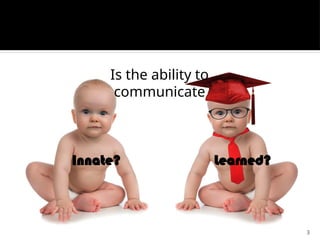
Is the ability to
communicate
Innate? Learned?
4
TRIVIA
We speak at a rate of about 150 words
per minute (wpm).
But we can hear at a rate of about 1,000
wpm. This gives us a lot of extra time!
What do we do with this time?
5
Trivia
Meaning of Words
The Oxford Dictionary records an
average of 28 separate meanings for
each of the 500 most-used words in the
English language
6
Trivia
• A person is fast when he or she can run quickly.
• He or she is also fast if restrained and can’t run at all.
• Colors are fast when they do not run.
• One is fast if he or she moves in suspect company.
• This is not quite the same thing as playing fast and loose.
• A racetrack is fast when it is in good running condition.
• A friend is fast when he or she is loyal.
• A watch is fast when it is ahead of time.
• To be fast asleep is to be deep in slumber.
• To be fast by is to be near.
• To fast is also to refrain from eating.
• A fast may be a ship’s mooring line.
• Photographic film is fast when it is sensitive to light.
• Bacteria are fast when they are insensitive to antiseptics
7
Trivia
“I know that you believe you understand
what you think I said, but I am not sure
you realize that what you heard is not
what I meant!”
Quote from a U.S. government official
8
The Discipline of
Communication
Deals with how humans use verbal
and non-verbal messages to create
meaning
in various contexts
9
The Discipline of
Communication
Also concerned
with the impact of communication on
human behavior
10
COMMUNICATION
is a transactional process
in which people generate meaning through the
exchange of verbal messages in specific
contexts, influenced by
individual and societal forces and
embedded in culture.
(Alberts, Nakayama, and Martin, 2007)
11
COMMUNICATION
Meaning-making system that
follows the goal of conveying the
intended message from the
sender to the receiver as
accurately as possible.
12
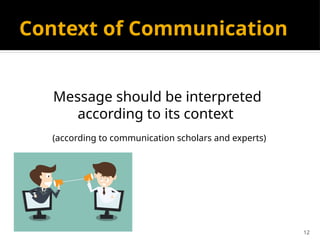
Context of Communication
Message should be interpreted
according to its context
(according to communication scholars and experts)
13
Context of Communication
=Frames of Reference
Frame of Reference
A set of criteria as basis for measuring,
understanding or making judgment
about the message received
14
Context of Communication
=Frames of Reference
Frame of Reference
Different individuals interpret the same message
differently depending on their experiences or “frame
of reference”
15
Context of Communication
=Frames of Reference
1. Psychological FR
A set of parameters that define
one’s mental schema
16
Context of Communication
=Frames of Reference
2. Cultural FR
A set of parameters that define
one’s cultural bias
17
Context of Communication
=Frames of Reference
3. Social FR
A set of parameters that define
one’s social bias
18
Context of Communication
=Frames of Reference
4. Spatial FR
A set of egocentric experience ,
environmental and geographical
parameters that defines one’s
interpretation of reality.
Ex. How do you look at life
19
Context of Communication
=Frames of Reference
5. Temporal FR
A set of transient parameters (such as
space and a range of experience types)
that underlie immediate interpretations,
which define one’s interpretation of
reality.
20
Context of Communication
=Frames of Reference
6. Historical FR
A set of parameters
that define one’s historical bias
21
Why
Communicate?
22
Goals of Communication
Everyday we communicate
with a variety of people,
for a variety of reasons,
in a variety of ways.
23
Goals of Communication
1. To EXPRESS one’s needs and wants
2. To transfer or convey information
24
Goals of Communication
3. To establish, strengthen, or sustain
social relationships
4. To facilitate social etiquette
25
Goals of Communication
5. For people with opposing views to
understand each other and connect.
6. To transduce emotions and/or
thoughts from one another
7. To change behavior
26
Aim of Communication
To create SOCIAL
and
POLITICAL change
27
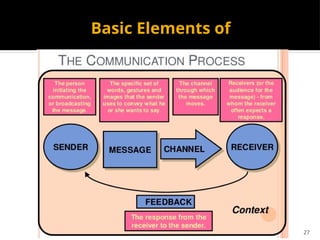
Basic Elements of
28
Basic Elements
of the Communication Process
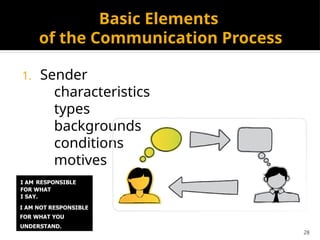
1. Sender
characteristics
types
backgrounds
conditions
motives
29
Basic Elements
of the Communication Process
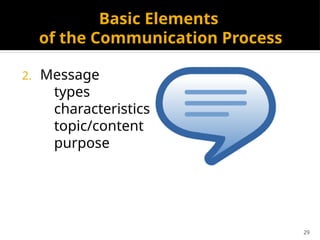
2. Message
types
characteristics
topic/content
purpose
30
Basic Elements
of the Communication Process
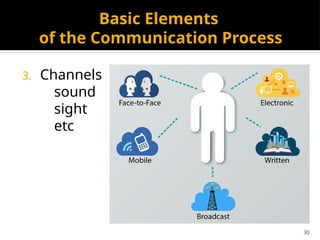
3. Channels
sound
sight
etc
31
Basic Elements
of the Communication Process
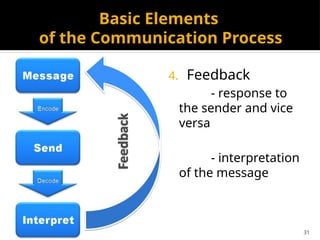
4. Feedback
- response to
the sender and vice
versa
- interpretation
of the message
32
Basic Elements
of the Communication Process
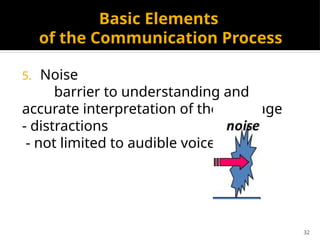
5. Noise
barrier to understanding and
accurate interpretation of the message
- distractions
- not limited to audible voices
33
Basic Elements
of the Communication Process
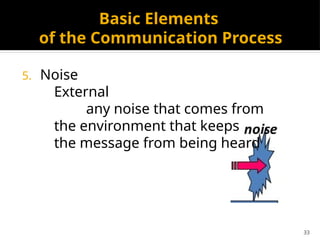
5. Noise
External
any noise that comes from
the environment that keeps
the message from being heard
34
Basic Elements
of the Communication Process
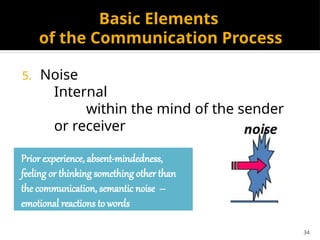
5. Noise
Internal
within the mind of the sender
or receiver
Prior experience, absent-mindedness,
feeling or thinking something other than
the communication, semantic noise –
emotional reactions to words
35
Basic Elements
of the Communication Process
6. Setting/Context
 Types of Setting:
 Intrapersonal: In your mind (talking to
yourself)
 Interpersonal: Informal between 2 people
 Small group: 3-20
 Public: Communication delivered to more
than 20
36
Basic Elements
of the Communication Process
6. Setting/Context
 Types of Context
Physical
Location, environment (temperature, lighting, noise),
distance between participants, and time of day.
37
Basic Elements
of the Communication Process
6. Setting/Context
 Types of Context
Social
Nature of the relationship
38
Basic Elements
of the Communication Process
6. Setting/Context
 Types of Context
Historical
Background from previous communication
39
Basic Elements
of the Communication Process
6. Setting/Context
 Types of Context
Psychological
Moods and feelings each participant brings to the
interaction
40
Basic Elements
of the Communication Process
6. Setting/Context
 Types of Context
Cultural
Values, beliefs, orientations, underlying
assumptions, and rituals prevalent among people in society
41
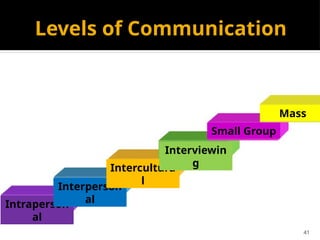
Levels of Communication
Intrapersonal
Intraperson
al
Interperson
al
Intercultura
l
Interviewin
g
Small Group
Mass

THE DISCIPLINE FO COMMUNICATION1234.pptx

  • 1.
  • 2.
    2 Can you imaginethe world without communication?
  • 3.
    3 Is the abilityto communicate Innate? Learned?
  • 4.
    4 TRIVIA We speak ata rate of about 150 words per minute (wpm). But we can hear at a rate of about 1,000 wpm. This gives us a lot of extra time! What do we do with this time?
  • 5.
    5 Trivia Meaning of Words TheOxford Dictionary records an average of 28 separate meanings for each of the 500 most-used words in the English language
  • 6.
    6 Trivia • A personis fast when he or she can run quickly. • He or she is also fast if restrained and can’t run at all. • Colors are fast when they do not run. • One is fast if he or she moves in suspect company. • This is not quite the same thing as playing fast and loose. • A racetrack is fast when it is in good running condition. • A friend is fast when he or she is loyal. • A watch is fast when it is ahead of time. • To be fast asleep is to be deep in slumber. • To be fast by is to be near. • To fast is also to refrain from eating. • A fast may be a ship’s mooring line. • Photographic film is fast when it is sensitive to light. • Bacteria are fast when they are insensitive to antiseptics
  • 7.
    7 Trivia “I know thatyou believe you understand what you think I said, but I am not sure you realize that what you heard is not what I meant!” Quote from a U.S. government official
  • 8.
    8 The Discipline of Communication Dealswith how humans use verbal and non-verbal messages to create meaning in various contexts
  • 9.
    9 The Discipline of Communication Alsoconcerned with the impact of communication on human behavior
  • 10.
    10 COMMUNICATION is a transactionalprocess in which people generate meaning through the exchange of verbal messages in specific contexts, influenced by individual and societal forces and embedded in culture. (Alberts, Nakayama, and Martin, 2007)
  • 11.
    11 COMMUNICATION Meaning-making system that followsthe goal of conveying the intended message from the sender to the receiver as accurately as possible.
  • 12.
    12 Context of Communication Messageshould be interpreted according to its context (according to communication scholars and experts)
  • 13.
    13 Context of Communication =Framesof Reference Frame of Reference A set of criteria as basis for measuring, understanding or making judgment about the message received
  • 14.
    14 Context of Communication =Framesof Reference Frame of Reference Different individuals interpret the same message differently depending on their experiences or “frame of reference”
  • 15.
    15 Context of Communication =Framesof Reference 1. Psychological FR A set of parameters that define one’s mental schema
  • 16.
    16 Context of Communication =Framesof Reference 2. Cultural FR A set of parameters that define one’s cultural bias
  • 17.
    17 Context of Communication =Framesof Reference 3. Social FR A set of parameters that define one’s social bias
  • 18.
    18 Context of Communication =Framesof Reference 4. Spatial FR A set of egocentric experience , environmental and geographical parameters that defines one’s interpretation of reality. Ex. How do you look at life
  • 19.
    19 Context of Communication =Framesof Reference 5. Temporal FR A set of transient parameters (such as space and a range of experience types) that underlie immediate interpretations, which define one’s interpretation of reality.
  • 20.
    20 Context of Communication =Framesof Reference 6. Historical FR A set of parameters that define one’s historical bias
  • 21.
  • 22.
    22 Goals of Communication Everydaywe communicate with a variety of people, for a variety of reasons, in a variety of ways.
  • 23.
    23 Goals of Communication 1.To EXPRESS one’s needs and wants 2. To transfer or convey information
  • 24.
    24 Goals of Communication 3.To establish, strengthen, or sustain social relationships 4. To facilitate social etiquette
  • 25.
    25 Goals of Communication 5.For people with opposing views to understand each other and connect. 6. To transduce emotions and/or thoughts from one another 7. To change behavior
  • 26.
    26 Aim of Communication Tocreate SOCIAL and POLITICAL change
  • 27.
  • 28.
    28 Basic Elements of theCommunication Process 1. Sender characteristics types backgrounds conditions motives
  • 29.
    29 Basic Elements of theCommunication Process 2. Message types characteristics topic/content purpose
  • 30.
    30 Basic Elements of theCommunication Process 3. Channels sound sight etc
  • 31.
    31 Basic Elements of theCommunication Process 4. Feedback - response to the sender and vice versa - interpretation of the message
  • 32.
    32 Basic Elements of theCommunication Process 5. Noise barrier to understanding and accurate interpretation of the message - distractions - not limited to audible voices
  • 33.
    33 Basic Elements of theCommunication Process 5. Noise External any noise that comes from the environment that keeps the message from being heard
  • 34.
    34 Basic Elements of theCommunication Process 5. Noise Internal within the mind of the sender or receiver Prior experience, absent-mindedness, feeling or thinking something other than the communication, semantic noise – emotional reactions to words
  • 35.
    35 Basic Elements of theCommunication Process 6. Setting/Context  Types of Setting:  Intrapersonal: In your mind (talking to yourself)  Interpersonal: Informal between 2 people  Small group: 3-20  Public: Communication delivered to more than 20
  • 36.
    36 Basic Elements of theCommunication Process 6. Setting/Context  Types of Context Physical Location, environment (temperature, lighting, noise), distance between participants, and time of day.
  • 37.
    37 Basic Elements of theCommunication Process 6. Setting/Context  Types of Context Social Nature of the relationship
  • 38.
    38 Basic Elements of theCommunication Process 6. Setting/Context  Types of Context Historical Background from previous communication
  • 39.
    39 Basic Elements of theCommunication Process 6. Setting/Context  Types of Context Psychological Moods and feelings each participant brings to the interaction
  • 40.
    40 Basic Elements of theCommunication Process 6. Setting/Context  Types of Context Cultural Values, beliefs, orientations, underlying assumptions, and rituals prevalent among people in society
  • 41.