13/12/2018 The Differences Between Wetting Agents and Dispersants
https://knowledge.ulprospector.com/2282/pc-differences-between-wetting-agents-and-dispersants/ 1/4
The Differences Between Wetting Agents and
Dispersants
Posted on April 10, 2015 by Jochum Beetsma
Introduction
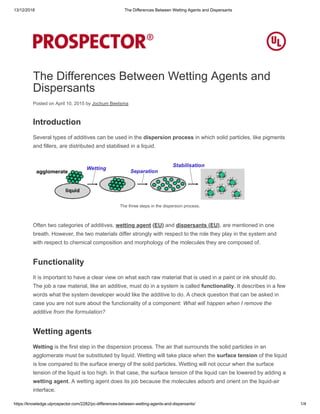
Several types of additives can be used in the dispersion process in which solid particles, like pigments
and fillers, are distributed and stabilised in a liquid.
The three steps in the dispersion process.
Often two categories of additives, wetting agent (EU) and dispersants (EU), are mentioned in one
breath. However, the two materials differ strongly with respect to the role they play in the system and
with respect to chemical composition and morphology of the molecules they are composed of.
Functionality
It is important to have a clear view on what each raw material that is used in a paint or ink should do.
The job a raw material, like an additive, must do in a system is called functionality. It describes in a few
words what the system developer would like the additive to do. A check question that can be asked in
case you are not sure about the functionality of a component: What will happen when I remove the
additive from the formulation?
Wetting agents
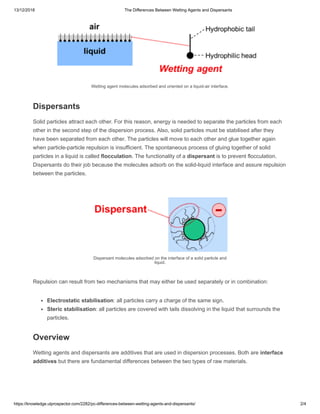
Wetting is the first step in the dispersion process. The air that surrounds the solid particles in an
agglomerate must be substituted by liquid. Wetting will take place when the surface tension of the liquid
is low compared to the surface energy of the solid particles. Wetting will not occur when the surface
tension of the liquid is too high. In that case, the surface tension of the liquid can be lowered by adding a
wetting agent. A wetting agent does its job because the molecules adsorb and orient on the liquid-air
interface.
13/12/2018 The Differences Between Wetting Agents and Dispersants
https://knowledge.ulprospector.com/2282/pc-differences-between-wetting-agents-and-dispersants/ 2/4
Wetting agent molecules adsorbed and oriented on a liquid-air interface.
Dispersants
Solid particles attract each other. For this reason, energy is needed to separate the particles from each
other in the second step of the dispersion process. Also, solid particles must be stabilised after they
have been separated from each other. The particles will move to each other and glue together again
when particle-particle repulsion is insufficient. The spontaneous process of gluing together of solid
particles in a liquid is called flocculation. The functionality of a dispersant is to prevent flocculation.
Dispersants do their job because the molecules adsorb on the solid-liquid interface and assure repulsion
between the particles.
Dispersant molecules adsorbed on the interface of a solid particle and
liquid.
Repulsion can result from two mechanisms that may either be used separately or in combination:
Electrostatic stabilisation: all particles carry a charge of the same sign.
Steric stabilisation: all particles are covered with tails dissolving in the liquid that surrounds the
particles.
Overview
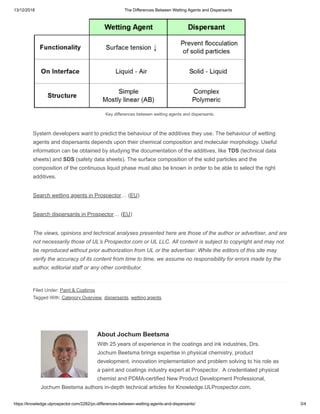
Wetting agents and dispersants are additives that are used in dispersion processes. Both are interface
additives but there are fundamental differences between the two types of raw materials.
13/12/2018 The Differences Between Wetting Agents and Dispersants
https://knowledge.ulprospector.com/2282/pc-differences-between-wetting-agents-and-dispersants/ 3/4
Key differences between wetting agents and dispersants.
System developers want to predict the behaviour of the additives they use. The behaviour of wetting
agents and dispersants depends upon their chemical composition and molecular morphology. Useful
information can be obtained by studying the documentation of the additives, like TDS (technical data
sheets) and SDS (safety data sheets). The surface composition of the solid particles and the
composition of the continuous liquid phase must also be known in order to be able to select the right
additives.
Search wetting agents in Prospector… (EU)
Search dispersants in Prospector… (EU)
The views, opinions and technical analyses presented here are those of the author or advertiser, and are
not necessarily those of UL’s Prospector.com or UL LLC. All content is subject to copyright and may not
be reproduced without prior authorization from UL or the advertiser. While the editors of this site may
verify the accuracy of its content from time to time, we assume no responsibility for errors made by the
author, editorial staff or any other contributor.
Filed Under: Paint & Coatings
Tagged With: Category Overview, dispersants, wetting agents
About Jochum Beetsma
With 25 years of experience in the coatings and ink industries, Drs.
Jochum Beetsma brings expertise in physical chemistry, product
development, innovation implementation and problem solving to his role as
a paint and coatings industry expert at Prospector. A credentialed physical
chemist and PDMA-certified New Product Development Professional,
Jochum Beetsma authors in-depth technical articles for Knowledge.ULProspector.com.
13/12/2018 The Differences Between Wetting Agents and Dispersants
https://knowledge.ulprospector.com/2282/pc-differences-between-wetting-agents-and-dispersants/ 4/4
Copyright © 2018 Prospector Knowledge Center
Find Ingredients Faster on ULProspector.com

The differences between wetting agents and dispersants

  • 1.
    13/12/2018 The DifferencesBetween Wetting Agents and Dispersants https://knowledge.ulprospector.com/2282/pc-differences-between-wetting-agents-and-dispersants/ 1/4 The Differences Between Wetting Agents and Dispersants Posted on April 10, 2015 by Jochum Beetsma Introduction Several types of additives can be used in the dispersion process in which solid particles, like pigments and fillers, are distributed and stabilised in a liquid. The three steps in the dispersion process. Often two categories of additives, wetting agent (EU) and dispersants (EU), are mentioned in one breath. However, the two materials differ strongly with respect to the role they play in the system and with respect to chemical composition and morphology of the molecules they are composed of. Functionality It is important to have a clear view on what each raw material that is used in a paint or ink should do. The job a raw material, like an additive, must do in a system is called functionality. It describes in a few words what the system developer would like the additive to do. A check question that can be asked in case you are not sure about the functionality of a component: What will happen when I remove the additive from the formulation? Wetting agents Wetting is the first step in the dispersion process. The air that surrounds the solid particles in an agglomerate must be substituted by liquid. Wetting will take place when the surface tension of the liquid is low compared to the surface energy of the solid particles. Wetting will not occur when the surface tension of the liquid is too high. In that case, the surface tension of the liquid can be lowered by adding a wetting agent. A wetting agent does its job because the molecules adsorb and orient on the liquid-air interface.
  • 2.
    13/12/2018 The DifferencesBetween Wetting Agents and Dispersants https://knowledge.ulprospector.com/2282/pc-differences-between-wetting-agents-and-dispersants/ 2/4 Wetting agent molecules adsorbed and oriented on a liquid-air interface. Dispersants Solid particles attract each other. For this reason, energy is needed to separate the particles from each other in the second step of the dispersion process. Also, solid particles must be stabilised after they have been separated from each other. The particles will move to each other and glue together again when particle-particle repulsion is insufficient. The spontaneous process of gluing together of solid particles in a liquid is called flocculation. The functionality of a dispersant is to prevent flocculation. Dispersants do their job because the molecules adsorb on the solid-liquid interface and assure repulsion between the particles. Dispersant molecules adsorbed on the interface of a solid particle and liquid. Repulsion can result from two mechanisms that may either be used separately or in combination: Electrostatic stabilisation: all particles carry a charge of the same sign. Steric stabilisation: all particles are covered with tails dissolving in the liquid that surrounds the particles. Overview Wetting agents and dispersants are additives that are used in dispersion processes. Both are interface additives but there are fundamental differences between the two types of raw materials.
  • 3.
    13/12/2018 The DifferencesBetween Wetting Agents and Dispersants https://knowledge.ulprospector.com/2282/pc-differences-between-wetting-agents-and-dispersants/ 3/4 Key differences between wetting agents and dispersants. System developers want to predict the behaviour of the additives they use. The behaviour of wetting agents and dispersants depends upon their chemical composition and molecular morphology. Useful information can be obtained by studying the documentation of the additives, like TDS (technical data sheets) and SDS (safety data sheets). The surface composition of the solid particles and the composition of the continuous liquid phase must also be known in order to be able to select the right additives. Search wetting agents in Prospector… (EU) Search dispersants in Prospector… (EU) The views, opinions and technical analyses presented here are those of the author or advertiser, and are not necessarily those of UL’s Prospector.com or UL LLC. All content is subject to copyright and may not be reproduced without prior authorization from UL or the advertiser. While the editors of this site may verify the accuracy of its content from time to time, we assume no responsibility for errors made by the author, editorial staff or any other contributor. Filed Under: Paint & Coatings Tagged With: Category Overview, dispersants, wetting agents About Jochum Beetsma With 25 years of experience in the coatings and ink industries, Drs. Jochum Beetsma brings expertise in physical chemistry, product development, innovation implementation and problem solving to his role as a paint and coatings industry expert at Prospector. A credentialed physical chemist and PDMA-certified New Product Development Professional, Jochum Beetsma authors in-depth technical articles for Knowledge.ULProspector.com.
  • 4.
    13/12/2018 The DifferencesBetween Wetting Agents and Dispersants https://knowledge.ulprospector.com/2282/pc-differences-between-wetting-agents-and-dispersants/ 4/4 Copyright © 2018 Prospector Knowledge Center Find Ingredients Faster on ULProspector.com