Make notes on what some of the main developments
have been
Maybe the best place to start is Orson Wellses ‘Citizen Kane’. Citizen
Kane broke many rules and revolutionised the cinema industry.Since
then. A lot of movies such as Batman,Raiders of the lost ark and many
more movies have been influenced by citizen Kane. Techniques such as
Deep focus and extreme low angle shots originate from this
film .Another game changing technique invented by Orson Welles was
the use of montage to show the passing of time.The improvement in
technology has been a key aspect of the development of cinema and
film industry. 

The beginning of the seventh art cannot be understood without the
contribution of the Lumière brothers. These pioneers, inventors of the
cinematograph, recreated the illusion of movement. Their goal was no
other than deceiving our eyes. According to the journalist Yolima
Andrea Díaz, the film and its advances in technology date back to
representations such as the mid-sixteenth century “camera obscura”,
the seventeenth century “magic lantern” or Étienne-Jules Marey’s
portable chronophotography. But the industry went far beyond those
basic techniques that projected images in dark rooms, showed still
transparent pictures or moved bands that displayed twelve images per
second.

The French director Georges Méliès used the techniques of
superimposition of images, fading, double exposures and scale models.
Thus he managed to produce the film A Trip to the Moon (Le Voyage
dans la Lune) despite the technical precariousness of the early
twentieth century. 67 years before the Apollo 11 mission set foot on the
satellite for the first time, Méliès could “portray” the landing of a ship in
the eye of the Moon, a famous image that characterizes the first major
science fiction film.

Thanks to the discovery of Daniel Comstock and Burton Wescott, the
Technicolor Corporation company succeeded in turning black and
white films into colour.
The incorporation of coloured frames was not the only technical
revolution experienced by the cinema between the twenties and thirties.
In 1927, Alan Crosland premiered his black and white film The Jazz
Singer. A work which was not yet benefited from the advantages of
Technicolor, but in which an essential aspect for another of our senses
was changed. We changed from the silent film characterized by
Charles Chaplin to one in which sounds accompanied the images
projected.
If something has been highlighted in the recent film innovation it has
been, without a doubt, the works of animation. And Disney has played a
key role in these advances. With the release of Steamboat Willie in
1927, Walt Disney began the golden age of animated films, with Mickey
Mouse as the big star, becoming the flagship of the multinational until
today. The genius of animation introduced a technique that would be
emulated by many other producers of his time. The method, known as
sound cartoon, allowed to synchronize cartoons and sounds, as
perfectly shown in the scene of the smoke coming out of the boat that a
primitive Mickey Mouse sailed.
Give examples of some success stories and/or less
successful ventures (e.g. 3D technology, live
streaming) including actual case studies of films
https://www.youtube.com/watch?v=v6QjRHwursw
2010 is poised to be one of the biggest years ever for 3D movies.
Studios everywhere are intent on replicating the success of Avatar.
Meanwhile, TV manufacturers are introducing the first wave of 3D-
capable TV sets for those who crave the 3D experience at home.
3D has come a long way in the past 100 years, particularly in this last
decade. At the current rate of advancing technology it shouldn't be too
long before viewers are able to sit down at home or in a theater and
enjoy a true 3D experience without the need for glasses. It should be an
interesting journey.Undoubtedly the most most successful 3D film to
date is James Cameron's Avatar.However it wasnt the first 3D movie.
3D films have existed in some form since 1915, but had been largely
relegated to a niche in the motion picture industry because of the costly
hardware and processes required to produce and display a 3D film, and
the lack of a standardized format for all segments of the entertainment
business.
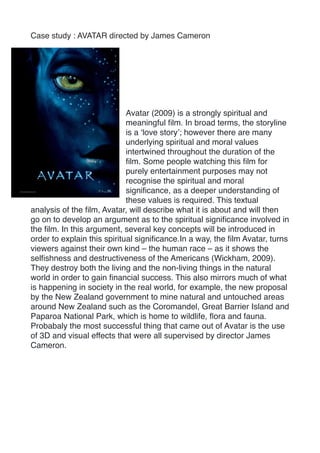
Case study : AVATAR directed by James Cameron
Avatar (2009) is a strongly spiritual and
meaningful film. In broad terms, the storyline
is a ‘love story’; however there are many
underlying spiritual and moral values
intertwined throughout the duration of the
film. Some people watching this film for
purely entertainment purposes may not
recognise the spiritual and moral
significance, as a deeper understanding of
these values is required. This textual
analysis of the film, Avatar, will describe what it is about and will then
go on to develop an argument as to the spiritual significance involved in
the film. In this argument, several key concepts will be introduced in
order to explain this spiritual significance.In a way, the film Avatar, turns
viewers against their own kind – the human race – as it shows the
selfishness and destructiveness of the Americans (Wickham, 2009).
They destroy both the living and the non-living things in the natural
world in order to gain financial success. This also mirrors much of what
is happening in society in the real world, for example, the new proposal
by the New Zealand government to mine natural and untouched areas
around New Zealand such as the Coromandel, Great Barrier Island and
Paparoa National Park, which is home to wildlife, flora and fauna.
Probabaly the most successful thing that came out of Avatar is the use
of 3D and visual effects that were all supervised by director James
Cameron.
The US film industry has always been more powerful and richer than
the UK film industry. The US has produced countless high class movies
and blockbuster films over the cast decades and the UK has only
produced a few movies that have been known worldwide. The younger
audience seem to be attracted to movies with more visual effects such
as Star Wars, Avatar and blockbuster marvel movies such as the
Avengers series . However the older generations have more interest in
drama with less or no visual effects at all. The reason for this might be
related to the childhood of a person and whether they were raised with
technology around them or not.
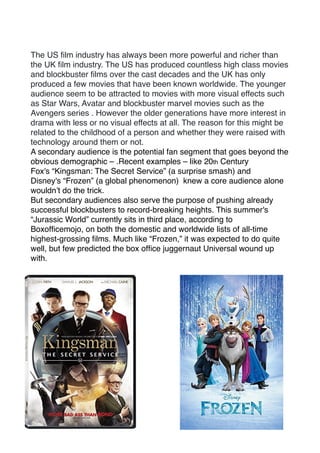
A secondary audience is the potential fan segment that goes beyond the
obvious demographic – .Recent examples – like 20th Century
Fox's “Kingsman: The Secret Service” (a surprise smash) and
Disney's “Frozen” (a global phenomenon) knew a core audience alone
wouldn’t do the trick.
But secondary audiences also serve the purpose of pushing already
successful blockbusters to record-breaking heights. This summer's
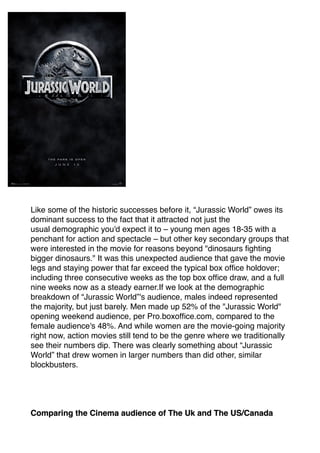
“Jurassic World” currently sits in third place, according to
Boxofficemojo, on both the domestic and worldwide lists of all-time
highest-grossing films. Much like “Frozen,” it was expected to do quite
well, but few predicted the box office juggernaut Universal wound up
with.
Like some of the historic successes before it, “Jurassic World” owes its
dominant success to the fact that it attracted not just the
usual demographic you'd expect it to – young men ages 18-35 with a
penchant for action and spectacle – but other key secondary groups that
were interested in the movie for reasons beyond "dinosaurs fighting
bigger dinosaurs." It was this unexpected audience that gave the movie
legs and staying power that far exceed the typical box office holdover;
including three consecutive weeks as the top box office draw, and a full
nine weeks now as a steady earner.If we look at the demographic
breakdown of “Jurassic World”'s audience, males indeed represented
the majority, but just barely. Men made up 52% of the "Jurassic World"
opening weekend audience, per Pro.boxoffice.com, compared to the
female audience's 48%. And while women are the movie-going majority
right now, action movies still tend to be the genre where we traditionally
see their numbers dip. There was clearly something about “Jurassic
World” that drew women in larger numbers than did other, similar
blockbusters.  
Comparing the Cinema audience of The Uk and The US/Canada
Cinema attendance in the U.K. topped 177 million in 2018, the highest
number since 1970. Box office held firm at £1.3 billion ($1.7 billion)
through the year as 10 movies crossed the £30 million threshold in the
year. That compares with six films in
2017.Industry experts said a diverse slate
of big-budget films piqued audience
interest, and investment in infrastructure –
more than a dozen new theaters opened
in 2018 and many others were refurbished
– propelled Britain to a banner movie-
going year.
More than two-thirds (71%) of the U.S./
Canada population – or 246 million people –
went to the cinema at least once in 2016, a
two percent increase from 2015. Frequent
moviegoers – individuals who go to the
cinema once a month or more – continue to
drive the movie industry, accounting for 48
percent of all tickets sold in the United States and Canada.In 2016,
18-24 year olds went to the movies an average of 6.5 times over the
year, up 0.6 from 2015. This was the largest increase of any age group.
Per capita attendance was next highest for 12-17 year olds . Per capita
attendance also increased for
25-39 year olds and 50-59 year
olds compared to the previous
year.Three of the top five grossing
films in 2016 attracted majority
female audiences. Finding Dory
drew the largest proportion of
females, with 55 percent of its box
office coming from women. The Jungle Book drew the most ethnically
diverse audience, followed by Finding Dory and Captain America: Civil
War.
Frequent moviegoers tend to own more key technology products, such
as smartphones and tablets, compared to the general population of
adults 18 years and older. More than three quarters of all frequent
moviegoers (79%) own at least four different types of key technology
products, compared to 60 percent of the total adult population.
Let’s get back to the developments in cinema. In the beginning of the
presentation I talked about the 3Dimension technology or 3D that has
had a huge impact on the audience since day one. Another topic that I
want to talk about is the development and improvement of the camera
equipment
Everything started with Thomas Edison having a light-bulb moment and
files a claim with the U.S. Patent Office to create the Kinetoscope, which
will "do for the eye what the phonograph does for the ear. A few years go
by and finally the
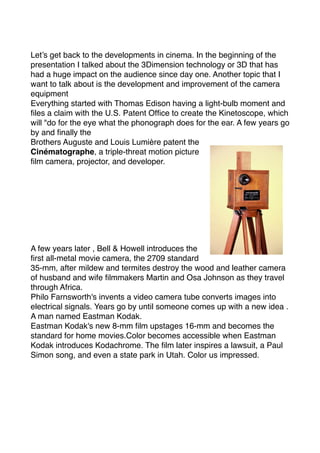
Brothers Auguste and Louis Lumière patent the
Cinématographe, a triple-threat motion picture
film camera, projector, and developer.
A few years later , Bell & Howell introduces the
first all-metal movie camera, the 2709 standard
35-mm, after mildew and termites destroy the wood and leather camera
of husband and wife filmmakers Martin and Osa Johnson as they travel
through Africa.
Philo Farnsworth's invents a video camera tube converts images into
electrical signals. Years go by until someone comes up with a new idea .
A man named Eastman Kodak.
Eastman Kodak's new 8-mm film upstages 16-mm and becomes the
standard for home movies.Color becomes accessible when Eastman
Kodak introduces Kodachrome. The film later inspires a lawsuit, a Paul
Simon song, and even a state park in Utah. Color us impressed.
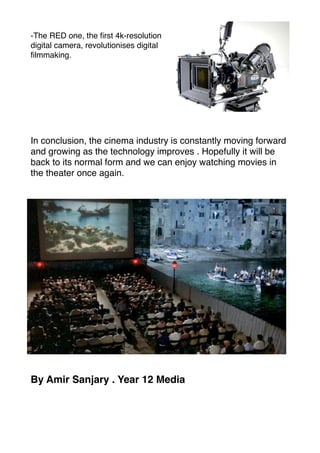
-The RED one, the first 4k-resolution
digital camera, revolutionises digital
filmmaking.
In conclusion, the cinema industry is constantly moving forward
and growing as the technology improves . Hopefully it will be
back to its normal form and we can enjoy watching movies in
the theater once again.
By Amir Sanjary . Year 12 Media

The developments in Cinema over the years

  • 1.
    Make notes onwhat some of the main developments have been Maybe the best place to start is Orson Wellses ‘Citizen Kane’. Citizen Kane broke many rules and revolutionised the cinema industry.Since then. A lot of movies such as Batman,Raiders of the lost ark and many more movies have been influenced by citizen Kane. Techniques such as Deep focus and extreme low angle shots originate from this film .Another game changing technique invented by Orson Welles was the use of montage to show the passing of time.The improvement in technology has been a key aspect of the development of cinema and film industry. The beginning of the seventh art cannot be understood without the contribution of the Lumière brothers. These pioneers, inventors of the cinematograph, recreated the illusion of movement. Their goal was no other than deceiving our eyes. According to the journalist Yolima Andrea Díaz, the film and its advances in technology date back to representations such as the mid-sixteenth century “camera obscura”, the seventeenth century “magic lantern” or Étienne-Jules Marey’s portable chronophotography. But the industry went far beyond those basic techniques that projected images in dark rooms, showed still transparent pictures or moved bands that displayed twelve images per second. The French director Georges Méliès used the techniques of superimposition of images, fading, double exposures and scale models. Thus he managed to produce the film A Trip to the Moon (Le Voyage dans la Lune) despite the technical precariousness of the early twentieth century. 67 years before the Apollo 11 mission set foot on the satellite for the first time, Méliès could “portray” the landing of a ship in the eye of the Moon, a famous image that characterizes the first major science fiction film. Thanks to the discovery of Daniel Comstock and Burton Wescott, the Technicolor Corporation company succeeded in turning black and white films into colour. The incorporation of coloured frames was not the only technical revolution experienced by the cinema between the twenties and thirties. In 1927, Alan Crosland premiered his black and white film The Jazz Singer. A work which was not yet benefited from the advantages of Technicolor, but in which an essential aspect for another of our senses
  • 2.
    was changed. Wechanged from the silent film characterized by Charles Chaplin to one in which sounds accompanied the images projected. If something has been highlighted in the recent film innovation it has been, without a doubt, the works of animation. And Disney has played a key role in these advances. With the release of Steamboat Willie in 1927, Walt Disney began the golden age of animated films, with Mickey Mouse as the big star, becoming the flagship of the multinational until today. The genius of animation introduced a technique that would be emulated by many other producers of his time. The method, known as sound cartoon, allowed to synchronize cartoons and sounds, as perfectly shown in the scene of the smoke coming out of the boat that a primitive Mickey Mouse sailed. Give examples of some success stories and/or less successful ventures (e.g. 3D technology, live streaming) including actual case studies of films https://www.youtube.com/watch?v=v6QjRHwursw 2010 is poised to be one of the biggest years ever for 3D movies. Studios everywhere are intent on replicating the success of Avatar. Meanwhile, TV manufacturers are introducing the first wave of 3D- capable TV sets for those who crave the 3D experience at home. 3D has come a long way in the past 100 years, particularly in this last decade. At the current rate of advancing technology it shouldn't be too long before viewers are able to sit down at home or in a theater and enjoy a true 3D experience without the need for glasses. It should be an interesting journey.Undoubtedly the most most successful 3D film to date is James Cameron's Avatar.However it wasnt the first 3D movie. 3D films have existed in some form since 1915, but had been largely relegated to a niche in the motion picture industry because of the costly hardware and processes required to produce and display a 3D film, and the lack of a standardized format for all segments of the entertainment business.
  • 3.
    Case study :AVATAR directed by James Cameron Avatar (2009) is a strongly spiritual and meaningful film. In broad terms, the storyline is a ‘love story’; however there are many underlying spiritual and moral values intertwined throughout the duration of the film. Some people watching this film for purely entertainment purposes may not recognise the spiritual and moral significance, as a deeper understanding of these values is required. This textual analysis of the film, Avatar, will describe what it is about and will then go on to develop an argument as to the spiritual significance involved in the film. In this argument, several key concepts will be introduced in order to explain this spiritual significance.In a way, the film Avatar, turns viewers against their own kind – the human race – as it shows the selfishness and destructiveness of the Americans (Wickham, 2009). They destroy both the living and the non-living things in the natural world in order to gain financial success. This also mirrors much of what is happening in society in the real world, for example, the new proposal by the New Zealand government to mine natural and untouched areas around New Zealand such as the Coromandel, Great Barrier Island and Paparoa National Park, which is home to wildlife, flora and fauna. Probabaly the most successful thing that came out of Avatar is the use of 3D and visual effects that were all supervised by director James Cameron.
  • 4.
    The US filmindustry has always been more powerful and richer than the UK film industry. The US has produced countless high class movies and blockbuster films over the cast decades and the UK has only produced a few movies that have been known worldwide. The younger audience seem to be attracted to movies with more visual effects such as Star Wars, Avatar and blockbuster marvel movies such as the Avengers series . However the older generations have more interest in drama with less or no visual effects at all. The reason for this might be related to the childhood of a person and whether they were raised with technology around them or not. A secondary audience is the potential fan segment that goes beyond the obvious demographic – .Recent examples – like 20th Century Fox's “Kingsman: The Secret Service” (a surprise smash) and Disney's “Frozen” (a global phenomenon) knew a core audience alone wouldn’t do the trick. But secondary audiences also serve the purpose of pushing already successful blockbusters to record-breaking heights. This summer's “Jurassic World” currently sits in third place, according to Boxofficemojo, on both the domestic and worldwide lists of all-time highest-grossing films. Much like “Frozen,” it was expected to do quite well, but few predicted the box office juggernaut Universal wound up with.
  • 5.
    Like some ofthe historic successes before it, “Jurassic World” owes its dominant success to the fact that it attracted not just the usual demographic you'd expect it to – young men ages 18-35 with a penchant for action and spectacle – but other key secondary groups that were interested in the movie for reasons beyond "dinosaurs fighting bigger dinosaurs." It was this unexpected audience that gave the movie legs and staying power that far exceed the typical box office holdover; including three consecutive weeks as the top box office draw, and a full nine weeks now as a steady earner.If we look at the demographic breakdown of “Jurassic World”'s audience, males indeed represented the majority, but just barely. Men made up 52% of the "Jurassic World" opening weekend audience, per Pro.boxoffice.com, compared to the female audience's 48%. And while women are the movie-going majority right now, action movies still tend to be the genre where we traditionally see their numbers dip. There was clearly something about “Jurassic World” that drew women in larger numbers than did other, similar blockbusters.   Comparing the Cinema audience of The Uk and The US/Canada
  • 6.
    Cinema attendance inthe U.K. topped 177 million in 2018, the highest number since 1970. Box office held firm at £1.3 billion ($1.7 billion) through the year as 10 movies crossed the £30 million threshold in the year. That compares with six films in 2017.Industry experts said a diverse slate of big-budget films piqued audience interest, and investment in infrastructure – more than a dozen new theaters opened in 2018 and many others were refurbished – propelled Britain to a banner movie- going year. More than two-thirds (71%) of the U.S./ Canada population – or 246 million people – went to the cinema at least once in 2016, a two percent increase from 2015. Frequent moviegoers – individuals who go to the cinema once a month or more – continue to drive the movie industry, accounting for 48 percent of all tickets sold in the United States and Canada.In 2016, 18-24 year olds went to the movies an average of 6.5 times over the year, up 0.6 from 2015. This was the largest increase of any age group. Per capita attendance was next highest for 12-17 year olds . Per capita attendance also increased for 25-39 year olds and 50-59 year olds compared to the previous year.Three of the top five grossing films in 2016 attracted majority female audiences. Finding Dory drew the largest proportion of females, with 55 percent of its box office coming from women. The Jungle Book drew the most ethnically diverse audience, followed by Finding Dory and Captain America: Civil War. Frequent moviegoers tend to own more key technology products, such as smartphones and tablets, compared to the general population of adults 18 years and older. More than three quarters of all frequent moviegoers (79%) own at least four different types of key technology products, compared to 60 percent of the total adult population.
  • 7.
    Let’s get backto the developments in cinema. In the beginning of the presentation I talked about the 3Dimension technology or 3D that has had a huge impact on the audience since day one. Another topic that I want to talk about is the development and improvement of the camera equipment Everything started with Thomas Edison having a light-bulb moment and files a claim with the U.S. Patent Office to create the Kinetoscope, which will "do for the eye what the phonograph does for the ear. A few years go by and finally the Brothers Auguste and Louis Lumière patent the Cinématographe, a triple-threat motion picture film camera, projector, and developer. A few years later , Bell & Howell introduces the first all-metal movie camera, the 2709 standard 35-mm, after mildew and termites destroy the wood and leather camera of husband and wife filmmakers Martin and Osa Johnson as they travel through Africa. Philo Farnsworth's invents a video camera tube converts images into electrical signals. Years go by until someone comes up with a new idea . A man named Eastman Kodak. Eastman Kodak's new 8-mm film upstages 16-mm and becomes the standard for home movies.Color becomes accessible when Eastman Kodak introduces Kodachrome. The film later inspires a lawsuit, a Paul Simon song, and even a state park in Utah. Color us impressed.
  • 8.
    -The RED one,the first 4k-resolution digital camera, revolutionises digital filmmaking. In conclusion, the cinema industry is constantly moving forward and growing as the technology improves . Hopefully it will be back to its normal form and we can enjoy watching movies in the theater once again. By Amir Sanjary . Year 12 Media