The Design and Construction of Modern
Integrated Circuits
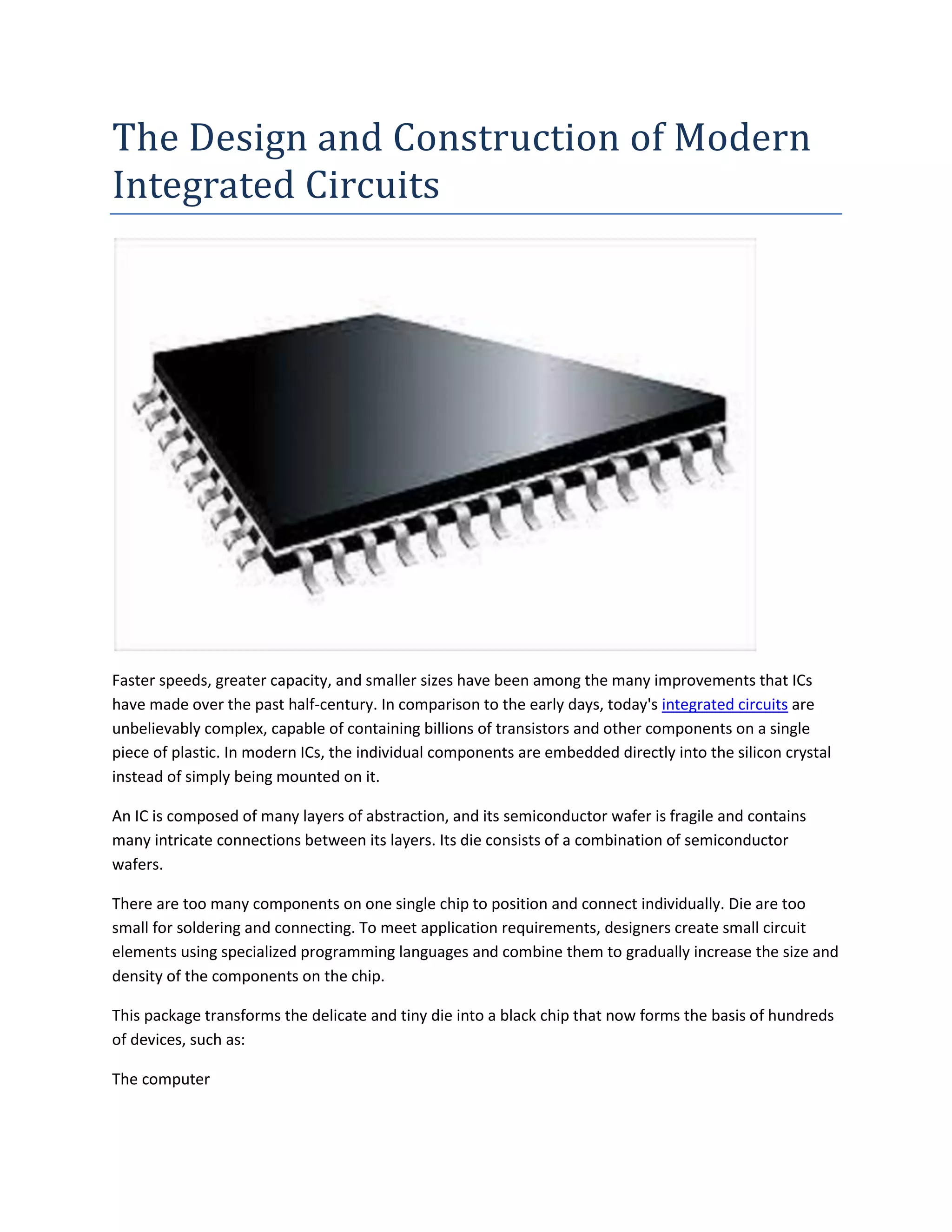
Faster speeds, greater capacity, and smaller sizes have been among the many improvements that ICs
have made over the past half-century. In comparison to the early days, today's integrated circuits are
unbelievably complex, capable of containing billions of transistors and other components on a single
piece of plastic. In modern ICs, the individual components are embedded directly into the silicon crystal
instead of simply being mounted on it.
An IC is composed of many layers of abstraction, and its semiconductor wafer is fragile and contains
many intricate connections between its layers. Its die consists of a combination of semiconductor
wafers.
There are too many components on one single chip to position and connect individually. Die are too
small for soldering and connecting. To meet application requirements, designers create small circuit
elements using specialized programming languages and combine them to gradually increase the size and
density of the components on the chip.
This package transforms the delicate and tiny die into a black chip that now forms the basis of hundreds
of devices, such as:
The computer
The mobile phone and the Smartphone
Airplanes and cars
The amplifier
Switches for networks
Washing machines, toasters, microwaves, televisions, and other electronic devices.
The types of integrated circuits
According to their intended application, ICs can be linear (analog), digital, or a combination of the two.
According to the input signal level, analog or linear ICs produce continuously variable outputs. These ICs
can theoretically reach an infinite number of states. With this IC type, the output signal level is linearly
related to the input signal level. A straight line should appear when instantaneous output and
instantaneous input are plotted.
There are usually only a few components in analog integrated circuits and they are quite simple.
It is common for linear ICs to be used as audio-frequency (AF) and radio-frequency (RF) amplifiers.
Operating amplifiers (op amps) are one of them. Temperature sensors are another common application
of analog ICs. Various devices can be turned on or off with linear ICs once a particular signal reaches a
certain level, including:
The air conditioner
Heating systems
The oven
Digital ICs operate at only a few defined (discrete) levels or states, not a continuous range of signal
amplitudes. In digital electronics, logic gates are the fundamental building blocks, which work with
binary data, which is signals with only two states, known as low (logic 0) and high (logic 1).
The microprocessor and integrated circuit
Microprocessors are the most complicated type of integrated circuits electronic components, capable of
performing billions of operations per second. In a computing device, a microprocessor contains the
central processing unit (CPU), which runs a computer, or the graphics processing unit (GPU), which
renders images and videos. The clock instructs millions of transistors on how to perform a specific logic
function on a single microprocessor.
Transistors perform logic functions (e.g., calculations) when the clock changes state and the clocks
frequency determines how fast these functions are performed.
As well as predetermined memory locations and registers, microprocessors have the following types of
memory:
In a permanent register, instructions for various operations are stored in advance.
Numbers to be operated on and results of operations are stored in a temporary register.
The counter contains the memory address of the next instruction.
There is a stack pointer that indicates the address of the last instruction placed in the stack memory.
This register contains the location (address) of the data to be worked on.
The IC made our lives infinitely better. A modern laptop computer is thousands of times more powerful
and about 100 times smaller than the first computer created in the 1940s. The ENIAC had 18,000
vacuum tubes and was as large as three to four double-decker buses.

The Design and Construction of Modern Integrated Circuits

  • 1.
    The Design andConstruction of Modern Integrated Circuits Faster speeds, greater capacity, and smaller sizes have been among the many improvements that ICs have made over the past half-century. In comparison to the early days, today's integrated circuits are unbelievably complex, capable of containing billions of transistors and other components on a single piece of plastic. In modern ICs, the individual components are embedded directly into the silicon crystal instead of simply being mounted on it. An IC is composed of many layers of abstraction, and its semiconductor wafer is fragile and contains many intricate connections between its layers. Its die consists of a combination of semiconductor wafers. There are too many components on one single chip to position and connect individually. Die are too small for soldering and connecting. To meet application requirements, designers create small circuit elements using specialized programming languages and combine them to gradually increase the size and density of the components on the chip. This package transforms the delicate and tiny die into a black chip that now forms the basis of hundreds of devices, such as: The computer
  • 2.
    The mobile phoneand the Smartphone Airplanes and cars The amplifier Switches for networks Washing machines, toasters, microwaves, televisions, and other electronic devices. The types of integrated circuits According to their intended application, ICs can be linear (analog), digital, or a combination of the two. According to the input signal level, analog or linear ICs produce continuously variable outputs. These ICs can theoretically reach an infinite number of states. With this IC type, the output signal level is linearly related to the input signal level. A straight line should appear when instantaneous output and instantaneous input are plotted. There are usually only a few components in analog integrated circuits and they are quite simple. It is common for linear ICs to be used as audio-frequency (AF) and radio-frequency (RF) amplifiers. Operating amplifiers (op amps) are one of them. Temperature sensors are another common application of analog ICs. Various devices can be turned on or off with linear ICs once a particular signal reaches a certain level, including: The air conditioner Heating systems The oven Digital ICs operate at only a few defined (discrete) levels or states, not a continuous range of signal amplitudes. In digital electronics, logic gates are the fundamental building blocks, which work with binary data, which is signals with only two states, known as low (logic 0) and high (logic 1). The microprocessor and integrated circuit Microprocessors are the most complicated type of integrated circuits electronic components, capable of performing billions of operations per second. In a computing device, a microprocessor contains the central processing unit (CPU), which runs a computer, or the graphics processing unit (GPU), which renders images and videos. The clock instructs millions of transistors on how to perform a specific logic function on a single microprocessor.
  • 3.
    Transistors perform logicfunctions (e.g., calculations) when the clock changes state and the clocks frequency determines how fast these functions are performed. As well as predetermined memory locations and registers, microprocessors have the following types of memory: In a permanent register, instructions for various operations are stored in advance. Numbers to be operated on and results of operations are stored in a temporary register. The counter contains the memory address of the next instruction. There is a stack pointer that indicates the address of the last instruction placed in the stack memory. This register contains the location (address) of the data to be worked on. The IC made our lives infinitely better. A modern laptop computer is thousands of times more powerful and about 100 times smaller than the first computer created in the 1940s. The ENIAC had 18,000 vacuum tubes and was as large as three to four double-decker buses.