IC TECHNOLOGY, INTERGRATION & THE
CIRCUIT LOQIC FAMILIES
The development of electronics endless with invention of vaccum tubes and associated electronic circuits.
This activity termed as vaccum tube electronics, afterward the evolution of solid state devices and consequent
development of integrated circuits (IC) are responsible for the present status of communication,
computing and instrumentation
THE INTRODUCTION
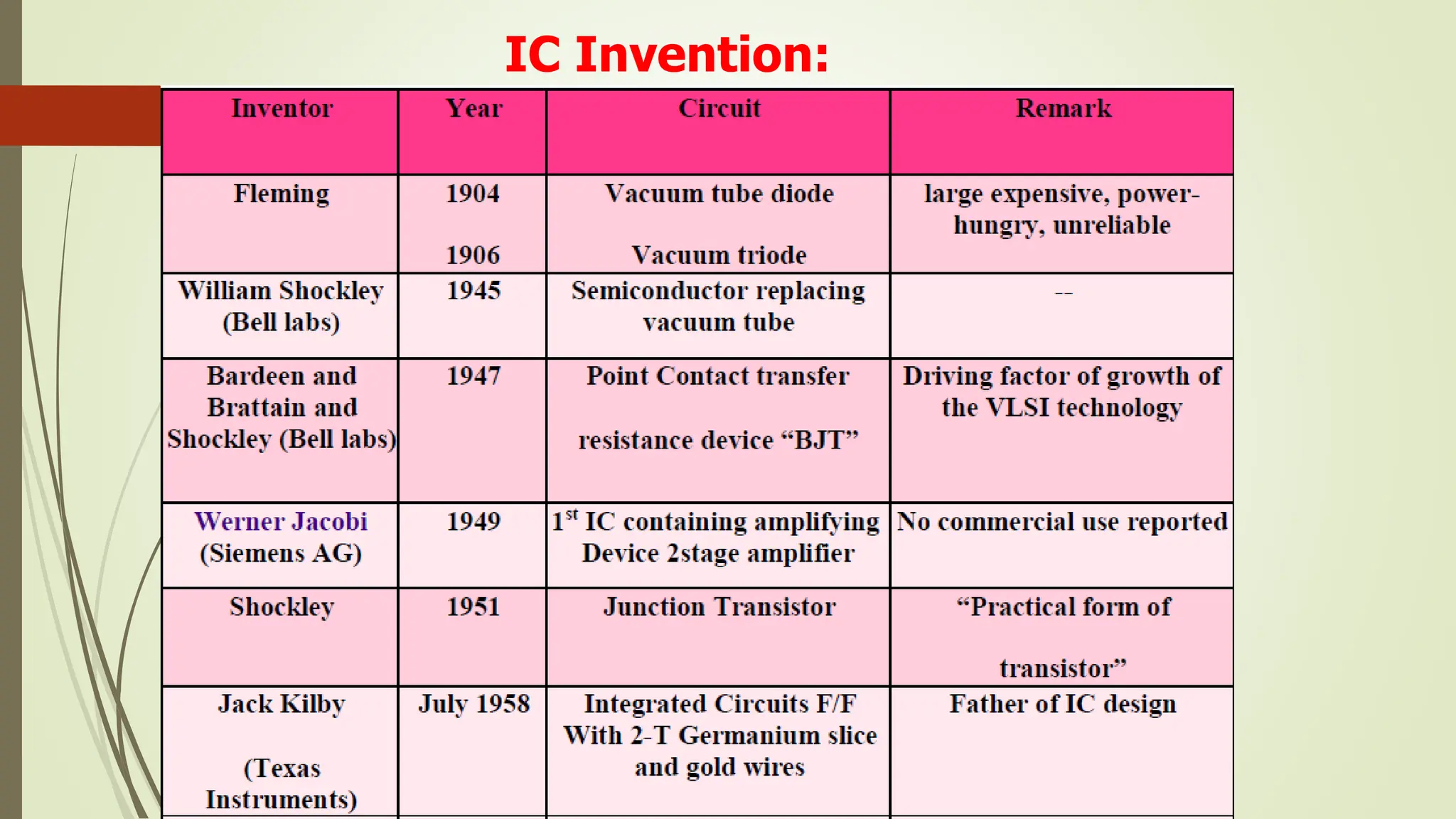
 The first vaccum tube diode was invented by JOHN AMBRASE Fleming in 1904.
 The vaccum triode was invented by LEE DE FOREST in 1906.
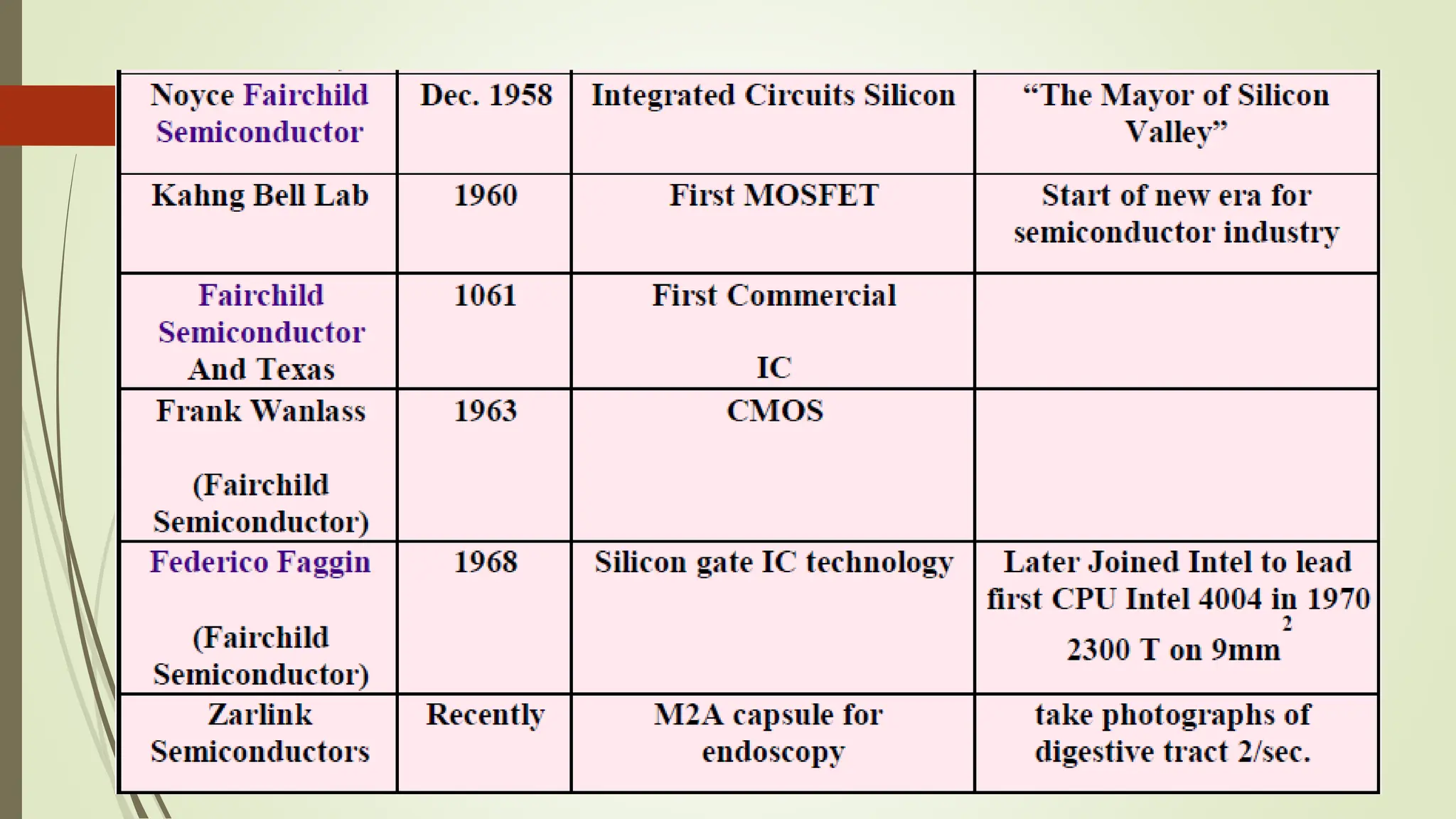
Early developments of the Integrated Circuit (IC) go back to 1949. German engineer Werner Jacobi filed a
patent for an IC like semiconductor amplifying device showing five transistors on a common substrate in a
2-stage amplifier arrangement.
Integrated circuits were made possible by experimental discoveries which showed that semiconductor
devices could perform the functions of vacuum tubes and by mid-20th-century technology advancements in
semiconductor device fabrication had already picked momentum.
The integration of large numbers of tiny transistors into a small chip was an enormous improvement
over the manual assembly of circuits using electronic components.
The integrated circuits mass production capability, reliability, and building-block approach to circuit design
ensured the rapid adoption of standardized ICs in place of designs using discrete transistors.
DEFINITION OF AN IC
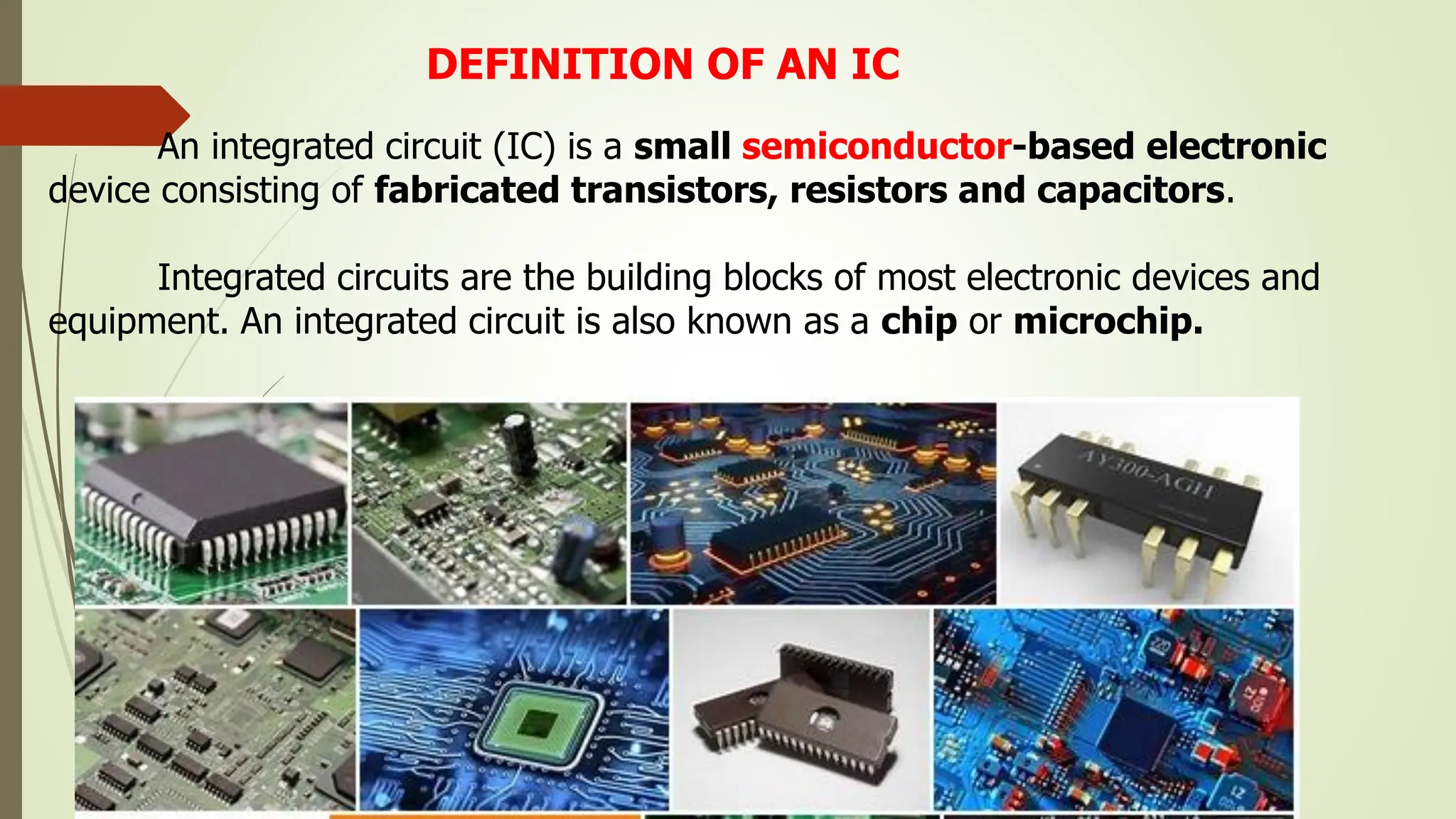
An integrated circuit (IC) is a small semiconductor-based electronic
device consisting of fabricated transistors, resistors and capacitors.
Integrated circuits are the building blocks of most electronic devices and
equipment. An integrated circuit is also known as a chip or microchip.
ADVANTAGES OF IC’S OVER DISCRETE CIRCUITS
There are two main advantages of ICs over discrete circuits:
 cost and
 performance.
Cost is low because the chips, with all their components, are printed as a unit by photolithography rather
than being constructed one transistor at a time.
Furthermore, much less material is used to construct a packaged IC die than a discrete circuit.
Performance is high since the components switch quickly and consume little power (compared to their
discrete counterparts) because the components are small and positioned close together.
IC Invention:
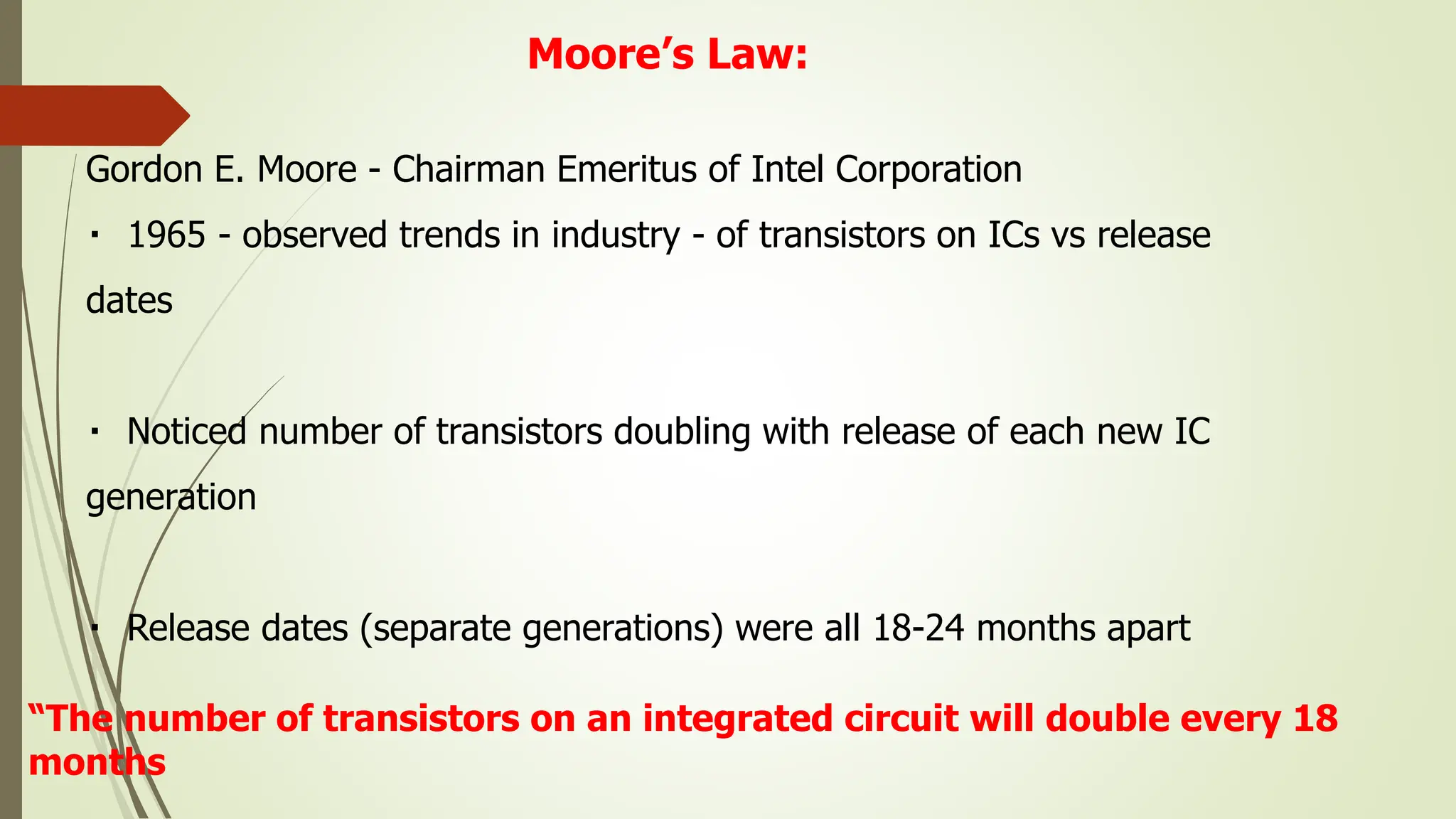
Moore’s Law:
Gordon E. Moore - Chairman Emeritus of Intel Corporation
1965 - observed trends in industry - of transistors on ICs vs release
dates
Noticed number of transistors doubling with release of each new IC
generation
Release dates (separate generations) were all 18-24 months apart
“The number of transistors on an integrated circuit will double every 18
months
Scale of Integration:
 Small scale integration(SSI) --1960
The technology was developed by integrating the number of transistors of 1-100 on a single chip. Ex: Gates, flip-
flops, op-amps.
 Medium scale integration(MSI) --1967
This was developed by integrating the number of transistors of 100- 1000 on a single chip. Ex: Counters, MUX,
adders, 4-bit microprocessors.
 Large scale integration(LSI) --1972
Was developed by integrating the number of transistors of 1000- 10000 on a single chip. Ex:8-bit micro-
processors, ROM,RAM.
 Very large scale integration(VLSI) -1978
Developed by integrating the number of transistors of 10000- 1Million on a single chip. Ex:16-32 bit
microprocessors, peripherals, complimentary high MOS.
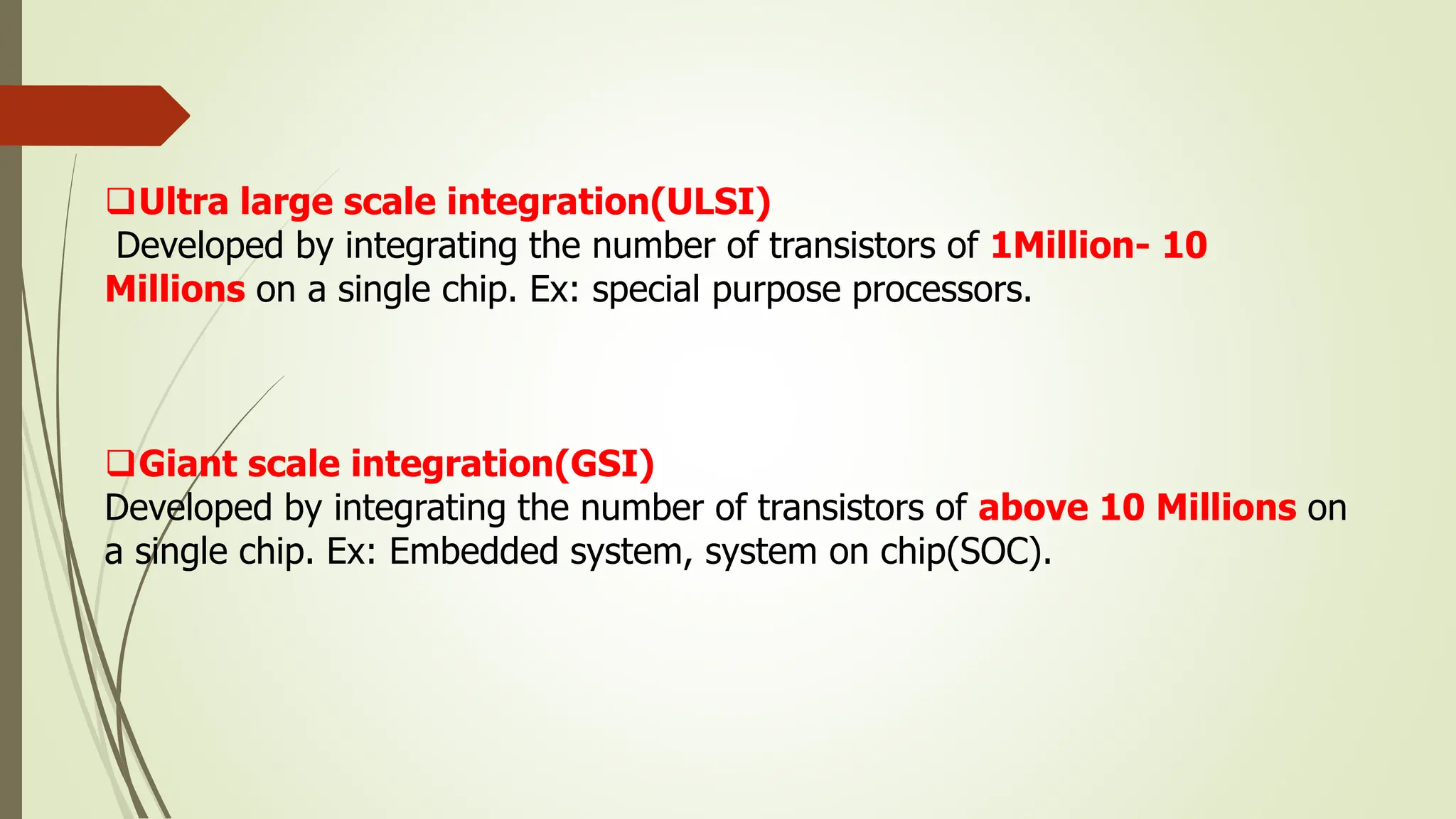
Ultra large scale integration(ULSI)
Developed by integrating the number of transistors of 1Million- 10
Millions on a single chip. Ex: special purpose processors.
Giant scale integration(GSI)
Developed by integrating the number of transistors of above 10 Millions on
a single chip. Ex: Embedded system, system on chip(SOC).
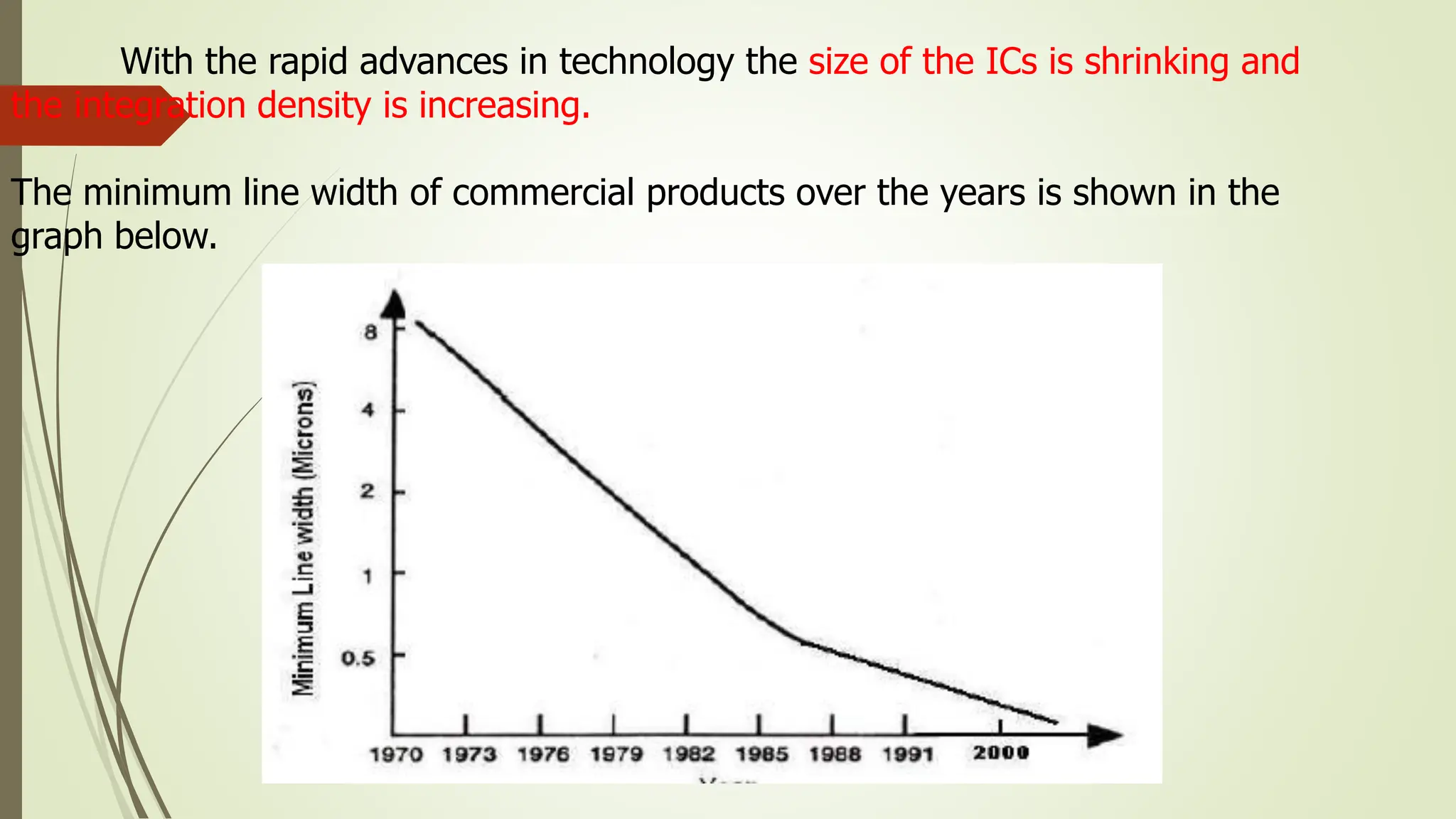
With the rapid advances in technology the size of the ICs is shrinking and
the integration density is increasing.
The minimum line width of commercial products over the years is shown in the
graph below.
Microprocessors/controllers AS MSI
CIRCUITS
The microprocessor is the core of computer systems.
Nowadays many communication, digital entertainment,
portable devices, are controlled by them.
A designer should know what types of components he
needs, ways to reduce production costs and product reliable.
WHAT IS A MICROPROCESSOR?
• The word comes from the combination micro and processor.
• In this context processor means a device that processes numbers,
specifically binary numbers, 0’s and 1’s.
Micro is a new addition.
In the late 1960’s, processors were built using discrete elements.
These devices performed the required operation, but were too large and too
slow.
In the early 1970’s the microchip was invented. All of the components that
made up the processor were now placed on a single piece of silicon.
The size became several thousand times smaller and the speed became several
hundred times faster. The “Micro” Processor was born.
DEFINITION OF A MICROPROCESSOR.
The microprocessor is a programmable device that takes in numbers,
performs on them arithmetic or logical operations according to the program
stored in memory and then produces other numbers as a result.
Lets expand each of the underlined words:
Programmable device: The microprocessor can perform different sets of
operations on the data it receives depending on the sequence of instructions
supplied in the given program.
By changing the program, the microprocessor manipulates the data in different
ways.
Instructions: Each microprocessor is designed to execute a specific group of
operations. This group of operations is called an instruction set. This instruction
set defines what the microprocessor can and cannot do.
Takes in: The data that the microprocessor manipulates must come from somewhere.
It comes from what is called “input devices”.
These are devices that bring data into the system from the outside world.
These represent devices such as a keyboard, a mouse, switches, and the like.
Numbers: The microprocessor has a very narrow view on life. It only understands
binary numbers.
A binary digit is called a bit (which comes from binary digit).
The microprocessor recognizes and processes a group of bits together. This group
of bits is called a “word”.
The number of bits in a Microprocessor’s word, is a measure of its “abilities”.
Words, Bytes, etc.
The earliest microprocessor (the Intel 8088 and Motorola’s 6800) recognized
8-bit words.
They processed information 8-bits at a time. That’s why they are called “8-bit
processors”. They can handle large numbers, but in order to process these
numbers, they broke them into 8-bit pieces and processed each group of 8-bits
separately.
Later microprocessors (8086 and 68000) were designed with 16-bit words.
A group of 8-bits were referred to as a “half-word” or “byte”.
A group of 4 bits is called a “nibble”.
Also, 32 bit groups were given the name “long word”.
Today, all processors manipulate at least 32 bits at a time and there exists
microprocessors that can process 64, 80, 128 bits or more at a time.
Arithmetic and Logic Operations:
Every microprocessor has arithmetic operations such as add and
subtract as part of its instruction set.
Most microprocessors will have operations such as multiply
and divide.
Some of the newer ones will have complex operations such
as square root.
In addition, microprocessors have logic operations as well. Such
as AND, OR, XOR, shift left, shift right, etc.
Again, the number and types of operations define the
microprocessor’s instruction set and depends on the specific
microprocessor.
Program: A program is a sequence of instructions that bring data into the
microprocessor, processes it and sends it out.
There are many programming languages (C, C++, FORTRAN, and JAVA…)
However, these programming languages can be grouped into three main
levels (these days a fourth level is developing).
Programming Languages
Machine language
Machine language is the lowest level programming language. It is a language intended
to be understood by the microprocessor (the machine) only.
In this language, every instruction is described by binary patterns.
e.g. 11001101 may mean 1 + 2
This is the form in which instructions are stored in memory. This is the only form
that the microprocessor understands.
Stored in memory :
First, what is memory?
Memory is the location where information is kept while not in current use. Memory
is a collection of storage devices. Usually, each storage device holds one bit.
Memory is usually measured by the number of bytes it can hold. It is measured in
Kilos, Megas and lately Gigas.
A Kilo in computer language is 210 =1024. So, a KB (KiloByte) is 1024 bytes.
Mega is 1024 Kilos and Giga is 1024 Mega.
Produces:
For the user to see the result of the execution of the program, the results must be presented
in a human readable form. The results must be presented on an output device.
This can be the monitor, a paper from the printer, a simple LED or many other forms
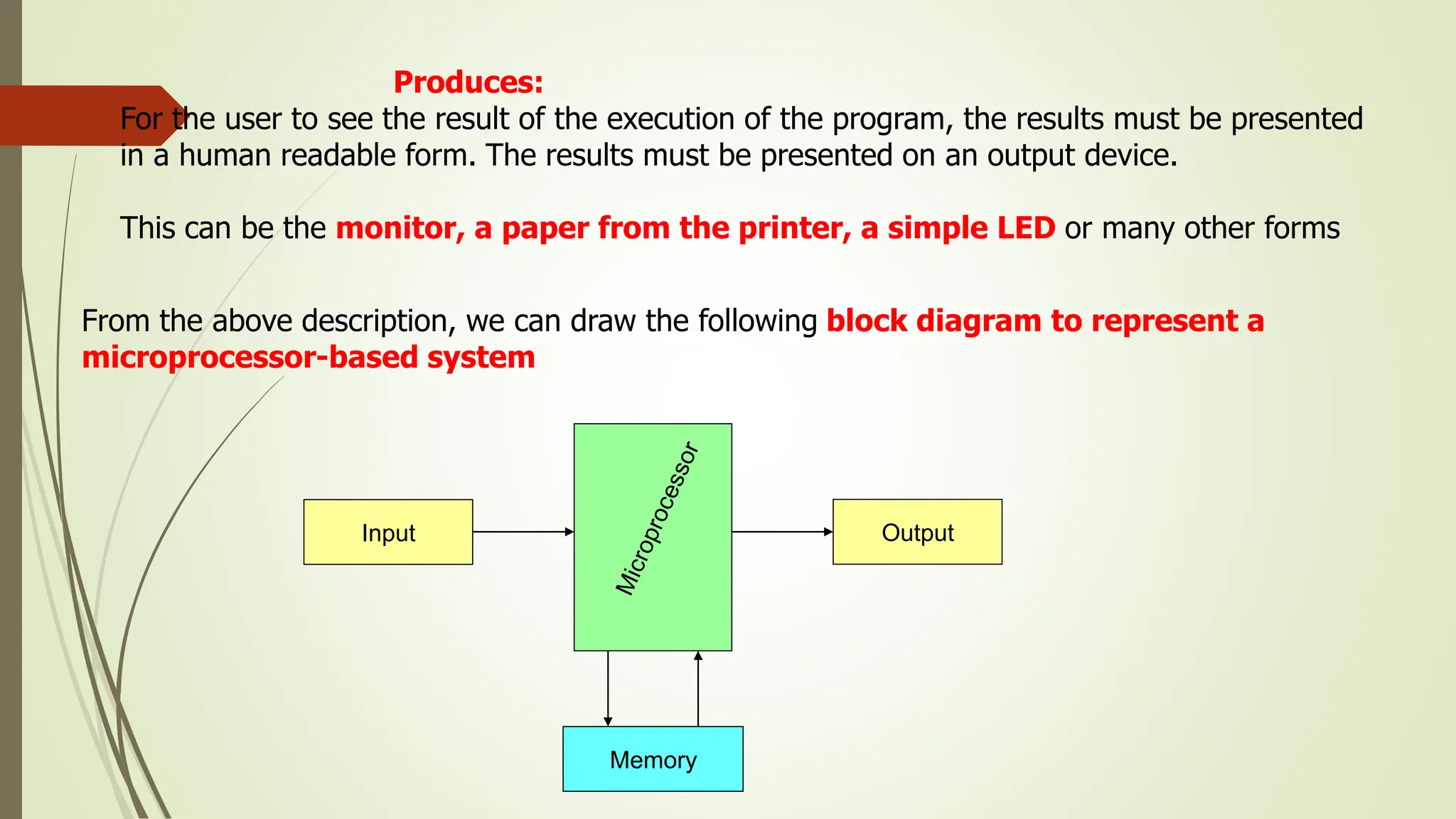
From the above description, we can draw the following block diagram to represent a
microprocessor-based system
Memory
Output
Input
INSIDE THE MICROPROCESSOR.
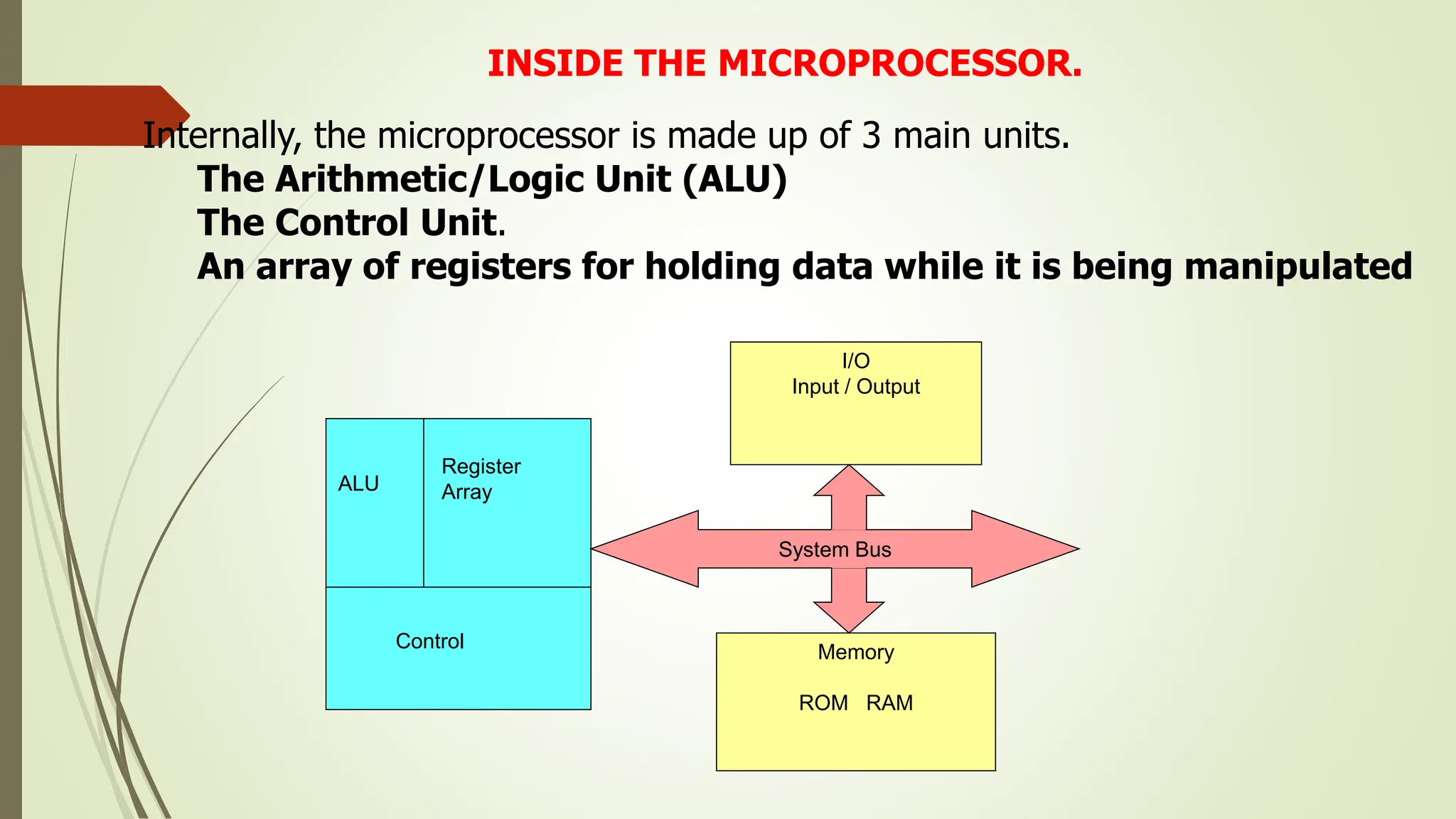
Internally, the microprocessor is made up of 3 main units.
The Arithmetic/Logic Unit (ALU)
The Control Unit.
An array of registers for holding data while it is being manipulated
I/O
Input / Output
Memory
ROM RAM
System Bus
ALU
Register
Array
Control
Organization of the Microprocessor
The microprocessor can be divided into three main pieces:
Arithmetic/Logic Unit
Performs all computing and logic operations such as addition and
subtraction as well as AND, OR and XOR.
Register Array
A collection of registers within the microprocessor itself. These are used
primarily for data storage during program execution. The number and
the size of these registers differ from one microprocessor to the other.
Control Unit
As the name implies, the control Unit controls what is happening in the
microprocessor. It provides the necessary control and timing signals to
all operations in the microprocessor as well as its contact to the outside
world.
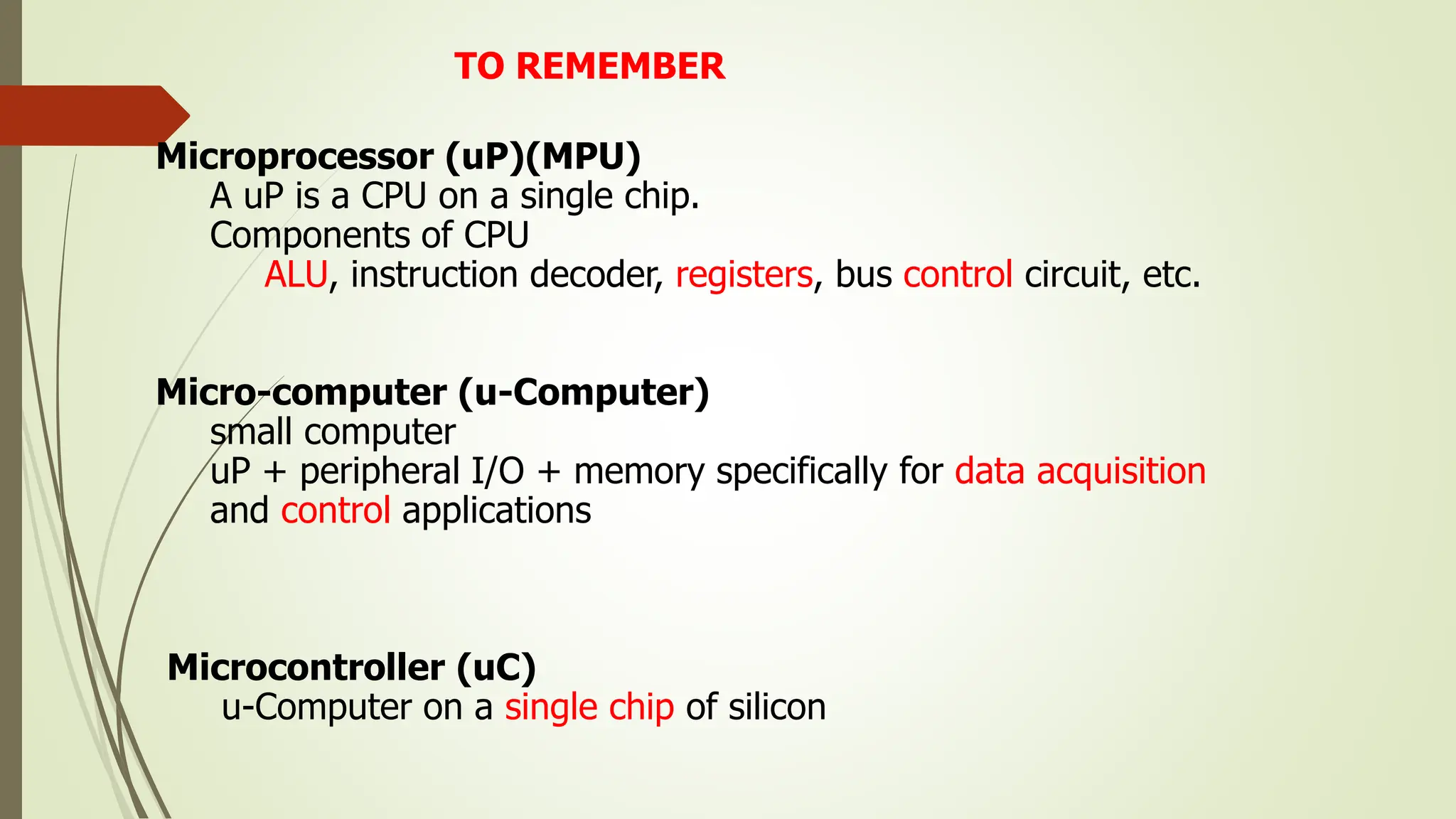
TO REMEMBER
Microprocessor (uP)(MPU)
A uP is a CPU on a single chip.
Components of CPU
ALU, instruction decoder, registers, bus control circuit, etc.
Micro-computer (u-Computer)
small computer
uP + peripheral I/O + memory specifically for data acquisition
and control applications
Microcontroller (uC)
u-Computer on a single chip of silicon
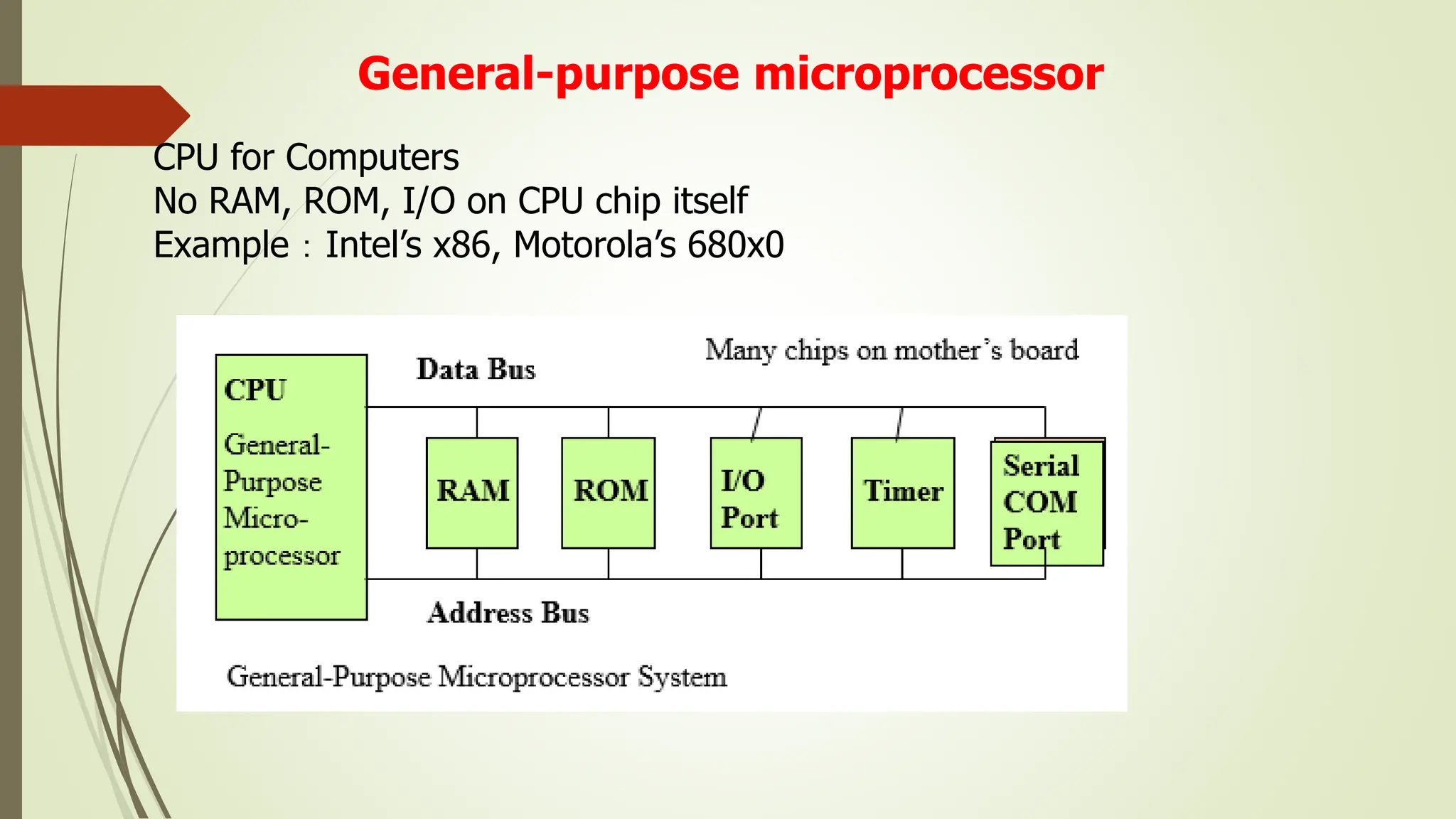
General-purpose microprocessor
CPU for Computers
No RAM, ROM, I/O on CPU chip itself
Example:Intel’s x86, Motorola’s 680x0
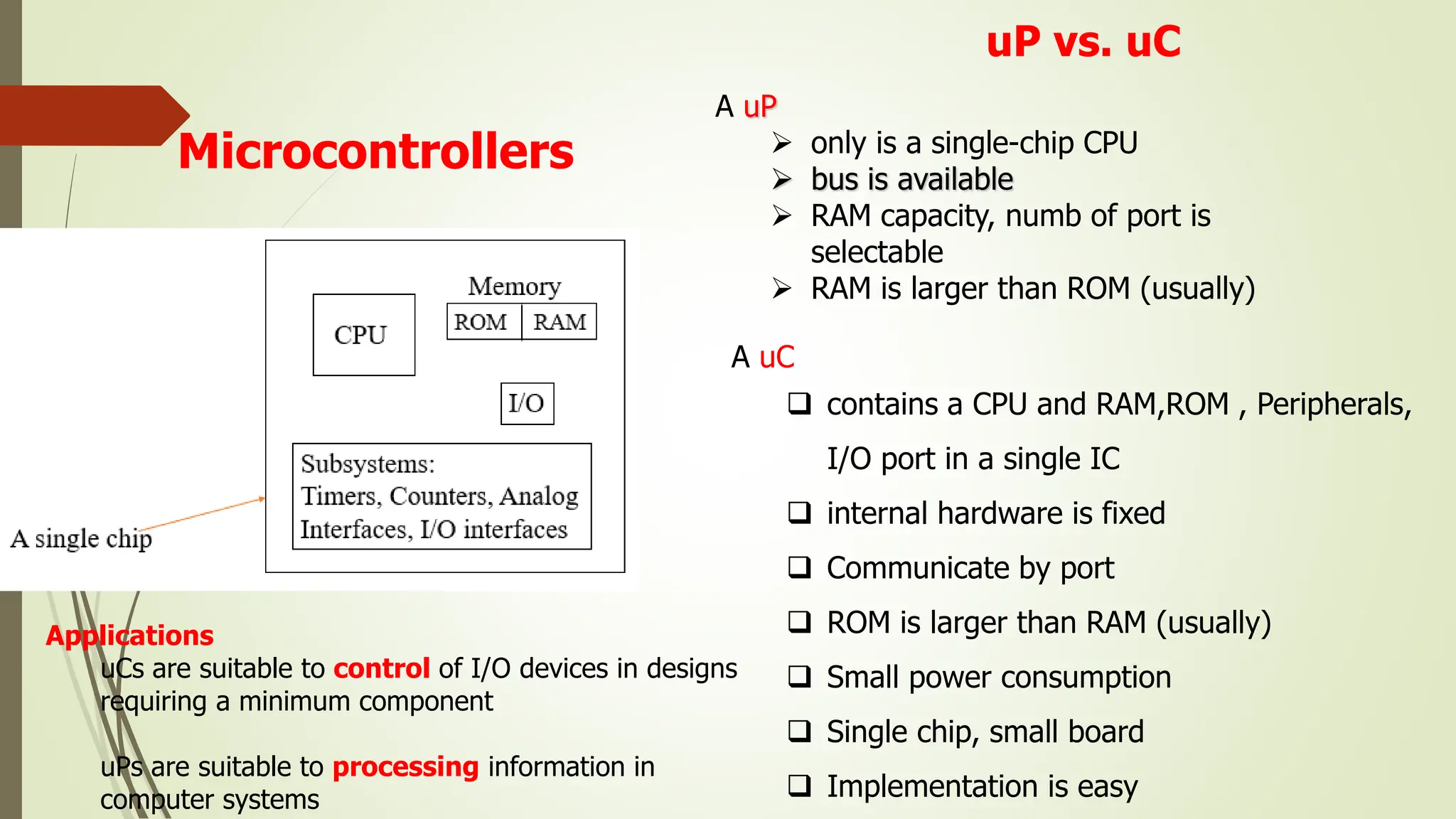
Microcontrollers
uP vs. uC
A uP
 only is a single-chip CPU
 bus is available
 RAM capacity, numb of port is
selectable
 RAM is larger than ROM (usually)
A uC
 contains a CPU and RAM,ROM , Peripherals,
I/O port in a single IC
 internal hardware is fixed
 Communicate by port
 ROM is larger than RAM (usually)
 Small power consumption
 Single chip, small board
 Implementation is easy
Applications
uCs are suitable to control of I/O devices in designs
requiring a minimum component
uPs are suitable to processing information in
computer systems
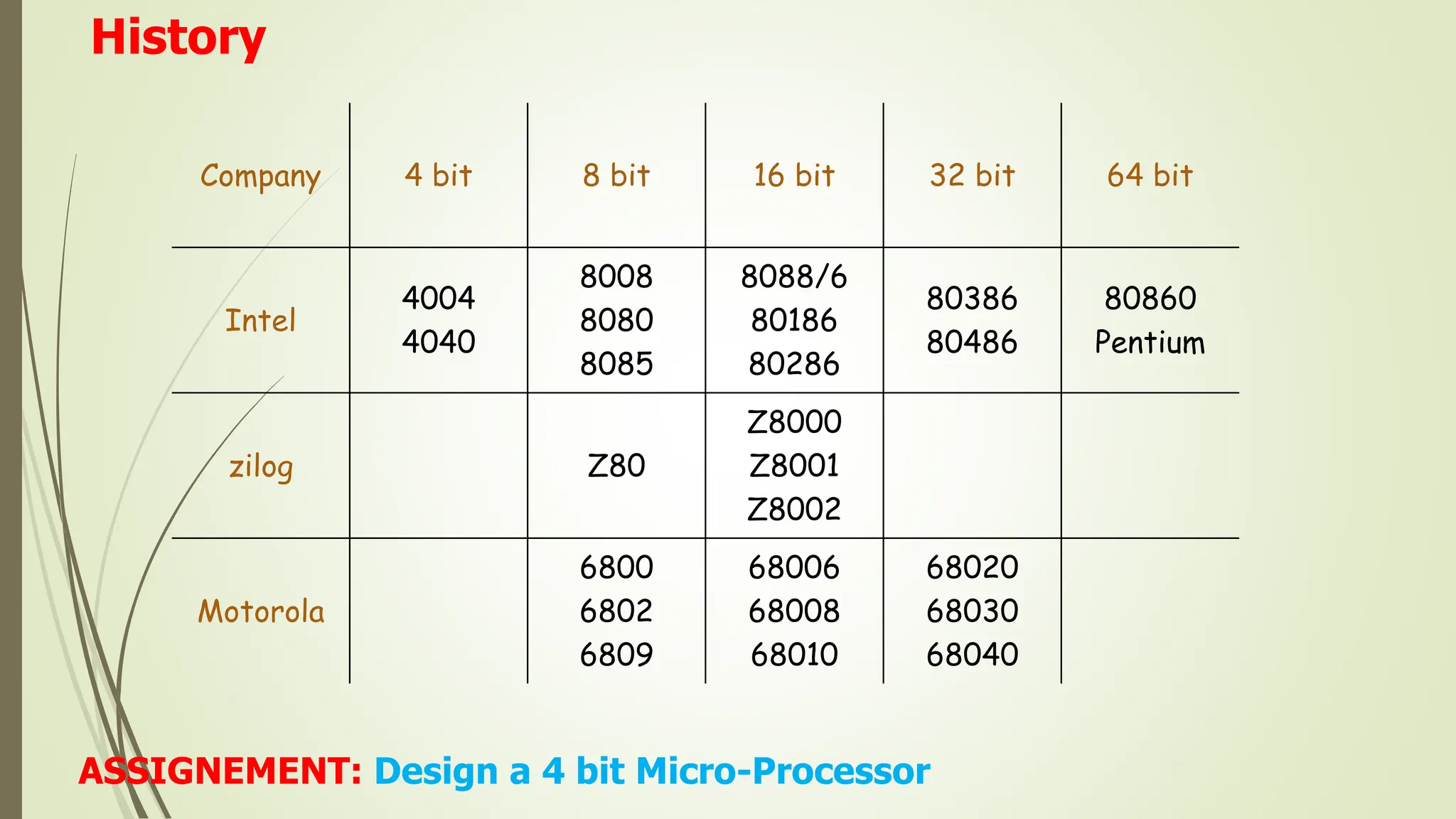
History
Company 4 bit 8 bit 16 bit 32 bit 64 bit
Intel
4004
4040
8008
8080
8085
8088/6
80186
80286
80386
80486
80860
Pentium
zilog Z80
Z8000
Z8001
Z8002
Motorola
6800
6802
6809
68006
68008
68010
68020
68030
68040
ASSIGNEMENT: Design a 4 bit Micro-Processor
IC technology integration and circuit logic families

  • 1.
    IC TECHNOLOGY, INTERGRATION& THE CIRCUIT LOQIC FAMILIES
  • 2.
    The development ofelectronics endless with invention of vaccum tubes and associated electronic circuits. This activity termed as vaccum tube electronics, afterward the evolution of solid state devices and consequent development of integrated circuits (IC) are responsible for the present status of communication, computing and instrumentation THE INTRODUCTION  The first vaccum tube diode was invented by JOHN AMBRASE Fleming in 1904.  The vaccum triode was invented by LEE DE FOREST in 1906. Early developments of the Integrated Circuit (IC) go back to 1949. German engineer Werner Jacobi filed a patent for an IC like semiconductor amplifying device showing five transistors on a common substrate in a 2-stage amplifier arrangement.
  • 3.
    Integrated circuits weremade possible by experimental discoveries which showed that semiconductor devices could perform the functions of vacuum tubes and by mid-20th-century technology advancements in semiconductor device fabrication had already picked momentum. The integration of large numbers of tiny transistors into a small chip was an enormous improvement over the manual assembly of circuits using electronic components. The integrated circuits mass production capability, reliability, and building-block approach to circuit design ensured the rapid adoption of standardized ICs in place of designs using discrete transistors.
  • 4.
    DEFINITION OF ANIC An integrated circuit (IC) is a small semiconductor-based electronic device consisting of fabricated transistors, resistors and capacitors. Integrated circuits are the building blocks of most electronic devices and equipment. An integrated circuit is also known as a chip or microchip.
  • 5.
    ADVANTAGES OF IC’SOVER DISCRETE CIRCUITS There are two main advantages of ICs over discrete circuits:  cost and  performance. Cost is low because the chips, with all their components, are printed as a unit by photolithography rather than being constructed one transistor at a time. Furthermore, much less material is used to construct a packaged IC die than a discrete circuit. Performance is high since the components switch quickly and consume little power (compared to their discrete counterparts) because the components are small and positioned close together.
  • 6.
  • 8.
    Moore’s Law: Gordon E.Moore - Chairman Emeritus of Intel Corporation 1965 - observed trends in industry - of transistors on ICs vs release dates Noticed number of transistors doubling with release of each new IC generation Release dates (separate generations) were all 18-24 months apart “The number of transistors on an integrated circuit will double every 18 months
  • 10.
    Scale of Integration: Small scale integration(SSI) --1960 The technology was developed by integrating the number of transistors of 1-100 on a single chip. Ex: Gates, flip- flops, op-amps.  Medium scale integration(MSI) --1967 This was developed by integrating the number of transistors of 100- 1000 on a single chip. Ex: Counters, MUX, adders, 4-bit microprocessors.  Large scale integration(LSI) --1972 Was developed by integrating the number of transistors of 1000- 10000 on a single chip. Ex:8-bit micro- processors, ROM,RAM.  Very large scale integration(VLSI) -1978 Developed by integrating the number of transistors of 10000- 1Million on a single chip. Ex:16-32 bit microprocessors, peripherals, complimentary high MOS.
  • 11.
    Ultra large scaleintegration(ULSI) Developed by integrating the number of transistors of 1Million- 10 Millions on a single chip. Ex: special purpose processors. Giant scale integration(GSI) Developed by integrating the number of transistors of above 10 Millions on a single chip. Ex: Embedded system, system on chip(SOC).
  • 12.
    With the rapidadvances in technology the size of the ICs is shrinking and the integration density is increasing. The minimum line width of commercial products over the years is shown in the graph below.
  • 13.
    Microprocessors/controllers AS MSI CIRCUITS Themicroprocessor is the core of computer systems. Nowadays many communication, digital entertainment, portable devices, are controlled by them. A designer should know what types of components he needs, ways to reduce production costs and product reliable.
  • 14.
    WHAT IS AMICROPROCESSOR? • The word comes from the combination micro and processor. • In this context processor means a device that processes numbers, specifically binary numbers, 0’s and 1’s. Micro is a new addition. In the late 1960’s, processors were built using discrete elements. These devices performed the required operation, but were too large and too slow. In the early 1970’s the microchip was invented. All of the components that made up the processor were now placed on a single piece of silicon. The size became several thousand times smaller and the speed became several hundred times faster. The “Micro” Processor was born.
  • 15.
    DEFINITION OF AMICROPROCESSOR. The microprocessor is a programmable device that takes in numbers, performs on them arithmetic or logical operations according to the program stored in memory and then produces other numbers as a result. Lets expand each of the underlined words: Programmable device: The microprocessor can perform different sets of operations on the data it receives depending on the sequence of instructions supplied in the given program. By changing the program, the microprocessor manipulates the data in different ways. Instructions: Each microprocessor is designed to execute a specific group of operations. This group of operations is called an instruction set. This instruction set defines what the microprocessor can and cannot do.
  • 16.
    Takes in: Thedata that the microprocessor manipulates must come from somewhere. It comes from what is called “input devices”. These are devices that bring data into the system from the outside world. These represent devices such as a keyboard, a mouse, switches, and the like. Numbers: The microprocessor has a very narrow view on life. It only understands binary numbers. A binary digit is called a bit (which comes from binary digit). The microprocessor recognizes and processes a group of bits together. This group of bits is called a “word”. The number of bits in a Microprocessor’s word, is a measure of its “abilities”.
  • 17.
    Words, Bytes, etc. Theearliest microprocessor (the Intel 8088 and Motorola’s 6800) recognized 8-bit words. They processed information 8-bits at a time. That’s why they are called “8-bit processors”. They can handle large numbers, but in order to process these numbers, they broke them into 8-bit pieces and processed each group of 8-bits separately. Later microprocessors (8086 and 68000) were designed with 16-bit words. A group of 8-bits were referred to as a “half-word” or “byte”. A group of 4 bits is called a “nibble”. Also, 32 bit groups were given the name “long word”. Today, all processors manipulate at least 32 bits at a time and there exists microprocessors that can process 64, 80, 128 bits or more at a time.
  • 18.
    Arithmetic and LogicOperations: Every microprocessor has arithmetic operations such as add and subtract as part of its instruction set. Most microprocessors will have operations such as multiply and divide. Some of the newer ones will have complex operations such as square root. In addition, microprocessors have logic operations as well. Such as AND, OR, XOR, shift left, shift right, etc. Again, the number and types of operations define the microprocessor’s instruction set and depends on the specific microprocessor.
  • 19.
    Program: A programis a sequence of instructions that bring data into the microprocessor, processes it and sends it out. There are many programming languages (C, C++, FORTRAN, and JAVA…) However, these programming languages can be grouped into three main levels (these days a fourth level is developing). Programming Languages Machine language Machine language is the lowest level programming language. It is a language intended to be understood by the microprocessor (the machine) only. In this language, every instruction is described by binary patterns. e.g. 11001101 may mean 1 + 2 This is the form in which instructions are stored in memory. This is the only form that the microprocessor understands.
  • 20.
    Stored in memory: First, what is memory? Memory is the location where information is kept while not in current use. Memory is a collection of storage devices. Usually, each storage device holds one bit. Memory is usually measured by the number of bytes it can hold. It is measured in Kilos, Megas and lately Gigas. A Kilo in computer language is 210 =1024. So, a KB (KiloByte) is 1024 bytes. Mega is 1024 Kilos and Giga is 1024 Mega.
  • 21.
    Produces: For the userto see the result of the execution of the program, the results must be presented in a human readable form. The results must be presented on an output device. This can be the monitor, a paper from the printer, a simple LED or many other forms From the above description, we can draw the following block diagram to represent a microprocessor-based system Memory Output Input
  • 22.
    INSIDE THE MICROPROCESSOR. Internally,the microprocessor is made up of 3 main units. The Arithmetic/Logic Unit (ALU) The Control Unit. An array of registers for holding data while it is being manipulated I/O Input / Output Memory ROM RAM System Bus ALU Register Array Control
  • 23.
    Organization of theMicroprocessor The microprocessor can be divided into three main pieces: Arithmetic/Logic Unit Performs all computing and logic operations such as addition and subtraction as well as AND, OR and XOR. Register Array A collection of registers within the microprocessor itself. These are used primarily for data storage during program execution. The number and the size of these registers differ from one microprocessor to the other. Control Unit As the name implies, the control Unit controls what is happening in the microprocessor. It provides the necessary control and timing signals to all operations in the microprocessor as well as its contact to the outside world.
  • 24.
    TO REMEMBER Microprocessor (uP)(MPU) AuP is a CPU on a single chip. Components of CPU ALU, instruction decoder, registers, bus control circuit, etc. Micro-computer (u-Computer) small computer uP + peripheral I/O + memory specifically for data acquisition and control applications Microcontroller (uC) u-Computer on a single chip of silicon
  • 25.
    General-purpose microprocessor CPU forComputers No RAM, ROM, I/O on CPU chip itself Example:Intel’s x86, Motorola’s 680x0
  • 26.
    Microcontrollers uP vs. uC AuP  only is a single-chip CPU  bus is available  RAM capacity, numb of port is selectable  RAM is larger than ROM (usually) A uC  contains a CPU and RAM,ROM , Peripherals, I/O port in a single IC  internal hardware is fixed  Communicate by port  ROM is larger than RAM (usually)  Small power consumption  Single chip, small board  Implementation is easy Applications uCs are suitable to control of I/O devices in designs requiring a minimum component uPs are suitable to processing information in computer systems
  • 27.
    History Company 4 bit8 bit 16 bit 32 bit 64 bit Intel 4004 4040 8008 8080 8085 8088/6 80186 80286 80386 80486 80860 Pentium zilog Z80 Z8000 Z8001 Z8002 Motorola 6800 6802 6809 68006 68008 68010 68020 68030 68040 ASSIGNEMENT: Design a 4 bit Micro-Processor