
From Battlefield Hospitals to Nazi Labs, One Doctor’s Heroic Search for the World’s First Miracle DrugThe Demon Under the MicroscopeBy Thomas Hager
Courtesy Professor  at the University of OregonRaised in Portland OregonHas earned masters degrees in medical microbiology, immunology, and journalismStarted his career as a communications intern at the National Cancer InstituteHas 100+ articles on medicine and science published in various journals including Reader’s Digest, the Wall Street Journal, and many others.Has given public talks before many meetings and associations such as the American Association for the Advancement of ScienceThomas Hager
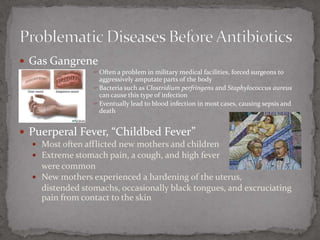
Gas GangreneOften a problem in military medical facilities, forced surgeons to aggressively amputate parts of the bodyBacteria such as Clostridium perfringensand Staphylococcus aureuscan cause this type of infectionEventually lead to blood infection in most cases, causing sepsis and deathPuerperal Fever, “Childbed Fever”Most often afflicted new mothers and childrenExtreme stomach pain, a cough, and high fever 	were commonNew mothers experienced a hardening of the uterus, 	distended stomachs, occasionally black tongues, and excruciating pain from contact to the skinProblematic Diseases Before Antibiotics
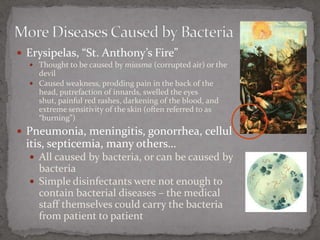
More Diseases Caused by BacteriaErysipelas, “St. Anthony’s Fire”Thought to be caused by miasma (corrupted air) or the devilCaused weakness, prodding pain in the back of the head, putrefaction of innards, swelled the eyes shut, painful red rashes, darkening of the blood, and extreme sensitivity of the skin (often referred to as “burning”)Pneumonia, meningitis, gonorrhea, cellulitis, septicemia, many others…All caused by bacteria, or can be caused by bacteriaSimple disinfectants were not enough to contain bacterial diseases – the medical staff themselves could carry the bacteria from patient to patient
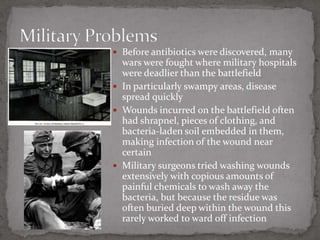
Before antibiotics were discovered, many wars were fought where military hospitals were deadlier than the battlefieldIn particularly swampy areas, disease spread quicklyWounds incurred on the battlefield often had shrapnel, pieces of clothing, and bacteria-laden soil embedded in them, making infection of the wound near certainMilitary surgeons tried washing wounds extensively with copious amounts of painful chemicals to wash away the bacteria, but because the residue was often buried deep within the wound this rarely worked to ward off infectionMilitary Problems
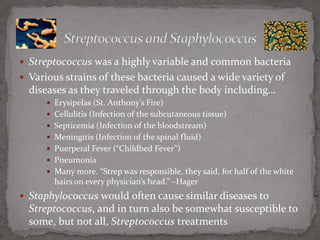
Streptococcus was a highly variable and common bacteriaVarious strains of these bacteria caused a wide variety of diseases as they traveled through the body including…Erysipelas (St. Anthony’s Fire)Cellulitis (Infection of the subcutaneous tissue)Septicemia (Infection of the bloodstream)Meningitis (Infection of the spinal fluid)Puerperal Fever (“Childbed Fever”)PneumoniaMany more. “Strep was responsible, they said, for half of the white hairs on every physician’s head.” –HagerStaphylococcus would often cause similar diseases to Streptococcus, and in turn also be somewhat susceptible to some, but not all, Streptococcus treatmentsStreptococcus and Staphylococcus
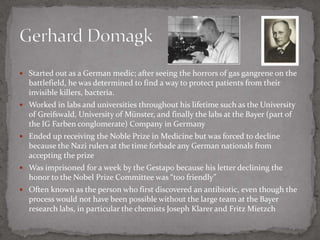
Started out as a German medic; after seeing the horrors of gas gangrene on the battlefield, he was determined to find a way to protect patients from their invisible killers, bacteria.Worked in labs and universities throughout his lifetime such as the University of Greifswald, University of Münster, and finally the labs at the Bayer (part of the IG Farben conglomerate) Company in GermanyEnded up receiving the Noble Prize in Medicine but was forced to decline because the Nazi rulers at the time forbade any German nationals from accepting the prizeWas imprisoned for a week by the Gestapo because his letter declining the honor to the Nobel Prize Committee was “too friendly”Often known as the person who first discovered an antibiotic, even though the process would not have been possible without the large team at the Bayer research labs, in particular the chemists Joseph Klarer and Fritz MietzchGerhard Domagk
Because of its relations with the IG Farben conglomerate (a company infamous for its support of the Nazi ambition), Bayer Labs were under pressure to clear their employee roster of their prize Jewish scientists during the Nazi regimeThe Bayer branch in the United States today is the result of the original founding branch in Germany which expanded rapidly as a result of the sulfa discoveryAt the time of Domagk’s research, Bayerwas well known for its best-selling drug,aspirin, which it is still known for todayThe Bayer Company
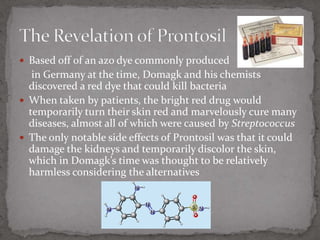
Based off of an azo dye commonly produced in Germany at the time, Domagk and his chemists discovered a red dye that could kill bacteriaWhen taken by patients, the bright red drug would temporarily turn their skin red and marvelously cure many diseases, almost all of which were caused by StreptococcusThe only notable side effects of Prontosil was that it could damage the kidneys and temporarily discolor the skin, which in Domagk’s time was thought to be relatively harmless considering the alternativesThe Revelation of Prontosil
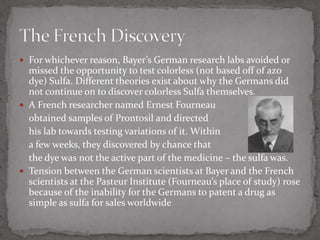
For whichever reason, Bayer’s German research labs avoided or missed the opportunity to test colorless (not based off of azo dye) Sulfa. Different theories exist about why the Germans did not continue on to discover colorless Sulfa themselves.A French researcher named Ernest Fourneauobtained samples of Prontosil and directed 	his lab towards testing variations of it. Within 	a few weeks, they discovered by chance that 	the dye was not the active part of the medicine – the sulfa was.Tension between the German scientists at Bayer and the French scientists at the Pasteur Institute (Fourneau’s place of study) rose because of the inability for the Germans to patent a drug as simple as sulfa for sales worldwideThe French Discovery
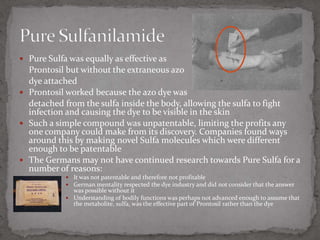
Pure Sulfa was equally as effective as Prontosil but without the extraneous azo	dye attachedProntosil worked because the azo dye was 	detached from the sulfa inside the body, allowing the sulfa to fight infection and causing the dye to be visible in the skinSuch a simple compound was unpatentable, limiting the profits any one company could make from its discovery. Companies found ways around this by making novel Sulfa molecules which were different enough to be patentableThe Germans may not have continued research towards Pure Sulfa for a number of reasons:It was not patentable and therefore not profitableGerman mentality respected the dye industry and did not consider that the answer was possible without itUnderstanding of bodily functions was perhaps not advanced enough to assume that the metabolite, sulfa, was the effective part of Prontosil rather than the dyePure Sulfanilamide
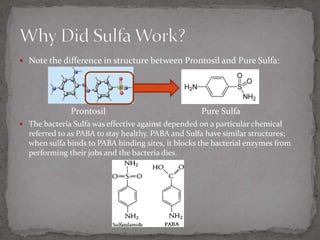
Note the difference in structure between Prontosil and Pure Sulfa:Prontosil			          Pure SulfaThe bacteria Sulfa was effective against depended on a particular chemical referred to as PABA to stay healthy. PABA and Sulfa have similar structures; when sulfa binds to PABA binding sites, it blocks the bacterial enzymes from performing their jobs and the bacteria dies.Why Did Sulfa Work?
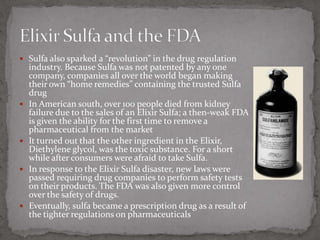
Sulfa also sparked a “revolution” in the drug regulation industry. Because Sulfa was not patented by any one company, companies all over the world began making their own “home remedies” containing the trusted Sulfa drugIn American south, over 100 people died from kidney failure due to the sales of an Elixir Sulfa; a then-weak FDA is given the ability for the first time to remove a pharmaceutical from the marketIt turned out that the other ingredient in the Elixir, Diethylene glycol, was the toxic substance. For a short while after consumers were afraid to take Sulfa.In response to the Elixir Sulfa disaster, new laws were passed requiring drug companies to perform safety tests on their products. The FDA was also given more control over the safety of drugs.Eventually, sulfa became a prescription drug as a result of the tighter regulations on pharmaceuticalsElixir Sulfa and the FDA
http://thomashager.net/m.medlineplus.govhttp://betterlivingwithherbs.com/witches%E2%80%99-brews-st-anthony%E2%80%99s-fire/http://qwickstep.com/search/streptococcus-pyogenes-a.htmlhttp://www.semp.us/publications/biot_reader.php?BiotID=641http://www.ww2incolor.com/dramatic/young-german-soldier-teen.jpg.htmlhttp://www.volksapotheke.ch/2010/Meilensteine%20der%20Pharmazie/PenicillinFleming.htmlhttp://www.potshot.ca/pm/index.php?n=EmployeeOfTheMonthDr.Mengelehttp://www.wackypackages.org/realproductsscans/bayer.htmlhttp://microbewiki.kenyon.edu/index.php/Dental_Caries_Prevention_by_Camellia_sinensishttp://geneura.ugr.es/~jmerelo/atalaya/print.cgi?id=/historias/58925=Ciencia%2015http://commons.wikimedia.org/wiki/File:Prontosil.pnghttp://www.pasteur.fr/infosci/archives/fur0.htmlhttp://med-dept.com/sulfa.php#sulfahttp://chemistry.about.com/od/factsstructures/ig/Chemical-Structures---S/Sulfanilamide.htmhttp://textbookofbacteriology.net/themicrobialworld/control.htmlhttp://www.dailykos.com/story/2010/1/17/826061/-How-regulation-came-to-bePower-of-One:-Frances-Oldham-KelseyReferences

The demon under the microscope

  • 1.
    From Battlefield Hospitalsto Nazi Labs, One Doctor’s Heroic Search for the World’s First Miracle DrugThe Demon Under the MicroscopeBy Thomas Hager
  • 2.
    Courtesy Professor at the University of OregonRaised in Portland OregonHas earned masters degrees in medical microbiology, immunology, and journalismStarted his career as a communications intern at the National Cancer InstituteHas 100+ articles on medicine and science published in various journals including Reader’s Digest, the Wall Street Journal, and many others.Has given public talks before many meetings and associations such as the American Association for the Advancement of ScienceThomas Hager
  • 3.
    Gas GangreneOften aproblem in military medical facilities, forced surgeons to aggressively amputate parts of the bodyBacteria such as Clostridium perfringensand Staphylococcus aureuscan cause this type of infectionEventually lead to blood infection in most cases, causing sepsis and deathPuerperal Fever, “Childbed Fever”Most often afflicted new mothers and childrenExtreme stomach pain, a cough, and high fever were commonNew mothers experienced a hardening of the uterus, distended stomachs, occasionally black tongues, and excruciating pain from contact to the skinProblematic Diseases Before Antibiotics
  • 4.
    More Diseases Causedby BacteriaErysipelas, “St. Anthony’s Fire”Thought to be caused by miasma (corrupted air) or the devilCaused weakness, prodding pain in the back of the head, putrefaction of innards, swelled the eyes shut, painful red rashes, darkening of the blood, and extreme sensitivity of the skin (often referred to as “burning”)Pneumonia, meningitis, gonorrhea, cellulitis, septicemia, many others…All caused by bacteria, or can be caused by bacteriaSimple disinfectants were not enough to contain bacterial diseases – the medical staff themselves could carry the bacteria from patient to patient
  • 5.
    Before antibiotics werediscovered, many wars were fought where military hospitals were deadlier than the battlefieldIn particularly swampy areas, disease spread quicklyWounds incurred on the battlefield often had shrapnel, pieces of clothing, and bacteria-laden soil embedded in them, making infection of the wound near certainMilitary surgeons tried washing wounds extensively with copious amounts of painful chemicals to wash away the bacteria, but because the residue was often buried deep within the wound this rarely worked to ward off infectionMilitary Problems
  • 6.
    Streptococcus was ahighly variable and common bacteriaVarious strains of these bacteria caused a wide variety of diseases as they traveled through the body including…Erysipelas (St. Anthony’s Fire)Cellulitis (Infection of the subcutaneous tissue)Septicemia (Infection of the bloodstream)Meningitis (Infection of the spinal fluid)Puerperal Fever (“Childbed Fever”)PneumoniaMany more. “Strep was responsible, they said, for half of the white hairs on every physician’s head.” –HagerStaphylococcus would often cause similar diseases to Streptococcus, and in turn also be somewhat susceptible to some, but not all, Streptococcus treatmentsStreptococcus and Staphylococcus
  • 7.
    Started out asa German medic; after seeing the horrors of gas gangrene on the battlefield, he was determined to find a way to protect patients from their invisible killers, bacteria.Worked in labs and universities throughout his lifetime such as the University of Greifswald, University of Münster, and finally the labs at the Bayer (part of the IG Farben conglomerate) Company in GermanyEnded up receiving the Noble Prize in Medicine but was forced to decline because the Nazi rulers at the time forbade any German nationals from accepting the prizeWas imprisoned for a week by the Gestapo because his letter declining the honor to the Nobel Prize Committee was “too friendly”Often known as the person who first discovered an antibiotic, even though the process would not have been possible without the large team at the Bayer research labs, in particular the chemists Joseph Klarer and Fritz MietzchGerhard Domagk
  • 8.
    Because of itsrelations with the IG Farben conglomerate (a company infamous for its support of the Nazi ambition), Bayer Labs were under pressure to clear their employee roster of their prize Jewish scientists during the Nazi regimeThe Bayer branch in the United States today is the result of the original founding branch in Germany which expanded rapidly as a result of the sulfa discoveryAt the time of Domagk’s research, Bayerwas well known for its best-selling drug,aspirin, which it is still known for todayThe Bayer Company
  • 9.
    Based off ofan azo dye commonly produced in Germany at the time, Domagk and his chemists discovered a red dye that could kill bacteriaWhen taken by patients, the bright red drug would temporarily turn their skin red and marvelously cure many diseases, almost all of which were caused by StreptococcusThe only notable side effects of Prontosil was that it could damage the kidneys and temporarily discolor the skin, which in Domagk’s time was thought to be relatively harmless considering the alternativesThe Revelation of Prontosil
  • 10.
    For whichever reason,Bayer’s German research labs avoided or missed the opportunity to test colorless (not based off of azo dye) Sulfa. Different theories exist about why the Germans did not continue on to discover colorless Sulfa themselves.A French researcher named Ernest Fourneauobtained samples of Prontosil and directed his lab towards testing variations of it. Within a few weeks, they discovered by chance that the dye was not the active part of the medicine – the sulfa was.Tension between the German scientists at Bayer and the French scientists at the Pasteur Institute (Fourneau’s place of study) rose because of the inability for the Germans to patent a drug as simple as sulfa for sales worldwideThe French Discovery
  • 11.
    Pure Sulfa wasequally as effective as Prontosil but without the extraneous azo dye attachedProntosil worked because the azo dye was detached from the sulfa inside the body, allowing the sulfa to fight infection and causing the dye to be visible in the skinSuch a simple compound was unpatentable, limiting the profits any one company could make from its discovery. Companies found ways around this by making novel Sulfa molecules which were different enough to be patentableThe Germans may not have continued research towards Pure Sulfa for a number of reasons:It was not patentable and therefore not profitableGerman mentality respected the dye industry and did not consider that the answer was possible without itUnderstanding of bodily functions was perhaps not advanced enough to assume that the metabolite, sulfa, was the effective part of Prontosil rather than the dyePure Sulfanilamide
  • 12.
    Note the differencein structure between Prontosil and Pure Sulfa:Prontosil Pure SulfaThe bacteria Sulfa was effective against depended on a particular chemical referred to as PABA to stay healthy. PABA and Sulfa have similar structures; when sulfa binds to PABA binding sites, it blocks the bacterial enzymes from performing their jobs and the bacteria dies.Why Did Sulfa Work?
  • 13.
    Sulfa also sparkeda “revolution” in the drug regulation industry. Because Sulfa was not patented by any one company, companies all over the world began making their own “home remedies” containing the trusted Sulfa drugIn American south, over 100 people died from kidney failure due to the sales of an Elixir Sulfa; a then-weak FDA is given the ability for the first time to remove a pharmaceutical from the marketIt turned out that the other ingredient in the Elixir, Diethylene glycol, was the toxic substance. For a short while after consumers were afraid to take Sulfa.In response to the Elixir Sulfa disaster, new laws were passed requiring drug companies to perform safety tests on their products. The FDA was also given more control over the safety of drugs.Eventually, sulfa became a prescription drug as a result of the tighter regulations on pharmaceuticalsElixir Sulfa and the FDA
  • 14.
    http://thomashager.net/m.medlineplus.govhttp://betterlivingwithherbs.com/witches%E2%80%99-brews-st-anthony%E2%80%99s-fire/http://qwickstep.com/search/streptococcus-pyogenes-a.htmlhttp://www.semp.us/publications/biot_reader.php?BiotID=641http://www.ww2incolor.com/dramatic/young-german-soldier-teen.jpg.htmlhttp://www.volksapotheke.ch/2010/Meilensteine%20der%20Pharmazie/PenicillinFleming.htmlhttp://www.potshot.ca/pm/index.php?n=EmployeeOfTheMonthDr.Mengelehttp://www.wackypackages.org/realproductsscans/bayer.htmlhttp://microbewiki.kenyon.edu/index.php/Dental_Caries_Prevention_by_Camellia_sinensishttp://geneura.ugr.es/~jmerelo/atalaya/print.cgi?id=/historias/58925=Ciencia%2015http://commons.wikimedia.org/wiki/File:Prontosil.pnghttp://www.pasteur.fr/infosci/archives/fur0.htmlhttp://med-dept.com/sulfa.php#sulfahttp://chemistry.about.com/od/factsstructures/ig/Chemical-Structures---S/Sulfanilamide.htmhttp://textbookofbacteriology.net/themicrobialworld/control.htmlhttp://www.dailykos.com/story/2010/1/17/826061/-How-regulation-came-to-bePower-of-One:-Frances-Oldham-KelseyReferences