


TABLE OF CONTENTS
Part One: Introduction to Lead Generation
	 Chapter One: What is Lead Generation and Why is it Important?
	 Chapter Two: How Has Lead Generation Evolved?
	 Chapter Three: Defining a Lead
Part Two: Lead Generation Tactics
Chapter Four: Content Marketing and Blogging
Chapter Five: Website and SEO
Chapter Six: Landing Pages
Chapter Seven: Social Media and Lead Generation
Chapter Eight: Email Marketing
Chapter Nine: Paid Programs
Chapter Ten: Telephone-Based Lead Generation
Chapter Eleven: Middle-of-Funnel Lead Generation
Part Three: Optimize and Measure Your Lead Generation
Chapter Twelve: Testing and Optimization
Chapter Thirteen: Metrics
Chapter Fourteen: Lead Generation Technology
Conclusion: Lead the Way!
Appendix: References
03
04
07
11
19
20
31
56
62
83
94
114
119
132
133
140
151
156
157
PART ONE:
INTRODUCTION TO LEAD GENERATION
CHAPTER ONE:
WHAT IS LEAD GENERATION AND
WHY IS IT IMPORTANT?
5
CHAPTER ONE: WHAT IS LEAD GENERATION AND WHY IS IT IMPORTANT?
LEAD GENERATION DEFINED
Lead generation describes the marketing process of stimulating and capturing interest in a product or
service for the purpose of developing sales pipeline.
In today’s complex marketing
climate, lead generation has
become a popular strategy to
help create demand and get your
marketing messages heard
across multiple channels. Lead
generation helps your company
increase brand awareness, build
relationships, generate qualified
leads, and ultimately close deals.
Through the various lead generation
tactics mentioned in this guide, a
company can collect the contact
information of potential targets in
order to nurture them to eventually
become customers. Lead generation
is useful for all types of businesses,
both small and large, and in both
B2B and B2C companies—such as
financial services, healthcare, and
automotive organizations.
Lead generation strategies that are
discussed in this guide include:
•	Content marketing and blogging
•	Website and SEO
•	Social media
•	Pay-Per-Click (PPC) advertising
•	Content syndication
•	Direct mail
•	Telesales
•	Email marketing
•	Lead nurturing and lead scoring
•	Testing and optimization
•	Lead generation metrics
CHAPTER ONE: WHAT IS LEAD GENERATION AND WHY IS IT IMPORTANT?
WHY IS LEAD GENERATION IMPORTANT?
If you can generate quality leads for sales, you make their job easier—and more of your leads will be
turned into revenue faster.
Just because someone
downloaded a whitepaper
doesn’t mean he or she wants to
talk to a sales rep. You don’t
want your sales teams wasting
time cold calling from a list of
unqualified leads. Simply put,
cold calling doesn’t work in
today’s world of information
abundance. You want your sales
team closing deals and spending
time actively selling, instead of
wasting time calling
down a list of cold leads.
Lead generation can help your sales
teams spend more time selling and
less time with administrative tasks
and prospecting, because you are
giving them warm, well qualified
leads. In fact, according to a recent
benchmark study by Marketo,
companies with mature lead
generation practices achieve better
sales productivity and higher
revenue growth.
Mature companies achieve 133%
greater revenue versus their plan
than average companies, and 174%
more than the least mature
companies. Additionally, sales reps
at mature companies spend 73% of
their time selling (rather than on
administrative tasks, training, etc.).
At companies without mature lead
generation strategies, sales reps
spend only 57% of their time selling.
If you can generate more leads for your
sales team, not only are you helping
your company grow, but you are also
helping marketing’s credibility. You are
no longer seen as a cost center, but as
a viable part of the revenue team.
CHAPTER TWO:
HOW HAS LEAD
GENERATION EVOLVED?
8
CHAPTER TWO: HOW HAS LEAD GENERATION EVOLVED?
TRANSFORMATION OF
LEAD GENERATION
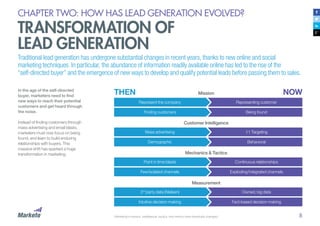
Traditional lead generation has undergone substantial changes in recent years, thanks to new online and social
marketing techniques. In particular, the abundance of information readily available online has led to the rise of the
“self-directed buyer” and the emergence of new ways to develop and qualify potential leads before passing them to sales.
In the age of the self-directed
buyer, marketers need to find
new ways to reach their potential
customers and get heard through
the noise.
Instead of finding customers through
mass advertising and email blasts,
marketers must now focus on being
found, and learn to build enduring
relationships with buyers. This
massive shift has sparked a huge
transformation in marketing.
Represent the company
Mass advertising
Point in time blasts
3rd
party data (Nielsen)
Representing customer
1:1 Targeting
Continuous relationships
Owned, big data
Finding customers
Demographic
Few/isolated channels
Intuitive decision making
Being found
Behavioral
Exploding/integrated channels
Fact-based decision making
Mission
Customer Intelligence
Mechanics & Tactics
Measurement
Marketing’s mission, intelligence, tactics, and metrics have drastically changed.
THEN NOW
9
CHAPTER TWO: HOW HAS LEAD GENERATION EVOLVED?
TRANSFORMATION OF
LEAD GENERATION
Information Abundance
and Attention Economics
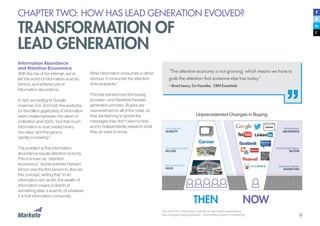
With the rise of the internet, we’ve
left the world of information scarcity
behind, and entered one of
information abundance.
In fact, according to Google
chairman Eric Schmidt, five exabytes
(or five billion gigabytes) of information
were created between the dawn of
civilization and 2003, “but that much
information is now created every
two days, and the pace is
rapidly increasing.”
The problem is that information
abundance equals attention scarcity.
This is known as “attention
economics”. Social scientist Herbert
Simon was the first person to discuss
this concept, writing that “in an
information-rich world, the wealth of
information means a dearth of
something else: a scarcity of whatever
it is that information consumes.
What information consumes is rather
obvious: it consumes the attention
of its recipients.”
This has transformed the buying
process—and therefore the lead
generation process. Buyers are
overwhelmed by all of the noise, so
they are learning to ignore the
messages they don’t want to hear,
and to independently research what
they do want to know.
“The attention economy is not growing, which means we have to
grab the attention that someone else has today.”
– Brent Leary, Co-Founder, CRM Essentials
The shift from information scarcity to information abundance
has changed buying behavior – and shifted power to marketing.
THEN NOW
Unprecedented Changes in Buying
10
CHAPTER TWO: HOW HAS LEAD GENERATION EVOLVED?
TRANSFORMATION OF
LEAD GENERATION
The New Buying Process
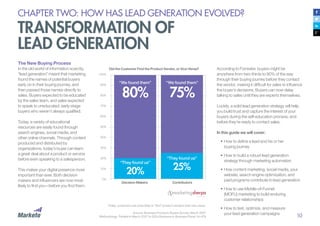
In the old world of information scarcity,
“lead generation” meant that marketing
found the names of potential buyers
early on in their buying journey, and
then passed those names directly to
sales. Buyers expected to be educated
by the sales team, and sales expected
to speak to uneducated, early-stage
buyers who weren’t always qualified.
Today, a variety of educational
resources are easily found through
search engines, social media, and
other online channels. Through content
produced and distributed by
organizations, today’s buyer can learn
a great deal about a product or service
before even speaking to a salesperson.
This makes your digital presence more
important than ever. Both decision
makers and influencers are now most
likely to find you—before you find them.
100%
90%
80%
70%
60%
50%
40%
30%
20%
10%
0%
Today, customers are more likely to “find” product vendors than vice-versa.
Source: Business Products Buyers Survey, March 2007
Methodology: Fielded in March 2007 to SSI’s Business to Business Panel. N=478
“We found them”
80%
“They found us”
20%
“They found us”
25%
“We found them”
75%
Decision Makers
Did the Customer Find the Product Vendor, or Vice-Versa?
Contributors
According to Forrester, buyers might be
anywhere from two-thirds to 90% of the way
through their buying journey before they contact
the vendor, making it difficult for sales to influence
the buyer’s decisions. Buyers can now delay
talking to sales until they are experts themselves.
Luckily, a solid lead generation strategy will help
you build trust and capture the interest of your
buyers during the self-education process, and
before they’re ready to contact sales.
In this guide we will cover:
•	How to define a lead and his or her
buying journey
•	How to build a robust lead generation
strategy through marketing automation
•	How content marketing, social media, your
website, search engine optimization, and
paid programs contribute to lead generation
•	How to use Middle-of-Funnel
(MOFU) marketing to build enduring
customer relationships
•	How to test, optimize, and measure
your lead generation campaigns
CHAPTER THREE:
DEFINING A LEAD
12
CHAPTER THREE: DEFINING A LEAD
WHAT IS A LEAD?
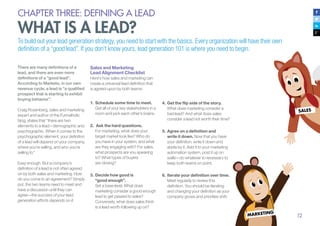
To build out your lead generation strategy, you need to start with the basics. Every organization will have their own
definition of a “good lead”. If you don’t know yours, lead generation 101 is where you need to begin.
There are many definitions of a
lead, and there are even more
definitions of a “good lead”.
According to Marketo, in our own
revenue cycle, a lead is “a qualified
prospect that is starting to exhibit
buying behavior”.
Craig Rosenberg, sales and marketing
expert and author of the Funnelholic
blog, states that “there are two
elements to a lead—demographic and
psychographic. When it comes to the
psychographic element, your definition
of a lead will depend on your company,
where you’re selling, and who you’re
selling to.”
Easy enough. But a company’s
definition of a lead is not often agreed
on by both sales and marketing. How
do you come to an agreement? Simply
put, the two teams need to meet and
have a discussion until they can
agree—the success of your lead
generation efforts depends on it.
Sales and Marketing
Lead Alignment Checklist
Here’s how sales and marketing can
create a universal lead definition that
is agreed upon by both teams:
1.	Schedule some time to meet.
Get all of your key stakeholders in a
room and pick each other’s brains.
2.	 Ask the hard questions.
For marketing, what does your
target market look like? Who do
you have in your system, and what
are they engaging with? For sales,
what prospects are you speaking
to? What types of buyers
are closing?
3.	Decide how good is
“good enough”.
Set a base level. What does
marketing consider a good enough
lead to get passed to sales?
Conversely, what does sales think
is a lead worth following up on?
4.	Get the flip side of the story.
What does marketing consider a
bad lead? And what does sales
consider a lead not worth their time?
5.	Agree on a definition and
write it down. Now that you have
your definition, write it down and
abide by it. Add it to your marketing
automation system, post it up on
walls—do whatever is necessary to
keep both teams on point.
6.	Iterate your definition over time.
Meet regularly to review this
definition. You should be iterating
and changing your definition as your
company grows and priorities shift.
CHAPTER THREE: DEFINING A LEAD
WHAT IS A LEAD?
Demographics
When profiling your leads, you
need to look at demographics—
quantifiable identifiers which
characterize your lead population.
Typical demographic attributes for
both B2C and B2B can consist of
the following:
•	Gender
•	Title
•	Company
•	Years of experience
•	Personal email vs.
corporate email
•	Education (B2C)
•	Age (B2C)
•	Income (B2C)
Firmograhics
Firmogaphics, which are used as
criteria by B2B companies, are
organizational characteristics which
help you find your ideal customer
organization, e.g.:
•	Name of company
•	Company size
•	Company location
•	Revenue
•	Number of divisions
•	Number of products/services sold
•	Geographic markets served
•	Industry
•	Products already owned
BANT
You can also often determine a
prospect’s place in the buying
process by analyzing his or her BANT
(Budget, Authority, Need, and
Timeline) attributes. BANT is a more
advanced lead qualification practice
than demographic and firmographic
analysis alone.
•	Budget: Can this lead afford your
product or service?
•	Authority: Does your lead have
the authority to purchase your
product? Is he or she the decision
maker?
•	Need: Your lead has to need your
product or service. Is there a pain
that your product or service can
solve?
•	Time: What is your lead’s
purchasing timeframe? And does
that align with your sales cycle?
14
CHAPTER THREE: DEFINING A LEAD
WHAT IS A LEAD?
Lead Handoff
Just as sales and marketing must
agree on the definition of a lead, they
must also agree on lead handoff—
when that lead gets sent to sales.
This ensures a seamless transition
from marketing to sales, and
immediate follow-up on hot leads.
Lead Stage Definition
To agree on lead handoff
qualifications, your sales and
marketing teams must define
together the two main categories of
lead stages: Marketing Qualified
Leads (MQLs) and Sales Qualified
Leads (SQLs).
•		Marketing Qualified Leads
(MQLs): These prospects are
considered viable marketing
leads, taking implicit scoring
criteria, explicit scoring criteria,
and (if available) BANT (Budget,
Authority, Need, and Timeline)
into consideration.
Sales Notifications
Once a lead hits a certain score
threshold in your marketing
automation tool, your lead becomes
an MQL and your inside sales lead
qualification team should be notified
to make contact. Because marketing
automation tools sync with many
customer relationships management
tools (CRMs), this data can be
transferred directly into the lead
record in a CRM.
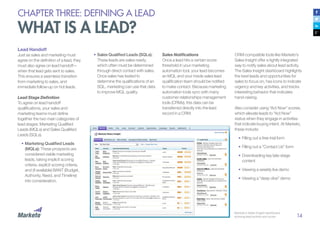
CRM-compatible tools like Marketo’s
Sales Insight offer a tightly integrated
way to notify sales about lead activity.
The Sales Insight dashboard highlights
the best leads and opportunities for
sales to focus on, has icons to indicate
urgency and key activities, and tracks
interesting behavior that indicates
hand-raising.
Also consider using “Act Now” scores,
which elevate leads to “Act Now”
status when they engage in activities
that indicate buying intent. At Marketo,
these include:
•	Filling out a free trial form
•	Filling out a “Contact Us” form
•	Downloading key late-stage
content
•	Viewing a weekly live demo
•	Viewing a “deep dive” demo
Marketo’s Sales Insight dashboard,
showing lead activity and score.
•	Sales Qualified Leads (SQLs):
These leads are sales-ready,
which often must be determined
through direct contact with sales.
Once sales has tested to
determine the qualifications of an
SQL, marketing can use that data
to improve MQL quality.
15
DAY 7
DAY 8
DAY 9
If stale, reminder
If stale, reminder cc boss
If stale, alert executives
DAY 0
DAY 1
DAY 2
DAY 3
Notification
If untouched, reminder
If untouched, reminder cc boss
If untouched, alert executives
CHAPTER THREE: DEFINING A LEAD
WHAT IS A LEAD?
Service Level
Agreements (SLAs)
Once you’ve agreed upon the lead
lifecycle and handoff process, how
can you ensure that sales follows
through on your hot leads? At
Marketo, we have implemented
Service Level Agreements (SLAs)
between sales and marketing to
ensure proper follow-up.
SLAs are written agreements
between sales and marketing,
ensuring closed loop lead processing
by indicating specific timeframes for
follow-ups. If a lead is not followed up
on within the indicated timeframe, an
alert is sent to a sales rep’s boss, and
ultimately to the executive team.
A critical element to note:
SLAs only work when sales is
heavily involved in the process and
champions the SLAs internally.
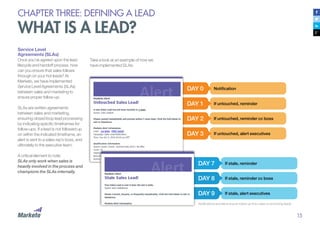
Take a look at an example of how we
have implemented SLAs:
Notifications and alerts ensure follow-up from sales on promising leads.
MKTO: What are your top tips for
sales and marketing alignment?
TB: To truly get serious about sales
and marketing alignment, you have
to measure the leaders of both
teams on the same goal—revenue.
Not all personnel on the marketing
team need be 100% revenue-
focused, but whomever is “large
and in charge” should have the
same compensation plan as the VP
of Sales. Live and die by the revenue
sword, baby!
On the flip side, sales leaders need
to belly up to the bar. Assume that
only 50% of your pipeline (at
maximum) will ever come from
marketing efforts. What’s your
strategy for making up the rest of
that pipeline? Figure it out, get your
reps executing against the strategy,
and stop pointing fingers
at marketing!
ASK THE EXPERTS: WHAT IS A LEAD?
Q&A WITH TRISH BERTUZZI,
PRESIDENT & CHIEF STRATEGIST, THE BRIDGE GROUP
MKTO: How should sales
and marketing agree upon
lead definitions?
TB: This will never happen, but it is
my dream scenario: first, sales and
marketing executives should get
together and create lead definitions.
Next, they should each grab a list of
100 companies and put them
through the qualification
process—I’m not talking about the
reps, here, but the execs themselves.
Then, based on the real world output
they have created, they sit back down
to re-examine their lead definitions.
How awesome would that be?
16
17
CHAPTER THREE: DEFINING A LEAD
MAPPING LEAD GENERATION
STRATEGIES TO YOUR FUNNEL
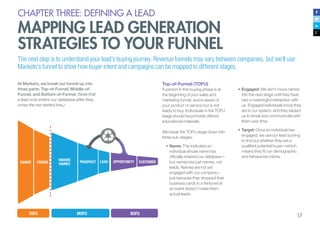
At Marketo, we break our funnel up into
three parts: Top-of-Funnel, Middle-of-
Funnel, and Bottom-of-Funnel. (Note that
a lead only enters our database after they
cross the red dotted line.)
The next step is to understand your lead’s buying journey. Revenue funnels may vary between companies, but we’ll use
Marketo’s funnel to show how buyer intent and campaigns can be mapped to different stages.
Top-of-Funnel (TOFU)
A person in this buying phase is at
the beginning of your sales and
marketing funnel, and is aware of
your product or service but is not
ready to buy. Individuals in the TOFU
stage should be primarily offered
educational materials.
We break the TOFU stage down into
three sub-stages:
•	Name: This indicates an
individual whose name has
officially entered our database—
but names are just names, not
leads. Names are not yet
engaged with our company—
just because they dropped their
business cards in a fishbowl at
an event doesn’t make them
actual leads.
•	Engaged: We don’t move names
into the next stage until they have
had a meaningful interaction with
us. Engaged individuals know they
are in our system, and they expect
us to email and communicate with
them over time.
•	Target: Once an individual has
engaged, we use our lead scoring
to find out whether they are a
qualified potential buyer—which
means they fit our demographic
and behavioral criteria.
CHAPTER THREE: DEFINING A LEAD
MAPPING LEAD GENERATION
STRATEGIES TO YOUR FUNNEL
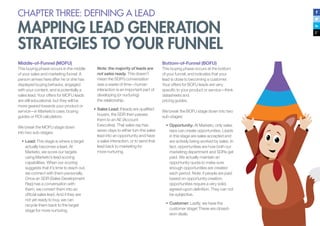
Middle-of-Funnel (MOFU)
This buying phase occurs in the middle
of your sales and marketing funnel. A
person arrives here after he or she has
displayed buying behavior, engaged
with your content, and is potentially a
sales lead. Your offers for MOFU leads
are still educational, but they will be
more geared towards your product or
service—in Marketo’s case, buying
guides or ROI calculators.
We break the MOFU stage down
into two sub-stages:
•	Lead: This stage is where a target
actually becomes a lead. At
Marketo, we score our targets
using Marketo’s lead scoring
capabilities. When our scoring
suggests that it’s time to reach out,
we connect with them personally.
Once an SDR (Sales Development
Rep) has a conversation with
them, we convert them into an
official sales lead. And if they are
not yet ready to buy, we can
recycle them back to the target
stage for more nurturing.
Note: the majority of leads are
not sales ready. This doesn’t
mean the SDR’s conversation
was a waste of time—human
interaction is an important part of
developing (or nurturing)
the relationship.
•	Sales Lead: If leads are qualified
buyers, the SDR then passes
them to an AE (Account
Executive). That sales rep has
seven days to either turn the sales
lead into an opportunity and have
a sales interaction, or to send that
lead back to marketing for
more nurturing.
Bottom-of-Funnel (BOFU)
This buying phase occurs at the bottom
of your funnel, and indicates that your
lead is close to becoming a customer.
Your offers for BOFU leads are very
specific to your product or service—think
datasheets and
pricing guides.
We break the BOFU stage down into two
sub-stages:
•	Opportunity: At Marketo, only sales
reps can create opportunities. Leads
in this stage are sales accepted and
are actively being worked by sales. In
fact, opportunities are how both our
marketing department and SDRs get
paid. We actually maintain an
opportunity quota to make sure
enough opportunities are created
each period. Note: if people are paid
based on opportunity creation,
opportunities require a very solid,
agreed-upon definition. They can not
be subjective.
•	Customer: Lastly, we have the
customer stage! These are closed-
won deals.
PART TWO:
LEAD GENERATION TACTICS
CHAPTER FOUR:
CONTENT MARKETING
21
CHAPTER FOUR: CONTENT MARKETING
WHY IS CONTENT
MARKETING IMPORTANT?
Think of content as the fuel for all of
your marketing campaigns—from
email to social to event collateral.
Marketers have come to rely on
content to engage prospects and
customers in today’s new buyer
landscape. You must create content
that educates, inspires, and begs to be
shared. It should help leads overcome
challenges and achieve their
aspirations. If you are able to do that,
leads will flock to you, and you’ll gain
their trust. Trust is ultimately what
creates customers out of leads.
Content is the foundation of your lead generation efforts. The Content Marketing Institute defines content marketing as
“the marketing technique of creating and distributing relevant and valuable content to attract, acquire, and engage a
clearly defined and understood target audience—with the objective of driving profitable customer action”.
“Customers are now smarter, more
connected, more informed, more influenced
and influential socially, and less likely to
respond to campaign-bait. Marketing has to
create content people actually want.”
– Tim Barker, Chief Product Officer, DataSift
What Form Can My Content Take?
Content is more than just ebooks. It can come in many
forms, so think outside of the box!
•	Articles
•	Blog posts
•	Case studies
•	Cheat sheets
•	Checklists
•	Ebooks
•	Email
•	Infographics
•	Kits
•	Large definitive
guides
•	Podcasts
•	Reference
guides
•	Slideshares
•	Surveys
•	Templates
•	Videos
•	Visual content
•	Webinars
•	Whitepapers
•	Workbooks
CHAPTER FOUR: CONTENT MARKETING
WHY IS CONTENT
MARKETING IMPORTANT?
When used effectively, content
marketing can:
•	Shape a brand preference and
influence future purchases
•	Generate social media shares and
inbound links
•	Put customers in the driver’s seat
•	Help fuel search engine
optimization (SEO) efforts
•	Increase brand awareness
•	Generate quality leads for less
money (when compared to more
traditional marketing)
Ask the Experts:
What is the biggest mistake marketers
make in their content marketing strategy?
“A lack of formal business
strategy around content. Right
now, most marketers are
filling content buckets, and
lack a true business objective (such as
revenue, cost savings, or customer loyalty)
behind their content initiatives.
Secondly: patience. Most brands still call
content marketing a campaign, which
implies there is a stop date. Content
marketing is a marathon, not a sprint. We
need to take a longer-term view of how we
communicate with our customers.”
– Joe Pulizzi, Founder, Content Marketing Institute
“The biggest mistake is to
create content that your boss or
client loves, but your customer
doesn’t. If your customer loves
your content, that means it’s meeting the
needs of the people you are trying to reach,
which your boss or client will love by default.
But the inverse isn’t true. If your boss/client
loves it, but the customer hates it...well, who
cares? Ask yourself: What would your content
look like if your customer signed your
paycheck?”
– Ann Handley, Chief Content Officer, Marketing Profs
CHAPTER FOUR: CONTENT MARKETING
THOUGHT LEADERSHIP VS.
PROMOTIONAL CONTENT
Any vendor can publish feature-
focused brochures and other
product-related content. But the
trusted vendors—the ones that
rise above the noise—are those
focused on helping their target
audience. Buyers naturally
gravitate toward these vendors.
At the outset of your content planning, it’s important to make a distinction between promotional content and thought
leadership. Thought leadership demonstrates a deep understanding of your prospects’ and customers’ pain points, and
guides them toward solutions.
At Marketo, we create content that
is simply meant to help people
become better marketers. We also
try to create assets that educate our
audience about marketing
automation as a platform, and how
it can help marketers be more
effective at their jobs. Instead of
constantly pushing sales messages
to our leads, we want to teach
people the benefits of investing in
marketing automation.
So while we are talking about our
core competency—marketing
automation—we are educating our
audience with thought leadership,
rather than pushing our solution.
Content Marketing CTAs
That said, even educational content
should have a strong, clear, call-to-
action (or CTA). What is a CTA? It’s
the part of your marketing message
that should persuade people to act.
Your standard CTA might ask the
reader to subscribe to your blog,
download another ebook, or to sign
up for a demo.
Regardless of what your ask is, your
CTA must:
•	Stand out
•	Clearly define what you want
the lead to do
•	Create urgency
•	Be positioned in a prominent area
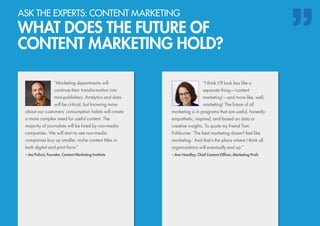
“Marketing departments will
continue their transformation into
mini-publishers. Analytics and data
will be critical, but knowing more
about our customers’ consumption habits will create
a more complex need for useful content. The
majority of journalists will be hired by non-media
companies. We will start to see non-media
companies buy up smaller, niche content titles in
both digital and print form.”
– Joe Pulizzi, Founder, Content Marketing Institute
“I think it’ll look less like a
separate thing—’content
marketing’—and more like, well,
marketing! The future of all
marketing is in programs that are useful, honestly
empathetic, inspired, and based on data or
creative insights. To quote my friend Tom
Fishburne: ‘The best marketing doesn’t feel like
marketing.’ And that’s the place where I think all
organizations will eventually end up.”
– Ann Handley, Chief Content Officer, Marketing Profs
ASK THE EXPERTS: CONTENT MARKETING
WHAT DOES THE FUTURE OF
CONTENT MARKETING HOLD?
CHAPTER FOUR: CONTENT MARKETING
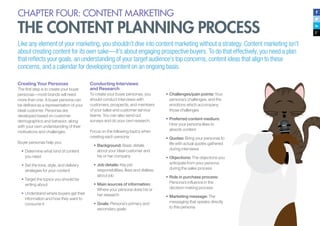
THE CONTENT PLANNING PROCESS
Like any element of your marketing, you shouldn’t dive into content marketing without a strategy. Content marketing isn’t
about creating content for its own sake—it’s about engaging prospective buyers. To do that effectively, you need a plan
that reflects your goals, an understanding of your target audience’s top concerns, content ideas that align to these
concerns, and a calendar for developing content on an ongoing basis.
Creating Your Personas
The first step is to create your buyer
personas—most brands will need
more than one. A buyer persona can
be defined as a representation of your
ideal customer. Personas are
developed based on customer
demographics and behavior, along
with your own understanding of their
motivations and challenges.
Buyer personas help you:
•	Determine what kind of content
you need
•	Set the tone, style, and delivery
strategies for your content
•	Target the topics you should be
writing about
•	Understand where buyers get their
information and how they want to
consume it
Conducting Interviews
and Research
To create your buyer personas, you
should conduct interviews with
customers, prospects, and members
of your sales and customer service
teams. You can also send out
surveys and do your own research.
Focus on the following topics when
creating each persona:
•	Background: Basic details
about your ideal customer and
his or her company
•	Job details: Key job
responsibilities, likes and dislikes
about job
•	Main sources of information:
Where your persona does his or
her research
•	Goals: Persona’s primary and
secondary goals
•	Challenges/pain points: Your
persona’s challenges, and the
emotions which accompany
those challenges
•	Preferred content medium:
How your persona likes to
absorb content
•	Quotes: Bring your personas to
life with actual quotes gathered
during interviews
•	Objections: The objections you
anticipate from your persona
during the sales process
•	Role in purchase process:
Persona’s influence in the
decision making process
•	Marketing message: The
messaging that speaks directly
to this persona
26
CHAPTER FOUR: CONTENT MARKETING
THE CONTENT PLANNING PROCESS
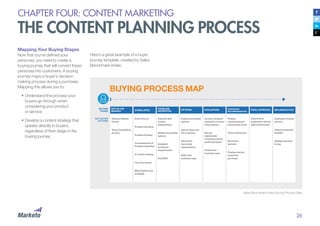
Mapping Your Buying Stages
Now that you’ve defined your
personas, you need to create a
buying journey that will convert these
personas into customers. A buying
journey maps a buyer’s decision
making process during a purchase.
Mapping this allows you to:
•	Understand the process your
buyers go through when
considering your product
or service
•	Develop a content strategy that
speaks directly to buyers,
regardless of their stage in the
buying journey
Here’s a great example of a buyer
journey template, created by Sales
Benchmark Index:
NOT IN THE
MARKET
BUYING
PHASE
KEY BUYER
ACTIONS
Observe Market
Trends
Track Competitive
Activity
Event Occurs
Problem Surfaces
Problem Studied
Consequences of
Problem Identified
Is it worth solving
Can it be solved
What Options are
Available
Indentify and
involve
stakeholders
Research possible
options
Establish
functional
requirements
Draft ROI
Explore promising
options
Narrow down the
list of options
Reconfirm
functional
requirements
Refine the
business case
Conduct detailed
evaluation of short
listed options
Secure
stakeholder
consensus about
preferred option
Finalize the
business case
Finalize
contractual and
commercial terms
Check references
Reconfirm
decision
Finalize internal
request to
purchase
Implement chosen
solution
Achieve expected
benefits
Validate decision
to buy
Submit final
proposal to formal
approval process
PROBLEM
DEFINITION
OPTIONS EVALUATION FINAL APPROVAL IMPLEMENTATIONPREFERRED
RECOMMENDATION
STIMULATED
BUYING PROCESS MAP
Sales Benchmark Index Buying Process Map
27
CHAPTER FOUR: CONTENT MARKETING
THE CONTENT PLANNING PROCESS
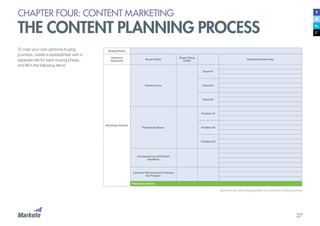
To map your own persona buying
journeys, create a spreadsheet with a
separate tab for each buying phase,
and fill in the following items:
Questions for each buying phase of a persona’s buying journey
Buying Phase
Actions &
Questions
Buyer Action
Buyer Doing
(Y/N)?
Questions Buyer Asks
Key Buyer Actions
Event Occurs
Event #1
Event #2
Event #3
Problem Surfaces
Problem #1
Problem #2
Problem #3
Consequences of Problem
Identified
Consider Alternatives for Solving
the Problem
Phase Exit Criteria
28
CHAPTER FOUR: CONTENT MARKETING
VISUAL CONTENT
As content marketing is more widely used, readers are becoming inundated with text. That’s why visual
content is such an important way to engage. At Marketo, we’ve found that good visual design can make
even “copy-pasta” content stand out.
Make Every Piece Visual
Whenever possible, take your
content to the next level with a visual
element. You don’t have to create
custom illustrations for every ebook—
just think about creating visual
interest, whether it’s with a custom
cover or interior graphics.
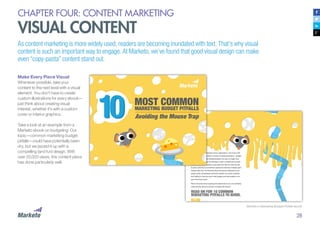
Take a look at an example from a
Marketo ebook on budgeting. Our
topic—common marketing budget
pitfalls—could have potentially been
dry, but we jazzed it up with a
compelling (and fun) design. With
over 20,000 views, this content piece
has done particularly well.
Marketo’s Marketing Budget Pitfalls ebook
29
CHAPTER FOUR: CONTENT MARKETING
VISUAL CONTENT
Repurposing Content
to Make it Visual
For a quick win, repurpose content
you already have into something more
visual. For instance, use content from
an ebook to create an infographic or a
slide deck. You might find that the
visual asset is more shareable and
easier to consume.
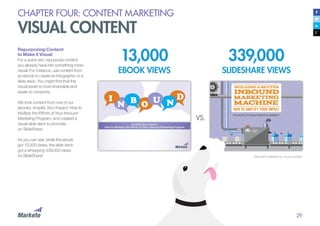
We took content from one of our
ebooks, Amplify Your Impact: How to
Multiply the Efforts of Your Inbound
Marketing Program, and created a
visual slide deck to promote
on SlideShare.
As you can see, while the ebook
got 13,000 views, the slide deck
got a whopping 339,000 views
on SlideShare!
13,000
EBOOK VIEWS
339,000
SLIDESHARE VIEWS
VS.
Standard collateral vs. visual content
30
CHAPTER FOUR: CONTENT MARKETING
COMPANY BLOG
Your blog is a great resource for generating leads. Just remember that someone reading your blog may not want
to immediately sign up for a demo—they may not even know what your product is—so aim for less ambitious
calls-to-action (CTAs). Ask your readers to subscribe to your blog, or to follow you on social channels.
By opening the door to further
conversation, you are taking the
first step towards generating a
quality lead. A well-executed blog
will keep your readers interested,
encourage them to come back for
more, and eventually spark their
curiosity about your company.
The Top 3 “Do’s”
for Starting a Great Blog
Brian Clark, Founder and CEO, Copyblogger
“Don’t focus on having a
great blog. Focus on
producing a blog that’s
great for your readers.”
– Brian Clark
	 Founder and CEO, Copyblogger
1. Do understand who you’re
trying to reach. Start by thinking
in terms of audience archetypes.
This keeps you focused on
quality content, which begins the
sales cycle but doesn’t make the
customer feel “sold” to.
2. Do uniquely position your
content. Think media first, not
marketing. You’re basically creating
a digital magazine, but you’re using
a different business model than
other media companies—you’re
selling your own products and
services, not advertising.
3. Do create an initial content
strategy and editorial calendar.
You’ll naturally adapt and revise
both based on the real-time
feedback you get, but you need
a “best guess” approach based
on your research. And don’t
forget you’ll have to hustle to get
attention until you’ve built an
audience that will spread the
word for you.
CHAPTER FIVE:
WEBSITE AND SEO
32
CHAPTER FIVE: WEBSITE AND SEO
WEBSITE FORMS
When it comes to converting leads and making lasting impressions, your website is where the magic happens.
KISSmetrics, an analytics and
testing company, puts it best on
their blog: “Your leads are only as
good as the website that
produces them”.
They also provided these two
compelling stats:
•	You have 0-8 seconds to
persuade your audience with
your headline and landing page.
•	Approximately 96% of visitors
that come to your website are not
ready to buy (but they may be
willing to provide contact
information in exchange for
valuable content).
So how can you optimize your site for
lead generation? Let’s take a look.
Using Website Forms
You can’t convert leads unless they
fill out a form. A good lead capture
form might ask for only first name,
last name, email address, company,
and job function. You can add more
or fewer fields depending on your
needs, but always err on the shorter
side—with forms, less is more.
Why Short Forms Perform Better
When it comes to conversion rates,
short forms outperform long forms.
It’s common sense—people don’t
want to waste time filling in
information. But to prove our point,
Marketo decided to perform an A/B
test of short forms vs. long forms.
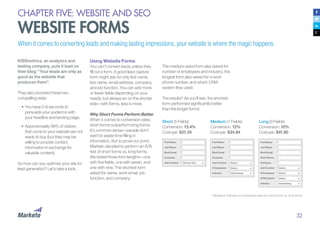
We tested three form lengths—one
with five fields, one with seven, and
one with nine. The shortest form
asked for name, work email, job
function, and company.
The medium-sized form also asked for
number of employees and industry; the
longest form also asked for a work
phone number, and which CRM
system they used.
The results? As you’ll see, the shortest
form performed significantly better
than the longer forms:
First Name:
Last Name:
Work Email:
Company:
Job Function:
First Name:
Last Name:
Work Email:
Company:
Job Function:
# Employees:
Industry:
First Name:
Last Name:
Work Email:
Work Phone:
Company:
Job Function:
# Employees:
CRM System:
Industry:
*
*
*
*
*
*
*
*
*
*
*
*
*
*
*
*
*
*
*
Choose One Select
Select
SelectSelect
Select
Advertising
Advertising
Short (5 Fields)
Conversion: 13.4%
Cost per: $31.24
Medium (7 Fields)
Conversion: 12%
Cost per: $34.94
Long (9 Fields)
Conversion: 10%
Cost per: $41.90
Marketo’s A/B test on conversion rates for short forms vs. long forms
33
CHAPTER FIVE: WEBSITE AND SEO
WEBSITE FORMS
Although you may want a long form to
feed your CRM, you’ll be sacrificing
leads in exchange for more data. And,
as explained on the following page,
you can still get additional data using
other methods.
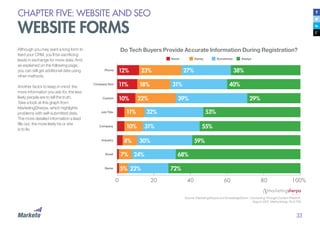
Another factor to keep in mind: the
more information you ask for, the less
likely people are to tell the truth.
Take a look at this graph from
MarketingSherpa, which highlights
problems with self-submitted data.
The more detailed information a lead
fills out, the more likely he or she
is to lie.
Do Tech Buyers Provide Accurate Information During Registration?
Source: MarketingSherpa and KnowledgeStorm. Connecting Through Content Phase III.
August 2007. Methodology: N=2,700
Phone
Company Size
Custom
Job Title
Company
Industry
Email
Name
Never Rarely Sometimes Always
12%
11%
10%
23%
18%
22%
11%
10%
8%
7%
5%
27%
31%
39%
32%
31%
30%
24%
22%
38%
40%
29%
53%
55%
59%
68%
72%
34
CHAPTER FIVE: WEBSITE AND SEO
WEBSITE FORMS
Filling in the Blanks
Short forms may get you more
(and more truthful) responses, but
they might not provide the data you
need to effectively segment leads in
your marketing automation tool. A
potential solution is to use progressive
profiling. Progressive profiling—which
is often supported by your marketing
automation platform—allows you to
collect information and build
qualification over time. Each time a
person fills out a form on your site,
the progressive form asks for
more information.
If you don’t have the ability to use
progressive profiling, carefully
determine what you need on a form,
as opposed to what you want—again,
keep it short and sweet.
Another solution is to use data
augmentation services, Marketo’s
Real-Time Personalization Platform,
powered by Insightera, which can
help you “clean” and augment your
data. You may only have five fields on
your form, but these services can fill in
the blanks.
Extra-Intelligent Forms
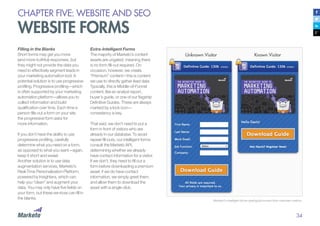
The majority of Marketo’s content
assets are ungated, meaning there
is no form fill-out required. On
occasion, however, we create
“Premium” content—this is content
we use to directly gather lead data.
Typically, this is Middle-of-Funnel
content, like an analyst report,
buyer’s guide, or one of our flagship
Definitive Guides. These are always
marked by a lock icon—
consistency is key.
That said, we don’t need to put a
form in front of visitors who are
already in our database. To avoid
repeat fill-outs, our intelligent forms
consult the Marketo API,
determining whether we already
have contact information for a visitor.
If we don’t, they need to fill out a
form before downloading a premium
asset; if we do have contact
information, we simply greet them,
and allow them to download the
asset with a single click.
Marketo’s intelligent forms distinguish known from unknown visitors.
35
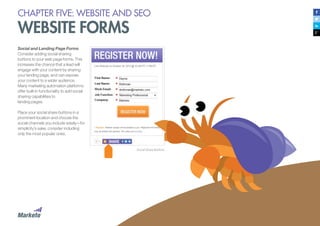
Social and Landing Page Forms
Consider adding social sharing
buttons to your web page forms. This
increases the chance that a lead will
engage with your content by sharing
your landing page, and can expose
your content to a wider audience.
Many marketing automation platforms
offer built-in functionality to add social
sharing capabilities to
landing pages.
Place your social share buttons in a
prominent location and choose the
social channels you include wisely—for
simplicity’s sake, consider including
only the most popular ones.
Social Share Buttons
CHAPTER FIVE: WEBSITE AND SEO
WEBSITE FORMS
FPO
36
CHAPTER FIVE: WEBSITE AND SEO
WEBSITE CALLS-TO-ACTION (CTAS)
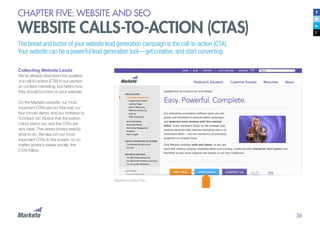
Collecting Website Leads
We’ve already described the qualities
of a call-to-action (CTA) in our section
on content marketing, but here’s how
they should function on your website.
On the Marketo website, our most
important CTAs are our free trial, our
four minute demo, and our invitation to
“Contact Us”. Notice that the button
colors stand out, and the CTAs are
very clear. The viewer knows exactly
what to do. We also pin our most
important CTAs to the screen, so no
matter where a viewer scrolls, the
CTAs follow.
Marketo’s pinned CTAs
The bread and butter of your website lead generation campaign is the call-to-action (CTA).
Your website can be a powerful lead generation tool—get creative, and start converting.
CHAPTER FIVE: WEBSITE AND SEO
WEBSITE CALLS-TO-ACTION (CTAS)
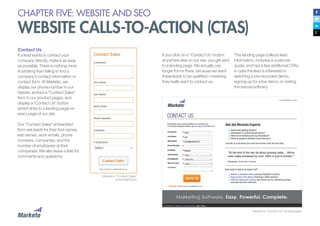
Contact Us
If a lead wants to contact your
company directly, make it as easy
as possible. There is nothing more
frustrating than failing to find a
company’s contact information or
contact form. At Marketo, we
display our phone number in our
header, embed a “Contact Sales”
form in our product pages, and
display a “Contact Us” button
(which links to a landing page) on
every page of our site.
Our “Contact Sales” embedded
form ask leads for their first names,
last names, work emails, phone
numbers, companies, and the
number of employees at their
companies. We also leave a field for
comments and questions.
Marketo’s “Contact Sales”
embedded form
Marketo’s “Contact Us” landing page.
If you click on a “Contact Us” button
anywhere else on our site, you get sent
to a landing page. We actually use
longer forms there, because we want
these leads to be qualified—meaning
they really want to contact us.
This landing page collects lead
information, includes a customer
quote, and has a few additional CTAs,
in case the lead is interested in
watching a pre-recorded demo,
signing up for a live demo, or visiting
the resource library.
38
Asset Download
Another common way to generate
leads on your website is through your
content asset downloads. If your
content marketing strategy is aligned
with your lead generation efforts, you
should already have assets that will
interest your website visitors. And that
means you can ask for lead
information in exchange!
There are many theories about
putting a form in front of content
assets (known as “gating”). You can
gate all of your assets, only gate your
Middle-of-Funnel or premium assets,
or you can ask a lead to fill out one
form to access your entire library.
There is no right or wrong way to do
this, but at Marketo, we only gate our
Middle-of-Funnel or premium assets
(like third-party research reports, or
our Definitive Guides).
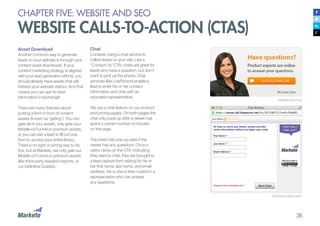
Marketo Live Chat
Chat lead capture form
Chat
Consider using a chat service to
collect leads on your site. Like a
“Contact Us” CTA, chats are great for
leads who have a question, but don’t
want to pick up the phone. Chat
services (like LivePerson) enable a
lead to enter his or her contact
information and chat with an
educated representative.
We use a chat feature on our product
and pricing pages. On both pages the
chat only pops up after a viewer has
spent a certain number of minutes
on the page.
The initial chat pop-up asks if the
viewer has any questions. Once a
visitor clicks on the CTA, indicating
they want to chat, they are brought to
a lead capture form asking for his or
her first name, last name, and email
address. He or she is then routed to a
representative who can answer
any questions.
CHAPTER FIVE: WEBSITE AND SEO
WEBSITE CALLS-TO-ACTION (CTAS)
39
Free Benchmark,
Grader, or Survey
Depending on your product or
service offering, you might consider
offering your website visitors a
value-add in the form of a
benchmark, grader, or survey tool.
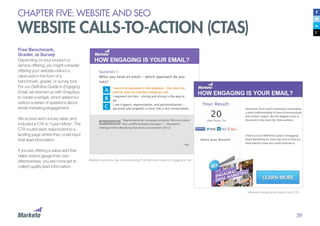
For our Definitive Guide to Engaging
Email, we teamed up with SnapApp
to create a widget, which asked our
visitors a series of questions about
email marketing engagement.
We scored each survey taker, and
included a CTA to “Learn More”. The
CTA routed each respondent to a
landing page where they could input
their lead information.
If you are offering a value-add that
helps visitors gauge their own
effectiveness, you are more apt to
collect quality lead information.
Marketo’s email survey, accompanying The Definitive Guide to Engaging Email
Marketo’s email survey results and CTA
CHAPTER FIVE: WEBSITE AND SEO
WEBSITE CALLS-TO-ACTION (CTAS)
Subscriptions
Another way to generate leads on
your website is to offer a subscription
to your blog, email program, or
resource center. In exchange for a
lead’s email address, you will send
your blog digest, newest assets, or
other valuable offers.
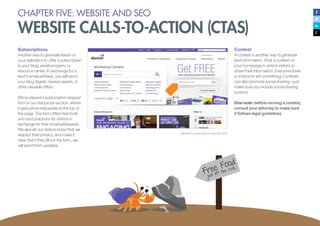
We’ve placed a subscription request
form in our resources section, where
it gets prime real estate at the top of
the page. The form offers free tools
and best practices for visitors in
exchange for their email addresses.
We also let our visitors know that we
respect their privacy, and make it
clear that if they fill out the form, we
will send them updates.
Marketo’s subscription request form
Contest
A contest is another way to generate
lead information. Host a contest on
your homepage to entice visitors to
share their information. Everyone loves
a chance to win something! Contests
can also promote social sharing—just
make sure you include social sharing
buttons.
One note: before running a contest,
consult your attorney to make sure
it follows legal guidelines.
CHAPTER FIVE: WEBSITE AND SEO
WEBSITE CALLS-TO-ACTION (CTAS)
41
CHAPTER FIVE: WEBSITE AND SEO
BLOG OPT-INS
You can do this by using blog
opt-ins, or subscriptions, as
conversion points on your
website. When your audience
subscribes to your blog, they can
either receive an email digest or
an RSS feed of posts. In return,
you can add their information to
your lead database.
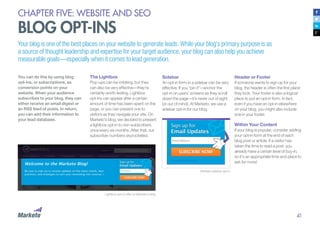
Marketo sidebar opt-in
Lightbox opt-in offer on Marketo’s blog
The Lightbox
Pop-ups can be irritating, but they
can also be very effective—they’re
certainly worth testing. Lightbox
opt-ins can appear after a certain
amount of time has been spent on the
page, or you can present one to
visitors as they navigate your site. On
Marketo’s blog, we decided to present
a lightbox opt-in to non-subscribers
once every six months. After that, our
subscriber numbers skyrocketed.
Sidebar
An opt-in form in a sidebar can be very
effective. If you “pin it”—anchor the
opt-in on users’ screens as they scroll
down the page—it’s never out of sight
(or out of mind). At Marketo, we use a
sidebar opt-in for our blog.
Your blog is one of the best places on your website to generate leads. While your blog’s primary purpose is as
a source of thought leadership and expertise for your target audience, your blog can also help you achieve
measurable goals—especially when it comes to lead generation.
Header or Footer
If someone wants to sign up for your
blog, the header is often the first place
they look. Your footer is also a logical
place to put an opt-in form. In fact,
even if you have an opt-in elsewhere
on your blog, you might also include
one in your footer.
Within Your Content
If your blog is popular, consider adding
your opt-in form at the end of each
blog post or article. If a visitor has
taken the time to read a post, you
already have a certain level of buy-in,
so it’s an appropriate time and place to
ask for more!
42
CHAPTER FIVE: WEBSITE AND SEO
WEBSITE USABILITY
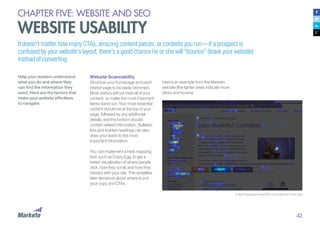
A heat mapping screenshot, provided by Crazy Egg
Help your readers understand
what you do and where they
can find the information they
need. Here are the factors that
make your website effortless
to navigate:
Website Scannability
Structure your homepage and each
interior page to be easily skimmed.
Most visitors will not read all of your
content, so make the most important
items stand out. Your most essential
content should be at the top of your
page, followed by any additional
details, and the bottom should
contain related information. Bulleted
lists and bolded headings can also
draw your leads to the most
important information.
You can implement a heat mapping
tool, such as Crazy Egg, to get a
better visualization of where people
click, how they scroll, and how they
interact with your site. This simplifies
later decisions about where to put
your copy and CTAs.
It doesn’t matter how many CTAs, amazing content pieces, or contests you run—if a prospect is
confused by your website’s layout, there’s a good chance he or she will “bounce” (leave your website)
instead of converting.
Here’s an example from the Marketo
website (the lighter areas indicate more
clicks and hovers):
43
Clear Conversion Paths
To create intuitive conversion paths,
you need to get into the head of your
target personas. Who are they? What
resonates with them? As they search
for the right information, what paths will
they want to take?
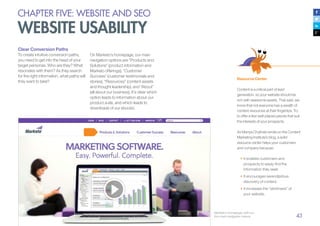
Marketo’s homepage, with our
four main navigation menus
Resource Center
Content is a critical part of lead
generation, so your website should be
rich with awesome assets. That said, we
know that not everyone has a wealth of
content resources at their fingertips. Try
to offer a few well-placed pieces that suit
the interests of your prospects.
As Manya Chylinski wrote on the Content
Marketing Institute’s blog, a solid
resource center helps your customers
and company because:
•	It enables customers and
prospects to easily find the
information they seek.
•	It encourages serendipitous
discovery of content.
•	It increases the “stickiness” of
your website.
CHAPTER FIVE: WEBSITE AND SEO
WEBSITE USABILITY
On Marketo’s homepage, our main
navigation options are “Products and
Solutions” (product information and
Marketo offerings), “Customer
Success” (customer testimonials and
stories), “Resources” (content assets
and thought leadership), and “About”
(all about our business). It’s clear which
option leads to information about our
product suite, and which leads to
downloads of our ebooks.
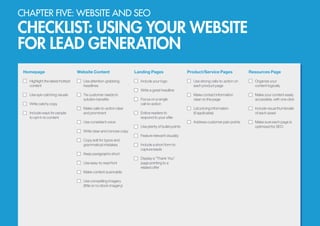
CHAPTER FIVE: WEBSITE AND SEO
CHECKLIST: USING YOUR WEBSITE
FOR LEAD GENERATION
Homepage
Highlight the latest/hottest
content
Use eye-catching visuals
Write catchy copy
Include ways for people
to opt-in to content
Website Content
Use attention-grabbing
headlines
Tie customer needs to
solution benefits
Make calls-to-action clear
and prominent
Use consistent voice
Write clear and concise copy
Copy edit for typos and
grammatical mistakes
Keep paragraphs short
Use easy-to-read font
Make content scannable
Use compelling imagery
(little or no stock imagery)
Landing Pages
Include your logo
Write a great headline
Focus on a single
call-to-action
Entice readers to
respond to your offer
Use plenty of bullet points
Feature relevant visual(s)
Include a short form to
capture leads
Display a “Thank You”
page pointing to a
related offer
Product/Service Pages
Use strong calls-to-action on
each product page
Make contact information
clear on the page
List pricing information
(if applicable)
Address customer pain points
Resources Page
Organize your
content logically
Make your content easily
accessible, with one click
Include visual thumbnails
of each asset
Make sure each page is
optimized for SEO
45
CHAPTER FIVE: WEBSITE AND SEO
SEARCH ENGINE OPTIMIZATION (SEO)
Your prospects are searching for what you sell—but will they find you? Search marketing is about getting found by
prospects through search results and converting them into opportunities. The higher you rank in organic searches,
the more people will find you.
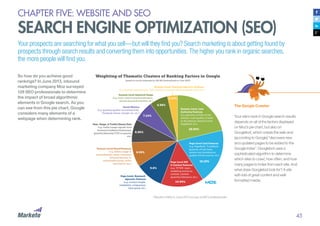
So how do you achieve good
rankings? In June 2013, inbound
marketing company Moz surveyed
128 SEO professionals to determine
the impact of broad algorithmic
elements in Google search. As you
can see from this pie chart, Google
considers many elements of a
webpage when determining rank.
Results of Moz’s June 2013 survey of SEO professionals
The Google Crawler
Your site’s rank in Google search results
depends on all of the factors displayed
on Moz’s pie chart, but also on
Googlebot, which crawls the web and
(according to Google) “discovers new
and updated pages to be added to the
Google index”. Googlebot uses a
sophisticated algorithm to determine
which sites to crawl, how often, and how
many pages to index from each site. And
what does Googlebot look for? A site
with lots of great content and well-
formatted media.
46
CHAPTER FIVE: WEBSITE AND SEO
SEARCH ENGINE OPTIMIZATION (SEO)
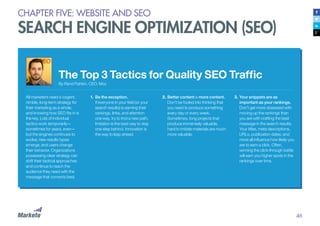
The Top 3 Tactics for Quality SEO Traffic
By Rand Fishkin, CEO, Moz
All marketers need a cogent,
nimble, long-term strategy for
their marketing as a whole,
and knowing how SEO fits in is
the key. Lots of individual
tactics work temporarily—
sometimes for years, even—
but the engines continues to
evolve, new results types
emerge, and users change
their behavior. Organizations
possessing clear strategy can
shift their tactical approaches
and continue to reach the
audience they need with the
message that converts best.
1.	Be the exception.
If everyone in your field (or your
search results) is earning their
rankings, links, and attention
one way, try to find a new path.
Imitation is the best way to stay
one step behind. Innovation is
the way to leap ahead.
2.	Better content > more content.
Don’t be fooled into thinking that
you need to produce something
every day or every week.
Sometimes, long projects that
produce immensely valuable,
hard to imitate materials are much
more valuable.
3.	Your snippets are as
important as your rankings.
Don’t get more obsessed with
moving up the rankings than
you are with crafting the best
message in the search results.
Your titles, meta descriptions,
URLs, publication dates, and
more all influence how likely you
are to earn a click. Often,
winning the click-through battle
will earn you higher spots in the
rankings over time.
47
CHAPTER FIVE: WEBSITE AND SEO
AUTHENTIC CONTENT
In previous updates, Google
focused on improving their
indexing; next they
concentrated on identifying
spam. With Hummingbird,
Google is trying to improve the
other side of the search.
They’re trying to get better at
listening—at finding out what
users want to know.
This shift shouldn’t come as a
surprise to marketers. Google has
announced a string of updates in
the last few years, each one
altering the best practices for SEO.
So how should marketers respond to
Hummingbird? By focusing on relevant,
high-quality content. Smart content
marketing is one of the best ways to
nurture relationships with your prospects
and customers, but it requires a whole
mix of techniques. Optimization is vital to
that mix, but so is the constant creation of
valuable materials. You need to drive
traffic to your site, but you also need to
keep your audience on the page.
If you’re continuously creating the kind of
content your audience is looking for, the
new algorithm will help them find you.
That’s why Hummingbird is a win for your
customers, and ultimately a win for you.
Ask the Experts:
What types of content
works best for converting
SEO traffic to leads?
Google is constantly optimizing to focus on quality content, as is evident in their recent release of Hummingbird.
Named for its precision and speed, Hummingbird represents a big change in Google’s approach to search.
“Just because you get ‘SEO traffic’ doesn’t mean it’s good traffic! Be sure that
your content appeals specifically to your target audience—avoid the
temptation to write too much ‘thin’ content in order to ‘go viral’. Instead, provide
meaningful resources for buyers in each stage of your sales funnel.”
– Nate Dame, CEO and Founder, SEOperks
“If you’re targeting keywords
that are conversion-likely (they
have true purchase/signup/
action intent), it pays to have
pages that are both worthy of being shared
and contain enough information to drive the
conversion. Talk to your customers and to your
evangelists (those who help your message
spread), discover what makes both tick, then
attempt to combine them.”
– Rand Fishkin, CEO, Moz
48
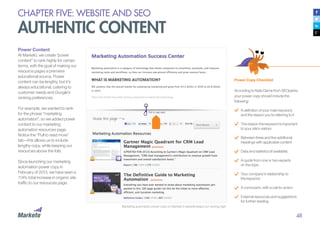
Power Content
At Marketo, we create “power
content” to rank highly for certain
terms, with the goal of making our
resource pages a premiere
educational source. Power
content can be lengthy, but it’s
always educational, catering to
customer needs and Google’s
ranking preferences.
For example, we wanted to rank
for the phrase “marketing
automation”, so we added power
content to our marketing
automation resources page.
Notice the “Pull to read more”
tab—this allows us to include
lengthy copy, while keeping our
resources above the fold.
Since launching our marketing
automation power copy in
February of 2013, we have seen a
114% total increase in organic site
traffic to our resources page.
Power Copy Checklist
According to Nate Dame from SEOperks,
your power copy should include the
following:
A definition of your main keyword,
and the reason you’re referring to it
The reason the keyword is important
to your site’s visitors
Between three and five additional
headings with applicable content
Data and statistics (if available)
A quote from one or two experts
on the topic
Your company’s relationship to
the keyword
A conclusion, with a call-to-action
External resources and suggestions
for further reading
Marketing automation power copy on Marketo’s website keeps our ranking high.
CHAPTER FIVE: WEBSITE AND SEO
AUTHENTIC CONTENT
49
CHAPTER FIVE: WEBSITE AND SEO
KEYWORDS
This means that when someone
searches for that term, you’ll
come up in the first results.
Keywords should be chosen
based on:
•	Relevant business goals
•	Traffic opportunity
•	Competition
Keyword Research
Try Google Adwords Keyword
Planner to find new search terms.
Before you implement your new
keywords, research click-through-
rate (CTR) estimates in Keyword
Planner, so that you can determine
conversion success over time. Tools
like Google Webmaster can help you
measure your results.
When researching keywords,
ask yourself:
•	How relevant is this keyword to
my website, my products and
services, and my content?
•	If someone searches for this
keyword, will he or she find my
offerings useful?
•	Do we have content to offer for
this keyword or will we have to
create content?
•	Will traffic for this keyword deliver
leads to our sales team?
When creating your SEO strategy, first determine your keywords–i.e. what you want to rank highly
for–and then optimize for those terms.
Consider scheduling a keyword
brain-storming session with your
team. You want to have a solid list of
keywords—you could have 10, 50, or
hundreds of words, depending on
your business and goals.
Because your keywords will also be
used in Pay-Per-Click and other online
ad campaigns, think about the
distinction between early and late
stage keywords. You want your offers
and copy to resonate with buyers at
the right place in their buyer journeys.
Once you determine what keywords
will resonate, check to see which
websites already rank for that keyword.
Next, look at the ads that your
competitors are serving up. The more
ads, the higher the value of your
keywords—and the harder it will be to
rise above the noise. Search volume
can tell you how popular your
keywords are. Make sure people
actually search for your keywords, but
the higher the keyword search volume,
the more money your keywords will
cost.
50
Keyword Document
Once you’ve created a spreadsheet
or document of keywords you want to
rank for, grade their priority and list
their target URL, making it easy for
your whole team to use those
keywords. At Marketo, we use a
keyword document for our blog, so
we know what to link to. Remember,
Google doesn’t like exact-match
keywords, so look for phrases that
relate to your target term. Just make
sure that your keywords are used
naturally—no keyword stuffing!
To avoid using exact keywords
(which Google penalizes), try creating
phrases that include your keywords.
For example, instead of “revenue
marketing”, we use the phrase “how
to tie marketing effort to revenue”.
CHAPTER FIVE: WEBSITE AND SEO
KEYWORDS
51
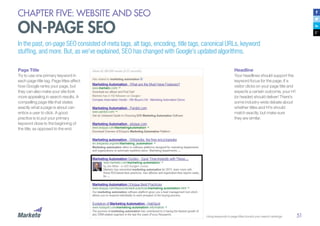
Page Title
Try to use one primary keyword in
each page title tag. Page titles affect
how Google ranks your page, but
they can also make your site look
more appealing in search results. A
compelling page title that states
exactly what a page is about can
entice a user to click. A good
practice is to put your primary
keyword close to the beginning of
the title, as opposed to the end.
CHAPTER FIVE: WEBSITE AND SEO
ON-PAGE SEO
In the past, on-page SEO consisted of meta tags, alt tags, encoding, title tags, canonical URLs, keyword
stuffing, and more. But, as we’ve explained, SEO has changed with Google’s updated algorithms.
Headline
Your headlines should support the
keyword focus for the page. If a
visitor clicks on your page title and
expects a certain outcome, your H1
(or header) should deliver! There’s
some industry-wide debate about
whether titles and H1s should
match exactly, but make sure
they are similar.
Using keywords in page titles boosts your search rankings
CHAPTER FIVE: WEBSITE AND SEO
ON-PAGE SEO
Content
Make sure your content is educational
and relevant to your readers. Keyword
stuffing (or overloading a page with
keywords specifically to improve SEO)
is a big no-no, and Google has gotten
wise to the practice. Moz suggests a
test to ensure your keyword
placement reads naturally: have a
non-marketing friend read the page,
and then ask if he or she thinks a term
is suspiciously prominent. If he or she
says yes, you should revise.
In blog posts, a good rule of thumb is
to use your keyword two or three
times per short post, or between four
and six times for long ones.
URLs
The structure of your URL is still
important. URLs should be concise,
but should also include your keywords.
Your URLs should mimic the site page
structure—for example,
marketo.com/content-marketing
is clearly a page about content
marketing on the Marketo website.
Load Time Averages
Slow load times hurt your Google
rankings, even if you have great
content. Why does Google care? They
want to give their users easy-to-access
information—not content that takes
forever to load.
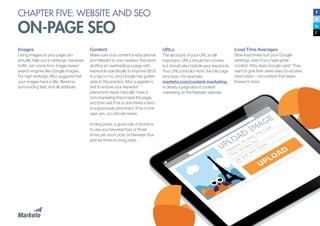
Images
Using images on your page can
actually help you in rankings, because
traffic can come from image-based
search engines like Google Images.
For high rankings, Moz suggests that
your images have a title, filename,
surrounding text, and alt attribute.
Title: My Paris Trip
Filename: My_Paris_Trip_1.jpg
CHAPTER FIVE: WEBSITE AND SEO
ON-PAGE SEO
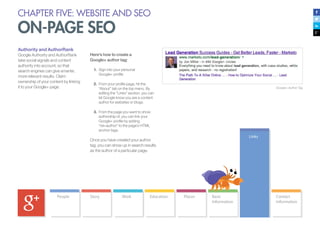
Authority and AuthorRank
Google Authority and AuthorRank
take social signals and content
authority into account, so that
search engines can give smarter,
more relevant results. Claim
ownership of your content by linking
it to your Google+ page.
Here’s how to create a
Google+ author tag:
1.	 Sign into your personal
Google+ profile
2.	 	From your profile page, hit the
“About” tab on the top menu. By
editing the “Links” section, you can
let Google know you are a content
author for websites or blogs.
3.	 	From the page you want to show
authorship of, you can link your
Google+ profile by adding
“rel=author” to the page’s HTML
anchor tags.
Once you have created your author
tag, you can show up in search results
as the author of a particular page.
Google+ Author Tag
CHAPTER FIVE: WEBSITE AND SEO
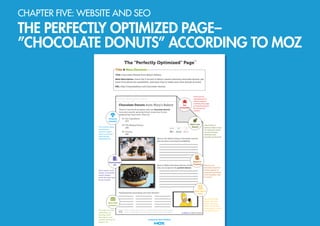
THE PERFECTLY OPTIMIZED PAGE–
”CHOCOLATE DONUTS” ACCORDING TO MOZ
55
CHAPTER FIVE: WEBSITE AND SEO
LINKS
The exact mix is hard to pin
down, but authority is
established though a trusted link
profile—and a good amount of
thought leadership content.
On-Page Links
To show Google that a page is
relevant to people searching for your
keyword, you need to create links to
that page, using variants of that
keyword as anchor text. For
instance, we want our event
marketing resource page to rank
highly for the term “event marketing”,
so whenever we use the phrase
“event marketing” on another page,
we link it back to the resource page.
External Links
According to Moz’s survey (see p.43),
link authority factors (such as the
quantity and quality of links to your
domain and specific pages) are the
biggest factor in your rankings. This
means you need other sites to link to
your domain and the pages for which
you want to rank.
For good reason, external links improve
your ranking authority more than your
own on-page links—more so if the
external sites are relevant to your
business. Also, the higher the external
site’s authority, the more credit Google
will give you for the link.
Here are some easy tips to get started
with link building:
•	Make sure your content is relevant,
educational, fun, and link-worthy.
•	Make sure the sites that link to
you are reputable and have
good content.
•	Ideally, the anchor text in the link
from the external site should use a
variant of your keyword phrase.
The Relationship Between Social
Media and SEO
As SEO and social have become
increasingly intertwined, Google now
uses social signals to determine how
your company ranks in search results.
Engagement from your followers on
social can actually boost your SEO.
Fostering social engagement requires
valuable content: the more useful people
find your content, the more they’ll
engage and share.
Establishing link-based authority on one of the major search engines requires a mix of on-page SEO and link building efforts.
CHAPTER SIX:
LANDING PAGES
57
CHAPTER SIX: LANDING PAGES
LANDING PAGES FOR LEAD GENERATION
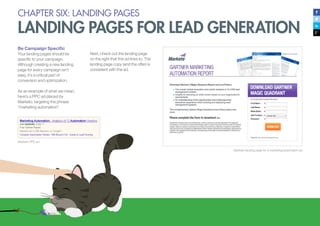
Landing pages are customized pages that your leads are directed to from a social media page, an email send,
an event invitation, a paid ad, or a search engine result.
No matter how much time or money
you spend on a campaign, if your
landing page doesn’t resonate with
your audience, they will bounce—
potentially never to return. The goal
of your landing page is to keep a
potential customer interested
enough to keep reading—ideally,
they will fill out your form and
become a lead.
Most leads take only a few seconds to
decide whether they’ll read a page or
bounce. Does the page make sense
immediately, or is it hard to
understand? Is it relevant to the link
your lead clicked on, or does it seem
out of place?
CHAPTER SIX: LANDING PAGES
LANDING PAGES FOR LEAD GENERATION
Be Campaign Specific
Your landing pages should be
specific to your campaign.
Although creating a new landing
page for every campaign isn’t
easy, it’s a critical part of
conversion and optimization.
As an example of what we mean,
here’s a PPC ad placed by
Marketo, targeting the phrase
“marketing automation”.
Marketo PPC ad
Marketo landing page for a marketing automation ad
Next, check out the landing page
on the right that this ad links to. The
landing page copy (and the offer) is
consistent with the ad.
59
CHAPTER SIX: LANDING PAGES
LANDING PAGE DESIGN
Err on the side of simplicity with your landing page design. Use your design layout carefully—the wrong
design for your audience can immediately detract from the offer and ultimately the conversion. Simply put:
design can have a polarizing effect.
Consider including the following
design elements in your landing
pages:
•	Company logo
•	A banner image or heading
•	A “hero” shot—a mock-up of
your ebook or offer, or a photo
of your webinar speaker
•	Social sharing buttons
Basically, you want to follow the
K.I.S.S (Keep It Simple, Silly) rule with
a logical, well-designed landing
page—your lead shouldn’t have to
wade through clutter.
Removing Navigation
It may be tempting to include your
main navigation links on your landing
pages (“If they don’t like this offer,
they’ll be able to find something
else!”), but these can distract your
leads from your CTA. In eye tracking
studies, it’s been found that
navigation panels draw attention
away from your offer and conversion.
Remember that your main goal isn’t a
visit to your website—it’s lead
conversion for a particular campaign.
After they convert, feel free to send
your leads additional information—
just don’t muddy the waters at your
initial interaction.
A simple, streamlined landing page
for a Marketo webinar
60
CHAPTER SIX: LANDING PAGES
LANDING PAGE COPY
Your landing page copy and CTAs should be clear and direct, and should give your prospects a
good reason to provide their information.
As you write your landing page
copy, use these four steps as a
guide:
1.	 Set up the problem
2.	 Talk about the solution
3.	 Point out the WIIFM
(What’s In It For Me)
4.	 Deliver the goods
(such as an ebook, video,
or webinar registration)
Landing page offering The Definitive Guide to Marketing Automation
Scannable Content
People simply don’t read full landing
pages—they scan. Studies have
shown that, at most, people read
three pieces of your landing page:
1.	 The headline
2.	 	Bullet points
3.	 	Bio (if applicable)
Keep it short and sweet with a bold
headline, one or two short
paragraphs of explanatory copy, and
bullet points to show your leads why
they should click through. To engage
leads without overwhelming the
page, consider using interactive
elements such as an audio clip or a
short video.
The landing page to the left offers
our Definitive Guide to Marketing
Automation. It includes a bold
headline, bullet points, a fun video,
and instructions. There is no
superfluous copy—it is simple
and concise.
Your landing page doesn’t need to
sell your product and company, but it
does need to have a very clear offer.
Focus your landing page around a
single CTA, which must be relevant to
the ad, email, or link that your lead
originally clicked on. Avoid additional
offers, or additional information about
your company.
Reassure Your Lead
Your leads are risking their privacy (or more)
by filling out your form. Reassure them with
privacy statements, customer testimonials,
and guarantees. You want your leads to feel
safe giving their information to a reputable
company—add copy or imagery to
reinforce that trust.
61
CHAPTER SIX: LANDING PAGES
CONFIRMATION AND
THANK YOU PAGES
After a customer converts, take time to thank them with an email, or send them to a confirmation page.
Confirmation and thank you
pages are an important way to
track conversion.
These also give you the opportunity
to deepen the relationship by
making another offer, promoting
your blog, asking for feedback or a
social share, or running a poll. In fact,
over 40% of prospects are willing to
share additional information after
they convert.
Take a look at the landing page to
the right for Marketo webinar
registrants. The page asks you to
register for more events, and gives
you a list of resources that relate to
the webinar content.
A Marketo “Thank You” page
CHAPTER SEVEN:
SOCIAL MEDIA
AND LEAD GENERATION
CHAPTER SEVEN: SOCIAL MEDIA AND LEAD GENERATION
OPTIMIZING SOCIAL MEDIA
FOR LEAD GENERATION
Using social media to brand your business isn’t groundbreaking anymore. Been there, done that?
But although social is still important for branding and generating buzz, it’s increasingly used for lead generation.
At Marketo, we’ve found that
tapping into social media channels
can transform your lead generation
efforts from blah to wow.
“For successful lead generation on
social, equip your buyer for success. Be
personable, connect with your
prospect’s challenges, and give them a
next step to move forward.”
– Chris Brogan
	 CEO and Founder, Human Business Works
Social for Lead Generation
Power Tips
1.	 Don’t take yourself too seriously
2.	 Organic isn’t enough on its own;
don’t be afraid to pay to boost
your presence
3.	 Focus on valuable content and
solid offers
4.	 Create strong calls-to-action
(CTAs)
5.	 Always add value
6.	 Never forget that social is a
two-way street
64
Need proof? A recent Forrester
survey found that only 20% of buyers
believe what a brand says about
itself, because people view any
brand-to-buyer communication as an
advertisement. Conversely, 70% of
buyers trust the recommendations of
their friends and family.
When people learn about your brand
through social, it gives you the
opportunity to turn those “Likes” into
leads. By adding elements of social to
your campaigns, you empower
customers, prospects, and fans to
become brand advocates.
Leveraging the power of peer-to-peer
communication delivers no- or low-cost
brand lift and increased brand
authenticity. Because your audience’s
peers have nothing to gain by
recommending a product, peer-to-peer
word of mouth is one of the most credible
forms of “advertising”.
Brand or product recommendations from
friends and family
Professionally written online reviews (e.g.,
CNET, consumer reports)
Consumer-written online reviews
(e.g., Amazon)
Natural search engine results
(e.g., Google, Bing)
Self-seleced
digital pull content
Digital
push content
Information on websites of
companies or brands
Sponsored search engine results
(e.g., Google, Bing)
Emails from companies
or brands
Posts by companies or brands on social
networking sites (e.g., Facebook, Twitter)
Base: 57,499 US online adults (age 18+)
*Base: 15,654 EU-7 online adults (age 18+)
Source: North American Technographics* Online
Benchmark Survey (Part 1), Q2 2012 (US, Canada)
* Source: European Technographics* Online
Benchmark Survey, Q3 2012
US
EU*
Information on mobile applications
from companies or brands
Ads on websites
(e.g., banners)
Text messages from
companies or brands
70%
55%
46%
43%
32%
27%24%
11% 18%
15%
12%
10%
9%
10%
10%
8%
8%
23%
37%
38%
33%
61%
Europeans trust all advertising
communications less
than Americans
CHAPTER SEVEN: SOCIAL MEDIA AND LEAD GENERATION
PEER-TO-PEER INFLUENCE MARKETING
“To what extent do you trust each of the following types of advertising/promotion?”
(4 or 5 on a scale of 1 [do not trust at all] to 5 [trust completely])
Social marketing is shifting away from company-to-buyer marketing, and toward peer-to-peer influence marketing.
A Forrester Research survey on consumer trust in advertisements
65
CHAPTER SEVEN: SOCIAL MEDIA AND LEAD GENERATION
SOCIAL SHARING
People are motivated to share by:
1.	 Reputation enhancement
2.	 	Access to something exclusive
3.	 	Opportunities for
co-creation/authorship
4.	 	Competitions
5.	 	Altruism
Social Sharing Offers
Keep these motivations in mind, and
try to align them to your social offers.
Consider adding some extra oomph to
your social campaigns and messaging
by employing one of these tactics:
•	Refer-a-friend: Create a
compelling offer for both the
referrers and referees. This taps
into the same power as peer-to-
peer recommendations—people
are far more likely to trust their
friends. Of course, this is also a
fantastic way to collect
lead information.
•	Sweepstakes: Create a contest
and get your entrants to spread the
word on your behalf. Everyone
loves winning, and contests are
highly shareable on social
channels. You can also gain
important lead data through
entry forms.
Utilizing the 80/20 Rule for social
So what kind of content should you post
on social channels? Social media has
many different functions, including lead
generation, brand awareness, and
relationship building. To be effective, you
need a good balance of promotional
content and thought leadership. We
advise marketers to use the 80/20
rule—80% of your content should be
informational/educational, and 20%
should be self-promotional.
“When it comes to sharing on social,
pick the channel where you can best
tell your story. If you’re better in
video, use YouTube. If you’re brief
and quippy, use Twitter. Pick what
you like.”
– Chris Brogan, CEO and Founder, 	
	 Human Business Works
Social sharing amplifies your message and your lead generation efforts, but getting people to share isn’t easy.
•		Polls and voting: Everyone
has an opinion, and most
people are happy to share.
Build relationships with
campaigns that engage your
audience and compel them to
share their opinions. You can
also gain valuable information
about your leads’ likes and
dislikes, which can help you
plan future campaigns.
•	Flash deals: Create a sense of
urgency with a strong CTA and
a time limit—these cause leads
to act quickly. Flash deals can
quickly increase brand
awareness and bring in
new customers.
66
CHAPTER SEVEN: SOCIAL MEDIA AND LEAD GENERATION
FACEBOOK
Facebook boasts the largest user base of any social network, so it’s essential that you have a presence there. Formerly
dismissed by marketers as too “personal” for business correspondence, it’s become an increasingly common way to
deliver messaging. With more than 1.1 billion users, and many opportunities for paid advertisements, Facebook is a
critical element of any lead generation campaign.
Contagious Content
So what works on Facebook for lead
generation? The key is to strike a
balance between offering content
that is valuable for brand positioning,
and offering content that is fun and
shareable on social channels. If you
can show value to your followers,
your lead generation efforts can have
a true network effect.
At Marketo, we are always
experimenting with different types of
ads, new content, and eye catching
visuals. We also track our success
using Marketo and Facebook Insights.
We’ve found that to successfully
generate leads on Facebook,
you need:
1.	 Compelling messages
2.	 	Eye catching visuals
3.	 	Mass audience appeal
and shareability
4.	 A clear CTA
5.	 	Personality!
“Facebook is great because it allows you to humanize
your brand—companies often forget that people
aren’t ‘all business’ when it comes to social media.
They want to have fun, not engage with robots.”
– Carra Manahan, Marketing Programs Specialist, Marketo
67
CHAPTER SEVEN: SOCIAL MEDIA AND LEAD GENERATION
FACEBOOK
Facebook News Feed
Facebook’s News Feed uses an
algorithm to determine whether your
posts get displayed on a user’s News
Feed, which is critical for lead
generation. So how do you get your
posts to appear? This algorithm has
gone through numerous iterations, and
(like Google) will continue to change
over time, but it always responds to
content engagement—if users and
their networks interact with your
content, it will show up in the feed. If
not, it will be dropped.
Here are some other factors that the
algorithm considers:
•	Affinity:
How close is the relationship
between the user and content?
•	Weight:
What type of action was taken on
the content?
•	Decay:
How current is the content?
•	Post Types:
What types of posts does a user
typically interact with?
•	Hide Post/Spam:
What types of posts does a user
usually hide or mark as spam?
•	Clicking on Ads:
Do users interact with the ad?
•	Device Considerations:
Can multiple devices handle
your content?
•	Story Bumping:
A post may be older, but is it still
being interacted with?
Promoted Posts
Amplify your lead generation and
engage your followers (and your
followers’ networks) by putting paid
efforts behind some of your top posts.
Remember, when using promoted
posts for lead generation purposes,
there should always be a strong
CTA—ask followers to download an
asset, attend a webinar, or learn about
a new product. You want people to
have something to click on.
How do promoted posts work? You
can promote a post (including status
updates, videos, blog posts, and
offers) directly from your News Feed.
Any post you promote will
automatically appear higher in the
News Feed, so more people will see it.
You can also determine a specific
budget for each promoted post. Your
budget will depend on your personal
business objectives, but Facebook
prices promotions based on your fan
count and budget—they can range
from $10 to $1000.
At Marketo, we promote assets and
daily blog posts with strong Facebook
CTAs, and we’ve seen a big uptick in
visibility since we started doing so.
Recently, we created a Facebook
promoted post for our Definitive Guide
to Engaging Email, which led to 9,923
clicks; 6,765 actions (“likes” and
comments); a 3.976% click-through-
rate; and cost us $0.70 per click.
Promoted Facebook post from Marketo
68
CHAPTER SEVEN: SOCIAL MEDIA AND LEAD GENERATION
FACEBOOK
Facebook Ads
Facebook ads provide highly
targeted opportunities to reach
your audience. They appear on the
right side of a user’s screen, and
are similar to traditional Pay-Per-
Click (PPC) ads—you place a bid on
how much you want to pay per
click, or you can pay per thousand
people who will see your ad. And
much like a typical PPC ad, the cost
depends on the popularity of your
keyword terms.
You can choose to link Facebook
ads to pages on your website, or to
your Facebook page to get more
“Likes”. You can also target
Facebook ads based on a variety of
demographic criteria including
location, job title, age, industry,
gender, and more.
Custom Audiences
If you’re using Sponsored Stories or
paid ads, you can target a specific
set of users, or custom audiences,
with whom you’ve already
established a relationship—either
on or off of Facebook. These
audiences can be defined by the
following attributes:
•	Email address
•	Facebook user ID
•	Phone number
•	Facebook App user ID
•	Apple IDFA
•	Location
•	Age
•	Gender
•	Education
•	Interests
•	Connections
69
CHAPTER SEVEN: SOCIAL MEDIA AND LEAD GENERATION
FACEBOOK
Tracking and Results
Facebook’s Page Insights application
provides fantastic analytics, tracking
a variety of engagement and ad
performance metrics. Leveraging this
data internally can help you begin the
conversation about your program
ROI on social.
Page Insights lets you see:
•	Page “Likes”
•	Post reach
•	Engagement
•	Organic/paid reach per post
•	Post clicks
•	Post “Likes”
•	Comments
•	Shares
Facebook’s Page Insights analytics
70
CHAPTER SEVEN: SOCIAL MEDIA AND LEAD GENERATION
TWITTER
Think of Twitter as a virtual water cooler for marketing professionals: it’s a vibrant community where businesses can
generate leads, and thought leaders can discuss relevant industry topics. With 218 million users, Twitter can’t be ignored.
At Marketo, Twitter helps us
foster continuous, real-time
engagement with our customers
and prospects. We use Twitter
to spread the word about
specific product offerings, and
as a forum for potential
customers to learn more about
us and our products. And like
Facebook, Twitter offers many
opportunities for marketers to
collect and generate leads.
Promoted Tweets
We’ve had great success with
Promoted Tweets, a form of paid ads
that appear in a user’s feed, targeted
to followers and users who fit our
criteria. Our Promoted Tweets contain
timely and engaging offers, like
contests for free trips to industry
events, or links to relevant thought
leadership. We use Promoted Tweets
to create demand for new content
assets, upcoming events, or demos.
Every Promoted Tweet that we run
leads to a form, which improves our
chances of gaining user data. Like
Facebook ads and Google Adwords,
Promoted Tweets use a Cost-Per-
Click (CPC) pricing model.
Twitter enables you to target tweets
based on the following criteria:
•	Interests
•	Keywords in timeline
•	Gender
•	Geography
•	Device
•	Similarity to existing followers
Marketo also uses Promoted Tweets in
Twitter searches. These tweets target
users based on particular keyword and
hashtag searches.
Here’s how Promoted Tweets appear
in a user’s timeline:
For tweets promoted in search results,
we run two offers every two weeks,
with three different tweets focusing on
15 keywords and five countries. Fresh,
relevant content offers with the right
messaging yield click-through rates of
up to 17%, with a cost-per-prospect at
around $14. This, of course, will vary
based on your offer and the relevancy
of your content.
We always see significant spikes in
relevant tweets during industry events,
so we decided to capitalize on that,
using Promoted Tweets in search
results during key conferences such as
Dreamforce. This allows us to be part
of relevant conversations while the
conversations are still hot. By targeting
event-specific hashtags and relevant
keywords like “lead management”, we
can tap into prime lead-generating
moments. Being a part of real-time
conversations means pouncing on
real-time opportunities.
Promoted tweet in timeline
CHAPTER SEVEN: SOCIAL MEDIA AND LEAD GENERATION
TWITTER
Promoted Accounts
and Trends
Twitter also offers two additional
promoted ad options—Promoted
Accounts and Promoted Trends. With
Promoted Account ads, businesses
can make their Twitter accounts show
up under the “Who to follow” list on
your Twitter page. This can be targeted
based on who a user typically follows,
whether it’s a similar advertiser or an
industry thought leader.
Promoted accounts can also be
placed in search results when
someone searches for a particular
topic or hashtag.
A Promoted Account ad from Pulsar, placed among
organic “Who to follow” suggestions
In this “Trends” list, GoPro Camera’s promoted
hashtag tops the list.
Promoted Trends enable a business
or an individual to promote a
particular trend or hashtag, which
appears on the left-hand side of a
user’s screen, under “Trends”. Note
that promoted trends carry a hefty
price tag—according to Mashable,
placement costs about $200,000.
72
CHAPTER SEVEN: SOCIAL MEDIA AND LEAD GENERATION
TWITTER
Twitter Lead Generation Cards
Twitter Lead Generation Cards permit
businesses to collect lead information
directly from Twitter. How do these
work? When individuals expand your
tweet, they see a form, a description
of your compelling offer, and a CTA.
Twitter handles, names, and email
addresses are already filled in, so all a
lead has to do is click the CTA.
A Twitter Lead
Generation Card
from Marketo
Twitter Lead Generation Cards can
also sync to your marketing
automation tool, but note that Lead
Generation Cards only have a full
name field—most marketing
automation tools collect names in a
first and last name field. Also, Twitter
Lead Generation Cards do not
capture company data. Because of
this, you can’t (yet) push the lead
information to most CRM tools.
Twitter Words of Caution
A little self-promotion is good for business,
but if your entire tweet history is about you
and your company, you’re doing it wrong.
Use the 80/20 rule: 80% of your content
should be helpful or entertaining, 20%
should be promotional
Tracking and Results
When people choose to follow you
on Twitter, you’ll be notified and can
review their conversations in
dedicated streams. This helps you
identify opportunities to engage.
We’ve seen immediate results from
our efforts on Twitter: our average
lead-conversion rate from emails and
online campaigns is between 2-3%,
but some of our Twitter campaigns
have yielded conversion rates as
high as 14%.
73
CHAPTER SEVEN: SOCIAL MEDIA AND LEAD GENERATION
LINKEDIN
LinkedIn goes beyond personal profiles and status updates; it’s a great resource for networking, influencer
relationship building, and lead generation opportunities through paid programs. Because users visit the site for
purely work-related purposes, LinkedIn lends itself to making business connections.
Company Page
Building out your company page is the
first step to optimizing LinkedIn for lead
generation. Your company page tells
users who you are, what you do, and why
they should follow you.
Follow these key best practices when
building out your LinkedIn company page:
•	Optimize your company page for
keywords—people frequently run
searches on LinkedIn, so make sure
you show up in results.
•	Add tabs to your company page—
these are usually “Careers”,
“Products”, and “Insights”. Your
“Products” tab should be optimized
for search.
•	Post on LinkedIn at least once daily
to establish your presence.
•	Consider adding videos and other
media to your product pages to
further engage users.
Marketo’s LinkedIn page
CHAPTER SEVEN: SOCIAL MEDIA AND LEAD GENERATION
LINKEDIN
LinkedIn Sponsored Updates
To get into the lead generation
game, LinkedIn began offering
Sponsored Updates, allowing
companies to put paid promotions
behind status updates. These
promoted updates are seen by your
followers and targeted users
outside of your follower network.
Like all other social ads, LinkedIn
updates should include a visual,
and then link to a gated asset.
A Sponsored Update from Marketo on LinkedIn
Sponsored Updates allow you to
target users—you can choose to
include or exclude users based on
the following criteria:
•	Location
•	Company name
•	Job title
•	Skills
•	School name
•	LinkedIn Group associations
•	Gender
•	Age
LinkedIn Ads
LinkedIn ads give companies the
chance to target their audience in
powerful, unique ways. How? The
information found on a user’s
LinkedIn profile is different than
other social networks, and it’s
particularly helpful for businesses.
This data maps well to the lead
data you want from users—such as
job title, company, industry,
geographic location, and other
demographic targeting.
LinkedIn allows you to customize
your ads—you can opt for text-only
ads, images, or video ads.
However, according to LinkedIn,
adding an image to your ad can
bring you 20% more clicks.
75
CHAPTER SEVEN: SOCIAL MEDIA AND LEAD GENERATION
GOOGLE+
Google+ is quickly becoming an essential part of any business’s social media strategy, but it’s also a must for lead
generation. Already boasting 90 million users, Google is making Google+ accounts mandatory for all Gmail users
and those who want to post comments on YouTube. Google+ also now plays a major role in SEO.
About Us Page
Use the “About Us” page on Google+
to give audiences a quick overview of
your business. From there, you can
link to specific pages and services,
directing potential customers to the
most important pages on your
website. Make sure your copy is SEO
friendly, but—as always—avoid
keyword stuffing.
On Marketo’s Google+ “About Us”
page, note that we include our tagline,
keywords, and links that direct
viewers to our highest ranking pages.
Marketo’s Google+ “About Us” page
CHAPTER SEVEN: SOCIAL MEDIA AND LEAD GENERATION
GOOGLE+
Claiming Ownership
of Your Content
We’ve already discussed Google
AuthorRank in our chapter about
SEO, but it’s worth noting that
Google search results greatly favor
those who engage with Google+.
Google Authorship is how Google
authenticates authors, and how it
begins to “trust” you as a quality
source of content.
Jazz up your virtual meetings or panels with fun effects in Google+ Hangouts
Google+ Hangouts
Google+ Hangouts are a great way
to generate buzz, sharing, and brand
awareness. Gather thought leaders
in your industry for a panel or a
topical chat. Send out invites to your
customer and prospect base, and
make sure you promote heavily
on social.
77
CHAPTER SEVEN: SOCIAL MEDIA AND LEAD GENERATION
SLIDESHARE
Readers are inundated with text, which means marketing professionals can’t rely solely on whitepapers and blog
posts to reach prospects and customers. It’s now vital to include visual elements in all of your marketing campaigns.
SlideShare is a service that hosts
your slide decks and presentations
online, but it’s also much more—
it’s an essential part of any
successful content marketing
strategy, and a powerful social
community with a reported 60
million monthly visitors.
Creative Topics and Visuals
Content marketing through SlideShare
can help you establish yourself as an
expert in your field, using highly
consumable visual elements. When it
comes to lead generation, SlideShare
can help you attract audiences who
might ordinarily skim past your
content. Some people might want to
read a 10-page ebook, while others
want to consume their information
quickly and visually.
Optimizing for SEO
Creating slide presentations that rank
for certain keywords can be much
easier than ranking a post on your
blog. To give your presentations a
fighting chance in the world of search
engines (as well as in SlideShare’s
own search results) include keyword-
rich titles, descriptions, and tags.
Write your titles and descriptions with
SEO in mind.
SlideShare presentations are easily
embedded into other sites, which will
also drive SEO results. Each time
someone embeds your presentation,
it serves as an inbound link to
your content.
78
CHAPTER SEVEN: SOCIAL MEDIA AND LEAD GENERATION
SLIDESHARE
SlideShare Forms
When it comes to lead generation,
forms are where SlideShare really
shines. With SlideShare, you can
embed a lead generation form directly
into your presentation, which pops up
after some or all of your presentation is
complete. Users can enter their
information to download the slides
and learn more about your company.
	
If you are using a marketing
automation platform, you can sync
your leads directly into your database
and add them to a nurture program.
Use SlideShare forms to generate leads.
“Although many think
that Facebook is a terrific
platform to build a strong
community of fans, it’s
even more powerful when you turn your
raving fans into quality leads that you
can communicate with and build a
relationship with outside of Facebook.”
– Amy Porterfield
	 Social Media Strategist
“There are three
channels that are great
for lead generation.
Facebook’s ad interface
and their targeting capabilities are
impressive—you can get very granular
and ensure you’re reaching the right
audience. LinkedIn has generally given
us the best leads, because you can
target by job titles, companies,
company size, or industry. Lastly, we’ve
had success with lead generation forms
on SlideShare, where we host all of our
slide decks, from webinar decks to
shortened versions of our ebooks.”
– Carra Manahan
	 Marketing Program Specialist, Marketo
“At Social Media
Examiner, we’ve found
that LinkedIn has the
highest conversion rate,
but Facebook delivers a higher quantity
of leads for us. We have a much larger
fan base on Facebook (192,000+)
compared to LinkedIn (11,000+), and
have multiple dedicated staff manning
our Facebook account.”
– Michael Stelzner
	 CEO and Founder, Social Media Examiner
ASK THE EXPERTS: SOCIAL MEDIA AND LEAD GEN ROUNDTABLE
WHAT SOCIAL CHANNEL WORKS
BEST FOR LEAD GENERATION?
“Social media platforms
are becoming more
sophisticated in terms of
giving marketers
opportunities to strategically attract
leads. It’s no longer all about attracting
fans and followers—the appeal of social
media marketing is gravitating more
toward turning those fans and followers
into warm leads. These leads are
genuinely interested in hearing from you.
– Amy Porterfield
	 Social Media Strategist
“More and more
companies are investing
in their brand’s social
presence, and at the
same time, social platforms are
investing in features that help drive lead
generation. If you’re not using social
media for your lead generation efforts,
you’re missing out on a great
opportunity. We’ve seen great ROI from
adding a social component to almost
everything we do—whether it’s a simple
social share button or a fun contest.”
– Carra Manahan
	 Marketing Program Specialist, Marketo
“Now that Twitter has
introduced Lead
Generation Cards,
which allow advertisers
to collect leads directly from paid ads, I
think we will see more of this type of
lead generation across the various
social networks—especially as those
networks become more reliant on
advertisers who are seeking to
generate leads.”
– Michael Stelzner
	 CEO and Founder, Social Media Examiner
ASK THE EXPERTS: SOCIAL MEDIA AND LEAD GEN ROUNDTABLE
WHAT IS THE FUTURE OF SOCIAL
FOR LEAD GENERATION?
“You need to know
where your audience is
spending time and have
a keen understanding of
their interests, likes, dislikes and overall
challenges. If you can create giveaways
that they perceive as highly valuable,
they’ll be more than happy to give you
their names and email addresses in
exchange. That’s how list building on
social media sites works best—with an
irresistible giveaway, promoted on your
social media channels. This not only
builds goodwill and establishes your
authority, it also builds your email list
with people that are genuinely
interested in what you are all about.”
– Amy Porterfield
	 Social Media Strategist
“At Marketo, we’re aware
that a social media
manager doesn’t just post
a few tweets or Facebook
statuses every day—they also have a
strategy for reaching lead generation
goals. To have an effective lead
generation strategy, you’ll need to make
sure that you have awesome content, the
right people, and creativity. Content is
what fuels social media—without it you
would have nothing to offer your
audience. Dedicated staff ensure that
you’re following a strategy, not just using
social at random. And creativity is key for
breaking through the noise.”
– Carra Manahan
	 Marketing Program Specialist, Marketo
“Generating leads with
social comes down to
offering a valuable free
offer. It’s important to
remember why people are on social
networks: to connect with people. Thus
it’s critical to offer up major value if
you’re going to interrupt their main
reason for being on the network. Said
another way, people using social
networks have a low tolerance for
overly promotional content.”
– Michael Stelzner
	 CEO and Founder, Social Media Examiner
ASK THE EXPERTS: SOCIAL MEDIA AND LEAD GEN ROUNDTABLE
WHAT ARE THE KEY SOCIAL
COMPONENTS OF AN EFFECTIVE
LEAD GENERATION STRATEGY?
“People who think
social media is not
effective for lead
generation need to give
it a try! I can’t stress how important it is
to test before drawing conclusions.
You’ll need to try different methods,
keeping in mind that not everything you
do will be a success. Not every post on
every social channel will get a ton of
engagement—you need to figure out
which messaging and content resonates
best with your target audience.”
– Carra Manahan
	 Marketing Program Specialist, Marketo
ASK THE EXPERTS: SOCIAL MEDIA AND LEAD GEN ROUNDTABLE
WHAT DO YOU SAY TO PEOPLE WHO
THINK SOCIAL MEDIA IS NOT EFFECTIVE
FOR LEAD GENERATION?
“I would say they are
missing out on a huge
opportunity, and will
struggle to build up their
email lists if they don’t begin to
experiment with social media
opportunities to attract quality leads.
I would also say that their competition
is very lucky!”
– Amy Porterfield
	 Social Media Strategist
“Social networks are the
fastest and lowest cost
way to generate leads,
bar none.”
– Michael Stelzner
	 CEO and Founder, Social Media Examiner
CHAPTER EIGHT:
EMAIL MARKETING
84
CHAPTER EIGHT: EMAIL MARKETING
MAINTAINING RELATIONSHIPS
WITH EMAIL MARKETING
Email is a cornerstone of many marketing campaigns. Whether you’re hosting an event, sending out a new piece of
content, or promoting a new service offering, email can deliver relationship-building communication at every stage
of the funnel, especially to those leads that you already have in your database.
That said, marketers often
struggle to generate the open
rates, click-through rates, and
conversions they’d like to see.
In fact, according to a recent
research study by
MarketingProfs, the average
open rate for a B2B email is
19.9%, and the average click-
through rate is 5.4%. According
to marketing solutions firm
VerticalResponse, the average
open rate for a B2C email is
between 15-20%, and the
average click-through rate is
around 6%.
Today’s buyers have short attention
spans and intelligent browsing
habits—they want personalized,
relevant information at all times.
That’s why marketers must create
engaging email campaigns—not just
batch-and-blast. To rise above the
noise, your emails should be
trustworthy, relevant, conversational,
coordinated across all channels,
and strategic.
Email marketing done right can help
nurture leads already in your
database and bring them closer to
becoming a customer.
CHAPTER EIGHT: EMAIL MARKETING
EMAIL TIMING AND FREQUENCY
Time your emails depending on your audience, based on captured user data and other parameters.
When to Send an Email
Although there is no true “best”
time of day to send your emails,
there are certainly some best
practices you can consider:
•	Time of opt-in: If a subscriber
opts into your newsletter at 2pm
PST, you can reasonably assume
that subscriber is often online
at 2pm.
•	Early bird: If you schedule your
emails to arrive in the early
morning, you can be at the top of
the email pile when folks arrive at
the office. Note that as
smartphones become more
ubiquitous, people check their
email earlier and earlier in the
day—often long before they
actually get into work.
•	Time zone: By capturing IP
addresses at opt-in, you can
segment your list and send
emails based on where
subscribers live, so that your
emails reflect the correct
time zone.
•	Domain: Send emails to
subscribers who register
personal email domains
(gmail.com, yahoo.com, etc.)
during the early morning and
evening hours. Those using
work-related domains
(company.com) should
receive emails during the day.
How Often to Send Emails
We’re often asked how often
marketers should send emails,
and ultimately, the answer
depends on the level of perceived
value you deliver in each email. For
instance, daily deal emails, such
as those from Daily Candy,
Groupon, and Living Social, have
high value and merit daily
frequency. For most businesses,
however, once a day is much too
much. A general rule to follow:
If you find yourself wondering
whether you’re sending too
many emails, you probably are.
Early bird
Time of opt-in
Time zone
Domain
86
CHAPTER EIGHT: EMAIL MARKETING
EMAIL CALLS-TO-ACTION
A strong, clear call-to-action (CTA) is a crucial element of any great lead generation campaign.
If you have three things to
promote this week, but you don’t
want to email your database
three times, it might seem wise
to combine the offers with an
email that covers all three.
Unfortunately, this can dilute
your message and confuse the
recipient. You want your recipient
to know exactly where to focus
and what to do.
Email with a strong CTA
We covered CTAs in our section on
content, but here’s an example of a
strong email CTA (on the right). It’s
obvious what we want the reader to
do—attend one of our LaunchPoint
partner webinars.
Instead of driving your readers directly
to your website homepage, it’s always
better to point them to a landing page
created specifically for your offer (see
our section on landing pages for more
landing page best practices). Same
rules apply: make sure your CTA
stands out and that the copy is
compelling.
87
CHAPTER EIGHT: EMAIL MARKETING
EMAIL SUBJECT LINES
Your subject line, in conjunction with a trusted From address, is what drives opens. Make it clear and concise, and
don’t be afraid to try something creative—you can always A/B test before sending it to your entire list.
Here are some best practices to
improve your open rates:
•	Frame your subject line as a
question. Questions compel
readers to open your emails as
they pause to consider the
answer. Nab their attention with a
simple question mark.
•	Try a list. This is where your “Top
10” and “5 Tips” subject lines
come in. People gravitate towards
short, easily digestible information.	
•	Make a psychological appeal.
According to Copyblogger, the
subject line “You are not alone”
gets an average open rate of
90%. As you write your subject
lines, keep basic human
psychology in mind.
•	Be conversational. Don’t be
afraid to use conversational
language in a subject line. Your
leads are people, so use natural
language that references
real-life interactions.
CHAPTER EIGHT: EMAIL MARKETING
EMAIL COPY
An opened email is one thing; a read email is another.
There is truly an art to crafting email copy that will convince someone to click.
Remember, your readers will scan
through hundreds of emails on
any given day, making quick
decisions about which are worth
their time.
At Marketo, we send thousands of
emails, and we test every email
design and copy to ensure that our
readers click through.
Here are some tips for writing
email copy:
•	Short and sweet: We find it’s
best to say things simply. Try using
short sentences and bullets to
make your emails easy to scan.
•	Cut out the marketing-speak:
Marketing jargon can immediately
turn off your reader. Make your
copy clear and conversational.
•	Address a pain point: Your email
copy can speak to a problem you
can solve for your reader. Offer a
clear, concise solution.
•	Don’t forget to proofread:
Multiple people should review
every email you send for spelling,
grammar, and punctuation errors.
If you can, set your email aside for
a few hours before sending—with
fresh eyes, you’re more likely to
catch mistakes.
“This is true, but to be
more precise, you need a
quality list. A list of
unengaged, unresponsive
contacts is nearly as bad as not having a
list at all. The size and quality of your
subscriber list is a direct indicator of how
successful you will be at reaching your
email marketing goals.”
– Adam Holden-Bache
	 CEO and Managing Director, Mass Transmit
“This is absolutely true.
An email list—ideally one
that is obtained through
permission-based best
practices—is a critical aspect of any
solid email marketing program. It starts
with the opt-in form—setting
expectations around content, value,
timing and frequency. Then it’s all
about delivering on that promise. This
is where trust is earned or lost. The list.
The list. The list!”
– DJ Waldow
	 Digital Marketing Evangelist, Marketo
“Absolutely true. Email
marketing begins with
your database. I am
always amazed when
my students and clients tell me that
growing their list is not one of their
priorities! Your newest subscribers are
often your most active subscribers and
so, logically, it makes sense to prioritize
growing your database. And the bigger
your list, the more opportunities you
have for conversions.”
– Katy Pay
	 Co-Founder, Plan to Engage
ASK THE EXPERTS: EMAIL MARKETING ROUNDTABLE
TRUE OR FALSE: You can have the most compelling subject line,
the best call-to-action, and an unbelievable offer, but if you don’t have a list of
email addresses to send to, nothing else matters.
“They don’t offer value to
the recipient. They make
the content about what
they want people to
know, rather than what people want
to hear.”
– Adam Holden-Bache
	 CEO and Managing Director, Mass Transmit
“They forget about
mobile. If you look
at the mobile email
statistics, usage has
been growing rapidly over the past few
years and will continue to do so. More
and more people are viewing and
interacting with emails on their smart
phones. However, very few email
marketing messages are optimized for
mobile. This is where responsive design
comes into play.”
– DJ Waldow
	 Digital Marketing Evangelist, Marketo
“Not designing their
emails for conversions! I
find that most email
marketers (or their
designers) are actually designing their
emails to be aesthetically pleasing,
rather than focusing on designing for
conversions. You need to test your CTAs
and copy, and make the most of your
headlines and imagery to support your
main objective. Too many equally
weighted CTAs make it confusing for the
reader as opposed to setting a clear
task for the reader to follow.”
– Katy Pay
	 Co-Founder, Plan to Engage
ASK THE EXPERTS: EMAIL MARKETING ROUNDTABLE
WHAT ARE THE BIGGEST MISTAKES
PEOPLE MAKE WHEN DESIGNING
EMAILS FOR CONVERSION?
91
CHAPTER EIGHT: EMAIL MARKETING
PAID EMAIL PROGRAMS
Paid email programs extend your reach, attract your target audience, and increase the size of your database. With
paid email, a sponsored email to high-quality targets is sent out on your behalf. Pick a reputable organization with a
high-quality database that is filled with your target audience.
Targeting with Paid Emails
Which organizations in your industry
are known for relevant news or
particularly engaging commentary?
Check to see if those companies offer
sponsored email programs. If you are
sending emails out through a well-
respected organization in your space,
they probably have an organically
grown list that speaks directly to
your audience.
Most organizations allow you to
target subscribers based on the
following criteria:
•	Audience: Who are you trying to
reach? Target based on title,
industry, and other
demographic criteria.
•	Topics: What topics are your
audience interested in? Many
vendors allow you to target
based on topics that leads have
engaged with in the past.
•	Region: If you are doing a
geo-targeted campaign, have
your vendor segment based
on location.
As you write copy for your paid email
program, be aware that the
recipients may or may not know who
your company is, so branding and
clarity are critical. Focus on bold,
eye-catching visuals, a very clear
CTA, and concise copy.
Vendor Selection
If you turn to a vendor for paid email
programs, here are some steps we
recommend that you take:
1.	Check out a vendor’s media kit:
Most vendors will have a media kit
on their website. Read through the
kit to determine list demographics,
program offerings, and
payment terms.
2.	Get on the phone: Go over
program details, success metrics,
and payment.
3.	Ask about data replenishing:
You want to know how large the
vendor database is and how they
replenish their database. Do they
clean their database frequently,
verifying that their list still wants to
receive communications? Keep
your eye on the percentage of new
names in a vendor’s system.
4.	Determine pricing model: Some
vendors price based on cost-per-
lead, others price based on cost-
per-thousand individual sends
(or CPM).
5.	Negotiate, negotiate, negotiate:
Be very clear about the metrics and
goals you are trying to hit. Negotiate
with your vendors based on
expected outcome.
92
CHAPTER EIGHT: EMAIL MARKETING
PAID EMAIL PROGRAMS
Getting the Cost Down
Paid email programs can be pricey,
but there are low-risk ways to try a
new channel. Consider splitting the
cost with a good partner in exchange
for lead sharing. If you’ve co-created
a content asset, you could find a
vendor whose database is relevant to
both partners. Note: if you plan to
share leads, make sure you
include the proper verbiage on
your landing pages.
Also consider trades. You might be
working with a vendor that has a
similar target audience to yours.
What if you send out an email on their
behalf, and they send out an email on
your behalf? You can often cut costs
by trading.
Considerations for Paid Email Campaigns
Paid email programs can be very different than
emails you send to your database. When creating a
paid email program, be sure to:
1.	 Work with good vendors. Make sure they
update their house lists, are flexible, and are
willing to negotiate. Good vendors will make
their database sizes transparent, and will
help you determine the best lead generation
package for your business.
2.	 Have a backup plan. If you thought your
email would generate 500 new leads, but
you received 200, have a plan to fill in the
gap. If a technical problem was to blame,
some vendors will let you negotiate a
make-up send.
3.	 Don’t be afraid to use the same content
multiple times. Every time you do a send,
even to the same database, only a small
percentage of people actually download/
read the asset you include. While you should
never send the same email twice, you can
re-send an asset in a new context.
4.	 Don’t send to dupes. Particularly if you are
using a vendor who has a similar database to
your own, you want to prevent simultaneous
sends to the same people. Consider using a
third- party service like Optizmo to prevent
duplicates. Send Optimizo your list and your
vendor’s list, and Optimzo will send back one
concise list.
5.	 Ask for a make-up drop. Sometimes your
send just doesn’t go as well as expected. Be
aggressive and ask that the vendor re-send
your email.
6.	 Evaluate over time. Be sure to revisit your
program a few months later—your success
numbers may have changed.
93
CHAPTER EIGHT: EMAIL MARKETING
EMAIL MARKETING METRICS
What you measure will depend on
your priorities. Here are seven
common email metrics to
consider measuring:
1.	 Sent: The number of emails that
actually moved through your
sending mail server/marketing
automation tool. Marketo counts
“sent” emails as valid contacts who
were sent an email.
2.	 Delivered: The number of emails
that were sent and not rejected by
the receiving server—note that
“delivered” emails don’t necessarily
land in the recipient’s inbox.
3.	 Bounced: The number of emails
that were rejected by the
receiving server.
4.	 Open/Open Rate: How many
recipients opened and viewed the
email. Marketo defines “opens” as
emails that were opened at least
once, and the “open rate” as the
number of opens divided by the
number of delivered emails.
Marketo Engagement Score
The Marketo Engagement Score is a
proprietary algorithm that our Data
Science Team created to determine
exactly how engaging each message is. It
combines multiple data points such as
clicks, opens, conversions, unsubscribes,
and program successes, and then applies
a statistical algorithm to create a single
measure of engagement.
5.	 Clicks/Click Rate/Click-to-Open
Rate: The rate at which leads click
on a link, button, or image within
your message. The rate is only
calculated once—so if a recipient
clicks numerous times, the click is
only recorded once. The “click
rate” is the total number of clicks
divided by the total number of
emails delivered. The “click-to-
open” rate is the total number of
clicks divided by the total number
of opened emails.
Always measure your email campaigns, whether they are emails to your database or through a paid program,
to drive testing, iteration, and program successes.
Marketo Engagement Score
6.	 Unsubscribe Rate: The rate at
which leads clicked the
“unsubscribe” link in the email and
then successfully opted-out.
7.	 Marked-as-Spam Rate: The rate at
which recipients reported your email
as spam, divided by the number sent
or delivered.
CHAPTER NINE:
PAID PROGRAMS
95
CHAPTER NINE: PAID PROGRAMS
PAID PROGRAMS AND
LEAD GENERATION
While inbound marketing has been getting a lot of buzz lately, a well-rounded marketing mix should include both
inbound and paid techniques. Inbound alone can’t always drive someone to buy, so smart marketers use outbound
and paid techniques to introduce their companies, amplify their messages, and expose their leads to content.
Paid Programs Defined
We’ve already talked about using
paid efforts in your social and email
marketing, but paid programs can
also include events, online ads, and
content syndication.
Because paid communication is
highly targeted, and usually includes
explicit CTAs, they work particularly
well for lead generation. In fact,
many people think about lead
generation as exclusively done
through paid/outbound marketing.
Paid programs also tend to include
content that’s geared toward the
mid-stage buyers. Middle-of-Funnel
content can help push someone
through your sales process at a
faster rate because engagement
can indicate buying intent.
Combining paid with inbound
marketing can multiply the number
of views you generate, dramatically
increase sharing, and ultimately
increase the number of potential
customers who see your content.
Cost per Lead (CPL)
In paid programs, “cost per lead” or
“investment per lead” refers to the
amount of money spent to earn each
lead. You can divide the program
investment by the number of leads you
acquired to come up with this metric.
96
CHAPTER NINE: PAID PROGRAMS
PAY-PER-CLICK (PPC) SEARCH ADS
With pay-per-click advertisements, your ad is placed as a “sponsored result” on the top of search engine
results, and you pay for each received click. You can tailor your PPC ads to appear when specific search terms
are entered, creating highly targeted ads.
PPC ads allow you to limit how
much you’ll spend, and unlike
traditional advertising, you can
adjust your copy or CTA
within hours.
PPC Keywords
The keywords you choose for your
PPC campaigns should be close to
your top SEO keywords, but you’ll
probably have more. Some
companies have hundreds of PPC
keywords, depending on their
business and goals. As with your
SEO keywords, you can use
Google’s Keyword Planner to help
you brainstorm and research
keyword popularity.
PPC ads purchased by SAS, tableau, and Marketo for the search term “how can I track marketing analytics?”
97
CHAPTER NINE: PAID PROGRAMS
PAY-PER-CLICK (PPC) SEARCH ADS
PPC Ad Copy
A great PPC ad has good copy and
an engaging headline, but you only
have 25 characters for your headline
and 70 characters for your copy. So
you have to say a lot in a very small
amount of space!
According to Search Engine Watch,
there are five golden rules of PPC
ad writing:
1.	 Use clear, easy to understand
language
2.	 Use vivid and emotional
language
3.	 Focus on keywords and the
intent behind them
4.	 Have a compelling offer and CTA
5.	 Don’t go overboard with
abbreviations and
truncated phrases
Negative Keyword Campaigns
Consider using negative PPC
keywords, e.g. keywords that will cause
your ad to not trigger. For example, if
you sell high-end jewelry and are
bidding on the word “watches”, you
might exclude any search that has the
word “cheap”. Remember your PPC
campaigns are budgeted by cost-per-
click, so every click makes a difference
to your bottom line.
Excluding specific words or phrases
that aren’t relevant to your product
or service can help you reach your
ideal prospects.
Relevancy and Targeting
To really resonate with the needs of
your leads, your copy should directly
address a customer pain point. You
want your leads to immediately see
value in clicking on your ad.
As an example, if you type the term
“buying marketing automation” into
Google, you’ll see one of Marketo’s
PPC ads—one that addresses that
exact request with an analysis of
twelve automation vendors. The ad
copy states that the report is free,
adding additional value.
98
CHAPTER NINE: PAID PROGRAMS
PAY-PER-CLICK (PPC) SEARCH ADS
PPC Headlines
PPC headlines have to pop—and
quickly. Don’t be afraid to use strong
language to create a sense of urgency.
You also want your headline to convey
authority. Your ad will likely be
competing against other PPC ads, so
make yours stand out by reviewing
other ads that show up for
your keywords.
Call-to-Action Strategy
PPC ads are a great place to
showcase your content, keeping in
mind that people who search for your
keywords may be unfamiliar with your
company. This means that it often
doesn’t make sense for your call-to-
action to be a sales pitch. Instead, offer
them a piece of content that is
applicable to their search query.
PPC ad from Marketo, targeting the keyword phrase “lead nurturing”
Marketo PPC ad with additional extensions
Marketo runs this PPC ad, targeting
the keyword phrase “lead nurturing”
(see right):
We assume that a person searching
for “lead nurturing” is doing research
—they’re probably not ready for an
aggressive pitch. As you can see, we
offer them an educational piece of
content (The Definitive Guide to
Lead Nurturing) instead.
Ad Extensions
You can add additional information
to your PPC ads with ad
extensions, including:
•	Your business location and
display map
•		Links to additional pages on your
site (aside from your chief CTA)
•		Product images and prices
•		Phone number
•		The number of your company’s
Google+ followers
•	Seller ratings (if applicable)
Here is an example of a Marketo
PPC ad with extensions—a
Google+ follower number and three
additional links.
CHAPTER NINE: PAID PROGRAMS
PAY-PER-CLICK (PPC) SEARCH ADS
Google Quality Score
According to Google, your PPC ad’s
Google Quality Score is “an estimate of
how relevant your ads, keywords, and
landing pages are to a person seeing
your ad”. If you have a high Quality
Score, Google thinks your ad and
landing page is relevant to searchers—
so you will rank higher for the same bid
amount!
Google tabulates Quality Score based
on the following criteria:
•	Your keyword’s expected
click-through rate (CTR):
This is calculated based on past
CTRs and how the keyword has
historically performed in your ad.
•	Your display URL’s past CTR:
How often your display URL
received clicks.
•	Your account history:
Your overall CTR on all ads
and keywords.
•	Landing page quality:
The relevancy of your landing page
and how easy it is to view
and navigate.
•	Your keyword/ad relevance:
How relevant your ad is to
your keyword.
•	Your keyword/search relevance:
How relevant your keyword is to
what the customer searches for.
•	Geographic performance:
How successful you have been in
the regions you are targeting.
•	Ad performance on a site:
How your ads are performing on
Google and other partner sites.
•	Targeted devices:
How well your ads perform on
mobile and tablet devices.
Your Quality Score affects your ad
position, your eligibility for ad
extensions and other formats, and
your actual cost-per-click (CPC). In
other words, a high Quality Score is a
big deal.
CHAPTER NINE: PAID PROGRAMS
PAY-PER-CLICK (PPC) SEARCH ADS
PPC Measurement
With PPC ads, you can quickly
change your copy, CTA, landing
page, or offer. To take advantage of
this flexibility, pay close attention to
how your ads are performing.
Measure the following metrics for
your PPC campaigns:
•	Impressions: An impression
measures the number of times
your ad is displayed when
someone types in your
search term.
•	Clicks: This is the number of
times a viewer actually clicks
on your ad.
•	Conversions: A conversion
refers to the number of times a
lead takes the action that you
intended—downloading a piece
of content or asking for a demo.
You can keep track of
conversions either in Google
Analytics or your marketing
automation solution.
As an example, Marketo offers
an integration with Google
AdWords that enables joint
customers to view conversion
data from Marketo in AdWords,
providing insight into which
clicks resulted in qualified leads,
opportunities, and
new customers.
•	Spend: The amount of money
that you have spent on
your campaign.
You can combine these
measurements to come up with
other important metrics:
•	Click-Through Rate (CTR):
Clicks/Impressions. The
percentage of impressions that
yield clicks.
•	Cost Per Click (CPC): Spend/
Clicks. This refers to the amount
of money that you are spending
per click, taking your entire
campaign spend into account.
•	Conversion Rate: Conversions/
Clicks. This is probably the most
important of all the paid search
metrics. This is the percentage of
your clicks that turn into
actual conversions.
MKTO: What makes PPC effective
for lead generation?
MN: No other channel can provide the
same level of targeting, segmentation,
and performance measurement. PPC
is distinctly measurable, but it’s not
limited. In your lead gen efforts, you
can adjust performance on a
microcosm level—tweak a bid by
geography and hour, test ads and
offers, or target a specific company.
MKTO: How do PPC strategies for
B2B differ from those in B2C?
MN: Lead generation PPC requires
qualification, nurturing, and most
importantly education. In B2B, your
PPC strategy is content-based and
lead quality focused; you need to
incorporate data from both marketing
automation and CRM systems. You
also want your PPC strategy to focus
on campaigns that drive MQLs and
high pipeline-to-cost ratios—not just
cheap conversions or
high impressions.
ASK THE EXPERTS:
PPC Q&A WITH MIKE NIERENGARTEN, CEO, OBILITY CONSULTANTS
MKTO: How do you see PPC lead
generation strategies evolving in
the future?
MN: As marketers and consumers get
more sophisticated, decision-makers
are beginning to want higher quality,
more compelling content. They’re
starting to get creeped out by
aggressive retargeting and social
advertising. Marketers need to take a
step back and better understand the
customer journey at an atomic level. If
a prospect has downloaded this piece
of content, watched this demo, and
read this analyst report, what content/
offer/phone call/direct mail piece is
going to close the sale?
PPC managers are going to need to
recognize that simply generating new
leads is not enough. PPC needs to be
an effective lead nurturing and sales
enablement program. The future PPC
strategy includes lead generation and
lead nurturing. PPC managers really
need to be able to grasp the full
sales funnel.
101
102
CHAPTER NINE: PAID PROGRAMS
CONTENT SYNDICATION
As we’ve covered, prospective buyers start their purchasing journey on many different channels, so it’s important that
you establish a multi-channel presence. One way to deliver high-value content to the right prospects is through content
syndication—promoting your whitepapers, articles, news releases, and more on third-party sites and newsletters for
greater reach and engagement.
“Creating and curating
high-value content so it can
easily be found and shared
is essential.”
– Stephanie Bridges,
	 Product Marketing Expert
Content Syndication Targeting
Content syndication works best with
mid to late stage offers. It can help
you move leads further down your
funnel, and gauge those leads who
are closer to making a purchase.
Content syndication websites (like Zift
Solutions, Outbrain, and NewsCred)
gate your content, capturing a
prospect’s information so that you
can market to them later.
When working with content
syndicators, you can generally target
your leads based on numerous
demographic features, such as:
•	Geography (e.g., “all English-
speaking countries”)
•	Job Type (e.g., “only Sr. Marketing
Managers and Directors”)
•	Company Size
(e.g., “100+ employees”)
•	Industry Type
(e.g., “all industries” or “only IT”)
Here is an example of a content
syndication registration page. The
registration form shows you which
demographics you can target with
your content.
Use registration forms to segment your audience.
103
CHAPTER NINE: PAID PROGRAMS
CONTENT SYNDICATION
System Integrations
Use an API to sync your content
syndication program leads with your
marketing automation solution—that
way, you won’t have to wait for an
Excel file from the vendor.
Following up fast, and with a high-value
offer, is critical to success with content
syndication campaigns, since many of
the leads won’t know who your
company is. If you don’t follow up fast,
they won’t connect your email to the
content they downloaded a week ago.
As with any email correspondence,
feature a very clear CTA and an image
at the top. If your content is synced
with your marketing automation, you
can quickly send a relevant follow-up.
Quick Content Syndication Tips
Heed these words of caution when
choosing a content syndication vendor:
•	Be vigilant. Some site owners
mistake permission to republish
content as permission to
repurpose. Be cautious of who you
share your content with, and only
work with reputable, established
companies. Find out which other
websites your content will be
placed on.
•	Get credit. Confirm that your
company is getting credit for its
work. Ensure that your logo will be
kept intact and your company will
be named.
•	Keep prospects fresh. Find out how
often the vendor adds fresh
prospects to its database so your
content isn’t circulating with the same
audience. Occasional breaks from a
syndicator between contract
renewals can help your numbers.
•	Use mid-stage content. By using
mid-stage content in your paid
content syndication programs, you
are selecting leads that are further
along in the buying cycle.
104
CHAPTER NINE: PAID PROGRAMS
DIRECT MAIL
You may think direct mail is a thing of the past, but it’s still effective for very targeted communications.
Maybe you’ve developed a
content asset for high-level
executives who don’t usually
browse the web and have
cluttered email inboxes.
That’s where direct mail comes in
because a physical piece of
correspondence can stand out.
If your marketing automation
software and CRM system has a
direct mail application, you can track
your direct mail from the moment the
vendor creates the package to when
it hits the prospect’s desk.
Target Your Creative
In today’s digital marketing world,
direct mail campaigns need to be
innovative. Don’t send a postcard with
a cut and dry marketing message—
make your direct mail campaign
targeted, and make it pop. Don’t use
the same messaging in a direct mail
campaign to CEOs that you’d use for
a marketing practitioner.
Here’s a clean, sophisticated direct
mail piece, inviting director-level
executives to an exclusive event:
Direct mail piece from Telindus
105
CHAPTER NINE: PAID PROGRAMS
DIRECT MAIL
Avoid Looking Like Junk Mail
Overloaded text, or verbiage like
“Free______”, “No Gimmick”, and
“Pre-Approved” can send the wrong
message to your audience. Keep an
eye on the design, and make sure
to test.
Instead of sending mail that looks like
junk mail, make sure your design is
clean, streamlined, and creative.
Here are two highly creative, artfully
designed direct mail pieces:
Direct mail piece from Skype
Direct mail piece from Hell Pizza
CHAPTER NINE: PAID PROGRAMS
DIRECT MAIL
Multi-Channel Direct Mail
The best way to use direct mail is to
build a whole campaign around it,
using email, social, blogs,
and events.
We recently drove $200,000 in
revenue with a direct mail campaign.
How? By being creative and multi-
channeled in our efforts. Here’s a
quick case study:
The Marketo Fortune
Cookie Campaign
To engage a targeted list of accounts,
we used a mix of tactics including
direct mail, email, social, and sales.
Here was the campaign flow:
1.	 Sales nominated a select group of
target accounts for the campaign.
2.	 We sent personalized baskets to
targeted executives at each
account. These included fortune
cookies, a printed version of a
Definitive Guide—one of Marketo’s
large pieces of thought leadership
content—and a personalized letter.
3.	 When the package was signed for,
we received a notification through
Marketo, and a follow-up email was
automatically sent.
4.	 Once the email was sent, a follow-up
call was scheduled with the sales rep
through Marketo’s integration with
Salesforce.
5.	 We also created specialized,
campaign-specific social and web
posts to reaffirm our campaign
messaging and imagery.
107
CHAPTER NINE: PAID PROGRAMS
EVENTS
Whether you are hosting a small private function, a large-scale international tradeshow, or an
executive-level webinar, event marketing can be an integral part of your lead generation mix.
Events offer you the chance to
define your brand, clarify the
solutions you provide, establish
personal connections with
participants, and give your
prospects and customers the
chance to interact with each other.
As every marketer knows, there’s no
better advertising than the direct words
of a satisfied customer. Events also
provide a venue to convey your
company’s thought leadership and
personality through speeches, content
assets, and presentation style.
CHAPTER NINE: PAID PROGRAMS
EVENTS
Webinars
Called webinars, webcasts, or web
conferences, these events can take
the form of web-delivered
presentations, discussions, or
workshops. Typically lasting 30-60
minutes, webinars can be delivered
in real-time, or in pre-recorded form.
With real-time webinars, you can
allow attendees to participate by
asking questions directly of the
presenters. Recorded webinars can
be hosted with other content on your
website, adding a video element to
your content mix. Webinars can help
you generate new leads and nurture
known leads.
Use Your Webinars to Educate
Many companies fail to produce
quality webinars that map to early or
mid-stage leads, focusing instead
on webinars that are very product or
service-centric. It’s important to
develop educational, thought
leadership webinars that resonate
with Top-of-Funnel (TOFU) leads.
Once you draw them in, you can
take a more promotional approach
in your follow-ups.
As an example, we recently hosted
a webinar called Graduating From
Email Marketing to Marketing
Automation. While marketing
automation is our core competency,
we didn’t mention Marketo-specific
information in the webinar at all.
Instead, we educated our audience
about the benefits of marketing
automation in general. Don’t try to
make the sale before your audience
is ready to buy.
Webinar Content Repurposing
Once the webinar is over, you can
generate additional leads, engage
registrants that didn’t attend, and
continue the conversation with
repurposed webinar content—your
slide decks and your webinar
recording. Post your slide decks on
SlideShare, post your recording on
YouTube, and feature both on your
website. Promote your recording on
social channels and send it to all
registrants directly after the event.
CHAPTER NINE: PAID PROGRAMS
EVENTS
Booth Content
Most virtual events allow you to include
content in your booth and elsewhere
within the exhibit hall. It may be
tempting to throw up some product or
service-specific datasheets, but your
best bet is to include thought
leadership pieces. As with any lead
generation technique, make sure you
are addressing pain points, but not
shoving your sales messaging down
your audience members’ throats.
Marketo recently hosted a virtual event
and all of the offered content was
Top-of-Funnel thought leadership,
rather than pure promotion.
Top-of-Funnel content offerings at a Marketo virtual event
Virtual Events
These events have the look and
feel of an offline event, but are
hosted in a virtual environment,
combining the educational
elements and ease of a webinar
with the networking and interactive
features of a trade show.
Participants visit a virtual booth,
where they can collect materials,
meet the staff, ask questions, and
even pick up some virtual swag.
The virtual booth at a Marketo virtual event
Your Virtual Booth
You wouldn’t design a tradeshow
booth that doesn’t suit your company,
and the same goes for your virtual
booth—rather than using a default
appearance and setting, adhere to
your own style guide.
Many platforms allow you to chat both
privately and publicly with your booth
visitors. Keep your public chat box
clear of clutter, and use it to moderate
discussions, promote your content
and/or session, and welcome visitors.
If it’s appropriate to answer a question
privately, simply move the discussion
off your public chat.
110
CHAPTER NINE: PAID PROGRAMS
EVENTS
Physical Events
From pre-event promotion, to the
booth and follow-up, physical
events arguably involve more
moving pieces than any other type
of marketing program. That said,
trade shows, conferences/summits,
and roadshows offer you something
invaluable—the chance to engage
directly with your prospects and
create relationships face-to-face.
Think of a trade show as a museum,
and every booth as a different
exhibit. Which exhibit would you
rather check out—the one with a
bland fact plaque and a pre-
recorded explanation of the exhibit,
or the one that lets you play?
Marketo’s meme generator at Dreamforce 2012
Games and Interactive
Booth Tools
During a physical event, it’s not
unusual for hundreds, if not
thousands, of people to be packed
into an expo hall. Every vendor is
trying to lure people into their booth,
so how do you stand out from the
competition? At Dreamforce 2012,
Marketo attracted crowds with a
meme generator:
111
CHAPTER NINE: PAID PROGRAMS
EVENTS
Contests and Sweepstakes
Trade shows are a huge investment
for participants and attendees
alike—especially supersized
conferences like Salesforce’s
Dreamforce, Microsoft’s
Convergence, SAP’s Sapphire, CES,
and SXSW. Why not reward your
prospects and customers for their
investment? A sweepstakes builds
brand buzz, but it can also build your
database with qualified contact
information before the show even
starts. Use a sweepstakes during an
event to drive booth traffic. For
instance, for Dreamforce 2013,
Marketo ran a sweepstakes to
win a Smart Car.
We also hold a “Road to Dreamforce”
contest each year, offering winners a
Dreamforce Full Conference pass,
VIP access to exclusive Dreamforce
parties, and money for airfare,
lodging, and extras. This contest lets
us know who will be attending the
event, and also gets us new leads.
Sweepstakes and contests can
humanize your brand, but they
can backfire if you don’t take two
aspects seriously: the terms and
conditions, and the fulfillment
process. Make sure the terms
comply with legal standards
and are completely
transparent, and have a solid
plan for fulfillment in mind.
Unique Collateral
Many companies are moving
away from printed collateral at
their booths and sessions, but
consider still providing one or two
items that attendees can take
home. A good rule of thumb is to
provide one asset that explains
what your company does (in an
engaging way, of course) and one
piece of thought leadership—this
can be a fun, visual ebook or a
printed infographic. Stay away
from basic whitepapers—if it isn’t
visually appealing, it’s likely to be
thrown away.	
Marketo’s Smart Car sweepstakes
CHAPTER NINE: PAID PROGRAMS
EVENT PROMOTION CHECKLIST
Pre-Event Promotion Checklist:
If appropriate, kick off your event with a press release
Schedule a series of emails (we’ve found the third email
usually drives the most registrations!)
Include a calendar invite (ICS file) in the email, so folks
can add the event to their calendars
Create your confirmation process:
Send a confirmation email immediately after registration
Send a reminder email two days prior to the event
Send a final reminder email one hour before the event
Steadily promote on social channels
Consider a call down with your inside sales reps to get more
registrants, or run an automated campaign with a voicemail
service like Boxpilot
Following up after the event is just as critical as your promotion.
A one-third attendance rate is typical, so follow up with attendees
and those who registered but didn’t attend. For the highest
possible click-to-open rates, follow up fast.
Post-Event Promotion Checklist:
Send a thank you email immediately after the event
Send slides, if applicable, within 45 minutes of the event
Send recordings, if applicable, as soon as they’re available—
ideally by the next day
Consider a phone call to those who meet your demographic
criteria. Your follow-up call should happen within a few days of
the event’s conclusion
MKTO: What kinds of events are
most effective for lead generation?
PC: This will differ for every company,
depending on your target audience
and their stage in the buying cycle.
Roadshows and industry tradeshows
are great at providing the initial touch
for early stage buyers, especially for
companies that want to build brand
awareness. For larger organizations
with a broad user base and diverse
product line, user conferences can be
great for developing leads at every
stage of the buying process.
MKTO: How will event marketers
generate leads in 2014? What
about in 2024?
PC: In 2014, we’ll see an increasingly
personalized attendee experience at
events, in which the content is curated
to the needs of each participant and
the engagements are targeted to
achieve their specific goals.
ASK THE EXPERTS:
Q&A WITH PATRICK CAVA, SR. MANAGER OF PRODUCT
AND PARTNER MARKETING, CERTAIN
Additionally, event marketers will
leverage technologies that can more
easily connect the right people, start to
measure the qualitative value of those
engagements, and tie those back to
tangible revenue.
Given the pace of technology
innovation, lead generation at events
20 years from now will be a much more
seamless experience. Just as Marketo
is able to easily aggregate all the
“interesting moments” of a customer’s
interactions over various digital
marketing channels, you’ll see an
increase in the ability to passively gain
insight into the behavior and interests
of attendees at in-person events,
enabling organizers to focus less on
simply gathering leads and more on
deepening those connections through
the quality of content and connections
they’re providing.
MKTO: What do you say to people
who doubt that event marketing is
effective for lead generation?
PC: In Content Marketing Institute’s
2013 study, in-person events were
rated more effective than any other
content marketing tactic, and
according to a 2013 CMO council
report, 31% of respondents consider
events essential to doing business.
But in that same CMO report, only
34% of those respondents actually
applied those metrics to assess ROI.
Fortunately, event marketers no longer
need to rely on anecdotal evidence or
less meaningful statistics such as
number of attendees to measure
event success.
By integrating event management
software with marketing automation
and CRM, you can assess real event
return compared to other digital
marketing programs, and assess
indirect lead generation benefits, such
as an increase in brand awareness or
social sentiment.
113
CHAPTER TEN:
TELEPHONE-BASED LEAD GENERATION
115
CHAPTER TEN: TELEPHONE-BASED LEAD GENERATION
INSIDE SALES TEAMS
Telesales, or inside sales reps, can be a big contributor to successful lead generation.
Your sales team qualifies your leads and adds a personal touch.
An important distinction here—
telephone-based lead
generation isn’t the same as
telemarketing. Telesales
provides the human interaction
needed to turn your marketing
leads into opportunities
and sales.
Lead Qualification
with Inside Sales
Inside sales teams (at Marketo, we
call them Sales Development Reps,
or SDRs) have one focus: to pass
the baton from marketing to sales.
Our SDRs review, contact, and
qualify marketing-generated leads
and deliver them to Sales Account
Executives (or AEs). This ensures
that every single lead marketing
passes to your sales team is as
qualified as possible. Your inside
sales reps should offer every lead
value, making a positive impression,
creating future demand, and
becoming trusted advisors.
“The most successful lead
generation/lead
management programs have
dedicated phone resources
whose sole job in life is to
take raw inquiries and
qualify them before they are
sent directly to sales.”
– Craig Rosenberg,
	 The Funnelholic Blog
Insidesales.com’s 7 Rules to Increase Contact Ratios
1.	 Call back as fast as you can!
A lead that is contacted within
five minutes, compared to one
contacted after 30 minutes, has
a 100x higher contact rate.
2.	 Be persistent. If you call once,
you’ll earn 37% of a lead’s
potential value, two phone calls
will earn you 61%, and six phone
calls will get you 90%.
3.	 Optimize calls. Ask your lead
when the best time to contact
them is. You can do this by
putting a field in a form.
4.	 Time of day matters. It has been
said that the best time to call a lead is
between 8am and 9am or between
4pm and 5pm. Make sure your reps
are available at this time.
5.	 Day of the week matters too.
Studies show that Tuesday and
Thursday are the best calling days.
Use sales tracking tools to determine
what works best for your audience.
6.	 You need a direct dial line. You
don’t want to deal with gatekeepers.
Consider including a form that asks
for this information.
7.	 Get the right technology. Whether
it’s a marketing automation tool to
help you manage your leads, or a
caller ID tool like LocalPresence,
technology helps.
CHAPTER TEN: TELEPHONE-BASED LEAD GENERATION
INSIDE SALES TEAMS
Building Your Team
Compared to the cost of not calling a
qualified prospect and missing out
on a deal, the cost of calling a lead
that isn’t ready to become a sales
lead is low. Set your lead scoring bar
low enough that your inside sales
team calls a relatively high number of
people, and keep your inside sales
team amply staffed.
Your inside sales teams should be
college educated, and have some
experience on the phone in a sales
function. Additionally, your reps
should be outgoing, motivated, and
have excellent communication skills.
Expectations
The average number of leads each
inside sales rep can handle depends
on your follow-up process.
Marketo’s rigorous process involves
multiple calls and emails over a
three-week period. We base our
expectations of each inside sales
rep on the following assumptions:
•	Each inside sales rep can
complete 40 to 60 meaningful
activities each day (50 on
average)—meaningful can be
defined as a good phone call or
email exchange.
•		Each month includes an
average of 20 business days.
•		Inside sales reps work their
inbound queue about two-thirds
of the time. (The other third
comprises outbound
prospecting, training, inviting
prospects to events, etc.)
Marketo multiplies these numbers
(50 x 20 x 2/3) to gauge how many
meaningful activities each inside sales
rep should complete every month. We
divide that number—about 650—by
2.6 to account for how many times an
inside sales rep will call each lead on
average. These calculations form our
expectation that each inside sales rep
can work 250 quality leads per month.
Of course, if your follow-up process is
lighter, you may expect each rep to
work 400 (or more) leads
each month.
You can also look at the ratio of inside
sales reps to quota-carrying sales
representatives. At Marketo, the
marketing and inside sales team
generate 80% of the sales pipeline, so
we bias towards a relatively low ratio:
one inside sales rep for every two or
three AEs. If your inside sales team
generates fewer leads per AE, or if you
follow a less exhaustive follow-up
process for each lead, this ratio can be
as high as 1:4 or 1:5.
117
CHAPTER TEN: TELEPHONE-BASED LEAD GENERATION
PAID TELESERVICES
If you want to outsource your outbound prospecting or need additional manpower, paid teleservices are ideal
for ramping up call volume. And, thanks to improved training and ROI tracking, today’s options are a far cry
from yesterday’s telemarketing services.
Types of Teleservice Vendors
There are many ways that teleservice
vendors can help augment your lead
generation efforts. Here are the
different types of vendors you might
encounter in your research process.
Automated Voicemail Campaigns
Automated voicemail campaigns
(through companies like Boxpilot) can
add a personal touch to your call
downs without tying up your inside
sales teams. These services allow you
to send pre-recorded voicemails from
anyone at your company—even the
CEO—to a targeted list. A service like
this is cost-effective, fast, and can be
particularly useful when announcing a
new product launch or confirming
event registrations.
Choosing Your Teleservice Vendor
Your sales team is the front line and
often the first human interaction that a
lead has with your company, so make
sure you contract with the very best.
According to The Direct Marketing
Association, here are some key
elements to keep in mind when
choosing a teleservice vendor:
•	Experience—Does your vendor
have the right type of experience in
your industry and space?
•	Culture—Does your vendor often
use temporary services, or do they
have full-time staff? If they have a
full-time staff, how is their turnover
rate? Visit your chosen call center
if possible.
Appointment Setting Services
Is your sales team wasting time with
cold calls and appointment setting?
Consider investing in appointment
setting services from companies like
By Appointment Only. Most of these
services have live reps who make
over 175 calls per day, and charge
only by results.
Skilled Calling Agents
If you want a more personal touch,
consider hiring services like Televerde
or The Bridge Group to help augment
your sales team. These companies
offer dedicated teams of skilled
calling agents who specialize in lead
generation, lead nurturing, and inside
sales. Skilled calling agents are
particularly experienced in handling
objections, and can be a great option
for smaller companies.
•	Location—Is the vendor located
overseas? If so, ensure that best
practices are applied and that
you can reach them during your
own business hours. Consider
having a third party visit the
location on your behalf.
•	Compliance—Does the vendor
comply with all relevant call
center regulations?
118
CHAPTER TEN: TELEPHONE-BASED LEAD GENERATION
PAID TELESERVICES
Managing Teleservice Vendors
When outsourcing your outbound
calling efforts, you need to closely
manage the process. A great
experience with a teleservice vendor
can produce stellar results, but if the
relationship is managed poorly, you
might find yourself with poor leads
and a lack of ROI.
Results First
Make sure you have agreed upon
metrics and a distinct set of
expectations. Are you aiming to
generate, qualify, or nurture leads with
your vendor? Present your criteria at
the outset, or your experience might
not meet expectations.
Train About Company and Industry
Your leads need to believe your
teleservice vendor is part of your
company, which makes training a
must. Seek out quality teleservices
firms, who will have methods of
learning about your value proposition
and space, and firms who specialize in
your industry. Do you have buyer
personas built out? If so, use them to
give your teleservices firm insight into
your business and buyers.
Ask for a Dedicated Team
Your teleservices vendor should
provide you with a dedicated team
who can learn your business over time.
Aim for a team of agents who have a
sales background rather than a
telemarketing background, particularly
if your product or service has more of a
relationship-based sale.
And throw out the script! Your vendor
should be employing smart sales reps
who can be agile during a
conversation. Another smart move?
Test the reps yourself. Do a variety of
test calls to evaluate their expertise.
Operational Details
According to The Direct Marketing
Association, you should agree to the
following operational details with
your selected vendor:
•	What information is to be
provided to leads?
•		How will the management of
data and contacts be
processed?
•		What are the calling hours
during which you want your reps
to work?
•		How will you monitor and record
their calls?
•	Is there a quality control process
in place?
Once you have these nailed down,
create a Service Level Agreement
with your vendor that outlines all of
these elements.
CHAPTER ELEVEN:
MIDDLE-OF-FUNNEL LEAD GENERATION
120
CHAPTER ELEVEN: MIDDLE-OF-FUNNEL LEAD GENERATION
MIDDLE-OF-FUNNEL DEFINED
Once you’ve invested in your lead generation strategy, you want to get the most out of every lead. Many companies
do a great job at generating Top-of-Funnel (TOFU) leads, but most new leads aren’t yet ready to buy. That’s where a
solid Middle-of-Funnel, or MOFU, strategy comes in.
Remember the new buyer, in the
age of self-education and
information abundance? Like
TOFU leads, most MOFU leads
still aren’t ready to engage with a
sales rep, but they eventually will
be. It’s up to you to build your
relationship, becoming a trusted
source of relevant information.
Through lead nurturing and scoring
techniques, you can make your lead
generation efforts worth
the investment.
Too many marketers think their job is
done once a lead becomes a
customer, but some of the same
techniques described in this section
can also be used for marketing to
current customers (known as
“customer lifecycle marketing”) with
cross-selling and upselling.
121
CHAPTER ELEVEN: MIDDLE-OF-FUNNEL LEAD GENERATION
LEAD NURTURING
Lead nurturing is the process of building relationships with qualified prospects regardless of when they buy, with
the goal of earning their business when they are ready. When done well, lead nurturing plays a critical role in your
lasting relationship with both customers and prospects.
Why Lead Nurturing is
Critical to Lead Generation
Without lead nurturing, leads who
aren’t ready to buy will simply fade
away—and that’s a lot of leads.
From Marketo’s own database,
we’ve learned the following about
leads in the “target” stage of our
sales funnel—remember, targets are
known leads who have engaged
with our company, and fit our
demographic/behavioral criteria:
•	98% of our targets are not
opportunity-ready
•		Target to opportunity time is
123 days, on average
•		80% of our leads are slow
leads—leads sent to our inside
sales reps more than a month
after entering our database
98% may seem like a high
percentage, and it is. But if you have a
strong Top-of-Funnel lead generation
program, your database will gain a lot
of early-stage leads. So what do we
do? At Marketo, we nurture them.
Lead nurturing isn’t about sending
the occasional email (what we call
“marketing at random”), and it isn’t
about promotional batch-and-blast
campaigns either. Lead nurturing
takes every lead’s interests and
buying stage into account, building
awareness and affinity towards your
brand while the lead is self-educating.
Lead nurturing throughout the
customer lifecycle also helps improve
retention through upsell and cross-
sell opportunities.
As this MarketingSherpa chart
demonstrates, combining lead
nurturing with your lead generation
efforts can dramatically increase ROI.
MarketingSherpa Average ROI
122
CHAPTER ELEVEN: MIDDLE-OF-FUNNEL LEAD GENERATION
LEAD NURTURING
The 6 Most Important Elements
of a Lead Nurture Campaign
Jon Miller, VP of Marketing and Co-Founder at Marketo
1.	Be relevant. If you’re not
being relevant, your leads will
either opt-out, or they’ll
emotionally opt out when
they stop paying attention.
2.	Don’t be promotional. Early
stage buyers don’t want
product pitches or sales
offers – they want to be
educated or entertained.
Promoting yourself in a lead
nurture campaign is like
going on a date and talking
about yourself the whole
time—you won’t get that
second date.
3.	Establish permission and
expectations upfront. A big part
of email marketing is to set and
consistently meet expectations—
nurturing is no different. At the
opt-in or soon after, let them know
what to expect.
4.	Optimize for mobile. 48% of
emails are currently opened on
mobile, and that number is
growing. Many (if not the majority)
of your emails will be seen on a
mobile device.
5.	Don’t make conversions your
goal. Your goal with nurturing is
to keep in touch and develop a
relationship over time. Keep your
nurture emails casual—after all,
your lead is probably reading it
on a mobile device, in line
at Starbucks.
6.	Forget traditional metrics.
You can’t measure the
effectiveness of nurturing
based on open and click rates,
especially if there isn’t anything
to click. The only real way to
measure nurturing is to pull out
a control group who you aren’t
nurturing, and to measure the
differences between those
populations over time.
CHAPTER ELEVEN: MIDDLE-OF-FUNNEL LEAD GENERATION
LEAD NURTURING
Engagement Marketing
and Lead Nurturing
We already know that batch-and-
blast email campaigns lead to
noisy, ineffective, and irrelevant
messages that weaken your
chances to connect with potential
buyers. Engagement marketing, on
the other hand, nurtures leads
through relevant, multi-channel
conversations at every stage of the
sales funnel. By creating a
conversation with your buyers
throughout the nurture journey
instead of blasting them with
irrelevant messages, you can
strengthen your relationship with
the buyer over time.
The 4 Elements of Effective
Engagement Marketing
1.	 Relevance
2.	 Two-way communication
3.	 Multi-channel interactions
4.	 Continuous conversation
“Most marketers treat lead nurturing as an extended form of
automated batch-and-blast—heavy on product pitches and
offers, light on educational content. Without taking the time to
develop personas, buying cycles, and mapping leads to their
place in the buying process, marketers will fail at lead nurturing.”
– Jeff Pedowitz, President and CEO, The Pedowitz Group
124
CHAPTER ELEVEN: MIDDLE-OF-FUNNEL LEAD GENERATION
LEAD NURTURING
Basic Lead Nurturing
If you’re new to lead nurturing, setting
up your initial campaigns can be
daunting. We often see companies
bite off more than they can chew with
overly-complex nurture campaigns,
but we recommend that you start
simple. Think big, start small, and
move quickly with one of these basic
lead nurturing techniques.
Incoming Lead
Processing Campaigns
Incoming lead processing campaigns
are a great way to make a positive first
impression, which will improve a lead’s
perception of you forever. Before you
introduce yourself, make sure you
understand your lead’s personal
preferences and stage in the funnel.
“One of the biggest mistakes
we see marketers make with
lead nurturing is overthinking
and overdesigning their lead
nurture programs at the gate.
They become intimidated by
the hugeness of the project,
or they put together a
behemoth nurture plan that
takes too long to actually get
started. Instead, start with
one track for all of your
personas—not seven. If
you’re currently doing
random acts of marketing,
even one track will be a
huge improvement.”
– Jon Miller,
	 VP of Marketing and			
	 Co-Founder, Marketo
Stay in Touch Campaigns
These campaigns are useful for all
prospects who aren’t ready to engage
with sales. This type of campaign
sends out relevant content to
prospects over time, helping to
educate them and building trust in your
company. By touching prospects
regularly, “stay in touch” campaigns
keep your brand top-of-mind, so that
prospects will contact you when
they’re ready for the next stage.
A stay in touch campaign may look like
the following:
•	Day 1: Introductory email
•	Day 10: Email offering new content
related to first download and
subsequent web activity
•	Day 15: Personal email from
sales rep
•	Day 30: Email offering best
practices ebook or video
•	Day 45: Call from sales rep to
“check in”
•	Day 75: Personal email from sales
rep offering a demo
Accelerator Campaigns
Accelerator campaigns attempt to
move prospects through the sales
funnel faster with relevant “nudges”,
usually triggered by specific buyer
behaviors or sales updates. By
observing the type of content a
prospect requests, visits to your
website, and interactions with your
brand on social, marketers can adapt
their nurturing approach accordingly.
Use accelerator campaigns for
prospects displaying strong interest.
Lead Lifecycle Campaigns
Lead lifecycle campaigns maximize
marketing’s investment in lead
generation by ensuring leads will never
grow stagnant or lost, even if sales
does not engage. As a general lead
nurturing rule, leads should never just
“sit” during the buying process. There
are three important stages of lead
lifecycle campaigns: lead handoff, lead
recycling, and new customers.
125
CHAPTER ELEVEN: MIDDLE-OF-FUNNEL LEAD GENERATION
LEAD NURTURING
Buying stage lead nurture
campaigns in Marketo
Open and click-to-open rates in standard nurture programs, vs. interest-based nurturing
Interest-Based Campaigns
If a lead downloads an ebook on
social marketing from your site,
why not keep them interested by
sending them similar material? In
an interest-based track, you offer
content that is related to a
particular interest or theme. At
Marketo, we’ve had big success
with interest-based campaigns—
compared to standard nurture
tracks, we’ve seen a 57% lift in
opens and a 59% lift in
click-to-opens.
Standard
Nurture
Triggered
Interests
Lift
Open % 21.7% 34.0% 57%
Click to
Open% 23.4% 37.1% 59%
Buying Stage Campaigns
Set up nurture campaigns that
map relevant materials to your
lead buying stages. Create
mid-stage and late-stage tracks
and include content that engages
throughout the buying journey.
Early-stage leads should be
nurtured with your “stay in touch”
campaign. Your buying stage
campaigns can also be mapped
directly to personas, to ensure
you’re targeting the right people
with the right content.
126
CHAPTER ELEVEN: MIDDLE-OF-FUNNEL LEAD GENERATION
LEAD NURTURING
Lead Nurturing with Marketo’s
Customer Engagement Engine
Because buyers today are
multi-channeled in their buying
behavior, you should be multi-
channeled in your lead nurturing
efforts. Tools like Marketo’s Customer
Engagement engine help you to
deliver dialogues that are far more
relevant and engaging than basic
lead nurturing campaigns.
As you begin to think about
multi-channel lead nurturing and
engagement marketing, consider the
following tips:
•	Listen and respond. Observe
and react to individual behaviors
in real time.
•	Communicate both online and
offline. Amplify your message
with conversations on social
channels and at offline events.
•	Don’t blast your audience. This
becomes particularly important if
you are running multiple email
campaigns. Advanced nurturing
systems like Marketo’s Customer
Engagement engine prevent you
from sending too many emails to
one lead.
•	Know which content to send
and when. Send content that
resonates based on a lead’s
actions, and never send
duplicate content.
•	Build relationships over the
entire customer lifecycle.
Send relevant content to
buyers at every stage of the
sales funnel.
•	Measure true engagement.
Track customer engagement
with your entire program, as well
as with each component over
time. Marketo’s Engagement
Score can help you determine
how engaged each lead is with
your content.
•	Opt for an easy-to-implement
solution. Don’t rely on IT to get
your program off of the ground—
look for a lead nurturing solution
that lets you create engagement
programs on your own.
•	Simplify your content
management. Never send the
same content twice, and
automatically de-activate content
when it is outdated.
127
CHAPTER ELEVEN: MIDDLE-OF-FUNNEL LEAD GENERATION
LEAD NURTURING
Marketo’s Customer Engagement engine
“You don’t want to be sales-y
or pushy with prospects. At
the same time, you want to
nudge things along, or else
you’ll end up in the ‘friend
zone’. Just like with flirting,
you might occasionally touch
their arm—you want to let
them know you’re interested.
That’s where the 4-1-1 rule
comes in.”
– Jon Miller,
	 VP of Marketing and			
	 Co-Founder, Marketo
Follow the 4-1-1 Rule
At Marketo, we use the 4-1-1 rule: for every four
educational or entertaining messages that we
send, we also send one Middle-of-Funnel offer
(like tips to help you make a business case for
our product) and one later-stage, slightly more
promotional offer (such as a demo). This helps
us balance our messaging and keeps us from
coming on too strong.
128
CHAPTER ELEVEN: MIDDLE-OF-FUNNEL LEAD GENERATION
LEAD SCORING
Lead scoring—a method of ranking leads for their sales-readiness, agreed upon by sales and marketing—is essential to your lead
generation. By scoring leads based on the interest they show in your business, their current place in the buying cycle, and their
demographic fit, you get a better idea of where each lead is in his or her buying cycle.
Lead scoring tells companies
whether prospects need to be
fast-tracked to sales or lead
nurtured further. The best lead
scoring systems use
demographics and
firmographics, as well as
behavioral scoring (such as
clicks, keywords, web visits,
and social interactions).
Companies who use lead
scoring see a huge lift in ROI,
and their sales teams spend
less time selling.
From Marketo Benchmark: lead scoring based on fit and interest grows revenue and reduces sales time
Lead Fit
Determining lead fit, or explicit lead
scoring, is based on observable or
directly shared information, often
collected via an online form or
registration process. Demographics
and firmographics tell you how well a
prospect fits your ideal buyer profile. In
Part Three: Defining a Lead, we
discussed BANT qualification (budget,
authority, need, and timeline),
demographics, and firmographics, all
of which should be used to score
your leads.
Also consider scoring for negative
demographic fit—you might choose to
negatively score someone with a
generic email address, invalid phone
number, non-existent company, or
who says they are a student. Focus on
leads that could become deals.
24%
50%
52%
63%
24.5%
32%
We pass everything to sales
and let them cherry pick
We pass everything to sales and let them cherry pick
We score leads based on fit
as well as interest
We score leads based on fit as well as interest
Hard ROI of Lead Scoring
Sales Time Spent Selling
Revenue Growth vs Peers
129
CHAPTER ELEVEN: MIDDLE-OF-FUNNEL LEAD GENERATION
LEAD SCORING
Lead Interest
Scoring lead interest, often called
implicit lead scoring, is done by
tracking your prospect’s
behaviors (e.g. online body
language) to measure his or her
level of interest in your product or
solution. For instance, a lead that
downloads a simple whitepaper
has shown engagement with your
brand, while downloading a
pricing sheet shows true buyer
intent. Implicit lead scoring can
also mean inferring additional
information about a prospect
based on the quality of the data
you have (like the location of his or
her IP address).
Behavioral lead scoring based on
email and online activity
Lead Recycling
Sometimes a lead is not quite ready
to buy, even after being contacted
by sales. If, after contacting a lead,
a rep determines that the lead is not
sales-ready, the lead should be
sent back to marketing—we call
this “recycling” the lead.
When leads get recycled, they are
either returned to your basic
nurturing campaign or, even better,
added to a specialized nurture
track. These campaigns have been
optimized according to specific
information the rep collected during
the sales interaction—such as the
reasons why the prospect didn’t
move forward, or that lead’s
BANT score.
Latent Behaviors
(Engagement)
Active Behaviors
(Buying Intent)
•	Early stage content +3
•	Attend webinar: +5
•	Visit any webpage / blog: +1
•	Visit careers pages: -10
•	Decay inactivity: -1, -5, -10
•	Pricing pages: +10
•	Watch demos:
	 • +5 overview
	 • +10 detailed
•	Mid-stage content +8
•	Late-stage content +12
•	Searches for branded
keyword “Marketo” +8
CHAPTER ELEVEN: MIDDLE-OF-FUNNEL LEAD GENERATION
LEAD SCORING CHECKLIST
Which attributes or behaviors will you consider as you score your leads?
Check off the boxes you think should be included in your model.
Explicit Scores to Consider:
Individual-specific
demographic scoring rules
Title
Role
Purchasing authority
Number of direct reports
Level of manager (to whom do they report?)
Years of experience
Specialties
Type of email used (Gmail, corporate, Yahoo)
Years at current position
Designations/certifications
Honors and awards received
Social network participation
Social network connections
Social network influence
Public recommendations
Affiliations—groups and associations
Career interests
Personal interests
Degrees received
Individual-specific
demographic scoring rules
Rankings/stock indexes: Fortune 500/Inc 500, etc.
Number of employees
Company revenue
Revenue growth (growing, declining, etc.)
Company financial viability
Number of divisions
Number of products sold (SKUs)
Location
City
State
Zip
Country
Relationship scoring rules
Account type (potential vs. actual)
Customer
Partner
Competitor
Phone area code
Headquarters or satellite
Location of branches
Size of branches
Website traffic
Website plug-ins
Year founded
Organizational structure
(proprietorship, partnership, corporation)
Geographic markets served
Partners
Fiscal year end
Industry
Prospect
Investor
Previous relationship
Ex-customer
Lost opportunity
Product(s) purchased
Complementary technologies used
(CRM, ESP, ERP, CMS, MRM, MA)
Recycled count
Lead source
Website
Sponsorship
PPC
Content syndication
Online ad
Budget defined (monthly, quarterly, annually)
Timeframe (project completion deadline)
Behavior-Based Scores to Consider:
Livestreamed events
Registered for
Viewed
Commented during
Asked questions during
Reviewed follow-up recording
Rated event
Surveys
Visited
Completed
Viewed results
Participated in multiple surveys
Tradeshow
Attended
Visited booth
Watched demo
Attended multiple tradeshows
Roadshow/Seminar
Registered
Attended
Attended multiple events
Web pages
Viewed landing page
Filled out form on landing page
Used instant chat functionality
Used “request a call back” functionality
Viewed–any
Viewed–product specific
Viewed–pricing
Viewed–customers or reviews
Viewed–multiple web pages
Viewed–multiple web pages in 1 week
Shared via social sharing
Browser used
Search Activity
Searched for company name
Searched for product name
Searched other (scored on term)
Search engine used
Online courses
Viewed information on
Registered for
Completed
Registered for multiple
Completed multiple
Community
Submitted an idea
Submitted multiple ideas
Read about best practices
Read about ideas
Visited knowledge base
Read about product information
Asked a question
Asked multiple questions
Answered a question
Answered multiple questions
Shared a best practice
Shared multiple best practices
Podcasts
Listened
Listened multiple times
Downloaded
Subscribed
Videocasts
Viewed
Viewed multiple times
Downloaded
Additional Behaviors
CHAPTER ELEVEN: MIDDLE-OF-FUNNEL LEAD GENERATION
LEAD SCORING CHECKLIST
PART THREE:
OPTIMIZE AND MEASURE YOUR
LEAD GENERATION
CHAPTER TWELVE:
TESTING AND OPTIMIZATION
CHAPTER TWELVE: TESTING AND OPTIMIZATION
WHAT TO TEST IN YOUR LEAD
GENERATION CAMPAIGNS
When it comes to lead generation, the more you test, the more you know. You can’t optimize your lead generation
unless you test it first. But many marketers don’t know where to start with testing—you need a clear plan of attack.
Program Testing
First, use control groups. Apply the
program or treatment that you want
to measure to only one subset of
your target buyer group, and leave
the rest of the group as-is. All other
factors being equal, you’ll be able to
attribute any difference in buyer
behavior to the program.
You can test almost anything:
•	Programs and tactics. Did a
particular webinar have an
impact on conversions?
•	Messages. Which message
and/or copy resonated the most
with our target audience?
•	Contact frequency. How often
should we send an email?
•	Spending levels. What
happens if we double investment
in display advertising?
It’s also possible to measure
combinations of “touches” (actions
taken by your company to engage
leads) rather than individual touches.
This is a great way to test lead
nurturing tracks—it allows you to test
and measure the effectiveness of an
entire lead nurturing track, rather than
the effectiveness of individual emails or
offers. Should you want to test multiple
campaigns at one time, you can use
multivariate testing methods.
135
CHAPTER TWELVE: TESTING AND OPTIMIZATION
TESTING TYPES
The two most common types of tests are A/B and multivariate; you can run either (or both) on your lead generation
programs. Services like Visual Website Optimizer (VWO) and Optimizely can help you take your testing to the next level.
But first, you’ll need to know how you want to test.
A/B Testing
A/B testing, or split testing,
compares the conversion rates of
two assets (such as landing pages,
emails, or website pages) by splitting
the traffic or email send between
both, and then comparing results.
You can also perform A/B/C tests
and A/B/C/D tests.
A/B testing your lead generation
assets and campaigns is inherently
simple, as you’re only testing a single
variable at a time. This makes it
easier to form actionable
conclusions. A/B testing is also the
ideal choice for smaller companies
with less traffic or smaller
databases—smaller amounts of
traffic or leads can’t handle a more
complex test.
How long should you run an A/B test?
According to Neil Patel at KISSmetrics,
you should run A/B tests for at least a
week: “Even if you hit statistically
significant conversion rates, these will vary
a lot during the first few days of a test.
Also, your variations should produce at
least 100 conversions before you consider
running them off.”
Unsure of how many tests you should
run? Find out how many versions you
should run, or the number of days you
should run each version, with our
Landing Page Split Calculator.
Multivariate Testing
Multivariate testing compares a
much larger number of variables, and
produces more complex information.
With multivariate testing, you can
compare a combination of multiple
designs, CTAs, imagery, and copy
choices. To run a conclusive
multivariate test, you need to show
statistically significant numbers of
leads your different combinations.
Because high traffic or large
databases are needed to run a
multivariate test to its full potential,
they are best for large companies.
136
CHAPTER TWELVE: TESTING AND OPTIMIZATION
THE 5 STEP TESTING PROCESS
According to Optimizely, a website optimization platform and leader in online testing, these are the five steps
every company should take before launching a test.
Step 1: Define Success
Determine what you want to achieve
through testing. What are your
ultimate success metrics? What will
you improve through testing and
optimization? For lead generation,
consider the successes that turn into
clicks, conversions, and leads—think
of these as macro-conversions.
Next, consider micro-conversions—
smaller steps you want leads to take,
such as clicking a button, watching a
video, or sharing a blog post.
Step 2: Identify Bottlenecks
Identify what isn’t working. Maybe
you’re getting a lot of traffic to a key
website page, but people aren’t
actually converting or downloading
your gated ebook. Ultimately, it’s the
bottleneck that you will want to test.
Step 3: Construct a Hypothesis
Determine a possible solution. If no
one’s filling out your form, maybe you
need to shorten the number of fields,
move the form to a different part of the
page, or change the download button
color. Your first hypothesis might be
that your forms will work better with
three fields instead of five. This is only
your starting place—experiment,
continually validating or invalidating
your hypotheses to form new ones.
Step 4: Prioritize
Prioritize your hypotheses based on
predicted impact. For instance, you
might predict that moving your form
will have more impact than shortening
your form, so test the new form
location first. Depending on your
resources, you can always run
multiple tests.
137
CHAPTER TWELVE: TESTING AND OPTIMIZATION
THE 5 STEP TESTING PROCESS
Step 5: Test
Time to test! Read on for a series of
best practices for running accurate,
conclusive tests.
Isolate Variables,
Identify Your Control
Your control is the unchanged
version of your email or landing
page—the version you’ve already
been using. For an A/B test, choose
one variable of the control to isolate
and change; for a multivariate test,
isolate multiple variables.
Marketo recently ran a simple email
marketing A/B test, in which we
changed a single aspect of our
“From” address. In this test, we used
our usual “From” address (“Marketo
Premium Content”) as our control,
and tried a personal “From” address
with half of our emails in a
particular campaign:
With approximately 1000 more opens
and 500 more clicks, the personal
address was much more successful.
Our confidence level was 99%,
meaning that our results were 99%
reliable, rather than due to chance. For
a test like this, a confidence level above
95% is commonly considered
“statistically significant”. And because
we isolated only one factor, we were
able to easily identify the reason for the
higher number of clicks. Marketo now
uses personal names in our email
sends whenever we can.
From:
To:
Cc:
Subject:
From:
To:
Cc:
Subject:
Marketo Premium Content <ryanh@marketo.com>
Miles Gotcher
TEST | [New Gartner Report] The 2013 Leaders in CRM Lead Management
Ryan Hammer <ryanh@marketo.com>
Miles Gotcher
TEST | [New Gartner Report] The 2013 Leaders in CRM Lead Management
Control:
Test:
Marketo’s email marketing A/B control and test
Use a Large Enough Sample Size
The larger the sample size, the
stronger your results will be. That being
said, you obviously want to use the
winning version as soon as you can. If
you start too big, you’ll expose half of a
huge group to a less effective email,
landing page, or website page. The
best practice is to start out on the
smaller side, keeping in mind that you
can always repeat the test if your
company needs extra convincing. Or
you can leave the landing page test
running a little longer to build the
sample size.
138
CHAPTER TWELVE: TESTING AND OPTIMIZATION
THE 5 STEP TESTING PROCESS
Eliminate Confounding Variables
Be sure to control for any extraneous
factors that could be affecting the
results. To reduce these factors, you
don’t just need to leave your control
unchanged—in an A/B email test, for
example, you’d also need to send
your test emails at the same time,
have your two versions of your
landing page running simultaneously,
and make sure that the test is
randomized. If you’re using Marketo,
you could send the two versions of
your email to a random sample of
50% of your designated email list.
You could also equally split the traffic
to your landing page URL between
the two different versions of your
landing page.
Draw Appropriate Conclusions
Once you have your results,
determine whether a statistically
significant difference exists
between your two versions.
Instead of performing the
significance tests yourself, you can
simply search online for “A/B
testing significance calculator”, or
“email testing significance
calculator”. It’s never a bad idea to
use two different online calculators
to double-check your results.
CHAPTER TWELVE: TESTING AND OPTIMIZATION
30 THINGS TO A/B TEST FOR
LEAD GENERATION
Calls-to-Action
1.	 Buy now? Purchase? Check out?
Add to cart? Change your CTA text
on your buttons to see which
word or phrase converts the
most visitors.
2.	 	Vary the location of your CTA
button—make some more
prominent than others.
3.	 Test different colors, shapes,
and sizes for CTA buttons on
your website.
Content
4.	 Test gated content against non-gated
content. Find out which gets more
downloads and whether users are
willing to fill out forms.
5.	 Test how your content is displayed. Do
users prefer to scroll down the page, or
click through to another page to learn
more?
Copy
6.	 Test different headline texts.
Try headlines that are more
straightforward, goofy, or creative.
7.	 Test paragraphs vs.
bulleted lists.
8.	 Test shorter vs. longer copy on your
website, emails, and landing pages.
Visual Media
9.	 Test different types of imagery on your
landing page—people vs. products vs.
illustrations are a good place to start.
10.	 See how stock images stack up
against images of your employees or
customers in action.
11.	 Test auto-play against click-to-play.
Site Navigation
12.	 Test the order of your menu items in
your site navigation.
13.	 Test the display of your navigation
bar. Do visitors prefer a horizontal or
vertical orientation?
Forms
14.	 Test the length of sign-up forms.
15.	 Try a special offer, discount, or
promotion to increase signups.
16.	 Try asking for different information in
your form fields.
Mobile Site
17.	 Try different displays and navigation
options. Blinds, buttons, and blocks
are a good place to start.
Ads
18.	 Test the headlines on your paid
campaigns to see what gets
more clicks.
19.	 Try changing the display URL on
your ad.
20.	 Try different landing page
variations—copy, image, CTA,
and form.
Social
21.	 Change the size and placement of
your social icons to see what
compels users to share more often.
22.	 Test different images in social ads.
See which ones get the best
results.
Email
23.	 Test length and copy of your email
subject lines.
24.	 Test personalized vs.
un-personalized emails by using
the recipient’s name in the subject
or email text.
25.	 Find the optimal time to reach your
audience by measuring open rates
on different days of the week and
at different times.
Personalization
26.	 Test different page designs and
messaging for new vs.
returning visitors.
27.	 Test auto-filling form fields related
to a visitor’s site location.
28.	 Create seasonal or location-based
offers and test them on visitors
living in specific locations.
Pricing and Shipping
29.	 Test a free trial offer vs. a free
demo offer for short-term and
long-term conversions.
30.	 Test annual billing vs. monthly
billing on your pricing page. Which
generates more subscriptions?
Dan Siroker
Co-Founder and CEO,
Optimizely
Pete Koomen
Co-Founder and President,
Optimizely
CHAPTER THIRTEEN:
METRICS
141
CHAPTER THIRTEEN: METRICS
METRICS PLANNING
In the age of the self-educated buyer, marketing is in a unique position to reinvent itself as a core part of a company’s
revenue engine. As the function that “owns” the relationship with self-educating prospects, marketing is now
responsible for a much greater portion of the revenue cycle than ever before.
If you can confidently identify how
your lead generation campaigns
truly deliver financial returns, you’ll
lift your marketing team’s influence
and credibility even further. And if
you understand how your
campaigns perform, you can also
make the right strategic investments
to improve results over time.
Before you can prove your lead
generation ROI, you have to
establish your metrics. Planning and
developing concrete metrics to
track your lead generation
campaign and investment is no
easy task—but it’s an essential one.
In the next few pages, we’ll discuss
best practices for establishing your
expectations and criteria.
“The #1 mistake I see
demand gen marketers
make is not measuring
program performance
regularly. It’s critical to have
your immediate metrics to
examine program
performance (such as
investment/new name or
investment/MQL) but you
also need to look at business
metrics like opportunities
and pipeline.”
– Heidi Bullock,
	 Senior Director of Marketing, 		
	Marketo
142
CHAPTER THIRTEEN: METRICS
METRICS PLANNING
Establish Goals and
ROI Estimates Up Front
When planning any lead generation
campaign or marketing investment,
your first step is to quantify your
expected outcomes. All too often,
marketers plan programs and commit
their budgets without establishing a
concrete set of expectations about a
program’s impact.
The solution is to form up-front goals,
benchmarks, and Key Performance
Indicators (KPIs) for each lead
generation campaign. Modeling your
ROI goals will help you to:
•	Identify the key profit drivers that
most affect the model and
ultimately your profits
•		Create “what if” scenarios to see
how changing parameters may
vary the results and
impact profitability
•	Establish the targets you will use
to compare actual results
As part of planning any program, you
need to answer these three questions:
•	What will you measure?
•		When will you measure?
•		How will you measure?
In almost every case, you will need to
take specific steps to make your
programs measureable. This often
includes setting up test and control
groups, or varying your spending levels
across markets to measure relative
impact. You’ll also need to track the
appropriate attributes of your
marketing programs—target audience,
message, channel, offer, investment
level, or other relevant attributes.
Set the Right Goals
It’s important to set goals, but they have
to be the right ones. According to Brian
Carroll at MECLABS, marketers should
ask themselves the following about every
goal or KPI they set:
•	How does this goal drive revenue
or profit?
•	Does this goal give the executive
team something they’ve asked for
or want?
•	How does this goal align my
marketing team with sales?
143
CHAPTER THIRTEEN: METRICS
METRICS PLANNING
Investment in Lead Generation
Once you’ve established your goals
and expectations, you need to know
exactly how much you’re spending
on lead generation. 89% of
organizations use spreadsheets to
track spend, but this gives you
limited visibility into how your
investment tracks to your forecast.
You also can’t track spend across
multiple budgets and line items.
In order to track your lead generation
investments, consider a tool like
Marketo Financial Management,
which tracks budgets in a
sophisticated and agile way across
all of your marketing programs. Tools
like Marketo Financial Management
can compare your budget to your
current and total spend, and can also
allocate and reallocate budget as
necessary. Marketo Financial
Management also syncs to internal
ERP (Enterprise Resource Planning)
systems and pushes actual costs to
Marketo’s Revenue Cycle Analytics,
giving you actual data that aligns to
program costs. This data makes it
possible to accurately assess
your programs.
Marketo Financial Management metrics showing planned vs. actual spend
144
CHAPTER THIRTEEN: METRICS
OPPORTUNITY INFLUENCE
Marketo’s Opportunity Influencer Analyzer
Tracking Touches
Across All Influencers
In order to track FT and MT for all
deals, you need to know how your
marketing influences each contact
in the sales process—you may have
touched influencers more than you
have touched the final decision
maker. You need marketing
automation to connect the dots and
show marketing’s total contribution
to a deal over time.
For example, the Opportunity
Influence Analyzer in Marketo (at
right) shows every marketing
interaction with an account over
time. The blue portion represents
the account before the opportunity
was created; the graph turns green
when the account became an active
opportunity. At first glance, you
might get the impression that
marketing had little effect on this
account—they brought in some
leads, but nothing more.
But look at the names that are also
associated with the company. If you
hover over Sarah Miller’s name, you
see that she is the CEO. Click on her
name and you’ll get an entirely new
picture. Marketing influenced Sarah
many times over the course of her
lead lifecycle. She downloaded
ebooks, visited the blog, and
attended a webinar.
Clearly, she was a heavy influencer in
the decision to ultimately sign up for
our software. In fact, in this scenario,
Sarah asked Manny (her director) to
contact the company directly. Without
the ability to see all of marketing’s
interactions with an account, you
would miss this level of insight.
To track program effectiveness, you
have to track marketing’s influence
over the entire history of an account.
Marketo’s Opportunity Influence Analyzer
145
CHAPTER THIRTEEN: METRICS
FIRST-TOUCH AND
MULTI-TOUCH ATTRIBUTION
Now that you know how much you’re investing, you can accurately track return on your lead generation programs. But
you can’t look at just the first touch or last touch to determine how your overall strategy is working—common wisdom
is that it takes seven touches to convert a cold lead to a sale.
You need to examine how all of
your programs are performing
simultaneously.
First-Touch vs. Multi-Touch
A distinction that we make at Marketo
is between first-touch (FT) and multi-
touch (MT) pipeline. When a deal is
made, first-touch credit is given to the
program that originally created or
acquired the lead. Essentially, your
first-touch numbers tell you whether
you’re attracting the right type of
people with Top-of-Funnel campaigns.
Multi-touch, on the other hand,
examines the value of every marketing
interaction with an account in terms of
driving opportunities, pipeline, and
revenue—this shows you how all of
your marketing programs
work together.
Actual data from Marketo Revenue Cycle Analytics on FT and MT Program Attribution
146
Marketo pipeline generation report
Pipeline to Investment
To dial in deeper, track your program
channel, investment, FT, and MT
opportunities created from each
channel. You also want to track your
MT ratio (pipeline divided by
investment) so you know what works
and what doesn’t. At Marketo, we
characterize ratios higher than 10 as
good programs, programs scoring
above a seven as “fine”, and
programs scoring less than five
as inadequate.
Our pipeline generation data chart
shows that on average, 52% of our
programs are above a seven. We can
see that some of our programs aren’t
working as well, and we know what
needs to be fixed. We know that
webinars perform fantastically, with
an MT ratio of nearly 54. Tradeshows
are a 6.9, sponsored emails a 3.8,
and content syndication is a 9.6.
CHAPTER THIRTEEN: METRICS
FIRST-TOUCH AND
MULTI-TOUCH ATTRIBUTION
Program Channel Investment
(FT)
Opportunities
(MT)
Opportunities
(MT)
Ratio
Website $0 1,247 1,925 N/A
Paid Online (PPC+Email) $3,919,554 889 1,093 8.4
Webinar $594,110 228 510 25.8
Nurture Email $15,750 19 472 898.3
Tradeshow $1,276,977 426 353 8.3
Nurture Email -CTA $26,665 13 250 280.8
Micro-Event $689,858 87 145 6.3
Roadshow $470,119 80 119 7.6
Sales Outbound $0 1058 106 N/A
Blog $0 25 103 N/A
Nurture (New) $0 0 72 N/A
Content Syndication $483,264 57 63 3.9
Virtual Trade Show $329,825 128 58 5.3
Source: Marketo Revenue Cycle Analytics, June 2013
*Percentage of all programs in channel that achieve MT Ratio > 5
ASK THE EXPERTS:
5 LEAD GEN METRICS THAT
MARKETERS SHOULD TRACK
David Cain
VP of Marketing, Marketo
Access to quality metrics is the key to
any marketer’s success. You’re
investing a lot of time and money into
building awareness and demand for
your company’s products or services,
so it’s incredibly important to
understand whether things are
performing as expected. Are they
paying off? Are they trending in the
right direction?
Every marketer will need a different set
of metrics—it all depends on the types
of lead generation programs that make
sense for your company. But
regardless of what your primary lead
gen activities are, there are some
important high-level metrics that you’ll
probably want to monitor.
At Marketo, we like to look at these on a
monthly basis:
1.	 Number of MQLs
(marketing qualified leads):
Remember the famous quote in
Glengarry Glen Ross? (“These are
the Glengarry leads! And to you,
they’re GOLD!”) The fact is,
marketers must acknowledge that
not all leads are created equal. It’s
important to put quality measures in
place (e.g. a lead score) and only
count leads that pass a certain
quality threshold as MQLs. By
eliminating the “bad” leads from your
calculations, you’ll get a more
accurate picture, and you’ll gain the
trust of the sales team that depends
on you for a living.
2.	 Cost per MQL: All marketers have
limited resources. If you’re running
lead generation, make sure you are
maximizing the results you generate.
To achieve the greatest results with
the resources you have, you’ll want
to minimize the cost per MQL.
3.	 Cost per Sales Accepted
Opportunity: Cost per MQL can be a
great early indicator of the health of
your lead generation initiatives, but
sometimes you have to look further
down the funnel. If you have a sales
team and they run lengthy sales
cycles (anything longer than one
week) you’ll find that the Cost per
Opportunity is an important metric
and might not correlate exactly with
the Cost per MQL trend. Take a longer
term perspective, examining all spend
and the resulting opportunities over a
period of time. If this metric is trending
the wrong way, you’ll want to dive
deeper into your programs.
4.	 First-Touch ROI (by program): As a
lead gen marketer, your job is to
determine what programs to run.
MQLs and opportunities are helpful,
but at the end of the day, it’s all about
the financial ROI of your marketing
investments. Which programs are
bringing in quality leads that eventually
convert to dollars for your team? How
much revenue resulted from those
programs? And how much did you
spend to generate that revenue?
5.	 Multi-Touch ROI (by program):
Many programs will look great
from a first-touch ROI
perspective. You probably want
to invest more in those over time.
Other programs will look terrible
from a first-touch perspective, but
don’t be so quick to stop running
those programs. Some programs
tend to be extremely influential
after a lead has been created. If
you take a multi-touch ROI view of
your programs, you’ll find that
some of your best performing
programs look like losers from a
first-touch perspective.
148
CHAPTER THIRTEEN: METRICS
MARKETING’S CONTRIBUTION
TO REVENUE
To prove marketing’s contribution to revenue, you need to know how much pipeline you are directly creating,
and where leads sit in the revenue cycle at any given time.
Revenue Cycle Modeler
At Marketo, we look at these
important metrics in our Revenue
Cycle Modeler, as shown below.
The green line represents our sales
funnel, where individuals start as
anonymous leads, eventually
becoming customers.
Digging deeper, our charts show us
exactly what’s happening in each
stage—how many leads are in each
stage, how much time leads spend
there, conversion rates, and so on.
We can also see how those values
are trending over time.
Marketo Revenue Cycle Modeler
Marketo Revenue Cycle Analytics Deep Dive
CHAPTER THIRTEEN: METRICS
MARKETING’S CONTRIBUTION
TO REVENUE
If you are able to dig deep into your
data, you can determine how many
opportunities you generated during
any given period, and forecast what
you will generate in subsequent
periods. Next, you can cross check
to see how you are actually doing
when compared to your opportunity
quota. Here is one way to present
the information.
Marketing forecasting
Marketing Forecast -4 -3 -2 -1 CUR +1 +2 +3
Commit 244 254 263 263 273 282 295 302
Target 257 266 276 286 292 302 311 321
-4 257 266 276 286 – – – –
-3 – 273 276 270 276 – – –
-2 – – 305 276 276 289 – –
Previous Month – – – 276 282 302 311 –
Current Month – – – – 294 305 315 331
Commit Target Forcast Actual
150
CHAPTER THIRTEEN: METRICS
FOCUS ON METRICS THAT
IMPROVE LEAD GENERATION
When it comes to metrics, you’ll deliver the best ROI when you measure to improve marketing ROI, not just
prove ROI. Each measurement should ultimately guide you toward improved company profitability.
By using sophisticated marketing
automation platforms, you can
evolve your mix of tactics based
on concrete measurements. Each
measurement is meant to inform
your program improvements
and align you closely with
strategic objectives.
“We’re entering an age in
marketing where data-
science, machine learning,
and social data mining are
coming to the forefront. Yes,
marketers will still need the
emotional hook in their
message and creativity, but
marketing is rapidly becoming
a science as much as an art.”
– Tim Barker
	 Chief Product Officer, DataSift
CHAPTER FOURTEEN:
LEAD GENERATION TECHNOLOGY
CHAPTER FOURTEEN: LEAD GENERATION TECHNOLOGY
CHOOSING YOUR
LEAD GENERATION TECHNOLOGY
The right lead generation technologies will save you money, help you do more with less, measure and optimize
your programs, and ultimately allow you to grow your lead generation programs faster. And that means you can
help your company grow faster, and more efficiently.
To give you an idea of the breadth
of available technology, take a
peek at this Marketing
Technology LUMAscape, which
attempts to organize today’s
marketing technology
ecosystem. Although you
probably won’t choose
technologies in all of these
categories (nor will we go into
detail about every single one),
you should certainly consider
investing in a few.
153
CHAPTER FOURTEEN: LEAD GENERATION TECHNOLOGY
CHOOSING YOUR
LEAD GENERATION TECHNOLOGY
Customer Relationship
Management (CRM)
A CRM tool is where your sales
teams track leads, opportunities,
closed/won deals, and customers.
Although CRMs are used primarily
by salespeople (and sometimes by
your customer service team), you
need to know how yours functions
and integrates with your other
technology solutions. CRM tools
integrate directly with marketing
automation platforms for closed-
loop lead tracking and reporting.
Popular CRM systems include
Salesforce.com, Microsoft
Dynamics CRM, Oracle, SAP,
and SugarCRM.
Marketing Automation
Marketing automation allows
companies to streamline, automate,
and measure marketing tasks. It also
allows marketers to create
workflows, increasing operational
efficiency and growing revenue
faster. Marketing automation features
include: email marketing, landing
pages, campaign management, lead
generation, lead scoring, lead
nurturing, social marketing,
marketing resource management,
marketing analytics, and more.
Basically, marketing automation
enables marketers to excel at the
business of marketing (and lead
generation)! Popular marketing
automation platforms include
Marketo and Eloqua (Oracle).
Social Media Management
If you are planning to have a
presence on social channels for lead
generation, you may consider
adopting a social media
management tool. This type of
technology enables your social
teams to easily post, schedule, and
engage on all of your social
channels. Social media
management tools allow you to view
multiple social channels at the same
time on one dashboard, effectively
streamlining your efforts. Popular
social media management tools
include Hootsuite, Crowdbooster,
and Argyle Social.
Social Media Tracking
Social media tracking tools provide
metrics, which makes them
particularly important for lead
generation. Through these
platforms, you can track and
measure your social interactions,
and respond to customer and lead
exchanges on all of your social
channels. Note that some
marketing automation tools, like
Marketo, also provide similar social
functionality. Popular social media
tracking tools include Radian6,
Sysmos, and Lithium.
154
CHAPTER FOURTEEN: LEAD GENERATION TECHNOLOGY
CHOOSING YOUR
LEAD GENERATION TECHNOLOGY
“Marketing is an exciting
place to be right now, but it
can also feel very
overwhelming. Marketers feel
pressure to be very metrics-
driven, content producing
geniuses, social stars, and
spreadsheet wizards. I am pro
any tool that simplifies some of
this for marketers.”
– Heidi Bullock
	 Senior Director of Marketing, 		
	Marketo
Website Analytics
Your lead generation programs will
drive traffic to your website, which is
why you need a complete picture of
how those campaigns are affecting
website traffic. You also need to
track the effects of your website
optimization tactics. Website
tracking tools allow you to determine
traffic increases and decreases,
conversions, content engagement,
call-to-action performance, and
more. Popular website tracking tools
include Google Analytics, Omniture,
and Crazy Egg.
Event Technologies
Whether you’re hosting physical
events or virtual events, a
sophisticated event solution can
make the big day (or days) go
smoothly. Event tools can help you
register participants, gather and
organize lead data, send
notifications to attendees, and
follow-up with registrants. They
can also help you optimize by
collecting attendee feedback,
setting up your next event for even
more success. For physical
events, try Certain or TapCrowd;
for virtual events, ReadyTalk and
GoToWebinar are popular options.
A/B Testing
You need solid metrics to optimize
your email sends, landing pages,
URLs, and website for lead
generation, and A/B testing tools
can give you that data. A/B testing
tools can track engagement, clicks,
conversion, sign-ups, and more.
Marketers can experiment with the
placement, wording, and visual
elements of their materials, finding
the combinations which yield the
highest ROI. Popular A/B testing
solutions include Optimizely and
Visual Website Optimizer (VWO).
CHAPTER FOURTEEN: LEAD GENERATION TECHNOLOGY
CHOOSING YOUR
LEAD GENERATION TECHNOLOGY
Predictive Analytics
Predictive analytics tools leverage
historical data about your prospects
and customers to predict what they’ll
do next. Based on information in your
marketing automation tool and CRM,
combined with data on transactional
behavior and social media
engagement, these tools build
predictive models and assign scores
to leads in your database. Marketers
can then use these scores to increase
engagement and decrease churn.
ForeSee and SAS are both popular
predictive analytics providers.
SEO Technology
As we’ve discussed, optimizing your
website pages for high search
engine rankings is an ongoing—and
crucial—task. An SEO tool can help
you decide which terms you want to
rank for, analyze your competitors,
optimize your website, and then
track and measure the results.
Popular SEO technology providers
include MOZ and BrightEdge.
CONCLUSION
LEAD THE WAY!
We know that marketing is a tough job—after all, we’re marketers ourselves. We also know that there’s no perfect, one-
size-fits-all approach to lead generation—just use the channels and tactics that help you reach and engage your target
audience. Keep their challenges, goals, and concerns top of mind; deliver information and content that solves their pain
points; nurture those relationships and engage them over time—you’ll soon be filling your funnel with high-quality leads.
157
APPENDIX
Blogging
Brian Clark	
Copyblogger	
@copyblogger	
www.copyblogger.com
Kim Garst	
Boom! Social	
@kimgarst	
kimgarst.com
Content Marketing	
Ann Handley	
Marketing Profs	
@annhandley	
www.marketingprofs.com
Doug Kessler	
Velocity	
@dougkessler	
www.velocitypartners.co.uk
Rebecca Leib	
Altimeter Group	
@rebeccaleib	
rebeccalieb.com
Joe Pulizzi	
Content Marketing Institute	
@joepulizzi	
joepulizzi.com
Email Marketing
Katya Constantine	
Digishopgirl Media	
@digishopgirl	
www.digishopgirl.com
Adam Holden-Bache	
MassTransmit	
@adamholdenbache	
masstransmit.com
Kath Pay	
Plan to Engage	
@kathpay	
plantoengage.com
DJ Waldow	
Marketo	
@djwaldow	
www.marketo.com
Event Marketing	
Patrick Cava	
Certain
@patrick_cava	
www.certain.com
Dan King
ReadyTalk
@readytalkdan
www.readytalk.com
Lead Generation	
Justine Arthur	
BT Expedite	
@justineloua	
www.btexpedite.com
Tim Barker	
DataSift	
@timbarker	
datasift.com
Sam Boush	
Lead Lizard	
@samboush	
www.leadlizard.com
Michael Brenner	
B2B Marketing Insider	
@brennermichael	
www.b2bmarketinginsider.com
Gerry Brown	
Ovum 	
@gerrybrown	
ovum.com
Heidi Bullock	
Marketo	
@heidibullock
www.marketo.com
Brian Carroll	
MECLABS	
@brianjcarroll
b2bleadblog.com
Brian Carter	
InfiniGraph	
@briancarter	
www.infinigraph.com
Mike Damphousse	
Green Leads 	
@damphoux	
www.green-leads.com
Ashleigh Davis	
Rackspace	
@ashforddavis	
www.rackspace.com
Koen De Witte	
LeadFabric	
@kdewitte27	
www.leadfabric.com
Holly Donahue	
The Economist Intelligence Unit
@hollygoblighty	
www.eiu.com
Andrew Gaffney
Content4Demand	
@agaffney	
www.content4demand.com
Matt Heinz	
Heinz Marketing	
@heinzmarketing	
www.heinzmarketing.com
Brent Leary
CRM Essentials
@brentleary
www.crm-essentials.com
David Lewis	
DemandGen International, Inc.	
@demandgendave	
www.demandgen.com
René Power	
Barret Dixon Bell	
@renépower	
www.bdb.co.uk
Richard Robinson	
Google
@robinsonRG	
www.google.com
Adam Sharp	
CleverTouch	
@ctmadam	
www.clever-touch.com
Eric Wittlake	
Babcock & Jenkins	
@wittlake	
www.bnj.com
Stephen Yeo	
Panasonic System
Communications Europe	
business.panasonic.eu
Marketing Analytics	
Rohit Bhargava	
Influential Marketing Group	
@rohitbhargava	
www.rohitbhargava.com
David Cain	
Marketo	
@davidcain	
www.marketo.com
Chuck Hemann	
WCG	
@chuckhemann	
www.wcgworld.com
Rajiv Narang	
eBay	
@rajivnarang	
www.ebay.com 	
	
Wes Nichols	
MarketShare	
@wesnichols	
www.marketshare.com
Jeremiah Owyang	
Crowd Companies	
@jowyang	
www.web-strategist.com/blog
Tom Webster	
Edison Research	
@webby2001	
brandsavant.com
158
APPENDIX
Marketing Automation
Jon Miller	
Marketo	
@jonmiller	
www.marketo.com
Jeff Pedowitz	
Pedowitz Group	
@jeffpedowitz
www.pedowitzgroup.com
PPC	
Pat East	
Hanapin Marketing 	
@ppchero	
www.hanapinmarketing.com
Mike Nierengarten	
Obility Consulting
@nierengarten
www.obilityconsulting.com
Sales
Trish Bertuzzi	
The Bridge Group	
@bridgegroupinc	
www.bridgegroupinc.com
Andrew Hunt	
Inbound Sales Network	
@inboundsales	
www.inboundsales.net
Ken Krogue	
InsideSales	
@kenkrogue	
www.insidesales.com
Craig Rosenberg	
The Funnelholic Blog
@funnelholic	
funnelholic.com
SEO	
Nate Dame	
SEOperks	
@seonate	
seoperks.com
Rand Fishkin	
Moz	
@randfish	
moz.com
Scott Levy	
Fuel Online	
@fuelonline	
www.fuelonline.co
Chris Penn	
Shift Communications	
@cspenn	
www.shiftcomm.com
Danny Sullivan	
Search Engine Land	
@dannysullivan	
searchengineland.com
Social Marketing
Chris Brogan	
Human Business Works
@chrisbrogan	
www.humanbusinessworks.com
Carra Manahan
Marketo	
@carramanahan	
www.marketo.com
Amy Porterfield	
@amyporterfield	
www.amyporterfield.com
Mike Stelzner	
Social Media Examiner	
@mike_stelzner	
www.socialmediaexaminer.com
Website Conversion	
Tim Ash
Conversion Conference	
@tim_ash	
sitetuners.com
Bryan Eisenberg
Eisenberg Holdings	
@thegrok	
www.bryaneisenberg.com
Jeff Eisenberg
Eisenberg Holdings	
@jeffreygroks	
www.bryaneisenberg.com
Chris Goward	
WiderFunnel	
@chrisgoward
www.widerfunnel.com
Neil Patel	
KISSmetrics	
@neilpatel	
www.kissmetrics.com
Dan Siroker
Optimizely	
@dsiroker	
www.optimizely.com
159
ABOUT THIS GUIDE
#DG2LG
Written By:
Dayna Rothman
Sr. Content Marketing Manager, Marketo
@dayroth
Additional Contributors:
Jon Miller
VP of Marketing, Marketo
@jonmiller
Maggie Jones
Content Marketing Specialist, Marketo
@maggiejonezzz
About Marketo:
Marketing Software.
Easy, Powerful, Complete.
Marketo (NASDAQ: MKTO) provides
the leading cloud-based marketing
software platform for companies of all
sizes to build and sustain engaging
customer relationships. Spanning
today’s digital, social, mobile and
offline channels, the Marketo®
solution includes a complete suite of
applications that help organizations
acquire new customers more
efficiently, maximize customer loyalty
and lifetime value, improve sales
effectiveness, and provide analytical
insight into marketing’s contribution to
revenue growth. Marketo’s
applications are known for their
breakthrough ease-of-use, and are
complemented by the Marketing
Nation™, a thriving network of more
than 190 LaunchPoint™ ecosystem
partners and over 40,000 marketers
who share and learn from each other
to grow their collective marketing
expertise. The result for modern
marketers is unprecedented agility
and superior results.
Headquartered in San Mateo, CA with
offices in Europe and Australia, Marketo
serves as a strategic marketing partner
to more than 2,700 large enterprises and
fast-growing small companies across a
wide variety of industries. For more
information, visit www.marketo.com.
Marketo, the Marketo logo, Marketing
Nation and LaunchPoint are trademarks
of Marketo, Inc. All other trademarks are
the property of their respective owners.
Designed By:
Davis Lee
Creative Director, Marketo
Lynn-Kai Chao
Graphic Designer, Marketo
Special Thanks To:
Heidi Bullock
Sr. Director of Marketing, Marketo
David Cain
VP of Marketing, Marketo
Miles Gotcher
Marketing Programs Coordinator, Marketo
Carra Manahan
Marketing Programs Specialist, Marketo
DJ Waldow
Digital Marketing Evangelist, Marketo
DG2LG-01142014
© 2014 Marketo, Inc. All Rights Reserved.
info@marketo.com
www.marketo.com

Lead Generation Strategies for Every Channel- Go For the Gold! [Free In-Depth Guide]

  • 2.
    TABLE OF CONTENTS PartOne: Introduction to Lead Generation Chapter One: What is Lead Generation and Why is it Important? Chapter Two: How Has Lead Generation Evolved? Chapter Three: Defining a Lead Part Two: Lead Generation Tactics Chapter Four: Content Marketing and Blogging Chapter Five: Website and SEO Chapter Six: Landing Pages Chapter Seven: Social Media and Lead Generation Chapter Eight: Email Marketing Chapter Nine: Paid Programs Chapter Ten: Telephone-Based Lead Generation Chapter Eleven: Middle-of-Funnel Lead Generation Part Three: Optimize and Measure Your Lead Generation Chapter Twelve: Testing and Optimization Chapter Thirteen: Metrics Chapter Fourteen: Lead Generation Technology Conclusion: Lead the Way! Appendix: References 03 04 07 11 19 20 31 56 62 83 94 114 119 132 133 140 151 156 157
  • 3.
  • 4.
    CHAPTER ONE: WHAT ISLEAD GENERATION AND WHY IS IT IMPORTANT?
  • 5.
    5 CHAPTER ONE: WHATIS LEAD GENERATION AND WHY IS IT IMPORTANT? LEAD GENERATION DEFINED Lead generation describes the marketing process of stimulating and capturing interest in a product or service for the purpose of developing sales pipeline. In today’s complex marketing climate, lead generation has become a popular strategy to help create demand and get your marketing messages heard across multiple channels. Lead generation helps your company increase brand awareness, build relationships, generate qualified leads, and ultimately close deals. Through the various lead generation tactics mentioned in this guide, a company can collect the contact information of potential targets in order to nurture them to eventually become customers. Lead generation is useful for all types of businesses, both small and large, and in both B2B and B2C companies—such as financial services, healthcare, and automotive organizations. Lead generation strategies that are discussed in this guide include: • Content marketing and blogging • Website and SEO • Social media • Pay-Per-Click (PPC) advertising • Content syndication • Direct mail • Telesales • Email marketing • Lead nurturing and lead scoring • Testing and optimization • Lead generation metrics
  • 6.
    CHAPTER ONE: WHATIS LEAD GENERATION AND WHY IS IT IMPORTANT? WHY IS LEAD GENERATION IMPORTANT? If you can generate quality leads for sales, you make their job easier—and more of your leads will be turned into revenue faster. Just because someone downloaded a whitepaper doesn’t mean he or she wants to talk to a sales rep. You don’t want your sales teams wasting time cold calling from a list of unqualified leads. Simply put, cold calling doesn’t work in today’s world of information abundance. You want your sales team closing deals and spending time actively selling, instead of wasting time calling down a list of cold leads. Lead generation can help your sales teams spend more time selling and less time with administrative tasks and prospecting, because you are giving them warm, well qualified leads. In fact, according to a recent benchmark study by Marketo, companies with mature lead generation practices achieve better sales productivity and higher revenue growth. Mature companies achieve 133% greater revenue versus their plan than average companies, and 174% more than the least mature companies. Additionally, sales reps at mature companies spend 73% of their time selling (rather than on administrative tasks, training, etc.). At companies without mature lead generation strategies, sales reps spend only 57% of their time selling. If you can generate more leads for your sales team, not only are you helping your company grow, but you are also helping marketing’s credibility. You are no longer seen as a cost center, but as a viable part of the revenue team.
  • 7.
    CHAPTER TWO: HOW HASLEAD GENERATION EVOLVED?
  • 8.
    8 CHAPTER TWO: HOWHAS LEAD GENERATION EVOLVED? TRANSFORMATION OF LEAD GENERATION Traditional lead generation has undergone substantial changes in recent years, thanks to new online and social marketing techniques. In particular, the abundance of information readily available online has led to the rise of the “self-directed buyer” and the emergence of new ways to develop and qualify potential leads before passing them to sales. In the age of the self-directed buyer, marketers need to find new ways to reach their potential customers and get heard through the noise. Instead of finding customers through mass advertising and email blasts, marketers must now focus on being found, and learn to build enduring relationships with buyers. This massive shift has sparked a huge transformation in marketing. Represent the company Mass advertising Point in time blasts 3rd party data (Nielsen) Representing customer 1:1 Targeting Continuous relationships Owned, big data Finding customers Demographic Few/isolated channels Intuitive decision making Being found Behavioral Exploding/integrated channels Fact-based decision making Mission Customer Intelligence Mechanics & Tactics Measurement Marketing’s mission, intelligence, tactics, and metrics have drastically changed. THEN NOW
  • 9.
    9 CHAPTER TWO: HOWHAS LEAD GENERATION EVOLVED? TRANSFORMATION OF LEAD GENERATION Information Abundance and Attention Economics With the rise of the internet, we’ve left the world of information scarcity behind, and entered one of information abundance. In fact, according to Google chairman Eric Schmidt, five exabytes (or five billion gigabytes) of information were created between the dawn of civilization and 2003, “but that much information is now created every two days, and the pace is rapidly increasing.” The problem is that information abundance equals attention scarcity. This is known as “attention economics”. Social scientist Herbert Simon was the first person to discuss this concept, writing that “in an information-rich world, the wealth of information means a dearth of something else: a scarcity of whatever it is that information consumes. What information consumes is rather obvious: it consumes the attention of its recipients.” This has transformed the buying process—and therefore the lead generation process. Buyers are overwhelmed by all of the noise, so they are learning to ignore the messages they don’t want to hear, and to independently research what they do want to know. “The attention economy is not growing, which means we have to grab the attention that someone else has today.” – Brent Leary, Co-Founder, CRM Essentials The shift from information scarcity to information abundance has changed buying behavior – and shifted power to marketing. THEN NOW Unprecedented Changes in Buying
  • 10.
    10 CHAPTER TWO: HOWHAS LEAD GENERATION EVOLVED? TRANSFORMATION OF LEAD GENERATION The New Buying Process In the old world of information scarcity, “lead generation” meant that marketing found the names of potential buyers early on in their buying journey, and then passed those names directly to sales. Buyers expected to be educated by the sales team, and sales expected to speak to uneducated, early-stage buyers who weren’t always qualified. Today, a variety of educational resources are easily found through search engines, social media, and other online channels. Through content produced and distributed by organizations, today’s buyer can learn a great deal about a product or service before even speaking to a salesperson. This makes your digital presence more important than ever. Both decision makers and influencers are now most likely to find you—before you find them. 100% 90% 80% 70% 60% 50% 40% 30% 20% 10% 0% Today, customers are more likely to “find” product vendors than vice-versa. Source: Business Products Buyers Survey, March 2007 Methodology: Fielded in March 2007 to SSI’s Business to Business Panel. N=478 “We found them” 80% “They found us” 20% “They found us” 25% “We found them” 75% Decision Makers Did the Customer Find the Product Vendor, or Vice-Versa? Contributors According to Forrester, buyers might be anywhere from two-thirds to 90% of the way through their buying journey before they contact the vendor, making it difficult for sales to influence the buyer’s decisions. Buyers can now delay talking to sales until they are experts themselves. Luckily, a solid lead generation strategy will help you build trust and capture the interest of your buyers during the self-education process, and before they’re ready to contact sales. In this guide we will cover: • How to define a lead and his or her buying journey • How to build a robust lead generation strategy through marketing automation • How content marketing, social media, your website, search engine optimization, and paid programs contribute to lead generation • How to use Middle-of-Funnel (MOFU) marketing to build enduring customer relationships • How to test, optimize, and measure your lead generation campaigns
  • 11.
  • 12.
    12 CHAPTER THREE: DEFININGA LEAD WHAT IS A LEAD? To build out your lead generation strategy, you need to start with the basics. Every organization will have their own definition of a “good lead”. If you don’t know yours, lead generation 101 is where you need to begin. There are many definitions of a lead, and there are even more definitions of a “good lead”. According to Marketo, in our own revenue cycle, a lead is “a qualified prospect that is starting to exhibit buying behavior”. Craig Rosenberg, sales and marketing expert and author of the Funnelholic blog, states that “there are two elements to a lead—demographic and psychographic. When it comes to the psychographic element, your definition of a lead will depend on your company, where you’re selling, and who you’re selling to.” Easy enough. But a company’s definition of a lead is not often agreed on by both sales and marketing. How do you come to an agreement? Simply put, the two teams need to meet and have a discussion until they can agree—the success of your lead generation efforts depends on it. Sales and Marketing Lead Alignment Checklist Here’s how sales and marketing can create a universal lead definition that is agreed upon by both teams: 1. Schedule some time to meet. Get all of your key stakeholders in a room and pick each other’s brains. 2. Ask the hard questions. For marketing, what does your target market look like? Who do you have in your system, and what are they engaging with? For sales, what prospects are you speaking to? What types of buyers are closing? 3. Decide how good is “good enough”. Set a base level. What does marketing consider a good enough lead to get passed to sales? Conversely, what does sales think is a lead worth following up on? 4. Get the flip side of the story. What does marketing consider a bad lead? And what does sales consider a lead not worth their time? 5. Agree on a definition and write it down. Now that you have your definition, write it down and abide by it. Add it to your marketing automation system, post it up on walls—do whatever is necessary to keep both teams on point. 6. Iterate your definition over time. Meet regularly to review this definition. You should be iterating and changing your definition as your company grows and priorities shift.
  • 13.
    CHAPTER THREE: DEFININGA LEAD WHAT IS A LEAD? Demographics When profiling your leads, you need to look at demographics— quantifiable identifiers which characterize your lead population. Typical demographic attributes for both B2C and B2B can consist of the following: • Gender • Title • Company • Years of experience • Personal email vs. corporate email • Education (B2C) • Age (B2C) • Income (B2C) Firmograhics Firmogaphics, which are used as criteria by B2B companies, are organizational characteristics which help you find your ideal customer organization, e.g.: • Name of company • Company size • Company location • Revenue • Number of divisions • Number of products/services sold • Geographic markets served • Industry • Products already owned BANT You can also often determine a prospect’s place in the buying process by analyzing his or her BANT (Budget, Authority, Need, and Timeline) attributes. BANT is a more advanced lead qualification practice than demographic and firmographic analysis alone. • Budget: Can this lead afford your product or service? • Authority: Does your lead have the authority to purchase your product? Is he or she the decision maker? • Need: Your lead has to need your product or service. Is there a pain that your product or service can solve? • Time: What is your lead’s purchasing timeframe? And does that align with your sales cycle?
  • 14.
    14 CHAPTER THREE: DEFININGA LEAD WHAT IS A LEAD? Lead Handoff Just as sales and marketing must agree on the definition of a lead, they must also agree on lead handoff— when that lead gets sent to sales. This ensures a seamless transition from marketing to sales, and immediate follow-up on hot leads. Lead Stage Definition To agree on lead handoff qualifications, your sales and marketing teams must define together the two main categories of lead stages: Marketing Qualified Leads (MQLs) and Sales Qualified Leads (SQLs). • Marketing Qualified Leads (MQLs): These prospects are considered viable marketing leads, taking implicit scoring criteria, explicit scoring criteria, and (if available) BANT (Budget, Authority, Need, and Timeline) into consideration. Sales Notifications Once a lead hits a certain score threshold in your marketing automation tool, your lead becomes an MQL and your inside sales lead qualification team should be notified to make contact. Because marketing automation tools sync with many customer relationships management tools (CRMs), this data can be transferred directly into the lead record in a CRM. CRM-compatible tools like Marketo’s Sales Insight offer a tightly integrated way to notify sales about lead activity. The Sales Insight dashboard highlights the best leads and opportunities for sales to focus on, has icons to indicate urgency and key activities, and tracks interesting behavior that indicates hand-raising. Also consider using “Act Now” scores, which elevate leads to “Act Now” status when they engage in activities that indicate buying intent. At Marketo, these include: • Filling out a free trial form • Filling out a “Contact Us” form • Downloading key late-stage content • Viewing a weekly live demo • Viewing a “deep dive” demo Marketo’s Sales Insight dashboard, showing lead activity and score. • Sales Qualified Leads (SQLs): These leads are sales-ready, which often must be determined through direct contact with sales. Once sales has tested to determine the qualifications of an SQL, marketing can use that data to improve MQL quality.
  • 15.
    15 DAY 7 DAY 8 DAY9 If stale, reminder If stale, reminder cc boss If stale, alert executives DAY 0 DAY 1 DAY 2 DAY 3 Notification If untouched, reminder If untouched, reminder cc boss If untouched, alert executives CHAPTER THREE: DEFINING A LEAD WHAT IS A LEAD? Service Level Agreements (SLAs) Once you’ve agreed upon the lead lifecycle and handoff process, how can you ensure that sales follows through on your hot leads? At Marketo, we have implemented Service Level Agreements (SLAs) between sales and marketing to ensure proper follow-up. SLAs are written agreements between sales and marketing, ensuring closed loop lead processing by indicating specific timeframes for follow-ups. If a lead is not followed up on within the indicated timeframe, an alert is sent to a sales rep’s boss, and ultimately to the executive team. A critical element to note: SLAs only work when sales is heavily involved in the process and champions the SLAs internally. Take a look at an example of how we have implemented SLAs: Notifications and alerts ensure follow-up from sales on promising leads.
  • 16.
    MKTO: What areyour top tips for sales and marketing alignment? TB: To truly get serious about sales and marketing alignment, you have to measure the leaders of both teams on the same goal—revenue. Not all personnel on the marketing team need be 100% revenue- focused, but whomever is “large and in charge” should have the same compensation plan as the VP of Sales. Live and die by the revenue sword, baby! On the flip side, sales leaders need to belly up to the bar. Assume that only 50% of your pipeline (at maximum) will ever come from marketing efforts. What’s your strategy for making up the rest of that pipeline? Figure it out, get your reps executing against the strategy, and stop pointing fingers at marketing! ASK THE EXPERTS: WHAT IS A LEAD? Q&A WITH TRISH BERTUZZI, PRESIDENT & CHIEF STRATEGIST, THE BRIDGE GROUP MKTO: How should sales and marketing agree upon lead definitions? TB: This will never happen, but it is my dream scenario: first, sales and marketing executives should get together and create lead definitions. Next, they should each grab a list of 100 companies and put them through the qualification process—I’m not talking about the reps, here, but the execs themselves. Then, based on the real world output they have created, they sit back down to re-examine their lead definitions. How awesome would that be? 16
  • 17.
    17 CHAPTER THREE: DEFININGA LEAD MAPPING LEAD GENERATION STRATEGIES TO YOUR FUNNEL At Marketo, we break our funnel up into three parts: Top-of-Funnel, Middle-of- Funnel, and Bottom-of-Funnel. (Note that a lead only enters our database after they cross the red dotted line.) The next step is to understand your lead’s buying journey. Revenue funnels may vary between companies, but we’ll use Marketo’s funnel to show how buyer intent and campaigns can be mapped to different stages. Top-of-Funnel (TOFU) A person in this buying phase is at the beginning of your sales and marketing funnel, and is aware of your product or service but is not ready to buy. Individuals in the TOFU stage should be primarily offered educational materials. We break the TOFU stage down into three sub-stages: • Name: This indicates an individual whose name has officially entered our database— but names are just names, not leads. Names are not yet engaged with our company— just because they dropped their business cards in a fishbowl at an event doesn’t make them actual leads. • Engaged: We don’t move names into the next stage until they have had a meaningful interaction with us. Engaged individuals know they are in our system, and they expect us to email and communicate with them over time. • Target: Once an individual has engaged, we use our lead scoring to find out whether they are a qualified potential buyer—which means they fit our demographic and behavioral criteria.
  • 18.
    CHAPTER THREE: DEFININGA LEAD MAPPING LEAD GENERATION STRATEGIES TO YOUR FUNNEL Middle-of-Funnel (MOFU) This buying phase occurs in the middle of your sales and marketing funnel. A person arrives here after he or she has displayed buying behavior, engaged with your content, and is potentially a sales lead. Your offers for MOFU leads are still educational, but they will be more geared towards your product or service—in Marketo’s case, buying guides or ROI calculators. We break the MOFU stage down into two sub-stages: • Lead: This stage is where a target actually becomes a lead. At Marketo, we score our targets using Marketo’s lead scoring capabilities. When our scoring suggests that it’s time to reach out, we connect with them personally. Once an SDR (Sales Development Rep) has a conversation with them, we convert them into an official sales lead. And if they are not yet ready to buy, we can recycle them back to the target stage for more nurturing. Note: the majority of leads are not sales ready. This doesn’t mean the SDR’s conversation was a waste of time—human interaction is an important part of developing (or nurturing) the relationship. • Sales Lead: If leads are qualified buyers, the SDR then passes them to an AE (Account Executive). That sales rep has seven days to either turn the sales lead into an opportunity and have a sales interaction, or to send that lead back to marketing for more nurturing. Bottom-of-Funnel (BOFU) This buying phase occurs at the bottom of your funnel, and indicates that your lead is close to becoming a customer. Your offers for BOFU leads are very specific to your product or service—think datasheets and pricing guides. We break the BOFU stage down into two sub-stages: • Opportunity: At Marketo, only sales reps can create opportunities. Leads in this stage are sales accepted and are actively being worked by sales. In fact, opportunities are how both our marketing department and SDRs get paid. We actually maintain an opportunity quota to make sure enough opportunities are created each period. Note: if people are paid based on opportunity creation, opportunities require a very solid, agreed-upon definition. They can not be subjective. • Customer: Lastly, we have the customer stage! These are closed- won deals.
  • 19.
  • 20.
  • 21.
    21 CHAPTER FOUR: CONTENTMARKETING WHY IS CONTENT MARKETING IMPORTANT? Think of content as the fuel for all of your marketing campaigns—from email to social to event collateral. Marketers have come to rely on content to engage prospects and customers in today’s new buyer landscape. You must create content that educates, inspires, and begs to be shared. It should help leads overcome challenges and achieve their aspirations. If you are able to do that, leads will flock to you, and you’ll gain their trust. Trust is ultimately what creates customers out of leads. Content is the foundation of your lead generation efforts. The Content Marketing Institute defines content marketing as “the marketing technique of creating and distributing relevant and valuable content to attract, acquire, and engage a clearly defined and understood target audience—with the objective of driving profitable customer action”. “Customers are now smarter, more connected, more informed, more influenced and influential socially, and less likely to respond to campaign-bait. Marketing has to create content people actually want.” – Tim Barker, Chief Product Officer, DataSift What Form Can My Content Take? Content is more than just ebooks. It can come in many forms, so think outside of the box! • Articles • Blog posts • Case studies • Cheat sheets • Checklists • Ebooks • Email • Infographics • Kits • Large definitive guides • Podcasts • Reference guides • Slideshares • Surveys • Templates • Videos • Visual content • Webinars • Whitepapers • Workbooks
  • 22.
    CHAPTER FOUR: CONTENTMARKETING WHY IS CONTENT MARKETING IMPORTANT? When used effectively, content marketing can: • Shape a brand preference and influence future purchases • Generate social media shares and inbound links • Put customers in the driver’s seat • Help fuel search engine optimization (SEO) efforts • Increase brand awareness • Generate quality leads for less money (when compared to more traditional marketing) Ask the Experts: What is the biggest mistake marketers make in their content marketing strategy? “A lack of formal business strategy around content. Right now, most marketers are filling content buckets, and lack a true business objective (such as revenue, cost savings, or customer loyalty) behind their content initiatives. Secondly: patience. Most brands still call content marketing a campaign, which implies there is a stop date. Content marketing is a marathon, not a sprint. We need to take a longer-term view of how we communicate with our customers.” – Joe Pulizzi, Founder, Content Marketing Institute “The biggest mistake is to create content that your boss or client loves, but your customer doesn’t. If your customer loves your content, that means it’s meeting the needs of the people you are trying to reach, which your boss or client will love by default. But the inverse isn’t true. If your boss/client loves it, but the customer hates it...well, who cares? Ask yourself: What would your content look like if your customer signed your paycheck?” – Ann Handley, Chief Content Officer, Marketing Profs
  • 23.
    CHAPTER FOUR: CONTENTMARKETING THOUGHT LEADERSHIP VS. PROMOTIONAL CONTENT Any vendor can publish feature- focused brochures and other product-related content. But the trusted vendors—the ones that rise above the noise—are those focused on helping their target audience. Buyers naturally gravitate toward these vendors. At the outset of your content planning, it’s important to make a distinction between promotional content and thought leadership. Thought leadership demonstrates a deep understanding of your prospects’ and customers’ pain points, and guides them toward solutions. At Marketo, we create content that is simply meant to help people become better marketers. We also try to create assets that educate our audience about marketing automation as a platform, and how it can help marketers be more effective at their jobs. Instead of constantly pushing sales messages to our leads, we want to teach people the benefits of investing in marketing automation. So while we are talking about our core competency—marketing automation—we are educating our audience with thought leadership, rather than pushing our solution. Content Marketing CTAs That said, even educational content should have a strong, clear, call-to- action (or CTA). What is a CTA? It’s the part of your marketing message that should persuade people to act. Your standard CTA might ask the reader to subscribe to your blog, download another ebook, or to sign up for a demo. Regardless of what your ask is, your CTA must: • Stand out • Clearly define what you want the lead to do • Create urgency • Be positioned in a prominent area
  • 24.
    “Marketing departments will continuetheir transformation into mini-publishers. Analytics and data will be critical, but knowing more about our customers’ consumption habits will create a more complex need for useful content. The majority of journalists will be hired by non-media companies. We will start to see non-media companies buy up smaller, niche content titles in both digital and print form.” – Joe Pulizzi, Founder, Content Marketing Institute “I think it’ll look less like a separate thing—’content marketing’—and more like, well, marketing! The future of all marketing is in programs that are useful, honestly empathetic, inspired, and based on data or creative insights. To quote my friend Tom Fishburne: ‘The best marketing doesn’t feel like marketing.’ And that’s the place where I think all organizations will eventually end up.” – Ann Handley, Chief Content Officer, Marketing Profs ASK THE EXPERTS: CONTENT MARKETING WHAT DOES THE FUTURE OF CONTENT MARKETING HOLD?
  • 25.
    CHAPTER FOUR: CONTENTMARKETING THE CONTENT PLANNING PROCESS Like any element of your marketing, you shouldn’t dive into content marketing without a strategy. Content marketing isn’t about creating content for its own sake—it’s about engaging prospective buyers. To do that effectively, you need a plan that reflects your goals, an understanding of your target audience’s top concerns, content ideas that align to these concerns, and a calendar for developing content on an ongoing basis. Creating Your Personas The first step is to create your buyer personas—most brands will need more than one. A buyer persona can be defined as a representation of your ideal customer. Personas are developed based on customer demographics and behavior, along with your own understanding of their motivations and challenges. Buyer personas help you: • Determine what kind of content you need • Set the tone, style, and delivery strategies for your content • Target the topics you should be writing about • Understand where buyers get their information and how they want to consume it Conducting Interviews and Research To create your buyer personas, you should conduct interviews with customers, prospects, and members of your sales and customer service teams. You can also send out surveys and do your own research. Focus on the following topics when creating each persona: • Background: Basic details about your ideal customer and his or her company • Job details: Key job responsibilities, likes and dislikes about job • Main sources of information: Where your persona does his or her research • Goals: Persona’s primary and secondary goals • Challenges/pain points: Your persona’s challenges, and the emotions which accompany those challenges • Preferred content medium: How your persona likes to absorb content • Quotes: Bring your personas to life with actual quotes gathered during interviews • Objections: The objections you anticipate from your persona during the sales process • Role in purchase process: Persona’s influence in the decision making process • Marketing message: The messaging that speaks directly to this persona
  • 26.
    26 CHAPTER FOUR: CONTENTMARKETING THE CONTENT PLANNING PROCESS Mapping Your Buying Stages Now that you’ve defined your personas, you need to create a buying journey that will convert these personas into customers. A buying journey maps a buyer’s decision making process during a purchase. Mapping this allows you to: • Understand the process your buyers go through when considering your product or service • Develop a content strategy that speaks directly to buyers, regardless of their stage in the buying journey Here’s a great example of a buyer journey template, created by Sales Benchmark Index: NOT IN THE MARKET BUYING PHASE KEY BUYER ACTIONS Observe Market Trends Track Competitive Activity Event Occurs Problem Surfaces Problem Studied Consequences of Problem Identified Is it worth solving Can it be solved What Options are Available Indentify and involve stakeholders Research possible options Establish functional requirements Draft ROI Explore promising options Narrow down the list of options Reconfirm functional requirements Refine the business case Conduct detailed evaluation of short listed options Secure stakeholder consensus about preferred option Finalize the business case Finalize contractual and commercial terms Check references Reconfirm decision Finalize internal request to purchase Implement chosen solution Achieve expected benefits Validate decision to buy Submit final proposal to formal approval process PROBLEM DEFINITION OPTIONS EVALUATION FINAL APPROVAL IMPLEMENTATIONPREFERRED RECOMMENDATION STIMULATED BUYING PROCESS MAP Sales Benchmark Index Buying Process Map
  • 27.
    27 CHAPTER FOUR: CONTENTMARKETING THE CONTENT PLANNING PROCESS To map your own persona buying journeys, create a spreadsheet with a separate tab for each buying phase, and fill in the following items: Questions for each buying phase of a persona’s buying journey Buying Phase Actions & Questions Buyer Action Buyer Doing (Y/N)? Questions Buyer Asks Key Buyer Actions Event Occurs Event #1 Event #2 Event #3 Problem Surfaces Problem #1 Problem #2 Problem #3 Consequences of Problem Identified Consider Alternatives for Solving the Problem Phase Exit Criteria
  • 28.
    28 CHAPTER FOUR: CONTENTMARKETING VISUAL CONTENT As content marketing is more widely used, readers are becoming inundated with text. That’s why visual content is such an important way to engage. At Marketo, we’ve found that good visual design can make even “copy-pasta” content stand out. Make Every Piece Visual Whenever possible, take your content to the next level with a visual element. You don’t have to create custom illustrations for every ebook— just think about creating visual interest, whether it’s with a custom cover or interior graphics. Take a look at an example from a Marketo ebook on budgeting. Our topic—common marketing budget pitfalls—could have potentially been dry, but we jazzed it up with a compelling (and fun) design. With over 20,000 views, this content piece has done particularly well. Marketo’s Marketing Budget Pitfalls ebook
  • 29.
    29 CHAPTER FOUR: CONTENTMARKETING VISUAL CONTENT Repurposing Content to Make it Visual For a quick win, repurpose content you already have into something more visual. For instance, use content from an ebook to create an infographic or a slide deck. You might find that the visual asset is more shareable and easier to consume. We took content from one of our ebooks, Amplify Your Impact: How to Multiply the Efforts of Your Inbound Marketing Program, and created a visual slide deck to promote on SlideShare. As you can see, while the ebook got 13,000 views, the slide deck got a whopping 339,000 views on SlideShare! 13,000 EBOOK VIEWS 339,000 SLIDESHARE VIEWS VS. Standard collateral vs. visual content
  • 30.
    30 CHAPTER FOUR: CONTENTMARKETING COMPANY BLOG Your blog is a great resource for generating leads. Just remember that someone reading your blog may not want to immediately sign up for a demo—they may not even know what your product is—so aim for less ambitious calls-to-action (CTAs). Ask your readers to subscribe to your blog, or to follow you on social channels. By opening the door to further conversation, you are taking the first step towards generating a quality lead. A well-executed blog will keep your readers interested, encourage them to come back for more, and eventually spark their curiosity about your company. The Top 3 “Do’s” for Starting a Great Blog Brian Clark, Founder and CEO, Copyblogger “Don’t focus on having a great blog. Focus on producing a blog that’s great for your readers.” – Brian Clark Founder and CEO, Copyblogger 1. Do understand who you’re trying to reach. Start by thinking in terms of audience archetypes. This keeps you focused on quality content, which begins the sales cycle but doesn’t make the customer feel “sold” to. 2. Do uniquely position your content. Think media first, not marketing. You’re basically creating a digital magazine, but you’re using a different business model than other media companies—you’re selling your own products and services, not advertising. 3. Do create an initial content strategy and editorial calendar. You’ll naturally adapt and revise both based on the real-time feedback you get, but you need a “best guess” approach based on your research. And don’t forget you’ll have to hustle to get attention until you’ve built an audience that will spread the word for you.
  • 31.
  • 32.
    32 CHAPTER FIVE: WEBSITEAND SEO WEBSITE FORMS When it comes to converting leads and making lasting impressions, your website is where the magic happens. KISSmetrics, an analytics and testing company, puts it best on their blog: “Your leads are only as good as the website that produces them”. They also provided these two compelling stats: • You have 0-8 seconds to persuade your audience with your headline and landing page. • Approximately 96% of visitors that come to your website are not ready to buy (but they may be willing to provide contact information in exchange for valuable content). So how can you optimize your site for lead generation? Let’s take a look. Using Website Forms You can’t convert leads unless they fill out a form. A good lead capture form might ask for only first name, last name, email address, company, and job function. You can add more or fewer fields depending on your needs, but always err on the shorter side—with forms, less is more. Why Short Forms Perform Better When it comes to conversion rates, short forms outperform long forms. It’s common sense—people don’t want to waste time filling in information. But to prove our point, Marketo decided to perform an A/B test of short forms vs. long forms. We tested three form lengths—one with five fields, one with seven, and one with nine. The shortest form asked for name, work email, job function, and company. The medium-sized form also asked for number of employees and industry; the longest form also asked for a work phone number, and which CRM system they used. The results? As you’ll see, the shortest form performed significantly better than the longer forms: First Name: Last Name: Work Email: Company: Job Function: First Name: Last Name: Work Email: Company: Job Function: # Employees: Industry: First Name: Last Name: Work Email: Work Phone: Company: Job Function: # Employees: CRM System: Industry: * * * * * * * * * * * * * * * * * * * Choose One Select Select SelectSelect Select Advertising Advertising Short (5 Fields) Conversion: 13.4% Cost per: $31.24 Medium (7 Fields) Conversion: 12% Cost per: $34.94 Long (9 Fields) Conversion: 10% Cost per: $41.90 Marketo’s A/B test on conversion rates for short forms vs. long forms
  • 33.
    33 CHAPTER FIVE: WEBSITEAND SEO WEBSITE FORMS Although you may want a long form to feed your CRM, you’ll be sacrificing leads in exchange for more data. And, as explained on the following page, you can still get additional data using other methods. Another factor to keep in mind: the more information you ask for, the less likely people are to tell the truth. Take a look at this graph from MarketingSherpa, which highlights problems with self-submitted data. The more detailed information a lead fills out, the more likely he or she is to lie. Do Tech Buyers Provide Accurate Information During Registration? Source: MarketingSherpa and KnowledgeStorm. Connecting Through Content Phase III. August 2007. Methodology: N=2,700 Phone Company Size Custom Job Title Company Industry Email Name Never Rarely Sometimes Always 12% 11% 10% 23% 18% 22% 11% 10% 8% 7% 5% 27% 31% 39% 32% 31% 30% 24% 22% 38% 40% 29% 53% 55% 59% 68% 72%
  • 34.
    34 CHAPTER FIVE: WEBSITEAND SEO WEBSITE FORMS Filling in the Blanks Short forms may get you more (and more truthful) responses, but they might not provide the data you need to effectively segment leads in your marketing automation tool. A potential solution is to use progressive profiling. Progressive profiling—which is often supported by your marketing automation platform—allows you to collect information and build qualification over time. Each time a person fills out a form on your site, the progressive form asks for more information. If you don’t have the ability to use progressive profiling, carefully determine what you need on a form, as opposed to what you want—again, keep it short and sweet. Another solution is to use data augmentation services, Marketo’s Real-Time Personalization Platform, powered by Insightera, which can help you “clean” and augment your data. You may only have five fields on your form, but these services can fill in the blanks. Extra-Intelligent Forms The majority of Marketo’s content assets are ungated, meaning there is no form fill-out required. On occasion, however, we create “Premium” content—this is content we use to directly gather lead data. Typically, this is Middle-of-Funnel content, like an analyst report, buyer’s guide, or one of our flagship Definitive Guides. These are always marked by a lock icon— consistency is key. That said, we don’t need to put a form in front of visitors who are already in our database. To avoid repeat fill-outs, our intelligent forms consult the Marketo API, determining whether we already have contact information for a visitor. If we don’t, they need to fill out a form before downloading a premium asset; if we do have contact information, we simply greet them, and allow them to download the asset with a single click. Marketo’s intelligent forms distinguish known from unknown visitors.
  • 35.
    35 Social and LandingPage Forms Consider adding social sharing buttons to your web page forms. This increases the chance that a lead will engage with your content by sharing your landing page, and can expose your content to a wider audience. Many marketing automation platforms offer built-in functionality to add social sharing capabilities to landing pages. Place your social share buttons in a prominent location and choose the social channels you include wisely—for simplicity’s sake, consider including only the most popular ones. Social Share Buttons CHAPTER FIVE: WEBSITE AND SEO WEBSITE FORMS FPO
  • 36.
    36 CHAPTER FIVE: WEBSITEAND SEO WEBSITE CALLS-TO-ACTION (CTAS) Collecting Website Leads We’ve already described the qualities of a call-to-action (CTA) in our section on content marketing, but here’s how they should function on your website. On the Marketo website, our most important CTAs are our free trial, our four minute demo, and our invitation to “Contact Us”. Notice that the button colors stand out, and the CTAs are very clear. The viewer knows exactly what to do. We also pin our most important CTAs to the screen, so no matter where a viewer scrolls, the CTAs follow. Marketo’s pinned CTAs The bread and butter of your website lead generation campaign is the call-to-action (CTA). Your website can be a powerful lead generation tool—get creative, and start converting.
  • 37.
    CHAPTER FIVE: WEBSITEAND SEO WEBSITE CALLS-TO-ACTION (CTAS) Contact Us If a lead wants to contact your company directly, make it as easy as possible. There is nothing more frustrating than failing to find a company’s contact information or contact form. At Marketo, we display our phone number in our header, embed a “Contact Sales” form in our product pages, and display a “Contact Us” button (which links to a landing page) on every page of our site. Our “Contact Sales” embedded form ask leads for their first names, last names, work emails, phone numbers, companies, and the number of employees at their companies. We also leave a field for comments and questions. Marketo’s “Contact Sales” embedded form Marketo’s “Contact Us” landing page. If you click on a “Contact Us” button anywhere else on our site, you get sent to a landing page. We actually use longer forms there, because we want these leads to be qualified—meaning they really want to contact us. This landing page collects lead information, includes a customer quote, and has a few additional CTAs, in case the lead is interested in watching a pre-recorded demo, signing up for a live demo, or visiting the resource library.
  • 38.
    38 Asset Download Another commonway to generate leads on your website is through your content asset downloads. If your content marketing strategy is aligned with your lead generation efforts, you should already have assets that will interest your website visitors. And that means you can ask for lead information in exchange! There are many theories about putting a form in front of content assets (known as “gating”). You can gate all of your assets, only gate your Middle-of-Funnel or premium assets, or you can ask a lead to fill out one form to access your entire library. There is no right or wrong way to do this, but at Marketo, we only gate our Middle-of-Funnel or premium assets (like third-party research reports, or our Definitive Guides). Marketo Live Chat Chat lead capture form Chat Consider using a chat service to collect leads on your site. Like a “Contact Us” CTA, chats are great for leads who have a question, but don’t want to pick up the phone. Chat services (like LivePerson) enable a lead to enter his or her contact information and chat with an educated representative. We use a chat feature on our product and pricing pages. On both pages the chat only pops up after a viewer has spent a certain number of minutes on the page. The initial chat pop-up asks if the viewer has any questions. Once a visitor clicks on the CTA, indicating they want to chat, they are brought to a lead capture form asking for his or her first name, last name, and email address. He or she is then routed to a representative who can answer any questions. CHAPTER FIVE: WEBSITE AND SEO WEBSITE CALLS-TO-ACTION (CTAS)
  • 39.
    39 Free Benchmark, Grader, orSurvey Depending on your product or service offering, you might consider offering your website visitors a value-add in the form of a benchmark, grader, or survey tool. For our Definitive Guide to Engaging Email, we teamed up with SnapApp to create a widget, which asked our visitors a series of questions about email marketing engagement. We scored each survey taker, and included a CTA to “Learn More”. The CTA routed each respondent to a landing page where they could input their lead information. If you are offering a value-add that helps visitors gauge their own effectiveness, you are more apt to collect quality lead information. Marketo’s email survey, accompanying The Definitive Guide to Engaging Email Marketo’s email survey results and CTA CHAPTER FIVE: WEBSITE AND SEO WEBSITE CALLS-TO-ACTION (CTAS)
  • 40.
    Subscriptions Another way togenerate leads on your website is to offer a subscription to your blog, email program, or resource center. In exchange for a lead’s email address, you will send your blog digest, newest assets, or other valuable offers. We’ve placed a subscription request form in our resources section, where it gets prime real estate at the top of the page. The form offers free tools and best practices for visitors in exchange for their email addresses. We also let our visitors know that we respect their privacy, and make it clear that if they fill out the form, we will send them updates. Marketo’s subscription request form Contest A contest is another way to generate lead information. Host a contest on your homepage to entice visitors to share their information. Everyone loves a chance to win something! Contests can also promote social sharing—just make sure you include social sharing buttons. One note: before running a contest, consult your attorney to make sure it follows legal guidelines. CHAPTER FIVE: WEBSITE AND SEO WEBSITE CALLS-TO-ACTION (CTAS)
  • 41.
    41 CHAPTER FIVE: WEBSITEAND SEO BLOG OPT-INS You can do this by using blog opt-ins, or subscriptions, as conversion points on your website. When your audience subscribes to your blog, they can either receive an email digest or an RSS feed of posts. In return, you can add their information to your lead database. Marketo sidebar opt-in Lightbox opt-in offer on Marketo’s blog The Lightbox Pop-ups can be irritating, but they can also be very effective—they’re certainly worth testing. Lightbox opt-ins can appear after a certain amount of time has been spent on the page, or you can present one to visitors as they navigate your site. On Marketo’s blog, we decided to present a lightbox opt-in to non-subscribers once every six months. After that, our subscriber numbers skyrocketed. Sidebar An opt-in form in a sidebar can be very effective. If you “pin it”—anchor the opt-in on users’ screens as they scroll down the page—it’s never out of sight (or out of mind). At Marketo, we use a sidebar opt-in for our blog. Your blog is one of the best places on your website to generate leads. While your blog’s primary purpose is as a source of thought leadership and expertise for your target audience, your blog can also help you achieve measurable goals—especially when it comes to lead generation. Header or Footer If someone wants to sign up for your blog, the header is often the first place they look. Your footer is also a logical place to put an opt-in form. In fact, even if you have an opt-in elsewhere on your blog, you might also include one in your footer. Within Your Content If your blog is popular, consider adding your opt-in form at the end of each blog post or article. If a visitor has taken the time to read a post, you already have a certain level of buy-in, so it’s an appropriate time and place to ask for more!
  • 42.
    42 CHAPTER FIVE: WEBSITEAND SEO WEBSITE USABILITY A heat mapping screenshot, provided by Crazy Egg Help your readers understand what you do and where they can find the information they need. Here are the factors that make your website effortless to navigate: Website Scannability Structure your homepage and each interior page to be easily skimmed. Most visitors will not read all of your content, so make the most important items stand out. Your most essential content should be at the top of your page, followed by any additional details, and the bottom should contain related information. Bulleted lists and bolded headings can also draw your leads to the most important information. You can implement a heat mapping tool, such as Crazy Egg, to get a better visualization of where people click, how they scroll, and how they interact with your site. This simplifies later decisions about where to put your copy and CTAs. It doesn’t matter how many CTAs, amazing content pieces, or contests you run—if a prospect is confused by your website’s layout, there’s a good chance he or she will “bounce” (leave your website) instead of converting. Here’s an example from the Marketo website (the lighter areas indicate more clicks and hovers):
  • 43.
    43 Clear Conversion Paths Tocreate intuitive conversion paths, you need to get into the head of your target personas. Who are they? What resonates with them? As they search for the right information, what paths will they want to take? Marketo’s homepage, with our four main navigation menus Resource Center Content is a critical part of lead generation, so your website should be rich with awesome assets. That said, we know that not everyone has a wealth of content resources at their fingertips. Try to offer a few well-placed pieces that suit the interests of your prospects. As Manya Chylinski wrote on the Content Marketing Institute’s blog, a solid resource center helps your customers and company because: • It enables customers and prospects to easily find the information they seek. • It encourages serendipitous discovery of content. • It increases the “stickiness” of your website. CHAPTER FIVE: WEBSITE AND SEO WEBSITE USABILITY On Marketo’s homepage, our main navigation options are “Products and Solutions” (product information and Marketo offerings), “Customer Success” (customer testimonials and stories), “Resources” (content assets and thought leadership), and “About” (all about our business). It’s clear which option leads to information about our product suite, and which leads to downloads of our ebooks.
  • 44.
    CHAPTER FIVE: WEBSITEAND SEO CHECKLIST: USING YOUR WEBSITE FOR LEAD GENERATION Homepage Highlight the latest/hottest content Use eye-catching visuals Write catchy copy Include ways for people to opt-in to content Website Content Use attention-grabbing headlines Tie customer needs to solution benefits Make calls-to-action clear and prominent Use consistent voice Write clear and concise copy Copy edit for typos and grammatical mistakes Keep paragraphs short Use easy-to-read font Make content scannable Use compelling imagery (little or no stock imagery) Landing Pages Include your logo Write a great headline Focus on a single call-to-action Entice readers to respond to your offer Use plenty of bullet points Feature relevant visual(s) Include a short form to capture leads Display a “Thank You” page pointing to a related offer Product/Service Pages Use strong calls-to-action on each product page Make contact information clear on the page List pricing information (if applicable) Address customer pain points Resources Page Organize your content logically Make your content easily accessible, with one click Include visual thumbnails of each asset Make sure each page is optimized for SEO
  • 45.
    45 CHAPTER FIVE: WEBSITEAND SEO SEARCH ENGINE OPTIMIZATION (SEO) Your prospects are searching for what you sell—but will they find you? Search marketing is about getting found by prospects through search results and converting them into opportunities. The higher you rank in organic searches, the more people will find you. So how do you achieve good rankings? In June 2013, inbound marketing company Moz surveyed 128 SEO professionals to determine the impact of broad algorithmic elements in Google search. As you can see from this pie chart, Google considers many elements of a webpage when determining rank. Results of Moz’s June 2013 survey of SEO professionals The Google Crawler Your site’s rank in Google search results depends on all of the factors displayed on Moz’s pie chart, but also on Googlebot, which crawls the web and (according to Google) “discovers new and updated pages to be added to the Google index”. Googlebot uses a sophisticated algorithm to determine which sites to crawl, how often, and how many pages to index from each site. And what does Googlebot look for? A site with lots of great content and well- formatted media.
  • 46.
    46 CHAPTER FIVE: WEBSITEAND SEO SEARCH ENGINE OPTIMIZATION (SEO) The Top 3 Tactics for Quality SEO Traffic By Rand Fishkin, CEO, Moz All marketers need a cogent, nimble, long-term strategy for their marketing as a whole, and knowing how SEO fits in is the key. Lots of individual tactics work temporarily— sometimes for years, even— but the engines continues to evolve, new results types emerge, and users change their behavior. Organizations possessing clear strategy can shift their tactical approaches and continue to reach the audience they need with the message that converts best. 1. Be the exception. If everyone in your field (or your search results) is earning their rankings, links, and attention one way, try to find a new path. Imitation is the best way to stay one step behind. Innovation is the way to leap ahead. 2. Better content > more content. Don’t be fooled into thinking that you need to produce something every day or every week. Sometimes, long projects that produce immensely valuable, hard to imitate materials are much more valuable. 3. Your snippets are as important as your rankings. Don’t get more obsessed with moving up the rankings than you are with crafting the best message in the search results. Your titles, meta descriptions, URLs, publication dates, and more all influence how likely you are to earn a click. Often, winning the click-through battle will earn you higher spots in the rankings over time.
  • 47.
    47 CHAPTER FIVE: WEBSITEAND SEO AUTHENTIC CONTENT In previous updates, Google focused on improving their indexing; next they concentrated on identifying spam. With Hummingbird, Google is trying to improve the other side of the search. They’re trying to get better at listening—at finding out what users want to know. This shift shouldn’t come as a surprise to marketers. Google has announced a string of updates in the last few years, each one altering the best practices for SEO. So how should marketers respond to Hummingbird? By focusing on relevant, high-quality content. Smart content marketing is one of the best ways to nurture relationships with your prospects and customers, but it requires a whole mix of techniques. Optimization is vital to that mix, but so is the constant creation of valuable materials. You need to drive traffic to your site, but you also need to keep your audience on the page. If you’re continuously creating the kind of content your audience is looking for, the new algorithm will help them find you. That’s why Hummingbird is a win for your customers, and ultimately a win for you. Ask the Experts: What types of content works best for converting SEO traffic to leads? Google is constantly optimizing to focus on quality content, as is evident in their recent release of Hummingbird. Named for its precision and speed, Hummingbird represents a big change in Google’s approach to search. “Just because you get ‘SEO traffic’ doesn’t mean it’s good traffic! Be sure that your content appeals specifically to your target audience—avoid the temptation to write too much ‘thin’ content in order to ‘go viral’. Instead, provide meaningful resources for buyers in each stage of your sales funnel.” – Nate Dame, CEO and Founder, SEOperks “If you’re targeting keywords that are conversion-likely (they have true purchase/signup/ action intent), it pays to have pages that are both worthy of being shared and contain enough information to drive the conversion. Talk to your customers and to your evangelists (those who help your message spread), discover what makes both tick, then attempt to combine them.” – Rand Fishkin, CEO, Moz
  • 48.
    48 Power Content At Marketo,we create “power content” to rank highly for certain terms, with the goal of making our resource pages a premiere educational source. Power content can be lengthy, but it’s always educational, catering to customer needs and Google’s ranking preferences. For example, we wanted to rank for the phrase “marketing automation”, so we added power content to our marketing automation resources page. Notice the “Pull to read more” tab—this allows us to include lengthy copy, while keeping our resources above the fold. Since launching our marketing automation power copy in February of 2013, we have seen a 114% total increase in organic site traffic to our resources page. Power Copy Checklist According to Nate Dame from SEOperks, your power copy should include the following: A definition of your main keyword, and the reason you’re referring to it The reason the keyword is important to your site’s visitors Between three and five additional headings with applicable content Data and statistics (if available) A quote from one or two experts on the topic Your company’s relationship to the keyword A conclusion, with a call-to-action External resources and suggestions for further reading Marketing automation power copy on Marketo’s website keeps our ranking high. CHAPTER FIVE: WEBSITE AND SEO AUTHENTIC CONTENT
  • 49.
    49 CHAPTER FIVE: WEBSITEAND SEO KEYWORDS This means that when someone searches for that term, you’ll come up in the first results. Keywords should be chosen based on: • Relevant business goals • Traffic opportunity • Competition Keyword Research Try Google Adwords Keyword Planner to find new search terms. Before you implement your new keywords, research click-through- rate (CTR) estimates in Keyword Planner, so that you can determine conversion success over time. Tools like Google Webmaster can help you measure your results. When researching keywords, ask yourself: • How relevant is this keyword to my website, my products and services, and my content? • If someone searches for this keyword, will he or she find my offerings useful? • Do we have content to offer for this keyword or will we have to create content? • Will traffic for this keyword deliver leads to our sales team? When creating your SEO strategy, first determine your keywords–i.e. what you want to rank highly for–and then optimize for those terms. Consider scheduling a keyword brain-storming session with your team. You want to have a solid list of keywords—you could have 10, 50, or hundreds of words, depending on your business and goals. Because your keywords will also be used in Pay-Per-Click and other online ad campaigns, think about the distinction between early and late stage keywords. You want your offers and copy to resonate with buyers at the right place in their buyer journeys. Once you determine what keywords will resonate, check to see which websites already rank for that keyword. Next, look at the ads that your competitors are serving up. The more ads, the higher the value of your keywords—and the harder it will be to rise above the noise. Search volume can tell you how popular your keywords are. Make sure people actually search for your keywords, but the higher the keyword search volume, the more money your keywords will cost.
  • 50.
    50 Keyword Document Once you’vecreated a spreadsheet or document of keywords you want to rank for, grade their priority and list their target URL, making it easy for your whole team to use those keywords. At Marketo, we use a keyword document for our blog, so we know what to link to. Remember, Google doesn’t like exact-match keywords, so look for phrases that relate to your target term. Just make sure that your keywords are used naturally—no keyword stuffing! To avoid using exact keywords (which Google penalizes), try creating phrases that include your keywords. For example, instead of “revenue marketing”, we use the phrase “how to tie marketing effort to revenue”. CHAPTER FIVE: WEBSITE AND SEO KEYWORDS
  • 51.
    51 Page Title Try touse one primary keyword in each page title tag. Page titles affect how Google ranks your page, but they can also make your site look more appealing in search results. A compelling page title that states exactly what a page is about can entice a user to click. A good practice is to put your primary keyword close to the beginning of the title, as opposed to the end. CHAPTER FIVE: WEBSITE AND SEO ON-PAGE SEO In the past, on-page SEO consisted of meta tags, alt tags, encoding, title tags, canonical URLs, keyword stuffing, and more. But, as we’ve explained, SEO has changed with Google’s updated algorithms. Headline Your headlines should support the keyword focus for the page. If a visitor clicks on your page title and expects a certain outcome, your H1 (or header) should deliver! There’s some industry-wide debate about whether titles and H1s should match exactly, but make sure they are similar. Using keywords in page titles boosts your search rankings
  • 52.
    CHAPTER FIVE: WEBSITEAND SEO ON-PAGE SEO Content Make sure your content is educational and relevant to your readers. Keyword stuffing (or overloading a page with keywords specifically to improve SEO) is a big no-no, and Google has gotten wise to the practice. Moz suggests a test to ensure your keyword placement reads naturally: have a non-marketing friend read the page, and then ask if he or she thinks a term is suspiciously prominent. If he or she says yes, you should revise. In blog posts, a good rule of thumb is to use your keyword two or three times per short post, or between four and six times for long ones. URLs The structure of your URL is still important. URLs should be concise, but should also include your keywords. Your URLs should mimic the site page structure—for example, marketo.com/content-marketing is clearly a page about content marketing on the Marketo website. Load Time Averages Slow load times hurt your Google rankings, even if you have great content. Why does Google care? They want to give their users easy-to-access information—not content that takes forever to load. Images Using images on your page can actually help you in rankings, because traffic can come from image-based search engines like Google Images. For high rankings, Moz suggests that your images have a title, filename, surrounding text, and alt attribute. Title: My Paris Trip Filename: My_Paris_Trip_1.jpg
  • 53.
    CHAPTER FIVE: WEBSITEAND SEO ON-PAGE SEO Authority and AuthorRank Google Authority and AuthorRank take social signals and content authority into account, so that search engines can give smarter, more relevant results. Claim ownership of your content by linking it to your Google+ page. Here’s how to create a Google+ author tag: 1. Sign into your personal Google+ profile 2. From your profile page, hit the “About” tab on the top menu. By editing the “Links” section, you can let Google know you are a content author for websites or blogs. 3. From the page you want to show authorship of, you can link your Google+ profile by adding “rel=author” to the page’s HTML anchor tags. Once you have created your author tag, you can show up in search results as the author of a particular page. Google+ Author Tag
  • 54.
    CHAPTER FIVE: WEBSITEAND SEO THE PERFECTLY OPTIMIZED PAGE– ”CHOCOLATE DONUTS” ACCORDING TO MOZ
  • 55.
    55 CHAPTER FIVE: WEBSITEAND SEO LINKS The exact mix is hard to pin down, but authority is established though a trusted link profile—and a good amount of thought leadership content. On-Page Links To show Google that a page is relevant to people searching for your keyword, you need to create links to that page, using variants of that keyword as anchor text. For instance, we want our event marketing resource page to rank highly for the term “event marketing”, so whenever we use the phrase “event marketing” on another page, we link it back to the resource page. External Links According to Moz’s survey (see p.43), link authority factors (such as the quantity and quality of links to your domain and specific pages) are the biggest factor in your rankings. This means you need other sites to link to your domain and the pages for which you want to rank. For good reason, external links improve your ranking authority more than your own on-page links—more so if the external sites are relevant to your business. Also, the higher the external site’s authority, the more credit Google will give you for the link. Here are some easy tips to get started with link building: • Make sure your content is relevant, educational, fun, and link-worthy. • Make sure the sites that link to you are reputable and have good content. • Ideally, the anchor text in the link from the external site should use a variant of your keyword phrase. The Relationship Between Social Media and SEO As SEO and social have become increasingly intertwined, Google now uses social signals to determine how your company ranks in search results. Engagement from your followers on social can actually boost your SEO. Fostering social engagement requires valuable content: the more useful people find your content, the more they’ll engage and share. Establishing link-based authority on one of the major search engines requires a mix of on-page SEO and link building efforts.
  • 56.
  • 57.
    57 CHAPTER SIX: LANDINGPAGES LANDING PAGES FOR LEAD GENERATION Landing pages are customized pages that your leads are directed to from a social media page, an email send, an event invitation, a paid ad, or a search engine result. No matter how much time or money you spend on a campaign, if your landing page doesn’t resonate with your audience, they will bounce— potentially never to return. The goal of your landing page is to keep a potential customer interested enough to keep reading—ideally, they will fill out your form and become a lead. Most leads take only a few seconds to decide whether they’ll read a page or bounce. Does the page make sense immediately, or is it hard to understand? Is it relevant to the link your lead clicked on, or does it seem out of place?
  • 58.
    CHAPTER SIX: LANDINGPAGES LANDING PAGES FOR LEAD GENERATION Be Campaign Specific Your landing pages should be specific to your campaign. Although creating a new landing page for every campaign isn’t easy, it’s a critical part of conversion and optimization. As an example of what we mean, here’s a PPC ad placed by Marketo, targeting the phrase “marketing automation”. Marketo PPC ad Marketo landing page for a marketing automation ad Next, check out the landing page on the right that this ad links to. The landing page copy (and the offer) is consistent with the ad.
  • 59.
    59 CHAPTER SIX: LANDINGPAGES LANDING PAGE DESIGN Err on the side of simplicity with your landing page design. Use your design layout carefully—the wrong design for your audience can immediately detract from the offer and ultimately the conversion. Simply put: design can have a polarizing effect. Consider including the following design elements in your landing pages: • Company logo • A banner image or heading • A “hero” shot—a mock-up of your ebook or offer, or a photo of your webinar speaker • Social sharing buttons Basically, you want to follow the K.I.S.S (Keep It Simple, Silly) rule with a logical, well-designed landing page—your lead shouldn’t have to wade through clutter. Removing Navigation It may be tempting to include your main navigation links on your landing pages (“If they don’t like this offer, they’ll be able to find something else!”), but these can distract your leads from your CTA. In eye tracking studies, it’s been found that navigation panels draw attention away from your offer and conversion. Remember that your main goal isn’t a visit to your website—it’s lead conversion for a particular campaign. After they convert, feel free to send your leads additional information— just don’t muddy the waters at your initial interaction. A simple, streamlined landing page for a Marketo webinar
  • 60.
    60 CHAPTER SIX: LANDINGPAGES LANDING PAGE COPY Your landing page copy and CTAs should be clear and direct, and should give your prospects a good reason to provide their information. As you write your landing page copy, use these four steps as a guide: 1. Set up the problem 2. Talk about the solution 3. Point out the WIIFM (What’s In It For Me) 4. Deliver the goods (such as an ebook, video, or webinar registration) Landing page offering The Definitive Guide to Marketing Automation Scannable Content People simply don’t read full landing pages—they scan. Studies have shown that, at most, people read three pieces of your landing page: 1. The headline 2. Bullet points 3. Bio (if applicable) Keep it short and sweet with a bold headline, one or two short paragraphs of explanatory copy, and bullet points to show your leads why they should click through. To engage leads without overwhelming the page, consider using interactive elements such as an audio clip or a short video. The landing page to the left offers our Definitive Guide to Marketing Automation. It includes a bold headline, bullet points, a fun video, and instructions. There is no superfluous copy—it is simple and concise. Your landing page doesn’t need to sell your product and company, but it does need to have a very clear offer. Focus your landing page around a single CTA, which must be relevant to the ad, email, or link that your lead originally clicked on. Avoid additional offers, or additional information about your company. Reassure Your Lead Your leads are risking their privacy (or more) by filling out your form. Reassure them with privacy statements, customer testimonials, and guarantees. You want your leads to feel safe giving their information to a reputable company—add copy or imagery to reinforce that trust.
  • 61.
    61 CHAPTER SIX: LANDINGPAGES CONFIRMATION AND THANK YOU PAGES After a customer converts, take time to thank them with an email, or send them to a confirmation page. Confirmation and thank you pages are an important way to track conversion. These also give you the opportunity to deepen the relationship by making another offer, promoting your blog, asking for feedback or a social share, or running a poll. In fact, over 40% of prospects are willing to share additional information after they convert. Take a look at the landing page to the right for Marketo webinar registrants. The page asks you to register for more events, and gives you a list of resources that relate to the webinar content. A Marketo “Thank You” page
  • 62.
  • 63.
    CHAPTER SEVEN: SOCIALMEDIA AND LEAD GENERATION OPTIMIZING SOCIAL MEDIA FOR LEAD GENERATION Using social media to brand your business isn’t groundbreaking anymore. Been there, done that? But although social is still important for branding and generating buzz, it’s increasingly used for lead generation. At Marketo, we’ve found that tapping into social media channels can transform your lead generation efforts from blah to wow. “For successful lead generation on social, equip your buyer for success. Be personable, connect with your prospect’s challenges, and give them a next step to move forward.” – Chris Brogan CEO and Founder, Human Business Works Social for Lead Generation Power Tips 1. Don’t take yourself too seriously 2. Organic isn’t enough on its own; don’t be afraid to pay to boost your presence 3. Focus on valuable content and solid offers 4. Create strong calls-to-action (CTAs) 5. Always add value 6. Never forget that social is a two-way street
  • 64.
    64 Need proof? Arecent Forrester survey found that only 20% of buyers believe what a brand says about itself, because people view any brand-to-buyer communication as an advertisement. Conversely, 70% of buyers trust the recommendations of their friends and family. When people learn about your brand through social, it gives you the opportunity to turn those “Likes” into leads. By adding elements of social to your campaigns, you empower customers, prospects, and fans to become brand advocates. Leveraging the power of peer-to-peer communication delivers no- or low-cost brand lift and increased brand authenticity. Because your audience’s peers have nothing to gain by recommending a product, peer-to-peer word of mouth is one of the most credible forms of “advertising”. Brand or product recommendations from friends and family Professionally written online reviews (e.g., CNET, consumer reports) Consumer-written online reviews (e.g., Amazon) Natural search engine results (e.g., Google, Bing) Self-seleced digital pull content Digital push content Information on websites of companies or brands Sponsored search engine results (e.g., Google, Bing) Emails from companies or brands Posts by companies or brands on social networking sites (e.g., Facebook, Twitter) Base: 57,499 US online adults (age 18+) *Base: 15,654 EU-7 online adults (age 18+) Source: North American Technographics* Online Benchmark Survey (Part 1), Q2 2012 (US, Canada) * Source: European Technographics* Online Benchmark Survey, Q3 2012 US EU* Information on mobile applications from companies or brands Ads on websites (e.g., banners) Text messages from companies or brands 70% 55% 46% 43% 32% 27%24% 11% 18% 15% 12% 10% 9% 10% 10% 8% 8% 23% 37% 38% 33% 61% Europeans trust all advertising communications less than Americans CHAPTER SEVEN: SOCIAL MEDIA AND LEAD GENERATION PEER-TO-PEER INFLUENCE MARKETING “To what extent do you trust each of the following types of advertising/promotion?” (4 or 5 on a scale of 1 [do not trust at all] to 5 [trust completely]) Social marketing is shifting away from company-to-buyer marketing, and toward peer-to-peer influence marketing. A Forrester Research survey on consumer trust in advertisements
  • 65.
    65 CHAPTER SEVEN: SOCIALMEDIA AND LEAD GENERATION SOCIAL SHARING People are motivated to share by: 1. Reputation enhancement 2. Access to something exclusive 3. Opportunities for co-creation/authorship 4. Competitions 5. Altruism Social Sharing Offers Keep these motivations in mind, and try to align them to your social offers. Consider adding some extra oomph to your social campaigns and messaging by employing one of these tactics: • Refer-a-friend: Create a compelling offer for both the referrers and referees. This taps into the same power as peer-to- peer recommendations—people are far more likely to trust their friends. Of course, this is also a fantastic way to collect lead information. • Sweepstakes: Create a contest and get your entrants to spread the word on your behalf. Everyone loves winning, and contests are highly shareable on social channels. You can also gain important lead data through entry forms. Utilizing the 80/20 Rule for social So what kind of content should you post on social channels? Social media has many different functions, including lead generation, brand awareness, and relationship building. To be effective, you need a good balance of promotional content and thought leadership. We advise marketers to use the 80/20 rule—80% of your content should be informational/educational, and 20% should be self-promotional. “When it comes to sharing on social, pick the channel where you can best tell your story. If you’re better in video, use YouTube. If you’re brief and quippy, use Twitter. Pick what you like.” – Chris Brogan, CEO and Founder, Human Business Works Social sharing amplifies your message and your lead generation efforts, but getting people to share isn’t easy. • Polls and voting: Everyone has an opinion, and most people are happy to share. Build relationships with campaigns that engage your audience and compel them to share their opinions. You can also gain valuable information about your leads’ likes and dislikes, which can help you plan future campaigns. • Flash deals: Create a sense of urgency with a strong CTA and a time limit—these cause leads to act quickly. Flash deals can quickly increase brand awareness and bring in new customers.
  • 66.
    66 CHAPTER SEVEN: SOCIALMEDIA AND LEAD GENERATION FACEBOOK Facebook boasts the largest user base of any social network, so it’s essential that you have a presence there. Formerly dismissed by marketers as too “personal” for business correspondence, it’s become an increasingly common way to deliver messaging. With more than 1.1 billion users, and many opportunities for paid advertisements, Facebook is a critical element of any lead generation campaign. Contagious Content So what works on Facebook for lead generation? The key is to strike a balance between offering content that is valuable for brand positioning, and offering content that is fun and shareable on social channels. If you can show value to your followers, your lead generation efforts can have a true network effect. At Marketo, we are always experimenting with different types of ads, new content, and eye catching visuals. We also track our success using Marketo and Facebook Insights. We’ve found that to successfully generate leads on Facebook, you need: 1. Compelling messages 2. Eye catching visuals 3. Mass audience appeal and shareability 4. A clear CTA 5. Personality! “Facebook is great because it allows you to humanize your brand—companies often forget that people aren’t ‘all business’ when it comes to social media. They want to have fun, not engage with robots.” – Carra Manahan, Marketing Programs Specialist, Marketo
  • 67.
    67 CHAPTER SEVEN: SOCIALMEDIA AND LEAD GENERATION FACEBOOK Facebook News Feed Facebook’s News Feed uses an algorithm to determine whether your posts get displayed on a user’s News Feed, which is critical for lead generation. So how do you get your posts to appear? This algorithm has gone through numerous iterations, and (like Google) will continue to change over time, but it always responds to content engagement—if users and their networks interact with your content, it will show up in the feed. If not, it will be dropped. Here are some other factors that the algorithm considers: • Affinity: How close is the relationship between the user and content? • Weight: What type of action was taken on the content? • Decay: How current is the content? • Post Types: What types of posts does a user typically interact with? • Hide Post/Spam: What types of posts does a user usually hide or mark as spam? • Clicking on Ads: Do users interact with the ad? • Device Considerations: Can multiple devices handle your content? • Story Bumping: A post may be older, but is it still being interacted with? Promoted Posts Amplify your lead generation and engage your followers (and your followers’ networks) by putting paid efforts behind some of your top posts. Remember, when using promoted posts for lead generation purposes, there should always be a strong CTA—ask followers to download an asset, attend a webinar, or learn about a new product. You want people to have something to click on. How do promoted posts work? You can promote a post (including status updates, videos, blog posts, and offers) directly from your News Feed. Any post you promote will automatically appear higher in the News Feed, so more people will see it. You can also determine a specific budget for each promoted post. Your budget will depend on your personal business objectives, but Facebook prices promotions based on your fan count and budget—they can range from $10 to $1000. At Marketo, we promote assets and daily blog posts with strong Facebook CTAs, and we’ve seen a big uptick in visibility since we started doing so. Recently, we created a Facebook promoted post for our Definitive Guide to Engaging Email, which led to 9,923 clicks; 6,765 actions (“likes” and comments); a 3.976% click-through- rate; and cost us $0.70 per click. Promoted Facebook post from Marketo
  • 68.
    68 CHAPTER SEVEN: SOCIALMEDIA AND LEAD GENERATION FACEBOOK Facebook Ads Facebook ads provide highly targeted opportunities to reach your audience. They appear on the right side of a user’s screen, and are similar to traditional Pay-Per- Click (PPC) ads—you place a bid on how much you want to pay per click, or you can pay per thousand people who will see your ad. And much like a typical PPC ad, the cost depends on the popularity of your keyword terms. You can choose to link Facebook ads to pages on your website, or to your Facebook page to get more “Likes”. You can also target Facebook ads based on a variety of demographic criteria including location, job title, age, industry, gender, and more. Custom Audiences If you’re using Sponsored Stories or paid ads, you can target a specific set of users, or custom audiences, with whom you’ve already established a relationship—either on or off of Facebook. These audiences can be defined by the following attributes: • Email address • Facebook user ID • Phone number • Facebook App user ID • Apple IDFA • Location • Age • Gender • Education • Interests • Connections
  • 69.
    69 CHAPTER SEVEN: SOCIALMEDIA AND LEAD GENERATION FACEBOOK Tracking and Results Facebook’s Page Insights application provides fantastic analytics, tracking a variety of engagement and ad performance metrics. Leveraging this data internally can help you begin the conversation about your program ROI on social. Page Insights lets you see: • Page “Likes” • Post reach • Engagement • Organic/paid reach per post • Post clicks • Post “Likes” • Comments • Shares Facebook’s Page Insights analytics
  • 70.
    70 CHAPTER SEVEN: SOCIALMEDIA AND LEAD GENERATION TWITTER Think of Twitter as a virtual water cooler for marketing professionals: it’s a vibrant community where businesses can generate leads, and thought leaders can discuss relevant industry topics. With 218 million users, Twitter can’t be ignored. At Marketo, Twitter helps us foster continuous, real-time engagement with our customers and prospects. We use Twitter to spread the word about specific product offerings, and as a forum for potential customers to learn more about us and our products. And like Facebook, Twitter offers many opportunities for marketers to collect and generate leads. Promoted Tweets We’ve had great success with Promoted Tweets, a form of paid ads that appear in a user’s feed, targeted to followers and users who fit our criteria. Our Promoted Tweets contain timely and engaging offers, like contests for free trips to industry events, or links to relevant thought leadership. We use Promoted Tweets to create demand for new content assets, upcoming events, or demos. Every Promoted Tweet that we run leads to a form, which improves our chances of gaining user data. Like Facebook ads and Google Adwords, Promoted Tweets use a Cost-Per- Click (CPC) pricing model. Twitter enables you to target tweets based on the following criteria: • Interests • Keywords in timeline • Gender • Geography • Device • Similarity to existing followers Marketo also uses Promoted Tweets in Twitter searches. These tweets target users based on particular keyword and hashtag searches. Here’s how Promoted Tweets appear in a user’s timeline: For tweets promoted in search results, we run two offers every two weeks, with three different tweets focusing on 15 keywords and five countries. Fresh, relevant content offers with the right messaging yield click-through rates of up to 17%, with a cost-per-prospect at around $14. This, of course, will vary based on your offer and the relevancy of your content. We always see significant spikes in relevant tweets during industry events, so we decided to capitalize on that, using Promoted Tweets in search results during key conferences such as Dreamforce. This allows us to be part of relevant conversations while the conversations are still hot. By targeting event-specific hashtags and relevant keywords like “lead management”, we can tap into prime lead-generating moments. Being a part of real-time conversations means pouncing on real-time opportunities. Promoted tweet in timeline
  • 71.
    CHAPTER SEVEN: SOCIALMEDIA AND LEAD GENERATION TWITTER Promoted Accounts and Trends Twitter also offers two additional promoted ad options—Promoted Accounts and Promoted Trends. With Promoted Account ads, businesses can make their Twitter accounts show up under the “Who to follow” list on your Twitter page. This can be targeted based on who a user typically follows, whether it’s a similar advertiser or an industry thought leader. Promoted accounts can also be placed in search results when someone searches for a particular topic or hashtag. A Promoted Account ad from Pulsar, placed among organic “Who to follow” suggestions In this “Trends” list, GoPro Camera’s promoted hashtag tops the list. Promoted Trends enable a business or an individual to promote a particular trend or hashtag, which appears on the left-hand side of a user’s screen, under “Trends”. Note that promoted trends carry a hefty price tag—according to Mashable, placement costs about $200,000.
  • 72.
    72 CHAPTER SEVEN: SOCIALMEDIA AND LEAD GENERATION TWITTER Twitter Lead Generation Cards Twitter Lead Generation Cards permit businesses to collect lead information directly from Twitter. How do these work? When individuals expand your tweet, they see a form, a description of your compelling offer, and a CTA. Twitter handles, names, and email addresses are already filled in, so all a lead has to do is click the CTA. A Twitter Lead Generation Card from Marketo Twitter Lead Generation Cards can also sync to your marketing automation tool, but note that Lead Generation Cards only have a full name field—most marketing automation tools collect names in a first and last name field. Also, Twitter Lead Generation Cards do not capture company data. Because of this, you can’t (yet) push the lead information to most CRM tools. Twitter Words of Caution A little self-promotion is good for business, but if your entire tweet history is about you and your company, you’re doing it wrong. Use the 80/20 rule: 80% of your content should be helpful or entertaining, 20% should be promotional Tracking and Results When people choose to follow you on Twitter, you’ll be notified and can review their conversations in dedicated streams. This helps you identify opportunities to engage. We’ve seen immediate results from our efforts on Twitter: our average lead-conversion rate from emails and online campaigns is between 2-3%, but some of our Twitter campaigns have yielded conversion rates as high as 14%.
  • 73.
    73 CHAPTER SEVEN: SOCIALMEDIA AND LEAD GENERATION LINKEDIN LinkedIn goes beyond personal profiles and status updates; it’s a great resource for networking, influencer relationship building, and lead generation opportunities through paid programs. Because users visit the site for purely work-related purposes, LinkedIn lends itself to making business connections. Company Page Building out your company page is the first step to optimizing LinkedIn for lead generation. Your company page tells users who you are, what you do, and why they should follow you. Follow these key best practices when building out your LinkedIn company page: • Optimize your company page for keywords—people frequently run searches on LinkedIn, so make sure you show up in results. • Add tabs to your company page— these are usually “Careers”, “Products”, and “Insights”. Your “Products” tab should be optimized for search. • Post on LinkedIn at least once daily to establish your presence. • Consider adding videos and other media to your product pages to further engage users. Marketo’s LinkedIn page
  • 74.
    CHAPTER SEVEN: SOCIALMEDIA AND LEAD GENERATION LINKEDIN LinkedIn Sponsored Updates To get into the lead generation game, LinkedIn began offering Sponsored Updates, allowing companies to put paid promotions behind status updates. These promoted updates are seen by your followers and targeted users outside of your follower network. Like all other social ads, LinkedIn updates should include a visual, and then link to a gated asset. A Sponsored Update from Marketo on LinkedIn Sponsored Updates allow you to target users—you can choose to include or exclude users based on the following criteria: • Location • Company name • Job title • Skills • School name • LinkedIn Group associations • Gender • Age LinkedIn Ads LinkedIn ads give companies the chance to target their audience in powerful, unique ways. How? The information found on a user’s LinkedIn profile is different than other social networks, and it’s particularly helpful for businesses. This data maps well to the lead data you want from users—such as job title, company, industry, geographic location, and other demographic targeting. LinkedIn allows you to customize your ads—you can opt for text-only ads, images, or video ads. However, according to LinkedIn, adding an image to your ad can bring you 20% more clicks.
  • 75.
    75 CHAPTER SEVEN: SOCIALMEDIA AND LEAD GENERATION GOOGLE+ Google+ is quickly becoming an essential part of any business’s social media strategy, but it’s also a must for lead generation. Already boasting 90 million users, Google is making Google+ accounts mandatory for all Gmail users and those who want to post comments on YouTube. Google+ also now plays a major role in SEO. About Us Page Use the “About Us” page on Google+ to give audiences a quick overview of your business. From there, you can link to specific pages and services, directing potential customers to the most important pages on your website. Make sure your copy is SEO friendly, but—as always—avoid keyword stuffing. On Marketo’s Google+ “About Us” page, note that we include our tagline, keywords, and links that direct viewers to our highest ranking pages. Marketo’s Google+ “About Us” page
  • 76.
    CHAPTER SEVEN: SOCIALMEDIA AND LEAD GENERATION GOOGLE+ Claiming Ownership of Your Content We’ve already discussed Google AuthorRank in our chapter about SEO, but it’s worth noting that Google search results greatly favor those who engage with Google+. Google Authorship is how Google authenticates authors, and how it begins to “trust” you as a quality source of content. Jazz up your virtual meetings or panels with fun effects in Google+ Hangouts Google+ Hangouts Google+ Hangouts are a great way to generate buzz, sharing, and brand awareness. Gather thought leaders in your industry for a panel or a topical chat. Send out invites to your customer and prospect base, and make sure you promote heavily on social.
  • 77.
    77 CHAPTER SEVEN: SOCIALMEDIA AND LEAD GENERATION SLIDESHARE Readers are inundated with text, which means marketing professionals can’t rely solely on whitepapers and blog posts to reach prospects and customers. It’s now vital to include visual elements in all of your marketing campaigns. SlideShare is a service that hosts your slide decks and presentations online, but it’s also much more— it’s an essential part of any successful content marketing strategy, and a powerful social community with a reported 60 million monthly visitors. Creative Topics and Visuals Content marketing through SlideShare can help you establish yourself as an expert in your field, using highly consumable visual elements. When it comes to lead generation, SlideShare can help you attract audiences who might ordinarily skim past your content. Some people might want to read a 10-page ebook, while others want to consume their information quickly and visually. Optimizing for SEO Creating slide presentations that rank for certain keywords can be much easier than ranking a post on your blog. To give your presentations a fighting chance in the world of search engines (as well as in SlideShare’s own search results) include keyword- rich titles, descriptions, and tags. Write your titles and descriptions with SEO in mind. SlideShare presentations are easily embedded into other sites, which will also drive SEO results. Each time someone embeds your presentation, it serves as an inbound link to your content.
  • 78.
    78 CHAPTER SEVEN: SOCIALMEDIA AND LEAD GENERATION SLIDESHARE SlideShare Forms When it comes to lead generation, forms are where SlideShare really shines. With SlideShare, you can embed a lead generation form directly into your presentation, which pops up after some or all of your presentation is complete. Users can enter their information to download the slides and learn more about your company. If you are using a marketing automation platform, you can sync your leads directly into your database and add them to a nurture program. Use SlideShare forms to generate leads.
  • 79.
    “Although many think thatFacebook is a terrific platform to build a strong community of fans, it’s even more powerful when you turn your raving fans into quality leads that you can communicate with and build a relationship with outside of Facebook.” – Amy Porterfield Social Media Strategist “There are three channels that are great for lead generation. Facebook’s ad interface and their targeting capabilities are impressive—you can get very granular and ensure you’re reaching the right audience. LinkedIn has generally given us the best leads, because you can target by job titles, companies, company size, or industry. Lastly, we’ve had success with lead generation forms on SlideShare, where we host all of our slide decks, from webinar decks to shortened versions of our ebooks.” – Carra Manahan Marketing Program Specialist, Marketo “At Social Media Examiner, we’ve found that LinkedIn has the highest conversion rate, but Facebook delivers a higher quantity of leads for us. We have a much larger fan base on Facebook (192,000+) compared to LinkedIn (11,000+), and have multiple dedicated staff manning our Facebook account.” – Michael Stelzner CEO and Founder, Social Media Examiner ASK THE EXPERTS: SOCIAL MEDIA AND LEAD GEN ROUNDTABLE WHAT SOCIAL CHANNEL WORKS BEST FOR LEAD GENERATION?
  • 80.
    “Social media platforms arebecoming more sophisticated in terms of giving marketers opportunities to strategically attract leads. It’s no longer all about attracting fans and followers—the appeal of social media marketing is gravitating more toward turning those fans and followers into warm leads. These leads are genuinely interested in hearing from you. – Amy Porterfield Social Media Strategist “More and more companies are investing in their brand’s social presence, and at the same time, social platforms are investing in features that help drive lead generation. If you’re not using social media for your lead generation efforts, you’re missing out on a great opportunity. We’ve seen great ROI from adding a social component to almost everything we do—whether it’s a simple social share button or a fun contest.” – Carra Manahan Marketing Program Specialist, Marketo “Now that Twitter has introduced Lead Generation Cards, which allow advertisers to collect leads directly from paid ads, I think we will see more of this type of lead generation across the various social networks—especially as those networks become more reliant on advertisers who are seeking to generate leads.” – Michael Stelzner CEO and Founder, Social Media Examiner ASK THE EXPERTS: SOCIAL MEDIA AND LEAD GEN ROUNDTABLE WHAT IS THE FUTURE OF SOCIAL FOR LEAD GENERATION?
  • 81.
    “You need toknow where your audience is spending time and have a keen understanding of their interests, likes, dislikes and overall challenges. If you can create giveaways that they perceive as highly valuable, they’ll be more than happy to give you their names and email addresses in exchange. That’s how list building on social media sites works best—with an irresistible giveaway, promoted on your social media channels. This not only builds goodwill and establishes your authority, it also builds your email list with people that are genuinely interested in what you are all about.” – Amy Porterfield Social Media Strategist “At Marketo, we’re aware that a social media manager doesn’t just post a few tweets or Facebook statuses every day—they also have a strategy for reaching lead generation goals. To have an effective lead generation strategy, you’ll need to make sure that you have awesome content, the right people, and creativity. Content is what fuels social media—without it you would have nothing to offer your audience. Dedicated staff ensure that you’re following a strategy, not just using social at random. And creativity is key for breaking through the noise.” – Carra Manahan Marketing Program Specialist, Marketo “Generating leads with social comes down to offering a valuable free offer. It’s important to remember why people are on social networks: to connect with people. Thus it’s critical to offer up major value if you’re going to interrupt their main reason for being on the network. Said another way, people using social networks have a low tolerance for overly promotional content.” – Michael Stelzner CEO and Founder, Social Media Examiner ASK THE EXPERTS: SOCIAL MEDIA AND LEAD GEN ROUNDTABLE WHAT ARE THE KEY SOCIAL COMPONENTS OF AN EFFECTIVE LEAD GENERATION STRATEGY?
  • 82.
    “People who think socialmedia is not effective for lead generation need to give it a try! I can’t stress how important it is to test before drawing conclusions. You’ll need to try different methods, keeping in mind that not everything you do will be a success. Not every post on every social channel will get a ton of engagement—you need to figure out which messaging and content resonates best with your target audience.” – Carra Manahan Marketing Program Specialist, Marketo ASK THE EXPERTS: SOCIAL MEDIA AND LEAD GEN ROUNDTABLE WHAT DO YOU SAY TO PEOPLE WHO THINK SOCIAL MEDIA IS NOT EFFECTIVE FOR LEAD GENERATION? “I would say they are missing out on a huge opportunity, and will struggle to build up their email lists if they don’t begin to experiment with social media opportunities to attract quality leads. I would also say that their competition is very lucky!” – Amy Porterfield Social Media Strategist “Social networks are the fastest and lowest cost way to generate leads, bar none.” – Michael Stelzner CEO and Founder, Social Media Examiner
  • 83.
  • 84.
    84 CHAPTER EIGHT: EMAILMARKETING MAINTAINING RELATIONSHIPS WITH EMAIL MARKETING Email is a cornerstone of many marketing campaigns. Whether you’re hosting an event, sending out a new piece of content, or promoting a new service offering, email can deliver relationship-building communication at every stage of the funnel, especially to those leads that you already have in your database. That said, marketers often struggle to generate the open rates, click-through rates, and conversions they’d like to see. In fact, according to a recent research study by MarketingProfs, the average open rate for a B2B email is 19.9%, and the average click- through rate is 5.4%. According to marketing solutions firm VerticalResponse, the average open rate for a B2C email is between 15-20%, and the average click-through rate is around 6%. Today’s buyers have short attention spans and intelligent browsing habits—they want personalized, relevant information at all times. That’s why marketers must create engaging email campaigns—not just batch-and-blast. To rise above the noise, your emails should be trustworthy, relevant, conversational, coordinated across all channels, and strategic. Email marketing done right can help nurture leads already in your database and bring them closer to becoming a customer.
  • 85.
    CHAPTER EIGHT: EMAILMARKETING EMAIL TIMING AND FREQUENCY Time your emails depending on your audience, based on captured user data and other parameters. When to Send an Email Although there is no true “best” time of day to send your emails, there are certainly some best practices you can consider: • Time of opt-in: If a subscriber opts into your newsletter at 2pm PST, you can reasonably assume that subscriber is often online at 2pm. • Early bird: If you schedule your emails to arrive in the early morning, you can be at the top of the email pile when folks arrive at the office. Note that as smartphones become more ubiquitous, people check their email earlier and earlier in the day—often long before they actually get into work. • Time zone: By capturing IP addresses at opt-in, you can segment your list and send emails based on where subscribers live, so that your emails reflect the correct time zone. • Domain: Send emails to subscribers who register personal email domains (gmail.com, yahoo.com, etc.) during the early morning and evening hours. Those using work-related domains (company.com) should receive emails during the day. How Often to Send Emails We’re often asked how often marketers should send emails, and ultimately, the answer depends on the level of perceived value you deliver in each email. For instance, daily deal emails, such as those from Daily Candy, Groupon, and Living Social, have high value and merit daily frequency. For most businesses, however, once a day is much too much. A general rule to follow: If you find yourself wondering whether you’re sending too many emails, you probably are. Early bird Time of opt-in Time zone Domain
  • 86.
    86 CHAPTER EIGHT: EMAILMARKETING EMAIL CALLS-TO-ACTION A strong, clear call-to-action (CTA) is a crucial element of any great lead generation campaign. If you have three things to promote this week, but you don’t want to email your database three times, it might seem wise to combine the offers with an email that covers all three. Unfortunately, this can dilute your message and confuse the recipient. You want your recipient to know exactly where to focus and what to do. Email with a strong CTA We covered CTAs in our section on content, but here’s an example of a strong email CTA (on the right). It’s obvious what we want the reader to do—attend one of our LaunchPoint partner webinars. Instead of driving your readers directly to your website homepage, it’s always better to point them to a landing page created specifically for your offer (see our section on landing pages for more landing page best practices). Same rules apply: make sure your CTA stands out and that the copy is compelling.
  • 87.
    87 CHAPTER EIGHT: EMAILMARKETING EMAIL SUBJECT LINES Your subject line, in conjunction with a trusted From address, is what drives opens. Make it clear and concise, and don’t be afraid to try something creative—you can always A/B test before sending it to your entire list. Here are some best practices to improve your open rates: • Frame your subject line as a question. Questions compel readers to open your emails as they pause to consider the answer. Nab their attention with a simple question mark. • Try a list. This is where your “Top 10” and “5 Tips” subject lines come in. People gravitate towards short, easily digestible information. • Make a psychological appeal. According to Copyblogger, the subject line “You are not alone” gets an average open rate of 90%. As you write your subject lines, keep basic human psychology in mind. • Be conversational. Don’t be afraid to use conversational language in a subject line. Your leads are people, so use natural language that references real-life interactions.
  • 88.
    CHAPTER EIGHT: EMAILMARKETING EMAIL COPY An opened email is one thing; a read email is another. There is truly an art to crafting email copy that will convince someone to click. Remember, your readers will scan through hundreds of emails on any given day, making quick decisions about which are worth their time. At Marketo, we send thousands of emails, and we test every email design and copy to ensure that our readers click through. Here are some tips for writing email copy: • Short and sweet: We find it’s best to say things simply. Try using short sentences and bullets to make your emails easy to scan. • Cut out the marketing-speak: Marketing jargon can immediately turn off your reader. Make your copy clear and conversational. • Address a pain point: Your email copy can speak to a problem you can solve for your reader. Offer a clear, concise solution. • Don’t forget to proofread: Multiple people should review every email you send for spelling, grammar, and punctuation errors. If you can, set your email aside for a few hours before sending—with fresh eyes, you’re more likely to catch mistakes.
  • 89.
    “This is true,but to be more precise, you need a quality list. A list of unengaged, unresponsive contacts is nearly as bad as not having a list at all. The size and quality of your subscriber list is a direct indicator of how successful you will be at reaching your email marketing goals.” – Adam Holden-Bache CEO and Managing Director, Mass Transmit “This is absolutely true. An email list—ideally one that is obtained through permission-based best practices—is a critical aspect of any solid email marketing program. It starts with the opt-in form—setting expectations around content, value, timing and frequency. Then it’s all about delivering on that promise. This is where trust is earned or lost. The list. The list. The list!” – DJ Waldow Digital Marketing Evangelist, Marketo “Absolutely true. Email marketing begins with your database. I am always amazed when my students and clients tell me that growing their list is not one of their priorities! Your newest subscribers are often your most active subscribers and so, logically, it makes sense to prioritize growing your database. And the bigger your list, the more opportunities you have for conversions.” – Katy Pay Co-Founder, Plan to Engage ASK THE EXPERTS: EMAIL MARKETING ROUNDTABLE TRUE OR FALSE: You can have the most compelling subject line, the best call-to-action, and an unbelievable offer, but if you don’t have a list of email addresses to send to, nothing else matters.
  • 90.
    “They don’t offervalue to the recipient. They make the content about what they want people to know, rather than what people want to hear.” – Adam Holden-Bache CEO and Managing Director, Mass Transmit “They forget about mobile. If you look at the mobile email statistics, usage has been growing rapidly over the past few years and will continue to do so. More and more people are viewing and interacting with emails on their smart phones. However, very few email marketing messages are optimized for mobile. This is where responsive design comes into play.” – DJ Waldow Digital Marketing Evangelist, Marketo “Not designing their emails for conversions! I find that most email marketers (or their designers) are actually designing their emails to be aesthetically pleasing, rather than focusing on designing for conversions. You need to test your CTAs and copy, and make the most of your headlines and imagery to support your main objective. Too many equally weighted CTAs make it confusing for the reader as opposed to setting a clear task for the reader to follow.” – Katy Pay Co-Founder, Plan to Engage ASK THE EXPERTS: EMAIL MARKETING ROUNDTABLE WHAT ARE THE BIGGEST MISTAKES PEOPLE MAKE WHEN DESIGNING EMAILS FOR CONVERSION?
  • 91.
    91 CHAPTER EIGHT: EMAILMARKETING PAID EMAIL PROGRAMS Paid email programs extend your reach, attract your target audience, and increase the size of your database. With paid email, a sponsored email to high-quality targets is sent out on your behalf. Pick a reputable organization with a high-quality database that is filled with your target audience. Targeting with Paid Emails Which organizations in your industry are known for relevant news or particularly engaging commentary? Check to see if those companies offer sponsored email programs. If you are sending emails out through a well- respected organization in your space, they probably have an organically grown list that speaks directly to your audience. Most organizations allow you to target subscribers based on the following criteria: • Audience: Who are you trying to reach? Target based on title, industry, and other demographic criteria. • Topics: What topics are your audience interested in? Many vendors allow you to target based on topics that leads have engaged with in the past. • Region: If you are doing a geo-targeted campaign, have your vendor segment based on location. As you write copy for your paid email program, be aware that the recipients may or may not know who your company is, so branding and clarity are critical. Focus on bold, eye-catching visuals, a very clear CTA, and concise copy. Vendor Selection If you turn to a vendor for paid email programs, here are some steps we recommend that you take: 1. Check out a vendor’s media kit: Most vendors will have a media kit on their website. Read through the kit to determine list demographics, program offerings, and payment terms. 2. Get on the phone: Go over program details, success metrics, and payment. 3. Ask about data replenishing: You want to know how large the vendor database is and how they replenish their database. Do they clean their database frequently, verifying that their list still wants to receive communications? Keep your eye on the percentage of new names in a vendor’s system. 4. Determine pricing model: Some vendors price based on cost-per- lead, others price based on cost- per-thousand individual sends (or CPM). 5. Negotiate, negotiate, negotiate: Be very clear about the metrics and goals you are trying to hit. Negotiate with your vendors based on expected outcome.
  • 92.
    92 CHAPTER EIGHT: EMAILMARKETING PAID EMAIL PROGRAMS Getting the Cost Down Paid email programs can be pricey, but there are low-risk ways to try a new channel. Consider splitting the cost with a good partner in exchange for lead sharing. If you’ve co-created a content asset, you could find a vendor whose database is relevant to both partners. Note: if you plan to share leads, make sure you include the proper verbiage on your landing pages. Also consider trades. You might be working with a vendor that has a similar target audience to yours. What if you send out an email on their behalf, and they send out an email on your behalf? You can often cut costs by trading. Considerations for Paid Email Campaigns Paid email programs can be very different than emails you send to your database. When creating a paid email program, be sure to: 1. Work with good vendors. Make sure they update their house lists, are flexible, and are willing to negotiate. Good vendors will make their database sizes transparent, and will help you determine the best lead generation package for your business. 2. Have a backup plan. If you thought your email would generate 500 new leads, but you received 200, have a plan to fill in the gap. If a technical problem was to blame, some vendors will let you negotiate a make-up send. 3. Don’t be afraid to use the same content multiple times. Every time you do a send, even to the same database, only a small percentage of people actually download/ read the asset you include. While you should never send the same email twice, you can re-send an asset in a new context. 4. Don’t send to dupes. Particularly if you are using a vendor who has a similar database to your own, you want to prevent simultaneous sends to the same people. Consider using a third- party service like Optizmo to prevent duplicates. Send Optimizo your list and your vendor’s list, and Optimzo will send back one concise list. 5. Ask for a make-up drop. Sometimes your send just doesn’t go as well as expected. Be aggressive and ask that the vendor re-send your email. 6. Evaluate over time. Be sure to revisit your program a few months later—your success numbers may have changed.
  • 93.
    93 CHAPTER EIGHT: EMAILMARKETING EMAIL MARKETING METRICS What you measure will depend on your priorities. Here are seven common email metrics to consider measuring: 1. Sent: The number of emails that actually moved through your sending mail server/marketing automation tool. Marketo counts “sent” emails as valid contacts who were sent an email. 2. Delivered: The number of emails that were sent and not rejected by the receiving server—note that “delivered” emails don’t necessarily land in the recipient’s inbox. 3. Bounced: The number of emails that were rejected by the receiving server. 4. Open/Open Rate: How many recipients opened and viewed the email. Marketo defines “opens” as emails that were opened at least once, and the “open rate” as the number of opens divided by the number of delivered emails. Marketo Engagement Score The Marketo Engagement Score is a proprietary algorithm that our Data Science Team created to determine exactly how engaging each message is. It combines multiple data points such as clicks, opens, conversions, unsubscribes, and program successes, and then applies a statistical algorithm to create a single measure of engagement. 5. Clicks/Click Rate/Click-to-Open Rate: The rate at which leads click on a link, button, or image within your message. The rate is only calculated once—so if a recipient clicks numerous times, the click is only recorded once. The “click rate” is the total number of clicks divided by the total number of emails delivered. The “click-to- open” rate is the total number of clicks divided by the total number of opened emails. Always measure your email campaigns, whether they are emails to your database or through a paid program, to drive testing, iteration, and program successes. Marketo Engagement Score 6. Unsubscribe Rate: The rate at which leads clicked the “unsubscribe” link in the email and then successfully opted-out. 7. Marked-as-Spam Rate: The rate at which recipients reported your email as spam, divided by the number sent or delivered.
  • 94.
  • 95.
    95 CHAPTER NINE: PAIDPROGRAMS PAID PROGRAMS AND LEAD GENERATION While inbound marketing has been getting a lot of buzz lately, a well-rounded marketing mix should include both inbound and paid techniques. Inbound alone can’t always drive someone to buy, so smart marketers use outbound and paid techniques to introduce their companies, amplify their messages, and expose their leads to content. Paid Programs Defined We’ve already talked about using paid efforts in your social and email marketing, but paid programs can also include events, online ads, and content syndication. Because paid communication is highly targeted, and usually includes explicit CTAs, they work particularly well for lead generation. In fact, many people think about lead generation as exclusively done through paid/outbound marketing. Paid programs also tend to include content that’s geared toward the mid-stage buyers. Middle-of-Funnel content can help push someone through your sales process at a faster rate because engagement can indicate buying intent. Combining paid with inbound marketing can multiply the number of views you generate, dramatically increase sharing, and ultimately increase the number of potential customers who see your content. Cost per Lead (CPL) In paid programs, “cost per lead” or “investment per lead” refers to the amount of money spent to earn each lead. You can divide the program investment by the number of leads you acquired to come up with this metric.
  • 96.
    96 CHAPTER NINE: PAIDPROGRAMS PAY-PER-CLICK (PPC) SEARCH ADS With pay-per-click advertisements, your ad is placed as a “sponsored result” on the top of search engine results, and you pay for each received click. You can tailor your PPC ads to appear when specific search terms are entered, creating highly targeted ads. PPC ads allow you to limit how much you’ll spend, and unlike traditional advertising, you can adjust your copy or CTA within hours. PPC Keywords The keywords you choose for your PPC campaigns should be close to your top SEO keywords, but you’ll probably have more. Some companies have hundreds of PPC keywords, depending on their business and goals. As with your SEO keywords, you can use Google’s Keyword Planner to help you brainstorm and research keyword popularity. PPC ads purchased by SAS, tableau, and Marketo for the search term “how can I track marketing analytics?”
  • 97.
    97 CHAPTER NINE: PAIDPROGRAMS PAY-PER-CLICK (PPC) SEARCH ADS PPC Ad Copy A great PPC ad has good copy and an engaging headline, but you only have 25 characters for your headline and 70 characters for your copy. So you have to say a lot in a very small amount of space! According to Search Engine Watch, there are five golden rules of PPC ad writing: 1. Use clear, easy to understand language 2. Use vivid and emotional language 3. Focus on keywords and the intent behind them 4. Have a compelling offer and CTA 5. Don’t go overboard with abbreviations and truncated phrases Negative Keyword Campaigns Consider using negative PPC keywords, e.g. keywords that will cause your ad to not trigger. For example, if you sell high-end jewelry and are bidding on the word “watches”, you might exclude any search that has the word “cheap”. Remember your PPC campaigns are budgeted by cost-per- click, so every click makes a difference to your bottom line. Excluding specific words or phrases that aren’t relevant to your product or service can help you reach your ideal prospects. Relevancy and Targeting To really resonate with the needs of your leads, your copy should directly address a customer pain point. You want your leads to immediately see value in clicking on your ad. As an example, if you type the term “buying marketing automation” into Google, you’ll see one of Marketo’s PPC ads—one that addresses that exact request with an analysis of twelve automation vendors. The ad copy states that the report is free, adding additional value.
  • 98.
    98 CHAPTER NINE: PAIDPROGRAMS PAY-PER-CLICK (PPC) SEARCH ADS PPC Headlines PPC headlines have to pop—and quickly. Don’t be afraid to use strong language to create a sense of urgency. You also want your headline to convey authority. Your ad will likely be competing against other PPC ads, so make yours stand out by reviewing other ads that show up for your keywords. Call-to-Action Strategy PPC ads are a great place to showcase your content, keeping in mind that people who search for your keywords may be unfamiliar with your company. This means that it often doesn’t make sense for your call-to- action to be a sales pitch. Instead, offer them a piece of content that is applicable to their search query. PPC ad from Marketo, targeting the keyword phrase “lead nurturing” Marketo PPC ad with additional extensions Marketo runs this PPC ad, targeting the keyword phrase “lead nurturing” (see right): We assume that a person searching for “lead nurturing” is doing research —they’re probably not ready for an aggressive pitch. As you can see, we offer them an educational piece of content (The Definitive Guide to Lead Nurturing) instead. Ad Extensions You can add additional information to your PPC ads with ad extensions, including: • Your business location and display map • Links to additional pages on your site (aside from your chief CTA) • Product images and prices • Phone number • The number of your company’s Google+ followers • Seller ratings (if applicable) Here is an example of a Marketo PPC ad with extensions—a Google+ follower number and three additional links.
  • 99.
    CHAPTER NINE: PAIDPROGRAMS PAY-PER-CLICK (PPC) SEARCH ADS Google Quality Score According to Google, your PPC ad’s Google Quality Score is “an estimate of how relevant your ads, keywords, and landing pages are to a person seeing your ad”. If you have a high Quality Score, Google thinks your ad and landing page is relevant to searchers— so you will rank higher for the same bid amount! Google tabulates Quality Score based on the following criteria: • Your keyword’s expected click-through rate (CTR): This is calculated based on past CTRs and how the keyword has historically performed in your ad. • Your display URL’s past CTR: How often your display URL received clicks. • Your account history: Your overall CTR on all ads and keywords. • Landing page quality: The relevancy of your landing page and how easy it is to view and navigate. • Your keyword/ad relevance: How relevant your ad is to your keyword. • Your keyword/search relevance: How relevant your keyword is to what the customer searches for. • Geographic performance: How successful you have been in the regions you are targeting. • Ad performance on a site: How your ads are performing on Google and other partner sites. • Targeted devices: How well your ads perform on mobile and tablet devices. Your Quality Score affects your ad position, your eligibility for ad extensions and other formats, and your actual cost-per-click (CPC). In other words, a high Quality Score is a big deal.
  • 100.
    CHAPTER NINE: PAIDPROGRAMS PAY-PER-CLICK (PPC) SEARCH ADS PPC Measurement With PPC ads, you can quickly change your copy, CTA, landing page, or offer. To take advantage of this flexibility, pay close attention to how your ads are performing. Measure the following metrics for your PPC campaigns: • Impressions: An impression measures the number of times your ad is displayed when someone types in your search term. • Clicks: This is the number of times a viewer actually clicks on your ad. • Conversions: A conversion refers to the number of times a lead takes the action that you intended—downloading a piece of content or asking for a demo. You can keep track of conversions either in Google Analytics or your marketing automation solution. As an example, Marketo offers an integration with Google AdWords that enables joint customers to view conversion data from Marketo in AdWords, providing insight into which clicks resulted in qualified leads, opportunities, and new customers. • Spend: The amount of money that you have spent on your campaign. You can combine these measurements to come up with other important metrics: • Click-Through Rate (CTR): Clicks/Impressions. The percentage of impressions that yield clicks. • Cost Per Click (CPC): Spend/ Clicks. This refers to the amount of money that you are spending per click, taking your entire campaign spend into account. • Conversion Rate: Conversions/ Clicks. This is probably the most important of all the paid search metrics. This is the percentage of your clicks that turn into actual conversions.
  • 101.
    MKTO: What makesPPC effective for lead generation? MN: No other channel can provide the same level of targeting, segmentation, and performance measurement. PPC is distinctly measurable, but it’s not limited. In your lead gen efforts, you can adjust performance on a microcosm level—tweak a bid by geography and hour, test ads and offers, or target a specific company. MKTO: How do PPC strategies for B2B differ from those in B2C? MN: Lead generation PPC requires qualification, nurturing, and most importantly education. In B2B, your PPC strategy is content-based and lead quality focused; you need to incorporate data from both marketing automation and CRM systems. You also want your PPC strategy to focus on campaigns that drive MQLs and high pipeline-to-cost ratios—not just cheap conversions or high impressions. ASK THE EXPERTS: PPC Q&A WITH MIKE NIERENGARTEN, CEO, OBILITY CONSULTANTS MKTO: How do you see PPC lead generation strategies evolving in the future? MN: As marketers and consumers get more sophisticated, decision-makers are beginning to want higher quality, more compelling content. They’re starting to get creeped out by aggressive retargeting and social advertising. Marketers need to take a step back and better understand the customer journey at an atomic level. If a prospect has downloaded this piece of content, watched this demo, and read this analyst report, what content/ offer/phone call/direct mail piece is going to close the sale? PPC managers are going to need to recognize that simply generating new leads is not enough. PPC needs to be an effective lead nurturing and sales enablement program. The future PPC strategy includes lead generation and lead nurturing. PPC managers really need to be able to grasp the full sales funnel. 101
  • 102.
    102 CHAPTER NINE: PAIDPROGRAMS CONTENT SYNDICATION As we’ve covered, prospective buyers start their purchasing journey on many different channels, so it’s important that you establish a multi-channel presence. One way to deliver high-value content to the right prospects is through content syndication—promoting your whitepapers, articles, news releases, and more on third-party sites and newsletters for greater reach and engagement. “Creating and curating high-value content so it can easily be found and shared is essential.” – Stephanie Bridges, Product Marketing Expert Content Syndication Targeting Content syndication works best with mid to late stage offers. It can help you move leads further down your funnel, and gauge those leads who are closer to making a purchase. Content syndication websites (like Zift Solutions, Outbrain, and NewsCred) gate your content, capturing a prospect’s information so that you can market to them later. When working with content syndicators, you can generally target your leads based on numerous demographic features, such as: • Geography (e.g., “all English- speaking countries”) • Job Type (e.g., “only Sr. Marketing Managers and Directors”) • Company Size (e.g., “100+ employees”) • Industry Type (e.g., “all industries” or “only IT”) Here is an example of a content syndication registration page. The registration form shows you which demographics you can target with your content. Use registration forms to segment your audience.
  • 103.
    103 CHAPTER NINE: PAIDPROGRAMS CONTENT SYNDICATION System Integrations Use an API to sync your content syndication program leads with your marketing automation solution—that way, you won’t have to wait for an Excel file from the vendor. Following up fast, and with a high-value offer, is critical to success with content syndication campaigns, since many of the leads won’t know who your company is. If you don’t follow up fast, they won’t connect your email to the content they downloaded a week ago. As with any email correspondence, feature a very clear CTA and an image at the top. If your content is synced with your marketing automation, you can quickly send a relevant follow-up. Quick Content Syndication Tips Heed these words of caution when choosing a content syndication vendor: • Be vigilant. Some site owners mistake permission to republish content as permission to repurpose. Be cautious of who you share your content with, and only work with reputable, established companies. Find out which other websites your content will be placed on. • Get credit. Confirm that your company is getting credit for its work. Ensure that your logo will be kept intact and your company will be named. • Keep prospects fresh. Find out how often the vendor adds fresh prospects to its database so your content isn’t circulating with the same audience. Occasional breaks from a syndicator between contract renewals can help your numbers. • Use mid-stage content. By using mid-stage content in your paid content syndication programs, you are selecting leads that are further along in the buying cycle.
  • 104.
    104 CHAPTER NINE: PAIDPROGRAMS DIRECT MAIL You may think direct mail is a thing of the past, but it’s still effective for very targeted communications. Maybe you’ve developed a content asset for high-level executives who don’t usually browse the web and have cluttered email inboxes. That’s where direct mail comes in because a physical piece of correspondence can stand out. If your marketing automation software and CRM system has a direct mail application, you can track your direct mail from the moment the vendor creates the package to when it hits the prospect’s desk. Target Your Creative In today’s digital marketing world, direct mail campaigns need to be innovative. Don’t send a postcard with a cut and dry marketing message— make your direct mail campaign targeted, and make it pop. Don’t use the same messaging in a direct mail campaign to CEOs that you’d use for a marketing practitioner. Here’s a clean, sophisticated direct mail piece, inviting director-level executives to an exclusive event: Direct mail piece from Telindus
  • 105.
    105 CHAPTER NINE: PAIDPROGRAMS DIRECT MAIL Avoid Looking Like Junk Mail Overloaded text, or verbiage like “Free______”, “No Gimmick”, and “Pre-Approved” can send the wrong message to your audience. Keep an eye on the design, and make sure to test. Instead of sending mail that looks like junk mail, make sure your design is clean, streamlined, and creative. Here are two highly creative, artfully designed direct mail pieces: Direct mail piece from Skype Direct mail piece from Hell Pizza
  • 106.
    CHAPTER NINE: PAIDPROGRAMS DIRECT MAIL Multi-Channel Direct Mail The best way to use direct mail is to build a whole campaign around it, using email, social, blogs, and events. We recently drove $200,000 in revenue with a direct mail campaign. How? By being creative and multi- channeled in our efforts. Here’s a quick case study: The Marketo Fortune Cookie Campaign To engage a targeted list of accounts, we used a mix of tactics including direct mail, email, social, and sales. Here was the campaign flow: 1. Sales nominated a select group of target accounts for the campaign. 2. We sent personalized baskets to targeted executives at each account. These included fortune cookies, a printed version of a Definitive Guide—one of Marketo’s large pieces of thought leadership content—and a personalized letter. 3. When the package was signed for, we received a notification through Marketo, and a follow-up email was automatically sent. 4. Once the email was sent, a follow-up call was scheduled with the sales rep through Marketo’s integration with Salesforce. 5. We also created specialized, campaign-specific social and web posts to reaffirm our campaign messaging and imagery.
  • 107.
    107 CHAPTER NINE: PAIDPROGRAMS EVENTS Whether you are hosting a small private function, a large-scale international tradeshow, or an executive-level webinar, event marketing can be an integral part of your lead generation mix. Events offer you the chance to define your brand, clarify the solutions you provide, establish personal connections with participants, and give your prospects and customers the chance to interact with each other. As every marketer knows, there’s no better advertising than the direct words of a satisfied customer. Events also provide a venue to convey your company’s thought leadership and personality through speeches, content assets, and presentation style.
  • 108.
    CHAPTER NINE: PAIDPROGRAMS EVENTS Webinars Called webinars, webcasts, or web conferences, these events can take the form of web-delivered presentations, discussions, or workshops. Typically lasting 30-60 minutes, webinars can be delivered in real-time, or in pre-recorded form. With real-time webinars, you can allow attendees to participate by asking questions directly of the presenters. Recorded webinars can be hosted with other content on your website, adding a video element to your content mix. Webinars can help you generate new leads and nurture known leads. Use Your Webinars to Educate Many companies fail to produce quality webinars that map to early or mid-stage leads, focusing instead on webinars that are very product or service-centric. It’s important to develop educational, thought leadership webinars that resonate with Top-of-Funnel (TOFU) leads. Once you draw them in, you can take a more promotional approach in your follow-ups. As an example, we recently hosted a webinar called Graduating From Email Marketing to Marketing Automation. While marketing automation is our core competency, we didn’t mention Marketo-specific information in the webinar at all. Instead, we educated our audience about the benefits of marketing automation in general. Don’t try to make the sale before your audience is ready to buy. Webinar Content Repurposing Once the webinar is over, you can generate additional leads, engage registrants that didn’t attend, and continue the conversation with repurposed webinar content—your slide decks and your webinar recording. Post your slide decks on SlideShare, post your recording on YouTube, and feature both on your website. Promote your recording on social channels and send it to all registrants directly after the event.
  • 109.
    CHAPTER NINE: PAIDPROGRAMS EVENTS Booth Content Most virtual events allow you to include content in your booth and elsewhere within the exhibit hall. It may be tempting to throw up some product or service-specific datasheets, but your best bet is to include thought leadership pieces. As with any lead generation technique, make sure you are addressing pain points, but not shoving your sales messaging down your audience members’ throats. Marketo recently hosted a virtual event and all of the offered content was Top-of-Funnel thought leadership, rather than pure promotion. Top-of-Funnel content offerings at a Marketo virtual event Virtual Events These events have the look and feel of an offline event, but are hosted in a virtual environment, combining the educational elements and ease of a webinar with the networking and interactive features of a trade show. Participants visit a virtual booth, where they can collect materials, meet the staff, ask questions, and even pick up some virtual swag. The virtual booth at a Marketo virtual event Your Virtual Booth You wouldn’t design a tradeshow booth that doesn’t suit your company, and the same goes for your virtual booth—rather than using a default appearance and setting, adhere to your own style guide. Many platforms allow you to chat both privately and publicly with your booth visitors. Keep your public chat box clear of clutter, and use it to moderate discussions, promote your content and/or session, and welcome visitors. If it’s appropriate to answer a question privately, simply move the discussion off your public chat.
  • 110.
    110 CHAPTER NINE: PAIDPROGRAMS EVENTS Physical Events From pre-event promotion, to the booth and follow-up, physical events arguably involve more moving pieces than any other type of marketing program. That said, trade shows, conferences/summits, and roadshows offer you something invaluable—the chance to engage directly with your prospects and create relationships face-to-face. Think of a trade show as a museum, and every booth as a different exhibit. Which exhibit would you rather check out—the one with a bland fact plaque and a pre- recorded explanation of the exhibit, or the one that lets you play? Marketo’s meme generator at Dreamforce 2012 Games and Interactive Booth Tools During a physical event, it’s not unusual for hundreds, if not thousands, of people to be packed into an expo hall. Every vendor is trying to lure people into their booth, so how do you stand out from the competition? At Dreamforce 2012, Marketo attracted crowds with a meme generator:
  • 111.
    111 CHAPTER NINE: PAIDPROGRAMS EVENTS Contests and Sweepstakes Trade shows are a huge investment for participants and attendees alike—especially supersized conferences like Salesforce’s Dreamforce, Microsoft’s Convergence, SAP’s Sapphire, CES, and SXSW. Why not reward your prospects and customers for their investment? A sweepstakes builds brand buzz, but it can also build your database with qualified contact information before the show even starts. Use a sweepstakes during an event to drive booth traffic. For instance, for Dreamforce 2013, Marketo ran a sweepstakes to win a Smart Car. We also hold a “Road to Dreamforce” contest each year, offering winners a Dreamforce Full Conference pass, VIP access to exclusive Dreamforce parties, and money for airfare, lodging, and extras. This contest lets us know who will be attending the event, and also gets us new leads. Sweepstakes and contests can humanize your brand, but they can backfire if you don’t take two aspects seriously: the terms and conditions, and the fulfillment process. Make sure the terms comply with legal standards and are completely transparent, and have a solid plan for fulfillment in mind. Unique Collateral Many companies are moving away from printed collateral at their booths and sessions, but consider still providing one or two items that attendees can take home. A good rule of thumb is to provide one asset that explains what your company does (in an engaging way, of course) and one piece of thought leadership—this can be a fun, visual ebook or a printed infographic. Stay away from basic whitepapers—if it isn’t visually appealing, it’s likely to be thrown away. Marketo’s Smart Car sweepstakes
  • 112.
    CHAPTER NINE: PAIDPROGRAMS EVENT PROMOTION CHECKLIST Pre-Event Promotion Checklist: If appropriate, kick off your event with a press release Schedule a series of emails (we’ve found the third email usually drives the most registrations!) Include a calendar invite (ICS file) in the email, so folks can add the event to their calendars Create your confirmation process: Send a confirmation email immediately after registration Send a reminder email two days prior to the event Send a final reminder email one hour before the event Steadily promote on social channels Consider a call down with your inside sales reps to get more registrants, or run an automated campaign with a voicemail service like Boxpilot Following up after the event is just as critical as your promotion. A one-third attendance rate is typical, so follow up with attendees and those who registered but didn’t attend. For the highest possible click-to-open rates, follow up fast. Post-Event Promotion Checklist: Send a thank you email immediately after the event Send slides, if applicable, within 45 minutes of the event Send recordings, if applicable, as soon as they’re available— ideally by the next day Consider a phone call to those who meet your demographic criteria. Your follow-up call should happen within a few days of the event’s conclusion
  • 113.
    MKTO: What kindsof events are most effective for lead generation? PC: This will differ for every company, depending on your target audience and their stage in the buying cycle. Roadshows and industry tradeshows are great at providing the initial touch for early stage buyers, especially for companies that want to build brand awareness. For larger organizations with a broad user base and diverse product line, user conferences can be great for developing leads at every stage of the buying process. MKTO: How will event marketers generate leads in 2014? What about in 2024? PC: In 2014, we’ll see an increasingly personalized attendee experience at events, in which the content is curated to the needs of each participant and the engagements are targeted to achieve their specific goals. ASK THE EXPERTS: Q&A WITH PATRICK CAVA, SR. MANAGER OF PRODUCT AND PARTNER MARKETING, CERTAIN Additionally, event marketers will leverage technologies that can more easily connect the right people, start to measure the qualitative value of those engagements, and tie those back to tangible revenue. Given the pace of technology innovation, lead generation at events 20 years from now will be a much more seamless experience. Just as Marketo is able to easily aggregate all the “interesting moments” of a customer’s interactions over various digital marketing channels, you’ll see an increase in the ability to passively gain insight into the behavior and interests of attendees at in-person events, enabling organizers to focus less on simply gathering leads and more on deepening those connections through the quality of content and connections they’re providing. MKTO: What do you say to people who doubt that event marketing is effective for lead generation? PC: In Content Marketing Institute’s 2013 study, in-person events were rated more effective than any other content marketing tactic, and according to a 2013 CMO council report, 31% of respondents consider events essential to doing business. But in that same CMO report, only 34% of those respondents actually applied those metrics to assess ROI. Fortunately, event marketers no longer need to rely on anecdotal evidence or less meaningful statistics such as number of attendees to measure event success. By integrating event management software with marketing automation and CRM, you can assess real event return compared to other digital marketing programs, and assess indirect lead generation benefits, such as an increase in brand awareness or social sentiment. 113
  • 114.
  • 115.
    115 CHAPTER TEN: TELEPHONE-BASEDLEAD GENERATION INSIDE SALES TEAMS Telesales, or inside sales reps, can be a big contributor to successful lead generation. Your sales team qualifies your leads and adds a personal touch. An important distinction here— telephone-based lead generation isn’t the same as telemarketing. Telesales provides the human interaction needed to turn your marketing leads into opportunities and sales. Lead Qualification with Inside Sales Inside sales teams (at Marketo, we call them Sales Development Reps, or SDRs) have one focus: to pass the baton from marketing to sales. Our SDRs review, contact, and qualify marketing-generated leads and deliver them to Sales Account Executives (or AEs). This ensures that every single lead marketing passes to your sales team is as qualified as possible. Your inside sales reps should offer every lead value, making a positive impression, creating future demand, and becoming trusted advisors. “The most successful lead generation/lead management programs have dedicated phone resources whose sole job in life is to take raw inquiries and qualify them before they are sent directly to sales.” – Craig Rosenberg, The Funnelholic Blog Insidesales.com’s 7 Rules to Increase Contact Ratios 1. Call back as fast as you can! A lead that is contacted within five minutes, compared to one contacted after 30 minutes, has a 100x higher contact rate. 2. Be persistent. If you call once, you’ll earn 37% of a lead’s potential value, two phone calls will earn you 61%, and six phone calls will get you 90%. 3. Optimize calls. Ask your lead when the best time to contact them is. You can do this by putting a field in a form. 4. Time of day matters. It has been said that the best time to call a lead is between 8am and 9am or between 4pm and 5pm. Make sure your reps are available at this time. 5. Day of the week matters too. Studies show that Tuesday and Thursday are the best calling days. Use sales tracking tools to determine what works best for your audience. 6. You need a direct dial line. You don’t want to deal with gatekeepers. Consider including a form that asks for this information. 7. Get the right technology. Whether it’s a marketing automation tool to help you manage your leads, or a caller ID tool like LocalPresence, technology helps.
  • 116.
    CHAPTER TEN: TELEPHONE-BASEDLEAD GENERATION INSIDE SALES TEAMS Building Your Team Compared to the cost of not calling a qualified prospect and missing out on a deal, the cost of calling a lead that isn’t ready to become a sales lead is low. Set your lead scoring bar low enough that your inside sales team calls a relatively high number of people, and keep your inside sales team amply staffed. Your inside sales teams should be college educated, and have some experience on the phone in a sales function. Additionally, your reps should be outgoing, motivated, and have excellent communication skills. Expectations The average number of leads each inside sales rep can handle depends on your follow-up process. Marketo’s rigorous process involves multiple calls and emails over a three-week period. We base our expectations of each inside sales rep on the following assumptions: • Each inside sales rep can complete 40 to 60 meaningful activities each day (50 on average)—meaningful can be defined as a good phone call or email exchange. • Each month includes an average of 20 business days. • Inside sales reps work their inbound queue about two-thirds of the time. (The other third comprises outbound prospecting, training, inviting prospects to events, etc.) Marketo multiplies these numbers (50 x 20 x 2/3) to gauge how many meaningful activities each inside sales rep should complete every month. We divide that number—about 650—by 2.6 to account for how many times an inside sales rep will call each lead on average. These calculations form our expectation that each inside sales rep can work 250 quality leads per month. Of course, if your follow-up process is lighter, you may expect each rep to work 400 (or more) leads each month. You can also look at the ratio of inside sales reps to quota-carrying sales representatives. At Marketo, the marketing and inside sales team generate 80% of the sales pipeline, so we bias towards a relatively low ratio: one inside sales rep for every two or three AEs. If your inside sales team generates fewer leads per AE, or if you follow a less exhaustive follow-up process for each lead, this ratio can be as high as 1:4 or 1:5.
  • 117.
    117 CHAPTER TEN: TELEPHONE-BASEDLEAD GENERATION PAID TELESERVICES If you want to outsource your outbound prospecting or need additional manpower, paid teleservices are ideal for ramping up call volume. And, thanks to improved training and ROI tracking, today’s options are a far cry from yesterday’s telemarketing services. Types of Teleservice Vendors There are many ways that teleservice vendors can help augment your lead generation efforts. Here are the different types of vendors you might encounter in your research process. Automated Voicemail Campaigns Automated voicemail campaigns (through companies like Boxpilot) can add a personal touch to your call downs without tying up your inside sales teams. These services allow you to send pre-recorded voicemails from anyone at your company—even the CEO—to a targeted list. A service like this is cost-effective, fast, and can be particularly useful when announcing a new product launch or confirming event registrations. Choosing Your Teleservice Vendor Your sales team is the front line and often the first human interaction that a lead has with your company, so make sure you contract with the very best. According to The Direct Marketing Association, here are some key elements to keep in mind when choosing a teleservice vendor: • Experience—Does your vendor have the right type of experience in your industry and space? • Culture—Does your vendor often use temporary services, or do they have full-time staff? If they have a full-time staff, how is their turnover rate? Visit your chosen call center if possible. Appointment Setting Services Is your sales team wasting time with cold calls and appointment setting? Consider investing in appointment setting services from companies like By Appointment Only. Most of these services have live reps who make over 175 calls per day, and charge only by results. Skilled Calling Agents If you want a more personal touch, consider hiring services like Televerde or The Bridge Group to help augment your sales team. These companies offer dedicated teams of skilled calling agents who specialize in lead generation, lead nurturing, and inside sales. Skilled calling agents are particularly experienced in handling objections, and can be a great option for smaller companies. • Location—Is the vendor located overseas? If so, ensure that best practices are applied and that you can reach them during your own business hours. Consider having a third party visit the location on your behalf. • Compliance—Does the vendor comply with all relevant call center regulations?
  • 118.
    118 CHAPTER TEN: TELEPHONE-BASEDLEAD GENERATION PAID TELESERVICES Managing Teleservice Vendors When outsourcing your outbound calling efforts, you need to closely manage the process. A great experience with a teleservice vendor can produce stellar results, but if the relationship is managed poorly, you might find yourself with poor leads and a lack of ROI. Results First Make sure you have agreed upon metrics and a distinct set of expectations. Are you aiming to generate, qualify, or nurture leads with your vendor? Present your criteria at the outset, or your experience might not meet expectations. Train About Company and Industry Your leads need to believe your teleservice vendor is part of your company, which makes training a must. Seek out quality teleservices firms, who will have methods of learning about your value proposition and space, and firms who specialize in your industry. Do you have buyer personas built out? If so, use them to give your teleservices firm insight into your business and buyers. Ask for a Dedicated Team Your teleservices vendor should provide you with a dedicated team who can learn your business over time. Aim for a team of agents who have a sales background rather than a telemarketing background, particularly if your product or service has more of a relationship-based sale. And throw out the script! Your vendor should be employing smart sales reps who can be agile during a conversation. Another smart move? Test the reps yourself. Do a variety of test calls to evaluate their expertise. Operational Details According to The Direct Marketing Association, you should agree to the following operational details with your selected vendor: • What information is to be provided to leads? • How will the management of data and contacts be processed? • What are the calling hours during which you want your reps to work? • How will you monitor and record their calls? • Is there a quality control process in place? Once you have these nailed down, create a Service Level Agreement with your vendor that outlines all of these elements.
  • 119.
  • 120.
    120 CHAPTER ELEVEN: MIDDLE-OF-FUNNELLEAD GENERATION MIDDLE-OF-FUNNEL DEFINED Once you’ve invested in your lead generation strategy, you want to get the most out of every lead. Many companies do a great job at generating Top-of-Funnel (TOFU) leads, but most new leads aren’t yet ready to buy. That’s where a solid Middle-of-Funnel, or MOFU, strategy comes in. Remember the new buyer, in the age of self-education and information abundance? Like TOFU leads, most MOFU leads still aren’t ready to engage with a sales rep, but they eventually will be. It’s up to you to build your relationship, becoming a trusted source of relevant information. Through lead nurturing and scoring techniques, you can make your lead generation efforts worth the investment. Too many marketers think their job is done once a lead becomes a customer, but some of the same techniques described in this section can also be used for marketing to current customers (known as “customer lifecycle marketing”) with cross-selling and upselling.
  • 121.
    121 CHAPTER ELEVEN: MIDDLE-OF-FUNNELLEAD GENERATION LEAD NURTURING Lead nurturing is the process of building relationships with qualified prospects regardless of when they buy, with the goal of earning their business when they are ready. When done well, lead nurturing plays a critical role in your lasting relationship with both customers and prospects. Why Lead Nurturing is Critical to Lead Generation Without lead nurturing, leads who aren’t ready to buy will simply fade away—and that’s a lot of leads. From Marketo’s own database, we’ve learned the following about leads in the “target” stage of our sales funnel—remember, targets are known leads who have engaged with our company, and fit our demographic/behavioral criteria: • 98% of our targets are not opportunity-ready • Target to opportunity time is 123 days, on average • 80% of our leads are slow leads—leads sent to our inside sales reps more than a month after entering our database 98% may seem like a high percentage, and it is. But if you have a strong Top-of-Funnel lead generation program, your database will gain a lot of early-stage leads. So what do we do? At Marketo, we nurture them. Lead nurturing isn’t about sending the occasional email (what we call “marketing at random”), and it isn’t about promotional batch-and-blast campaigns either. Lead nurturing takes every lead’s interests and buying stage into account, building awareness and affinity towards your brand while the lead is self-educating. Lead nurturing throughout the customer lifecycle also helps improve retention through upsell and cross- sell opportunities. As this MarketingSherpa chart demonstrates, combining lead nurturing with your lead generation efforts can dramatically increase ROI. MarketingSherpa Average ROI
  • 122.
    122 CHAPTER ELEVEN: MIDDLE-OF-FUNNELLEAD GENERATION LEAD NURTURING The 6 Most Important Elements of a Lead Nurture Campaign Jon Miller, VP of Marketing and Co-Founder at Marketo 1. Be relevant. If you’re not being relevant, your leads will either opt-out, or they’ll emotionally opt out when they stop paying attention. 2. Don’t be promotional. Early stage buyers don’t want product pitches or sales offers – they want to be educated or entertained. Promoting yourself in a lead nurture campaign is like going on a date and talking about yourself the whole time—you won’t get that second date. 3. Establish permission and expectations upfront. A big part of email marketing is to set and consistently meet expectations— nurturing is no different. At the opt-in or soon after, let them know what to expect. 4. Optimize for mobile. 48% of emails are currently opened on mobile, and that number is growing. Many (if not the majority) of your emails will be seen on a mobile device. 5. Don’t make conversions your goal. Your goal with nurturing is to keep in touch and develop a relationship over time. Keep your nurture emails casual—after all, your lead is probably reading it on a mobile device, in line at Starbucks. 6. Forget traditional metrics. You can’t measure the effectiveness of nurturing based on open and click rates, especially if there isn’t anything to click. The only real way to measure nurturing is to pull out a control group who you aren’t nurturing, and to measure the differences between those populations over time.
  • 123.
    CHAPTER ELEVEN: MIDDLE-OF-FUNNELLEAD GENERATION LEAD NURTURING Engagement Marketing and Lead Nurturing We already know that batch-and- blast email campaigns lead to noisy, ineffective, and irrelevant messages that weaken your chances to connect with potential buyers. Engagement marketing, on the other hand, nurtures leads through relevant, multi-channel conversations at every stage of the sales funnel. By creating a conversation with your buyers throughout the nurture journey instead of blasting them with irrelevant messages, you can strengthen your relationship with the buyer over time. The 4 Elements of Effective Engagement Marketing 1. Relevance 2. Two-way communication 3. Multi-channel interactions 4. Continuous conversation “Most marketers treat lead nurturing as an extended form of automated batch-and-blast—heavy on product pitches and offers, light on educational content. Without taking the time to develop personas, buying cycles, and mapping leads to their place in the buying process, marketers will fail at lead nurturing.” – Jeff Pedowitz, President and CEO, The Pedowitz Group
  • 124.
    124 CHAPTER ELEVEN: MIDDLE-OF-FUNNELLEAD GENERATION LEAD NURTURING Basic Lead Nurturing If you’re new to lead nurturing, setting up your initial campaigns can be daunting. We often see companies bite off more than they can chew with overly-complex nurture campaigns, but we recommend that you start simple. Think big, start small, and move quickly with one of these basic lead nurturing techniques. Incoming Lead Processing Campaigns Incoming lead processing campaigns are a great way to make a positive first impression, which will improve a lead’s perception of you forever. Before you introduce yourself, make sure you understand your lead’s personal preferences and stage in the funnel. “One of the biggest mistakes we see marketers make with lead nurturing is overthinking and overdesigning their lead nurture programs at the gate. They become intimidated by the hugeness of the project, or they put together a behemoth nurture plan that takes too long to actually get started. Instead, start with one track for all of your personas—not seven. If you’re currently doing random acts of marketing, even one track will be a huge improvement.” – Jon Miller, VP of Marketing and Co-Founder, Marketo Stay in Touch Campaigns These campaigns are useful for all prospects who aren’t ready to engage with sales. This type of campaign sends out relevant content to prospects over time, helping to educate them and building trust in your company. By touching prospects regularly, “stay in touch” campaigns keep your brand top-of-mind, so that prospects will contact you when they’re ready for the next stage. A stay in touch campaign may look like the following: • Day 1: Introductory email • Day 10: Email offering new content related to first download and subsequent web activity • Day 15: Personal email from sales rep • Day 30: Email offering best practices ebook or video • Day 45: Call from sales rep to “check in” • Day 75: Personal email from sales rep offering a demo Accelerator Campaigns Accelerator campaigns attempt to move prospects through the sales funnel faster with relevant “nudges”, usually triggered by specific buyer behaviors or sales updates. By observing the type of content a prospect requests, visits to your website, and interactions with your brand on social, marketers can adapt their nurturing approach accordingly. Use accelerator campaigns for prospects displaying strong interest. Lead Lifecycle Campaigns Lead lifecycle campaigns maximize marketing’s investment in lead generation by ensuring leads will never grow stagnant or lost, even if sales does not engage. As a general lead nurturing rule, leads should never just “sit” during the buying process. There are three important stages of lead lifecycle campaigns: lead handoff, lead recycling, and new customers.
  • 125.
    125 CHAPTER ELEVEN: MIDDLE-OF-FUNNELLEAD GENERATION LEAD NURTURING Buying stage lead nurture campaigns in Marketo Open and click-to-open rates in standard nurture programs, vs. interest-based nurturing Interest-Based Campaigns If a lead downloads an ebook on social marketing from your site, why not keep them interested by sending them similar material? In an interest-based track, you offer content that is related to a particular interest or theme. At Marketo, we’ve had big success with interest-based campaigns— compared to standard nurture tracks, we’ve seen a 57% lift in opens and a 59% lift in click-to-opens. Standard Nurture Triggered Interests Lift Open % 21.7% 34.0% 57% Click to Open% 23.4% 37.1% 59% Buying Stage Campaigns Set up nurture campaigns that map relevant materials to your lead buying stages. Create mid-stage and late-stage tracks and include content that engages throughout the buying journey. Early-stage leads should be nurtured with your “stay in touch” campaign. Your buying stage campaigns can also be mapped directly to personas, to ensure you’re targeting the right people with the right content.
  • 126.
    126 CHAPTER ELEVEN: MIDDLE-OF-FUNNELLEAD GENERATION LEAD NURTURING Lead Nurturing with Marketo’s Customer Engagement Engine Because buyers today are multi-channeled in their buying behavior, you should be multi- channeled in your lead nurturing efforts. Tools like Marketo’s Customer Engagement engine help you to deliver dialogues that are far more relevant and engaging than basic lead nurturing campaigns. As you begin to think about multi-channel lead nurturing and engagement marketing, consider the following tips: • Listen and respond. Observe and react to individual behaviors in real time. • Communicate both online and offline. Amplify your message with conversations on social channels and at offline events. • Don’t blast your audience. This becomes particularly important if you are running multiple email campaigns. Advanced nurturing systems like Marketo’s Customer Engagement engine prevent you from sending too many emails to one lead. • Know which content to send and when. Send content that resonates based on a lead’s actions, and never send duplicate content. • Build relationships over the entire customer lifecycle. Send relevant content to buyers at every stage of the sales funnel. • Measure true engagement. Track customer engagement with your entire program, as well as with each component over time. Marketo’s Engagement Score can help you determine how engaged each lead is with your content. • Opt for an easy-to-implement solution. Don’t rely on IT to get your program off of the ground— look for a lead nurturing solution that lets you create engagement programs on your own. • Simplify your content management. Never send the same content twice, and automatically de-activate content when it is outdated.
  • 127.
    127 CHAPTER ELEVEN: MIDDLE-OF-FUNNELLEAD GENERATION LEAD NURTURING Marketo’s Customer Engagement engine “You don’t want to be sales-y or pushy with prospects. At the same time, you want to nudge things along, or else you’ll end up in the ‘friend zone’. Just like with flirting, you might occasionally touch their arm—you want to let them know you’re interested. That’s where the 4-1-1 rule comes in.” – Jon Miller, VP of Marketing and Co-Founder, Marketo Follow the 4-1-1 Rule At Marketo, we use the 4-1-1 rule: for every four educational or entertaining messages that we send, we also send one Middle-of-Funnel offer (like tips to help you make a business case for our product) and one later-stage, slightly more promotional offer (such as a demo). This helps us balance our messaging and keeps us from coming on too strong.
  • 128.
    128 CHAPTER ELEVEN: MIDDLE-OF-FUNNELLEAD GENERATION LEAD SCORING Lead scoring—a method of ranking leads for their sales-readiness, agreed upon by sales and marketing—is essential to your lead generation. By scoring leads based on the interest they show in your business, their current place in the buying cycle, and their demographic fit, you get a better idea of where each lead is in his or her buying cycle. Lead scoring tells companies whether prospects need to be fast-tracked to sales or lead nurtured further. The best lead scoring systems use demographics and firmographics, as well as behavioral scoring (such as clicks, keywords, web visits, and social interactions). Companies who use lead scoring see a huge lift in ROI, and their sales teams spend less time selling. From Marketo Benchmark: lead scoring based on fit and interest grows revenue and reduces sales time Lead Fit Determining lead fit, or explicit lead scoring, is based on observable or directly shared information, often collected via an online form or registration process. Demographics and firmographics tell you how well a prospect fits your ideal buyer profile. In Part Three: Defining a Lead, we discussed BANT qualification (budget, authority, need, and timeline), demographics, and firmographics, all of which should be used to score your leads. Also consider scoring for negative demographic fit—you might choose to negatively score someone with a generic email address, invalid phone number, non-existent company, or who says they are a student. Focus on leads that could become deals. 24% 50% 52% 63% 24.5% 32% We pass everything to sales and let them cherry pick We pass everything to sales and let them cherry pick We score leads based on fit We score leads based on fit We score leads based on fit as well as interest We score leads based on fit as well as interest Hard ROI of Lead Scoring Sales Time Spent Selling Revenue Growth vs Peers
  • 129.
    129 CHAPTER ELEVEN: MIDDLE-OF-FUNNELLEAD GENERATION LEAD SCORING Lead Interest Scoring lead interest, often called implicit lead scoring, is done by tracking your prospect’s behaviors (e.g. online body language) to measure his or her level of interest in your product or solution. For instance, a lead that downloads a simple whitepaper has shown engagement with your brand, while downloading a pricing sheet shows true buyer intent. Implicit lead scoring can also mean inferring additional information about a prospect based on the quality of the data you have (like the location of his or her IP address). Behavioral lead scoring based on email and online activity Lead Recycling Sometimes a lead is not quite ready to buy, even after being contacted by sales. If, after contacting a lead, a rep determines that the lead is not sales-ready, the lead should be sent back to marketing—we call this “recycling” the lead. When leads get recycled, they are either returned to your basic nurturing campaign or, even better, added to a specialized nurture track. These campaigns have been optimized according to specific information the rep collected during the sales interaction—such as the reasons why the prospect didn’t move forward, or that lead’s BANT score. Latent Behaviors (Engagement) Active Behaviors (Buying Intent) • Early stage content +3 • Attend webinar: +5 • Visit any webpage / blog: +1 • Visit careers pages: -10 • Decay inactivity: -1, -5, -10 • Pricing pages: +10 • Watch demos: • +5 overview • +10 detailed • Mid-stage content +8 • Late-stage content +12 • Searches for branded keyword “Marketo” +8
  • 130.
    CHAPTER ELEVEN: MIDDLE-OF-FUNNELLEAD GENERATION LEAD SCORING CHECKLIST Which attributes or behaviors will you consider as you score your leads? Check off the boxes you think should be included in your model. Explicit Scores to Consider: Individual-specific demographic scoring rules Title Role Purchasing authority Number of direct reports Level of manager (to whom do they report?) Years of experience Specialties Type of email used (Gmail, corporate, Yahoo) Years at current position Designations/certifications Honors and awards received Social network participation Social network connections Social network influence Public recommendations Affiliations—groups and associations Career interests Personal interests Degrees received Individual-specific demographic scoring rules Rankings/stock indexes: Fortune 500/Inc 500, etc. Number of employees Company revenue Revenue growth (growing, declining, etc.) Company financial viability Number of divisions Number of products sold (SKUs) Location City State Zip Country Relationship scoring rules Account type (potential vs. actual) Customer Partner Competitor Phone area code Headquarters or satellite Location of branches Size of branches Website traffic Website plug-ins Year founded Organizational structure (proprietorship, partnership, corporation) Geographic markets served Partners Fiscal year end Industry Prospect Investor Previous relationship Ex-customer Lost opportunity Product(s) purchased Complementary technologies used (CRM, ESP, ERP, CMS, MRM, MA) Recycled count Lead source Website Sponsorship PPC Content syndication Online ad Budget defined (monthly, quarterly, annually) Timeframe (project completion deadline)
  • 131.
    Behavior-Based Scores toConsider: Livestreamed events Registered for Viewed Commented during Asked questions during Reviewed follow-up recording Rated event Surveys Visited Completed Viewed results Participated in multiple surveys Tradeshow Attended Visited booth Watched demo Attended multiple tradeshows Roadshow/Seminar Registered Attended Attended multiple events Web pages Viewed landing page Filled out form on landing page Used instant chat functionality Used “request a call back” functionality Viewed–any Viewed–product specific Viewed–pricing Viewed–customers or reviews Viewed–multiple web pages Viewed–multiple web pages in 1 week Shared via social sharing Browser used Search Activity Searched for company name Searched for product name Searched other (scored on term) Search engine used Online courses Viewed information on Registered for Completed Registered for multiple Completed multiple Community Submitted an idea Submitted multiple ideas Read about best practices Read about ideas Visited knowledge base Read about product information Asked a question Asked multiple questions Answered a question Answered multiple questions Shared a best practice Shared multiple best practices Podcasts Listened Listened multiple times Downloaded Subscribed Videocasts Viewed Viewed multiple times Downloaded Additional Behaviors CHAPTER ELEVEN: MIDDLE-OF-FUNNEL LEAD GENERATION LEAD SCORING CHECKLIST
  • 132.
    PART THREE: OPTIMIZE ANDMEASURE YOUR LEAD GENERATION
  • 133.
  • 134.
    CHAPTER TWELVE: TESTINGAND OPTIMIZATION WHAT TO TEST IN YOUR LEAD GENERATION CAMPAIGNS When it comes to lead generation, the more you test, the more you know. You can’t optimize your lead generation unless you test it first. But many marketers don’t know where to start with testing—you need a clear plan of attack. Program Testing First, use control groups. Apply the program or treatment that you want to measure to only one subset of your target buyer group, and leave the rest of the group as-is. All other factors being equal, you’ll be able to attribute any difference in buyer behavior to the program. You can test almost anything: • Programs and tactics. Did a particular webinar have an impact on conversions? • Messages. Which message and/or copy resonated the most with our target audience? • Contact frequency. How often should we send an email? • Spending levels. What happens if we double investment in display advertising? It’s also possible to measure combinations of “touches” (actions taken by your company to engage leads) rather than individual touches. This is a great way to test lead nurturing tracks—it allows you to test and measure the effectiveness of an entire lead nurturing track, rather than the effectiveness of individual emails or offers. Should you want to test multiple campaigns at one time, you can use multivariate testing methods.
  • 135.
    135 CHAPTER TWELVE: TESTINGAND OPTIMIZATION TESTING TYPES The two most common types of tests are A/B and multivariate; you can run either (or both) on your lead generation programs. Services like Visual Website Optimizer (VWO) and Optimizely can help you take your testing to the next level. But first, you’ll need to know how you want to test. A/B Testing A/B testing, or split testing, compares the conversion rates of two assets (such as landing pages, emails, or website pages) by splitting the traffic or email send between both, and then comparing results. You can also perform A/B/C tests and A/B/C/D tests. A/B testing your lead generation assets and campaigns is inherently simple, as you’re only testing a single variable at a time. This makes it easier to form actionable conclusions. A/B testing is also the ideal choice for smaller companies with less traffic or smaller databases—smaller amounts of traffic or leads can’t handle a more complex test. How long should you run an A/B test? According to Neil Patel at KISSmetrics, you should run A/B tests for at least a week: “Even if you hit statistically significant conversion rates, these will vary a lot during the first few days of a test. Also, your variations should produce at least 100 conversions before you consider running them off.” Unsure of how many tests you should run? Find out how many versions you should run, or the number of days you should run each version, with our Landing Page Split Calculator. Multivariate Testing Multivariate testing compares a much larger number of variables, and produces more complex information. With multivariate testing, you can compare a combination of multiple designs, CTAs, imagery, and copy choices. To run a conclusive multivariate test, you need to show statistically significant numbers of leads your different combinations. Because high traffic or large databases are needed to run a multivariate test to its full potential, they are best for large companies.
  • 136.
    136 CHAPTER TWELVE: TESTINGAND OPTIMIZATION THE 5 STEP TESTING PROCESS According to Optimizely, a website optimization platform and leader in online testing, these are the five steps every company should take before launching a test. Step 1: Define Success Determine what you want to achieve through testing. What are your ultimate success metrics? What will you improve through testing and optimization? For lead generation, consider the successes that turn into clicks, conversions, and leads—think of these as macro-conversions. Next, consider micro-conversions— smaller steps you want leads to take, such as clicking a button, watching a video, or sharing a blog post. Step 2: Identify Bottlenecks Identify what isn’t working. Maybe you’re getting a lot of traffic to a key website page, but people aren’t actually converting or downloading your gated ebook. Ultimately, it’s the bottleneck that you will want to test. Step 3: Construct a Hypothesis Determine a possible solution. If no one’s filling out your form, maybe you need to shorten the number of fields, move the form to a different part of the page, or change the download button color. Your first hypothesis might be that your forms will work better with three fields instead of five. This is only your starting place—experiment, continually validating or invalidating your hypotheses to form new ones. Step 4: Prioritize Prioritize your hypotheses based on predicted impact. For instance, you might predict that moving your form will have more impact than shortening your form, so test the new form location first. Depending on your resources, you can always run multiple tests.
  • 137.
    137 CHAPTER TWELVE: TESTINGAND OPTIMIZATION THE 5 STEP TESTING PROCESS Step 5: Test Time to test! Read on for a series of best practices for running accurate, conclusive tests. Isolate Variables, Identify Your Control Your control is the unchanged version of your email or landing page—the version you’ve already been using. For an A/B test, choose one variable of the control to isolate and change; for a multivariate test, isolate multiple variables. Marketo recently ran a simple email marketing A/B test, in which we changed a single aspect of our “From” address. In this test, we used our usual “From” address (“Marketo Premium Content”) as our control, and tried a personal “From” address with half of our emails in a particular campaign: With approximately 1000 more opens and 500 more clicks, the personal address was much more successful. Our confidence level was 99%, meaning that our results were 99% reliable, rather than due to chance. For a test like this, a confidence level above 95% is commonly considered “statistically significant”. And because we isolated only one factor, we were able to easily identify the reason for the higher number of clicks. Marketo now uses personal names in our email sends whenever we can. From: To: Cc: Subject: From: To: Cc: Subject: Marketo Premium Content <ryanh@marketo.com> Miles Gotcher TEST | [New Gartner Report] The 2013 Leaders in CRM Lead Management Ryan Hammer <ryanh@marketo.com> Miles Gotcher TEST | [New Gartner Report] The 2013 Leaders in CRM Lead Management Control: Test: Marketo’s email marketing A/B control and test Use a Large Enough Sample Size The larger the sample size, the stronger your results will be. That being said, you obviously want to use the winning version as soon as you can. If you start too big, you’ll expose half of a huge group to a less effective email, landing page, or website page. The best practice is to start out on the smaller side, keeping in mind that you can always repeat the test if your company needs extra convincing. Or you can leave the landing page test running a little longer to build the sample size.
  • 138.
    138 CHAPTER TWELVE: TESTINGAND OPTIMIZATION THE 5 STEP TESTING PROCESS Eliminate Confounding Variables Be sure to control for any extraneous factors that could be affecting the results. To reduce these factors, you don’t just need to leave your control unchanged—in an A/B email test, for example, you’d also need to send your test emails at the same time, have your two versions of your landing page running simultaneously, and make sure that the test is randomized. If you’re using Marketo, you could send the two versions of your email to a random sample of 50% of your designated email list. You could also equally split the traffic to your landing page URL between the two different versions of your landing page. Draw Appropriate Conclusions Once you have your results, determine whether a statistically significant difference exists between your two versions. Instead of performing the significance tests yourself, you can simply search online for “A/B testing significance calculator”, or “email testing significance calculator”. It’s never a bad idea to use two different online calculators to double-check your results.
  • 139.
    CHAPTER TWELVE: TESTINGAND OPTIMIZATION 30 THINGS TO A/B TEST FOR LEAD GENERATION Calls-to-Action 1. Buy now? Purchase? Check out? Add to cart? Change your CTA text on your buttons to see which word or phrase converts the most visitors. 2. Vary the location of your CTA button—make some more prominent than others. 3. Test different colors, shapes, and sizes for CTA buttons on your website. Content 4. Test gated content against non-gated content. Find out which gets more downloads and whether users are willing to fill out forms. 5. Test how your content is displayed. Do users prefer to scroll down the page, or click through to another page to learn more? Copy 6. Test different headline texts. Try headlines that are more straightforward, goofy, or creative. 7. Test paragraphs vs. bulleted lists. 8. Test shorter vs. longer copy on your website, emails, and landing pages. Visual Media 9. Test different types of imagery on your landing page—people vs. products vs. illustrations are a good place to start. 10. See how stock images stack up against images of your employees or customers in action. 11. Test auto-play against click-to-play. Site Navigation 12. Test the order of your menu items in your site navigation. 13. Test the display of your navigation bar. Do visitors prefer a horizontal or vertical orientation? Forms 14. Test the length of sign-up forms. 15. Try a special offer, discount, or promotion to increase signups. 16. Try asking for different information in your form fields. Mobile Site 17. Try different displays and navigation options. Blinds, buttons, and blocks are a good place to start. Ads 18. Test the headlines on your paid campaigns to see what gets more clicks. 19. Try changing the display URL on your ad. 20. Try different landing page variations—copy, image, CTA, and form. Social 21. Change the size and placement of your social icons to see what compels users to share more often. 22. Test different images in social ads. See which ones get the best results. Email 23. Test length and copy of your email subject lines. 24. Test personalized vs. un-personalized emails by using the recipient’s name in the subject or email text. 25. Find the optimal time to reach your audience by measuring open rates on different days of the week and at different times. Personalization 26. Test different page designs and messaging for new vs. returning visitors. 27. Test auto-filling form fields related to a visitor’s site location. 28. Create seasonal or location-based offers and test them on visitors living in specific locations. Pricing and Shipping 29. Test a free trial offer vs. a free demo offer for short-term and long-term conversions. 30. Test annual billing vs. monthly billing on your pricing page. Which generates more subscriptions? Dan Siroker Co-Founder and CEO, Optimizely Pete Koomen Co-Founder and President, Optimizely
  • 140.
  • 141.
    141 CHAPTER THIRTEEN: METRICS METRICSPLANNING In the age of the self-educated buyer, marketing is in a unique position to reinvent itself as a core part of a company’s revenue engine. As the function that “owns” the relationship with self-educating prospects, marketing is now responsible for a much greater portion of the revenue cycle than ever before. If you can confidently identify how your lead generation campaigns truly deliver financial returns, you’ll lift your marketing team’s influence and credibility even further. And if you understand how your campaigns perform, you can also make the right strategic investments to improve results over time. Before you can prove your lead generation ROI, you have to establish your metrics. Planning and developing concrete metrics to track your lead generation campaign and investment is no easy task—but it’s an essential one. In the next few pages, we’ll discuss best practices for establishing your expectations and criteria. “The #1 mistake I see demand gen marketers make is not measuring program performance regularly. It’s critical to have your immediate metrics to examine program performance (such as investment/new name or investment/MQL) but you also need to look at business metrics like opportunities and pipeline.” – Heidi Bullock, Senior Director of Marketing, Marketo
  • 142.
    142 CHAPTER THIRTEEN: METRICS METRICSPLANNING Establish Goals and ROI Estimates Up Front When planning any lead generation campaign or marketing investment, your first step is to quantify your expected outcomes. All too often, marketers plan programs and commit their budgets without establishing a concrete set of expectations about a program’s impact. The solution is to form up-front goals, benchmarks, and Key Performance Indicators (KPIs) for each lead generation campaign. Modeling your ROI goals will help you to: • Identify the key profit drivers that most affect the model and ultimately your profits • Create “what if” scenarios to see how changing parameters may vary the results and impact profitability • Establish the targets you will use to compare actual results As part of planning any program, you need to answer these three questions: • What will you measure? • When will you measure? • How will you measure? In almost every case, you will need to take specific steps to make your programs measureable. This often includes setting up test and control groups, or varying your spending levels across markets to measure relative impact. You’ll also need to track the appropriate attributes of your marketing programs—target audience, message, channel, offer, investment level, or other relevant attributes. Set the Right Goals It’s important to set goals, but they have to be the right ones. According to Brian Carroll at MECLABS, marketers should ask themselves the following about every goal or KPI they set: • How does this goal drive revenue or profit? • Does this goal give the executive team something they’ve asked for or want? • How does this goal align my marketing team with sales?
  • 143.
    143 CHAPTER THIRTEEN: METRICS METRICSPLANNING Investment in Lead Generation Once you’ve established your goals and expectations, you need to know exactly how much you’re spending on lead generation. 89% of organizations use spreadsheets to track spend, but this gives you limited visibility into how your investment tracks to your forecast. You also can’t track spend across multiple budgets and line items. In order to track your lead generation investments, consider a tool like Marketo Financial Management, which tracks budgets in a sophisticated and agile way across all of your marketing programs. Tools like Marketo Financial Management can compare your budget to your current and total spend, and can also allocate and reallocate budget as necessary. Marketo Financial Management also syncs to internal ERP (Enterprise Resource Planning) systems and pushes actual costs to Marketo’s Revenue Cycle Analytics, giving you actual data that aligns to program costs. This data makes it possible to accurately assess your programs. Marketo Financial Management metrics showing planned vs. actual spend
  • 144.
    144 CHAPTER THIRTEEN: METRICS OPPORTUNITYINFLUENCE Marketo’s Opportunity Influencer Analyzer Tracking Touches Across All Influencers In order to track FT and MT for all deals, you need to know how your marketing influences each contact in the sales process—you may have touched influencers more than you have touched the final decision maker. You need marketing automation to connect the dots and show marketing’s total contribution to a deal over time. For example, the Opportunity Influence Analyzer in Marketo (at right) shows every marketing interaction with an account over time. The blue portion represents the account before the opportunity was created; the graph turns green when the account became an active opportunity. At first glance, you might get the impression that marketing had little effect on this account—they brought in some leads, but nothing more. But look at the names that are also associated with the company. If you hover over Sarah Miller’s name, you see that she is the CEO. Click on her name and you’ll get an entirely new picture. Marketing influenced Sarah many times over the course of her lead lifecycle. She downloaded ebooks, visited the blog, and attended a webinar. Clearly, she was a heavy influencer in the decision to ultimately sign up for our software. In fact, in this scenario, Sarah asked Manny (her director) to contact the company directly. Without the ability to see all of marketing’s interactions with an account, you would miss this level of insight. To track program effectiveness, you have to track marketing’s influence over the entire history of an account. Marketo’s Opportunity Influence Analyzer
  • 145.
    145 CHAPTER THIRTEEN: METRICS FIRST-TOUCHAND MULTI-TOUCH ATTRIBUTION Now that you know how much you’re investing, you can accurately track return on your lead generation programs. But you can’t look at just the first touch or last touch to determine how your overall strategy is working—common wisdom is that it takes seven touches to convert a cold lead to a sale. You need to examine how all of your programs are performing simultaneously. First-Touch vs. Multi-Touch A distinction that we make at Marketo is between first-touch (FT) and multi- touch (MT) pipeline. When a deal is made, first-touch credit is given to the program that originally created or acquired the lead. Essentially, your first-touch numbers tell you whether you’re attracting the right type of people with Top-of-Funnel campaigns. Multi-touch, on the other hand, examines the value of every marketing interaction with an account in terms of driving opportunities, pipeline, and revenue—this shows you how all of your marketing programs work together. Actual data from Marketo Revenue Cycle Analytics on FT and MT Program Attribution
  • 146.
    146 Marketo pipeline generationreport Pipeline to Investment To dial in deeper, track your program channel, investment, FT, and MT opportunities created from each channel. You also want to track your MT ratio (pipeline divided by investment) so you know what works and what doesn’t. At Marketo, we characterize ratios higher than 10 as good programs, programs scoring above a seven as “fine”, and programs scoring less than five as inadequate. Our pipeline generation data chart shows that on average, 52% of our programs are above a seven. We can see that some of our programs aren’t working as well, and we know what needs to be fixed. We know that webinars perform fantastically, with an MT ratio of nearly 54. Tradeshows are a 6.9, sponsored emails a 3.8, and content syndication is a 9.6. CHAPTER THIRTEEN: METRICS FIRST-TOUCH AND MULTI-TOUCH ATTRIBUTION Program Channel Investment (FT) Opportunities (MT) Opportunities (MT) Ratio Website $0 1,247 1,925 N/A Paid Online (PPC+Email) $3,919,554 889 1,093 8.4 Webinar $594,110 228 510 25.8 Nurture Email $15,750 19 472 898.3 Tradeshow $1,276,977 426 353 8.3 Nurture Email -CTA $26,665 13 250 280.8 Micro-Event $689,858 87 145 6.3 Roadshow $470,119 80 119 7.6 Sales Outbound $0 1058 106 N/A Blog $0 25 103 N/A Nurture (New) $0 0 72 N/A Content Syndication $483,264 57 63 3.9 Virtual Trade Show $329,825 128 58 5.3 Source: Marketo Revenue Cycle Analytics, June 2013 *Percentage of all programs in channel that achieve MT Ratio > 5
  • 147.
    ASK THE EXPERTS: 5LEAD GEN METRICS THAT MARKETERS SHOULD TRACK David Cain VP of Marketing, Marketo Access to quality metrics is the key to any marketer’s success. You’re investing a lot of time and money into building awareness and demand for your company’s products or services, so it’s incredibly important to understand whether things are performing as expected. Are they paying off? Are they trending in the right direction? Every marketer will need a different set of metrics—it all depends on the types of lead generation programs that make sense for your company. But regardless of what your primary lead gen activities are, there are some important high-level metrics that you’ll probably want to monitor. At Marketo, we like to look at these on a monthly basis: 1. Number of MQLs (marketing qualified leads): Remember the famous quote in Glengarry Glen Ross? (“These are the Glengarry leads! And to you, they’re GOLD!”) The fact is, marketers must acknowledge that not all leads are created equal. It’s important to put quality measures in place (e.g. a lead score) and only count leads that pass a certain quality threshold as MQLs. By eliminating the “bad” leads from your calculations, you’ll get a more accurate picture, and you’ll gain the trust of the sales team that depends on you for a living. 2. Cost per MQL: All marketers have limited resources. If you’re running lead generation, make sure you are maximizing the results you generate. To achieve the greatest results with the resources you have, you’ll want to minimize the cost per MQL. 3. Cost per Sales Accepted Opportunity: Cost per MQL can be a great early indicator of the health of your lead generation initiatives, but sometimes you have to look further down the funnel. If you have a sales team and they run lengthy sales cycles (anything longer than one week) you’ll find that the Cost per Opportunity is an important metric and might not correlate exactly with the Cost per MQL trend. Take a longer term perspective, examining all spend and the resulting opportunities over a period of time. If this metric is trending the wrong way, you’ll want to dive deeper into your programs. 4. First-Touch ROI (by program): As a lead gen marketer, your job is to determine what programs to run. MQLs and opportunities are helpful, but at the end of the day, it’s all about the financial ROI of your marketing investments. Which programs are bringing in quality leads that eventually convert to dollars for your team? How much revenue resulted from those programs? And how much did you spend to generate that revenue? 5. Multi-Touch ROI (by program): Many programs will look great from a first-touch ROI perspective. You probably want to invest more in those over time. Other programs will look terrible from a first-touch perspective, but don’t be so quick to stop running those programs. Some programs tend to be extremely influential after a lead has been created. If you take a multi-touch ROI view of your programs, you’ll find that some of your best performing programs look like losers from a first-touch perspective.
  • 148.
    148 CHAPTER THIRTEEN: METRICS MARKETING’SCONTRIBUTION TO REVENUE To prove marketing’s contribution to revenue, you need to know how much pipeline you are directly creating, and where leads sit in the revenue cycle at any given time. Revenue Cycle Modeler At Marketo, we look at these important metrics in our Revenue Cycle Modeler, as shown below. The green line represents our sales funnel, where individuals start as anonymous leads, eventually becoming customers. Digging deeper, our charts show us exactly what’s happening in each stage—how many leads are in each stage, how much time leads spend there, conversion rates, and so on. We can also see how those values are trending over time. Marketo Revenue Cycle Modeler Marketo Revenue Cycle Analytics Deep Dive
  • 149.
    CHAPTER THIRTEEN: METRICS MARKETING’SCONTRIBUTION TO REVENUE If you are able to dig deep into your data, you can determine how many opportunities you generated during any given period, and forecast what you will generate in subsequent periods. Next, you can cross check to see how you are actually doing when compared to your opportunity quota. Here is one way to present the information. Marketing forecasting Marketing Forecast -4 -3 -2 -1 CUR +1 +2 +3 Commit 244 254 263 263 273 282 295 302 Target 257 266 276 286 292 302 311 321 -4 257 266 276 286 – – – – -3 – 273 276 270 276 – – – -2 – – 305 276 276 289 – – Previous Month – – – 276 282 302 311 – Current Month – – – – 294 305 315 331 Commit Target Forcast Actual
  • 150.
    150 CHAPTER THIRTEEN: METRICS FOCUSON METRICS THAT IMPROVE LEAD GENERATION When it comes to metrics, you’ll deliver the best ROI when you measure to improve marketing ROI, not just prove ROI. Each measurement should ultimately guide you toward improved company profitability. By using sophisticated marketing automation platforms, you can evolve your mix of tactics based on concrete measurements. Each measurement is meant to inform your program improvements and align you closely with strategic objectives. “We’re entering an age in marketing where data- science, machine learning, and social data mining are coming to the forefront. Yes, marketers will still need the emotional hook in their message and creativity, but marketing is rapidly becoming a science as much as an art.” – Tim Barker Chief Product Officer, DataSift
  • 151.
  • 152.
    CHAPTER FOURTEEN: LEADGENERATION TECHNOLOGY CHOOSING YOUR LEAD GENERATION TECHNOLOGY The right lead generation technologies will save you money, help you do more with less, measure and optimize your programs, and ultimately allow you to grow your lead generation programs faster. And that means you can help your company grow faster, and more efficiently. To give you an idea of the breadth of available technology, take a peek at this Marketing Technology LUMAscape, which attempts to organize today’s marketing technology ecosystem. Although you probably won’t choose technologies in all of these categories (nor will we go into detail about every single one), you should certainly consider investing in a few.
  • 153.
    153 CHAPTER FOURTEEN: LEADGENERATION TECHNOLOGY CHOOSING YOUR LEAD GENERATION TECHNOLOGY Customer Relationship Management (CRM) A CRM tool is where your sales teams track leads, opportunities, closed/won deals, and customers. Although CRMs are used primarily by salespeople (and sometimes by your customer service team), you need to know how yours functions and integrates with your other technology solutions. CRM tools integrate directly with marketing automation platforms for closed- loop lead tracking and reporting. Popular CRM systems include Salesforce.com, Microsoft Dynamics CRM, Oracle, SAP, and SugarCRM. Marketing Automation Marketing automation allows companies to streamline, automate, and measure marketing tasks. It also allows marketers to create workflows, increasing operational efficiency and growing revenue faster. Marketing automation features include: email marketing, landing pages, campaign management, lead generation, lead scoring, lead nurturing, social marketing, marketing resource management, marketing analytics, and more. Basically, marketing automation enables marketers to excel at the business of marketing (and lead generation)! Popular marketing automation platforms include Marketo and Eloqua (Oracle). Social Media Management If you are planning to have a presence on social channels for lead generation, you may consider adopting a social media management tool. This type of technology enables your social teams to easily post, schedule, and engage on all of your social channels. Social media management tools allow you to view multiple social channels at the same time on one dashboard, effectively streamlining your efforts. Popular social media management tools include Hootsuite, Crowdbooster, and Argyle Social. Social Media Tracking Social media tracking tools provide metrics, which makes them particularly important for lead generation. Through these platforms, you can track and measure your social interactions, and respond to customer and lead exchanges on all of your social channels. Note that some marketing automation tools, like Marketo, also provide similar social functionality. Popular social media tracking tools include Radian6, Sysmos, and Lithium.
  • 154.
    154 CHAPTER FOURTEEN: LEADGENERATION TECHNOLOGY CHOOSING YOUR LEAD GENERATION TECHNOLOGY “Marketing is an exciting place to be right now, but it can also feel very overwhelming. Marketers feel pressure to be very metrics- driven, content producing geniuses, social stars, and spreadsheet wizards. I am pro any tool that simplifies some of this for marketers.” – Heidi Bullock Senior Director of Marketing, Marketo Website Analytics Your lead generation programs will drive traffic to your website, which is why you need a complete picture of how those campaigns are affecting website traffic. You also need to track the effects of your website optimization tactics. Website tracking tools allow you to determine traffic increases and decreases, conversions, content engagement, call-to-action performance, and more. Popular website tracking tools include Google Analytics, Omniture, and Crazy Egg. Event Technologies Whether you’re hosting physical events or virtual events, a sophisticated event solution can make the big day (or days) go smoothly. Event tools can help you register participants, gather and organize lead data, send notifications to attendees, and follow-up with registrants. They can also help you optimize by collecting attendee feedback, setting up your next event for even more success. For physical events, try Certain or TapCrowd; for virtual events, ReadyTalk and GoToWebinar are popular options. A/B Testing You need solid metrics to optimize your email sends, landing pages, URLs, and website for lead generation, and A/B testing tools can give you that data. A/B testing tools can track engagement, clicks, conversion, sign-ups, and more. Marketers can experiment with the placement, wording, and visual elements of their materials, finding the combinations which yield the highest ROI. Popular A/B testing solutions include Optimizely and Visual Website Optimizer (VWO).
  • 155.
    CHAPTER FOURTEEN: LEADGENERATION TECHNOLOGY CHOOSING YOUR LEAD GENERATION TECHNOLOGY Predictive Analytics Predictive analytics tools leverage historical data about your prospects and customers to predict what they’ll do next. Based on information in your marketing automation tool and CRM, combined with data on transactional behavior and social media engagement, these tools build predictive models and assign scores to leads in your database. Marketers can then use these scores to increase engagement and decrease churn. ForeSee and SAS are both popular predictive analytics providers. SEO Technology As we’ve discussed, optimizing your website pages for high search engine rankings is an ongoing—and crucial—task. An SEO tool can help you decide which terms you want to rank for, analyze your competitors, optimize your website, and then track and measure the results. Popular SEO technology providers include MOZ and BrightEdge.
  • 156.
    CONCLUSION LEAD THE WAY! Weknow that marketing is a tough job—after all, we’re marketers ourselves. We also know that there’s no perfect, one- size-fits-all approach to lead generation—just use the channels and tactics that help you reach and engage your target audience. Keep their challenges, goals, and concerns top of mind; deliver information and content that solves their pain points; nurture those relationships and engage them over time—you’ll soon be filling your funnel with high-quality leads.
  • 157.
    157 APPENDIX Blogging Brian Clark Copyblogger @copyblogger www.copyblogger.com Kim Garst Boom!Social @kimgarst kimgarst.com Content Marketing Ann Handley Marketing Profs @annhandley www.marketingprofs.com Doug Kessler Velocity @dougkessler www.velocitypartners.co.uk Rebecca Leib Altimeter Group @rebeccaleib rebeccalieb.com Joe Pulizzi Content Marketing Institute @joepulizzi joepulizzi.com Email Marketing Katya Constantine Digishopgirl Media @digishopgirl www.digishopgirl.com Adam Holden-Bache MassTransmit @adamholdenbache masstransmit.com Kath Pay Plan to Engage @kathpay plantoengage.com DJ Waldow Marketo @djwaldow www.marketo.com Event Marketing Patrick Cava Certain @patrick_cava www.certain.com Dan King ReadyTalk @readytalkdan www.readytalk.com Lead Generation Justine Arthur BT Expedite @justineloua www.btexpedite.com Tim Barker DataSift @timbarker datasift.com Sam Boush Lead Lizard @samboush www.leadlizard.com Michael Brenner B2B Marketing Insider @brennermichael www.b2bmarketinginsider.com Gerry Brown Ovum @gerrybrown ovum.com Heidi Bullock Marketo @heidibullock www.marketo.com Brian Carroll MECLABS @brianjcarroll b2bleadblog.com Brian Carter InfiniGraph @briancarter www.infinigraph.com Mike Damphousse Green Leads @damphoux www.green-leads.com Ashleigh Davis Rackspace @ashforddavis www.rackspace.com Koen De Witte LeadFabric @kdewitte27 www.leadfabric.com Holly Donahue The Economist Intelligence Unit @hollygoblighty www.eiu.com Andrew Gaffney Content4Demand @agaffney www.content4demand.com Matt Heinz Heinz Marketing @heinzmarketing www.heinzmarketing.com Brent Leary CRM Essentials @brentleary www.crm-essentials.com David Lewis DemandGen International, Inc. @demandgendave www.demandgen.com René Power Barret Dixon Bell @renépower www.bdb.co.uk Richard Robinson Google @robinsonRG www.google.com Adam Sharp CleverTouch @ctmadam www.clever-touch.com Eric Wittlake Babcock & Jenkins @wittlake www.bnj.com Stephen Yeo Panasonic System Communications Europe business.panasonic.eu Marketing Analytics Rohit Bhargava Influential Marketing Group @rohitbhargava www.rohitbhargava.com David Cain Marketo @davidcain www.marketo.com Chuck Hemann WCG @chuckhemann www.wcgworld.com Rajiv Narang eBay @rajivnarang www.ebay.com Wes Nichols MarketShare @wesnichols www.marketshare.com Jeremiah Owyang Crowd Companies @jowyang www.web-strategist.com/blog Tom Webster Edison Research @webby2001 brandsavant.com
  • 158.
    158 APPENDIX Marketing Automation Jon Miller Marketo @jonmiller www.marketo.com JeffPedowitz Pedowitz Group @jeffpedowitz www.pedowitzgroup.com PPC Pat East Hanapin Marketing @ppchero www.hanapinmarketing.com Mike Nierengarten Obility Consulting @nierengarten www.obilityconsulting.com Sales Trish Bertuzzi The Bridge Group @bridgegroupinc www.bridgegroupinc.com Andrew Hunt Inbound Sales Network @inboundsales www.inboundsales.net Ken Krogue InsideSales @kenkrogue www.insidesales.com Craig Rosenberg The Funnelholic Blog @funnelholic funnelholic.com SEO Nate Dame SEOperks @seonate seoperks.com Rand Fishkin Moz @randfish moz.com Scott Levy Fuel Online @fuelonline www.fuelonline.co Chris Penn Shift Communications @cspenn www.shiftcomm.com Danny Sullivan Search Engine Land @dannysullivan searchengineland.com Social Marketing Chris Brogan Human Business Works @chrisbrogan www.humanbusinessworks.com Carra Manahan Marketo @carramanahan www.marketo.com Amy Porterfield @amyporterfield www.amyporterfield.com Mike Stelzner Social Media Examiner @mike_stelzner www.socialmediaexaminer.com Website Conversion Tim Ash Conversion Conference @tim_ash sitetuners.com Bryan Eisenberg Eisenberg Holdings @thegrok www.bryaneisenberg.com Jeff Eisenberg Eisenberg Holdings @jeffreygroks www.bryaneisenberg.com Chris Goward WiderFunnel @chrisgoward www.widerfunnel.com Neil Patel KISSmetrics @neilpatel www.kissmetrics.com Dan Siroker Optimizely @dsiroker www.optimizely.com
  • 159.
    159 ABOUT THIS GUIDE #DG2LG WrittenBy: Dayna Rothman Sr. Content Marketing Manager, Marketo @dayroth Additional Contributors: Jon Miller VP of Marketing, Marketo @jonmiller Maggie Jones Content Marketing Specialist, Marketo @maggiejonezzz About Marketo: Marketing Software. Easy, Powerful, Complete. Marketo (NASDAQ: MKTO) provides the leading cloud-based marketing software platform for companies of all sizes to build and sustain engaging customer relationships. Spanning today’s digital, social, mobile and offline channels, the Marketo® solution includes a complete suite of applications that help organizations acquire new customers more efficiently, maximize customer loyalty and lifetime value, improve sales effectiveness, and provide analytical insight into marketing’s contribution to revenue growth. Marketo’s applications are known for their breakthrough ease-of-use, and are complemented by the Marketing Nation™, a thriving network of more than 190 LaunchPoint™ ecosystem partners and over 40,000 marketers who share and learn from each other to grow their collective marketing expertise. The result for modern marketers is unprecedented agility and superior results. Headquartered in San Mateo, CA with offices in Europe and Australia, Marketo serves as a strategic marketing partner to more than 2,700 large enterprises and fast-growing small companies across a wide variety of industries. For more information, visit www.marketo.com. Marketo, the Marketo logo, Marketing Nation and LaunchPoint are trademarks of Marketo, Inc. All other trademarks are the property of their respective owners. Designed By: Davis Lee Creative Director, Marketo Lynn-Kai Chao Graphic Designer, Marketo Special Thanks To: Heidi Bullock Sr. Director of Marketing, Marketo David Cain VP of Marketing, Marketo Miles Gotcher Marketing Programs Coordinator, Marketo Carra Manahan Marketing Programs Specialist, Marketo DJ Waldow Digital Marketing Evangelist, Marketo
  • 160.
    DG2LG-01142014 © 2014 Marketo,Inc. All Rights Reserved. info@marketo.com www.marketo.com