The Evolution of the 
Sales and Marketing Relationship 
WHAT YOU NEED TO KNOW TO ADAPT!
Table of Contents! 
1. The History of Marketing & Sales 
2. The Evolution of the Buying Process – Why We Must Adapt 
3. How Inbound Marketing Helps Us Adapt 
4. Gaining Sales Buy-In 
5. Creating a Service-Level Agreement (SLA) 
6. Defining Marketing and Sales Qualified Leads 
7. Tools to Help Adapt 
8. Partner with Sales on Content 
Conclusion 
Copyright 2014. SmartBug Media. All rights reserved.
The History of 
Marketing & Sales 
Copyright 2014. SmartBug Media. All rights reserved. 
1.
1. 
In early 2014, HubSpot and LinkedIn wanted to gain knowledge about current processes and 
collaboration between marketing and sales. The two powerhouses surveyed several marketing 
teams and found that although most marketers agree that their sales teams are collaborative, 59% 
admit that they do not have a formal service level agreement (SLA) with sales. In addition, 40% have 
yet to define rules and criteria for marketing- or sales-qualified leads for their company. While the 
data surprising to some, it certainly isn’t breaking news that marketing and sales teams don’t always 
mesh. Marketing and sales should work simultaneously and cohesively, but why is it that they don’t? 
To start with, marketing professionals are wired differently than sales professionals. Marketers are 
the protectors of the brand, the voice of the company, and the company’s advocate on various 
media channels. Marketers are also content kings. They labor and sweat to make sure the goals 
mentioned above are achieved. At the end of the day, a marketer’s greatest want is to represent!a! 
company’s!product!or!service!in!such!a!way!that!the!right!prospects!are!interested!in!learning!more!and! 
exis7ng!customers!are!compelled!to!come!back!for!more.! 
Conversely, sales teams are responsible for converting marketing qualified leads into opportunities 
Copyright 2014. SmartBug Media. All rights reserved.
1. 
and closing the sale. The bottom line is that moving a lead to an opportunity to a customer is them 
most important thing to them. A salesperson’s goal are simply different from a marketer’s goals. 
Sales professionals also approach their job quite differently than marketers do. They are driven by 
in-person, or phone one on one interaction with their leads. Rather than using media channels as 
their core communication tactics, they use their individual personalities and well-developed sales 
strategies to close the sale of the product or service. Sales teams are focused on the here-and-now 
rather than the future of the brand and how it is perceived. That isn’t to say, they don’t care at all 
about the brand or company, but the brand isn’t where the immediate pay off lives for them. In the 
past, many companies have been able to overlook the conflict between the two revenue-generating 
departments, but this will, fortunately, no longer work in today’s hyper-digital world. 
1 Devaney,!Erik.!"The!Data!You!Need!to!Make!a!Compelling!Case!for!Inbound!Marke7ng."!The!Data!You!Need!to!Make!a!Compelling!Case!for!Inbound!Marke7ng.!March!20,!2014.! 
Accessed!September!15,!2014.!hMp://blog.hubspot.com/marke7ng/inboundPmarke7ngPdata! 
Copyright 2014. SmartBug Media. All rights reserved.
The Evolution of the 
Buying Process – 
WHY WE MUST ADAPT 
Copyright 2014. SmartBug Media. All rights reserved. 
2.
2. 
Some marketing and sales teams are working together by utilizing SLAs, that define lead quality, 
and much more. This is largely a result, as mentioned previously, of our hyper-digital world, which 
is also causing a shift in the typical buying process. For example, prior to the Internet and search 
engines (if you are, in fact, old enough to remember those days), you would drive down to your local 
appliance store, talk to a salesperson and purchase the vacuum that is most promoted by that 
salesperson. The salesperson was responsible for building trust, educating the buyer on the ins and 
outs of the industry and product offerings, and then closed the sale. 
Another example would be if you were the CEO of a large manufacturing company who needs to 
find a parts distributor near one of your plants; you pick up the phone book, dial a few numbers, or 
attend a local tradeshow. Today, you Google the “top rated vacuums” or, if you are the CEO, search 
Google for a “XYZ parts distributor in the Southeast.” As you can see, there has been a fundamental 
shift in the way we buy no matter what role we play. The buying process has changed because so 
much information is readily available online usually curated or created by the marketing team at a 
company. 
Copyright 2014. SmartBug Media. All rights reserved.
2. 
We no longer need to educate prospects on the industry, product offerings, or exceptional reviews 
in person, nor do our buyers seek that information out from a salesperson. Between 55 – 90% of 
B2B and B2C customers research information online before ever speaking with a sales 
representative. It is becoming more and more clear that because marketing is in charge of educating 
lead first, a healthy relationship with sales is imperative. 
Copyright 2014. SmartBug Media. All rights reserved.
How Inbound Marketing 
HELPS US Adapt 
Copyright 2014. SmartBug Media. All rights reserved. 
3.
3. 
First of all, what is inbound marketing? The inbound methodology works by bringing customers to 
a company by providing valuable information to prospects. Inbound marketers attract visitors to 
the company’s website by creating content, that is tailored to the ideal buyers needs and pain 
points. Then, the content is distributed through blogging, social media promo promotions and SEO 
best practices. Once visitors have been attracted to the website, visitors are converted into leads 
by offering a more valuable content asset that lives behind a form. To elaborate further, inbound 
marketing helps markets turn visitors into leads by offering educational or informational content 
offers in exchange for information, such as a name and email address, and other important contact 
information. Finally, there are leads that are ready to be passed to sales and those that are not. In 
fact, 50% of leads on your website are not ready to buy. Marketing handles those leads and brings 
them closer and closer to the qualification criteria by utilizing email automation, otherwise known 
as lead nurturing. 
So, how does inbound marketing help marketing and sales teams adapt to the changing buying 
process? Let’s review our example from above. Before you began your online search, an inbound 
marketer working for XYZ Vacuum Cleaners has created the “The Complete Guide to Selecting a 
Copyright 2014. SmartBug Media. All rights reserved.
3. 
Great Vacuum”, published numerous blogs promoting this guide and also optimized XYZ Vacuum 
Cleaners’ website for SEO so that when you search for information, you’ll find their website. This 
makes sense, right? But where does sales come in? The answer is it really depends largely on the 
company. For example, if XYZ Vacuum Cleaners has not sold a vacuum all year, they may be more 
apt to pass every lead onto sales, but if they are thriving, they may choose to use marketing 
automation to help close the sale. 
For inbound marketing to be successful and for your company to be successful as the buying 
process evolves, marketing and sales teams need to work together. In this guide, you will learn how 
to do all this with your marketing and sales teams to ensure your company can survive the evolution 
of the buying process. 
Copyright 2014. SmartBug Media. All rights reserved.
GAINING Sales Buy$In! 
4. 
Copyright 2014. SmartBug Media. All rights reserved.
4. 
The first step to evolving the marketing and sales relationship is for marketers to get their 
salespeople onboard with inbound marketing if they haven’t already. Not only do they need to 
help them understand how the elements of inbound marketing, which are shown in the graph above, 
work together, they will also need to show sales that inbound marketing is successful. There are a 
few ways you can start convincing your sales team that inbound marketing works including: 
1. Start Generating Leads 
If you are new to inbound marketing and haven’t generated very many quality leads from your 
website, it will be a bit more challenging to convince sales of its success. By launching an initial 
inbound marketing campaign, you can start to bring traffic and leads to your website, whom you can 
pass to sales as evidence that inbound marketing does work. 
2. Gather Your Own Data 
In the past, it hasn’t been exactly easy to measure ROI from marketing campaigns. Without a closed-loop 
reporting tool, marketing did their thing and sales did theirs when it came to reporting. 
Marketing would place ads, and sales would follow up. Each had their way of measuring success, 
Copyright 2014. SmartBug Media. All rights reserved.
4. 
but it wasn’t always easy to put the together. With a closed-loop reporting tool like HubSpot, you 
can know where marketing is most successful in generating leads and revenue. 
3. Show Them How It Has Helped Others 
Your sales team has likely heard of inbound marketing, but they likely don’t know it like you do. If 
they haven’t jumped onboard with inbound marketing yet, show them how it has worked for others: 
Inbound marketing delivers 54% more leads into the marketing funnel than traditional outbound 
leads. 
• Inbound leads costs 61% less than outbound leads. 
• Companies that blog generate 126% more leads than those that don’t. 
• 61% of U.S. consumers have made a purchase based on a blog post. 
• 70% of consumers prefer getting to know a company via articles (not ads). 
• Social media produces the marketing leads of tradeshows, telemarketing, direct mail, or PPC. 
• Companies that automate lead management see a 10% or greater increase in revenue in 6-9 
months. 
Copyright 2014. SmartBug Media. All rights reserved.
Creating a Service$Level/ 
Agreement/(SLA) ! 
Copyright 2014. SmartBug Media. All rights reserved. 
5.
5. 
All of the information that marketing and sales share including goals, processes and even the 
tools used to make the relationship successful should be documented in a service-level 
agreement (SLA). This will ensure that both teams are held accountable and everyone is on the 
same page. One of the first elements to discuss and add to the SLA are goals. 
Creating Goal Statements 
Many marketers will likely admit that setting goals hasn’t been their forte’. When they do set goals, 
they look something like this: 
• Spread our brand presence on social media. 
• Purify our brand by establishing a stronger voice. 
• Increase leads over the next quarter. 
2 Devaney,!Erik.!"The!Data!You!Need!to!Make!a!Compelling!Case!for!Inbound!Marke7ng."!The!Data!You!Need!to!Make!a!Compelling!Case!for!Inbound!Marke7ng.!March!20,!2014.! 
Accessed!September!15,!2014.!hMp://blog.hubspot.com/marke7ng/inboundPmarke7ngPdata.! 
Copyright 2014. SmartBug Media. All rights reserved.
5. 
This is great, and credit should be given to those who are actually thinking about goals, but the 
problem with the examples above and many of the goals set by marketers is that they lack several 
critical components that make goals actionable. 
On the other hand, sales teams have been much better at setting goals, however; the biggest 
problem with those goals is that they are rarely communicated to the marketing team. For 
marketing and sales teams to be successful, they need to work together when setting goals and 
discuss the strategies they will use to help achieve them. 
When discussing goals, it is important to consider the following in creating goal statements: 
1. What are you going to achieve? 
When creating a goal statement, be specific about what you want to achieve and the purpose of the goal. Do you need to reach a 
monthly/annual revenue goal by a certain date? Is there a certain lead generation target you need to reach for a campaign? Of 
course, you can also include non-monetary goals like hosting a fundraising event. A well-written goal statement would look like this, 
“Generate 50% more leads by the end of the year.” 
! 
Copyright 2014. SmartBug Media. All rights reserved.
5. 
2. How will you achieve this? 
What does your marketing and sales team each need to contribute to help achieve this goal? What will each team plan to do to help 
ensure this happens? For example, a revenue increase of $10,000 by the end of the year may mean that marketing has to help 
generate 50% more leads by launching an inbound campaign, and sales must close 25% of those leads by following up within one day 
to all qualified leads generated. 
3. What challenges could you encounter? 
It’s great to have a goal and a plan to get there, but are you being overly optimistic? Are there budget constraints that could stand in 
the way? Do you lack the internal resources to build an inbound campaign? Does your sales team have the time to follow up in one 
day? 
4. What are your milestones? 
Most of your goals likely happen quarterly or annually. To ensure you are on track along the way, set milestones. This allows you to 
adjust your strategy if you aren’t making the mark. 
5. What are the rewards and consequences? 
Knowing how you might benefit from achieving the goal is important because it helps motivate the entire team. On the other hand, 
knowing the consequences helps push you to achieve the goal through the fear of expense. 
Copyright 2014. SmartBug Media. All rights reserved.
5. 
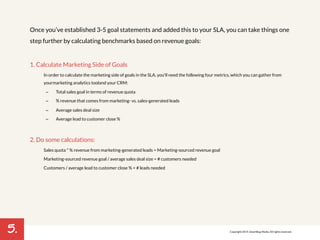
Once you’ve established 3-5 goal statements and added this to your SLA, you can take things one 
step further by calculating benchmarks based on revenue goals: 
1. Calculate Marketing Side of Goals 
In order to calculate the marketing side of goals in the SLA, you'll need the following four metrics, which you can gather from 
your marketing analytics tool and your CRM: 
– Total sales goal in terms of revenue quota 
– % revenue that comes from marketing- vs. sales-generated leads 
– Average sales deal size 
– Average lead to customer close % 
2. Do some calculations: 
Sales quota * % revenue from marketing-generated leads = Marketing-sourced revenue goal 
Marketing-sourced revenue goal / average sales deal size = # customers needed 
Customers / average lead to customer close % = # leads needed 
Copyright 2014. SmartBug Media. All rights reserved.
5. 
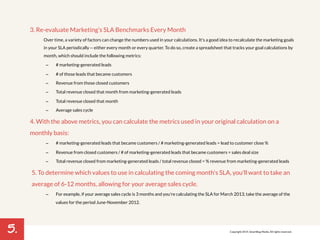
3. Re-evaluate Marketing’s SLA Benchmarks Every Month 
Over time, a variety of factors can change the numbers used in your calculations. It's a good idea to recalculate the marketing goals 
in your SLA periodically -- either every month or every quarter. To do so, create a spreadsheet that tracks your goal calculations by 
month, which should include the following metrics: 
– # marketing-generated leads 
– # of those leads that became customers 
– Revenue from those closed customers 
– Total revenue closed that month from marketing-generated leads 
– Total revenue closed that month 
– Average sales cycle 
4. With the above metrics, you can calculate the metrics used in your original calculation on a 
monthly basis: 
– # marketing-generated leads that became customers / # marketing-generated leads = lead to customer close % 
– Revenue from closed customers / # of marketing-generated leads that became customers = sales deal size 
– Total revenue closed from marketing-generated leads / total revenue closed = % revenue from marketing-generated leads 
5. To determine which values to use in calculating the coming month's SLA, you'll want to take an 
average of 6-12 months, allowing for your average sales cycle. 
– For example, if your average sales cycle is 3 months and you're calculating the SLA for March 2013, take the average of the 
values for the period June-November 2012. 
Copyright 2014. SmartBug Media. All rights reserved.
Defining Marketing and / 
Sales Qualified Leads 
/ 
Copyright 2014. SmartBug Media. All rights reserved. 
6.
6. 
Since many leads aren’t ready to be passed to sales yet but may deserve to be moved down the 
funnel through lead nurturing, one of the most important elements that marketing and sales 
teams can discuss are the differences between a marketing qualified lead(MQL) and sales 
qualified lead (SQL). While the definition of a company’s MQL or SQL will vary, here are several 
characteristics you can use to come up with your definitions: 
Behavior 
One of the most important factors that differentiates a lead from a MQL or SQL is their behavior on 
your website or how they engage with your company. For example, Company A may notice that first 
time visitors are just as likely to purchase as a repeat visitor, while Company B’s leads aren’t likely to 
convert until they’ve visited the site three or more times. There are some general behavioral 
characteristics that can be monitored and utilized in lead qualifying including: 
• First time visitor vs repeat visitor 
• The lead’s conversion count or the number of times they fill out a form 
• The lead's stage in the buying cycle 
• The lead’s source (i.e. Are leads from LinkedIn more likely to become customers for you?) 
Copyright 2014. SmartBug Media. All rights reserved.
6. 
Demographics 
Your website’s forms can be a goldmine for gathering lead qualifying information. Some examples of 
information you can gather and use in qualifying leads are: 
• Role 
• Company 
• Pain points 
• Budget 
Progressive Profile 
Because more form fields can decrease lead conversions, you shouldn’t ask for all the information 
you want on one form. With progressive profiling, a visitor fills out a form on a website landing 
page for the first time, they are required to only answer a few form fields. The next time that visitor 
fills out a form you can replace the existing form fields with new form fields to gain additional lead 
intelligence. 
Copyright 2014. SmartBug Media. All rights reserved.
6. 
The Service Part of the SLA 
When you discuss goals, you will likely talk to your sales team about what each of you need to do to 
be successful, but you should also take this a step further. Marketing will need to know how sales 
will follow up with leads and also when they will do this. This is important because timing really 
does matter for close rates. According to research published on Forbes.com of over 10,000 
companies, when leads are called in 5 minutes, the odds of contact are 100 times higher compared 
to 30 minutes. Thus, if marketing is going to promise X amount of qualified leads this month, sales 
also needs to promise to follow up quickly and efficiently with these leads. 
3 Krogue,!Ken.!"Why!Companies!Waste!71%!Of!Internet!Leads."!Forbes.!July!12,!2012.!Accessed!September!10,!2014.!hMp://www.forbes.com/sites/kenkrogue/2012/07/12/theP 
blackPholePthatPexecu7vesPdontPknowPabout/.! 
Copyright 2014. SmartBug Media. All rights reserved.
Tools to Help/Adapt 
/ 
Copyright 2014. SmartBug Media. All rights reserved. 
7.
7. 
One/of/the/major/differences/between/humans/and/chimpanzees,/which/is/thought/to/be/the/driving/ 
force/behind/human/intelligence,/is/the/sophisBcaBon/of/tools/used/by/humans.//Thus,!the!tools!that! 
humans!once!created!and!used!has!helped!to!evolve!the!intelligence!we!possess!today.!!Like!human! 
evolu7on,!the!sales!and!marke7ng!rela7onship!can!also!gain!a!significant!amount!of!intelligence!and! 
success!from!the!tools!they!u7lize.!! 
Closed-Loop Marketing 
Your company likely already has tools for marketing like automation software and tools for sales 
like a CRM. This is great, but both tools often times don’t integrate. Closed-loop 
marketing integrates your marketing software with the sales’ CRM system. This type of marketing 
gives you the ability to see which channels are most successful at closing sales and which ones may 
need some work. 
If you use HubSpot for marketing automation, you can integrate CRMs like Salesforce, Sugar CRM, 
and Microsoft Dynamics. Even better, if your sales team doesn’t use a CRM or the CRM you 
currently use isn’t optimal, you can use the new HubSpot CRM for closed-loop marketing. 
! 
Copyright 2014. SmartBug Media. All rights reserved.
7. 
Lead Scoring 
Lead scoring is a valuable tool that allows you to automate lead qualifying by placing a value on a 
lead based on online behavior and demographics gathered from forms. It is especially valuable to 
companies who are generating more leads than they can manage manually. With HubSpot, leads 
who are given are a particular score can be stored in a Smart list for sales to easily monitor. 
Workflows 
While workflows on HubSpot are beneficial for lead nurturing campaigns, they are also beneficial 
for internal notifications. For example, when a sales qualified lead converts on your website, the 
workflow tool can be used to notify your sales team. 
Sidekick 
Sidekick is a HubSpot tool that plugs into email applications allowing your sales team to allows have 
lead data accessible. It also sends instant notifications for lead revisits and activity. 
!! 
! 
Copyright 2014. SmartBug Media. All rights reserved.
7. 
Social Media 
Marketing usually takes the steering wheel on social media, but it is also beneficial to get your sales 
team up-to-speed on using social too. Not only will prospects research your sales team via social 
media, which means their profile pictures shouldn’t be of their dog, they can also use social media 
for prospecting and reaching out to leads or customers. 
Copyright 2014. SmartBug Media. All rights reserved.
Partner with Sales/ 
On Content / 
Copyright 2014. SmartBug Media. All rights reserved. 
8.
8. 
Although marketing has always been responsible for creating content, your sales team may 
actually be a gold mine for ideas because they work closely with prospects and customers. Ask 
your sales team what some of the typical questions prospects ask, what their pain points are, and 
what type of information they would find helpful on your website. In addition, producing content 
for your website or blog can take a lot of man power, which is why it is great to get your sales team 
to contribute when possible. You may even want to offer incentives to those who do help 
contribute to the blog. 
Copyright 2014. SmartBug Media. All rights reserved.
Conclusion 
The Internet has caused the buying process to 
evolve, which has ultimately created a need for 
change in the way we market and sell. Inbound 
marketing, as well as a collaborative 
relationship between marketing and sales 
teams helps companies adapt to this big shift. If 
your company wants to take action and build a 
better marketing and sales relationship, but find 
that you don’t have the time nor the expertise, 
consider contacting SmartBug Media for a 
Marketing Assessment. We’d love to help you. 
Copyright 2014. SmartBug Media. All rights reserved.
How’s your marketing? While you’re busy integrating 
sales and marketing teams, SmartBug Media can help 
you get the rest done. Consider contacting SmartBug 
Media for a complimentary Marketing Assessment. 
We’d love to help you! 
Request a Free Marketing Assessment! 
Copyright 2014. SmartBug Media. All rights reserved.

Evolution of-sales-marketing

  • 1.
    The Evolution ofthe Sales and Marketing Relationship WHAT YOU NEED TO KNOW TO ADAPT!
  • 2.
    Table of Contents! 1. The History of Marketing & Sales 2. The Evolution of the Buying Process – Why We Must Adapt 3. How Inbound Marketing Helps Us Adapt 4. Gaining Sales Buy-In 5. Creating a Service-Level Agreement (SLA) 6. Defining Marketing and Sales Qualified Leads 7. Tools to Help Adapt 8. Partner with Sales on Content Conclusion Copyright 2014. SmartBug Media. All rights reserved.
  • 3.
    The History of Marketing & Sales Copyright 2014. SmartBug Media. All rights reserved. 1.
  • 4.
    1. In early2014, HubSpot and LinkedIn wanted to gain knowledge about current processes and collaboration between marketing and sales. The two powerhouses surveyed several marketing teams and found that although most marketers agree that their sales teams are collaborative, 59% admit that they do not have a formal service level agreement (SLA) with sales. In addition, 40% have yet to define rules and criteria for marketing- or sales-qualified leads for their company. While the data surprising to some, it certainly isn’t breaking news that marketing and sales teams don’t always mesh. Marketing and sales should work simultaneously and cohesively, but why is it that they don’t? To start with, marketing professionals are wired differently than sales professionals. Marketers are the protectors of the brand, the voice of the company, and the company’s advocate on various media channels. Marketers are also content kings. They labor and sweat to make sure the goals mentioned above are achieved. At the end of the day, a marketer’s greatest want is to represent!a! company’s!product!or!service!in!such!a!way!that!the!right!prospects!are!interested!in!learning!more!and! exis7ng!customers!are!compelled!to!come!back!for!more.! Conversely, sales teams are responsible for converting marketing qualified leads into opportunities Copyright 2014. SmartBug Media. All rights reserved.
  • 5.
    1. and closingthe sale. The bottom line is that moving a lead to an opportunity to a customer is them most important thing to them. A salesperson’s goal are simply different from a marketer’s goals. Sales professionals also approach their job quite differently than marketers do. They are driven by in-person, or phone one on one interaction with their leads. Rather than using media channels as their core communication tactics, they use their individual personalities and well-developed sales strategies to close the sale of the product or service. Sales teams are focused on the here-and-now rather than the future of the brand and how it is perceived. That isn’t to say, they don’t care at all about the brand or company, but the brand isn’t where the immediate pay off lives for them. In the past, many companies have been able to overlook the conflict between the two revenue-generating departments, but this will, fortunately, no longer work in today’s hyper-digital world. 1 Devaney,!Erik.!"The!Data!You!Need!to!Make!a!Compelling!Case!for!Inbound!Marke7ng."!The!Data!You!Need!to!Make!a!Compelling!Case!for!Inbound!Marke7ng.!March!20,!2014.! Accessed!September!15,!2014.!hMp://blog.hubspot.com/marke7ng/inboundPmarke7ngPdata! Copyright 2014. SmartBug Media. All rights reserved.
  • 6.
    The Evolution ofthe Buying Process – WHY WE MUST ADAPT Copyright 2014. SmartBug Media. All rights reserved. 2.
  • 7.
    2. Some marketingand sales teams are working together by utilizing SLAs, that define lead quality, and much more. This is largely a result, as mentioned previously, of our hyper-digital world, which is also causing a shift in the typical buying process. For example, prior to the Internet and search engines (if you are, in fact, old enough to remember those days), you would drive down to your local appliance store, talk to a salesperson and purchase the vacuum that is most promoted by that salesperson. The salesperson was responsible for building trust, educating the buyer on the ins and outs of the industry and product offerings, and then closed the sale. Another example would be if you were the CEO of a large manufacturing company who needs to find a parts distributor near one of your plants; you pick up the phone book, dial a few numbers, or attend a local tradeshow. Today, you Google the “top rated vacuums” or, if you are the CEO, search Google for a “XYZ parts distributor in the Southeast.” As you can see, there has been a fundamental shift in the way we buy no matter what role we play. The buying process has changed because so much information is readily available online usually curated or created by the marketing team at a company. Copyright 2014. SmartBug Media. All rights reserved.
  • 8.
    2. We nolonger need to educate prospects on the industry, product offerings, or exceptional reviews in person, nor do our buyers seek that information out from a salesperson. Between 55 – 90% of B2B and B2C customers research information online before ever speaking with a sales representative. It is becoming more and more clear that because marketing is in charge of educating lead first, a healthy relationship with sales is imperative. Copyright 2014. SmartBug Media. All rights reserved.
  • 9.
    How Inbound Marketing HELPS US Adapt Copyright 2014. SmartBug Media. All rights reserved. 3.
  • 10.
    3. First ofall, what is inbound marketing? The inbound methodology works by bringing customers to a company by providing valuable information to prospects. Inbound marketers attract visitors to the company’s website by creating content, that is tailored to the ideal buyers needs and pain points. Then, the content is distributed through blogging, social media promo promotions and SEO best practices. Once visitors have been attracted to the website, visitors are converted into leads by offering a more valuable content asset that lives behind a form. To elaborate further, inbound marketing helps markets turn visitors into leads by offering educational or informational content offers in exchange for information, such as a name and email address, and other important contact information. Finally, there are leads that are ready to be passed to sales and those that are not. In fact, 50% of leads on your website are not ready to buy. Marketing handles those leads and brings them closer and closer to the qualification criteria by utilizing email automation, otherwise known as lead nurturing. So, how does inbound marketing help marketing and sales teams adapt to the changing buying process? Let’s review our example from above. Before you began your online search, an inbound marketer working for XYZ Vacuum Cleaners has created the “The Complete Guide to Selecting a Copyright 2014. SmartBug Media. All rights reserved.
  • 11.
    3. Great Vacuum”,published numerous blogs promoting this guide and also optimized XYZ Vacuum Cleaners’ website for SEO so that when you search for information, you’ll find their website. This makes sense, right? But where does sales come in? The answer is it really depends largely on the company. For example, if XYZ Vacuum Cleaners has not sold a vacuum all year, they may be more apt to pass every lead onto sales, but if they are thriving, they may choose to use marketing automation to help close the sale. For inbound marketing to be successful and for your company to be successful as the buying process evolves, marketing and sales teams need to work together. In this guide, you will learn how to do all this with your marketing and sales teams to ensure your company can survive the evolution of the buying process. Copyright 2014. SmartBug Media. All rights reserved.
  • 12.
    GAINING Sales Buy$In! 4. Copyright 2014. SmartBug Media. All rights reserved.
  • 13.
    4. The firststep to evolving the marketing and sales relationship is for marketers to get their salespeople onboard with inbound marketing if they haven’t already. Not only do they need to help them understand how the elements of inbound marketing, which are shown in the graph above, work together, they will also need to show sales that inbound marketing is successful. There are a few ways you can start convincing your sales team that inbound marketing works including: 1. Start Generating Leads If you are new to inbound marketing and haven’t generated very many quality leads from your website, it will be a bit more challenging to convince sales of its success. By launching an initial inbound marketing campaign, you can start to bring traffic and leads to your website, whom you can pass to sales as evidence that inbound marketing does work. 2. Gather Your Own Data In the past, it hasn’t been exactly easy to measure ROI from marketing campaigns. Without a closed-loop reporting tool, marketing did their thing and sales did theirs when it came to reporting. Marketing would place ads, and sales would follow up. Each had their way of measuring success, Copyright 2014. SmartBug Media. All rights reserved.
  • 14.
    4. but itwasn’t always easy to put the together. With a closed-loop reporting tool like HubSpot, you can know where marketing is most successful in generating leads and revenue. 3. Show Them How It Has Helped Others Your sales team has likely heard of inbound marketing, but they likely don’t know it like you do. If they haven’t jumped onboard with inbound marketing yet, show them how it has worked for others: Inbound marketing delivers 54% more leads into the marketing funnel than traditional outbound leads. • Inbound leads costs 61% less than outbound leads. • Companies that blog generate 126% more leads than those that don’t. • 61% of U.S. consumers have made a purchase based on a blog post. • 70% of consumers prefer getting to know a company via articles (not ads). • Social media produces the marketing leads of tradeshows, telemarketing, direct mail, or PPC. • Companies that automate lead management see a 10% or greater increase in revenue in 6-9 months. Copyright 2014. SmartBug Media. All rights reserved.
  • 15.
    Creating a Service$Level/ Agreement/(SLA) ! Copyright 2014. SmartBug Media. All rights reserved. 5.
  • 16.
    5. All ofthe information that marketing and sales share including goals, processes and even the tools used to make the relationship successful should be documented in a service-level agreement (SLA). This will ensure that both teams are held accountable and everyone is on the same page. One of the first elements to discuss and add to the SLA are goals. Creating Goal Statements Many marketers will likely admit that setting goals hasn’t been their forte’. When they do set goals, they look something like this: • Spread our brand presence on social media. • Purify our brand by establishing a stronger voice. • Increase leads over the next quarter. 2 Devaney,!Erik.!"The!Data!You!Need!to!Make!a!Compelling!Case!for!Inbound!Marke7ng."!The!Data!You!Need!to!Make!a!Compelling!Case!for!Inbound!Marke7ng.!March!20,!2014.! Accessed!September!15,!2014.!hMp://blog.hubspot.com/marke7ng/inboundPmarke7ngPdata.! Copyright 2014. SmartBug Media. All rights reserved.
  • 17.
    5. This isgreat, and credit should be given to those who are actually thinking about goals, but the problem with the examples above and many of the goals set by marketers is that they lack several critical components that make goals actionable. On the other hand, sales teams have been much better at setting goals, however; the biggest problem with those goals is that they are rarely communicated to the marketing team. For marketing and sales teams to be successful, they need to work together when setting goals and discuss the strategies they will use to help achieve them. When discussing goals, it is important to consider the following in creating goal statements: 1. What are you going to achieve? When creating a goal statement, be specific about what you want to achieve and the purpose of the goal. Do you need to reach a monthly/annual revenue goal by a certain date? Is there a certain lead generation target you need to reach for a campaign? Of course, you can also include non-monetary goals like hosting a fundraising event. A well-written goal statement would look like this, “Generate 50% more leads by the end of the year.” ! Copyright 2014. SmartBug Media. All rights reserved.
  • 18.
    5. 2. Howwill you achieve this? What does your marketing and sales team each need to contribute to help achieve this goal? What will each team plan to do to help ensure this happens? For example, a revenue increase of $10,000 by the end of the year may mean that marketing has to help generate 50% more leads by launching an inbound campaign, and sales must close 25% of those leads by following up within one day to all qualified leads generated. 3. What challenges could you encounter? It’s great to have a goal and a plan to get there, but are you being overly optimistic? Are there budget constraints that could stand in the way? Do you lack the internal resources to build an inbound campaign? Does your sales team have the time to follow up in one day? 4. What are your milestones? Most of your goals likely happen quarterly or annually. To ensure you are on track along the way, set milestones. This allows you to adjust your strategy if you aren’t making the mark. 5. What are the rewards and consequences? Knowing how you might benefit from achieving the goal is important because it helps motivate the entire team. On the other hand, knowing the consequences helps push you to achieve the goal through the fear of expense. Copyright 2014. SmartBug Media. All rights reserved.
  • 19.
    5. Once you’veestablished 3-5 goal statements and added this to your SLA, you can take things one step further by calculating benchmarks based on revenue goals: 1. Calculate Marketing Side of Goals In order to calculate the marketing side of goals in the SLA, you'll need the following four metrics, which you can gather from your marketing analytics tool and your CRM: – Total sales goal in terms of revenue quota – % revenue that comes from marketing- vs. sales-generated leads – Average sales deal size – Average lead to customer close % 2. Do some calculations: Sales quota * % revenue from marketing-generated leads = Marketing-sourced revenue goal Marketing-sourced revenue goal / average sales deal size = # customers needed Customers / average lead to customer close % = # leads needed Copyright 2014. SmartBug Media. All rights reserved.
  • 20.
    5. 3. Re-evaluateMarketing’s SLA Benchmarks Every Month Over time, a variety of factors can change the numbers used in your calculations. It's a good idea to recalculate the marketing goals in your SLA periodically -- either every month or every quarter. To do so, create a spreadsheet that tracks your goal calculations by month, which should include the following metrics: – # marketing-generated leads – # of those leads that became customers – Revenue from those closed customers – Total revenue closed that month from marketing-generated leads – Total revenue closed that month – Average sales cycle 4. With the above metrics, you can calculate the metrics used in your original calculation on a monthly basis: – # marketing-generated leads that became customers / # marketing-generated leads = lead to customer close % – Revenue from closed customers / # of marketing-generated leads that became customers = sales deal size – Total revenue closed from marketing-generated leads / total revenue closed = % revenue from marketing-generated leads 5. To determine which values to use in calculating the coming month's SLA, you'll want to take an average of 6-12 months, allowing for your average sales cycle. – For example, if your average sales cycle is 3 months and you're calculating the SLA for March 2013, take the average of the values for the period June-November 2012. Copyright 2014. SmartBug Media. All rights reserved.
  • 21.
    Defining Marketing and/ Sales Qualified Leads / Copyright 2014. SmartBug Media. All rights reserved. 6.
  • 22.
    6. Since manyleads aren’t ready to be passed to sales yet but may deserve to be moved down the funnel through lead nurturing, one of the most important elements that marketing and sales teams can discuss are the differences between a marketing qualified lead(MQL) and sales qualified lead (SQL). While the definition of a company’s MQL or SQL will vary, here are several characteristics you can use to come up with your definitions: Behavior One of the most important factors that differentiates a lead from a MQL or SQL is their behavior on your website or how they engage with your company. For example, Company A may notice that first time visitors are just as likely to purchase as a repeat visitor, while Company B’s leads aren’t likely to convert until they’ve visited the site three or more times. There are some general behavioral characteristics that can be monitored and utilized in lead qualifying including: • First time visitor vs repeat visitor • The lead’s conversion count or the number of times they fill out a form • The lead's stage in the buying cycle • The lead’s source (i.e. Are leads from LinkedIn more likely to become customers for you?) Copyright 2014. SmartBug Media. All rights reserved.
  • 23.
    6. Demographics Yourwebsite’s forms can be a goldmine for gathering lead qualifying information. Some examples of information you can gather and use in qualifying leads are: • Role • Company • Pain points • Budget Progressive Profile Because more form fields can decrease lead conversions, you shouldn’t ask for all the information you want on one form. With progressive profiling, a visitor fills out a form on a website landing page for the first time, they are required to only answer a few form fields. The next time that visitor fills out a form you can replace the existing form fields with new form fields to gain additional lead intelligence. Copyright 2014. SmartBug Media. All rights reserved.
  • 24.
    6. The ServicePart of the SLA When you discuss goals, you will likely talk to your sales team about what each of you need to do to be successful, but you should also take this a step further. Marketing will need to know how sales will follow up with leads and also when they will do this. This is important because timing really does matter for close rates. According to research published on Forbes.com of over 10,000 companies, when leads are called in 5 minutes, the odds of contact are 100 times higher compared to 30 minutes. Thus, if marketing is going to promise X amount of qualified leads this month, sales also needs to promise to follow up quickly and efficiently with these leads. 3 Krogue,!Ken.!"Why!Companies!Waste!71%!Of!Internet!Leads."!Forbes.!July!12,!2012.!Accessed!September!10,!2014.!hMp://www.forbes.com/sites/kenkrogue/2012/07/12/theP blackPholePthatPexecu7vesPdontPknowPabout/.! Copyright 2014. SmartBug Media. All rights reserved.
  • 25.
    Tools to Help/Adapt / Copyright 2014. SmartBug Media. All rights reserved. 7.
  • 26.
    7. One/of/the/major/differences/between/humans/and/chimpanzees,/which/is/thought/to/be/the/driving/ force/behind/human/intelligence,/is/the/sophisBcaBon/of/tools/used/by/humans.//Thus,!the!tools!that! humans!once!created!and!used!has!helped!to!evolve!the!intelligence!we!possess!today.!!Like!human! evolu7on,!the!sales!and!marke7ng!rela7onship!can!also!gain!a!significant!amount!of!intelligence!and! success!from!the!tools!they!u7lize.!! Closed-Loop Marketing Your company likely already has tools for marketing like automation software and tools for sales like a CRM. This is great, but both tools often times don’t integrate. Closed-loop marketing integrates your marketing software with the sales’ CRM system. This type of marketing gives you the ability to see which channels are most successful at closing sales and which ones may need some work. If you use HubSpot for marketing automation, you can integrate CRMs like Salesforce, Sugar CRM, and Microsoft Dynamics. Even better, if your sales team doesn’t use a CRM or the CRM you currently use isn’t optimal, you can use the new HubSpot CRM for closed-loop marketing. ! Copyright 2014. SmartBug Media. All rights reserved.
  • 27.
    7. Lead Scoring Lead scoring is a valuable tool that allows you to automate lead qualifying by placing a value on a lead based on online behavior and demographics gathered from forms. It is especially valuable to companies who are generating more leads than they can manage manually. With HubSpot, leads who are given are a particular score can be stored in a Smart list for sales to easily monitor. Workflows While workflows on HubSpot are beneficial for lead nurturing campaigns, they are also beneficial for internal notifications. For example, when a sales qualified lead converts on your website, the workflow tool can be used to notify your sales team. Sidekick Sidekick is a HubSpot tool that plugs into email applications allowing your sales team to allows have lead data accessible. It also sends instant notifications for lead revisits and activity. !! ! Copyright 2014. SmartBug Media. All rights reserved.
  • 28.
    7. Social Media Marketing usually takes the steering wheel on social media, but it is also beneficial to get your sales team up-to-speed on using social too. Not only will prospects research your sales team via social media, which means their profile pictures shouldn’t be of their dog, they can also use social media for prospecting and reaching out to leads or customers. Copyright 2014. SmartBug Media. All rights reserved.
  • 29.
    Partner with Sales/ On Content / Copyright 2014. SmartBug Media. All rights reserved. 8.
  • 30.
    8. Although marketinghas always been responsible for creating content, your sales team may actually be a gold mine for ideas because they work closely with prospects and customers. Ask your sales team what some of the typical questions prospects ask, what their pain points are, and what type of information they would find helpful on your website. In addition, producing content for your website or blog can take a lot of man power, which is why it is great to get your sales team to contribute when possible. You may even want to offer incentives to those who do help contribute to the blog. Copyright 2014. SmartBug Media. All rights reserved.
  • 31.
    Conclusion The Internethas caused the buying process to evolve, which has ultimately created a need for change in the way we market and sell. Inbound marketing, as well as a collaborative relationship between marketing and sales teams helps companies adapt to this big shift. If your company wants to take action and build a better marketing and sales relationship, but find that you don’t have the time nor the expertise, consider contacting SmartBug Media for a Marketing Assessment. We’d love to help you. Copyright 2014. SmartBug Media. All rights reserved.
  • 32.
    How’s your marketing?While you’re busy integrating sales and marketing teams, SmartBug Media can help you get the rest done. Consider contacting SmartBug Media for a complimentary Marketing Assessment. We’d love to help you! Request a Free Marketing Assessment! Copyright 2014. SmartBug Media. All rights reserved.