
The Current Transport Policy Environment (Law 23/2007: Objectives & Follow-up)Harun al-Rasyid LUBIS15 December 2009
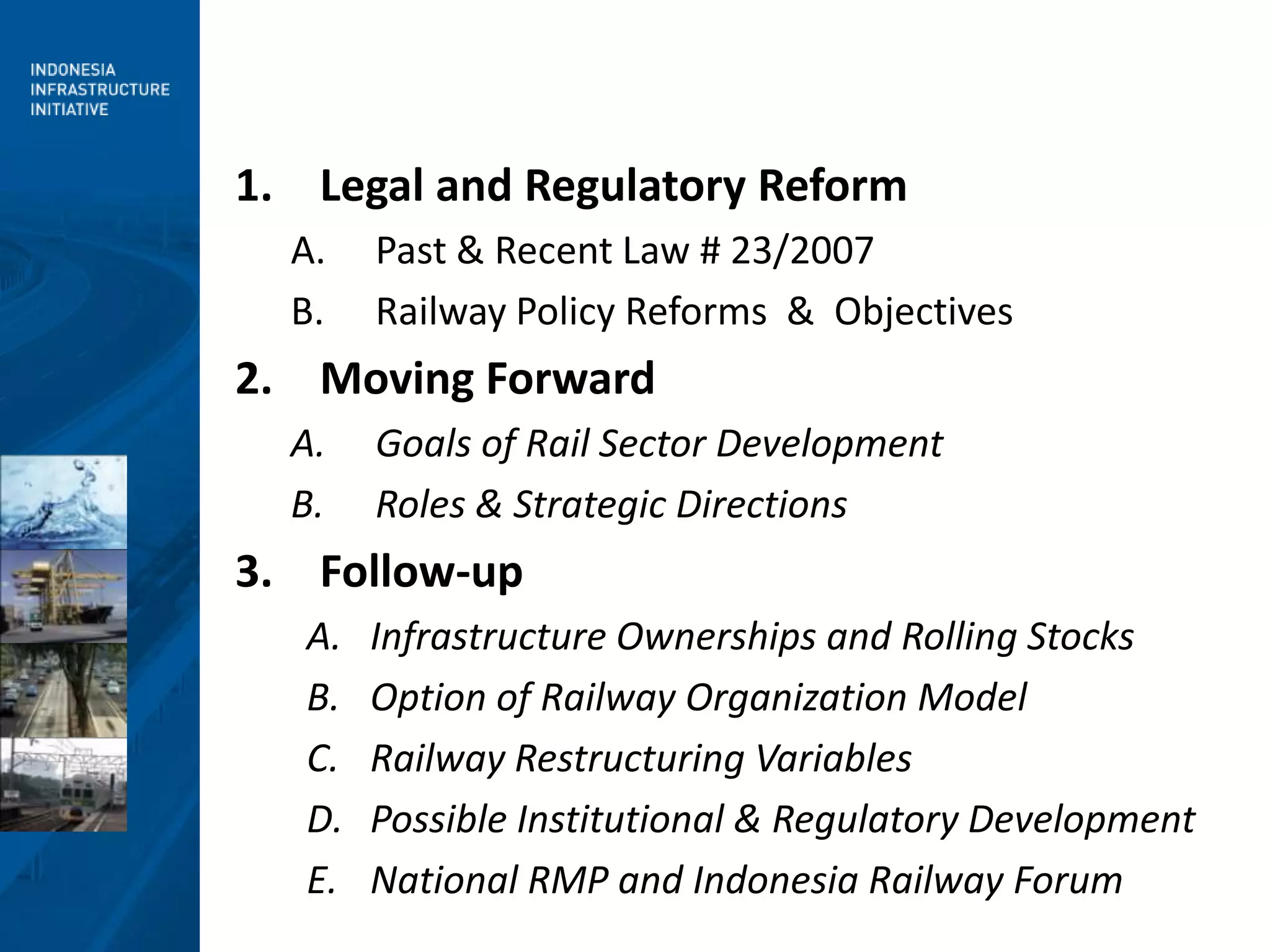
Legal and Regulatory ReformPast & Recent Law # 23/2007Railway Policy Reforms  &  Objectives Moving ForwardGoals of Rail Sector DevelopmentRoles & Strategic DirectionsFollow-upInfrastructure Ownerships and Rolling StocksOption of Railway Organization ModelRailway Restructuring VariablesPossible Institutional & Regulatory DevelopmentNational RMP and Indonesia Railway Forum
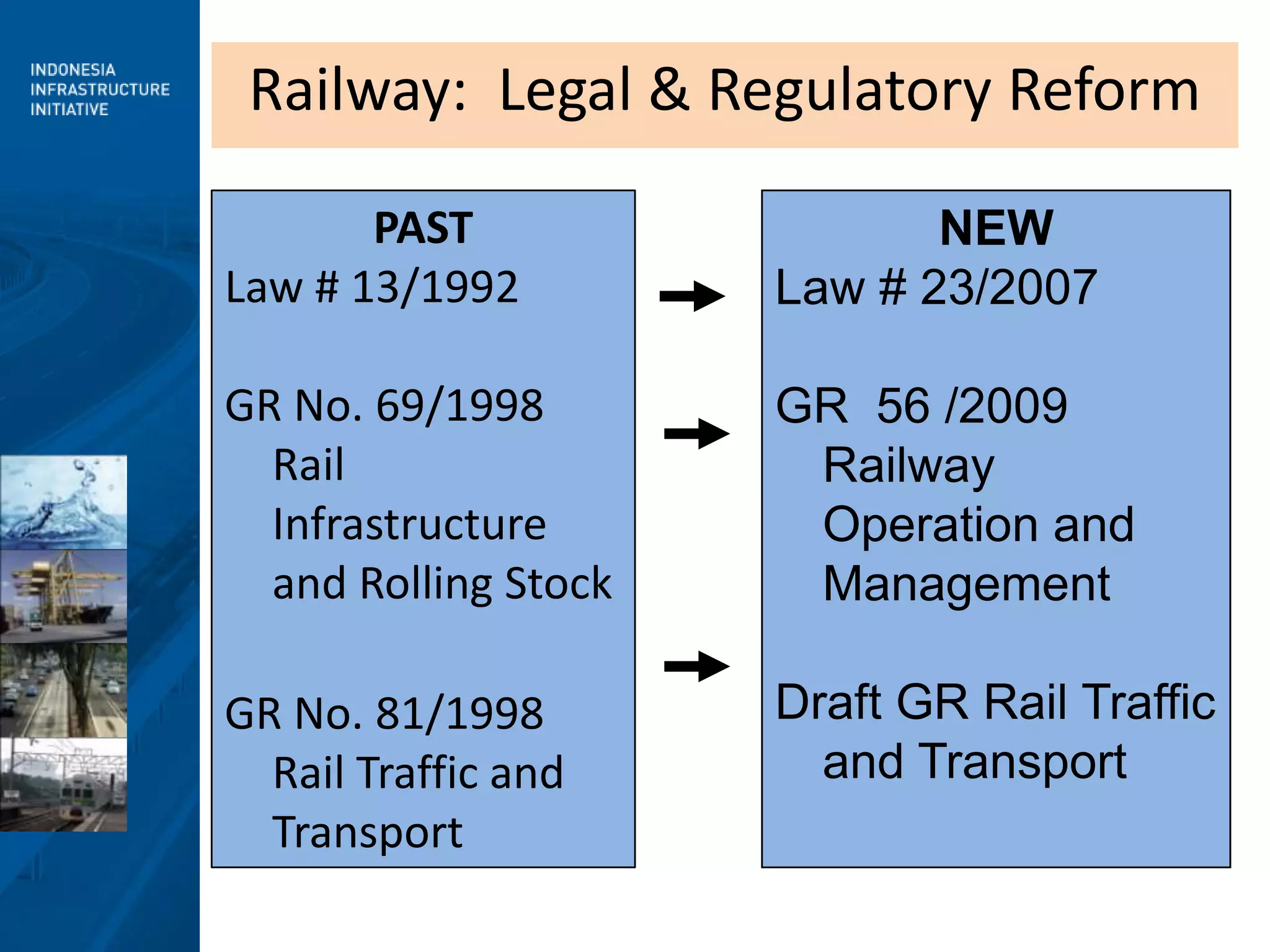
Railway:  Legal & Regulatory ReformPASTLaw # 13/1992 GR No. 69/1998 Rail Infrastructure and Rolling StockGR No. 81/1998 Rail Traffic and TransportNEWLaw # 23/2007GR  56 /2009 Railway Operation and Management Draft GR Rail Traffic and Transport
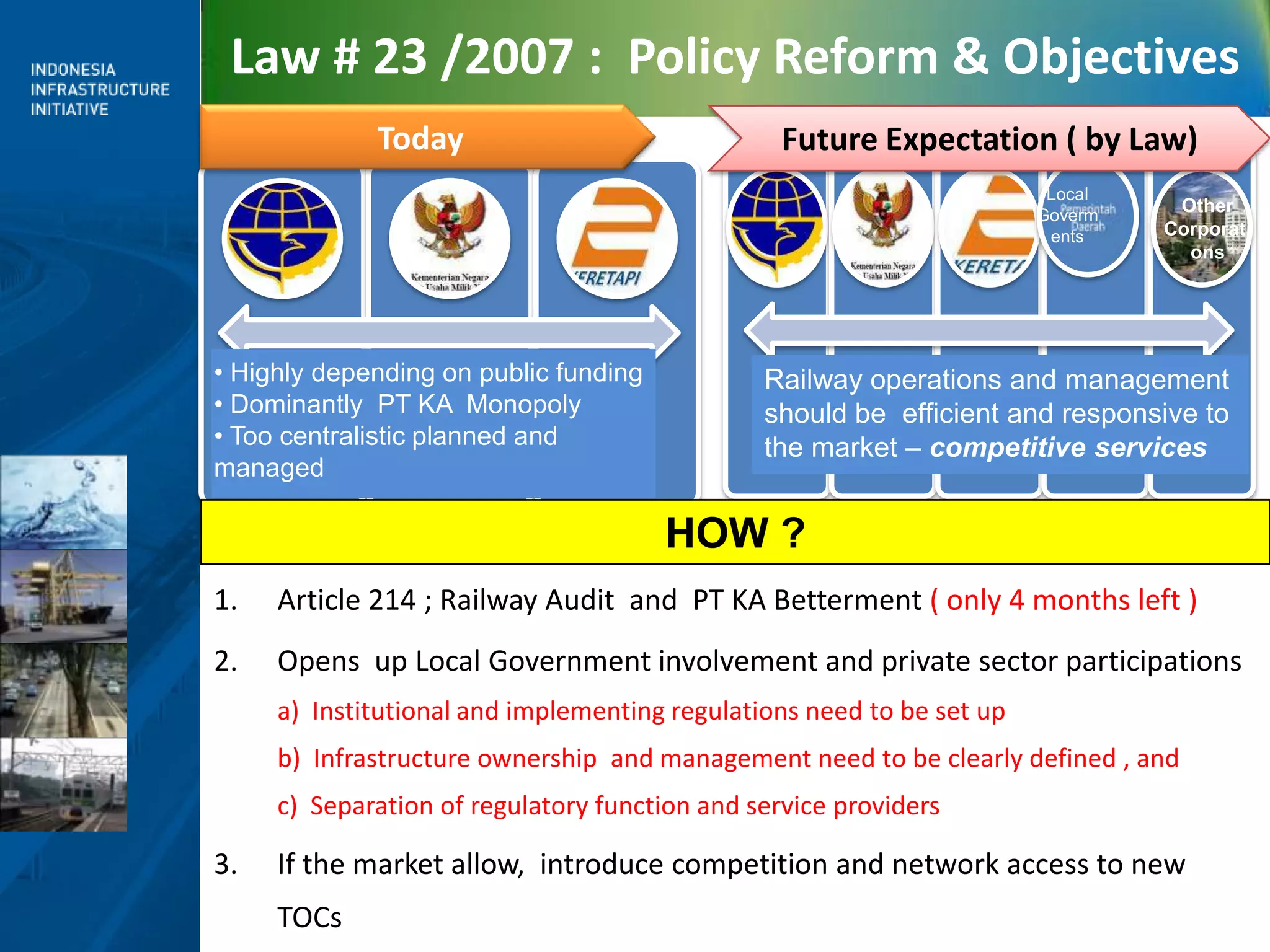
Law # 23 /2007 :  Policy Reform & ObjectivesToday Future Expectation ( by Law) Local GovermentsOther      Corporations Highly depending on public funding
 Dominantly  PT KA  Monopoly
 Too centralistic planned and managed  Railwayoperations and managementshouldbeefficient and responsivetothemarket – competitiveservicesHOW ?Article 214 ; Railway Audit  and  PT KA Betterment ( only 4 months left )Opens  up Local Government involvement and private sector participationsa)  Institutional and implementing regulations need to be set upb)  Infrastructure ownership  and management need to be clearly defined , andc)  Separation of regulatory function and service providersIf the market allow,  introduce competition and network access to new TOCs
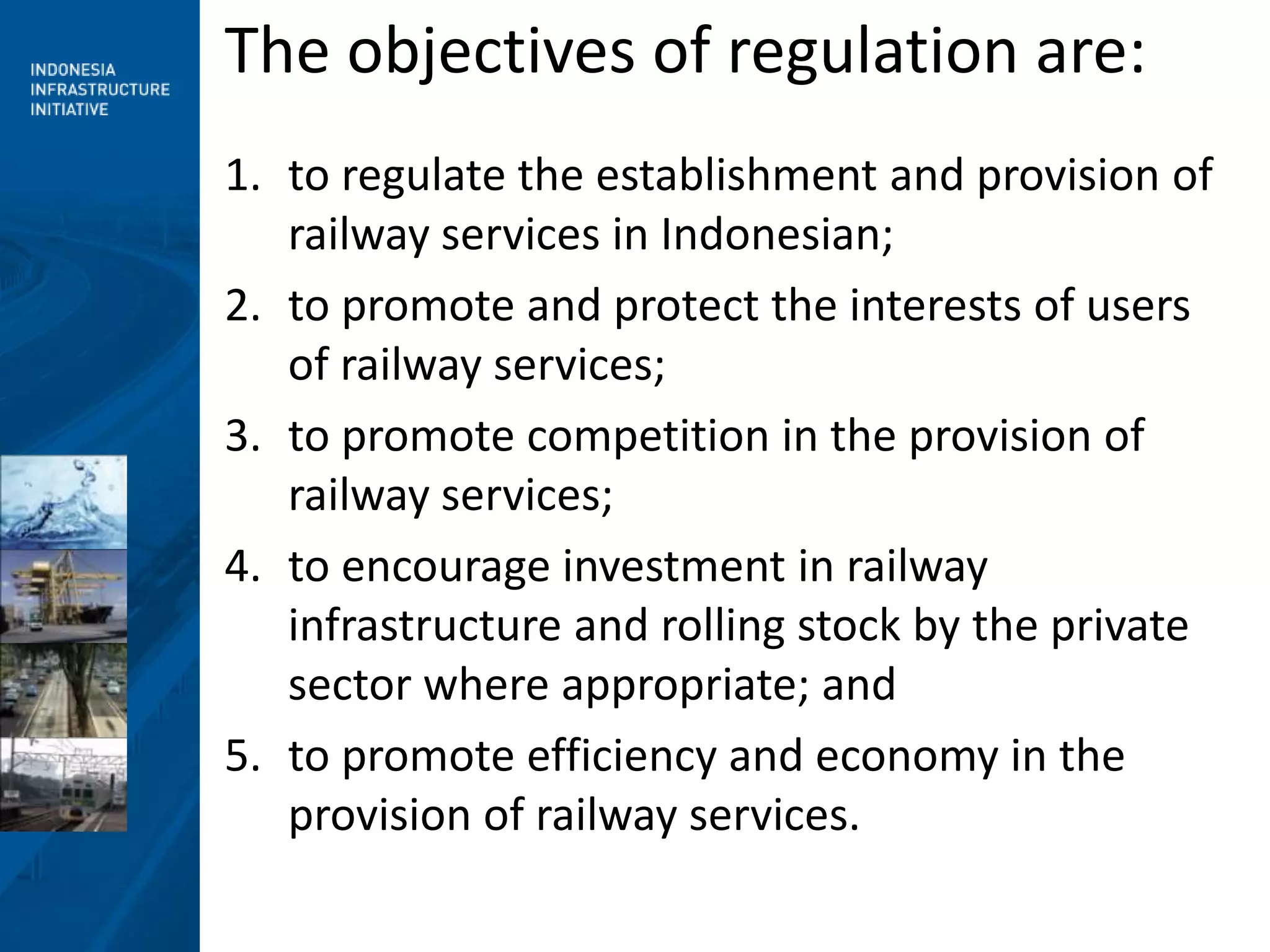
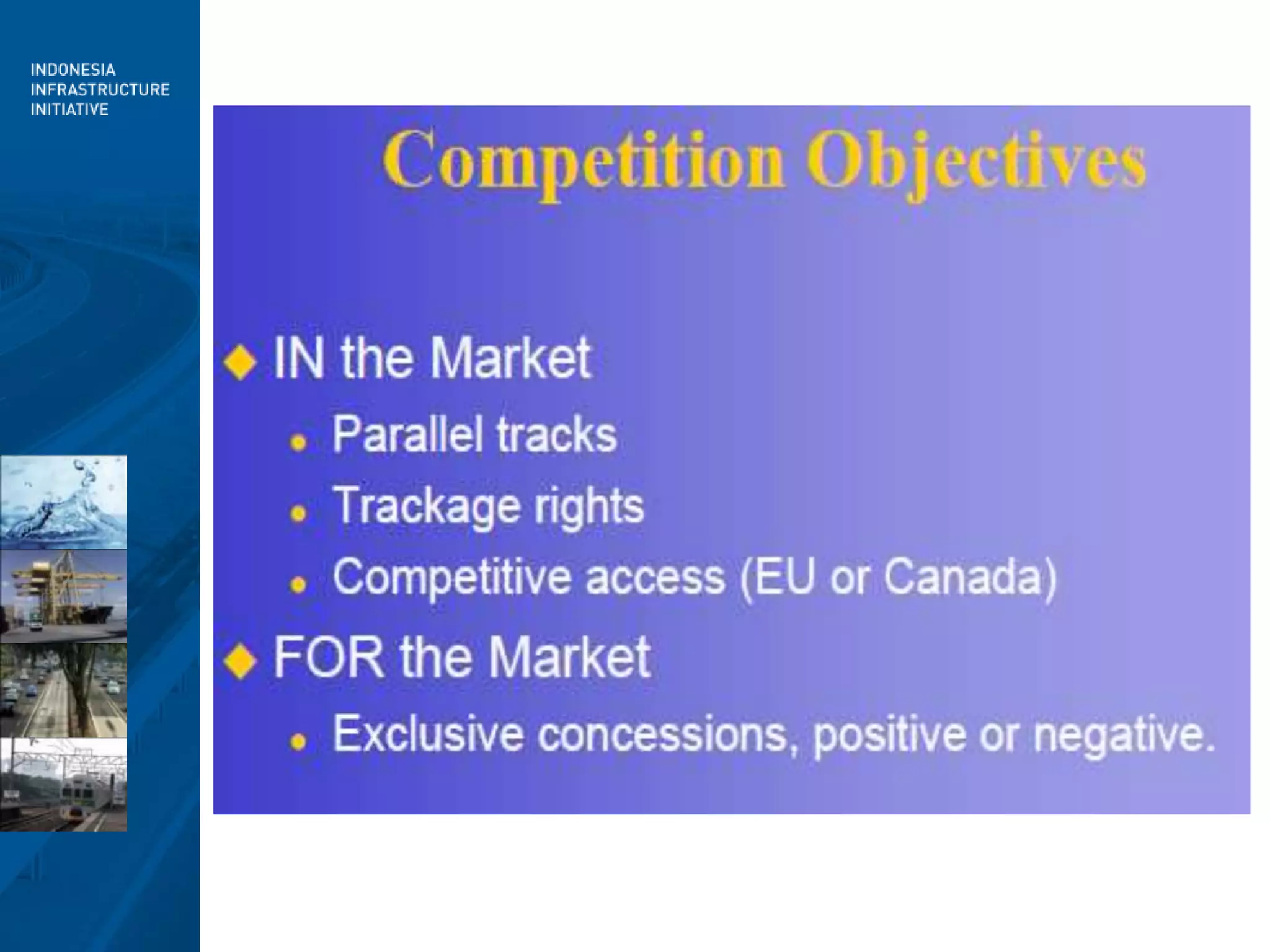
The objectives of regulation are: to regulate the establishment and provision of railway services in Indonesian;to promote and protect the interests of users of railway services;to promote competition in the provision of railway services;to encourage investment in railway infrastructure and rolling stock by the private sector where appropriate; andto promote efficiency and economy in the provision of railway services.
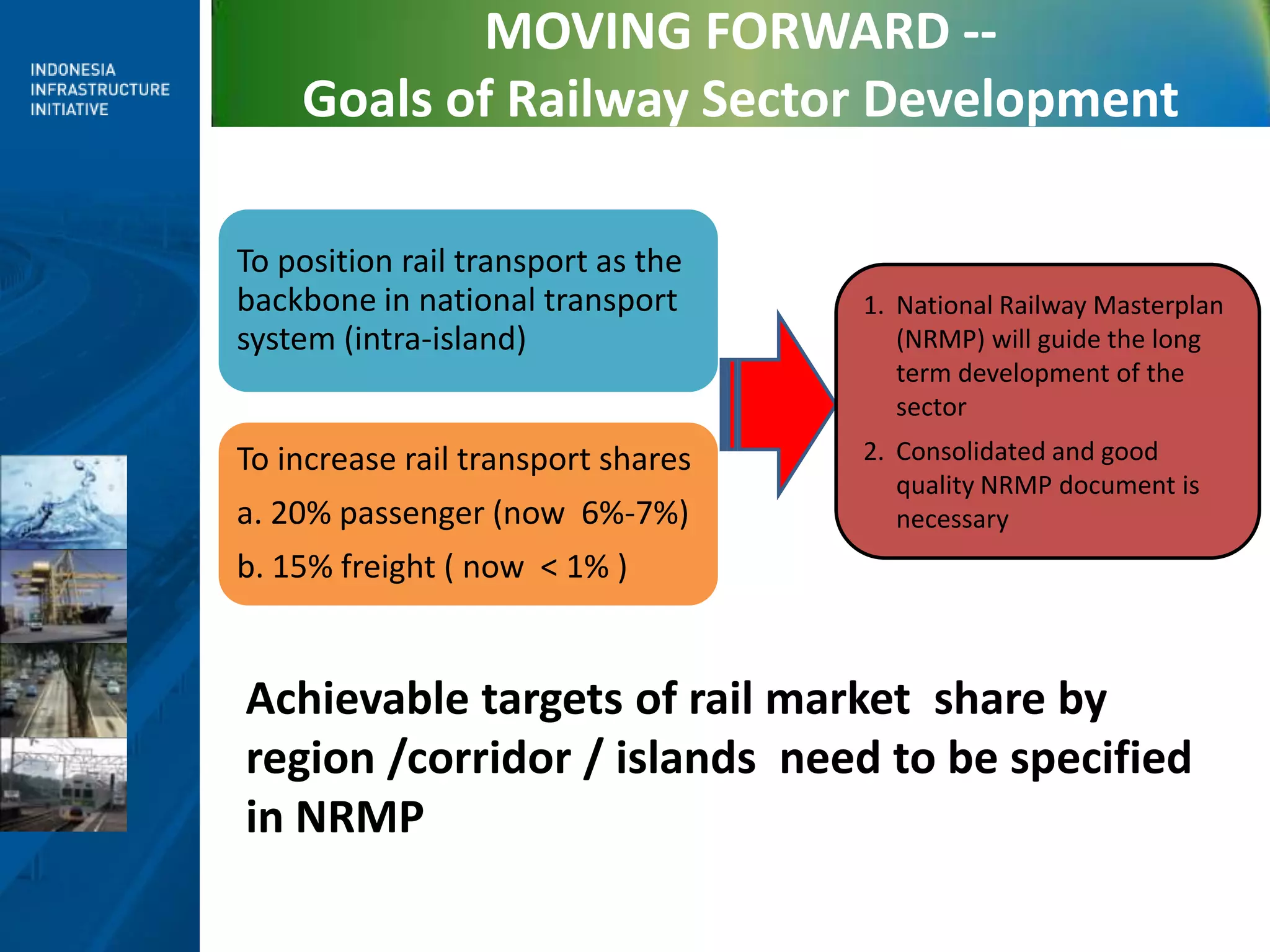
MOVING FORWARD --Goals of Railway Sector DevelopmentNational Railway Masterplan (NRMP) will guide the long term development of the sectorConsolidated and good quality NRMP document is necessaryAchievable targets of railmarket  share byregion /corridor / islandsneedtobespecified in NRMP
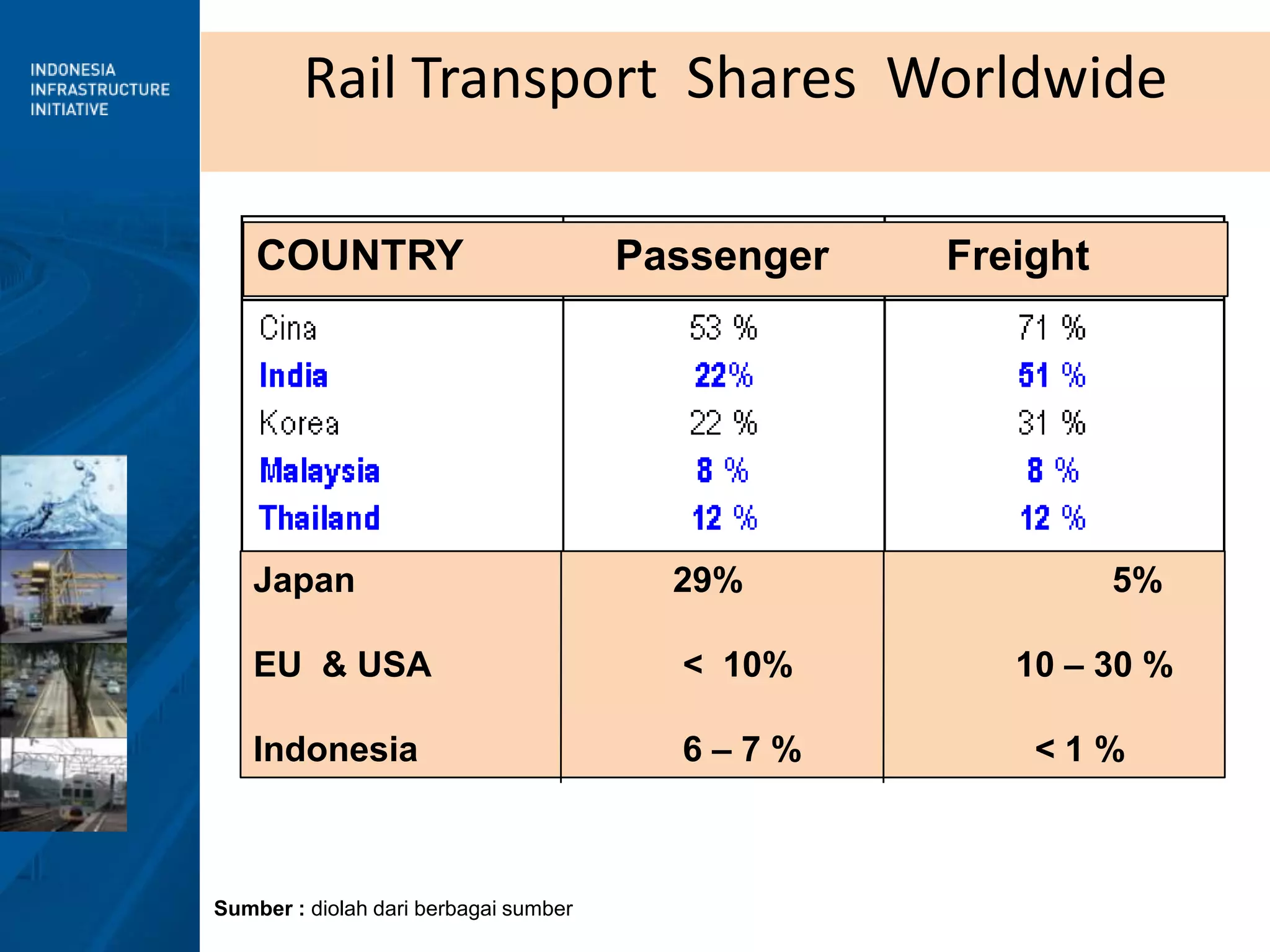
Rail Transport  Shares  WorldwideCOUNTRY             Passenger          FreightJapan 			    29%                                      5%EU  & USA		     <  10%		10 – 30 %Indonesia		     6 – 7 %		  < 1 %Sumber : diolah dari berbagai sumber
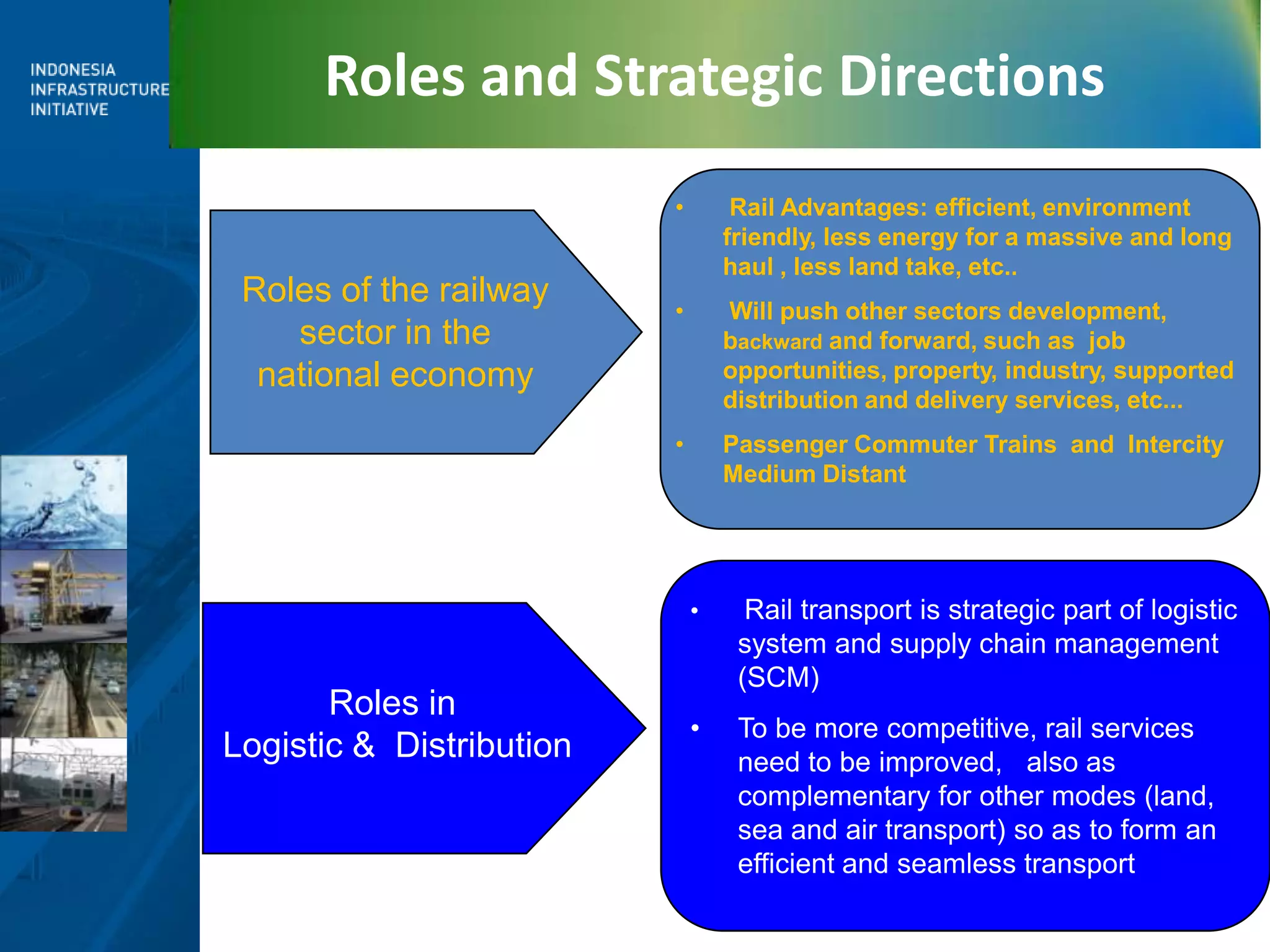
Roles and Strategic Directions Rail Advantages: efficient, environment friendly, less energy for a massive and long haul , less land take, etc..
 Will push other sectors development, backward and forward, such as  job opportunities, property, industry, supported distribution and delivery services, etc...
Passenger Commuter Trains  and  Intercity Medium Distant  Roles of the railway sector in the national economyRail transport is strategic part of logistic system and supply chain management (SCM)
To be more competitive, rail services need to be improved,   also as complementary for other modes (land, sea and air transport) so as to form an efficient and seamless transport Roles in Logistic &  Distribution
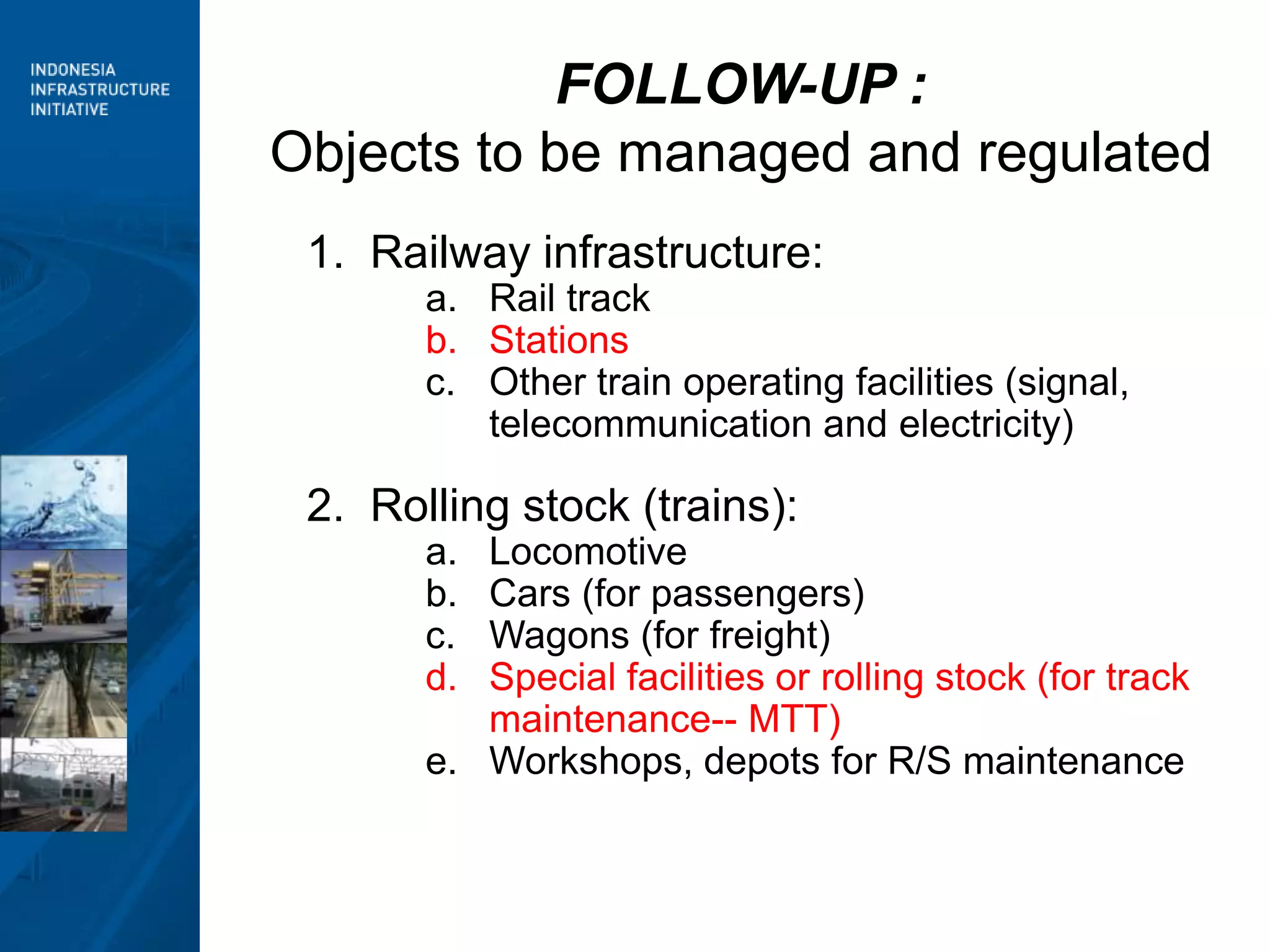
FOLLOW-UP :Objects to be managed and regulated    Railway infrastructure:Rail trackStationsOther train operating facilities (signal, telecommunication and electricity) Rolling stock (trains):LocomotiveCars (for passengers)Wagons (for freight)Special facilities or rolling stock (for track maintenance-- MTT)Workshops, depots for R/S maintenance
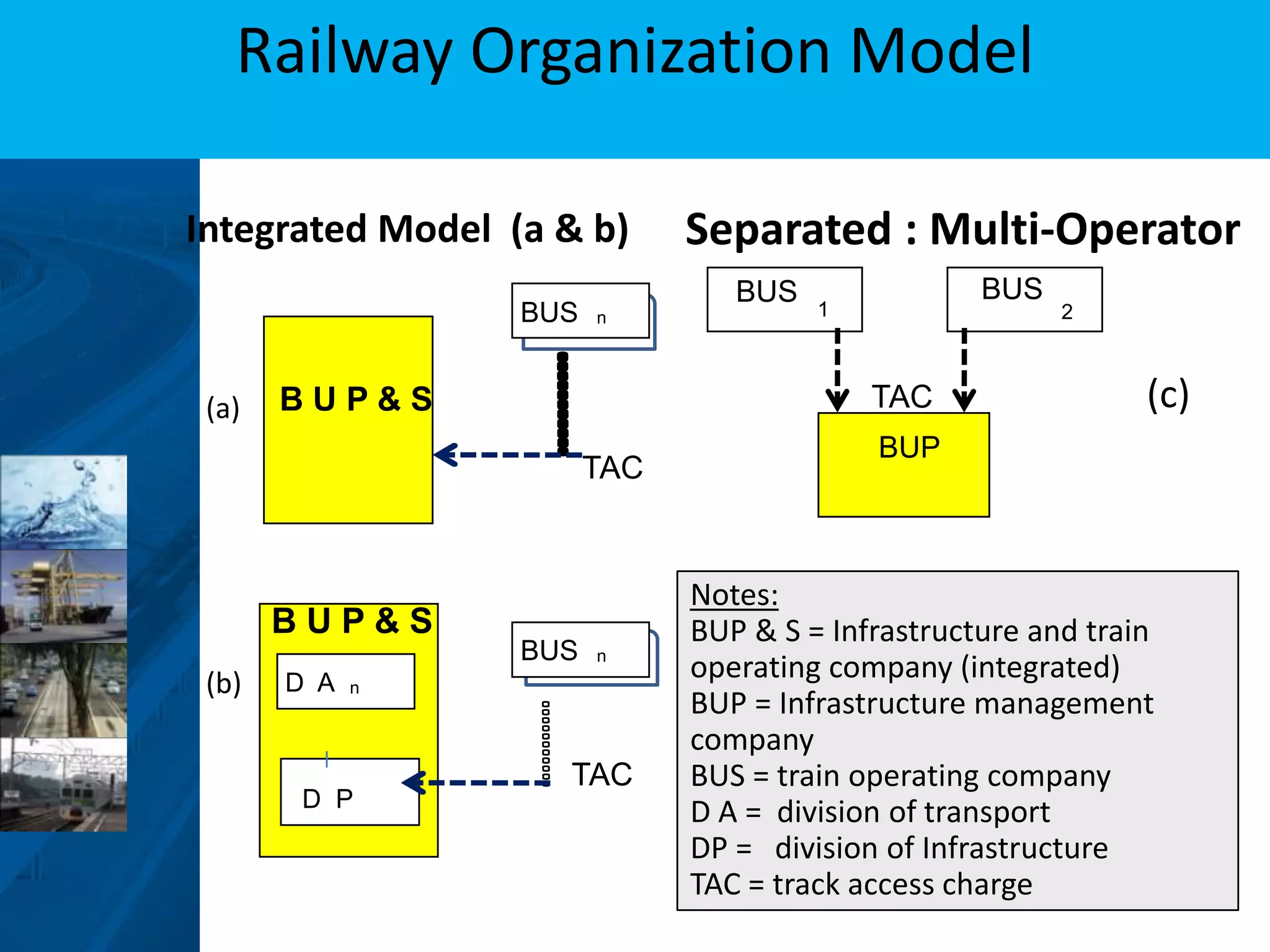
Railway Organization ModelSeparated : Multi-OperatorIntegrated Model  (a & b)BUS BUS  12BUSn(c)TACB U P & S(a)BUPTACNotes:BUP & S = Infrastructure and train operating company (integrated)BUP = Infrastructure management companyBUS = train operating companyD A =  division of transportDP =   division of InfrastructureTAC = track access chargeB U P & SBUSn(b)D  AnTACD  P
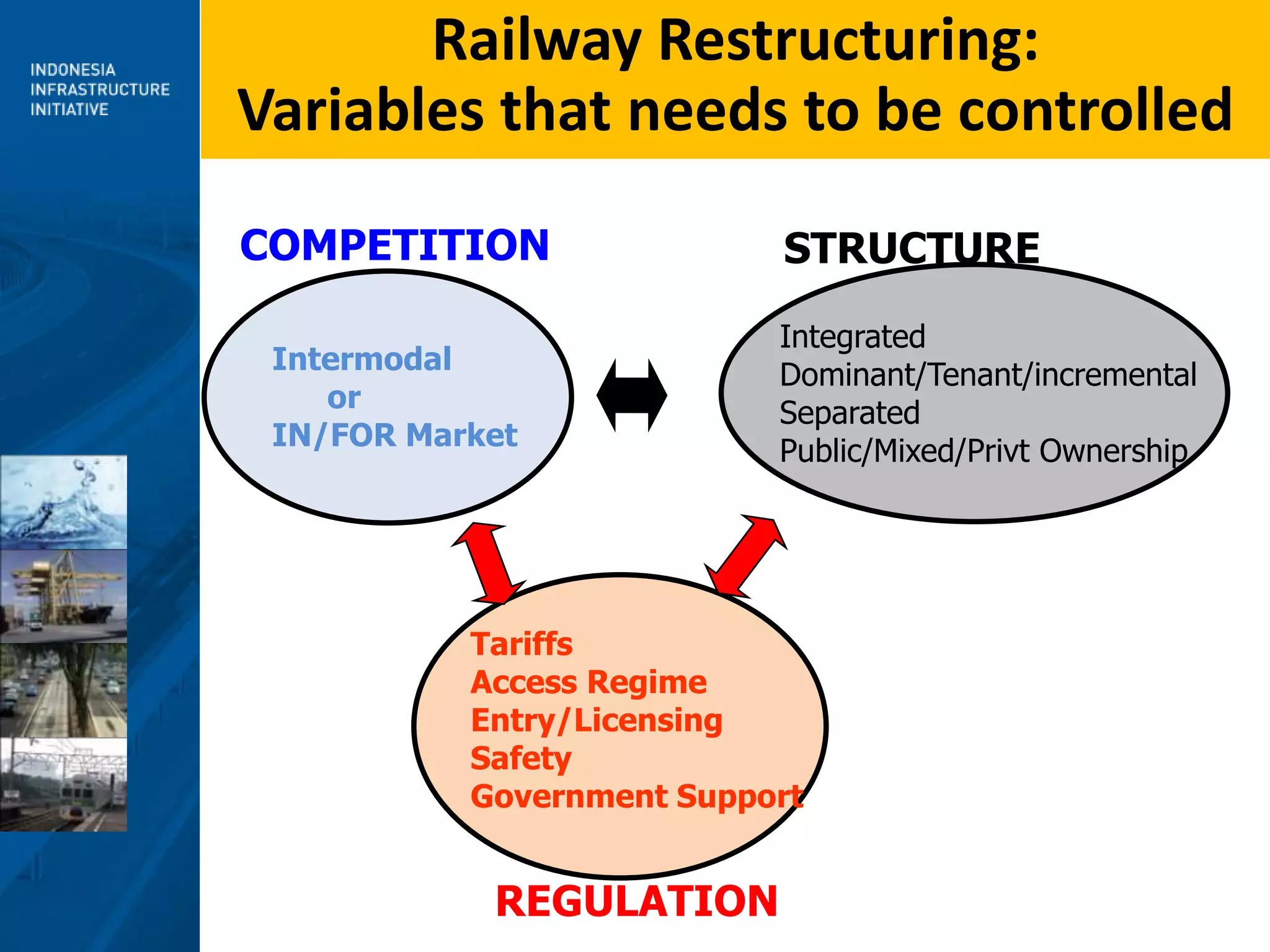
Railway Restructuring: Variables that needs to be controlledCOMPETITIONSTRUCTUREIntegratedDominant/Tenant/incrementalSeparatedPublic/Mixed/Privt OwnershipIntermodal      orIN/FOR MarketTariffsAccess RegimeEntry/LicensingSafetyGovernment SupportREGULATION

The Current Transport Policy Environment

  • 1.
    The Current TransportPolicy Environment (Law 23/2007: Objectives & Follow-up)Harun al-Rasyid LUBIS15 December 2009
  • 2.
    Legal and RegulatoryReformPast & Recent Law # 23/2007Railway Policy Reforms & Objectives Moving ForwardGoals of Rail Sector DevelopmentRoles & Strategic DirectionsFollow-upInfrastructure Ownerships and Rolling StocksOption of Railway Organization ModelRailway Restructuring VariablesPossible Institutional & Regulatory DevelopmentNational RMP and Indonesia Railway Forum
  • 3.
    Railway: Legal& Regulatory ReformPASTLaw # 13/1992 GR No. 69/1998 Rail Infrastructure and Rolling StockGR No. 81/1998 Rail Traffic and TransportNEWLaw # 23/2007GR 56 /2009 Railway Operation and Management Draft GR Rail Traffic and Transport
  • 4.
    Law # 23/2007 : Policy Reform & ObjectivesToday Future Expectation ( by Law) Local GovermentsOther Corporations Highly depending on public funding
  • 5.
    Dominantly PT KA Monopoly
  • 6.
    Too centralisticplanned and managed Railwayoperations and managementshouldbeefficient and responsivetothemarket – competitiveservicesHOW ?Article 214 ; Railway Audit and PT KA Betterment ( only 4 months left )Opens up Local Government involvement and private sector participationsa) Institutional and implementing regulations need to be set upb) Infrastructure ownership and management need to be clearly defined , andc) Separation of regulatory function and service providersIf the market allow, introduce competition and network access to new TOCs
  • 7.
    The objectives ofregulation are: to regulate the establishment and provision of railway services in Indonesian;to promote and protect the interests of users of railway services;to promote competition in the provision of railway services;to encourage investment in railway infrastructure and rolling stock by the private sector where appropriate; andto promote efficiency and economy in the provision of railway services.
  • 8.
    MOVING FORWARD --Goalsof Railway Sector DevelopmentNational Railway Masterplan (NRMP) will guide the long term development of the sectorConsolidated and good quality NRMP document is necessaryAchievable targets of railmarket share byregion /corridor / islandsneedtobespecified in NRMP
  • 9.
    Rail Transport Shares WorldwideCOUNTRY Passenger FreightJapan 29% 5%EU & USA < 10% 10 – 30 %Indonesia 6 – 7 % < 1 %Sumber : diolah dari berbagai sumber
  • 10.
    Roles and StrategicDirections Rail Advantages: efficient, environment friendly, less energy for a massive and long haul , less land take, etc..
  • 11.
    Will pushother sectors development, backward and forward, such as job opportunities, property, industry, supported distribution and delivery services, etc...
  • 12.
    Passenger Commuter Trains and Intercity Medium Distant Roles of the railway sector in the national economyRail transport is strategic part of logistic system and supply chain management (SCM)
  • 13.
    To be morecompetitive, rail services need to be improved, also as complementary for other modes (land, sea and air transport) so as to form an efficient and seamless transport Roles in Logistic & Distribution
  • 14.
    FOLLOW-UP :Objects tobe managed and regulated Railway infrastructure:Rail trackStationsOther train operating facilities (signal, telecommunication and electricity) Rolling stock (trains):LocomotiveCars (for passengers)Wagons (for freight)Special facilities or rolling stock (for track maintenance-- MTT)Workshops, depots for R/S maintenance
  • 15.
    Railway Organization ModelSeparated: Multi-OperatorIntegrated Model (a & b)BUS BUS 12BUSn(c)TACB U P & S(a)BUPTACNotes:BUP & S = Infrastructure and train operating company (integrated)BUP = Infrastructure management companyBUS = train operating companyD A = division of transportDP = division of InfrastructureTAC = track access chargeB U P & SBUSn(b)D AnTACD P
  • 16.
    Railway Restructuring: Variablesthat needs to be controlledCOMPETITIONSTRUCTUREIntegratedDominant/Tenant/incrementalSeparatedPublic/Mixed/Privt OwnershipIntermodal orIN/FOR MarketTariffsAccess RegimeEntry/LicensingSafetyGovernment SupportREGULATION
  • 18.
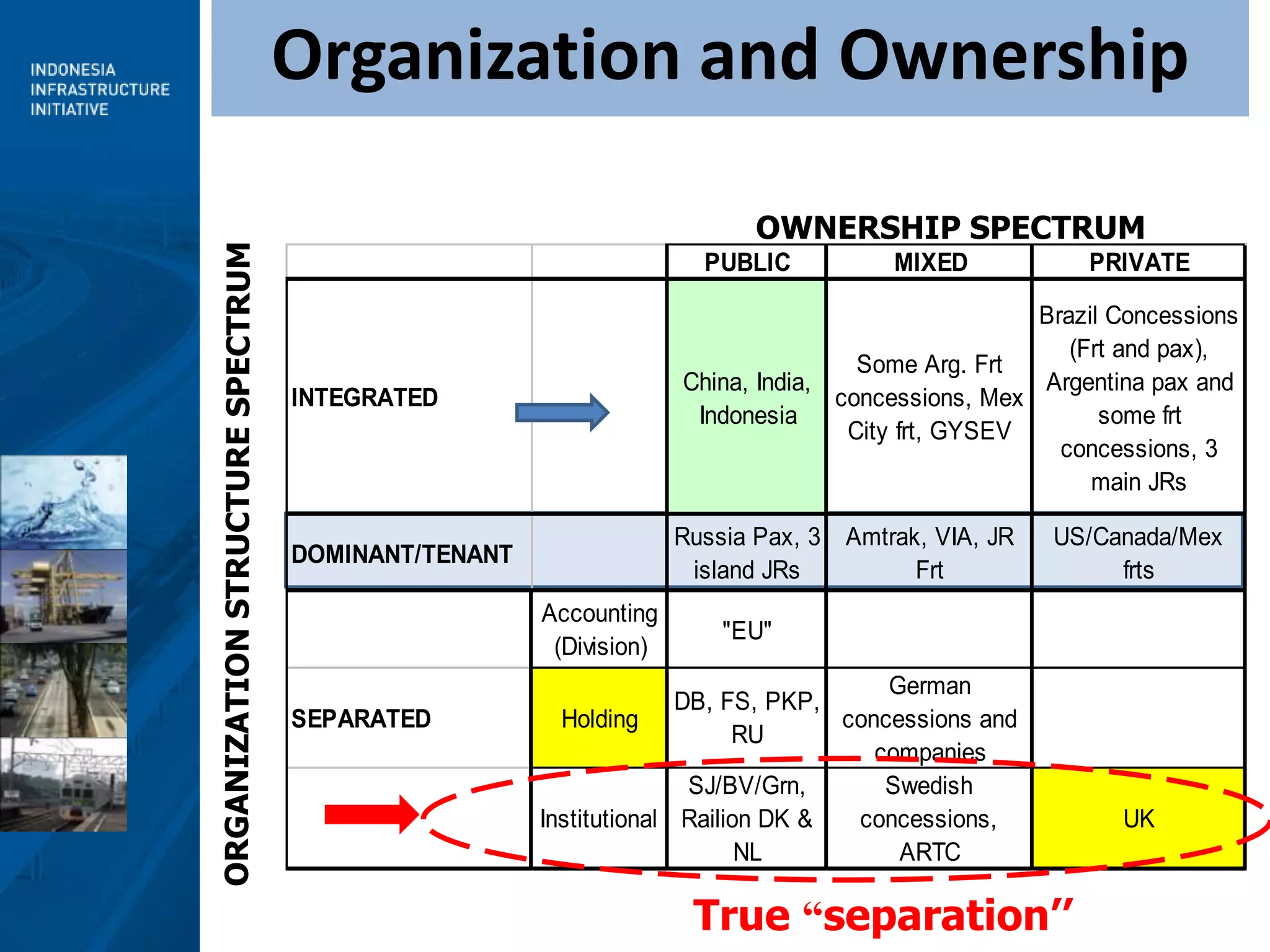
    Organization and OwnershipOWNERSHIPSPECTRUMORGANIZATION STRUCTURE SPECTRUMTrue “separation’’
  • 19.
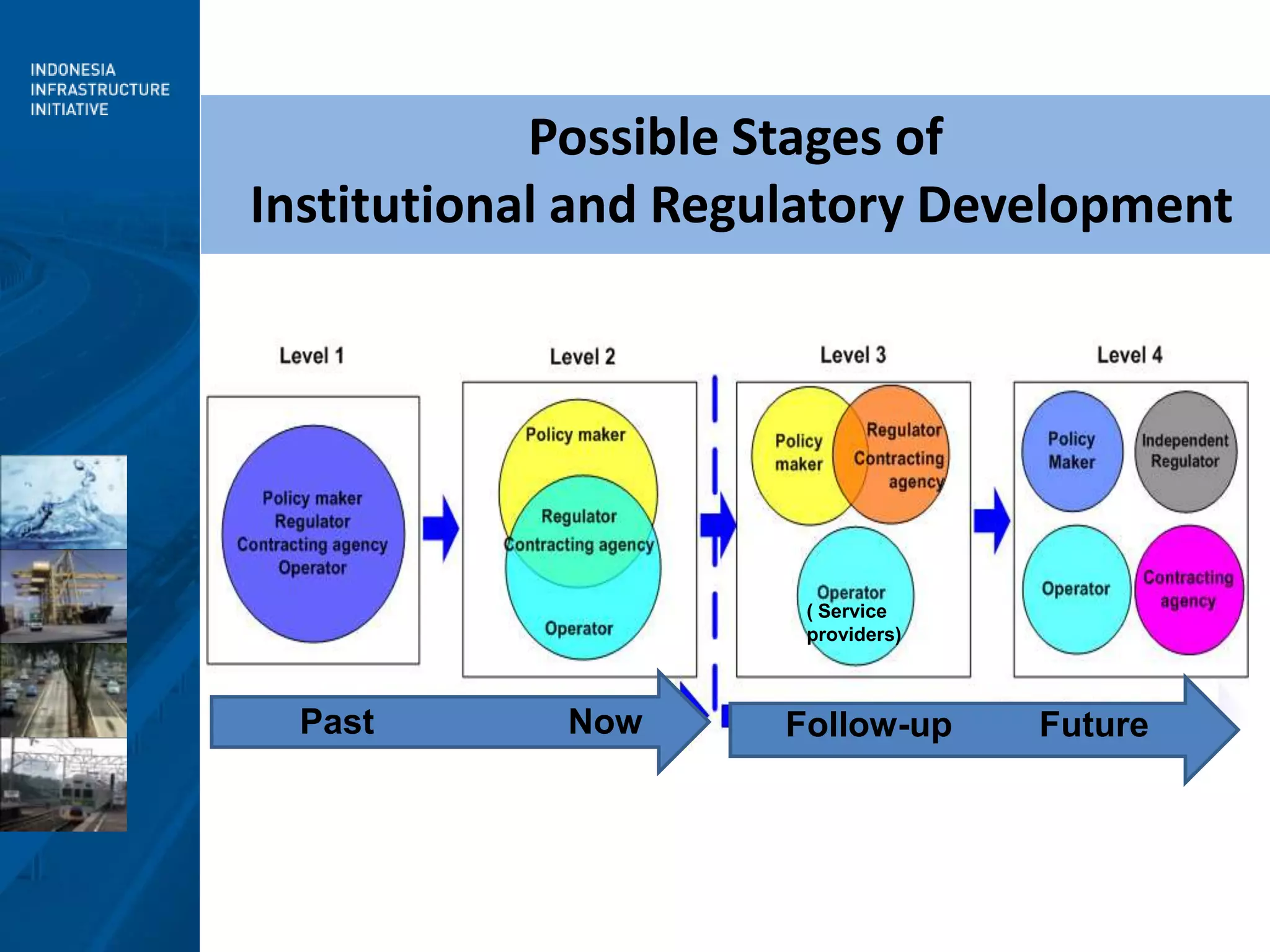
    Possible Stages of Institutional and Regulatory Development( Service providers)Past Now14Follow-up Future
  • 20.
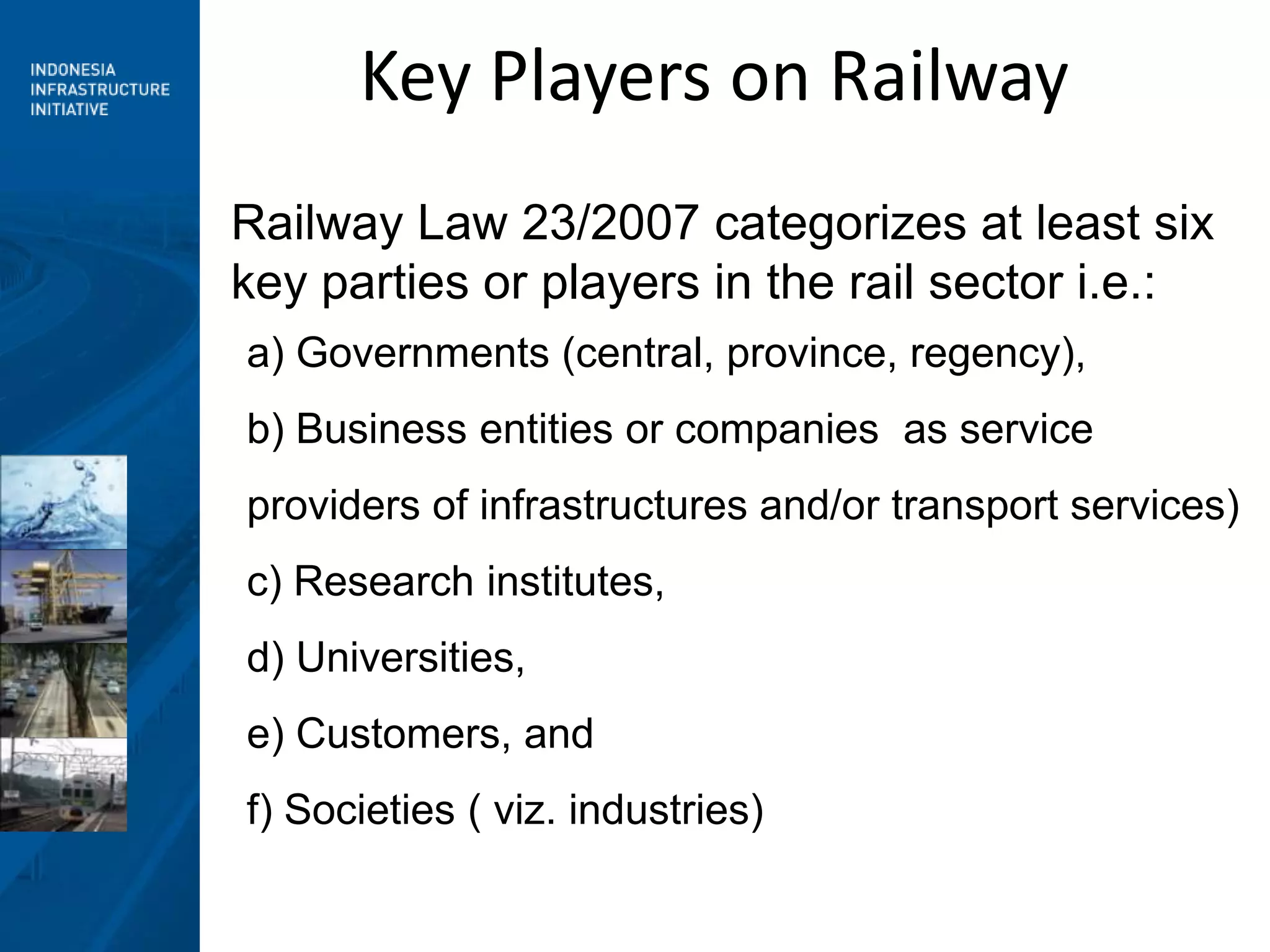
    Key Players onRailwayRailway Law 23/2007 categorizes at least six key parties or players in the rail sector i.e.: Governments (central, province, regency), Business entities or companies as service providers of infrastructures and/or transport services) Research institutes, Universities, Customers, and Societies ( viz. industries)
  • 21.
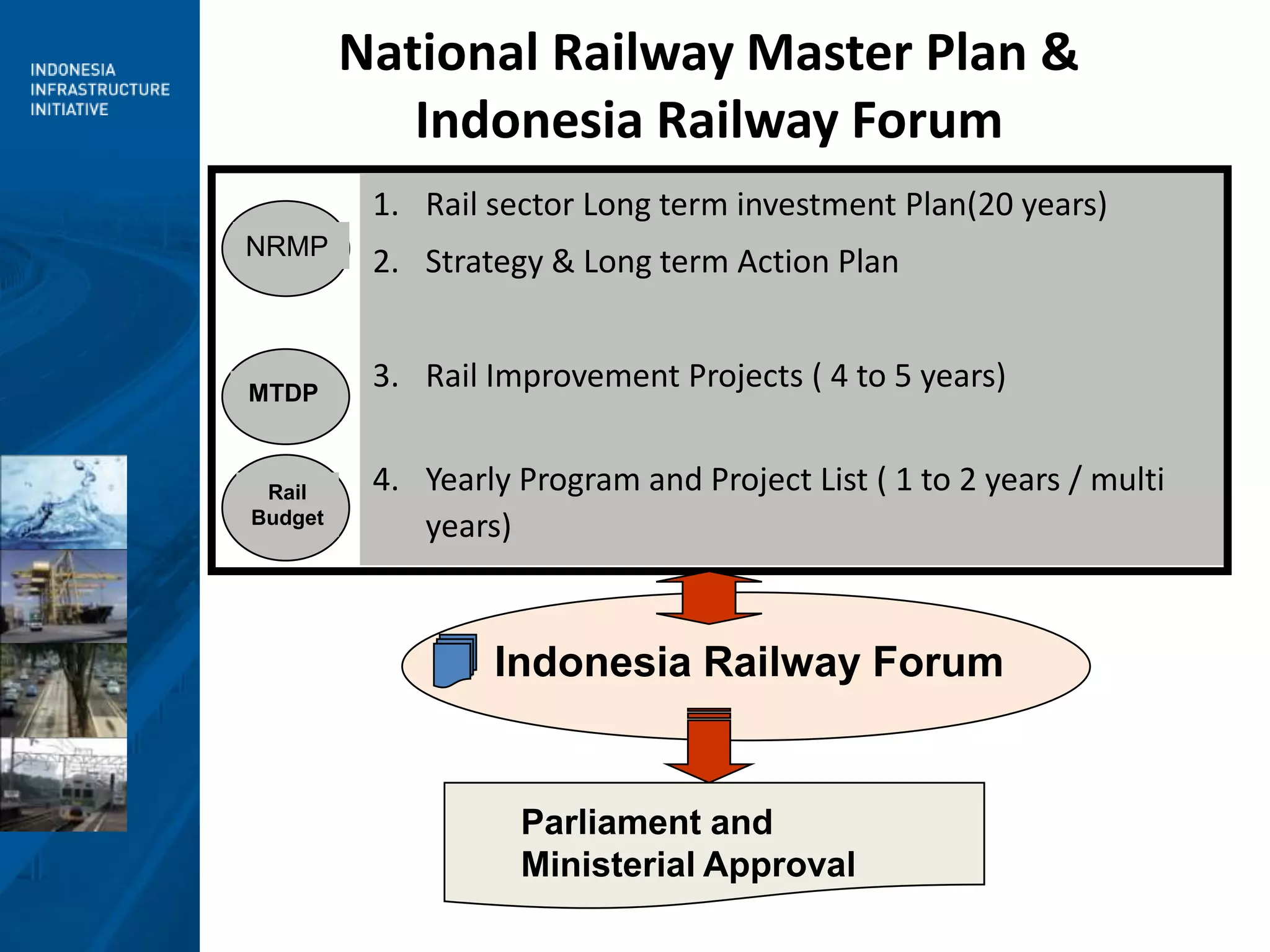
    NRMPNational Railway MasterPlan & Indonesia Railway ForumRail sector Long term investment Plan(20 years)Strategy & Long term Action PlanRail Improvement Projects ( 4 to 5 years)Yearly Program and Project List ( 1 to 2 years / multi years)MTDPRail BudgetIndonesia Railway ForumParliament and Ministerial Approval
  • 22.