
11.09.07 presented to the market research & intelligence association qualitative research day jason oke vp strategic planning leo burnett canada the credibility problem why respect for research is eroding, and why we need to win it back
i love research.
 
ROI
does qual provide its own ROI?
“ over 50% of the research done at companies is wasted . they’re asked to do things that, even if the research project is perfect,  won't be useful . it’s  covering-your-butt  kind of thinking.” bob barocci ceo, advertising research foundation adage, sept 24, 2007
“ [research] is this huge industry of billions of dollars  that anyone basically can do .” alison zelen director of consumer & market insights, unilever  adage, sept 24, 2007
“ it’s like the hole in the ozone layer.  everyone knows it’s a growing problem . but they just ignore it and go on to the next project.”  shari morwood, vp-worldwide market research, ibm adage, october 2, 2006
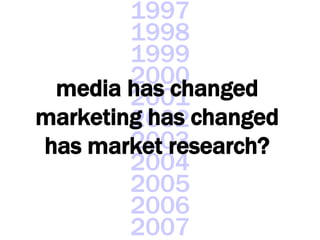
1997 1998 1999 2000 2001 2002 2003 2004 2005 2006 2007 media has changed marketing has changed has market research?
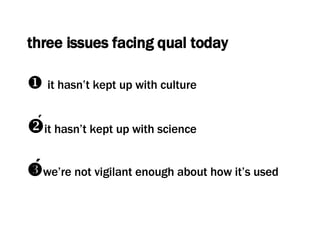
three issues facing qual today    it hasn’t kept up with culture  it hasn’t kept up with science  we’re not vigilant enough about how it’s used
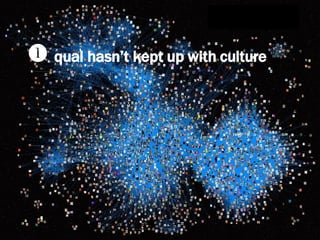
   qual hasn’t kept up with culture
getting the chance to give feedback to a company  used to be interesting.
now it’s assumed.


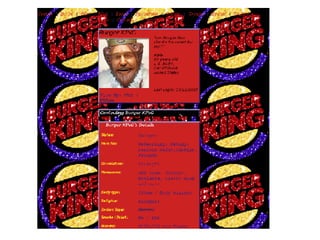
response rates are low it’s hard to recruit decent respondents is it any wonder?
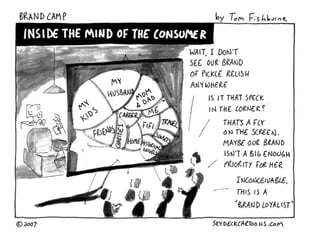
research is a  brand touchpoint and most market research is actually a  highly negative brand experience
we know  communications needs to engage and provide value  in order to be effective…   what about research?
“ The core problem is one of  relevance and value .   If more research were relevant and provided value back to participants, then more people would be participating. It’s pure economics and incentives .”  Max Kalehoff, Nielsen
“ It’s a symptom of the horribly compartmentalised way most of us do our jobs that we can spend half our day thinking of delicious and imaginative ways to delight our audience.  And then, in the next meeting, we round up some of the same people so we can show them dozens of stupid ideas in a fake living room…  [we take our] best and most influential customers, shove them in a dreary room for a couple of hours, confuse them with obtuse questions and odd drawings and then sent them on their way with £20  On the one hand we’re trying our hardest to be persuasive and seductive, on the other  we’re strip-mining people’s heads .”   - Russell Davies   former Global Strategy Director, Nike   Campaign, August 30, 2007
what can we learn from culture? people enjoy contributing when it’s fun & interesting people enjoy it when they get to be creative people enjoy it when it’s interactive
 
 
“ Imaginative research design can be like great video game design;   you can get respondents into a flow state, having purposeful fun with their answers, enjoying their experience with you, not noticing the time flying by. This not only gets you the answers you want, it leaves people liking you more. In a world where our customers are lining up to share their opinions anyway, this kind of  imaginative research will soon be all that anyone’s going to pay for.”     - Russell Davies   former Global Strategy Director, Nike   Campaign, August 30, 2007
imaginative research ethnography observation storytelling projective games
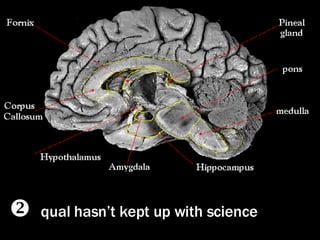
   qual hasn’t kept up with science
 
research tends to assume people are aware of their behaviour/needs/wants/motivations people can access and describe those things to others …  neither is particularly true
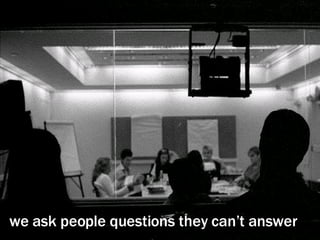
we ask people questions they can’t answer
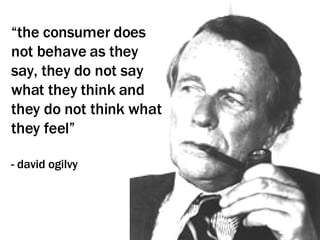
“ the consumer does not behave as they say, they do not say what they think and they do not think what they feel” - david ogilvy


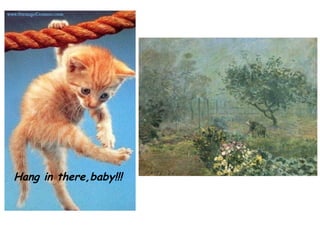
Hang in there,baby!!!
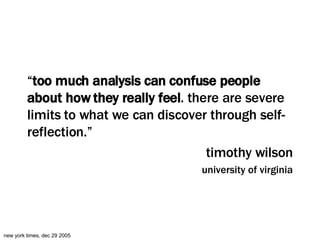
“ too much analysis can confuse people about how they really feel . there are severe limits to what we can discover through self-reflection.” timothy wilson university of virginia new york times, dec 29 2005
making you think about a choice  unconsciously  changes  your answer
towards  cautious  safe familiar choices because they are  easier to explain
so people are often  highly skeptical of new ideas  the first time we see them
“ you simply  can’t research your way to everything  and here’s why: consumers prefer the familiar and can have a hard time accepting the unexpected… but  consumers are not always right. ” scott bedbury ex-cmo nike & starbucks Advertising Age, May 1 2006
all of this isn’t necessarily a problem the problem is  taking the answers at face value
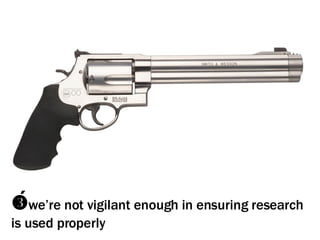
 we’re not vigilant enough in ensuring research is used properly
research is often  far too literal: we report  what people say ,  rather than  what they  mean
part of the problem is how research is used
fear of failure fear of blame inability to make decisions habit history support
no one ever got fired  for doing “what consumers  said we should do”
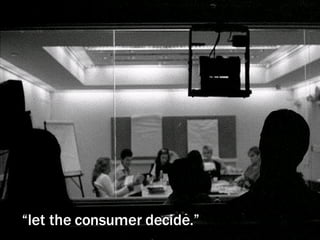
“ let the consumer decide.”
“ one should never simplify or pretend to be sure of such simplicity where there is none.  if things were simple, word would have gotten around .” jacques derrida
we all know better. we know when we’re doing ‘bad’ research.
“ researchers are to blame too…  for not pushing back , or at least not disclosing what the  quality trade-offs  will be from low bids and rushed timelines.”    –  bob barocci ceo, advertising research foundation
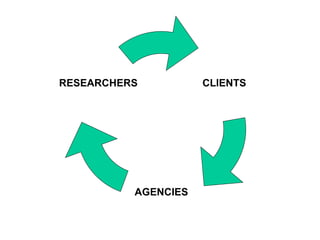
RESEARCHERS AGENCIES CLIENTS
we all need to  work together to stick up for better research the people who can make a difference are in this room
we need to say  “no”  more often it’s not  rocket science “… we can’t ask that question, and here’s why”
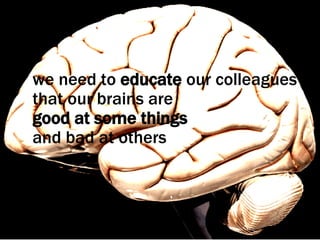
we need to  educate  our colleagues that our brains are  good at some things and bad at others
we are  good   at  associating understanding
we are  bad  at  explaining & describing  what we want what we like like  and why we do things
we need to get beyond self-reported descriptions & explanations


ask  less observe  more get people to  play  and  tell stories make research  fun again fight  for good research
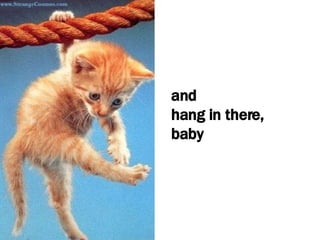
and hang in there, baby
thanks. jason.oke @ leoburnett.ca http://www.leoburnettblog.com

The credibility problem

  • 1.
    11.09.07 presented tothe market research & intelligence association qualitative research day jason oke vp strategic planning leo burnett canada the credibility problem why respect for research is eroding, and why we need to win it back
  • 2.
  • 3.
  • 4.
  • 5.
    does qual provideits own ROI?
  • 6.
    “ over 50%of the research done at companies is wasted . they’re asked to do things that, even if the research project is perfect, won't be useful . it’s covering-your-butt kind of thinking.” bob barocci ceo, advertising research foundation adage, sept 24, 2007
  • 7.
    “ [research] isthis huge industry of billions of dollars that anyone basically can do .” alison zelen director of consumer & market insights, unilever adage, sept 24, 2007
  • 8.
    “ it’s likethe hole in the ozone layer. everyone knows it’s a growing problem . but they just ignore it and go on to the next project.” shari morwood, vp-worldwide market research, ibm adage, october 2, 2006
  • 9.
    1997 1998 19992000 2001 2002 2003 2004 2005 2006 2007 media has changed marketing has changed has market research?
  • 10.
    three issues facingqual today  it hasn’t kept up with culture  it hasn’t kept up with science  we’re not vigilant enough about how it’s used
  • 11.
    qual hasn’t kept up with culture
  • 12.
    getting the chanceto give feedback to a company used to be interesting.
  • 13.
  • 14.
  • 15.
  • 16.
  • 17.
  • 18.
    response rates arelow it’s hard to recruit decent respondents is it any wonder?
  • 19.
    research is a brand touchpoint and most market research is actually a highly negative brand experience
  • 20.
    we know communications needs to engage and provide value in order to be effective… what about research?
  • 21.
    “ The coreproblem is one of relevance and value . If more research were relevant and provided value back to participants, then more people would be participating. It’s pure economics and incentives .” Max Kalehoff, Nielsen
  • 22.
    “ It’s asymptom of the horribly compartmentalised way most of us do our jobs that we can spend half our day thinking of delicious and imaginative ways to delight our audience. And then, in the next meeting, we round up some of the same people so we can show them dozens of stupid ideas in a fake living room… [we take our] best and most influential customers, shove them in a dreary room for a couple of hours, confuse them with obtuse questions and odd drawings and then sent them on their way with £20 On the one hand we’re trying our hardest to be persuasive and seductive, on the other we’re strip-mining people’s heads .” - Russell Davies former Global Strategy Director, Nike Campaign, August 30, 2007
  • 23.
    what can welearn from culture? people enjoy contributing when it’s fun & interesting people enjoy it when they get to be creative people enjoy it when it’s interactive
  • 24.
  • 25.
  • 26.
    “ Imaginative researchdesign can be like great video game design; you can get respondents into a flow state, having purposeful fun with their answers, enjoying their experience with you, not noticing the time flying by. This not only gets you the answers you want, it leaves people liking you more. In a world where our customers are lining up to share their opinions anyway, this kind of imaginative research will soon be all that anyone’s going to pay for.” - Russell Davies former Global Strategy Director, Nike Campaign, August 30, 2007
  • 27.
    imaginative research ethnographyobservation storytelling projective games
  • 28.
    qual hasn’t kept up with science
  • 29.
  • 30.
    research tends toassume people are aware of their behaviour/needs/wants/motivations people can access and describe those things to others … neither is particularly true
  • 31.
    we ask peoplequestions they can’t answer
  • 32.
    “ the consumerdoes not behave as they say, they do not say what they think and they do not think what they feel” - david ogilvy
  • 33.
  • 34.
  • 35.
  • 36.
  • 37.
  • 38.
  • 39.
  • 40.
    “ too muchanalysis can confuse people about how they really feel . there are severe limits to what we can discover through self-reflection.” timothy wilson university of virginia new york times, dec 29 2005
  • 41.
    making you thinkabout a choice unconsciously changes your answer
  • 42.
    towards cautious safe familiar choices because they are easier to explain
  • 43.
    so people areoften highly skeptical of new ideas the first time we see them
  • 44.
    “ you simply can’t research your way to everything and here’s why: consumers prefer the familiar and can have a hard time accepting the unexpected… but consumers are not always right. ” scott bedbury ex-cmo nike & starbucks Advertising Age, May 1 2006
  • 45.
    all of thisisn’t necessarily a problem the problem is taking the answers at face value
  • 46.
     we’re notvigilant enough in ensuring research is used properly
  • 47.
    research is often far too literal: we report what people say , rather than what they mean
  • 48.
    part of theproblem is how research is used
  • 49.
    fear of failurefear of blame inability to make decisions habit history support
  • 50.
    no one evergot fired for doing “what consumers said we should do”
  • 51.
    “ let theconsumer decide.”
  • 52.
    “ one shouldnever simplify or pretend to be sure of such simplicity where there is none. if things were simple, word would have gotten around .” jacques derrida
  • 53.
    we all knowbetter. we know when we’re doing ‘bad’ research.
  • 54.
    “ researchers areto blame too… for not pushing back , or at least not disclosing what the quality trade-offs will be from low bids and rushed timelines.” – bob barocci ceo, advertising research foundation
  • 55.
  • 56.
    we all needto work together to stick up for better research the people who can make a difference are in this room
  • 57.
    we need tosay “no” more often it’s not rocket science “… we can’t ask that question, and here’s why”
  • 58.
    we need to educate our colleagues that our brains are good at some things and bad at others
  • 59.
    we are good at associating understanding
  • 60.
    we are bad at explaining & describing what we want what we like like and why we do things
  • 61.
    we need toget beyond self-reported descriptions & explanations
  • 62.
  • 63.
  • 64.
  • 65.
    ask lessobserve more get people to play and tell stories make research fun again fight for good research
  • 66.
    and hang inthere, baby
  • 67.
    thanks. jason.oke @leoburnett.ca http://www.leoburnettblog.com

Editor's Notes

  • #2 I know the conventional wisdom is that advertising agencies hate research. This is not a presentation about an advertising agency bashing research. Actually, I hate the knee-jerk reaction some agency people have against research. I think research is one of the most important things we do – helps us get to brilliant insights, see things differently, make solid creative better, stopped bad ideas from getting too far. It’s arguably the most crucial part of what we do. We’re all under pressure to justify our decisions, find breakthrough insights, and prove ROI. But for something so crucial, here’s my question: how often do we actually talk about what we’re doing, how we do it, what questions we ask, and how we expect people to be able to give us answers? The answer is we don't. We default to “doing it the same way we did it last year.” Using the same questionnaire, using the same norms. And so on. As a strategic planner, part of my job is thinking about how people make decisions, studying how the brain works, looking at best research practices from around the world. There's a lot of new evidence – from psychology, neurology, and market research itself – that shows some of the ways we do research don't actually give us the answers we think they do. A lot of debate is starting to happen, with some shocking conclusions. But sadly, little of this debate is reaching into marketing departments and agencies yet – our debate seems to be limited to the occasional “focus groups suck” article. So today we’re going to look deeper at this most important part of our business, talk about some of the work that’s going on, challenge some conventional wisdom, provoke a discussion of how we do things, and the best ways to involve our consumers in that process. But first, I want to tell you about a chair.