➢ Introduction:
• The Consumer Protection Act, 1986 (COPRA) is an Act of the Parliament of India enacted in 1986 to
protect the interests of consumers in India.
• It is made for the establishment of consumer councils and other authorities for the settlement of consumer's
grievances and for matters connected there with it.
• The act was passed in Assembly in October 1986 and came into force on December 24, 1986.This statute was
made before this act."
➢ Need for Consumer Protection
1. Social responsibility
2. Misleading advertisement
3. Consumer satisfaction
4. Principle of social justice
5. Principle of trusteeship
6. Unfair trade practices
7. Physical protection
➢ Objectives
The main objective of CPA is :
(a) to provide speedy and simple redressal to consumer disputes.
(b) It is one of the benevolent pieces of legislation intended to protect the consumers at large from exploitation
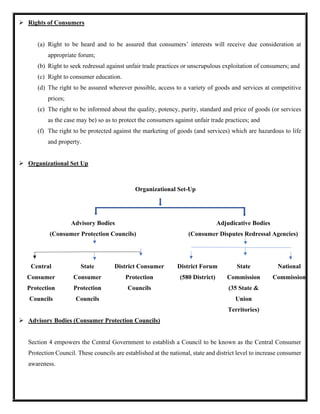
➢ Rights of Consumers
(a) Right to be heard and to be assured that consumers’ interests will receive due consideration at appropriate
forum;
(b) Right to seek redressal against unfair trade practices or unscrupulous exploitation of consumers; and
(c) Right to consumer education.
(d) The right to be assured wherever possible, access to a variety of goods and services at competitive prices;
(e) The right to be informed about the quality, potency, purity, standard and price of goods (or services as the
case may be) so as to protect the consumers against unfair trade practices; and
(f) The right to be protected against the marketing of goods (and services) which are hazardous to life and
property.
➢ Eligibility for filing a complaint
a) Beneficiary of the goods/services
b) Legal representative of the deceased consumer
c) Legal heirs of the deceased consumer
d) Husband of the consumer
e) A relative of consumer
f) Insurance company
➢ Time frame within which a complaint can be filed
▪ Consumer dispute can be filled within two years from the date on which the action to place.
▪ To file a complaint the point of time when the action arises is an important factor for determining the time
period available.
▪ There are no set of such rules which decide time rather it depends on the facts and circumstances of each
case.
➢ Consumer [ Section 2(1)(d)] is one who :–
Buys any goods for a consideration and includes a hire-purchaser;
– Any user of such goods for consideration but excludes one, who obtains for re-sale or for commercial purposes;
– Hires a service for consideration and includes a beneficiary of such service, if availed of with the approval of
the hirer.
➢ Goods: According to Section 2 (7) of the sales of goods ACT, Goods means,
• every kind of movable property other than actionable claims and money.
• Include stock, shares, grass and things attached to, or forming part of the land which are agreed to be served
before sale or under the contract of sale.
➢ Service:
According to [section.2(o)] service means service of any description which is made available to potential
users and includes the provision of facilities in connection with banking, financing, insurance, transport,
processing, supply of electricity or other energy board or lodging or both purveying of news or other
information, but does not include the rendering of any service free of charge or under a contract of personal
service.
➢ Complaint:
An allegation in writing by a complainant that:
(i) An unfair or restrictive trade practice is practiced by trader or service provider
(ii) Goods bought or to be bought or services hired or to be hired suffered from any deficiency
(iii) Service hired or availed of or agreed to be hired or availed by him suffers from deficiency
(iv) Trader or service provider has charged excess price-
-- fixed by or under any law for the time being in force;
-- displayed on the goods or any package containing such goods;
-- displayed on the price list exhibited by him by or under any law for the time being in force
-- agreed between the parties.
(v) Goods and services are hazardous or are likely to be hazardous to life and safety.
➢ Complainant [Section 2(1)] means
(i) A consumer
(ii) Any voluntary consumer association registered under the Companies Act or any other law
(iii) Central or State Government, if it makes a complaint
(iv) One or more consumers having same interest
(v) In case of death of a consumer, his legal heir or representative.
(vi) A Consumer Dispute arises when a complaint is denied or disputed.
➢ Defect in Goods: According to section.2 (1) (f) – "defect" means any fault, imperfection or shortcoming in
the quality, quantity, potency, purity or standard which is required to be maintained by or under any law for
the time being in force under any contract, express or implied or as is claimed by the trader in any manner
whatsoever in relation to any goods.
➢ Deficiency in Service
• Deficiency means – a fault, imperfection, shortcoming or inadequacy in quality, nature, or manner of
performance than is required.
• Service includes – service in connection with banking, financing, insurance, transport, processing, supply
of electrical and other energy, boarding or lodging, housing construction, entertainment, amusement or
purveying of news and other information
– but does not include any service free of charge or under a personal contract.
➢ Unfair Trade Practices
"Unfair Trade Practice" means a trade practice which, for the purpose of promoting the sale, use or supply of
any goods or for the provision of any service, adopts any unfair method or unfair or deceptive practice
including any of the following practices, namely;—
1) The practice of making any statement, whether orally or in writing or by visible representation
falsely represents that
o The goods or services are of a particular standard, quality, quantity, grade, composition, style or model;
o Any re-built, second-hand, renovated, reconditioned or old goods as new goods;
o The goods or services have sponsorship, approval, performance, characteristics, accessories, uses or
benefits which such goods or services do not have;
o The seller or the supplier has a sponsorship or approval or affiliation which such seller or supplier does
not have;
o Makes a false or misleading representation concerning the need for, or the Usefulness of, any goods
or services;
o Gives to the public any warranty or guarantee of the performance, efficacy or Length of life of a
product or of any goods that is not based on an adequate or Proper test thereof;
2) permits the publication of any advertisement whether in any newspaper or otherwise, for the sale or supply
at a bargain price, of goods or services that are not intended to be offered for sale or supply at the bargain
price, or for a period that is, and in quantities that are, reasonable, having regard to the nature of the market
in which the business is carried on, the nature and size of business, and the nature of the advertisement.
3) The offering gifts, prizes or other items with the intension of not providing them as offered or creating
impression that something is being given offered free of charge, when it is fully or partly covered by the
amount charged, in the transaction as a whole.
4) Permits the sale or supply of goods intended to be used, or are of a kind likely to be used, by consumers,
knowing or having reason to believe that the goods do not comply with the standards prescribed by
competent authority relating to performance, composition, contents, design, constructions, finishing or
packaging as are necessary to prevent or reduce the risk of injury to the person using the goods;
5) permits the hoarding or destruction of goods, or refuses to sell the goods or to make them available for
sale or to provide any service, if such hoarding or destruction or refusal raises or tends to raise or is
intended to raise, the cost of those or other similar goods or services.
6) manufacture of spurious goods or offering such goods for sale or adopts deceptive practices in the
provision of services.
➢ Restricted Trade Practices
Means a trade practice which tends to bring about manipulation of price or conditions of delivery or to affect flow
of supplies in the market relating to goods or services in such a manner as to impose on the consumers unjustified
costs or restrictions and shall include-
a) Delay beyond the period agreed to by a trader in supply of such goods or in providing the services which has
led or is likely to lead to rise in the price;
b) Any trade practice which requires a consumer to buy, hire or avail of any goods or, as the case may be, services
as condition precedent to buying, hiring or availing of other goods or services.
➢ Reasons for Complaint
One can file a consumer complaint under Consumer Protection Act, 1986 for any of the following reasons.
o When a company cheats a consumer after purchasing a product. Cheating by giving false promises.
o Not delivering the goods and services for which payment is made.
o Consumer has suffered loss or damage as a result of any unfair Trade Practice.
o Any unfair trade practice as defined in the Act or restrictive trade practices like tie-up sales adopted by any
trader
o The goods purchased suffer from one or more defects
o The trader charging excess of amount of the price displayed on goods or on any packet containing such good
or fixed by any law for the time being in force
o The goods hazardous to life and safety, when used, are being offered for sale to public in contravention of
provisions of any law for the time being in force
o Deficiencies in services
o Misleading advertisements and false representation.
o Any other factors that affected the consumer.
➢ Rights of Consumers
(a) Right to be heard and to be assured that consumers’ interests will receive due consideration at
appropriate forum;
(b) Right to seek redressal against unfair trade practices or unscrupulous exploitation of consumers; and
(c) Right to consumer education.
(d) The right to be assured wherever possible, access to a variety of goods and services at competitive
prices;
(e) The right to be informed about the quality, potency, purity, standard and price of goods (or services
as the case may be) so as to protect the consumers against unfair trade practices; and
(f) The right to be protected against the marketing of goods (and services) which are hazardous to life
and property.
➢ Organizational Set Up
Organizational Set-Up
Advisory Bodies
(Consumer Protection Councils)
Adjudicative Bodies
(Consumer Disputes Redressal Agencies)
Central
Consumer
Protection
Councils
State
Consumer
Protection
Councils
District Consumer
Protection
Councils
District Forum
(580 District)
State
Commission
(35 State &
Union
Territories)
National
Commission
➢ Advisory Bodies (Consumer Protection Councils)
Section 4 empowers the Central Government to establish a Council to be known as the Central Consumer
Protection Council. These councils are established at the national, state and district level to increase consumer
awareness.
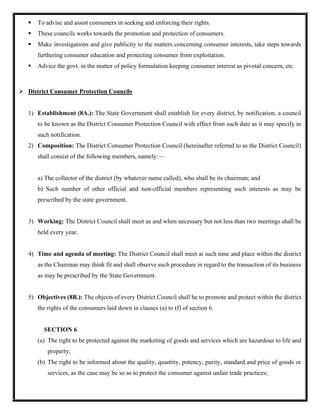
▪ To advise and assist consumers in seeking and enforcing their rights.
▪ These councils works towards the promotion and protection of consumers.
▪ Make investigations and give publicity to the matters concerning consumer interests, take steps towards
furthering consumer education and protecting consumer from exploitation.
▪ Advice the govt. in the matter of policy formulation keeping consumer interest as pivotal concern, etc.
➢ District Consumer Protection Councils
1) Establishment (8A.): The State Government shall establish for every district, by notification, a council
to be known as the District Consumer Protection Council with effect from such date as it may specify in
such notification.
2) Composition: The District Consumer Protection Council (hereinafter referred to as the District Council)
shall consist of the following members, namely:—
a) The collector of the district (by whatever name called), who shall be its chairman; and
b) Such number of other official and non-official members representing such interests as may be
prescribed by the state government.
3) Working: The District Council shall meet as and when necessary but not less than two meetings shall be
held every year.
4) Time and agenda of meeting: The District Council shall meet at such time and place within the district
as the Chairman may think fit and shall observe such procedure in regard to the transaction of its business
as may be prescribed by the State Government.
5) Objectives (8B.): The objects of every District Council shall be to promote and protect within the district
the rights of the consumers laid down in clauses (a) to (f) of section 6.
SECTION 6
(a) The right to be protected against the marketing of goods and services which are hazardous to life and
property;
(b) The right to be informed about the quality, quantity, potency, purity, standard and price of goods or
services, as the case may be so as to protect the consumer against unfair trade practices;
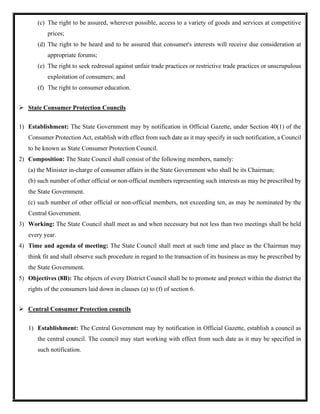
(c) The right to be assured, wherever possible, access to a variety of goods and services at competitive
prices;
(d) The right to be heard and to be assured that consumer's interests will receive due consideration at
appropriate forums;
(e) The right to seek redressal against unfair trade practices or restrictive trade practices or unscrupulous
exploitation of consumers; and
(f) The right to consumer education.
➢ State Consumer Protection Councils
1) Establishment: The State Government may by notification in Official Gazette, under Section 40(1) of the
Consumer Protection Act, establish with effect from such date as it may specify in such notification, a Council
to be known as State Consumer Protection Council.
2) Composition: The State Council shall consist of the following members, namely:
(a) the Minister in-charge of consumer affairs in the State Government who shall be its Chairman;
(b) such number of other official or non-official members representing such interests as may be prescribed by
the State Government.
(c) such number of other official or non-official members, not exceeding ten, as may be nominated by the
Central Government.
3) Working: The State Council shall meet as and when necessary but not less than two meetings shall be held
every year.
4) Time and agenda of meeting: The State Council shall meet at such time and place as the Chairman may
think fit and shall observe such procedure in regard to the transaction of its business as may be prescribed by
the State Government.
5) Objectives (8B): The objects of every District Council shall be to promote and protect within the district the
rights of the consumers laid down in clauses (a) to (f) of section 6.
➢ Central Consumer Protection councils
1) Establishment: The Central Government may by notification in Official Gazette, establish a council as
the central council. The council may start working with effect from such date as it may be specified in
such notification.
2) Composition: The Central Council shall consist of the following members, namely:— (a) the Minister in
charge of the consumer affairs in the Central Government, who shall be its Chairman, and (b) such number
of other official or non-official members representing such interests as may be prescribed.
3) Working: The Central Council shall meet as and when necessary, but at least one meeting of the Council
shall be held every year.
4) Time and agenda of meeting: The Central Council shall meet at such time and place as the Chairman
may think fit and shall observe such procedure in regard to the transaction of its business as may be
prescribed.
5) Objectives (8B): The objects of Central Council shall be to promote and protect within the district the
rights of the consumers laid down in clauses (a) to (f) of section 6.
➢ Adjudicative Bodies (Consumer Disputes Redressal Agencies)
Consumer Court is a special purpose court in India that deals with cases regarding consumer disputes, conflicts
and grievances. They are judiciary hearings set up by the government to protect the consumers' rights. Its main
function is to maintain the fair practices & contracts by sellers. Consumers can file a case against a seller if they
are cheated or exploited by sellers. The court will only give a verdict in favour of the consumers/customers if they
have proof of exploitation, i.e., bills or purchase memos. If a consumer does not have the proper documents
required for filing a case then it would be very difficult for the consumer to win or even file a case
▪ Three-tier consumer grievance redressal machinery.
▪ State and national level bodies-Appellate Authorities
▪ Verdict given by the national commission can be challenged in the Supreme Court.
▪ Objective : To provide speedy, simple and inexpensive (no court fee ) redressal to consumers
grievances.
▪ They driven by the basic rules of natural justice.
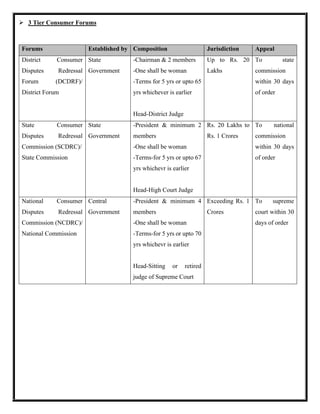
➢ 3 Tier Consumer Forums
Forums Established by Composition Jurisdiction Appeal
District Consumer
Disputes Redressal
Forum (DCDRF)/
District Forum
State
Government
-Chairman & 2 members
-One shall be woman
-Terms for 5 yrs or upto 65
yrs whichever is earlier
Head-District Judge
Up to Rs. 20
Lakhs
To state
commission
within 30 days
of order
State Consumer
Disputes Redressal
Commission (SCDRC)/
State Commission
State
Government
-President & minimum 2
members
-One shall be woman
-Terms-for 5 yrs or upto 67
yrs whichevr is earlier
Head-High Court Judge
Rs. 20 Lakhs to
Rs. 1 Crores
To national
commission
within 30 days
of order
National Consumer
Disputes Redressal
Commission (NCDRC)/
National Commission
Central
Government
-President & minimum 4
members
-One shall be woman
-Terms-for 5 yrs or upto 70
yrs whichevr is earlier
Head-Sitting or retired
judge of Supreme Court
Exceeding Rs. 1
Crores
To supreme
court within 30
days of order

The Consumer Protection Act, 1986 (COPRA)

  • 1.
    ➢ Introduction: • TheConsumer Protection Act, 1986 (COPRA) is an Act of the Parliament of India enacted in 1986 to protect the interests of consumers in India. • It is made for the establishment of consumer councils and other authorities for the settlement of consumer's grievances and for matters connected there with it. • The act was passed in Assembly in October 1986 and came into force on December 24, 1986.This statute was made before this act." ➢ Need for Consumer Protection 1. Social responsibility 2. Misleading advertisement 3. Consumer satisfaction 4. Principle of social justice 5. Principle of trusteeship 6. Unfair trade practices 7. Physical protection ➢ Objectives The main objective of CPA is : (a) to provide speedy and simple redressal to consumer disputes. (b) It is one of the benevolent pieces of legislation intended to protect the consumers at large from exploitation ➢ Rights of Consumers (a) Right to be heard and to be assured that consumers’ interests will receive due consideration at appropriate forum; (b) Right to seek redressal against unfair trade practices or unscrupulous exploitation of consumers; and (c) Right to consumer education. (d) The right to be assured wherever possible, access to a variety of goods and services at competitive prices; (e) The right to be informed about the quality, potency, purity, standard and price of goods (or services as the case may be) so as to protect the consumers against unfair trade practices; and (f) The right to be protected against the marketing of goods (and services) which are hazardous to life and property.
  • 2.
    ➢ Eligibility forfiling a complaint a) Beneficiary of the goods/services b) Legal representative of the deceased consumer c) Legal heirs of the deceased consumer d) Husband of the consumer e) A relative of consumer f) Insurance company ➢ Time frame within which a complaint can be filed ▪ Consumer dispute can be filled within two years from the date on which the action to place. ▪ To file a complaint the point of time when the action arises is an important factor for determining the time period available. ▪ There are no set of such rules which decide time rather it depends on the facts and circumstances of each case. ➢ Consumer [ Section 2(1)(d)] is one who :– Buys any goods for a consideration and includes a hire-purchaser; – Any user of such goods for consideration but excludes one, who obtains for re-sale or for commercial purposes; – Hires a service for consideration and includes a beneficiary of such service, if availed of with the approval of the hirer. ➢ Goods: According to Section 2 (7) of the sales of goods ACT, Goods means, • every kind of movable property other than actionable claims and money. • Include stock, shares, grass and things attached to, or forming part of the land which are agreed to be served before sale or under the contract of sale. ➢ Service: According to [section.2(o)] service means service of any description which is made available to potential users and includes the provision of facilities in connection with banking, financing, insurance, transport, processing, supply of electricity or other energy board or lodging or both purveying of news or other information, but does not include the rendering of any service free of charge or under a contract of personal service.
  • 3.
    ➢ Complaint: An allegationin writing by a complainant that: (i) An unfair or restrictive trade practice is practiced by trader or service provider (ii) Goods bought or to be bought or services hired or to be hired suffered from any deficiency (iii) Service hired or availed of or agreed to be hired or availed by him suffers from deficiency (iv) Trader or service provider has charged excess price- -- fixed by or under any law for the time being in force; -- displayed on the goods or any package containing such goods; -- displayed on the price list exhibited by him by or under any law for the time being in force -- agreed between the parties. (v) Goods and services are hazardous or are likely to be hazardous to life and safety. ➢ Complainant [Section 2(1)] means (i) A consumer (ii) Any voluntary consumer association registered under the Companies Act or any other law (iii) Central or State Government, if it makes a complaint (iv) One or more consumers having same interest (v) In case of death of a consumer, his legal heir or representative. (vi) A Consumer Dispute arises when a complaint is denied or disputed. ➢ Defect in Goods: According to section.2 (1) (f) – "defect" means any fault, imperfection or shortcoming in the quality, quantity, potency, purity or standard which is required to be maintained by or under any law for the time being in force under any contract, express or implied or as is claimed by the trader in any manner whatsoever in relation to any goods. ➢ Deficiency in Service • Deficiency means – a fault, imperfection, shortcoming or inadequacy in quality, nature, or manner of performance than is required. • Service includes – service in connection with banking, financing, insurance, transport, processing, supply of electrical and other energy, boarding or lodging, housing construction, entertainment, amusement or purveying of news and other information – but does not include any service free of charge or under a personal contract.
  • 4.
    ➢ Unfair TradePractices "Unfair Trade Practice" means a trade practice which, for the purpose of promoting the sale, use or supply of any goods or for the provision of any service, adopts any unfair method or unfair or deceptive practice including any of the following practices, namely;— 1) The practice of making any statement, whether orally or in writing or by visible representation falsely represents that o The goods or services are of a particular standard, quality, quantity, grade, composition, style or model; o Any re-built, second-hand, renovated, reconditioned or old goods as new goods; o The goods or services have sponsorship, approval, performance, characteristics, accessories, uses or benefits which such goods or services do not have; o The seller or the supplier has a sponsorship or approval or affiliation which such seller or supplier does not have; o Makes a false or misleading representation concerning the need for, or the Usefulness of, any goods or services; o Gives to the public any warranty or guarantee of the performance, efficacy or Length of life of a product or of any goods that is not based on an adequate or Proper test thereof; 2) permits the publication of any advertisement whether in any newspaper or otherwise, for the sale or supply at a bargain price, of goods or services that are not intended to be offered for sale or supply at the bargain price, or for a period that is, and in quantities that are, reasonable, having regard to the nature of the market in which the business is carried on, the nature and size of business, and the nature of the advertisement. 3) The offering gifts, prizes or other items with the intension of not providing them as offered or creating impression that something is being given offered free of charge, when it is fully or partly covered by the amount charged, in the transaction as a whole. 4) Permits the sale or supply of goods intended to be used, or are of a kind likely to be used, by consumers, knowing or having reason to believe that the goods do not comply with the standards prescribed by competent authority relating to performance, composition, contents, design, constructions, finishing or packaging as are necessary to prevent or reduce the risk of injury to the person using the goods;
  • 5.
    5) permits thehoarding or destruction of goods, or refuses to sell the goods or to make them available for sale or to provide any service, if such hoarding or destruction or refusal raises or tends to raise or is intended to raise, the cost of those or other similar goods or services. 6) manufacture of spurious goods or offering such goods for sale or adopts deceptive practices in the provision of services. ➢ Restricted Trade Practices Means a trade practice which tends to bring about manipulation of price or conditions of delivery or to affect flow of supplies in the market relating to goods or services in such a manner as to impose on the consumers unjustified costs or restrictions and shall include- a) Delay beyond the period agreed to by a trader in supply of such goods or in providing the services which has led or is likely to lead to rise in the price; b) Any trade practice which requires a consumer to buy, hire or avail of any goods or, as the case may be, services as condition precedent to buying, hiring or availing of other goods or services. ➢ Reasons for Complaint One can file a consumer complaint under Consumer Protection Act, 1986 for any of the following reasons. o When a company cheats a consumer after purchasing a product. Cheating by giving false promises. o Not delivering the goods and services for which payment is made. o Consumer has suffered loss or damage as a result of any unfair Trade Practice. o Any unfair trade practice as defined in the Act or restrictive trade practices like tie-up sales adopted by any trader o The goods purchased suffer from one or more defects o The trader charging excess of amount of the price displayed on goods or on any packet containing such good or fixed by any law for the time being in force o The goods hazardous to life and safety, when used, are being offered for sale to public in contravention of provisions of any law for the time being in force o Deficiencies in services o Misleading advertisements and false representation. o Any other factors that affected the consumer.
  • 6.
    ➢ Rights ofConsumers (a) Right to be heard and to be assured that consumers’ interests will receive due consideration at appropriate forum; (b) Right to seek redressal against unfair trade practices or unscrupulous exploitation of consumers; and (c) Right to consumer education. (d) The right to be assured wherever possible, access to a variety of goods and services at competitive prices; (e) The right to be informed about the quality, potency, purity, standard and price of goods (or services as the case may be) so as to protect the consumers against unfair trade practices; and (f) The right to be protected against the marketing of goods (and services) which are hazardous to life and property. ➢ Organizational Set Up Organizational Set-Up Advisory Bodies (Consumer Protection Councils) Adjudicative Bodies (Consumer Disputes Redressal Agencies) Central Consumer Protection Councils State Consumer Protection Councils District Consumer Protection Councils District Forum (580 District) State Commission (35 State & Union Territories) National Commission ➢ Advisory Bodies (Consumer Protection Councils) Section 4 empowers the Central Government to establish a Council to be known as the Central Consumer Protection Council. These councils are established at the national, state and district level to increase consumer awareness.
  • 7.
    ▪ To adviseand assist consumers in seeking and enforcing their rights. ▪ These councils works towards the promotion and protection of consumers. ▪ Make investigations and give publicity to the matters concerning consumer interests, take steps towards furthering consumer education and protecting consumer from exploitation. ▪ Advice the govt. in the matter of policy formulation keeping consumer interest as pivotal concern, etc. ➢ District Consumer Protection Councils 1) Establishment (8A.): The State Government shall establish for every district, by notification, a council to be known as the District Consumer Protection Council with effect from such date as it may specify in such notification. 2) Composition: The District Consumer Protection Council (hereinafter referred to as the District Council) shall consist of the following members, namely:— a) The collector of the district (by whatever name called), who shall be its chairman; and b) Such number of other official and non-official members representing such interests as may be prescribed by the state government. 3) Working: The District Council shall meet as and when necessary but not less than two meetings shall be held every year. 4) Time and agenda of meeting: The District Council shall meet at such time and place within the district as the Chairman may think fit and shall observe such procedure in regard to the transaction of its business as may be prescribed by the State Government. 5) Objectives (8B.): The objects of every District Council shall be to promote and protect within the district the rights of the consumers laid down in clauses (a) to (f) of section 6. SECTION 6 (a) The right to be protected against the marketing of goods and services which are hazardous to life and property; (b) The right to be informed about the quality, quantity, potency, purity, standard and price of goods or services, as the case may be so as to protect the consumer against unfair trade practices;
  • 8.
    (c) The rightto be assured, wherever possible, access to a variety of goods and services at competitive prices; (d) The right to be heard and to be assured that consumer's interests will receive due consideration at appropriate forums; (e) The right to seek redressal against unfair trade practices or restrictive trade practices or unscrupulous exploitation of consumers; and (f) The right to consumer education. ➢ State Consumer Protection Councils 1) Establishment: The State Government may by notification in Official Gazette, under Section 40(1) of the Consumer Protection Act, establish with effect from such date as it may specify in such notification, a Council to be known as State Consumer Protection Council. 2) Composition: The State Council shall consist of the following members, namely: (a) the Minister in-charge of consumer affairs in the State Government who shall be its Chairman; (b) such number of other official or non-official members representing such interests as may be prescribed by the State Government. (c) such number of other official or non-official members, not exceeding ten, as may be nominated by the Central Government. 3) Working: The State Council shall meet as and when necessary but not less than two meetings shall be held every year. 4) Time and agenda of meeting: The State Council shall meet at such time and place as the Chairman may think fit and shall observe such procedure in regard to the transaction of its business as may be prescribed by the State Government. 5) Objectives (8B): The objects of every District Council shall be to promote and protect within the district the rights of the consumers laid down in clauses (a) to (f) of section 6. ➢ Central Consumer Protection councils 1) Establishment: The Central Government may by notification in Official Gazette, establish a council as the central council. The council may start working with effect from such date as it may be specified in such notification.
  • 9.
    2) Composition: TheCentral Council shall consist of the following members, namely:— (a) the Minister in charge of the consumer affairs in the Central Government, who shall be its Chairman, and (b) such number of other official or non-official members representing such interests as may be prescribed. 3) Working: The Central Council shall meet as and when necessary, but at least one meeting of the Council shall be held every year. 4) Time and agenda of meeting: The Central Council shall meet at such time and place as the Chairman may think fit and shall observe such procedure in regard to the transaction of its business as may be prescribed. 5) Objectives (8B): The objects of Central Council shall be to promote and protect within the district the rights of the consumers laid down in clauses (a) to (f) of section 6. ➢ Adjudicative Bodies (Consumer Disputes Redressal Agencies) Consumer Court is a special purpose court in India that deals with cases regarding consumer disputes, conflicts and grievances. They are judiciary hearings set up by the government to protect the consumers' rights. Its main function is to maintain the fair practices & contracts by sellers. Consumers can file a case against a seller if they are cheated or exploited by sellers. The court will only give a verdict in favour of the consumers/customers if they have proof of exploitation, i.e., bills or purchase memos. If a consumer does not have the proper documents required for filing a case then it would be very difficult for the consumer to win or even file a case ▪ Three-tier consumer grievance redressal machinery. ▪ State and national level bodies-Appellate Authorities ▪ Verdict given by the national commission can be challenged in the Supreme Court. ▪ Objective : To provide speedy, simple and inexpensive (no court fee ) redressal to consumers grievances. ▪ They driven by the basic rules of natural justice.
  • 10.
    ➢ 3 TierConsumer Forums Forums Established by Composition Jurisdiction Appeal District Consumer Disputes Redressal Forum (DCDRF)/ District Forum State Government -Chairman & 2 members -One shall be woman -Terms for 5 yrs or upto 65 yrs whichever is earlier Head-District Judge Up to Rs. 20 Lakhs To state commission within 30 days of order State Consumer Disputes Redressal Commission (SCDRC)/ State Commission State Government -President & minimum 2 members -One shall be woman -Terms-for 5 yrs or upto 67 yrs whichevr is earlier Head-High Court Judge Rs. 20 Lakhs to Rs. 1 Crores To national commission within 30 days of order National Consumer Disputes Redressal Commission (NCDRC)/ National Commission Central Government -President & minimum 4 members -One shall be woman -Terms-for 5 yrs or upto 70 yrs whichevr is earlier Head-Sitting or retired judge of Supreme Court Exceeding Rs. 1 Crores To supreme court within 30 days of order