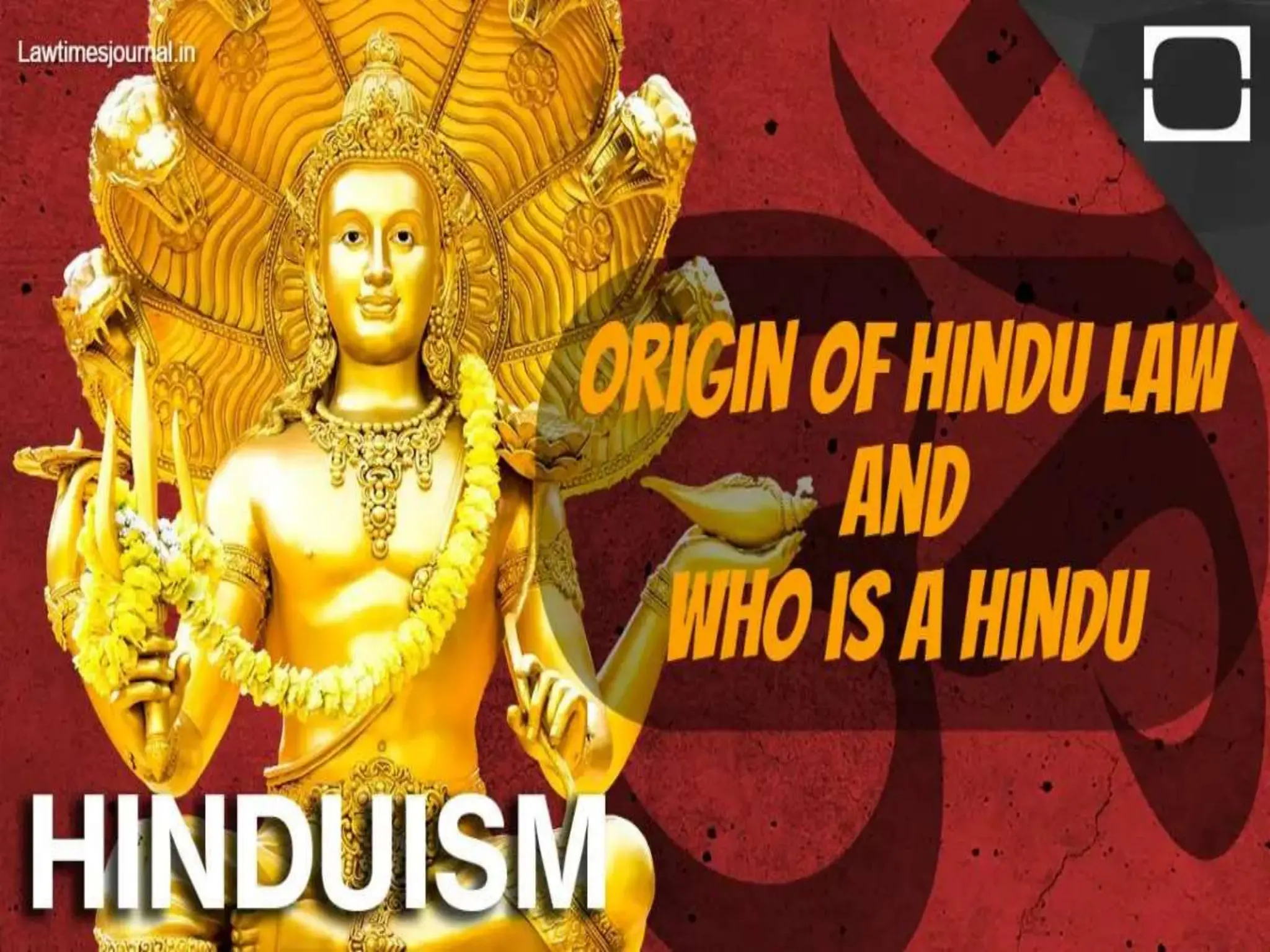
HINDU LAW
1
Family law I ( Hindu law)
2
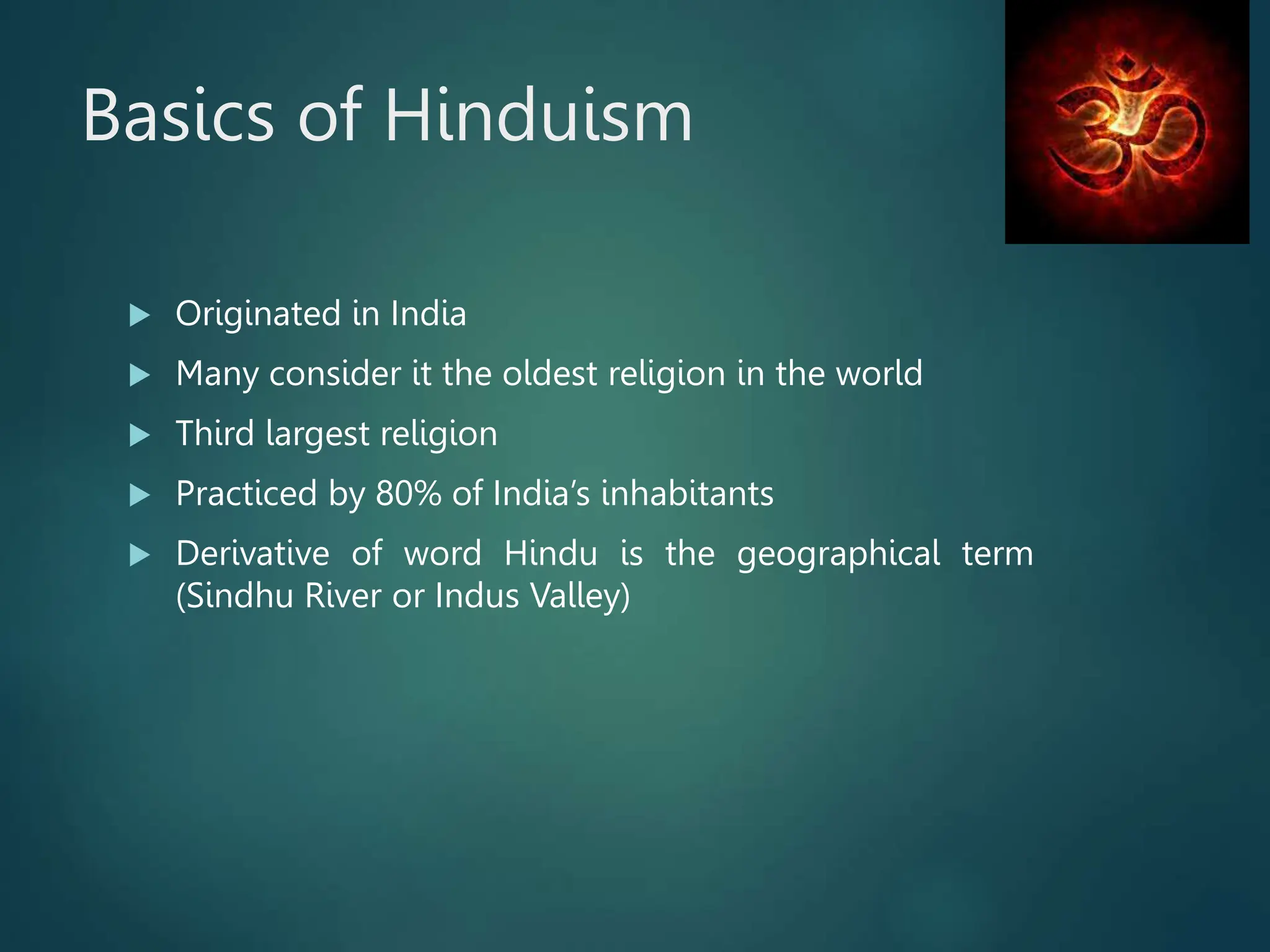
Basics of Hinduism
 Originated in India
 Many consider it the oldest religion in the world
 Third largest religion
 Practiced by 80% of India’s inhabitants
 Derivative of word Hindu is the geographical term
(Sindhu River or Indus Valley)
3
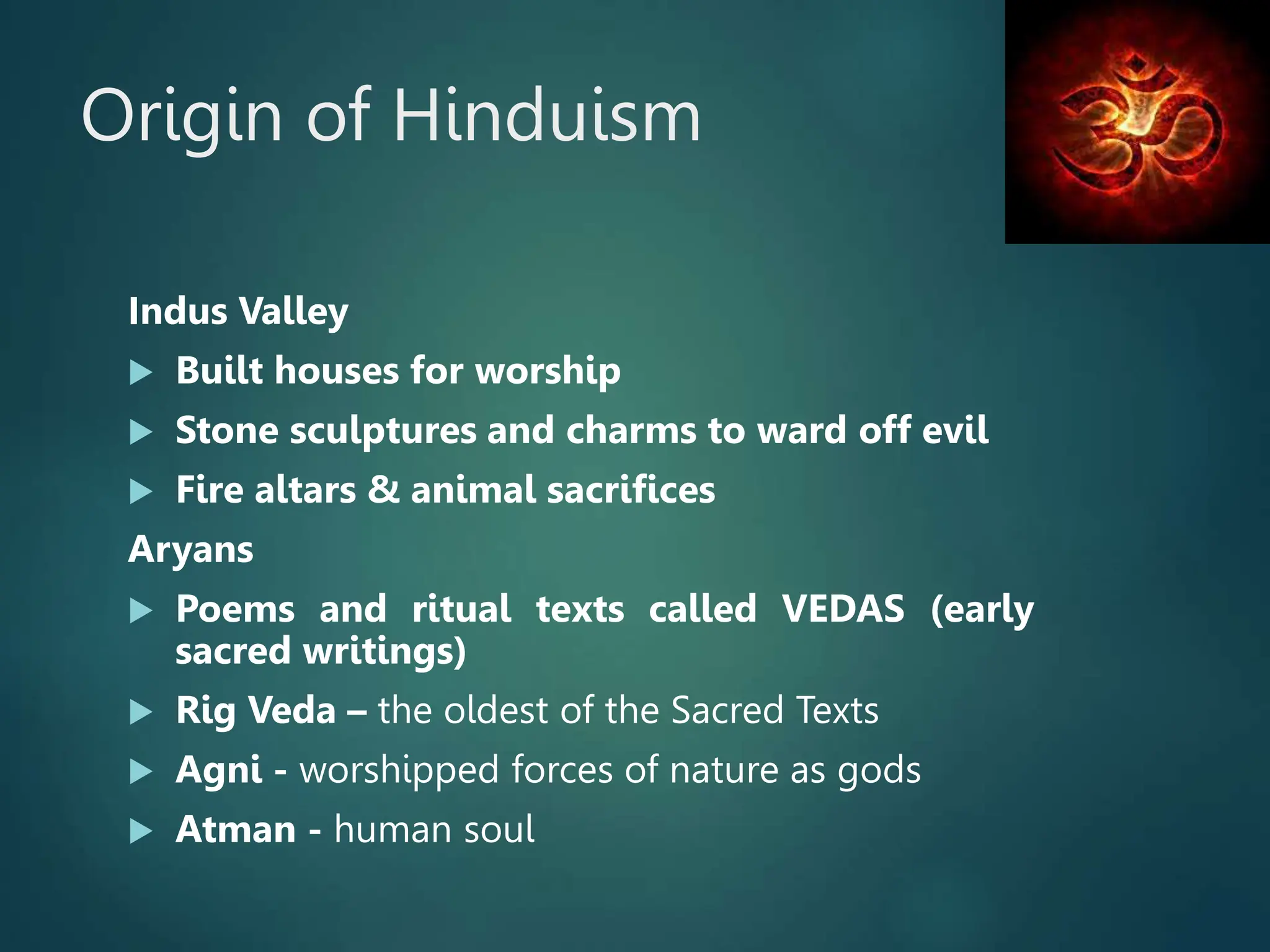
Origin of Hinduism
Indus Valley
 Built houses for worship
 Stone sculptures and charms to ward off evil
 Fire altars & animal sacrifices
Aryans
 Poems and ritual texts called VEDAS (early
sacred writings)
 Rig Veda – the oldest of the Sacred Texts
 Agni - worshipped forces of nature as gods
 Atman - human soul
4
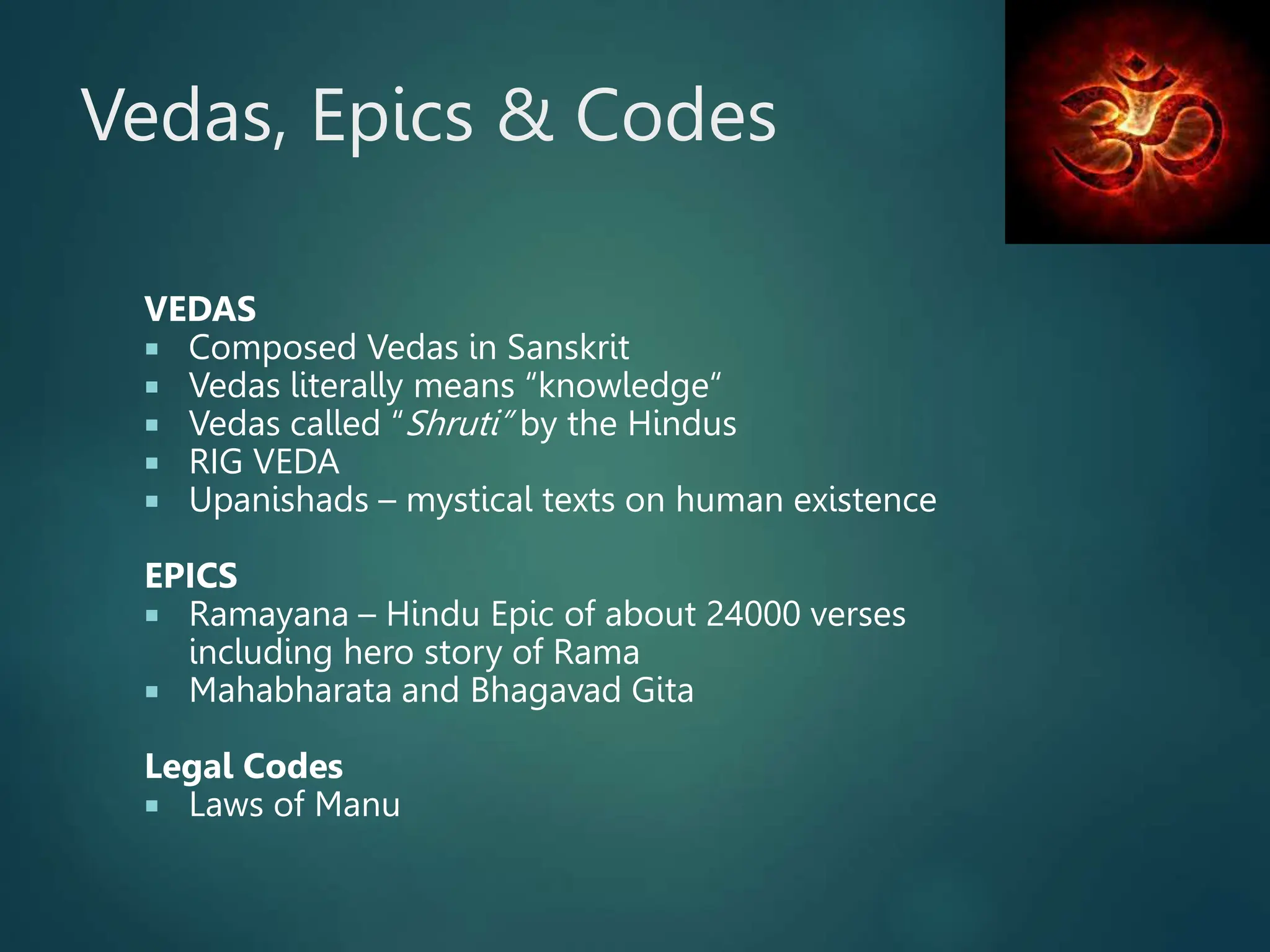
Vedas, Epics & Codes
VEDAS
 Composed Vedas in Sanskrit
 Vedas literally means “knowledge“
 Vedas called “Shruti” by the Hindus
 RIG VEDA
 Upanishads – mystical texts on human existence
EPICS
 Ramayana – Hindu Epic of about 24000 verses
including hero story of Rama
 Mahabharata and Bhagavad Gita
Legal Codes
 Laws of Manu
5
Hindu Belifes
Categorizing the religion of Hinduism is somewhat confusing:
 POLYTHEISTIC worships multiple deities: gods and goddesses
 MONOTHEISTIC it recognizes only one supreme God: the
panentheistic principle of Brahman, that all reality is a unity. The entire
universe is seen as one divine entity who is simultaneously at one with the
universe and who transcends it as well
 TRINITARIAN Brahman is simultaneously visualized as a triad --
one God with three persons:
Brahma (the Creator)
Vishnu (the Preserver,
Shiva (the Destroyer)
 HENOTHEISTI recognize a single deity, and recognizes other gods and
goddesses as facets, forms, manifestations, or aspects of that supreme God
6
Beliefs and Goals
 The ultimate aim of all Hindu thoughts is to attain
the universal soul or divine wisdom called Brahman
 Hindu’s believe in the freedom to individually worship and
guide own spiritual experience.
 The goals of Hinduism consist of personal conduct and
righteous living which equals to dharma
 Goal to achieve moksha, (liberation) from endless
cycle of rebirths called Samsara and reunite atman
with Brahman
7
 MAYA all forms of existence are temporary and
illusionary
 SAMSARA endless cycle of reincarnation
 KARMA Basic belief of cause and effect (all
actions have a consequence)
 DHARMA personal conduct and righteous
living
 MOKSHA the liberation from samsara and the
uniting of ATMAN (human soul) with Brahman
(ultimate soul)
8
9
 The Hindu Marriage Act, 1955 is applicable to following types of
persons:
(i) By religion and birth: Those who are Hindus, Sikhs, Jains or
Buddhist by religion or by birth;
(ii) By not belonging to a non-Hindu religion: Those who are not
Muslims, Christians, Parsis or Jews by religion or by birth;
(iii) Domicile in territory: To any other person domiciled in the
territories to which this Act extends who is not a Muslim, Christian,
Parsi by religion, unless it is proved that any such person would not
have been governed by the Hindu law or by any custom or usage as
part of that law in respect of any of the matters dealt with herein if
this Act had not been passed.
10
Hindus
 Those who are Hindus by Birth and religion
 Jains and Sikhs
 Illegitimate Children whose both parents are
Hindus
 Any child whose father or mother is Hindu
and who is brought up as Hindu
 Those of certain Hindu Sampradayas (Arya
Samaj, Swaminarayan, Brahma Samaj)
11
Not considered as Hindus
 Muslims, Parsis and Christians
 Those who have converted from Hinduism
12
Who can become Hindu?
 Any person by expressing intention to live as Hindu,
if the community accepts him/her
 On conversion from other faith as per Hindu custom
 Child of Hindu and non-Hindu parent – status
 Marriage between Hindu and non-Hindu
13
14
15
16
shruti
Shruti means "that which is heard" and refers to the body of
most authoritative, ancient religious texts comprising the
central canon of Hinduism.
 The “Samhita” or 4 Vedas along with their “Brahmanas”,
108 Upanishads and the Aranyakas are Shruti Literature.
Brahmanas are commentaries on the four Vedas and deal
with proper performance of rituals.
17
The shruti literature include the four Vedas 18
Each of these Vedas include the
following texts, and these belong to
the shruti canon
 Samhitas
 Brahmanas
 Aranyakas
 Upanishads
19
20
smriti
Smrti is a Sanskrit word, from the root Smara, which
means "remembrance, reminiscence, thinking of or
upon, calling to mind", or simply "memory". The word
is found in ancient Vedic literature, such as
the Chandogya Upanishad. In later and modern
scholarly usage, the term refers to tradition, memory,
as well as a vast post-Vedic canon of "tradition that is
remembered"
21
smriti
smritis, a systematic study and teaching of Vedas started. Many
sages, from time to time, have written down the concepts
given in Vedas. So it can be said that Smritis are a written
memory of the knowledge of the sages. Immediately after
the Vedic period, a need for the regulation of the society
arose. Thus, the study of vedas and the incorporation of
local culture and customs became important. It is believed
that many smritis were composed in this period and some
were reduced into writing, however, not all are known. The
smritis can be divided into two - Early smritis
(Dharmasutras) and Later smritis (Dharmashastras).
22
23
Manusmriti
This is the earliest and most important of all. It is not only defined the way of life
in India but is also well know in Java, Bali, and Sumatra. The name of the real
author is not known because the author has written it under the mythical name
of Manu, who is considered to the first human. This was probably done to
increase its importance due to divine origin. Manusmriti compiles all the
laws that were scattered in pre-smriti sutras and gathas
He was a brahman protagonist and was particularly harsh on women and
sudras. He holds local customs to be most important. He directs the king to
obey the customs but tries to cloak the king with divinity. He gives
importance to the principle of 'dand' which forces everybody to follow the
law.
There have been several commentaries on this smruti. The main ones
are: Kalluka's Manavarthmuktavali, Meghthithi's Manubhashya, and
Govindraja's Manutika.
24
25
Yajnavalkya Smriti
Though written after Manusmruti, this is a very important smruti.
Its language is very direct and clear. It is also a lot more
logical. He also gives a lot of importance to customs but hold
the king to be below the law. He considers law to be the
king of kings and the king to be only an enforcer of the law.
He did not deal much with religion and morality but mostly
with civil law. It includes most of the points given in
Manusmruti but also differs on many points such as position of
women and sudras. He was more liberal than Manu.
Vijnaneshwar's commentary 'Mitakshara' on this smruti, is
the most important legal treatise followed almost everywhere
in India except in West Bengal and Orissa.
26
27
Narada Smriti
Narada was from Nepal and this smriti is well
preserved and its complete text is available. This is
the only smriti that does not deal with religion and
morality at all but concentrates only on civil law. This
is very logical and precise. In general, it is based on
Manusmriti and Yajnavalkya smriti but differ on many
points due to changes in social structure. He also gives
a lot of importance to customs.
28
Difference between Shruti &
Smriti
 Shruti is “that which has been heard” and is canonical,
consisting of revelation and unquestionable truth, and is
considered eternal. It refers mainly to the Vedas themselves.
 Smriti is “that which has been remembered” supplementary
and may change over time. It is authoritative only to the extent
that it conforms to the bedrock of Shruti. It’s worth note that,
there is not a distinct divide between Shruti and Smriti. Both
Shruti and Smriti can be represented as a continuum, with
some texts more canonical than others.
29
Commentaries and Digest
The work done to explain a particular Smritis is
called a commentary. Digests were mainly written
after that and incorporated and explained material
from all the Smritis. As noted earlier, some of the
commentaries were, Manubhashya, Manutika, and
Mitakshara. While the most important digest is
Jimutvahan's Dayabhag that is applicable in the
Bengal and Orissa area.
30
31
Customs
Most of the Hindu law is based on customs and
practices followed by the people all across the
country. Even Smrutis have given importance to
customs. They have held customs as transcendent
law and have advised the Kings to give decisions
based on customs after due religious consideration
32
Customs are of four types
customs
Family
Caste
and
commu
nity
Guild
Local
33
Essentials of Customs
 Ancient.
 Invariable and continuous.
 It should be certain.
 Reasonable.
 It should not be immoral.
 Must not be opposed to public policy.
 It must not be forbidden by any express enactment of
the legislature.
34
Judicial Decisions
During British regime in this country Hindu law was
administered by British Judges with the help of Hindu Pandits
because they interpreted the Sanskrit texts for them to apply it
to the dispute and to arrive at a decision. So the decision of the
higher courts become a law for the lower courts. Today the
doctrine of Stare decisis is part of Indian Law. Supreme Court’s
decisions are binding on all courts, though Supreme Court is
not bound by its own decisions. The decisions of State High
Courts are bindings on all subordinate courts of their respective
states though decisions of the one High Court is not binding on
other High Courts.
35
Legislation
It has been an important factor in the development of Hindu Law. Most of them are in the direction of
reforming Hindu Law and some of them supersedes Hindu Law. Prior to the British rule it was
difficult to find fixed principles of law on several areas so British Government passed certain Acts
which have effect of changing the religious nature of Hindu law at several instances. Some important
legislations are–
i) The Indian Majority Act, 1875.
ii) The Transfer of Property Act, 1882.
iii) The Guardians and Wards Act, 1890.
iv) The Indian Succession Act, 1925.
v) The Child Marriage Restraint Act, 1929.
vi) The Special Marriage Act, 1954.
vii) The Hindu Marriage Act, 1955.
viii) The Hindu Minority and Guardianship Act, 1956.
ix) The Hindu Succession Act, 1956.
x) The Hindu Adoptions and Maintenance Act, 1956. xi) Hindu Succession (Amendment) Act, 2005.
36
Equity, Justice and Good
Conscience
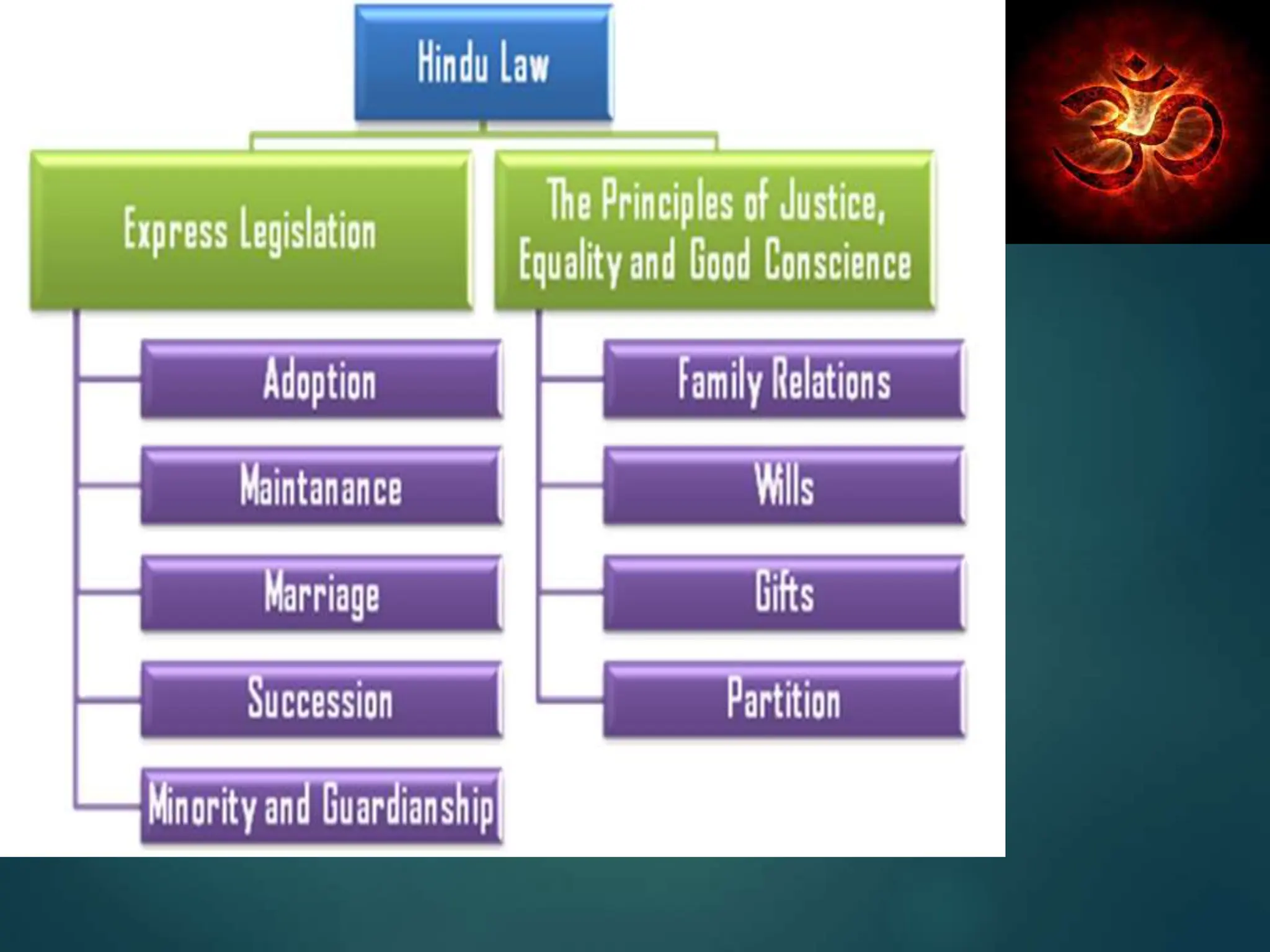
In the absence of any specific law in the Smriti, or in
the event of a conflict between the Smritis, the
principles of justice, equity and good conscience
would be applied. In other words, what would be
most fair and equitable in the opinion of the Judge
would be done in a particular case. The Supreme
Court has observed in Gurunath v. Kamlabai1 in the
absence of any clear Shastric text, the courts have the
authority to decide cases on principles of equity,
justice and good conscience.
37
38

hindu law basic & sources ppt.ppt and the history

  • 1.
    HINDU LAW 1 Family lawI ( Hindu law)
  • 2.
  • 3.
    Basics of Hinduism Originated in India  Many consider it the oldest religion in the world  Third largest religion  Practiced by 80% of India’s inhabitants  Derivative of word Hindu is the geographical term (Sindhu River or Indus Valley) 3
  • 4.
    Origin of Hinduism IndusValley  Built houses for worship  Stone sculptures and charms to ward off evil  Fire altars & animal sacrifices Aryans  Poems and ritual texts called VEDAS (early sacred writings)  Rig Veda – the oldest of the Sacred Texts  Agni - worshipped forces of nature as gods  Atman - human soul 4
  • 5.
    Vedas, Epics &Codes VEDAS  Composed Vedas in Sanskrit  Vedas literally means “knowledge“  Vedas called “Shruti” by the Hindus  RIG VEDA  Upanishads – mystical texts on human existence EPICS  Ramayana – Hindu Epic of about 24000 verses including hero story of Rama  Mahabharata and Bhagavad Gita Legal Codes  Laws of Manu 5
  • 6.
    Hindu Belifes Categorizing thereligion of Hinduism is somewhat confusing:  POLYTHEISTIC worships multiple deities: gods and goddesses  MONOTHEISTIC it recognizes only one supreme God: the panentheistic principle of Brahman, that all reality is a unity. The entire universe is seen as one divine entity who is simultaneously at one with the universe and who transcends it as well  TRINITARIAN Brahman is simultaneously visualized as a triad -- one God with three persons: Brahma (the Creator) Vishnu (the Preserver, Shiva (the Destroyer)  HENOTHEISTI recognize a single deity, and recognizes other gods and goddesses as facets, forms, manifestations, or aspects of that supreme God 6
  • 7.
    Beliefs and Goals The ultimate aim of all Hindu thoughts is to attain the universal soul or divine wisdom called Brahman  Hindu’s believe in the freedom to individually worship and guide own spiritual experience.  The goals of Hinduism consist of personal conduct and righteous living which equals to dharma  Goal to achieve moksha, (liberation) from endless cycle of rebirths called Samsara and reunite atman with Brahman 7
  • 8.
     MAYA allforms of existence are temporary and illusionary  SAMSARA endless cycle of reincarnation  KARMA Basic belief of cause and effect (all actions have a consequence)  DHARMA personal conduct and righteous living  MOKSHA the liberation from samsara and the uniting of ATMAN (human soul) with Brahman (ultimate soul) 8
  • 9.
  • 10.
     The HinduMarriage Act, 1955 is applicable to following types of persons: (i) By religion and birth: Those who are Hindus, Sikhs, Jains or Buddhist by religion or by birth; (ii) By not belonging to a non-Hindu religion: Those who are not Muslims, Christians, Parsis or Jews by religion or by birth; (iii) Domicile in territory: To any other person domiciled in the territories to which this Act extends who is not a Muslim, Christian, Parsi by religion, unless it is proved that any such person would not have been governed by the Hindu law or by any custom or usage as part of that law in respect of any of the matters dealt with herein if this Act had not been passed. 10
  • 11.
    Hindus  Those whoare Hindus by Birth and religion  Jains and Sikhs  Illegitimate Children whose both parents are Hindus  Any child whose father or mother is Hindu and who is brought up as Hindu  Those of certain Hindu Sampradayas (Arya Samaj, Swaminarayan, Brahma Samaj) 11
  • 12.
    Not considered asHindus  Muslims, Parsis and Christians  Those who have converted from Hinduism 12
  • 13.
    Who can becomeHindu?  Any person by expressing intention to live as Hindu, if the community accepts him/her  On conversion from other faith as per Hindu custom  Child of Hindu and non-Hindu parent – status  Marriage between Hindu and non-Hindu 13
  • 14.
  • 15.
  • 16.
  • 17.
    shruti Shruti means "thatwhich is heard" and refers to the body of most authoritative, ancient religious texts comprising the central canon of Hinduism.  The “Samhita” or 4 Vedas along with their “Brahmanas”, 108 Upanishads and the Aranyakas are Shruti Literature. Brahmanas are commentaries on the four Vedas and deal with proper performance of rituals. 17
  • 18.
    The shruti literatureinclude the four Vedas 18
  • 19.
    Each of theseVedas include the following texts, and these belong to the shruti canon  Samhitas  Brahmanas  Aranyakas  Upanishads 19
  • 20.
  • 21.
    smriti Smrti is aSanskrit word, from the root Smara, which means "remembrance, reminiscence, thinking of or upon, calling to mind", or simply "memory". The word is found in ancient Vedic literature, such as the Chandogya Upanishad. In later and modern scholarly usage, the term refers to tradition, memory, as well as a vast post-Vedic canon of "tradition that is remembered" 21
  • 22.
    smriti smritis, a systematicstudy and teaching of Vedas started. Many sages, from time to time, have written down the concepts given in Vedas. So it can be said that Smritis are a written memory of the knowledge of the sages. Immediately after the Vedic period, a need for the regulation of the society arose. Thus, the study of vedas and the incorporation of local culture and customs became important. It is believed that many smritis were composed in this period and some were reduced into writing, however, not all are known. The smritis can be divided into two - Early smritis (Dharmasutras) and Later smritis (Dharmashastras). 22
  • 23.
  • 24.
    Manusmriti This is theearliest and most important of all. It is not only defined the way of life in India but is also well know in Java, Bali, and Sumatra. The name of the real author is not known because the author has written it under the mythical name of Manu, who is considered to the first human. This was probably done to increase its importance due to divine origin. Manusmriti compiles all the laws that were scattered in pre-smriti sutras and gathas He was a brahman protagonist and was particularly harsh on women and sudras. He holds local customs to be most important. He directs the king to obey the customs but tries to cloak the king with divinity. He gives importance to the principle of 'dand' which forces everybody to follow the law. There have been several commentaries on this smruti. The main ones are: Kalluka's Manavarthmuktavali, Meghthithi's Manubhashya, and Govindraja's Manutika. 24
  • 25.
  • 26.
    Yajnavalkya Smriti Though writtenafter Manusmruti, this is a very important smruti. Its language is very direct and clear. It is also a lot more logical. He also gives a lot of importance to customs but hold the king to be below the law. He considers law to be the king of kings and the king to be only an enforcer of the law. He did not deal much with religion and morality but mostly with civil law. It includes most of the points given in Manusmruti but also differs on many points such as position of women and sudras. He was more liberal than Manu. Vijnaneshwar's commentary 'Mitakshara' on this smruti, is the most important legal treatise followed almost everywhere in India except in West Bengal and Orissa. 26
  • 27.
  • 28.
    Narada Smriti Narada wasfrom Nepal and this smriti is well preserved and its complete text is available. This is the only smriti that does not deal with religion and morality at all but concentrates only on civil law. This is very logical and precise. In general, it is based on Manusmriti and Yajnavalkya smriti but differ on many points due to changes in social structure. He also gives a lot of importance to customs. 28
  • 29.
    Difference between Shruti& Smriti  Shruti is “that which has been heard” and is canonical, consisting of revelation and unquestionable truth, and is considered eternal. It refers mainly to the Vedas themselves.  Smriti is “that which has been remembered” supplementary and may change over time. It is authoritative only to the extent that it conforms to the bedrock of Shruti. It’s worth note that, there is not a distinct divide between Shruti and Smriti. Both Shruti and Smriti can be represented as a continuum, with some texts more canonical than others. 29
  • 30.
    Commentaries and Digest Thework done to explain a particular Smritis is called a commentary. Digests were mainly written after that and incorporated and explained material from all the Smritis. As noted earlier, some of the commentaries were, Manubhashya, Manutika, and Mitakshara. While the most important digest is Jimutvahan's Dayabhag that is applicable in the Bengal and Orissa area. 30
  • 31.
  • 32.
    Customs Most of theHindu law is based on customs and practices followed by the people all across the country. Even Smrutis have given importance to customs. They have held customs as transcendent law and have advised the Kings to give decisions based on customs after due religious consideration 32
  • 33.
    Customs are offour types customs Family Caste and commu nity Guild Local 33
  • 34.
    Essentials of Customs Ancient.  Invariable and continuous.  It should be certain.  Reasonable.  It should not be immoral.  Must not be opposed to public policy.  It must not be forbidden by any express enactment of the legislature. 34
  • 35.
    Judicial Decisions During Britishregime in this country Hindu law was administered by British Judges with the help of Hindu Pandits because they interpreted the Sanskrit texts for them to apply it to the dispute and to arrive at a decision. So the decision of the higher courts become a law for the lower courts. Today the doctrine of Stare decisis is part of Indian Law. Supreme Court’s decisions are binding on all courts, though Supreme Court is not bound by its own decisions. The decisions of State High Courts are bindings on all subordinate courts of their respective states though decisions of the one High Court is not binding on other High Courts. 35
  • 36.
    Legislation It has beenan important factor in the development of Hindu Law. Most of them are in the direction of reforming Hindu Law and some of them supersedes Hindu Law. Prior to the British rule it was difficult to find fixed principles of law on several areas so British Government passed certain Acts which have effect of changing the religious nature of Hindu law at several instances. Some important legislations are– i) The Indian Majority Act, 1875. ii) The Transfer of Property Act, 1882. iii) The Guardians and Wards Act, 1890. iv) The Indian Succession Act, 1925. v) The Child Marriage Restraint Act, 1929. vi) The Special Marriage Act, 1954. vii) The Hindu Marriage Act, 1955. viii) The Hindu Minority and Guardianship Act, 1956. ix) The Hindu Succession Act, 1956. x) The Hindu Adoptions and Maintenance Act, 1956. xi) Hindu Succession (Amendment) Act, 2005. 36
  • 37.
    Equity, Justice andGood Conscience In the absence of any specific law in the Smriti, or in the event of a conflict between the Smritis, the principles of justice, equity and good conscience would be applied. In other words, what would be most fair and equitable in the opinion of the Judge would be done in a particular case. The Supreme Court has observed in Gurunath v. Kamlabai1 in the absence of any clear Shastric text, the courts have the authority to decide cases on principles of equity, justice and good conscience. 37
  • 38.