Survey of World Art 
TThhee CCoolloorr WWhheeeell 
Lesson Objective: Students will 
recreate the color wheel using 
original designs.
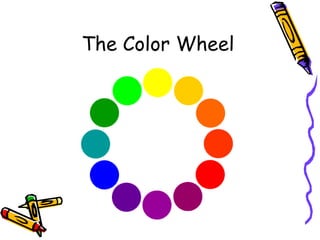
The Color Wheel
History of Color Theory 
• The first color wheel was invented by Sir Isaac Newton (1643-1727). 
He was an English physicist, mathematician, astronomer, 
natural philosopher, alchemist and theologian. 
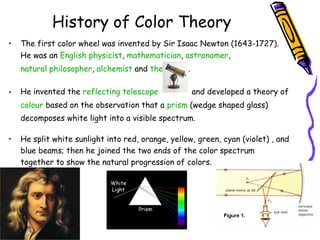
• He invented the reflecting telescope and developed a theory of 
colour based on the observation that a prism (wedge shaped glass) 
decomposes white light into a visible spectrum. 
• He split white sunlight into red, orange, yellow, green, cyan (violet) , and 
blue beams; then he joined the two ends of the color spectrum 
together to show the natural progression of colors.
Current Color Theory 
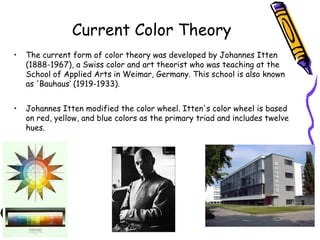
• The current form of color theory was developed by Johannes Itten 
(1888-1967), a Swiss color and art theorist who was teaching at the 
School of Applied Arts in Weimar, Germany. This school is also known 
as 'Bauhaus‘ (1919-1933). 
• Johannes Itten modified the color wheel. Itten's color wheel is based 
on red, yellow, and blue colors as the primary triad and includes twelve 
hues.
Psychological/Cultural Meanings of Colors 
1. Cultural associations: the color of currency, traditions, celebrations, 
geography, etc. (For example, green is associated with heaven 
(Muslims) and luck (U.S. and Ireland) 
2. Political and historical associations: the color of flags, political 
parties, royalty, etc. (For example, green is the color of Libya's flag; 
it’s the favorite color of Emperor Hirohito and the source of "Green 
Day" in Japan, and in the U.S., the Green Party.) 
3. Religious and mythical associations: the colors associated with 
spiritual or magical beliefs (For example, in contemporary Western 
culture, green is associated with extraterrestrial beings.)
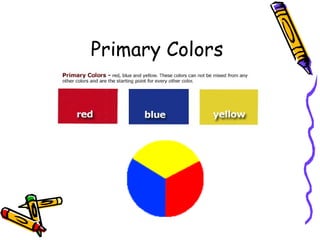
Primary Colors
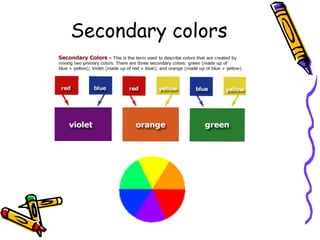
Secondary colors
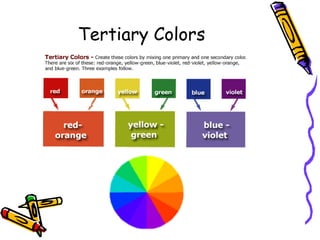
Tertiary Colors
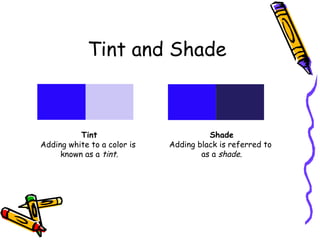
Tint and Shade 
Shade 
Adding black is referred to 
as a shade. 
Tint 
Adding white to a color is 
known as a tint.
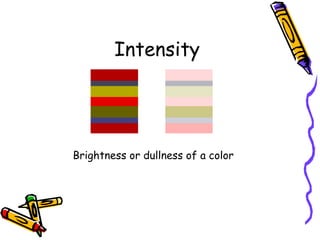
Intensity 
Brightness or dullness of a color
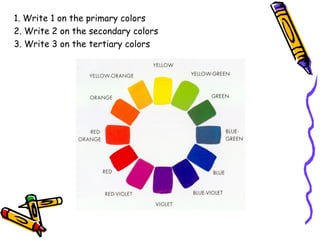
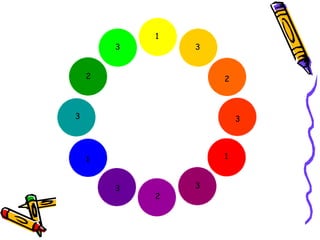
1. Write 1 on the primary colors 
2. Write 2 on the secondary colors 
3. Write 3 on the tertiary colors
1 
2 2 
1 1 
2 
3 
3 3 
3 
3 3

The color wheel

  • 1.
    Survey of WorldArt TThhee CCoolloorr WWhheeeell Lesson Objective: Students will recreate the color wheel using original designs.
  • 2.
  • 3.
    History of ColorTheory • The first color wheel was invented by Sir Isaac Newton (1643-1727). He was an English physicist, mathematician, astronomer, natural philosopher, alchemist and theologian. • He invented the reflecting telescope and developed a theory of colour based on the observation that a prism (wedge shaped glass) decomposes white light into a visible spectrum. • He split white sunlight into red, orange, yellow, green, cyan (violet) , and blue beams; then he joined the two ends of the color spectrum together to show the natural progression of colors.
  • 4.
    Current Color Theory • The current form of color theory was developed by Johannes Itten (1888-1967), a Swiss color and art theorist who was teaching at the School of Applied Arts in Weimar, Germany. This school is also known as 'Bauhaus‘ (1919-1933). • Johannes Itten modified the color wheel. Itten's color wheel is based on red, yellow, and blue colors as the primary triad and includes twelve hues.
  • 5.
    Psychological/Cultural Meanings ofColors 1. Cultural associations: the color of currency, traditions, celebrations, geography, etc. (For example, green is associated with heaven (Muslims) and luck (U.S. and Ireland) 2. Political and historical associations: the color of flags, political parties, royalty, etc. (For example, green is the color of Libya's flag; it’s the favorite color of Emperor Hirohito and the source of "Green Day" in Japan, and in the U.S., the Green Party.) 3. Religious and mythical associations: the colors associated with spiritual or magical beliefs (For example, in contemporary Western culture, green is associated with extraterrestrial beings.)
  • 6.
  • 7.
  • 8.
  • 10.
    Tint and Shade Shade Adding black is referred to as a shade. Tint Adding white to a color is known as a tint.
  • 11.
    Intensity Brightness ordullness of a color
  • 12.
    1. Write 1on the primary colors 2. Write 2 on the secondary colors 3. Write 3 on the tertiary colors
  • 13.
    1 2 2 1 1 2 3 3 3 3 3 3