The CircularFlow of
Economic Activity
A lesson in Market
Economic Systems
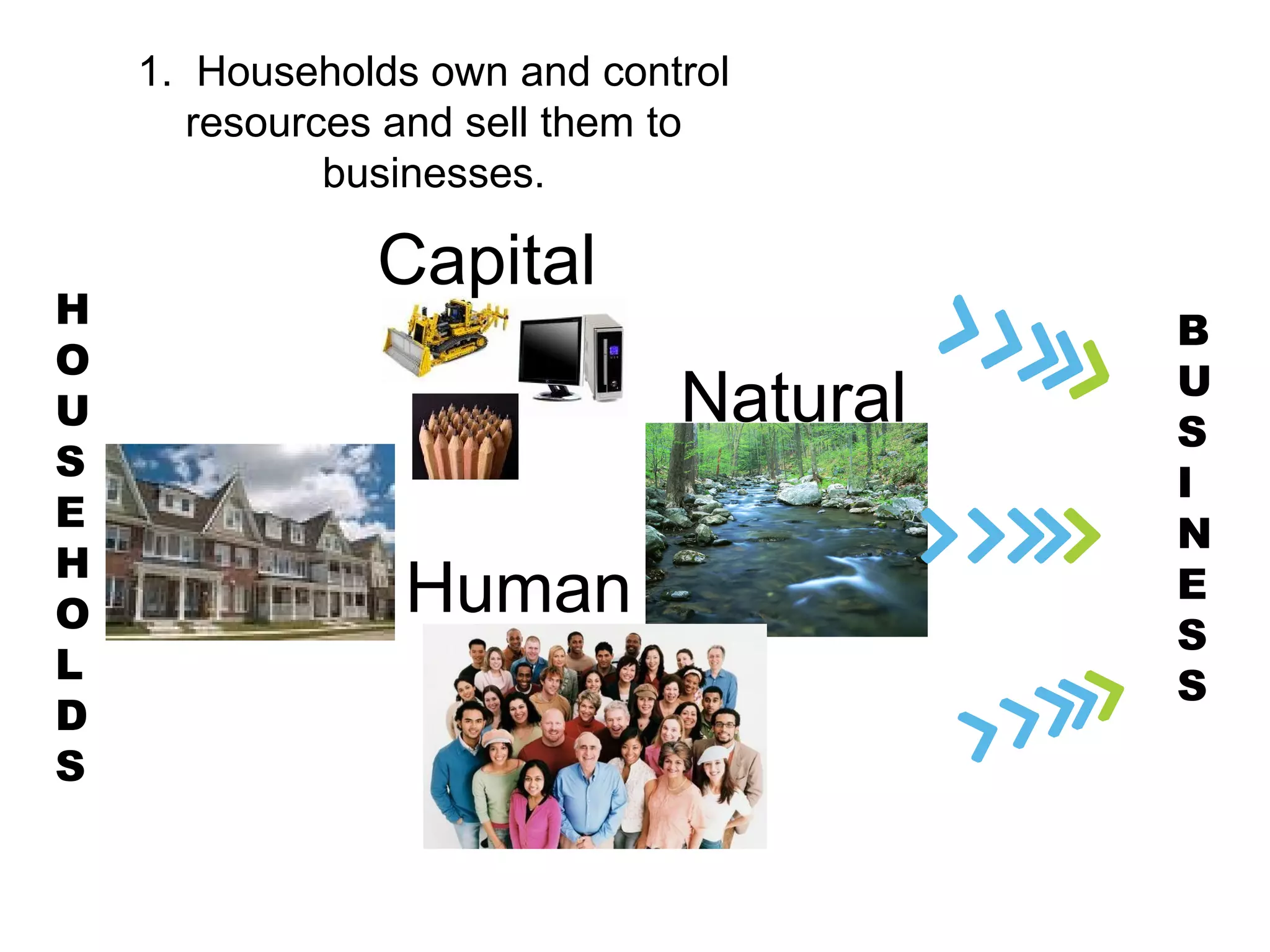
Human
Natural
Capital
1. Households own and control
resources and sell them to
businesses.
B
U
S
I
N
E
S
S
H
O
U
S
E
H
O
L
D
S
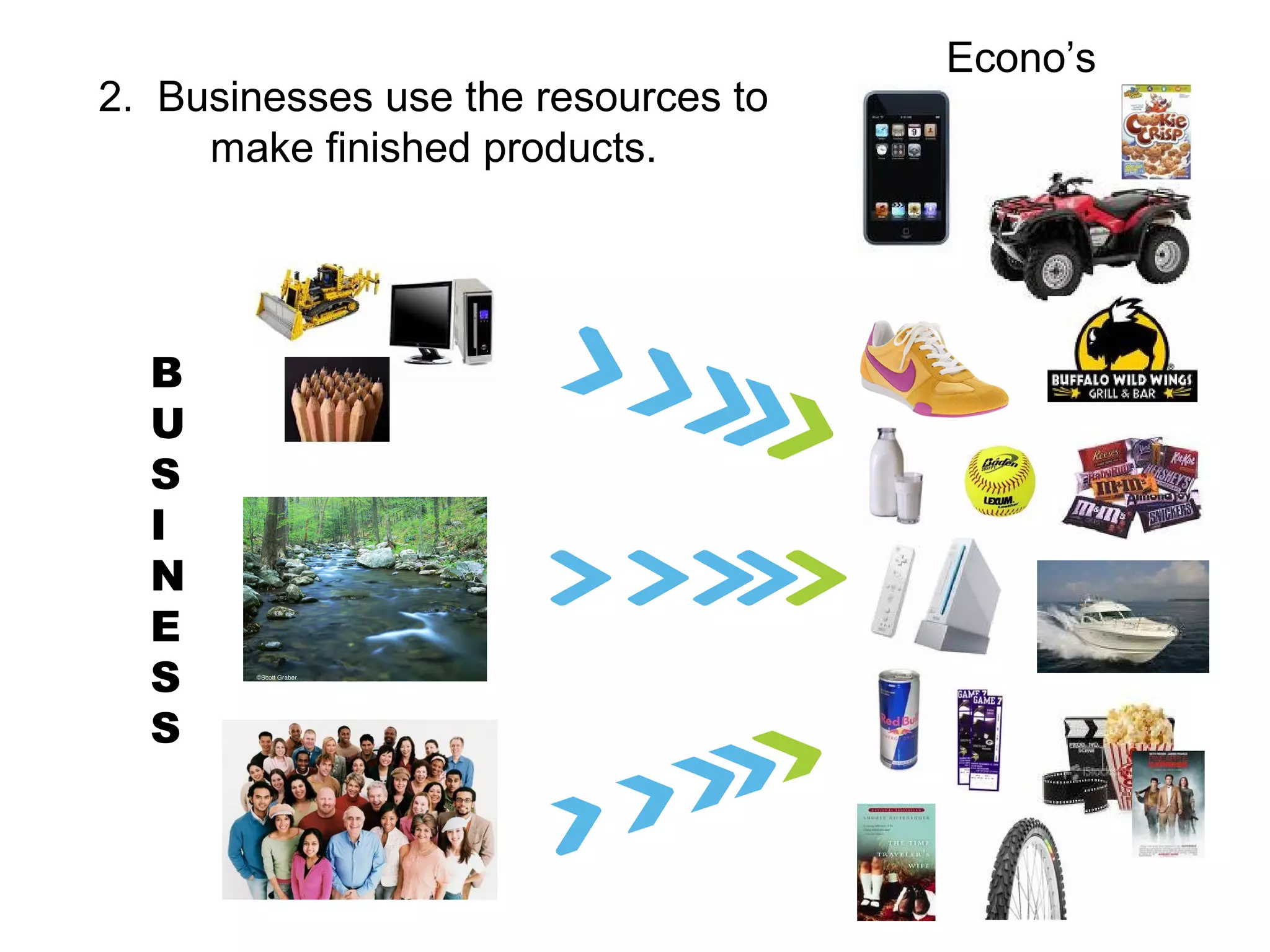
2. Businesses use the resources to
make finished products.
Econo’s
B
U
S
I
N
E
S
S
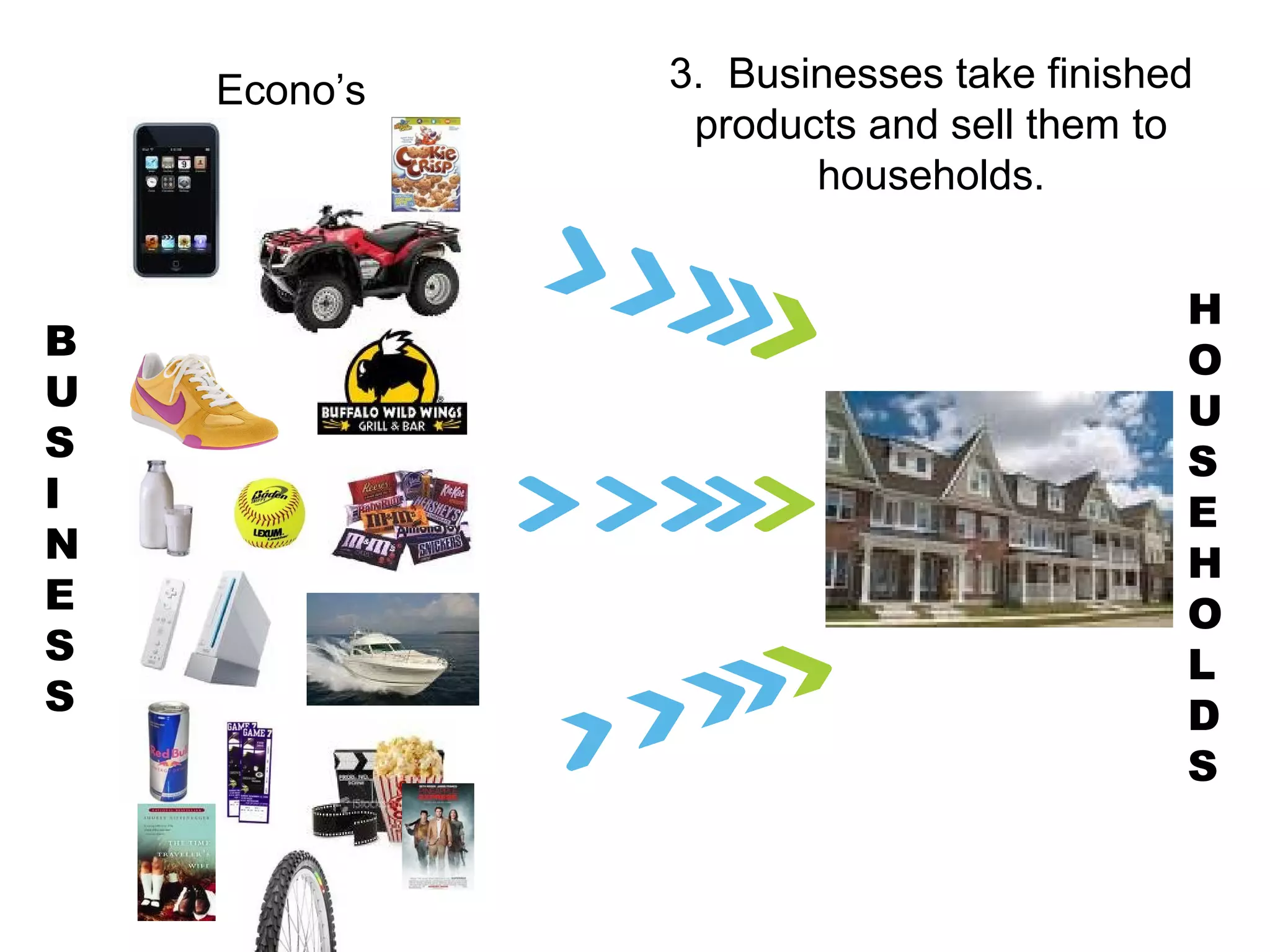
3. Businesses take finished
products and sell them to
households.
Econo’s
B
U
S
I
N
E
S
S
H
O
U
S
E
H
O
L
D
S
The Activity
• Half the class will be households.
They will own 15 resource cards.
Households sell resources and buy the product.
• Half the class will be businesses. They will
have $1000.
Businesses buy resources, make the product, and
the sell product.
Econoland Factory
The Activity
Top Businesses: The one’s that make the most
money.
Class record $2500
Hr 2 Riley - $1700, Hr 3 Ehret - $1600, Hr 4 Oman
- $2000
Top Household: The one’s that buy the most
“Econo’s”
Class record 11
Hr 2 Middleton – 8, Hr 3 Hauth – 7, Hr 4 Housley -
10
Households/Businesses
1. What strategy worked best foryou?
2. What would you change if we did the
activity again?
3. Which group had it easier, the
businesses orhouseholds and why?
Questions on CircularFlow
1. Which group started with the money?
2. Which group ended with (most of) the money?
3. How many transactions tookplace forthis result to
occur?
4. Which group started with the resources?
5. Which group ended with the products (econo’s)?
6. How many transactions tookplace forthis result to
occur?
7. What was exchanged in the initial transactions?
8. What name could you give the initial transactions?
9. What was exchanged in the secondary transactions?
10. What name could you give the secondary
transactions?
The Circular Flow of Economic
Activity
The Circular Flow of Economic
Activity
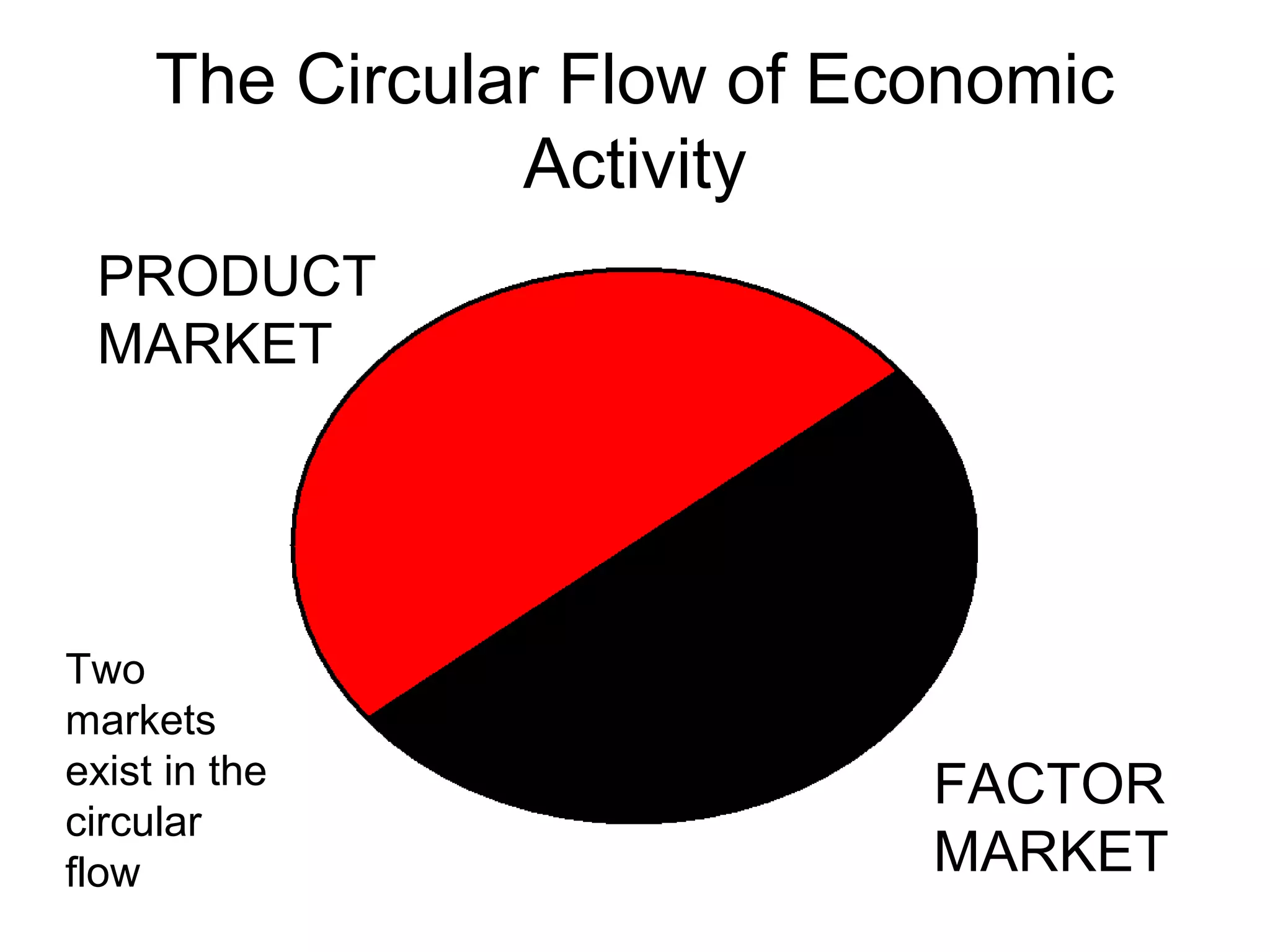
Two
markets
exist in the
circular
flow
FACTOR
MARKET
PRODUCT
MARKET
The Circular Flow of Economic
Activity
FACTOR
MARKET
PRODUCT
MARKET
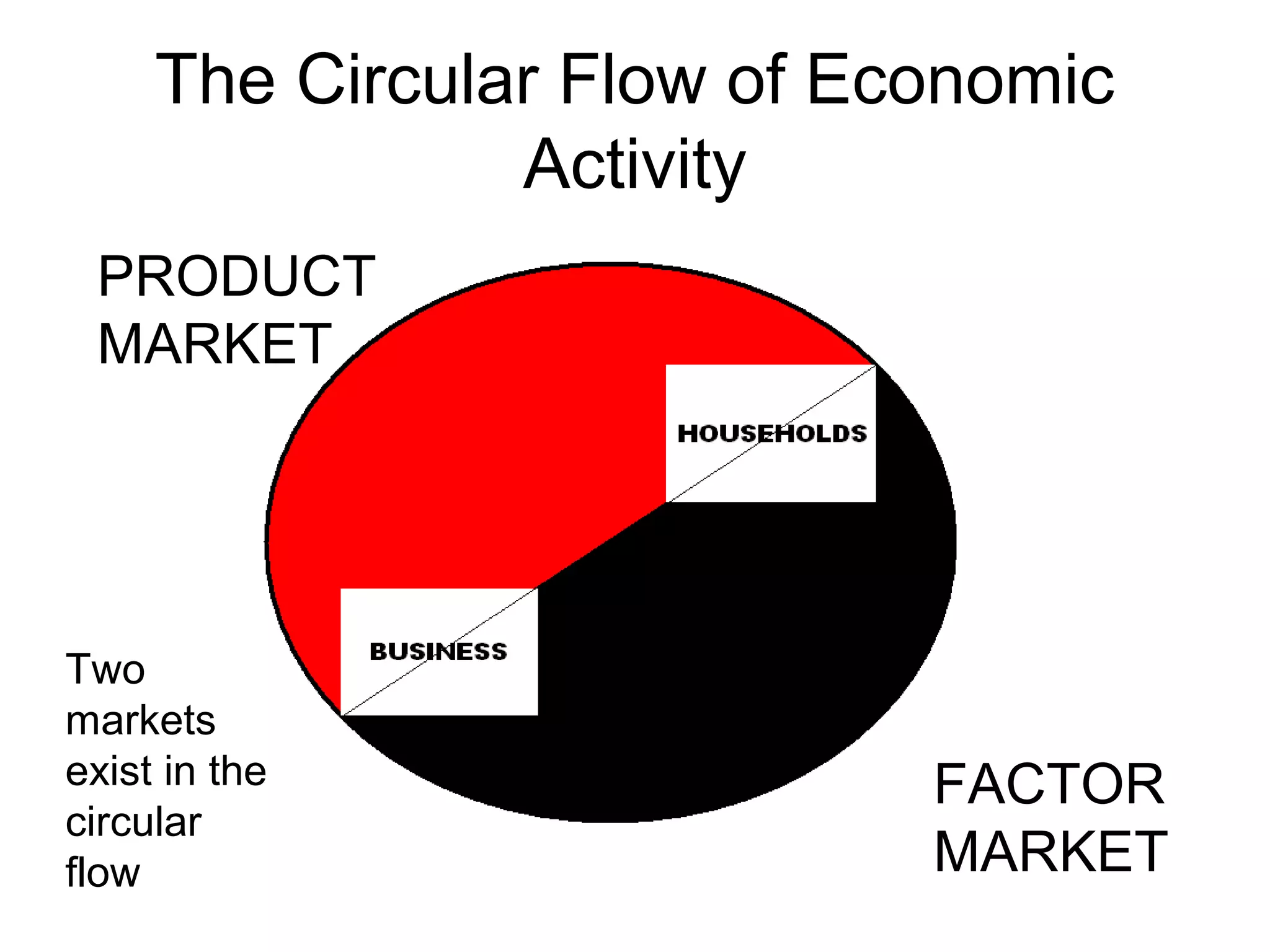
Two
markets
exist in the
circular
flow
The Circular Flow of Economic
Activity
FACTOR
MARKET
PRODUCT
MARKET
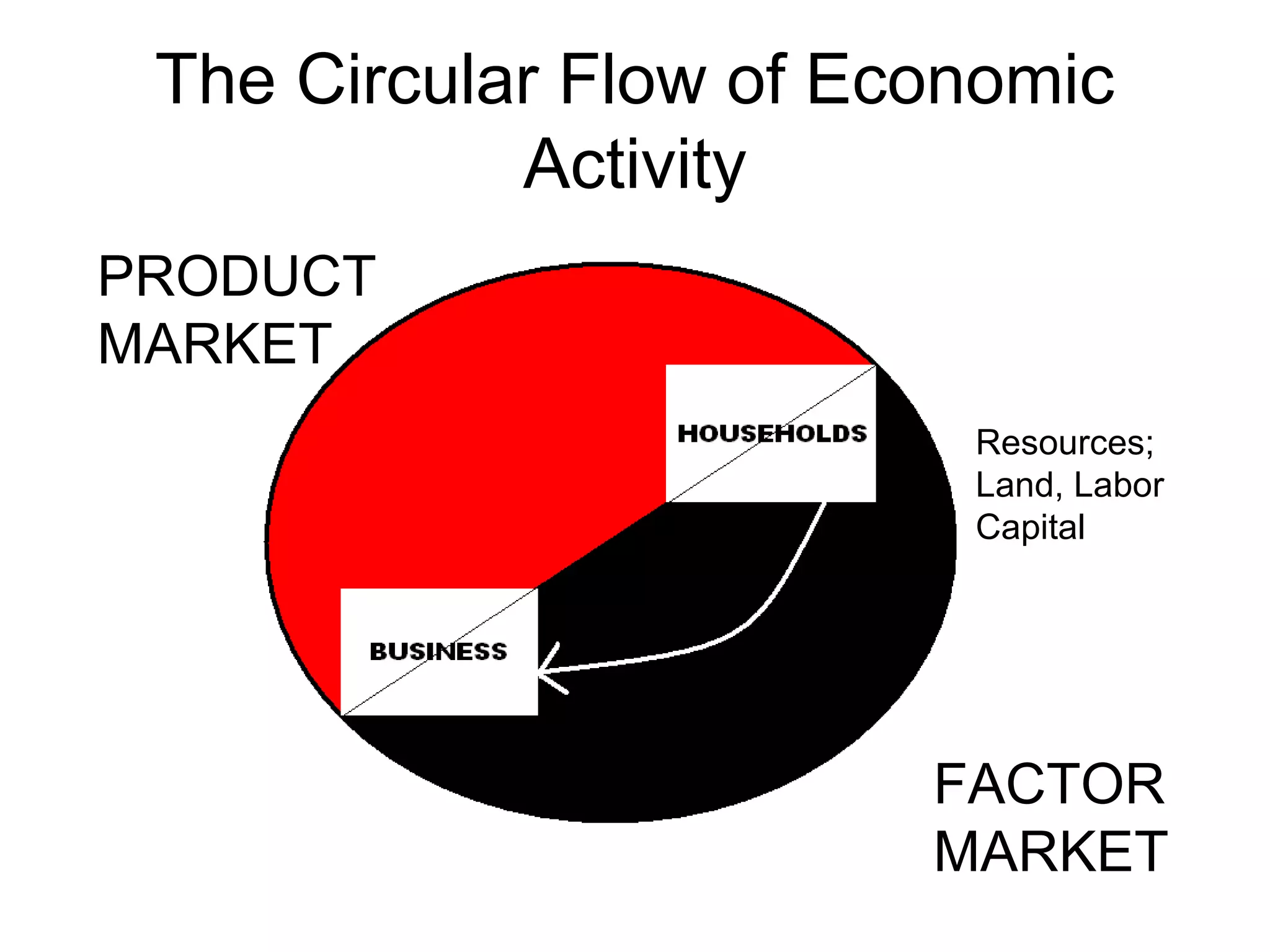
Resources;
Land, Labor
Capital
The Circular Flow of Economic
Activity
FACTOR
MARKET
PRODUCT
MARKET
Resources;
Land, Labor
Capital
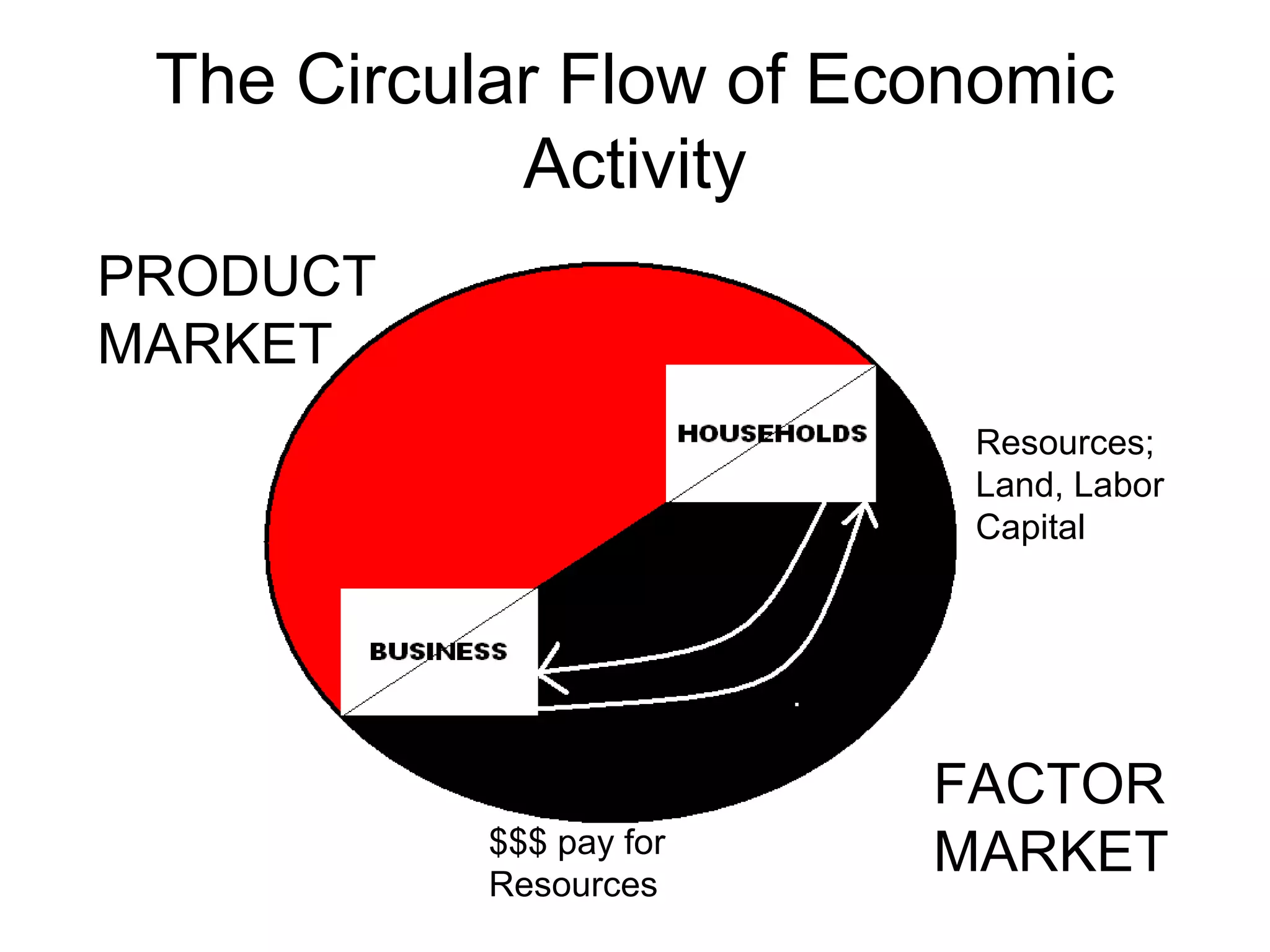
$$$ pay for
Resources
The Circular Flow of Economic
Activity
FACTOR
MARKET
PRODUCT
MARKET
Resources;
Land, Labor
Capital
$$$ pay for
Resources
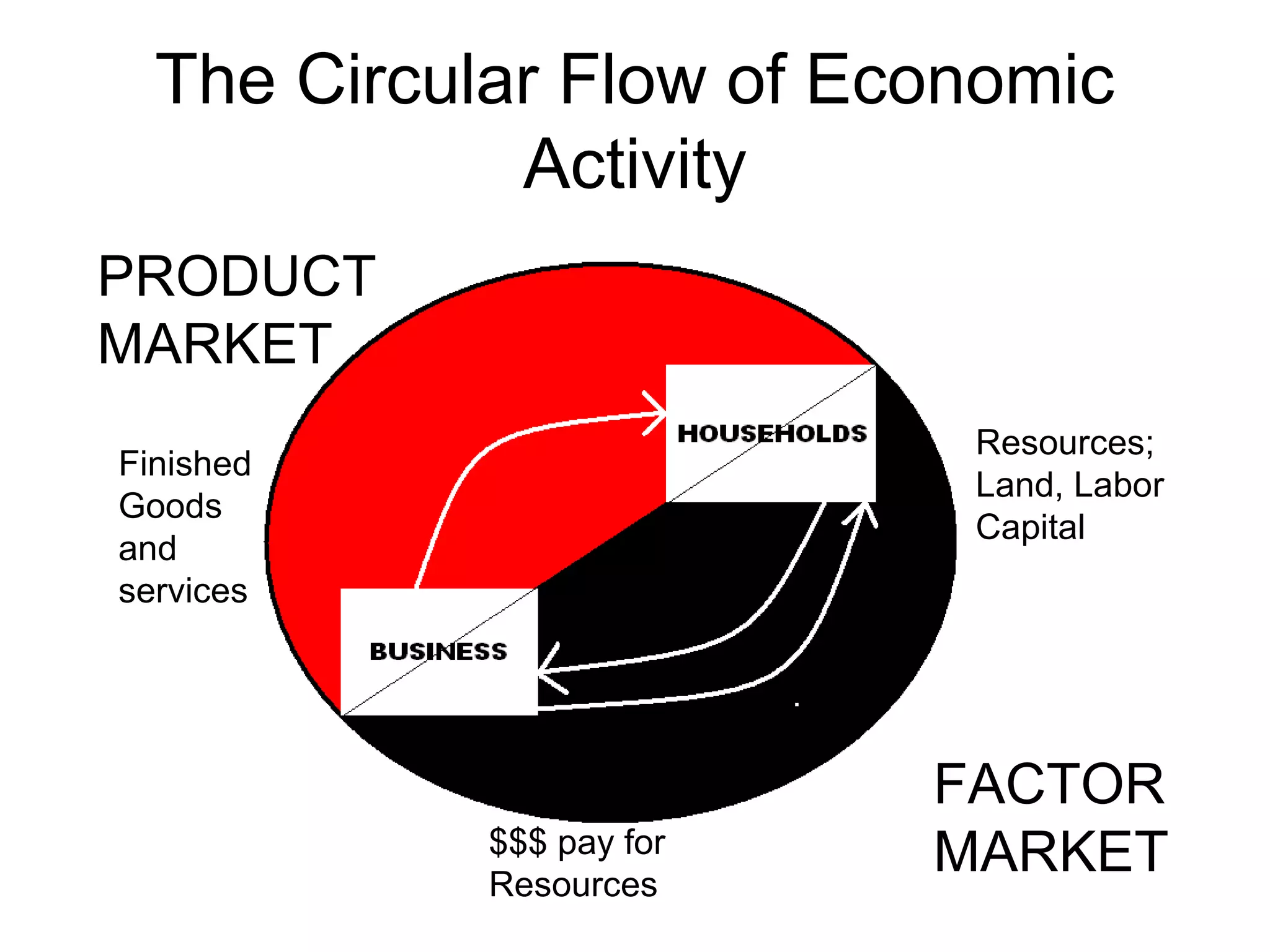
Finished
Goods
and
services
The Circular Flow of Economic
Activity
FACTOR
MARKET
PRODUCT
MARKET
Resources;
Land, Labor
Capital
$$$ pay for
Resources
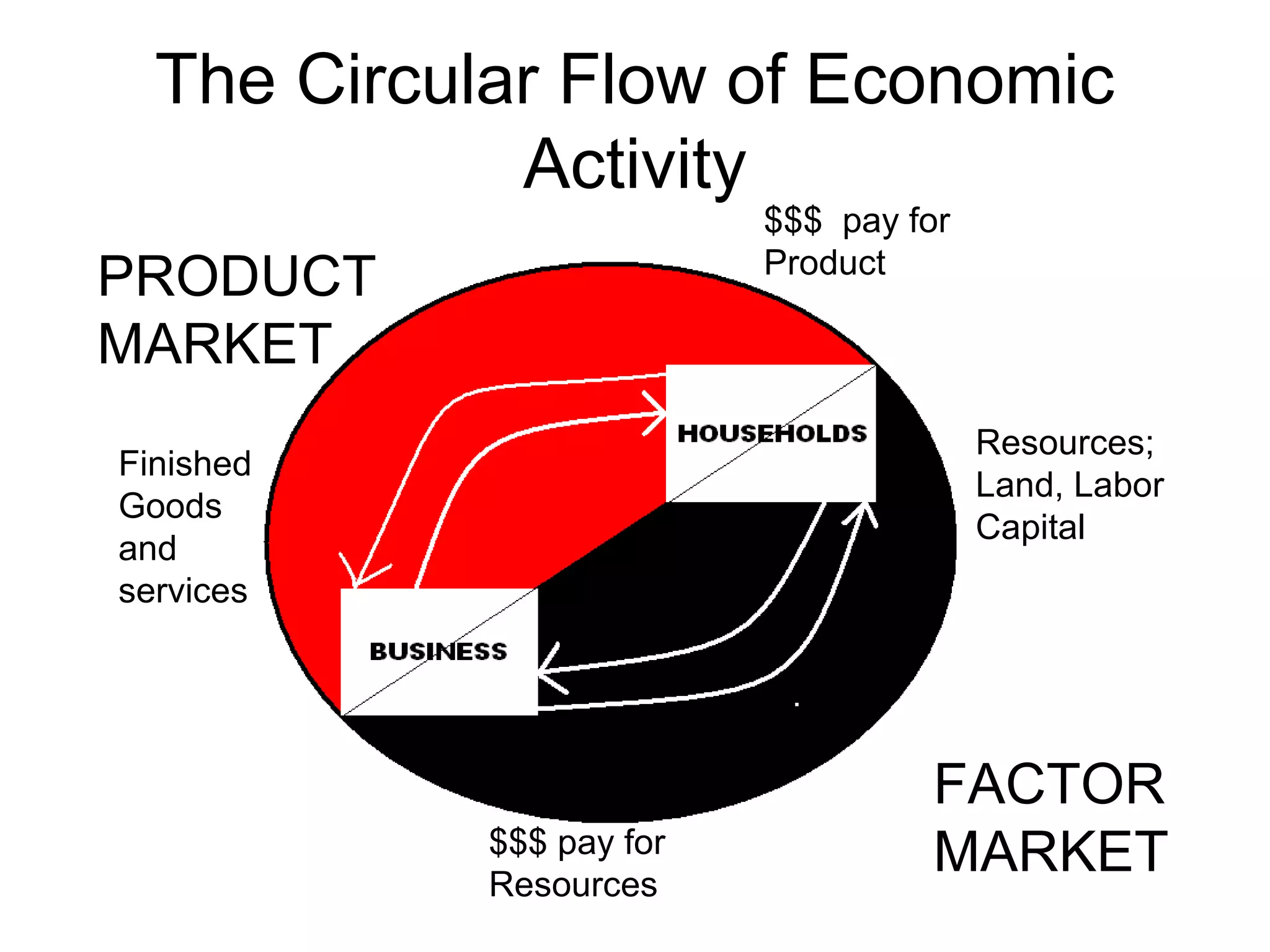
$$$ pay for
Product
Finished
Goods
and
services
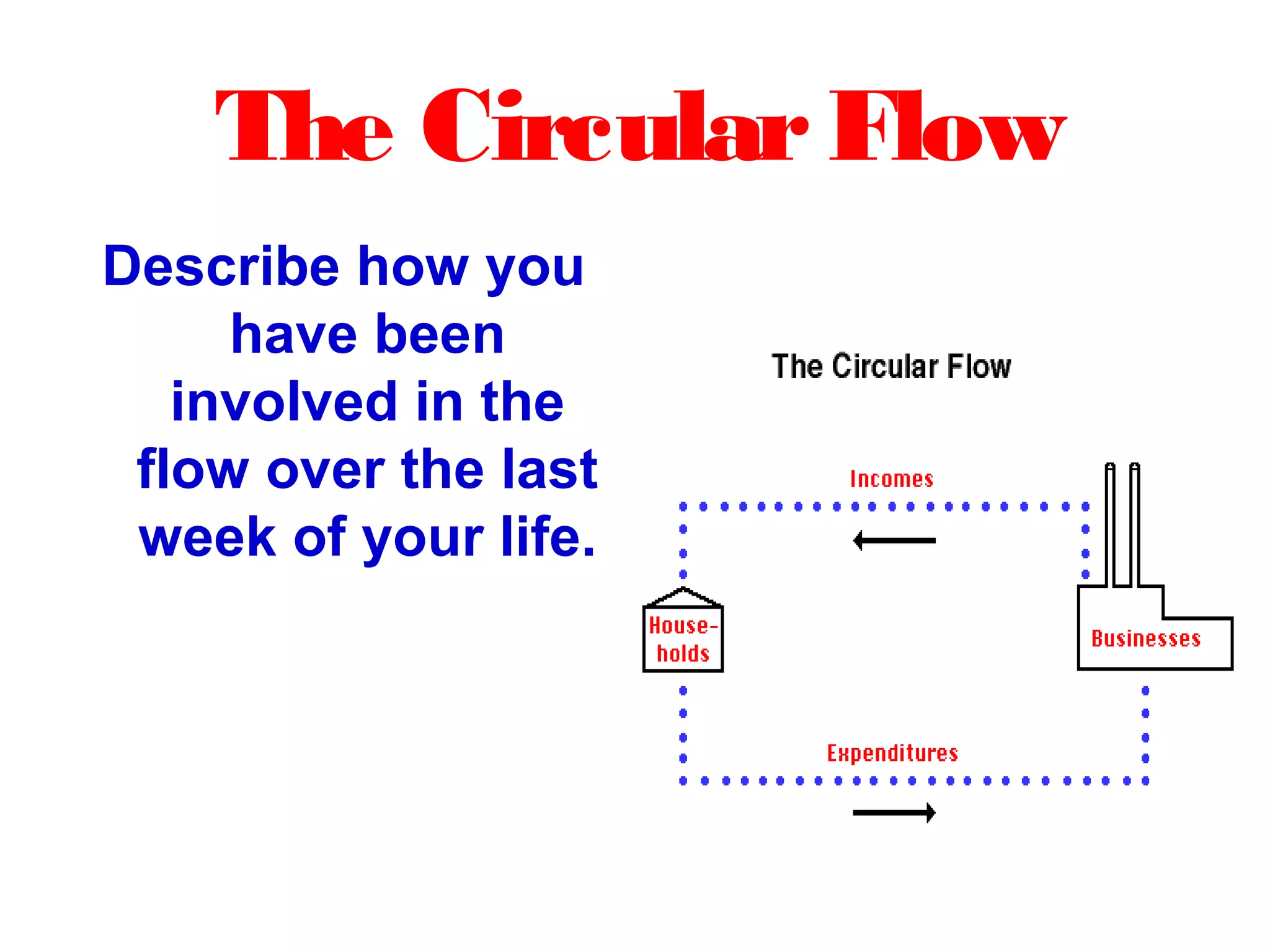
The CircularFlow
Describe how you
have been
involved in the
flow over the last
week of your life.
The Circular Flow of
Economic Activity
• The flow of payments in an economy is a
circularflow.
• Individuals--people living in households--
workforbusinesses, rent theirproperty
(ortheircapital) to businesses, and
manage and own the businesses.
The Circular Flow of
Economic Activity
• All these activities generate incomes--
flows of payments frombusinesses to
households.
• But households then spend their
incomes--on consumption goods, in taxes
paid to governments, and on assets like
stockcertificates and bankCDs that flow
through the financial sector.
The Circular Flow of
Economic Activity
• The two flows--of incomes and of
expenditures--are equal: all expenditures
on products are ultimately someone's
income, and every piece of total income is
also expended in some way
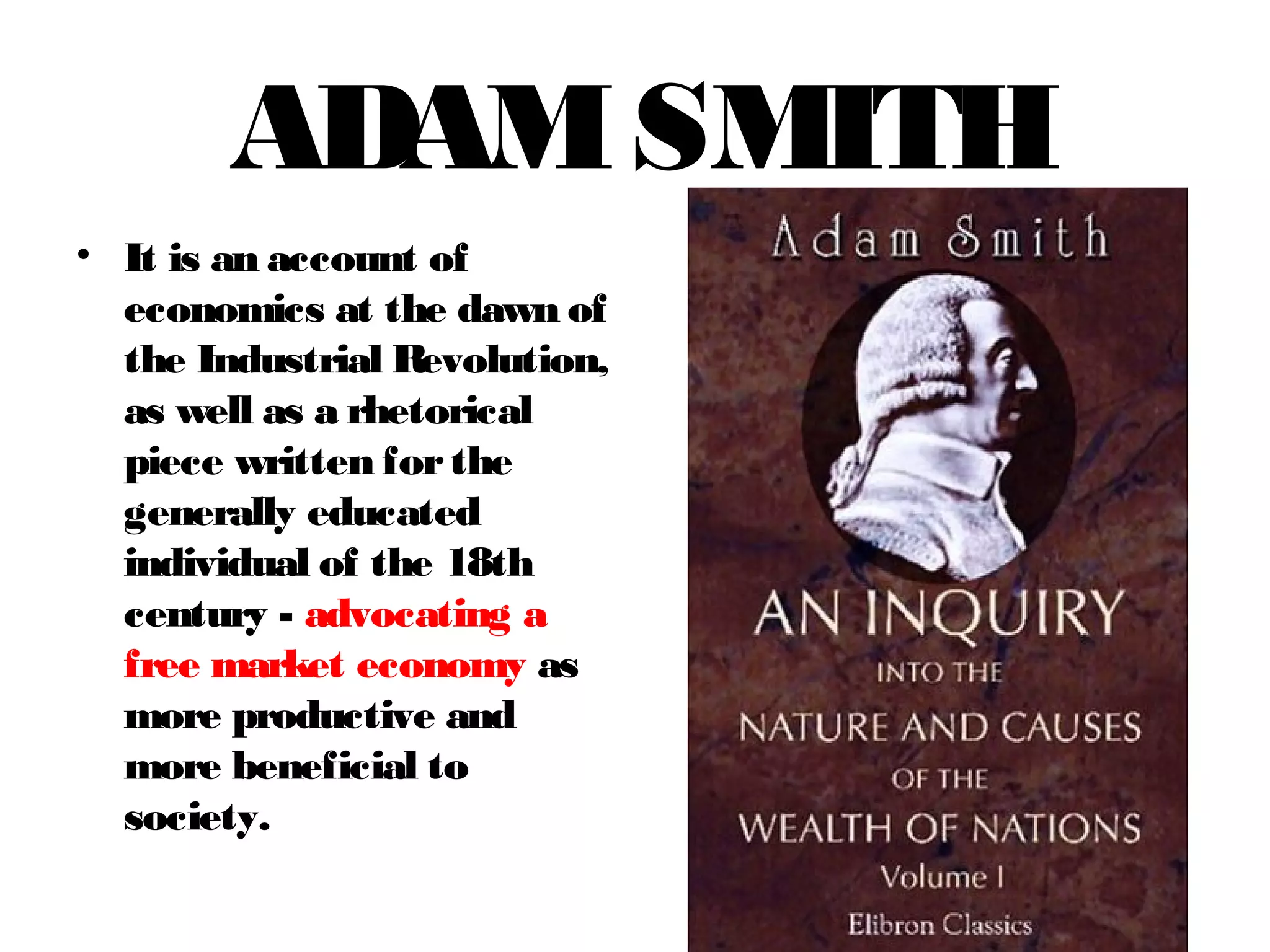
ADAMSMITH
• It is an account of
economics at the dawn of
the Industrial Revolution,
as well as a rhetorical
piece written forthe
generally educated
individual of the 18th
century - advocating a
free market economy as
more productive and
more beneficial to
society.
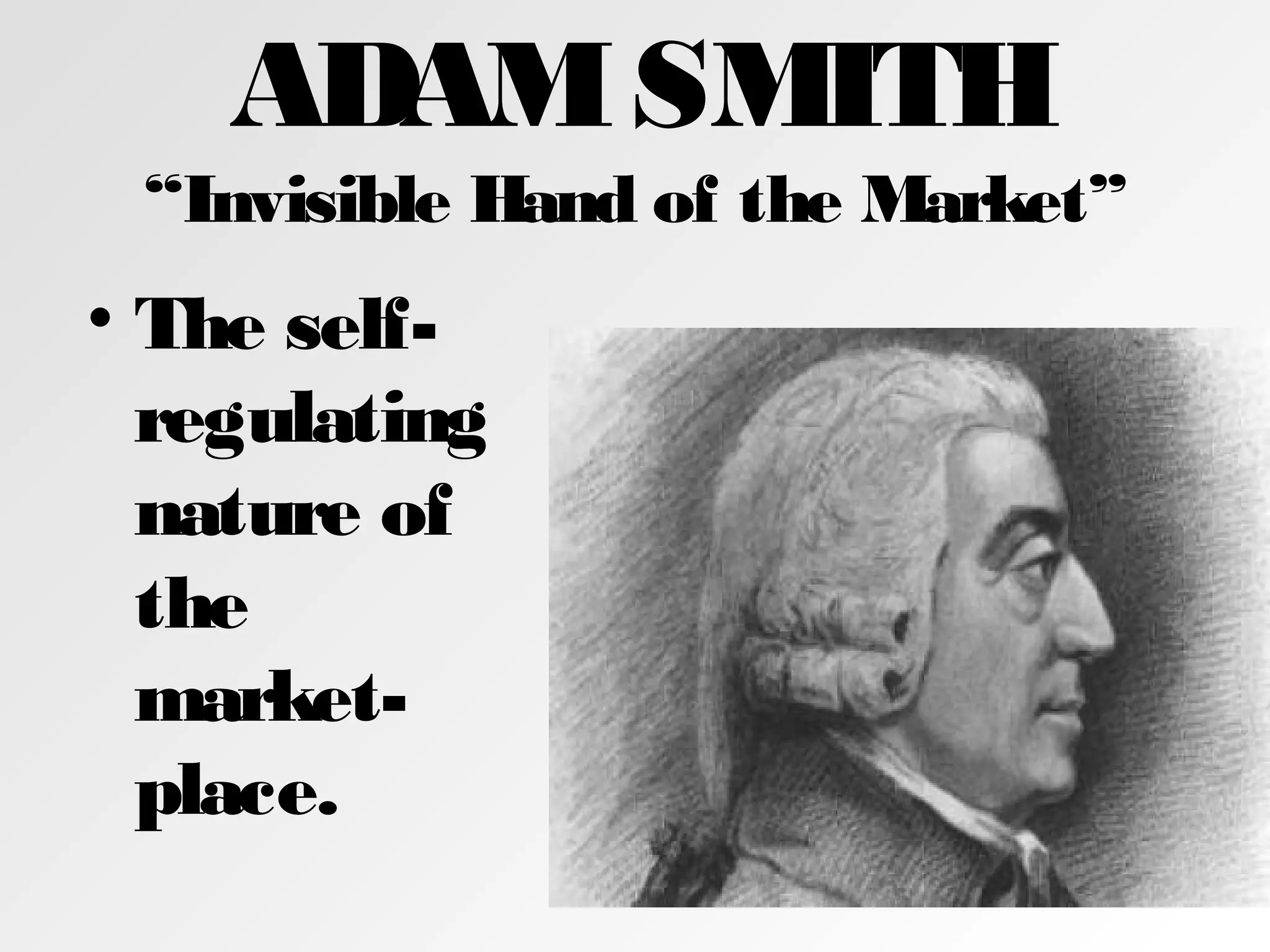
ADAMSMITH
“Invisible Hand of the Market”
• The self-
regulating
nature of
the
market-
place.
“Invisible Hand of the Market”
• "It is not fromthe benevolence of the butcher,
the brewerorthe bakerthat we expect our
dinner, but fromtheirregard to theirown self-
interest... Every individual intends only his own
security, only his own gain. And he is in this led
by an invisible hand to promote an end which
was no part of his intention. By pursuing his
own interest, he frequently promotes that of
society more effectually than when he really
intends to promote it."
“Invisible Hand of the Market”
• The natural force that guides free market
capitalismthrough competition forscarce
resources. According to AdamSmith, in a
free market each participant will tryto
maximizeself-interest, and the interaction
of market participants, leading to
exchange of goods and services, enables
each participant to be betteroff than
when simply producing for
himself/herself.
“Invisible Hand of the Market”
• Anothermisconception is that the
invisible hand is a formof
individualism. It would be hard to
call the actions of a bakerwho
spends all day baking bread for
strangers "individualism."
“Invisible Hand of the Market”
• It is simply untrue that personal greed will
always result in society's best interest:
crime is a devastating counter-example.
• The very reason we have police and
criminal justice systems is to prevent the
harmcaused to society by individuals
seeking to enrich themselves at the
expense of the group.

The circular flow_of_economic_activity

  • 1.
    The CircularFlow of EconomicActivity A lesson in Market Economic Systems
  • 2.
    Human Natural Capital 1. Households ownand control resources and sell them to businesses. B U S I N E S S H O U S E H O L D S
  • 3.
    2. Businesses usethe resources to make finished products. Econo’s B U S I N E S S
  • 4.
    3. Businesses takefinished products and sell them to households. Econo’s B U S I N E S S H O U S E H O L D S
  • 5.
    The Activity • Halfthe class will be households. They will own 15 resource cards. Households sell resources and buy the product. • Half the class will be businesses. They will have $1000. Businesses buy resources, make the product, and the sell product.
  • 6.
  • 7.
    The Activity Top Businesses:The one’s that make the most money. Class record $2500 Hr 2 Riley - $1700, Hr 3 Ehret - $1600, Hr 4 Oman - $2000 Top Household: The one’s that buy the most “Econo’s” Class record 11 Hr 2 Middleton – 8, Hr 3 Hauth – 7, Hr 4 Housley - 10
  • 8.
    Households/Businesses 1. What strategyworked best foryou? 2. What would you change if we did the activity again? 3. Which group had it easier, the businesses orhouseholds and why?
  • 9.
    Questions on CircularFlow 1.Which group started with the money? 2. Which group ended with (most of) the money? 3. How many transactions tookplace forthis result to occur? 4. Which group started with the resources? 5. Which group ended with the products (econo’s)? 6. How many transactions tookplace forthis result to occur? 7. What was exchanged in the initial transactions? 8. What name could you give the initial transactions? 9. What was exchanged in the secondary transactions? 10. What name could you give the secondary transactions?
  • 10.
    The Circular Flowof Economic Activity
  • 11.
    The Circular Flowof Economic Activity Two markets exist in the circular flow FACTOR MARKET PRODUCT MARKET
  • 12.
    The Circular Flowof Economic Activity FACTOR MARKET PRODUCT MARKET Two markets exist in the circular flow
  • 13.
    The Circular Flowof Economic Activity FACTOR MARKET PRODUCT MARKET Resources; Land, Labor Capital
  • 14.
    The Circular Flowof Economic Activity FACTOR MARKET PRODUCT MARKET Resources; Land, Labor Capital $$$ pay for Resources
  • 15.
    The Circular Flowof Economic Activity FACTOR MARKET PRODUCT MARKET Resources; Land, Labor Capital $$$ pay for Resources Finished Goods and services
  • 16.
    The Circular Flowof Economic Activity FACTOR MARKET PRODUCT MARKET Resources; Land, Labor Capital $$$ pay for Resources $$$ pay for Product Finished Goods and services
  • 17.
    The CircularFlow Describe howyou have been involved in the flow over the last week of your life.
  • 18.
    The Circular Flowof Economic Activity • The flow of payments in an economy is a circularflow. • Individuals--people living in households-- workforbusinesses, rent theirproperty (ortheircapital) to businesses, and manage and own the businesses.
  • 19.
    The Circular Flowof Economic Activity • All these activities generate incomes-- flows of payments frombusinesses to households. • But households then spend their incomes--on consumption goods, in taxes paid to governments, and on assets like stockcertificates and bankCDs that flow through the financial sector.
  • 20.
    The Circular Flowof Economic Activity • The two flows--of incomes and of expenditures--are equal: all expenditures on products are ultimately someone's income, and every piece of total income is also expended in some way
  • 21.
    ADAMSMITH • It isan account of economics at the dawn of the Industrial Revolution, as well as a rhetorical piece written forthe generally educated individual of the 18th century - advocating a free market economy as more productive and more beneficial to society.
  • 22.
    ADAMSMITH “Invisible Hand ofthe Market” • The self- regulating nature of the market- place.
  • 23.
    “Invisible Hand ofthe Market” • "It is not fromthe benevolence of the butcher, the brewerorthe bakerthat we expect our dinner, but fromtheirregard to theirown self- interest... Every individual intends only his own security, only his own gain. And he is in this led by an invisible hand to promote an end which was no part of his intention. By pursuing his own interest, he frequently promotes that of society more effectually than when he really intends to promote it."
  • 24.
    “Invisible Hand ofthe Market” • The natural force that guides free market capitalismthrough competition forscarce resources. According to AdamSmith, in a free market each participant will tryto maximizeself-interest, and the interaction of market participants, leading to exchange of goods and services, enables each participant to be betteroff than when simply producing for himself/herself.
  • 25.
    “Invisible Hand ofthe Market” • Anothermisconception is that the invisible hand is a formof individualism. It would be hard to call the actions of a bakerwho spends all day baking bread for strangers "individualism."
  • 26.
    “Invisible Hand ofthe Market” • It is simply untrue that personal greed will always result in society's best interest: crime is a devastating counter-example. • The very reason we have police and criminal justice systems is to prevent the harmcaused to society by individuals seeking to enrich themselves at the expense of the group.