The Blue Pill or the Red Pill 
Introduction 
In the movie “The Matrix”the main character Neo is offered the red pill to find the 
truth about the world. Wouldn’t it be nice if we could take a red pill to find out the 
truth about the real world? Is there anything that can help us to find out the truth? 
How to Know Truth in the Real World - By Examining Your Worldview 
1. Know what your worldview is 
2. Understand why you believe what you believe 
3. Test your worldview to see if it matches reality 
1. Know Your Worldview 
Definition of Worldview 
Worldview comes from a German word weltanschauung meaning a comprehensive 
understanding of the universe and humanity’s relation to it. 
Is the lens or framework of our beliefs, attitudes, values, ideas, assumptions and 
convictions by which we interpret reality and from which we derive meaning, 
purpose, and direction. 
Is the orientation of our hearts towards the fundamental aspects of reality. 
How do we figure out what worldview we have? 
We start by understanding what makes up the foundation of every worldview? 
Origins 
1. Where the universe came from 
2. Where we came from 
The Study of Origins Begins with Two Main Things 
1. Universe - cosmology 
2. God - theology 
Three Categories for All Worldviews 
1. Only the universe, no God (atheism) 
2. God and universe (theism) 
3. Everything is God (pantheism) 
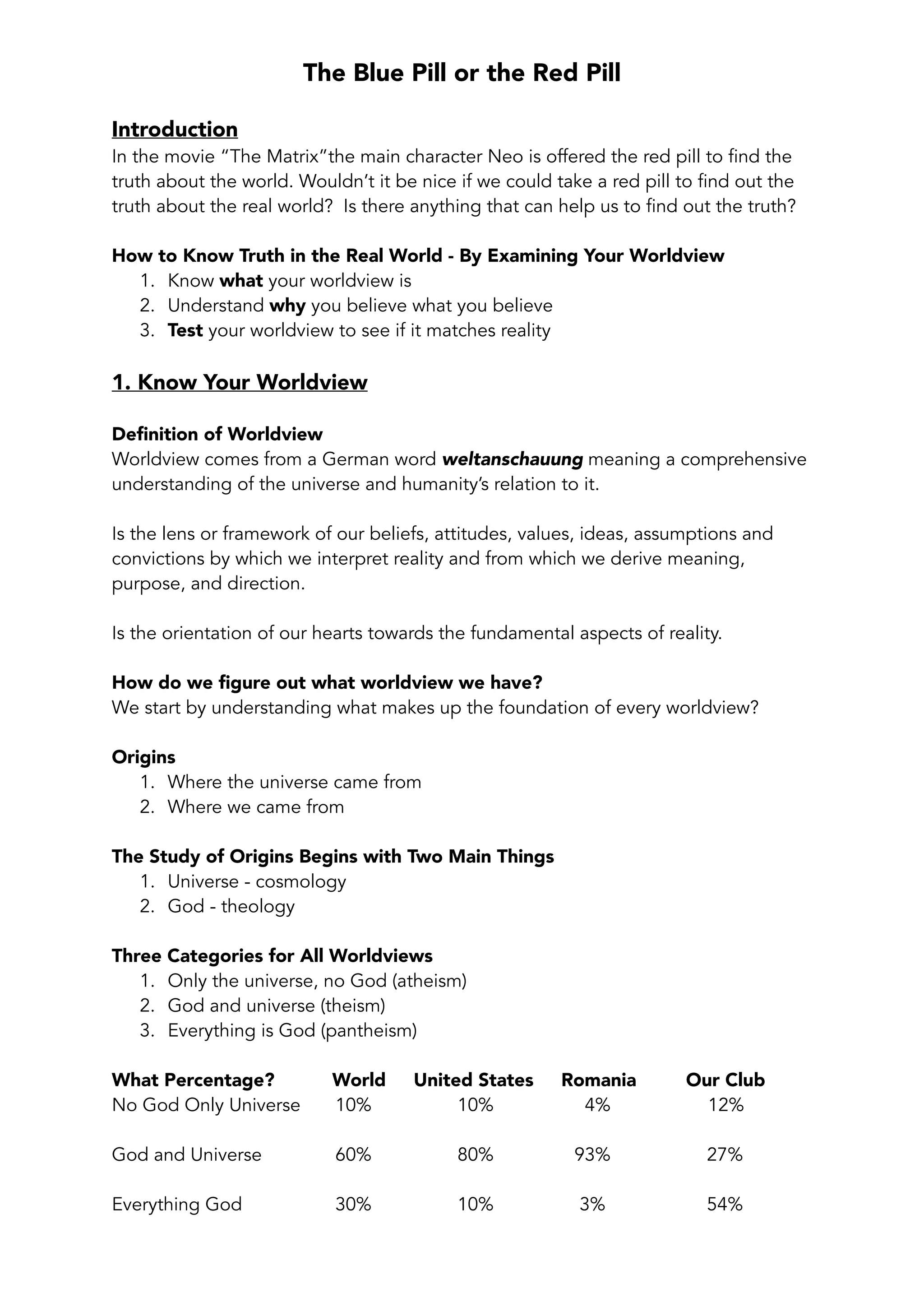
What Percentage? World United States Romania Our Club 
No God Only Universe 10% 10% 4% 12% 
God and Universe 60% 80% 93% 27% 
Everything God 30% 10% 3% 54%
Four Questions that Reveal One’s Worldview (Ravi Zacharias) 
1. Origin – Where do the universe and human beings come from? 
2. Meaning – What is the meaning or purpose of life? 
3. Morality – How do we know what is right and what is wrong? 
4. Destiny – What happens to us after we die? 
Club Survey Results 
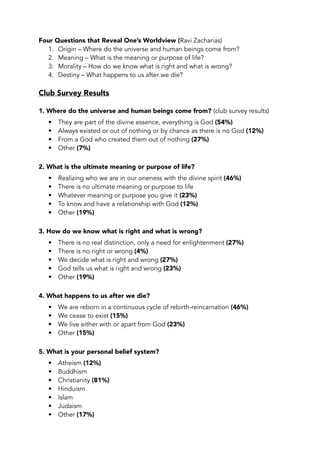
1. Where do the universe and human beings come from? (club survey results) 
• They are part of the divine essence, everything is God (54%) 
• Always existed or out of nothing or by chance as there is no God (12%) 
• From a God who created them out of nothing (27%) 
• Other (7%) 
2. What is the ultimate meaning or purpose of life? 
• Realizing who we are in our oneness with the divine spirit (46%) 
• There is no ultimate meaning or purpose to life 
• Whatever meaning or purpose you give it (23%) 
• To know and have a relationship with God (12%) 
• Other (19%) 
3. How do we know what is right and what is wrong? 
• There is no real distinction, only a need for enlightenment (27%) 
• There is no right or wrong (4%) 
• We decide what is right and wrong (27%) 
• God tells us what is right and wrong (23%) 
• Other (19%) 
4. What happens to us after we die? 
• We are reborn in a continuous cycle of rebirth-reincarnation (46%) 
• We cease to exist (15%) 
• We live either with or apart from God (23%) 
• Other (15%) 
5. What is your personal belief system? 
• Atheism (12%) 
• Buddhism 
• Christianity (81%) 
• Hinduism 
• Islam 
• Judaism 
• Other (17%)
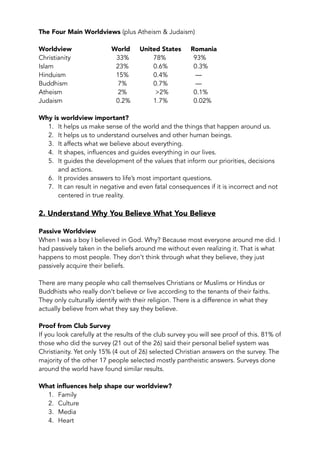
The Four Main Worldviews (plus Atheism & Judaism) 
Worldview World United States Romania 
Christianity 33% 78% 93% 
Islam 23% 0.6% 0.3% 
Hinduism 15% 0.4% — 
Buddhism 7% 0.7% — 
Atheism 2% >2% 0.1% 
Judaism 0.2% 1.7% 0.02% 
Why is worldview important? 
1. It helps us make sense of the world and the things that happen around us. 
2. It helps us to understand ourselves and other human beings. 
3. It affects what we believe about everything. 
4. It shapes, influences and guides everything in our lives. 
5. It guides the development of the values that inform our priorities, decisions 
and actions. 
6. It provides answers to life’s most important questions. 
7. It can result in negative and even fatal consequences if it is incorrect and not 
centered in true reality. 
2. Understand Why You Believe What You Believe 
Passive Worldview 
When I was a boy I believed in God. Why? Because most everyone around me did. I 
had passively taken in the beliefs around me without even realizing it. That is what 
happens to most people. They don’t think through what they believe, they just 
passively acquire their beliefs. 
There are many people who call themselves Christians or Muslims or Hindus or 
Buddhists who really don’t believe or live according to the tenants of their faiths. 
They only culturally identify with their religion. There is a difference in what they 
actually believe from what they say they believe. 
Proof from Club Survey 
If you look carefully at the results of the club survey you will see proof of this. 81% of 
those who did the survey (21 out of the 26) said their personal belief system was 
Christianity. Yet only 15% (4 out of 26) selected Christian answers on the survey. The 
majority of the other 17 people selected mostly pantheistic answers. Surveys done 
around the world have found similar results. 
What influences help shape our worldview? 
1. Family 
2. Culture 
3. Media 
4. Heart
Most Powerful Influence - Heart 
Behavioral and social scientists have discovered that us human beings are not 
motivated by reason in how we live and what we do but by the desires of our hearts. 
Since our worldview is shaped much more by what we want rather than by reality 
how can we be sure if it is true? 
3. Test Your Worldview to See If It Matches Reality 
True Test of a Worldview 
“The true test of a worldview is its coherence to reality.” Ravi Zacharias 
(Coherence is the quality of being logical and consistent.) 
Three Truth Tests (Ravi Zacharias) 
1. Logically consistent – cannot be self-contradictory 
2. Empirically adequate – must match what we see in reality 
3. Existentially relevant – must be liveable in the real world 
More on the Three Truth Tests 
1. Truth makes sense, it will not contain logical inconsistencies or elements that are 
mutually contradictory 
2. Truth properly describes the real world and does not make claims inconsistent 
with reality. 
3. Truth works in real life, it can be lived out in the real world. 
Examples of the Three Tests 
Logically consistent – cannot be self-contradictory 
1. There is no truth - If there is no truth how can that statement be true? 
2. All paths lead to God 
a. Pantheism, Theism, Atheism - contradict each other about origins 
b. Christianity, Islam, Judaism - contradict each other about Jesus 
Empirically adequate – must match what we see in reality 
1. The universe has a beginning 
Science has proven that the universe had a beginning. If this is really true it means 
the universe itself could not be either spiritually or physically eternal. The most 
logical answer is that something or someone created the universe. (See short video) 
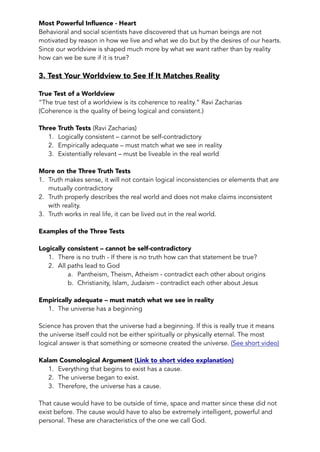
Kalam Cosmological Argument (Link to short video explanation) 
1. Everything that begins to exist has a cause. 
2. The universe began to exist. 
3. Therefore, the universe has a cause. 
That cause would have to be outside of time, space and matter since these did not 
exist before. The cause would have to also be extremely intelligent, powerful and 
personal. These are characteristics of the one we call God.
Existentially relevant – must be livable 
1. The physical world is an illusion - Do those who believe this look both ways 
before crossing the street? 
2. There is no evil - Do those who believe this lock their doors at night? 
Conclusion 
In closing I encourage you to do the three things I talked about: 
1. Make the effort to really know what your worldview is 
2. Take an honest look at your heart reasons for why you believe what you 
believe 
3. Have the courage to test your worldview to see if it matches up with reality. If 
it doesn’t then find the one that does. 
Where should you start? Here are some suggestions: 
1. Pray to God even if you don’t believe in Him 
2. Examine the evidence for the origin of the universe 
3. If you have questions or need help talk to me 
Lastly, remember, you can take the blue pill and believe whatever you want to 
believe or you can take the red pill and search for truth, the choice is yours. 
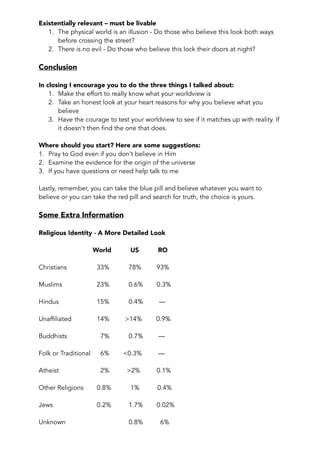
Some Extra Information 
Religious Identity - A More Detailed Look 
World US RO 
Christians 33% 78% 93% 
Muslims 23% 0.6% 0.3% 
Hindus 15% 0.4% — 
Unaffiliated 14% >14% 0.9% 
Buddhists 7% 0.7% — 
Folk or Traditional 6% <0.3% — 
Atheist 2% >2% 0.1% 
Other Religions 0.8% 1% 0.4% 
Jews 0.2% 1.7% 0.02% 
Unknown 0.8% 6%
Sources of Information for My Speech (includes links) 
Ideas for Speech 
I spent time on and off over two months looking up information from as many 
websites and articles as I could find on the internet. I got ideas from around five 
different sources but the main source was Ravi Zacharias who is a leading expert on 
worldview, religions and philosophy. In my opinion he is one of the best. He grew 
up in India in a cultural Christian home but was an atheist until he was 17 years old. 
Check out his website and YouTube channel. 
Two of his videos on worldviews 
What is a Worldview? (4:39) 
How do you know that Christianity is the one true worldview? (9:30) 
Books about Worldview Used 
How Now Shall We Live? Charles Colson and Nancy Pearcey, 1999 
Total Truth, Nancy Pearcey, 2004 
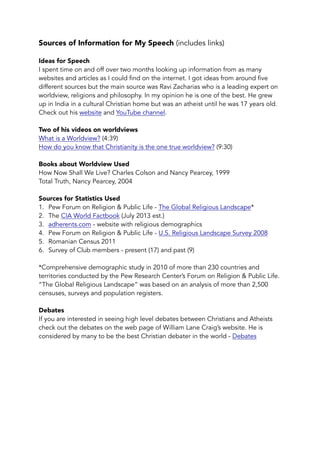
Sources for Statistics Used 
1. Pew Forum on Religion & Public Life - The Global Religious Landscape* 
2. The CIA World Factbook (July 2013 est.) 
3. adherents.com - website with religious demographics 
4. Pew Forum on Religion & Public Life - U.S. Religious Landscape Survey 2008 
5. Romanian Census 2011 
6. Survey of Club members - present (17) and past (9) 
*Comprehensive demographic study in 2010 of more than 230 countries and 
territories conducted by the Pew Research Center’s Forum on Religion & Public Life. 
“The Global Religious Landscape” was based on an analysis of more than 2,500 
censuses, surveys and population registers. 
Debates 
If you are interested in seeing high level debates between Christians and Atheists 
check out the debates on the web page of William Lane Craig’s website. He is 
considered by many to be the best Christian debater in the world - Debates

The Blue Pill or The Red Pill - A4

  • 1.
    The Blue Pillor the Red Pill Introduction In the movie “The Matrix”the main character Neo is offered the red pill to find the truth about the world. Wouldn’t it be nice if we could take a red pill to find out the truth about the real world? Is there anything that can help us to find out the truth? How to Know Truth in the Real World - By Examining Your Worldview 1. Know what your worldview is 2. Understand why you believe what you believe 3. Test your worldview to see if it matches reality 1. Know Your Worldview Definition of Worldview Worldview comes from a German word weltanschauung meaning a comprehensive understanding of the universe and humanity’s relation to it. Is the lens or framework of our beliefs, attitudes, values, ideas, assumptions and convictions by which we interpret reality and from which we derive meaning, purpose, and direction. Is the orientation of our hearts towards the fundamental aspects of reality. How do we figure out what worldview we have? We start by understanding what makes up the foundation of every worldview? Origins 1. Where the universe came from 2. Where we came from The Study of Origins Begins with Two Main Things 1. Universe - cosmology 2. God - theology Three Categories for All Worldviews 1. Only the universe, no God (atheism) 2. God and universe (theism) 3. Everything is God (pantheism) What Percentage? World United States Romania Our Club No God Only Universe 10% 10% 4% 12% God and Universe 60% 80% 93% 27% Everything God 30% 10% 3% 54%
  • 2.
    Four Questions thatReveal One’s Worldview (Ravi Zacharias) 1. Origin – Where do the universe and human beings come from? 2. Meaning – What is the meaning or purpose of life? 3. Morality – How do we know what is right and what is wrong? 4. Destiny – What happens to us after we die? Club Survey Results 1. Where do the universe and human beings come from? (club survey results) • They are part of the divine essence, everything is God (54%) • Always existed or out of nothing or by chance as there is no God (12%) • From a God who created them out of nothing (27%) • Other (7%) 2. What is the ultimate meaning or purpose of life? • Realizing who we are in our oneness with the divine spirit (46%) • There is no ultimate meaning or purpose to life • Whatever meaning or purpose you give it (23%) • To know and have a relationship with God (12%) • Other (19%) 3. How do we know what is right and what is wrong? • There is no real distinction, only a need for enlightenment (27%) • There is no right or wrong (4%) • We decide what is right and wrong (27%) • God tells us what is right and wrong (23%) • Other (19%) 4. What happens to us after we die? • We are reborn in a continuous cycle of rebirth-reincarnation (46%) • We cease to exist (15%) • We live either with or apart from God (23%) • Other (15%) 5. What is your personal belief system? • Atheism (12%) • Buddhism • Christianity (81%) • Hinduism • Islam • Judaism • Other (17%)
  • 3.
    The Four MainWorldviews (plus Atheism & Judaism) Worldview World United States Romania Christianity 33% 78% 93% Islam 23% 0.6% 0.3% Hinduism 15% 0.4% — Buddhism 7% 0.7% — Atheism 2% >2% 0.1% Judaism 0.2% 1.7% 0.02% Why is worldview important? 1. It helps us make sense of the world and the things that happen around us. 2. It helps us to understand ourselves and other human beings. 3. It affects what we believe about everything. 4. It shapes, influences and guides everything in our lives. 5. It guides the development of the values that inform our priorities, decisions and actions. 6. It provides answers to life’s most important questions. 7. It can result in negative and even fatal consequences if it is incorrect and not centered in true reality. 2. Understand Why You Believe What You Believe Passive Worldview When I was a boy I believed in God. Why? Because most everyone around me did. I had passively taken in the beliefs around me without even realizing it. That is what happens to most people. They don’t think through what they believe, they just passively acquire their beliefs. There are many people who call themselves Christians or Muslims or Hindus or Buddhists who really don’t believe or live according to the tenants of their faiths. They only culturally identify with their religion. There is a difference in what they actually believe from what they say they believe. Proof from Club Survey If you look carefully at the results of the club survey you will see proof of this. 81% of those who did the survey (21 out of the 26) said their personal belief system was Christianity. Yet only 15% (4 out of 26) selected Christian answers on the survey. The majority of the other 17 people selected mostly pantheistic answers. Surveys done around the world have found similar results. What influences help shape our worldview? 1. Family 2. Culture 3. Media 4. Heart
  • 4.
    Most Powerful Influence- Heart Behavioral and social scientists have discovered that us human beings are not motivated by reason in how we live and what we do but by the desires of our hearts. Since our worldview is shaped much more by what we want rather than by reality how can we be sure if it is true? 3. Test Your Worldview to See If It Matches Reality True Test of a Worldview “The true test of a worldview is its coherence to reality.” Ravi Zacharias (Coherence is the quality of being logical and consistent.) Three Truth Tests (Ravi Zacharias) 1. Logically consistent – cannot be self-contradictory 2. Empirically adequate – must match what we see in reality 3. Existentially relevant – must be liveable in the real world More on the Three Truth Tests 1. Truth makes sense, it will not contain logical inconsistencies or elements that are mutually contradictory 2. Truth properly describes the real world and does not make claims inconsistent with reality. 3. Truth works in real life, it can be lived out in the real world. Examples of the Three Tests Logically consistent – cannot be self-contradictory 1. There is no truth - If there is no truth how can that statement be true? 2. All paths lead to God a. Pantheism, Theism, Atheism - contradict each other about origins b. Christianity, Islam, Judaism - contradict each other about Jesus Empirically adequate – must match what we see in reality 1. The universe has a beginning Science has proven that the universe had a beginning. If this is really true it means the universe itself could not be either spiritually or physically eternal. The most logical answer is that something or someone created the universe. (See short video) Kalam Cosmological Argument (Link to short video explanation) 1. Everything that begins to exist has a cause. 2. The universe began to exist. 3. Therefore, the universe has a cause. That cause would have to be outside of time, space and matter since these did not exist before. The cause would have to also be extremely intelligent, powerful and personal. These are characteristics of the one we call God.
  • 5.
    Existentially relevant –must be livable 1. The physical world is an illusion - Do those who believe this look both ways before crossing the street? 2. There is no evil - Do those who believe this lock their doors at night? Conclusion In closing I encourage you to do the three things I talked about: 1. Make the effort to really know what your worldview is 2. Take an honest look at your heart reasons for why you believe what you believe 3. Have the courage to test your worldview to see if it matches up with reality. If it doesn’t then find the one that does. Where should you start? Here are some suggestions: 1. Pray to God even if you don’t believe in Him 2. Examine the evidence for the origin of the universe 3. If you have questions or need help talk to me Lastly, remember, you can take the blue pill and believe whatever you want to believe or you can take the red pill and search for truth, the choice is yours. Some Extra Information Religious Identity - A More Detailed Look World US RO Christians 33% 78% 93% Muslims 23% 0.6% 0.3% Hindus 15% 0.4% — Unaffiliated 14% >14% 0.9% Buddhists 7% 0.7% — Folk or Traditional 6% <0.3% — Atheist 2% >2% 0.1% Other Religions 0.8% 1% 0.4% Jews 0.2% 1.7% 0.02% Unknown 0.8% 6%
  • 6.
    Sources of Informationfor My Speech (includes links) Ideas for Speech I spent time on and off over two months looking up information from as many websites and articles as I could find on the internet. I got ideas from around five different sources but the main source was Ravi Zacharias who is a leading expert on worldview, religions and philosophy. In my opinion he is one of the best. He grew up in India in a cultural Christian home but was an atheist until he was 17 years old. Check out his website and YouTube channel. Two of his videos on worldviews What is a Worldview? (4:39) How do you know that Christianity is the one true worldview? (9:30) Books about Worldview Used How Now Shall We Live? Charles Colson and Nancy Pearcey, 1999 Total Truth, Nancy Pearcey, 2004 Sources for Statistics Used 1. Pew Forum on Religion & Public Life - The Global Religious Landscape* 2. The CIA World Factbook (July 2013 est.) 3. adherents.com - website with religious demographics 4. Pew Forum on Religion & Public Life - U.S. Religious Landscape Survey 2008 5. Romanian Census 2011 6. Survey of Club members - present (17) and past (9) *Comprehensive demographic study in 2010 of more than 230 countries and territories conducted by the Pew Research Center’s Forum on Religion & Public Life. “The Global Religious Landscape” was based on an analysis of more than 2,500 censuses, surveys and population registers. Debates If you are interested in seeing high level debates between Christians and Atheists check out the debates on the web page of William Lane Craig’s website. He is considered by many to be the best Christian debater in the world - Debates