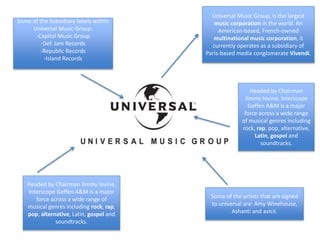
Universal Music Group, is the largest
music corporation in the world. An
American-based, French-owned
multinational music corporation, it
currently operates as a subsidiary of
Paris-based media conglomerate Vivendi.
Some of the artists that are signed
to universal are: Amy Winehouse,
Ashanti and avicii.
Headed by Chairman
Jimmy Iovine, Interscope
Geffen A&M is a major
force across a wide range
of musical genres including
rock, rap, pop, alternative,
Latin, gospel and
soundtracks.
Some of the Subsidiary labels within
Universal Music Group:
-Capitol Music Group
-Def. Jam Records
-Republic Records
-Island Records
Headed by Chairman Jimmy Iovine,
Interscope Geffen A&M is a major
force across a wide range of
musical genres including rock, rap,
pop, alternative, Latin, gospel and
soundtracks.
After Warner Bros. was sold to
Seven Arts Productions in 1967
(forming Warner Bros.-Seven Arts),
it purchased Atlantic Records,
founded in 1947 and WMG's oldest
label (until WMG completed its
acquisition of Parlophone in 2013),
as well as its subsidiary Atco
Records.
In the latest figures that have
been taken, it was been
exemplified that Warner
Music Group currently have a
15.8% owning of the total
market share.
Here is a list of artists who
are signed to Warner music
group:
- Coldplay, Alesha dixon,
Catherine Jenkins, Flor-
Rida, Katy Perry and Wiz
Khalifa.
As you can see, Warner music group do
know mainly recruit a specific genre of
artist. They tend to recruit multiple
artists of multiple genres.
For the Japanese film
company within the Sony
corporation, see Sony
Pictures Entertainment
Japan. Sony Pictures
Entertainment Inc. (SPE) is
the American
entertainment subsidiary
of Japanese multinational
technology and media
conglomerate Sony.
Sony are the owners of
multiple worldwide artists
such as:
Bruno mars, Destiny’s child,
Foo Fighters, ke$ha and Kid
ink.
Sony music entertainment are the
parents of many subsiduary labels,
some of these are:
Columbia records, Startime
international and Dreamville.
As Sony music entertainment are such
a large corporation, they therefore
don’t have artists of a specific genre.
They have artists who produce rap,
pop, hip-hop and so on. This allows for
them to increase the size of their
audience as they can sell to followes of
multiple genres.
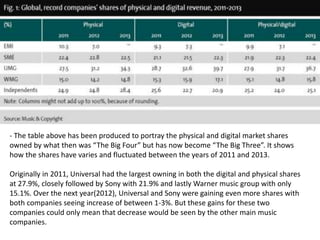
- The table above has been produced to portray the physical and digital market shares
owned by what then was “The Big Four” but has now become “The Big Three”. It shows
how the shares have varies and fluctuated between the years of 2011 and 2013.
Originally in 2011, Universal had the largest owning in both the digital and physical shares
at 27.9%, closely followed by Sony with 21.9% and lastly Warner music group with only
15.1%. Over the next year(2012), Universal and Sony were gaining even more shares with
both companies seeing increase of between 1-3%. But these gains for these two
companies could only mean that decrease would be seen by the other main music
companies.
-In 2012, EMI saw a 2.8% fall in their shares
and Warner saw a 0.3% fall in their shares.
Come 2013, the constant increase of shares for
Warner music group had seen another 5% gain
in the market shares. Due to their new found
dominance in market shares, it caused for EMI
to now have no shares left in the market after
the $1.2billion takeover by Universal music
group.

The big 3 powerpoint

  • 1.
    Universal Music Group,is the largest music corporation in the world. An American-based, French-owned multinational music corporation, it currently operates as a subsidiary of Paris-based media conglomerate Vivendi. Some of the artists that are signed to universal are: Amy Winehouse, Ashanti and avicii. Headed by Chairman Jimmy Iovine, Interscope Geffen A&M is a major force across a wide range of musical genres including rock, rap, pop, alternative, Latin, gospel and soundtracks. Some of the Subsidiary labels within Universal Music Group: -Capitol Music Group -Def. Jam Records -Republic Records -Island Records Headed by Chairman Jimmy Iovine, Interscope Geffen A&M is a major force across a wide range of musical genres including rock, rap, pop, alternative, Latin, gospel and soundtracks.
  • 2.
    After Warner Bros.was sold to Seven Arts Productions in 1967 (forming Warner Bros.-Seven Arts), it purchased Atlantic Records, founded in 1947 and WMG's oldest label (until WMG completed its acquisition of Parlophone in 2013), as well as its subsidiary Atco Records. In the latest figures that have been taken, it was been exemplified that Warner Music Group currently have a 15.8% owning of the total market share. Here is a list of artists who are signed to Warner music group: - Coldplay, Alesha dixon, Catherine Jenkins, Flor- Rida, Katy Perry and Wiz Khalifa. As you can see, Warner music group do know mainly recruit a specific genre of artist. They tend to recruit multiple artists of multiple genres.
  • 3.
    For the Japanesefilm company within the Sony corporation, see Sony Pictures Entertainment Japan. Sony Pictures Entertainment Inc. (SPE) is the American entertainment subsidiary of Japanese multinational technology and media conglomerate Sony. Sony are the owners of multiple worldwide artists such as: Bruno mars, Destiny’s child, Foo Fighters, ke$ha and Kid ink. Sony music entertainment are the parents of many subsiduary labels, some of these are: Columbia records, Startime international and Dreamville. As Sony music entertainment are such a large corporation, they therefore don’t have artists of a specific genre. They have artists who produce rap, pop, hip-hop and so on. This allows for them to increase the size of their audience as they can sell to followes of multiple genres.
  • 4.
    - The tableabove has been produced to portray the physical and digital market shares owned by what then was “The Big Four” but has now become “The Big Three”. It shows how the shares have varies and fluctuated between the years of 2011 and 2013. Originally in 2011, Universal had the largest owning in both the digital and physical shares at 27.9%, closely followed by Sony with 21.9% and lastly Warner music group with only 15.1%. Over the next year(2012), Universal and Sony were gaining even more shares with both companies seeing increase of between 1-3%. But these gains for these two companies could only mean that decrease would be seen by the other main music companies.
  • 5.
    -In 2012, EMIsaw a 2.8% fall in their shares and Warner saw a 0.3% fall in their shares. Come 2013, the constant increase of shares for Warner music group had seen another 5% gain in the market shares. Due to their new found dominance in market shares, it caused for EMI to now have no shares left in the market after the $1.2billion takeover by Universal music group.