API Economy
PRACTICAL EXAMPLES WITH SCIENTIFIC RESEARCH
MARJUKKA NIINIOJA, OSAANGO
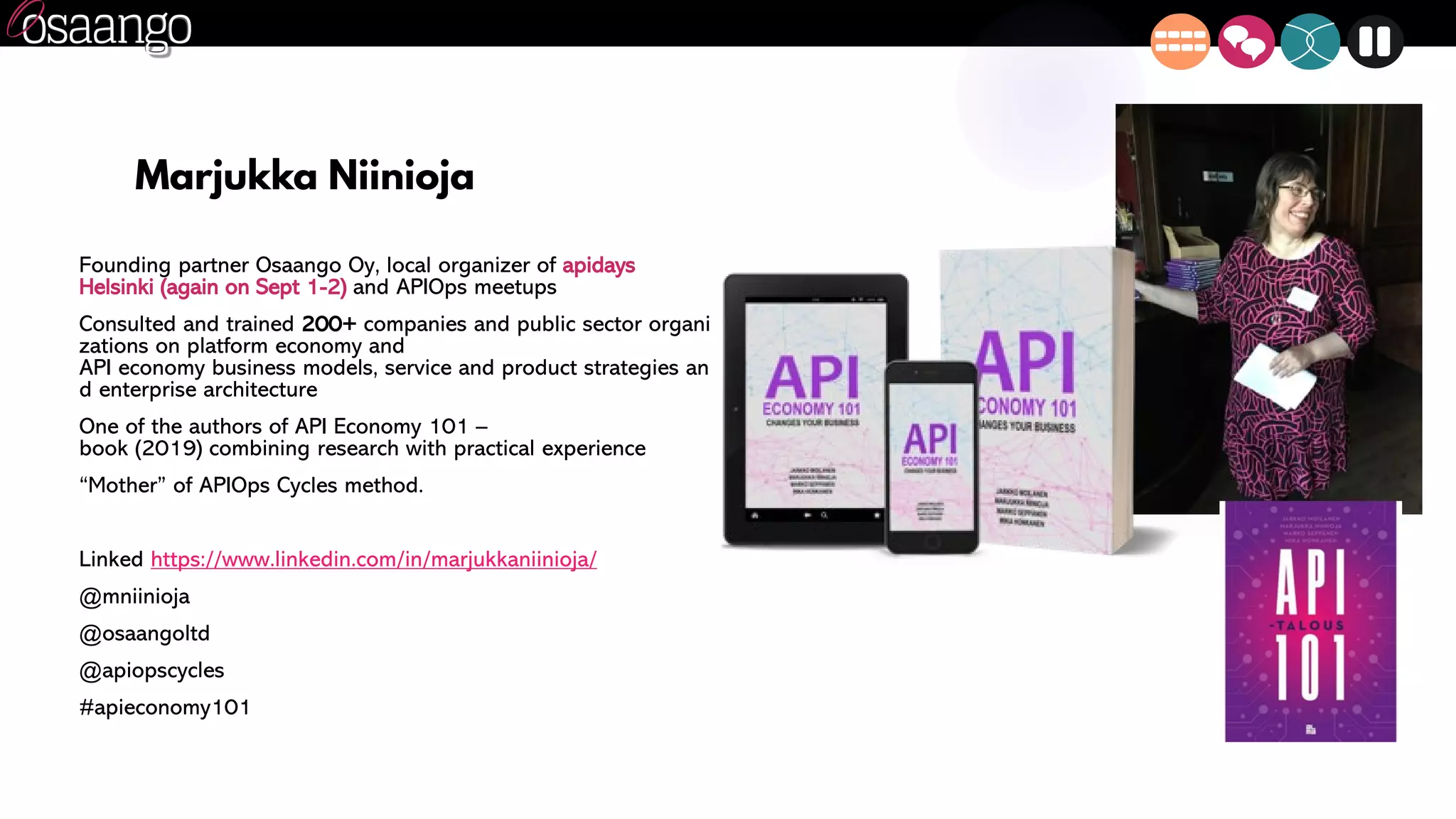
Marjukka Niinioja
Founding partner Osaango Oy, local organizer of apidays
Helsinki (again on Sept 1-2) and APIOps meetups
Consulted and trained 200+ companies and public sector organi
zations on platform economy and
API economy business models, service and product strategies an
d enterprise architecture
One of the authors of API Economy 101 –
book (2019) combining research with practical experience
“Mother” of APIOps Cycles method.
Linked https://www.linkedin.com/in/marjukkaniinioja/
@mniinioja
@osaangoltd
@apiopscycles
#apieconomy101
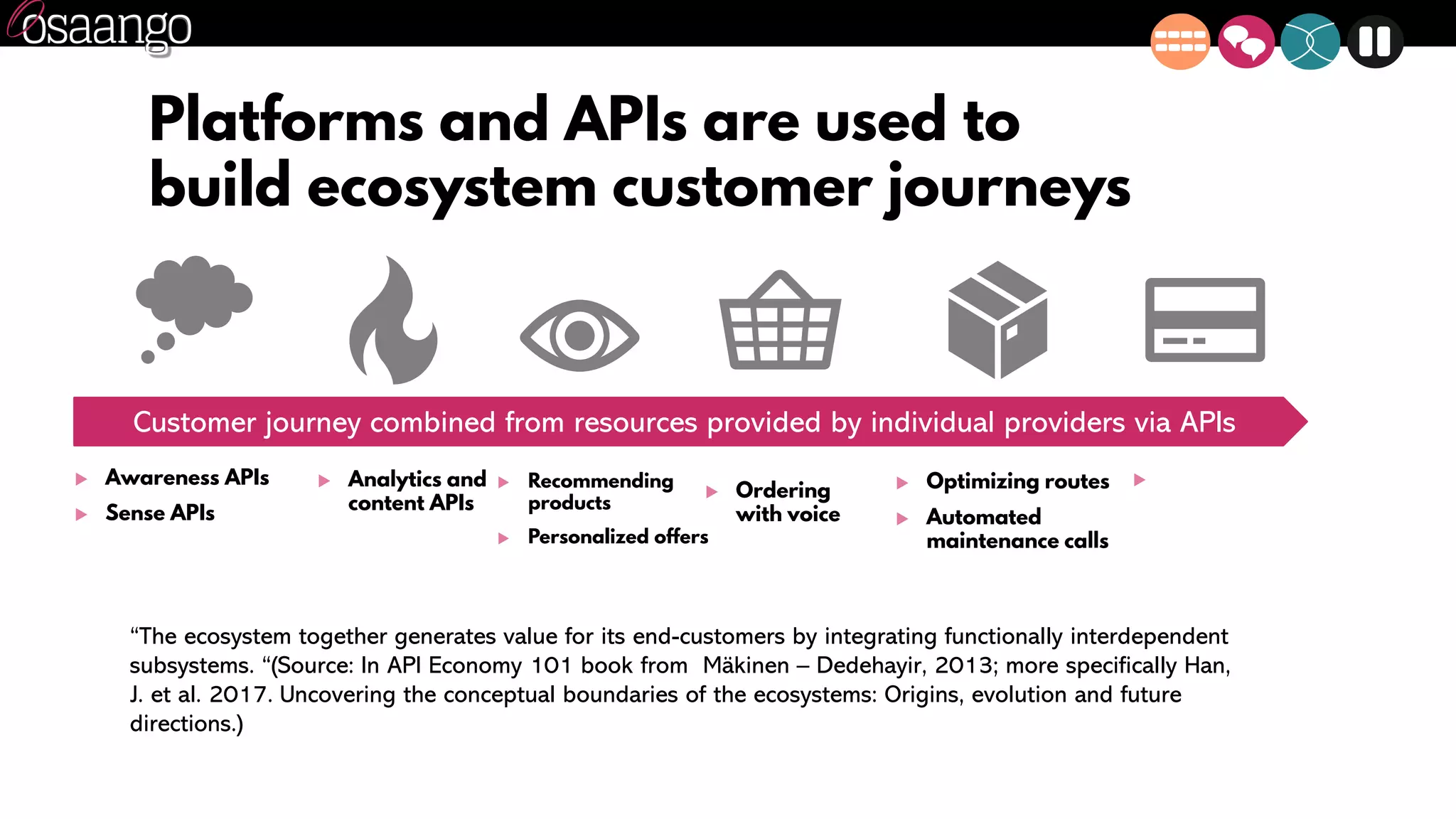
Platforms and APIs are used to
build ecosystem customer journeys
Customer journey combined from resources provided by individual providers via APIs
 Analytics and
content APIs
 Awareness APIs
 Sense APIs
 Recommending
products
 Personalized offers
 Ordering
with voice
 Fraud detection in
payments
 Optimizing routes
 Automated
maintenance calls
“The ecosystem together generates value for its end-customers by integrating functionally interdependent
subsystems. “(Source: In API Economy 101 book from Mäkinen – Dedehayir, 2013; more specifically Han,
J. et al. 2017. Uncovering the conceptual boundaries of the ecosystems: Origins, evolution and future
directions.)
What is API Economy?
"In API Economy company utilizes resources efficiently and quickly to create
added value for own customers. These resources can be for example data
or function provided by other organizations.
Building blocks utilized are own APIs and open APIs provided by other
organizations (free or commercial) in addition to developer communities.
These enable quicker adaptability to unpredictable and faster changing
customer needs.
Defining characteristics of API Economy are competing for popularity
among application developers and considering them as primary customers.
In brief, services are offered from businesses to developers (Business-to-
Developers, B2D)."
Moilanen J., Niinioja M., Seppänen M. & Honkanen M. 2019. API Economy 101
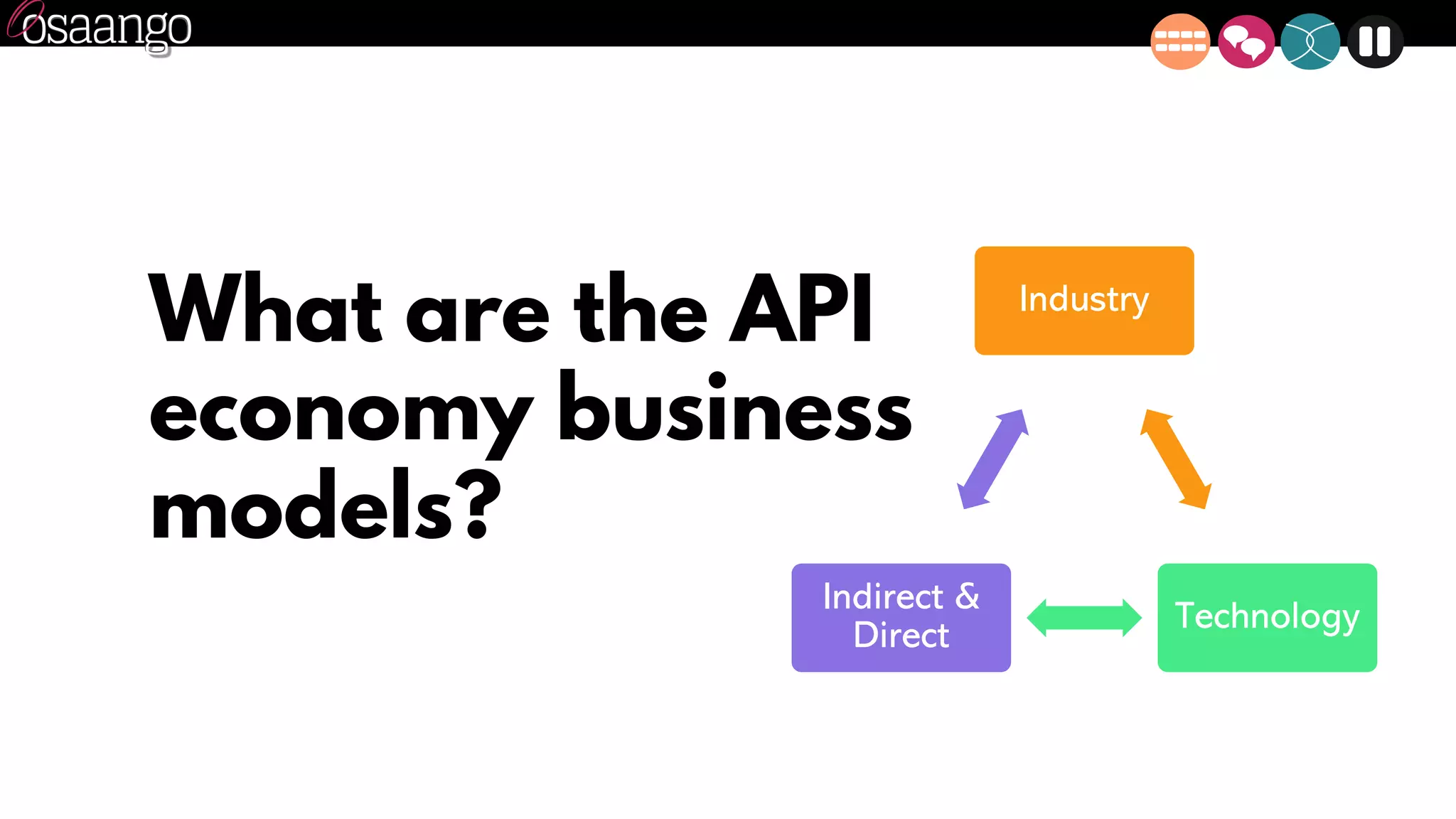
What are the API
economy business
models?
Industry
Technology
Indirect &
Direct
5 misconceptions
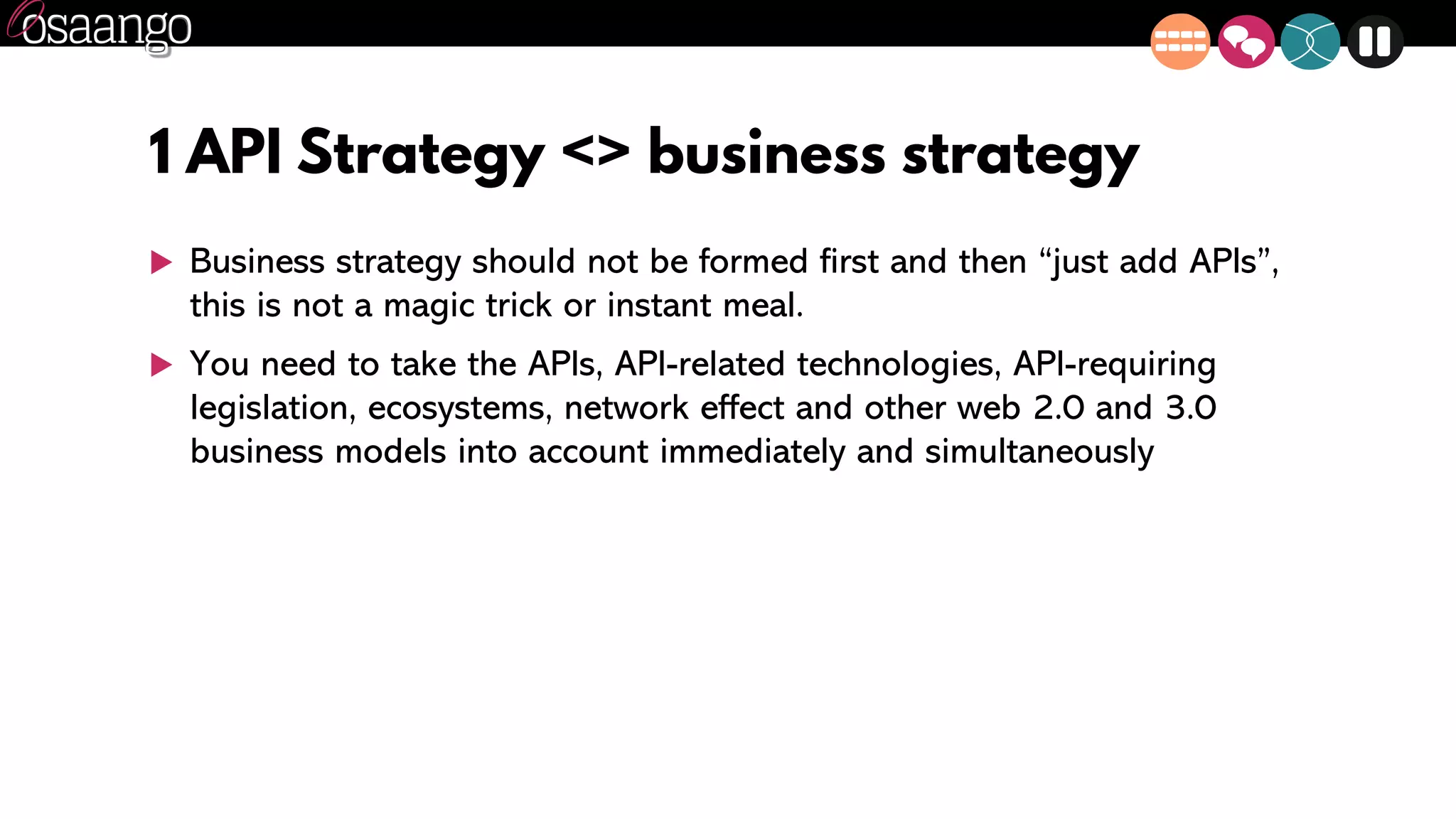
1 API Strategy <> business strategy
 Business strategy should not be formed first and then “just add APIs”,
this is not a magic trick or instant meal.
 You need to take the APIs, API-related technologies, API-requiring
legislation, ecosystems, network effect and other web 2.0 and 3.0
business models into account immediately and simultaneously
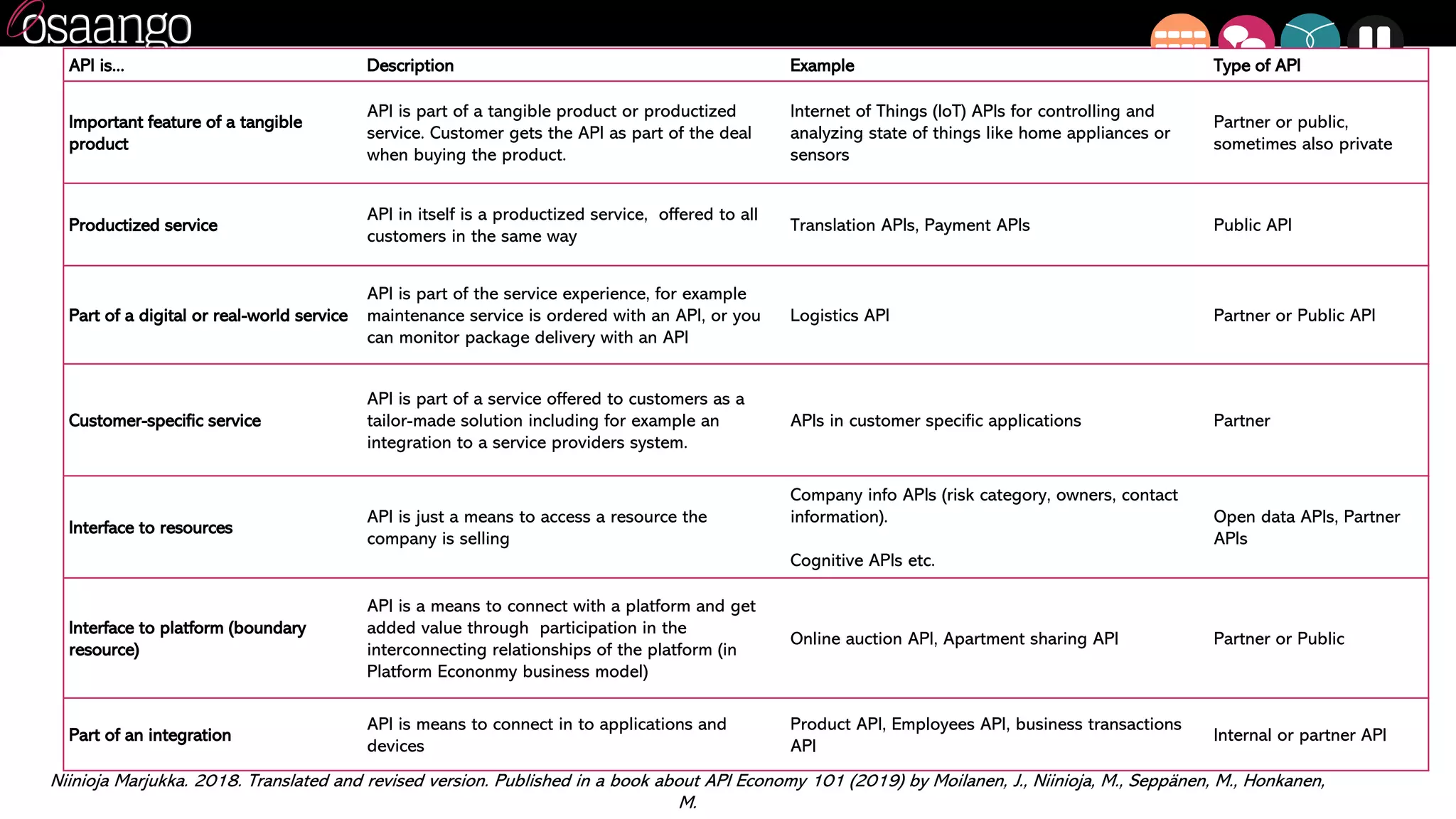
API is... Description Example Type of API
Important feature of a tangible
product
API is part of a tangible product or productized
service. Customer gets the API as part of the deal
when buying the product.
Internet of Things (IoT) APIs for controlling and
analyzing state of things like home appliances or
sensors
Partner or public,
sometimes also private
Productized service
API in itself is a productized service, offered to all
customers in the same way
Translation APIs, Payment APIs Public API
Part of a digital or real-world service
API is part of the service experience, for example
maintenance service is ordered with an API, or you
can monitor package delivery with an API
Logistics API Partner or Public API
Customer-specific service
API is part of a service offered to customers as a
tailor-made solution including for example an
integration to a service providers system.
APIs in customer specific applications Partner
Interface to resources
API is just a means to access a resource the
company is selling
Company info APIs (risk category, owners, contact
information).
Cognitive APIs etc.
Open data APIs, Partner
APIs
Interface to platform (boundary
resource)
API is a means to connect with a platform and get
added value through participation in the
interconnecting relationships of the platform (in
Platform Econonmy business model)
Online auction API, Apartment sharing API Partner or Public
Part of an integration
API is means to connect in to applications and
devices
Product API, Employees API, business transactions
API
Internal or partner API
Niinioja Marjukka. 2018. Translated and revised version. Published in a book about API Economy 101 (2019) by Moilanen, J., Niinioja, M., Seppänen, M., Honkanen,
M.
2 API Strategy == Who you provide
APIs to
 API-enabled business strategy is as much choosing NOT to cater certain
segments or
 NOT to provide certain services or products directly as it is about
figuring out what the role of the APIs IS in the business model
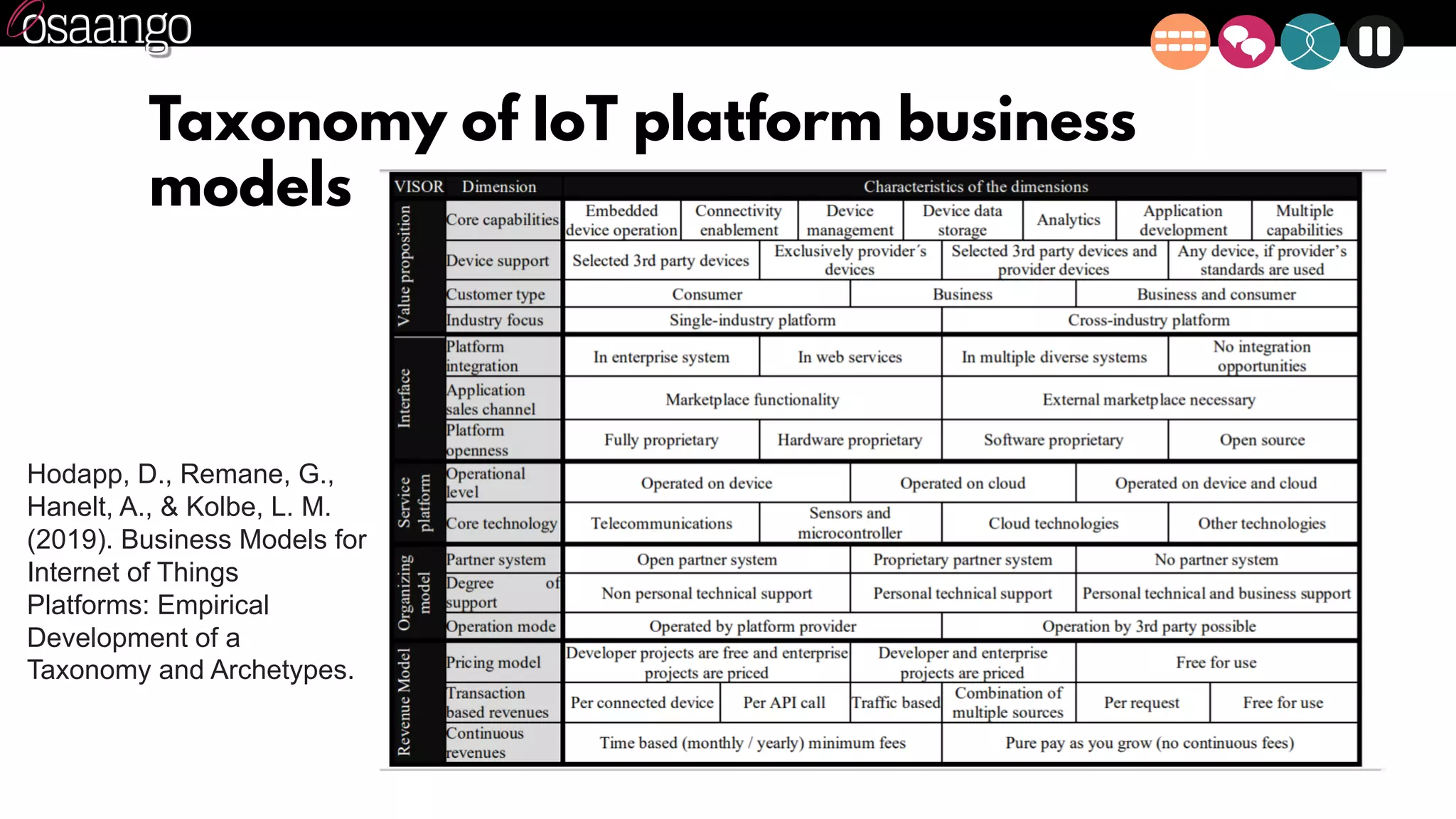
Taxonomy of IoT platform business
models
Hodapp, D., Remane, G.,
Hanelt, A., & Kolbe, L. M.
(2019). Business Models for
Internet of Things
Platforms: Empirical
Development of a
Taxonomy and Archetypes.
3 Business model == Revenue model
 Business model is not the same as revenue model, revenue model is one
part of business model
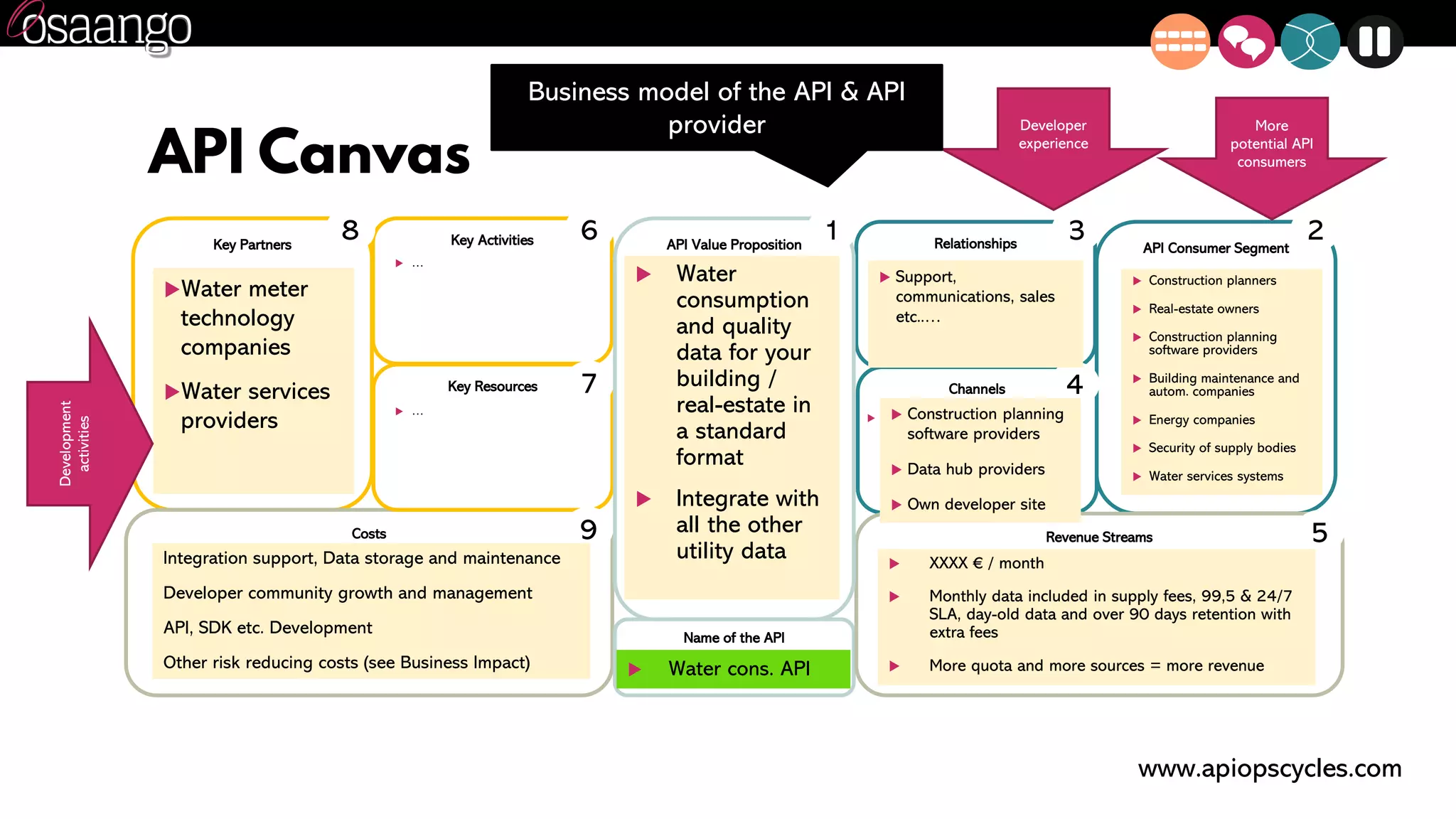
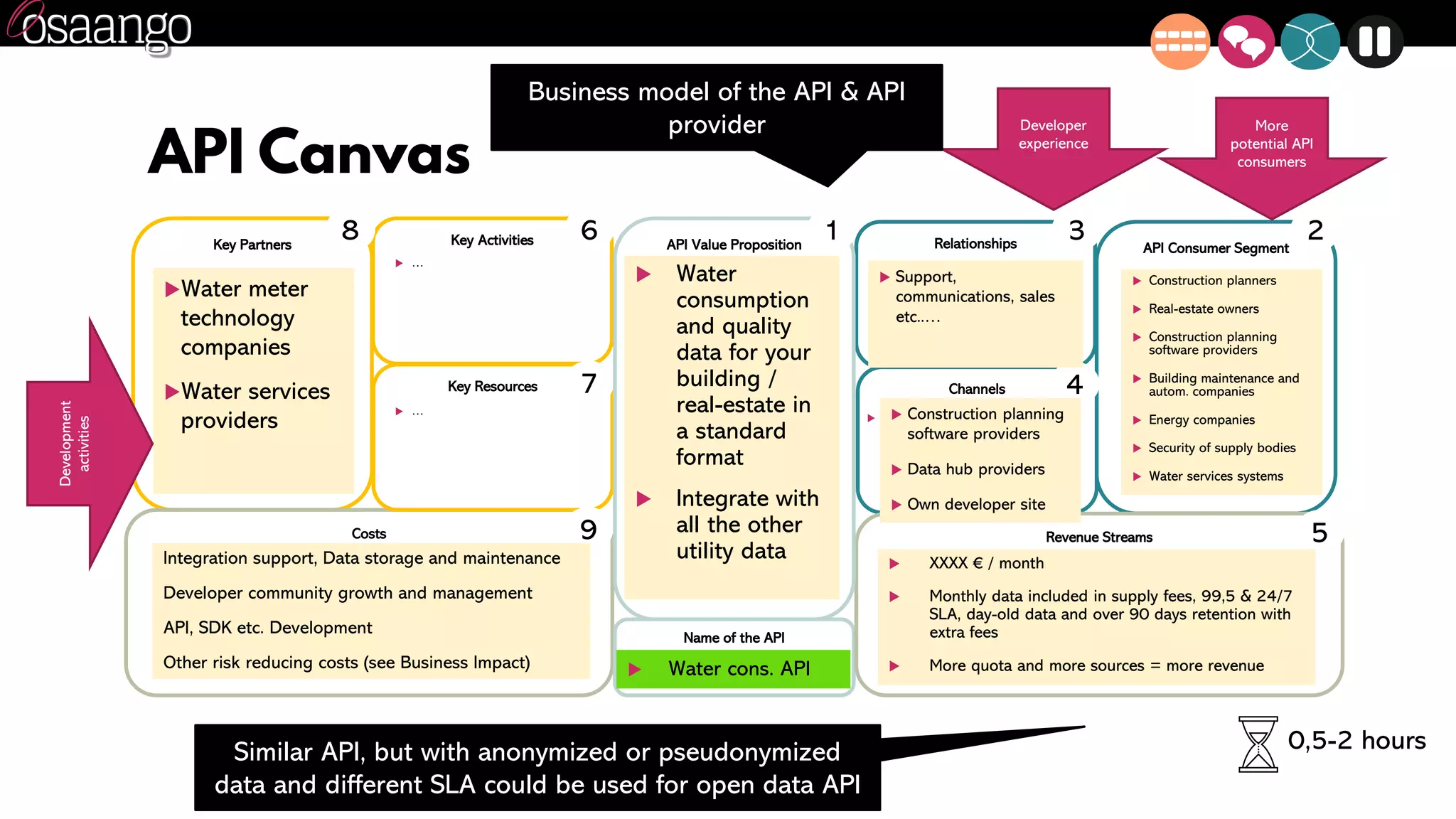
Key ActivitiesKey Partners
Costs
Key Resources
Name of the API
Relationships
Channels
API Consumer Segment
Revenue Streams
23
4
5
6
7
8
9
API Value Proposition
1
API Canvas
Water meter
technology
companies
Water services
providers
 …
 …
 Support,
communications, sales
etc..…
Integration support, Data storage and maintenance
Developer community growth and management
API, SDK etc. Development
Other risk reducing costs (see Business Impact)
 Construction planners
 Real-estate owners
 Construction planning
software providers
 Building maintenance and
autom. companies
 Energy companies
 Security of supply bodies
 Water services systems
 XXXX € / month
 Monthly data included in supply fees, 99,5 & 24/7
SLA, day-old data and over 90 days retention with
extra fees
 More quota and more sources = more revenue
 Water
consumption
and quality
data for your
building /
real-estate in
a standard
format
 Integrate with
all the other
utility data
 Water cons. API
Developer
experience
Development
activities
Business model of the API & API
provider
 … Construction planning
software providers
 Data hub providers
 Own developer site
More
potential API
consumers
www.apiopscycles.com
4 API monetization == Revenue
 API monetization is as much about creating in-direct value of all kinds as
it is about creating direct value, one area of value creation being revenue
streams directly from APIs
 Freemium?
 Costreduction?
 Market-share growth?
 Customer engagement?
 ….
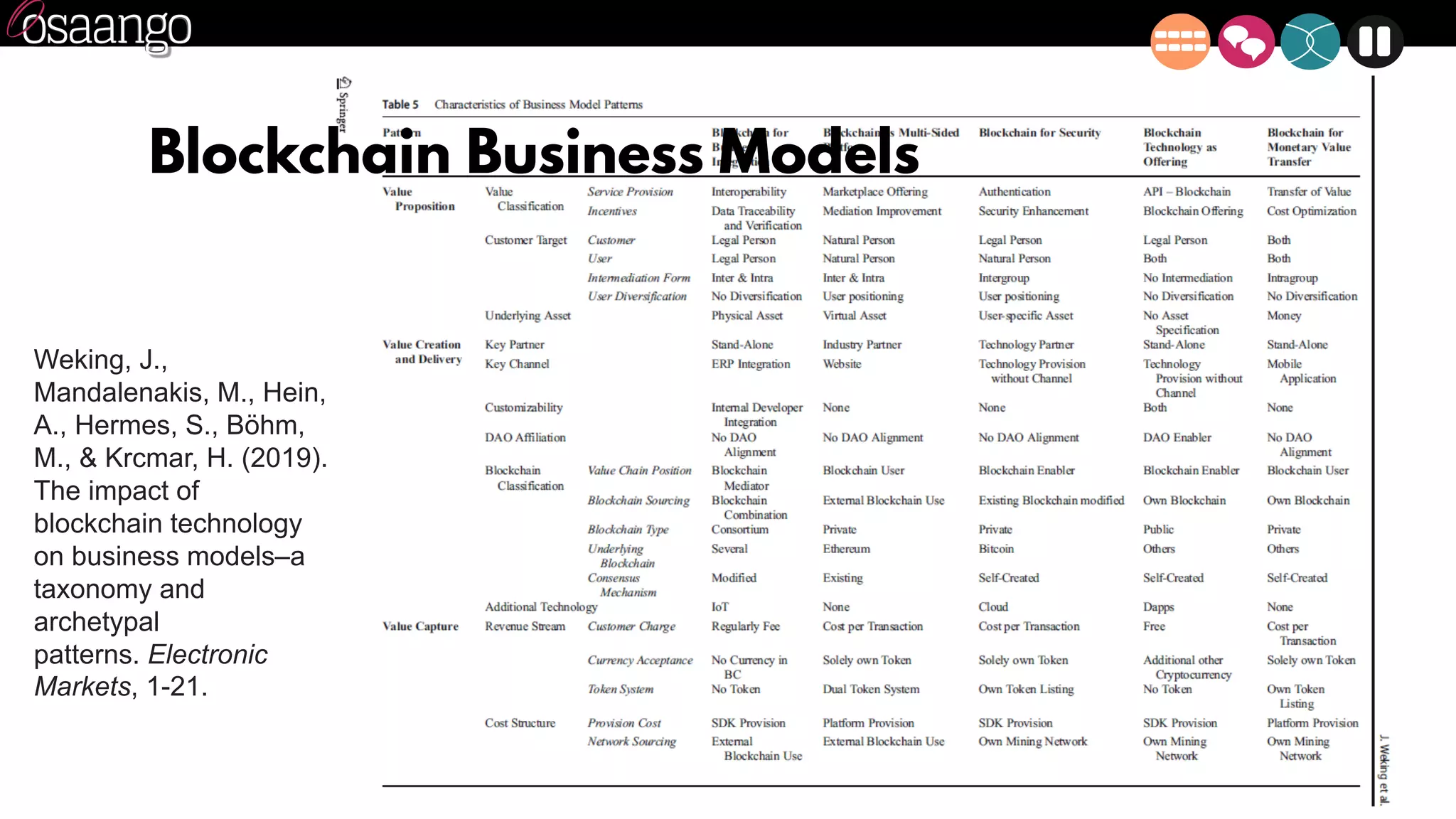
Weking, J.,
Mandalenakis, M., Hein,
A., Hermes, S., Böhm,
M., & Krcmar, H. (2019).
The impact of
blockchain technology
on business models–a
taxonomy and
archetypal
patterns. Electronic
Markets, 1-21.
Blockchain Business Models
5 API business models == only about
APIs
 Nope. There’s IoT, Blockchain, AI/ML, VR/AR, Data and just your
“average” business models like SaaS, PaaS, IPaaS, any other kind of
Platform etc.
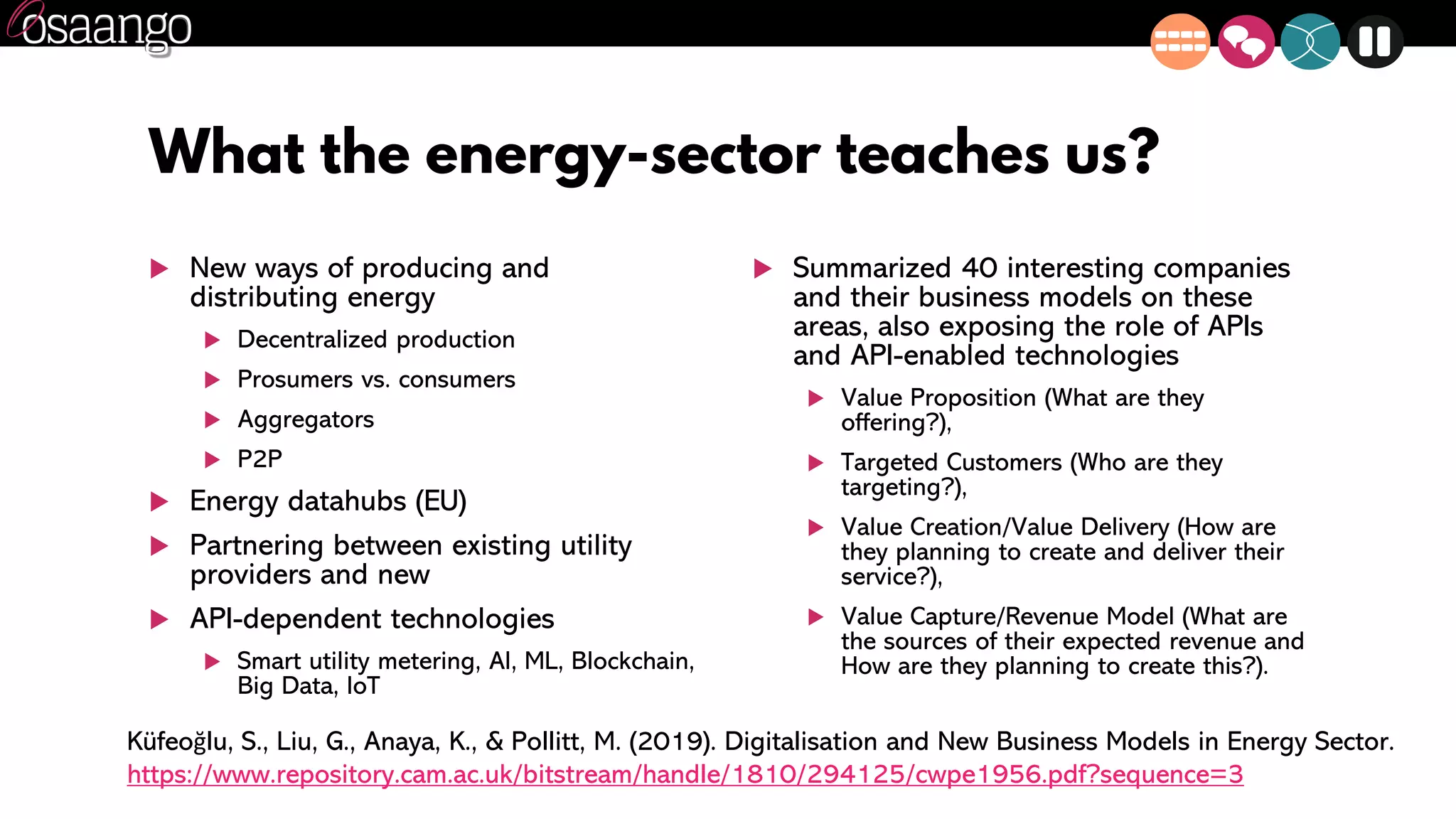
What the energy-sector teaches us?
 New ways of producing and
distributing energy
 Decentralized production
 Prosumers vs. consumers
 Aggregators
 P2P
 Energy datahubs (EU)
 Partnering between existing utility
providers and new
 API-dependent technologies
 Smart utility metering, AI, ML, Blockchain,
Big Data, IoT
 Summarized 40 interesting companies
and their business models on these
areas, also exposing the role of APIs
and API-enabled technologies
 Value Proposition (What are they
offering?),
 Targeted Customers (Who are they
targeting?),
 Value Creation/Value Delivery (How are
they planning to create and deliver their
service?),
 Value Capture/Revenue Model (What are
the sources of their expected revenue and
How are they planning to create this?).
Küfeoğlu, S., Liu, G., Anaya, K., & Pollitt, M. (2019). Digitalisation and New Business Models in Energy Sector.
https://www.repository.cam.ac.uk/bitstream/handle/1810/294125/cwpe1956.pdf?sequence=3
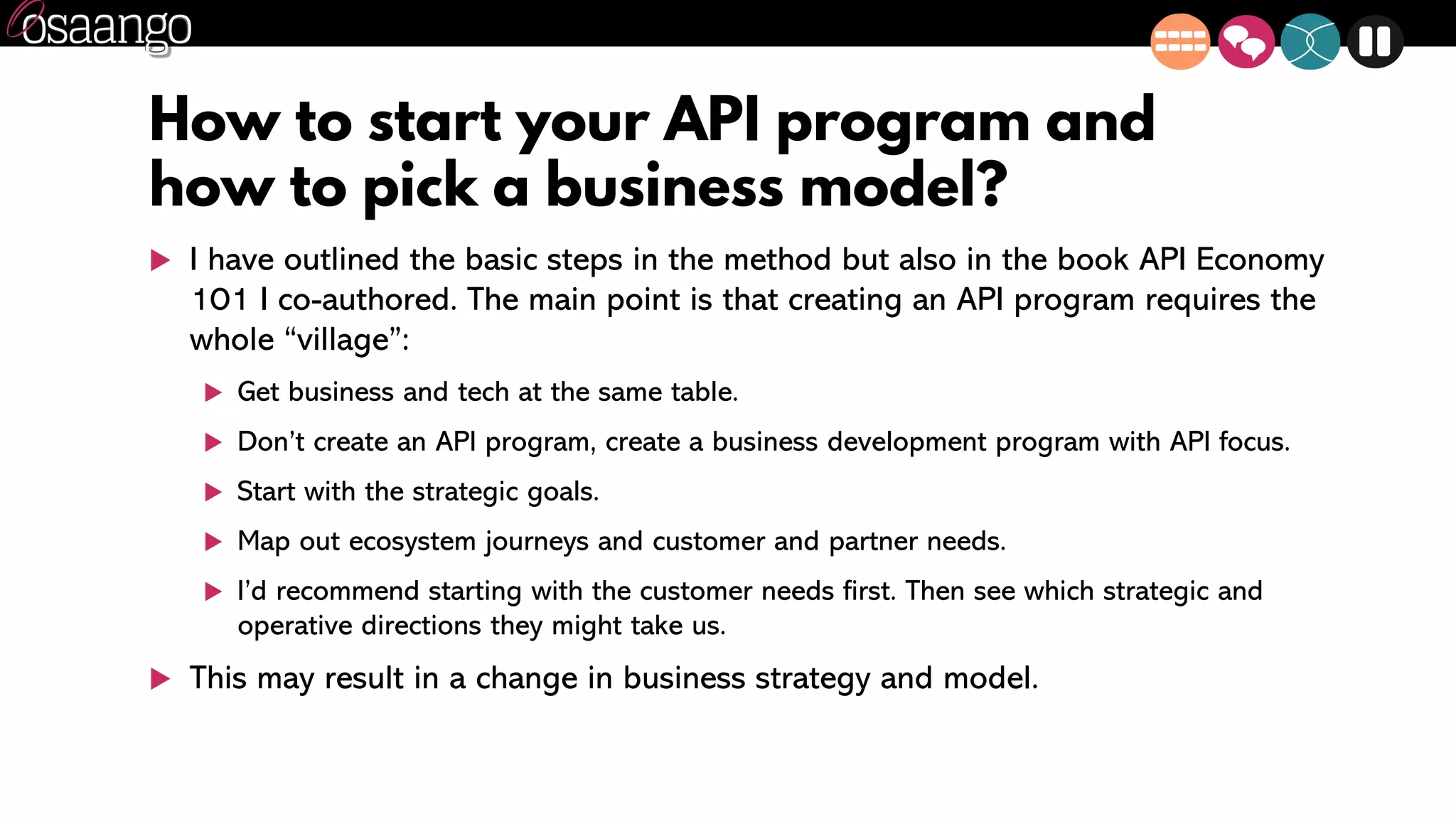
How to start your API program and
how to pick a business model?
 I have outlined the basic steps in the method but also in the book API Economy
101 I co-authored. The main point is that creating an API program requires the
whole “village”:
 Get business and tech at the same table.
 Don’t create an API program, create a business development program with API focus.
 Start with the strategic goals.
 Map out ecosystem journeys and customer and partner needs.
 I’d recommend starting with the customer needs first. Then see which strategic and
operative directions they might take us.
 This may result in a change in business strategy and model.
What are the tools needed to support
the beginning of an API program?
You can use any strategy and business modeling tools you like.
But.
They might only cover the “typical” business model possibilities.
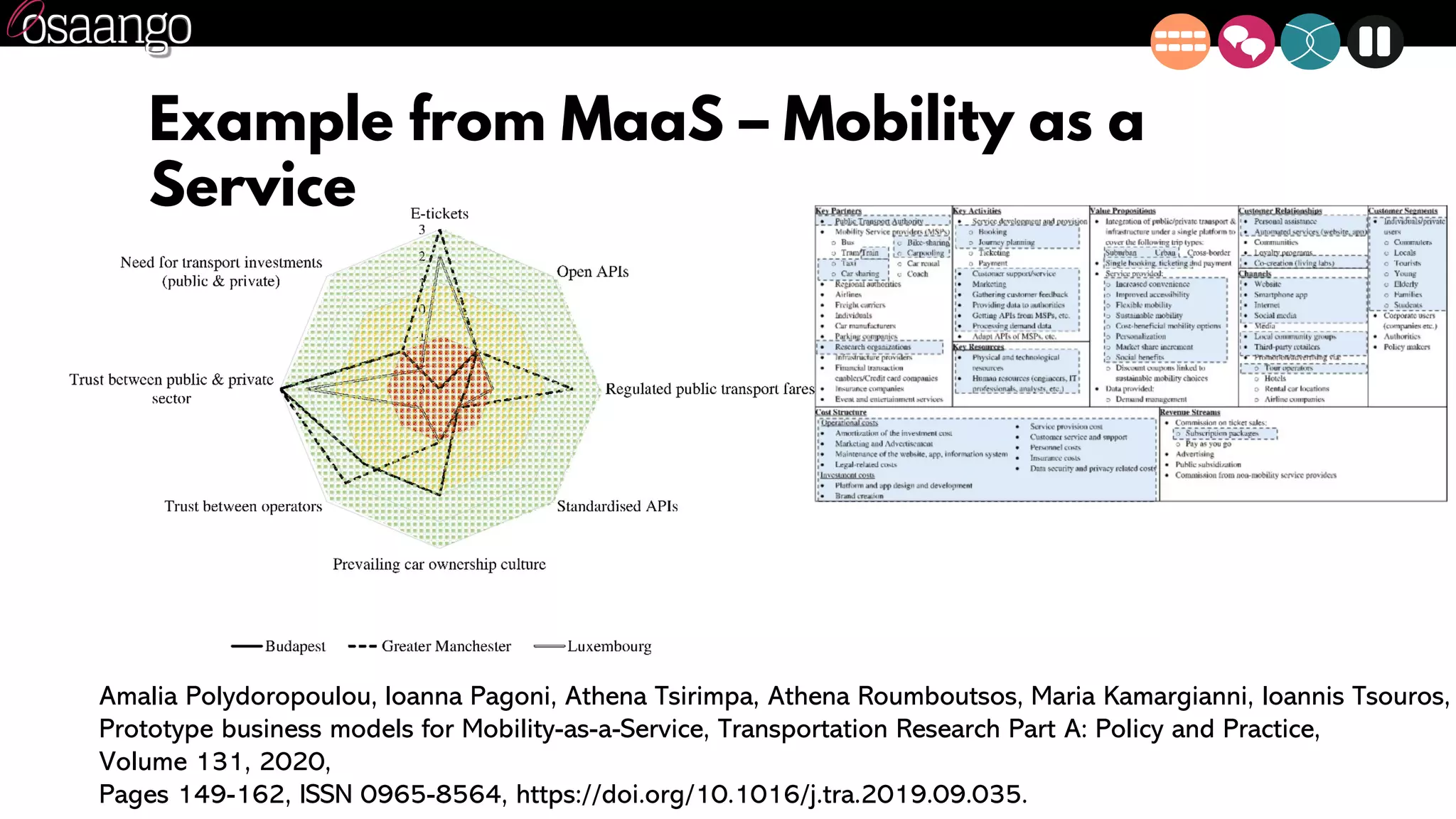
Example from MaaS – Mobility as a
Service
Amalia Polydoropoulou, Ioanna Pagoni, Athena Tsirimpa, Athena Roumboutsos, Maria Kamargianni, Ioannis Tsouros,
Prototype business models for Mobility-as-a-Service, Transportation Research Part A: Policy and Practice,
Volume 131, 2020,
Pages 149-162, ISSN 0965-8564, https://doi.org/10.1016/j.tra.2019.09.035.
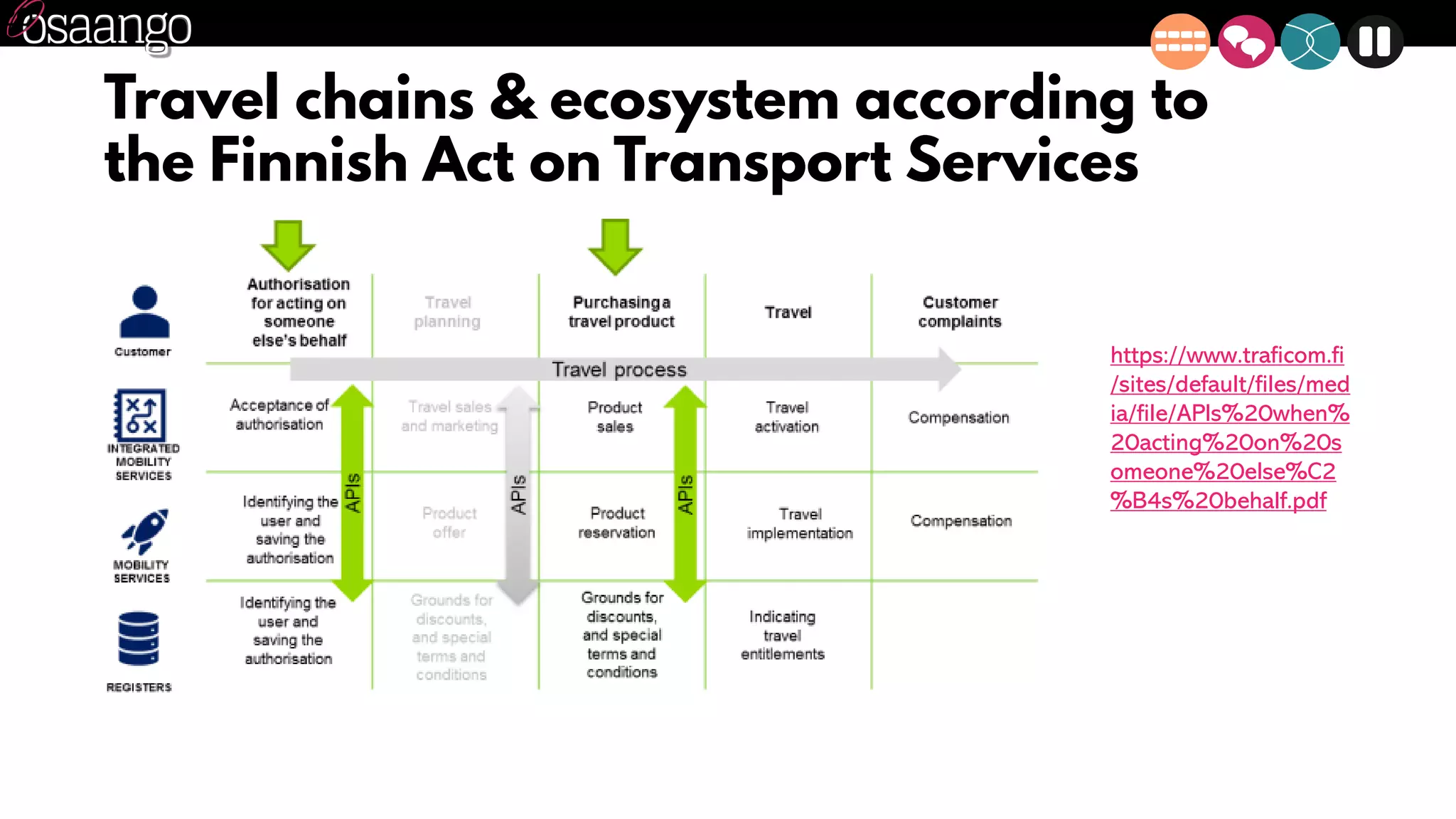
Travel chains & ecosystem according to
the Finnish Act on Transport Services
20
https://www.traficom.fi
/sites/default/files/med
ia/file/APIs%20when%
20acting%20on%20s
omeone%20else%C2
%B4s%20behalf.pdf
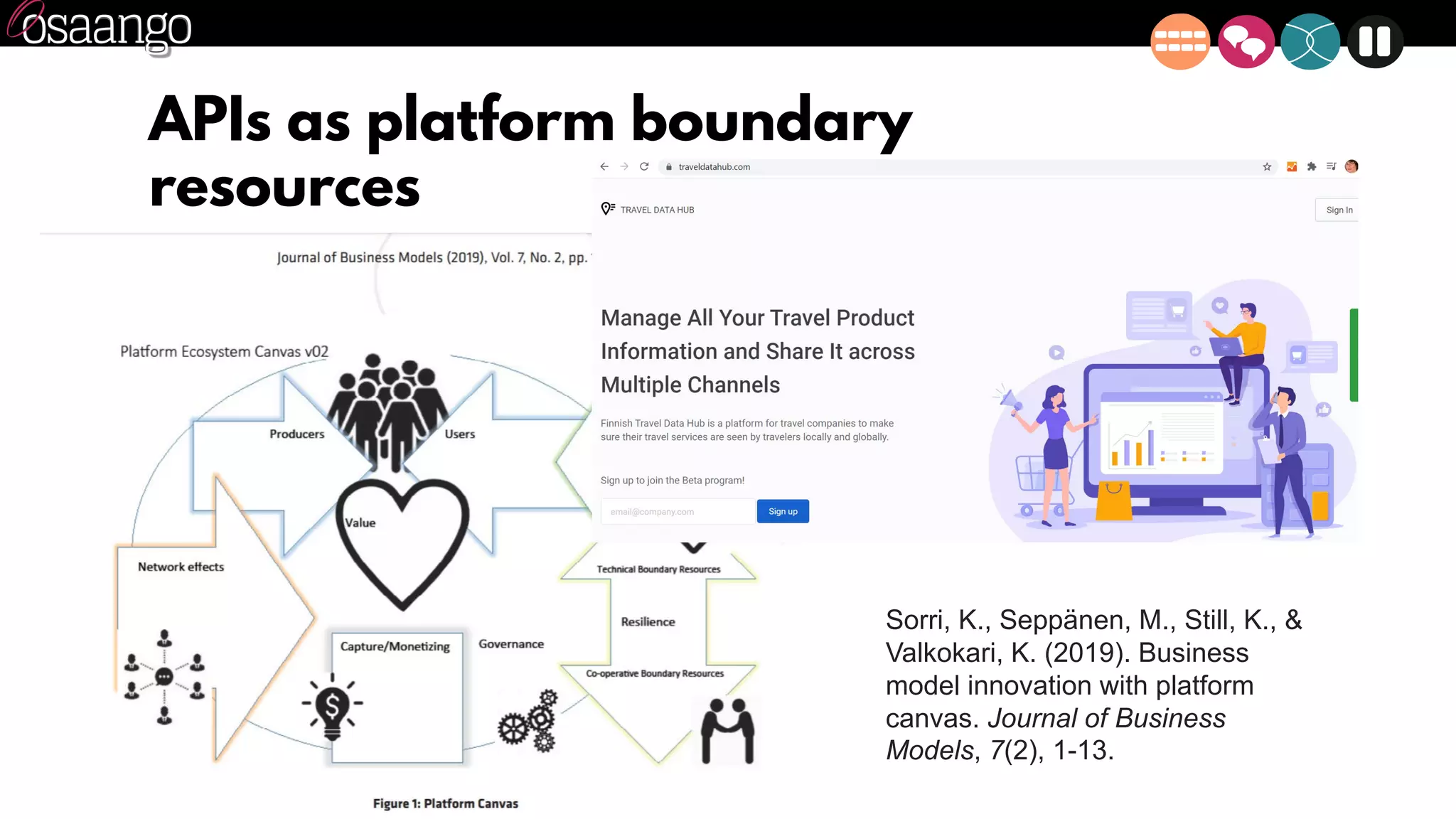
APIs as platform boundary
resources
Sorri, K., Seppänen, M., Still, K., &
Valkokari, K. (2019). Business
model innovation with platform
canvas. Journal of Business
Models, 7(2), 1-13.
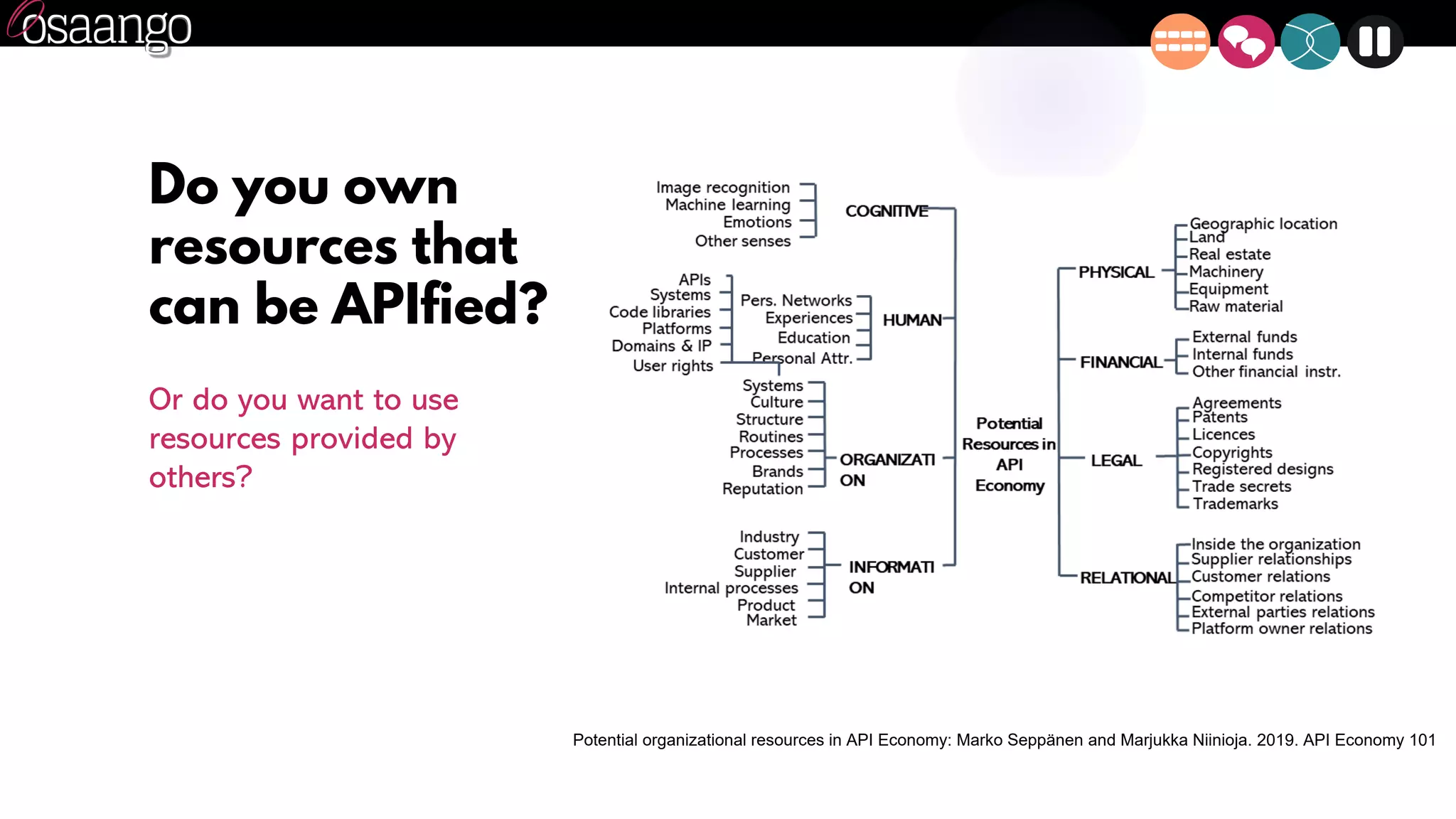
Do you own
resources that
can be APIfied?
Or do you want to use
resources provided by
others?
Potential organizational resources in API Economy: Marko Seppänen and Marjukka Niinioja. 2019. API Economy 101
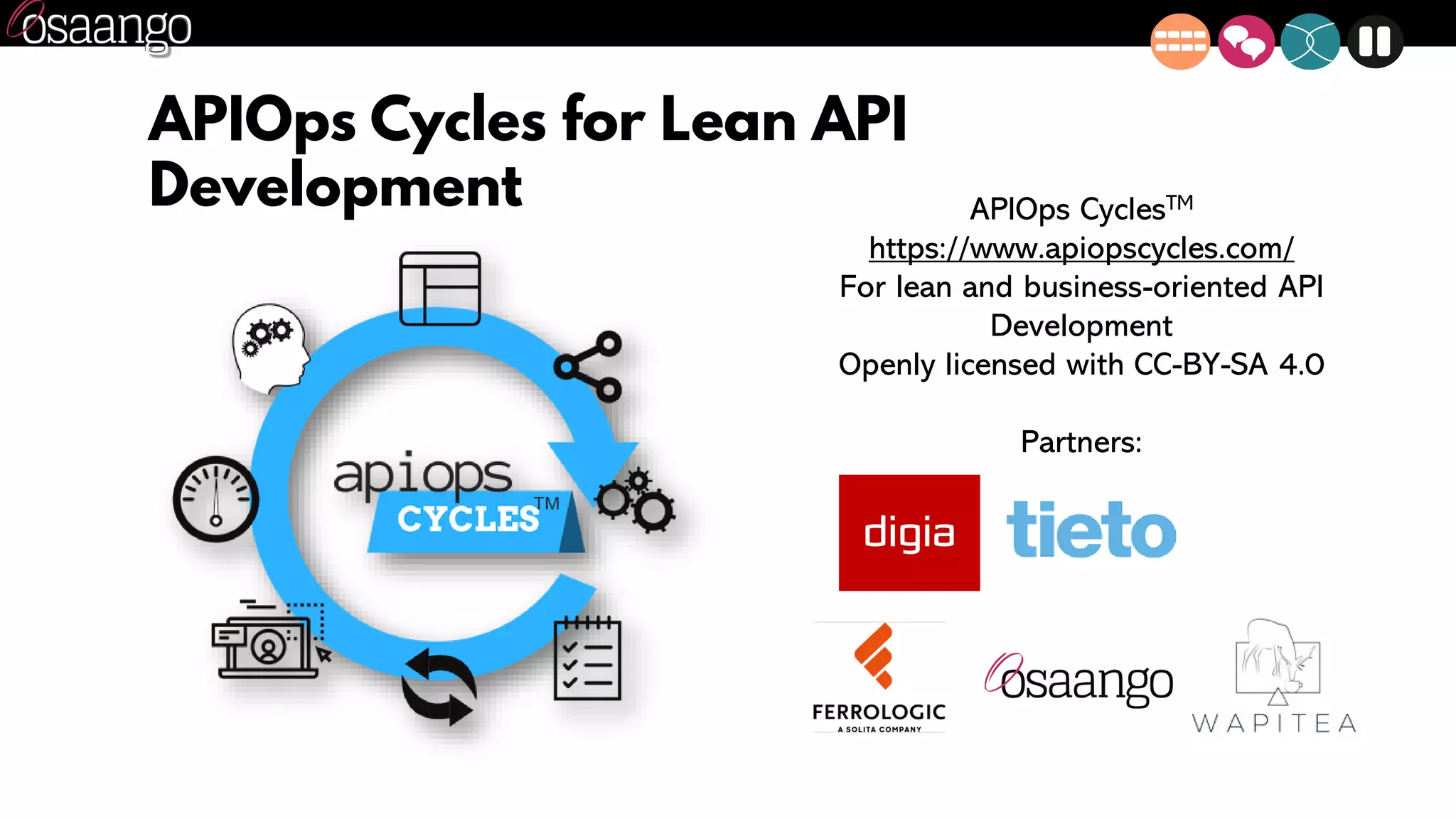
APIOps CyclesTM
https://www.apiopscycles.com/
For lean and business-oriented API
Development
Openly licensed with CC-BY-SA 4.0
Partners:
APIOps Cycles for Lean API
Development
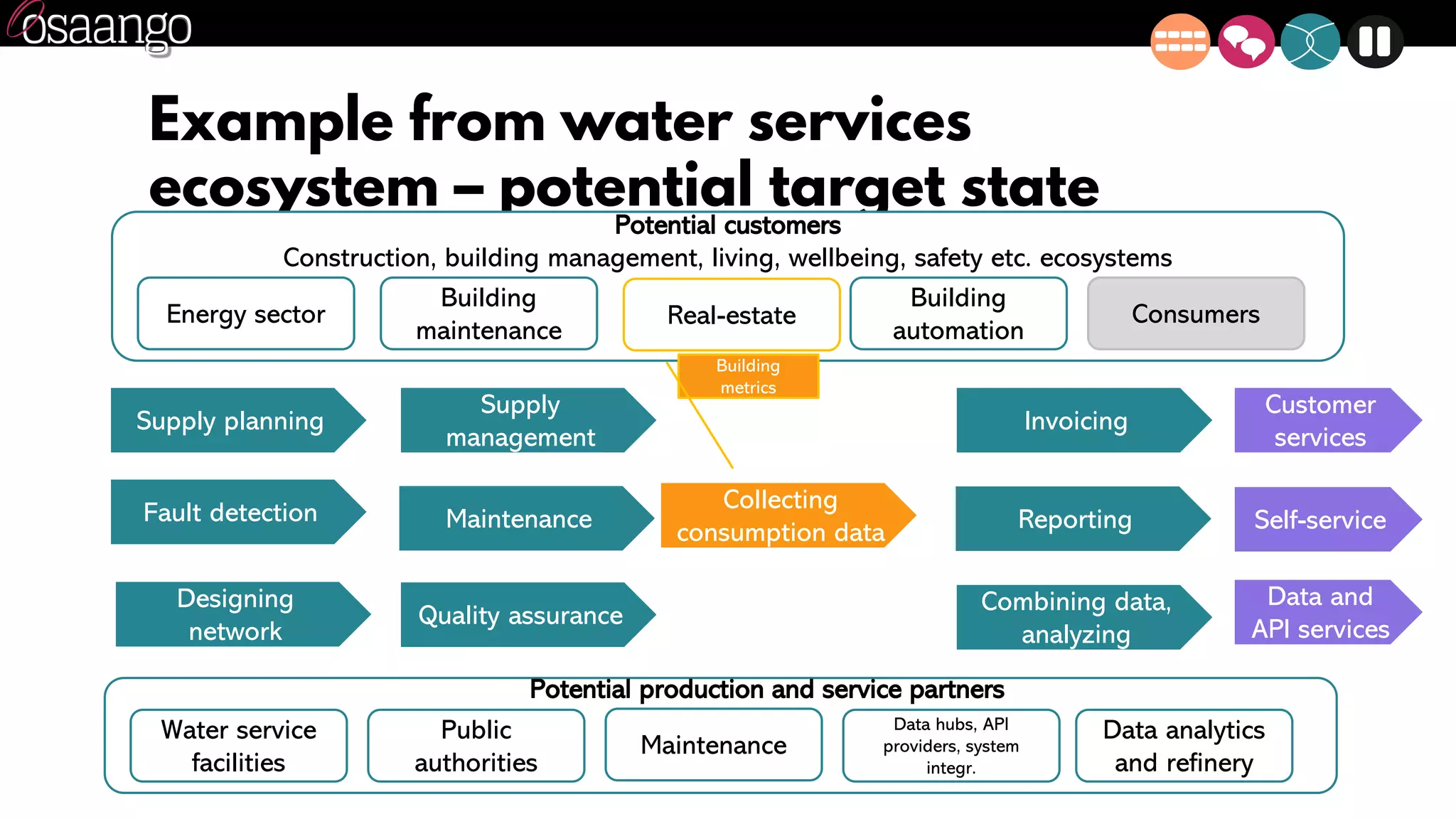
Example from water services
ecosystem – potential target state
Energy sector Real-estate
Building
maintenance
Building
automation
Consumers
Potential customers
Construction, building management, living, wellbeing, safety etc. ecosystems
Supply planning
Supply
management
Collecting
consumption data
Invoicing
Combining data,
analyzing
Reporting
Water service
facilities
Public
authorities
Maintenance
Data hubs, API
providers, system
integr.
Potential production and service partners
Maintenance
Data analytics
and refinery
Customer
services
Self-service
Data and
API services
Quality assurance
Designing
network
Fault detection
Building
metrics
Key ActivitiesKey Partners
Costs
Key Resources
Name of the API
Relationships
Channels
API Consumer Segment
Revenue Streams
23
4
5
6
7
8
9
API Value Proposition
1
API Canvas
Water meter
technology
companies
Water services
providers
 …
 …
 Support,
communications, sales
etc..…
Integration support, Data storage and maintenance
Developer community growth and management
API, SDK etc. Development
Other risk reducing costs (see Business Impact)
 Construction planners
 Real-estate owners
 Construction planning
software providers
 Building maintenance and
autom. companies
 Energy companies
 Security of supply bodies
 Water services systems
 XXXX € / month
 Monthly data included in supply fees, 99,5 & 24/7
SLA, day-old data and over 90 days retention with
extra fees
 More quota and more sources = more revenue
 Water
consumption
and quality
data for your
building /
real-estate in
a standard
format
 Integrate with
all the other
utility data
 Water cons. API
Developer
experience
Development
activities
Business model of the API & API
provider
 … Construction planning
software providers
 Data hub providers
 Own developer site
More
potential API
consumers
Similar API, but with anonymized or pseudonymized
data and different SLA could be used for open data API
0,5-2 hours
Read more
OR ASK FOR TRAINING OR CONSULTING JUST FOR YOUR TEAM – ONLINE AND
REMOTELY
WWW.APIOPSCYCLES.COM
WWW.OSAANGO.ACADEMY
HTTPS://WWW.APISCENE.IO/DX/HOW-TO-START-AN-API-PROGRAM-USING-APIOPS-
CYCLES-METHOD/ - INCLUDES A FULL VIDEO FROM APIDAYS HELSINKI
WWW.APIECONOMY.INFO OR GET THE BOOK FROM YOUR NEAREST ONLINE STORE

API Economy updated practical examples with scientific research

  • 1.
    API Economy PRACTICAL EXAMPLESWITH SCIENTIFIC RESEARCH MARJUKKA NIINIOJA, OSAANGO
  • 2.
    Marjukka Niinioja Founding partnerOsaango Oy, local organizer of apidays Helsinki (again on Sept 1-2) and APIOps meetups Consulted and trained 200+ companies and public sector organi zations on platform economy and API economy business models, service and product strategies an d enterprise architecture One of the authors of API Economy 101 – book (2019) combining research with practical experience “Mother” of APIOps Cycles method. Linked https://www.linkedin.com/in/marjukkaniinioja/ @mniinioja @osaangoltd @apiopscycles #apieconomy101
  • 3.
    Platforms and APIsare used to build ecosystem customer journeys Customer journey combined from resources provided by individual providers via APIs  Analytics and content APIs  Awareness APIs  Sense APIs  Recommending products  Personalized offers  Ordering with voice  Fraud detection in payments  Optimizing routes  Automated maintenance calls “The ecosystem together generates value for its end-customers by integrating functionally interdependent subsystems. “(Source: In API Economy 101 book from Mäkinen – Dedehayir, 2013; more specifically Han, J. et al. 2017. Uncovering the conceptual boundaries of the ecosystems: Origins, evolution and future directions.)
  • 4.
    What is APIEconomy? "In API Economy company utilizes resources efficiently and quickly to create added value for own customers. These resources can be for example data or function provided by other organizations. Building blocks utilized are own APIs and open APIs provided by other organizations (free or commercial) in addition to developer communities. These enable quicker adaptability to unpredictable and faster changing customer needs. Defining characteristics of API Economy are competing for popularity among application developers and considering them as primary customers. In brief, services are offered from businesses to developers (Business-to- Developers, B2D)." Moilanen J., Niinioja M., Seppänen M. & Honkanen M. 2019. API Economy 101
  • 5.
    What are theAPI economy business models? Industry Technology Indirect & Direct
  • 6.
  • 7.
    1 API Strategy<> business strategy  Business strategy should not be formed first and then “just add APIs”, this is not a magic trick or instant meal.  You need to take the APIs, API-related technologies, API-requiring legislation, ecosystems, network effect and other web 2.0 and 3.0 business models into account immediately and simultaneously
  • 8.
    API is... DescriptionExample Type of API Important feature of a tangible product API is part of a tangible product or productized service. Customer gets the API as part of the deal when buying the product. Internet of Things (IoT) APIs for controlling and analyzing state of things like home appliances or sensors Partner or public, sometimes also private Productized service API in itself is a productized service, offered to all customers in the same way Translation APIs, Payment APIs Public API Part of a digital or real-world service API is part of the service experience, for example maintenance service is ordered with an API, or you can monitor package delivery with an API Logistics API Partner or Public API Customer-specific service API is part of a service offered to customers as a tailor-made solution including for example an integration to a service providers system. APIs in customer specific applications Partner Interface to resources API is just a means to access a resource the company is selling Company info APIs (risk category, owners, contact information). Cognitive APIs etc. Open data APIs, Partner APIs Interface to platform (boundary resource) API is a means to connect with a platform and get added value through participation in the interconnecting relationships of the platform (in Platform Econonmy business model) Online auction API, Apartment sharing API Partner or Public Part of an integration API is means to connect in to applications and devices Product API, Employees API, business transactions API Internal or partner API Niinioja Marjukka. 2018. Translated and revised version. Published in a book about API Economy 101 (2019) by Moilanen, J., Niinioja, M., Seppänen, M., Honkanen, M.
  • 9.
    2 API Strategy== Who you provide APIs to  API-enabled business strategy is as much choosing NOT to cater certain segments or  NOT to provide certain services or products directly as it is about figuring out what the role of the APIs IS in the business model
  • 10.
    Taxonomy of IoTplatform business models Hodapp, D., Remane, G., Hanelt, A., & Kolbe, L. M. (2019). Business Models for Internet of Things Platforms: Empirical Development of a Taxonomy and Archetypes.
  • 11.
    3 Business model== Revenue model  Business model is not the same as revenue model, revenue model is one part of business model
  • 12.
    Key ActivitiesKey Partners Costs KeyResources Name of the API Relationships Channels API Consumer Segment Revenue Streams 23 4 5 6 7 8 9 API Value Proposition 1 API Canvas Water meter technology companies Water services providers  …  …  Support, communications, sales etc..… Integration support, Data storage and maintenance Developer community growth and management API, SDK etc. Development Other risk reducing costs (see Business Impact)  Construction planners  Real-estate owners  Construction planning software providers  Building maintenance and autom. companies  Energy companies  Security of supply bodies  Water services systems  XXXX € / month  Monthly data included in supply fees, 99,5 & 24/7 SLA, day-old data and over 90 days retention with extra fees  More quota and more sources = more revenue  Water consumption and quality data for your building / real-estate in a standard format  Integrate with all the other utility data  Water cons. API Developer experience Development activities Business model of the API & API provider  … Construction planning software providers  Data hub providers  Own developer site More potential API consumers www.apiopscycles.com
  • 13.
    4 API monetization== Revenue  API monetization is as much about creating in-direct value of all kinds as it is about creating direct value, one area of value creation being revenue streams directly from APIs  Freemium?  Costreduction?  Market-share growth?  Customer engagement?  ….
  • 14.
    Weking, J., Mandalenakis, M.,Hein, A., Hermes, S., Böhm, M., & Krcmar, H. (2019). The impact of blockchain technology on business models–a taxonomy and archetypal patterns. Electronic Markets, 1-21. Blockchain Business Models
  • 15.
    5 API businessmodels == only about APIs  Nope. There’s IoT, Blockchain, AI/ML, VR/AR, Data and just your “average” business models like SaaS, PaaS, IPaaS, any other kind of Platform etc.
  • 16.
    What the energy-sectorteaches us?  New ways of producing and distributing energy  Decentralized production  Prosumers vs. consumers  Aggregators  P2P  Energy datahubs (EU)  Partnering between existing utility providers and new  API-dependent technologies  Smart utility metering, AI, ML, Blockchain, Big Data, IoT  Summarized 40 interesting companies and their business models on these areas, also exposing the role of APIs and API-enabled technologies  Value Proposition (What are they offering?),  Targeted Customers (Who are they targeting?),  Value Creation/Value Delivery (How are they planning to create and deliver their service?),  Value Capture/Revenue Model (What are the sources of their expected revenue and How are they planning to create this?). Küfeoğlu, S., Liu, G., Anaya, K., & Pollitt, M. (2019). Digitalisation and New Business Models in Energy Sector. https://www.repository.cam.ac.uk/bitstream/handle/1810/294125/cwpe1956.pdf?sequence=3
  • 17.
    How to startyour API program and how to pick a business model?  I have outlined the basic steps in the method but also in the book API Economy 101 I co-authored. The main point is that creating an API program requires the whole “village”:  Get business and tech at the same table.  Don’t create an API program, create a business development program with API focus.  Start with the strategic goals.  Map out ecosystem journeys and customer and partner needs.  I’d recommend starting with the customer needs first. Then see which strategic and operative directions they might take us.  This may result in a change in business strategy and model.
  • 18.
    What are thetools needed to support the beginning of an API program? You can use any strategy and business modeling tools you like. But. They might only cover the “typical” business model possibilities.
  • 19.
    Example from MaaS– Mobility as a Service Amalia Polydoropoulou, Ioanna Pagoni, Athena Tsirimpa, Athena Roumboutsos, Maria Kamargianni, Ioannis Tsouros, Prototype business models for Mobility-as-a-Service, Transportation Research Part A: Policy and Practice, Volume 131, 2020, Pages 149-162, ISSN 0965-8564, https://doi.org/10.1016/j.tra.2019.09.035.
  • 20.
    Travel chains &ecosystem according to the Finnish Act on Transport Services 20 https://www.traficom.fi /sites/default/files/med ia/file/APIs%20when% 20acting%20on%20s omeone%20else%C2 %B4s%20behalf.pdf
  • 21.
    APIs as platformboundary resources Sorri, K., Seppänen, M., Still, K., & Valkokari, K. (2019). Business model innovation with platform canvas. Journal of Business Models, 7(2), 1-13.
  • 22.
    Do you own resourcesthat can be APIfied? Or do you want to use resources provided by others? Potential organizational resources in API Economy: Marko Seppänen and Marjukka Niinioja. 2019. API Economy 101
  • 23.
    APIOps CyclesTM https://www.apiopscycles.com/ For leanand business-oriented API Development Openly licensed with CC-BY-SA 4.0 Partners: APIOps Cycles for Lean API Development
  • 24.
    Example from waterservices ecosystem – potential target state Energy sector Real-estate Building maintenance Building automation Consumers Potential customers Construction, building management, living, wellbeing, safety etc. ecosystems Supply planning Supply management Collecting consumption data Invoicing Combining data, analyzing Reporting Water service facilities Public authorities Maintenance Data hubs, API providers, system integr. Potential production and service partners Maintenance Data analytics and refinery Customer services Self-service Data and API services Quality assurance Designing network Fault detection Building metrics
  • 25.
    Key ActivitiesKey Partners Costs KeyResources Name of the API Relationships Channels API Consumer Segment Revenue Streams 23 4 5 6 7 8 9 API Value Proposition 1 API Canvas Water meter technology companies Water services providers  …  …  Support, communications, sales etc..… Integration support, Data storage and maintenance Developer community growth and management API, SDK etc. Development Other risk reducing costs (see Business Impact)  Construction planners  Real-estate owners  Construction planning software providers  Building maintenance and autom. companies  Energy companies  Security of supply bodies  Water services systems  XXXX € / month  Monthly data included in supply fees, 99,5 & 24/7 SLA, day-old data and over 90 days retention with extra fees  More quota and more sources = more revenue  Water consumption and quality data for your building / real-estate in a standard format  Integrate with all the other utility data  Water cons. API Developer experience Development activities Business model of the API & API provider  … Construction planning software providers  Data hub providers  Own developer site More potential API consumers Similar API, but with anonymized or pseudonymized data and different SLA could be used for open data API 0,5-2 hours
  • 26.
    Read more OR ASKFOR TRAINING OR CONSULTING JUST FOR YOUR TEAM – ONLINE AND REMOTELY WWW.APIOPSCYCLES.COM WWW.OSAANGO.ACADEMY HTTPS://WWW.APISCENE.IO/DX/HOW-TO-START-AN-API-PROGRAM-USING-APIOPS- CYCLES-METHOD/ - INCLUDES A FULL VIDEO FROM APIDAYS HELSINKI WWW.APIECONOMY.INFO OR GET THE BOOK FROM YOUR NEAREST ONLINE STORE