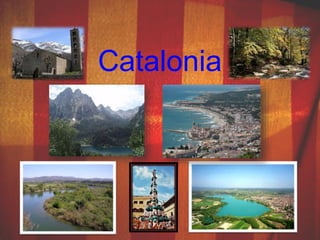
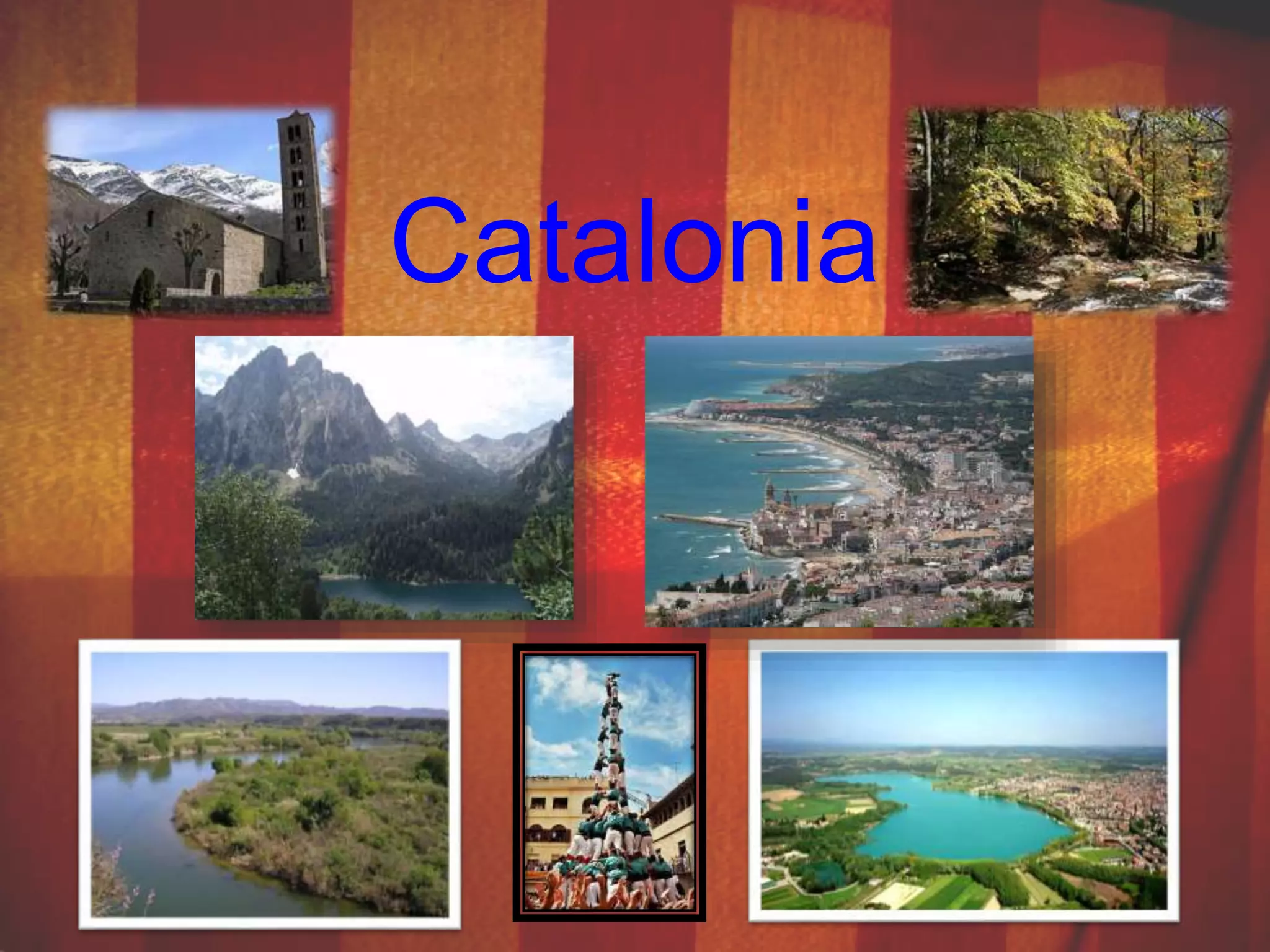
Catalonia
Location 
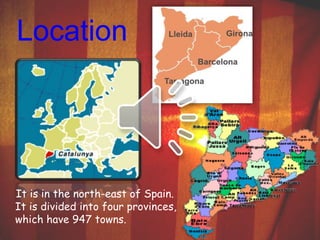
It is in the north-east of Spain. 
It is divided into four provinces, 
which have 947 towns.
History 
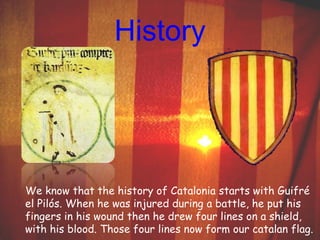
We know that the history of Catalonia starts with Guifré 
el Pilós. When he was injured during a battle, he put his 
fingers in his wound then he drew four lines on a shield, 
with his blood. Those four lines now form our catalan flag.
History 
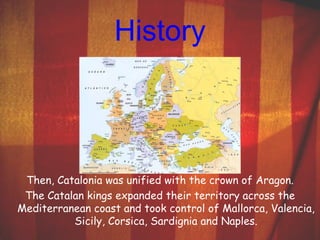
Then, Catalonia was unified with the crown of Aragon. 
The Catalan kings expanded their territory across the 
Mediterranean coast and took control of Mallorca, Valencia, 
Sicily, Corsica, Sardignia and Naples.
History 
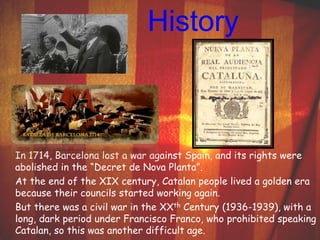
In 1714, Barcelona lost a war against Spain, and its rights were 
abolished in the “Decret de Nova Planta”. 
At the end of the XIX century, Catalan people lived a golden era 
because their councils started working again. 
But there was a civil war in the XXth Century (1936-1939), with a 
long, dark period under Francisco Franco, who prohibited speaking 
Catalan, so this was another difficult age.
History 
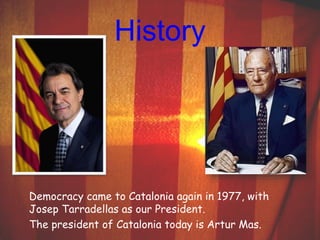
Democracy came to Catalonia again in 1977, with 
Josep Tarradellas as our President. 
The president of Catalonia today is Artur Mas.
Flags 
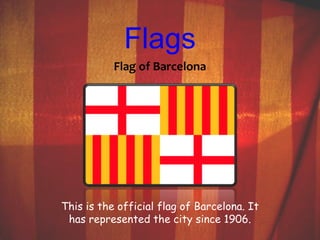
Flag of Barcelona 
This is the official flag of Barcelona. It 
has represented the city since 1906.
Flags 
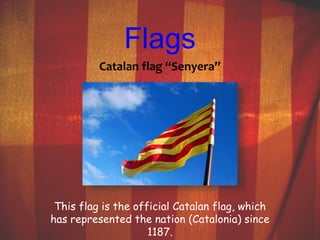
Catalan flag “Senyera” 
This flag is the official Catalan flag, which 
has represented the nation (Catalonia) since 
1187.
Flags 
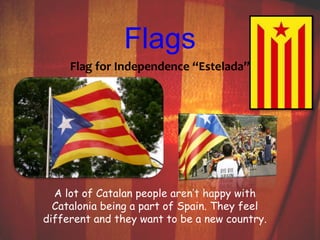
Flag for Independence “Estelada” 
A lot of Catalan people aren’t happy with 
Catalonia being a part of Spain. They feel 
different and they want to be a new country.
Flags 
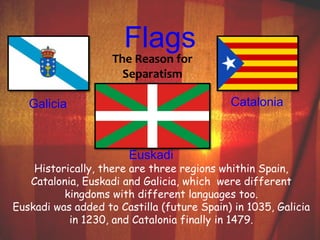
The Reason for 
Separatism 
Galicia Catalonia 
Euskadi 
Historically, there are three regions whithin Spain, 
Catalonia, Euskadi and Galicia, which were different 
kingdoms with different languages too. 
Euskadi was added to Castilla (future Spain) in 1035, Galicia 
in 1230, and Catalonia finally in 1479.
Flags 
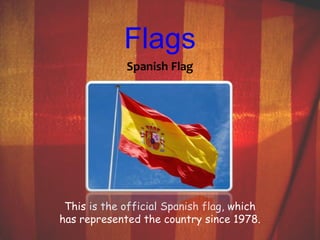
Spanish Flag 
This is the official Spanish flag, which 
has represented the country since 1978.
Symbols 
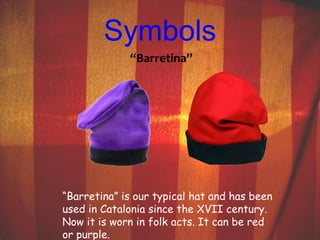
“Barretina” 
“Barretina” is our typical hat and has been 
used in Catalonia since the XVII century. 
Now it is worn in folk acts. It can be red 
or purple.
Symbols 
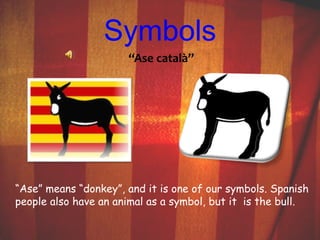
“Ase català” 
“Ase” means “donkey”, and it is one of our symbols. Spanish 
people also have an animal as a symbol, but it is the bull.
Symbols 
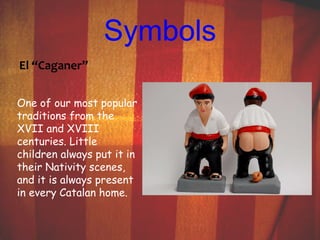
El “Caganer” 
One of our most popular 
traditions from the 
XVII and XVIII 
centuries. Little 
children always put it in 
their Nativity scenes, 
and it is always present 
in every Catalan home.
Landscapes 
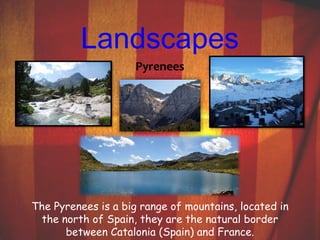
Pyrenees 
The Pyrenees is a big range of mountains, located in 
the north of Spain, they are the natural border 
between Catalonia (Spain) and France.
Landscapes 
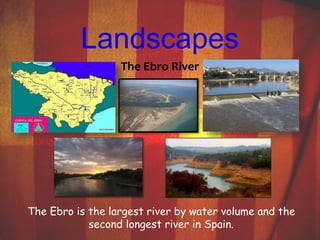
The Ebro River 
The Ebro is the largest river by water volume and the 
second longest river in Spain.
Landscapes 
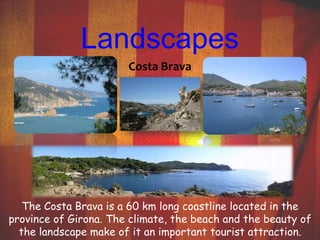
Costa Brava 
The Costa Brava is a 60 km long coastline located in the 
province of Girona. The climate, the beach and the beauty of 
the landscape make of it an important tourist attraction.
Architecture 
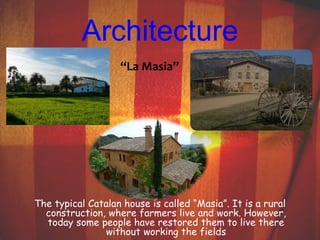
“La Masia” 
The typical Catalan house is called “Masia”. It is a rural 
construction, where farmers live and work. However, 
today some people have restored them to live there 
without working the fields
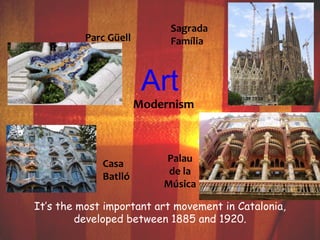
Sagrada 
Família 
Art 
Modernism 
Palau 
de la 
Música 
Parc Güell 
Casa 
Batlló 
It’s the most important art movement in Catalonia, 
developed between 1885 and 1920.
Monuments 
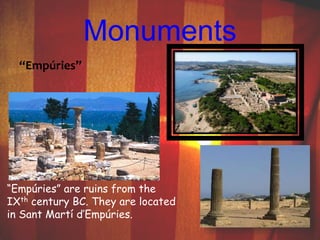
“Empúries” 
“Empúries” are ruins from the 
IXth century BC. They are located 
in Sant Martí d’Empúries.
Monuments 
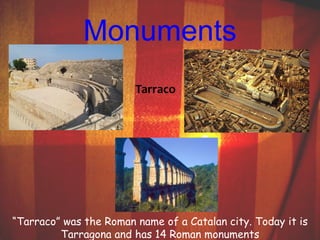
Tarraco 
“Tarraco” was the Roman name of a Catalan city. Today it is 
Tarragona and has 14 Roman monuments
Monuments 
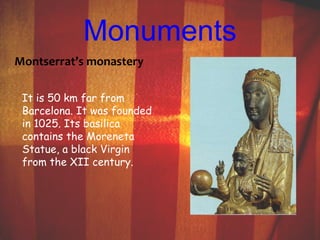
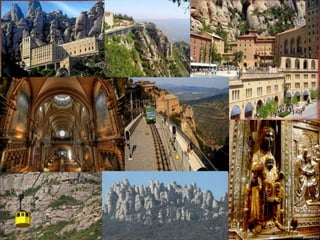
Montserrat’s monastery 
It is 50 km far from 
Barcelona. It was founded 
in 1025. Its basilica 
contains the Moreneta 
Statue, a black Virgin 
from the XII century.
Monuments 
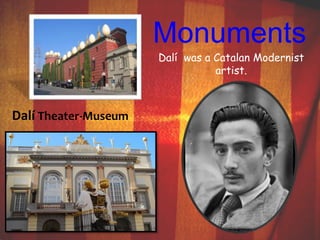
Dalí Theater-Museum 
Dalí was a Catalan Modernist 
artist.
Monuments 
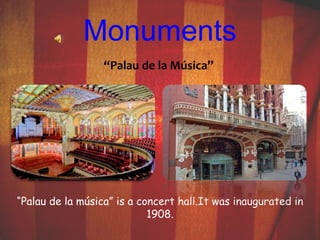
“Palau de la Música” 
“Palau de la música” is a concert hall.It was inaugurated in 
1908.
Monuments 
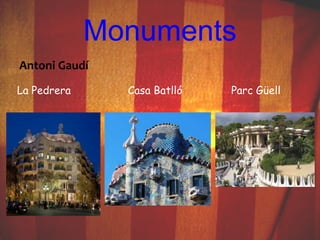
Antoni Gaudí 
La Pedrera Casa Batlló Parc Güell
Monuments 
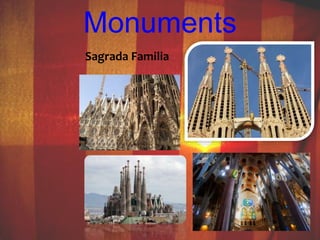
Sagrada Familia
Our Food 
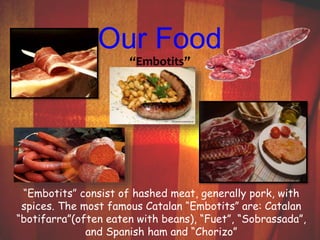
“Embotits” 
“Embotits” consist of hashed meat, generally pork, with 
spices. The most famous Catalan “Embotits” are: Catalan 
“botifarra”(often eaten with beans), “Fuet”, “Sobrassada”, 
and Spanish ham and “Chorizo”
Our Food 
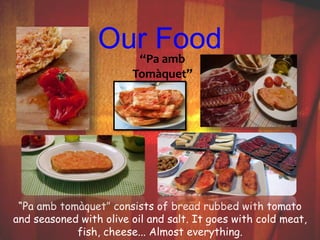
“Pa amb 
Tomàquet” 
“Pa amb tomàquet” consists of bread rubbed with tomato 
and seasoned with olive oil and salt. It goes with cold meat, 
fish, cheese... Almost everything.
Our Food 
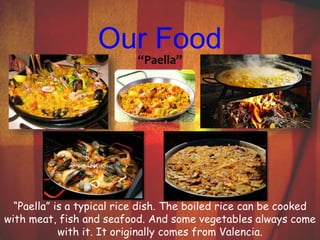
“Paella” 
“Paella” is a typical rice dish. The boiled rice can be cooked 
with meat, fish and seafood. And some vegetables always come 
with it. It originally comes from Valencia.
Our Food 
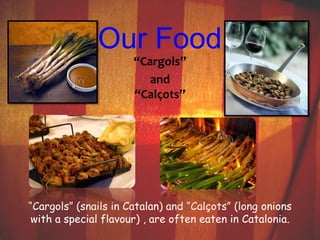
“Cargols” 
and 
“Calçots” 
“Cargols” (snails in Catalan) and “Calçots” (long onions 
with a special flavour) , are often eaten in Catalonia.
Our Food 
“Ensaïmada” 
and 
“Coca” 
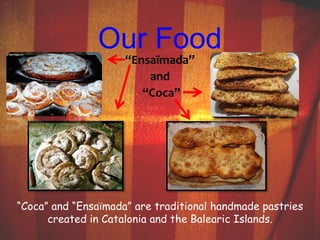
“Coca” and “Ensaïmada” are traditional handmade pastries 
created in Catalonia and the Balearic Islands.
Traditions 
“Sardana” 
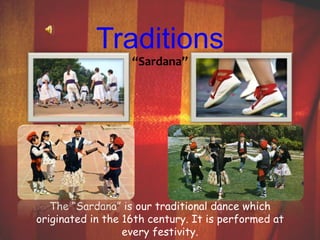
The “Sardana” is our traditional dance which 
originated in the 16th century. It is performed at 
every festivity.
Traditions 
“Correfocs” 
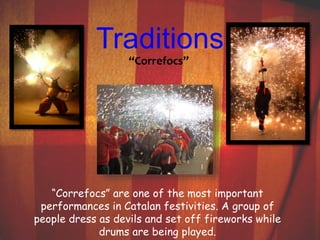
“Correfocs” are one of the most important 
performances in Catalan festivities. A group of 
people dress as devils and set off fireworks while 
drums are being played.
Traditions 
“Gegants” 
and 
“Capgrossos” 
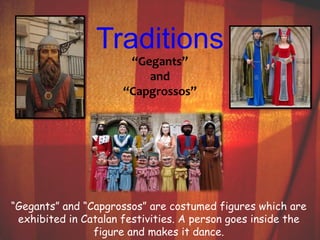
“Gegants” and “Capgrossos” are costumed figures which are 
exhibited in Catalan festivities. A person goes inside the 
figure and makes it dance.
Traditions 
“Castells” 
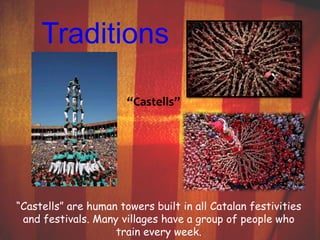
“Castells” are human towers built in all Catalan festivities 
and festivals. Many villages have a group of people who 
train every week.
Traditions 
Clothes 
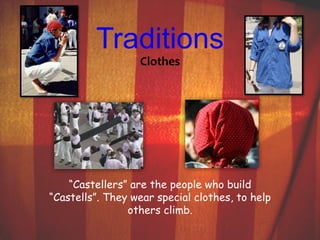
“Castellers” are the people who build 
“Castells”. They wear special clothes, to help 
others climb.
Traditions 
The music 
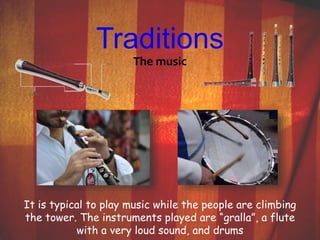
It is typical to play music while the people are climbing 
the tower. The instruments played are “gralla”, a flute 
with a very loud sound, and drums
Traditions 
“Castells” 
“Castells” were declared UNESCO World Heritage. In this 
video you can see the highest “Castell” built ever.
Festivities 
“Diada de 
Sant Jordi” 
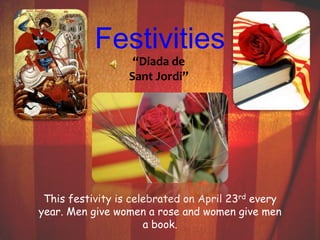
This festivity is celebrated on April 23rd every 
year. Men give women a rose and women give men 
a book.
Festivities 
“Castanyada” 
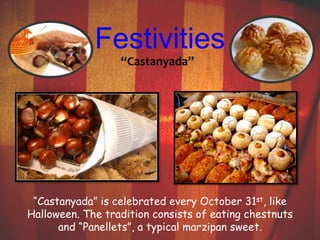
“Castanyada” is celebrated every October 31st, like 
Halloween. The tradition consists of eating chestnuts 
and “Panellets”, a typical marzipan sweet.
So... How are Catalan 
People? 
If we ask ordinary people how to describe ourselves as 
members of the same community, these words pop up: 
-Hard-working 
-Proud of our origins 
-Serious (but not always!) 
-Honest and generous 
-Very traditional 
-Family lovers 
-Music lovers 
-Stubborn (sometimes) 
-Creative 
-Sporty 
Don’t you think we 
probably share 
most of those 
characteristics?
The End

The anonymous personality

  • 1.
  • 2.
    Location It isin the north-east of Spain. It is divided into four provinces, which have 947 towns.
  • 3.
    History We knowthat the history of Catalonia starts with Guifré el Pilós. When he was injured during a battle, he put his fingers in his wound then he drew four lines on a shield, with his blood. Those four lines now form our catalan flag.
  • 4.
    History Then, Cataloniawas unified with the crown of Aragon. The Catalan kings expanded their territory across the Mediterranean coast and took control of Mallorca, Valencia, Sicily, Corsica, Sardignia and Naples.
  • 5.
    History In 1714,Barcelona lost a war against Spain, and its rights were abolished in the “Decret de Nova Planta”. At the end of the XIX century, Catalan people lived a golden era because their councils started working again. But there was a civil war in the XXth Century (1936-1939), with a long, dark period under Francisco Franco, who prohibited speaking Catalan, so this was another difficult age.
  • 6.
    History Democracy cameto Catalonia again in 1977, with Josep Tarradellas as our President. The president of Catalonia today is Artur Mas.
  • 7.
    Flags Flag ofBarcelona This is the official flag of Barcelona. It has represented the city since 1906.
  • 8.
    Flags Catalan flag“Senyera” This flag is the official Catalan flag, which has represented the nation (Catalonia) since 1187.
  • 9.
    Flags Flag forIndependence “Estelada” A lot of Catalan people aren’t happy with Catalonia being a part of Spain. They feel different and they want to be a new country.
  • 10.
    Flags The Reasonfor Separatism Galicia Catalonia Euskadi Historically, there are three regions whithin Spain, Catalonia, Euskadi and Galicia, which were different kingdoms with different languages too. Euskadi was added to Castilla (future Spain) in 1035, Galicia in 1230, and Catalonia finally in 1479.
  • 11.
    Flags Spanish Flag This is the official Spanish flag, which has represented the country since 1978.
  • 12.
    Symbols “Barretina” “Barretina”is our typical hat and has been used in Catalonia since the XVII century. Now it is worn in folk acts. It can be red or purple.
  • 13.
    Symbols “Ase català” “Ase” means “donkey”, and it is one of our symbols. Spanish people also have an animal as a symbol, but it is the bull.
  • 14.
    Symbols El “Caganer” One of our most popular traditions from the XVII and XVIII centuries. Little children always put it in their Nativity scenes, and it is always present in every Catalan home.
  • 15.
    Landscapes Pyrenees ThePyrenees is a big range of mountains, located in the north of Spain, they are the natural border between Catalonia (Spain) and France.
  • 16.
    Landscapes The EbroRiver The Ebro is the largest river by water volume and the second longest river in Spain.
  • 17.
    Landscapes Costa Brava The Costa Brava is a 60 km long coastline located in the province of Girona. The climate, the beach and the beauty of the landscape make of it an important tourist attraction.
  • 18.
    Architecture “La Masia” The typical Catalan house is called “Masia”. It is a rural construction, where farmers live and work. However, today some people have restored them to live there without working the fields
  • 19.
    Sagrada Família Art Modernism Palau de la Música Parc Güell Casa Batlló It’s the most important art movement in Catalonia, developed between 1885 and 1920.
  • 20.
    Monuments “Empúries” “Empúries”are ruins from the IXth century BC. They are located in Sant Martí d’Empúries.
  • 21.
    Monuments Tarraco “Tarraco”was the Roman name of a Catalan city. Today it is Tarragona and has 14 Roman monuments
  • 22.
    Monuments Montserrat’s monastery It is 50 km far from Barcelona. It was founded in 1025. Its basilica contains the Moreneta Statue, a black Virgin from the XII century.
  • 24.
    Monuments Dalí Theater-Museum Dalí was a Catalan Modernist artist.
  • 25.
    Monuments “Palau dela Música” “Palau de la música” is a concert hall.It was inaugurated in 1908.
  • 26.
    Monuments Antoni Gaudí La Pedrera Casa Batlló Parc Güell
  • 27.
  • 28.
    Our Food “Embotits” “Embotits” consist of hashed meat, generally pork, with spices. The most famous Catalan “Embotits” are: Catalan “botifarra”(often eaten with beans), “Fuet”, “Sobrassada”, and Spanish ham and “Chorizo”
  • 29.
    Our Food “Paamb Tomàquet” “Pa amb tomàquet” consists of bread rubbed with tomato and seasoned with olive oil and salt. It goes with cold meat, fish, cheese... Almost everything.
  • 30.
    Our Food “Paella” “Paella” is a typical rice dish. The boiled rice can be cooked with meat, fish and seafood. And some vegetables always come with it. It originally comes from Valencia.
  • 31.
    Our Food “Cargols” and “Calçots” “Cargols” (snails in Catalan) and “Calçots” (long onions with a special flavour) , are often eaten in Catalonia.
  • 32.
    Our Food “Ensaïmada” and “Coca” “Coca” and “Ensaïmada” are traditional handmade pastries created in Catalonia and the Balearic Islands.
  • 33.
    Traditions “Sardana” The“Sardana” is our traditional dance which originated in the 16th century. It is performed at every festivity.
  • 34.
    Traditions “Correfocs” “Correfocs”are one of the most important performances in Catalan festivities. A group of people dress as devils and set off fireworks while drums are being played.
  • 35.
    Traditions “Gegants” and “Capgrossos” “Gegants” and “Capgrossos” are costumed figures which are exhibited in Catalan festivities. A person goes inside the figure and makes it dance.
  • 36.
    Traditions “Castells” “Castells”are human towers built in all Catalan festivities and festivals. Many villages have a group of people who train every week.
  • 37.
    Traditions Clothes “Castellers”are the people who build “Castells”. They wear special clothes, to help others climb.
  • 38.
    Traditions The music It is typical to play music while the people are climbing the tower. The instruments played are “gralla”, a flute with a very loud sound, and drums
  • 39.
    Traditions “Castells” “Castells”were declared UNESCO World Heritage. In this video you can see the highest “Castell” built ever.
  • 40.
    Festivities “Diada de Sant Jordi” This festivity is celebrated on April 23rd every year. Men give women a rose and women give men a book.
  • 41.
    Festivities “Castanyada” “Castanyada”is celebrated every October 31st, like Halloween. The tradition consists of eating chestnuts and “Panellets”, a typical marzipan sweet.
  • 42.
    So... How areCatalan People? If we ask ordinary people how to describe ourselves as members of the same community, these words pop up: -Hard-working -Proud of our origins -Serious (but not always!) -Honest and generous -Very traditional -Family lovers -Music lovers -Stubborn (sometimes) -Creative -Sporty Don’t you think we probably share most of those characteristics?
  • 43.