Location:

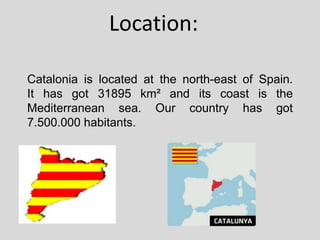
Catalonia is located at the north-east of Spain.
It has got 31895 km² and its coast is the
Mediterranean sea. Our country has got
7.500.000 habitants.
Languages:
Our language is the Catalan and it’s a roman
language, with 11 million speakers.
Here are the percentages of the speakers in Catalonia:
•The 48,8% speak Catalan
•The 44,32% speak Spanish
•And the 0.02% Occitan
Although more than 52% of the Catalan population have
parents who use the Spanish as his language.
The only country where the Catalan is the official
language is Andorra.
Flag and Symbols:
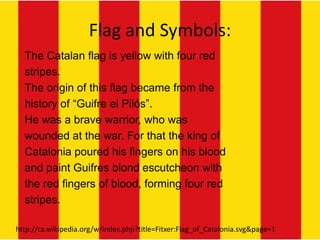
  The Catalan flag is yellow with four red
  stripes.
  The origin of this flag became from the
  history of “Guifre el Pilós”.
  He was a brave warrior, who was
  wounded at the war. For that the king of
  Catalonia poured his fingers on his blood
  and paint Guifres blond escutcheon with
  the red fingers of blood, forming four red
  stripes.

http://ca.wikipedia.org/w/index.php?title=Fitxer:Flag_of_Catalonia.svg&page=1
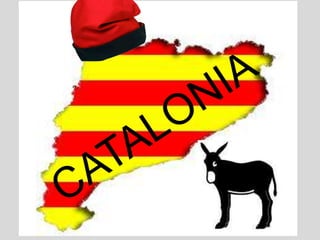
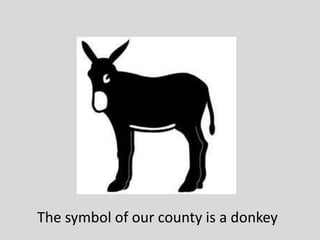
The symbol of our county is a donkey
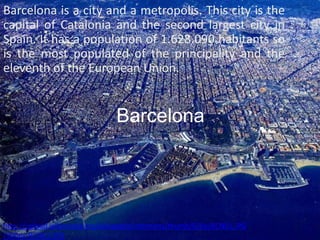
Barcelona is a city and a metropolis. This city is the
capital of Catalonia and the second largest city in
Spain. It has a population of 1.628.090 habitants so
is the most populated of the principality and the
eleventh of the European Union.


                              Barcelona


http://upload.wikimedia.org/wikipedia/commons/thumb/0/0e/BCN01.JPG
/300px-BCN01.JPG
BARCELONA ARCHITECTURE
Barcelona has a rich long architectonic history,
starting with the oldest rests of the roman
settlement who establish this incredible city.
From the medieval period has been conserved
a lot of architectonic buildings, we attach a great
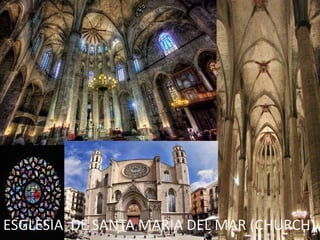
important to a wonderful church in this city:
“L’esglèsia de Santa Maria del Mar”.
In Barcelona there are a lot of important buildings
because some famous architects lived there and
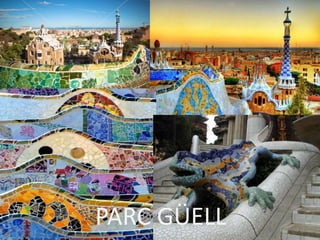
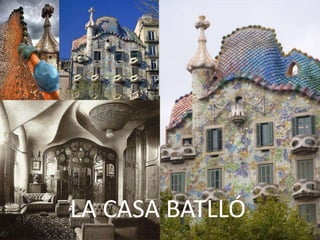
they built beautiful buildings during her live, like “Parc
Güell” and “la casa Batlló” by Antoni Guadi.
ESGLÈSIA DE SANTA MARIA DEL MAR (CHURCH)
PARC GÜELL
LA CASA BATLLÓ
TOPOGRAPHY
• Topography
Catalonia has an important geography diversity, and
knowing that it has a relative small size of its territory.
The Catalan geography it’s constituted by:
• “Pirineus”: is a range of mountains that connects the
  Iberian Peninsula with the European continental territory.
  They are situated at north of Catalonia.
• The Catalan coastal ranges : are an alternation of
  elevations and parallel flats on the Mediterranean coast.
• The Central Catalan depression: is an structural unit that
  conforms the oriental sector of “Vall de l’Ebre”.
Rivers


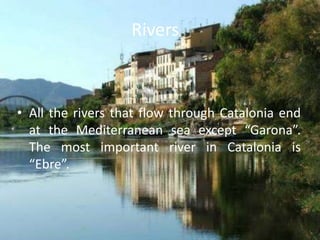
• All the rivers that flow through Catalonia end
  at the Mediterranean sea except “Garona”.
  The most important river in Catalonia is
  “Ebre”.
MONTSERRAT
Montserrat is a very important mountain in
Catalonia. It has been highlighted for its
characteristic geology and topography . The
Monserrat monastery it’s situated near Bages,
Anoia and Baix Llobregat (counties of Catalonia).
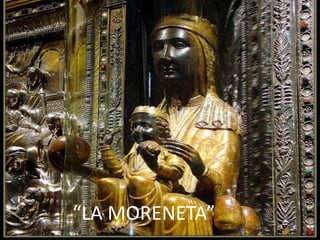
In Montserrat there is a train who takes you to
its cave and there you can see the Montserrat
mother of god it’s called “la moreneta”.
“LA MORENETA”
La sardana
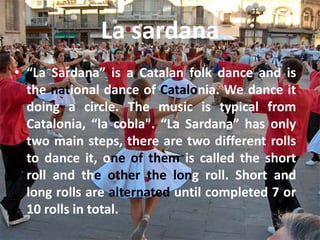
• “La Sardana” is a Catalan folk dance and is
  the national dance of Catalonia. We dance it
  doing a circle. The music is typical from
  Catalonia, “la cobla". “La Sardana” has only
  two main steps, there are two different rolls
  to dance it, one of them is called the short
  roll and the other the long roll. Short and
  long rolls are alternated until completed 7 or
  10 rolls in total.
the11th of September
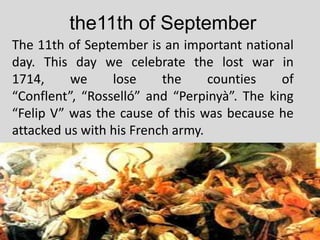
The 11th of September is an important national
day. This day we celebrate the lost war in
1714,     we     lose     the     counties   of
“Conflent”, “Rosselló” and “Perpinyà”. The king
“Felip V” was the cause of this was because he
attacked us with his French army.
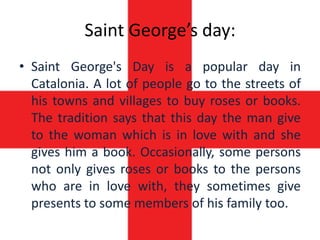
Saint George’s day:
• Saint George's Day is a popular day in
  Catalonia. A lot of people go to the streets of
  his towns and villages to buy roses or books.
  The tradition says that this day the man give
  to the woman which is in love with and she
  gives him a book. Occasionally, some persons
  not only gives roses or books to the persons
  who are in love with, they sometimes give
  presents to some members of his family too.
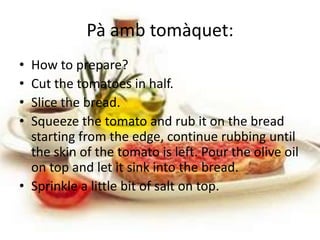
Pà amb tomàquet:
• How to prepare?
• Cut the tomatoes in half.
• Slice the bread.
• Squeeze the tomato and rub it on the bread
  starting from the edge, continue rubbing until
  the skin of the tomato is left. Pour the olive oil
  on top and let it sink into the bread.
• Sprinkle a little bit of salt on top.
CATALAN ECONOMY
At this moment the Catalan economy depends on
Spanish economy which is really in a bad situation
and that’s why, together with some other reasons,
that Catalonia wants to be independent. But Spain
doesn’t let Catalonia be independent, because if
this would happen Spanish economy will get
worse.
Thanks for
your attention
          Ariadna Bonet
          Alvaro Martil
          Anna Mocunill
          Joan Roca

Catalunya

  • 2.
    Location: Catalonia is locatedat the north-east of Spain. It has got 31895 km² and its coast is the Mediterranean sea. Our country has got 7.500.000 habitants.
  • 3.
    Languages: Our language isthe Catalan and it’s a roman language, with 11 million speakers. Here are the percentages of the speakers in Catalonia: •The 48,8% speak Catalan •The 44,32% speak Spanish •And the 0.02% Occitan Although more than 52% of the Catalan population have parents who use the Spanish as his language. The only country where the Catalan is the official language is Andorra.
  • 4.
    Flag and Symbols: The Catalan flag is yellow with four red stripes. The origin of this flag became from the history of “Guifre el Pilós”. He was a brave warrior, who was wounded at the war. For that the king of Catalonia poured his fingers on his blood and paint Guifres blond escutcheon with the red fingers of blood, forming four red stripes. http://ca.wikipedia.org/w/index.php?title=Fitxer:Flag_of_Catalonia.svg&page=1
  • 5.
    The symbol ofour county is a donkey
  • 6.
    Barcelona is acity and a metropolis. This city is the capital of Catalonia and the second largest city in Spain. It has a population of 1.628.090 habitants so is the most populated of the principality and the eleventh of the European Union. Barcelona http://upload.wikimedia.org/wikipedia/commons/thumb/0/0e/BCN01.JPG /300px-BCN01.JPG
  • 7.
    BARCELONA ARCHITECTURE Barcelona hasa rich long architectonic history, starting with the oldest rests of the roman settlement who establish this incredible city. From the medieval period has been conserved a lot of architectonic buildings, we attach a great important to a wonderful church in this city: “L’esglèsia de Santa Maria del Mar”. In Barcelona there are a lot of important buildings because some famous architects lived there and they built beautiful buildings during her live, like “Parc Güell” and “la casa Batlló” by Antoni Guadi.
  • 8.
    ESGLÈSIA DE SANTAMARIA DEL MAR (CHURCH)
  • 9.
  • 10.
  • 11.
    TOPOGRAPHY • Topography Catalonia hasan important geography diversity, and knowing that it has a relative small size of its territory. The Catalan geography it’s constituted by: • “Pirineus”: is a range of mountains that connects the Iberian Peninsula with the European continental territory. They are situated at north of Catalonia. • The Catalan coastal ranges : are an alternation of elevations and parallel flats on the Mediterranean coast. • The Central Catalan depression: is an structural unit that conforms the oriental sector of “Vall de l’Ebre”.
  • 12.
    Rivers • All therivers that flow through Catalonia end at the Mediterranean sea except “Garona”. The most important river in Catalonia is “Ebre”.
  • 13.
    MONTSERRAT Montserrat is avery important mountain in Catalonia. It has been highlighted for its characteristic geology and topography . The Monserrat monastery it’s situated near Bages, Anoia and Baix Llobregat (counties of Catalonia). In Montserrat there is a train who takes you to its cave and there you can see the Montserrat mother of god it’s called “la moreneta”.
  • 14.
  • 15.
    La sardana • “LaSardana” is a Catalan folk dance and is the national dance of Catalonia. We dance it doing a circle. The music is typical from Catalonia, “la cobla". “La Sardana” has only two main steps, there are two different rolls to dance it, one of them is called the short roll and the other the long roll. Short and long rolls are alternated until completed 7 or 10 rolls in total.
  • 16.
    the11th of September The11th of September is an important national day. This day we celebrate the lost war in 1714, we lose the counties of “Conflent”, “Rosselló” and “Perpinyà”. The king “Felip V” was the cause of this was because he attacked us with his French army.
  • 17.
    Saint George’s day: •Saint George's Day is a popular day in Catalonia. A lot of people go to the streets of his towns and villages to buy roses or books. The tradition says that this day the man give to the woman which is in love with and she gives him a book. Occasionally, some persons not only gives roses or books to the persons who are in love with, they sometimes give presents to some members of his family too.
  • 18.
    Pà amb tomàquet: •How to prepare? • Cut the tomatoes in half. • Slice the bread. • Squeeze the tomato and rub it on the bread starting from the edge, continue rubbing until the skin of the tomato is left. Pour the olive oil on top and let it sink into the bread. • Sprinkle a little bit of salt on top.
  • 19.
    CATALAN ECONOMY At thismoment the Catalan economy depends on Spanish economy which is really in a bad situation and that’s why, together with some other reasons, that Catalonia wants to be independent. But Spain doesn’t let Catalonia be independent, because if this would happen Spanish economy will get worse.
  • 20.
    Thanks for your attention Ariadna Bonet Alvaro Martil Anna Mocunill Joan Roca