THE AFFIRMATIVE
ACTION ON EDUCATION
Montgomery College – Rockville
Intro to Human Communication (SP 108)
Nancy Yanira Muñoz Martinez –
Presentation
Dec. /2013
Introduction
Would you like to get better jobs, to earn more
money, and finally to live a better life than have
you ever imaged?.
Of course you can because of the opportunity
that Affirmative Action programs bring. That’s
what it says Graduates who benefited from
those programs.
But what Affirmative Action means?
Definition
Affirmative Action refers to Admission policies
that provide equal access to education for those
groups that have been historically excluded or
underrepresented, such as women and
minorities.
Controversy surrounding the constitutionality of
affirmative action programs has made the topic
one of heated debate.
History
 Affirmative Action is an outcome of the 1960's
Civil Rights Movement, intended to provide
equal opportunities for members of minority
groups and women in education and employment.
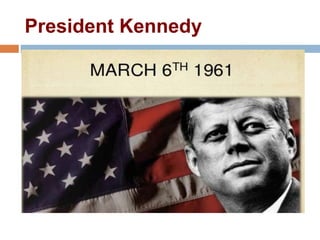
 In 1961, President Kennedy was the first to use
the term "affirmative action" in an Executive
Order that directed government contractors to
take "affirmative action to ensure that applicants
are employed, and that employees are treated
during employment, without regard to their race,
creed, color, or national origin."
President Kennedy
History
 Affirmative action policies initially focused
on improving opportunities for African
Americans in employment and education.
 The Supreme Court's Brown v. Board of
Education decision in 1954 outlawing school
segregation and the Civil Rights Act of 1964
improved life prospects for African Americans.
History
In 1965, however, only five percent of
undergraduate students, one percent of law
students, and two percent of medical students in
the country were African American.
President Lyndon Johnson, an advocate for
affirmative action, signed an Executive Order in
1965 that required government contractors to
use affirmative action policies in their hiring to
increase the number of minority employees.
History
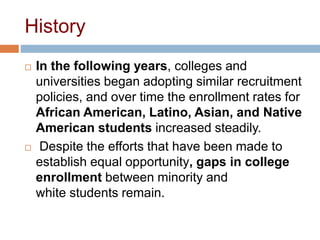
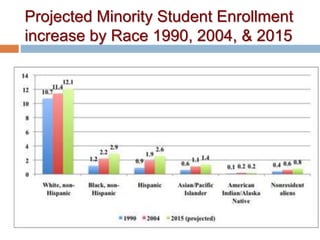
 In the following years, colleges and
universities began adopting similar recruitment
policies, and over time the enrollment rates for
African American, Latino, Asian, and Native
American students increased steadily.
 Despite the efforts that have been made to
establish equal opportunity, gaps in college
enrollment between minority and
white students remain.
Projected Minority Student Enrollment
increase by Race 1990, 2004, & 2015
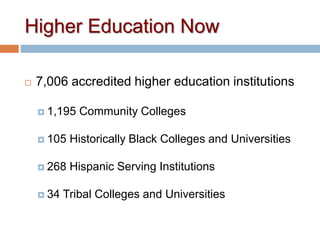
Higher Education Now
 7,006 accredited higher education institutions
 1,195 Community Colleges
 105 Historically Black Colleges and Universities
 268 Hispanic Serving Institutions
 34 Tribal Colleges and Universities
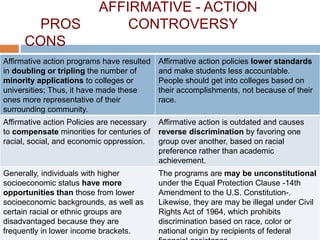
Affirmative action programs have resulted
in doubling or tripling the number of
minority applications to colleges or
universities; Thus, it have made these
ones more representative of their
surrounding community.
Affirmative action policies lower standards
and make students less accountable.
People should get into colleges based on
their accomplishments, not because of their
race.
Affirmative action Policies are necessary
to compensate minorities for centuries of
racial, social, and economic oppression.
Affirmative action is outdated and causes
reverse discrimination by favoring one
group over another, based on racial
preference rather than academic
achievement.
Generally, individuals with higher
socioeconomic status have more
opportunities than those from lower
socioeconomic backgrounds, as well as
certain racial or ethnic groups are
disadvantaged because they are
frequently in lower income brackets.
The programs are may be unconstitutional
under the Equal Protection Clause -14th
Amendment to the U.S. Constitution-.
Likewise, they are may be illegal under Civil
Rights Act of 1964, which prohibits
discrimination based on race, color or
national origin by recipients of federal
AFFIRMATIVE - ACTION
PROS CONTROVERSY
CONS
Consequently, they are not
exposed to the same
resources as students from
higher socioeconomic
classes.
Affirmative action makes
colleges worse because they
are not hiring the most qualified
applicants.
AFFIRMATIVE - ACTION
PROS CONTROVERSY CONS
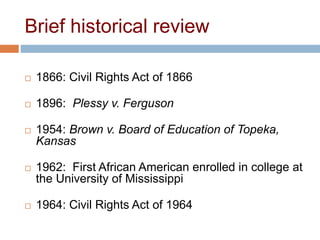
Brief historical review
 1866: Civil Rights Act of 1866
 1896: Plessy v. Ferguson
 1954: Brown v. Board of Education of Topeka,
Kansas
 1962: First African American enrolled in college at
the University of Mississippi
 1964: Civil Rights Act of 1964
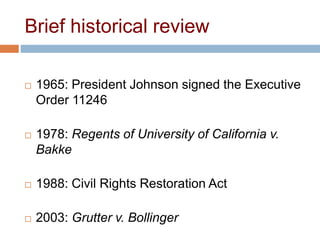
Brief historical review
 1965: President Johnson signed the Executive
Order 11246
 1978: Regents of University of California v.
Bakke
 1988: Civil Rights Restoration Act
 2003: Grutter v. Bollinger
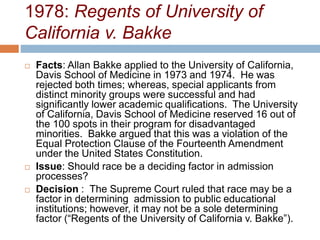
1978: Regents of University of
California v. Bakke
 Facts: Allan Bakke applied to the University of California,
Davis School of Medicine in 1973 and 1974. He was
rejected both times; whereas, special applicants from
distinct minority groups were successful and had
significantly lower academic qualifications. The University
of California, Davis School of Medicine reserved 16 out of
the 100 spots in their program for disadvantaged
minorities. Bakke argued that this was a violation of the
Equal Protection Clause of the Fourteenth Amendment
under the United States Constitution.
 Issue: Should race be a deciding factor in admission
processes?
 Decision : The Supreme Court ruled that race may be a
factor in determining admission to public educational
institutions; however, it may not be a sole determining
factor (“Regents of the University of California v. Bakke”).
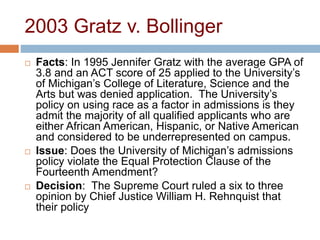
2003 Gratz v. Bollinger
 Facts: In 1995 Jennifer Gratz with the average GPA of
3.8 and an ACT score of 25 applied to the University’s
of Michigan’s College of Literature, Science and the
Arts but was denied application. The University’s
policy on using race as a factor in admissions is they
admit the majority of all qualified applicants who are
either African American, Hispanic, or Native American
and considered to be underrepresented on campus.
 Issue: Does the University of Michigan’s admissions
policy violate the Equal Protection Clause of the
Fourteenth Amendment?
 Decision: The Supreme Court ruled a six to three
opinion by Chief Justice William H. Rehnquist that
their policy
2003 Grutter v. Bollinger
 Facts: In 1997 Barbara Grutter a white female with a
average GPA of 3.8 and an LSAT score of 161 applied
to the University of Michigan’s Law school but was
denied admittance. The Law School admits they use
race as a determining factor since they believe it
serves a “compelling interest in achieving diversity
among its student body.”
 Issue: Does this racial preference violate the Equal
Protection Clause?
 Decision: The Court ruled in a five to four opinion by
Justice Sandra Day O’Connor that the Equal
Protection Clause does not prohibit the Law School’s
use of race in admissions to obtain the benefits of a
diverse community (Grutter v
Brief historical review
 The above court cases and amendments
increased access to higher education to
minority students
 Although colleges are allowed to use race to
increase the overall diversity of students on
campus, this must be outlined in admission
plans and be backed by proper documentation
 Race is not to be used for any other reason in
admission policies and procedures
Barack Obama - Student at Harvard – Law
- Law Review - Affirmative Action
 http://www.youtube.com/watch?v=mbNzDzIGj
PI
06 Barack Obama's views on
AFFIRMATIVE ACTION
http://www.youtube.com/watch?v=I6siavaJXfg
Conclusion
Affirmative action is a good public policy because
helps students who are still smart, but started their
lives with a disadvantage for belonging to lower
social class, lower income level, or minorities race.
It is a fact that most minorities do not receive the
best education in the U.S. compared to white
students. It means the OPPORTUNITIES were not
present for that student. So what can we attribute
this to? Our education system which is essentially
economically and thus racially focused (since there
is such a strong correlation between the two).
Conclusion
 Affirmative action is good because it gives
minorities an opportunity for a better
education. This will finally result in better job
opportunities, and overall a better life.
 Proof of this is the case of President Obama,
who as a result of Affirmative Action achieved
entering into the one of the most prestigious
universities, such as Harvard, despite
belonging to a family of lower middle class,
and an African-American minorities.
 This, of course, was crucial to their
subsequent success in his political career.
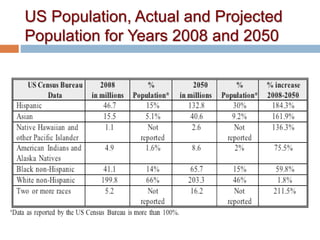
US Population, Actual and Projected
Population for Years 2008 and 2050

The affirmative action 7

  • 1.
    THE AFFIRMATIVE ACTION ONEDUCATION Montgomery College – Rockville Intro to Human Communication (SP 108) Nancy Yanira Muñoz Martinez – Presentation Dec. /2013
  • 2.
    Introduction Would you liketo get better jobs, to earn more money, and finally to live a better life than have you ever imaged?. Of course you can because of the opportunity that Affirmative Action programs bring. That’s what it says Graduates who benefited from those programs. But what Affirmative Action means?
  • 3.
    Definition Affirmative Action refersto Admission policies that provide equal access to education for those groups that have been historically excluded or underrepresented, such as women and minorities. Controversy surrounding the constitutionality of affirmative action programs has made the topic one of heated debate.
  • 4.
    History  Affirmative Actionis an outcome of the 1960's Civil Rights Movement, intended to provide equal opportunities for members of minority groups and women in education and employment.  In 1961, President Kennedy was the first to use the term "affirmative action" in an Executive Order that directed government contractors to take "affirmative action to ensure that applicants are employed, and that employees are treated during employment, without regard to their race, creed, color, or national origin."
  • 5.
  • 6.
    History  Affirmative actionpolicies initially focused on improving opportunities for African Americans in employment and education.  The Supreme Court's Brown v. Board of Education decision in 1954 outlawing school segregation and the Civil Rights Act of 1964 improved life prospects for African Americans.
  • 7.
    History In 1965, however,only five percent of undergraduate students, one percent of law students, and two percent of medical students in the country were African American. President Lyndon Johnson, an advocate for affirmative action, signed an Executive Order in 1965 that required government contractors to use affirmative action policies in their hiring to increase the number of minority employees.
  • 8.
    History  In thefollowing years, colleges and universities began adopting similar recruitment policies, and over time the enrollment rates for African American, Latino, Asian, and Native American students increased steadily.  Despite the efforts that have been made to establish equal opportunity, gaps in college enrollment between minority and white students remain.
  • 9.
    Projected Minority StudentEnrollment increase by Race 1990, 2004, & 2015
  • 10.
    Higher Education Now 7,006 accredited higher education institutions  1,195 Community Colleges  105 Historically Black Colleges and Universities  268 Hispanic Serving Institutions  34 Tribal Colleges and Universities
  • 11.
    Affirmative action programshave resulted in doubling or tripling the number of minority applications to colleges or universities; Thus, it have made these ones more representative of their surrounding community. Affirmative action policies lower standards and make students less accountable. People should get into colleges based on their accomplishments, not because of their race. Affirmative action Policies are necessary to compensate minorities for centuries of racial, social, and economic oppression. Affirmative action is outdated and causes reverse discrimination by favoring one group over another, based on racial preference rather than academic achievement. Generally, individuals with higher socioeconomic status have more opportunities than those from lower socioeconomic backgrounds, as well as certain racial or ethnic groups are disadvantaged because they are frequently in lower income brackets. The programs are may be unconstitutional under the Equal Protection Clause -14th Amendment to the U.S. Constitution-. Likewise, they are may be illegal under Civil Rights Act of 1964, which prohibits discrimination based on race, color or national origin by recipients of federal AFFIRMATIVE - ACTION PROS CONTROVERSY CONS
  • 12.
    Consequently, they arenot exposed to the same resources as students from higher socioeconomic classes. Affirmative action makes colleges worse because they are not hiring the most qualified applicants. AFFIRMATIVE - ACTION PROS CONTROVERSY CONS
  • 13.
    Brief historical review 1866: Civil Rights Act of 1866  1896: Plessy v. Ferguson  1954: Brown v. Board of Education of Topeka, Kansas  1962: First African American enrolled in college at the University of Mississippi  1964: Civil Rights Act of 1964
  • 14.
    Brief historical review 1965: President Johnson signed the Executive Order 11246  1978: Regents of University of California v. Bakke  1988: Civil Rights Restoration Act  2003: Grutter v. Bollinger
  • 15.
    1978: Regents ofUniversity of California v. Bakke  Facts: Allan Bakke applied to the University of California, Davis School of Medicine in 1973 and 1974. He was rejected both times; whereas, special applicants from distinct minority groups were successful and had significantly lower academic qualifications. The University of California, Davis School of Medicine reserved 16 out of the 100 spots in their program for disadvantaged minorities. Bakke argued that this was a violation of the Equal Protection Clause of the Fourteenth Amendment under the United States Constitution.  Issue: Should race be a deciding factor in admission processes?  Decision : The Supreme Court ruled that race may be a factor in determining admission to public educational institutions; however, it may not be a sole determining factor (“Regents of the University of California v. Bakke”).
  • 16.
    2003 Gratz v.Bollinger  Facts: In 1995 Jennifer Gratz with the average GPA of 3.8 and an ACT score of 25 applied to the University’s of Michigan’s College of Literature, Science and the Arts but was denied application. The University’s policy on using race as a factor in admissions is they admit the majority of all qualified applicants who are either African American, Hispanic, or Native American and considered to be underrepresented on campus.  Issue: Does the University of Michigan’s admissions policy violate the Equal Protection Clause of the Fourteenth Amendment?  Decision: The Supreme Court ruled a six to three opinion by Chief Justice William H. Rehnquist that their policy
  • 17.
    2003 Grutter v.Bollinger  Facts: In 1997 Barbara Grutter a white female with a average GPA of 3.8 and an LSAT score of 161 applied to the University of Michigan’s Law school but was denied admittance. The Law School admits they use race as a determining factor since they believe it serves a “compelling interest in achieving diversity among its student body.”  Issue: Does this racial preference violate the Equal Protection Clause?  Decision: The Court ruled in a five to four opinion by Justice Sandra Day O’Connor that the Equal Protection Clause does not prohibit the Law School’s use of race in admissions to obtain the benefits of a diverse community (Grutter v
  • 18.
    Brief historical review The above court cases and amendments increased access to higher education to minority students  Although colleges are allowed to use race to increase the overall diversity of students on campus, this must be outlined in admission plans and be backed by proper documentation  Race is not to be used for any other reason in admission policies and procedures
  • 19.
    Barack Obama -Student at Harvard – Law - Law Review - Affirmative Action  http://www.youtube.com/watch?v=mbNzDzIGj PI
  • 20.
    06 Barack Obama'sviews on AFFIRMATIVE ACTION http://www.youtube.com/watch?v=I6siavaJXfg
  • 21.
    Conclusion Affirmative action isa good public policy because helps students who are still smart, but started their lives with a disadvantage for belonging to lower social class, lower income level, or minorities race. It is a fact that most minorities do not receive the best education in the U.S. compared to white students. It means the OPPORTUNITIES were not present for that student. So what can we attribute this to? Our education system which is essentially economically and thus racially focused (since there is such a strong correlation between the two).
  • 22.
    Conclusion  Affirmative actionis good because it gives minorities an opportunity for a better education. This will finally result in better job opportunities, and overall a better life.  Proof of this is the case of President Obama, who as a result of Affirmative Action achieved entering into the one of the most prestigious universities, such as Harvard, despite belonging to a family of lower middle class, and an African-American minorities.  This, of course, was crucial to their subsequent success in his political career.
  • 23.
    US Population, Actualand Projected Population for Years 2008 and 2050