ABOUT THE WRITER
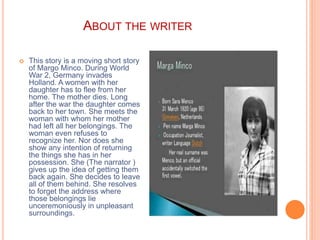
 This story is a moving short story
of Margo Minco. During World
War 2, Germany invades
Holland. A women with her
daughter has to flee from her
home. The mother dies. Long
after the war the daughter comes
back to her town. She meets the
woman with whom her mother
had left all her belongings. The
woman even refuses to
recognize her. Nor does she
show any intention of returning
the things she has in her
possession. She (The narrator )
gives up the idea of getting them
back again. She decides to leave
all of them behind. She resolves
to forget the address where
those belongings lie
unceremoniously in unpleasant
surroundings.
MAIN POINTS OF THE CHAPTER
Mrs S ’s Daughter visits no.
46, marconi street
The narrator was at number 46,
Marconi Street. She was the
daughter of Mrs S . She pressed
the bell. A women opened the
door. She looked at the
newcomer searchling. She was
Mrs. Dongling. The narrator
introduced herself. The women’s
face showed absolutely no sign
of recognition. She kept staring
at her in silence. The girl had
once seen the women years ago.
She realised that perhaps she
had rang the wrong bell. But
soon her doubt was set to rest.
The women was wearing her
mother’s green knitted cardigan.
She was at the right place.
THE WOMEN REFUSE TO RECOGNIZE THE GIRL
The girl asked the women if she still
knew her. Mrs Dorling replied that she
did not. She stood their dumbfounded.
The narrator then told her that she was
the daughter of Mrs S. The women
asked “Have you come back?” It was
clear that she was not pleased to see the
girl again. The girl replied that she was
the only one who survived and came
back. The woman expressed regret that
she could not do anything for her. The
narrator told her that she had come
specially for her by train she wanted to
talk to her for a moment. But the lady
showed her helplessness. She was not
ready to entertain the girl she could
come at another time.
THE NARRATOR THOUGHT OF HER MOTHER
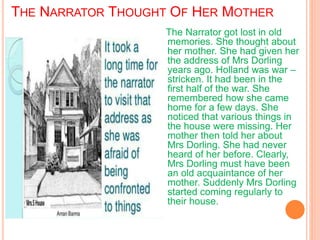
The Narrator got lost in old
memories. She thought about
her mother. She had given her
the address of Mrs Dorling
years ago. Holland was war –
stricken. It had been in the
first half of the war. She
remembered how she came
home for a few days. She
noticed that various things in
the house were missing. Her
mother then told her about
Mrs Dorling. She had never
heard of her before. Clearly,
Mrs Dorling must have been
an old acquaintance of her
mother. Suddenly Mrs Dorling
started coming regularly to
their house.
MRS DORLING’S FREQUENT VISITS
Mrs Dorling came frequently. Everytime she visited, she took
something with her. One day she took all the silverware. Then
she took away the antique plates hung on the wall. Mrs S told her
daughter that Mrs Dorling wanted to save all her articles. It was
war time. If they had to leave the place, they would lose
everything. The daughter wanted to know if there was a written
agreement that Mrs Dorling would return all the articles safely.
The girl could not trust anyone so blindly. Mrs S replied that it was
not necessary. Mrs S was thankful to Mrs Dorling for what she
was doing for her all that happened years ago.
SECOND VISIT TO MRS DORLING’S HOUSE
The narrator’s first visit
was not rewarding. She
paid a second visit to
see Mrs Dorling. This
time she found her 15
year-old daughter in the
house. Mrs Dorling was
not there. She decided
to wait for Mrs Dorling.
THE DAUGHTER SEES HER MOTHER’S
BELONGINGS
The narrator found herself in the midst of
things. Once they belonged to her mother.
She wanted to see them again. All those
things were taken away by Mrs Dorling and
kept here in her house. She was pained to
note that they were arranged tastelessly. The
ugly furniture and the muggy smell upset her.
The girl brought tea for her. Then she opened
a box and took some spoons out of it. The
narrator also looked at the antique plates.
She knew that all the cutlery, knives, forks
and spoons were of silver. Her mother had
told her about them when she was alive.
WORD - MEANINGS
Picked up - lifted up
Rack - frame of wooden bars used for holding things
Case - box
Initially - in the beginning
Liberation- freedom
Stored - that has been preserved
Stuff - things
Confront - faced with
Connection- relation
In vain - uselessly
Endured - tolerated
T
 Gradually – slowly
 Unthreatened – without any threat or fear
 View – sight
 Used to – habitual
 Glancing – looking at
 Possessions – belongings
 Hanukkah – a jewish festival of lights
 Cumbersome – heavy
 Living room – sitting room
 Past her – went in front of her
 Mark – sign
 Midst – among
 Oppressed – troubled
 Muggy – smell of dampness
 Pewter plate – plate made of zinc
T
 Lent – given to someone
 Pulled – dragged
 Instantly – at once
 Fleetingly – lasting for a moment
 Knitted – made through knitting needles
 Cardigan – a kitted woolen jacket
 Pale – dim
 Musty – smelling unpleasant
 Emerged – rose
The Tale Of A Melon City
ABOUT THE AUTHOR
 Vikram Seth was born in Calcutta, India, in
1952, the oldest of three children. His father,
Prem Seth was a shoe company executive
and his mother, Leela Seth, served as a judge.
Seth left India to study at oxford university in
England earning degrees in philosophy
economics, and politics. He enrolled at
stanford university in California, intending to
complete a Ph.D. in economics. While at
stanford, Seth was a wallace stegner fellow
creative writing. He wrote the poems collected
in mappings during this time. From 1980 to
1982, Seth was in china for 2 years for travell
and economic research. While there, he
studied lake details the hitch hiking trip
through nepal and tibet that seth took while a
student in china; and The golden gate is about
young proferrionals is San Francisco
searching for love in identity.
 Translation has played an important part in
Seth’s life, reflecting the multicultural sources
of his material. His earliest book of poetry
includes works translated from Chinese
classical Chinese poetry and language at
Nanjing University.
OTHER BOOKS OF VIKRAM SETH
 From Heaven Lake
 The humble administrator’s garden
 All you who sleep tonight etc.
ABOUT
THE
POEM
 “The tale of melon city” by Vikram Seth is a satire about a king,
his ministers and the kingdom. The poem shows the stupidity of
the king and his kingdom. Once the king, ordered his ministers to
build an arch over the main street to impress visitors and tourists.
The arch was constructed. When the king was returning from
bouldevard, the arch knocked down his crown. The king was
furious and ordered immediately the execution of the builders of
the arch. When the builders were taken to the gallows, they
shouted out that the work man were at fault. The king stopped
the proceedings and asked men to hang the workmen. The
workmen then shouted out that the masons were to be blamed.
T
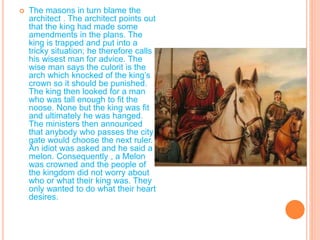
 The masons in turn blame the
architect . The architect points out
that the king had made some
amendments in the plans. The
king is trapped and put into a
tricky situation; he therefore calls
his wisest man for advice. The
wise man says the culorit is the
arch which knocked of the king’s
crown so it should be punished.
The king then looked for a man
who was tall enough to fit the
noose. None but the king was fit
and ultimately he was hanged.
The ministers then announced
that anybody who passes the city
gate would choose the next ruler.
An idiot was asked and he said a
melon. Consequently , a Melon
was crowned and the people of
the kingdom did not worry about
who or what their king was. They
only wanted to do what their heart
desires.
WORD - MEANINGS
 Enforce – ensure observance of
laws and rules
 Quavering – quivering as from
weakness or fear
 Rejoice – feel happiness or joy
 Amendment – the act of
amending or correcting
 Fault – a wrong action
attributable or ignorance
or inattention
 Reverently – with reverence
 Gallows – an instrument of
execution consisting of a wooden
frame from which a condemned
person is
 Placid – free from disturbance by
heavy waves
WORD -
MEANINGS
 Scaffold – a platform from which criminals are executed
 Counsel – a lawyer who pleads cases in court
 Arch – a curved shape in the vertical plane that spans an
opening
 Idiot – a person of subnormal intelligence
 Triumphal – relating to or celebrating a triumph
 Spectator – a close observer
 Culprit – someone who perpetrates wrong doing
 Proclaim – declare someone to be something
 Majesty – impressiveness in scale or proportion
WORD - MEANINGS
 Architect – someone who creates plans to be used
in making something
 Shameful – deserving or bringing disgrace or
shame
 Gallows – wooden frame from which a condemned
person is executed by hanging
Ppt the address by samshad

Ppt the address by samshad

  • 2.
    ABOUT THE WRITER This story is a moving short story of Margo Minco. During World War 2, Germany invades Holland. A women with her daughter has to flee from her home. The mother dies. Long after the war the daughter comes back to her town. She meets the woman with whom her mother had left all her belongings. The woman even refuses to recognize her. Nor does she show any intention of returning the things she has in her possession. She (The narrator ) gives up the idea of getting them back again. She decides to leave all of them behind. She resolves to forget the address where those belongings lie unceremoniously in unpleasant surroundings.
  • 3.
    MAIN POINTS OFTHE CHAPTER Mrs S ’s Daughter visits no. 46, marconi street The narrator was at number 46, Marconi Street. She was the daughter of Mrs S . She pressed the bell. A women opened the door. She looked at the newcomer searchling. She was Mrs. Dongling. The narrator introduced herself. The women’s face showed absolutely no sign of recognition. She kept staring at her in silence. The girl had once seen the women years ago. She realised that perhaps she had rang the wrong bell. But soon her doubt was set to rest. The women was wearing her mother’s green knitted cardigan. She was at the right place.
  • 4.
    THE WOMEN REFUSETO RECOGNIZE THE GIRL The girl asked the women if she still knew her. Mrs Dorling replied that she did not. She stood their dumbfounded. The narrator then told her that she was the daughter of Mrs S. The women asked “Have you come back?” It was clear that she was not pleased to see the girl again. The girl replied that she was the only one who survived and came back. The woman expressed regret that she could not do anything for her. The narrator told her that she had come specially for her by train she wanted to talk to her for a moment. But the lady showed her helplessness. She was not ready to entertain the girl she could come at another time.
  • 5.
    THE NARRATOR THOUGHTOF HER MOTHER The Narrator got lost in old memories. She thought about her mother. She had given her the address of Mrs Dorling years ago. Holland was war – stricken. It had been in the first half of the war. She remembered how she came home for a few days. She noticed that various things in the house were missing. Her mother then told her about Mrs Dorling. She had never heard of her before. Clearly, Mrs Dorling must have been an old acquaintance of her mother. Suddenly Mrs Dorling started coming regularly to their house.
  • 6.
    MRS DORLING’S FREQUENTVISITS Mrs Dorling came frequently. Everytime she visited, she took something with her. One day she took all the silverware. Then she took away the antique plates hung on the wall. Mrs S told her daughter that Mrs Dorling wanted to save all her articles. It was war time. If they had to leave the place, they would lose everything. The daughter wanted to know if there was a written agreement that Mrs Dorling would return all the articles safely. The girl could not trust anyone so blindly. Mrs S replied that it was not necessary. Mrs S was thankful to Mrs Dorling for what she was doing for her all that happened years ago.
  • 7.
    SECOND VISIT TOMRS DORLING’S HOUSE The narrator’s first visit was not rewarding. She paid a second visit to see Mrs Dorling. This time she found her 15 year-old daughter in the house. Mrs Dorling was not there. She decided to wait for Mrs Dorling.
  • 8.
    THE DAUGHTER SEESHER MOTHER’S BELONGINGS The narrator found herself in the midst of things. Once they belonged to her mother. She wanted to see them again. All those things were taken away by Mrs Dorling and kept here in her house. She was pained to note that they were arranged tastelessly. The ugly furniture and the muggy smell upset her. The girl brought tea for her. Then she opened a box and took some spoons out of it. The narrator also looked at the antique plates. She knew that all the cutlery, knives, forks and spoons were of silver. Her mother had told her about them when she was alive.
  • 9.
    WORD - MEANINGS Pickedup - lifted up Rack - frame of wooden bars used for holding things Case - box Initially - in the beginning Liberation- freedom Stored - that has been preserved Stuff - things Confront - faced with Connection- relation In vain - uselessly Endured - tolerated
  • 10.
    T  Gradually –slowly  Unthreatened – without any threat or fear  View – sight  Used to – habitual  Glancing – looking at  Possessions – belongings  Hanukkah – a jewish festival of lights  Cumbersome – heavy  Living room – sitting room  Past her – went in front of her  Mark – sign  Midst – among  Oppressed – troubled  Muggy – smell of dampness  Pewter plate – plate made of zinc
  • 11.
    T  Lent –given to someone  Pulled – dragged  Instantly – at once  Fleetingly – lasting for a moment  Knitted – made through knitting needles  Cardigan – a kitted woolen jacket  Pale – dim  Musty – smelling unpleasant  Emerged – rose
  • 12.
    The Tale OfA Melon City
  • 13.
    ABOUT THE AUTHOR Vikram Seth was born in Calcutta, India, in 1952, the oldest of three children. His father, Prem Seth was a shoe company executive and his mother, Leela Seth, served as a judge. Seth left India to study at oxford university in England earning degrees in philosophy economics, and politics. He enrolled at stanford university in California, intending to complete a Ph.D. in economics. While at stanford, Seth was a wallace stegner fellow creative writing. He wrote the poems collected in mappings during this time. From 1980 to 1982, Seth was in china for 2 years for travell and economic research. While there, he studied lake details the hitch hiking trip through nepal and tibet that seth took while a student in china; and The golden gate is about young proferrionals is San Francisco searching for love in identity.  Translation has played an important part in Seth’s life, reflecting the multicultural sources of his material. His earliest book of poetry includes works translated from Chinese classical Chinese poetry and language at Nanjing University.
  • 14.
    OTHER BOOKS OFVIKRAM SETH  From Heaven Lake  The humble administrator’s garden  All you who sleep tonight etc.
  • 15.
    ABOUT THE POEM  “The taleof melon city” by Vikram Seth is a satire about a king, his ministers and the kingdom. The poem shows the stupidity of the king and his kingdom. Once the king, ordered his ministers to build an arch over the main street to impress visitors and tourists. The arch was constructed. When the king was returning from bouldevard, the arch knocked down his crown. The king was furious and ordered immediately the execution of the builders of the arch. When the builders were taken to the gallows, they shouted out that the work man were at fault. The king stopped the proceedings and asked men to hang the workmen. The workmen then shouted out that the masons were to be blamed.
  • 16.
    T  The masonsin turn blame the architect . The architect points out that the king had made some amendments in the plans. The king is trapped and put into a tricky situation; he therefore calls his wisest man for advice. The wise man says the culorit is the arch which knocked of the king’s crown so it should be punished. The king then looked for a man who was tall enough to fit the noose. None but the king was fit and ultimately he was hanged. The ministers then announced that anybody who passes the city gate would choose the next ruler. An idiot was asked and he said a melon. Consequently , a Melon was crowned and the people of the kingdom did not worry about who or what their king was. They only wanted to do what their heart desires.
  • 17.
    WORD - MEANINGS Enforce – ensure observance of laws and rules  Quavering – quivering as from weakness or fear  Rejoice – feel happiness or joy  Amendment – the act of amending or correcting  Fault – a wrong action attributable or ignorance or inattention  Reverently – with reverence  Gallows – an instrument of execution consisting of a wooden frame from which a condemned person is  Placid – free from disturbance by heavy waves
  • 18.
    WORD - MEANINGS  Scaffold– a platform from which criminals are executed  Counsel – a lawyer who pleads cases in court  Arch – a curved shape in the vertical plane that spans an opening  Idiot – a person of subnormal intelligence  Triumphal – relating to or celebrating a triumph  Spectator – a close observer  Culprit – someone who perpetrates wrong doing  Proclaim – declare someone to be something  Majesty – impressiveness in scale or proportion
  • 19.
    WORD - MEANINGS Architect – someone who creates plans to be used in making something  Shameful – deserving or bringing disgrace or shame  Gallows – wooden frame from which a condemned person is executed by hanging