RASKY PARTNERS, INC.
JohnBivona
RASKYPARTNERS, INC.
Kevin Gluba
Park&KPublicAffairs
2
TheInfrastructure Investment andJobs Act (IIJA) presents
opportunities for a number of industries in the privateand public
sector. This historic investment presents $1.2 trillion in formula-
basedandcompetitive grants.
• Transportation - Highways, Transit, Aviation & Safety
• Clean Energy & Community Resiliency - Electric Grid, Weatherization, Energy
Weatherization, Energy Infrastructure, Renewable Energy Projects, Batteries, &
Critical Minerals
• Rural Broadband - Expanding Access For States, Tribes, & Municipalities
Municipalities
• Electric Vehicles - Charging & Fueling Infrastructure
THE LANDSCAPE:
IIJA TOPLINES
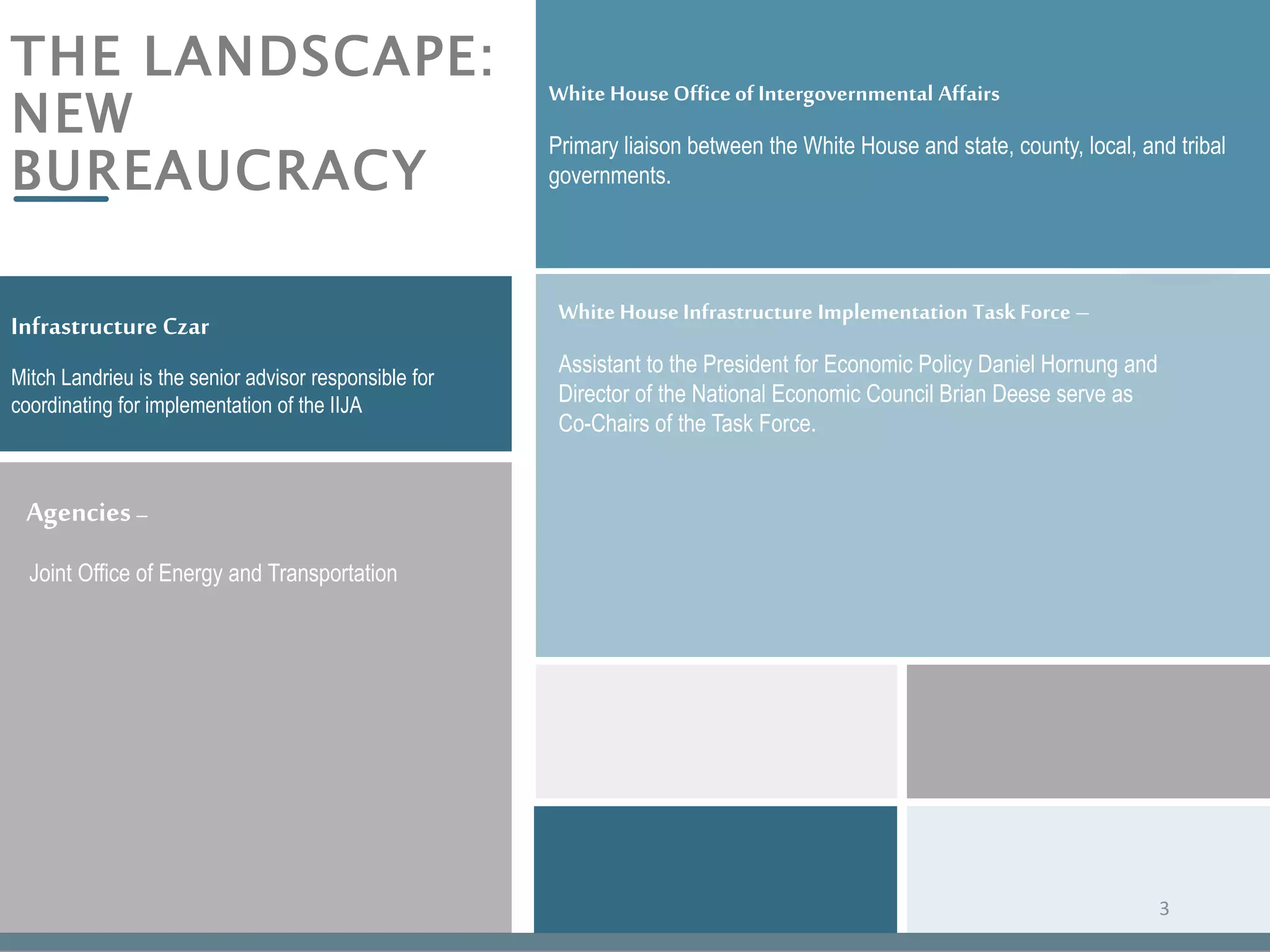
THE LANDSCAPE:
NEW
BUREAUCRACY
3
White House Officeof Intergovernmental Affairs
Primary liaison between the White House and state, county, local, and tribal
governments.
White House Infrastructure Implementation Task Force –
Assistant to the President for Economic Policy Daniel Hornung and
Director of the National Economic Council Brian Deese serve as
Co-Chairs of the Task Force.
Agencies–
Joint Office of Energy and Transportation
Infrastructure Czar
Mitch Landrieu is the senior advisor responsible for
coordinating for implementation of the IIJA
4
• Electric Vehicle Formula Program – Provides $5 billion in funding to
funding to states to strategically deploy EV charging infrastructure and to
establish an interconnected network to facilitate data collection, access, and
reliability.
• Charging and Fueling Infrastructure Grants - Provides $2.5 billion for
$2.5 billion for charging and fueling infrastructure for states, municipalities,
counties, cities, territories, special districts and other public authorities.
THE LANDSCAPE: EV
CHARGING TOPLINES
The Infrastructure Investment andJobs Act (IIJA)
invests $7.5 billion in developinga national network of
Electric Vehicles chargers in the United States. $2.5
billion is discretionary.
• $1.25 billion in funding will build out charging and fueling
Infrastructure along designated Alternative Fuel Corridors.
• $1.25 billion in funding will provide Community Charging grants
convenient charging where people live, work, and shop.
5
THE LANDSCAPE: EV
CHARGING INSIGHTS
• Rural and Underserved Communities + Equity in
delivery
• Bi-directional charging important once you get to
community-based charging programs
• Administration has said that vast majority of projects
will be public private partnerships
• Regional Infrastructure Accelerator Program can be
used to explore public private partnerships
Coast to Coast Opportunities
6
Democrats Push Electric
Car Infrastructure Bill As A
Solution To Rural Gaps
Ultimately, the question is going to be, 'Is rural
Virginia going to be left behind as EVs begin to
take over the market?'" said Greg Habeeb, a
former Republican House Delegate.
Expanding electric vehicle
charging stations in Texas
“That investment has the potential to help
address barriers to EV purchases in Texas, which
could receive as much as $400 million for
projects directly related to electric vehicle
charging.”
Federal funding to allow
more electric vehicle
charging stations in Arizona
“Arizona is set to get more than $11 million in
funding to start and more than $76 million over five
years to expand electric vehicle infrastructure
through the National Electric Vehicle Funding
program.”
Bill would build electric
vehicle charging stations
across Nebraska
“State Sen. Eliot Bostar of Lincoln introduced LB-
1257, which would use $10 million in federal
funding to support electric vehicle infrastructure
across Nebraska, especially in rural areas.”
WHAT’S NEXT: IIJA
IMPLEMENTATION TIMELINE
7
2022 Q1
Applications opened for the Rural
Surface Transportation Grant,
RAISE and INFRA grants.
2022 Q3
Applications open for Building Resilient
Infrastructure program, Flood Mitigation
Grants, Reconnect and other broadband
programs
2022 Q4
Application open for Energy Efficiency
Grants, Rural Energy Improvement Grants,
and Renewable Energy Grants for Schools
2022 Q2
Applications open for Clean School Bus
Program, Reconnecting Communities Grant,
and Safe Streets and Roads for All Program.
*This is not an exhaustive list of available programs
WHAT’S NEXT: EV CHARGING
TIMELINE
8
December 14th
DoT & DoE announced Joint
Office of Energy and
Transportation
May 13th
Federal Highway
Administration will publish
standards for EV chargers in
the national network
End of 2022
Goal for initial charging
port installation
2022
FHWA will post notice of
funding opportunity
OUR SERVICES
February 10th
Joint Office released guidelines for
EV charging stations, building out
a national network along our
nation’s highway system
September 30th
FHWA must review state
plans for approval
August 1st
States must submit their
deployment plans for the
formula-based funding to the
FHWA
9
Federal Grants are typically not given to private, for-profit
organizations
 Eligible applicants more than likely would be one or more of the
following organizations:
o State, County, City or other special purpose unit of a State
(such as State Department of Transportation or Public Library
System);
o Institution of higher education or a consortium of education
institutions i.e. University of California Irvine Campus (single
institution) or California Community Colleges (all 115
campuses under single consortium);
o Public or private non-profit organization or association; or
o Indian Tribe or consortium of Indian Tribes.
Grant Eligibility
10
HOW DOES A PRIVATE COMPANY BENEFIT
FROM A “PUBLIC” GRANT OPPORTUNITY?
11
• A Public-Private Partnership (P3) is a valuable tool to directly
tap into the $1.2 trillion available, including the $7.5 billion in
EV charging infrastructure.
• Most states have specific laws that govern what is
considered a P3 vs. a working relationship with a public
entity.
• Always needs to point to a public good, regardless of the
size or type of P3
• In order to benefit from the Biden EV $7.5 billion, it is
imperative to establish some kind of teaming arrangement with
an eligible applicant—they will be the grant recipient who will
work with your company to develop the EV solution.
Need for Partnerships
with Eligible Applicants
12
• Low or No Emissions Vehicle grant program—created in 2015
FAST Act and reauthorized in 2020.
• Provides funding to state and local governmental
authorities for the purchase or lease of zero-emission
and low-emission transit buses as well as required
supporting facilities.
• In FY2021 ~$180 million was authorized with each bus
costing $1 - $1.3 million.
• Max Federal match of 85% for buses and 90% for
supporting facilities.
“Low-No” FTA Program
Likely Model
13
• BYD (Columbia, Missouri; Baton Rouge, Louisiana) & Proterra
(Greensboro, NC; University of Montana)
• These companies successfully worked with eligible
applicants (City, County, Local Government) through
partnerships to apply for and receive millions in grant
money
• City would win award (up to $7 million per application)
and Private company (BYD/Proterra) would sell/service
vehicle
• Both companies receive 10’s of millions through Public
partners via the FTA annually
• Same model could be used for the $7.5 billion for EV in IIJA as
the $180 million from Federal Transit Authority.
Success Stories
14
Rasky and Park&K are in the process of connecting 3 entities in
the Northeast United States to form a P3 to take advantage of the
benefits of the EV Infrastructure grant program.
• Rasky is engaging with one of the largest gasoline/convenience
store/heating oil suppliers in the Northeast (1,600 stores).
• Park&K is working with a provider of EV infrastructure & 5G
technology.
• Similar to private sector investment models i.e. Starbucks
An EV Model That Works
15
Where We Fit
The firms will assist with
• Partnership Development
• Grant writing;
• DC profile raising & lobbying (discretionary
funding); and
• Highlighting proposed projects to targeted
leaders at Department of Energy and
Transportation to help move the green economy.
PUBLIC PRIVATE
PARTNERSHIP STRATEGY
16
PHASE 1
Power Mapping & Local
Partnership Development
PHASE 3
Grant Application Strategy
PHASE 2
Federal Relationship
Building & Intelligence
Gathering
PHASE 4
Continued Grant Advocacy
PUBLIC PRIVATE PARTNERSHIP STRATEGY
Rasky Partners is one of the leading independent public and
government relations firms in the US. With teams of
experts in Washington, D.C. and Boston, we offer our clients
strategic communications and government affairs counsel
designed to achieve their short- and long-term objectives.
WHO WE ARE
25 fulltime
employees inBoston
and Washington
Raskyoperatesat
the intersection
of business,
governmentand
the media.
Unusual longevityofstaff –most
senior
andmid-levelstaff
havebeenwiththe
firmforadecadeand
manyforlonger
Keyclientsinclude
CarbonCleanSolutions,Toyota,
Veolia,
GeneralDynamicsandothers
Networkof
consultantsand on-the-
ground
operativesin
All50statesand
beyond
Independently
owned, formorethan 30
years

THE $1.2 TRILLION BIDEN INFRASTRUCTURE PLAN

  • 1.
    RASKY PARTNERS, INC. JohnBivona RASKYPARTNERS,INC. Kevin Gluba Park&KPublicAffairs
  • 2.
    2 TheInfrastructure Investment andJobsAct (IIJA) presents opportunities for a number of industries in the privateand public sector. This historic investment presents $1.2 trillion in formula- basedandcompetitive grants. • Transportation - Highways, Transit, Aviation & Safety • Clean Energy & Community Resiliency - Electric Grid, Weatherization, Energy Weatherization, Energy Infrastructure, Renewable Energy Projects, Batteries, & Critical Minerals • Rural Broadband - Expanding Access For States, Tribes, & Municipalities Municipalities • Electric Vehicles - Charging & Fueling Infrastructure THE LANDSCAPE: IIJA TOPLINES
  • 3.
    THE LANDSCAPE: NEW BUREAUCRACY 3 White HouseOfficeof Intergovernmental Affairs Primary liaison between the White House and state, county, local, and tribal governments. White House Infrastructure Implementation Task Force – Assistant to the President for Economic Policy Daniel Hornung and Director of the National Economic Council Brian Deese serve as Co-Chairs of the Task Force. Agencies– Joint Office of Energy and Transportation Infrastructure Czar Mitch Landrieu is the senior advisor responsible for coordinating for implementation of the IIJA
  • 4.
    4 • Electric VehicleFormula Program – Provides $5 billion in funding to funding to states to strategically deploy EV charging infrastructure and to establish an interconnected network to facilitate data collection, access, and reliability. • Charging and Fueling Infrastructure Grants - Provides $2.5 billion for $2.5 billion for charging and fueling infrastructure for states, municipalities, counties, cities, territories, special districts and other public authorities. THE LANDSCAPE: EV CHARGING TOPLINES The Infrastructure Investment andJobs Act (IIJA) invests $7.5 billion in developinga national network of Electric Vehicles chargers in the United States. $2.5 billion is discretionary. • $1.25 billion in funding will build out charging and fueling Infrastructure along designated Alternative Fuel Corridors. • $1.25 billion in funding will provide Community Charging grants convenient charging where people live, work, and shop.
  • 5.
    5 THE LANDSCAPE: EV CHARGINGINSIGHTS • Rural and Underserved Communities + Equity in delivery • Bi-directional charging important once you get to community-based charging programs • Administration has said that vast majority of projects will be public private partnerships • Regional Infrastructure Accelerator Program can be used to explore public private partnerships
  • 6.
    Coast to CoastOpportunities 6 Democrats Push Electric Car Infrastructure Bill As A Solution To Rural Gaps Ultimately, the question is going to be, 'Is rural Virginia going to be left behind as EVs begin to take over the market?'" said Greg Habeeb, a former Republican House Delegate. Expanding electric vehicle charging stations in Texas “That investment has the potential to help address barriers to EV purchases in Texas, which could receive as much as $400 million for projects directly related to electric vehicle charging.” Federal funding to allow more electric vehicle charging stations in Arizona “Arizona is set to get more than $11 million in funding to start and more than $76 million over five years to expand electric vehicle infrastructure through the National Electric Vehicle Funding program.” Bill would build electric vehicle charging stations across Nebraska “State Sen. Eliot Bostar of Lincoln introduced LB- 1257, which would use $10 million in federal funding to support electric vehicle infrastructure across Nebraska, especially in rural areas.”
  • 7.
    WHAT’S NEXT: IIJA IMPLEMENTATIONTIMELINE 7 2022 Q1 Applications opened for the Rural Surface Transportation Grant, RAISE and INFRA grants. 2022 Q3 Applications open for Building Resilient Infrastructure program, Flood Mitigation Grants, Reconnect and other broadband programs 2022 Q4 Application open for Energy Efficiency Grants, Rural Energy Improvement Grants, and Renewable Energy Grants for Schools 2022 Q2 Applications open for Clean School Bus Program, Reconnecting Communities Grant, and Safe Streets and Roads for All Program. *This is not an exhaustive list of available programs
  • 8.
    WHAT’S NEXT: EVCHARGING TIMELINE 8 December 14th DoT & DoE announced Joint Office of Energy and Transportation May 13th Federal Highway Administration will publish standards for EV chargers in the national network End of 2022 Goal for initial charging port installation 2022 FHWA will post notice of funding opportunity OUR SERVICES February 10th Joint Office released guidelines for EV charging stations, building out a national network along our nation’s highway system September 30th FHWA must review state plans for approval August 1st States must submit their deployment plans for the formula-based funding to the FHWA
  • 9.
    9 Federal Grants aretypically not given to private, for-profit organizations  Eligible applicants more than likely would be one or more of the following organizations: o State, County, City or other special purpose unit of a State (such as State Department of Transportation or Public Library System); o Institution of higher education or a consortium of education institutions i.e. University of California Irvine Campus (single institution) or California Community Colleges (all 115 campuses under single consortium); o Public or private non-profit organization or association; or o Indian Tribe or consortium of Indian Tribes. Grant Eligibility
  • 10.
    10 HOW DOES APRIVATE COMPANY BENEFIT FROM A “PUBLIC” GRANT OPPORTUNITY?
  • 11.
    11 • A Public-PrivatePartnership (P3) is a valuable tool to directly tap into the $1.2 trillion available, including the $7.5 billion in EV charging infrastructure. • Most states have specific laws that govern what is considered a P3 vs. a working relationship with a public entity. • Always needs to point to a public good, regardless of the size or type of P3 • In order to benefit from the Biden EV $7.5 billion, it is imperative to establish some kind of teaming arrangement with an eligible applicant—they will be the grant recipient who will work with your company to develop the EV solution. Need for Partnerships with Eligible Applicants
  • 12.
    12 • Low orNo Emissions Vehicle grant program—created in 2015 FAST Act and reauthorized in 2020. • Provides funding to state and local governmental authorities for the purchase or lease of zero-emission and low-emission transit buses as well as required supporting facilities. • In FY2021 ~$180 million was authorized with each bus costing $1 - $1.3 million. • Max Federal match of 85% for buses and 90% for supporting facilities. “Low-No” FTA Program Likely Model
  • 13.
    13 • BYD (Columbia,Missouri; Baton Rouge, Louisiana) & Proterra (Greensboro, NC; University of Montana) • These companies successfully worked with eligible applicants (City, County, Local Government) through partnerships to apply for and receive millions in grant money • City would win award (up to $7 million per application) and Private company (BYD/Proterra) would sell/service vehicle • Both companies receive 10’s of millions through Public partners via the FTA annually • Same model could be used for the $7.5 billion for EV in IIJA as the $180 million from Federal Transit Authority. Success Stories
  • 14.
    14 Rasky and Park&Kare in the process of connecting 3 entities in the Northeast United States to form a P3 to take advantage of the benefits of the EV Infrastructure grant program. • Rasky is engaging with one of the largest gasoline/convenience store/heating oil suppliers in the Northeast (1,600 stores). • Park&K is working with a provider of EV infrastructure & 5G technology. • Similar to private sector investment models i.e. Starbucks An EV Model That Works
  • 15.
    15 Where We Fit Thefirms will assist with • Partnership Development • Grant writing; • DC profile raising & lobbying (discretionary funding); and • Highlighting proposed projects to targeted leaders at Department of Energy and Transportation to help move the green economy.
  • 16.
    PUBLIC PRIVATE PARTNERSHIP STRATEGY 16 PHASE1 Power Mapping & Local Partnership Development PHASE 3 Grant Application Strategy PHASE 2 Federal Relationship Building & Intelligence Gathering PHASE 4 Continued Grant Advocacy PUBLIC PRIVATE PARTNERSHIP STRATEGY
  • 17.
    Rasky Partners isone of the leading independent public and government relations firms in the US. With teams of experts in Washington, D.C. and Boston, we offer our clients strategic communications and government affairs counsel designed to achieve their short- and long-term objectives. WHO WE ARE 25 fulltime employees inBoston and Washington Raskyoperatesat the intersection of business, governmentand the media. Unusual longevityofstaff –most senior andmid-levelstaff havebeenwiththe firmforadecadeand manyforlonger Keyclientsinclude CarbonCleanSolutions,Toyota, Veolia, GeneralDynamicsandothers Networkof consultantsand on-the- ground operativesin All50statesand beyond Independently owned, formorethan 30 years