Download to read offline

![Thakur et al.; J. Pharm. Res. Int., vol. 35, no. 35, pp. 13-27, 2023; Article no.JPRI.111654
14
ABSTRACT
Introduction: This study explores the use of Response Surface Methodology (RSM), a statistical
optimization technique, to optimize the SR properties of prochlorperazine maleate (PCM) matrix
tablets. PCM is a phenothiazine derivative used for treating schizophrenia, nausea, and vomiting.
Sustained-release formulations offer extended drug delivery, potentially improving patient
compliance and reducing side effects. RSM helps identify optimal combinations of critical
formulation factors influencing drug release, such as polymer type and concentration, filler type, and
drug/polymer ratio. The study likely involves designing experiments based on chosen RSM designs
(e.g., Box-Behnken) with varying factor levels. Formulate SR tablets with different factor
combinations. Evaluating the drug release profiles of each tablet formulation. Analyzing data using
RSM software to build mathematical models relating factors to drug release and identifying optimal
factor combinations that maximize desired release characteristics.
Objective: The ongoing research purpose to improve the advancement of a sustained release
tablet containing Phenothiazine derivative PCM loaded matrix. This is achieved by utilizing DoE as
a computational method to statistically validate the formulation.
Methodology: Basically two methods involved in the formulation using direct compression; a
simple and efficient method where all dry ingredients are blended and directly compressed into
tablets.
Results: The obtained outcomes closely matched the anticipated values derived from the
experimental setup. The enhanced PCM matrix tablets demonstrated a prolonged and uniform
discharge of PCM over a span of 6 hours.
Conclusion: This study Based on a 23 FD, response surface methodology was used to
successfully develop the current research of PCM matrix tablets for sustained release application.
The corresponding contour plots and 3D response methodology represent the important variables
for the optimisation process.
Keywords: Sustained release; tablets; statistical analysis; contour plot; response surface
methodology; optimization; antiemetic formulations; computational approach; factorial
study; design of experiments; and designs.
1. INTRODUCTION
The matrix tablet formulated for sustained
release refers to a specific type of medication
where the active ingredient is dispersed
throughout a solid, inert matrix. This matrix acts
as a controlled-release mechanism, gradually
releasing the drug over a longer period of time
compared to a conventional immediate-release
tablet [1-2]. The mechanism is the drug is that
physically dispersed within the matrix, usually
composed of polymers and other excipients. The
matrix allows for slow diffusion of the drug into
the surrounding fluids, controlling the release
rate.
RSM is a powerful statistical and mathematical
tool widely employed in the pharmaceutical
industry, particularly for optimizing the
formulation of matrix tablets. It helps to identify
the optimal combination of critical factors
influencing the desired characteristics of the
tablet, such as drug release rate, hardness, and
disintegration time [3-4]. DoE plays a crucial role
in both formulation development and
optimization. It helps researchers systematically
explore the influence of various factors on
desired responses, paving the way for efficient
and effective formulation design.
PCM, also known by the brand name
Compazine, is a medication belonging to the
phenothiazine class. It acts primarily as an
antiemetic (prevents nausea and vomiting) and
an antipsychotic (treats mental disorders like
schizophrenia) [5]. The chemical structure of
PCM shown in the given Fig. 01 as below
followings:
Phenothiazines are a group of older
antipsychotic medications with various
applications. They share a similar chemical
structure and mechanism of action, but differ in
potency and side effect profiles. PCM is
considered a first-generation phenothiazine,
meaning it was developed earlier and has a
higher risk of side effects compared to newer
generations [6-7]. Overall, PCM is an effective
medication for managing nausea and vomiting
and short-term treatment of certain mental
disorders. However, it's crucial to be aware of its
potential side effects and use it only under the
guidance of a healthcare professional [8].](https://image.slidesharecdn.com/thakur35352024jpri111654-240115065351-4d91cbdf/85/Thakur35352024JPRI111654-pdf-2-320.jpg)
![Thakur et al.; J. Pharm. Res. Int., vol. 35, no. 35, pp. 13-27, 2023; Article no.JPRI.111654
15
Fig. 1. The chemical structure of prochlorperazine maleate (PCM) with its IUPAC name
Table 1. The PCM matrix tablet formulation batches for each suggested trial formulation
Preparation
Batches
API
(mg)
Calcium
alginate (mg)
(M)
EC (mg)
(N)
Carbopol
971 (mg)
(R)
Lactose
(mg)
Mg-Stearate
(mg)
RP1 25 16 (+1) 0 (−1) 0 (−1) 85 10.5
RP2 25 32 (-1) 25 (+1) 25 (+1) 85 10.5
RP3 25 32 (-1) 0 (−1) 0 (−1) 85 10.5
RP4 25 32 (+1) 25 (+1) 25 (−1) 85 10.5
RP5 25 16 (+1) 25 (+1) 25 (+1) 85 10.5
RP6 25 16 (−1) 0 (−1) 25 (+1) 85 10.5
RP7 25 32 (+1) 0 (−1) 25 (+1) 85 10.5
RP8 25 16 ( 1) 25 (+1) 0 ( 1) 85 10.5
Where; EC: Ethyl cellulose.
Manufacturing a pharmaceutical formulation that
delivers ideal quality quickly and with few trials is
essential for creating a matrix tablet for
continuous release, for example. Due to its ability
to reduce the necessity for significant research,
the RSM is a generally used strategy for creating
and optimising diverse pharmacological
formulations [8-10].
The primary objective of the ongoing research is
to enhance the progress of a sustained release
tablet that contains a PCM loaded matrix. This
goal is accomplished by employing DoE as a
computational method to statistically validate the
formulation. An investigation was conducted
using a computer-aided optimization technique,
specifically a 23 FD, to analyze the impact of
different amounts of hydrophilic polymers on the
properties of PCM sustained release matrix
tablets [10]. The three independent process
variables, namely calcium alginate, EC, and
Carbopol 971, were considered as factors in the
polymer-blend. The study focused on evaluating
the effects of these factors on drug release and
tablet hardness [11-12].
2. METHODOLOGY / MATERIALS
2.1 Chemical Agents
Lactose and prochlorperazine maleate (PCM)
were acquired from Pvt. Ltd. in India. We bought
carbopol 971, ethyl cellulose (EC), and calcium
alginate from M.K. Specialties Pvt. Ltd. in India.
Analytical grade reagents and chemicals were
utilised in all other instances.
2.2 Formulation of PMC loaded Matrix
Tablet
PCM matrix tablets were prepared using the
direct compression approach. In order to do this,
different excipients were combined with
hydrophilic polymers in the proper ratios to act as
release modifiers. Using an #80 sieve, the
medication, polymers, and excipients were
filtered. After that, a single punch tablet machine
from Pvt. Ltd., India was used to properly blend
and compress the medicine together with all the
other elements. For a batch size of 100 tablets, 6](https://image.slidesharecdn.com/thakur35352024jpri111654-240115065351-4d91cbdf/85/Thakur35352024JPRI111654-pdf-3-320.jpg)
![Thakur et al.; J. Pharm. Res. Int., vol. 35, no. 35, pp. 13-27, 2023; Article no.JPRI.111654
16
mm round and flat punches were used to
compress the material.
2.3 Experimental Design (23
Factorial
Design)
The FD with three factors and two levels was
employed to optimize the PCM matrix tablet. The
independent variables, namely the amount of
calcium alginate (M), EC (N), and Carbopol 971
(R) in the polymer-blend, were varied at low and
high levels. Several trial formulations of the PCM
matrix tablets were created based on the FD's
trial suggestion. The formulation chart for each
suggested trial is shown in the table. The
hardness (kg/cm2) and cumulative drug release
after 6 hours (R6h. %) were examined as
dependent variables. Design-Expert 8.0.6.1 was
utilized to construct and evaluate the statistical
experimental design [13-15]. This design matrix,
which includes the investigated factors and
responses, is shown in Table. 02.
2.4 Determination of Drug Content
Twenty tablets from each batch of formulation
were weighed and crushed to a fine powder. The
powder equivalent to 20 mg of PCM was then
transferred to a 100 mL volumetric flask. In order
to ensure complete dissolution, the flask was
filled up to the 100 mL mark with 0.1 N HCl, while
vigorously shaking the contents. The resulting
mixture was filtered using filter paper no. 40.
Following appropriate dilution, the absorbance
values were measured at the maximum λ max of
254.5 nm using a UV-VIS spec [16-17].
2.5 Weight Variation Test
From each batch, twenty tablets were selected,
and an electronic analytical balance was used to
measure the tablets precisely. Next, the
percentage of weight fluctuation was computed.
Weight variation (%) =
Standard Deviation
Mean Weight
x 100
2.6 Hardness Test
The PCM matrix tablets' hardness was assessed
using the Pfizer hardness tester. Initially, the
tester was adjusted to zero and the tablets were
placed between two jaws. The tablet was then
forced to shatter into smaller pieces. The tester's
scale was examined to determine the kilogram-
level pressure needed to break the pill [18].
2.7 In-Vitro Drug Release (DR) Evaluation
The in-vitro DR studies were conducted using the
USP dissolution apparatus, specifically the
basket type manufactured by Campbell
Electronics in India. The experiments were
performed at a speed of 50 rpm and a
temperature of 37 ± 0.5◦C. PCM matrix tablets
were placed in the basket and the dissolution
process involved using 900 mL of 0.1 N HCl (pH
1.2) for the initial 2 hours, followed by 900 mL of
phosphate buffer (pH 7.4) for the remaining
duration. To keep track of the PCM release, 5 mL
portions were taken out from the disso. Container
at specific time intervals and replaced with the
same amount of new solution. The gathered
samples were then filtered using Whatman filter
paper (no. 40) and analyzed for PCM content
using a UV-VIS spec. made by Thermo
Spectronic in the USA, at a wavelength of 254.5
nm [19-21].
2.8 Kinetic Analysis of Release Data
In order to examine how drugs are released from
PCM matrix tablets, the in vitro dissolution data
was analyzed using different mathematical
models [22-23]. These models include the zero-
order, first-order, Higuchi, and Korsmeyer-
Peppas models as in Table. 03 as below
followings:
The Korsmeyer-Peppas model has once again
been used to analyze drug release behavior in
different pharmaceutical formulations. Its
purpose is to distinguish between various
releases mechanisms like Fickian release, non-
Fickian release, and case-II transport. Fickian
release occurs when the value of n is 0.5 or less
[24]. Non-Fickian release is defined when the
value of n is between 0.4 and 1.0. On the other
hand, case-II transport happens when the value
of n is 1.0 or greater, involving polymer
dissolution and polymeric chain enlargement or
relaxation.
2.9 Statistical Analysis (SA)
The SA is the science of collecting, examining,
and interpreting data to uncover patterns, trends,
and relationships. It's a powerful tool used in
various fields, from scientific research and social
sciences to business and healthcare. The
statistical optimization was conducted utilizing
Design-Expert 8.0.6.1 software developed by
Stat-Ease Inc. Simple statistics were employed
to analyze all other data [24-26].
2.10 Optimization of Receptor and
Ligands for PCM
A phenothiazine derivative belonging to the class
of atypical antipsychotics. Primarily used to treat](https://image.slidesharecdn.com/thakur35352024jpri111654-240115065351-4d91cbdf/85/Thakur35352024JPRI111654-pdf-4-320.jpg)
![Thakur et al.; J. Pharm. Res. Int., vol. 35, no. 35, pp. 13-27, 2023; Article no.JPRI.111654
17
nausea, vomiting, and vertigo associated with
motion sickness and chemotherapy. Also
prescribed for schizophrenia, anxiety, and other
psychiatric disorders.
2.11 PCM and its Receptor Binding
PCM interacts with various receptors in the
central nervous system, including dopamine D2,
serotonin 5-HT2, and histamine H1 receptors.
The antiemetic effects are mainly attributed to
dopamine D2 receptor antagonism in the
chemoreceptor trigger zone (CTZ). Antagonism
of serotonin 5-HT2 receptors contributes to its
antipsychotic and anxiolytic properties [26-27].
2.12 Optimization of Receptor and
Ligands for PCM
Receptor optimization aims to improve the
binding affinity and selectivity of PCM towards its
target receptors. This can be achieved through:
• Structure-based drug design: Utilizing
computational modeling and structural
information of the receptors to design PCM
analogs with enhanced binding properties.
• High-throughput screening: Identifying
new ligands from large compound libraries
that bind more potently and selectively to
the desired receptors [28].
2.13 Ligand optimization Focuses on
Modifying the Chemical Structure of
PCM to
• Increase its binding affinity to the target
receptors.
• Improve its selectivity over other receptors,
minimizing side effects.
• Enhance its pharmacokinetic properties,
such as oral bioavailability and blood-brain
barrier penetration.
3. RESULTS AND DISCUSSION
3.1 Optimization of PCM Matrix Tablet
Pharmaceutical formulators traditionally create
different formulations by changing one factor at a
time, which is a time-consuming method.
However, this approach often leads to
unsuccessful experiments due to poor planning
and design. A lack of appropriate planning
cannot be compensated for, not even with
extensive data analysis. Consequently, it is
critical to comprehend how formulation
parameters impact the calibre of formulations
that require few experimental trials. As a result,
the selection of formulation variables should be
based on established statistical tools for
optimization. In the case of PCM matrix tablets, a
total of 8 trial formulations were proposed using a
23 FD. These formulations involved three
independent variables: the amounts of calcium
alginate (M), EC (N), and Carbopol 971 (R),
considered in mg quantity, which were
varied at two different levels (high and low) [27-
29].
The purpose of this study was to analyze how
independent variables affect the release of drugs
after 6 hours, as well as the percentage and
hardness of the tablets. These parameters were
considered important for optimization. The used
of a 23 FD to create different trial formulations of
PCM matrix tablets using the direct compression
method [30]. These ingredients used are listed in
Table. 02. The results of the experiments and the
corresponding responses are summarized in
Table. 03. The ANOVA results confirmed the
significance of these models for all response
parameters, as shown in Table. 04.
The Design-Expert 8.0.6.1 software used the
data to create polynomial model equations that
included main factors and interaction factors. The
equation showing the relationship between R and
6h% can be rewritten in the following ways:
R 6h (%) = 85.36 − 0.66G − 0.85H − 0.79J +
6.6 ×
10-3 GH + 1.3 × 10⁻² GJ + 9.4 × 10⁻³ HJ,
R2 = 0.9999; F value = 2815.99; P < 0.05
Equation [3]
The model equation, which describes the
connection between the response variable
hardness, has now taken a different form as
followings:
Hardness kg/cm2 = 3.86 + 0.03G + 8.86 ×
10-3 H + 0.06J + 2.49 × 10⁻⁴ GH − 1.09 × 10⁻³
GJ − 1.16 × 10⁻⁴ HJ
R2 = 0.9997; F value = 456.19; P < 0.05
Equation [4]
A simplified model was produced by eliminating
non-significant components (P > 0.05) from
multiple regression analysis-derived model
equations during the model simplification phase
[29-31].](https://image.slidesharecdn.com/thakur35352024jpri111654-240115065351-4d91cbdf/85/Thakur35352024JPRI111654-pdf-5-320.jpg)
![Thakur et al.; J. Pharm. Res. Int., vol. 35, no. 35, pp. 13-27, 2023; Article no.JPRI.111654
18
R6h. (%) = 85.39 − 0.69G − 0.89H − 0.78J +
9.5 × 10⁻³ HJ, Equation [5]
Hardness kg/cm2
= 2.89 + 0.04G + 7.89 × 10⁻³
H
+ 0.08 J − 1.09 × 10⁻³
GJ
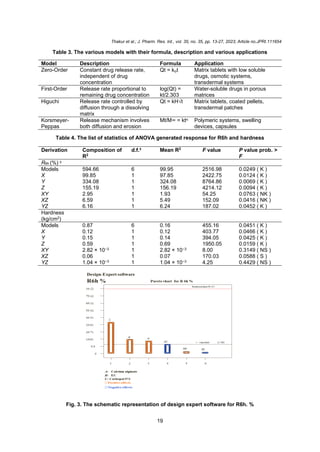
The Fig. 03 and Fig. 04 present Pareto charts
that were used to analyze the statistical
significance of each response coefficient (R6h %
and Hardness) respectively.
These charts show the importance of each
coefficient visually. Coefficients with t values
above the Bonferroni line are considered
important, while coefficients with t values
between the Bonferroni line and the t limit line
are likely to be important. However, coefficients
with t values below the t limit line are not
statistically significant. These Pareto charts also
help confirm the ANOVA resulting by identifying
and removing terms that are not significant (P >
0.05) in the model equations [32].
RSM is a very successful method that is applied
to the creation and improvement of drug delivery
systems. The 3D RSP and the accompanying CP
are shown in Fig. 05, 06, 07, 08, 09, and 10, and
they aid in estimating the impacts of independent
variables on each response under investigation.
These plots are valuable tools for understanding
the main and interaction effects of the variables.
Additionally, the 2D CP provides a visual
representation of the response values. In the
case of hardness, as shown in Fig. 03, the
Pareto chart reveals both positive and negative
effects [30-31].
Table 2. The observed response values with drug contents in PCM matrix tablets and the 23
factorial designs (FD) are presented
Formulation
Batches
Calcium
alginate (mg) M
EC
(mg) N
Carbopol
971 (mg) R
Observations
R 6h (%)x
Hardness
(kg/cm2
) y
RP1 16 (−1) 0 (−1) 0 (−1) 75.72 ± 3.37 4.20 ± 0.26
RP2 32 (+1) 25 (+1) 25 (+1) 57.25 ± 2.14 3.19 ± 0.16
RP3 32 (-1) 0 (−1) 0 (−1) 74.17 ± 2.55 4.53 ± 0.22
RP4 32 (+1) 25 (+1) 0 (-1) 62.42 ± 3.26 3.85 ± 0.17
RP5 16 (−1) 25 (+1) 25 (+1) 51.49 ± 2.18 4.12 ± 0.12
RP6 16 (+1) 0 (+1) 25 (-1) 63.44 ± 1.83 3.89 ± 0.35
RP7 32 (-1) 0 (−1) 25 (+1) 56.86 ± 2.33 4.92 ± 0.14
RP8 16 (−1) 25 (_1) 0 (+1) 60.16 ± 1.74 3.42 ± 0.26
The cumulative drug release after 6 hours is denoted as x R 6h (%). The mean value, represented by y, is
accompanied by the standard deviation (S.D.) and is based on a sample size of 6 (n = 6). The main effects
(factors) are represented by A, B, and C. A higher value is indicated by (+1), while a lower value is indicated by
(−1)
Fig. 2. The Structure of the dopamine D2 receptor in complex with the PCM drug
[A]. Chemical structure of PCM and [B]. The docking of PCM](https://image.slidesharecdn.com/thakur35352024jpri111654-240115065351-4d91cbdf/85/Thakur35352024JPRI111654-pdf-6-320.jpg)
![Thakur et al.; J. Pharm. Res. Int., vol. 35, no. 35, pp. 13-27, 2023; Article no.JPRI.111654
20
Fig. 4. The schematic representation of design expert software for hardness
Fig. 5. The RSP [A] and CP [B] illustrate the impact of varying quantities of calcium alginate
and EC on the R6h (%) outcome
More calcium alginate, EC, and carbopol 971 in
PCM matrix tablets results in lower R 6h %
values and higher hardness values, as seen by
the 3D RSP and CP for R6h and hardness. To
created optimised PCM matrix tablets using the
direct compression approach in order to evaluate
the optimisation capabilities of the models
created based on a 23 FD [32]. One of the](https://image.slidesharecdn.com/thakur35352024jpri111654-240115065351-4d91cbdf/85/Thakur35352024JPRI111654-pdf-8-320.jpg)
![Thakur et al.; J. Pharm. Res. Int., vol. 35, no. 35, pp. 13-27, 2023; Article no.JPRI.111654
21
carefully chosen ideal process variable
configurations suggested by the experimental
design was employed.
The optimized formulation of PCM matrix tablets
involved using M = 16.29 mg, N = 34.11 mg, and
R = 30.32 mg as selected optimal process
variable settings. To determine the optimal
values of responses based on the desirability
criterion, we conducted numerical analysis with
the assistance of Design expert 8.0.6.1 software
[33]. This analysis led to the development of
optimized PCM matrix tablet.
The actual values observed during the practical
experiments are presented in Table. 05 along
with the projected values derived from the
mathematical model [33-34].
Fig. 6. The RSP [A] and CP [B] illustrate the impact of varying quantities of calcium alginate
and Carbopol 971 on R6h (%)
Fig. 7. The RSP [A] and CP [B] illustrate the impact of varying quantities of EC and Carbopol
971 on R6h (%)](https://image.slidesharecdn.com/thakur35352024jpri111654-240115065351-4d91cbdf/85/Thakur35352024JPRI111654-pdf-9-320.jpg)
![Thakur et al.; J. Pharm. Res. Int., vol. 35, no. 35, pp. 13-27, 2023; Article no.JPRI.111654
22
Fig. 8. The RSP [A] and CP [B] illustrate the impact of varying amounts of calcium alginate and
EC on the hardness (kg/cm2
)
Fig. 9. The RSP [A] and CP [B] show how different concentrations of Carbopol 971 and calcium
alginate affect hardness (kg/cm2
)
Table 5. The observations obtained from experiments to confirm optimization aptitude
Formulation
Code
Calcium alginate
(mg) [M]
EC (mg)
[N]
Carbopol
971 (mg) [R]
Observations
R6h (%)x
Hardness
(kg/cm2
)
RO 16.29 33.16 31.34 Actual values y
42.62 ± 1.89 4.76 ±
0.08
Predicted values
39.98 5.59
% Error 4.04 2.43
aR6h (%): DR accumulated after 6 hours; b mean ± S.D. of actual values, n = 3; c% error = (actual value −
predicted value)/predicted value × 100; A, B, and C denote the primary factors.](https://image.slidesharecdn.com/thakur35352024jpri111654-240115065351-4d91cbdf/85/Thakur35352024JPRI111654-pdf-10-320.jpg)
![Thakur et al.; J. Pharm. Res. Int., vol. 35, no. 35, pp. 13-27, 2023; Article no.JPRI.111654
23
Fig. 10. The RSP [A] and contour plot (CP) [B] illustrate the impact of varying quantities of EC
and Carbopol 971 on the hardness (kg/cm2
)
The PCM matrix tablets that were optimized
showed an R 6h of 42.64 ± 1.96% and a
hardness of 4.67 ± 0.08 kg/cm2. The error values
were small, less than 5, which suggests that the
mathematical models derived from the 23 FD
were a good fit [35].
3.2 Optimization of Drug Content and
Weight Variation
All matrix tablets containing PCM were analyzed
and found to contain PCM within the range of
97.99 ± 0.85 to 99.03 ± 0.59 (Table. 06). This
confirms that the drug content is present in the
appropriate amount in all the matrix tablets. The
weight variation of the tablets also indicates
adherence to GMPs by the manufacturers and
the amount of APIs in the formulation. This PCM
loaded matrix tablets meet the weight uniformity
specifications outlined in the USP. The tablets
exhibited a weight variation ranging from 2.79 ±
0.07 to 4.08 ± 0.29%, with none of them
deviating by more than 5% from their average
weight (Table. 06) [34-35]. The uniform mixing of
CPM with other ingredients is evident from the
consistent drug content and weight of the
formulated PCM matrix tablets.
3.2.1 Hardness
The purpose of conducting the hardness test on
PCM matrix tablets was to evaluate their ability to
endure handling without breaking or chipping. It
has been determined that a minimum force of
approximately 4 kg/cm2 is necessary for the
tablets to possess satisfactory hardness. The
results obtained from the hardness evaluation
indicated that the hardness of the matrix tablets
was found to be within the acceptable range of
3.20 ± 0.26 and 5.67 ± 0.08 kg/cm2 (Table. 03
and 04) [35-36]. These findings confirm that the
tablets possess the desired level of hardness.
Table 6. The Drug content and weight variation of PCM matrix tablets
Formulation codes Drug content ( % ) x
Weight variation (%) y
RP1 98.04 ± 0.61 2.14 ± 0.19
RP2 97.43 ± 0.71 3.36 ± 0.32
RP3 98.25 ± 0.66 2.15 ± 0.31
RP4 99.98 ± 0.84 3.06 ± 0.32
RP5 99.22 ± 1.24 3.42 ± 0.16
RP6 97.64 ± 0.54 2.89 ± 0.16
RP7 97.81 ± 0.77 2.04 ± 0.15
RP8 99.63 ± 0.56 3.84 ± 0.15
RO 97.84 ± 0.73 1.69 ± 0.09
Where; x Mean ± S.D., n = 20; y: coefficient of weight variation (%) [The weight variation coefficient (%) can be
calculated by dividing the standard deviation by the mean weight and then multiplying the result by 100]](https://image.slidesharecdn.com/thakur35352024jpri111654-240115065351-4d91cbdf/85/Thakur35352024JPRI111654-pdf-11-320.jpg)
![Thakur et al.; J. Pharm. Res. Int., vol. 35, no. 35, pp. 13-27, 2023; Article no.JPRI.111654
24
Fig. 11. The drug release from different PCM matrix tablets (RP1 to RO) was evaluated in-vitro
The values are expressed as the mean ± standard deviation (SD), with a sample size
Table 7. The outcomes of curve fitting for the release data of In-vitro PCM from various PCM
matrix tablets
Formulation
Batches
Correlation coefficient (R2
)
Zero Order First Order Higuchi Korsmeyer-
Peppas
Release
exponent (n)
RP1 0.9645 0.9807 0.8278 0.9510 0.61
RP2 0.9798 0.9930 0.7069 0.9416 0.74
RP3 0.9577 0.9952 0.6844 0.8988 0.70
RP4 0.9810 0.9949 0.7288 0.9418 0.71
RP5 0.9733 0.9942 0.7062 0.9084 0.71
RP6 0.9677 0.9908 0.6925 0.9048 0.72
RP7 0.9774 0.9954 0.7059 0.9093 0.72
RP8 0.9670 0.9944 0.7214 0.9098 0.69
RO 0.9744 0.9920 0.7211 0.9470 0.75
3.2.2 In-Vitro Drug Release (DR)
All PCM matrix tablets exhibited drug release in
0.1 N HCl (pH 1.2) for the initial 2 hours, followed
by release in phosphate buffer (pH 7.4) for 4
hours. These matrix tablets consistently
demonstrated prolonged and sustained drug
release for a total of 6 hours (Fig. 11). The
cumulative DR from these tablets after 6 hours of
dissolution (R6h) ranged from 41.61 ± 1.97 to
74.62 ± 2.36%. Analysis of the response surface
revealed that the R6h% values decreased as the
three independent variables (amount of calcium
alginate, EC, and Carbopol 971) increased
Table. 07. The presence of larger quantities of
hydrophilic polymers, such as calcium alginate,
EC, and Carbopol 971, leads to an elevated
viscosity [37]. This increased viscosity can
promote the creation of extremely thick gels
when exposed to the aqueous fluids in the
dissolution medium. Consequently, this process
would decelerate the rate at which drugs are
released from the PCM matrix tablets. The
release exponent (n) value, obtained from in-vitro
PCM release data for different matrix tablets,
varied between 0.49 and 0.76. This range
suggests the presence of an anomalous diffusion
mechanism for drug release. The anomalous
diffusion mechanism indicates a combination of](https://image.slidesharecdn.com/thakur35352024jpri111654-240115065351-4d91cbdf/85/Thakur35352024JPRI111654-pdf-12-320.jpg)
![Thakur et al.; J. Pharm. Res. Int., vol. 35, no. 35, pp. 13-27, 2023; Article no.JPRI.111654
25
diffusion-controlled and swelling-controlled DR
from PCM matrix tablets [38-41].
4. CONCLUSION
The SR application of PCM matrix tablets was
successfully achieved through the use of RSM
based on a 23-FD. The analysis and optimization
of the properties of the matrix tablet, including
drug release and hardness, were conducted in a
comprehensive manner, focusing on the effects
of calcium alginate, EC, and Carbopol 971.
Through the examination of RSP and CP, it was
observed that higher quantities of calcium
alginate, EC, and Carbopol 971 led to reduced
drug release (R 6h%) values and increased
hardness values. The PCM matrix tablets (RO)
that were optimized displayed a drug release rate
of 44.72 ± 1.89% within a span of 6 hours, along
with a hardness value 4.86 ± 0.08 kg/cm2. This
final optimized tablet showcased an extended
sustained release of PCM for a period of 12
hours, which has the potential to enhance patient
adherence by decreasing the frequency of
dosing when compared to traditional tablets.
CONSENT
It is not applicable.
ETHICAL APPROVAL
It is not applicable.
COMPETING INTERESTS
Authors have declared that no competing
interests exist.
REFERENCES
1. Zalte HD, Saudagar RB. Review on
sustained release matrix
tablet. International Journal of Pharmacy
and Biological Sciences. 2013;3(4):
17-29.
2. Ganesh GNK, Sureshkumar R, Jawahar N,
Senthil V, Venkatesh DN, Srinivas MS.
Preparation and evaluation of sustained
release matrix tablet of diclofenac sodium
using natural polymer. Journal of
pharmaceutical sciences and research.
2010;2(6):360.
3. Alhalmi A, Altowairi M, Saeed O, Alzubaidi
N, Almoiliqy M, Abdulmalik W. Sustained
release matrix system: an overview. World
J Pharm Pharm Sci. 2018;7(6):1470-86.
4. Prakhar A, Akhtar S. A comprehensive
review on sustained release matrix tablets:
a promising dosage form. Universal
Journal of Pharmaceutical Research.
2018;3(6):49-54.
5. Nautyal U, Gupta D. Oral sustained
release tablets: an overview with a special
emphasis on matrix tablet. International
Journal of Health and Biological Sciences.
2020;3(1):06-13.
6. Khuri AI, Mukhopadhyay S. Response
surface methodology. Wiley
Interdisciplinary Reviews: Computational
Statistics. 2010;2(2):128-149.
7. Pal R, Pandey P, Rizwan M, Koli M,
Thakur SK, Malakar RK, Chawra HS. The
Utilization of Response Surface
Methodology (RSM) In the Optimization of
Diclofenac Sodium (DS) Liposomes
Formulate through the Thin Film Hydration
(TFH) Technique with Involving
Computational Method. Journal of
Advances in Medicine and Medical
Research. 2023;35(22): 287-300.
8. Politis N, S, Colombo P, Colombo G, M.
Rekkas D. Design of experiments (DoE) in
pharmaceutical development. Drug
development and industrial pharmacy.
2017;43(6):889-901.
9. Albadry AA, Ali WK, Al-saady FA.
Formulation and evaluation of
prochlorperazine maleate sustained
release floating tablet. Int J Pharm Pharm
Sci. 2017;9(2):89-98.
10. Pal R, Pandey P, Jha D, Dutta P, Sahoo S,
Gupta R, Chawra HS. The Utilization of
32Full Factorial Design (FFD) for
Optimization of Lincomycin Hydrochloride
(LNH) Loaded Nanogel Involving; Design
of Experiments (DoE) an Advanced
Approach. Advances in Research. 2023;
24(6):272-281.
11. Vaja Divyeshkumar N, Patel Maulik M,
Joshi Ujjwal T, Patel Jaykishan M. Design,
development and characterization of orally
disintegrating tablet of prochlorperazine
maleate. J. Chem. 2010; 2(5):307-312.
12. Malakar J, Nayak AK. Formulation and
statistical optimization of multiple-unit
ibuprofen-loaded buoyant system using
23-factorial design. Chemical Engineering
Research and Design. 2012; 90(11):1834-
1846.
13. Pandey P, Pal R. Bharath KS,
Akilandeshwari A, Koli M, Rizwan M,
Chawra HS. Design of Experiments (DoE)
manipulation in the formulation and
optimization of a traditional Ayurvedic](https://image.slidesharecdn.com/thakur35352024jpri111654-240115065351-4d91cbdf/85/Thakur35352024JPRI111654-pdf-13-320.jpg)
![Thakur et al.; J. Pharm. Res. Int., vol. 35, no. 35, pp. 13-27, 2023; Article no.JPRI.111654
26
medicine derived from dried extract of
Senegalia catechu enhanced through
statistical analysis. Journal of
Pharmacognosy and Phytochemistry.
2023;12(6);159-169.
14. Savaşer A, Özkan Y, Işımer A. Preparation
and in vitro evaluation of sustained release
tablet formulations of diclofenac sodium. Il
Farmaco. 2005; 60(2):171-177.
15. Ofori-Kwakye K, Osei-Yeboah F, Kipo SL.
Formulation and quality evaluation of two
conventional release tablet
formulations. International Journal of
Pharmaceutical Sciences Review and
Research. 2010;4(1):94-99.
16. Pandey, Prachi & Pal, Rahul & Thakur,
Shiva Kant & Sharma, Vidhi & Chanana,
Arsh & Singh, Ravinder. future aspects &
modification in carbon- nanoparticles in
treatment and diagnosis. World journal of
pharmacy and pharmaceutical sciences.
2023;12:307-324.
DOI:10.20959/wjpps20232-24094.
17. Bohrey S, Chourasiya V, Pandey A.
Polymeric nanoparticles containing
diazepam: preparation, optimization,
characterization, in-vitro drug release and
release kinetic study. Nano Convergence.
2016;3(1):1-7.
18. Clark AL, Johnson M, Fairhurst C,
Torgerson D, Cockayne S, Rodgers S,
Greenstone M. Statistical analysis. In Does
home oxygen therapy (HOT) in addition to
standard care reduce disease severity and
improve symptoms in people with chronic
heart failure? A randomised trial of home
oxygen therapy for patients with chronic
heart failure. NIHR Journals Library; 2015.
19. Pal R, Pandey P, Nogai L, Anand A,
Suthar P, SahdevKeskar M, Kumar V. The
future perspectives and novel approach on
gastro retentive drug delivery system
(GRDDS) with currrent state. Journal of
Population Therapeutics and Clinical
Pharmacology. 2023;30(17): 594-613.
20. Kenakin T. Predicting therapeutic value in
the lead optimization phase of drug
discovery. Nature Reviews Drug
Discovery. 2003;2(6):429-438.
21. Pal R, Pandey P, Nogai L. The Advanced
Approach in The Development of Targeted
Drug Delivery (TDD) With Their Bio-
Medical Applications: A Descriptive
Review. International Neurourology
Journal. 2023;27(4):40-58.
22. Wermuth CG. Selective optimization of
side activities: another way for drug
discovery. Journal of medicinal chemistry.
2004;47(6):1303-1314.
23. Caldwell GW, Yan Z. Optimization in drug
discovery. New York: Springer.[Google
Scholar]; 2014.
24. Pal, Rahul Pandey, Prachi Kumar Maurya,
Vishesh & Saxena, Archita & Koli, Manju.
Optimization And Formulation of
Doxorubicin (DOX) Loaded Liposome
Well-Used in Chemotherapy Involving
Quality by Design (QBD): A Transitory
Research. European Chemical Bulletin.
2023;12:4491-4510.
DOI:10.48047/ecb/2023.12.si5a.0355.
25. Dua'a KA, Kamal BA. Formulation and
Optimization of Oral Fast Dissolving
Prochloperazine Maleate Tablets. Iraqi
Journal of Pharmaceutical Sciences; 2012.
(P-ISSN 1683-3597 E-ISSN 2521-
3512), 21(1), 46-55.
26. Pal, Rahul & Pandey, Prachi & Waheed,
Saman & Thakur, Shiva Kant & Sharma,
Vidhi & Chanana, Arsh & Singh, Ravindra.
Transdermal Drug Delivery System (Tdds)
As A Novel Tool For Drug Delivery.
2023;12:688-711.
DOI:10.20959/wjpr20232-26997.
27. Wang S, Zhang D, Li C, Wang J, Zhang J,
Cheng Y, Wang Q. Numerical optimization
for a phase change material based lithium-
ion battery thermal management
system. Applied Thermal Engineering.
2023;222:119839.
28. Teja SP, Damodharan N. 23 full factorial
model for particle size optimization of
methotrexate loaded chitosan
nanocarriers: A design of experiments
(DoE) approach. BioMed research
international; 2018.
29. Pandey Prachi Thakur Shiva Kant
Chanana, Arsh Pal, Rahul. biodegradable
polymer’s enhancing drug delivery activity
in different novel drug delivery system.
world journal of pharmacy and
pharmaceutical sciences. 2023;12:2046-
2069.
DOI:10.20959/wjpps2023.
30. Fegade SL, Tande BM, Cho H, Seames
WS, Sakodynskaya I, Muggli DS, Kozliak
EI. Aromatization of propylene over Hzsm-
5: A design of experiments (DOE)
approach. Chemical Engineering
Communications. 2013;200(8):1039-1056.
31. Granato D, de Araújo Calado VM. The use
and importance of design of experiments
(DOE) in process modelling in food
science and technology. Mathematical and](https://image.slidesharecdn.com/thakur35352024jpri111654-240115065351-4d91cbdf/85/Thakur35352024JPRI111654-pdf-14-320.jpg)

The study utilizes response surface methodology (RSM) to optimize the sustained release properties of phenothiazine derivative prochlorperazine maleate (PCM) matrix tablets, which are intended to improve patient compliance and reduce side effects. By exploring various factors influencing drug release, such as polymer type and concentration, the research successfully developed a formulation yielding a prolonged and uniform PCM release over six hours. Results indicate a strong correlation between proposed experimental designs and the drug release profiles, validating the use of RSM in pharmaceutical formulation optimization.


![Complexation and Protein Binding: Unit IV (ii) [BP302T] .pptx](https://cdn.slidesharecdn.com/ss_thumbnails/unitiviicomplexationandproteinbinding-251207164128-8b45a45b-thumbnail.jpg?width=640&height=640&fit=bounds)
![Complexation and Protein Binding: Unit IV (i) [BP302T].pptx](https://cdn.slidesharecdn.com/ss_thumbnails/unitivicomplexationandproteinbinding-251207163820-1722f0aa-thumbnail.jpg?width=640&height=640&fit=bounds)
![Surface and Interfacial Phenomena: Unit III Physical Pharmaceutics-I [BP302T]...](https://cdn.slidesharecdn.com/ss_thumbnails/unitiiiphysicalpharmaceutics-ibp302t-251207163200-ab3370a1-thumbnail.jpg?width=640&height=640&fit=bounds)

![PELLETS - BASIC AND COMPOSITION UNIT DOSAGE FORM [Industrial Pharmacy-I].pdf](https://cdn.slidesharecdn.com/ss_thumbnails/pellets-basicandcompositionunitdosageform-241029091949-dd0369dc-thumbnail.jpg?width=640&height=640&fit=bounds)


![Software Used In Formulation Design Process- Minor Project [Bachelor].pdf](https://cdn.slidesharecdn.com/ss_thumbnails/softwareusedinformulationdesignprocess-minorprojectbachelor-240423141933-4b6eee88-thumbnail.jpg?width=640&height=640&fit=bounds)


