Thailand
COUNTRY STARTER PACK
Country starter pack
Introduction to Thailand
2
A$5.17
Billion
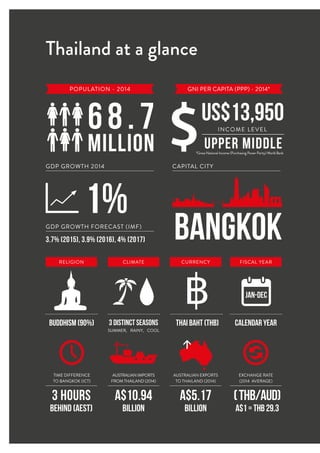
68.7
million
US$13,950
Upper middle
GDP GROWTH 2014		
POPULATION - 2014 GNI PER CAPITA (PPP) - 2014*
INCOME LEVEL
3 distinct seasons
SUMMER, RAINY, COOL
THAI BAHT (THB)
GDP GROWTH FORECAST (IMF)	
3.7% (2015), 3.9% (2016), 4% (2017)
CAPITAL CITY	
Bangkok
TIME DIFFERENCE
TO BANGKOK (ICT)
3 hours
behind (AEST)
AUSTRALIAN IMPORTS
FROM THAILAND (2014)
AUSTRALIAN EXPORTS
TO THAILAND (2014)
RELIGION CLIMATE CURRENCY FISCAL YEAR
calendar year
jan-dec
A$10.94
Billion
Buddhism (90%)
>
EXCHANGE RATE
(2014 AVERAGE)
(THB/AUD)
A$1=THB29.3
Thailand at a glance
1%
*Gross National Income (Purchasing Power Parity) World Bank
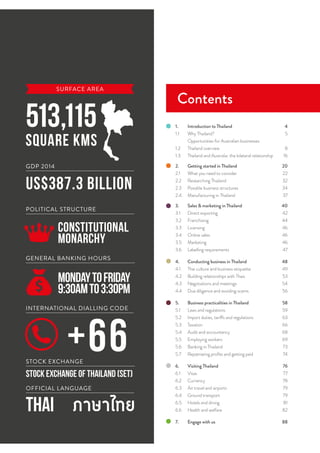
1.	 Introduction to Thailand		 4
1.1	Why Thailand?	 5
	 Opportunities for Australian businesses	
1.2 	 Thailand overview	 8
1.3	 Thailand and Australia: the bilateral relationship	 16
2.	 Getting started in Thailand	 20
2.1	 What you need to consider		 22
2.2	 Researching Thailand	 32
2.3	 Possible business structures	 34
2.4	 Manufacturing in Thailand	 37
3.	 Sales  marketing in Thailand	 40
3.1	 Direct exporting	 42
3.2	Franchising	 44
3.3	Licensing	 46
3.4	 Online sales	 46
3.5	Marketing	 46
3.6	 Labelling requirements	 47
4.	 Conducting business in Thailand	 48
4.1	 Thai culture and business etiquette	 49
4.2	 Building relationships with Thais	 53
4.3	 Negotiations and meetings	 54
4.4	 Due diligence and avoiding scams	 56
5.	 Business practicalities in Thailand	 58
5.1	 Laws and regulations	 59
5.2	 Import duties, tariffs and regulations	 63
5.3	Taxation	 66
5.4	 Audit and accountancy	 68
5.5	 Employing workers	 69
5.6	 Banking in Thailand	 73
5.7	 Repatriating profits and getting paid	 74
6.	 Visiting Thailand	 76
6.1	Visas	 77
6.2	Currency	 78
6.3	 Air travel and airports	 79
6.4	 Ground transport	 79
6.5	 Hotels and dining	 81
6.6	 Health and welfare	 82
7.	 Engage with us	 88
Contents
STOCK EXCHANGE	
Stock Exchange of Thailand (SET)
GDP 2014	
US$387.3 billion
POLITICAL STRUCTURE 	
513,115
square kmS
SURFACE AREA
OFFICIAL LANGUAGE		
Thai
Constitutional
Monarchy
GENERAL BANKING HOURS	
INTERNATIONAL DIALLING CODE	
+66
MondaytoFriday
9:30AMto3:30PM
ภาษาไทย
Country starter pack
Introduction to Thailand
4
1. Introduction
Country starter pack
Introduction to Thailand
5
1.1	 WHY THAILAND?
OPPORTUNITIES FOR
AUSTRALIAN BUSINESSES
The Kingdom of Thailand is fast becoming a rich northern
frontier for Australian business, and a commanding
gateway to the region’s economic powerhouses India
and China, as well as Indochina and the Greater Mekong
sub-region. Already, 300 Australian companies have
built a presence there and two-way Thai-Australian
trade is pushing towards $16 billion a year, with several
opportunities arising for expansion and growth. Propelled
by the two countries’ historic free trade agreement,
investors are seizing new prospects in a range of industry
sectors, with generous Thai tax and other financial
incentives providing an added lure.
Of course, this was not always so, and for a long time
the country was eyed suspiciously in the face of political
unrest and perceptions surrounding labour conditions.
But Thailand is making a concerted effort to draw foreign
investors, particularly to high-tech industries and to
less-developed sectors of the economy, as well as to its
underdeveloped regions.
Economically, this country of more than 68 million
people has been characterised as one of steady growth.
Abundant natural resources combined with a skilled and
cost-effective workforce have allowed Thailand to attract
foreign investment, which in turn has underpinned the
nation’s surging prosperity through the development
of key industries. While foreign ownership is limited to
49 per cent of individual enterprises across a number
of sectors, unrestricted foreign ownership is allowed in
manufacturing, some areas of agriculture and services.
Australian investors are now getting a range of additional
benefits and protections under the Thailand-Australia
Free Trade Agreement (known as TAFTA). In its 10th-
anniversary year in 2015, some of the new TAFTA benefits
include the ability to take full ownership of enterprises in
certain construction services and majority ownership in
mining operations, tertiary education services, restaurants
and hotels.
Country starter pack
Introduction to Thailand
6
Consider some key facts:
•	 Thailand ranks among the top 10 most attractive
countries in the region for investment over the
next three to five years, with research showing
foreign investors are reassured by its abundance of
suitable suppliers, raw materials, and development of
infrastructure.
•	 Thailand has repositioned itself after a period of
political instability as a hub for medical tourism,
services and agribusiness with average annual GDP
growth of four per cent forecast from 2015 – 2020.
•	 Thailand is one of the world’s leading producers of
rice, rubber and sugar. It brings together an array of
agricultural expertise, drawing on leading technologies
and underpinned by strong government support for
food research and development.
•	 As the world’s largest medical tourism market –
the result of low-cost medical treatments and
high-quality healthcare – Thailand boasts business
opportunities for healthcare service providers, with
the Thai government offering various investment
incentives for manufacturing of medical food and
equipment.
Friendly and rich culture: Thailand has gained a reputation
throughout the world for its gracious hospitality. The
friendliness of its people and the diverse nature of Thai
culture make visitors feel at home in Thailand.
Gateway to Asia: Thailand lies at the heart of Asia and is
on the doorstep of some of the world’s biggest and fastest
growing markets. It serves as a gateway to Southeast
Asia and the Greater Mekong sub-region, where newly
emerging markets offer great business potential. Thailand
also provides a convenient launching pad for businesses
looking to trade with China and India.
Hub of ASEAN: Thailand was one of the founding
members of the Association of Southeast Asian Nations
(ASEAN) and has been instrumental in the formation and
development of the ASEAN Free Trade Area (AFTA).
As a result, Thailand has forged closer economic ties
with the bloc’s member nations, and its manufactured
products and services have access to the markets of all
nine ASEAN partners. The alliance encompasses total
consumer spending that is forecast to grow to $2 trillion
by 2020, representing growth of 45.7 per cent (2013
to 2020), a surge that looks certain to continue in the
decades ahead. The region is expected to account for just
under 60 per cent of global middle-class consumption
by 2030, with much of that growth predicted to centre
on communications and education, as well as hotels and
catering.
Foreign direct investment policies: The country’s well-
defined investment policies focus on market liberalisation
and the encouragement of free trade. Foreign
investment in Thailand, especially that which is seen to
be contributing to the development of domestic skills,
technology and innovation, is actively encouraged by the
government. Little wonder that Thailand consistently
ranks among the most attractive investment destinations
in well-credentialled international surveys. According
to the World Bank, Thailand ranks as the third easiest
country in the Southeast Asian region in which to do
business, and 26th easiest in the world.
Considering doing business in Thailand?
1.	 Do your research
•	 Speak to industry experts
•	 Connect with Australian businesses
operating in Thailand
•	 Go to industry events and information
seminars
•	 Seek professional advice.
2.	 Become aware of cultural difference
and ways of doing business in Thailand
•	 Gain an understanding of your customer
and local business partners
•	 Be flexible and open to difference
•	 Understand the local culture and
prepare before meeting with local
business partners
•	 Practise Thai business etiquette.
3.	 Building relationships is crucial in Thai
culture, but it can take time
•	 Be patient with developing relationships
•	 Follow up and maintain contact with
your networks.
Country starter pack
Introduction to Thailand
7
Government support and incentives: Numerous Thai
government agencies reach out to investors with
various tax incentives, support services and import duty
concessions that are made available to an extensive range
of businesses considered top priority in the country’s
investment needs. The key conduit for such assistance
is Thailand’s Board of Investment (BOI). Under the
BOI stewardship, no foreign equity restrictions apply
to the manufacturing sector, nor are there onerous
local content or export requirements, putting Thailand’s
investment regime in full compliance with the World
Trade Organisation regulations. The BOI also oversees
Thailand’s One-Stop Service Centre for Visas and Work
Permits, which allows foreign staff of companies meeting
the board’s guidelines to obtain the necessary work
documents within three hours or less.
Long-established and newly emerging industries: On the
back of strong economic development and in concert
with robust support industries, Thailand’s industrial
production has expanded and diversified rapidly, both
within long established sectors and newly emerging
industries. As a means of fast-tracking and prioritising
development, the government has put an emphasis on
attracting investment in six key sectors. These have
been identified as integral to meeting the country’s
developmental objectives with targeted industries
including agriculture and agroindustry, alternative
energy, automotive, electronics, fashion, and information
communications technology. Value-added services
including entertainment, healthcare and tourism are
also earmarked for special attention, while opportunities
remain rife in the Thai pharmaceutical industry, which is
the second biggest in Southeast Asia, currently worth
more than $4.5 billion annually and expected to double
by 2020. Indeed, foreign investment in the sector in both
manufacturing and importing can be expected to increase
dramatically should Thailand’s application for membership
of the global Pharmaceutical Inspection Convention and
Pharmaceutical Cooperation Scheme succeed, thereby
ramping up safeguards and standards.
Thailand’s cosmetics and beauty care industry is another
sector enjoying growth in both manufacturing and sales,
the result of a range of factors including rising domestic
incomes, rapid product development and changing social
attitudes towards personal care, particularly among young
men. Thailand’s cosmetics market is the largest within
ASEAN, while sales of skincare products rank 12th in the
world and those of haircare products second. The industry
overall is expected to continue growing at three to six per
cent a year.
Thailand has a large and competent manufacturing
sector: The physical infrastructure of the sector is well
developed, particularly when compared with other
countries in the region. The BOI also offers a range
of privileges, guarantees, protections, permissions,
tax incentives and export incentives to attract foreign
businesses to the sector. In regards to the Australian
automotive industry, Thailand houses more than 20
Australian Tier One and Two auto industry suppliers.
Particular areas of opportunity for Australians (especially
under TAFTA) lie within:
•	 Horticulture
•	 Dairy
•	 Processed food and beverages
•	 Education
•	 Automotive products.
Country starter pack
Introduction to Thailand
8
The freeing up of agribusiness trade rules has led to
increased Australian exports of grain, cotton and milk
powder to Thailand and growing rice exports from
Thailand to Australia. Education also dominates Australia’s
service exports to Thailand with key initiatives in English
teaching, the training of teachers and hospitality workers,
as well as collaboration between institutions.
A shortage of skills training in Thailand presents a valuable
opportunity for Australian educational institutions,
underscored by the strong perception in Thailand – and
in many other Asian nations – that education abroad is
of a higher quality. While Australia is the number one
destination for Thai students studying overseas, Thailand
ranks just fifth in terms of the numbers of foreign
students in Australia across all sectors (schools, higher
education, TAFE/VET), a possible pointer to future
growth opportunities. A total of 25,642 Thai students
were enrolled in Australia across all sectors in 2014, up
from 21,762 the previous year.
1.2	 THAILAND OVERVIEW
Geography
Thailand is situated in Southeast Asia, flanked by the
Indian Ocean and the Gulf of Thailand. Covering 513,115
square kilometres, it is roughly equal in area to France.
The country is bordered by Myanmar to the west, Laos
and Cambodia to the east, and Malaysia to the south.
It consists of various distinct areas – the mountainous
north, the dry north-eastern plateau, the fertile central
delta, the eastern seaboard and the southern peninsula.
The capital city, Bangkok, is situated in the central delta
area and lies just one metre above sea level. Thailand’s
climate is tropical with the average temperature around
29o
C and humidity usually sitting between 73 and 82 per
cent. It is generally warm all year round, although Thai
people recognise three distinct seasons.
THAI SEASONS
Summer (March to May)
Hot and humid.
Wet season (June to October)
While it does not rain constantly, the sky is overcast and
a tropical downpour lasting one to two hours is typical on
most days.
Cool (November to February)
Weather is dry and relatively cooler than the rest of the year.
History
Popular belief has it that the Thai people originally
came from southeastern China in AD 650 and formed
a kingdom called Nanchao. In the 13th century these
people migrated south to the area that is now regarded
as northern Thailand, and established its first kingdom
called Sukhothai. It was during the Sukhothai period that
the Thais developed their own distinctive language, art,
culture and architecture.
The Sukhothai Kingdom flourished for about 100 years
before gradually crumbling when another more powerful
kingdom of Ayutthaya arose in the mid-14th century. Its
emergence coincided with the initiation of trade with the
West, followed by a period of territorial battles between
the Thais and the Burmese. The Ayutthaya period lasted
for over 400 years, when the capital was lost to the
Burmese invasion in 1767.
The Burmese did not control Ayutthaya for long.
Within months conflict erupted again, and soon after
the brief Taksin Dynasty emerged. In 1782, General
Chakri transferred the capital across the Chao Phraya
River to Bangkok and proclaimed himself King Rama I
of the Chakri Dynasty, signalling the beginning of the
Rattanakosin period, which continues today. His Majesty
King Bhumibol Adulyadej (Rama IX) has reigned since
1946 and is the world’s longest serving head of state as
well as Thailand’s longest reigning monarch. Reflecting
the nation’s deep respect for the monarchy, it is a serious
crime to make critical or defamatory comments about the
King or other members of the royal family. This particular
crime is dubbed lese majeste and those who violate it, even
unknowingly, face being arrested.
Country starter pack
Introduction to Thailand
9
It is interesting to note that up until the reign of King
Rama IX, the country had always been known as Siam.
The name was changed to Thailand (meaning “free”) to
acknowledge the nation’s unique standing as the only
country in Southeast Asia to avoid colonisation by a
European power. The city of Bangkok, better known
among Thais as Krung Thep, or City of Angels, is actually
an abbreviated version of the city’s full ceremonial name
which is the world’s longest city name.
Culture
Thailand embraces a mix of colourful and exotic cultures,
which has given rise to a distinctive national psyche and
ways of interacting. The foremost ethnic group is Thai, but
diversity reigns through a high degree of intermarriage
with the Chinese and the presence of many other groups
that include Burmese, Lao, Malay, Mon and Indian.
Religion is a core feature of Thai life. While Buddhism
is regarded as the national religion, practised by more
than 90 per cent of the population, Islam, Christianity,
Hinduism and other faiths are also represented. Religious
freedom is enshrined in the Thai constitution, and the
King, though himself a Buddhist, remains the patron of
all religions practised in Thailand. In fact, the King holds
the title Defender of all Faiths. Buddhism is mostly of
the Theravada school, although it has become entwined
through the centuries with folk beliefs such as Chinese
ancestor worship been introduced through the blending
of Thai and Chinese populations. Meanwhile, a key
influence on Thai Buddhism has been Hindu beliefs
received from Cambodia. The faithful in modern Thailand
practise certain rituals, performed either by monks or by
Hindu ritual specialists, that are either identified explicitly
as Hindu in origin, or easily understood to have been
derived from Hindu practices.
9
Muslims make up the second-largest religious group,
accounting for about five per cent of the Thai population.
Muslims are most dominant in Thailand’s southern
provinces – Pattani, Yala, Narathiwat and part of
Songkhla and Chumphon – and consist of both of ethnic
Thais and Malays, the latter making up the majority
of people living at the southernmost tip of Thailand.
Christians, mainly Catholics, account for less than one
per cent of the population, while a very small community
of Sikhs and Hindus also live in Thai cities, and are well
represented in retail commerce.
Thailand is a collectivist society, which dictates that the
needs of the group are placed ahead of those of the
individual. Subtlety and indirect forms of communication
are highly valued in Thai society which, as in the case of
many others across Asia, is hierarchical. Individuals are
viewed as being either higher or lower in status, measured
between one another in relative terms – younger or
older, weaker or stronger, junior or senior, subordinate or
superior, and rarely equal. As a result, young Thais grow
up needing to learn appropriate behaviour within the
confines of the existing hierarchy, taught to recognise
the difference between ‘high place’ and ‘low place’,
particularly in regard to the roles in society of adults
and children, or teachers and students. This organised
ranking is dynamic in nature, allowing for movement of a
person’s status in either direction. A further element in
the hierarchy of social order, according to Thai belief, has
a spiritual dimension, attesting that a person’s standing
within the hierarchy reflects what an individual has been
and what an individual has done. This Buddhist perspective
is very different from that understood by Hinduism. For
the Buddhist, it does not matter who a person is but what
they do; whereas Hinduism believes that a person does
what they do because of who they are.
Country starter pack
Introduction to Thailand
10
Likewise, the Buddhist concept of karma lies at the
spiritual core of Thai society and culture. This infers that
actions that occurred in a past life can affect the present,
while behaviour in the present can have a bearing on a
future life. Past karma’s effects pertain to such common
expressions as mai pen rai (never mind, it doesn’t matter)
or the notion of forgiveness. Another fundamental Thai
custom, bun khun, embraces a sense of indebtedness
towards parents, guardians, teachers and caretakers.
Acknowledged as any good thing, a helping hand, perhaps,
or favour, bun khun entails gratitude but also obligation
on the part of the recipient. What parents do for their
children is also a form of bun khun, as is the mentoring of
students by their teachers.
It is little wonder, in such a hierarchical society, that status
in Thailand is also seen as important. Such a ranking can
be determined simply by someone’s clothing and general
appearance, their age or job, education, family history, as
well as their wealth and social connections. Status dictates
that subordinates will generally listen to and accept advice
and direction from his or her superior without question.
But this courtesy imposes on superiors an unstated
obligation to lead and to be mentors in return.
While not unique to Thai culture, notions of respect
and of saving face are highly prized. Conflict and angry
outbursts are to be avoided at all costs. Indeed, displaying
anger towards another person and public disagreement
can cause a person to lose face. Differences of opinion
and disputes need to be handled delicately and with a
smile: no attempt should be made to assign blame to
another person. Thais also place great emphasis on the
concept of sanuk – the sense that life, after all, should
be fun and enjoyable. In view of this, Thais can be quite
playful even at work and during most daily activities. Being
upbeat, and showing positive emotions in everyday social
interactions is also considered integral to Thai life.
One of Thai society’s most distinctive customs is the wai,
which can be likened somewhat to the Indian gesture
of namaste – a kind of greeting or farewell, or means of
acknowledging others. A simple but highly significant
gesture, the wai is something that foreigners should look
to master quickly in their effort to engage meaningfully
and respectfully with their Thai counterparts. The wai
generally involves a prayer-like gesture and a bow of the
head (Chapter 4 explains the wai in more detail). Beyond
this, the showing of affection in public can be common
between friends and acceptable. However, it is very rare
for couples to do so, although more common in urbanised
parts of the country.
The Thai people share a deep respect for religious
symbols, with Buddhist monks holding a special status
within Thai society, to the point where interaction with
monks is constrained by special mores. For a start,
monks are prohibited from touching or being touched by
females, to the point where women need to avoid even
accidental conduct while walking in a street. Meanwhile,
the white or sometimes golden symbols or writings given
by monks that are displayed on the walls of buildings, on
houses or cars are considered sacred and bestow luck
and blessings on the owner. These should be treated with
great respect. In regard to bun khun, an ultimate way of
paying gratitude and for bestowing great merit on himself
and his parents is for a man to become a monk, because
this will enable them to go to heaven.
Country starter pack
Introduction to Thailand
11
So-called ‘spirit houses’ are prevalent in Thailand. These
are miniature constructions that stand outside most Thai
homes and office buildings as a means of recognising and
engaging spirits that Thais believe exist throughout their
country – in forests, mountains, rivers and trees, and on
the land. In this context, it is natural that buildings should
have spirits, too. The spirit house is erected to encourage
spirits to live outside the family dwelling and workplace.
It therefore is important that people show respect for
the place in which they are living by not slamming doors,
banging on the floor or doing anything that is likely to
disturb the guardian spirit. In deference to the spirits,
Thais often observe the wai when they pass these shrines.
While foreigners are not expected to display such
reverence, they should pass by in a respectful manner.
Politics and government
Thailand is one of almost 40 constitutional monarchies
that exist in the world today. Normally, an elected Prime
Minister heads the government, while the head of state
is the hereditary monarch. In Thailand, the King exercises
his legislative power through the Parliament, executive
power through Cabinet and judicial power through the
courts. Just as in Australia, the bicameral Parliament is
made up of the House of Representatives and the Senate,
although the Thai Senate has often been appointed or
semi-appointed. Generally, the former consists of 500
members, with 375 of these drawn from single-seat
constituencies and a further 125 elected on a party-list
basis across a nationwide single constituency. Members
of the House of Representatives are normally elected for
four-year terms; senators get six years at a time.
Thailand’s 77 provinces are administered by governors
(appointed by the Interior Minister), divided into
amphurs (districts), tambons (sub-districts) and villages.
Metropolitan Bangkok, however, is governed by an
elected governor with administrative responsibilities
divided into 50 districts.
The current political situation
Thailand’s recent political and civil unrest started in 2005
and intensified after the 2006 military coup that ousted
communications billionaire and Prime Minister – Thaksin
Shinawatra, who had built strong electoral support
through sometimes populist policies. These focused on
Thailand’s rural poor but alienated other segments of
the population. His removal from office sparked a strong
display of support among the country’s northern and
northeastern villagers who had been beneficiaries of his
party’s policies. This caused a shift in political power in
Thailand away from Bangkok and the south towards the
north and northeast. Thaksin’s supporters became known
as the ‘red shirts’, a broad-based movement in support
of the deposed leader that collided with pro-government
supporters known as the ‘yellow shirts’, and defined by a
colour that heralded allegiance to the King. The yellow
shirts made international headlines in late 2008 with the
occupation and forced closure of Bangkok’s two airports.
In 2010, widespread demonstrations erupted again in
parts of Bangkok. More than 80 civilians and six soldiers
were killed and 2,100 people injured over three months
of hostilities to May 2010. Thaksin’s party again won
the elections in 2011 and his sister, Yingluck, became
prime minister. In late 2013, anti-government protests
resumed, with political instability peaking between
November 2013 and May 2014.
On 22 May 2014, Thailand’s army chief, General Prayuth
Chan-ocha, staged a military coup, following months of
deadlock between highly polarised political factions. While
initially clouding Thailand’s political and economic outlook,
the military government has been able to generally
restore business confidence, with the Thai economy
showing strong signs of recovery.
This has been further strengthened by the new
administration’s demonstrated commitment to:
•	 Free market principles, and further integration with
the economies of the Greater Mekong sub-region,
ASEAN and Northeast Asia
•	 The promotion of a value-added, innovation-driven
economy
•	 Upgrading and expanding connectivity and
infrastructure
•	 The launch of digital technology platforms.
Country starter pack
Introduction to Thailand
12
The ruling National Council for Peace and Order has
introduced an interim constitution, established a National
Legislative Council, created a National Reform Council
and appointed a provisional civilian-led Cabinet. It has
also committed to holding a general election in 2016.
While Australian investors may not be readily accustomed
to such controversy, Thailand historically has shown
a certain economic resilience in the face of regular
political upheaval. In the wake of this most recent
turbulence, businesses generally have kept operating as
usual. Thailand’s economy remains export dependent,
with exports accounting for more than two-thirds of
the country’s Gross Domestic Product (GDP), and
despite this civil unrest, the military-backed rulers have
stayed committed to Thailand’s open door policies that
encourage foreign investment and a mostly free market.
Overall, Thailand’s periodic political volatility tends not
to affect day-to-day business operations. Although Thai
politics is sometimes unstable, the administration of the
country is very sound and all political parties in Thailand,
without exception, are pro-business.
Economy
Formerly an agriculture based economy, Thailand is now a
leading exporter of manufactured goods. Industries such
as clothing and textiles, agricultural processing, beverages,
cement, jewellery, electrical appliances, computers,
accessories and parts, furniture, plastics, automobiles
and automotive parts have all seen rapid growth in recent
years fuelled by overseas demand. Tourism is also a
significant contributor to the Thai economy.
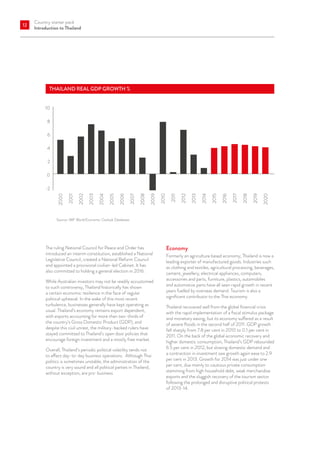
Thailand recovered well from the global financial crisis
with the rapid implementation of a fiscal stimulus package
and monetary easing, but its economy suffered as a result
of severe floods in the second half of 2011. GDP growth
fell sharply from 7.8 per cent in 2010 to 0.1 per cent in
2011. On the back of the global economic recovery and
higher domestic consumption, Thailand’s GDP rebounded
6.5 per cent in 2012, but slowing domestic demand and
a contraction in investment saw growth again ease to 2.9
per cent in 2013. Growth for 2014 was just under one
per cent, due mainly to cautious private consumption
stemming from high household debt, weak merchandise
exports and the sluggish recovery of the tourism sector
following the prolonged and disruptive political protests
of 2013-14.
THAILAND REAL GDP GROWTH %
2000
2001
2002
2003
2004
2005
2006
2007
2008
2009
2010
2011
2012
2013
2014
2015
2016
2017
2018
2019
2020
10
8
6
4
2
0
-2
Source: IMF World Economic Outlook Databases
Country starter pack
Introduction to Thailand
13
Headline inflation for 2014 was 1.9 per cent and is expected
to be subdued at 1.3 per cent for 2015. The International
Monetary Fund (IMF) forecasts Thailand’s economic growth
to gather steam in 2015 and 2016, with GDP growing 3.7
per cent and 3.9 per cent respectively.
In October 2014, the Thai Government unveiled
an economic reform agenda to make Thailand more
attractive as a regional trading hub and as a means
of developing its digital economy. The reforms being
introduced are aimed at promoting Thai investment
overseas, cutting the cost of doing business in Thailand,
tackling corruption, improving logistics and infrastructure,
building a better tax structure, and developing a new body
to govern the digital economy. The reforms are intended
to support the Thai private sector, facilitate trade and
promote overseas investment.
A key factor affecting the country’s economy is the role
played by the four major global economies – China,
Japan, the US and the European Union (EU). Japan is
Thailand’s biggest investor, with Japanese enterprises and
individuals accounting for the bulk of applications lodged
with the BOI in recent years: 49 per cent of applications
in 2011, 58 per cent in 2012 and 54 per cent in 2013,
with investment totalling around $10 billion in 2013.
Thailand permits foreign investment in all sectors, except
for projects related to national security, agriculture and
fisheries, and mass media. However, in many sectors
foreign investment is restricted to a minority interest.
After Japan, Thailand’s biggest foreign investors are Hong
Kong, Singapore, the US and the EU.
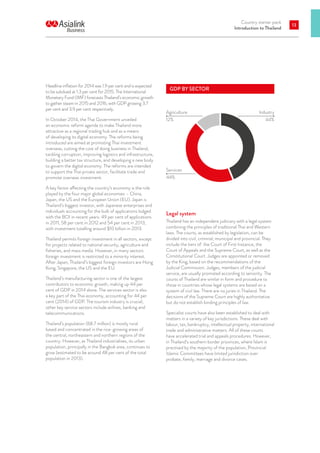
Thailand’s manufacturing sector is one of the largest
contributors to economic growth, making up 44 per
cent of GDP in 2014 alone. The services sector is also
a key part of the Thai economy, accounting for 44 per
cent (2014) of GDP. The tourism industry is crucial;
other key service sectors include airlines, banking and
telecommunications.
Thailand’s population (68.7 million) is mostly rural
based and concentrated in the rice-growing areas of
the central, northeastern and northern regions of the
country. However, as Thailand industrialises, its urban
population, principally in the Bangkok area, continues to
grow (estimated to be around 48 per cent of the total
population in 2013).
GDP BY SECTOR
Agriculture
12%
Industry
44%
Services
44%
Legal system
Thailand has an independent judiciary with a legal system
combining the principles of traditional Thai and Western
laws. The courts, as established by legislation, can be
divided into civil, criminal, municipal and provincial. They
include the tiers of: the Court of First Instance, the
Court of Appeals and the Supreme Court, as well as the
Constitutional Court. Judges are appointed or removed
by the King, based on the recommendations of the
Judicial Commission. Judges, members of the judicial
service, are usually promoted according to seniority. The
courts of Thailand are similar in form and procedure to
those in countries whose legal systems are based on a
system of civil law. There are no juries in Thailand. The
decisions of the Supreme Court are highly authoritative
but do not establish binding principles of law.
Specialist courts have also been established to deal with
matters in a variety of key jurisdictions. These deal with
labour, tax, bankruptcy, intellectual property, international
trade and administrative matters. All of these courts
have accelerated trial and appeals procedures. However,
in Thailand’s southern border provinces, where Islam is
practised by the majority of the population, Provincial
Islamic Committees have limited jurisdiction over
probate, family, marriage and divorce cases.
Country starter pack
Introduction to Thailand
14
Infrastructure
Thailand’s spending on infrastructure has lagged behind
some regional neighbours, such as Singapore, and can
present a challenge for those enterprises contemplating
doing business in the country. Rankings issued by the
World Economic Forum underscore the degree of
difficulty: out of 144 countries, it placed Thailand’s road
network 50th, rail 74th and port infrastructure 54th. The
quality of Thailand’s air transport infrastructure comes
in at 37th place. However, investment in infrastructure
continues to grow after a capital boost from the Thai
government, anxious to raise the standard of the
country’s transport network.
In October 2014, The National Council for Peace
and Order approved a THB 2.4 trillion infrastructure
development blueprint that includes projects to improve
the nation’s highways and water transport networks, as
well as Thailand’s air transport competitiveness. On top
of this, the government unveiled a THB 127 billion project
to build six dual-track rail lines with a combined length of
887 kilometres.
Roads: Thailand has an extensive road network of
approximately 400,000 kilometres, most of which is
paved with concrete or asphalt. A system of national
highways connecting the regions, provinces and
districts is well maintained and adequate for long haul
transportation, while special highways such as tollways
and motorways have a minimum of junctions, allowing
traffic to flow at higher speeds.
Sea ports: Thailand’s water transportation system
has been part of the country’s history for centuries.
More than 120 ports, wharves and jetties are able to
accommodate sea-going vessels engaging in international
trade. Deep sea ports are located in Bangkok, Laem
Chabang and Map Ta Phut on Thailand’s eastern
seaboard, while Songkhla, Satun, Narathiwat, Phuket and
Ranong are located in the south. The most important port
for freight is Laem Chabang, which is a gateway to the
Asia Pacific. Ranking next is Bangkok Port, which serves
the central region. Chiang Saen Port is a significant
launching pad for the north, as a gateway to trade
with southern China, while Ranong Port is vital for the
Andaman coastal area.
Waterway journeys for locals and visitors are
commonplace, used for every purpose including
commuting to and from work, cruising rivers and canals
or crossing to popular islands such as Koh Samet and
Koh Lipe. Meanwhile, shuttle boats cross canals or rivers,
particularly the Mekong and Chao Phraya rivers, and
Saen Saep canal in Bangkok.
Rail and mass transit systems (MTR): Thailand’s rail
transportation covers more than 4,000 kilometres and
extends from Bangkok to the Malaysian border in the
south and the Lao border in the northeast, as well as to
the country’s northernmost provinces and Kanchanaburi
in the west. In order to alleviate traffic snarls in Bangkok,
three mass transit systems have been developed totalling
85 kilometres. The first system, known as the Skytrain,
opened in 1999 and operates on overhead tracks. A
second system, which opened in 2004, is a subway.
Additionally, a dedicated overhead line from the city to
Suvarnabhumi Airport was opened in 2011. A number of
extensions of the Skytrain to the suburbs of Bangkok are
currently being constructed or planned and are expected
to be operating within five years.
Airports: Thailand has developed an extensive air
transport network that encompasses 28 commercial
airports, of which nine are international airports. Bangkok
has become a major hub for air services in the region,
with direct services to all parts of the world. Bangkok’s
Suvarnabhumi Airport is ranked as number 47 on the
2015 Skytrax World’s Top Airports.
Telecommunications: Modern telecommunication
facilities are available across the country, especially in
urban areas. Fixed line telephones, mobile phones and
access to the internet are readily available. However,
while the overall penetration of broadband connections
remains quite low, the growth rate is beginning to
accelerate smartly. During recent years, ownership of
mobile phones has grown at a much faster rate than
that of landlines. Indeed, mobile phones now outnumber
landlines almost five to one, with 98 per cent of the Thai
population owning a mobile. The mobile phone market is
serviced by AIS, DTAC, True Move, TrueMove H, Hutch,
and DPC. With the use of smart phones and tablets on
the rise, major mobile operators are also offering 3G and
4G services.
The Thai internet market continues to expand, as Thailand
looks to build capacity and catch some of its regional
competitors. Despite this, the country’s estimated
personal computer penetration rate remained less than
25 per cent at the end of 2013 with high-speed internet
access only nascent. Operators were looking at a variety
of delivery methods to augment internet penetration
with the current rate being 28.9 per cent (2014). The
burgeoning mobile market in Thailand ensured that mobile
phones, as well as set-top boxes, were high on the list of
potential delivery devices. At the same time, the cyber
cafe in its various guises had already established itself as
a key element in the country’s access equation. Most
importantly, with 3G and 4G services being rolled out in
a significant way, mobile broadband is booming. Mobile
broadband usage has a current estimate of 50 million
users, with Thailand becoming the second-largest mobile
broadband subscriber in ASEAN (after Singapore) once
the nation completes setting up of a high-speed fourth-
generation (4G) network.
Country starter pack
Introduction to Thailand
15
LAOS
VIETNAM
CAMBODIA
MYANMAR
MALAYSIA
Don Mueang
Samui
krabi
Phuket
Hat Yai
Surat Thani
28 COMMERCIAL
AIRPORTS
(9 international)
OVER 400,000KMS
OF ROAD NETWORK
OVER 4000KMS OF
RAIL NETWORK
OVER 120 PORTS
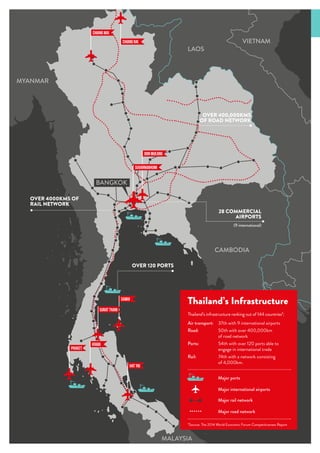
Thailand’s infrastructure ranking out of 144 countries*:
Air transport:	 37th with 9 international airports
Road:	 50th with over 400,000km
	 of road network
Ports:	
54th with over 120 ports able to
engage in international trade
Rail:	 74th with a network consisting
	 of 4,000km.
Major ports
Major international airports
Major rail network
Major road network
Thailand’s Infrastructure
*Source: The 2014 World Economic Forum Competitiveness Report
Suvarnabhumi
chiang mai
chiang rai
BANGKOK
Country starter pack
Introduction to Thailand
16
1.3	THAILAND AND AUSTRALIA:
THE BILATERAL RELATIONSHIP
When Australians think of Thailand, tropical holidays and
Thai food spring to mind for many. But there is much
more to Australia’s relationship with Thailand than tourism
and tasty cuisine. The two countries have extensive and
long standing connections – spanning trade, investment,
business, regional security and culture. Diplomatic
relations date back more than 60 years, but the
connections have grown more rapidly in recent times with
Thailand’s emergence as one of the leading economies
of Southeast Asia, and with Australia’s increasing
engagement with Asia generally.
The bilateral economic relationship is strong, with Thailand
now Australia’s eighth largest trading partner in goods
and services, and our second largest partner among the
countries of ASEAN with a two-way trade in the financial
year of 2013-14 (from here on referred to as 2014 for
this section) of $19 billion (including services). Unlike
our trade relationships with some other Asian countries
such as China and Japan – in which Australia enjoys a
substantial trade surplus – with Thailand we have a deficit
in goods and services trade, which means we buy much
more from the Thais than they do from us.
In 2014, Australia’s imports of goods and services from
Thailand totalled more than $13 billion, while our exports
to Thailand were just over $6 billion. Commercial and
passenger vehicles – including popular Toyota and Honda
models built in Thailand – make up more than $4.5
billion of our imports from there. Conversely, Australian
automotive parts makers have established a valuable, if
smaller, business supplying to the Thai car industry.
Australia’s biggest export categories to Thailand include
gold (almost $600 million) and crude petroleum
(worth more than $1.7 billion a year) along with coal and
aluminium. Australia also has substantial services exports
to Thailand, totalling about $848 million in 2014 – of
which around $571 million was in education exports.
Country starter pack
Introduction to Thailand
17
The trade and economic relationship has grown strongly
since 1 January 2005 when the Thailand-Australia Free
Trade Agreement (TAFTA) came into force. It was
Australia’s third comprehensive free trade agreement,
and Thailand’s first with a developed country.
Under the agreement, the majority of Thai tariffs
on goods imported from Australia – which in some
categories had been levied at up to 200 per cent – have
been eliminated. This has given Australian exporters
of horticulture, dairy, grain, mining, processed food
and beverages an edge over their European and North
American rivals. Total two-way trade between Australia
and Thailand has more than doubled since the agreement
came into operation.
The agreement has led to substantial growth in
agribusiness trade in particular, with increased wheat,
cotton and milk powder exports from Australia to Thailand
and rice exports from Thailand to Australia. Education
dominates Australia’s service exports to Thailand, with the
biggest areas including English training, teacher training
and hospitality training. The stock of Thai investment in
Australia has also grown spectacularly, from $338 million
in 2006 to $6.1 billion in 2013. Australian investment in
Thailand for 2014 was worth about $3 billion.
AUSTRALIA’S TRADE AND INVESTMENT RELATIONSHIP WITH THAILAND
Australian merchandise trade with Thailand 2014 A$m Total share* Growth (yoy)
Major Australian Exports, 2014 (A$m) 5,173 1.9% 5.4%
	 Crude Petroleum 1,731
	Gold 590
	Aluminium 399
	Coal 279
Major Australian Imports, 2014 (A$m) 10,942 4.3% -4.1%
	 Crude petroleum 2,078
	 Refined petroleum 500
	 Iron, steel, aluminium structures 391
	 Ships  boats (incl hovercraft) 310
Total trade (exports and imports) 16,115 3.1% -1.3%
Australian services trade with Thailand 2013-14
Major Australian service exports, 2013-14 (A$m) 848 1.5%
	 Education-related travel 571
	 Personal travel excl education 115
Major Australian service imports, 2013-14 (A$m) 2,171 3.1%
	 Personal travel excl education 1,463
	Transport 535
Source: Department of Foreign Affairs and Trade’s Thailand fact sheet 2014
* Total share of Australia’s international trade
Country starter pack
Introduction to Thailand
18
Key elements of the TAFTA deal that offer benefits to
Australian businesses include:
•	 The elimination of 94 per cent of Thailand’s tariff and
quota barriers on imports from Australia as of 2010,
with the remaining tariffs phasing to zero in 2015 or
2020 (with the exception of skim milk powder and
liquid milk and cream, for which the tariff rate quotas
will be eliminated in 2025)
•	 More open access for Australian companies to
Thailand’s services market and a commitment to
liberalise two-way services trade in future
•	 Increased access for Australian investors in Thailand,
with majority Australian ownership permitted for
businesses in certain sectors including mining,
construction, restaurants and hotels, tertiary
education institutions and maritime cargo services
•	 More investment protection for Australian direct
investors in Thailand, including the right to transfer
their funds out of Thailand at any time, and the right
to seek impartial resolution of any disputes with the
Thai Government over their investments
•	 Easing of visa and other requirements for the
temporary entry of Australian business people to
Thailand.
While large parts of the agreement have been in force
for some time, there is still more work to be done
to implement remaining elements covering issues
such as food standards and agriculture. In addition to
TAFTA, Australia and Thailand are also parties to the
ASEAN-Australia-New Zealand Free Trade Agreement
(AANZFTA), which came into force on 1 January 2010.
Thanks to this agreement, goods produced in Thailand
with materials from other ASEAN states still receive tariff
reductions, further enhancing Thailand’s attractiveness as
a regional manufacturing hub.
People-to-people ties
While the relationship between Thailand and Australia
is unquestionably dominated by tourism and business, it
goes much further than that. Formal diplomatic relations
were established in 1952. Fifty-three years later, as the
business relationship was beginning to thrive, a treaty-
level Agreement on Bilateral Cooperation came into
force, providing a framework for bilateral cooperation in
non-trade areas, including security and law enforcement,
environment and heritage, science and technology,
telecommunications, civil aviation, public administration,
energy, immigration, education, culture and social
development. A Memorandum of Understanding (MOU)
on ‘Work and Holiday’ visas allows nationals of both
countries to undertake 12 month working holidays in the
other country.
The tourism and business trades underpin extensive
people-to-people links between our countries. More
than 565,000 Australians visit Thailand each year on
holidays or business (Tourism Australia), while more than
45,000 Thais live in Australia (2011 Census). The Thai-
born population in Australia is one of the fastest growing,
having doubled between 2001 and 2011, according to the
2011 Census. The relationship is expected to strengthen
further in 2015 with Thailand beginning to host Australian
New Colombo Plan scholars.
Australia has enjoyed a close relationship with the Thai
royal family. His Majesty King Bhumibol Adulyadej and his
wife Queen Sirikit visited Australia in 1962 and the Thai
Crown Prince, His Royal Highness Maha Vajiralongkorn,
studied at secondary school and military college in
Australia, subsequently completing training with the
Australian Army’s Special Air Service Regiment in Perth.
Over the past couple of decades, Australian and Thai
prime ministers have visited each other’s nations with
senior government officials visits regularly occurring.
In August 2012, Her Royal Highness, Princess
Bajarakitiyabha visited Australia to mark the 60th
anniversary of diplomatic relations between Australia
and Thailand.
Country starter pack
Introduction to Thailand
19
Defence and regional security
Regional security has become a key area of mutual
interest and cooperation between Thailand and Australia
in the early part of this century. The two countries
concluded a bilateral memorandum of understanding
on counter terrorism in 2002. This was followed by
memorandums on police cooperation (June 2003),
mutual assistance in customs matters (December 2003),
and money laundering (June 2004), and a Mutual Legal
Assistance Treaty (July 2006). There is also regular
high level dialogue on regional security. Thailand has also
cooperated with Australia on regional efforts against
people smuggling and trafficking, and has extradited
accused people smugglers to stand trial in Australia.
Thailand also hosts the Regional Support Office for the
Bali Process on People Smuggling, Trafficking in Persons
and Related Transnational Crime. The office supports and
strengthens practical cooperation on refugee protection
and international migration.
Defence ties between Thailand and Australia date
back to the end of World War II, when an Australian
Defence Section was established in Bangkok in August
1945. Its primary role was to oversee the repatriation of
surviving Australian prisoners-of-war, and the recovery
and reburial in the Commonwealth War Cemetery
in Kanchanaburi of the remains of those who died on
the Thai-Burma Railway. Over the next 30 years, Thai
and Australian armed forces served together in various
missions including the Korean War and the Vietnam War.
In 1972, a formal Defence Cooperation (DC) Program
was initiated, involving training and combined maritime,
ground and air exercises. The program has continued to
develop over ensuing decades, and now involves regular
senior officer visits; seminars and workshops; individual
education and training courses for Royal Thai Armed
Forces personnel at Australian Defence Force schools,
colleges and national universities; annual combined
exercises; logistics systems and support; and science and
technology cooperation.
Since the early 1990s, Royal Thai Armed Forces and
Australian Defence Force personnel have served together
in United Nations operations in Cambodia, Somalia and
East Timor and, more recently, in coalition operations in
Iraq. Defence policy talks have also been held annually
since 1990, with the aim of continual improvement in
the bilateral defence relationship, and promotion of
understanding and cooperation on regional security
issues. There is also an annual bilateral dialogue on
regional security issues, involving foreign affairs, defence
and military officials.
Development assistance is another area in which Australia
engages with Thailand. In November 2003, Thailand
moved from being an aid recipient to an aid donor.
However, Australian regional aid programs in human
trafficking, labour rights, health, disaster management
and economic integration continue to include Thailand.
Australia also provides limited support to Thailand as
part of efforts to strengthen the capacity of regional
organisations such as ASEAN and APEC.
Country starter pack
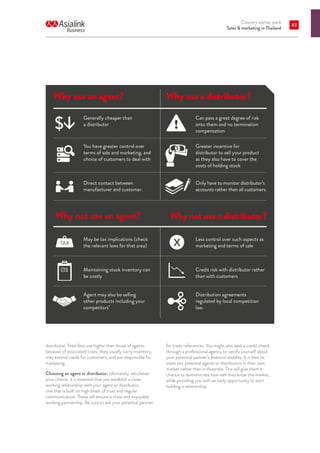
Getting started in Thailand
20
2. Getting started in Thailand
Country starter pack
Getting started in Thailand
21
Knowledge is power, and knowledge of the market you are
about to enter is essential for business success. The more
you can get to grips with the peculiarities of a particular
market outside Australia, the better prepared you will
be. It is important, therefore, to become informed on a
range of subjects on Thailand – from labour laws and tax
matters, to banking provisions and financial regulations.
In addition, smart business operators will also take time
to familiarise themselves with cultural norms, particularly
as they pertain to doing business, as well as the local
language. Inadequate research has brought many a
market foray unstuck.
There are some general principles to bear in mind when
considering cultural and business differences while
operating abroad, including some that are unique to
Thailand. This chapter provides detailed information on
how to go about researching the Thai market – what to
look for and where to find it. It also includes advice on key
considerations and decisions to be made before launching
your business venture – choosing a location, hiring
interpreters, assessing the potential risks of operating in a
foreign environment, and potential business structures.
Country starter pack
Getting started in Thailand
22
2.1	 WHATYOUNEEDTOCONSIDER
Location
There are a myriad of locations that can be used for
establishing a foothold in Thailand’s bustling economy, but
it is wise to match your choice of location with the market
that your business is looking to target. Increasingly,
foreign enterprises are focusing on niche opportunities,
and that can dictate a specific location or geography
rather than one chosen more generally as a catch-all for
customers. Either way, detailed research is essential.
Key regions: Geographically, Thailand is broadly divided
into four distinct regions comprising 77 provinces. Bung
Kan district, in Nong Khai, northeast Thailand, became
the country’s latest province, designated in August, 2010.
The four regions are:
•	 Central: The location of Bangkok, the Kingdom’s capital
•	 Northeast: Encompasses the country’s most
populous region and is home to Nakhon Ratchasima
(Korat), a major industrial city.
•	 North: Takes in the cities of Chiang Mai and
Chiang Rai.
•	 South: Includes the popular coastal resorts of Phuket,
Koh Samui, Hua Hin, Phang Nga and Krabi.
Bangkok, as well as serving as the nation’s capital and
centre of government, is also its economic, educational
and cultural focal point. With a greater metropolitan
population of more than 9 million (almost one in every
10 Thais resides there), Bangkok stands as Thailand’s
principal entry point for international traders and
investors, accounting for 44 per cent of the country’s
GDP. This commercial hub is a natural drawcard with its
numerous industrial estates and gateway to important
national markets.
Thailand’s eastern coastline contains a sweeping industrial
zone and is home to Thai and foreign-owned industries
that include automotive, engineering, large-scale
manufacturing, petrochemicals and power generation.
The industrial strip straddles the provinces of Chonburi,
Chachoengsao, Samut Prakan and Rayong, and includes
the leading port of Laem Chabang, Thailand’s biggest and
one of the world’s most industrious.
Free trade zones: On top of the Thailand-Australia
Free Trade Agreement (TAFTA), free trade zones have
been declared throughout Thailand in a bid to entice
greater foreign investment. These include industrial
estates established by the Industrial Estate Authority of
Thailand (IEAT), of which there are two types: General
Industrial Zones (GIZ) that are reserved for enterprises
manufacturing goods for domestic and/or export
consumption, and Export Processing Zones (EPZ),
earmarked for export-only industries. Most of the latter
zones have government customs houses for fast clearing.
Where should I set up my business?
Factors to consider:
1.	 Are there other Australian companies
there? Why did they choose a particular
area?
2.	 Can you use an existing Australian
relationship there (e.g. sister city)?
3.	 What are the local costs (e.g. land,
labour, utilities)?
4.	 Is it within a free trade zone that offers
tax and other incentives?
5.	 What is the skill level of the local labour
force?
6.	 Can you leverage off an existing
marketing or distribution network?
7.	 Is it close to your chosen market and
suppliers?
8.	 Do you have a good agent/distributor or
business partner there?
Country starter pack
Getting started in Thailand
23
Koh Chang
Koh Phangan
bangkok
Chiang Mai
Chiang Rai
Laem Chabang
koh samui
Hua Hin
phuket
thailand
is divided into four distinct regions comprising
77PROVINCES
The four regions are
Central, Northeast,
North and South
bangkok
9 MILLION
POPULATION OF
The Thai capital,
is the centre of government and the nation’s biggest city with a
It is the
THAI focal
point for CULTURE
THE ECONOMY EDUCATION
44 per cent
AND ACCOUNTS FOR
of the country’s GDP
Thailand’s eastern coastline
contains a sweeping industrial
zone and is home to Thai and
foreign-owned industries that include
engineering, petrochemicals
The southern region is well
known for travel and tourism
The cities of Chiang Mai and Chiang
Rai in the northern region are both
popular destinations for tourists,
and are well known for hand-made
craft. The northeast is the most
populous region and is home to
Nakhon Ratchasima (Korat), a major
industrial city and also a primary
source of crops and rice.
boasting the popular coastal resorts of
Phuket, Koh Samui, Hua Hin,
Phang Nga and Krabi
krabi The industrial strip straddles the
provinces of Chonburi, Chachoengsao,
Samut Prakan and Rayong, and includes one
of the world’s most industrious ports, the
AUTOMOTIVE MANUFACTURING
POWER
port of Laem Chabang
Nakhon Ratchasima
Country starter pack
Getting started in Thailand
24
These estates are designed to be self contained industrial
communities with reliable, essential infrastructure such as
electricity and water, and with flood protection, as well as
access to waste water treatment and solid waste disposal.
They also have communications facilities, security
systems and banks.
These government sponsored industrial zones aim to
support regional development and specific sectors of the
economy, while industrial parks remain entirely a product
of the private sector.
There are clear benefits for operating in government
endorsed free trade zones: they offer special tax
treatment and other incentives, and other privileges that
can instantly enhance a newcomer’s competitiveness.
Associated tax-based incentives can include an income
tax “holiday”, plus exemptions from import duties and
value-added (or goods and services) tax. Excise tax
exemptions can cover plant and equipment, raw materials,
imports into an EPZ and exports from the zone. The
benefits of operating in a government trade zone can also
include the ability to bring in foreign workers, own land
and take or remit foreign currency abroad.
Manufacturing: Choosing a location for your factory
Apart from government owned zones, Thailand has many
hi-tech private sector industrial parks that look to support
regional development in specific industrial sectors and
those nominated as top priority by the Thailand Board of
Investment (BOI). Most offer BOI incentives and confer
privileges that can vary according to the type of business,
the scale of capital invested and the physical location or
“zone” in which the business is located.
Using interpreters
Thai is the official language, although English is spoken
widely and understood in business circles, particularly in
the major cities, especially Bangkok. However, written
English is less commonly used or understood. Thai is a
tonal language and has five distinct tones, making the
tone in the pronunciation of a word critical to its meaning.
So, one word can have five totally different meanings.
Consequently, mispronunciation can conjure an entirely
different meaning from that which was intended.
A consolation is that Thais are very forgiving when
foreigners attempt to speak their language, and once they
understand what a farang (typically, a white foreigner) is
trying to communicate, they will happily coach him or her
on how to pronounce the word correctly. As mentioned,
cultural norms dictate the importance that Buddhism
and the royal family play in Thai life, but also influence
the meaning of particular words. For example, it is best to
double-check that a “Yes” is in fact a confirmation, as it
can sometimes be used simply as an acknowledgement.
While using an interpreter won’t generally be necessary
during business dealings in Thailand, it can be extremely
helpful during complex negotiations, especially those
of a technical nature, or when dealing with a large
group. Sometimes, local participants in a meeting will
start speaking to one another in Thai as they discuss
aspects of a deal or to clarify aspects of a conversation
they may not have fully grasped in English. This can be
challenging without the help of an interpreter. While Thais
are generous and usually considerate, often explaining
their discussion to their business guests, an interpreter
can identify nuances and ensure that you are imparting
information that is relevant and effective.
There is good access to interpreters in Thailand, usually
through international and local language schools.
Some points to keep in mind when hiring an interpreter
include:
•	 Ideally, they should be professionally trained and have
experience working with business people.
•	 They should be familiar with the sort of technical
language specific to your business and also with your
style of operation.
•	 Trust is important. You need someone who will give
you confidence in communicating with your local
business partners, and especially potential partners
and customers.
•	 Longer term, you may want to consider employing
your own interpreter or bilingual staff full-time.
Is Thailand a viable
option?
Have a detailed financial plan that
considers:
•	 Regular visits to the market and
possible provision of samples
•	 Hiring dedicated staff in Thailand to
assist with start-up
•	 Business advisory services and legal
consultants
•	 Updates and adjustments as you collect
more data and knowledge
•	 Contains scenario planning and risk
mitigation approaches.
Country starter pack
Getting started in Thailand
25
•	 Make sure you brief your interpreter extensively
ahead of key meetings or appointments so that they
understand your needs and ambition. Where relevant,
make sure they are across key terminology or specific
concepts so that they can articulate this clearly in
negotiations.
Translators: Interpreters are not necessarily translators;
the two skills are very different and not always
interchangeable. Interpreters are used for interpreting
speech; translators for deciphering the written word.
Mostly, people specialise in one discipline.
Finding a good interpreter: The recommendation of a
trusted source or contact can usually lead to a proficient
interpreter or translator. But beware – being able to
speak fluent Thai does not guarantee that a person
will be a good interpreter. Interpreting is a skill of its
own. Nor does hiring an interpreter on the strength
of an advertisement placed on the internet or in a
trade directory guarantee top service, unless this is
accompanied by reputable third-party endorsement.
What it costs: Costs of hiring interpreters or translators
are likely to vary depending on the nature of the business
interaction – for example, is it an informal occasion,
such as a factory visit or social event, or a more formal
(and likely intense) business meeting or negotiation? The
length of time will add cost, obviously, and whether the
location is in Bangkok or another city such as Chiang
Mai. An interpreter’s average charge can range from $11
to $19 an hour. Sometimes, it may be best to negotiate
a daily rate, especially if you are hoping to cement an
ongoing relationship with an interpreter so that he or she
can develop a good understanding of your business and its
workings.
Financing your Thai business venture
Getting to grips with the likely costs of running your
business in another country will be critical in allowing you
to make an informed decision about when to proceed
with your venture. Key differences operating in Thailand
versus Australia can include:
•	 The likelihood of a longer cash flow cycle, and
subsequent impact on the company’s cash and
working capital positions
•	 Potential alienation from clients through distance,
raising the risk of default and the degree of difficulty
in chasing debts
•	 Being paid in foreign currencies, introducing foreign
exchange risk and a potentially adverse effect on
profits
•	 Limited access to finance, should your local bank be
reluctant to accept foreign assets as security for loans
•	 More time needed to recover any upfront costs
associated with setting up overseas, which could
put the squeeze on funds needed for domestic
operations.
Country starter pack
Getting started in Thailand
26
Ensuring that your business is fuelled by adequate finance
will be critical to succeeding in a foreign market: careful
financial planning is a necessity. But one size will not
fit all ventures. There are several financing options to
consider and whether they are a good fit for your business
will depend on variables such as the type of business
operation you are proposing, whether you are exporting
or importing, whether you are establishing a facility
from scratch or investing in an established one. You may
wish to gain access to various grants, tap venture capital
or enter some type of equity-sharing arrangement,
which are becoming increasingly popular. Of course,
borrowing from the bank can be the simplest and most
straightforward option for many entrepreneurs, and most
will leverage their business by offering tailored services to
customers.
Venture capital: Can be an attractive financing vehicle for
ventures looking to move into new international markets,
especially for operators comfortable with the notion of
a third party taking a stake in their business in return for
a share of the profits. A starting point for exploring this
option would be the website of Australian Private Equity
and Venture Capital Association Limited at
www.avcal.com.au.
Government assistance: Can help bring great ideas
to fruition, with both federal and state governments
offering a range of help to Australian businesses looking
to expand overseas, especially exporters. Assistance can
take the form of grants, loan facilities and reimbursement
schemes. Information can be sourced from Australia’s
export credit agency, the Export Finance Insurance
Corporation (efic), at www.efic.gov.au, as well as the
Export Market Development Grants (EMDG) scheme,
administered by Austrade, at: www.austrade.gov.au/EMDG.
As well as these sources of finance, business owners
might also consider:
•	 Teaming with a Thai partner in a joint venture
•	 Taking on board an equity investor – or so called
‘angel investor’ – with like minded goals and a good
understanding of your business ambition.
Stock Exchange of Thailand (SET): Provides a range of
services including listings, initial public offerings and stock
trading. Listing on the SET is one way to access financing
through the Thai capital market. Reports and detailed
information on various sectors of the Thai economy are
available on their website.
www.set.or.th
Risks
No venture can be entirely risk free, but solid and detailed
research into an overseas market is vital to minimising
any risks associated with doing business there. Asia can
offer tantalising upsides for Australian businesses that
are well prepared and well run, but experience attests
to the increased risks of going offshore. These need to
be identified and mitigated as much as practicable, and
managed carefully from day one. Due diligence is not
simply a throwaway line, but must be practised actively
throughout the drafting and execution of business plans,
with attention paid to the protection of intellectual
property (IP) in Thailand.
As in any foreign country, Thailand’s business climate,
namely its banking, taxation and legal systems, all have
unique features that must be well understood and
navigated carefully ahead of launching your operation
there.
A key drawback in targeting Thailand ahead of other
Asian markets has been its political instability, difficulty
enforcing contracts and volatility of the baht. Aside from
political risk, efic nominates the vagaries of the business
cycle, sovereign default and other risks affecting foreign
investors and exporters. It ranks these as ranging from
low to moderate in severity. Thailand’s high reliance on
exports, which leaves the economy vulnerable to swings in
global demand, is of particular concern.
While Thailand has experienced 19 coups over the past
80 years, it is important to note these have had minimal
impact on business. Both sides of Thai politics and
the Thai military are pro-business and support foreign
involvement in the Thai economy.
The protection of IP also remains an issue for businesses
operating in Thailand. The US Trade Office had Thailand
among 10 countries on its 2014 Priority Watch List,
which focuses on countries not providing an adequate
level of IP protection or enforcement, or market access
for anyone relying on IP protection. While overall
protection of IP rights in Thailand has been improving
in recent years in the wake of new laws, enforcement
remains patchy. Campaigns gathered steam for a time,
but the effort has not been generally sustained.
Thailand enjoys a good credit rating, with Fitch Ratings
giving the country a ‘Stable’ outlook and a BBB+ rating.
Country starter pack
Getting started in Thailand
27
Common areas of risk
When doing business overseas, Australians must consider multiple areas of risks and
associated potential difficulties. These include:
Political risk: How stable is the market
politically, economically and socially?
•	 Government and international enforced
trade embargoes may affect the flow of
goods and services and could affect your
delivery of goods and getting paid
•	 Another potential consideration is whether
the country complies with international
law requirements, such as on human rights,
trade sanctions and recognition of personal
property rights.
Legal and regulatory risk: Challenges may
arise due to differing legal and regulatory
systems. For example:
•	 Common law systems verses civil law
systems, IP issues, taxation and auditing
requirements
•	 Differences in contract law: get tailored
advice on contract terms due to
differences with contract laws
•	 Access to courts and dispute resolution
mechanisms: some countries may not
permit local litigation or place restrictions
on the types of claims that can be made.
Bribery, graft and corruption risk:
•	 Bribery, graft and corruption are illegal in
most countries around the world. Under
Australian law (Division 70 of the Criminal
Code Act 1995) ) you can face criminal
prosecution in Australia for bribing a public
official in another country.
Exchange rate risk: How will adverse
movements in exchange rates impact on
your profits?
Non-payment risk: What is the likelihood
of your suppliers or customers defaulting or
becoming insolvent?
Country starter pack
Getting started in Thailand
28
THE MOST PROBLEMATIC FACTORS FOR DOING BUSINESS*
5 10 15 20 25
Foreign currency regulations
Poor public health
Inflation
Restrictive labour regulations
Crime and theft
Tax regulations
Tax rates
Access to financing
Poor work ethic in national labour force
Inadequately educated workforce
Inadequate supply of infrastructure
Insufficient capacity to innovate
Policy instability
Inefficient government bureaucracy
Government instability/coups
Corruption
2013 BUSINESS CLIMATE INDICATORS*
GOVERNANCE INDICATORS
Thailand
Source: World Bank  efic
*Country percentile rank
Per cent
Emerging and developing Asia
Control of corruption
Rule of law
Regulatory quality
Government effectiveness
Political stability and absence of violence
Voice and accountability
0 25 50 75 0 25 50 75
Source: The 2014 World Economic Forum Global Competitiveness Report
*Ranked by respondents per the perceived top five problematic factors in doing business in Thailand
Country starter pack
Getting started in Thailand
29
Despite its prolonged instability, Thailand advanced six
places, to 31, in the World Economic Forum’s Global
Competitiveness Index 2013-14. The country climbed 12
places in the rankings of macroeconomic environments
and now sits in 19th position, its best showing among the
12 categories measured, referred to as pillars. In 2013,
Thailand almost balanced its budget and brought inflation
down to 2 per cent. Public debt remained stable, with
the country’s savings rate high. It continued to do well in
financial development (34th on the list) and improved
its already strong showing in the market efficiency pillar
(30th, up four places).
However, competition within the Thai economy
continued to be constrained by various barriers to
entry, especially those pertaining to foreign investment.
The index confirmed that considerable challenges also
remained in other key areas, especially those relating
to governance. Political and policy instability, excessive
red tape, widespread corruption, security concerns and
high uncertainty around property rights protection were
seriously undermining Thailand’s institutional framework
(it ranked 93rd in the public institutions sub-pillar, down
eight places). In most of these areas, Thailand was placed
poorly. In particular, the level of trust in its politicians was
among the lowest in the world (129th place). Another
concern was the mediocre quality of education at all levels
(87th, down nine places on the previous rankings) and
technological readiness (65th), although Thailand showed
marked improvement in the latter (rising 13 places). It
should be noted that data used by the World Economic
Forum for its report were collected before the most
recent political developments, including the military coup
of May 2014.
Other global measures are also instructive when assessing
the Thai business environment. The World Bank’s “Doing
Business” reports, for example, shed light on how difficult
– or easy – it is for a local entrepreneur to open and run
a small-to-medium sized business when complying with
all relevant local regulations. Measuring and tracking
changes in regulations affecting 11 areas in the life cycle
of a business, the bank ranked Thailand 26 out of 189
countries in 2015 for the ease of doing business in the
country, up two places on its previous standing (2014).
In 2014, the country was ranked 85th
out of 175 nations in Transparency
International’s public sector
Corruption Perceptions Index (with
175 representing the most corrupt).
This was an improvement on Thailand’s
107th place, recorded the previous
year. By way of comparison, its
Southeast Asian neighbours recorded
mixed results: Malaysia came in at 50,
but Indonesia (107), Vietnam (119) and
Myanmar (156) all lagged well behind
Thailand.
Businesses contemplating launching operations in
Thailand need to understand that corruption remains an
issue there. Even so, anyone doing business in Thailand
can expect to come across – or hear indirectly about –
corruption in one form or another. This most common
take the form of facilitation payments, bribes and the
giving and receiving of expensive gifts in order to win
business. Australian firms operating in Thailand should
not engage in such practice and instead commit to the
most ethical of corporate behaviour, while taking time to
note Australian law and penalties regarding the bribery of
foreign officials, which is a crime. Australian individuals
and companies can be prosecuted in Australia for bribing
foreign officials.
Country starter pack
Getting started in Thailand
30
Source: The 2014 World Economic Forum Competitiveness Report
*Ranking out of 144 countries
1
2 3
Most
competitive
Least
competitive
Macroeconomic situation
Market efficiency
Financial development
Talent retention
Business sophistication
Pay and productivity
Technological readiness
Competitiveness
Health and primary education
Trust in politicians
Intellectual property protection
Quality of education
Public institutions
Innovation
150 120 90 60 30 0 30 60 90 120 150
INTERNATIONAL COMPARISONS OF COMPETITIVENESS*
Country starter pack
Getting started in Thailand
31
87th
30th
129th
104th
66th
67th
93rd
65th
19th
34th
36th
Another concern was the mediocre
quality of education at all levels
(down nine places on the previous
rankings).
It improved its already strong
showing in market efficiency
(30th, up four places).
The level of trust in Thailand’s
politicians was among the lowest in
the world.
Intellectual property protection ranks
low at 104th and therefore can be
a concern for businesses operating
in Thailand. Strengthening law
enforcement in IP is a key area the
Thai Government intends to improve.
The Thai population’s health
and primary education are good
compared to some of its neighbours
in Southeast Asia, however there is
room for improvement.
With a ranking of 67th for
innovation, the Thai Government
has a focus to improve the country’s
innovation and relevant industries
with foreign investment.
Thailand climbed 12 places in
the rankings of macroeconomic
environments, its best showing
among the 12 categories measured.
Public debt remained stable, with
the country’s savings rate high and
it continued to do well in financial
development.
Talent management and retaining
staff are some of the core challenges
businesses in the region experience.
Thailand ranks one of the best in Asia
for capacity to retain talent at 36th.
Political and policy instability,
excessive red tape and widespread
corruption were seriously
undermining Thailand’s institutional
framework (ranking 93rd in the
public institutions sub-pillar).
Thailand showed marked
improvement for technological
readiness (rising 13 spots).
Rank out of
144 countries.
1 being the most
competitive.
31st
41st
50th
Despite its prolonged instability,
Thailand advanced six places for
competitiveness.
Thais have a good understanding of
modern business structures, with a
high level of business sophistication.
Thailand ranks well in pay and
productivity, with Thai workers
highly productive and reasonable
wages offered for the skillset.
1
2 3
Country starter pack
Getting started in Thailand
32
2.2	RESEARCHING THAILAND
A consistent and key message throughout this guide has
been the worth and necessity of preparation and research.
Do your homework. Nothing beats comprehensive
inquiry, including specific market research, when looking
to enter new markets including Thailand, with its unique
and various features. These can include:
•	 Cultural and geographical complexities
•	 Evolving markets that can shift quickly
•	 Changing rules, regulations and the focus of
enforcement authorities
•	 Thin consumer data and vagaries of markets and
regulations
•	 The availability of information on how to navigate
processes and rule.
When conducting market research, it is important to cast
your net widely, taking note of import duties and other
broad regulations, including reviewing more market-
specific issues. What is the market’s size and growth
prospects, and its demographics? How many competitors
are there and what is the state of local production? How
will you distribute your product? Pulling together this
information can be straightforward, but the volume of
information can also be overwhelming. This section aims
to condense key areas that may assist you. However,
do not limit your Thai market investigation to this guide.
First, a couple of key considerations:
•	 Do not make the mistake of focusing on the needs
of your own company as opposed to the needs of the
Thai market
•	 It may be necessary to commission professional
research that looks specifically at market conditions
as they relate to your product and plans. You may also
need to travel to Thailand to familiarise yourself with
conditions and the nature of the opportunities and
challenge that awaits you. An internet search alone
will likely not suffice.
Getting help
Top tier international accounting and management firms
with a major presence in Thailand are valuable sources
of information, as are research-specific organisations.
Austrade also offers a range of services to Australian
businesses investigating prospects offshore, including
information and various checklists on:
•	 Market entry and how to grow your business
•	 Where to establish your business
•	 Locating on-the-ground contacts and tapping into
networks
•	 Identifying business opportunities.
Relevant state and territory government trade
departments and the commonwealth’s Export Market
Development Grant scheme (EMDG) may also provide
further information.
Country starter pack
Getting started in Thailand
33
Market visits
While much of your research can be directed from
Australia, you will need ultimately to visit Thailand to
verify what you have learnt and to develop a deeper
understanding of your target market, as well as to start
making contacts on the ground. Only once you have
started building relationships will you feel confident
negotiating contracts and agreements. As previously
outlined, cementing these links requires commitment and
focus, but also patience and understanding.
Determine where and when to visit. There are no fixed
rules about when to visit a market, except that you
should do so before entering into any agreements with
prospective agents, distributors or other business partners
that could influence your future dealings. Consider
meeting with several potential partners first to give you
a basis for comparison. It can be helpful to meet with
the contact that you believe will be the best fit for your
business towards the end of your trip. This will give you
time to develop a better understanding of the market
so that you can handle questions and discuss strategic
options with confidence. Concentrate your effort on only
one or two markets at first to ensure a better chance of
success.
Plan your trip well in advance. To ensure a successful
trip, you should arrange in-country assistance for the
planning and setting up of your program. This will help
you see the right agents and customers who will be
briefed and screened for interest and suitability. Take
note of holidays and religious festivals that occur at the
same time as your planned visit. Also ensure you have all
your required paperwork completed before departing for
Thailand, including your relevant visa and taking with you
(if applicable) any legal documentation such as financial
documents and regulation information. Having company
and product information and business cards is vital for
developing business relationships.
An easy-to-navigate, well-constructed and
up-to-date website is crucial
It allows you to:
•	 Present your product to potential overseas customers and business partners in cost-
effective ways
•	 Project an image of a professional and trustworthy business
•	 Convey that your business is “modern” and uses new technology
•	 Avoid problems with time differences
•	 Introduce, promote new products and sell directly to customers.
Do some background reading. If you have never visited
Thailand and don’t know much about the country and
its way of life, you should do some research online.
News articles and travel books can also provide useful
information. Having some broad background knowledge
about the area you are visiting will inform and focus your
discussions when negotiating with local partners. Guides
like this one, and others with a more specific industry or
product focus, will also be beneficial.
Have a good website before you go: A website can be
a double-edged sword: it is a convenient and powerful
calling card that allows potential associates and customers
to learn about you and your company quickly and
efficiently. But a bad website can turn off clients if it looks
shoddy and the information it contains is out of date or
indigestible. The best websites are clean and attractive,
easy to navigate and informative. They should present
information about your company clearly and concisely,
preferably with attractive illustrations and interesting
graphics. Remember, a website can also be a form of
endorsement: where possible, display customer or client
endorsements and photographs that testify to the quality
of your products and services. Ensure that contact details
are easy to find and link email addresses with photos of
each staff member.
Country starter pack
Getting started in Thailand
34
Building relationships and making connections
Don’t waste a trip to your target market by arriving
unprepared. There really is no point. Save valuable time
on the ground in Thailand by doing as much as possible
before leaving Australia, including any training or research
that can enlighten you about doing business there and
across Southeast Asia. Organisations such as Asialink
Business, Austrade, the Export Council of Australia
(ECA) and various state and territory government
departments are worthy first ports of call. Attending
specialist seminars and courses can allow you to build
valuable networks while getting expert advice from people
with experience of doing business in Thailand.
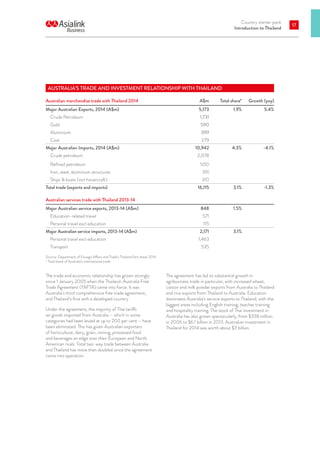
Part of your planning should include arranging as many
of your meetings in Thailand as possible before you leave
Australia, while reconfirming these a day in advance. Put
together a dossier that maps out your schedule, lists the
addresses for meetings and includes some information
about the people you are meeting. Pack your business
cards: remember to share these routinely and to follow
up with people who offer you their cards. It is courteous –
and recommended – to send an email within 48 hours of
your appointment thanking your contact for the meeting,
while using the opportunity to provide any follow up
information. You should make the point that you intend
getting back to the person within a specific timeframe
regarding any other requests. Apart from opening
channels for future communication, such attention can
create a good impression by demonstrating your reliability
and professionalism.
Just as you might expect in Australia, joining a business
association in Thailand can be a handy way to make
contacts and learn more about contemporary issues
playing out in the local business community. In Bangkok,
for example, there are numerous country-specific
business associations, many long established, with
membership in the hundreds. AustCham Thailand is
the paramount association for Australians wanting to
do business in Thailand to connect with. It is a useful
network of Australian and Thai businesses operating in
both countries. They hold regular networking events and
actively work with the Australian and Thai Governments
to run seminars and other activities. To connect and
find out more about with AustCham, go to: www.
austchamthailand.com.
2.3	POSSIBLE BUSINESS
STRUCTURES
Beyond researching Thailand generally – and your
targeted market segment in particular – there will be
pressing practical considerations for getting established
there. For example, what kind of business structure will
you deploy? Would a local agent be best, or should you
open a branch office? Perhaps you could set up a Thai
company? And what legal and administrative processes
must you negotiate along the way? This section examines
the pros and cons of the various business structures
available, and the legal processes required for each.
While it is possible that Thai companies interested in
buying your products could approach you directly,
having a local presence in Thailand can often be the
most efficient way of gaining a foothold in the market.
Establishing a permanent in country presence can offer
several advantages by:
•	 Demonstrating your commitment to Thai-based
customers
•	 Cutting out the ‘middle man’
•	 Providing direct access to the end customer/supplier
•	 Maintaining direct control over company strategy and
operations, enabling trading in local currency
•	 Easing the process of doing business.
Several types of corporate structures allow foreign
enterprises in Thailand to pursue a variety of business
activities, including companies, partnerships, branches
and representative offices. A key determinant of which
type is best for your venture will be the nature of the
intended business operation. Private or publicly limited
companies owned 50 per cent or more by foreign
interests will be subject to the Foreign Business Act,
which prohibits the operation of certain businesses unless
approval is obtained from the BOI. Foreign investors will
usually conduct business through a limited company,
branch or representative office.
According to Thailand’s Civil and Commercial Code,
there are two types of partnerships: so-called ordinary
partnerships and limited partnerships. When two or
more people decide to invest in one of these types
of partnership, the appointed managing partner is
responsible for registering the partnership with the
commercial registration office of the province in which
its head office is located. Limited partnerships must only
be managed by a partner with unlimited liability. The fee
for registering a partnership is THB 100 for every THB
100,000 of registered capital, or fraction thereof. The
minimum fee is THB 1,000 and the maximum THB
5,000.
Country starter pack
Getting started in Thailand
35
Ordinary partnerships: In an ordinary partnership, all of
the partners are jointly and wholly liable for all obligations
of the partnership. An ordinary partnership may or may
not register as a juristic person. Therefore, an ordinary
partnership can be divided into two types:
•	 A non-registered ordinary partnership, which has
no status as a juristic person and is treated, for tax
purposes, as an individual
•	 A registered ordinary partnership, which is registered
with the Commercial Registrar as a juristic person and
is taxed as a corporate entity.
Limited partnerships: Limited partnerships must be
registered and are taxed as a corporate entity either as:
•	 One or more partners whose individual liability is
limited to the amount of capital contributed to the
partnership
•	 One or more partners who are jointly and unlimitedly
liable for all the obligations of the partnership.
There are two types of companies in Thailand – private
limited companies and public limited companies. The first
type is governed by the Civil and Commercial Code, while
the second is governed by the Public Limited Company
Act. A private limited company is the most common
structure used for conducting business in Thailand. A
company is regarded as a juristic person with the right to
own property and carry on business under its name and
has liabilities to others separately from its shareholders.
At least three shareholders are required to form a
company. A private limited company is formed through a
process that leads to the registration of a Memorandum
of Association (Articles of Incorporation) and Articles of
Association (Bylaws) as its constituent documents. The
shareholders enjoy limited liability and are managed by a
board of directors in accordance with Thailand’s corporate
laws and its own Articles of Association. In a board of
directors’ meeting, proxies and circular board resolution
(agreed without the physical presence of directors) are
not allowed. All shares must be subscribed to, and at
least 25 per cent of the subscribed shares must be paid
up. Both common and preferred shares of stock may be
issued, but all shares must have voting rights. Thai law
prohibits the issuing of shares with a par value of less than
THB 5. Treasury shares are prohibited.
A minimum of three shareholders is required at all
times for both Thai and foreign corporations. Under
certain conditions, a private limited company may be
wholly owned by foreigners. However, in those activities
reserved for Thai nationals under the Foreign Business
Act, foreigner ownership is generally allowed only up
to a maximum of 49 per cent of the enterprise. The
registration fee for the Memorandum of Association and
for establishing the company is THB 5500 per THB 1
million of registered capital.
Setting up a company
STEP 1: Corporate name reservation
At the Commercial Registration Department
of the Ministry of Commerce. The name is valid
for 30 days so ensure registration is completed
in this time or you’ll have to begin again.
STEP 2: File a memorandum
of association
To the Business Development Office, with the
reserved company name, location, business
objectives, capital, and names of all the
shareholders. Share distribution and value must
be described.
STEP 3: Convene a statutory meeting
Where the articles of incorporation and bylaws
are approved, the Board of Directors is elected
and an auditor appointed. A minimum of 25 per
cent of the par value of each subscribed share
must be paid and minutes must be recorded and
used for registration.
STEP 4: Registration of company
The directors must submit the company
registration application within three months.
Fees are THB 5,500 per million of registered
capital (public companies: THB 2,000 per
million baht of registered capital).
STEP 5: Tax registration
Business operators earning more than THB
600,000 p.a. must register for VAT within 30
days of reaching THB 600,000 in sales.
Country starter pack
Getting started in Thailand
36
Branch
Where a foreign company is contracted to carry out
a business project in Thailand, the foreign company
may choose to perform such a project through a
branch office. However, if the nature of the business
falls within any of the restricted categories of the
Foreign Business Act (1999), a permit will be required
before the business activities can commence.
Issuance of a permit is discretionary. A foreign
company cannot engage in businesses listed under
the prohibited categories of the Act.
A branch office is regarded as having the same legal
entity as its head office. Therefore, the head office
and other branches will jointly be held responsible for
all liabilities of the brand in Thailand.
Application process:
1. 	 The Department of Business Development
(DBD) will conclude the application details for
the Sub-Committee and Committee of Foreign
Business for consideration.
2.	 
The consideration period for the application is
within 60 days
3.	
If approval is granted, the applicant will be
notified and licence is given within 15 days and
the applicant is entitled to appeal to the MOC
within 30 days.
The whole process of applying for a business licence
will take around two to three months.
Representative Office (RO)
A representative office is established merely for the
purpose of serving its head office of affiliates abroad
for the provision of information. The activities of an
RO generally involve some or all of the following
activities:
1.	 
Sourcing of goods or services in Thailand for the
head office or affiliated companies.
2.	 Checking and controlling the quality and quantity
of goods purchased or hired for the purpose of
manufacturing in Thailand by the head office or
affiliated companies.
3.	 Giving advice concerning the goods of the head
office or affiliated companies sold to agents or
customers.
4.	 Propagation of information concerning new
goods or new services of the head office.
5.	 Reporting to the head office on the general
business trends or movements in Thailand.
Under the Foreign Business Act (1999), the activities
an RO are considered as a service business under the
Act, whereby a foreign company wishing to set up an
RO must apply for and obtain permission from the
Director-General of the Department of Business
Development of the Ministry of Commerce, with the
approval of the Foreign Business Committee, prior to
the commencement of its activities.
RO is considered as a non-trading office which is not
permitted to conduct business with a view to profit
(e.g. negotiate contracts, marketing, sell or trade,
etc).
Procedures for setting up an RO is similar to branch
registration.
Country starter pack
Getting started in Thailand
37
A public limited company is an entity established for
the purpose of offering shares to the public (which a
private company may not do). The purpose of offering
shares in the public company and the limited liability of
its shareholders must be clearly and specifically stated
in the Articles of Association. At least 15 shareholders
are required to form a public company. Unlike a private
company, a public company may issue debentures and
offer them to the public. Only public companies are able
to be listed on the Stock Exchange of Thailand (SET).
The procedure for setting up a public limited company
is similar to that for a private limited company. The
provisions of the Limited Public Company Act of 1992
allow for a private company to be converted into a public
company.
Joint venture: A joint venture is described in accordance
with general practice as a group of persons (natural and/
or juristic) entering into an agreement in order to carry
on a business together. It has not yet been recognised
as a legal entity under the Civil and Commercial Code.
However, income from a joint venture is subject to
corporate tax under the Revenue Code, which classifies it
as a single entity.
Before considering which business structure best suits
your purposes, there are some key issues to consider,
all of which can affect the ease or otherwise of doing
business in Thailand. The World Bank and International
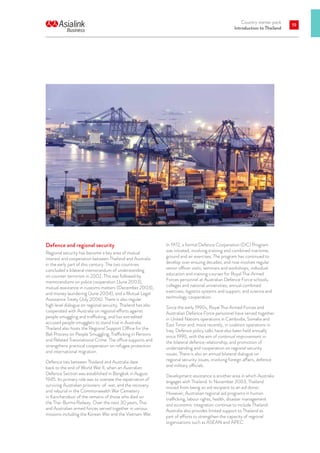
Finance Corporation (IFC) have identified nine specific
areas of interest and noted comparisons with other
countries in their Doing Business in Thailand Report.
Overall, the bank and IFC ranked Thailand 26th out
of 189 economies in 2015 for ease of doing business,
an improvement on the previous year’s place of 28. A
business in a start-up phase is required to register the
company’s name, deposit funds into a bank account,
obtain a corporate seal and register the company as a
legal entity.
2.4 	MANUFACTURING
IN THAILAND
Thailand’s skilled workforce, rapidly improving
infrastructure and pivotal location at the heart of one of
the world’s fastest-growing and most dynamic economic
regions makes the country an attractive destination
for foreign investment, particularly in manufacturing.
Capitalising on Thailand’s status as a regional hub for
manufacturers are global brands including car makers
Toyota, Ford and BMW, which have well established
presences in the country. Thai labour is relatively cheap
for the skill levels available, while Thailand manufacturers
enjoy handy access to the bustling economies of
Southeast Asia and global supply chains.
Australian small and medium enterprises currently
engaged in manufacturing in Thailand have runs on
the board, and prospective Australian investors can
choose between establishing their own manufacturing
operations in the country or forming partnerships with
local Thai businesses. Under relaxed trade laws, the Thai
Government permits foreign invested companies to be
involved in most manufacturing operations. For more
information on setting up a business in Thailand, see
section 2.3 regarding possible business structures.
Country starter pack
Getting started in Thailand
38
Nine areas to consider when setting up a business in Thailand.
STARTING OFF DEALING WITH
CONSTRUCTION PERMITS
ELECTRICITY CONNECTION
REGISTERING PROPERTY GETTING CREDIT PROTECTING INVESTORS
PAYING TAXES ENFORCING CONTRACTS AND
RESOLVING INSOLVENCY
TRADING ACROSS BORDERS
☑
☑
☑
It takes four procedures to establish
a corporate entity in Thailand over an
average of 27.5 days.
$
Construction permits take an
average of 113 days to acquire and
involve seven procedures.
Getting connected takes an
average 35 days and incorporates
four procedures done through the
Metropolitan Electricity Authority.
It takes a couple of days and two
procedures to register a property.
Thailand’s ranking is one of the
better scores for Southeast
Asia for availability and depth of
credit information. However, the
country’s collateral and bankruptcy
laws are limited when it comes to
ease of access to credit.
Investor protection in Thailand
ranks a strong 25th in the world.
Fiscal obligations are by far the most
laborious aspect of doing business in
Thailand, taking an average of 264
hours of company time to deal with.
Exporting a container of goods on
average requires five documents,
takes 14 days and costs US$595.
Enforcing a contract takes an average
of 440 days, requires 36 procedures
and, on average, costs 15 per cent of
the value of the claim.
Country starter pack
Getting started in Thailand
39
GreenCo Water
Nigel Blair, Executive Director
If you’re hoping to do business in Thailand, it pays
to have an introduction to the people you want to
do business with. If you have big plans that involve
distribution, exports or breaking into new markets
from Thailand, make sure you have the relationships
in place to make those plans a reality. And if you’re
not willing to invest the time into forging those
relationships, you might as well stay at home.
That advice comes from Melbourne investor,
entrepreneur and international business strategist
Nigel Blair, who has been doing business in Thailand
since 2006.
“Patience, temperament and attitude are very
important in Thailand,” he says. “It’s how the culture
works there; they [Thai businesspeople] are cautious
about who they let into their orbit.
“Some Australians have a sense of urgency and want
to push things, but if you’re impatient, you won’t
cut it there. People get frustrated because getting
to that point [of trust] can take two, three or four
years. But once you’re there things move quickly.”
Blair and GreenCo CEO Simon McMahon developed
the Pak Flat Tank, a self-assembly modular water
tank that can store from 1,000 to 10,000 litres
and which can be transported in flat-pack format.
Blair has used his longstanding relationship with
listed Thai manufacturing and distribution giant
Srithai Superware PLC to make Bangkok the hub of
GreenCo’s international growth plans.
GreenCo is targeting two markets: the aid agency/
humanitarian market, providing vital access to water
in refugee and displaced persons camps, initially
in Asia, but potentially anywhere in the world; and
the retail market, initially in Australia. The tanks are
manufactured and distributed from Bangkok.
Srithai is a diversified manufacturer of moulded
plastics – including automotive parts, pallets,
household electrical items, food and beverage
packaging and melamine tableware – under its own
consumer and industrial brands, as well as supplying
some of the biggest companies in the world such
as Coca-Cola, Pepsi and McDonald’s. Srithai also
has manufacturing operations in China, Vietnam,
Indonesia and India as well as a global distribution
network.
GreenCo is in the safest of hands, but Blair insists
that kind of relationship doesn’t happen overnight.
“I was referred to Srithai [to place a manufacturing
contract] by a consultant. On that occasion, we
were a client to them and the contract was done and
dusted in two months,” Blair says.
However, he knew enough about doing business
in Thailand to spend the time to create a deep and
lasting relationship with Srithai “so that it was more
than just an order book relationship”. Other business
deals soon followed.
Forming lasting business relationships means
not only getting to know key executives but
their families as well. “When you have that kind
of relationship with contacts over time, the
referrals and opportunities that come from those
relationships are invaluable and access to the market
becomes open wide, but it takes time to get there,”
he says.
“In Asia, when you do business, you’re doing it with
the family too. The basis of a real relationship is
when you know the family as well. When you get to
that point, they’ll do anything for you.”
CASE STUDY
greencowater.com
Country starter pack
Sales  marketing in Thailand
40
3.	 Sales and marketing in Thailand
Country starter pack
Sales  marketing in Thailand
41
Having decided on the best structure for your business in
Thailand, the next step is to consider the most effective
way of introducing your product or service into the local
market. There are plenty of options, but tailoring one to
best fit your business can be crucial to success. Should
you sell your product online or through a local agent? And
what are the labelling requirements? Would a franchise
be best? What are your competitors doing? This chapter
examines the various methods of selling in Thailand,
including marketing and packaging requirements to
import and sell goods.
The speed of entry into the Thai market – and issues of
cost, risk and the ability to grow – will vary depending
on the route taken. As well as the options flagged in the
table on the next page, direct selling and online sales are
additional alternatives.
The Australian Industry Group (Ai Group) highlights
these various market entry options into Thailand and the
differing degrees of difficulty and time. These options
are discussed in more detail throughout this section. The
bottom line for Australian businesses is that any foray into
a foreign market requires as a minimum due diligence and
thorough research so that their ambition matches their
business strategy.
Country starter pack
Sales  marketing in Thailand
42
3.1 	DIRECT EXPORTING
Exporting directly to a foreign market means involving
yourself with every aspect of exporting, including:
•	 Market research
•	 Marketing
•	 Distribution
•	 Sales and receivables.
Advantages include:
•	 Greater control including control of the sales process
•	 Better margins, as middle men are avoided
•	 More direct customer relationships.
However, going it alone may carry a much higher cost
to establishing business in the Thai market as in-house
resources are generally more expensive than outsourcing
to experienced professionals. Reorganising your company
may be necessary.
Different methods or approaches can be adopted within
a direct exporting framework and might involve sales
representatives, agents and distributors.
Local sales representatives:
•	 Use company resources, product advertising and
samples, and make presentations to buyers
•	 May work on sales commission
•	 Present little risk since they have no exposure to the
cost of the goods.
Using agents and distributors:
Most Australian firms doing business in international
markets rely on agents or distributors. But there are
key differences in the roles of each, which can also vary
according to country and industry. It is critical that
the roles and responsibilities of prospective overseas
representatives are clearly mapped out in any agreement
you have with them. Don’t just assume that your agent
or distributor will take on the broad array of activities that
are generally ascribed such representatives, confirm the
specifics in a contract with each operator.
The role of an agent: Agents do not take ownership of
goods being exported to a foreign market; they act simply
as a representative of the supplier. They are also engaged
by exporters of services to represent them in overseas
markets. Agents are usually paid on a commission basis,
which provides an incentive for them to drive sales of
your product. Based in the target market, they will often
represent several complementary products or services.
They can be retained exclusively as the sole agent for a
company’s goods or services or as one of a number of
agents for the exporter in a particular market – that is, on
a non-exclusive basis.
The role of a distributor: Unlike agents, a distributor
actually buys the goods from the exporter – that is,
‘takes title’ of the goods – and then resells them to local
customers who may be retailers or direct consumers. In
some cases, a distributor may sell to other wholesalers
who then sell on to retailers or consumers. Distributors
may carry complementary and competing lines and
usually offer after sales service. Margins added to the
price of the goods fund the fees that are paid to a
MARKET ENTRY PROFILES
Mode Agent Distributor Licensing Franchise
Joint Equity
Venture
Speed of market entry High High Slower Slower Slow
Costs - direct  indirect Low Low Higher Higher High
Degrees of freedom Low Low Contractual Contractual Limited
Total exposure to risk Low Low Moderate/high Moderate Moderate/high
Investment payback
period
Short Short Short/medium Short/medium Medium
Foreign market
competition
Less likely Less likely Limited Limited Less likely
Ability to expand
within mode
Less likely Less likely Limited Limited Limited
Country starter pack
Sales  marketing in Thailand
43
distributor. Their fees are higher than those of agents
because of associated costs; they usually carry inventory,
may extend credit for customers, and are responsible for
marketing.
Choosing an agent or distributor: Ultimately, whichever
your choice, it is essential that you establish a close
working relationship with your agent or distributor,
one that is built on high levels of trust and regular
communication. These will ensure a close and enjoyable
working partnership. Be sure to ask your potential partner
for trade references. You might also seek a credit check
through a professional agency to satisfy yourself about
your potential partner’s financial stability. It is best to
meet any potential agents or distributors in their own
market rather than in Australia. This will give them a
chance to demonstrate how well they know the market,
while providing you with an early opportunity to start
building a relationship.
Why use an agent? Why use a distributor?
Why not use an agent?
Direct contact between
manufacturer and customer.
Generally cheaper than
a distributor
$

You have greater control over
terms of sale and marketing, and
choice of customers to deal with
May be tax implications (check
the relevant laws for that area)
Why not use a distributor?
Can pass a great degree of risk
onto them and no termination
compensation
Distribution agreements
regulated by local competition
law.
☑$
$
x
TAX
Only have to monitor distributor’s
accounts rather than all customers.
Greater incentive for
distributor to sell your product
as they also have to cover the
costs of holding stock
Maintaining stock inventory can
be costly
Agent may also be selling
other products including your
competitors’
Less control over such aspects as
marketing and terms of sale
Credit risk with distributor rather
than with customers
Country starter pack
Sales  marketing in Thailand
44
Knowledge of the market: It is vital that your chosen
representative has a thorough understanding of the
products and prices of your competitors, which will
guide you in critical decisions about possible product
modification, advertising requirements or changes.
Consider:
•	 What sort of network and contacts the representative
has.
•	 What depth of experience they have in your targeted
market sector. There may often be a trade-off:
a well-established company with a good network
of contacts might nevertheless be inflexible and
less open to innovative practices. Alternatively,
newcomers might lack experience of the sector but
are brimming with enthusiasm and energy and are out
to prove themselves. Weighing the merits of these
alternative profiles can be important.
•	 The extent and depth of their knowledge of the local
market. The more experienced and tuned in, the
more likely a representative will be able to identify
opportunities and assist you in your marketing
program.
Direct selling
Not every business will choose to access the Thai market
through agents and distributors. Alternatively, you may
choose to contact directly buyers and end users of your
product or services. Though low cost and potentially a
means of getting a feel for the market at relatively low
risk, this DIY approach is not an easy pathway.
On the upside:
•	 It can eliminate the expense of using middlemen
•	 It gives you a first-hand opportunity to get to know
the needs of your customers and the chance to
customise accordingly
•	 It demands a sleeves-rolled-up effort but also
an opportunity to learn the hard way. There is no
substitute for thorough preparation.
But there are distinct downsides:
•	 The lack of a physical presence in the market can
stymie efforts to do business with some Thai clients
unwilling to engage with enterprises without offices or
a representative on the ground
•	 A direct selling strategy can require establishing a
strong and extensive network of sales agents to cover
a diverse geographical area.
Direct to end users: A further consequence of selling
directly to end users means taking charge of all market
research and marketing, as well as distribution, shipment,
warehousing and delivery, customer and after sales
services and the sales order, billing and collection
processes all from Australia.
Thai retailers: Exporters of consumer goods may
choose to sell directly to retailers, targeting the bigger
populations of Bangkok and Chiang Mai. A direct
approach to these retailers would be necessary, supported
by direct mail material of letters, brochures, catalogues
and so forth. This approach also requires regular
follow-up contact to build the retailers’ awareness and
understanding of the products they are selling on your
behalf. In return, their intimate knowledge of the Thai
market will contribute to the development of products,
pricing and marketing. Selling directly to savvy local
retailers can generally cut commissions, reduce expensive
travel and create an effective conduit to market.
3.2	FRANCHISING
The virtues of franchising are well documented. There are
plenty of examples of successful businesses that leverage
a great idea or business model by leasing it to others. The
practice allows business owners to retain a measure of
control while harnessing the energy of franchisees to drive
expansion. Franchises project a company’s reputation
and brand, and while it can prove expensive, building a
network of franchises is generally cheaper than owning and
operating retail or branch offices in foreign markets.
By franchising, a franchisee is given the right to use
the goodwill of a known firm, company or corporation.
Franchising agreements are defined clearly in a contract
between the owner of the business and the franchisee,
which governs the rights, duties or obligations of both
parties.
Franchising is common in Thailand, where such ventures
are among the best-run businesses in the country. While
there are no specific laws overseeing franchise operations,
the rights and obligations of both parties are well
protected by existing laws. These include the Thai Civil and
Commercial Code, which governs primarily the obligations
of the parties while defining what is valid in a contract. The
Trademark Act protects a franchisor from improper use
of its trademark, while the Copyright Act protects against
infringement of copyright. This is on top of a natural bias
in favour of the franchisor that exists in most franchise
agreements. Also, the Trade Secret Act is intended to
protect the unique formula and other essential trade
secrets of a known company. Finally, the Unfair Contract
Term Act prohibits some terms in franchise agreements.
Country starter pack
Sales  marketing in Thailand
45
SiteMinder Asia
Glenn Andrews, Managing Director
With more than 8,000 hotels and a position at the
heart of Southeast Asia, Thailand was an obvious
choice for online hotel booking technology company
SiteMinder to establish their primary Asian support
office. But the Australian-headquartered business
had its work cut out to persuade the bricks and
mortar owners of Thailand’s hotel sector to invest in
its online offerings.
As its core business, SiteMinder essentially acts as a
switch between hotels and online travel agents like
Agoda, booking.com and Expedia. It uses channel
manager software to help hotels maximise their
online room distribution and acquire more bookings.
Globally, SiteMinder has more than 18,000 hotels
as customers.
“Often the owners of hotels in Thailand are quite
successful,” explains Glenn Andrews, SiteMinder’s
Asia managing director. “To get them to understand
why they should change their already profitable way
of doing business and look towards online methods,
requires education and some persistence. They’re
often very traditional, having lots of personal
connections and business coming through travel
agents who have a physical presence throughout
Thailand.”
“The Thai hotel owners say ‘it almost costs less to
get someone to do this manually so why should I
invest in your solution?’. We had to invest in a lot of
training for our sales staff to explain that broadening
existing distribution will increase revenue.”
“Another challenge was that we are still providing
client support out of our Australian office for all of
Asia through our bilingual support team members.
However, quite often Thai hotels have the opinion
that local office support will be better because they
will understand Thai service expectations more,”
explains Andrews. “We are now in a position to move
that way but had to first grow the business to a
certain level to support the decentralisation.”
Originating from founder Mike Ford’s search
for a better online booking system for his Manly
backpacker hostel in 2006, SiteMinder now has
offices in Sydney, London, Dallas, Cape Town and
Bangkok. Andrews set up the Thai office in 2012,
and has built the Asia regional customer base to span
across Thailand, Indonesia, Hong Kong, Vietnam,
the Philippines, Malaysia, Singapore and Taiwan. The
company hopes to double the size of its Thai-based
team over the next 12 months. But when it comes
to attracting dynamic Thai staff, SiteMinder’s online
platform is all positive.
“Our Thai staff love working with what they call a
‘sexy’ business because it’s all online,” highlights
Andrews. “We have a culture of excellence which
they really run with, they love motivation. In
Thailand, you can get people who are hard working
but fun loving at the same time.”
SiteMinder sweetens the deal too. “We’re seen to
be a foreign-owned business without too much of
a brand in a very unique industry so we made the
decision to pay good base salaries. These are slightly
above the average to win confidence, which led to
word-of-mouth referrals – all which help to get
more good staff,” says Andrews.
CASE STUDY
www.siteminder.com
Country starter pack
Sales  marketing in Thailand
46
3.3	LICENSING
Licensing can be a quick and assured way of selling
trademarks, intellectual property, design and patent
rights, copyright and software into a foreign market
such as Thailand. Licensing allows rapid market entry
with limited capital, since it is unnecessary to set up
expensive production facilities. Universally recognised
contracts or agreements need to be in place to protect
intellectual property, trademarks and design rights.
Licence arrangements must meet international and Thai
laws as well.
3.4	ONLINE SALES
While the growth of online retailing globally appears
exponential, a constraint in developing economies is the
often poor broadband penetration. This is the case in
Thailand, due to the country’s geography and historically
low capital investment in telecommunications, which can
put a brake on online retailers’ ambition of reaching more
affluent consumers.
Internet penetration in Thailand is relatively low at around
25 per cent of the population, with growth in online sales
remaining low. Mobile subscriptions, however, are very high
with a 125 per cent penetration rate. Social media apps
are used by over half of mobile subscribers, making social
media an effective channel for sales and marketing. Retailers
looking to engage Thai consumers should bear this in mind
when developing an ecommerce strategy for Thailand.
A common method for facilitating internet sales is to set
up online stores through popular web-hosted shopping
carts. Unlike other countries in the ASEAN region such
as Indonesia and Vietnam, Thailand has a wide variety of
ecommerce sites including the popular global Amazon
and eBay, as well as local sites such as weloveshopping.
com, tarad.com, lazada.co.th and pantipmarket.com.
Australians opting for an online presence in Thailand
should research carefully the various web hosted options
that are available, as well as any taxes that may apply due
to customs (both Australian and Thai) and by being a
foreign entity. They should also consider that most of the
existing ecommerce sites are in Thai rather than English.
3.5	MARKETING
The challenge of building a customer base in Thailand
will demand continual reassessment of your marketing
strategy. Getting a foothold in a foreign market is just
the beginning: trade shows and exhibitions are effective
ways of identifying and reaching out to potential new
customers in a bid to build your business. It is wise to
translate all sales and product literature and technical
specifications into Thai when advertising in trade journals,
exhibiting at trade shows or running technical seminars.
Product and service adaptations: A key determinant
of success can be how effectively a company adapts
its product range to meet Thai tastes and cultural
preferences, and to meet regulatory requirements.
Getting the product mix and style right will vastly lift your
chances of success.
Branding: Thais are very brand conscious, which can help
or hinder new entrants. Those with a recognised brand
can look to capitalise with a concerted product launch or
news conference to announce their arrival in Thailand.
Sales promotion: Companies that team with local
partners can usually draw on their associate’s intimate
market knowledge to help draft an advertising and sales
promotion suitable for their product range. In most cases,
special promotional campaigns should be held at local
shopping centres, hotels and convention halls. A popular
gimmick is giving away free samples at major business and
commercial hubs and offices. Commercial promotions
can be equally effective for both consumer and industrial
products, supported by gift premiums and discount
coupons, or through draws for items such as package
tours, cars or electrical goods.
Advertising and media: Again, Australian businesses with
ambitions in Thailand will want to tap the knowledge of
a local contact or advertising company to understand
how best to reach potential customers. Two popular
English-language newspapers – The Bangkok Post and The
Nation – are obvious vehicles for carrying your message.
But Australian companies should obviously consider
Thai-language publications to promote their products
and services, the most popular of which are Krung Thep
Thurakit (Bangkok Business News) and Thai Rath.
Direct marketing: Home shopping on TV was introduced
into Thailand several years ago but has struggled against
consumer scepticism and the perceived poor quality
of many of the goods on offer. The selling forum has
gained ground in recent years and now accounts for
annual turnover of more than US$50 million. Still, Thai
consumers generally prefer to see and touch products,
which further limit the reach of TV shopping channels.
Country starter pack
Sales  marketing in Thailand
47
3.6	LABELLING REQUIREMENTS
Like most countries, Thailand imposes strict requirements
regarding labelling and other product details. A local
agent/importer can usually navigate these rules, help
register a product and ensure labelling requirements
are met. These rules are applied most stringently to the
labelling of dairy foods, baby foods, canned foods, vinegar,
beverages, edible oil and fats, and gourmet powder
(defined as an article containing monosodium glutamate,
or MSG, and used for food seasoning). Food products
must be approved and registered with Thailand’s Food and
Drug Administration (FDA). When seeking registration,
importers must supply two samples of each product,
details of the exact composition by percentage of all
ingredients, and six labels. Foodstuffs in sealed containers
are subject to specific regulations.
Food products imported into Thailand must be labelled in
Thai and display specific information including:
•	 Name and brand of the product (both generic and
trade)
•	 Registration number
•	 Name and address of the manufacturer
•	 Name and address of the importer
•	 Date of manufacturing and expiry
•	 Net weight and volume
•	 Any additives used
•	 Health and nutritional claims (if any)
•	 Labels for alcoholic beverages that must advise the
percentage of alcohol content. There must also be a
health warning, printed in Thai, on the label or on a
sticker, with specific wording.
Specific regulations govern the labelling of cosmetic
products. These require labels to indicate the following
in Thai:
•	 Name and type of the product
•	 Name of manufacturer and address
•	 Directions for use
•	 Net contents
•	 A statement of caution should irregular use of the
product possibly cause harm.
In some cases, labels can be applied as a sticker over an
existing English-language label.
Packaging
Packaging needs to be secure and able to withstand
extreme heat and humidity, especially in the event that
goods are stored in the open. Waterproofing is critical,
too, as imports can often be landed in Thai ports from
open barges. Packaging material such as hay and straw
should be avoided.
Special certificates: Certain types of seeds, plants and
animals require phytosanitary certificates issued by the
approved authority in the country of origin. In Australia,
this usually falls to the Department of Agriculture or the
relevant state department of agriculture.
Meat imports to Thailand must be accompanied by
a veterinary health certificate signed by the official
authority in the country of origin certifying that:
•	 The country of origin has been free from endemic
diseases for the specified period
•	 The animal has been processed in an approved
establishment in sanitary conditions and under
constant veterinary supervision
•	 The products are fit for human consumption and
do not contain preservatives, additives or other
substances in quantities harmful to human health
•	 They have not been stored for more than three
months (the date of processing or packing must be
stated).
Exporters of pharmaceutical and medicinal products may
be requested to provide a Certificate of Free Sale, which
certifies that the goods are normally and freely sold in the
exporting country’s open markets and are approved for
export, before shipment will be allowed.
Marking and barcodes: Thailand follows the international
EAN system of standardised barcodes, which are
administered locally by the Federation of Thai Industries.
Country starter pack
Conducting business in Thailand
48
4.	 Conducting business in Thailand
Country starter pack
Conducting business in Thailand
49
Having chosen a business structure and strategy for taking
on the Thai market, it is important for foreign businesses
to familiarise themselves with Thai business etiquette and
culture, as well as appropriate ways of developing business
relationships, negotiating, holding meetings and conducting
due diligence.
4.1	THAI CULTURE AND
BUSINESS ETIQUETTE
Cultural nuances can trip up business operators who fail
to make an effort to work within local customs. Respect
is a cornerstone of Thai culture and underpins business
relationships. ‘Maintaining face’ is also important, with anger
and even mild irritation to be discouraged. Thais embrace the
characteristics of smiling, humbleness and patience, while
laughing frequently and speaking softly. They guard proudly
a cultural heritage that has Buddhism at its core and which
is fundamental to their society and customs, including when
doing business. Respect for the royal family is paramount,
and negative comments about the royals are punishable by
law.
Greetings
There are instances of gender differences: for example,
men say Sawadee-khap and women Sawadee-ka when
being introduced or greeting someone. The traditional
form of greeting is known as the wai, which is performed
by placing the palms of the hands together, raising them
to the face with the fingertips at eye level and inclining
the head slightly. Much formality is associated with the
wai, with the level at which the hands are placed carrying
great significance. Younger and lower ranking people are
expected to offer the wai to their senior counterparts first.
Generally, Thais will greet each other with a wai but will
shake hands with foreign business contacts. Indeed,
foreigners are not expected to initiate a wai or even return
it. Rather, a simple smile and a nod of acknowledgement is
acceptable. However, over time and as you become more
involved in the community returning a wai may be more
appropriate.
When addressing others verbally, Thais use Khun
(pronounced koon, as in cook), which stands for Mr, Mrs,
Ms or Miss. This is followed by a person’s first (given)
name. For example: Khun John (rather than Khun Smith).
A nickname can often substitute for a Thai’s given name.
In Thailand, last names tend to be reserved for very formal
occasions or formal written communications, with Thais
preferring mostly to address one another by first names
and titles. This will usually also apply to foreign business
people who can expect to be addressed as Mrs Jane rather
than Mrs Smith. When corresponding, it is best to use:
Dear + Khun + given name – for example, Dear Khun
Mary. Introductions are common only in formal situations.
Then, it is best to introduce yourself by your first name.
It is acceptable, also, to ask for someone’s name. When
introducing your business partner to an important Thai,
mention your partner’s name first.
Country starter pack
Conducting business in Thailand
50
Business cards
As in many Asian cultures, business cards in Thailand
are valued highly and always presented when meeting
someone for the first time. Ideally, your business cards
should have a Thai language version printed on one side.
Cards should be handed person to person using the
right hand or both hands, and received in similar fashion.
Preferably, you should present your card to the most
senior person first and when receiving a business card, it
is important to take a few moments to read it, rather than
placing it immediately in your pocket or on the table. In
larger meetings, it is acceptable to place your associates’
business cards in order on the table in front of you.
Dress code
In Thailand, status and wealth are to be admired. While
high status Thais often overdress, especially given the
climate, appearance is very important and business people
observe a dress code that dictates a certain formality.
For meetings, businessmen will wear a shirt and tie, and
proper footwear (not sandals). Thai people will usually
judge a person on their clothing and accessories, so good
grooming and a bit of polish on shoes is worth the effort.
Women should wear conservative dresses or skirts that
are not too short, or business suits, and blouses (not
sleeveless tops). Both men and women should not take
backpacks to meetings in Thailand as Thais consider
backpacks inappropriate accessories for business wear.
Business culture
Relationship building is universally a factor in business
success, and doing business in Thailand is no different.
Thais will usually expect to spend time working on their
relationship with a business contact before exchanging
critical information or committing to a deal. ‘Ice-breaking’
informal conversation will often precede and follow
business meetings, and inquisitive Thai contacts will
be interested to learn more personal details about you
such as your age, as well as your family and educational
background, as a means of building familiarity.
Foreigners need to be aware, however, that Thais are
unlikely to admit to having not understood you for fear
of offending you. Likewise, they will generally avoid
disagreeing openly and avoid appearing negative in answer
to questions. This can be frustrating when foreign business
people assume a deal or agreement has been struck only to
find nothing further eventuates. Having an interpreter on-
hand can help avoid such confusion. Translating language is
one thing – but deducing meaning can be another matter
altogether.
Hierarchy and rank are important in Thai society, and senior
officials and business people will usually expect to meet
Australian representatives of similar seniority, not more
junior staff. All correspondence should be addressed to the
most senior person.
Age, seniority and rank all have an influence on
conversation and dialogue. The less senior person is
expected to show restraint, and will rarely disagree openly
with superiors. This can at times stifle communication, and
you may find it necessary to follow up with counterparts
later to clarify matters. In this environment, it makes sense
to Thais to try to place you within a hierarchy when they
first meet you, so that they have a framework in which to
engage. This may involve them asking what might appear in
other cultures as very personal questions.
Bargaining and negotiating are commonplace in Thailand,
and normally do not offend. Rather, deploying such
give and take negotiation demonstrates flexibility and a
willingness to accommodate business partners. Thais rate
a person’s ability to bargain and reach what they consider
a fair deal as a measure of business acumen. Sometimes,
details of an agreement may be altered between
negotiation and final sign-off when circumstances change
unexpectedly and in such cases both parties are expected
to be accommodating.
Exchanging gifts, as a display of friendship and in gratitude
for hospitality, is widely practised among business
associates in Thailand and is encouraged. Gifts are usually
exchanged at the end of a meeting or function. They are
given when visiting someone for the first time, but are
opened in privacy, not when received. While gifts do not
need to be expensive, they should reflect a generosity of
Country starter pack
Conducting business in Thailand
51
spirit that can help build a strong relationship. Gifts should
be modest and appropriate to the occasion, and Australians
doing business with foreign counterparts need to be
aware that giving overly expensive gifts may be seen as an
undue benefit with the intention of obtaining or retaining
a business advantage, thereby constituting an offence.
Under Australia’s anti-bribery laws, this would be illegal if
the recipient is a foreign public official. Appropriate gifts
include flowers, a basket of nutritional food, good quality
chocolates, bottle of Australian wine or fruit. Money is
usually given for weddings and ordination parties. Any sharp
items – for example, a letter opener or sword – should
not be given, as sharp objects represent the severing of a
relationship.
When doing business in Thailand, it is worth observing that:
•	 Thais prefer to work into the evening rather than early
in the morning. Business is kept separate from home,
while family comes first, ahead of business.
•	 Subtlety – not frankness – is essential, especially
when saying “No”.
•	 Speaking in a loud voice is not appreciated, nor is
displaying temper. Never criticise someone publicly.
While business relationships in Thailand tend to be less
formal than in other Asian countries, they are not as
relaxed as in the West. When negotiating, you must be
sensitive to hierarchy and it is important to arrange an
introduction or personal reference before approaching
potential business contacts.
Across Thai culture it is important to make sure that when
sitting, the soles of your feet are never pointed at anyone,
nor towards an image of the Buddha. This is viewed as
disrespectful, as the feet are considered the lowliest part of
the body. As mentioned, Thais avoid violence, conflict and
confrontation. Losing your composure will cause you to lose
respect in Thailand. At the same time, situations involving
an obvious injustice or abuse can be met with an outwardly
submissive attitude, for the sake of not losing face.
Dining
Should you be invited to dinner at the home of a Thai
colleague, you should reciprocate out of respect for
your colleague and as a means of building mutual trust
and respect. Remember to remove your shoes before
entering a Thai house. Usually, a fork and spoon alone are
provided as eating utensils, with the former held in the
left hand and the latter in the right, with the fork used to
guide food onto the spoon. Sticky rice, a northern Thai
delicacy, is often eaten with the fingers of the right hand,
but it is important not to lick your fingers. You may begin
eating as soon as you are served. It is customary to leave
as little food as possible on your plate, and do not leave
rice as to do so is considered wasteful. Never take the last
bite from the serving bowl and wait to be asked before
taking a second helping.
Body language
•	 Touching people of the same gender is more common
in Thailand than in many other Asian countries, but
touching someone of the opposite sex remains taboo.
Nor is it acceptable to show affection in public.
•	 Avoid touching or passing anything over someone’s
head, as the head is considered sacred in Thailand and
must be respected.
•	 Do not point your feet at anyone or use your feet to
move anything or touch others. Feet are regarded as
unclean and are both symbolically and physically the
lowest part of the body.
•	 Smiles reflect many different emotions, ranging
from an apology, a thank you or greeting, to showing
embarrassment. For outsiders, this can sometimes
be confusing. For example, a Thai’s smiling assurance
does not always mean you will get what you want,
or when you want it. In essence, it reflects the Thai
appreciation of harmony and a ‘never mind’ attitude.
•	 Smiling regularly is a virtue, as this demonstrates
patience, which is much valued in Thai society.
•	 Resist waving your hands about as you talk. This can
give Thais the impression that you are angry. Never
pass anything with your left hand nor point with your
hand. And beware, you must never ever point with
one finger.
•	 Do not cross your legs in the presence of elderly
Thais or monks.
•	 Even beckoning someone requires caution. It is
best to extend your arm with the palm of your hand
downward, while fluttering your fingers up and down.
Finally, it is important to allow sufficient time travelling
to and from appointments in Bangkok, where traffic
congestion is burdensome and can cause lengthy delays.
This can be tricky because arriving at meetings on time is
critical for good business relations as it signifies respect
for the person with whom you are meeting.
It may be best to avoid visiting Thailand around Songkran
(Thailand’s New Year) in mid-April, as businesses close
for about three days and many people head out of town
at this time.
Country starter pack
Conducting business in Thailand
52
Lady Pie
Harry Usher, Managing Director
When the 2004 tsunami that devastated South Asia
hit Phuket, it took with it Harry and Susan Usher’s
home, and the tools of her fledgling pie-making
trade. However, inspired by the Thais’ resilience and
a little help from home, their business, Lady Pie, was
baking again within days.
Having sailed to Phuket in 1999, the pair liked what
they saw and settled in. Susan, an Australian, started
making pies as a hobby, building it into a small
cottage industry. “She made them in a Breville pie
maker at first, two pies at a time,” says her Scottish-
Australian husband Harry, now general manager of
the company. “Then she got two pie makers, and just
before the tsunami we upgraded to a pizza oven.”
The oven was washed away with the Ushers’ home,
but they were determined to stay. “The thing
about Thailand is it gets in the way of many natural
disasters and unrest. The economy goes up and down
like a yo-yo but it always seems to recover, it’s got
an elasticity to it,” says Harry.
“People pulled together after the tsunami. Phuket
pulled itself together. We picked up fairly quickly,
Susan was making pies within a few days of the
tsunami, she found one of the old Breville machines
and got it rewired. We had customers and they were
wanting pies.”
When the owner of Sydney factory Lindsay Pie
Making Equipment saw a newspaper photo of Susan
in the remains of their washed-away house, they
sent a pallet-load of equipment including an electric
oven and dough mixers.
Today, Lady Pies are sold throughout Thailand
via two supermarket chains and a network of
distributors. They produce around 500 pies a day
for a mainly expatriate market, though the sweet-
toothed Thais are partial to their apple pies and
lamingtons.
No one anticipated such growth from the once
home-run business. Harry left his construction job
to join the company in 2010, and today works with
Susan and eight Thai workers. As a Thai Limited
Partnership, a business structure chosen when it was
initially set up, a strict four-to-one Thai-to-expat
staff ratio is required for its registered company
structure.
If setting up Lady Pie now, the Ushers highlight that
they would seek approval to operate under the freer
Thailand Board of Investment (BOI) rules designed
to encourage investment in certain sectors or
regional areas.
“There are several conditions and the location has
to be approved and your accounts checked, but
the new regulations permit expats to own 100 per
cent of their business’ shares and own the land the
business is on, which is one of the few ways for a
foreigner to own land here,” explains Harry.
Other benefits also exist for Australians wanting
to set up a business in Thailand in areas where the
government seeks to attract foreign investment,
under recently introduced BOI regulations.
“Business visas and work permits can be fast-tracked
and there’s no profits tax for the first few years.
There is a lot of paperwork and you need a specialist
to help, but that’s the way to go,” highlights Harry.
CASE STUDY
www.ladypie.com
Country starter pack
Conducting business in Thailand
53
4.2 	BUILDING RELATIONSHIPS
WITH THAIS
As in most intercontinental dealings, building strong
relationships is critical for succeeding in business in
Thailand. Indeed, the strength and soundness of business
relationships can have a cascading effect in many aspects
of commercial life – in procurement and contracting,
gaining credit and for navigating bureaucratic processes.
This can take time, and will usually require extensive ‘face-
to-face’ time with contacts of similar age and status.
Critically, loyalty and trustworthiness are at the core of
relationship building in Thailand.
Nuances such as age and seniority also come into play
in forming personal and commercial bonds: you should
consider carefully the impact of age, gender, educational
and marital status when building relationships, as in
Thailand younger people are often excluded from key
decision making and are expected to defer to older people
in terms of language and attitude.
Business partners
Teamwork is paramount to succeeding in Thai business
life. In most instances, individual preferences give way
to the more valued sense of belonging to a group,
conforming to its norms and maintaining harmony
within its membership. The ability to build lasting and
trustworthy personal relationships is a key goal for most
Thai business people, who often expect to establish strong
bonds before committing to any deals and will tend to do
business foremost with those operators they know and
respect. Pushing too hard, too quickly, on a deal can be
counterproductive. Rather, serious business talks should
come only after your potential business partners have
become comfortable with you.
Relationships in Thailand are based almost universally on
familiarity, respect and personal trust, which cannot be
established overnight. Business relationships tend to be
more personal – more likely established between people
as opposed to companies. Even once you have established
a solid relationship with your local partner, their friendship
and trust is unlikely to be extended automatically to
others within your company. As a consequence, it is vital
to keep in place personnel at the forefront of interactions
with the local partner. Changing a key contact can risk
having to rebuild a relationship from scratch. In extreme
cases, such a change can bring negotiations to a halt.
Remember, ‘saving face’ is key to Thai culture, and
harmony should always be maintained, whatever the
cost, while being able to hold emotions in check is deeply
respected. Reputation and standing throughout Thailand’s
social strata rest on this concept. Causing embarrassment
to others, or openly criticising them, can cause a loss
of face for all parties involved. Ultimately, business
negotiations will suffer. Remaining friendly at all times is
the wisest credo for those wishing to strike solid, long-
standing and mutually beneficial partnerships. Diplomatic
restraint and tact are cornerstones of this approach: in
other words, stay cool and refrain from ever showing
openly that you are upset or angry.
As in the case of many other Southeast Asian nations,
Chinese are represented strongly in business. While
around 80 per cent of Thailand’s population is ethnic
Thais, Chinese by far lead minority groups in this
pluralistic society. Many businesspeople are Chinese, who
retain strong connections with family businesses in China.
This can sometimes mean that business deals can only be
closed with the assistance of partners domiciled in China,
as well as Thailand.
Local government and authorities
While building relationships with private business partners
and engaging with the local business environment are
primary objectives, Australian businesses need to be
mindful of the key government agencies that may need
to be consulted throughout the process of setting up a
business in Thailand.
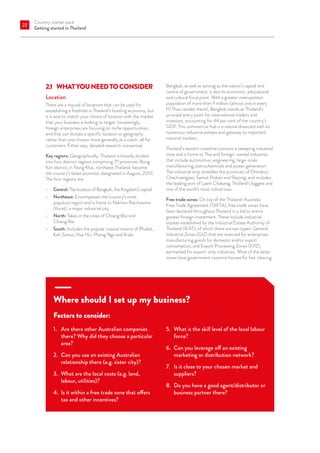
The main agencies and their areas of licensing authority
for foreign investors are:
Board of Investment Thailand (BOI): This agency is at the
forefront of efforts to promote investment in Thailand,
offering information and services for investors, as well as
many incentives.
Ministry of Industry: This is a Thai Government ministry,
responsible for the promotion and regulation of industries.
Ministry of Foreign Affairs: Similar to the Australian
Government’s Department of Foreign Affairs and Trade,
this ministry compiles general information and statistical
data on foreign trade, overseas import/export laws and
legislation. Consular and diplomatic services are also
carried out through this ministry.
Ministry of Commerce: Together with the BOI, this
ministry is responsible for promoting Thailand’s economic
development. It also compiles statistics on international
trade.
The Customs Department: Holds responsibility for
collecting revenues such as import/export taxes and
duties and fees. It advises on export promotion and
privileges, customs procedures for parcel postage as well
as other customs-related information for travellers.
Revenue Department of Thailand: Alongside the
Customs Department is the Revenue Department of
Thailand, both under the Ministry of Finance’s jurisdiction.
The Revenue Department is responsible for about half of
all tax collections.
Country starter pack
Conducting business in Thailand
54
4.3	NEGOTIATIONS AND
MEETINGS
A key to building good business relationships in Thailand
is establishing the right chemistry with partners, but
nurturing the relationship is critical for its longevity.
Courtesy and conformity are core prerequisites: organise
appointments before you leave Australia and follow up
with telephone calls on arrival to confirm your partner’s
availability.
Managing Thai business meetings
Meetings can be held over meals – breakfast, lunch or
dinner – as well as during normal business hours. Rest
assured that English is commonly used during meetings
and presentations in Thailand although, as previously
noted, a translator may be necessary during complex
negotiations or discussions about technical products or
issues.
In general, it is customary to wait for your host and
hostess to introduce you to other attendees. This allows
everyone to grasp your status relative to their own,
thereby understanding who should perform the wai – the
common form of greeting that carries strict protocols,
as previously discussed – and how low one’s head should
be bowed. Guests should also remain standing until told
where to sit.
Surprising your hosts can have the wrong effect,
presentations, for example, can have the best impact
when delivered formally and following accepted formats.
However, more informal question and answer sessions
can often elicit healthy participation among Thais who
are normally not so keen to exchange views in formal
settings or large meetings that include a range of
differently ranked individuals. One means of encouraging
participation can be to allow those present to submit
questions anonymously on paper. Ultimately, it is best
to look for opportunities to make your partners as
comfortable as possible so that there can be a beneficial
sharing of views.
Do not be alarmed if during a meeting or presentation
your Thai counterparts talk among themselves in their
own language. This is seen as neither rude nor a sign that
they are bored, but is more likely an attempt by them to
make sure they are understanding correctly. It is a good
idea to make sure you are carrying sufficient numbers of
business cards and corporate literature to enhance your
presentation. Having the flip side of your cards translated
into Thai can create a very good first impression. Always
follow up meetings by letter or email on your return to
Australia.
Typically, first meetings produce good humour and easy-
going smiles, but polite and measured conversation.
Quick results are rare. Second meetings, ideally, should
include a meal invitation. Always begin meetings with
small talk. To launch immediately into business talks
before becoming acquainted is viewed as impolite.
Qualifications and degrees, especially from prestigious
universities, carry status and Thais will sometimes list
these on their business cards. Foreigners with powerful
connections are widely respected.
Negotiations the Thai way
Negotiations in Thailand are generally more of a joint
problem solving process and focused on compromise,
even when there is no real need to do so. The importance
Thais place on relationships in general is also significant in
the negotiation process. Patience really is a virtue. Thais
expect it and reward those who resist the temptation
to display frustration. Do not expect to clinch a deal
immediately or on a first visit. Being patient is particularly
vital as negotiations can often be lengthy, with process
overshadowing content, and a generally poor information
flow stunting the progress of discussions and decision
making. Always avoid confrontation but keep in mind that
sometimes Chinese cultural influences can impact on
Thai business negotiations.
Try not to get frustrated by the holistic nature of your
Thai counterpart’s negotiating style. It is common for
Thais to quickly change discussions from one topic
to another, with no sequential order being used to
address agenda items. They also tend to use a variety of
negotiation techniques. These include techniques such
as fake non verbal messages showing disinterest, making
false demands and concessions, emotive techniques such
as grimacing, appealing to personal relationships and
making you feel guilty. Nevertheless, being direct should
always be avoided. Thais also enjoy bargaining and may be
offended if you do not reciprocate. Despite these various
elements of the negotiation process, never apply any in an
aggressive manner or with too much pressure.
While Thailand has a pro-business attitude, business
decisions can be slow and may involve several layers of
authority before being finalised. Planning is usually short
term. The upper echelons of management are often
filled with family members. Who you know is important;
powerful connections are respected. Facts and figures are
not valued as highly as personal experiences and feelings,
therefore if you expect a risky decision to be made, you
need to find a way to make your Thai counterpart feel
comfortable.
Country starter pack
Conducting business in Thailand
55
Insight Education Consulting
Greg O’Neill, CEO
Greg O’Neill had an early run-in with the cultural
sensitivities of doing business as a Westerner in
Thailand when setting up his company, Insight
Education Consulting, in Bangkok 18 years ago.
“We employed a lawyer to do the business
administration, got all the documents, ran through
a checklist then fronted up to the Ministry of
Commerce. We had an organisational chart which
had me sitting at the top with the other Thai
directors a few rungs below. And a middle-level
bureaucrat says ‘look, I don’t like this organisational
chart. Can you put the Westerner a bit further
down?’ So I just moved me down a few notches.”
O’Neill acknowledges he was “confused and
bewildered” by the Thai way of working, with its
“sometimes rubbery” regulations and reliance on
contacts and patronage. Having good, trusted Thai
staff to be “eyes and ears” is vital, he highlights.
“There are times to put a Western face out in front
of the company and other times when it might be
best to put a Thai face out there,” O’Neill explains.
“At the initial stages of negotiation I might go in
and be introduced as the CEO of the company and
might talk a bit about big-picture stuff, then sit back
and let one of the less senior Thai staff take on the
conversation, the nitty gritty.”
O’Neill’s company works with Thai universities,
colleges and schools on education projects including
teacher training and curriculum development, helps
Thai students wanting to study overseas, and foreign
universities seeking partnerships in Thailand.
He says humility is “really important” to keep in
mind when doing business there.
“There’s a fine line between being seen to be
an expert in something and coming across as
condescending or patronising. In this part of the
world, and particularly if you’re a Westerner, you
don’t want to be seen coming in and saying, for us in
terms of education, our system is superior to yours
and this is how you should do it.”
Cultural sensitivity is important in the workplace too,
O’Neill outlines. “When giving feedback or being
critical of staff you’ve got to be extremely careful
about people’s feelings. Delegating those kinds of
things to Thai staff is important to understand right
from the get go. For trivial issues like lateness, it’s
much better to have my office manager mention
it rather than me say something because there’s
much greater sensitivity to it purely because I’m a
foreigner. It’s partly a language thing and partly a
cultural thing.”
CASE STUDY
www.insight.in.th
Country starter pack
Conducting business in Thailand
56
4.4	DUE DILIGENCE AND
AVOIDING SCAMS
Australian firms looking to do business in Thailand
should avail themselves of Australian law and penalties,
particularly those relating to bribery of foreign officials.
It is important that they commit to the highest level
of corporate behaviour so as to avoid pitfalls that can
lead to grave consequences. Put simply, the bribing of
foreign public officials is a crime and both individuals
and companies can be prosecuted in Australia for such
offences committed while doing business overseas. Those
at the frontline of doing business abroad should familiarise
themselves closely with the regulations governing bribery.
History shows that many of the problems encountered by
foreign companies doing business in Thailand could have
been avoided with the benefit of proper due diligence.
Different degrees of due diligence may be applicable.
For example, for an exporting initiative, the best proof of
a Thai receiver’s ability to pay is whether it can produce
a letter of credit from a bank, underscoring its financial
standing. Essentially, the bank has carried out the checks
for you. Another simple exercise as part of any due
diligence is to get a copy of a company’s business licence.
This will inform you of several things, including:
•	 The legal representative of the company
•	 The name and address of the company
•	 Its registered capital, which is also its limited liability
•	 The type of company
•	 Its business scope
•	 The date the company was established and the period
covered by the licence.
It is wise to check that information contained in the
business licence matches what you already know about
the company. Should it not match, make further inquiries.
The more you know about who you are dealing with, the
greater your security: which person is legally responsible
for the enterprise? Who is it that you are actually
dealing with? Of course, the company’s shareholders
are responsible for the amount of liability stated as
registered capital on its business licence but, if in doubt,
you could check whether the capital has been paid up
by getting a Capital Verification Report through a firm
of accountants. Should you wish to establish a business
relationship in Thailand that goes beyond exporting, it will
be necessary to carry out further research.
Country starter pack
Conducting business in Thailand
57
There is no doubt that a thorough examination of your
potential partner will be time consuming and expensive,
but valuable insurance nonetheless. Making the effort
ahead of forging partnerships will greatly reduce the risk
of future problems. Be aware however, that company
accounts in Thailand are unlikely to be audited with the
same rigour that might be expected in Australia and
that a superficial reading of those of a potential partner
may prove inadequate for assessing their credentials. In
fact, companies in Thailand may have different sets of
accounts to suit different audiences. It is advisable to
use such data with caution and only in conjunction with
information gleaned elsewhere.
There are many accounting and legal firms in Thailand
able to assist with due diligence. These range from leading
international audit, tax and advisory specialists to private
business consultants who have lived in Thailand for some
time.
Dispute resolution: It is important for companies
involved in any international commercial dispute to seek
appropriate legal advice in Australia or in the country
where they are operating. Austrade is able to provide
referrals to legal service providers upon request.
There are a number of international arbitration
commissions that exist to facilitate international
dispute resolution. However, deciding which arbitration
body is best suited to your commercial needs can be
complicated. In short, Australian companies should seek
legal advice when deciding on a preferred forum for
arbitration. This will depend on a range of factors to do
with convenience, cost and the facts of a particular case.
While the Australian Government routinely supports
arbitration as a preferred method of handling commercial
disputes involving foreign companies, it does not endorse
one arbitration body over another – whether in Australia
or overseas.
Scams to watch out for in Thailand: Several websites
document examples of known scams operating in
Australia and abroad in a bid to protect consumers and
business people from fraud. Scam ‘alerts’ are available at
www.scamwatch.com.au. If you believe you are contacted
by a scam, ignore the emails and delete immediately.
Country starter pack
Business practicalities in Thailand
58
5.	 Business practicalities in Thailand
Country starter pack
Business practicalities in Thailand
59
For Australians conducting business in Thailand, getting
to grips with legal regulations and the practicalities of tax
and employment laws, as well as other key provisions, is
a fundamental challenge. This chapter offers an overview
of the main areas that need to be considered, but it is
strongly recommended that prospective investors seek
professional advice in those areas requiring specific
information.
5.1	 LAWS AND REGULATIONS
Investment rules
Thailand is no stranger to foreign investment and
welcomes new investors. The Board of Investment (BOI)
oversees many incentives aimed at drawing foreign
enterprises to Thailand. As a conduit for investment, the
BOI aims ultimately to funnel investment into sectors
that will drive the nation’s economic development. The
legal architecture supporting this incentive regime exists
within the Investment Promotion Act. The incentives can
range from tax-associated discounts such as a reduction
in, or exemption from, import duties on machinery and
raw or essential materials, to deductions in personal
income tax and dividends. On top of these, non tax
incentives focus on permits related to the exploration
of investment possibilities in Thailand, the bringing in
of foreign skilled and specialist workers for promoted
investment activities, and the movement of foreign
currency through Thailand.
Foreign business activities are also covered by the Foreign
Business Act B.E. 2542 (1999). This act outlines which
sectors of the Thai economy where foreign ownership
is limited or not allowed. Sectors off-limits to foreign
businesses include rice cultivation, mass media and
forestry. For more information on the Foreign Business
Act B.E. (1999), visit the Department of Business
Development’s website.
Country starter pack
Business practicalities in Thailand
60
Policies for investment promotion: As a means of
enhancing economic development and to respond in a
timely fashion to shifts in global economic trends, while
also relieving the Thai Government of some of the fiscal
heavy lifting, the BOI promotes these key initiatives:
•	 Investment that enhances national competitiveness
by intensifying activity in the agriculture, industrial
and services sectors, as well as for SMEs, through
innovation, research, value-adding, fair competition
and expansive growth
•	 Providing tax and non-tax incentives for businesses
to set up International Headquarters (IHQ) and
International Trading Centres (ITC) in Thailand. This
aims to further develop Thailand as a global business
hub
•	 Environmentally friendly activities that can lead to
reduced energy use or which incorporate alternative
energy sources that encourage sustainable growth
•	 A concentration on development and strengthening
of supply chains in regional areas
•	 Investment in border provinces in southern Thailand
that will help bolster the local economy while playing
to a national focus on enhancing security in the area
•	 Promotion of special economic development zones
that can strengthen economic ties with neighbouring
countries and to pave the way for entry into the
ASEAN Economic Community (AEC)
•	 Promotion of overseas investment by Thai enterprises
that will enhance the competitiveness of Thai
businesses and mark out and nurture Thailand’s role in
the global economy.
Thailand-Australia Free Trade Agreement (TAFTA):
One of more than 20 free trade deals to which Thailand
is a signatory, TAFTA benefits Australian businesses
by permitting levels of foreign ownership not generally
afforded to other nationalities. The investment levels for
Australian corporations have been raised from a previous
cap of 49.9 per cent and include, according to the
Australian Government Department of Foreign Affairs
and Trade (DFAT):
•	 Majority ownership of mining operations (up to 60
per cent)
•	 100 per cent equity in companies established to
distribute goods manufactured in Thailand
•	 100 per cent ownership of companies providing
certain construction services
•	 100 per cent ownership of companies providing
management consulting services through a regional
operating headquarters or associated company or
branch
•	 Majority ownership of major restaurants or hotels (up
to 60 per cent)
•	 Majority ownership of tertiary education institutions
specialising in science and technology (up to 60 per
cent), provided the operation is located outside of
Bangkok
•	 Majority ownership of companies providing certain
maritime cargo services (up to 60 per cent).
The free trade agreement also incorporates provisions
that offer investment protection through a range of
guaranteed rights for Australian direct investors in
Thailand. These include the right to transfer funds out
of the country at any time, as well as the right to seek
impartial resolution of any disputes they may encounter
with the Thai government over their investments.
Land and property rights
Thailand does not generally allow foreigners or foreign
businesses to own land. Rather, leasing is the common
protocol for foreigners in Thailand with each contract
imposing conditions generally provided by the Crown
Property Bureau or other government agencies. Private
Thai owners also offer leasehold titles. Land and property
rights are usually applied according to two types of usage:
•	 Residential leases are for a maximum of 30 years
(with the possibility of a further 30 years)
•	 Industrial or commercial leases can be for up to 50
years (and may be renewed for a further 50 years).
Nevertheless, in accordance with the BOI’s investment
incentives, foreign individuals can own land of up to 1600
square metres (referred to in Thai as one rai) in specified
areas for residential purposes. Under the deal, a THB
40 million investment must be made in specified assets
or government bonds beneficial to the Thai economy.
Buying an apartment or condominium is a simpler way for
foreigners to buy residential property in Thailand. As long
as Thai nationals own at least 51 per cent of apartments in
a building, a foreigner is able to buy an apartment.
Further, foreign companies with substantial investments
already in Thailand that are deemed beneficial to the
economy may be afforded special privileges for the
duration of their business activity and exemption from
more restrictive land ownership rules either under section
27 of the Investment Promotion Act, section 44 of the
Industrial Estate Authority of Thailand Act or section 65
of the Petroleum Act. Because of the complex nature of
these requirements and rules, seeking professional advice
in Thailand on the pros and cons of purchasing or leasing
property for commercial or private purposes is essential.
Country starter pack
Business practicalities in Thailand
61
Fibre King Oryx Automation
Suren Moodley, Managing Director
When Fibre King Oryx Automation looked at
expanding its manufacturing overseas to escape
the effects of the global financial crisis and a strong
Australian dollar, the Thailand-Australia Free Trade
Agreement (TAFTA) helped it settle on Thailand.
“TAFTA was one of the main reasons we chose Thailand
over somewhere like Malaysia or southern China,” says
managing director Suren Moodley.
The company designs and builds end-of-line automated
packaging machinery, including case conveyers, case
packers and palletising systems. The 89-year-old
Brisbane-based parent company Fibre King set up a
subsidiary company – Oryx Automation – in Thailand
in 2012, and is now established with 80 staff in an
industrial estate 130 kilometres southeast of Bangkok.
“At that time, most of the machinery we were building
was getting imported into Australia, as well as spare
parts for machinery already in the field. We now have
TAFTA certification on all our parts and machinery
imported into Australia, avoiding any import duties in
Australia.”
“The only challenge with TAFTA is that in Thailand
it’s not as easy as Australia to get your certification
(COO – Certificate of Origin – to qualify for TAFTA
benefits). It’s isn’t difficult, just very, very paper
intensive. You simply need people to do the paperwork
demonstrating the required Thai value add.”
Like other parts of Asia, establishing a business in
Thailand comes with constant challenges associated
with talent and retention of staff. Oryx Automation
builds highly customised engineered products so skilled
technical staff are vital – however finding and keeping
such highly skilled employees is no easy task.
“It’s very, very difficult to attract good talent outside of
Bangkok,” says Moodley. “Thais are very social people,
they put a high value on social life and family structures
so to get them to move out of Bangkok is nigh on
impossible.”
“Also, because of the rapidly emerging industry here
creating new jobs, it’s really hard to hold on to staff. You
employ people, train them, then someone else poaches
them. But we identified this issue early on and our staff
retention policies are working really well.”
One of the strategies is splitting the traditional bonus
system. Most companies pay a big, pro-rata bonus at
the end of each year in Thailand. But Oryx Automation
also provides a loyalty bonus half-way through the year
with no pro rata condition.
“The estate we are in is known as the Detroit of the
East. Nevertheless, we have managed to retain all our
key staff despite the lure of large multinationals who
tend to attract the best people.”
“It takes about two years to develop someone to be a
really good technician,” says Moodley. “Therefore staff
retention and loyalty is really important to our success.
Moodley and his management team also recognised
the importance Thais place on building and maintaining
relationships in their collective society. “The other thing
that has helped, though this was not deliberate, is that
all the five expatriates based here engage very actively
with staff outside of work. We play football, play
badminton, attend weddings and celebrate traditions
like Songkran (Thai New Year).
“Forget the money, forget bonuses, the biggest
thing is engaging people and taking in their culture,
understanding their values and their families, their lives,
playing their sport and enjoying their social stuff, and
then you’ve got them on side because you value them.”
CASE STUDY
www.oryxautomation.com.au
Country starter pack
Business practicalities in Thailand
62
Intellectual property (IP)
Australian businesses considering exporting to Thailand
would be advised to seek expert advice regarding Thai
intellectual property (IP) law, and in regard to customs
and other laws regulating imports in Thailand. Australian
IP professionals can usually facilitate contact with local
experts. There are various methods for registering
intellectual property, depending on its type. This
information is outlined on the Australian Government’s IP
Australia website:
www.ipaustralia.gov.au/understanding-intellectual-
property/ip-for-business/doing-business-overseas/ip-
protection-in-thailand/.
IP rights for trademarks, patents, designs and plant
varieties and integrated circuit topographies can all be
registered in Thailand, which also adopts a voluntary
records system under which trademark owners are able
to record their copyright. The Department of Intellectual
Property (DIP) within the Ministry of Commerce is the
government body responsible for administering Thailand’s
IP rights system.
While Thailand has been regarded by many as a haven
for counterfeiting and piracy, the Thai Government has
been at pains to reinforce its legal framework with the
aim of overcoming enforcement challenges. Accordingly,
exporters to Thailand should seek advice regarding any
recent changes that may affect their business. Thailand
has three major laws dealing with IP: the Patent Act,
Trademark Act and Copyright Act. The first of these
has adopted internationally recognised rules and
principles, including those of the Paris Convention for
the Protection of Industrial Property (of which Thailand
is a member party), the Patent Cooperation Treaty, the
World Intellectual Property Organisation Model Law, the
Harmonisation Treaty and the Draft Agreement on TRIPs
(Trade-Related Aspects of Intellectual Property Rights),
including Trade in Counterfeit Goods.
Thailand’s own Central Intellectual Property and
International Trade Court is responsible for criminal and
civil cases relating to violations of trademarks, copyrights
and patent law and/or the counterfeiting or imitation
of trademarks. Although its jurisdiction is limited to
Bangkok and its vicinity, the court by default holds sway
throughout the country because of the absence of any
regional intellectual property tribunals.
Filing and renewal fees for the Intellectual Property and
Trade Court are generally lower than the comparable
charges in Australia. However, businesses should be aware
that translation fees can increase the overall cost of filing
applications. Successfully registering IP in Thailand usually
requires a local address for service.
Trademarks
•	 Thailand adopts a first-to-file trademark system,
which therefore demands the expedient filing of
applications. Delaying this increases the risk of the
trademark being hijacked by local entities, although
some protection is still afforded to well known
trademarks.
•	 A Thai trademark registration is valid for 10 years
and, for a fee, may be renewed for successive 10 year
periods.
•	 Foreign words used in a trademark must be
transliterated and submitted along with a trademark
application that has been translated into Thai.
•	 Protection for nontraditional marks is limited in
Thailand, but trademark protection is available for
shapes and three-dimensional marks. However, this
can often be difficult to pursue. Registering a single
colour is not allowed.
•	 Multi-class applications are currently not possible,
with a separate application to be filed for each class of
goods and/or services to which a trademark is or will
be used.
•	 Applications for registration of geographical
considerations (that is, a name or symbol that
indicates the origin of goods, reflecting a particular
quality) are permissible.
•	 A trademark registration may be removed from the
register if it is not used for a period of three or more
consecutive years.
•	 Thai Customs apply cross border measures as a
means of protecting registered trademarks.
Two forms of patent protection exist in Thailand – patents
(which are the equivalent of Australian standard patents)
and petty patents (for lower-level inventions).
•	 Patents generally have a life of 20 years. Petty
patents may be taken out for a term of up to 10 years.
Each is subject to payment of renewal fees, should
owners wish to extend protection.
•	 Eligibility for patent protection rests on an invention
being new, involving an inventive step and being
capable of industrial application. The hurdle is less
onerous for petty patents, which can be awarded as
long as an invention is new and is capable of industrial
application.
•	 Certain types of subject matter cannot be patented
in Thailand, including animal and plant extracts,
computer programs, methods for medical treatment
and business methods.
•	 Applications for patents filed in a foreign language
must be translated into Thai within 90 days of filing.
Country starter pack
Business practicalities in Thailand
63
Designs
The term of protection in Thailand for registered designs
is 10 years, subject to payment of annual fees from the
fifth year of registration onwards.
Copyright
Several amendments to the Copyright Act necessary
for it to comply with the provisions of the World
Trade Organisation’s TRIPS agreement, as well as the
international standards set out by the Bern Convention,
have beefed up Thailand’s copyright protection regime.
Both literary and other artistic works are protected by
the Act with copyright protection continuing for 50
years after the death of an author. Although copyright
arises automatically at the time an eligible work is created,
registration of works is still possible in Thailand, and may
be useful evidence in the face of any dispute.
Plant varieties
Thailand makes provision for the protection of plant
variety rights with terms of 12, 17 and 27 years, depending
upon the length of time it takes for a plant to mature for
cultivation.
5.2	IMPORT DUTIES, TARIFFS
AND REGULATIONS
Australian businesses looking to export goods to Thailand
will want to be aware of the various import duties and
taxes that may apply, as well as other regulations with
which they must comply. Issues may arise for exporters
not taking enough care: tariffs and import regulations are
frequently revised and subject to change without notice.
It is important to stay informed and that you reconfirm
appropriate rates before selling goods into Thailand.
Of course, the terms “tariff” and “duty” are commonly
misused. Though both are essentially taxes, a tariff is a
tax applied on imports only, whereas duty is a tax that
also applies to domestic goods. In the context of sending
goods from Australia to Thailand, tariffs refer to custom
import duties. This section outlines key information on
tariffs and duties, as well as other taxes that may affect
Australian businesses, and provides an overview of import
regulations.
Tariffs/import duties
Thailand applies a two-column tariff based on the
Harmonised Commodity Description and Coding System
(Harmonised System). Tariffs are levied on numerous
import items either according to value or at a specific
rate, whichever is higher. The invoices of suppliers or
manufacturers generally determine values and quantities.
The customs authority, however, has the right to reassess
the value of the goods should they be found to have been
valued manifestly lower than market price.
Most imported goods are subject to two different taxes:
tariff duty and value added tax (VAT). The former is
calculated by multiplying the CIF (cost, insurance and
freight) value of the goods by the rate of duty. This is
added to the value of the goods to determine a final tax.
VAT is then levied on the total sum of the CIF value, duty
and excise tax (if any). Goods imported for reexport are
generally exempt from import duty and VAT.
Preferential tariff rates may apply to selected imports
from ASEAN countries, Australia and New Zealand
under the ASEAN Australia New Zealand Free Trade
Agreement (AANZFTA). Australian exporters also enjoy
preferential rates on many goods as a result of its free
trade agreement with Thailand, TAFTA. Tariff schedules
can be accessed from the Australian Government Free
Trade Agreement website. Australian exporters can
also access Austrade’s AANZFTA tariff finder: http://
aseantariffs.austrade.gov.au/tariff-finder/.
Country starter pack
Business practicalities in Thailand
64
Tariffs/Import duties under TAFTA
Beef
Pork
DAIRY PRODUCTS
0%
0%
by 2020
0%
0%
0%
0%
0%
0%
0%
0%
0%
0%
Cutter and cheese,
other milk powders and
concentrates
Grain: wheat,
barley, rye
AGRICULTURE
Sheep meat
AUTOMOTIVE
Large passenger motor
vehicles and goods
vehicles
Other passenger
vehicles
Automotive parts
NON-FERROUS
METAL
Copper bars and pipes,
aluminium bar, sheet and
foil, unwrought lead and zinc
MACHINERY 
EQUIPMENT
Electric transformers,
inductors, fully automatic
washing machines
STEEL
Flat-rolled steel (hot-
rolled coil, cold-rolled
coil, coated steel), long
products, steel articles
PHARMACEUTICAL
0%
0%
0%
PHOTOGRAPHIC
GOODS
PLASTIC
FERTILISERS
5 to
20%
with some tariffs
completely phasing
out by 2025
FTA Tool: To further explore the benefits of TAFTA
and AANZFTA, consult the FTA Tool developed by the
Export Council of Australia. This website helps Australian
exporters navigate the basics of Australia’s Free Trade
Agreements (FTAs) quickly and easily. Businesses can
search by country and industry to discover how FTAs can
make doing business easier.
www.ftatool.com.au
Country starter pack
Business practicalities in Thailand
65
An overview of TAFTA
•	 The agreement, hailed as a remarkable achievement
by both parties, came into force on 1 January 2005
and is chiefly responsible for a doubling of trade
between Thailand and Australia. For its part, Thailand
eliminated tariffs on 2,934 items, more than half of
all goods to attract duties on arrival in Thailand, and
which account for 78 per cent of current Thai imports
from Australia.
•	 A further 41 per cent of Thai tariffs – covering 17 per
cent of current trade – were slashed to zero in 2010.
•	 All remaining tariffs, including tariff rate quotas, are
being phased out in 2015 or in 2020, with the exception
of skim milk powder and liquid milk and cream, for which
tariff rate quotas will be eliminated in 2025.
Import regulations
TAFTA regulations: Preferential rules of origin (ROO)
are contained in the TAFTA. These are agreed criteria
that ensure that only goods originating in either Thailand
or Australia benefit from the agreement’s reduced duties.
Essentially, these rules are used to stymie attempts
at transshipment, in which goods from a third party
are redirected through either Thailand or Australia in
a bid to avoid payment of import tariffs. A certificate
of origin (COO) is therefore required to import goods
into Thailand from Australia under TAFTA, as a means
of guaranteeing that rules of origin have been met.
The process for obtaining the correct certification and
adhering to the rules is outlined in depth on the DFAT
website dedicated to informing traders about the free
trade agreement. Both the Australian Industry Group
(Ai Group) and the Australian Chamber of Commerce
and Industry (ACCI), including their state chapters, are
authorised to certify origin for TAFTA.
Customs and excise duties: Should a product being
exported to Thailand not meet the TAFTA requirements,
customs duties may be imposed under the Customs
Act and the Customs Tariff Decree. These duties are
collected in Thailand on both imports and a narrow range
of exports. Classification of imports is based on the
Harmonised System. Thailand has adopted the ASEAN
Harmonised Tariff Nomenclature (AHTN) 2012, which
is based on the Harmonised System 2012, as its latest
import tariff nomenclature.
Duties are levied on a specific, ad valorem or a combined
basis, with the applied ad valorem duties ranging between
zero and 80 per cent. Exemptions from import duties
are available on particular items of goods as prescribed
in the Customs Tariff Decree. Preferential duty rates are
available on imported goods from countries that have a
preferential free trade agreement (FTA) with Thailand.
Generally, the value of imports is based on their CIF
(cost, insurance and freight), whereas exported goods are
based on their FOB (free on board).
Thailand has implemented the WTO Valuation
Agreement. The primary basis for the customs value is
transaction value (i.e. the price actually paid or payable
for the goods when sold for export). This is subject to
adjustments for certain elements which are considered
to form a part of the value for customs purposes, but are
not yet included in the selling price. The elements that
may need to be added include royalties and licence fees,
which are related to the goods and paid as a condition of
sale, proceeds from subsequent resale in the importing
country, value of goods or services supplied by the buyer,
such as design or development fees related to imported
goods, etc. If the declared price is evidently low or is
unlikely to be the true value of such goods, Thai Customs
will dispute the declared price.
Excise tax is imposed on the sale of a selected range
of commodities whether manufactured locally or
imported. Tax rates are based on ad valorem, specific
rate or a combined basis. Tax liabilities arise on locally
manufactured goods when leaving the factory and at the
time of importation for imported goods.
Import restrictions: While most goods can be readily
imported into Thailand, provided appropriate import
duties have been paid, restrictions do apply to some
products (i.e. art, food and ammunition). Australian
exporters are required to check these with the Thai
Ministry of Commerce prior to exporting. The control of
the import, marketing, distribution and sale of products is
shared between a number of government bodies including
the Food and Drug Administration (FDA), the Customs
Department, the Ministry of Agriculture and the Ministry
of Commerce. The latter is responsible for designating
classes of goods that are subject to import controls,
which usually take the form of permission and licensing.
Exporters need to investigate thoroughly the regulations
governing their business.
Country starter pack
Business practicalities in Thailand
66
5.3	TAXATION
Thailand’s regulatory authorities impose a wide ranging
tax regime on businesses and individuals that incorporate
income taxes (corporate and personal), turnover and
indirect taxes (VAT and specific business tax), as well
as property tax and taxes such as stamp duty, excise
tax, customs duties and municipal taxes. This section
provides an overview of the primary taxes that Australian
enterprises can expect to face when establishing a
business in Thailand. But professional advice from firms
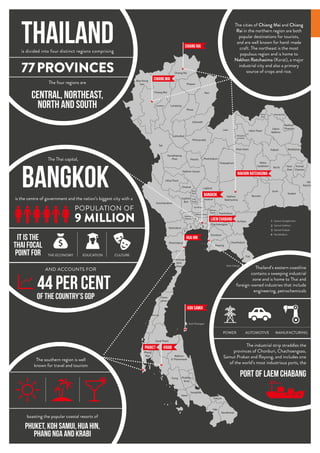
operating in Thailand is vital for understanding tax rules
specific to your business. Not all applicable taxes are
covered in this starter pack. Information provided stands
only as a general guide.
Principal taxes on income and consumption in Thailand
are levied under the Revenue Code of 1937 and its
subsequent amendments. It is the responsibility of the
Revenue Department of the Ministry of Finance to
administer the income tax code, which divides taxpayers
into two classes: personal and corporate. Personal income
tax not only applies to individuals but also to groups of
individuals and an unregistered ordinary partnership.
Group taxation is not permitted in Thailand. Corporate
taxpayers include locally incorporated companies,
branches of foreign companies, joint ventures, limited
partnerships and registered ordinary partnerships.
Corporate income tax
Corporate income tax (CIT): This applies to company
residents of Thailand. Residence is determined by
the actual place of incorporation and not the place
of management or ultimate control. Companies
incorporated under Thai law are regarded as resident
companies and are taxed on their global income. A
foreign incorporated company, however, is taxed on
profits arising from – or as a consequence of – business
carried out in Thailand. The current corporate rate of tax
is 20 per cent for accounting periods that commence
between 1 January 2013 and 31 December 2015. A
foreign company that is not operating a business in
Thailand is nevertheless subject to withholding tax
(WHT) on assessable income such as interest, dividends,
royalties, rentals and service fees that are paid from
or in Thailand. Generally, the rate of WHT is 15 per
cent, except for dividends, which attract a 10 per cent
rate, while other rates may be levied according to
the provisions of applicable tax treaties. A company
incorporated in another country but carrying on business
in Thailand (e.g. a branch office) will need to pay CIT on
profits arising from any business conducted in Thailand. In
addition, should after-tax profits be repatriated to head
office, a final 10 per cent WHT is imposed.
SMEs with a paid-up capital not exceeding THB 5 million
at the end of any accounting period, and having derived
income from the sale of goods and/or the provision
of services not exceeding THB 30 million in the same
period, will be subject to CIT at the following rates:
Net profit (THB) CIT rate (%)
0 to 300,000 0
300,001 to 1 million 15
Over 1 million 20
Tax treaty: Thailand and Australia share a tax treaty that
seeks to eliminate double taxation rates. However, it
does not reduce the domestic law applied WHT rates for
dividends (10 per cent), interest income (15 per cent) and
royalties (15 per cent).
Capital gains tax: There is no specific legislation governing
the taxation of capital gains in Thailand. Rather, capital
gains earned by companies are treated the same as
ordinary revenue for tax purposes. Profits derived from
the sale of investments in Thailand by a foreign company
not carrying on business in Thailand are taxed at 15 per
cent, withheld at source by the purchaser of the asset.
This is exempt under the tax treaty for Thailand and
Australia unless the Thai company’s assets are more than
50 per cent real property.
Thin capitalisation rule: There is currently no thin
capitalisation or prescribed debt-to-equity law applicable
in Thailand.
Wage tax and social security contributions: As in
Australia, employers are responsible for withholding
income tax from their employees and forwarding it to
the tax authorities. Social security contributions are
mandatory for both employers and employees levied at
the rate of five per cent of an employee’s salary, subject
to THB 750 per month cap per employee.
Indirect taxes
Value added tax (VAT): This is an indirect national tax
levied on the sales of goods and the provision of services,
in similar fashion to Australia’s GST. However, exports do
not incur VAT, while a number of goods and services are
exempt (namely, basic groceries, education, health care,
interest payments, leasing of immovable property, sale
of real estate, sales of goods or services to government
agencies and the United Nations). The standard rate of
VAT is 10 per cent, but the prevailing rate is just seven
per cent, a reduction that remains in force until 30
September 2015. It is expected there will be a permanent
rise to nine per cent from October 01, 2015 with a
potential one per cent change of local sales tax, taking the
combined rate to 10 per cent.
Specific business tax (SBT): This tax is imposed on the
gross revenues of certain businesses that are not subject
to VAT. It is levied at a flat rate depending on the type
of business. Commercial banking, finance and securities
Country starter pack
Business practicalities in Thailand
67
firms are taxed at three per cent and life insurance
operations at 2.5 per cent. The rate of SBT has been
reduced to 0.01 per cent for certain revenues pertaining
to the finance and securities industries. Municipal tax
at the rate of 10 per cent is imposed on top of SBT
payments.
Other taxes
Excise tax: This is a form of consumption tax that is
imposed on so-called “luxury” goods and services,
irrespective of whether they are manufactured locally
or imported. These can include tobacco, alcoholic and
certain non-alcoholic beverages, certain electrical
appliances, crystal glassware, motor vehicles, boats,
motorcycles, perfume products and cosmetics,
telecommunications products and business, petroleum
and petroleum products, batteries and woollen carpets.
The tax liability is incurred when the goods leave the
factory or warehouse, or are imported. Tax rates are based
on ad valorem or a specific rate, whichever is higher.
Rates differ, ranging widely from as little as five per cent
to 60 per cent. However, rates are subject to change so it
is important to consult a tax professional for up-to-date
figures.
Stamp duty: This applies to 28 different types of
documents and instruments, including contracts for
commissioned work, as well as loans, share transfers,
leases for land or buildings, and insurance policies. Stamp
duty rates vary according to the type of document,
but can range from THB 1 per every THB 1000 of
value inherent in the contract or agreement, to a fixed
amount per instrument on most commercial and other
documents. A surcharge as high as 600 per cent can
be applied for failing to pay the original stamp duty in
a timely fashion, while unstamped documents are not
admissible as evidence in a civil lawsuit.
Petroleum income tax: A tax is imposed on income
derived by any company that owns an interest in a
petroleum concession granted by the Thai Government,
or a company that buys oil for export from a concession
holder. Companies taxed under the Petroleum Income
Tax Acts (PITA) are exempt from taxes and duties on
income imposed under the Revenue Code and under any
other laws. The exemption applies provided the company
pays taxes and duties on income subject to the PITA or
on dividends paid out of income subject to the PITA.
Local taxes: there are three major local taxes.
•	 House and land tax is levied at the rate of 12.5 per
cent of assessable rental income.
•	 Signboard tax is levied on certain commercial signs
or billboards at varying rates according to size and
language deployed. Currently, the rates per 500
square centimetres are THB 3 if all of the words used
in the sign’s message are in Thai; THB 20 if both
Thai and foreign words are used; and THB 40 if the
language used is entirely foreign or if Thai words are
placed below the foreign ones.
•	 Local development tax is levied at rates ranging from
0.25 per cent to 0.95 per cent on the value of land
assessed by local authorities. Due each year, the tax
does not apply if the property is already subject to
house and land tax.
Compliance
Tax year and tax returns: Although the general tax year
is a calendar year in Thailand, corporate entities can
choose an alternative 12 month period should it suit their
specific accounting needs. Once chosen, the accounting
period cannot be changed without written approval from
the Revenue Department. The tax system is one of self-
assessment: companies prepare and file returns by the
due dates, simultaneously paying taxes that fall due.
CIT returns: Annual CIT returns, together with tax
payable, are due 150 days after the end of a corporation’s
accounting period. CIT, however, is paid twice a year. A
half-year return must be filed within two months of the
end of the first six months of an accounting period with a
company’s tax liability at that point calculated on one-half
of estimated full year profits, except in the case of listed
companies, banks, certain other financial institutions, and
other companies under prescribed conditions in which the
tax liability is based on the actual net interim profit. On
receipt of annual tax payments, government authorities
will credit the amount of tax previously paid at the half-
year.
VAT returns: Registered traders must submit VAT returns
and payments to the Revenue Department within 15 days
of the end of the month for which the VAT is applicable.
The monthly return should calculate the amount of
VAT due based on the sale of goods and the provision
of services by the trader net of any VAT charged to the
trader by its suppliers of goods and services.
Should this latter amount be in excess of the VAT owed
by the trader, any excess may be carried forward to offset
against future months’ VAT payments or a refund can be
requested. However, the VAT charged to a trader is not
always deductible from the total VAT falling due. This is
the case where the goods and services purchased were
not used in the ordinary course of business or where
they were used for VAT-exempt activities, represented
entertainment expenses, gifts or expenses in connection
with passenger vehicles with fewer than 10 seats, or in the
case where tax invoices did not contain all the requisite
information.
Individual (personal) income tax
Both residents and non residents who earn an income
for some form of work performed in Thailand – whether
it be salary, bonuses, gratuities, pensions, the monetary
value of rent free housing, the employer’s payment of
income tax, or any other money, property, or benefits
derived by virtue of being hired for service – are liable for
personal income tax in Thailand, regardless of whether the
income is paid within or outside the country. There are no
concessions for foreigners or short term residents.
Country starter pack
Business practicalities in Thailand
68
Compliance
The tax year for personal income tax and general tax
conditions is the calendar year, with returns to be filed
no later than 31 March of the following year. Individuals
engaged in most forms of business must also file a return
documenting their income for the first six months of the
year by 30 September and pay any tax due.
The income of a wife is no longer required to be treated as
part of her husband’s income. Consequently, each husband
or wife who earns an income can choose to file a tax return
either separately or jointly, whichever they prefer.
Income tax is required to be withheld from employee
salaries by employers, along with other benefits required
under legislation. The balance of any tax due for a calendar
year is payable at the time of filing an annual tax return.
5.4	AUDIT AND ACCOUNTANCY
Companies and businesses operating in Thailand are
required by law to maintain thorough and up-to-date
accounting records and must prepare annual financial
statements in accordance with the Thai Accounting
Standards (TAS). Developed by the Institute of Certified
Accountants and Auditors of Thailand (ICAAT), the
TAS have been adopted by the Board of Supervision
of Auditing Practices in the Ministry of Commerce
for regulating and overseeing accounting practices
in Thailand. TAS essentially follows the International
Financial Reporting Standards (IFRS) with some
exceptions.
Accounting period
Corporate entities are able to choose a 12-month period
for their accounting year that best suits their operations
(that is, the equivalent of the Australian financial year,
July 1 to June 30, or calendar year). Once decided, this
cannot be altered without written approval from the
Revenue Department.
Frequency of reporting
A corporation’s financial statements must be presented at
least annually. Should the corporation’s reporting period
change and financial statements are prepared for a period
other than a year, the entity must disclose the reason for
this and make clear that the information is not exactly
comparable to the previous reporting period.
Accounting books
A full range of accounting and other record-keeping
requirements must be observed by law: typically, a journal,
general ledger and inventory records, all maintained in
Thai, must be kept. Thai translations must be provided
where a foreign language is used.
In an effort to support low income earners and the aged,
the first THB 150,000 of income is tax exempt. For a
resident 65 years of age or older, this exemption applies
to income up to, but not exceeding, THB 190,000.
Individual income tax rates 2015
Taxable net income (THB) Tax rate (%)
0-150,000 Exempt
More than 150,000 up to 300,000 5
More than 300,000 up to 500,000 10
More than 500,000 up to 750,000 15
More than 750,000 up to 1,000,000 20
More than 1,000,000 up to 2,000,000 25
More than 2,000,000 up to
4,000,000
30
Over 4,000,000 35
Regional Operating Headquarters (ROH) tax
concession: Expatriates employed by an ROH can opt to
pay a personal income tax rate of 15 per cent of the WHT
flat rate for the first four years from the date noted on
their original work permit.
International Headquarters (IHQ) tax concession: The
Thai government has recently introduced an international
headquarters (IHQ) tax scheme in which expatriates
employed at an IHQ in Thailand are exempt from 15 per
cent WHT indefinitely. This is to attract more foreign
companies to set up IHQs in Thailand.
Capital gains: Capital gains and investment income
earned by residents from sources outside Thailand are
not taxable unless the gains are remitted in the year
they were made. Capital losses may not be offset against
capital gains for income tax purposes. Most types of
domestic capital gains rank as personal income for tax
purposes, although some gains associated with the sale of
securities and shares on the Thai Stock Exchange and on
the exchanges of ASEAN nations, may be exempt or be
subject to a 15 per cent WHT.
Dividends: Thai residents who receive dividend payments
from foreign companies listed on the local stock exchange
and a company incorporated in Thailand are subject to
WHT of 10 per cent.
Interest income: Interest received from bank deposits,
loans to finance companies, government bonds,
debentures, and bills issued by a corporate entity is liable
for WHT at a flat rate of 15 per cent.
Exemptions: Certain types of income are exempt from
personal income tax, namely work related income derived
in the form of per diem allowances, travelling expenses
and certain fringe benefits such as medical treatment.
Country starter pack
Business practicalities in Thailand
69
Preservation of books and records
These documents and records must be kept on the
premises of the business, or the usual location where
goods are produced or stored, and retained for at least
five years beyond the year to which they pertain, unless
otherwise agreed to the Accountants Inspector Office or
the Chief Accounts Inspector.
Financial statements
A complete set of the required financial documents
consists of a statement of financial position (balance
sheet), a statement of comprehensive income, a
statement of cash flows and a statement outlining any
changes in equity, as well as any notes to the accounts.
Audited requirements
All incorporated business entities – except partnerships
registered under Thai law with capital of THB 5 million
or less as well as assets and income not exceeding THB
30 million – must submit financial statements (audited
by a certified public accountant) to the Department of
Business Development within five months of the end
of its financial year. For limited companies or public
limited companies established under Thai law, financial
statements must be submitted within one month of the
date of the general meeting at which they were approved.
Additionally, audited accounts must accompany the
filing of the annual corporate income tax return with the
Revenue Department. Audited financial statements (in
THB and Thai) must be filed with the corporate income
tax return and also the Ministry of Commerce.
Consistent with global accounting practice, auditors
are required to declare whether in his or her opinion an
entity’s financial statements reflect honestly the financial
position of the company, its financial performance
and its cash flow position for the designated period in
accordance with Thai Financial Reporting Standards
(TFRS).
5.5	EMPLOYING WORKERS
Labour market
As has been the case with many of its Southeast Asian
neighbours, Thailand’s Government is looking to steer
the country away from its heavy reliance on cheap labour
towards an industrialised economy with a burgeoning
middle class. Necessity, as much as ambition, is driving
this transformation. Thailand has a rapidly ageing
population: the second oldest among the region’s 11
countries, according to the United Nations. It will unlikely
have the labour might in the future to sustain labour-
intensive industries. In response, the Thai government is
ramping up education as a key priority for its people and
reorganising its industrial base. This also comes in the face
of rising competition from developing Myanmar. As with
Singapore and Malaysia, Thailand has been dependent on
migrant labour in industries such as food processing, on
assembly lines and in construction. There are concerns
that eventually, many of these workers may return
home to neighbouring Myanmar to fill new jobs there,
if its economy continues to expand and attract foreign
investment.
Skill shortages have been identified as a key impediment
to Thailand’s future growth and drawing foreign
investment, as highlighted by the World Bank. While the
Government has sought to facilitate skills training for the
country’s labour force as a means of generating higher-
paid jobs, the Thai labour market remains skewed by low-
skilled workers with little education or training.
Despite this make up and reflecting the country’s reliance
on unskilled labour and often menial jobs, Thailand’s 39
million strong workforce enjoyed employment levels
around 98 per cent in 2013. These workers are mostly
employed in the agriculture sector (39.6 per cent) and
services (39.1 per cent). Manufacturing accounts for
21.1 per cent of employment. Thailand’s jobless rate was
0.7 per cent over the three years from 2012-14. Male
participation in the labour force is just under 80 per cent,
while the female participation rate is around 63 per cent.
The literacy rate: According to the World Bank, Thailand’s
Literacy rate for adults is approximately 96 per cent.
Skill level: Approximately 12 per cent of the Thai
workforce has an advanced education. Thailand also has
around 800 vocational colleges, producing a number of
technically skilled graduates every year. The country ranks
high on the United Nation’s Human Development Index,
coming in at 89 out of 187 countries.
Minimum wage: This has remained at THB 300 per day,
having reached that all time peak in 2012. The minimum
has averaged at THB 122.54 over the 40 years to 2013,
plummeting to a low figure of THB 12 in 1973. Minimum
wage rates are prescribed by law and vary according to
the location and types of jobs.
Human resources and employment law
Accompanying the surge in both domestic and foreign
investment in recent years has been a rising demand for
skilled labour. Given the interdependence of industry
and labour and the impact that labour shortages can
have on economic growth, greater effort has been taken
to bring into harmony the needs of both employers and
employees. This is overseen by industrial legislation.
The key laws governing this relationship include the
Civil and Commercial Code, the Labour Protection Act
(1998), and its subsequent amendment (2008), the
Labour Relations Act (1975) and the Labour Procedures
Act (1979).
A basic employment contract, which can be made
verbally or set out in writing, will stipulate the terms and
conditions, duties and responsibilities of both parties.
Country starter pack
Business practicalities in Thailand
70
According to law, employees have a duty to render their
service as agreed, performing the work with due care
and diligence and complying with rules and regulations of
work. In return, workers have the right to a wage or salary
as well as welfare in accordance with either the contract
or law.
Employment may be terminated:
•	 On the expiry of the employment period
•	 By mutual agreement
•	 On completion of the agreed work
•	 On notification in advance by either party, where the
employment period has not been fixed
•	 On the transfer of employment to a third person
without consent of an employee
•	 By an employer when an employee is found guilty of
gross misconduct of the type outlined by laws
•	 In the event of termination, an employer has a duty
to provide the worker with an employment certificate
and pay for a return journey to their home (if working
in a different town) as well as severance pay under
certain conditions as prescribed by law.
Labour protection laws: The Civil and Commercial Code
spells out the rights and duties of an employee and an
employer regarding an employment contract. But on top
of this, employees are entitled to additional protections
under Thailand’s labour protection laws. These basic
standards broadly cover minimum working hours, rest
periods, holidays, wages, employment of women and
children, severance pay and compensation. It is not
allowed for employers and employees to agree to forego
any provisions of the law which would put the employee at
a disadvantage.
Working hours: These can vary according to the type of
work, but should not be more than 48 hours per week for
industrial and commercial work or 42 hours per week for
work potentially harmful to the health of the employee.
Holidays: An employee is allowed to have at least one
day per week off and at least 13 holiday days (including
National Labour Day) per year to observe traditional
holidays. In addition, an employee is entitled to a
minimum of six working days per year as annual leave,
provided that they have completed one year’s service of
employment.
Overtime: Employees are entitled to overtime at the
rate of at least 1.5 times their normal hourly rate, and
where their contract does not stipulate working on public
holidays, then at least two times the regular rate on those
days. Employees whose terms of work include working
on public holidays are entitled to their normal hourly rate
on those days, but three times that rate for any overtime
worked on a public holiday. Overtime cannot be worked
for the types of work that may be harmful to the health or
physical wellbeing of an employee.
Sick leave: A maximum of 30 days’ paid sick leave applies
in Thailand. Employers can request a medical certificate
in the event that an employee requires more than three
consecutive days of sick leave. Women are entitled to up
to a maximum of 45 days’ maternity leave.
Compensation: Thailand does enforce workers’
compensation in the event that an employee suffers
illness, injury or death while performing their job, or
contracts a disease as a result of their working conditions.
In such cases they are entitled to compensation that
covers medical treatment and/or funeral expenses. In the
case of death, an employee’s parents, spouse or children
have the right to receive compensation. Thailand’s Social
Security Fund plays a vital role in this.
Country starter pack
Business practicalities in Thailand
71
Employer: Incidents involving injury, illness or death of
employees must be reported by employers to the local
compensation officer within 15 days. The authorities will
then investigate the circumstances and can direct the
employer to pay compensation to employees accordingly.
Workers compensation fund: Employers conducting
certain types of operations with at least one employee
must register with and contribute to the workers
compensation fund. Contribution rates vary between 0.2
per cent and one per cent of the business’s total wages
bill according to the level of risk associated with the type
of business (wages are capped at THB 240,000 a year
per person). The fund makes compensation payments
according to the law on behalf of employers.
Social Security Fund: On top of any compensation due
to employees under labour laws, workers may also have
a claim to compensation under the Social Security Act
(1990), as amended in 1994, even though an injury,
illness or death may not be the direct result of work.
All businesses with at least one employee, irrespective
of whether they are Thai or foreign, must register with
the Social Security Fund. Employees, employers and
the government must each contribute five per cent of
an employee’s salary (up to a maximum salary of THB
15,000 per month) to the Social Security Fund. These
contributions (both those of employees and employers)
must be paid into the fund monthly regardless of the size
of the business. There are no exceptions for expatriate
employees.
The fund provides medical services and expenses,
compensation and/or funeral expenses, and pensions at
rates prescribed by the law.
Pensions and social security: The Social Security Fund
also assumes responsibility for pensions, which can be
received by employees from the age of 55, drawn on
mandatory contributions made during the employee’s
working life. Workers who contribute to the fund for
15 years or more will receive, as a form of pension
upon retirement, at least 20 per cent of their average
salary for the previous five years. Special retirement
funds, governed by the Provident Fund Act, can be
established by employers on a voluntary basis to fortify
pension arrangements for their workers. Employers and
employees are able to put between two per cent and 15
per cent of the employees’ salary into the fund.
Labour relations law: The Labour Relations Act (1975)
monitors industrial relations across the Thai economy,
providing resolution of any labour conflicts. The Act
makes clear rules and regulations governing the formation
and operation of unions and federations, employee
committees and employer associations, while setting
frameworks for workplace agreements and settling labour
disputes. It also defines unfair labour practices, protection
measures and employee rights, as well as procedures for
making a claim in cases of unfair practices.
Labour Court: Workplace disputes and any incidents
leading to claims against employers or unions must
be submitted to the Labour Court. Cases presented
under the Labour Court Procedure Act (1979) are to be
conducted simply and resolved as quickly as possible. It is
the court’s intention that cases will be considered fairly
and with a view to reaching a compromise and mutual
agreement.
Severance pay: Employees generally have the right to
severance pay when discharged from work, provided they
have worked a minimum of 120 days and are not being
dismissed because of dishonesty, intentionally causing
damage to an employer, or because they have breached
rules and regulations after an official written warning. They
are also ineligible if they have been absent from work for
three consecutive days without reasonable grounds or have
been convicted of a crime and been jailed. The rates are:
Consecutive
service period
Minimum severance pay
From 120 days to
less than 1 year
30 days’ wages
From 1 year to less
than 3 years
90 days’ wages
From 3 years to less
than 6 years
180 days’ wages
From 6 years to less
than 10 years
240 days’ wages
From 10 years
onwards
300 days’ wages
In addition, special compensation may be due to
employees in cases where their termination is the
result of the business relocating or where technological
improvements have made workers redundant. Where
special severance pay is applicable, employers are
required to pay employees the provision specified by law.
Recruitment channels: Typically, workers are recruited in
Thailand by various means:
•	 Online job services such as www.jobthai.com and
www.jobbkk.com
•	 Classified advertisements published in local Thai daily
newspapers such as Thai Rath, Manager Daily and
Krungthep Turakij
•	 Classified advertisements for jobs published in English
in the Bangkok Post and The Nation, both of which
have daily circulations of around 60,000
•	 Recruitment firms – including experienced domestic
and international companies – that operate in Bangkok.
Country starter pack
Business practicalities in Thailand
72
Work permits
Having obtained a visa to enter Thailand, expatriates
wishing to work there must also apply for a work permit.
This must be done before engaging in any work and once
applicants are granted a non immigrant visa category B.
Most foreigners working in Thailand are subject to the
Alien Employment Act (B.E. 2521), under which they are
not allowed to perform any act of work or service without
a work permit issued by the Employment Department,
unless the work performed is exempted under the Act.
Six categories of foreigners are exempted from work
permit requirements. They are:
•	 Members of the diplomatic corps, or a consular
mission
•	 Representatives of member countries or officials of
the United Nations and its specialised agencies
•	 Personal servants coming from abroad to work
regularly for persons of the above categories
•	 Persons who perform any duties or missions in
the Kingdom under an arrangement between the
Government of Thailand and a foreign government or
an international organisation
•	 Persons who are permitted by the Government of
Thailand to enter and perform any duties or mission in
the Kingdom
•	 Persons who perform duties for the benefit of
education, culture, arts, sport or such other activities
as prescribed by Royal Decree.
Obligations for getting work permits lie in the definition
of the term “work”, which is applied broadly as “working
by exerting one’s physical energy or employing one’s
knowledge, whether or not for wages or other benefits”.
Under this definition, a foreign spouse doing volunteer or
charity work would theoretically require a work permit.
Provisions allow you to apply for a work permit if you are
entering Thailand temporarily to perform ‘urgent and
essential work’ for a period not longer than 15 days.
Work permit applications can be filed in two ways. The
preferred route for employers who meet certain criteria
is Thailand’s One Stop Service Centre, established
ostensibly to fast track applications, which can normally
be approved on the same day they are submitted.
In cases where an individual or employer does not qualify
for this service, work permits should be sought from
the Ministry of Labour and visas from the Immigration
Bureau.
Work permits are issued in a passport sized booklet and
detail where the individual may work, their job description
and so forth. Should a worker’s situation change, they
must contact immigration authorities immediately so
that details can be amended. Working at a location or in
a position that is not listed in a work permit could draw
penalties and is not recommended.
Foreigners are prohibited from working in 39 occupations
that are reserved for Thais, including manual and industrial
labour, as well as work in agriculture, animal breeding,
forestry, fishery and farm supervision, carpentry, shop
assistance, accountancy, hairdressing, civil engineering,
legal services, architectural work, dressmaking, and
clerical or secretarial work.
Visa and work permit cancellation: At the conclusion of
any work assignment in Thailand, you should contact the
Immigration Bureau to cancel your visa. This is not a legal
requirement, as work permits that are not renewed will
expire automatically. However, cancelling the work permit
at the end of your assignment allows a corporation’s Thai/
foreigner staff ratio to be maintained, paving the way for a
possible replacement expatriate.
Immigration law in Thailand is complex, and it is
recommended that professional advice be sought on
these matters on a regular basis.
Managing a Thai team
Given the more formal style of doing business in
Thailand, as well as in Thai relationships more generally,
cross-cultural management can be challenging and
requires thoughtfulness on the part of managers, with
strict rules of protocol needing to be observed. Thai
workers are attuned to a strict chain of command, which
carries expectations for both workers and managers.
Communication is often delivered nonverbally as a means
of protecting others from losing face, and it is important
that you observe closely the facial expressions and body
language of people while conducting business.
As a manager
Keeping in mind the distinct roles of those with whom
you are working allows for more effective cross cultural
communication. Maintaining – and reinforcing – these
distinctive roles helps keep order.
At the same time, it is important that managers maintain
their role as ‘boss’, commanding respect from within
the team, as this is expected in Thailand, as in other
hierarchical societies, where managers may display a
somewhat paternalistic attitude towards their employees.
Communication is vital when a manager needs to work
collectively with their team, rather than in a top-down
fashion. This requirement should be outlined very clearly
so that the team feels reassured about operating openly
in a nonthreatening environment.
Managers need to sensitively handle cases where a worker
makes a contribution that is not particularly helpful or
needed. Critically, the individual should not be shamed
in front of colleagues as this will put in jeopardy the open
participation and enthusiasm of the rest of the group.
Country starter pack
Business practicalities in Thailand
73
Approach to change
Tolerance for – and the ability to – change in Thailand
remains low. The country’s natural conservatism means
that change can often be viewed as threatening.
Domestic managers can therefore be averse to change
and it is important that expatriate ‘change agents’
promote any proposed variances as benefiting the ‘whole’
and not just an individual.
While change is not impossible, even the most effective
managers must factor in plenty of time to implement
changes in Thai work and business practices.
Approach to time and priorities
Whoever said “patience is a virtue” might have had
Thailand in mind: deadlines and schedules can be fluid and
patience is a key to successful intercultural management.
Thai culture is underscored by relationships, and taking
the time to get to know someone can be expected to
take precedence over any timelines. Rushing relationship
building can put at risk future business dealings.
Managing Thai people requires perception and sensitivity,
as well as flexibility. It’s worth reinforcing the importance
of agreed deadlines citing as context how these may
affect the rest of the operation. And be aware that a
manager in Thailand may avoid confrontation over a
deadline in order to maintain a positive relationship within
the team. This is perhaps less likely in businesses where
workforces have been exposed to a more globalised
world and, as a result, may have a greater appreciation
of the need to enforce timescales necessary for meeting
deadlines.
Decision making
International influence is also starting to have an impact
even on older Thai companies that are steeped in a rigid
hierarchy. This is most evident in many multinationals,
entrepreneurial companies and those doing regular
business with foreigners. But remember that this is
a country where rank not only carries privileges, but
also comes with clear cut responsibilities. The most
effective managers understand this relationship: while
workers show respect and deference to their managers,
it is customary for managers to know the personal
circumstances of subordinates and to offer advice and
guidance where needed.
5.6	BANKING IN THAILAND
Banking environment
The capital, Bangkok, also stands as Thailand’s financial
centre, where key regulators – the Ministry of Finance
(MOF) and the Bank of Thailand (BOT) – are based. The
former is responsible for fiscal policy, financial systems
policy and economic policy. It also oversees public
finances, taxation, treasury, government property, as
well as operations of state enterprises and government
monopolies. The BOT, meanwhile, is the central bank,
with responsibilities for setting monetary policy, managing
exchange rates and controlling foreign exchange, as well
as overseeing the financial system by supervising and
regulating financial institutions. It also provides banking
facilities to the government and financial institutions,
while regulating the money supply by printing and issuing
bank notes and other security documents.
The regulation of banking in Thailand is covered by
the Financial Institution Act B.E. 2551 (2008), which
defines a commercial bank and outlines the type of
business that banks may undertake. The law covers
commercial banks for small businesses, as well as banks
that are subsidiaries or branches of foreign banks. Overall
there are several different types of banks and financial
institutions operating in Thailand, including traditional
domestic commercial banks and well known international
banks that are subject to various restrictions that may
include the establishment of local branches. There are
also six government banks with specific mandates: the
Bank of Agriculture and Agricultural Cooperatives, the
Government Housing Bank, the Government Savings
Bank, the Export Import Bank of Thailand, the Islamic
Bank of Thailand, and the Small and Medium Enterprise
Development Bank of Thailand. In addition, there are
securities companies and international banking facilities
that are licensed by the MOF to engage in a variety of
activities including: offshore and domestic lending, foreign
exchange transactions, debt guarantees, letters of credit,
and merger and acquisition advice.
Types of banks and financial institutions
Thai commercial banks 14
Subsidiary 2
Retail banks 1
Foreign bank branches 13
Foreign bank representative offices 45
Credit card companies 10
Specialised financial institutions 10
Finance companies 2
Source: Bank of Thailand
Country starter pack
Business practicalities in Thailand
74
ANZ is the only Australian bank operating in Thailand.
Established as a representative office in 1986, ANZ Thai
is now a full licensed bank supporting institutional and
corporate clients in Thailand and across its global network.
Aside from major local banks such as Bangkok Bank,
Kasikorn Bank and Siam Commercial Bank, international
banks such as Citibank, HSBC and Standard Chartered
provide banking services in Thailand and are able to
provide full online banking facilities and support.
Bank accounts
Foreign firms are not restricted from opening a bank
account in Thailand but this must be done only by
authorised personnel with supporting documentation
such as a passport, Thai visa and work permit, and
company registration papers. A minimum initial deposit is
required, set generally for international bank accounts at
THB 50,000 or more (or foreign currency equivalent)
and for major Thai banks at THB 10,000 for current
accounts and THB 500 for savings accounts. But it is
important to research individual bank requirements for
establishing an account in Thailand.
Non-residents may open non-resident THB accounts
with authorised banks in Thailand, as follows:
•	 Non-resident Baht Account for securities (NRBS):
The account may be debited or credited for the
purpose of investment in securities and other
financial instruments, such as equity instruments,
debt instruments, unit trusts and derivatives
transactions traded on the Thailand Futures Exchange
and the Agricultural Futures Exchange of Thailand.
•	 Non-resident Baht Account (NRBA): The account
may be debited or credited for general purposes, such
as trade, services, direct investment, investment in
immovable properties and loans, etc.
Total amounts for each type of account must not exceed
THB 300 million per non resident. Transfers between
each of the above accounts are not permitted.
Currency regulations
There are no limits on foreign currencies being
transferred or brought into Thailand. People or entities
receiving foreign currency transfers are required
to repatriate such funds immediately and sell to an
authorised bank or deposit them in a foreign currency
account with an authorised bank within 360 days of
receipt. Those exempt from this regulation are foreigners
staying in Thailand for not more than three months,
foreign embassies, international organisations including
their staff with diplomatic privileges and immunities, and
Thai emigrants who are permanent residents abroad or
working abroad.
Purchasing foreign currency from authorised banks is
generally allowed with the submission of documents that
show this relates to international trade and investment.
Companies in Thailand are also entitled to engage in
derivatives transactions with authorised banks as a means
of hedging against foreign exchange risk, provided that
documents showing future foreign currency receipts
or obligations are provided. A customs declaration
is required from anyone bringing into or taking from
Thailand foreign currency bank notes exceeding
US$20,000 in total value.
Foreign currency account of Thai residents: Thai residents
are allowed to hold foreign currency accounts with
authorised banks, and deposit or withdraw funds from
such accounts under certain conditions.
Thai companies receiving payment in foreign currency
from overseas are able to transfer funds from their
overseas-based foreign currency accounts to deposit
into foreign currency accounts of their counterparties in
Thailand for the payment of goods or services.
Foreign currency account of non residents: Non residents
may maintain foreign currency accounts with authorised
banks in Thailand without limit. The accounts can be freely
credited with funds originating from abroad. Payments
from Thai residents or loans from authorised banks can
be deposited in such accounts subject to supporting
documentation, while funds can be freely withdrawn.
5.7	REPATRIATING PROFITS
AND GETTING PAID
Foreign exchange control: Currencies other than THB
are generally used for the repatriation of profits and
other transactions, with the BOT regulating payments
and responsible for any ceiling. When these payments
are calculated in THB, they are converted into the
appropriate foreign currency at the time of repatriation
and transacted through a commercial bank once the
necessary documentation is provided. Payments of
amounts above the ceiling require special approval from
the BOT.
The repatriation of investment funds and monies for
repaying overseas loans is permitted provided the bank
sights all supporting official documentation. Should
funds be taken as cash, it is important to be aware that
foreign currency amounts exceeding US$20,000 or
the equivalent in total must be declared to Thai Customs
on entry or exit from Thailand. Also, transactions that
involve the sale, exchange, withdrawal or deposit of
foreign currency totalling more than US$50,000 or its
equivalent must be documented in a Foreign Exchange
Transaction Form and submitted to the authorised bank.
Country starter pack
Business practicalities in Thailand
75
Getting paid: Doing business is one thing, but getting
paid for your effort can be another thing altogether when
doing business in a foreign country. Banks can assist
with detailed advice about how to go about this and to
determine which option best suits your enterprise. The
best payment option for your business will depend on
a variety of factors, not least the reliability of the buyer
and whether the company is trustworthy. Some of this
assessment may be intuitive and some based on the
nature of the business relationship so far. But questions
about the extent of any risk you are willing to accept, and
whether there is the prospect of bargaining for better
terms from a particular customer are factors that need to
be weighed carefully.
Choosing the right payment option: Payment terms can
prove decisive when competing for business, and savvy
negotiators will often use such detail as leverage for
clinching a deal.
Options for payment terms can include:
•	 Receiving some – or possibly all – of the payment
upfront as a down payment
•	 Documentary collection, where goods or services are
shipped but the seller retains control of them until
payment – or a legal undertaking of future payment
– is received from the Thai buyer
•	 Open account (or open credit), which affords the
buyer certain credit terms. Goods or services are
delivered with an invoice demanding payment by a
specific date.
It is worth erring on the side of caution in your initial
business transactions by using secure methods of
payment, such as Letters of Credit. The default currency
for payment, quotes and invoices – if not in THB – is US
dollars.
Risks of nonpayment: Little in the commercial world is
entirely risk free, but risks of default on payments are
best managed by choosing some form of prepayment
or documentary credit. This may be difficult in asserting
from the outset of a business relationship and is
something of a Catch-22 – that is, by the time you have
established a track record with the buyer it will be clear
whether or not prepayment is necessary for continuing
business transactions. Some independent assessment of
the buyer with the help of your bank or an international
business consultant may be worthwhile, as well as seeking
their advice on the best payment options.
Managing exchange risk: This is an essential part of
conducting foreign business transactions, which should be
discussed with your bank. Bank websites usually outline
key information regarding exchange rate products.
Country starter pack
Visiting Thailand
76
6.	 Visiting Thailand
Country starter pack
Visiting Thailand
77
Visiting Thailand is a crucial part of doing business there.
This chapter will review all the relevant information
necessary for travelling to – and within – Thailand.
6.1	VISAS
Australian passport holders do not require a visa in
advance to enter Thailand for tourism. Provided they
can show proof of their return – or onward – travel on
arrival at immigration checkpoints, they will normally be
permitted to stay in Thailand for up to 30 days. Business
visitors and those engaged in any business activities,
including attending a conference or meeting, or working
or conducting business of any nature, must acquire a
non-immigrant B visa before entering Thailand. However,
Thailand has made some changes for business temporary
entrants. Australian business visitors who are conducting
business meetings in Thailand for up to 15 days (up to 90
days for APEC Travel Card Holders) no longer require a
work permit.
Non-immigrant B Visa: This visa is for business people
engaging in any activities in Thailand related to business
including working, meetings and conferences. This is
categorised into two types based on the amount of
entries into Thailand. As of May 2015, the single entry
visa allows stays up to 90 days with the application
costing $90 and requiring a supporting letter from the
Australian employer or the Thai business counterpart.
The multiple entries visa allows multiple entries for one
year and also permits stays up to 90 days for each entry.
The applicant must report themselves to the nearest
immigration office or police station on each entry with
a visa application cost of $225. The application must be
supported by the following documents with the Royal Thai
Embassy also permitted to ask for further documentation:
•	 A letter from an employer in Australia and a business
counterpart in Thailand stating clearly the necessity
of getting a multiple entries one year visa
•	 A work contract
•	 A business registration of the company they are
working for.
In addition to these documents, both visas also require
a copy of the applicant’s itinerary or airline ticket,
one passport-sized photo and the original, as well as a
photocopy of their passport with at least six months’
validity beyond the proposed final Thailand departure
date. All application fees must be paid by bank cheque,
money order or cash and will take a minimum three
working days to process once the application is received.
Country starter pack
Visiting Thailand
78
In terms of other visas and work permits for longer stays:
•	 Thailand has recently expanded its visa and work
permit to five years’ stay (renewable annually) for
Australian citizens being transferred to work in
Thailand within the same company.
•	 Similarly, Thailand has extended to three years
its visa and work permit for Australian citizens
entering Thailand to work on a contract basis with an
Australian or Thai company other than their employer
in Australia (also renewable annually).
•	 Thailand will consider applications for visas and work
permits submitted by an employer on an applicant’s
behalf and advise in advance of approval. The visa will
then be granted on arrival at immigration checkpoints
subject to identity verification.
•	 Thailand now will also allow all Australian business
travellers access to its one-stop visa and work permit
service, which was previously reserved for visitors
representing – or employed by – major investors.
•	 Thailand will also allow Australians holding work
permits to participate in business meetings anywhere
in Thailand, including locations not specified in
their work permits. Previously, permit holders were
restricted to locations specified in the permit.
•	 Thailand also plans to narrow the number of
documents required from Australians for accessing or
renewing work permits.
Further information on visas and work permits can be
obtained from your nearest Thai Embassy or Consulate
prior to arrival.
6.2	CURRENCY
There are two simple options for acquiring THB at the
airport – ATMs or money changers. Commercial banks
are always the safest and most reliable option. Second
best are registered money changers in sole-purpose
shops or booths. ATMs throughout Thailand accept
most major international credit and cash cards, although
withdrawal fees are relatively high. Hotels and retailers
offer currency exchange at inferior exchange rates.
All major credit cards (Visa, Mastercard, American
Express and Diners) are accepted at most retailers and
restaurants.
VAT refund: Refunds of Value Added Tax (VAT)
are available to tourists but only on meeting key
requirements. They must leave Thailand through an
international airport, they must be a non-Thai resident
who has visited the country for no more than 180 days,
and they cannot be a pilot or member of a cabin crew of
any departing aircraft. Travellers wishing to claim a refund
must present their passport, along with a VAT Refund
Application Form (which can be obtained online or at the
airport), their original receipt(s) of goods purchased and
be in possession of the actual goods.
Opening bank accounts: Foreign nationals are allowed
to open accounts with any Thai bank once they have
obtained a work permit. They may also apply for additional
banking services such as telephone, mobile phone and
internet banking. To do this, they need to take their
passport and work permit to the branch. Such accounts
often come with an ATM card for a modest fee, perhaps
THB 100. A foreigner intending to open a current
account may first need to hold a savings account with
the bank for one or two months, or deposit a minimum of
THB 10,000.
Only some banks allow foreigners to open an account
without a work permit. Bangkok Bank will accept
alternatives such as a driver’s licence, student or teacher
identity card, a letter of recommendation from an
embassy or a bank statement from an account holder’s
home financial institution in addition to the applicant’s
passport. Krung Thai and Kasikorn Bank require a
document confirming that the applicant intends staying
in Thailand for longer than three months. Be aware,
however, that each bank applies different criteria for
opening an account. This can usually be determined
from the websites of individual banks. Note also, that it
is common practice for employees in Thailand to hold
accounts with the same bank as their employer, and for
expatriate employees to do likewise for ease of salary
payments.
Thailand’s standard
currency unit is the Baht
As is the case for all international travel, it is
advisable to exchange currency only at commercial
banks, currency exchange services or authorised
money changers
ilan
1 THB = 100 satangs
Bank notes come in six denominations
– 20, 50, 100, 500 and 1,000
Coins come in tokens of 25 and 50
satangs, as well as 1, 2, 5 and 10 Baht.
Country starter pack
Visiting Thailand
79
6.3	AIR TRAVEL AND AIRPORTS
Airlines: Thai Airways International, referred to simply as
Thai Airways, is the country’s national airline, launched
in 1960. It operates both domestic and international
services. Other local airlines include Bangkok Airways,
Nok Air, Thai AirAsia, SGA (Siam General Aviation),
Orient Thai Airlines, Happy Air and SkyStar Airways.
Domestic flights operated by Thai Airways International
and other private carriers are available to all major cities
and tourist resorts throughout Thailand.
Airports: Suvarnabhumi International Airport opened in
2006, replacing Don Muang as Bangkok’s international
airport. It is located approximately 30 kilometres from
Bangkok central business district. Thailand’s international
airports also include: Don Muang remains operational,
along with Chiang Mai, Chiang Rai, Hat Yai, Phuket and
Samui.
6.4	GROUND TRANSPORT
Taxis
Business travellers should always plan appointments in the
Thai capital well ahead of time given the prevailing problems
of traffic congestion. For convenience, but also for safety
and language ease, taxis and limousines provided by hotels
are the best options for visitors travelling in Bangkok. While
some taxi drivers speak English, their grasp is rudimentary.
A business card or address written in Thai can help, but is by
no means fool proof. Taxis do not carry street directories.
Taxis are plentiful, with the minimum fare around THB 37
for a distance of up to two kilometres. Taxis can be hired
at a fixed rate, negotiated in advance, but usually it is best
simply to request the use of the meter. A trip into the heart
of Bangkok from Suvarnabhumi International Airport can
take as long as an hour depending on the traffic. During
peak traffic periods, the best route is the elevated tollway,
although travelling on it will incur tolls, passengers may be
expected to stump up at toll booths and not at the end
of their journey. Tips are not required, although it is usual
to round up the fare. Taxis do not accept credit cards, so
travellers need to stock up on cash, preferably notes in
small denominations. Taxi drivers also do not issue receipts.
Meanwhile, Thai “tuk-tuks” are famous, but are less safe
than other forms of transport, and suitable for short
distances only. Fares must be negotiated beforehand.
There are also options to hire motorcycles with a driver for
short distances in some towns and cities. However, this
may not always be the safest option.
Driving in Thailand
Driving in Bangkok can be a challenge but for those who
know the city reasonably well, renting a car from one of the
international car rental companies operating in major Thai
cities is an option. This can also be a good option in areas
other than Bangkok if you’re familiar with that region. An
International Driving Permit (IDP) is required and driving is
on the left-hand side of the road, which should (in theory)
present no problem to Australians. Be prepared, however,
for some unusual driving practices!
Country starter pack
Visiting Thailand
80
Public transport in Bangkok
There are a number of public transport options available
in the capital that can cut commuting times and reduce
uncertainty when heading to an intended destination. In
Bangkok, it is often quicker to navigate the city by public
transport than by car.
BTS: The Bangkok Transit System (BTS), or Skytrain, started
operations at the turn of the millennium. During regular
hours, trains run nearly every five minutes but their frequency
increases to between three and four minutes during peak
times. The system operates seven days a week from 6am to
midnight. The BTS connects the most important business
areas – Silom and Sukhumvit. The network is currently being
expanded to other areas of Bangkok and new sections are
being opened as they are completed. Fares for the Skytrain
are set between TBH 15 to 52 for a one-way journey. Stored
value cards are also available, charged at adult and student
rates.
Metro (MRT): The first subway line became operational in July
2004, covering 20 kilometres of the most heavily congested
areas of Bangkok, linking 18 stations. Expansion, to include five
more lines and an additional 100-plus stations, is already under
way, though not expected to be completed before the end
of the decade. The expanded network, ultimately, will cover
most of central Bangkok as well as some suburbs. Metro trains
operate from 6am to midnight with fares costing TBH 16 to
40 for adults and TBH 8 to 20 (children and seniors).
BRT: An alternative means of mass transport in Bangkok is
the BRT, or bus rapid transit system, which has been operating
since 2010. The 16-kilometre route moves between 12
stations and connects with two BTS stations on the Silom line
– Chong Nonsi and Talat Phlu. The bus runs along Narathiwat
Ratchanakharin and Rama 3 roads with fares ranging from
TBH 12 to 20 depending on the distance. Each additional two
stations cost approximately TBH 2 more. BRT operates daily
from 6am to midnight, with services every five minutes during
rush hours and 10 minutes during off-peak times.
Public transport elsewhere
Outside of Bangkok, the bus network is reliable and
abundant with the Thai government subsidising the transport
company Baw Khaw Saw (BKS). Every city and town in
Thailand linked by bus has a BKS station, even if it’s simply
a dirt patch on the side of the road. Bus companies (state
owned or private) operating out of the government-run
BKS stations are the most reliable to use. However, it is not
recommended to use bus companies operating directly out
of tourist centres, such as Bangkok’s Khao San Road. This
is due to the regular reporting of theft and commission-
seeking stops. Be sure to be aware of bus scams and other
problems if you happen to be travelling in such areas.
Minivans, although run by private companies rather than
being public, are becoming popular. Due to using smaller
vehicles, they can depart from areas such as markets instead
of only out-of-town bus stations, and will deliver guests
directly to their hotel. Discuss this option with your hotel.
Country starter pack
Visiting Thailand
81
6.5 HOTELS AND DINING
Staying in Bangkok
As mentioned, traffic jams often make Bangkok difficult
to navigate and getting from one business meeting
to another can be a frustrating process. Planning is
paramount. Arrange meetings and catch-ups at an
appropriate location, or a hotel, that is convenient for
both parties. It is wise not to be overly ambitious about
what can be achieved in a single working day: three
to four business meetings will probably suffice given
transport constraints. Try to avoid scheduling meetings
any later than 3.30pm as locals often leave the office
early in a bid to beat the rush-hour.
Bangkok is divided into 50 districts, which are further
split into 154 sub-districts, for administrative purposes.
The latter are more often used in official business and
for addresses. However, visitors will find these more
colloquial divisions of greater use for getting around.
•	 Siam Square: This area, which also takes in
Ratchaprasong and Ploenchit Road, is Bangkok’s
modern commercial core, full of shopping malls and
top hotels. The Skytrain intersection at Siam Square
is the nearest thing Bangkok has to a centre.
•	 Sukhumvit: The long Sukhumvit Road, populated by
quality hotels and restaurants, is an exclusive district
popular among expatriates and upper class locals.
•	 Silom: Thailand’s sober financial centre by day,
the area around Silom Road and Sathorn Road
Thai Apps
Keep in touch: Popular communication apps
in Thailand are Line, WhatsApp, and Facebook
Messenger. All are available on Android, iPhone
and other operating systems. WhatsApp is one the
largest free messaging services in the world and
is popular throughout Asia. Facebook is a social
networking app which helps you keep in touch
with friends and family. With Line you can call and
message for free.
Understand: Speak Thai Sanuk is a free Thai
language app available on iPhones. For Android
users, Learn Thai - Phrasebook is a popular free app
that can translate between English and Thai. Both
of these apps can operate offline, making them
useful when travelling in areas with poor internet
connectivity.
Get around: GrabTaxi is a taxi-booking app available
in Thailand and many other Southeast Asian
countries for Android, iPhone and other systems.
Through this app you can order and track taxis with it
also providing a fare estimate.
Bangkok Travel Guide: is a popular travel app
available on Apple devices and Android. Find out
opening times for museums, restaurants, bars
and hotels, with the app allowing the user to build
itineraries including transport information. This app
can be used offline.
Eat: Through FoodPanda you can browse, order food
and arrange delivery from local restaurants without
the need to call or email. This free app is very popular
in Bangkok.
is Bangkok’s primary party district by night when
quarters such as the infamous Patpong come to life.
•	 Rattanakosin: Between the Chao Phraya River and
downtown lies densely packed “Old Bangkok”, the
location of many of the capital’s best-known sights,
including the Grand Palace and Wat Pho.
•	 Dusit: This leafy, European-style area is the political
centre of Thailand, home to numerous political
institutions and the monarchy.
Increasingly, multinational businesses are scattered across
Bangkok, located both in the CBD and in the suburbs,
but the oldest and main business zone remains in the
Silom-Sathorn area. There are many renowned hotel
chains operating within close proximity of Bangkok’s main
commercial districts.
Business, dining and entertaining
The focus of business lunches in Thailand tends to
be strictly work-related, while dinners often signify a
more relaxed and informal catch-up between business
acquaintances. Dinner invitations can often suggest an
intensifying business relationship, with the host keen
to move relations to a higher level. In this case, a host
should aim to arrive earlier than their guest/s, although
Bangkok’s unreliable traffic can undermine such plans.
Usually, lateness of 15-30 minutes is considered
acceptable. Business lunches and dinners nearly always
take place in a restaurant rather than in the home, and
seating arrangements are mostly orchestrated so that
senior individuals take their place at the head of the table,
Country starter pack
Visiting Thailand
82
or centre, should the group be dining at a long table.
Alternatively, higher-ranked personnel will be invited to
choose their seat ahead of others if the setting does not
make such rank obvious. While other team members
should be placed nearby to aid interaction and discussion,
very junior personnel may be seated at another table
altogether. Very senior figures will usually prefer to
have their managers or interpreters close by in order to
facilitate fluent conversation and limit the likelihood of
misunderstanding. Drinking alcohol is a normal part of
social activity for men and is acceptable for women, while
smoking is acceptable among both sexes.
Gifts
In Thailand, government officials and VIPs are routinely
given small gifts should they appear as guests of honour
at official events. Neck ties, scarves, handkerchiefs, food
and fruit baskets, books, moderately valued office items
such as pens or bags that carry your company’s logo or
lunch/fitness vouchers are all acceptable offerings. Guest
speakers, likewise, almost always receive gifts and in doing
so present opportunities for the host and speaker to pose
for publicity photographs.
Tipping
Although tipping is viewed widely as optional, hotels
and some larger restaurants routinely add a 10 per cent
service charge to bills. Guests who feel they have received
exceptional service will sometimes offer a token of
appreciation that is gratefully received by staff. Given the
very low rates of pay in Thailand, service staff will often
rely on gratuities to make ends meet, but they would not
solicit them.
Electricity
Thailand’s power supply is 220 volts, 50Hz and uses type
A, B, C and F plugs. Travellers will need an adapter for
Australian appliances.
6.6	HEALTH AND WELFARE
Most of the following information on health and
welfare in Thailand has been provided by the Australian
Government’s Department of Foreign Affairs and Trade
(DFAT) as general advice. Australians should always
consult DFAT for up-to-date information on travelling to
Thailand, particularly on health risks and personal safety.
Before travelling, should also register on DFAT’s
website in case of an emergency and consult
www.smartraveller.gov.au, which provides regularly
updated advice for business travellers and tourists visiting
Thailand.
Health insurance
It is prudent for Australians to take out comprehensive
travel insurance before heading to Thailand, which would
cover any overseas medical costs. The policy should cover
them for the entire time they are travelling.
Food and water
Travellers to Thailand should drink only bottled water and
avoid specific types of seafood, such as clams, ensuring
that all food is freshly cooked.
Other health risks
It would be worth consulting a doctor prior to travelling
and to ensure that vaccinations against diseases such
as hepatitis and tetanus are up to date. Vaccination
against typhoid is recommended for people heading to
Thailand who may wish to eat in markets or street stalls
where sanitation may be poor. It would be wise to carry
an appropriate medical kit with treatment for potential
illnesses such as gastro, coughs and colds, as well as pain
relief medication.
Malaria and other insect-borne disease: The threat
of malaria exists throughout the year, mostly in rural
areas of the country and particularly near the borders
with Cambodia, Laos and Myanmar. Dengue fever,
meanwhile, is particularly common during the rainy
season, peaking in July and August, with cases increasing
in recent times and reports of several deaths. Australian
health authorities note a number of cases of dengue
each year among Australians returning from Thailand.
There is no vaccination or specific treatment for dengue
fever: people suffering from a fever should seek medical
advice. Other insect-borne diseases – chikungunya virus,
Japanese encephalitis, filariasis – also present risks in
many areas. In short, authorities recommend travellers
consider extensive vaccinations and consider taking
prophylaxis against malaria where necessary. Wearing
insect repellent and long, loose-fitting and light-coloured
clothing is advisable, as well as ensuring accommodation is
mosquito proof.
HIV/AIDS: The rate of HIV/AIDS infection in Thailand
is high. Appropriate precautions are necessary when
engaging in activities that expose people to the risk of
infection.
Rabies: Most Australians would be unaware of the
risk of rabies. But this is very real in Thailand where
the potentially fatal viral disease can be found in dogs,
monkeys, bats and other mammals. Australians are
routinely treated with rabies immunoglobulin on their
return to Australia should they have been bitten by dogs,
or suffered bites or scratches from monkeys. As a result,
it is advisable not to feed or pat monkeys. This is the
case even in popular markets, tourist destinations and
sanctuaries where it is not unusual for locals to encourage
visitors to interact with monkeys.
Water-borne, food-borne, parasitic and other infectious
diseases: Outbreaks of such diseases, which can include
tuberculosis, cholera, hepatitis, leptospirosis and typhoid,
can occur irregularly. Travellers should take precautions
regardless of whether an outbreak has been identified:
they should boil all drinking water or drink bottled water,
avoid ice cubes and raw and undercooked food, and avoid
Country starter pack
Visiting Thailand
83
unpasteurised dairy products. They should seek medical
advice if experiencing fever or suffering from diarrhoea.
Smoke haze: People susceptible to bronchial, sinus-
related or other breathing illnesses such as asthma, should
be aware that smoke haze across some parts of north
and north-east Thailand bring high levels of air pollution.
This can be particularly so during March and April. It is
worth tracking conditions through reports from local
authorities, but medical advice on appropriate precautions
is recommended. Regular air-quality reports are available
from the Meteorological Service in neighbouring
Singapore.
Hospitals and medical services
Public hospitals and medical clinics do not always match
expected Australian standards, particularly beyond the
capital and on the islands. Excellent private hospitals do
exist, but can be expensive. Many hospitals require the
guarantee of payment before they will start treatment.
It is vital to ensure adequate travel health insurance
and accessible funds to cover the cost of any medical
treatment and potential repatriation to Australia.
Facilities in Bangkok are generally of a much higher
standard than those in other provinces, with many
public and private hospitals staffed by internationally
qualified physicians. Private hospitals, in particular, are
equipped with modern medical technology. Usually,
an appointment is not required to visit these clinics.
However, should a specific doctor or specialist be needed,
it is advisable to check their schedule first.
If you need emergency medical assistance
during your trip dial:
1669
191
199
MEDICAL EMERGENCY
POLICE
FIRE
If you need emergency medical assistance during your trip,
dial 1669 and ask for an ambulance. You should contact
your insurance/medical assistance company promptly
should you be referred to a medical facility for treatment.
Country starter pack
Visiting Thailand
84
The hierarchy of medicos in Thailand is different to
that in Australia: at least, most doctors in Thailand are
specialists, meaning it can be hard to find a reliable all-
round general practitioner for treating minor medical
problems. Expatriates often must attend a general
hospital, where they will usually be examined by a doctor
who is a specialist in one field or another. Often, for
minor ailments or when a patient is uncertain what the
trouble is, it is best to seek out a medical intern as a first
port of call. Also, some major hospitals in Thailand will still
accommodate family doctors or general practitioners. 
Generally, Thai doctors do not retain one specific place of
work. Surgeons and physicians juggle working schedules
across different hospitals that can be located all over.
Bangkok. Doctors generally move from one hospital to
another doing their rounds, but may also conduct private
clinics. Because of this mobility, it is possible that your
surgeon might not be immediately available should any
post operative problems arise, and may need to resolve
issues over the telephone.  
Emergency transport facilities in Thailand remain
underdeveloped. While the big hospitals have their own
mobile intensive care units offering immediate treatment
in cases of emergency, it is rare to sight an ambulance
nosing its way through Bangkok traffic. It is normally
volunteer emergency units that attend traffic accidents,
for instance. It is common, too, for passers-by to pitch in
and help in emergencies. In the case of traffic accidents in
Bangkok, people can seek help from the Police Hospital
at the Ratchaprasong Intersection (provided they are
nearby).
Personal safety
DFAT advises travellers to:
•	 Exercise a high degree of caution due to the
possibility of civil unrest and the threat of terrorist
attacks, including in Bangkok and Phuket. With the
security situation remaining volatile, travellers should
pay close attention to their personal security and
where possible monitor local media, including social
media, for information about possible new safety or
security risks.
•	 Stay well clear of any demonstrations, political events,
rallies, processions and large-scale public gatherings
as they may turn violent.
•	 Be aware of the risks of hiring jet skis and
motorcycles. Australian travellers continue to
report harassment and threats of violence by
jet-ski operators on beaches across Thailand, and
particularly in Phuket, Pattaya, Koh Samui and Koh
Phangan. Tourists have been detained and arrested
by police following jet-ski and motorcycle accidents
until compensation, often in thousands of dollars,
is negotiated between parties. It is important to
check insurance cover should you intend to ride a
motorcycle in Thailand when you are not licensed to
ride one in Australia.
•	 Watch out for scams and more serious criminal
activity. Be aware that food and drink spiking occurs
in Thailand, including around popular backpacker
destinations such as Khao San Road in Bangkok as
well as night-time entertainment zones in Bangkok,
Pattaya and Phuket, and during the Full Moon Party
on Koh Phangan. Travellers planning to attend full
moon parties should carefully consider personal
safety issues and take appropriate precautions.
•	 Do not travel to the southern provinces of Yala,
Pattani, Narathiwat and Songkhla or overland to and
from the Malaysian border through these provinces
due to continuing violence in these areas, including
terrorist attacks and bombings that have resulted in
deaths and injuries on an almost daily basis.
•	 Be aware that extremists may target Westerners in
the southern border provinces.
•	 Exercise particular caution in the areas surrounding
the Preah Vihear Temple (known as Khao Phra Viharn
temple) and the Ta Kwai and Ta Muen Thom temples,
which are all located on the Thailand-Cambodia
border, due to the presence of unexploded ordnance.
There was renewed fighting in the area in early 2011
and there continues to be a military presence in these
areas.
Country starter pack
Visiting Thailand
85
Penalties for drug crimes
As is the case throughout the region, penalties for drug
offences in Thailand are severe and include the death
penalty. Australians should be amply aware of this harsh
prospect given the fate of fellow citizens detained in
recent years in some of Thailand’s near neighbours. The
possession of even small quantities of “soft drugs” for
recreational purposes can result in lengthy jail terms in
prisons and detention facilities that are particularly bleak,
and which have limited access to healthcare.
People found guilty of being in possession of marijuana,
for instance, are likely to receive long prison sentences
and heavy fines. Those found guilty of being in possession
of 20 grams of a Class A drug – including amphetamines,
ecstasy, and heroin – at any Thai exit point, face the
prospect of the death penalty.
Beyond drugs, it is also a criminal offence to make critical
or defamatory remarks in any format, including online,
about the King or other members of Thailand’s royal
family. This is known as lese majeste and is punishable by
a prison sentence of between three and 15 years, and
sometimes longer. Foreign nationals have been convicted
of lese majeste.
Australians intent on travelling to Thailand for business
or pleasure are legally able to take with them a carton of
cigarettes (that is, 200). Breaching this limit, however,
can carry serious financial consequences imposed by
customs authorities: namely, fines of up to 10 times the
value of the items.
By law, travellers must carry their passport with them
at all times in Thailand. Tourists are known to have been
arrested because they were unable to produce their
passport on demand. With this in mind, always keep
next-of-kin and other contact details in the back of the
passport up to date.
Some Thai laws to be aware of include the following:
•	 Section 206 of the Penal Code states that inflicting
any act on an object or a place of religious reverence
of any community in a manner likely to insult the
religion shall be punished with imprisonment from one
to seven years and/or a fine of up to THB 14,000.
•	 Section 208 of the code states that anyone who
dresses or uses a symbol showing that he is a
Buddhist monk or novice, ascetic or clergyman of any
religion unlawfully in order to make another person
believe that he is such a person, shall be punished
with imprisonment not exceeding one year and/or a
fine not exceeding THB 2,000.
•	 Previously known to be a sex tourism destination,
Thailand passed an anti-prostitution law in April 1996
that imposes long prison sentences as well as large
fines on customers, procurers, brothel owners and
those who force children into prostitution.
•	 Littering and jaywalking are also offences. Signs
posted on Bangkok streets advertise this fact in both
English and Thai. The Tourist Police will stop and
charge all offenders, including foreigners, who face
fines as a consequence.
•	 The sale of alcohol is banned in Thailand between the
hours of 2pm and 5pm, and again between midnight
and 11am, seven days a week. This rule largely affects
supermarkets and chain shops such as 7-Eleven or
Tops. It is common knowledge that the law is not
always enforced at smaller, family-run stores.
•	 The Election Commission of Thailand also bans
alcohol on election days for the offices of Prime
Minister and Senator, including advanced voting days.
In addition, the Government of Thailand has also been
known to ban alcohol during religious holidays.
Clothing
Despite commonly shared images of carefree and casual
holidaymakers in Thailand, clothing should be appropriate
and modest throughout all provinces, especially for
women who are visiting temples. Although Thailand is
generally hot and humid, discretion should be observed
when choosing what to wear. Clothing suitable for the
beach should only be worn at the beach and should not be
worn elsewhere. Men in Thailand tend not to wear shorts
except for sports or very casual events (and in tourist/
beach districts). Most men will wear long trousers or
jeans. Also, men should avoid wearing sandals anywhere
other than the beach.
The dress code for women can be equally conservative:
they should not wear short skirts, for example, with the
recommended length being just above the knee. Women
tend to have more latitude than men in their choice of
footwear and can opt for just about any type of open
footwear, even when at work, provided they look smart
and not sporty. Strappy, open toe and high heeled
shoes are all acceptable in most environments, but very
casual footwear such as simple sandals or thongs are
not acceptable in the workplace. Women should also
cover their shoulders, with tank tops, spaghetti straps
and halters seen as inappropriate unless being worn at
the beach, in a night club or at a black tie event. Women
are at liberty to wear shorts provided they are not too
skimpy and are of a conservative style. Indeed, they can
be worn in most environments, though not at work or
in government buildings. Again, visiting temples brings
specific rules: women should wear long, loose skirts or
pants (down to their ankles) and have their shoulders and
the tops of their arms well covered.
Country starter pack
Visiting Thailand
86
Useful phrases for getting around Thailand
While the national – and official – language is Thai,
English is widely spoken and understood in business
circles in major cities, particularly Bangkok. Thai, which is
spoken by about 80 per cent of the population, has four
main dialects – southern, northern, north-eastern and
central. Central Thai, or Bangkok Thai as it is also known,
is taught in all schools. English is also taught in all public
schools.
USEFUL PHRASES FOR GETTING AROUND THAILAND
Hello, good bye Sawaddee
How are you? Khun sabai dee mai
Thank you Kob khun
Yes/No Chai/Mai chai
Nevermind Mai pen rai
Good/Bad Dee/Mai dee
I cannot speak Thai Phuut Thai mai dai
I don’t understand Mai kaw jai
I understand Kaw jai
I’m sorry Kor Tod
How much? Tao Rai
Expensive Paeng
Help! Chuay duay
Straight on Trong pai
Turn left/Turn right Leaw sai/Leaw kwa
Stop here Yood, Jod
Slow down Cha cha noi
Change to the left hand lane Chid sai
Change to the right hand lane Chid kwa
U-turn U-turn
Polite ending (from a male) Krub
Polite ending (from a female) Ka
Country starter pack
Visiting Thailand
87
Public holidays in Thailand - 2015  2016
Employees are entitled to a minimum of 13 days of public holidays per year.
Name Local name Remarks 2015 2016
New Years’ Day Wan Khuen Pi Mai Celebrates the start of the
Gregorian year
1 January 1 January
Additional Holiday 2 January n/a
Makha Bucha Day Magha Puja Celebrates Buddha’s first sermon
to his disciples
4 March 22 February
Chakri Day Chakri Day Commemorates founding of
current dynasty by its first king
Rama I
6 April 6 April
Thai New Year Water
Festival
Songkran Festival Traditional Thai New Year, generally
celebrated as a water festival
13-15 April 13-15 April
Labour Day Labour Day International Labour Day 1 May 2nd May
(substitute for 1st
May which falls on
a Sunday)
Additional Holiday Extra holiday added to make a 5
day weekend
4 May n/a
Coronation Day Wan Chatramongkhol Celebrates coronation of current
king Rama IX
5 May 5 May
Vesak Day Wan Wisakha Bucha The holiest and most important
Buddhist holiday celebrating the
birth, enlightenment and entry into
nirvana of the Buddha
1 June 20 May
Asalha Bucha Wan Asanha Bucha Commemorates the Buddha’s
first sermon and founding of the
Buddhist Sangha (monkhood)
30 July n/a
Mid Year Closing n/a 1 July
Buddhist Lent Khao Phansa Beginning of the Buddhist ‘lent’
period.
31 July 19 July
HM Queen’s Birthday Wan Mae Her Majesty the Queen’s birthday
(also serves as Mothers’ Day)
12 August 19 July
Chulalongkorn Day Wan Piyamaharaj Day Celebration of the death
anniversary of one of Thailand’s
most revered kings, Rama V
23 October 24th October
(Substitute for 23rd
October which falls
on a Sunday)
HM King’s Birthday Wan Chaloem Phra
Chonmaphansa Phra
Bat Somdet Phra
Chao Yu Hua
His Majesty the King’s birthday is
celebrated throughout the country;
day also serves as Fathers’ Day
7 December
(substitute day for
5 December)
5 December
Constitution Day Wan Rattha
Thammanun
Commemorates the proclamation
of the first permanent constitution
(1932)
10 December 12th
December
(substitute for 10th
December which
falls on a Saturday)
New Year's Eve Wan Sin Pi Final day of the Gregorian year 31 December n/a
Country starter pack
Engage with us
88
7.	 Engage with us
Country starter pack
Engage with us
89
Asialink Business
Asialink Business provides high-calibre opportunities for
Australian businesses to build the Asia capability of their
executives and team members.
Our business-focused cultural competency programs,
professional development opportunities and practical
research products allow businesses to develop essential
knowledge of contemporary Asian markets, business
environments, cultures and political landscapes.
Supported by extensive market research and customer
intelligence, Asialink Business is uniquely positioned to
provide tangible support to Australian businesses wishing
to maximise their economic opportunities.
To start a conversation about how we can help build Asia
capability in your business, please get in touch.
Asialink Business
Level 4, Sidney Myer Asia Centre
University of Melbourne
Victoria 3010 Australia
Tel: +61 3 8344 4800 Fax: +61 3 9347 1768
Web: www.asialink.unimelb.edu.au/asialink_business
PwC
PwC Australia helps organisations and individuals create
the value they’re looking for. We’re a member firm
of a network of firms in 157 countries with more than
195,000 people who are committed to delivering quality
in assurance, advisory, tax  legal, and private client
services.
If you’re looking to grow your business into Thailand,
we bring a combined knowledge of markets and our
connected international network to help you succeed.
Our experience and deep cultural understanding is how
we help our clients to navigate the opportunities and
challenges involved in investing away from home.
www.pwc.com.au/asia-practice
Country starter pack
Engage with us
90
Resources and contacts
Australian Embassy, Thailand
37 South Sathorn Road
Bangkok 10120, Thailand
Tel:	 +66 2 344 6300
Fax:	 +66 2 344 6593
Email:	 austembassy.bangkok@dfat.gov.au
Web:	thailand.embassy.gov.au/bkok/home.html
Australian-Thai Chamber of Commerce
(AustCham Thailand)
20th Floor, Unit 203, Thai CC Tower
889 South Sathorn Road
Yannawa, Bangkok 10120, Thailand
Tel:	 +66 2 210 0216
Fax:	 +66 2 675 6696
Email:	office@austchamthailand.com
Web:	 www.austchamthailand.com
Customs Department, Thailand
1 Sunthornkosa Road
Klong Toey, Bangkok 10110, Thailand
Tel:	 +66 2 667 6000
Fax:	 +66 2 667 7767
Email:	ctc@customs.go.th
Web:	www.customs.go.th
Ministry of Commerce, Thailand
563 Nonthaburi 1 Road
Amphur Muang, Nonthaburi 11000, Thailand
Tel:	 +66 2 507 7000
Fax:	 +66 2 547 520910
Email:	webmaster@mov.go.th
Web:	 www.moc.go.th
Ministry of Labour, Thailand
Mitrmitree Road
Din Deang, Bangkok 10400, Thailand
Tel:	 +66 2 245 43104
Email:	info@labour.mail.go.th
Web:	www.mol.go.th
Thailand Board of Investment
555 Vibhavadi-Rangsit Road
Chatuchak, Bangkok 10900, Thailand
Tel:	 +66 2 553 8111
Fax:	 +66 2 553 8222
Email:	head@boi.go.th
Web:	 www.boi.go.th
Thai Chamber of Commerce and Board of Trade of Thailand
150 Rajbopit Road
Pranakhon, Bangkok 10200, Thailand
Tel:	 +66 2 622 186075
Fax:	 +66 2 622 1879
Email:	 tcc@thaichamber.org (Thai Chamber
	 of Commerce)
Email:	 bot@thaichamber.org (Board of
	 Trade of Thailand)
Web:	www.thaichamber.org
Royal Thai Embassy, Australia
111 Empire Circuit
Yarralumla, ACT 2600, Australia
Tel:	 +61 2 6206 0100
Fax:	 +61 2 6206 0123
Web:	canberra.thaiembassy.org
Useful websites
In addition to the websites mentioned in this country
starter pack, these website may be useful for establishing
a business in Thailand.
The Bangkok Post
www.bangkokpost.com
Thailand’s leading English-language daily newspaper
Bank of Thailand
www.bot.or.th
Thailand’s central bank, their website is a good source for
the latest economic and financial statistics, reports and
official exchange rates.
CIA World Fact Book
https://www.cia.gov/library/publications/the-world-
factbook/
This website is a good starting point for research,
providing detailed and up-to-date country profiles.
Digitalbusiness.gov.au
www.digitalbusiness.gov.au
This website provides guidance for small businesses, not-
for-profits and community organisations to establish and/
or enhance their online presence so they can access the
benefits of participating in the digital economy.
Euromonitor International
www.euromonitor.com
Euromonitor International is a global market research
company. Reports by country, product and industry are
available for purchase from their website.
Export Council of Australia
www.export.org.au
The Export Council of Australia is the peak industry body
for the Australian export community.
Export Finance and Insurance Corporation
www.efic.gov.au
Efic provides information on overseas markets and
support to Australian businesses looking to expand
overseas.
Department of Intellectual Property, Thailand
www.ipthailand.go.th
Charged with enforcing IP in Thailand, their website
provides information on IP issues in Thailand. The
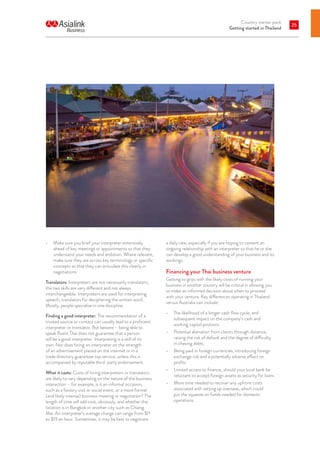
Department of Intellectual Property is part of the
Ministry of Commerce.
Country starter pack
Engage with us
91
Ozforex
www.ozforex.com.au
Provides current and historical exchange rates for a
variety of currencies.
ThaiTrade
www.thaitrade.com
A useful website for Australian businesses looking to
source products from Thailand.
Tourism Thailand
au.tourismthailand.org
The official tourism website for Thailand, providing up-to-
date information for visiting the country.
Thai Ministry of Foreign Affairs
www.mfa.go.th/main/en
The website for Thailand’s Ministry of Foreign Affairs,
providing information on Thailand’s foreign policy. It also
details visa requirements for Thailand.
World Bank Doing Business Report
www.doingbusiness.org
The annual World Bank Doing Business Report measures
business regulations in 189 economies and selected cities.
It ranks countries on areas such as infrastructure and
approvals processes.
Acknowledgements
Asialink Business gratefully acknowledges the assistance
and information from the following individuals and
organisations in the production of this country starter
pack:
Australian Government:
Australian Bureau of Statistics
Australian Trade Commission (Austrade)
Department of Agriculture
Department of Foreign Affairs and Trade
Department of Education
Department of Immigration and Border Protection
Export Finance and Insurance Corporation
IP Australia
Tourism Research Australia
Other:
Asian Development Bank
Allianz Worldwide Care
Australian Industry Group
Australia-Thailand Chamber of Commerce
Bank of Thailand
Fitch Ratings
Glenn Andrews, Managing Director, SiteMinder Asia
Greg O’Neill, CEO, Insight Education Consulting
Harry Usher, Managing Director, Lady Pie
International Labour Organisation
International Monetary Fund
James Wise, the Former Australian Ambassador to Thailand
McKinseyCompany
New Zealand Trade and Enterprise
Nigel Blair, Executive Director, GreenCo Water
Simon McMahon, CEO, GreenCo Water
Suren Moodley, Managing Director, Fibre King Oryx
Thailand Board of Investment
Trading Economics
Transparency International
United Kingdom Trade and Investment
United Nations
World Bank
World Economic Forum
World Intellectual Property Organisation
This publication has not been produced in affiliation with,
or with the endorsement of, the above organisations.
They cannot be held liable for any inaccuracies or loss
which may arise from use of information contained in this
publication.
Note on currency
All money amounts are in Australian dollars unless
otherwise indicated. Exchange rate used is the 2014
average from Ozforex.
A$1 = US$0.9028
A$1 = THB 29.3179
Country starter pack
Engage with us
92
Disclaimer
This publication contains country-specific general
information and does not address the circumstances of
any particular individual or entity. While all efforts have
been made by Asialink Business to ensure timeliness of
the data and information provided herein, the accuracy
of the information in the future cannot be guaranteed.
Users of this document are strongly suggested to pursue
thorough examination and obtain appropriate professional
advice, if required, before acting upon such information in
any given situation. Asialink Business accepts no liability
for any loss which may arise from use of information
contained in this publication.
Reproduction of any part of this publication without prior
written approval of Asialink Business is strictly prohibited.
The information in this document is accurate as of August
2015.
© August 2015, Asialink Business.
All rights reserved.
Printed in Australia.
Asialink Business is supported by the Commonwealth Government Department of Industry and Science,
The University of Melbourne and The Myer Foundation.
Images
Cover image - ©lkpro / Photocase.com
Page 40 - ©Peter Zoon / www.flickr.com/people/peterzen/
© July 2015, Asialink Business. All rights reserved.
Printed in Australia.

Thailand: Country Starter Pack

  • 1.
  • 2.
    Country starter pack Introductionto Thailand 2 A$5.17 Billion 68.7 million US$13,950 Upper middle GDP GROWTH 2014 POPULATION - 2014 GNI PER CAPITA (PPP) - 2014* INCOME LEVEL 3 distinct seasons SUMMER, RAINY, COOL THAI BAHT (THB) GDP GROWTH FORECAST (IMF) 3.7% (2015), 3.9% (2016), 4% (2017) CAPITAL CITY Bangkok TIME DIFFERENCE TO BANGKOK (ICT) 3 hours behind (AEST) AUSTRALIAN IMPORTS FROM THAILAND (2014) AUSTRALIAN EXPORTS TO THAILAND (2014) RELIGION CLIMATE CURRENCY FISCAL YEAR calendar year jan-dec A$10.94 Billion Buddhism (90%) > EXCHANGE RATE (2014 AVERAGE) (THB/AUD) A$1=THB29.3 Thailand at a glance 1% *Gross National Income (Purchasing Power Parity) World Bank
  • 3.
    1. Introduction toThailand 4 1.1 Why Thailand? 5 Opportunities for Australian businesses 1.2 Thailand overview 8 1.3 Thailand and Australia: the bilateral relationship 16 2. Getting started in Thailand 20 2.1 What you need to consider 22 2.2 Researching Thailand 32 2.3 Possible business structures 34 2.4 Manufacturing in Thailand 37 3. Sales marketing in Thailand 40 3.1 Direct exporting 42 3.2 Franchising 44 3.3 Licensing 46 3.4 Online sales 46 3.5 Marketing 46 3.6 Labelling requirements 47 4. Conducting business in Thailand 48 4.1 Thai culture and business etiquette 49 4.2 Building relationships with Thais 53 4.3 Negotiations and meetings 54 4.4 Due diligence and avoiding scams 56 5. Business practicalities in Thailand 58 5.1 Laws and regulations 59 5.2 Import duties, tariffs and regulations 63 5.3 Taxation 66 5.4 Audit and accountancy 68 5.5 Employing workers 69 5.6 Banking in Thailand 73 5.7 Repatriating profits and getting paid 74 6. Visiting Thailand 76 6.1 Visas 77 6.2 Currency 78 6.3 Air travel and airports 79 6.4 Ground transport 79 6.5 Hotels and dining 81 6.6 Health and welfare 82 7. Engage with us 88 Contents STOCK EXCHANGE Stock Exchange of Thailand (SET) GDP 2014 US$387.3 billion POLITICAL STRUCTURE 513,115 square kmS SURFACE AREA OFFICIAL LANGUAGE Thai Constitutional Monarchy GENERAL BANKING HOURS INTERNATIONAL DIALLING CODE +66 MondaytoFriday 9:30AMto3:30PM ภาษาไทย
  • 4.
    Country starter pack Introductionto Thailand 4 1. Introduction
  • 5.
    Country starter pack Introductionto Thailand 5 1.1 WHY THAILAND? OPPORTUNITIES FOR AUSTRALIAN BUSINESSES The Kingdom of Thailand is fast becoming a rich northern frontier for Australian business, and a commanding gateway to the region’s economic powerhouses India and China, as well as Indochina and the Greater Mekong sub-region. Already, 300 Australian companies have built a presence there and two-way Thai-Australian trade is pushing towards $16 billion a year, with several opportunities arising for expansion and growth. Propelled by the two countries’ historic free trade agreement, investors are seizing new prospects in a range of industry sectors, with generous Thai tax and other financial incentives providing an added lure. Of course, this was not always so, and for a long time the country was eyed suspiciously in the face of political unrest and perceptions surrounding labour conditions. But Thailand is making a concerted effort to draw foreign investors, particularly to high-tech industries and to less-developed sectors of the economy, as well as to its underdeveloped regions. Economically, this country of more than 68 million people has been characterised as one of steady growth. Abundant natural resources combined with a skilled and cost-effective workforce have allowed Thailand to attract foreign investment, which in turn has underpinned the nation’s surging prosperity through the development of key industries. While foreign ownership is limited to 49 per cent of individual enterprises across a number of sectors, unrestricted foreign ownership is allowed in manufacturing, some areas of agriculture and services. Australian investors are now getting a range of additional benefits and protections under the Thailand-Australia Free Trade Agreement (known as TAFTA). In its 10th- anniversary year in 2015, some of the new TAFTA benefits include the ability to take full ownership of enterprises in certain construction services and majority ownership in mining operations, tertiary education services, restaurants and hotels.
  • 6.
    Country starter pack Introductionto Thailand 6 Consider some key facts: • Thailand ranks among the top 10 most attractive countries in the region for investment over the next three to five years, with research showing foreign investors are reassured by its abundance of suitable suppliers, raw materials, and development of infrastructure. • Thailand has repositioned itself after a period of political instability as a hub for medical tourism, services and agribusiness with average annual GDP growth of four per cent forecast from 2015 – 2020. • Thailand is one of the world’s leading producers of rice, rubber and sugar. It brings together an array of agricultural expertise, drawing on leading technologies and underpinned by strong government support for food research and development. • As the world’s largest medical tourism market – the result of low-cost medical treatments and high-quality healthcare – Thailand boasts business opportunities for healthcare service providers, with the Thai government offering various investment incentives for manufacturing of medical food and equipment. Friendly and rich culture: Thailand has gained a reputation throughout the world for its gracious hospitality. The friendliness of its people and the diverse nature of Thai culture make visitors feel at home in Thailand. Gateway to Asia: Thailand lies at the heart of Asia and is on the doorstep of some of the world’s biggest and fastest growing markets. It serves as a gateway to Southeast Asia and the Greater Mekong sub-region, where newly emerging markets offer great business potential. Thailand also provides a convenient launching pad for businesses looking to trade with China and India. Hub of ASEAN: Thailand was one of the founding members of the Association of Southeast Asian Nations (ASEAN) and has been instrumental in the formation and development of the ASEAN Free Trade Area (AFTA). As a result, Thailand has forged closer economic ties with the bloc’s member nations, and its manufactured products and services have access to the markets of all nine ASEAN partners. The alliance encompasses total consumer spending that is forecast to grow to $2 trillion by 2020, representing growth of 45.7 per cent (2013 to 2020), a surge that looks certain to continue in the decades ahead. The region is expected to account for just under 60 per cent of global middle-class consumption by 2030, with much of that growth predicted to centre on communications and education, as well as hotels and catering. Foreign direct investment policies: The country’s well- defined investment policies focus on market liberalisation and the encouragement of free trade. Foreign investment in Thailand, especially that which is seen to be contributing to the development of domestic skills, technology and innovation, is actively encouraged by the government. Little wonder that Thailand consistently ranks among the most attractive investment destinations in well-credentialled international surveys. According to the World Bank, Thailand ranks as the third easiest country in the Southeast Asian region in which to do business, and 26th easiest in the world. Considering doing business in Thailand? 1. Do your research • Speak to industry experts • Connect with Australian businesses operating in Thailand • Go to industry events and information seminars • Seek professional advice. 2. Become aware of cultural difference and ways of doing business in Thailand • Gain an understanding of your customer and local business partners • Be flexible and open to difference • Understand the local culture and prepare before meeting with local business partners • Practise Thai business etiquette. 3. Building relationships is crucial in Thai culture, but it can take time • Be patient with developing relationships • Follow up and maintain contact with your networks.
  • 7.
    Country starter pack Introductionto Thailand 7 Government support and incentives: Numerous Thai government agencies reach out to investors with various tax incentives, support services and import duty concessions that are made available to an extensive range of businesses considered top priority in the country’s investment needs. The key conduit for such assistance is Thailand’s Board of Investment (BOI). Under the BOI stewardship, no foreign equity restrictions apply to the manufacturing sector, nor are there onerous local content or export requirements, putting Thailand’s investment regime in full compliance with the World Trade Organisation regulations. The BOI also oversees Thailand’s One-Stop Service Centre for Visas and Work Permits, which allows foreign staff of companies meeting the board’s guidelines to obtain the necessary work documents within three hours or less. Long-established and newly emerging industries: On the back of strong economic development and in concert with robust support industries, Thailand’s industrial production has expanded and diversified rapidly, both within long established sectors and newly emerging industries. As a means of fast-tracking and prioritising development, the government has put an emphasis on attracting investment in six key sectors. These have been identified as integral to meeting the country’s developmental objectives with targeted industries including agriculture and agroindustry, alternative energy, automotive, electronics, fashion, and information communications technology. Value-added services including entertainment, healthcare and tourism are also earmarked for special attention, while opportunities remain rife in the Thai pharmaceutical industry, which is the second biggest in Southeast Asia, currently worth more than $4.5 billion annually and expected to double by 2020. Indeed, foreign investment in the sector in both manufacturing and importing can be expected to increase dramatically should Thailand’s application for membership of the global Pharmaceutical Inspection Convention and Pharmaceutical Cooperation Scheme succeed, thereby ramping up safeguards and standards. Thailand’s cosmetics and beauty care industry is another sector enjoying growth in both manufacturing and sales, the result of a range of factors including rising domestic incomes, rapid product development and changing social attitudes towards personal care, particularly among young men. Thailand’s cosmetics market is the largest within ASEAN, while sales of skincare products rank 12th in the world and those of haircare products second. The industry overall is expected to continue growing at three to six per cent a year. Thailand has a large and competent manufacturing sector: The physical infrastructure of the sector is well developed, particularly when compared with other countries in the region. The BOI also offers a range of privileges, guarantees, protections, permissions, tax incentives and export incentives to attract foreign businesses to the sector. In regards to the Australian automotive industry, Thailand houses more than 20 Australian Tier One and Two auto industry suppliers. Particular areas of opportunity for Australians (especially under TAFTA) lie within: • Horticulture • Dairy • Processed food and beverages • Education • Automotive products.
  • 8.
    Country starter pack Introductionto Thailand 8 The freeing up of agribusiness trade rules has led to increased Australian exports of grain, cotton and milk powder to Thailand and growing rice exports from Thailand to Australia. Education also dominates Australia’s service exports to Thailand with key initiatives in English teaching, the training of teachers and hospitality workers, as well as collaboration between institutions. A shortage of skills training in Thailand presents a valuable opportunity for Australian educational institutions, underscored by the strong perception in Thailand – and in many other Asian nations – that education abroad is of a higher quality. While Australia is the number one destination for Thai students studying overseas, Thailand ranks just fifth in terms of the numbers of foreign students in Australia across all sectors (schools, higher education, TAFE/VET), a possible pointer to future growth opportunities. A total of 25,642 Thai students were enrolled in Australia across all sectors in 2014, up from 21,762 the previous year. 1.2 THAILAND OVERVIEW Geography Thailand is situated in Southeast Asia, flanked by the Indian Ocean and the Gulf of Thailand. Covering 513,115 square kilometres, it is roughly equal in area to France. The country is bordered by Myanmar to the west, Laos and Cambodia to the east, and Malaysia to the south. It consists of various distinct areas – the mountainous north, the dry north-eastern plateau, the fertile central delta, the eastern seaboard and the southern peninsula. The capital city, Bangkok, is situated in the central delta area and lies just one metre above sea level. Thailand’s climate is tropical with the average temperature around 29o C and humidity usually sitting between 73 and 82 per cent. It is generally warm all year round, although Thai people recognise three distinct seasons. THAI SEASONS Summer (March to May) Hot and humid. Wet season (June to October) While it does not rain constantly, the sky is overcast and a tropical downpour lasting one to two hours is typical on most days. Cool (November to February) Weather is dry and relatively cooler than the rest of the year. History Popular belief has it that the Thai people originally came from southeastern China in AD 650 and formed a kingdom called Nanchao. In the 13th century these people migrated south to the area that is now regarded as northern Thailand, and established its first kingdom called Sukhothai. It was during the Sukhothai period that the Thais developed their own distinctive language, art, culture and architecture. The Sukhothai Kingdom flourished for about 100 years before gradually crumbling when another more powerful kingdom of Ayutthaya arose in the mid-14th century. Its emergence coincided with the initiation of trade with the West, followed by a period of territorial battles between the Thais and the Burmese. The Ayutthaya period lasted for over 400 years, when the capital was lost to the Burmese invasion in 1767. The Burmese did not control Ayutthaya for long. Within months conflict erupted again, and soon after the brief Taksin Dynasty emerged. In 1782, General Chakri transferred the capital across the Chao Phraya River to Bangkok and proclaimed himself King Rama I of the Chakri Dynasty, signalling the beginning of the Rattanakosin period, which continues today. His Majesty King Bhumibol Adulyadej (Rama IX) has reigned since 1946 and is the world’s longest serving head of state as well as Thailand’s longest reigning monarch. Reflecting the nation’s deep respect for the monarchy, it is a serious crime to make critical or defamatory comments about the King or other members of the royal family. This particular crime is dubbed lese majeste and those who violate it, even unknowingly, face being arrested.
  • 9.
    Country starter pack Introductionto Thailand 9 It is interesting to note that up until the reign of King Rama IX, the country had always been known as Siam. The name was changed to Thailand (meaning “free”) to acknowledge the nation’s unique standing as the only country in Southeast Asia to avoid colonisation by a European power. The city of Bangkok, better known among Thais as Krung Thep, or City of Angels, is actually an abbreviated version of the city’s full ceremonial name which is the world’s longest city name. Culture Thailand embraces a mix of colourful and exotic cultures, which has given rise to a distinctive national psyche and ways of interacting. The foremost ethnic group is Thai, but diversity reigns through a high degree of intermarriage with the Chinese and the presence of many other groups that include Burmese, Lao, Malay, Mon and Indian. Religion is a core feature of Thai life. While Buddhism is regarded as the national religion, practised by more than 90 per cent of the population, Islam, Christianity, Hinduism and other faiths are also represented. Religious freedom is enshrined in the Thai constitution, and the King, though himself a Buddhist, remains the patron of all religions practised in Thailand. In fact, the King holds the title Defender of all Faiths. Buddhism is mostly of the Theravada school, although it has become entwined through the centuries with folk beliefs such as Chinese ancestor worship been introduced through the blending of Thai and Chinese populations. Meanwhile, a key influence on Thai Buddhism has been Hindu beliefs received from Cambodia. The faithful in modern Thailand practise certain rituals, performed either by monks or by Hindu ritual specialists, that are either identified explicitly as Hindu in origin, or easily understood to have been derived from Hindu practices. 9 Muslims make up the second-largest religious group, accounting for about five per cent of the Thai population. Muslims are most dominant in Thailand’s southern provinces – Pattani, Yala, Narathiwat and part of Songkhla and Chumphon – and consist of both of ethnic Thais and Malays, the latter making up the majority of people living at the southernmost tip of Thailand. Christians, mainly Catholics, account for less than one per cent of the population, while a very small community of Sikhs and Hindus also live in Thai cities, and are well represented in retail commerce. Thailand is a collectivist society, which dictates that the needs of the group are placed ahead of those of the individual. Subtlety and indirect forms of communication are highly valued in Thai society which, as in the case of many others across Asia, is hierarchical. Individuals are viewed as being either higher or lower in status, measured between one another in relative terms – younger or older, weaker or stronger, junior or senior, subordinate or superior, and rarely equal. As a result, young Thais grow up needing to learn appropriate behaviour within the confines of the existing hierarchy, taught to recognise the difference between ‘high place’ and ‘low place’, particularly in regard to the roles in society of adults and children, or teachers and students. This organised ranking is dynamic in nature, allowing for movement of a person’s status in either direction. A further element in the hierarchy of social order, according to Thai belief, has a spiritual dimension, attesting that a person’s standing within the hierarchy reflects what an individual has been and what an individual has done. This Buddhist perspective is very different from that understood by Hinduism. For the Buddhist, it does not matter who a person is but what they do; whereas Hinduism believes that a person does what they do because of who they are.
  • 10.
    Country starter pack Introductionto Thailand 10 Likewise, the Buddhist concept of karma lies at the spiritual core of Thai society and culture. This infers that actions that occurred in a past life can affect the present, while behaviour in the present can have a bearing on a future life. Past karma’s effects pertain to such common expressions as mai pen rai (never mind, it doesn’t matter) or the notion of forgiveness. Another fundamental Thai custom, bun khun, embraces a sense of indebtedness towards parents, guardians, teachers and caretakers. Acknowledged as any good thing, a helping hand, perhaps, or favour, bun khun entails gratitude but also obligation on the part of the recipient. What parents do for their children is also a form of bun khun, as is the mentoring of students by their teachers. It is little wonder, in such a hierarchical society, that status in Thailand is also seen as important. Such a ranking can be determined simply by someone’s clothing and general appearance, their age or job, education, family history, as well as their wealth and social connections. Status dictates that subordinates will generally listen to and accept advice and direction from his or her superior without question. But this courtesy imposes on superiors an unstated obligation to lead and to be mentors in return. While not unique to Thai culture, notions of respect and of saving face are highly prized. Conflict and angry outbursts are to be avoided at all costs. Indeed, displaying anger towards another person and public disagreement can cause a person to lose face. Differences of opinion and disputes need to be handled delicately and with a smile: no attempt should be made to assign blame to another person. Thais also place great emphasis on the concept of sanuk – the sense that life, after all, should be fun and enjoyable. In view of this, Thais can be quite playful even at work and during most daily activities. Being upbeat, and showing positive emotions in everyday social interactions is also considered integral to Thai life. One of Thai society’s most distinctive customs is the wai, which can be likened somewhat to the Indian gesture of namaste – a kind of greeting or farewell, or means of acknowledging others. A simple but highly significant gesture, the wai is something that foreigners should look to master quickly in their effort to engage meaningfully and respectfully with their Thai counterparts. The wai generally involves a prayer-like gesture and a bow of the head (Chapter 4 explains the wai in more detail). Beyond this, the showing of affection in public can be common between friends and acceptable. However, it is very rare for couples to do so, although more common in urbanised parts of the country. The Thai people share a deep respect for religious symbols, with Buddhist monks holding a special status within Thai society, to the point where interaction with monks is constrained by special mores. For a start, monks are prohibited from touching or being touched by females, to the point where women need to avoid even accidental conduct while walking in a street. Meanwhile, the white or sometimes golden symbols or writings given by monks that are displayed on the walls of buildings, on houses or cars are considered sacred and bestow luck and blessings on the owner. These should be treated with great respect. In regard to bun khun, an ultimate way of paying gratitude and for bestowing great merit on himself and his parents is for a man to become a monk, because this will enable them to go to heaven.
  • 11.
    Country starter pack Introductionto Thailand 11 So-called ‘spirit houses’ are prevalent in Thailand. These are miniature constructions that stand outside most Thai homes and office buildings as a means of recognising and engaging spirits that Thais believe exist throughout their country – in forests, mountains, rivers and trees, and on the land. In this context, it is natural that buildings should have spirits, too. The spirit house is erected to encourage spirits to live outside the family dwelling and workplace. It therefore is important that people show respect for the place in which they are living by not slamming doors, banging on the floor or doing anything that is likely to disturb the guardian spirit. In deference to the spirits, Thais often observe the wai when they pass these shrines. While foreigners are not expected to display such reverence, they should pass by in a respectful manner. Politics and government Thailand is one of almost 40 constitutional monarchies that exist in the world today. Normally, an elected Prime Minister heads the government, while the head of state is the hereditary monarch. In Thailand, the King exercises his legislative power through the Parliament, executive power through Cabinet and judicial power through the courts. Just as in Australia, the bicameral Parliament is made up of the House of Representatives and the Senate, although the Thai Senate has often been appointed or semi-appointed. Generally, the former consists of 500 members, with 375 of these drawn from single-seat constituencies and a further 125 elected on a party-list basis across a nationwide single constituency. Members of the House of Representatives are normally elected for four-year terms; senators get six years at a time. Thailand’s 77 provinces are administered by governors (appointed by the Interior Minister), divided into amphurs (districts), tambons (sub-districts) and villages. Metropolitan Bangkok, however, is governed by an elected governor with administrative responsibilities divided into 50 districts. The current political situation Thailand’s recent political and civil unrest started in 2005 and intensified after the 2006 military coup that ousted communications billionaire and Prime Minister – Thaksin Shinawatra, who had built strong electoral support through sometimes populist policies. These focused on Thailand’s rural poor but alienated other segments of the population. His removal from office sparked a strong display of support among the country’s northern and northeastern villagers who had been beneficiaries of his party’s policies. This caused a shift in political power in Thailand away from Bangkok and the south towards the north and northeast. Thaksin’s supporters became known as the ‘red shirts’, a broad-based movement in support of the deposed leader that collided with pro-government supporters known as the ‘yellow shirts’, and defined by a colour that heralded allegiance to the King. The yellow shirts made international headlines in late 2008 with the occupation and forced closure of Bangkok’s two airports. In 2010, widespread demonstrations erupted again in parts of Bangkok. More than 80 civilians and six soldiers were killed and 2,100 people injured over three months of hostilities to May 2010. Thaksin’s party again won the elections in 2011 and his sister, Yingluck, became prime minister. In late 2013, anti-government protests resumed, with political instability peaking between November 2013 and May 2014. On 22 May 2014, Thailand’s army chief, General Prayuth Chan-ocha, staged a military coup, following months of deadlock between highly polarised political factions. While initially clouding Thailand’s political and economic outlook, the military government has been able to generally restore business confidence, with the Thai economy showing strong signs of recovery. This has been further strengthened by the new administration’s demonstrated commitment to: • Free market principles, and further integration with the economies of the Greater Mekong sub-region, ASEAN and Northeast Asia • The promotion of a value-added, innovation-driven economy • Upgrading and expanding connectivity and infrastructure • The launch of digital technology platforms.
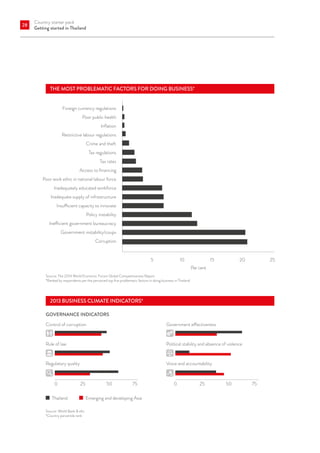
  • 12.
    Country starter pack Introductionto Thailand 12 The ruling National Council for Peace and Order has introduced an interim constitution, established a National Legislative Council, created a National Reform Council and appointed a provisional civilian-led Cabinet. It has also committed to holding a general election in 2016. While Australian investors may not be readily accustomed to such controversy, Thailand historically has shown a certain economic resilience in the face of regular political upheaval. In the wake of this most recent turbulence, businesses generally have kept operating as usual. Thailand’s economy remains export dependent, with exports accounting for more than two-thirds of the country’s Gross Domestic Product (GDP), and despite this civil unrest, the military-backed rulers have stayed committed to Thailand’s open door policies that encourage foreign investment and a mostly free market. Overall, Thailand’s periodic political volatility tends not to affect day-to-day business operations. Although Thai politics is sometimes unstable, the administration of the country is very sound and all political parties in Thailand, without exception, are pro-business. Economy Formerly an agriculture based economy, Thailand is now a leading exporter of manufactured goods. Industries such as clothing and textiles, agricultural processing, beverages, cement, jewellery, electrical appliances, computers, accessories and parts, furniture, plastics, automobiles and automotive parts have all seen rapid growth in recent years fuelled by overseas demand. Tourism is also a significant contributor to the Thai economy. Thailand recovered well from the global financial crisis with the rapid implementation of a fiscal stimulus package and monetary easing, but its economy suffered as a result of severe floods in the second half of 2011. GDP growth fell sharply from 7.8 per cent in 2010 to 0.1 per cent in 2011. On the back of the global economic recovery and higher domestic consumption, Thailand’s GDP rebounded 6.5 per cent in 2012, but slowing domestic demand and a contraction in investment saw growth again ease to 2.9 per cent in 2013. Growth for 2014 was just under one per cent, due mainly to cautious private consumption stemming from high household debt, weak merchandise exports and the sluggish recovery of the tourism sector following the prolonged and disruptive political protests of 2013-14. THAILAND REAL GDP GROWTH % 2000 2001 2002 2003 2004 2005 2006 2007 2008 2009 2010 2011 2012 2013 2014 2015 2016 2017 2018 2019 2020 10 8 6 4 2 0 -2 Source: IMF World Economic Outlook Databases
  • 13.
    Country starter pack Introductionto Thailand 13 Headline inflation for 2014 was 1.9 per cent and is expected to be subdued at 1.3 per cent for 2015. The International Monetary Fund (IMF) forecasts Thailand’s economic growth to gather steam in 2015 and 2016, with GDP growing 3.7 per cent and 3.9 per cent respectively. In October 2014, the Thai Government unveiled an economic reform agenda to make Thailand more attractive as a regional trading hub and as a means of developing its digital economy. The reforms being introduced are aimed at promoting Thai investment overseas, cutting the cost of doing business in Thailand, tackling corruption, improving logistics and infrastructure, building a better tax structure, and developing a new body to govern the digital economy. The reforms are intended to support the Thai private sector, facilitate trade and promote overseas investment. A key factor affecting the country’s economy is the role played by the four major global economies – China, Japan, the US and the European Union (EU). Japan is Thailand’s biggest investor, with Japanese enterprises and individuals accounting for the bulk of applications lodged with the BOI in recent years: 49 per cent of applications in 2011, 58 per cent in 2012 and 54 per cent in 2013, with investment totalling around $10 billion in 2013. Thailand permits foreign investment in all sectors, except for projects related to national security, agriculture and fisheries, and mass media. However, in many sectors foreign investment is restricted to a minority interest. After Japan, Thailand’s biggest foreign investors are Hong Kong, Singapore, the US and the EU. Thailand’s manufacturing sector is one of the largest contributors to economic growth, making up 44 per cent of GDP in 2014 alone. The services sector is also a key part of the Thai economy, accounting for 44 per cent (2014) of GDP. The tourism industry is crucial; other key service sectors include airlines, banking and telecommunications. Thailand’s population (68.7 million) is mostly rural based and concentrated in the rice-growing areas of the central, northeastern and northern regions of the country. However, as Thailand industrialises, its urban population, principally in the Bangkok area, continues to grow (estimated to be around 48 per cent of the total population in 2013). GDP BY SECTOR Agriculture 12% Industry 44% Services 44% Legal system Thailand has an independent judiciary with a legal system combining the principles of traditional Thai and Western laws. The courts, as established by legislation, can be divided into civil, criminal, municipal and provincial. They include the tiers of: the Court of First Instance, the Court of Appeals and the Supreme Court, as well as the Constitutional Court. Judges are appointed or removed by the King, based on the recommendations of the Judicial Commission. Judges, members of the judicial service, are usually promoted according to seniority. The courts of Thailand are similar in form and procedure to those in countries whose legal systems are based on a system of civil law. There are no juries in Thailand. The decisions of the Supreme Court are highly authoritative but do not establish binding principles of law. Specialist courts have also been established to deal with matters in a variety of key jurisdictions. These deal with labour, tax, bankruptcy, intellectual property, international trade and administrative matters. All of these courts have accelerated trial and appeals procedures. However, in Thailand’s southern border provinces, where Islam is practised by the majority of the population, Provincial Islamic Committees have limited jurisdiction over probate, family, marriage and divorce cases.
  • 14.
    Country starter pack Introductionto Thailand 14 Infrastructure Thailand’s spending on infrastructure has lagged behind some regional neighbours, such as Singapore, and can present a challenge for those enterprises contemplating doing business in the country. Rankings issued by the World Economic Forum underscore the degree of difficulty: out of 144 countries, it placed Thailand’s road network 50th, rail 74th and port infrastructure 54th. The quality of Thailand’s air transport infrastructure comes in at 37th place. However, investment in infrastructure continues to grow after a capital boost from the Thai government, anxious to raise the standard of the country’s transport network. In October 2014, The National Council for Peace and Order approved a THB 2.4 trillion infrastructure development blueprint that includes projects to improve the nation’s highways and water transport networks, as well as Thailand’s air transport competitiveness. On top of this, the government unveiled a THB 127 billion project to build six dual-track rail lines with a combined length of 887 kilometres. Roads: Thailand has an extensive road network of approximately 400,000 kilometres, most of which is paved with concrete or asphalt. A system of national highways connecting the regions, provinces and districts is well maintained and adequate for long haul transportation, while special highways such as tollways and motorways have a minimum of junctions, allowing traffic to flow at higher speeds. Sea ports: Thailand’s water transportation system has been part of the country’s history for centuries. More than 120 ports, wharves and jetties are able to accommodate sea-going vessels engaging in international trade. Deep sea ports are located in Bangkok, Laem Chabang and Map Ta Phut on Thailand’s eastern seaboard, while Songkhla, Satun, Narathiwat, Phuket and Ranong are located in the south. The most important port for freight is Laem Chabang, which is a gateway to the Asia Pacific. Ranking next is Bangkok Port, which serves the central region. Chiang Saen Port is a significant launching pad for the north, as a gateway to trade with southern China, while Ranong Port is vital for the Andaman coastal area. Waterway journeys for locals and visitors are commonplace, used for every purpose including commuting to and from work, cruising rivers and canals or crossing to popular islands such as Koh Samet and Koh Lipe. Meanwhile, shuttle boats cross canals or rivers, particularly the Mekong and Chao Phraya rivers, and Saen Saep canal in Bangkok. Rail and mass transit systems (MTR): Thailand’s rail transportation covers more than 4,000 kilometres and extends from Bangkok to the Malaysian border in the south and the Lao border in the northeast, as well as to the country’s northernmost provinces and Kanchanaburi in the west. In order to alleviate traffic snarls in Bangkok, three mass transit systems have been developed totalling 85 kilometres. The first system, known as the Skytrain, opened in 1999 and operates on overhead tracks. A second system, which opened in 2004, is a subway. Additionally, a dedicated overhead line from the city to Suvarnabhumi Airport was opened in 2011. A number of extensions of the Skytrain to the suburbs of Bangkok are currently being constructed or planned and are expected to be operating within five years. Airports: Thailand has developed an extensive air transport network that encompasses 28 commercial airports, of which nine are international airports. Bangkok has become a major hub for air services in the region, with direct services to all parts of the world. Bangkok’s Suvarnabhumi Airport is ranked as number 47 on the 2015 Skytrax World’s Top Airports. Telecommunications: Modern telecommunication facilities are available across the country, especially in urban areas. Fixed line telephones, mobile phones and access to the internet are readily available. However, while the overall penetration of broadband connections remains quite low, the growth rate is beginning to accelerate smartly. During recent years, ownership of mobile phones has grown at a much faster rate than that of landlines. Indeed, mobile phones now outnumber landlines almost five to one, with 98 per cent of the Thai population owning a mobile. The mobile phone market is serviced by AIS, DTAC, True Move, TrueMove H, Hutch, and DPC. With the use of smart phones and tablets on the rise, major mobile operators are also offering 3G and 4G services. The Thai internet market continues to expand, as Thailand looks to build capacity and catch some of its regional competitors. Despite this, the country’s estimated personal computer penetration rate remained less than 25 per cent at the end of 2013 with high-speed internet access only nascent. Operators were looking at a variety of delivery methods to augment internet penetration with the current rate being 28.9 per cent (2014). The burgeoning mobile market in Thailand ensured that mobile phones, as well as set-top boxes, were high on the list of potential delivery devices. At the same time, the cyber cafe in its various guises had already established itself as a key element in the country’s access equation. Most importantly, with 3G and 4G services being rolled out in a significant way, mobile broadband is booming. Mobile broadband usage has a current estimate of 50 million users, with Thailand becoming the second-largest mobile broadband subscriber in ASEAN (after Singapore) once the nation completes setting up of a high-speed fourth- generation (4G) network.
  • 15.
    Country starter pack Introductionto Thailand 15 LAOS VIETNAM CAMBODIA MYANMAR MALAYSIA Don Mueang Samui krabi Phuket Hat Yai Surat Thani 28 COMMERCIAL AIRPORTS (9 international) OVER 400,000KMS OF ROAD NETWORK OVER 4000KMS OF RAIL NETWORK OVER 120 PORTS Thailand’s infrastructure ranking out of 144 countries*: Air transport: 37th with 9 international airports Road: 50th with over 400,000km of road network Ports: 54th with over 120 ports able to engage in international trade Rail: 74th with a network consisting of 4,000km. Major ports Major international airports Major rail network Major road network Thailand’s Infrastructure *Source: The 2014 World Economic Forum Competitiveness Report Suvarnabhumi chiang mai chiang rai BANGKOK
  • 16.
    Country starter pack Introductionto Thailand 16 1.3 THAILAND AND AUSTRALIA: THE BILATERAL RELATIONSHIP When Australians think of Thailand, tropical holidays and Thai food spring to mind for many. But there is much more to Australia’s relationship with Thailand than tourism and tasty cuisine. The two countries have extensive and long standing connections – spanning trade, investment, business, regional security and culture. Diplomatic relations date back more than 60 years, but the connections have grown more rapidly in recent times with Thailand’s emergence as one of the leading economies of Southeast Asia, and with Australia’s increasing engagement with Asia generally. The bilateral economic relationship is strong, with Thailand now Australia’s eighth largest trading partner in goods and services, and our second largest partner among the countries of ASEAN with a two-way trade in the financial year of 2013-14 (from here on referred to as 2014 for this section) of $19 billion (including services). Unlike our trade relationships with some other Asian countries such as China and Japan – in which Australia enjoys a substantial trade surplus – with Thailand we have a deficit in goods and services trade, which means we buy much more from the Thais than they do from us. In 2014, Australia’s imports of goods and services from Thailand totalled more than $13 billion, while our exports to Thailand were just over $6 billion. Commercial and passenger vehicles – including popular Toyota and Honda models built in Thailand – make up more than $4.5 billion of our imports from there. Conversely, Australian automotive parts makers have established a valuable, if smaller, business supplying to the Thai car industry. Australia’s biggest export categories to Thailand include gold (almost $600 million) and crude petroleum (worth more than $1.7 billion a year) along with coal and aluminium. Australia also has substantial services exports to Thailand, totalling about $848 million in 2014 – of which around $571 million was in education exports.
  • 17.
    Country starter pack Introductionto Thailand 17 The trade and economic relationship has grown strongly since 1 January 2005 when the Thailand-Australia Free Trade Agreement (TAFTA) came into force. It was Australia’s third comprehensive free trade agreement, and Thailand’s first with a developed country. Under the agreement, the majority of Thai tariffs on goods imported from Australia – which in some categories had been levied at up to 200 per cent – have been eliminated. This has given Australian exporters of horticulture, dairy, grain, mining, processed food and beverages an edge over their European and North American rivals. Total two-way trade between Australia and Thailand has more than doubled since the agreement came into operation. The agreement has led to substantial growth in agribusiness trade in particular, with increased wheat, cotton and milk powder exports from Australia to Thailand and rice exports from Thailand to Australia. Education dominates Australia’s service exports to Thailand, with the biggest areas including English training, teacher training and hospitality training. The stock of Thai investment in Australia has also grown spectacularly, from $338 million in 2006 to $6.1 billion in 2013. Australian investment in Thailand for 2014 was worth about $3 billion. AUSTRALIA’S TRADE AND INVESTMENT RELATIONSHIP WITH THAILAND Australian merchandise trade with Thailand 2014 A$m Total share* Growth (yoy) Major Australian Exports, 2014 (A$m) 5,173 1.9% 5.4% Crude Petroleum 1,731 Gold 590 Aluminium 399 Coal 279 Major Australian Imports, 2014 (A$m) 10,942 4.3% -4.1% Crude petroleum 2,078 Refined petroleum 500 Iron, steel, aluminium structures 391 Ships boats (incl hovercraft) 310 Total trade (exports and imports) 16,115 3.1% -1.3% Australian services trade with Thailand 2013-14 Major Australian service exports, 2013-14 (A$m) 848 1.5% Education-related travel 571 Personal travel excl education 115 Major Australian service imports, 2013-14 (A$m) 2,171 3.1% Personal travel excl education 1,463 Transport 535 Source: Department of Foreign Affairs and Trade’s Thailand fact sheet 2014 * Total share of Australia’s international trade
  • 18.
    Country starter pack Introductionto Thailand 18 Key elements of the TAFTA deal that offer benefits to Australian businesses include: • The elimination of 94 per cent of Thailand’s tariff and quota barriers on imports from Australia as of 2010, with the remaining tariffs phasing to zero in 2015 or 2020 (with the exception of skim milk powder and liquid milk and cream, for which the tariff rate quotas will be eliminated in 2025) • More open access for Australian companies to Thailand’s services market and a commitment to liberalise two-way services trade in future • Increased access for Australian investors in Thailand, with majority Australian ownership permitted for businesses in certain sectors including mining, construction, restaurants and hotels, tertiary education institutions and maritime cargo services • More investment protection for Australian direct investors in Thailand, including the right to transfer their funds out of Thailand at any time, and the right to seek impartial resolution of any disputes with the Thai Government over their investments • Easing of visa and other requirements for the temporary entry of Australian business people to Thailand. While large parts of the agreement have been in force for some time, there is still more work to be done to implement remaining elements covering issues such as food standards and agriculture. In addition to TAFTA, Australia and Thailand are also parties to the ASEAN-Australia-New Zealand Free Trade Agreement (AANZFTA), which came into force on 1 January 2010. Thanks to this agreement, goods produced in Thailand with materials from other ASEAN states still receive tariff reductions, further enhancing Thailand’s attractiveness as a regional manufacturing hub. People-to-people ties While the relationship between Thailand and Australia is unquestionably dominated by tourism and business, it goes much further than that. Formal diplomatic relations were established in 1952. Fifty-three years later, as the business relationship was beginning to thrive, a treaty- level Agreement on Bilateral Cooperation came into force, providing a framework for bilateral cooperation in non-trade areas, including security and law enforcement, environment and heritage, science and technology, telecommunications, civil aviation, public administration, energy, immigration, education, culture and social development. A Memorandum of Understanding (MOU) on ‘Work and Holiday’ visas allows nationals of both countries to undertake 12 month working holidays in the other country. The tourism and business trades underpin extensive people-to-people links between our countries. More than 565,000 Australians visit Thailand each year on holidays or business (Tourism Australia), while more than 45,000 Thais live in Australia (2011 Census). The Thai- born population in Australia is one of the fastest growing, having doubled between 2001 and 2011, according to the 2011 Census. The relationship is expected to strengthen further in 2015 with Thailand beginning to host Australian New Colombo Plan scholars. Australia has enjoyed a close relationship with the Thai royal family. His Majesty King Bhumibol Adulyadej and his wife Queen Sirikit visited Australia in 1962 and the Thai Crown Prince, His Royal Highness Maha Vajiralongkorn, studied at secondary school and military college in Australia, subsequently completing training with the Australian Army’s Special Air Service Regiment in Perth. Over the past couple of decades, Australian and Thai prime ministers have visited each other’s nations with senior government officials visits regularly occurring. In August 2012, Her Royal Highness, Princess Bajarakitiyabha visited Australia to mark the 60th anniversary of diplomatic relations between Australia and Thailand.
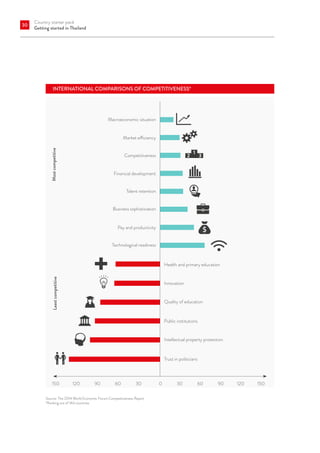
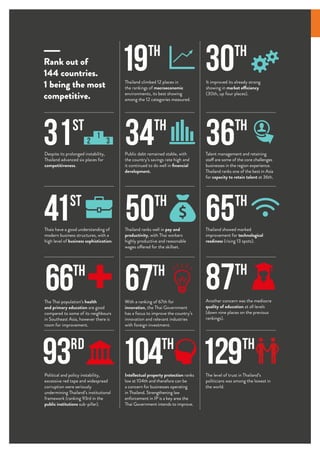
  • 19.
    Country starter pack Introductionto Thailand 19 Defence and regional security Regional security has become a key area of mutual interest and cooperation between Thailand and Australia in the early part of this century. The two countries concluded a bilateral memorandum of understanding on counter terrorism in 2002. This was followed by memorandums on police cooperation (June 2003), mutual assistance in customs matters (December 2003), and money laundering (June 2004), and a Mutual Legal Assistance Treaty (July 2006). There is also regular high level dialogue on regional security. Thailand has also cooperated with Australia on regional efforts against people smuggling and trafficking, and has extradited accused people smugglers to stand trial in Australia. Thailand also hosts the Regional Support Office for the Bali Process on People Smuggling, Trafficking in Persons and Related Transnational Crime. The office supports and strengthens practical cooperation on refugee protection and international migration. Defence ties between Thailand and Australia date back to the end of World War II, when an Australian Defence Section was established in Bangkok in August 1945. Its primary role was to oversee the repatriation of surviving Australian prisoners-of-war, and the recovery and reburial in the Commonwealth War Cemetery in Kanchanaburi of the remains of those who died on the Thai-Burma Railway. Over the next 30 years, Thai and Australian armed forces served together in various missions including the Korean War and the Vietnam War. In 1972, a formal Defence Cooperation (DC) Program was initiated, involving training and combined maritime, ground and air exercises. The program has continued to develop over ensuing decades, and now involves regular senior officer visits; seminars and workshops; individual education and training courses for Royal Thai Armed Forces personnel at Australian Defence Force schools, colleges and national universities; annual combined exercises; logistics systems and support; and science and technology cooperation. Since the early 1990s, Royal Thai Armed Forces and Australian Defence Force personnel have served together in United Nations operations in Cambodia, Somalia and East Timor and, more recently, in coalition operations in Iraq. Defence policy talks have also been held annually since 1990, with the aim of continual improvement in the bilateral defence relationship, and promotion of understanding and cooperation on regional security issues. There is also an annual bilateral dialogue on regional security issues, involving foreign affairs, defence and military officials. Development assistance is another area in which Australia engages with Thailand. In November 2003, Thailand moved from being an aid recipient to an aid donor. However, Australian regional aid programs in human trafficking, labour rights, health, disaster management and economic integration continue to include Thailand. Australia also provides limited support to Thailand as part of efforts to strengthen the capacity of regional organisations such as ASEAN and APEC.
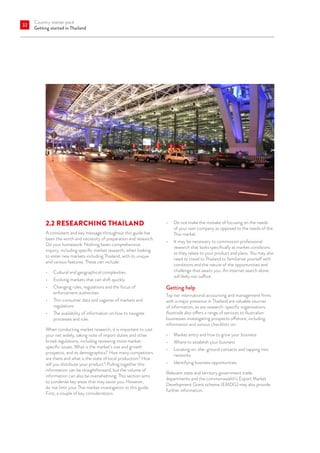
  • 20.
    Country starter pack Gettingstarted in Thailand 20 2. Getting started in Thailand
  • 21.
    Country starter pack Gettingstarted in Thailand 21 Knowledge is power, and knowledge of the market you are about to enter is essential for business success. The more you can get to grips with the peculiarities of a particular market outside Australia, the better prepared you will be. It is important, therefore, to become informed on a range of subjects on Thailand – from labour laws and tax matters, to banking provisions and financial regulations. In addition, smart business operators will also take time to familiarise themselves with cultural norms, particularly as they pertain to doing business, as well as the local language. Inadequate research has brought many a market foray unstuck. There are some general principles to bear in mind when considering cultural and business differences while operating abroad, including some that are unique to Thailand. This chapter provides detailed information on how to go about researching the Thai market – what to look for and where to find it. It also includes advice on key considerations and decisions to be made before launching your business venture – choosing a location, hiring interpreters, assessing the potential risks of operating in a foreign environment, and potential business structures.
  • 22.
    Country starter pack Gettingstarted in Thailand 22 2.1 WHATYOUNEEDTOCONSIDER Location There are a myriad of locations that can be used for establishing a foothold in Thailand’s bustling economy, but it is wise to match your choice of location with the market that your business is looking to target. Increasingly, foreign enterprises are focusing on niche opportunities, and that can dictate a specific location or geography rather than one chosen more generally as a catch-all for customers. Either way, detailed research is essential. Key regions: Geographically, Thailand is broadly divided into four distinct regions comprising 77 provinces. Bung Kan district, in Nong Khai, northeast Thailand, became the country’s latest province, designated in August, 2010. The four regions are: • Central: The location of Bangkok, the Kingdom’s capital • Northeast: Encompasses the country’s most populous region and is home to Nakhon Ratchasima (Korat), a major industrial city. • North: Takes in the cities of Chiang Mai and Chiang Rai. • South: Includes the popular coastal resorts of Phuket, Koh Samui, Hua Hin, Phang Nga and Krabi. Bangkok, as well as serving as the nation’s capital and centre of government, is also its economic, educational and cultural focal point. With a greater metropolitan population of more than 9 million (almost one in every 10 Thais resides there), Bangkok stands as Thailand’s principal entry point for international traders and investors, accounting for 44 per cent of the country’s GDP. This commercial hub is a natural drawcard with its numerous industrial estates and gateway to important national markets. Thailand’s eastern coastline contains a sweeping industrial zone and is home to Thai and foreign-owned industries that include automotive, engineering, large-scale manufacturing, petrochemicals and power generation. The industrial strip straddles the provinces of Chonburi, Chachoengsao, Samut Prakan and Rayong, and includes the leading port of Laem Chabang, Thailand’s biggest and one of the world’s most industrious. Free trade zones: On top of the Thailand-Australia Free Trade Agreement (TAFTA), free trade zones have been declared throughout Thailand in a bid to entice greater foreign investment. These include industrial estates established by the Industrial Estate Authority of Thailand (IEAT), of which there are two types: General Industrial Zones (GIZ) that are reserved for enterprises manufacturing goods for domestic and/or export consumption, and Export Processing Zones (EPZ), earmarked for export-only industries. Most of the latter zones have government customs houses for fast clearing. Where should I set up my business? Factors to consider: 1. Are there other Australian companies there? Why did they choose a particular area? 2. Can you use an existing Australian relationship there (e.g. sister city)? 3. What are the local costs (e.g. land, labour, utilities)? 4. Is it within a free trade zone that offers tax and other incentives? 5. What is the skill level of the local labour force? 6. Can you leverage off an existing marketing or distribution network? 7. Is it close to your chosen market and suppliers? 8. Do you have a good agent/distributor or business partner there?
  • 23.
    Country starter pack Gettingstarted in Thailand 23 Koh Chang Koh Phangan bangkok Chiang Mai Chiang Rai Laem Chabang koh samui Hua Hin phuket thailand is divided into four distinct regions comprising 77PROVINCES The four regions are Central, Northeast, North and South bangkok 9 MILLION POPULATION OF The Thai capital, is the centre of government and the nation’s biggest city with a It is the THAI focal point for CULTURE THE ECONOMY EDUCATION 44 per cent AND ACCOUNTS FOR of the country’s GDP Thailand’s eastern coastline contains a sweeping industrial zone and is home to Thai and foreign-owned industries that include engineering, petrochemicals The southern region is well known for travel and tourism The cities of Chiang Mai and Chiang Rai in the northern region are both popular destinations for tourists, and are well known for hand-made craft. The northeast is the most populous region and is home to Nakhon Ratchasima (Korat), a major industrial city and also a primary source of crops and rice. boasting the popular coastal resorts of Phuket, Koh Samui, Hua Hin, Phang Nga and Krabi krabi The industrial strip straddles the provinces of Chonburi, Chachoengsao, Samut Prakan and Rayong, and includes one of the world’s most industrious ports, the AUTOMOTIVE MANUFACTURING POWER port of Laem Chabang Nakhon Ratchasima
  • 24.
    Country starter pack Gettingstarted in Thailand 24 These estates are designed to be self contained industrial communities with reliable, essential infrastructure such as electricity and water, and with flood protection, as well as access to waste water treatment and solid waste disposal. They also have communications facilities, security systems and banks. These government sponsored industrial zones aim to support regional development and specific sectors of the economy, while industrial parks remain entirely a product of the private sector. There are clear benefits for operating in government endorsed free trade zones: they offer special tax treatment and other incentives, and other privileges that can instantly enhance a newcomer’s competitiveness. Associated tax-based incentives can include an income tax “holiday”, plus exemptions from import duties and value-added (or goods and services) tax. Excise tax exemptions can cover plant and equipment, raw materials, imports into an EPZ and exports from the zone. The benefits of operating in a government trade zone can also include the ability to bring in foreign workers, own land and take or remit foreign currency abroad. Manufacturing: Choosing a location for your factory Apart from government owned zones, Thailand has many hi-tech private sector industrial parks that look to support regional development in specific industrial sectors and those nominated as top priority by the Thailand Board of Investment (BOI). Most offer BOI incentives and confer privileges that can vary according to the type of business, the scale of capital invested and the physical location or “zone” in which the business is located. Using interpreters Thai is the official language, although English is spoken widely and understood in business circles, particularly in the major cities, especially Bangkok. However, written English is less commonly used or understood. Thai is a tonal language and has five distinct tones, making the tone in the pronunciation of a word critical to its meaning. So, one word can have five totally different meanings. Consequently, mispronunciation can conjure an entirely different meaning from that which was intended. A consolation is that Thais are very forgiving when foreigners attempt to speak their language, and once they understand what a farang (typically, a white foreigner) is trying to communicate, they will happily coach him or her on how to pronounce the word correctly. As mentioned, cultural norms dictate the importance that Buddhism and the royal family play in Thai life, but also influence the meaning of particular words. For example, it is best to double-check that a “Yes” is in fact a confirmation, as it can sometimes be used simply as an acknowledgement. While using an interpreter won’t generally be necessary during business dealings in Thailand, it can be extremely helpful during complex negotiations, especially those of a technical nature, or when dealing with a large group. Sometimes, local participants in a meeting will start speaking to one another in Thai as they discuss aspects of a deal or to clarify aspects of a conversation they may not have fully grasped in English. This can be challenging without the help of an interpreter. While Thais are generous and usually considerate, often explaining their discussion to their business guests, an interpreter can identify nuances and ensure that you are imparting information that is relevant and effective. There is good access to interpreters in Thailand, usually through international and local language schools. Some points to keep in mind when hiring an interpreter include: • Ideally, they should be professionally trained and have experience working with business people. • They should be familiar with the sort of technical language specific to your business and also with your style of operation. • Trust is important. You need someone who will give you confidence in communicating with your local business partners, and especially potential partners and customers. • Longer term, you may want to consider employing your own interpreter or bilingual staff full-time. Is Thailand a viable option? Have a detailed financial plan that considers: • Regular visits to the market and possible provision of samples • Hiring dedicated staff in Thailand to assist with start-up • Business advisory services and legal consultants • Updates and adjustments as you collect more data and knowledge • Contains scenario planning and risk mitigation approaches.
  • 25.
    Country starter pack Gettingstarted in Thailand 25 • Make sure you brief your interpreter extensively ahead of key meetings or appointments so that they understand your needs and ambition. Where relevant, make sure they are across key terminology or specific concepts so that they can articulate this clearly in negotiations. Translators: Interpreters are not necessarily translators; the two skills are very different and not always interchangeable. Interpreters are used for interpreting speech; translators for deciphering the written word. Mostly, people specialise in one discipline. Finding a good interpreter: The recommendation of a trusted source or contact can usually lead to a proficient interpreter or translator. But beware – being able to speak fluent Thai does not guarantee that a person will be a good interpreter. Interpreting is a skill of its own. Nor does hiring an interpreter on the strength of an advertisement placed on the internet or in a trade directory guarantee top service, unless this is accompanied by reputable third-party endorsement. What it costs: Costs of hiring interpreters or translators are likely to vary depending on the nature of the business interaction – for example, is it an informal occasion, such as a factory visit or social event, or a more formal (and likely intense) business meeting or negotiation? The length of time will add cost, obviously, and whether the location is in Bangkok or another city such as Chiang Mai. An interpreter’s average charge can range from $11 to $19 an hour. Sometimes, it may be best to negotiate a daily rate, especially if you are hoping to cement an ongoing relationship with an interpreter so that he or she can develop a good understanding of your business and its workings. Financing your Thai business venture Getting to grips with the likely costs of running your business in another country will be critical in allowing you to make an informed decision about when to proceed with your venture. Key differences operating in Thailand versus Australia can include: • The likelihood of a longer cash flow cycle, and subsequent impact on the company’s cash and working capital positions • Potential alienation from clients through distance, raising the risk of default and the degree of difficulty in chasing debts • Being paid in foreign currencies, introducing foreign exchange risk and a potentially adverse effect on profits • Limited access to finance, should your local bank be reluctant to accept foreign assets as security for loans • More time needed to recover any upfront costs associated with setting up overseas, which could put the squeeze on funds needed for domestic operations.
  • 26.
    Country starter pack Gettingstarted in Thailand 26 Ensuring that your business is fuelled by adequate finance will be critical to succeeding in a foreign market: careful financial planning is a necessity. But one size will not fit all ventures. There are several financing options to consider and whether they are a good fit for your business will depend on variables such as the type of business operation you are proposing, whether you are exporting or importing, whether you are establishing a facility from scratch or investing in an established one. You may wish to gain access to various grants, tap venture capital or enter some type of equity-sharing arrangement, which are becoming increasingly popular. Of course, borrowing from the bank can be the simplest and most straightforward option for many entrepreneurs, and most will leverage their business by offering tailored services to customers. Venture capital: Can be an attractive financing vehicle for ventures looking to move into new international markets, especially for operators comfortable with the notion of a third party taking a stake in their business in return for a share of the profits. A starting point for exploring this option would be the website of Australian Private Equity and Venture Capital Association Limited at www.avcal.com.au. Government assistance: Can help bring great ideas to fruition, with both federal and state governments offering a range of help to Australian businesses looking to expand overseas, especially exporters. Assistance can take the form of grants, loan facilities and reimbursement schemes. Information can be sourced from Australia’s export credit agency, the Export Finance Insurance Corporation (efic), at www.efic.gov.au, as well as the Export Market Development Grants (EMDG) scheme, administered by Austrade, at: www.austrade.gov.au/EMDG. As well as these sources of finance, business owners might also consider: • Teaming with a Thai partner in a joint venture • Taking on board an equity investor – or so called ‘angel investor’ – with like minded goals and a good understanding of your business ambition. Stock Exchange of Thailand (SET): Provides a range of services including listings, initial public offerings and stock trading. Listing on the SET is one way to access financing through the Thai capital market. Reports and detailed information on various sectors of the Thai economy are available on their website. www.set.or.th Risks No venture can be entirely risk free, but solid and detailed research into an overseas market is vital to minimising any risks associated with doing business there. Asia can offer tantalising upsides for Australian businesses that are well prepared and well run, but experience attests to the increased risks of going offshore. These need to be identified and mitigated as much as practicable, and managed carefully from day one. Due diligence is not simply a throwaway line, but must be practised actively throughout the drafting and execution of business plans, with attention paid to the protection of intellectual property (IP) in Thailand. As in any foreign country, Thailand’s business climate, namely its banking, taxation and legal systems, all have unique features that must be well understood and navigated carefully ahead of launching your operation there. A key drawback in targeting Thailand ahead of other Asian markets has been its political instability, difficulty enforcing contracts and volatility of the baht. Aside from political risk, efic nominates the vagaries of the business cycle, sovereign default and other risks affecting foreign investors and exporters. It ranks these as ranging from low to moderate in severity. Thailand’s high reliance on exports, which leaves the economy vulnerable to swings in global demand, is of particular concern. While Thailand has experienced 19 coups over the past 80 years, it is important to note these have had minimal impact on business. Both sides of Thai politics and the Thai military are pro-business and support foreign involvement in the Thai economy. The protection of IP also remains an issue for businesses operating in Thailand. The US Trade Office had Thailand among 10 countries on its 2014 Priority Watch List, which focuses on countries not providing an adequate level of IP protection or enforcement, or market access for anyone relying on IP protection. While overall protection of IP rights in Thailand has been improving in recent years in the wake of new laws, enforcement remains patchy. Campaigns gathered steam for a time, but the effort has not been generally sustained. Thailand enjoys a good credit rating, with Fitch Ratings giving the country a ‘Stable’ outlook and a BBB+ rating.
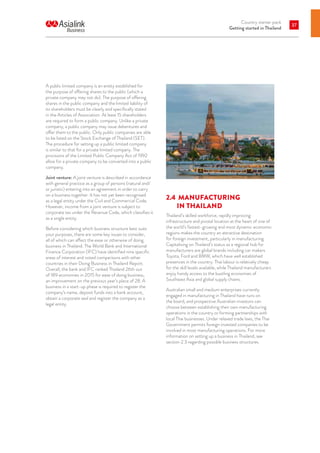
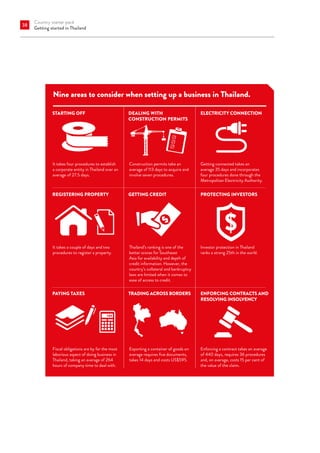
  • 27.
    Country starter pack Gettingstarted in Thailand 27 Common areas of risk When doing business overseas, Australians must consider multiple areas of risks and associated potential difficulties. These include: Political risk: How stable is the market politically, economically and socially? • Government and international enforced trade embargoes may affect the flow of goods and services and could affect your delivery of goods and getting paid • Another potential consideration is whether the country complies with international law requirements, such as on human rights, trade sanctions and recognition of personal property rights. Legal and regulatory risk: Challenges may arise due to differing legal and regulatory systems. For example: • Common law systems verses civil law systems, IP issues, taxation and auditing requirements • Differences in contract law: get tailored advice on contract terms due to differences with contract laws • Access to courts and dispute resolution mechanisms: some countries may not permit local litigation or place restrictions on the types of claims that can be made. Bribery, graft and corruption risk: • Bribery, graft and corruption are illegal in most countries around the world. Under Australian law (Division 70 of the Criminal Code Act 1995) ) you can face criminal prosecution in Australia for bribing a public official in another country. Exchange rate risk: How will adverse movements in exchange rates impact on your profits? Non-payment risk: What is the likelihood of your suppliers or customers defaulting or becoming insolvent?
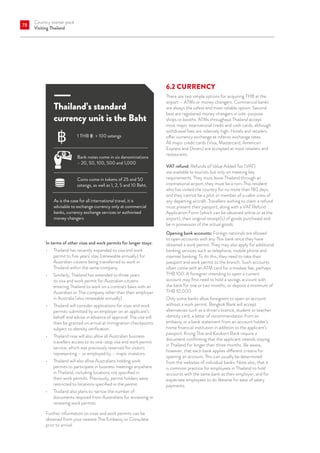
  • 28.
    Country starter pack Gettingstarted in Thailand 28 THE MOST PROBLEMATIC FACTORS FOR DOING BUSINESS* 5 10 15 20 25 Foreign currency regulations Poor public health Inflation Restrictive labour regulations Crime and theft Tax regulations Tax rates Access to financing Poor work ethic in national labour force Inadequately educated workforce Inadequate supply of infrastructure Insufficient capacity to innovate Policy instability Inefficient government bureaucracy Government instability/coups Corruption 2013 BUSINESS CLIMATE INDICATORS* GOVERNANCE INDICATORS Thailand Source: World Bank efic *Country percentile rank Per cent Emerging and developing Asia Control of corruption Rule of law Regulatory quality Government effectiveness Political stability and absence of violence Voice and accountability 0 25 50 75 0 25 50 75 Source: The 2014 World Economic Forum Global Competitiveness Report *Ranked by respondents per the perceived top five problematic factors in doing business in Thailand
  • 29.
    Country starter pack Gettingstarted in Thailand 29 Despite its prolonged instability, Thailand advanced six places, to 31, in the World Economic Forum’s Global Competitiveness Index 2013-14. The country climbed 12 places in the rankings of macroeconomic environments and now sits in 19th position, its best showing among the 12 categories measured, referred to as pillars. In 2013, Thailand almost balanced its budget and brought inflation down to 2 per cent. Public debt remained stable, with the country’s savings rate high. It continued to do well in financial development (34th on the list) and improved its already strong showing in the market efficiency pillar (30th, up four places). However, competition within the Thai economy continued to be constrained by various barriers to entry, especially those pertaining to foreign investment. The index confirmed that considerable challenges also remained in other key areas, especially those relating to governance. Political and policy instability, excessive red tape, widespread corruption, security concerns and high uncertainty around property rights protection were seriously undermining Thailand’s institutional framework (it ranked 93rd in the public institutions sub-pillar, down eight places). In most of these areas, Thailand was placed poorly. In particular, the level of trust in its politicians was among the lowest in the world (129th place). Another concern was the mediocre quality of education at all levels (87th, down nine places on the previous rankings) and technological readiness (65th), although Thailand showed marked improvement in the latter (rising 13 places). It should be noted that data used by the World Economic Forum for its report were collected before the most recent political developments, including the military coup of May 2014. Other global measures are also instructive when assessing the Thai business environment. The World Bank’s “Doing Business” reports, for example, shed light on how difficult – or easy – it is for a local entrepreneur to open and run a small-to-medium sized business when complying with all relevant local regulations. Measuring and tracking changes in regulations affecting 11 areas in the life cycle of a business, the bank ranked Thailand 26 out of 189 countries in 2015 for the ease of doing business in the country, up two places on its previous standing (2014). In 2014, the country was ranked 85th out of 175 nations in Transparency International’s public sector Corruption Perceptions Index (with 175 representing the most corrupt). This was an improvement on Thailand’s 107th place, recorded the previous year. By way of comparison, its Southeast Asian neighbours recorded mixed results: Malaysia came in at 50, but Indonesia (107), Vietnam (119) and Myanmar (156) all lagged well behind Thailand. Businesses contemplating launching operations in Thailand need to understand that corruption remains an issue there. Even so, anyone doing business in Thailand can expect to come across – or hear indirectly about – corruption in one form or another. This most common take the form of facilitation payments, bribes and the giving and receiving of expensive gifts in order to win business. Australian firms operating in Thailand should not engage in such practice and instead commit to the most ethical of corporate behaviour, while taking time to note Australian law and penalties regarding the bribery of foreign officials, which is a crime. Australian individuals and companies can be prosecuted in Australia for bribing foreign officials.
  • 30.
    Country starter pack Gettingstarted in Thailand 30 Source: The 2014 World Economic Forum Competitiveness Report *Ranking out of 144 countries 1 2 3 Most competitive Least competitive Macroeconomic situation Market efficiency Financial development Talent retention Business sophistication Pay and productivity Technological readiness Competitiveness Health and primary education Trust in politicians Intellectual property protection Quality of education Public institutions Innovation 150 120 90 60 30 0 30 60 90 120 150 INTERNATIONAL COMPARISONS OF COMPETITIVENESS*
  • 31.
    Country starter pack Gettingstarted in Thailand 31 87th 30th 129th 104th 66th 67th 93rd 65th 19th 34th 36th Another concern was the mediocre quality of education at all levels (down nine places on the previous rankings). It improved its already strong showing in market efficiency (30th, up four places). The level of trust in Thailand’s politicians was among the lowest in the world. Intellectual property protection ranks low at 104th and therefore can be a concern for businesses operating in Thailand. Strengthening law enforcement in IP is a key area the Thai Government intends to improve. The Thai population’s health and primary education are good compared to some of its neighbours in Southeast Asia, however there is room for improvement. With a ranking of 67th for innovation, the Thai Government has a focus to improve the country’s innovation and relevant industries with foreign investment. Thailand climbed 12 places in the rankings of macroeconomic environments, its best showing among the 12 categories measured. Public debt remained stable, with the country’s savings rate high and it continued to do well in financial development. Talent management and retaining staff are some of the core challenges businesses in the region experience. Thailand ranks one of the best in Asia for capacity to retain talent at 36th. Political and policy instability, excessive red tape and widespread corruption were seriously undermining Thailand’s institutional framework (ranking 93rd in the public institutions sub-pillar). Thailand showed marked improvement for technological readiness (rising 13 spots). Rank out of 144 countries. 1 being the most competitive. 31st 41st 50th Despite its prolonged instability, Thailand advanced six places for competitiveness. Thais have a good understanding of modern business structures, with a high level of business sophistication. Thailand ranks well in pay and productivity, with Thai workers highly productive and reasonable wages offered for the skillset. 1 2 3
  • 32.
    Country starter pack Gettingstarted in Thailand 32 2.2 RESEARCHING THAILAND A consistent and key message throughout this guide has been the worth and necessity of preparation and research. Do your homework. Nothing beats comprehensive inquiry, including specific market research, when looking to enter new markets including Thailand, with its unique and various features. These can include: • Cultural and geographical complexities • Evolving markets that can shift quickly • Changing rules, regulations and the focus of enforcement authorities • Thin consumer data and vagaries of markets and regulations • The availability of information on how to navigate processes and rule. When conducting market research, it is important to cast your net widely, taking note of import duties and other broad regulations, including reviewing more market- specific issues. What is the market’s size and growth prospects, and its demographics? How many competitors are there and what is the state of local production? How will you distribute your product? Pulling together this information can be straightforward, but the volume of information can also be overwhelming. This section aims to condense key areas that may assist you. However, do not limit your Thai market investigation to this guide. First, a couple of key considerations: • Do not make the mistake of focusing on the needs of your own company as opposed to the needs of the Thai market • It may be necessary to commission professional research that looks specifically at market conditions as they relate to your product and plans. You may also need to travel to Thailand to familiarise yourself with conditions and the nature of the opportunities and challenge that awaits you. An internet search alone will likely not suffice. Getting help Top tier international accounting and management firms with a major presence in Thailand are valuable sources of information, as are research-specific organisations. Austrade also offers a range of services to Australian businesses investigating prospects offshore, including information and various checklists on: • Market entry and how to grow your business • Where to establish your business • Locating on-the-ground contacts and tapping into networks • Identifying business opportunities. Relevant state and territory government trade departments and the commonwealth’s Export Market Development Grant scheme (EMDG) may also provide further information.
  • 33.
    Country starter pack Gettingstarted in Thailand 33 Market visits While much of your research can be directed from Australia, you will need ultimately to visit Thailand to verify what you have learnt and to develop a deeper understanding of your target market, as well as to start making contacts on the ground. Only once you have started building relationships will you feel confident negotiating contracts and agreements. As previously outlined, cementing these links requires commitment and focus, but also patience and understanding. Determine where and when to visit. There are no fixed rules about when to visit a market, except that you should do so before entering into any agreements with prospective agents, distributors or other business partners that could influence your future dealings. Consider meeting with several potential partners first to give you a basis for comparison. It can be helpful to meet with the contact that you believe will be the best fit for your business towards the end of your trip. This will give you time to develop a better understanding of the market so that you can handle questions and discuss strategic options with confidence. Concentrate your effort on only one or two markets at first to ensure a better chance of success. Plan your trip well in advance. To ensure a successful trip, you should arrange in-country assistance for the planning and setting up of your program. This will help you see the right agents and customers who will be briefed and screened for interest and suitability. Take note of holidays and religious festivals that occur at the same time as your planned visit. Also ensure you have all your required paperwork completed before departing for Thailand, including your relevant visa and taking with you (if applicable) any legal documentation such as financial documents and regulation information. Having company and product information and business cards is vital for developing business relationships. An easy-to-navigate, well-constructed and up-to-date website is crucial It allows you to: • Present your product to potential overseas customers and business partners in cost- effective ways • Project an image of a professional and trustworthy business • Convey that your business is “modern” and uses new technology • Avoid problems with time differences • Introduce, promote new products and sell directly to customers. Do some background reading. If you have never visited Thailand and don’t know much about the country and its way of life, you should do some research online. News articles and travel books can also provide useful information. Having some broad background knowledge about the area you are visiting will inform and focus your discussions when negotiating with local partners. Guides like this one, and others with a more specific industry or product focus, will also be beneficial. Have a good website before you go: A website can be a double-edged sword: it is a convenient and powerful calling card that allows potential associates and customers to learn about you and your company quickly and efficiently. But a bad website can turn off clients if it looks shoddy and the information it contains is out of date or indigestible. The best websites are clean and attractive, easy to navigate and informative. They should present information about your company clearly and concisely, preferably with attractive illustrations and interesting graphics. Remember, a website can also be a form of endorsement: where possible, display customer or client endorsements and photographs that testify to the quality of your products and services. Ensure that contact details are easy to find and link email addresses with photos of each staff member.
  • 34.
    Country starter pack Gettingstarted in Thailand 34 Building relationships and making connections Don’t waste a trip to your target market by arriving unprepared. There really is no point. Save valuable time on the ground in Thailand by doing as much as possible before leaving Australia, including any training or research that can enlighten you about doing business there and across Southeast Asia. Organisations such as Asialink Business, Austrade, the Export Council of Australia (ECA) and various state and territory government departments are worthy first ports of call. Attending specialist seminars and courses can allow you to build valuable networks while getting expert advice from people with experience of doing business in Thailand. Part of your planning should include arranging as many of your meetings in Thailand as possible before you leave Australia, while reconfirming these a day in advance. Put together a dossier that maps out your schedule, lists the addresses for meetings and includes some information about the people you are meeting. Pack your business cards: remember to share these routinely and to follow up with people who offer you their cards. It is courteous – and recommended – to send an email within 48 hours of your appointment thanking your contact for the meeting, while using the opportunity to provide any follow up information. You should make the point that you intend getting back to the person within a specific timeframe regarding any other requests. Apart from opening channels for future communication, such attention can create a good impression by demonstrating your reliability and professionalism. Just as you might expect in Australia, joining a business association in Thailand can be a handy way to make contacts and learn more about contemporary issues playing out in the local business community. In Bangkok, for example, there are numerous country-specific business associations, many long established, with membership in the hundreds. AustCham Thailand is the paramount association for Australians wanting to do business in Thailand to connect with. It is a useful network of Australian and Thai businesses operating in both countries. They hold regular networking events and actively work with the Australian and Thai Governments to run seminars and other activities. To connect and find out more about with AustCham, go to: www. austchamthailand.com. 2.3 POSSIBLE BUSINESS STRUCTURES Beyond researching Thailand generally – and your targeted market segment in particular – there will be pressing practical considerations for getting established there. For example, what kind of business structure will you deploy? Would a local agent be best, or should you open a branch office? Perhaps you could set up a Thai company? And what legal and administrative processes must you negotiate along the way? This section examines the pros and cons of the various business structures available, and the legal processes required for each. While it is possible that Thai companies interested in buying your products could approach you directly, having a local presence in Thailand can often be the most efficient way of gaining a foothold in the market. Establishing a permanent in country presence can offer several advantages by: • Demonstrating your commitment to Thai-based customers • Cutting out the ‘middle man’ • Providing direct access to the end customer/supplier • Maintaining direct control over company strategy and operations, enabling trading in local currency • Easing the process of doing business. Several types of corporate structures allow foreign enterprises in Thailand to pursue a variety of business activities, including companies, partnerships, branches and representative offices. A key determinant of which type is best for your venture will be the nature of the intended business operation. Private or publicly limited companies owned 50 per cent or more by foreign interests will be subject to the Foreign Business Act, which prohibits the operation of certain businesses unless approval is obtained from the BOI. Foreign investors will usually conduct business through a limited company, branch or representative office. According to Thailand’s Civil and Commercial Code, there are two types of partnerships: so-called ordinary partnerships and limited partnerships. When two or more people decide to invest in one of these types of partnership, the appointed managing partner is responsible for registering the partnership with the commercial registration office of the province in which its head office is located. Limited partnerships must only be managed by a partner with unlimited liability. The fee for registering a partnership is THB 100 for every THB 100,000 of registered capital, or fraction thereof. The minimum fee is THB 1,000 and the maximum THB 5,000.
  • 35.
    Country starter pack Gettingstarted in Thailand 35 Ordinary partnerships: In an ordinary partnership, all of the partners are jointly and wholly liable for all obligations of the partnership. An ordinary partnership may or may not register as a juristic person. Therefore, an ordinary partnership can be divided into two types: • A non-registered ordinary partnership, which has no status as a juristic person and is treated, for tax purposes, as an individual • A registered ordinary partnership, which is registered with the Commercial Registrar as a juristic person and is taxed as a corporate entity. Limited partnerships: Limited partnerships must be registered and are taxed as a corporate entity either as: • One or more partners whose individual liability is limited to the amount of capital contributed to the partnership • One or more partners who are jointly and unlimitedly liable for all the obligations of the partnership. There are two types of companies in Thailand – private limited companies and public limited companies. The first type is governed by the Civil and Commercial Code, while the second is governed by the Public Limited Company Act. A private limited company is the most common structure used for conducting business in Thailand. A company is regarded as a juristic person with the right to own property and carry on business under its name and has liabilities to others separately from its shareholders. At least three shareholders are required to form a company. A private limited company is formed through a process that leads to the registration of a Memorandum of Association (Articles of Incorporation) and Articles of Association (Bylaws) as its constituent documents. The shareholders enjoy limited liability and are managed by a board of directors in accordance with Thailand’s corporate laws and its own Articles of Association. In a board of directors’ meeting, proxies and circular board resolution (agreed without the physical presence of directors) are not allowed. All shares must be subscribed to, and at least 25 per cent of the subscribed shares must be paid up. Both common and preferred shares of stock may be issued, but all shares must have voting rights. Thai law prohibits the issuing of shares with a par value of less than THB 5. Treasury shares are prohibited. A minimum of three shareholders is required at all times for both Thai and foreign corporations. Under certain conditions, a private limited company may be wholly owned by foreigners. However, in those activities reserved for Thai nationals under the Foreign Business Act, foreigner ownership is generally allowed only up to a maximum of 49 per cent of the enterprise. The registration fee for the Memorandum of Association and for establishing the company is THB 5500 per THB 1 million of registered capital. Setting up a company STEP 1: Corporate name reservation At the Commercial Registration Department of the Ministry of Commerce. The name is valid for 30 days so ensure registration is completed in this time or you’ll have to begin again. STEP 2: File a memorandum of association To the Business Development Office, with the reserved company name, location, business objectives, capital, and names of all the shareholders. Share distribution and value must be described. STEP 3: Convene a statutory meeting Where the articles of incorporation and bylaws are approved, the Board of Directors is elected and an auditor appointed. A minimum of 25 per cent of the par value of each subscribed share must be paid and minutes must be recorded and used for registration. STEP 4: Registration of company The directors must submit the company registration application within three months. Fees are THB 5,500 per million of registered capital (public companies: THB 2,000 per million baht of registered capital). STEP 5: Tax registration Business operators earning more than THB 600,000 p.a. must register for VAT within 30 days of reaching THB 600,000 in sales.
  • 36.
    Country starter pack Gettingstarted in Thailand 36 Branch Where a foreign company is contracted to carry out a business project in Thailand, the foreign company may choose to perform such a project through a branch office. However, if the nature of the business falls within any of the restricted categories of the Foreign Business Act (1999), a permit will be required before the business activities can commence. Issuance of a permit is discretionary. A foreign company cannot engage in businesses listed under the prohibited categories of the Act. A branch office is regarded as having the same legal entity as its head office. Therefore, the head office and other branches will jointly be held responsible for all liabilities of the brand in Thailand. Application process: 1. The Department of Business Development (DBD) will conclude the application details for the Sub-Committee and Committee of Foreign Business for consideration. 2. The consideration period for the application is within 60 days 3. If approval is granted, the applicant will be notified and licence is given within 15 days and the applicant is entitled to appeal to the MOC within 30 days. The whole process of applying for a business licence will take around two to three months. Representative Office (RO) A representative office is established merely for the purpose of serving its head office of affiliates abroad for the provision of information. The activities of an RO generally involve some or all of the following activities: 1. Sourcing of goods or services in Thailand for the head office or affiliated companies. 2. Checking and controlling the quality and quantity of goods purchased or hired for the purpose of manufacturing in Thailand by the head office or affiliated companies. 3. Giving advice concerning the goods of the head office or affiliated companies sold to agents or customers. 4. Propagation of information concerning new goods or new services of the head office. 5. Reporting to the head office on the general business trends or movements in Thailand. Under the Foreign Business Act (1999), the activities an RO are considered as a service business under the Act, whereby a foreign company wishing to set up an RO must apply for and obtain permission from the Director-General of the Department of Business Development of the Ministry of Commerce, with the approval of the Foreign Business Committee, prior to the commencement of its activities. RO is considered as a non-trading office which is not permitted to conduct business with a view to profit (e.g. negotiate contracts, marketing, sell or trade, etc). Procedures for setting up an RO is similar to branch registration.
  • 37.
    Country starter pack Gettingstarted in Thailand 37 A public limited company is an entity established for the purpose of offering shares to the public (which a private company may not do). The purpose of offering shares in the public company and the limited liability of its shareholders must be clearly and specifically stated in the Articles of Association. At least 15 shareholders are required to form a public company. Unlike a private company, a public company may issue debentures and offer them to the public. Only public companies are able to be listed on the Stock Exchange of Thailand (SET). The procedure for setting up a public limited company is similar to that for a private limited company. The provisions of the Limited Public Company Act of 1992 allow for a private company to be converted into a public company. Joint venture: A joint venture is described in accordance with general practice as a group of persons (natural and/ or juristic) entering into an agreement in order to carry on a business together. It has not yet been recognised as a legal entity under the Civil and Commercial Code. However, income from a joint venture is subject to corporate tax under the Revenue Code, which classifies it as a single entity. Before considering which business structure best suits your purposes, there are some key issues to consider, all of which can affect the ease or otherwise of doing business in Thailand. The World Bank and International Finance Corporation (IFC) have identified nine specific areas of interest and noted comparisons with other countries in their Doing Business in Thailand Report. Overall, the bank and IFC ranked Thailand 26th out of 189 economies in 2015 for ease of doing business, an improvement on the previous year’s place of 28. A business in a start-up phase is required to register the company’s name, deposit funds into a bank account, obtain a corporate seal and register the company as a legal entity. 2.4 MANUFACTURING IN THAILAND Thailand’s skilled workforce, rapidly improving infrastructure and pivotal location at the heart of one of the world’s fastest-growing and most dynamic economic regions makes the country an attractive destination for foreign investment, particularly in manufacturing. Capitalising on Thailand’s status as a regional hub for manufacturers are global brands including car makers Toyota, Ford and BMW, which have well established presences in the country. Thai labour is relatively cheap for the skill levels available, while Thailand manufacturers enjoy handy access to the bustling economies of Southeast Asia and global supply chains. Australian small and medium enterprises currently engaged in manufacturing in Thailand have runs on the board, and prospective Australian investors can choose between establishing their own manufacturing operations in the country or forming partnerships with local Thai businesses. Under relaxed trade laws, the Thai Government permits foreign invested companies to be involved in most manufacturing operations. For more information on setting up a business in Thailand, see section 2.3 regarding possible business structures.
  • 38.
    Country starter pack Gettingstarted in Thailand 38 Nine areas to consider when setting up a business in Thailand. STARTING OFF DEALING WITH CONSTRUCTION PERMITS ELECTRICITY CONNECTION REGISTERING PROPERTY GETTING CREDIT PROTECTING INVESTORS PAYING TAXES ENFORCING CONTRACTS AND RESOLVING INSOLVENCY TRADING ACROSS BORDERS ☑ ☑ ☑ It takes four procedures to establish a corporate entity in Thailand over an average of 27.5 days. $ Construction permits take an average of 113 days to acquire and involve seven procedures. Getting connected takes an average 35 days and incorporates four procedures done through the Metropolitan Electricity Authority. It takes a couple of days and two procedures to register a property. Thailand’s ranking is one of the better scores for Southeast Asia for availability and depth of credit information. However, the country’s collateral and bankruptcy laws are limited when it comes to ease of access to credit. Investor protection in Thailand ranks a strong 25th in the world. Fiscal obligations are by far the most laborious aspect of doing business in Thailand, taking an average of 264 hours of company time to deal with. Exporting a container of goods on average requires five documents, takes 14 days and costs US$595. Enforcing a contract takes an average of 440 days, requires 36 procedures and, on average, costs 15 per cent of the value of the claim.
  • 39.
    Country starter pack Gettingstarted in Thailand 39 GreenCo Water Nigel Blair, Executive Director If you’re hoping to do business in Thailand, it pays to have an introduction to the people you want to do business with. If you have big plans that involve distribution, exports or breaking into new markets from Thailand, make sure you have the relationships in place to make those plans a reality. And if you’re not willing to invest the time into forging those relationships, you might as well stay at home. That advice comes from Melbourne investor, entrepreneur and international business strategist Nigel Blair, who has been doing business in Thailand since 2006. “Patience, temperament and attitude are very important in Thailand,” he says. “It’s how the culture works there; they [Thai businesspeople] are cautious about who they let into their orbit. “Some Australians have a sense of urgency and want to push things, but if you’re impatient, you won’t cut it there. People get frustrated because getting to that point [of trust] can take two, three or four years. But once you’re there things move quickly.” Blair and GreenCo CEO Simon McMahon developed the Pak Flat Tank, a self-assembly modular water tank that can store from 1,000 to 10,000 litres and which can be transported in flat-pack format. Blair has used his longstanding relationship with listed Thai manufacturing and distribution giant Srithai Superware PLC to make Bangkok the hub of GreenCo’s international growth plans. GreenCo is targeting two markets: the aid agency/ humanitarian market, providing vital access to water in refugee and displaced persons camps, initially in Asia, but potentially anywhere in the world; and the retail market, initially in Australia. The tanks are manufactured and distributed from Bangkok. Srithai is a diversified manufacturer of moulded plastics – including automotive parts, pallets, household electrical items, food and beverage packaging and melamine tableware – under its own consumer and industrial brands, as well as supplying some of the biggest companies in the world such as Coca-Cola, Pepsi and McDonald’s. Srithai also has manufacturing operations in China, Vietnam, Indonesia and India as well as a global distribution network. GreenCo is in the safest of hands, but Blair insists that kind of relationship doesn’t happen overnight. “I was referred to Srithai [to place a manufacturing contract] by a consultant. On that occasion, we were a client to them and the contract was done and dusted in two months,” Blair says. However, he knew enough about doing business in Thailand to spend the time to create a deep and lasting relationship with Srithai “so that it was more than just an order book relationship”. Other business deals soon followed. Forming lasting business relationships means not only getting to know key executives but their families as well. “When you have that kind of relationship with contacts over time, the referrals and opportunities that come from those relationships are invaluable and access to the market becomes open wide, but it takes time to get there,” he says. “In Asia, when you do business, you’re doing it with the family too. The basis of a real relationship is when you know the family as well. When you get to that point, they’ll do anything for you.” CASE STUDY greencowater.com
  • 40.
    Country starter pack Sales marketing in Thailand 40 3. Sales and marketing in Thailand
  • 41.
    Country starter pack Sales marketing in Thailand 41 Having decided on the best structure for your business in Thailand, the next step is to consider the most effective way of introducing your product or service into the local market. There are plenty of options, but tailoring one to best fit your business can be crucial to success. Should you sell your product online or through a local agent? And what are the labelling requirements? Would a franchise be best? What are your competitors doing? This chapter examines the various methods of selling in Thailand, including marketing and packaging requirements to import and sell goods. The speed of entry into the Thai market – and issues of cost, risk and the ability to grow – will vary depending on the route taken. As well as the options flagged in the table on the next page, direct selling and online sales are additional alternatives. The Australian Industry Group (Ai Group) highlights these various market entry options into Thailand and the differing degrees of difficulty and time. These options are discussed in more detail throughout this section. The bottom line for Australian businesses is that any foray into a foreign market requires as a minimum due diligence and thorough research so that their ambition matches their business strategy.
  • 42.
    Country starter pack Sales marketing in Thailand 42 3.1 DIRECT EXPORTING Exporting directly to a foreign market means involving yourself with every aspect of exporting, including: • Market research • Marketing • Distribution • Sales and receivables. Advantages include: • Greater control including control of the sales process • Better margins, as middle men are avoided • More direct customer relationships. However, going it alone may carry a much higher cost to establishing business in the Thai market as in-house resources are generally more expensive than outsourcing to experienced professionals. Reorganising your company may be necessary. Different methods or approaches can be adopted within a direct exporting framework and might involve sales representatives, agents and distributors. Local sales representatives: • Use company resources, product advertising and samples, and make presentations to buyers • May work on sales commission • Present little risk since they have no exposure to the cost of the goods. Using agents and distributors: Most Australian firms doing business in international markets rely on agents or distributors. But there are key differences in the roles of each, which can also vary according to country and industry. It is critical that the roles and responsibilities of prospective overseas representatives are clearly mapped out in any agreement you have with them. Don’t just assume that your agent or distributor will take on the broad array of activities that are generally ascribed such representatives, confirm the specifics in a contract with each operator. The role of an agent: Agents do not take ownership of goods being exported to a foreign market; they act simply as a representative of the supplier. They are also engaged by exporters of services to represent them in overseas markets. Agents are usually paid on a commission basis, which provides an incentive for them to drive sales of your product. Based in the target market, they will often represent several complementary products or services. They can be retained exclusively as the sole agent for a company’s goods or services or as one of a number of agents for the exporter in a particular market – that is, on a non-exclusive basis. The role of a distributor: Unlike agents, a distributor actually buys the goods from the exporter – that is, ‘takes title’ of the goods – and then resells them to local customers who may be retailers or direct consumers. In some cases, a distributor may sell to other wholesalers who then sell on to retailers or consumers. Distributors may carry complementary and competing lines and usually offer after sales service. Margins added to the price of the goods fund the fees that are paid to a MARKET ENTRY PROFILES Mode Agent Distributor Licensing Franchise Joint Equity Venture Speed of market entry High High Slower Slower Slow Costs - direct indirect Low Low Higher Higher High Degrees of freedom Low Low Contractual Contractual Limited Total exposure to risk Low Low Moderate/high Moderate Moderate/high Investment payback period Short Short Short/medium Short/medium Medium Foreign market competition Less likely Less likely Limited Limited Less likely Ability to expand within mode Less likely Less likely Limited Limited Limited
  • 43.
    Country starter pack Sales marketing in Thailand 43 distributor. Their fees are higher than those of agents because of associated costs; they usually carry inventory, may extend credit for customers, and are responsible for marketing. Choosing an agent or distributor: Ultimately, whichever your choice, it is essential that you establish a close working relationship with your agent or distributor, one that is built on high levels of trust and regular communication. These will ensure a close and enjoyable working partnership. Be sure to ask your potential partner for trade references. You might also seek a credit check through a professional agency to satisfy yourself about your potential partner’s financial stability. It is best to meet any potential agents or distributors in their own market rather than in Australia. This will give them a chance to demonstrate how well they know the market, while providing you with an early opportunity to start building a relationship. Why use an agent? Why use a distributor? Why not use an agent? Direct contact between manufacturer and customer. Generally cheaper than a distributor $ You have greater control over terms of sale and marketing, and choice of customers to deal with May be tax implications (check the relevant laws for that area) Why not use a distributor? Can pass a great degree of risk onto them and no termination compensation Distribution agreements regulated by local competition law. ☑$ $ x TAX Only have to monitor distributor’s accounts rather than all customers. Greater incentive for distributor to sell your product as they also have to cover the costs of holding stock Maintaining stock inventory can be costly Agent may also be selling other products including your competitors’ Less control over such aspects as marketing and terms of sale Credit risk with distributor rather than with customers
  • 44.
    Country starter pack Sales marketing in Thailand 44 Knowledge of the market: It is vital that your chosen representative has a thorough understanding of the products and prices of your competitors, which will guide you in critical decisions about possible product modification, advertising requirements or changes. Consider: • What sort of network and contacts the representative has. • What depth of experience they have in your targeted market sector. There may often be a trade-off: a well-established company with a good network of contacts might nevertheless be inflexible and less open to innovative practices. Alternatively, newcomers might lack experience of the sector but are brimming with enthusiasm and energy and are out to prove themselves. Weighing the merits of these alternative profiles can be important. • The extent and depth of their knowledge of the local market. The more experienced and tuned in, the more likely a representative will be able to identify opportunities and assist you in your marketing program. Direct selling Not every business will choose to access the Thai market through agents and distributors. Alternatively, you may choose to contact directly buyers and end users of your product or services. Though low cost and potentially a means of getting a feel for the market at relatively low risk, this DIY approach is not an easy pathway. On the upside: • It can eliminate the expense of using middlemen • It gives you a first-hand opportunity to get to know the needs of your customers and the chance to customise accordingly • It demands a sleeves-rolled-up effort but also an opportunity to learn the hard way. There is no substitute for thorough preparation. But there are distinct downsides: • The lack of a physical presence in the market can stymie efforts to do business with some Thai clients unwilling to engage with enterprises without offices or a representative on the ground • A direct selling strategy can require establishing a strong and extensive network of sales agents to cover a diverse geographical area. Direct to end users: A further consequence of selling directly to end users means taking charge of all market research and marketing, as well as distribution, shipment, warehousing and delivery, customer and after sales services and the sales order, billing and collection processes all from Australia. Thai retailers: Exporters of consumer goods may choose to sell directly to retailers, targeting the bigger populations of Bangkok and Chiang Mai. A direct approach to these retailers would be necessary, supported by direct mail material of letters, brochures, catalogues and so forth. This approach also requires regular follow-up contact to build the retailers’ awareness and understanding of the products they are selling on your behalf. In return, their intimate knowledge of the Thai market will contribute to the development of products, pricing and marketing. Selling directly to savvy local retailers can generally cut commissions, reduce expensive travel and create an effective conduit to market. 3.2 FRANCHISING The virtues of franchising are well documented. There are plenty of examples of successful businesses that leverage a great idea or business model by leasing it to others. The practice allows business owners to retain a measure of control while harnessing the energy of franchisees to drive expansion. Franchises project a company’s reputation and brand, and while it can prove expensive, building a network of franchises is generally cheaper than owning and operating retail or branch offices in foreign markets. By franchising, a franchisee is given the right to use the goodwill of a known firm, company or corporation. Franchising agreements are defined clearly in a contract between the owner of the business and the franchisee, which governs the rights, duties or obligations of both parties. Franchising is common in Thailand, where such ventures are among the best-run businesses in the country. While there are no specific laws overseeing franchise operations, the rights and obligations of both parties are well protected by existing laws. These include the Thai Civil and Commercial Code, which governs primarily the obligations of the parties while defining what is valid in a contract. The Trademark Act protects a franchisor from improper use of its trademark, while the Copyright Act protects against infringement of copyright. This is on top of a natural bias in favour of the franchisor that exists in most franchise agreements. Also, the Trade Secret Act is intended to protect the unique formula and other essential trade secrets of a known company. Finally, the Unfair Contract Term Act prohibits some terms in franchise agreements.
  • 45.
    Country starter pack Sales marketing in Thailand 45 SiteMinder Asia Glenn Andrews, Managing Director With more than 8,000 hotels and a position at the heart of Southeast Asia, Thailand was an obvious choice for online hotel booking technology company SiteMinder to establish their primary Asian support office. But the Australian-headquartered business had its work cut out to persuade the bricks and mortar owners of Thailand’s hotel sector to invest in its online offerings. As its core business, SiteMinder essentially acts as a switch between hotels and online travel agents like Agoda, booking.com and Expedia. It uses channel manager software to help hotels maximise their online room distribution and acquire more bookings. Globally, SiteMinder has more than 18,000 hotels as customers. “Often the owners of hotels in Thailand are quite successful,” explains Glenn Andrews, SiteMinder’s Asia managing director. “To get them to understand why they should change their already profitable way of doing business and look towards online methods, requires education and some persistence. They’re often very traditional, having lots of personal connections and business coming through travel agents who have a physical presence throughout Thailand.” “The Thai hotel owners say ‘it almost costs less to get someone to do this manually so why should I invest in your solution?’. We had to invest in a lot of training for our sales staff to explain that broadening existing distribution will increase revenue.” “Another challenge was that we are still providing client support out of our Australian office for all of Asia through our bilingual support team members. However, quite often Thai hotels have the opinion that local office support will be better because they will understand Thai service expectations more,” explains Andrews. “We are now in a position to move that way but had to first grow the business to a certain level to support the decentralisation.” Originating from founder Mike Ford’s search for a better online booking system for his Manly backpacker hostel in 2006, SiteMinder now has offices in Sydney, London, Dallas, Cape Town and Bangkok. Andrews set up the Thai office in 2012, and has built the Asia regional customer base to span across Thailand, Indonesia, Hong Kong, Vietnam, the Philippines, Malaysia, Singapore and Taiwan. The company hopes to double the size of its Thai-based team over the next 12 months. But when it comes to attracting dynamic Thai staff, SiteMinder’s online platform is all positive. “Our Thai staff love working with what they call a ‘sexy’ business because it’s all online,” highlights Andrews. “We have a culture of excellence which they really run with, they love motivation. In Thailand, you can get people who are hard working but fun loving at the same time.” SiteMinder sweetens the deal too. “We’re seen to be a foreign-owned business without too much of a brand in a very unique industry so we made the decision to pay good base salaries. These are slightly above the average to win confidence, which led to word-of-mouth referrals – all which help to get more good staff,” says Andrews. CASE STUDY www.siteminder.com
  • 46.
    Country starter pack Sales marketing in Thailand 46 3.3 LICENSING Licensing can be a quick and assured way of selling trademarks, intellectual property, design and patent rights, copyright and software into a foreign market such as Thailand. Licensing allows rapid market entry with limited capital, since it is unnecessary to set up expensive production facilities. Universally recognised contracts or agreements need to be in place to protect intellectual property, trademarks and design rights. Licence arrangements must meet international and Thai laws as well. 3.4 ONLINE SALES While the growth of online retailing globally appears exponential, a constraint in developing economies is the often poor broadband penetration. This is the case in Thailand, due to the country’s geography and historically low capital investment in telecommunications, which can put a brake on online retailers’ ambition of reaching more affluent consumers. Internet penetration in Thailand is relatively low at around 25 per cent of the population, with growth in online sales remaining low. Mobile subscriptions, however, are very high with a 125 per cent penetration rate. Social media apps are used by over half of mobile subscribers, making social media an effective channel for sales and marketing. Retailers looking to engage Thai consumers should bear this in mind when developing an ecommerce strategy for Thailand. A common method for facilitating internet sales is to set up online stores through popular web-hosted shopping carts. Unlike other countries in the ASEAN region such as Indonesia and Vietnam, Thailand has a wide variety of ecommerce sites including the popular global Amazon and eBay, as well as local sites such as weloveshopping. com, tarad.com, lazada.co.th and pantipmarket.com. Australians opting for an online presence in Thailand should research carefully the various web hosted options that are available, as well as any taxes that may apply due to customs (both Australian and Thai) and by being a foreign entity. They should also consider that most of the existing ecommerce sites are in Thai rather than English. 3.5 MARKETING The challenge of building a customer base in Thailand will demand continual reassessment of your marketing strategy. Getting a foothold in a foreign market is just the beginning: trade shows and exhibitions are effective ways of identifying and reaching out to potential new customers in a bid to build your business. It is wise to translate all sales and product literature and technical specifications into Thai when advertising in trade journals, exhibiting at trade shows or running technical seminars. Product and service adaptations: A key determinant of success can be how effectively a company adapts its product range to meet Thai tastes and cultural preferences, and to meet regulatory requirements. Getting the product mix and style right will vastly lift your chances of success. Branding: Thais are very brand conscious, which can help or hinder new entrants. Those with a recognised brand can look to capitalise with a concerted product launch or news conference to announce their arrival in Thailand. Sales promotion: Companies that team with local partners can usually draw on their associate’s intimate market knowledge to help draft an advertising and sales promotion suitable for their product range. In most cases, special promotional campaigns should be held at local shopping centres, hotels and convention halls. A popular gimmick is giving away free samples at major business and commercial hubs and offices. Commercial promotions can be equally effective for both consumer and industrial products, supported by gift premiums and discount coupons, or through draws for items such as package tours, cars or electrical goods. Advertising and media: Again, Australian businesses with ambitions in Thailand will want to tap the knowledge of a local contact or advertising company to understand how best to reach potential customers. Two popular English-language newspapers – The Bangkok Post and The Nation – are obvious vehicles for carrying your message. But Australian companies should obviously consider Thai-language publications to promote their products and services, the most popular of which are Krung Thep Thurakit (Bangkok Business News) and Thai Rath. Direct marketing: Home shopping on TV was introduced into Thailand several years ago but has struggled against consumer scepticism and the perceived poor quality of many of the goods on offer. The selling forum has gained ground in recent years and now accounts for annual turnover of more than US$50 million. Still, Thai consumers generally prefer to see and touch products, which further limit the reach of TV shopping channels.
  • 47.
    Country starter pack Sales marketing in Thailand 47 3.6 LABELLING REQUIREMENTS Like most countries, Thailand imposes strict requirements regarding labelling and other product details. A local agent/importer can usually navigate these rules, help register a product and ensure labelling requirements are met. These rules are applied most stringently to the labelling of dairy foods, baby foods, canned foods, vinegar, beverages, edible oil and fats, and gourmet powder (defined as an article containing monosodium glutamate, or MSG, and used for food seasoning). Food products must be approved and registered with Thailand’s Food and Drug Administration (FDA). When seeking registration, importers must supply two samples of each product, details of the exact composition by percentage of all ingredients, and six labels. Foodstuffs in sealed containers are subject to specific regulations. Food products imported into Thailand must be labelled in Thai and display specific information including: • Name and brand of the product (both generic and trade) • Registration number • Name and address of the manufacturer • Name and address of the importer • Date of manufacturing and expiry • Net weight and volume • Any additives used • Health and nutritional claims (if any) • Labels for alcoholic beverages that must advise the percentage of alcohol content. There must also be a health warning, printed in Thai, on the label or on a sticker, with specific wording. Specific regulations govern the labelling of cosmetic products. These require labels to indicate the following in Thai: • Name and type of the product • Name of manufacturer and address • Directions for use • Net contents • A statement of caution should irregular use of the product possibly cause harm. In some cases, labels can be applied as a sticker over an existing English-language label. Packaging Packaging needs to be secure and able to withstand extreme heat and humidity, especially in the event that goods are stored in the open. Waterproofing is critical, too, as imports can often be landed in Thai ports from open barges. Packaging material such as hay and straw should be avoided. Special certificates: Certain types of seeds, plants and animals require phytosanitary certificates issued by the approved authority in the country of origin. In Australia, this usually falls to the Department of Agriculture or the relevant state department of agriculture. Meat imports to Thailand must be accompanied by a veterinary health certificate signed by the official authority in the country of origin certifying that: • The country of origin has been free from endemic diseases for the specified period • The animal has been processed in an approved establishment in sanitary conditions and under constant veterinary supervision • The products are fit for human consumption and do not contain preservatives, additives or other substances in quantities harmful to human health • They have not been stored for more than three months (the date of processing or packing must be stated). Exporters of pharmaceutical and medicinal products may be requested to provide a Certificate of Free Sale, which certifies that the goods are normally and freely sold in the exporting country’s open markets and are approved for export, before shipment will be allowed. Marking and barcodes: Thailand follows the international EAN system of standardised barcodes, which are administered locally by the Federation of Thai Industries.
  • 48.
    Country starter pack Conductingbusiness in Thailand 48 4. Conducting business in Thailand
  • 49.
    Country starter pack Conductingbusiness in Thailand 49 Having chosen a business structure and strategy for taking on the Thai market, it is important for foreign businesses to familiarise themselves with Thai business etiquette and culture, as well as appropriate ways of developing business relationships, negotiating, holding meetings and conducting due diligence. 4.1 THAI CULTURE AND BUSINESS ETIQUETTE Cultural nuances can trip up business operators who fail to make an effort to work within local customs. Respect is a cornerstone of Thai culture and underpins business relationships. ‘Maintaining face’ is also important, with anger and even mild irritation to be discouraged. Thais embrace the characteristics of smiling, humbleness and patience, while laughing frequently and speaking softly. They guard proudly a cultural heritage that has Buddhism at its core and which is fundamental to their society and customs, including when doing business. Respect for the royal family is paramount, and negative comments about the royals are punishable by law. Greetings There are instances of gender differences: for example, men say Sawadee-khap and women Sawadee-ka when being introduced or greeting someone. The traditional form of greeting is known as the wai, which is performed by placing the palms of the hands together, raising them to the face with the fingertips at eye level and inclining the head slightly. Much formality is associated with the wai, with the level at which the hands are placed carrying great significance. Younger and lower ranking people are expected to offer the wai to their senior counterparts first. Generally, Thais will greet each other with a wai but will shake hands with foreign business contacts. Indeed, foreigners are not expected to initiate a wai or even return it. Rather, a simple smile and a nod of acknowledgement is acceptable. However, over time and as you become more involved in the community returning a wai may be more appropriate. When addressing others verbally, Thais use Khun (pronounced koon, as in cook), which stands for Mr, Mrs, Ms or Miss. This is followed by a person’s first (given) name. For example: Khun John (rather than Khun Smith). A nickname can often substitute for a Thai’s given name. In Thailand, last names tend to be reserved for very formal occasions or formal written communications, with Thais preferring mostly to address one another by first names and titles. This will usually also apply to foreign business people who can expect to be addressed as Mrs Jane rather than Mrs Smith. When corresponding, it is best to use: Dear + Khun + given name – for example, Dear Khun Mary. Introductions are common only in formal situations. Then, it is best to introduce yourself by your first name. It is acceptable, also, to ask for someone’s name. When introducing your business partner to an important Thai, mention your partner’s name first.
  • 50.
    Country starter pack Conductingbusiness in Thailand 50 Business cards As in many Asian cultures, business cards in Thailand are valued highly and always presented when meeting someone for the first time. Ideally, your business cards should have a Thai language version printed on one side. Cards should be handed person to person using the right hand or both hands, and received in similar fashion. Preferably, you should present your card to the most senior person first and when receiving a business card, it is important to take a few moments to read it, rather than placing it immediately in your pocket or on the table. In larger meetings, it is acceptable to place your associates’ business cards in order on the table in front of you. Dress code In Thailand, status and wealth are to be admired. While high status Thais often overdress, especially given the climate, appearance is very important and business people observe a dress code that dictates a certain formality. For meetings, businessmen will wear a shirt and tie, and proper footwear (not sandals). Thai people will usually judge a person on their clothing and accessories, so good grooming and a bit of polish on shoes is worth the effort. Women should wear conservative dresses or skirts that are not too short, or business suits, and blouses (not sleeveless tops). Both men and women should not take backpacks to meetings in Thailand as Thais consider backpacks inappropriate accessories for business wear. Business culture Relationship building is universally a factor in business success, and doing business in Thailand is no different. Thais will usually expect to spend time working on their relationship with a business contact before exchanging critical information or committing to a deal. ‘Ice-breaking’ informal conversation will often precede and follow business meetings, and inquisitive Thai contacts will be interested to learn more personal details about you such as your age, as well as your family and educational background, as a means of building familiarity. Foreigners need to be aware, however, that Thais are unlikely to admit to having not understood you for fear of offending you. Likewise, they will generally avoid disagreeing openly and avoid appearing negative in answer to questions. This can be frustrating when foreign business people assume a deal or agreement has been struck only to find nothing further eventuates. Having an interpreter on- hand can help avoid such confusion. Translating language is one thing – but deducing meaning can be another matter altogether. Hierarchy and rank are important in Thai society, and senior officials and business people will usually expect to meet Australian representatives of similar seniority, not more junior staff. All correspondence should be addressed to the most senior person. Age, seniority and rank all have an influence on conversation and dialogue. The less senior person is expected to show restraint, and will rarely disagree openly with superiors. This can at times stifle communication, and you may find it necessary to follow up with counterparts later to clarify matters. In this environment, it makes sense to Thais to try to place you within a hierarchy when they first meet you, so that they have a framework in which to engage. This may involve them asking what might appear in other cultures as very personal questions. Bargaining and negotiating are commonplace in Thailand, and normally do not offend. Rather, deploying such give and take negotiation demonstrates flexibility and a willingness to accommodate business partners. Thais rate a person’s ability to bargain and reach what they consider a fair deal as a measure of business acumen. Sometimes, details of an agreement may be altered between negotiation and final sign-off when circumstances change unexpectedly and in such cases both parties are expected to be accommodating. Exchanging gifts, as a display of friendship and in gratitude for hospitality, is widely practised among business associates in Thailand and is encouraged. Gifts are usually exchanged at the end of a meeting or function. They are given when visiting someone for the first time, but are opened in privacy, not when received. While gifts do not need to be expensive, they should reflect a generosity of
  • 51.
    Country starter pack Conductingbusiness in Thailand 51 spirit that can help build a strong relationship. Gifts should be modest and appropriate to the occasion, and Australians doing business with foreign counterparts need to be aware that giving overly expensive gifts may be seen as an undue benefit with the intention of obtaining or retaining a business advantage, thereby constituting an offence. Under Australia’s anti-bribery laws, this would be illegal if the recipient is a foreign public official. Appropriate gifts include flowers, a basket of nutritional food, good quality chocolates, bottle of Australian wine or fruit. Money is usually given for weddings and ordination parties. Any sharp items – for example, a letter opener or sword – should not be given, as sharp objects represent the severing of a relationship. When doing business in Thailand, it is worth observing that: • Thais prefer to work into the evening rather than early in the morning. Business is kept separate from home, while family comes first, ahead of business. • Subtlety – not frankness – is essential, especially when saying “No”. • Speaking in a loud voice is not appreciated, nor is displaying temper. Never criticise someone publicly. While business relationships in Thailand tend to be less formal than in other Asian countries, they are not as relaxed as in the West. When negotiating, you must be sensitive to hierarchy and it is important to arrange an introduction or personal reference before approaching potential business contacts. Across Thai culture it is important to make sure that when sitting, the soles of your feet are never pointed at anyone, nor towards an image of the Buddha. This is viewed as disrespectful, as the feet are considered the lowliest part of the body. As mentioned, Thais avoid violence, conflict and confrontation. Losing your composure will cause you to lose respect in Thailand. At the same time, situations involving an obvious injustice or abuse can be met with an outwardly submissive attitude, for the sake of not losing face. Dining Should you be invited to dinner at the home of a Thai colleague, you should reciprocate out of respect for your colleague and as a means of building mutual trust and respect. Remember to remove your shoes before entering a Thai house. Usually, a fork and spoon alone are provided as eating utensils, with the former held in the left hand and the latter in the right, with the fork used to guide food onto the spoon. Sticky rice, a northern Thai delicacy, is often eaten with the fingers of the right hand, but it is important not to lick your fingers. You may begin eating as soon as you are served. It is customary to leave as little food as possible on your plate, and do not leave rice as to do so is considered wasteful. Never take the last bite from the serving bowl and wait to be asked before taking a second helping. Body language • Touching people of the same gender is more common in Thailand than in many other Asian countries, but touching someone of the opposite sex remains taboo. Nor is it acceptable to show affection in public. • Avoid touching or passing anything over someone’s head, as the head is considered sacred in Thailand and must be respected. • Do not point your feet at anyone or use your feet to move anything or touch others. Feet are regarded as unclean and are both symbolically and physically the lowest part of the body. • Smiles reflect many different emotions, ranging from an apology, a thank you or greeting, to showing embarrassment. For outsiders, this can sometimes be confusing. For example, a Thai’s smiling assurance does not always mean you will get what you want, or when you want it. In essence, it reflects the Thai appreciation of harmony and a ‘never mind’ attitude. • Smiling regularly is a virtue, as this demonstrates patience, which is much valued in Thai society. • Resist waving your hands about as you talk. This can give Thais the impression that you are angry. Never pass anything with your left hand nor point with your hand. And beware, you must never ever point with one finger. • Do not cross your legs in the presence of elderly Thais or monks. • Even beckoning someone requires caution. It is best to extend your arm with the palm of your hand downward, while fluttering your fingers up and down. Finally, it is important to allow sufficient time travelling to and from appointments in Bangkok, where traffic congestion is burdensome and can cause lengthy delays. This can be tricky because arriving at meetings on time is critical for good business relations as it signifies respect for the person with whom you are meeting. It may be best to avoid visiting Thailand around Songkran (Thailand’s New Year) in mid-April, as businesses close for about three days and many people head out of town at this time.
  • 52.
    Country starter pack Conductingbusiness in Thailand 52 Lady Pie Harry Usher, Managing Director When the 2004 tsunami that devastated South Asia hit Phuket, it took with it Harry and Susan Usher’s home, and the tools of her fledgling pie-making trade. However, inspired by the Thais’ resilience and a little help from home, their business, Lady Pie, was baking again within days. Having sailed to Phuket in 1999, the pair liked what they saw and settled in. Susan, an Australian, started making pies as a hobby, building it into a small cottage industry. “She made them in a Breville pie maker at first, two pies at a time,” says her Scottish- Australian husband Harry, now general manager of the company. “Then she got two pie makers, and just before the tsunami we upgraded to a pizza oven.” The oven was washed away with the Ushers’ home, but they were determined to stay. “The thing about Thailand is it gets in the way of many natural disasters and unrest. The economy goes up and down like a yo-yo but it always seems to recover, it’s got an elasticity to it,” says Harry. “People pulled together after the tsunami. Phuket pulled itself together. We picked up fairly quickly, Susan was making pies within a few days of the tsunami, she found one of the old Breville machines and got it rewired. We had customers and they were wanting pies.” When the owner of Sydney factory Lindsay Pie Making Equipment saw a newspaper photo of Susan in the remains of their washed-away house, they sent a pallet-load of equipment including an electric oven and dough mixers. Today, Lady Pies are sold throughout Thailand via two supermarket chains and a network of distributors. They produce around 500 pies a day for a mainly expatriate market, though the sweet- toothed Thais are partial to their apple pies and lamingtons. No one anticipated such growth from the once home-run business. Harry left his construction job to join the company in 2010, and today works with Susan and eight Thai workers. As a Thai Limited Partnership, a business structure chosen when it was initially set up, a strict four-to-one Thai-to-expat staff ratio is required for its registered company structure. If setting up Lady Pie now, the Ushers highlight that they would seek approval to operate under the freer Thailand Board of Investment (BOI) rules designed to encourage investment in certain sectors or regional areas. “There are several conditions and the location has to be approved and your accounts checked, but the new regulations permit expats to own 100 per cent of their business’ shares and own the land the business is on, which is one of the few ways for a foreigner to own land here,” explains Harry. Other benefits also exist for Australians wanting to set up a business in Thailand in areas where the government seeks to attract foreign investment, under recently introduced BOI regulations. “Business visas and work permits can be fast-tracked and there’s no profits tax for the first few years. There is a lot of paperwork and you need a specialist to help, but that’s the way to go,” highlights Harry. CASE STUDY www.ladypie.com
  • 53.
    Country starter pack Conductingbusiness in Thailand 53 4.2 BUILDING RELATIONSHIPS WITH THAIS As in most intercontinental dealings, building strong relationships is critical for succeeding in business in Thailand. Indeed, the strength and soundness of business relationships can have a cascading effect in many aspects of commercial life – in procurement and contracting, gaining credit and for navigating bureaucratic processes. This can take time, and will usually require extensive ‘face- to-face’ time with contacts of similar age and status. Critically, loyalty and trustworthiness are at the core of relationship building in Thailand. Nuances such as age and seniority also come into play in forming personal and commercial bonds: you should consider carefully the impact of age, gender, educational and marital status when building relationships, as in Thailand younger people are often excluded from key decision making and are expected to defer to older people in terms of language and attitude. Business partners Teamwork is paramount to succeeding in Thai business life. In most instances, individual preferences give way to the more valued sense of belonging to a group, conforming to its norms and maintaining harmony within its membership. The ability to build lasting and trustworthy personal relationships is a key goal for most Thai business people, who often expect to establish strong bonds before committing to any deals and will tend to do business foremost with those operators they know and respect. Pushing too hard, too quickly, on a deal can be counterproductive. Rather, serious business talks should come only after your potential business partners have become comfortable with you. Relationships in Thailand are based almost universally on familiarity, respect and personal trust, which cannot be established overnight. Business relationships tend to be more personal – more likely established between people as opposed to companies. Even once you have established a solid relationship with your local partner, their friendship and trust is unlikely to be extended automatically to others within your company. As a consequence, it is vital to keep in place personnel at the forefront of interactions with the local partner. Changing a key contact can risk having to rebuild a relationship from scratch. In extreme cases, such a change can bring negotiations to a halt. Remember, ‘saving face’ is key to Thai culture, and harmony should always be maintained, whatever the cost, while being able to hold emotions in check is deeply respected. Reputation and standing throughout Thailand’s social strata rest on this concept. Causing embarrassment to others, or openly criticising them, can cause a loss of face for all parties involved. Ultimately, business negotiations will suffer. Remaining friendly at all times is the wisest credo for those wishing to strike solid, long- standing and mutually beneficial partnerships. Diplomatic restraint and tact are cornerstones of this approach: in other words, stay cool and refrain from ever showing openly that you are upset or angry. As in the case of many other Southeast Asian nations, Chinese are represented strongly in business. While around 80 per cent of Thailand’s population is ethnic Thais, Chinese by far lead minority groups in this pluralistic society. Many businesspeople are Chinese, who retain strong connections with family businesses in China. This can sometimes mean that business deals can only be closed with the assistance of partners domiciled in China, as well as Thailand. Local government and authorities While building relationships with private business partners and engaging with the local business environment are primary objectives, Australian businesses need to be mindful of the key government agencies that may need to be consulted throughout the process of setting up a business in Thailand. The main agencies and their areas of licensing authority for foreign investors are: Board of Investment Thailand (BOI): This agency is at the forefront of efforts to promote investment in Thailand, offering information and services for investors, as well as many incentives. Ministry of Industry: This is a Thai Government ministry, responsible for the promotion and regulation of industries. Ministry of Foreign Affairs: Similar to the Australian Government’s Department of Foreign Affairs and Trade, this ministry compiles general information and statistical data on foreign trade, overseas import/export laws and legislation. Consular and diplomatic services are also carried out through this ministry. Ministry of Commerce: Together with the BOI, this ministry is responsible for promoting Thailand’s economic development. It also compiles statistics on international trade. The Customs Department: Holds responsibility for collecting revenues such as import/export taxes and duties and fees. It advises on export promotion and privileges, customs procedures for parcel postage as well as other customs-related information for travellers. Revenue Department of Thailand: Alongside the Customs Department is the Revenue Department of Thailand, both under the Ministry of Finance’s jurisdiction. The Revenue Department is responsible for about half of all tax collections.
  • 54.
    Country starter pack Conductingbusiness in Thailand 54 4.3 NEGOTIATIONS AND MEETINGS A key to building good business relationships in Thailand is establishing the right chemistry with partners, but nurturing the relationship is critical for its longevity. Courtesy and conformity are core prerequisites: organise appointments before you leave Australia and follow up with telephone calls on arrival to confirm your partner’s availability. Managing Thai business meetings Meetings can be held over meals – breakfast, lunch or dinner – as well as during normal business hours. Rest assured that English is commonly used during meetings and presentations in Thailand although, as previously noted, a translator may be necessary during complex negotiations or discussions about technical products or issues. In general, it is customary to wait for your host and hostess to introduce you to other attendees. This allows everyone to grasp your status relative to their own, thereby understanding who should perform the wai – the common form of greeting that carries strict protocols, as previously discussed – and how low one’s head should be bowed. Guests should also remain standing until told where to sit. Surprising your hosts can have the wrong effect, presentations, for example, can have the best impact when delivered formally and following accepted formats. However, more informal question and answer sessions can often elicit healthy participation among Thais who are normally not so keen to exchange views in formal settings or large meetings that include a range of differently ranked individuals. One means of encouraging participation can be to allow those present to submit questions anonymously on paper. Ultimately, it is best to look for opportunities to make your partners as comfortable as possible so that there can be a beneficial sharing of views. Do not be alarmed if during a meeting or presentation your Thai counterparts talk among themselves in their own language. This is seen as neither rude nor a sign that they are bored, but is more likely an attempt by them to make sure they are understanding correctly. It is a good idea to make sure you are carrying sufficient numbers of business cards and corporate literature to enhance your presentation. Having the flip side of your cards translated into Thai can create a very good first impression. Always follow up meetings by letter or email on your return to Australia. Typically, first meetings produce good humour and easy- going smiles, but polite and measured conversation. Quick results are rare. Second meetings, ideally, should include a meal invitation. Always begin meetings with small talk. To launch immediately into business talks before becoming acquainted is viewed as impolite. Qualifications and degrees, especially from prestigious universities, carry status and Thais will sometimes list these on their business cards. Foreigners with powerful connections are widely respected. Negotiations the Thai way Negotiations in Thailand are generally more of a joint problem solving process and focused on compromise, even when there is no real need to do so. The importance Thais place on relationships in general is also significant in the negotiation process. Patience really is a virtue. Thais expect it and reward those who resist the temptation to display frustration. Do not expect to clinch a deal immediately or on a first visit. Being patient is particularly vital as negotiations can often be lengthy, with process overshadowing content, and a generally poor information flow stunting the progress of discussions and decision making. Always avoid confrontation but keep in mind that sometimes Chinese cultural influences can impact on Thai business negotiations. Try not to get frustrated by the holistic nature of your Thai counterpart’s negotiating style. It is common for Thais to quickly change discussions from one topic to another, with no sequential order being used to address agenda items. They also tend to use a variety of negotiation techniques. These include techniques such as fake non verbal messages showing disinterest, making false demands and concessions, emotive techniques such as grimacing, appealing to personal relationships and making you feel guilty. Nevertheless, being direct should always be avoided. Thais also enjoy bargaining and may be offended if you do not reciprocate. Despite these various elements of the negotiation process, never apply any in an aggressive manner or with too much pressure. While Thailand has a pro-business attitude, business decisions can be slow and may involve several layers of authority before being finalised. Planning is usually short term. The upper echelons of management are often filled with family members. Who you know is important; powerful connections are respected. Facts and figures are not valued as highly as personal experiences and feelings, therefore if you expect a risky decision to be made, you need to find a way to make your Thai counterpart feel comfortable.
  • 55.
    Country starter pack Conductingbusiness in Thailand 55 Insight Education Consulting Greg O’Neill, CEO Greg O’Neill had an early run-in with the cultural sensitivities of doing business as a Westerner in Thailand when setting up his company, Insight Education Consulting, in Bangkok 18 years ago. “We employed a lawyer to do the business administration, got all the documents, ran through a checklist then fronted up to the Ministry of Commerce. We had an organisational chart which had me sitting at the top with the other Thai directors a few rungs below. And a middle-level bureaucrat says ‘look, I don’t like this organisational chart. Can you put the Westerner a bit further down?’ So I just moved me down a few notches.” O’Neill acknowledges he was “confused and bewildered” by the Thai way of working, with its “sometimes rubbery” regulations and reliance on contacts and patronage. Having good, trusted Thai staff to be “eyes and ears” is vital, he highlights. “There are times to put a Western face out in front of the company and other times when it might be best to put a Thai face out there,” O’Neill explains. “At the initial stages of negotiation I might go in and be introduced as the CEO of the company and might talk a bit about big-picture stuff, then sit back and let one of the less senior Thai staff take on the conversation, the nitty gritty.” O’Neill’s company works with Thai universities, colleges and schools on education projects including teacher training and curriculum development, helps Thai students wanting to study overseas, and foreign universities seeking partnerships in Thailand. He says humility is “really important” to keep in mind when doing business there. “There’s a fine line between being seen to be an expert in something and coming across as condescending or patronising. In this part of the world, and particularly if you’re a Westerner, you don’t want to be seen coming in and saying, for us in terms of education, our system is superior to yours and this is how you should do it.” Cultural sensitivity is important in the workplace too, O’Neill outlines. “When giving feedback or being critical of staff you’ve got to be extremely careful about people’s feelings. Delegating those kinds of things to Thai staff is important to understand right from the get go. For trivial issues like lateness, it’s much better to have my office manager mention it rather than me say something because there’s much greater sensitivity to it purely because I’m a foreigner. It’s partly a language thing and partly a cultural thing.” CASE STUDY www.insight.in.th
  • 56.
    Country starter pack Conductingbusiness in Thailand 56 4.4 DUE DILIGENCE AND AVOIDING SCAMS Australian firms looking to do business in Thailand should avail themselves of Australian law and penalties, particularly those relating to bribery of foreign officials. It is important that they commit to the highest level of corporate behaviour so as to avoid pitfalls that can lead to grave consequences. Put simply, the bribing of foreign public officials is a crime and both individuals and companies can be prosecuted in Australia for such offences committed while doing business overseas. Those at the frontline of doing business abroad should familiarise themselves closely with the regulations governing bribery. History shows that many of the problems encountered by foreign companies doing business in Thailand could have been avoided with the benefit of proper due diligence. Different degrees of due diligence may be applicable. For example, for an exporting initiative, the best proof of a Thai receiver’s ability to pay is whether it can produce a letter of credit from a bank, underscoring its financial standing. Essentially, the bank has carried out the checks for you. Another simple exercise as part of any due diligence is to get a copy of a company’s business licence. This will inform you of several things, including: • The legal representative of the company • The name and address of the company • Its registered capital, which is also its limited liability • The type of company • Its business scope • The date the company was established and the period covered by the licence. It is wise to check that information contained in the business licence matches what you already know about the company. Should it not match, make further inquiries. The more you know about who you are dealing with, the greater your security: which person is legally responsible for the enterprise? Who is it that you are actually dealing with? Of course, the company’s shareholders are responsible for the amount of liability stated as registered capital on its business licence but, if in doubt, you could check whether the capital has been paid up by getting a Capital Verification Report through a firm of accountants. Should you wish to establish a business relationship in Thailand that goes beyond exporting, it will be necessary to carry out further research.
  • 57.
    Country starter pack Conductingbusiness in Thailand 57 There is no doubt that a thorough examination of your potential partner will be time consuming and expensive, but valuable insurance nonetheless. Making the effort ahead of forging partnerships will greatly reduce the risk of future problems. Be aware however, that company accounts in Thailand are unlikely to be audited with the same rigour that might be expected in Australia and that a superficial reading of those of a potential partner may prove inadequate for assessing their credentials. In fact, companies in Thailand may have different sets of accounts to suit different audiences. It is advisable to use such data with caution and only in conjunction with information gleaned elsewhere. There are many accounting and legal firms in Thailand able to assist with due diligence. These range from leading international audit, tax and advisory specialists to private business consultants who have lived in Thailand for some time. Dispute resolution: It is important for companies involved in any international commercial dispute to seek appropriate legal advice in Australia or in the country where they are operating. Austrade is able to provide referrals to legal service providers upon request. There are a number of international arbitration commissions that exist to facilitate international dispute resolution. However, deciding which arbitration body is best suited to your commercial needs can be complicated. In short, Australian companies should seek legal advice when deciding on a preferred forum for arbitration. This will depend on a range of factors to do with convenience, cost and the facts of a particular case. While the Australian Government routinely supports arbitration as a preferred method of handling commercial disputes involving foreign companies, it does not endorse one arbitration body over another – whether in Australia or overseas. Scams to watch out for in Thailand: Several websites document examples of known scams operating in Australia and abroad in a bid to protect consumers and business people from fraud. Scam ‘alerts’ are available at www.scamwatch.com.au. If you believe you are contacted by a scam, ignore the emails and delete immediately.
  • 58.
    Country starter pack Businesspracticalities in Thailand 58 5. Business practicalities in Thailand
  • 59.
    Country starter pack Businesspracticalities in Thailand 59 For Australians conducting business in Thailand, getting to grips with legal regulations and the practicalities of tax and employment laws, as well as other key provisions, is a fundamental challenge. This chapter offers an overview of the main areas that need to be considered, but it is strongly recommended that prospective investors seek professional advice in those areas requiring specific information. 5.1 LAWS AND REGULATIONS Investment rules Thailand is no stranger to foreign investment and welcomes new investors. The Board of Investment (BOI) oversees many incentives aimed at drawing foreign enterprises to Thailand. As a conduit for investment, the BOI aims ultimately to funnel investment into sectors that will drive the nation’s economic development. The legal architecture supporting this incentive regime exists within the Investment Promotion Act. The incentives can range from tax-associated discounts such as a reduction in, or exemption from, import duties on machinery and raw or essential materials, to deductions in personal income tax and dividends. On top of these, non tax incentives focus on permits related to the exploration of investment possibilities in Thailand, the bringing in of foreign skilled and specialist workers for promoted investment activities, and the movement of foreign currency through Thailand. Foreign business activities are also covered by the Foreign Business Act B.E. 2542 (1999). This act outlines which sectors of the Thai economy where foreign ownership is limited or not allowed. Sectors off-limits to foreign businesses include rice cultivation, mass media and forestry. For more information on the Foreign Business Act B.E. (1999), visit the Department of Business Development’s website.
  • 60.
    Country starter pack Businesspracticalities in Thailand 60 Policies for investment promotion: As a means of enhancing economic development and to respond in a timely fashion to shifts in global economic trends, while also relieving the Thai Government of some of the fiscal heavy lifting, the BOI promotes these key initiatives: • Investment that enhances national competitiveness by intensifying activity in the agriculture, industrial and services sectors, as well as for SMEs, through innovation, research, value-adding, fair competition and expansive growth • Providing tax and non-tax incentives for businesses to set up International Headquarters (IHQ) and International Trading Centres (ITC) in Thailand. This aims to further develop Thailand as a global business hub • Environmentally friendly activities that can lead to reduced energy use or which incorporate alternative energy sources that encourage sustainable growth • A concentration on development and strengthening of supply chains in regional areas • Investment in border provinces in southern Thailand that will help bolster the local economy while playing to a national focus on enhancing security in the area • Promotion of special economic development zones that can strengthen economic ties with neighbouring countries and to pave the way for entry into the ASEAN Economic Community (AEC) • Promotion of overseas investment by Thai enterprises that will enhance the competitiveness of Thai businesses and mark out and nurture Thailand’s role in the global economy. Thailand-Australia Free Trade Agreement (TAFTA): One of more than 20 free trade deals to which Thailand is a signatory, TAFTA benefits Australian businesses by permitting levels of foreign ownership not generally afforded to other nationalities. The investment levels for Australian corporations have been raised from a previous cap of 49.9 per cent and include, according to the Australian Government Department of Foreign Affairs and Trade (DFAT): • Majority ownership of mining operations (up to 60 per cent) • 100 per cent equity in companies established to distribute goods manufactured in Thailand • 100 per cent ownership of companies providing certain construction services • 100 per cent ownership of companies providing management consulting services through a regional operating headquarters or associated company or branch • Majority ownership of major restaurants or hotels (up to 60 per cent) • Majority ownership of tertiary education institutions specialising in science and technology (up to 60 per cent), provided the operation is located outside of Bangkok • Majority ownership of companies providing certain maritime cargo services (up to 60 per cent). The free trade agreement also incorporates provisions that offer investment protection through a range of guaranteed rights for Australian direct investors in Thailand. These include the right to transfer funds out of the country at any time, as well as the right to seek impartial resolution of any disputes they may encounter with the Thai government over their investments. Land and property rights Thailand does not generally allow foreigners or foreign businesses to own land. Rather, leasing is the common protocol for foreigners in Thailand with each contract imposing conditions generally provided by the Crown Property Bureau or other government agencies. Private Thai owners also offer leasehold titles. Land and property rights are usually applied according to two types of usage: • Residential leases are for a maximum of 30 years (with the possibility of a further 30 years) • Industrial or commercial leases can be for up to 50 years (and may be renewed for a further 50 years). Nevertheless, in accordance with the BOI’s investment incentives, foreign individuals can own land of up to 1600 square metres (referred to in Thai as one rai) in specified areas for residential purposes. Under the deal, a THB 40 million investment must be made in specified assets or government bonds beneficial to the Thai economy. Buying an apartment or condominium is a simpler way for foreigners to buy residential property in Thailand. As long as Thai nationals own at least 51 per cent of apartments in a building, a foreigner is able to buy an apartment. Further, foreign companies with substantial investments already in Thailand that are deemed beneficial to the economy may be afforded special privileges for the duration of their business activity and exemption from more restrictive land ownership rules either under section 27 of the Investment Promotion Act, section 44 of the Industrial Estate Authority of Thailand Act or section 65 of the Petroleum Act. Because of the complex nature of these requirements and rules, seeking professional advice in Thailand on the pros and cons of purchasing or leasing property for commercial or private purposes is essential.
  • 61.
    Country starter pack Businesspracticalities in Thailand 61 Fibre King Oryx Automation Suren Moodley, Managing Director When Fibre King Oryx Automation looked at expanding its manufacturing overseas to escape the effects of the global financial crisis and a strong Australian dollar, the Thailand-Australia Free Trade Agreement (TAFTA) helped it settle on Thailand. “TAFTA was one of the main reasons we chose Thailand over somewhere like Malaysia or southern China,” says managing director Suren Moodley. The company designs and builds end-of-line automated packaging machinery, including case conveyers, case packers and palletising systems. The 89-year-old Brisbane-based parent company Fibre King set up a subsidiary company – Oryx Automation – in Thailand in 2012, and is now established with 80 staff in an industrial estate 130 kilometres southeast of Bangkok. “At that time, most of the machinery we were building was getting imported into Australia, as well as spare parts for machinery already in the field. We now have TAFTA certification on all our parts and machinery imported into Australia, avoiding any import duties in Australia.” “The only challenge with TAFTA is that in Thailand it’s not as easy as Australia to get your certification (COO – Certificate of Origin – to qualify for TAFTA benefits). It’s isn’t difficult, just very, very paper intensive. You simply need people to do the paperwork demonstrating the required Thai value add.” Like other parts of Asia, establishing a business in Thailand comes with constant challenges associated with talent and retention of staff. Oryx Automation builds highly customised engineered products so skilled technical staff are vital – however finding and keeping such highly skilled employees is no easy task. “It’s very, very difficult to attract good talent outside of Bangkok,” says Moodley. “Thais are very social people, they put a high value on social life and family structures so to get them to move out of Bangkok is nigh on impossible.” “Also, because of the rapidly emerging industry here creating new jobs, it’s really hard to hold on to staff. You employ people, train them, then someone else poaches them. But we identified this issue early on and our staff retention policies are working really well.” One of the strategies is splitting the traditional bonus system. Most companies pay a big, pro-rata bonus at the end of each year in Thailand. But Oryx Automation also provides a loyalty bonus half-way through the year with no pro rata condition. “The estate we are in is known as the Detroit of the East. Nevertheless, we have managed to retain all our key staff despite the lure of large multinationals who tend to attract the best people.” “It takes about two years to develop someone to be a really good technician,” says Moodley. “Therefore staff retention and loyalty is really important to our success. Moodley and his management team also recognised the importance Thais place on building and maintaining relationships in their collective society. “The other thing that has helped, though this was not deliberate, is that all the five expatriates based here engage very actively with staff outside of work. We play football, play badminton, attend weddings and celebrate traditions like Songkran (Thai New Year). “Forget the money, forget bonuses, the biggest thing is engaging people and taking in their culture, understanding their values and their families, their lives, playing their sport and enjoying their social stuff, and then you’ve got them on side because you value them.” CASE STUDY www.oryxautomation.com.au
  • 62.
    Country starter pack Businesspracticalities in Thailand 62 Intellectual property (IP) Australian businesses considering exporting to Thailand would be advised to seek expert advice regarding Thai intellectual property (IP) law, and in regard to customs and other laws regulating imports in Thailand. Australian IP professionals can usually facilitate contact with local experts. There are various methods for registering intellectual property, depending on its type. This information is outlined on the Australian Government’s IP Australia website: www.ipaustralia.gov.au/understanding-intellectual- property/ip-for-business/doing-business-overseas/ip- protection-in-thailand/. IP rights for trademarks, patents, designs and plant varieties and integrated circuit topographies can all be registered in Thailand, which also adopts a voluntary records system under which trademark owners are able to record their copyright. The Department of Intellectual Property (DIP) within the Ministry of Commerce is the government body responsible for administering Thailand’s IP rights system. While Thailand has been regarded by many as a haven for counterfeiting and piracy, the Thai Government has been at pains to reinforce its legal framework with the aim of overcoming enforcement challenges. Accordingly, exporters to Thailand should seek advice regarding any recent changes that may affect their business. Thailand has three major laws dealing with IP: the Patent Act, Trademark Act and Copyright Act. The first of these has adopted internationally recognised rules and principles, including those of the Paris Convention for the Protection of Industrial Property (of which Thailand is a member party), the Patent Cooperation Treaty, the World Intellectual Property Organisation Model Law, the Harmonisation Treaty and the Draft Agreement on TRIPs (Trade-Related Aspects of Intellectual Property Rights), including Trade in Counterfeit Goods. Thailand’s own Central Intellectual Property and International Trade Court is responsible for criminal and civil cases relating to violations of trademarks, copyrights and patent law and/or the counterfeiting or imitation of trademarks. Although its jurisdiction is limited to Bangkok and its vicinity, the court by default holds sway throughout the country because of the absence of any regional intellectual property tribunals. Filing and renewal fees for the Intellectual Property and Trade Court are generally lower than the comparable charges in Australia. However, businesses should be aware that translation fees can increase the overall cost of filing applications. Successfully registering IP in Thailand usually requires a local address for service. Trademarks • Thailand adopts a first-to-file trademark system, which therefore demands the expedient filing of applications. Delaying this increases the risk of the trademark being hijacked by local entities, although some protection is still afforded to well known trademarks. • A Thai trademark registration is valid for 10 years and, for a fee, may be renewed for successive 10 year periods. • Foreign words used in a trademark must be transliterated and submitted along with a trademark application that has been translated into Thai. • Protection for nontraditional marks is limited in Thailand, but trademark protection is available for shapes and three-dimensional marks. However, this can often be difficult to pursue. Registering a single colour is not allowed. • Multi-class applications are currently not possible, with a separate application to be filed for each class of goods and/or services to which a trademark is or will be used. • Applications for registration of geographical considerations (that is, a name or symbol that indicates the origin of goods, reflecting a particular quality) are permissible. • A trademark registration may be removed from the register if it is not used for a period of three or more consecutive years. • Thai Customs apply cross border measures as a means of protecting registered trademarks. Two forms of patent protection exist in Thailand – patents (which are the equivalent of Australian standard patents) and petty patents (for lower-level inventions). • Patents generally have a life of 20 years. Petty patents may be taken out for a term of up to 10 years. Each is subject to payment of renewal fees, should owners wish to extend protection. • Eligibility for patent protection rests on an invention being new, involving an inventive step and being capable of industrial application. The hurdle is less onerous for petty patents, which can be awarded as long as an invention is new and is capable of industrial application. • Certain types of subject matter cannot be patented in Thailand, including animal and plant extracts, computer programs, methods for medical treatment and business methods. • Applications for patents filed in a foreign language must be translated into Thai within 90 days of filing.
  • 63.
    Country starter pack Businesspracticalities in Thailand 63 Designs The term of protection in Thailand for registered designs is 10 years, subject to payment of annual fees from the fifth year of registration onwards. Copyright Several amendments to the Copyright Act necessary for it to comply with the provisions of the World Trade Organisation’s TRIPS agreement, as well as the international standards set out by the Bern Convention, have beefed up Thailand’s copyright protection regime. Both literary and other artistic works are protected by the Act with copyright protection continuing for 50 years after the death of an author. Although copyright arises automatically at the time an eligible work is created, registration of works is still possible in Thailand, and may be useful evidence in the face of any dispute. Plant varieties Thailand makes provision for the protection of plant variety rights with terms of 12, 17 and 27 years, depending upon the length of time it takes for a plant to mature for cultivation. 5.2 IMPORT DUTIES, TARIFFS AND REGULATIONS Australian businesses looking to export goods to Thailand will want to be aware of the various import duties and taxes that may apply, as well as other regulations with which they must comply. Issues may arise for exporters not taking enough care: tariffs and import regulations are frequently revised and subject to change without notice. It is important to stay informed and that you reconfirm appropriate rates before selling goods into Thailand. Of course, the terms “tariff” and “duty” are commonly misused. Though both are essentially taxes, a tariff is a tax applied on imports only, whereas duty is a tax that also applies to domestic goods. In the context of sending goods from Australia to Thailand, tariffs refer to custom import duties. This section outlines key information on tariffs and duties, as well as other taxes that may affect Australian businesses, and provides an overview of import regulations. Tariffs/import duties Thailand applies a two-column tariff based on the Harmonised Commodity Description and Coding System (Harmonised System). Tariffs are levied on numerous import items either according to value or at a specific rate, whichever is higher. The invoices of suppliers or manufacturers generally determine values and quantities. The customs authority, however, has the right to reassess the value of the goods should they be found to have been valued manifestly lower than market price. Most imported goods are subject to two different taxes: tariff duty and value added tax (VAT). The former is calculated by multiplying the CIF (cost, insurance and freight) value of the goods by the rate of duty. This is added to the value of the goods to determine a final tax. VAT is then levied on the total sum of the CIF value, duty and excise tax (if any). Goods imported for reexport are generally exempt from import duty and VAT. Preferential tariff rates may apply to selected imports from ASEAN countries, Australia and New Zealand under the ASEAN Australia New Zealand Free Trade Agreement (AANZFTA). Australian exporters also enjoy preferential rates on many goods as a result of its free trade agreement with Thailand, TAFTA. Tariff schedules can be accessed from the Australian Government Free Trade Agreement website. Australian exporters can also access Austrade’s AANZFTA tariff finder: http:// aseantariffs.austrade.gov.au/tariff-finder/.
  • 64.
    Country starter pack Businesspracticalities in Thailand 64 Tariffs/Import duties under TAFTA Beef Pork DAIRY PRODUCTS 0% 0% by 2020 0% 0% 0% 0% 0% 0% 0% 0% 0% 0% Cutter and cheese, other milk powders and concentrates Grain: wheat, barley, rye AGRICULTURE Sheep meat AUTOMOTIVE Large passenger motor vehicles and goods vehicles Other passenger vehicles Automotive parts NON-FERROUS METAL Copper bars and pipes, aluminium bar, sheet and foil, unwrought lead and zinc MACHINERY EQUIPMENT Electric transformers, inductors, fully automatic washing machines STEEL Flat-rolled steel (hot- rolled coil, cold-rolled coil, coated steel), long products, steel articles PHARMACEUTICAL 0% 0% 0% PHOTOGRAPHIC GOODS PLASTIC FERTILISERS 5 to 20% with some tariffs completely phasing out by 2025 FTA Tool: To further explore the benefits of TAFTA and AANZFTA, consult the FTA Tool developed by the Export Council of Australia. This website helps Australian exporters navigate the basics of Australia’s Free Trade Agreements (FTAs) quickly and easily. Businesses can search by country and industry to discover how FTAs can make doing business easier. www.ftatool.com.au
  • 65.
    Country starter pack Businesspracticalities in Thailand 65 An overview of TAFTA • The agreement, hailed as a remarkable achievement by both parties, came into force on 1 January 2005 and is chiefly responsible for a doubling of trade between Thailand and Australia. For its part, Thailand eliminated tariffs on 2,934 items, more than half of all goods to attract duties on arrival in Thailand, and which account for 78 per cent of current Thai imports from Australia. • A further 41 per cent of Thai tariffs – covering 17 per cent of current trade – were slashed to zero in 2010. • All remaining tariffs, including tariff rate quotas, are being phased out in 2015 or in 2020, with the exception of skim milk powder and liquid milk and cream, for which tariff rate quotas will be eliminated in 2025. Import regulations TAFTA regulations: Preferential rules of origin (ROO) are contained in the TAFTA. These are agreed criteria that ensure that only goods originating in either Thailand or Australia benefit from the agreement’s reduced duties. Essentially, these rules are used to stymie attempts at transshipment, in which goods from a third party are redirected through either Thailand or Australia in a bid to avoid payment of import tariffs. A certificate of origin (COO) is therefore required to import goods into Thailand from Australia under TAFTA, as a means of guaranteeing that rules of origin have been met. The process for obtaining the correct certification and adhering to the rules is outlined in depth on the DFAT website dedicated to informing traders about the free trade agreement. Both the Australian Industry Group (Ai Group) and the Australian Chamber of Commerce and Industry (ACCI), including their state chapters, are authorised to certify origin for TAFTA. Customs and excise duties: Should a product being exported to Thailand not meet the TAFTA requirements, customs duties may be imposed under the Customs Act and the Customs Tariff Decree. These duties are collected in Thailand on both imports and a narrow range of exports. Classification of imports is based on the Harmonised System. Thailand has adopted the ASEAN Harmonised Tariff Nomenclature (AHTN) 2012, which is based on the Harmonised System 2012, as its latest import tariff nomenclature. Duties are levied on a specific, ad valorem or a combined basis, with the applied ad valorem duties ranging between zero and 80 per cent. Exemptions from import duties are available on particular items of goods as prescribed in the Customs Tariff Decree. Preferential duty rates are available on imported goods from countries that have a preferential free trade agreement (FTA) with Thailand. Generally, the value of imports is based on their CIF (cost, insurance and freight), whereas exported goods are based on their FOB (free on board). Thailand has implemented the WTO Valuation Agreement. The primary basis for the customs value is transaction value (i.e. the price actually paid or payable for the goods when sold for export). This is subject to adjustments for certain elements which are considered to form a part of the value for customs purposes, but are not yet included in the selling price. The elements that may need to be added include royalties and licence fees, which are related to the goods and paid as a condition of sale, proceeds from subsequent resale in the importing country, value of goods or services supplied by the buyer, such as design or development fees related to imported goods, etc. If the declared price is evidently low or is unlikely to be the true value of such goods, Thai Customs will dispute the declared price. Excise tax is imposed on the sale of a selected range of commodities whether manufactured locally or imported. Tax rates are based on ad valorem, specific rate or a combined basis. Tax liabilities arise on locally manufactured goods when leaving the factory and at the time of importation for imported goods. Import restrictions: While most goods can be readily imported into Thailand, provided appropriate import duties have been paid, restrictions do apply to some products (i.e. art, food and ammunition). Australian exporters are required to check these with the Thai Ministry of Commerce prior to exporting. The control of the import, marketing, distribution and sale of products is shared between a number of government bodies including the Food and Drug Administration (FDA), the Customs Department, the Ministry of Agriculture and the Ministry of Commerce. The latter is responsible for designating classes of goods that are subject to import controls, which usually take the form of permission and licensing. Exporters need to investigate thoroughly the regulations governing their business.
  • 66.
    Country starter pack Businesspracticalities in Thailand 66 5.3 TAXATION Thailand’s regulatory authorities impose a wide ranging tax regime on businesses and individuals that incorporate income taxes (corporate and personal), turnover and indirect taxes (VAT and specific business tax), as well as property tax and taxes such as stamp duty, excise tax, customs duties and municipal taxes. This section provides an overview of the primary taxes that Australian enterprises can expect to face when establishing a business in Thailand. But professional advice from firms operating in Thailand is vital for understanding tax rules specific to your business. Not all applicable taxes are covered in this starter pack. Information provided stands only as a general guide. Principal taxes on income and consumption in Thailand are levied under the Revenue Code of 1937 and its subsequent amendments. It is the responsibility of the Revenue Department of the Ministry of Finance to administer the income tax code, which divides taxpayers into two classes: personal and corporate. Personal income tax not only applies to individuals but also to groups of individuals and an unregistered ordinary partnership. Group taxation is not permitted in Thailand. Corporate taxpayers include locally incorporated companies, branches of foreign companies, joint ventures, limited partnerships and registered ordinary partnerships. Corporate income tax Corporate income tax (CIT): This applies to company residents of Thailand. Residence is determined by the actual place of incorporation and not the place of management or ultimate control. Companies incorporated under Thai law are regarded as resident companies and are taxed on their global income. A foreign incorporated company, however, is taxed on profits arising from – or as a consequence of – business carried out in Thailand. The current corporate rate of tax is 20 per cent for accounting periods that commence between 1 January 2013 and 31 December 2015. A foreign company that is not operating a business in Thailand is nevertheless subject to withholding tax (WHT) on assessable income such as interest, dividends, royalties, rentals and service fees that are paid from or in Thailand. Generally, the rate of WHT is 15 per cent, except for dividends, which attract a 10 per cent rate, while other rates may be levied according to the provisions of applicable tax treaties. A company incorporated in another country but carrying on business in Thailand (e.g. a branch office) will need to pay CIT on profits arising from any business conducted in Thailand. In addition, should after-tax profits be repatriated to head office, a final 10 per cent WHT is imposed. SMEs with a paid-up capital not exceeding THB 5 million at the end of any accounting period, and having derived income from the sale of goods and/or the provision of services not exceeding THB 30 million in the same period, will be subject to CIT at the following rates: Net profit (THB) CIT rate (%) 0 to 300,000 0 300,001 to 1 million 15 Over 1 million 20 Tax treaty: Thailand and Australia share a tax treaty that seeks to eliminate double taxation rates. However, it does not reduce the domestic law applied WHT rates for dividends (10 per cent), interest income (15 per cent) and royalties (15 per cent). Capital gains tax: There is no specific legislation governing the taxation of capital gains in Thailand. Rather, capital gains earned by companies are treated the same as ordinary revenue for tax purposes. Profits derived from the sale of investments in Thailand by a foreign company not carrying on business in Thailand are taxed at 15 per cent, withheld at source by the purchaser of the asset. This is exempt under the tax treaty for Thailand and Australia unless the Thai company’s assets are more than 50 per cent real property. Thin capitalisation rule: There is currently no thin capitalisation or prescribed debt-to-equity law applicable in Thailand. Wage tax and social security contributions: As in Australia, employers are responsible for withholding income tax from their employees and forwarding it to the tax authorities. Social security contributions are mandatory for both employers and employees levied at the rate of five per cent of an employee’s salary, subject to THB 750 per month cap per employee. Indirect taxes Value added tax (VAT): This is an indirect national tax levied on the sales of goods and the provision of services, in similar fashion to Australia’s GST. However, exports do not incur VAT, while a number of goods and services are exempt (namely, basic groceries, education, health care, interest payments, leasing of immovable property, sale of real estate, sales of goods or services to government agencies and the United Nations). The standard rate of VAT is 10 per cent, but the prevailing rate is just seven per cent, a reduction that remains in force until 30 September 2015. It is expected there will be a permanent rise to nine per cent from October 01, 2015 with a potential one per cent change of local sales tax, taking the combined rate to 10 per cent. Specific business tax (SBT): This tax is imposed on the gross revenues of certain businesses that are not subject to VAT. It is levied at a flat rate depending on the type of business. Commercial banking, finance and securities
  • 67.
    Country starter pack Businesspracticalities in Thailand 67 firms are taxed at three per cent and life insurance operations at 2.5 per cent. The rate of SBT has been reduced to 0.01 per cent for certain revenues pertaining to the finance and securities industries. Municipal tax at the rate of 10 per cent is imposed on top of SBT payments. Other taxes Excise tax: This is a form of consumption tax that is imposed on so-called “luxury” goods and services, irrespective of whether they are manufactured locally or imported. These can include tobacco, alcoholic and certain non-alcoholic beverages, certain electrical appliances, crystal glassware, motor vehicles, boats, motorcycles, perfume products and cosmetics, telecommunications products and business, petroleum and petroleum products, batteries and woollen carpets. The tax liability is incurred when the goods leave the factory or warehouse, or are imported. Tax rates are based on ad valorem or a specific rate, whichever is higher. Rates differ, ranging widely from as little as five per cent to 60 per cent. However, rates are subject to change so it is important to consult a tax professional for up-to-date figures. Stamp duty: This applies to 28 different types of documents and instruments, including contracts for commissioned work, as well as loans, share transfers, leases for land or buildings, and insurance policies. Stamp duty rates vary according to the type of document, but can range from THB 1 per every THB 1000 of value inherent in the contract or agreement, to a fixed amount per instrument on most commercial and other documents. A surcharge as high as 600 per cent can be applied for failing to pay the original stamp duty in a timely fashion, while unstamped documents are not admissible as evidence in a civil lawsuit. Petroleum income tax: A tax is imposed on income derived by any company that owns an interest in a petroleum concession granted by the Thai Government, or a company that buys oil for export from a concession holder. Companies taxed under the Petroleum Income Tax Acts (PITA) are exempt from taxes and duties on income imposed under the Revenue Code and under any other laws. The exemption applies provided the company pays taxes and duties on income subject to the PITA or on dividends paid out of income subject to the PITA. Local taxes: there are three major local taxes. • House and land tax is levied at the rate of 12.5 per cent of assessable rental income. • Signboard tax is levied on certain commercial signs or billboards at varying rates according to size and language deployed. Currently, the rates per 500 square centimetres are THB 3 if all of the words used in the sign’s message are in Thai; THB 20 if both Thai and foreign words are used; and THB 40 if the language used is entirely foreign or if Thai words are placed below the foreign ones. • Local development tax is levied at rates ranging from 0.25 per cent to 0.95 per cent on the value of land assessed by local authorities. Due each year, the tax does not apply if the property is already subject to house and land tax. Compliance Tax year and tax returns: Although the general tax year is a calendar year in Thailand, corporate entities can choose an alternative 12 month period should it suit their specific accounting needs. Once chosen, the accounting period cannot be changed without written approval from the Revenue Department. The tax system is one of self- assessment: companies prepare and file returns by the due dates, simultaneously paying taxes that fall due. CIT returns: Annual CIT returns, together with tax payable, are due 150 days after the end of a corporation’s accounting period. CIT, however, is paid twice a year. A half-year return must be filed within two months of the end of the first six months of an accounting period with a company’s tax liability at that point calculated on one-half of estimated full year profits, except in the case of listed companies, banks, certain other financial institutions, and other companies under prescribed conditions in which the tax liability is based on the actual net interim profit. On receipt of annual tax payments, government authorities will credit the amount of tax previously paid at the half- year. VAT returns: Registered traders must submit VAT returns and payments to the Revenue Department within 15 days of the end of the month for which the VAT is applicable. The monthly return should calculate the amount of VAT due based on the sale of goods and the provision of services by the trader net of any VAT charged to the trader by its suppliers of goods and services. Should this latter amount be in excess of the VAT owed by the trader, any excess may be carried forward to offset against future months’ VAT payments or a refund can be requested. However, the VAT charged to a trader is not always deductible from the total VAT falling due. This is the case where the goods and services purchased were not used in the ordinary course of business or where they were used for VAT-exempt activities, represented entertainment expenses, gifts or expenses in connection with passenger vehicles with fewer than 10 seats, or in the case where tax invoices did not contain all the requisite information. Individual (personal) income tax Both residents and non residents who earn an income for some form of work performed in Thailand – whether it be salary, bonuses, gratuities, pensions, the monetary value of rent free housing, the employer’s payment of income tax, or any other money, property, or benefits derived by virtue of being hired for service – are liable for personal income tax in Thailand, regardless of whether the income is paid within or outside the country. There are no concessions for foreigners or short term residents.
  • 68.
    Country starter pack Businesspracticalities in Thailand 68 Compliance The tax year for personal income tax and general tax conditions is the calendar year, with returns to be filed no later than 31 March of the following year. Individuals engaged in most forms of business must also file a return documenting their income for the first six months of the year by 30 September and pay any tax due. The income of a wife is no longer required to be treated as part of her husband’s income. Consequently, each husband or wife who earns an income can choose to file a tax return either separately or jointly, whichever they prefer. Income tax is required to be withheld from employee salaries by employers, along with other benefits required under legislation. The balance of any tax due for a calendar year is payable at the time of filing an annual tax return. 5.4 AUDIT AND ACCOUNTANCY Companies and businesses operating in Thailand are required by law to maintain thorough and up-to-date accounting records and must prepare annual financial statements in accordance with the Thai Accounting Standards (TAS). Developed by the Institute of Certified Accountants and Auditors of Thailand (ICAAT), the TAS have been adopted by the Board of Supervision of Auditing Practices in the Ministry of Commerce for regulating and overseeing accounting practices in Thailand. TAS essentially follows the International Financial Reporting Standards (IFRS) with some exceptions. Accounting period Corporate entities are able to choose a 12-month period for their accounting year that best suits their operations (that is, the equivalent of the Australian financial year, July 1 to June 30, or calendar year). Once decided, this cannot be altered without written approval from the Revenue Department. Frequency of reporting A corporation’s financial statements must be presented at least annually. Should the corporation’s reporting period change and financial statements are prepared for a period other than a year, the entity must disclose the reason for this and make clear that the information is not exactly comparable to the previous reporting period. Accounting books A full range of accounting and other record-keeping requirements must be observed by law: typically, a journal, general ledger and inventory records, all maintained in Thai, must be kept. Thai translations must be provided where a foreign language is used. In an effort to support low income earners and the aged, the first THB 150,000 of income is tax exempt. For a resident 65 years of age or older, this exemption applies to income up to, but not exceeding, THB 190,000. Individual income tax rates 2015 Taxable net income (THB) Tax rate (%) 0-150,000 Exempt More than 150,000 up to 300,000 5 More than 300,000 up to 500,000 10 More than 500,000 up to 750,000 15 More than 750,000 up to 1,000,000 20 More than 1,000,000 up to 2,000,000 25 More than 2,000,000 up to 4,000,000 30 Over 4,000,000 35 Regional Operating Headquarters (ROH) tax concession: Expatriates employed by an ROH can opt to pay a personal income tax rate of 15 per cent of the WHT flat rate for the first four years from the date noted on their original work permit. International Headquarters (IHQ) tax concession: The Thai government has recently introduced an international headquarters (IHQ) tax scheme in which expatriates employed at an IHQ in Thailand are exempt from 15 per cent WHT indefinitely. This is to attract more foreign companies to set up IHQs in Thailand. Capital gains: Capital gains and investment income earned by residents from sources outside Thailand are not taxable unless the gains are remitted in the year they were made. Capital losses may not be offset against capital gains for income tax purposes. Most types of domestic capital gains rank as personal income for tax purposes, although some gains associated with the sale of securities and shares on the Thai Stock Exchange and on the exchanges of ASEAN nations, may be exempt or be subject to a 15 per cent WHT. Dividends: Thai residents who receive dividend payments from foreign companies listed on the local stock exchange and a company incorporated in Thailand are subject to WHT of 10 per cent. Interest income: Interest received from bank deposits, loans to finance companies, government bonds, debentures, and bills issued by a corporate entity is liable for WHT at a flat rate of 15 per cent. Exemptions: Certain types of income are exempt from personal income tax, namely work related income derived in the form of per diem allowances, travelling expenses and certain fringe benefits such as medical treatment.
  • 69.
    Country starter pack Businesspracticalities in Thailand 69 Preservation of books and records These documents and records must be kept on the premises of the business, or the usual location where goods are produced or stored, and retained for at least five years beyond the year to which they pertain, unless otherwise agreed to the Accountants Inspector Office or the Chief Accounts Inspector. Financial statements A complete set of the required financial documents consists of a statement of financial position (balance sheet), a statement of comprehensive income, a statement of cash flows and a statement outlining any changes in equity, as well as any notes to the accounts. Audited requirements All incorporated business entities – except partnerships registered under Thai law with capital of THB 5 million or less as well as assets and income not exceeding THB 30 million – must submit financial statements (audited by a certified public accountant) to the Department of Business Development within five months of the end of its financial year. For limited companies or public limited companies established under Thai law, financial statements must be submitted within one month of the date of the general meeting at which they were approved. Additionally, audited accounts must accompany the filing of the annual corporate income tax return with the Revenue Department. Audited financial statements (in THB and Thai) must be filed with the corporate income tax return and also the Ministry of Commerce. Consistent with global accounting practice, auditors are required to declare whether in his or her opinion an entity’s financial statements reflect honestly the financial position of the company, its financial performance and its cash flow position for the designated period in accordance with Thai Financial Reporting Standards (TFRS). 5.5 EMPLOYING WORKERS Labour market As has been the case with many of its Southeast Asian neighbours, Thailand’s Government is looking to steer the country away from its heavy reliance on cheap labour towards an industrialised economy with a burgeoning middle class. Necessity, as much as ambition, is driving this transformation. Thailand has a rapidly ageing population: the second oldest among the region’s 11 countries, according to the United Nations. It will unlikely have the labour might in the future to sustain labour- intensive industries. In response, the Thai government is ramping up education as a key priority for its people and reorganising its industrial base. This also comes in the face of rising competition from developing Myanmar. As with Singapore and Malaysia, Thailand has been dependent on migrant labour in industries such as food processing, on assembly lines and in construction. There are concerns that eventually, many of these workers may return home to neighbouring Myanmar to fill new jobs there, if its economy continues to expand and attract foreign investment. Skill shortages have been identified as a key impediment to Thailand’s future growth and drawing foreign investment, as highlighted by the World Bank. While the Government has sought to facilitate skills training for the country’s labour force as a means of generating higher- paid jobs, the Thai labour market remains skewed by low- skilled workers with little education or training. Despite this make up and reflecting the country’s reliance on unskilled labour and often menial jobs, Thailand’s 39 million strong workforce enjoyed employment levels around 98 per cent in 2013. These workers are mostly employed in the agriculture sector (39.6 per cent) and services (39.1 per cent). Manufacturing accounts for 21.1 per cent of employment. Thailand’s jobless rate was 0.7 per cent over the three years from 2012-14. Male participation in the labour force is just under 80 per cent, while the female participation rate is around 63 per cent. The literacy rate: According to the World Bank, Thailand’s Literacy rate for adults is approximately 96 per cent. Skill level: Approximately 12 per cent of the Thai workforce has an advanced education. Thailand also has around 800 vocational colleges, producing a number of technically skilled graduates every year. The country ranks high on the United Nation’s Human Development Index, coming in at 89 out of 187 countries. Minimum wage: This has remained at THB 300 per day, having reached that all time peak in 2012. The minimum has averaged at THB 122.54 over the 40 years to 2013, plummeting to a low figure of THB 12 in 1973. Minimum wage rates are prescribed by law and vary according to the location and types of jobs. Human resources and employment law Accompanying the surge in both domestic and foreign investment in recent years has been a rising demand for skilled labour. Given the interdependence of industry and labour and the impact that labour shortages can have on economic growth, greater effort has been taken to bring into harmony the needs of both employers and employees. This is overseen by industrial legislation. The key laws governing this relationship include the Civil and Commercial Code, the Labour Protection Act (1998), and its subsequent amendment (2008), the Labour Relations Act (1975) and the Labour Procedures Act (1979). A basic employment contract, which can be made verbally or set out in writing, will stipulate the terms and conditions, duties and responsibilities of both parties.
  • 70.
    Country starter pack Businesspracticalities in Thailand 70 According to law, employees have a duty to render their service as agreed, performing the work with due care and diligence and complying with rules and regulations of work. In return, workers have the right to a wage or salary as well as welfare in accordance with either the contract or law. Employment may be terminated: • On the expiry of the employment period • By mutual agreement • On completion of the agreed work • On notification in advance by either party, where the employment period has not been fixed • On the transfer of employment to a third person without consent of an employee • By an employer when an employee is found guilty of gross misconduct of the type outlined by laws • In the event of termination, an employer has a duty to provide the worker with an employment certificate and pay for a return journey to their home (if working in a different town) as well as severance pay under certain conditions as prescribed by law. Labour protection laws: The Civil and Commercial Code spells out the rights and duties of an employee and an employer regarding an employment contract. But on top of this, employees are entitled to additional protections under Thailand’s labour protection laws. These basic standards broadly cover minimum working hours, rest periods, holidays, wages, employment of women and children, severance pay and compensation. It is not allowed for employers and employees to agree to forego any provisions of the law which would put the employee at a disadvantage. Working hours: These can vary according to the type of work, but should not be more than 48 hours per week for industrial and commercial work or 42 hours per week for work potentially harmful to the health of the employee. Holidays: An employee is allowed to have at least one day per week off and at least 13 holiday days (including National Labour Day) per year to observe traditional holidays. In addition, an employee is entitled to a minimum of six working days per year as annual leave, provided that they have completed one year’s service of employment. Overtime: Employees are entitled to overtime at the rate of at least 1.5 times their normal hourly rate, and where their contract does not stipulate working on public holidays, then at least two times the regular rate on those days. Employees whose terms of work include working on public holidays are entitled to their normal hourly rate on those days, but three times that rate for any overtime worked on a public holiday. Overtime cannot be worked for the types of work that may be harmful to the health or physical wellbeing of an employee. Sick leave: A maximum of 30 days’ paid sick leave applies in Thailand. Employers can request a medical certificate in the event that an employee requires more than three consecutive days of sick leave. Women are entitled to up to a maximum of 45 days’ maternity leave. Compensation: Thailand does enforce workers’ compensation in the event that an employee suffers illness, injury or death while performing their job, or contracts a disease as a result of their working conditions. In such cases they are entitled to compensation that covers medical treatment and/or funeral expenses. In the case of death, an employee’s parents, spouse or children have the right to receive compensation. Thailand’s Social Security Fund plays a vital role in this.
  • 71.
    Country starter pack Businesspracticalities in Thailand 71 Employer: Incidents involving injury, illness or death of employees must be reported by employers to the local compensation officer within 15 days. The authorities will then investigate the circumstances and can direct the employer to pay compensation to employees accordingly. Workers compensation fund: Employers conducting certain types of operations with at least one employee must register with and contribute to the workers compensation fund. Contribution rates vary between 0.2 per cent and one per cent of the business’s total wages bill according to the level of risk associated with the type of business (wages are capped at THB 240,000 a year per person). The fund makes compensation payments according to the law on behalf of employers. Social Security Fund: On top of any compensation due to employees under labour laws, workers may also have a claim to compensation under the Social Security Act (1990), as amended in 1994, even though an injury, illness or death may not be the direct result of work. All businesses with at least one employee, irrespective of whether they are Thai or foreign, must register with the Social Security Fund. Employees, employers and the government must each contribute five per cent of an employee’s salary (up to a maximum salary of THB 15,000 per month) to the Social Security Fund. These contributions (both those of employees and employers) must be paid into the fund monthly regardless of the size of the business. There are no exceptions for expatriate employees. The fund provides medical services and expenses, compensation and/or funeral expenses, and pensions at rates prescribed by the law. Pensions and social security: The Social Security Fund also assumes responsibility for pensions, which can be received by employees from the age of 55, drawn on mandatory contributions made during the employee’s working life. Workers who contribute to the fund for 15 years or more will receive, as a form of pension upon retirement, at least 20 per cent of their average salary for the previous five years. Special retirement funds, governed by the Provident Fund Act, can be established by employers on a voluntary basis to fortify pension arrangements for their workers. Employers and employees are able to put between two per cent and 15 per cent of the employees’ salary into the fund. Labour relations law: The Labour Relations Act (1975) monitors industrial relations across the Thai economy, providing resolution of any labour conflicts. The Act makes clear rules and regulations governing the formation and operation of unions and federations, employee committees and employer associations, while setting frameworks for workplace agreements and settling labour disputes. It also defines unfair labour practices, protection measures and employee rights, as well as procedures for making a claim in cases of unfair practices. Labour Court: Workplace disputes and any incidents leading to claims against employers or unions must be submitted to the Labour Court. Cases presented under the Labour Court Procedure Act (1979) are to be conducted simply and resolved as quickly as possible. It is the court’s intention that cases will be considered fairly and with a view to reaching a compromise and mutual agreement. Severance pay: Employees generally have the right to severance pay when discharged from work, provided they have worked a minimum of 120 days and are not being dismissed because of dishonesty, intentionally causing damage to an employer, or because they have breached rules and regulations after an official written warning. They are also ineligible if they have been absent from work for three consecutive days without reasonable grounds or have been convicted of a crime and been jailed. The rates are: Consecutive service period Minimum severance pay From 120 days to less than 1 year 30 days’ wages From 1 year to less than 3 years 90 days’ wages From 3 years to less than 6 years 180 days’ wages From 6 years to less than 10 years 240 days’ wages From 10 years onwards 300 days’ wages In addition, special compensation may be due to employees in cases where their termination is the result of the business relocating or where technological improvements have made workers redundant. Where special severance pay is applicable, employers are required to pay employees the provision specified by law. Recruitment channels: Typically, workers are recruited in Thailand by various means: • Online job services such as www.jobthai.com and www.jobbkk.com • Classified advertisements published in local Thai daily newspapers such as Thai Rath, Manager Daily and Krungthep Turakij • Classified advertisements for jobs published in English in the Bangkok Post and The Nation, both of which have daily circulations of around 60,000 • Recruitment firms – including experienced domestic and international companies – that operate in Bangkok.
  • 72.
    Country starter pack Businesspracticalities in Thailand 72 Work permits Having obtained a visa to enter Thailand, expatriates wishing to work there must also apply for a work permit. This must be done before engaging in any work and once applicants are granted a non immigrant visa category B. Most foreigners working in Thailand are subject to the Alien Employment Act (B.E. 2521), under which they are not allowed to perform any act of work or service without a work permit issued by the Employment Department, unless the work performed is exempted under the Act. Six categories of foreigners are exempted from work permit requirements. They are: • Members of the diplomatic corps, or a consular mission • Representatives of member countries or officials of the United Nations and its specialised agencies • Personal servants coming from abroad to work regularly for persons of the above categories • Persons who perform any duties or missions in the Kingdom under an arrangement between the Government of Thailand and a foreign government or an international organisation • Persons who are permitted by the Government of Thailand to enter and perform any duties or mission in the Kingdom • Persons who perform duties for the benefit of education, culture, arts, sport or such other activities as prescribed by Royal Decree. Obligations for getting work permits lie in the definition of the term “work”, which is applied broadly as “working by exerting one’s physical energy or employing one’s knowledge, whether or not for wages or other benefits”. Under this definition, a foreign spouse doing volunteer or charity work would theoretically require a work permit. Provisions allow you to apply for a work permit if you are entering Thailand temporarily to perform ‘urgent and essential work’ for a period not longer than 15 days. Work permit applications can be filed in two ways. The preferred route for employers who meet certain criteria is Thailand’s One Stop Service Centre, established ostensibly to fast track applications, which can normally be approved on the same day they are submitted. In cases where an individual or employer does not qualify for this service, work permits should be sought from the Ministry of Labour and visas from the Immigration Bureau. Work permits are issued in a passport sized booklet and detail where the individual may work, their job description and so forth. Should a worker’s situation change, they must contact immigration authorities immediately so that details can be amended. Working at a location or in a position that is not listed in a work permit could draw penalties and is not recommended. Foreigners are prohibited from working in 39 occupations that are reserved for Thais, including manual and industrial labour, as well as work in agriculture, animal breeding, forestry, fishery and farm supervision, carpentry, shop assistance, accountancy, hairdressing, civil engineering, legal services, architectural work, dressmaking, and clerical or secretarial work. Visa and work permit cancellation: At the conclusion of any work assignment in Thailand, you should contact the Immigration Bureau to cancel your visa. This is not a legal requirement, as work permits that are not renewed will expire automatically. However, cancelling the work permit at the end of your assignment allows a corporation’s Thai/ foreigner staff ratio to be maintained, paving the way for a possible replacement expatriate. Immigration law in Thailand is complex, and it is recommended that professional advice be sought on these matters on a regular basis. Managing a Thai team Given the more formal style of doing business in Thailand, as well as in Thai relationships more generally, cross-cultural management can be challenging and requires thoughtfulness on the part of managers, with strict rules of protocol needing to be observed. Thai workers are attuned to a strict chain of command, which carries expectations for both workers and managers. Communication is often delivered nonverbally as a means of protecting others from losing face, and it is important that you observe closely the facial expressions and body language of people while conducting business. As a manager Keeping in mind the distinct roles of those with whom you are working allows for more effective cross cultural communication. Maintaining – and reinforcing – these distinctive roles helps keep order. At the same time, it is important that managers maintain their role as ‘boss’, commanding respect from within the team, as this is expected in Thailand, as in other hierarchical societies, where managers may display a somewhat paternalistic attitude towards their employees. Communication is vital when a manager needs to work collectively with their team, rather than in a top-down fashion. This requirement should be outlined very clearly so that the team feels reassured about operating openly in a nonthreatening environment. Managers need to sensitively handle cases where a worker makes a contribution that is not particularly helpful or needed. Critically, the individual should not be shamed in front of colleagues as this will put in jeopardy the open participation and enthusiasm of the rest of the group.
  • 73.
    Country starter pack Businesspracticalities in Thailand 73 Approach to change Tolerance for – and the ability to – change in Thailand remains low. The country’s natural conservatism means that change can often be viewed as threatening. Domestic managers can therefore be averse to change and it is important that expatriate ‘change agents’ promote any proposed variances as benefiting the ‘whole’ and not just an individual. While change is not impossible, even the most effective managers must factor in plenty of time to implement changes in Thai work and business practices. Approach to time and priorities Whoever said “patience is a virtue” might have had Thailand in mind: deadlines and schedules can be fluid and patience is a key to successful intercultural management. Thai culture is underscored by relationships, and taking the time to get to know someone can be expected to take precedence over any timelines. Rushing relationship building can put at risk future business dealings. Managing Thai people requires perception and sensitivity, as well as flexibility. It’s worth reinforcing the importance of agreed deadlines citing as context how these may affect the rest of the operation. And be aware that a manager in Thailand may avoid confrontation over a deadline in order to maintain a positive relationship within the team. This is perhaps less likely in businesses where workforces have been exposed to a more globalised world and, as a result, may have a greater appreciation of the need to enforce timescales necessary for meeting deadlines. Decision making International influence is also starting to have an impact even on older Thai companies that are steeped in a rigid hierarchy. This is most evident in many multinationals, entrepreneurial companies and those doing regular business with foreigners. But remember that this is a country where rank not only carries privileges, but also comes with clear cut responsibilities. The most effective managers understand this relationship: while workers show respect and deference to their managers, it is customary for managers to know the personal circumstances of subordinates and to offer advice and guidance where needed. 5.6 BANKING IN THAILAND Banking environment The capital, Bangkok, also stands as Thailand’s financial centre, where key regulators – the Ministry of Finance (MOF) and the Bank of Thailand (BOT) – are based. The former is responsible for fiscal policy, financial systems policy and economic policy. It also oversees public finances, taxation, treasury, government property, as well as operations of state enterprises and government monopolies. The BOT, meanwhile, is the central bank, with responsibilities for setting monetary policy, managing exchange rates and controlling foreign exchange, as well as overseeing the financial system by supervising and regulating financial institutions. It also provides banking facilities to the government and financial institutions, while regulating the money supply by printing and issuing bank notes and other security documents. The regulation of banking in Thailand is covered by the Financial Institution Act B.E. 2551 (2008), which defines a commercial bank and outlines the type of business that banks may undertake. The law covers commercial banks for small businesses, as well as banks that are subsidiaries or branches of foreign banks. Overall there are several different types of banks and financial institutions operating in Thailand, including traditional domestic commercial banks and well known international banks that are subject to various restrictions that may include the establishment of local branches. There are also six government banks with specific mandates: the Bank of Agriculture and Agricultural Cooperatives, the Government Housing Bank, the Government Savings Bank, the Export Import Bank of Thailand, the Islamic Bank of Thailand, and the Small and Medium Enterprise Development Bank of Thailand. In addition, there are securities companies and international banking facilities that are licensed by the MOF to engage in a variety of activities including: offshore and domestic lending, foreign exchange transactions, debt guarantees, letters of credit, and merger and acquisition advice. Types of banks and financial institutions Thai commercial banks 14 Subsidiary 2 Retail banks 1 Foreign bank branches 13 Foreign bank representative offices 45 Credit card companies 10 Specialised financial institutions 10 Finance companies 2 Source: Bank of Thailand
  • 74.
    Country starter pack Businesspracticalities in Thailand 74 ANZ is the only Australian bank operating in Thailand. Established as a representative office in 1986, ANZ Thai is now a full licensed bank supporting institutional and corporate clients in Thailand and across its global network. Aside from major local banks such as Bangkok Bank, Kasikorn Bank and Siam Commercial Bank, international banks such as Citibank, HSBC and Standard Chartered provide banking services in Thailand and are able to provide full online banking facilities and support. Bank accounts Foreign firms are not restricted from opening a bank account in Thailand but this must be done only by authorised personnel with supporting documentation such as a passport, Thai visa and work permit, and company registration papers. A minimum initial deposit is required, set generally for international bank accounts at THB 50,000 or more (or foreign currency equivalent) and for major Thai banks at THB 10,000 for current accounts and THB 500 for savings accounts. But it is important to research individual bank requirements for establishing an account in Thailand. Non-residents may open non-resident THB accounts with authorised banks in Thailand, as follows: • Non-resident Baht Account for securities (NRBS): The account may be debited or credited for the purpose of investment in securities and other financial instruments, such as equity instruments, debt instruments, unit trusts and derivatives transactions traded on the Thailand Futures Exchange and the Agricultural Futures Exchange of Thailand. • Non-resident Baht Account (NRBA): The account may be debited or credited for general purposes, such as trade, services, direct investment, investment in immovable properties and loans, etc. Total amounts for each type of account must not exceed THB 300 million per non resident. Transfers between each of the above accounts are not permitted. Currency regulations There are no limits on foreign currencies being transferred or brought into Thailand. People or entities receiving foreign currency transfers are required to repatriate such funds immediately and sell to an authorised bank or deposit them in a foreign currency account with an authorised bank within 360 days of receipt. Those exempt from this regulation are foreigners staying in Thailand for not more than three months, foreign embassies, international organisations including their staff with diplomatic privileges and immunities, and Thai emigrants who are permanent residents abroad or working abroad. Purchasing foreign currency from authorised banks is generally allowed with the submission of documents that show this relates to international trade and investment. Companies in Thailand are also entitled to engage in derivatives transactions with authorised banks as a means of hedging against foreign exchange risk, provided that documents showing future foreign currency receipts or obligations are provided. A customs declaration is required from anyone bringing into or taking from Thailand foreign currency bank notes exceeding US$20,000 in total value. Foreign currency account of Thai residents: Thai residents are allowed to hold foreign currency accounts with authorised banks, and deposit or withdraw funds from such accounts under certain conditions. Thai companies receiving payment in foreign currency from overseas are able to transfer funds from their overseas-based foreign currency accounts to deposit into foreign currency accounts of their counterparties in Thailand for the payment of goods or services. Foreign currency account of non residents: Non residents may maintain foreign currency accounts with authorised banks in Thailand without limit. The accounts can be freely credited with funds originating from abroad. Payments from Thai residents or loans from authorised banks can be deposited in such accounts subject to supporting documentation, while funds can be freely withdrawn. 5.7 REPATRIATING PROFITS AND GETTING PAID Foreign exchange control: Currencies other than THB are generally used for the repatriation of profits and other transactions, with the BOT regulating payments and responsible for any ceiling. When these payments are calculated in THB, they are converted into the appropriate foreign currency at the time of repatriation and transacted through a commercial bank once the necessary documentation is provided. Payments of amounts above the ceiling require special approval from the BOT. The repatriation of investment funds and monies for repaying overseas loans is permitted provided the bank sights all supporting official documentation. Should funds be taken as cash, it is important to be aware that foreign currency amounts exceeding US$20,000 or the equivalent in total must be declared to Thai Customs on entry or exit from Thailand. Also, transactions that involve the sale, exchange, withdrawal or deposit of foreign currency totalling more than US$50,000 or its equivalent must be documented in a Foreign Exchange Transaction Form and submitted to the authorised bank.
  • 75.
    Country starter pack Businesspracticalities in Thailand 75 Getting paid: Doing business is one thing, but getting paid for your effort can be another thing altogether when doing business in a foreign country. Banks can assist with detailed advice about how to go about this and to determine which option best suits your enterprise. The best payment option for your business will depend on a variety of factors, not least the reliability of the buyer and whether the company is trustworthy. Some of this assessment may be intuitive and some based on the nature of the business relationship so far. But questions about the extent of any risk you are willing to accept, and whether there is the prospect of bargaining for better terms from a particular customer are factors that need to be weighed carefully. Choosing the right payment option: Payment terms can prove decisive when competing for business, and savvy negotiators will often use such detail as leverage for clinching a deal. Options for payment terms can include: • Receiving some – or possibly all – of the payment upfront as a down payment • Documentary collection, where goods or services are shipped but the seller retains control of them until payment – or a legal undertaking of future payment – is received from the Thai buyer • Open account (or open credit), which affords the buyer certain credit terms. Goods or services are delivered with an invoice demanding payment by a specific date. It is worth erring on the side of caution in your initial business transactions by using secure methods of payment, such as Letters of Credit. The default currency for payment, quotes and invoices – if not in THB – is US dollars. Risks of nonpayment: Little in the commercial world is entirely risk free, but risks of default on payments are best managed by choosing some form of prepayment or documentary credit. This may be difficult in asserting from the outset of a business relationship and is something of a Catch-22 – that is, by the time you have established a track record with the buyer it will be clear whether or not prepayment is necessary for continuing business transactions. Some independent assessment of the buyer with the help of your bank or an international business consultant may be worthwhile, as well as seeking their advice on the best payment options. Managing exchange risk: This is an essential part of conducting foreign business transactions, which should be discussed with your bank. Bank websites usually outline key information regarding exchange rate products.
  • 76.
    Country starter pack VisitingThailand 76 6. Visiting Thailand
  • 77.
    Country starter pack VisitingThailand 77 Visiting Thailand is a crucial part of doing business there. This chapter will review all the relevant information necessary for travelling to – and within – Thailand. 6.1 VISAS Australian passport holders do not require a visa in advance to enter Thailand for tourism. Provided they can show proof of their return – or onward – travel on arrival at immigration checkpoints, they will normally be permitted to stay in Thailand for up to 30 days. Business visitors and those engaged in any business activities, including attending a conference or meeting, or working or conducting business of any nature, must acquire a non-immigrant B visa before entering Thailand. However, Thailand has made some changes for business temporary entrants. Australian business visitors who are conducting business meetings in Thailand for up to 15 days (up to 90 days for APEC Travel Card Holders) no longer require a work permit. Non-immigrant B Visa: This visa is for business people engaging in any activities in Thailand related to business including working, meetings and conferences. This is categorised into two types based on the amount of entries into Thailand. As of May 2015, the single entry visa allows stays up to 90 days with the application costing $90 and requiring a supporting letter from the Australian employer or the Thai business counterpart. The multiple entries visa allows multiple entries for one year and also permits stays up to 90 days for each entry. The applicant must report themselves to the nearest immigration office or police station on each entry with a visa application cost of $225. The application must be supported by the following documents with the Royal Thai Embassy also permitted to ask for further documentation: • A letter from an employer in Australia and a business counterpart in Thailand stating clearly the necessity of getting a multiple entries one year visa • A work contract • A business registration of the company they are working for. In addition to these documents, both visas also require a copy of the applicant’s itinerary or airline ticket, one passport-sized photo and the original, as well as a photocopy of their passport with at least six months’ validity beyond the proposed final Thailand departure date. All application fees must be paid by bank cheque, money order or cash and will take a minimum three working days to process once the application is received.
  • 78.
    Country starter pack VisitingThailand 78 In terms of other visas and work permits for longer stays: • Thailand has recently expanded its visa and work permit to five years’ stay (renewable annually) for Australian citizens being transferred to work in Thailand within the same company. • Similarly, Thailand has extended to three years its visa and work permit for Australian citizens entering Thailand to work on a contract basis with an Australian or Thai company other than their employer in Australia (also renewable annually). • Thailand will consider applications for visas and work permits submitted by an employer on an applicant’s behalf and advise in advance of approval. The visa will then be granted on arrival at immigration checkpoints subject to identity verification. • Thailand now will also allow all Australian business travellers access to its one-stop visa and work permit service, which was previously reserved for visitors representing – or employed by – major investors. • Thailand will also allow Australians holding work permits to participate in business meetings anywhere in Thailand, including locations not specified in their work permits. Previously, permit holders were restricted to locations specified in the permit. • Thailand also plans to narrow the number of documents required from Australians for accessing or renewing work permits. Further information on visas and work permits can be obtained from your nearest Thai Embassy or Consulate prior to arrival. 6.2 CURRENCY There are two simple options for acquiring THB at the airport – ATMs or money changers. Commercial banks are always the safest and most reliable option. Second best are registered money changers in sole-purpose shops or booths. ATMs throughout Thailand accept most major international credit and cash cards, although withdrawal fees are relatively high. Hotels and retailers offer currency exchange at inferior exchange rates. All major credit cards (Visa, Mastercard, American Express and Diners) are accepted at most retailers and restaurants. VAT refund: Refunds of Value Added Tax (VAT) are available to tourists but only on meeting key requirements. They must leave Thailand through an international airport, they must be a non-Thai resident who has visited the country for no more than 180 days, and they cannot be a pilot or member of a cabin crew of any departing aircraft. Travellers wishing to claim a refund must present their passport, along with a VAT Refund Application Form (which can be obtained online or at the airport), their original receipt(s) of goods purchased and be in possession of the actual goods. Opening bank accounts: Foreign nationals are allowed to open accounts with any Thai bank once they have obtained a work permit. They may also apply for additional banking services such as telephone, mobile phone and internet banking. To do this, they need to take their passport and work permit to the branch. Such accounts often come with an ATM card for a modest fee, perhaps THB 100. A foreigner intending to open a current account may first need to hold a savings account with the bank for one or two months, or deposit a minimum of THB 10,000. Only some banks allow foreigners to open an account without a work permit. Bangkok Bank will accept alternatives such as a driver’s licence, student or teacher identity card, a letter of recommendation from an embassy or a bank statement from an account holder’s home financial institution in addition to the applicant’s passport. Krung Thai and Kasikorn Bank require a document confirming that the applicant intends staying in Thailand for longer than three months. Be aware, however, that each bank applies different criteria for opening an account. This can usually be determined from the websites of individual banks. Note also, that it is common practice for employees in Thailand to hold accounts with the same bank as their employer, and for expatriate employees to do likewise for ease of salary payments. Thailand’s standard currency unit is the Baht As is the case for all international travel, it is advisable to exchange currency only at commercial banks, currency exchange services or authorised money changers ilan 1 THB = 100 satangs Bank notes come in six denominations – 20, 50, 100, 500 and 1,000 Coins come in tokens of 25 and 50 satangs, as well as 1, 2, 5 and 10 Baht.
  • 79.
    Country starter pack VisitingThailand 79 6.3 AIR TRAVEL AND AIRPORTS Airlines: Thai Airways International, referred to simply as Thai Airways, is the country’s national airline, launched in 1960. It operates both domestic and international services. Other local airlines include Bangkok Airways, Nok Air, Thai AirAsia, SGA (Siam General Aviation), Orient Thai Airlines, Happy Air and SkyStar Airways. Domestic flights operated by Thai Airways International and other private carriers are available to all major cities and tourist resorts throughout Thailand. Airports: Suvarnabhumi International Airport opened in 2006, replacing Don Muang as Bangkok’s international airport. It is located approximately 30 kilometres from Bangkok central business district. Thailand’s international airports also include: Don Muang remains operational, along with Chiang Mai, Chiang Rai, Hat Yai, Phuket and Samui. 6.4 GROUND TRANSPORT Taxis Business travellers should always plan appointments in the Thai capital well ahead of time given the prevailing problems of traffic congestion. For convenience, but also for safety and language ease, taxis and limousines provided by hotels are the best options for visitors travelling in Bangkok. While some taxi drivers speak English, their grasp is rudimentary. A business card or address written in Thai can help, but is by no means fool proof. Taxis do not carry street directories. Taxis are plentiful, with the minimum fare around THB 37 for a distance of up to two kilometres. Taxis can be hired at a fixed rate, negotiated in advance, but usually it is best simply to request the use of the meter. A trip into the heart of Bangkok from Suvarnabhumi International Airport can take as long as an hour depending on the traffic. During peak traffic periods, the best route is the elevated tollway, although travelling on it will incur tolls, passengers may be expected to stump up at toll booths and not at the end of their journey. Tips are not required, although it is usual to round up the fare. Taxis do not accept credit cards, so travellers need to stock up on cash, preferably notes in small denominations. Taxi drivers also do not issue receipts. Meanwhile, Thai “tuk-tuks” are famous, but are less safe than other forms of transport, and suitable for short distances only. Fares must be negotiated beforehand. There are also options to hire motorcycles with a driver for short distances in some towns and cities. However, this may not always be the safest option. Driving in Thailand Driving in Bangkok can be a challenge but for those who know the city reasonably well, renting a car from one of the international car rental companies operating in major Thai cities is an option. This can also be a good option in areas other than Bangkok if you’re familiar with that region. An International Driving Permit (IDP) is required and driving is on the left-hand side of the road, which should (in theory) present no problem to Australians. Be prepared, however, for some unusual driving practices!
  • 80.
    Country starter pack VisitingThailand 80 Public transport in Bangkok There are a number of public transport options available in the capital that can cut commuting times and reduce uncertainty when heading to an intended destination. In Bangkok, it is often quicker to navigate the city by public transport than by car. BTS: The Bangkok Transit System (BTS), or Skytrain, started operations at the turn of the millennium. During regular hours, trains run nearly every five minutes but their frequency increases to between three and four minutes during peak times. The system operates seven days a week from 6am to midnight. The BTS connects the most important business areas – Silom and Sukhumvit. The network is currently being expanded to other areas of Bangkok and new sections are being opened as they are completed. Fares for the Skytrain are set between TBH 15 to 52 for a one-way journey. Stored value cards are also available, charged at adult and student rates. Metro (MRT): The first subway line became operational in July 2004, covering 20 kilometres of the most heavily congested areas of Bangkok, linking 18 stations. Expansion, to include five more lines and an additional 100-plus stations, is already under way, though not expected to be completed before the end of the decade. The expanded network, ultimately, will cover most of central Bangkok as well as some suburbs. Metro trains operate from 6am to midnight with fares costing TBH 16 to 40 for adults and TBH 8 to 20 (children and seniors). BRT: An alternative means of mass transport in Bangkok is the BRT, or bus rapid transit system, which has been operating since 2010. The 16-kilometre route moves between 12 stations and connects with two BTS stations on the Silom line – Chong Nonsi and Talat Phlu. The bus runs along Narathiwat Ratchanakharin and Rama 3 roads with fares ranging from TBH 12 to 20 depending on the distance. Each additional two stations cost approximately TBH 2 more. BRT operates daily from 6am to midnight, with services every five minutes during rush hours and 10 minutes during off-peak times. Public transport elsewhere Outside of Bangkok, the bus network is reliable and abundant with the Thai government subsidising the transport company Baw Khaw Saw (BKS). Every city and town in Thailand linked by bus has a BKS station, even if it’s simply a dirt patch on the side of the road. Bus companies (state owned or private) operating out of the government-run BKS stations are the most reliable to use. However, it is not recommended to use bus companies operating directly out of tourist centres, such as Bangkok’s Khao San Road. This is due to the regular reporting of theft and commission- seeking stops. Be sure to be aware of bus scams and other problems if you happen to be travelling in such areas. Minivans, although run by private companies rather than being public, are becoming popular. Due to using smaller vehicles, they can depart from areas such as markets instead of only out-of-town bus stations, and will deliver guests directly to their hotel. Discuss this option with your hotel.
  • 81.
    Country starter pack VisitingThailand 81 6.5 HOTELS AND DINING Staying in Bangkok As mentioned, traffic jams often make Bangkok difficult to navigate and getting from one business meeting to another can be a frustrating process. Planning is paramount. Arrange meetings and catch-ups at an appropriate location, or a hotel, that is convenient for both parties. It is wise not to be overly ambitious about what can be achieved in a single working day: three to four business meetings will probably suffice given transport constraints. Try to avoid scheduling meetings any later than 3.30pm as locals often leave the office early in a bid to beat the rush-hour. Bangkok is divided into 50 districts, which are further split into 154 sub-districts, for administrative purposes. The latter are more often used in official business and for addresses. However, visitors will find these more colloquial divisions of greater use for getting around. • Siam Square: This area, which also takes in Ratchaprasong and Ploenchit Road, is Bangkok’s modern commercial core, full of shopping malls and top hotels. The Skytrain intersection at Siam Square is the nearest thing Bangkok has to a centre. • Sukhumvit: The long Sukhumvit Road, populated by quality hotels and restaurants, is an exclusive district popular among expatriates and upper class locals. • Silom: Thailand’s sober financial centre by day, the area around Silom Road and Sathorn Road Thai Apps Keep in touch: Popular communication apps in Thailand are Line, WhatsApp, and Facebook Messenger. All are available on Android, iPhone and other operating systems. WhatsApp is one the largest free messaging services in the world and is popular throughout Asia. Facebook is a social networking app which helps you keep in touch with friends and family. With Line you can call and message for free. Understand: Speak Thai Sanuk is a free Thai language app available on iPhones. For Android users, Learn Thai - Phrasebook is a popular free app that can translate between English and Thai. Both of these apps can operate offline, making them useful when travelling in areas with poor internet connectivity. Get around: GrabTaxi is a taxi-booking app available in Thailand and many other Southeast Asian countries for Android, iPhone and other systems. Through this app you can order and track taxis with it also providing a fare estimate. Bangkok Travel Guide: is a popular travel app available on Apple devices and Android. Find out opening times for museums, restaurants, bars and hotels, with the app allowing the user to build itineraries including transport information. This app can be used offline. Eat: Through FoodPanda you can browse, order food and arrange delivery from local restaurants without the need to call or email. This free app is very popular in Bangkok. is Bangkok’s primary party district by night when quarters such as the infamous Patpong come to life. • Rattanakosin: Between the Chao Phraya River and downtown lies densely packed “Old Bangkok”, the location of many of the capital’s best-known sights, including the Grand Palace and Wat Pho. • Dusit: This leafy, European-style area is the political centre of Thailand, home to numerous political institutions and the monarchy. Increasingly, multinational businesses are scattered across Bangkok, located both in the CBD and in the suburbs, but the oldest and main business zone remains in the Silom-Sathorn area. There are many renowned hotel chains operating within close proximity of Bangkok’s main commercial districts. Business, dining and entertaining The focus of business lunches in Thailand tends to be strictly work-related, while dinners often signify a more relaxed and informal catch-up between business acquaintances. Dinner invitations can often suggest an intensifying business relationship, with the host keen to move relations to a higher level. In this case, a host should aim to arrive earlier than their guest/s, although Bangkok’s unreliable traffic can undermine such plans. Usually, lateness of 15-30 minutes is considered acceptable. Business lunches and dinners nearly always take place in a restaurant rather than in the home, and seating arrangements are mostly orchestrated so that senior individuals take their place at the head of the table,
  • 82.
    Country starter pack VisitingThailand 82 or centre, should the group be dining at a long table. Alternatively, higher-ranked personnel will be invited to choose their seat ahead of others if the setting does not make such rank obvious. While other team members should be placed nearby to aid interaction and discussion, very junior personnel may be seated at another table altogether. Very senior figures will usually prefer to have their managers or interpreters close by in order to facilitate fluent conversation and limit the likelihood of misunderstanding. Drinking alcohol is a normal part of social activity for men and is acceptable for women, while smoking is acceptable among both sexes. Gifts In Thailand, government officials and VIPs are routinely given small gifts should they appear as guests of honour at official events. Neck ties, scarves, handkerchiefs, food and fruit baskets, books, moderately valued office items such as pens or bags that carry your company’s logo or lunch/fitness vouchers are all acceptable offerings. Guest speakers, likewise, almost always receive gifts and in doing so present opportunities for the host and speaker to pose for publicity photographs. Tipping Although tipping is viewed widely as optional, hotels and some larger restaurants routinely add a 10 per cent service charge to bills. Guests who feel they have received exceptional service will sometimes offer a token of appreciation that is gratefully received by staff. Given the very low rates of pay in Thailand, service staff will often rely on gratuities to make ends meet, but they would not solicit them. Electricity Thailand’s power supply is 220 volts, 50Hz and uses type A, B, C and F plugs. Travellers will need an adapter for Australian appliances. 6.6 HEALTH AND WELFARE Most of the following information on health and welfare in Thailand has been provided by the Australian Government’s Department of Foreign Affairs and Trade (DFAT) as general advice. Australians should always consult DFAT for up-to-date information on travelling to Thailand, particularly on health risks and personal safety. Before travelling, should also register on DFAT’s website in case of an emergency and consult www.smartraveller.gov.au, which provides regularly updated advice for business travellers and tourists visiting Thailand. Health insurance It is prudent for Australians to take out comprehensive travel insurance before heading to Thailand, which would cover any overseas medical costs. The policy should cover them for the entire time they are travelling. Food and water Travellers to Thailand should drink only bottled water and avoid specific types of seafood, such as clams, ensuring that all food is freshly cooked. Other health risks It would be worth consulting a doctor prior to travelling and to ensure that vaccinations against diseases such as hepatitis and tetanus are up to date. Vaccination against typhoid is recommended for people heading to Thailand who may wish to eat in markets or street stalls where sanitation may be poor. It would be wise to carry an appropriate medical kit with treatment for potential illnesses such as gastro, coughs and colds, as well as pain relief medication. Malaria and other insect-borne disease: The threat of malaria exists throughout the year, mostly in rural areas of the country and particularly near the borders with Cambodia, Laos and Myanmar. Dengue fever, meanwhile, is particularly common during the rainy season, peaking in July and August, with cases increasing in recent times and reports of several deaths. Australian health authorities note a number of cases of dengue each year among Australians returning from Thailand. There is no vaccination or specific treatment for dengue fever: people suffering from a fever should seek medical advice. Other insect-borne diseases – chikungunya virus, Japanese encephalitis, filariasis – also present risks in many areas. In short, authorities recommend travellers consider extensive vaccinations and consider taking prophylaxis against malaria where necessary. Wearing insect repellent and long, loose-fitting and light-coloured clothing is advisable, as well as ensuring accommodation is mosquito proof. HIV/AIDS: The rate of HIV/AIDS infection in Thailand is high. Appropriate precautions are necessary when engaging in activities that expose people to the risk of infection. Rabies: Most Australians would be unaware of the risk of rabies. But this is very real in Thailand where the potentially fatal viral disease can be found in dogs, monkeys, bats and other mammals. Australians are routinely treated with rabies immunoglobulin on their return to Australia should they have been bitten by dogs, or suffered bites or scratches from monkeys. As a result, it is advisable not to feed or pat monkeys. This is the case even in popular markets, tourist destinations and sanctuaries where it is not unusual for locals to encourage visitors to interact with monkeys. Water-borne, food-borne, parasitic and other infectious diseases: Outbreaks of such diseases, which can include tuberculosis, cholera, hepatitis, leptospirosis and typhoid, can occur irregularly. Travellers should take precautions regardless of whether an outbreak has been identified: they should boil all drinking water or drink bottled water, avoid ice cubes and raw and undercooked food, and avoid
  • 83.
    Country starter pack VisitingThailand 83 unpasteurised dairy products. They should seek medical advice if experiencing fever or suffering from diarrhoea. Smoke haze: People susceptible to bronchial, sinus- related or other breathing illnesses such as asthma, should be aware that smoke haze across some parts of north and north-east Thailand bring high levels of air pollution. This can be particularly so during March and April. It is worth tracking conditions through reports from local authorities, but medical advice on appropriate precautions is recommended. Regular air-quality reports are available from the Meteorological Service in neighbouring Singapore. Hospitals and medical services Public hospitals and medical clinics do not always match expected Australian standards, particularly beyond the capital and on the islands. Excellent private hospitals do exist, but can be expensive. Many hospitals require the guarantee of payment before they will start treatment. It is vital to ensure adequate travel health insurance and accessible funds to cover the cost of any medical treatment and potential repatriation to Australia. Facilities in Bangkok are generally of a much higher standard than those in other provinces, with many public and private hospitals staffed by internationally qualified physicians. Private hospitals, in particular, are equipped with modern medical technology. Usually, an appointment is not required to visit these clinics. However, should a specific doctor or specialist be needed, it is advisable to check their schedule first. If you need emergency medical assistance during your trip dial: 1669 191 199 MEDICAL EMERGENCY POLICE FIRE If you need emergency medical assistance during your trip, dial 1669 and ask for an ambulance. You should contact your insurance/medical assistance company promptly should you be referred to a medical facility for treatment.
  • 84.
    Country starter pack VisitingThailand 84 The hierarchy of medicos in Thailand is different to that in Australia: at least, most doctors in Thailand are specialists, meaning it can be hard to find a reliable all- round general practitioner for treating minor medical problems. Expatriates often must attend a general hospital, where they will usually be examined by a doctor who is a specialist in one field or another. Often, for minor ailments or when a patient is uncertain what the trouble is, it is best to seek out a medical intern as a first port of call. Also, some major hospitals in Thailand will still accommodate family doctors or general practitioners.  Generally, Thai doctors do not retain one specific place of work. Surgeons and physicians juggle working schedules across different hospitals that can be located all over. Bangkok. Doctors generally move from one hospital to another doing their rounds, but may also conduct private clinics. Because of this mobility, it is possible that your surgeon might not be immediately available should any post operative problems arise, and may need to resolve issues over the telephone.   Emergency transport facilities in Thailand remain underdeveloped. While the big hospitals have their own mobile intensive care units offering immediate treatment in cases of emergency, it is rare to sight an ambulance nosing its way through Bangkok traffic. It is normally volunteer emergency units that attend traffic accidents, for instance. It is common, too, for passers-by to pitch in and help in emergencies. In the case of traffic accidents in Bangkok, people can seek help from the Police Hospital at the Ratchaprasong Intersection (provided they are nearby). Personal safety DFAT advises travellers to: • Exercise a high degree of caution due to the possibility of civil unrest and the threat of terrorist attacks, including in Bangkok and Phuket. With the security situation remaining volatile, travellers should pay close attention to their personal security and where possible monitor local media, including social media, for information about possible new safety or security risks. • Stay well clear of any demonstrations, political events, rallies, processions and large-scale public gatherings as they may turn violent. • Be aware of the risks of hiring jet skis and motorcycles. Australian travellers continue to report harassment and threats of violence by jet-ski operators on beaches across Thailand, and particularly in Phuket, Pattaya, Koh Samui and Koh Phangan. Tourists have been detained and arrested by police following jet-ski and motorcycle accidents until compensation, often in thousands of dollars, is negotiated between parties. It is important to check insurance cover should you intend to ride a motorcycle in Thailand when you are not licensed to ride one in Australia. • Watch out for scams and more serious criminal activity. Be aware that food and drink spiking occurs in Thailand, including around popular backpacker destinations such as Khao San Road in Bangkok as well as night-time entertainment zones in Bangkok, Pattaya and Phuket, and during the Full Moon Party on Koh Phangan. Travellers planning to attend full moon parties should carefully consider personal safety issues and take appropriate precautions. • Do not travel to the southern provinces of Yala, Pattani, Narathiwat and Songkhla or overland to and from the Malaysian border through these provinces due to continuing violence in these areas, including terrorist attacks and bombings that have resulted in deaths and injuries on an almost daily basis. • Be aware that extremists may target Westerners in the southern border provinces. • Exercise particular caution in the areas surrounding the Preah Vihear Temple (known as Khao Phra Viharn temple) and the Ta Kwai and Ta Muen Thom temples, which are all located on the Thailand-Cambodia border, due to the presence of unexploded ordnance. There was renewed fighting in the area in early 2011 and there continues to be a military presence in these areas.
  • 85.
    Country starter pack VisitingThailand 85 Penalties for drug crimes As is the case throughout the region, penalties for drug offences in Thailand are severe and include the death penalty. Australians should be amply aware of this harsh prospect given the fate of fellow citizens detained in recent years in some of Thailand’s near neighbours. The possession of even small quantities of “soft drugs” for recreational purposes can result in lengthy jail terms in prisons and detention facilities that are particularly bleak, and which have limited access to healthcare. People found guilty of being in possession of marijuana, for instance, are likely to receive long prison sentences and heavy fines. Those found guilty of being in possession of 20 grams of a Class A drug – including amphetamines, ecstasy, and heroin – at any Thai exit point, face the prospect of the death penalty. Beyond drugs, it is also a criminal offence to make critical or defamatory remarks in any format, including online, about the King or other members of Thailand’s royal family. This is known as lese majeste and is punishable by a prison sentence of between three and 15 years, and sometimes longer. Foreign nationals have been convicted of lese majeste. Australians intent on travelling to Thailand for business or pleasure are legally able to take with them a carton of cigarettes (that is, 200). Breaching this limit, however, can carry serious financial consequences imposed by customs authorities: namely, fines of up to 10 times the value of the items. By law, travellers must carry their passport with them at all times in Thailand. Tourists are known to have been arrested because they were unable to produce their passport on demand. With this in mind, always keep next-of-kin and other contact details in the back of the passport up to date. Some Thai laws to be aware of include the following: • Section 206 of the Penal Code states that inflicting any act on an object or a place of religious reverence of any community in a manner likely to insult the religion shall be punished with imprisonment from one to seven years and/or a fine of up to THB 14,000. • Section 208 of the code states that anyone who dresses or uses a symbol showing that he is a Buddhist monk or novice, ascetic or clergyman of any religion unlawfully in order to make another person believe that he is such a person, shall be punished with imprisonment not exceeding one year and/or a fine not exceeding THB 2,000. • Previously known to be a sex tourism destination, Thailand passed an anti-prostitution law in April 1996 that imposes long prison sentences as well as large fines on customers, procurers, brothel owners and those who force children into prostitution. • Littering and jaywalking are also offences. Signs posted on Bangkok streets advertise this fact in both English and Thai. The Tourist Police will stop and charge all offenders, including foreigners, who face fines as a consequence. • The sale of alcohol is banned in Thailand between the hours of 2pm and 5pm, and again between midnight and 11am, seven days a week. This rule largely affects supermarkets and chain shops such as 7-Eleven or Tops. It is common knowledge that the law is not always enforced at smaller, family-run stores. • The Election Commission of Thailand also bans alcohol on election days for the offices of Prime Minister and Senator, including advanced voting days. In addition, the Government of Thailand has also been known to ban alcohol during religious holidays. Clothing Despite commonly shared images of carefree and casual holidaymakers in Thailand, clothing should be appropriate and modest throughout all provinces, especially for women who are visiting temples. Although Thailand is generally hot and humid, discretion should be observed when choosing what to wear. Clothing suitable for the beach should only be worn at the beach and should not be worn elsewhere. Men in Thailand tend not to wear shorts except for sports or very casual events (and in tourist/ beach districts). Most men will wear long trousers or jeans. Also, men should avoid wearing sandals anywhere other than the beach. The dress code for women can be equally conservative: they should not wear short skirts, for example, with the recommended length being just above the knee. Women tend to have more latitude than men in their choice of footwear and can opt for just about any type of open footwear, even when at work, provided they look smart and not sporty. Strappy, open toe and high heeled shoes are all acceptable in most environments, but very casual footwear such as simple sandals or thongs are not acceptable in the workplace. Women should also cover their shoulders, with tank tops, spaghetti straps and halters seen as inappropriate unless being worn at the beach, in a night club or at a black tie event. Women are at liberty to wear shorts provided they are not too skimpy and are of a conservative style. Indeed, they can be worn in most environments, though not at work or in government buildings. Again, visiting temples brings specific rules: women should wear long, loose skirts or pants (down to their ankles) and have their shoulders and the tops of their arms well covered.
  • 86.
    Country starter pack VisitingThailand 86 Useful phrases for getting around Thailand While the national – and official – language is Thai, English is widely spoken and understood in business circles in major cities, particularly Bangkok. Thai, which is spoken by about 80 per cent of the population, has four main dialects – southern, northern, north-eastern and central. Central Thai, or Bangkok Thai as it is also known, is taught in all schools. English is also taught in all public schools. USEFUL PHRASES FOR GETTING AROUND THAILAND Hello, good bye Sawaddee How are you? Khun sabai dee mai Thank you Kob khun Yes/No Chai/Mai chai Nevermind Mai pen rai Good/Bad Dee/Mai dee I cannot speak Thai Phuut Thai mai dai I don’t understand Mai kaw jai I understand Kaw jai I’m sorry Kor Tod How much? Tao Rai Expensive Paeng Help! Chuay duay Straight on Trong pai Turn left/Turn right Leaw sai/Leaw kwa Stop here Yood, Jod Slow down Cha cha noi Change to the left hand lane Chid sai Change to the right hand lane Chid kwa U-turn U-turn Polite ending (from a male) Krub Polite ending (from a female) Ka
  • 87.
    Country starter pack VisitingThailand 87 Public holidays in Thailand - 2015 2016 Employees are entitled to a minimum of 13 days of public holidays per year. Name Local name Remarks 2015 2016 New Years’ Day Wan Khuen Pi Mai Celebrates the start of the Gregorian year 1 January 1 January Additional Holiday 2 January n/a Makha Bucha Day Magha Puja Celebrates Buddha’s first sermon to his disciples 4 March 22 February Chakri Day Chakri Day Commemorates founding of current dynasty by its first king Rama I 6 April 6 April Thai New Year Water Festival Songkran Festival Traditional Thai New Year, generally celebrated as a water festival 13-15 April 13-15 April Labour Day Labour Day International Labour Day 1 May 2nd May (substitute for 1st May which falls on a Sunday) Additional Holiday Extra holiday added to make a 5 day weekend 4 May n/a Coronation Day Wan Chatramongkhol Celebrates coronation of current king Rama IX 5 May 5 May Vesak Day Wan Wisakha Bucha The holiest and most important Buddhist holiday celebrating the birth, enlightenment and entry into nirvana of the Buddha 1 June 20 May Asalha Bucha Wan Asanha Bucha Commemorates the Buddha’s first sermon and founding of the Buddhist Sangha (monkhood) 30 July n/a Mid Year Closing n/a 1 July Buddhist Lent Khao Phansa Beginning of the Buddhist ‘lent’ period. 31 July 19 July HM Queen’s Birthday Wan Mae Her Majesty the Queen’s birthday (also serves as Mothers’ Day) 12 August 19 July Chulalongkorn Day Wan Piyamaharaj Day Celebration of the death anniversary of one of Thailand’s most revered kings, Rama V 23 October 24th October (Substitute for 23rd October which falls on a Sunday) HM King’s Birthday Wan Chaloem Phra Chonmaphansa Phra Bat Somdet Phra Chao Yu Hua His Majesty the King’s birthday is celebrated throughout the country; day also serves as Fathers’ Day 7 December (substitute day for 5 December) 5 December Constitution Day Wan Rattha Thammanun Commemorates the proclamation of the first permanent constitution (1932) 10 December 12th December (substitute for 10th December which falls on a Saturday) New Year's Eve Wan Sin Pi Final day of the Gregorian year 31 December n/a
  • 88.
    Country starter pack Engagewith us 88 7. Engage with us
  • 89.
    Country starter pack Engagewith us 89 Asialink Business Asialink Business provides high-calibre opportunities for Australian businesses to build the Asia capability of their executives and team members. Our business-focused cultural competency programs, professional development opportunities and practical research products allow businesses to develop essential knowledge of contemporary Asian markets, business environments, cultures and political landscapes. Supported by extensive market research and customer intelligence, Asialink Business is uniquely positioned to provide tangible support to Australian businesses wishing to maximise their economic opportunities. To start a conversation about how we can help build Asia capability in your business, please get in touch. Asialink Business Level 4, Sidney Myer Asia Centre University of Melbourne Victoria 3010 Australia Tel: +61 3 8344 4800 Fax: +61 3 9347 1768 Web: www.asialink.unimelb.edu.au/asialink_business PwC PwC Australia helps organisations and individuals create the value they’re looking for. We’re a member firm of a network of firms in 157 countries with more than 195,000 people who are committed to delivering quality in assurance, advisory, tax legal, and private client services. If you’re looking to grow your business into Thailand, we bring a combined knowledge of markets and our connected international network to help you succeed. Our experience and deep cultural understanding is how we help our clients to navigate the opportunities and challenges involved in investing away from home. www.pwc.com.au/asia-practice
  • 90.
    Country starter pack Engagewith us 90 Resources and contacts Australian Embassy, Thailand 37 South Sathorn Road Bangkok 10120, Thailand Tel: +66 2 344 6300 Fax: +66 2 344 6593 Email: austembassy.bangkok@dfat.gov.au Web: thailand.embassy.gov.au/bkok/home.html Australian-Thai Chamber of Commerce (AustCham Thailand) 20th Floor, Unit 203, Thai CC Tower 889 South Sathorn Road Yannawa, Bangkok 10120, Thailand Tel: +66 2 210 0216 Fax: +66 2 675 6696 Email: office@austchamthailand.com Web: www.austchamthailand.com Customs Department, Thailand 1 Sunthornkosa Road Klong Toey, Bangkok 10110, Thailand Tel: +66 2 667 6000 Fax: +66 2 667 7767 Email: ctc@customs.go.th Web: www.customs.go.th Ministry of Commerce, Thailand 563 Nonthaburi 1 Road Amphur Muang, Nonthaburi 11000, Thailand Tel: +66 2 507 7000 Fax: +66 2 547 520910 Email: webmaster@mov.go.th Web: www.moc.go.th Ministry of Labour, Thailand Mitrmitree Road Din Deang, Bangkok 10400, Thailand Tel: +66 2 245 43104 Email: info@labour.mail.go.th Web: www.mol.go.th Thailand Board of Investment 555 Vibhavadi-Rangsit Road Chatuchak, Bangkok 10900, Thailand Tel: +66 2 553 8111 Fax: +66 2 553 8222 Email: head@boi.go.th Web: www.boi.go.th Thai Chamber of Commerce and Board of Trade of Thailand 150 Rajbopit Road Pranakhon, Bangkok 10200, Thailand Tel: +66 2 622 186075 Fax: +66 2 622 1879 Email: tcc@thaichamber.org (Thai Chamber of Commerce) Email: bot@thaichamber.org (Board of Trade of Thailand) Web: www.thaichamber.org Royal Thai Embassy, Australia 111 Empire Circuit Yarralumla, ACT 2600, Australia Tel: +61 2 6206 0100 Fax: +61 2 6206 0123 Web: canberra.thaiembassy.org Useful websites In addition to the websites mentioned in this country starter pack, these website may be useful for establishing a business in Thailand. The Bangkok Post www.bangkokpost.com Thailand’s leading English-language daily newspaper Bank of Thailand www.bot.or.th Thailand’s central bank, their website is a good source for the latest economic and financial statistics, reports and official exchange rates. CIA World Fact Book https://www.cia.gov/library/publications/the-world- factbook/ This website is a good starting point for research, providing detailed and up-to-date country profiles. Digitalbusiness.gov.au www.digitalbusiness.gov.au This website provides guidance for small businesses, not- for-profits and community organisations to establish and/ or enhance their online presence so they can access the benefits of participating in the digital economy. Euromonitor International www.euromonitor.com Euromonitor International is a global market research company. Reports by country, product and industry are available for purchase from their website. Export Council of Australia www.export.org.au The Export Council of Australia is the peak industry body for the Australian export community. Export Finance and Insurance Corporation www.efic.gov.au Efic provides information on overseas markets and support to Australian businesses looking to expand overseas. Department of Intellectual Property, Thailand www.ipthailand.go.th Charged with enforcing IP in Thailand, their website provides information on IP issues in Thailand. The Department of Intellectual Property is part of the Ministry of Commerce.
  • 91.
    Country starter pack Engagewith us 91 Ozforex www.ozforex.com.au Provides current and historical exchange rates for a variety of currencies. ThaiTrade www.thaitrade.com A useful website for Australian businesses looking to source products from Thailand. Tourism Thailand au.tourismthailand.org The official tourism website for Thailand, providing up-to- date information for visiting the country. Thai Ministry of Foreign Affairs www.mfa.go.th/main/en The website for Thailand’s Ministry of Foreign Affairs, providing information on Thailand’s foreign policy. It also details visa requirements for Thailand. World Bank Doing Business Report www.doingbusiness.org The annual World Bank Doing Business Report measures business regulations in 189 economies and selected cities. It ranks countries on areas such as infrastructure and approvals processes. Acknowledgements Asialink Business gratefully acknowledges the assistance and information from the following individuals and organisations in the production of this country starter pack: Australian Government: Australian Bureau of Statistics Australian Trade Commission (Austrade) Department of Agriculture Department of Foreign Affairs and Trade Department of Education Department of Immigration and Border Protection Export Finance and Insurance Corporation IP Australia Tourism Research Australia Other: Asian Development Bank Allianz Worldwide Care Australian Industry Group Australia-Thailand Chamber of Commerce Bank of Thailand Fitch Ratings Glenn Andrews, Managing Director, SiteMinder Asia Greg O’Neill, CEO, Insight Education Consulting Harry Usher, Managing Director, Lady Pie International Labour Organisation International Monetary Fund James Wise, the Former Australian Ambassador to Thailand McKinseyCompany New Zealand Trade and Enterprise Nigel Blair, Executive Director, GreenCo Water Simon McMahon, CEO, GreenCo Water Suren Moodley, Managing Director, Fibre King Oryx Thailand Board of Investment Trading Economics Transparency International United Kingdom Trade and Investment United Nations World Bank World Economic Forum World Intellectual Property Organisation This publication has not been produced in affiliation with, or with the endorsement of, the above organisations. They cannot be held liable for any inaccuracies or loss which may arise from use of information contained in this publication. Note on currency All money amounts are in Australian dollars unless otherwise indicated. Exchange rate used is the 2014 average from Ozforex. A$1 = US$0.9028 A$1 = THB 29.3179
  • 92.
    Country starter pack Engagewith us 92 Disclaimer This publication contains country-specific general information and does not address the circumstances of any particular individual or entity. While all efforts have been made by Asialink Business to ensure timeliness of the data and information provided herein, the accuracy of the information in the future cannot be guaranteed. Users of this document are strongly suggested to pursue thorough examination and obtain appropriate professional advice, if required, before acting upon such information in any given situation. Asialink Business accepts no liability for any loss which may arise from use of information contained in this publication. Reproduction of any part of this publication without prior written approval of Asialink Business is strictly prohibited. The information in this document is accurate as of August 2015. © August 2015, Asialink Business. All rights reserved. Printed in Australia. Asialink Business is supported by the Commonwealth Government Department of Industry and Science, The University of Melbourne and The Myer Foundation. Images Cover image - ©lkpro / Photocase.com Page 40 - ©Peter Zoon / www.flickr.com/people/peterzen/
  • 94.
    © July 2015,Asialink Business. All rights reserved. Printed in Australia.