Doing Dialogue:
              Using MSD processes as a tool to
             reduce conflict in the forest sector


Gary Dunning
Executive Director
The Forests Dialogue

ISTF Conference
25 January
New Haven, USA
Overview
• Origins of The
  Forests Dialogue
• Fundamentals of
  Dialogue
• Doing Dialogue
• Key lessons
• Roundtable
  Discussions

                     2/13
TFD – Born of conflict
 • Culture of forestry
 • Rio ‘92 Summit
 • Sustainable Forest
   Management & Forest
   Certification
 • The Seventh American
   Forest Congress
 • World Bank CEOs
   Meeting
 • Independent
   international platform
   and process           3/13
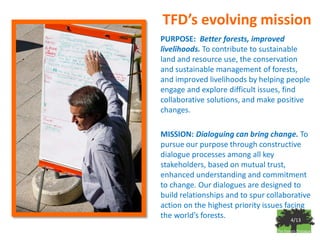
TFD’s evolving mission
PURPOSE: Better forests, improved
livelihoods. To contribute to sustainable
land and resource use, the conservation
and sustainable management of forests,
and improved livelihoods by helping people
engage and explore difficult issues, find
collaborative solutions, and make positive
changes.

MISSION: Dialoguing can bring change. To
pursue our purpose through constructive
dialogue processes among all key
stakeholders, based on mutual trust,
enhanced understanding and commitment
to change. Our dialogues are designed to
build relationships and to spur collaborative
action on the highest priority issues facing
the world’s forests.                    4/13
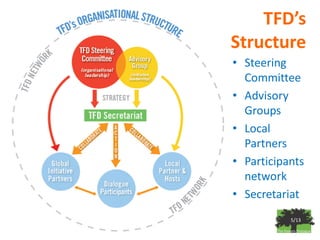
TFD’s
Structure
• Steering
  Committee
• Advisory
  Groups
• Local
  Partners
• Participants
  network
• Secretariat
           5/13
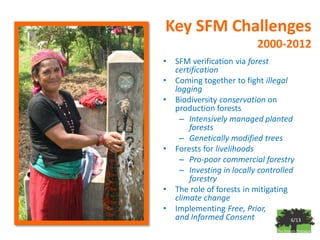
Key SFM Challenges
                            2000-2012
•   SFM verification via forest
    certification
•   Coming together to fight illegal
    logging
•   Biodiversity conservation on
    production forests
     – Intensively managed planted
        forests
     – Genetically modified trees
•   Forests for livelihoods
     – Pro-poor commercial forestry
     – Investing in locally controlled
        forestry
•   The role of forests in mitigating
    climate change
•   Implementing Free, Prior,
    and Informed Consent              6/13
Global Partners


Recent Donors


            7/13
What has dialogue
       accomplished?
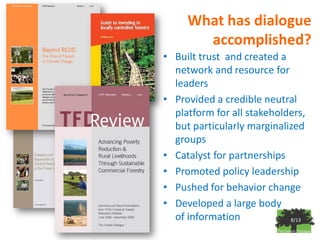
• Built trust and created a
  network and resource for
  leaders
• Provided a credible neutral
  platform for all stakeholders,
  but particularly marginalized
  groups
• Catalyst for partnerships
• Promoted policy leadership
• Pushed for behavior change
• Developed a large body
  of information            8/13
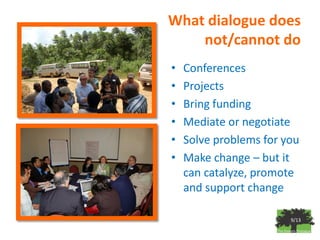
What dialogue does
    not/cannot do
•   Conferences
•   Projects
•   Bring funding
•   Mediate or negotiate
•   Solve problems for you
•   Make change – but it
    can catalyze, promote
    and support change

                        9/13
Doing
            Dialogue
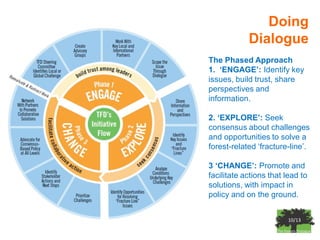
The Phased Approach
1. ‘ENGAGE’: Identify key
issues, build trust, share
perspectives and
information.

2. ‘EXPLORE’: Seek
consensus about challenges
and opportunities to solve a
forest-related ‘fracture-line’.

3 ‘CHANGE’: Promote and
facilitate actions that lead to
solutions, with impact in
policy and on the ground.


                        10/13
Doing Dialogue
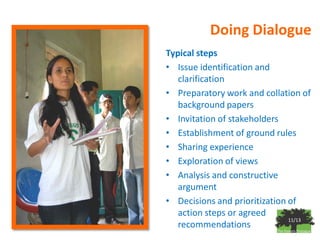
Typical steps
• Issue identification and
   clarification
• Preparatory work and collation of
   background papers
• Invitation of stakeholders
• Establishment of ground rules
• Sharing experience
• Exploration of views
• Analysis and constructive
   argument
• Decisions and prioritization of
   action steps or agreed
                               11/13
   recommendations
Lessons and Reflections
• Don’t create a new organization
  but find a neutral convenor
• Define consensus
• Language is key
• Inclusion takes cash
• Be independent
  (however governments do not
  like “independent” processes
• Keep it simple
• Stay with what you know
• Pick the right partners
• Define the process, but be
  transparent, flexible and open
• Maintain credibility
  – MOST important!!          12/13
Thanks!
TFD Documents and
Publications
Available electronically at:
www.theforestsdialogue.org


Follow us on Twitter: @forestsdialogue
Like us on Facebook: the forests dialogue

                      The Forests Dialogue Secretariat
                                        Yale University
                                  New Haven, CT, USA

                                      +1 203 432 5966

                                       tfd@yale.edu
                          www.theforestsdialogue.org

Doing Dialogue: Using MSD processes as a tool to reduce conflict in the forest sector

  • 1.
    Doing Dialogue: Using MSD processes as a tool to reduce conflict in the forest sector Gary Dunning Executive Director The Forests Dialogue ISTF Conference 25 January New Haven, USA
  • 2.
    Overview • Origins ofThe Forests Dialogue • Fundamentals of Dialogue • Doing Dialogue • Key lessons • Roundtable Discussions 2/13
  • 3.
    TFD – Bornof conflict • Culture of forestry • Rio ‘92 Summit • Sustainable Forest Management & Forest Certification • The Seventh American Forest Congress • World Bank CEOs Meeting • Independent international platform and process 3/13
  • 4.
    TFD’s evolving mission PURPOSE:Better forests, improved livelihoods. To contribute to sustainable land and resource use, the conservation and sustainable management of forests, and improved livelihoods by helping people engage and explore difficult issues, find collaborative solutions, and make positive changes. MISSION: Dialoguing can bring change. To pursue our purpose through constructive dialogue processes among all key stakeholders, based on mutual trust, enhanced understanding and commitment to change. Our dialogues are designed to build relationships and to spur collaborative action on the highest priority issues facing the world’s forests. 4/13
  • 5.
    TFD’s Structure • Steering Committee • Advisory Groups • Local Partners • Participants network • Secretariat 5/13
  • 6.
    Key SFM Challenges 2000-2012 • SFM verification via forest certification • Coming together to fight illegal logging • Biodiversity conservation on production forests – Intensively managed planted forests – Genetically modified trees • Forests for livelihoods – Pro-poor commercial forestry – Investing in locally controlled forestry • The role of forests in mitigating climate change • Implementing Free, Prior, and Informed Consent 6/13
  • 7.
  • 8.
    What has dialogue accomplished? • Built trust and created a network and resource for leaders • Provided a credible neutral platform for all stakeholders, but particularly marginalized groups • Catalyst for partnerships • Promoted policy leadership • Pushed for behavior change • Developed a large body of information 8/13
  • 9.
    What dialogue does not/cannot do • Conferences • Projects • Bring funding • Mediate or negotiate • Solve problems for you • Make change – but it can catalyze, promote and support change 9/13
  • 10.
    Doing Dialogue The Phased Approach 1. ‘ENGAGE’: Identify key issues, build trust, share perspectives and information. 2. ‘EXPLORE’: Seek consensus about challenges and opportunities to solve a forest-related ‘fracture-line’. 3 ‘CHANGE’: Promote and facilitate actions that lead to solutions, with impact in policy and on the ground. 10/13
  • 11.
    Doing Dialogue Typical steps •Issue identification and clarification • Preparatory work and collation of background papers • Invitation of stakeholders • Establishment of ground rules • Sharing experience • Exploration of views • Analysis and constructive argument • Decisions and prioritization of action steps or agreed 11/13 recommendations
  • 12.
    Lessons and Reflections •Don’t create a new organization but find a neutral convenor • Define consensus • Language is key • Inclusion takes cash • Be independent (however governments do not like “independent” processes • Keep it simple • Stay with what you know • Pick the right partners • Define the process, but be transparent, flexible and open • Maintain credibility – MOST important!! 12/13
  • 13.
    Thanks! TFD Documents and Publications Availableelectronically at: www.theforestsdialogue.org Follow us on Twitter: @forestsdialogue Like us on Facebook: the forests dialogue The Forests Dialogue Secretariat Yale University New Haven, CT, USA +1 203 432 5966 tfd@yale.edu www.theforestsdialogue.org