Things Fall Apart Introduction and Background to African Literature NCSCOS English II Goals and Objectives: 5.01, 5.02, 5.03
African Literature African literature was first recognized around 2300-2100 B.C., when ancient Egyptians begin using burial texts to accompany their dead. These include the first written accounts of creation - the  Memphite Declaration of Deitie s.
African Literature African literature spawns from their extremely oral culture Oral culture takes many forms: proverbs and riddles, epic narratives, praise poetry and songs, chants and rituals, stories, legends and folk tales.  This is present in the many proverbs told in  Things Fall Apart
African Literature With the period of Colonization, African oral traditions and written works came under serious threat from outside sources.     Europeans, justifying themselves with the Christian ethics, tried to destroy the "pagan" and "primitive" culture of the Africans, to make them more pliable slaves. However, African Literature survived this concerted attack.
African Literature Chinua Achebe presents native African culture in his stunning work,  Things Fall Apart . This is probably the most read work of African Literature ever written, and it provides a deep level of cultural detail http://blog.syracuse.com/shelflife/2007/11/achebe.jpg
TFA Background Things Fall Apart , Africa's most important novel to date, is probably the most widely studied African creative work both in Africa and abroad. The novel's universal appeal has led to its being translated into more than 50 languages
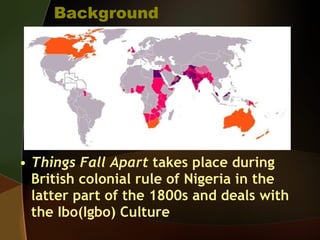
Background Things Fall Apart  takes place during British colonial rule of Nigeria in the latter part of the 1800s and deals with the Ibo(Igbo) Culture
www.nematoday.org/pictures/map_nigeria_wt_afr.gif
http://faizbash.files.wordpress.com/2009/07/nigeria-flag.jpg
Ibo Culture To understand the concepts in Things Fall Apart, it is important to know about the Ibo (also called Igbo) culture
People and Community http://peacecorpsonline.org/messages/jpeg/nigeria008.jpg http://media.photobucket.com/image/igbo%20husband/Feels_Good_2B_Home/igbowedding.jpg http://www.nigeriansinamerica.com/content_images/igbo_title.jpg
People and Community Igbo home life is also very structured.  Typically the husband is the head of the household. He also accepts his responsibilities to his community.  It is of equal importance to tend to both the family and the village. Igbo people usually have very extended families; it is a part of them as a people.  Ibo Huts http://img2.travelblog.org/Photos/11183/84066/t/520783-The-hut-0.jpg
Belief System The Igbo beliefs were once very tribal in nature. Before Christianity was introduced, their belief system revolved around one particular god, named Chukwu  Chukwu was seen as an all powerful and omnipresent God and representations, symbols and sanctuaries for him can be found almost anywhere. Homes, compounds, buildings and even village parks and squares would display these depictions of Chukwu Also believed in many smaller deities that would compete among themselves  CHI was a god seen as individually personalized by its followers.  The people believed strongly in ones ability to improve status in the present world or afterlife through change.
http://www.literaryworlds.wmich.edu/umuofia/images/mask3.JPG http://4.bp.blogspot.com/_Q_QOyPJQRZE/SMbWxYguxdI/AAAAAAAAABU/3eC7dGsGjvk/s320/eldermeeting.jpg Egwugwu These figures are tutelary deities known as  alusi  or  agbara   http://www.artheos.org/images/5476.jpg
Music Igbo music is generally lively, upbeat, and spontaneous which creates a variety of sounds that enables the Igbo people to incorporate music into almost all the facets of their daily lives
Ekwe- type of drum http://www.motherlandmusic.com/images/nigeria/drums/ekwe.jpg http://www.uta.fi/~meemen/ogenet.jpg Oge- type of bell
Yams are a staple crop. http://farm3.static.flickr.com/2236/2369013508_4c786d9af4.jpg?v=0
Ibo Culture Past and Present http://www.youtube.com/watch?v=keZXlDZlluI
Works Cited http://www.mnsu.edu/emuseum/cultural/oldworld/africa/igbo.html

TFA

  • 1.
    Things Fall ApartIntroduction and Background to African Literature NCSCOS English II Goals and Objectives: 5.01, 5.02, 5.03
  • 2.
    African Literature Africanliterature was first recognized around 2300-2100 B.C., when ancient Egyptians begin using burial texts to accompany their dead. These include the first written accounts of creation - the Memphite Declaration of Deitie s.
  • 3.
    African Literature Africanliterature spawns from their extremely oral culture Oral culture takes many forms: proverbs and riddles, epic narratives, praise poetry and songs, chants and rituals, stories, legends and folk tales. This is present in the many proverbs told in Things Fall Apart
  • 4.
    African Literature Withthe period of Colonization, African oral traditions and written works came under serious threat from outside sources.    Europeans, justifying themselves with the Christian ethics, tried to destroy the "pagan" and "primitive" culture of the Africans, to make them more pliable slaves. However, African Literature survived this concerted attack.
  • 5.
    African Literature ChinuaAchebe presents native African culture in his stunning work, Things Fall Apart . This is probably the most read work of African Literature ever written, and it provides a deep level of cultural detail http://blog.syracuse.com/shelflife/2007/11/achebe.jpg
  • 6.
    TFA Background ThingsFall Apart , Africa's most important novel to date, is probably the most widely studied African creative work both in Africa and abroad. The novel's universal appeal has led to its being translated into more than 50 languages
  • 7.
    Background Things FallApart takes place during British colonial rule of Nigeria in the latter part of the 1800s and deals with the Ibo(Igbo) Culture
  • 8.
  • 9.
  • 10.
    Ibo Culture Tounderstand the concepts in Things Fall Apart, it is important to know about the Ibo (also called Igbo) culture
  • 11.
    People and Communityhttp://peacecorpsonline.org/messages/jpeg/nigeria008.jpg http://media.photobucket.com/image/igbo%20husband/Feels_Good_2B_Home/igbowedding.jpg http://www.nigeriansinamerica.com/content_images/igbo_title.jpg
  • 12.
    People and CommunityIgbo home life is also very structured. Typically the husband is the head of the household. He also accepts his responsibilities to his community. It is of equal importance to tend to both the family and the village. Igbo people usually have very extended families; it is a part of them as a people. Ibo Huts http://img2.travelblog.org/Photos/11183/84066/t/520783-The-hut-0.jpg
  • 13.
    Belief System TheIgbo beliefs were once very tribal in nature. Before Christianity was introduced, their belief system revolved around one particular god, named Chukwu Chukwu was seen as an all powerful and omnipresent God and representations, symbols and sanctuaries for him can be found almost anywhere. Homes, compounds, buildings and even village parks and squares would display these depictions of Chukwu Also believed in many smaller deities that would compete among themselves CHI was a god seen as individually personalized by its followers. The people believed strongly in ones ability to improve status in the present world or afterlife through change.
  • 14.
  • 15.
    Music Igbo musicis generally lively, upbeat, and spontaneous which creates a variety of sounds that enables the Igbo people to incorporate music into almost all the facets of their daily lives
  • 16.
    Ekwe- type ofdrum http://www.motherlandmusic.com/images/nigeria/drums/ekwe.jpg http://www.uta.fi/~meemen/ogenet.jpg Oge- type of bell
  • 17.
    Yams are astaple crop. http://farm3.static.flickr.com/2236/2369013508_4c786d9af4.jpg?v=0
  • 18.
    Ibo Culture Pastand Present http://www.youtube.com/watch?v=keZXlDZlluI
  • 19.

Editor's Notes

  • #18 These are like sweet potato yams that we enjoy here in North Carolina, but the meals created with them are different from the way we serve our yams