Sector :Textile Machinery,
Parts & Accessories Sector
© Confederation of Indian Industry
 Background :The Indian Textile Engineering Industry (TEI) is one of the most
important capital goods sectors in India. The TEI has contributed substantially
over the last five decades in providing state-of-the-art and modern machinery
to the different segments of the textile industry. The industry is also exporting
approx. 30% of its production to more than 50 countries of the world.
 Growth Drivers : The Indian TEI consists of 1874 machinery and components
manufacturing units with 1019 units producing complete machinery, and the
remaining, parts and accessories. The investment in the industry is in the range
of Rs.9500 crores with an installed capacity of Rs.11000 crores.
2
© Confederation of Indian Industry
 Key challenges :. The pre-dominance of the decentralized sector in the weaving and
finishing sectors has stymied the demand for domestic capital goods (generally) and
hi-tech ones (specifically). In the absence of an economically viable demand the
Textiles Machinery Manufacturing Industry (TMMI) did not build up enough capacity
to produce hi-tech weaving, knitting and processing machines, earlier.
 Growth Opportunities : To build a strong TEI and produce all types of machineries
required for the Textile Industry and to met 60% of Domestic Demand.
3
Table of Content
© Confederation of Indian Industry
About the Association /Textile Machinery Manufacturers’ Association (India)
 Established in May 1958, the Textile Machinery Manufacturers’ Association
(India) (TMMA) has been playing a significant role in the progress of the Indian
Textile Engineering Industry. TMMA covers membership of almost 80 – 85% of
the production capacity of the organised sector of TEI. The members include
major manufacturers of Cotton, Synthetic, Jute, Knitting, Hosiery and Woollen
machinery, Textile Testing Measuring Instruments and Parts & Accessories as
well as Agents, Dealers, Exporter and Consultants.
4
© Confederation of Indian Industry
About the Association : TMMA (contd.)
 The Association is registered as a Society under the Societies Registration Act,
1860.
 Ever since its inception, TMMA has been playing a pivotal role in product
development and foreign trade of its constituents. Under its aegis the Textile
Engineering Industry (TEI) has grown steadily and remarkably in producing a
wide range of quality textile machinery, parts and accessories. The membership
has grown from 9 founder members to about 85.
 TMMA is recognized as one of the premier trade bodies of India and it is
consulted by the Government of India at various stages on its policy making etc.
and other organizations concerned on all matters pertaining to the development
of the TEI
 The TEI is more than 50 years old. It consists of over 1900 machinery and
equipment manufacturing units over1000 units are producing complete
machinery and over 900 parts and accessories.
5
© Confederation of Indian Industry
About the Association : TMMA (contd.)
 TMMA encourages research and development within the industry and makes
systematic efforts to effect improvement in quality on continuous basis. It had
promoted a Research and Development Centre at the Indian Institute of
Technology, Mumbai for development of textile machinery, components and
accessorie
 TMMA encourages its members by instituting and presenting export and
research & development awards.
 TMMA compiles and disseminates data relating to production and trade in
textile machinery industry.

 TMMA organizes Seminars/Workshops/Factory visits for the benefit of the
members as well as the industry.
6
© Confederation of Indian Industry
About the Association : TMMA (contd.)
 TMMA organizes delegation to various countries for export promotion.
 TMMA is founder of India-ITME Exhibition Society who organizes India-International
Textile Machinery Exhibitions in India by 1980 by a span of every four years.
 Publications : 1) Buyers’ Guide to Indian Textile Machinery covering the names and
addresses of manufacturers of textile machinery, parts and accessories, the range of
their products, the salient features and technical specifications of textile machines
and equipment with Illustrations. The Buyers’ Guide is an ideal reference book to
the buyers of textile machinery, parts & accessories. 2) Annual Reports 3) Quarterly
E-Zine (in-house bulletin)
 Address:
Textile Machinery Manufacturers’ Association (India),
53, Mittal Chambers, 5th Floor,
Nariman Point, Mumbai 400 021
Phone : 91-22-22023766/22834622 :
 E-mail : mail@tmmaindia.net
 Website : www.tmmaindia.net
7
© Confederation of Indian Industry 8
Background - < sector >
• Description about the sector : Textile Machinery, Parts &
Accessories Sector : consists of following categories :
1. Spinning Preparatory & Spinning Machinery
2. Synthetic Fibre Machinery
3. Weaving Preparatory & Weaving
4. Processing & Finishing
5. Testing/Controlling Equipments
6. Jute Machinery
7. Auxiliary/Humidification
8. Spares & Accessorie
<Sector name>
© Confederation of Indian Industry 9
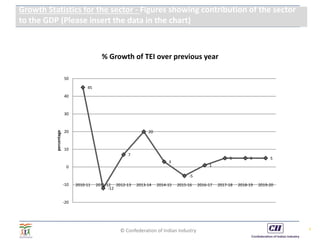
Growth Statistics for the sector - Figures showing contribution of the sector
to the GDP (Please insert the data in the chart)
45
-12
7
20
3
-5
1
5 5 5
-20
-10
0
10
20
30
40
50
2010-11 2011-12 2012-13 2013-14 2014-15 2015-16 2016-17 2017-18 2018-19 2019-20
percentage % Growth of TEI over previous year
© Confederation of Indian Industry 10
Growth Drivers for the sector
How the policy contributes to this particular sector
Policy ( Growth
drivers)
Current Trends followed in the industry that contribute to the
sector
Latest Industry
Trends
© Confederation of Indian Industry 11
Challenge 1 Challenge 2
Challenge 3 Challenge 4
<Challenge>
Key Challenges
© Confederation of Indian Industry 12
Opportunities
Growth Opportunities
Why Focus on India for <sector> ?
© Confederation of Indian Industry 13
Association / CII
<Association Logo>

Textile machinery

  • 1.
  • 2.
    © Confederation ofIndian Industry  Background :The Indian Textile Engineering Industry (TEI) is one of the most important capital goods sectors in India. The TEI has contributed substantially over the last five decades in providing state-of-the-art and modern machinery to the different segments of the textile industry. The industry is also exporting approx. 30% of its production to more than 50 countries of the world.  Growth Drivers : The Indian TEI consists of 1874 machinery and components manufacturing units with 1019 units producing complete machinery, and the remaining, parts and accessories. The investment in the industry is in the range of Rs.9500 crores with an installed capacity of Rs.11000 crores. 2
  • 3.
    © Confederation ofIndian Industry  Key challenges :. The pre-dominance of the decentralized sector in the weaving and finishing sectors has stymied the demand for domestic capital goods (generally) and hi-tech ones (specifically). In the absence of an economically viable demand the Textiles Machinery Manufacturing Industry (TMMI) did not build up enough capacity to produce hi-tech weaving, knitting and processing machines, earlier.  Growth Opportunities : To build a strong TEI and produce all types of machineries required for the Textile Industry and to met 60% of Domestic Demand. 3 Table of Content
  • 4.
    © Confederation ofIndian Industry About the Association /Textile Machinery Manufacturers’ Association (India)  Established in May 1958, the Textile Machinery Manufacturers’ Association (India) (TMMA) has been playing a significant role in the progress of the Indian Textile Engineering Industry. TMMA covers membership of almost 80 – 85% of the production capacity of the organised sector of TEI. The members include major manufacturers of Cotton, Synthetic, Jute, Knitting, Hosiery and Woollen machinery, Textile Testing Measuring Instruments and Parts & Accessories as well as Agents, Dealers, Exporter and Consultants. 4
  • 5.
    © Confederation ofIndian Industry About the Association : TMMA (contd.)  The Association is registered as a Society under the Societies Registration Act, 1860.  Ever since its inception, TMMA has been playing a pivotal role in product development and foreign trade of its constituents. Under its aegis the Textile Engineering Industry (TEI) has grown steadily and remarkably in producing a wide range of quality textile machinery, parts and accessories. The membership has grown from 9 founder members to about 85.  TMMA is recognized as one of the premier trade bodies of India and it is consulted by the Government of India at various stages on its policy making etc. and other organizations concerned on all matters pertaining to the development of the TEI  The TEI is more than 50 years old. It consists of over 1900 machinery and equipment manufacturing units over1000 units are producing complete machinery and over 900 parts and accessories. 5
  • 6.
    © Confederation ofIndian Industry About the Association : TMMA (contd.)  TMMA encourages research and development within the industry and makes systematic efforts to effect improvement in quality on continuous basis. It had promoted a Research and Development Centre at the Indian Institute of Technology, Mumbai for development of textile machinery, components and accessorie  TMMA encourages its members by instituting and presenting export and research & development awards.  TMMA compiles and disseminates data relating to production and trade in textile machinery industry.   TMMA organizes Seminars/Workshops/Factory visits for the benefit of the members as well as the industry. 6
  • 7.
    © Confederation ofIndian Industry About the Association : TMMA (contd.)  TMMA organizes delegation to various countries for export promotion.  TMMA is founder of India-ITME Exhibition Society who organizes India-International Textile Machinery Exhibitions in India by 1980 by a span of every four years.  Publications : 1) Buyers’ Guide to Indian Textile Machinery covering the names and addresses of manufacturers of textile machinery, parts and accessories, the range of their products, the salient features and technical specifications of textile machines and equipment with Illustrations. The Buyers’ Guide is an ideal reference book to the buyers of textile machinery, parts & accessories. 2) Annual Reports 3) Quarterly E-Zine (in-house bulletin)  Address: Textile Machinery Manufacturers’ Association (India), 53, Mittal Chambers, 5th Floor, Nariman Point, Mumbai 400 021 Phone : 91-22-22023766/22834622 :  E-mail : mail@tmmaindia.net  Website : www.tmmaindia.net 7
  • 8.
    © Confederation ofIndian Industry 8 Background - < sector > • Description about the sector : Textile Machinery, Parts & Accessories Sector : consists of following categories : 1. Spinning Preparatory & Spinning Machinery 2. Synthetic Fibre Machinery 3. Weaving Preparatory & Weaving 4. Processing & Finishing 5. Testing/Controlling Equipments 6. Jute Machinery 7. Auxiliary/Humidification 8. Spares & Accessorie <Sector name>
  • 9.
    © Confederation ofIndian Industry 9 Growth Statistics for the sector - Figures showing contribution of the sector to the GDP (Please insert the data in the chart) 45 -12 7 20 3 -5 1 5 5 5 -20 -10 0 10 20 30 40 50 2010-11 2011-12 2012-13 2013-14 2014-15 2015-16 2016-17 2017-18 2018-19 2019-20 percentage % Growth of TEI over previous year
  • 10.
    © Confederation ofIndian Industry 10 Growth Drivers for the sector How the policy contributes to this particular sector Policy ( Growth drivers) Current Trends followed in the industry that contribute to the sector Latest Industry Trends
  • 11.
    © Confederation ofIndian Industry 11 Challenge 1 Challenge 2 Challenge 3 Challenge 4 <Challenge> Key Challenges
  • 12.
    © Confederation ofIndian Industry 12 Opportunities Growth Opportunities Why Focus on India for <sector> ?
  • 13.
    © Confederation ofIndian Industry 13 Association / CII <Association Logo>