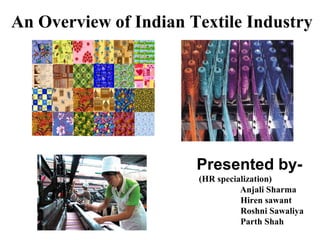
An Overview of Indian Textile Industry
Presented by-
(HR specialization)
Anjali Sharma
Hiren sawant
Roshni Sawaliya
Parth Shah
Textile
• The term textile is a Latin Word Originating from
the word ‘Texere’ which means To Weave.
• A textile is a flexible material consisting of a
network of natural or artificial fibers often referred
to as thread or yarn.
• Indian textile industry can be divided into several
segments, some of which can be listed as below:
• 1. Cotton Textiles
2.Silk Textiles
3.Woolen Textiles
4.Readymade Garments
5.Hand-crafted Textiles
6. Jute and Coir
Products Manufactured
Introduction
1.Industry contributes about…
14% to industrial production ,4% to GDP
17 % to country's export earning, 9% of the Excise collections
25% of world’s cotton export is done through India
2.Largest provider of employment after agriculture
3.Direct employment to over 35 mn people
4.50 mn engaged in allied activities.
5.Supports agriculture in over 9.5 million hectares of land where cotton is cultivated.
6. Consumers Japan, Australia and New Zealand
7.Rank second with 8 percent of the total.
8.High production of wool, cotton, jute and silk.
9.Global trade in this industry is now at US$ 350 billion.
10.The ready made garment sector is the biggest segment in the India’s textile export
basket contributing over 46% of the total textile exports
11.Largest pool of cheap and skilled labour
Major players
 Arvind Mills
 Bombay Dyeing
 Raymond's
 Alok Industries
 Reliance Textiles
 Lakshmi Mills
 Fabindia
 Grasim Industries
 Welspun India
 Mysore Silk Factory
 BSL Limited
 Wardhman Textiles
InUS$Bn
0
200
400
600
800
1000
Women's
dresses
Men's
Woven
Shirts
Women's
Woven Tops
T-Shirts Knitted
Skirts
India’s most exported product categories
0
5
10
15
20
25
30
35
1991 2001 2005 2009
%ageoffemale
intextilesector
Increasing working female
population
• Value Chain Analysis
• Primary activities
– Spinning department
– Weaving department
– Dyeing department
– Finishing department
• Supportive Activities
– Quality Assurance department
• laboratory
– Cotton laboratory
– Chemical Testing Laboratory
– Colour Quest Laboratory
– Calibration Laboratory
• Inspection Department
• Marketing Department
• Human Resource Department
Mills Ltd- Largest Denim manufacturer in
India
Corporate Office –
Ahmedabad, Gujarat
Turnover – 932 Million
Dollar
Employees – 2500+
Sector – Public Sector
Brands Provided by
Arvind are:-
Wrangler
Denim Jeans
Lee
Killer
Arrow
Flying Machine
Garments Exported
are:- Mainly Shirt
and Jeans
Raymond : The complete man
Introduction
•Raymond's is one of the India’s leading
fabric and garment manufacturers and
fashion retailers.
•The Raymond group was incorporated in
1925
•The company is led by CEO Gautam Hari
Singhania.
•Raymond is the largest producer of
worsted suiting fabrics commanding over
60% share of the market.
• Group also has business interests in
readymade garments, designer
wear, cosmetics & toiletries, engineering
files, tools and prophylactics
• Corporate Office – Mumbai, India
Turnover – 250 Million Dollar
Employees – 10000+
Sector – Public Sector
• It the largest retail store in the country having 650 stores in prime
locations, in over 200 cities in India.
• Apart from India Raymond also serves its garments in
 Bahrain
 Bangladesh
 Kuwait
 Saudi Arabia
 Sri Lanka
 Sultanate Of Oman
 U.A.E. etc.
In house brands
Bombay Dyeing- Flagship company
of Wadia Group
– Products: Bed Sheets,Towels,Blankets,Furnishings, Pillow
Cases , Covers
– Chairman:- Nusli wadia
– Founded:- 1879, Mumbai
– HQ:- India
– Corporate Office – Mumbai, Maharashtra
– Turnover – 310 Million Dollar
– Employees – 10000+
– Sector – Public
SLOWDOWN IN GROWTH
•The growth rate in the textile industry
became 0.8 % in 2008-09 (April-August).
•The growth rate of Wool, Silk & Man-Made
Textiles sector became negative (- 1.2%)
in the first five month in the year (April-
Aug).
•The jute textile segment also declined in
2008-09 by 7.4%.
Past scenario of textile industries
Market share in World(2008-09)
Slowdown & Impact on Employment
• Current global financial crisis leads to blanket job cut of
• 5 million specially in artificial textile & weaving sector(Source: Economic Times).
Other facts related to employment
• Currently, the textile industry is providing employment to 18% of the India s work
force
• Provides indirect employment to another 88 million people in the country.
• Expected to provide employment to an additional 10 million people in the
11th five year plan
Declining in Profitability
• Profitability of textile sector has been falling since Sep 2008.
• The profitability declined by 99% in quarter ending Sep 2009.
17
Problems in the industry
1. Fragmented industry
2. obsolescence
3. companies need to focus on product development
4. Lower cost Competitiveness
How they Overcome?
Strength
1.Abundant of Raw material Availability.
2.Low cost and cheap labour.( India mainly have low labour rates).
3. Used updated Technology.
Current Scenario of Textile Industry
• India is the 2nd
largest producer of fiber in the world and major fiber
produced is Cotton .( 60% of Indian Textile is cotton based)
• Textiles and Apparel Export from India are estimated to increase US$65
billion by 2016-17 from US$40 billion in 2013-14.
• The total Earning is at around US$ 108 Billion.( May cross US$ 223 billion
by 2021)(Biggest Revenue Earners)
• 2nd Largest employer after Agriculture providing employment to over 45
million people Directly and 60 Million People indirectly.
• 35% of the textile Companies operating in Cotton Segment Generates 100%
result
Final anjali textile

Final anjali textile

  • 1.
    An Overview ofIndian Textile Industry Presented by- (HR specialization) Anjali Sharma Hiren sawant Roshni Sawaliya Parth Shah
  • 2.
    Textile • The termtextile is a Latin Word Originating from the word ‘Texere’ which means To Weave. • A textile is a flexible material consisting of a network of natural or artificial fibers often referred to as thread or yarn. • Indian textile industry can be divided into several segments, some of which can be listed as below: • 1. Cotton Textiles 2.Silk Textiles 3.Woolen Textiles 4.Readymade Garments 5.Hand-crafted Textiles 6. Jute and Coir
  • 4.
  • 5.
    Introduction 1.Industry contributes about… 14%to industrial production ,4% to GDP 17 % to country's export earning, 9% of the Excise collections 25% of world’s cotton export is done through India 2.Largest provider of employment after agriculture 3.Direct employment to over 35 mn people 4.50 mn engaged in allied activities. 5.Supports agriculture in over 9.5 million hectares of land where cotton is cultivated. 6. Consumers Japan, Australia and New Zealand 7.Rank second with 8 percent of the total. 8.High production of wool, cotton, jute and silk. 9.Global trade in this industry is now at US$ 350 billion. 10.The ready made garment sector is the biggest segment in the India’s textile export basket contributing over 46% of the total textile exports 11.Largest pool of cheap and skilled labour
  • 6.
    Major players  ArvindMills  Bombay Dyeing  Raymond's  Alok Industries  Reliance Textiles  Lakshmi Mills  Fabindia  Grasim Industries  Welspun India  Mysore Silk Factory  BSL Limited  Wardhman Textiles
  • 7.
    InUS$Bn 0 200 400 600 800 1000 Women's dresses Men's Woven Shirts Women's Woven Tops T-Shirts Knitted Skirts India’smost exported product categories 0 5 10 15 20 25 30 35 1991 2001 2005 2009 %ageoffemale intextilesector Increasing working female population
  • 8.
    • Value ChainAnalysis • Primary activities – Spinning department – Weaving department – Dyeing department – Finishing department • Supportive Activities – Quality Assurance department • laboratory – Cotton laboratory – Chemical Testing Laboratory – Colour Quest Laboratory – Calibration Laboratory • Inspection Department • Marketing Department • Human Resource Department Mills Ltd- Largest Denim manufacturer in India Corporate Office – Ahmedabad, Gujarat Turnover – 932 Million Dollar Employees – 2500+ Sector – Public Sector
  • 9.
    Brands Provided by Arvindare:- Wrangler Denim Jeans Lee Killer Arrow Flying Machine Garments Exported are:- Mainly Shirt and Jeans
  • 10.
    Raymond : Thecomplete man Introduction •Raymond's is one of the India’s leading fabric and garment manufacturers and fashion retailers. •The Raymond group was incorporated in 1925 •The company is led by CEO Gautam Hari Singhania. •Raymond is the largest producer of worsted suiting fabrics commanding over 60% share of the market. • Group also has business interests in readymade garments, designer wear, cosmetics & toiletries, engineering files, tools and prophylactics
  • 11.
    • Corporate Office– Mumbai, India Turnover – 250 Million Dollar Employees – 10000+ Sector – Public Sector • It the largest retail store in the country having 650 stores in prime locations, in over 200 cities in India. • Apart from India Raymond also serves its garments in  Bahrain  Bangladesh  Kuwait  Saudi Arabia  Sri Lanka  Sultanate Of Oman  U.A.E. etc.
  • 12.
  • 14.
    Bombay Dyeing- Flagshipcompany of Wadia Group – Products: Bed Sheets,Towels,Blankets,Furnishings, Pillow Cases , Covers – Chairman:- Nusli wadia – Founded:- 1879, Mumbai – HQ:- India – Corporate Office – Mumbai, Maharashtra – Turnover – 310 Million Dollar – Employees – 10000+ – Sector – Public
  • 16.
    SLOWDOWN IN GROWTH •Thegrowth rate in the textile industry became 0.8 % in 2008-09 (April-August). •The growth rate of Wool, Silk & Man-Made Textiles sector became negative (- 1.2%) in the first five month in the year (April- Aug). •The jute textile segment also declined in 2008-09 by 7.4%. Past scenario of textile industries Market share in World(2008-09)
  • 17.
    Slowdown & Impacton Employment • Current global financial crisis leads to blanket job cut of • 5 million specially in artificial textile & weaving sector(Source: Economic Times). Other facts related to employment • Currently, the textile industry is providing employment to 18% of the India s work force • Provides indirect employment to another 88 million people in the country. • Expected to provide employment to an additional 10 million people in the 11th five year plan Declining in Profitability • Profitability of textile sector has been falling since Sep 2008. • The profitability declined by 99% in quarter ending Sep 2009. 17
  • 18.
    Problems in theindustry 1. Fragmented industry 2. obsolescence 3. companies need to focus on product development 4. Lower cost Competitiveness How they Overcome? Strength 1.Abundant of Raw material Availability. 2.Low cost and cheap labour.( India mainly have low labour rates). 3. Used updated Technology.
  • 19.
    Current Scenario ofTextile Industry • India is the 2nd largest producer of fiber in the world and major fiber produced is Cotton .( 60% of Indian Textile is cotton based) • Textiles and Apparel Export from India are estimated to increase US$65 billion by 2016-17 from US$40 billion in 2013-14. • The total Earning is at around US$ 108 Billion.( May cross US$ 223 billion by 2021)(Biggest Revenue Earners) • 2nd Largest employer after Agriculture providing employment to over 45 million people Directly and 60 Million People indirectly. • 35% of the textile Companies operating in Cotton Segment Generates 100% result

Editor's Notes

  • #3 Yarn is a kind of thread, from which various kinds of fabrics has been made and from Fabrics various end products has been made. .
  • #18 That is 35 million directly