Presented by Santosh singh
Textile Industry
Introduction
The Indian textile industry is one of the largest in the world with a
massive raw material and textiles manufacturing base. Our economy is
largely dependent on the textile manufacturing and trade in addition to
other major industries. About 27% of the foreign
exchange earnings are on account of export of textiles and clothing
alone. The textiles and clothing sector contributes about 14% to the
industrial production and 3% to the gross domestic product of the
country. Around 8% of the total excise revenue collection is contributed
by the textile industry. So much so, the textile industry accounts for large
as 21% of the total employment generated in the economy.
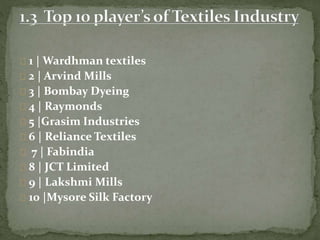
1 | Wardhman textiles
2 | Arvind Mills
3 | Bombay Dyeing
4 | Raymonds
5 |Grasim Industries
6 | Reliance Textiles
7 | Fabindia
8 | JCT Limited
9 | Lakshmi Mills
10 |Mysore Silk Factory
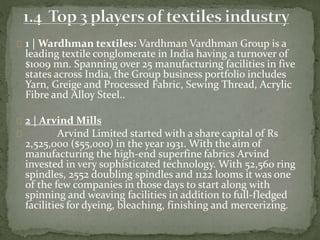
1 | Wardhman textiles: Vardhman Vardhman Group is a
leading textile conglomerate in India having a turnover of
$1009 mn. Spanning over 25 manufacturing facilities in five
states across India, the Group business portfolio includes
Yarn, Greige and Processed Fabric, Sewing Thread, Acrylic
Fibre and Alloy Steel..
2 | Arvind Mills
Arvind Limited started with a share capital of Rs
2,525,000 ($55,000) in the year 1931. With the aim of
manufacturing the high-end superfine fabrics Arvind
invested in very sophisticated technology. With 52,560 ring
spindles, 2552 doubling spindles and 1122 looms it was one
of the few companies in those days to start along with
spinning and weaving facilities in addition to full-fledged
facilities for dyeing, bleaching, finishing and mercerizing.
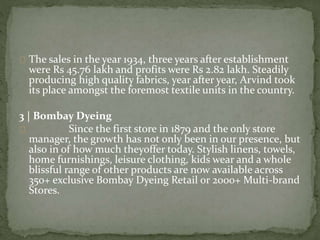
The sales in the year 1934, three years after establishment
were Rs 45.76 lakh and profits were Rs 2.82 lakh. Steadily
producing high quality fabrics, year after year, Arvind took
its place amongst the foremost textile units in the country.
3 | Bombay Dyeing
Since the first store in 1879 and the only store
manager, the growth has not only been in our presence, but
also in of how much theyoffer today. Stylish linens, towels,
home furnishings, leisure clothing, kids wear and a whole
blissful range of other products are now available across
350+ exclusive Bombay Dyeing Retail or 2000+ Multi-brand
Stores.
1. Ranbow denim Ltd
2. Vippy spinpro
3. M.H.Mills and industries
Rainbow Denim Ltd.; is an India-based company. The
Company is engaged in the business of manufacturing
of denim fabric. As of March 31, 2010, the Company
had a manufacturing plant in Mohali, Punjab. The
Company’s products include light weight denim,
medium weight denim and heavy weight denim.
Vippy Spinpro established in 1992, is in the business of
manufacturing cotton yarn for different applications
by rotor spinning. The company operates one of the
leading open-end spinning mills in India. It has ISO-
9001: 2000 certification from BVQI. surgical cloth,
industrial fabrics and furnishings.
M.H.Mills and industries: M H Mills and Industries
Limited was incorporated in 1932. The company's
objects is to manufacture cotton textile goods, and
other products like grey takas, sarees, dhoties,
bleached poplins, longcloths, crepes, drills, twills,
coatings, mosquito netting, dorias, printed poplins,
chintz, mercerised lawns and poplins.
North: Kashmir, Ludhiana and Panipat account for 80
per cent of woollens in India
East: Bihar for jute, parts of Uttar Pradesh for woollen
and Bengal for cotton and jute industry
West: Ahmadabad, Mumbai, Surat, Rajkot, Indore and
Vadodara are the key places for cotton industry
South: Tirpur, Coimabtore and Madurai for hosiery.
Bangalore, Mysore and Chennai for silk
Vardhman textiles Ltd.
Corporate governance refers to a combination of
laws, regulations, procedures, implicit rules and good
corporate practices that ensure that a Company meets its
obligations to optimize shareholders’ value and fulfil its
responsibilities to the community, customers, employees,
Government and other segments of society.
Arvind mills
Corporate governance at Arvind is a value-based
framework to manage our Company affairs in a fair and
transparent manner
. As a responsible corporation, theyuse this framework
to maintain accountability in all our affairs and employ
democratic and open processes.
Bombay dyeing
At Bombay Dyeing we have formulated and
adhere to a set of strong corporate governance
practices. Our processes, customs, policies are shaped
and controlled by certain ethical rules and regulations
Ranbow denim Ltd
The Report on Corporate Governance along
with the Auditor's Certificate regarding Compliance of
the conditions of Corporate Governance as also a
Management Discussion and Analysis
Vippy spinpro
The Company has complied with the
requirements of clause 49 of the Listing agreement
with Bombay Stock Exchange Ltd. regarding Corporate
Governance as were applicable during the year under
review to the Company
MH Mills & Industries Ltd
The importance of corporate governance lies
in its contribution both to business prosperity and to
accountability. Directors support basic tenets of
corporate governance as the prudent exercise of
management's rights in the best interest of all
stakeholders in a company in particular its
shareholders, creditors, the state arid its employees.
Actions against welspun India Ltd
SEBI had passed an Experts Ad Interim Order dated
December 2, 2010 u/s 11B, 11D and 11(4)(b) of the SEBI
Act, 1992 against a market participant, his associates
and other entities (including Welspun group promoter
entities) in various scrip alleging manipulative and
unfair trade practices by the market participant and
his associate entities (“SEBI Order”). The SEBI Order,
inter alia, directed that Welspun group promoter
entities, as mentioned in the SEBI Order, shall not
buy, sell or deal in the securities of their own
companies and their listed group companies in any
manner whatsoever till further directions
Welfare schemed: the government has offered health
insurance coverage nd life insurance coverage to 161.10
million weavers and ancillary workers under the
Handloom Weavers comprehensive welfare Scheme
E-marketing: the central cottage Industries
corporation of India (CCIC), and the Handicrafts
And Handlooms Exports Corporation of India have
developed a number of e-marketing
Skill development: as per the 12th five year plan, the
Integrated Skill Development Scheme aims to train
over 2675000 people
Environmental Effects of Textile Fibres
Natural fibres have their problems, too: Cotton is the
most pesticide intensive crop in the world: these
pesticides injure and kill many people every year. It
also takes up a large proportion of agricultural land,
much of which is needed by local people to grow their
own food. Herbicides, and also the chemical defoliants
which are sometimes used to aid mechanical cotton
harvesting
L D Textile Industries, a reputed manufacturer of
synthetic blended yarns with a total installed capacity
of 39,136 spindles at Ankleshwar, Gujarat, has a
weaving unit at Vikhroli, Bombay. It was promoted by
Kalicharan L Mehra in 1958 as a partnership concern
and was incorporated as a private limited company in
1965. The looms in the company's Bombay unit have
been leased out, hence spinning of polyester/viscose
blended yarn at the company's Ankleshwar plant forms
the core business activity. In 1993-94, the company
installed a one-MW wind farm in Lamba, Gujarat.
More than 100 textile mills shut down in over 3
years:
Price competitiveness.
Faster lead times.
High raw material base.
Full service offering.
Access to market. "A Cost is the value of economic
resources used as a result of producing or doing the
things costed".
To find out the costing of a garment, the following
things should things be calcuated:
Fabric consumption.
Gross weight of other components of garment.
Fabric cost per kg.
Fabric cost per garment
Interpretation
In Vardhman Textiles due to decrease of Current Liabilities working
capital is increase in the years from March 2011 to March 2013.
Ideal standard current ratio is 2:1 here in the march 2013,2012, 2011 is
2.03:1, 2.26:1, 2.10:1 so its good for the company.
Compare to 2011 and 2012 , in 2013 earnings per share has decrease
which is bad.
In Arvind mills due to increase of Current Liabilities so working capital
is decrease in the years from March 2011 to March 2013.
Ideal standard current ratio is 2:1 here company having in the year
March 2011, 2012, 2013 is 1.00:1, 0.89:1, 1.86:1 so it’s bad for the company.
Compare to 2011 and 2012 , in 2013 earnings per share has decrease
which is bad.
It is proposed to provide Rs. 50 crore in 2013-14 for the
scheme. It has been accepted that the handloom
sector which subsumes a large proportion of women
and belongs mainly to the backward classes is in
distress. It is proposed to accept their demand for
working capital and term loans at a concessional
interest of 6 percent. 150,000 individual weavers and
1,800 primary cooperative societies will benefit in 2013-
14
Export Promotion Measures
The Government has been continually supporting the
textiles exports sector through Various provisions of
the Foreign Trade Policy and the other policy
initiatives to enable the sector to increase market share
in the global textiles markets. Slowdown in exports of
the textile sector and policy measures taken.
5.3 Mergers and Acquisitions of Textiles Company
Arvind Mills
License Of ‘Healthtex’ Kidswear
Brand Of Vf Corpn (USA)
Raymonds
Regency Texteis Portuguesa
Limitada (Portugal)
5.4 Technology Development in the Indian Textile
Industry:-
In the Indian textile industry undertaken by the author as
part of a larger international study led by The World Bank.
The study methodology included a field survey of 18 firms
size, technological dynamism and location; interviews with
4 relevant technology institutions catering to the
technology related needs of the textile industry; a
questionnaire survey mailed to randomly selected firms to
facilitate generalisation of findings as well as a study of
relevant published materials.
The data from the “Gujarat state labour commissioner
,reveal that just between 2010 & 2012, there were 74
major strikes& lockouts across the state resulting in 1,
22,923 lost mandays”.A labour unrest is a social
phenomenon of vast complexity and very difficult to
give any detailed explanation of this phenomenon. It is
a matter of subjective opinion whether the
predominant factors underlying labour unrest are
economic or non-economic
Reliance Textile Industry at Naroda
Viral Desai of Zenitex named ‘Outstanding
Entrepreneur’
Viral Desai a young textile entrepreneur from the
textile hub of Surat has bagged “The Outstanding
Entrepreneur Award 2009-2011” awarded by the South
Gujarat Chamber of Commerce.
Reliance v/s Bombay dyeing
Jamnadas Moorjani passed away last week. In the
eighties, his office in a back lane of Kalbadevi used to
be an adda of sorts for journalists who covered the
synthetic textile industry and the savage war between
Dhirubhai Ambani and Nusli Wadia.
As president of the All-India Crimpers' Association, he
led a campaign by independent polyester text risers
against a duty hike on yarn, which was allegedly
engineered by the Ambanis. It was natural that he
soon became an ally of the Nusli Wadia-Indian Express
front.
Textile  industry

Textile industry

  • 1.
    Presented by Santoshsingh Textile Industry
  • 2.
    Introduction The Indian textileindustry is one of the largest in the world with a massive raw material and textiles manufacturing base. Our economy is largely dependent on the textile manufacturing and trade in addition to other major industries. About 27% of the foreign exchange earnings are on account of export of textiles and clothing alone. The textiles and clothing sector contributes about 14% to the industrial production and 3% to the gross domestic product of the country. Around 8% of the total excise revenue collection is contributed by the textile industry. So much so, the textile industry accounts for large as 21% of the total employment generated in the economy.
  • 3.
    1 | Wardhmantextiles 2 | Arvind Mills 3 | Bombay Dyeing 4 | Raymonds 5 |Grasim Industries 6 | Reliance Textiles 7 | Fabindia 8 | JCT Limited 9 | Lakshmi Mills 10 |Mysore Silk Factory
  • 4.
    1 | Wardhmantextiles: Vardhman Vardhman Group is a leading textile conglomerate in India having a turnover of $1009 mn. Spanning over 25 manufacturing facilities in five states across India, the Group business portfolio includes Yarn, Greige and Processed Fabric, Sewing Thread, Acrylic Fibre and Alloy Steel.. 2 | Arvind Mills Arvind Limited started with a share capital of Rs 2,525,000 ($55,000) in the year 1931. With the aim of manufacturing the high-end superfine fabrics Arvind invested in very sophisticated technology. With 52,560 ring spindles, 2552 doubling spindles and 1122 looms it was one of the few companies in those days to start along with spinning and weaving facilities in addition to full-fledged facilities for dyeing, bleaching, finishing and mercerizing.
  • 5.
    The sales inthe year 1934, three years after establishment were Rs 45.76 lakh and profits were Rs 2.82 lakh. Steadily producing high quality fabrics, year after year, Arvind took its place amongst the foremost textile units in the country. 3 | Bombay Dyeing Since the first store in 1879 and the only store manager, the growth has not only been in our presence, but also in of how much theyoffer today. Stylish linens, towels, home furnishings, leisure clothing, kids wear and a whole blissful range of other products are now available across 350+ exclusive Bombay Dyeing Retail or 2000+ Multi-brand Stores.
  • 8.
    1. Ranbow denimLtd 2. Vippy spinpro 3. M.H.Mills and industries Rainbow Denim Ltd.; is an India-based company. The Company is engaged in the business of manufacturing of denim fabric. As of March 31, 2010, the Company had a manufacturing plant in Mohali, Punjab. The Company’s products include light weight denim, medium weight denim and heavy weight denim.
  • 9.
    Vippy Spinpro establishedin 1992, is in the business of manufacturing cotton yarn for different applications by rotor spinning. The company operates one of the leading open-end spinning mills in India. It has ISO- 9001: 2000 certification from BVQI. surgical cloth, industrial fabrics and furnishings. M.H.Mills and industries: M H Mills and Industries Limited was incorporated in 1932. The company's objects is to manufacture cotton textile goods, and other products like grey takas, sarees, dhoties, bleached poplins, longcloths, crepes, drills, twills, coatings, mosquito netting, dorias, printed poplins, chintz, mercerised lawns and poplins.
  • 10.
    North: Kashmir, Ludhianaand Panipat account for 80 per cent of woollens in India East: Bihar for jute, parts of Uttar Pradesh for woollen and Bengal for cotton and jute industry West: Ahmadabad, Mumbai, Surat, Rajkot, Indore and Vadodara are the key places for cotton industry South: Tirpur, Coimabtore and Madurai for hosiery. Bangalore, Mysore and Chennai for silk
  • 11.
    Vardhman textiles Ltd. Corporategovernance refers to a combination of laws, regulations, procedures, implicit rules and good corporate practices that ensure that a Company meets its obligations to optimize shareholders’ value and fulfil its responsibilities to the community, customers, employees, Government and other segments of society. Arvind mills Corporate governance at Arvind is a value-based framework to manage our Company affairs in a fair and transparent manner
  • 12.
    . As aresponsible corporation, theyuse this framework to maintain accountability in all our affairs and employ democratic and open processes. Bombay dyeing At Bombay Dyeing we have formulated and adhere to a set of strong corporate governance practices. Our processes, customs, policies are shaped and controlled by certain ethical rules and regulations Ranbow denim Ltd The Report on Corporate Governance along with the Auditor's Certificate regarding Compliance of the conditions of Corporate Governance as also a Management Discussion and Analysis
  • 13.
    Vippy spinpro The Companyhas complied with the requirements of clause 49 of the Listing agreement with Bombay Stock Exchange Ltd. regarding Corporate Governance as were applicable during the year under review to the Company MH Mills & Industries Ltd The importance of corporate governance lies in its contribution both to business prosperity and to accountability. Directors support basic tenets of corporate governance as the prudent exercise of management's rights in the best interest of all stakeholders in a company in particular its shareholders, creditors, the state arid its employees.
  • 14.
    Actions against welspunIndia Ltd SEBI had passed an Experts Ad Interim Order dated December 2, 2010 u/s 11B, 11D and 11(4)(b) of the SEBI Act, 1992 against a market participant, his associates and other entities (including Welspun group promoter entities) in various scrip alleging manipulative and unfair trade practices by the market participant and his associate entities (“SEBI Order”). The SEBI Order, inter alia, directed that Welspun group promoter entities, as mentioned in the SEBI Order, shall not buy, sell or deal in the securities of their own companies and their listed group companies in any manner whatsoever till further directions
  • 15.
    Welfare schemed: thegovernment has offered health insurance coverage nd life insurance coverage to 161.10 million weavers and ancillary workers under the Handloom Weavers comprehensive welfare Scheme E-marketing: the central cottage Industries corporation of India (CCIC), and the Handicrafts And Handlooms Exports Corporation of India have developed a number of e-marketing Skill development: as per the 12th five year plan, the Integrated Skill Development Scheme aims to train over 2675000 people
  • 16.
    Environmental Effects ofTextile Fibres Natural fibres have their problems, too: Cotton is the most pesticide intensive crop in the world: these pesticides injure and kill many people every year. It also takes up a large proportion of agricultural land, much of which is needed by local people to grow their own food. Herbicides, and also the chemical defoliants which are sometimes used to aid mechanical cotton harvesting
  • 17.
    L D TextileIndustries, a reputed manufacturer of synthetic blended yarns with a total installed capacity of 39,136 spindles at Ankleshwar, Gujarat, has a weaving unit at Vikhroli, Bombay. It was promoted by Kalicharan L Mehra in 1958 as a partnership concern and was incorporated as a private limited company in 1965. The looms in the company's Bombay unit have been leased out, hence spinning of polyester/viscose blended yarn at the company's Ankleshwar plant forms the core business activity. In 1993-94, the company installed a one-MW wind farm in Lamba, Gujarat. More than 100 textile mills shut down in over 3 years:
  • 18.
    Price competitiveness. Faster leadtimes. High raw material base. Full service offering. Access to market. "A Cost is the value of economic resources used as a result of producing or doing the things costed". To find out the costing of a garment, the following things should things be calcuated: Fabric consumption. Gross weight of other components of garment. Fabric cost per kg. Fabric cost per garment
  • 19.
    Interpretation In Vardhman Textilesdue to decrease of Current Liabilities working capital is increase in the years from March 2011 to March 2013. Ideal standard current ratio is 2:1 here in the march 2013,2012, 2011 is 2.03:1, 2.26:1, 2.10:1 so its good for the company. Compare to 2011 and 2012 , in 2013 earnings per share has decrease which is bad. In Arvind mills due to increase of Current Liabilities so working capital is decrease in the years from March 2011 to March 2013. Ideal standard current ratio is 2:1 here company having in the year March 2011, 2012, 2013 is 1.00:1, 0.89:1, 1.86:1 so it’s bad for the company. Compare to 2011 and 2012 , in 2013 earnings per share has decrease which is bad.
  • 20.
    It is proposedto provide Rs. 50 crore in 2013-14 for the scheme. It has been accepted that the handloom sector which subsumes a large proportion of women and belongs mainly to the backward classes is in distress. It is proposed to accept their demand for working capital and term loans at a concessional interest of 6 percent. 150,000 individual weavers and 1,800 primary cooperative societies will benefit in 2013- 14
  • 21.
    Export Promotion Measures TheGovernment has been continually supporting the textiles exports sector through Various provisions of the Foreign Trade Policy and the other policy initiatives to enable the sector to increase market share in the global textiles markets. Slowdown in exports of the textile sector and policy measures taken. 5.3 Mergers and Acquisitions of Textiles Company Arvind Mills License Of ‘Healthtex’ Kidswear Brand Of Vf Corpn (USA)
  • 22.
    Raymonds Regency Texteis Portuguesa Limitada(Portugal) 5.4 Technology Development in the Indian Textile Industry:- In the Indian textile industry undertaken by the author as part of a larger international study led by The World Bank. The study methodology included a field survey of 18 firms size, technological dynamism and location; interviews with 4 relevant technology institutions catering to the technology related needs of the textile industry; a questionnaire survey mailed to randomly selected firms to facilitate generalisation of findings as well as a study of relevant published materials.
  • 23.
    The data fromthe “Gujarat state labour commissioner ,reveal that just between 2010 & 2012, there were 74 major strikes& lockouts across the state resulting in 1, 22,923 lost mandays”.A labour unrest is a social phenomenon of vast complexity and very difficult to give any detailed explanation of this phenomenon. It is a matter of subjective opinion whether the predominant factors underlying labour unrest are economic or non-economic Reliance Textile Industry at Naroda
  • 24.
    Viral Desai ofZenitex named ‘Outstanding Entrepreneur’ Viral Desai a young textile entrepreneur from the textile hub of Surat has bagged “The Outstanding Entrepreneur Award 2009-2011” awarded by the South Gujarat Chamber of Commerce.
  • 25.
    Reliance v/s Bombaydyeing Jamnadas Moorjani passed away last week. In the eighties, his office in a back lane of Kalbadevi used to be an adda of sorts for journalists who covered the synthetic textile industry and the savage war between Dhirubhai Ambani and Nusli Wadia. As president of the All-India Crimpers' Association, he led a campaign by independent polyester text risers against a duty hike on yarn, which was allegedly engineered by the Ambanis. It was natural that he soon became an ally of the Nusli Wadia-Indian Express front.