Testing
expect(subject).to
be_awesome
Why Test?
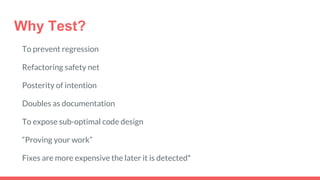
To prevent regression
Refactoring safety net
Posterity of intention
Doubles as documentation
To expose sub-optimal code design
“Proving your work”
Fixes are more expensive the later it is detected*
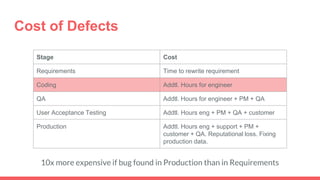
Cost of Defects
Stage Cost
Requirements Time to rewrite requirement
Coding Addtl. Hours for engineer
QA Addtl. Hours for engineer + PM + QA
User Acceptance Testing Addtl. Hours eng + PM + QA + customer
Production Addtl. Hours eng + support + PM +
customer + QA. Reputational loss. Fixing
production data.
10x more expensive if bug found in Production than in Requirements
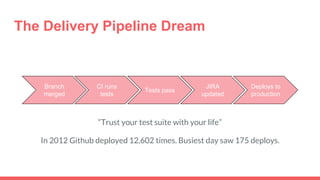
The Delivery Pipeline Dream
Branch
merged
CI runs
tests
Tests pass
Deploys to
production
JIRA
updated
“Trust your test suite with your life”
In 2012 Github deployed 12,602 times. Busiest day saw 175 deploys.
What Makes a Good Test?
Testing the interface
Good enough coverage, but not burdensome
Considers edge cases
Clear, concise, comprehensive, correct
Verify that you’ve met the stated requirements
When Tests Go Bad
Brittleness (mocking too much, testing implementation, etc)
Unreliable (Full stack tests reliant on timing guesswork)
Sluggishness
Incomprehensible
Size of test suite*
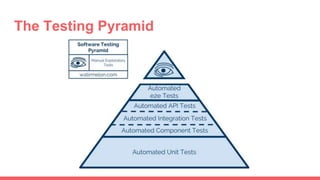
The Testing Pyramid
What Should I Test?
What Should I Test?
Good rule of thumb: If you are manually setting up data (Rails console, other
REPL, etc) and testing a change you are making, this should be your test
Same requirements as what the US considers patentable: “clever or non-obvious”
Aim for 80% test coverage - Complete coverage is asymptotic
Regressions (“Fool me once...”)
Code to be refactored
Test Types
Unit (component)
Integration
Full stack (e.g. “browser”)
Functional tests (e.g. “controller” aka “black box”)
Manual Testing (QA)
Performance/Stress/Load
A/B
End to End
Unit Testing Demo
Lead.mobile - Context, it, Factory pattern, expectation matcher, running tests
Lead.determine_business_unit_id - code branches, build vs create, running context
Lead.import_addresses_from_identifier_field - decomposing, stubbing
Controller / Functional Testing Demo
LeadsController.new - before/after hooks, missing records, traits, ivar, type matchers,
multiple assertions
Full Stack (Browser) Test Demo
AuthenticationSpec - feature, Capybara definitions
Summary
Testing is not an action taken “after the fact” that is meant to check a box
Proper testing helps guide code structure
The extreme of this is TDD (Test Driven Development) where tests are written
(and fail) before the code is written that allows the tests to pass
Lower defect count
Generally results in smaller, focused methods
Being a better tester will make you a better developer
Thank You
Ben Simpson
thehoagie@gmail.com
@mrfrosti

Testing

  • 1.
  • 2.
    Why Test? To preventregression Refactoring safety net Posterity of intention Doubles as documentation To expose sub-optimal code design “Proving your work” Fixes are more expensive the later it is detected*
  • 3.
    Cost of Defects StageCost Requirements Time to rewrite requirement Coding Addtl. Hours for engineer QA Addtl. Hours for engineer + PM + QA User Acceptance Testing Addtl. Hours eng + PM + QA + customer Production Addtl. Hours eng + support + PM + customer + QA. Reputational loss. Fixing production data. 10x more expensive if bug found in Production than in Requirements
  • 4.
    The Delivery PipelineDream Branch merged CI runs tests Tests pass Deploys to production JIRA updated “Trust your test suite with your life” In 2012 Github deployed 12,602 times. Busiest day saw 175 deploys.
  • 5.
    What Makes aGood Test? Testing the interface Good enough coverage, but not burdensome Considers edge cases Clear, concise, comprehensive, correct Verify that you’ve met the stated requirements
  • 6.
    When Tests GoBad Brittleness (mocking too much, testing implementation, etc) Unreliable (Full stack tests reliant on timing guesswork) Sluggishness Incomprehensible Size of test suite*
  • 7.
  • 8.
  • 9.
    What Should ITest? Good rule of thumb: If you are manually setting up data (Rails console, other REPL, etc) and testing a change you are making, this should be your test Same requirements as what the US considers patentable: “clever or non-obvious” Aim for 80% test coverage - Complete coverage is asymptotic Regressions (“Fool me once...”) Code to be refactored
  • 10.
    Test Types Unit (component) Integration Fullstack (e.g. “browser”) Functional tests (e.g. “controller” aka “black box”) Manual Testing (QA) Performance/Stress/Load A/B End to End
  • 11.
    Unit Testing Demo Lead.mobile- Context, it, Factory pattern, expectation matcher, running tests Lead.determine_business_unit_id - code branches, build vs create, running context Lead.import_addresses_from_identifier_field - decomposing, stubbing
  • 12.
    Controller / FunctionalTesting Demo LeadsController.new - before/after hooks, missing records, traits, ivar, type matchers, multiple assertions
  • 13.
    Full Stack (Browser)Test Demo AuthenticationSpec - feature, Capybara definitions
  • 14.
    Summary Testing is notan action taken “after the fact” that is meant to check a box Proper testing helps guide code structure The extreme of this is TDD (Test Driven Development) where tests are written (and fail) before the code is written that allows the tests to pass Lower defect count Generally results in smaller, focused methods Being a better tester will make you a better developer
  • 15.

Editor's Notes

  • #5 https://github.com/blog/1241-deploying-at-github
  • #13 https://www.relishapp.com/rspec/rspec-expectations/v/3-4/docs/built-in-matchers/type-matchers