ERB Test-Taking Tips & Strategies
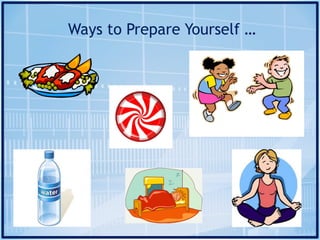
Ways to Prepare Yourself …
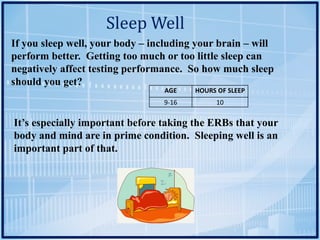
Sleep	Well
If you sleep well, your body – including your brain – will
perform better. Getting too much or too little sleep can
negatively affect testing performance. So how much sleep
should you get?
AGE HOURS	OF	SLEEP
9-16 10
It’s especially important before taking the ERBs that your
body and mind are in prime condition. Sleeping well is an
important part of that.
Eat	Well
Brain cells need twice as much energy as the other cells of your
body. A brain uses a fuel called glucose which is a type of
sugar. It can’t store it, so it gets it from your blood. Your blood
gets glucose from the foods you eat. If you want to think well,
your brain needs a steady supply of glucose. That’s why eating
well – especially before tests– is so important.
Natural foods provide a slow release of sugar into your blood.
Processed or refined foods provides a fast release of sugar. It is
usually better for your body to have a slow and steady release of
sugar.
Movement & Breathing
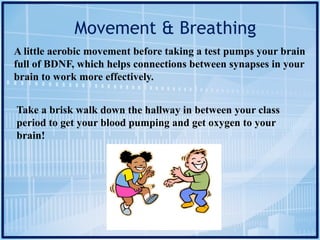
A little aerobic movement before taking a test pumps your brain
full of BDNF, which helps connections between synapses in your
brain to work more effectively.
Take a brisk walk down the hallway in between your class
period to get your blood pumping and get oxygen to your
brain!
Keep Hydrated
Your brain is approximately 80% water. You become restless
and have scattered attention when you are mildly dehydrated;
slow and lethargic when severely dehydrated.
Drinking plenty of water improves brain
functioning. Soft drinks, fruit juices, teas and
coffee do not hydrate nearly as well as pure
water.
Snacks for Fuel and Memory
If you skip breakfast, which hopefully you won’t, you should
give your brain a boost of glucose. This can be done with a
snack before the test. Certain foods also help your mind focus
and sharpen your memory.
Bananas, popcorn, even candy (especially
peppermint) will work to give your brain
glucose.
In a recent study, those who smelled peppermint
before test-taking were able to concentrate
better. Ask your teacher if this is allowed!
Relax
Feeling relaxed and stress-free is very important to perform best.
When your body is stressed, certain chemicals are released by the
body. Those chemicals cause a fight or flight reaction. They
quicken breathing, tighten muscles, raise blood pressure. It
makes it difficult to calmly and carefully concentrate on a test.
Here are some ideas you can do to help yourself:
1. Be active and get some exercise beforehand.
2. Before starting, stretch your muscles and breath slowly.
3. Visualize a calm place or something you like to do.
On the Day of the Test…
Have your laptop ready..
üBring your laptop fully charged to
school each day. THIS IS VERY
IMPORTANT! There will not be
enough loaner computers if
students forget.
Pretend You’re Alone
Distractions are a big reason why many test takers don’t
perform at their best. Your classroom setting will be very quiet
and comfortable. There won’t be a lot of movement or loud
talking.
ü Try not to look at anyone around you. Don’t speak to other
test-takers or respond to others speaking to you during the
test.
ü Keep your eyes on your own laptop, you don't want to
appear to be cheating and cause unnecessary trouble for
yourself. One of the biggest problems for test-takers is
worrying about what others are doing around them. It
doesn’t matter how far the others are on their tests.
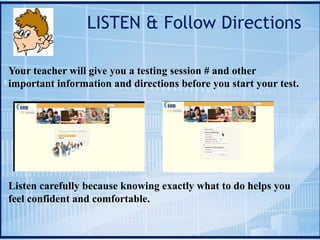
LISTEN & Follow Directions
Your teacher will give you a testing session # and other
important information and directions before you start your test.
Listen carefully because knowing exactly what to do helps you
feel confident and comfortable.
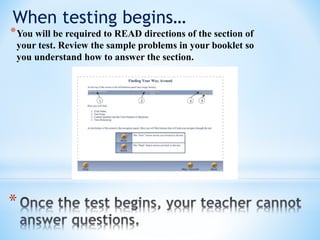
When testing begins…
*
*You will be required to READ directions of the section of
your test. Review the sample problems in your booklet so
you understand how to answer the section.
Pace Yourself
Another big mistakes made by test-takers is rushing through
questions like it’s a race. Go slowly. Even though the ERBs are a
timed test, pace yourself.
On timed tests, it’s a good strategy to answer the easy questions
first and skip some of the harder questions for later. This builds
your confidence and gets you in a groove.
The ERB online program will prompt you when you are halfway
through to review your answers and answer any skipped
questions. Remember to answer all questions!
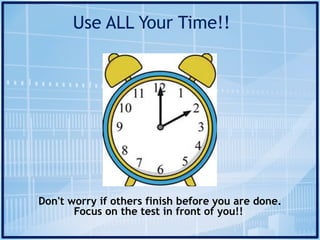
Don't worry if others finish before you are done.
Focus on the test in front of you!!.
Use ALL Your Time!!
If	you	begin	to	feel	nervous…
Stay relaxed. One of the goals of the ERBs in Middle
Division is to help familiarize you with the format of
standardized tests. You need to do your best but stressing
out can negatively impact your testing performance.
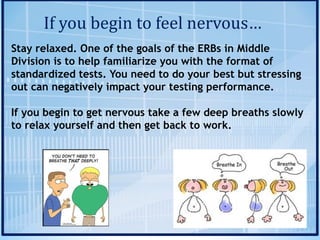
If you begin to get nervous take a few deep breaths slowly
to relax yourself and then get back to work.
You	will	take	only	3	sections	of	the	ERB
(one	each	day)
Reading Comprehension
Verbal Reasoning
Quantitative Reasoning
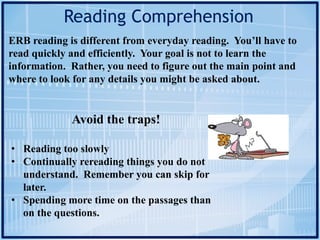
Reading Comprehension
ERB reading is different from everyday reading. You’ll have to
read quickly and efficiently. Your goal is not to learn the
information. Rather, you need to figure out the main point and
where to look for any details you might be asked about.
Avoid the traps!
• Reading too slowly
• Continually rereading things you do not
understand. Remember you can skip for
later.
• Spending more time on the passages than
on the questions.
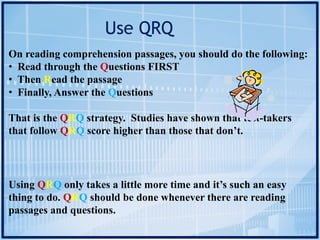
Use QRQ
On reading comprehension passages, you should do the following:
• Read through the Questions FIRST
• Then Read the passage
• Finally, Answer the Questions
That is the QRQ strategy. Studies have shown that test-takers
that follow QRQ score higher than those that don’t.
Using QRQ only takes a little more time and it’s such an easy
thing to do. QRQ should be done whenever there are reading
passages and questions.
Verbal Reasoning
VR is the ability to think, reason, and solve problems in
different ways. You will be asked to organize, compare,
analyze and synthesize information.
Sample question…
If all vehicles provide transportation, and if automobiles
and ships are vehicles, then:
(A) all vehicles are either automobiles or ships
(B) ships are used for the same purposes as automobiles
(C) ships and automobiles provide transportation
(D) all things that provide transportation are vehicles
Verbal Reasoning Sample Question:
KILN:HEAT:
(a) stove : oven
(b) drain : pipe
(c) gate : fence
(d) lamp : light
You must determine the relationship
between the two top words and choose a
pair related in the same way.
Verbal Reasoning Sample Question:
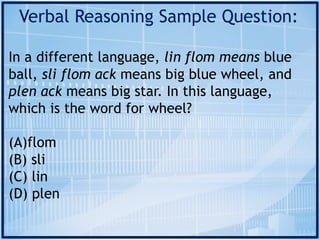
In a different language, lin flom means blue
ball, sli flom ack means big blue wheel, and
plen ack means big star. In this language,
which is the word for wheel?
(A)flom
(B) sli
(C) lin
(D) plen
Quantitative Reasoning
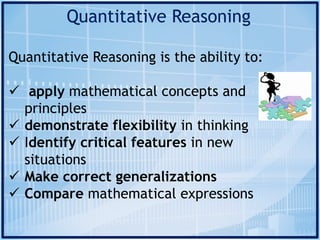
Quantitative Reasoning is the ability to:
ü apply mathematical concepts and
principles
ü demonstrate flexibility in thinking
ü Identify critical features in new
situations
ü Make correct generalizations
ü Compare mathematical expressions
Quantitative Reasoning
Sample Questions
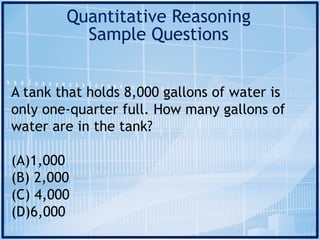
A tank that holds 8,000 gallons of water is
only one-quarter full. How many gallons of
water are in the tank?
(A)1,000
(B) 2,000
(C) 4,000
(D)6,000
Quantitative Reasoning
Sample Questions
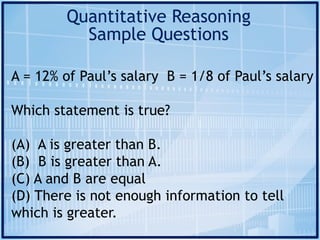
A = 12% of Paul’s salary B = 1/8 of Paul’s salary
Which statement is true?
(A) A is greater than B.
(B) B is greater than A.
(C) A and B are equal
(D) There is not enough information to tell
which is greater.
Multiple Choice Questions
The ERBs will offer you ONLY multiple choice questions.
Multiple choice questions require you to pick the best
answer from a list. If you do not know the answer right
away, work to eliminate choices in order to narrow down
your options.
How many states make up the United States of America?
a. 48
b. 52
c. 46
d. 50
You should click "d" to show that 50 is the correct answer
choice for this question. Always read all the answers
before selecting one.
Eliminate 52 and 46, the highest and
lowest numbers. You’re left with 48 and
50. You know that there are 48
continental states, but what about
Alaska and Hawaii? You have to
choose 50, the most logical answer.
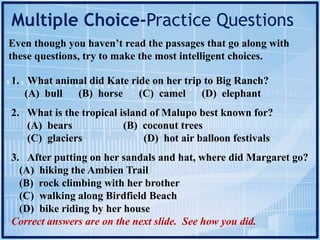
Multiple Choice-Practice Questions
1. What animal did Kate ride on her trip to Big Ranch?
(A) bull (B) horse (C) camel (D) elephant
2. What is the tropical island of Malupo best known for?
(A) bears (B) coconut trees
(C) glaciers (D) hot air balloon festivals
3. After putting on her sandals and hat, where did Margaret go?
(A) hiking the Ambien Trail
(B) rock climbing with her brother
(C) walking along Birdfield Beach
(D) bike riding by her house
Correct answers are on the next slide. See how you did.
Even though you haven’t read the passages that go along with
these questions, try to make the most intelligent choices.
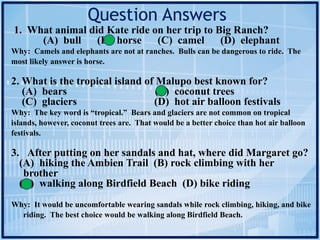
Question Answers
1. What animal did Kate ride on her trip to Big Ranch?
(A) bull (B) horse (C) camel (D) elephant
Why: Camels and elephants are not at ranches. Bulls can be dangerous to ride. The
most likely answer is horse.
2. What is the tropical island of Malupo best known for?
(A) bears (B) coconut trees
(C) glaciers (D) hot air balloon festivals
Why: The key word is “tropical.” Bears and glaciers are not common on tropical
islands, however, coconut trees are. That would be a better choice than hot air balloon
festivals.
3. After putting on her sandals and hat, where did Margaret go?
(A) hiking the Ambien Trail (B) rock climbing with her
brother
(C) walking along Birdfield Beach (D) bike riding
Why: It would be uncomfortable wearing sandals while rock climbing, hiking, and bike
riding. The best choice would be walking along Birdfield Beach.
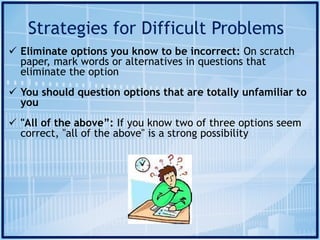
Strategies for Difficult Problems
ü Eliminate options you know to be incorrect: On scratch
paper, mark words or alternatives in questions that
eliminate the option
ü You should question options that are totally unfamiliar to
you
ü "All of the above”: If you know two of three options seem
correct, "all of the above" is a strong possibility
More Strategies for Difficult Problems
ü Number answers: Generally toss out the high and low
and consider the middle range numbers
ü "Look alike options“ probably one is correct; choose
the best but eliminate choices that mean basically the
same thing, and thus cancel each other out
ü If two alternatives seem correct, compare them for
differences, then refer to the question on the test to
find your best answer
You are almost done…
Reviewing Your Answers
If you have time, you should always go
back to review the answers you selected.
Don’t be afraid to change answers if you
feel they are wrong.
New research has shown that test-takers
that review and update some of their
answers tend to do better than those who
don’t. But be careful. You should only
change answers if you are confident that
the new answer is a better choice.
Think	Positively
Studies have shown that those who think
positively do better on assessments. On the days
you are taking the ERBs, say to yourself “I will
do well. I am prepared. I know these things.”
If you repeat these in your mind over and over
before the test, you will perform better. Positive
thinking is very powerful!
Test taking strategies erbs

Test taking strategies erbs

  • 1.
  • 2.
    Ways to PrepareYourself …
  • 3.
    Sleep Well If you sleepwell, your body – including your brain – will perform better. Getting too much or too little sleep can negatively affect testing performance. So how much sleep should you get? AGE HOURS OF SLEEP 9-16 10 It’s especially important before taking the ERBs that your body and mind are in prime condition. Sleeping well is an important part of that.
  • 4.
    Eat Well Brain cells needtwice as much energy as the other cells of your body. A brain uses a fuel called glucose which is a type of sugar. It can’t store it, so it gets it from your blood. Your blood gets glucose from the foods you eat. If you want to think well, your brain needs a steady supply of glucose. That’s why eating well – especially before tests– is so important. Natural foods provide a slow release of sugar into your blood. Processed or refined foods provides a fast release of sugar. It is usually better for your body to have a slow and steady release of sugar.
  • 5.
    Movement & Breathing Alittle aerobic movement before taking a test pumps your brain full of BDNF, which helps connections between synapses in your brain to work more effectively. Take a brisk walk down the hallway in between your class period to get your blood pumping and get oxygen to your brain!
  • 6.
    Keep Hydrated Your brainis approximately 80% water. You become restless and have scattered attention when you are mildly dehydrated; slow and lethargic when severely dehydrated. Drinking plenty of water improves brain functioning. Soft drinks, fruit juices, teas and coffee do not hydrate nearly as well as pure water.
  • 7.
    Snacks for Fueland Memory If you skip breakfast, which hopefully you won’t, you should give your brain a boost of glucose. This can be done with a snack before the test. Certain foods also help your mind focus and sharpen your memory. Bananas, popcorn, even candy (especially peppermint) will work to give your brain glucose. In a recent study, those who smelled peppermint before test-taking were able to concentrate better. Ask your teacher if this is allowed!
  • 8.
    Relax Feeling relaxed andstress-free is very important to perform best. When your body is stressed, certain chemicals are released by the body. Those chemicals cause a fight or flight reaction. They quicken breathing, tighten muscles, raise blood pressure. It makes it difficult to calmly and carefully concentrate on a test. Here are some ideas you can do to help yourself: 1. Be active and get some exercise beforehand. 2. Before starting, stretch your muscles and breath slowly. 3. Visualize a calm place or something you like to do.
  • 9.
    On the Dayof the Test…
  • 10.
    Have your laptopready.. üBring your laptop fully charged to school each day. THIS IS VERY IMPORTANT! There will not be enough loaner computers if students forget.
  • 11.
    Pretend You’re Alone Distractionsare a big reason why many test takers don’t perform at their best. Your classroom setting will be very quiet and comfortable. There won’t be a lot of movement or loud talking. ü Try not to look at anyone around you. Don’t speak to other test-takers or respond to others speaking to you during the test. ü Keep your eyes on your own laptop, you don't want to appear to be cheating and cause unnecessary trouble for yourself. One of the biggest problems for test-takers is worrying about what others are doing around them. It doesn’t matter how far the others are on their tests.
  • 12.
    LISTEN & FollowDirections Your teacher will give you a testing session # and other important information and directions before you start your test. Listen carefully because knowing exactly what to do helps you feel confident and comfortable.
  • 13.
    When testing begins… * *Youwill be required to READ directions of the section of your test. Review the sample problems in your booklet so you understand how to answer the section.
  • 14.
    Pace Yourself Another bigmistakes made by test-takers is rushing through questions like it’s a race. Go slowly. Even though the ERBs are a timed test, pace yourself. On timed tests, it’s a good strategy to answer the easy questions first and skip some of the harder questions for later. This builds your confidence and gets you in a groove. The ERB online program will prompt you when you are halfway through to review your answers and answer any skipped questions. Remember to answer all questions!
  • 15.
    Don't worry ifothers finish before you are done. Focus on the test in front of you!!. Use ALL Your Time!!
  • 16.
    If you begin to feel nervous… Stay relaxed. Oneof the goals of the ERBs in Middle Division is to help familiarize you with the format of standardized tests. You need to do your best but stressing out can negatively impact your testing performance. If you begin to get nervous take a few deep breaths slowly to relax yourself and then get back to work.
  • 17.
  • 18.
    Reading Comprehension ERB readingis different from everyday reading. You’ll have to read quickly and efficiently. Your goal is not to learn the information. Rather, you need to figure out the main point and where to look for any details you might be asked about. Avoid the traps! • Reading too slowly • Continually rereading things you do not understand. Remember you can skip for later. • Spending more time on the passages than on the questions.
  • 19.
    Use QRQ On readingcomprehension passages, you should do the following: • Read through the Questions FIRST • Then Read the passage • Finally, Answer the Questions That is the QRQ strategy. Studies have shown that test-takers that follow QRQ score higher than those that don’t. Using QRQ only takes a little more time and it’s such an easy thing to do. QRQ should be done whenever there are reading passages and questions.
  • 20.
    Verbal Reasoning VR isthe ability to think, reason, and solve problems in different ways. You will be asked to organize, compare, analyze and synthesize information. Sample question… If all vehicles provide transportation, and if automobiles and ships are vehicles, then: (A) all vehicles are either automobiles or ships (B) ships are used for the same purposes as automobiles (C) ships and automobiles provide transportation (D) all things that provide transportation are vehicles
  • 21.
    Verbal Reasoning SampleQuestion: KILN:HEAT: (a) stove : oven (b) drain : pipe (c) gate : fence (d) lamp : light You must determine the relationship between the two top words and choose a pair related in the same way.
  • 22.
    Verbal Reasoning SampleQuestion: In a different language, lin flom means blue ball, sli flom ack means big blue wheel, and plen ack means big star. In this language, which is the word for wheel? (A)flom (B) sli (C) lin (D) plen
  • 23.
    Quantitative Reasoning Quantitative Reasoningis the ability to: ü apply mathematical concepts and principles ü demonstrate flexibility in thinking ü Identify critical features in new situations ü Make correct generalizations ü Compare mathematical expressions
  • 24.
    Quantitative Reasoning Sample Questions Atank that holds 8,000 gallons of water is only one-quarter full. How many gallons of water are in the tank? (A)1,000 (B) 2,000 (C) 4,000 (D)6,000
  • 25.
    Quantitative Reasoning Sample Questions A= 12% of Paul’s salary B = 1/8 of Paul’s salary Which statement is true? (A) A is greater than B. (B) B is greater than A. (C) A and B are equal (D) There is not enough information to tell which is greater.
  • 26.
    Multiple Choice Questions TheERBs will offer you ONLY multiple choice questions. Multiple choice questions require you to pick the best answer from a list. If you do not know the answer right away, work to eliminate choices in order to narrow down your options. How many states make up the United States of America? a. 48 b. 52 c. 46 d. 50 You should click "d" to show that 50 is the correct answer choice for this question. Always read all the answers before selecting one. Eliminate 52 and 46, the highest and lowest numbers. You’re left with 48 and 50. You know that there are 48 continental states, but what about Alaska and Hawaii? You have to choose 50, the most logical answer.
  • 27.
    Multiple Choice-Practice Questions 1.What animal did Kate ride on her trip to Big Ranch? (A) bull (B) horse (C) camel (D) elephant 2. What is the tropical island of Malupo best known for? (A) bears (B) coconut trees (C) glaciers (D) hot air balloon festivals 3. After putting on her sandals and hat, where did Margaret go? (A) hiking the Ambien Trail (B) rock climbing with her brother (C) walking along Birdfield Beach (D) bike riding by her house Correct answers are on the next slide. See how you did. Even though you haven’t read the passages that go along with these questions, try to make the most intelligent choices.
  • 28.
    Question Answers 1. Whatanimal did Kate ride on her trip to Big Ranch? (A) bull (B) horse (C) camel (D) elephant Why: Camels and elephants are not at ranches. Bulls can be dangerous to ride. The most likely answer is horse. 2. What is the tropical island of Malupo best known for? (A) bears (B) coconut trees (C) glaciers (D) hot air balloon festivals Why: The key word is “tropical.” Bears and glaciers are not common on tropical islands, however, coconut trees are. That would be a better choice than hot air balloon festivals. 3. After putting on her sandals and hat, where did Margaret go? (A) hiking the Ambien Trail (B) rock climbing with her brother (C) walking along Birdfield Beach (D) bike riding Why: It would be uncomfortable wearing sandals while rock climbing, hiking, and bike riding. The best choice would be walking along Birdfield Beach.
  • 29.
    Strategies for DifficultProblems ü Eliminate options you know to be incorrect: On scratch paper, mark words or alternatives in questions that eliminate the option ü You should question options that are totally unfamiliar to you ü "All of the above”: If you know two of three options seem correct, "all of the above" is a strong possibility
  • 30.
    More Strategies forDifficult Problems ü Number answers: Generally toss out the high and low and consider the middle range numbers ü "Look alike options“ probably one is correct; choose the best but eliminate choices that mean basically the same thing, and thus cancel each other out ü If two alternatives seem correct, compare them for differences, then refer to the question on the test to find your best answer
  • 31.
    You are almostdone… Reviewing Your Answers If you have time, you should always go back to review the answers you selected. Don’t be afraid to change answers if you feel they are wrong. New research has shown that test-takers that review and update some of their answers tend to do better than those who don’t. But be careful. You should only change answers if you are confident that the new answer is a better choice.
  • 32.
    Think Positively Studies have shownthat those who think positively do better on assessments. On the days you are taking the ERBs, say to yourself “I will do well. I am prepared. I know these things.” If you repeat these in your mind over and over before the test, you will perform better. Positive thinking is very powerful!