MODULE-IVMODULE-IV
Test PlanningTest Planning
Namita PandaNamita Panda
School of Computer EngineeringSchool of Computer Engineering
KIIT Deemed to be UniversityKIIT Deemed to be University
IntroductionIntroduction
 Testing is aTesting is a projectproject itself.itself.
 It has to beIt has to be plannedplanned,, executedexecuted,, trackedtracked andand
periodically reportedperiodically reported..
01/25/1901/25/19 22
Test PlanningTest Planning
 Preparing a Test PlanPreparing a Test Plan
 What need to be testedWhat need to be tested
 How the testing is going to be performedHow the testing is going to be performed
 What resources are needed for testingWhat resources are needed for testing
 What is the time lineWhat is the time line
 Risk involved in all of the aboveRisk involved in all of the above
01/25/1901/25/19 33
Test Planning…Test Planning…
 Scope ManagementScope Management
 Understanding what constitutes release of aUnderstanding what constitutes release of a
product (end-goal/ product-release perspective)product (end-goal/ product-release perspective)
 Breaking down the release into featuresBreaking down the release into features
 Prioritizing the features for testingPrioritizing the features for testing
 Deciding which features will be tested and whichDeciding which features will be tested and which
will not bewill not be
 Gathering details to prepare for estimation ofGathering details to prepare for estimation of
resources for testing.resources for testing.
01/25/1901/25/19 44
Test Planning…Test Planning…
 Factors Influencing the PriorityFactors Influencing the Priority
 Features that are new and critical for the releaseFeatures that are new and critical for the release
- set the expectation of a customer- set the expectation of a customer
- higher susceptibility and exposure to defects- higher susceptibility and exposure to defects
- developer and tester go through a learning curve- developer and tester go through a learning curve
01/25/1901/25/19 55
Test Planning…Test Planning…
 Factors Influencing the PriorityFactors Influencing the Priority
 Features whose failure can be catastrophic
- produce adverse business impact
- recovery mechanism in a database
01/25/1901/25/19 66
Test Planning…Test Planning…
 Factors Influencing the PriorityFactors Influencing the Priority
 Features that are expected to be complex toFeatures that are expected to be complex to
testtest
-testing team should start the work on-testing team should start the work on
these features early and line up appropriatethese features early and line up appropriate
resource in timeresource in time
01/25/1901/25/19 77
Test PlanningTest Planning
 Factors Influencing the PriorityFactors Influencing the Priority
 Features which are extension of earlierFeatures which are extension of earlier
features that have been defect prone.features that have been defect prone.
01/25/1901/25/19 88
Test PlanningTest Planning
 Deciding Test Approach/StrategyDeciding Test Approach/Strategy
 What type of testing would you use for testing the functionality?What type of testing would you use for testing the functionality?
 What are the configuration or scenario for testing theWhat are the configuration or scenario for testing the
functionality?functionality?
 What integration testing would you do to ensure these featuresWhat integration testing would you do to ensure these features
work together?work together?
 What localization validation would be needed?What localization validation would be needed?
 What non-functional tests would you need to do?What non-functional tests would you need to do?
* Helps in estimation of size, effort and schedule.* Helps in estimation of size, effort and schedule.
01/25/1901/25/19 99
Test Planning…Test Planning…
 Setting of criteria for testingSetting of criteria for testing
Clear entry and exit criteria for differentClear entry and exit criteria for different
phases of testingphases of testing
Suspension CriteriaSuspension Criteria
- Encountering more than a certain number- Encountering more than a certain number
of defects, causing frequent stoppageof defects, causing frequent stoppage
- show stopper( ex. Data base is not starting)- show stopper( ex. Data base is not starting)
01/25/1901/25/19 1010
Test Planning…Test Planning…
 Identifying Responsibility, Staffing and TrainingIdentifying Responsibility, Staffing and Training
NeedsNeeds
 Ensure there is clear accountability for given taskEnsure there is clear accountability for given task
 Clearly list the responsibility for various functions toClearly list the responsibility for various functions to
various peoplevarious people
 Complement each otherComplement each other
 Supplement each other, so that no task is left unassignedSupplement each other, so that no task is left unassigned
 Specify staffing needs by skill levelSpecify staffing needs by skill level
 Identify training options for providing necessary skillIdentify training options for providing necessary skill
01/25/1901/25/19 1111
Test Planning…Test Planning…
 Identifying Responsibility, Staffing andIdentifying Responsibility, Staffing and
Training NeedsTraining Needs
- Staffing is done based on estimation of effort- Staffing is done based on estimation of effort
involved and the availability of time forinvolved and the availability of time for
release.release.
01/25/1901/25/19 1212
Test Planning…Test Planning…
 Identifying Test DeliverablesIdentifying Test Deliverables
 The test plan itselfThe test plan itself
 Test case design specificationTest case design specification
 Test case, including any automation that isTest case, including any automation that is
specified in the planspecified in the plan
 Test logs produced by running the testsTest logs produced by running the tests
 Test summary reportsTest summary reports
* Maintaining the defect repository and updating the* Maintaining the defect repository and updating the
status of the defectsstatus of the defects..
01/25/1901/25/19 1313
Test Planning…Test Planning…
 RiskRisk Identification:Identification:
 Lack of availability of required hardware,Lack of availability of required hardware,
software, data or toolsoftware, data or tool
 Lack of skilled personnelLack of skilled personnel
 Late delivery of softwareLate delivery of software
 Delay in training the new toolDelay in training the new tool
 Changes to the original requirementChanges to the original requirement
01/25/1901/25/19 1414
Test Planning…Test Planning…
 Test Plan HierarchyTest Plan Hierarchy
Master PlanMaster Plan
Verification PlanVerification Plan
Requirement V PlanRequirement V Plan
Design V PlanDesign V Plan
Code V PlanCode V Plan
Validation PlanValidation Plan
Unit Test PlanUnit Test Plan
Integration Test PlanIntegration Test Plan
System Test PlanSystem Test Plan
Acceptance Test PlanAcceptance Test Plan
01/25/1901/25/19 1515
Test Planning…Test Planning…
 Testing Tasks: Size and Effort EstimationTesting Tasks: Size and Effort Estimation
 Depends upon reusability of test cases
01/25/1901/25/19 1616
Test ManagementTest Management
 Choice of StandardsChoice of Standards
Internal StandardInternal Standard
Naming and Storage conventionNaming and Storage convention (Mapping)(Mapping)
Document StandardDocument Standard
Test Coding StandardsTest Coding Standards
Test Reporting StandardsTest Reporting Standards
01/25/1901/25/19 1717
Test Management…Test Management…
 Choice of StandardsChoice of Standards
External StandardExternal Standard
Acceptance test provided by the customerAcceptance test provided by the customer
External Consortia.External Consortia.
01/25/1901/25/19 1818
Test Management…Test Management…
 Test Infrastructure ManagementTest Infrastructure Management
 A test case databaseA test case database (TCDB)(TCDB)
 A defect repositoryA defect repository
 Configuration Management repository & toolsConfiguration Management repository & tools
01/25/1901/25/19 1919
Test Management…(TCDB)Test Management…(TCDB)
Entity Purpose Attributes
Test Case Record all the “static”
information about the test
Test ID
Test Case Name
Test Case Owner
Associate files for the test
Test case-Product cross-
reference
Provides a mapping
between the tests and the
corresponding product
features; enable
identification of tests for a
given feature
Test Case ID
Module ID
Test Case-Defect cross-
reference
Gives details of test cases
introduced to test certain
specific defects detected in
the product
Test Case ID
Defect Reference#
(Point to a record in the defect
repository)
01/25/1901/25/19 2020
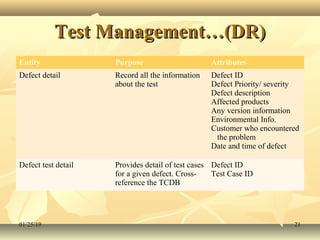
Test Management…(DR)Test Management…(DR)
Entity Purpose Attributes
Defect detail Record all the information
about the test
Defect ID
Defect Priority/ severity
Defect description
Affected products
Any version information
Environmental Info.
Customer who encountered
the problem
Date and time of defect
Defect test detail Provides detail of test cases
for a given defect. Cross-
reference the TCDB
Defect ID
Test Case ID
01/25/1901/25/19 2121
Test Management…Test Management…
 Configuration ManagementConfiguration Management
 Change to test files are made in a controlledChange to test files are made in a controlled
fashion and only with proper approvalsfashion and only with proper approvals
 Changes made by one test engineering areChanges made by one test engineering are
not accidentally lost or overwritten by othernot accidentally lost or overwritten by other
changes.changes.
 Each change produces a distinct version ofEach change produces a distinct version of
the file that is re-creatable at any point ofthe file that is re-creatable at any point of
time.time.
01/25/1901/25/19 2222
Test Management…Test Management…
 Test People ManagementTest People Management
 DevelopersDevelopers
 TestersTesters
 Sales PersonSales Person
 Hire, motivate and retain the right people.Hire, motivate and retain the right people.
 Team building exercises should be ongoing and sustained,Team building exercises should be ongoing and sustained,
rather than be done in one burst.rather than be done in one burst.
01/25/1901/25/19 2323
Test ProcessTest Process
 Putting together and Baselining a Test PlanPutting together and Baselining a Test Plan
 Organization arrives at a template used across theOrganization arrives at a template used across the
board.board.
 Plan is reviewed by a set of competent people.Plan is reviewed by a set of competent people.
 Approved by competent authority (responsible forApproved by competent authority (responsible for
testing)testing)
 Test plan is base lined into configurationTest plan is base lined into configuration
management repository.management repository.
 Change in base plan – discuss with stake holdersChange in base plan – discuss with stake holders
01/25/1901/25/19 2424
Test Process…Test Process…
 Test Case SpecificationTest Case Specification
 Helps in preparing individual test plan.Helps in preparing individual test plan.
 It should clearly identify:It should clearly identify:
 The purpose of the test (what features)The purpose of the test (what features)
 Items being tested, along with theirItems being tested, along with their
version/release numberversion/release number
 Environment that needs to be set up forEnvironment that needs to be set up for
running the test case.(h/w, s/w, O/S, data base,running the test case.(h/w, s/w, O/S, data base,
installation of right version)installation of right version)
01/25/1901/25/19 2525
Test Process…Test Process…
 Test Case Specification…Test Case Specification…
 Input data to be used for the test case. ( TechniquesInput data to be used for the test case. ( Techniques
followed- equivalence class partitioning:: automationfollowed- equivalence class partitioning:: automation
tools-data pool)tools-data pool)
 Steps to be followed to execute the test(automation-Steps to be followed to execute the test(automation-
script language of the tool/manual-detail instruction)script language of the tool/manual-detail instruction)
 The expected results that are considered to beThe expected results that are considered to be
“correct results.”(seen in the form of GUI, reports“correct results.”(seen in the form of GUI, reports
and so on)and so on)
 A step to compare the actual results produced withA step to compare the actual results produced with
the expected results.the expected results.
01/25/1901/25/19 2626
Test Process…Test Process…
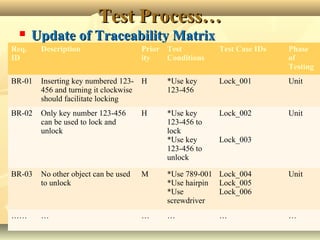
 Update of Traceability MatrixUpdate of Traceability Matrix
01/25/1901/25/19 2727
Req.
ID
Description Prior
ity
Test
Conditions
Test Case IDs Phase
of
Testing
BR-01 Inserting key numbered 123-
456 and turning it clockwise
should facilitate locking
H *Use key
123-456
Lock_001 Unit
BR-02 Only key number 123-456
can be used to lock and
unlock
H *Use key
123-456 to
lock
*Use key
123-456 to
unlock
Lock_002
Lock_003
Unit
BR-03 No other object can be used
to unlock
M *Use 789-001
*Use hairpin
*Use
screwdriver
Lock_004
Lock_005
Lock_006
Unit
…… … … … … …
Test Process…Test Process…
 Identifying Possible Candidate for AutomationIdentifying Possible Candidate for Automation
 Repetitive nature of the testRepetitive nature of the test
 Effort involved in automationEffort involved in automation
 Amount of manual intervention required for theAmount of manual intervention required for the
test andtest and
 Cost of automation toolCost of automation tool
01/25/1901/25/19 2828
Test Process…Test Process…
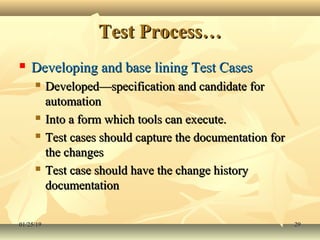
 Developing and base lining Test CasesDeveloping and base lining Test Cases
 Developed—specification and candidate forDeveloped—specification and candidate for
automationautomation
 Into a form which tools can execute.Into a form which tools can execute.
 Test cases should capture the documentation forTest cases should capture the documentation for
the changesthe changes
 Test case should have the change historyTest case should have the change history
documentationdocumentation
01/25/1901/25/19 2929
Test Process…Test Process…
 Executing Test Cases and Keeping TraceabilityExecuting Test Cases and Keeping Traceability
Matrix CurrentMatrix Current (Defect repository is updated)(Defect repository is updated)
 Defect from earlier test cycles that are fixed in the currentDefect from earlier test cycles that are fixed in the current
build andbuild and
 New defects that get uncovered in the current run of the tests.New defects that get uncovered in the current run of the tests.
 DR acts as the primary communication betweenDR acts as the primary communication between
development team and test teamdevelopment team and test team
 Stake holders may refer the DR to know the currentStake holders may refer the DR to know the current
status of all defects.status of all defects.
01/25/1901/25/19 3030
Test Process…Test Process…
 Recommending Product Release CriteriaRecommending Product Release Criteria
 Purpose of testing- deciding fitness of a product for release.Purpose of testing- deciding fitness of a product for release.
 Testing team to articulate the senior management and theTesting team to articulate the senior management and the
product teamproduct team
 What defect the product hasWhat defect the product has
 What is impact/severity of each of the defectsWhat is impact/severity of each of the defects
 What would be risks of releasing the product with theWhat would be risks of releasing the product with the
existing defect.existing defect.
 Then the senior management can then take a meaningfulThen the senior management can then take a meaningful
business decision on whether to release a given version or not.business decision on whether to release a given version or not.
01/25/1901/25/19 3131
Test Reporting…Test Reporting…
 Test incident reportTest incident report
 A test incident report is an entry made in the defectA test incident report is an entry made in the defect
repository.repository.
 Each defect has a unique ID used to identify theEach defect has a unique ID used to identify the
incident.incident.
01/25/1901/25/19 3232
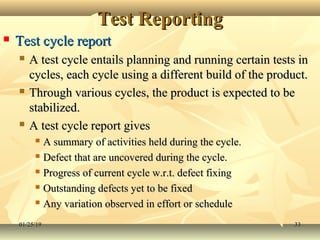
Test ReportingTest Reporting
 Test cycle reportTest cycle report
 A test cycle entails planning and running certain tests inA test cycle entails planning and running certain tests in
cycles, each cycle using a different build of the product.cycles, each cycle using a different build of the product.
 Through various cycles, the product is expected to beThrough various cycles, the product is expected to be
stabilized.stabilized.
 A test cycle report givesA test cycle report gives
 A summary of activities held during the cycle.A summary of activities held during the cycle.
 Defect that are uncovered during the cycle.Defect that are uncovered during the cycle.
 Progress of current cycle w.r.t. defect fixingProgress of current cycle w.r.t. defect fixing
 Outstanding defects yet to be fixedOutstanding defects yet to be fixed
 Any variation observed in effort or scheduleAny variation observed in effort or schedule
01/25/1901/25/19 3333
Test Reporting...Test Reporting...
 Test Summary ReportTest Summary Report
 Phase-wise test summary reportPhase-wise test summary report
 Final test summary reportFinal test summary report
 A summary report comprises ofA summary report comprises of
 A summary of activitiesA summary of activities
 Test that could not run(reason)Test that could not run(reason)
 Modification to test specificationModification to test specification
 Additional test that are runAdditional test that are run
 Difference in time taken and effortDifference in time taken and effort
 Summary of test that failedSummary of test that failed
 Impact of defects not uncovered by testImpact of defects not uncovered by test
 ““Fit for release” assessment and recommendation of releaseFit for release” assessment and recommendation of release
01/25/1901/25/19 3434
Test Reporting…Test Reporting…
 Recommending Product ReleaseRecommending Product Release
 Based on the test summary report decision is takenBased on the test summary report decision is taken
on whether to release the product or not.on whether to release the product or not.
 Release a product with zero defects- but marketRelease a product with zero defects- but market
pressure- decision depend on senior managementpressure- decision depend on senior management
after discussion with customer support team.after discussion with customer support team.
01/25/1901/25/19 3535
Best PracticesBest Practices
 Process RelatedProcess Related
 A strong process infrastructure and process culture isA strong process infrastructure and process culture is
required for better predictability and consistency.required for better predictability and consistency.
 Process model like CMMI provided a framework.Process model like CMMI provided a framework.
 Consistent training to employee and way in which tasksConsistent training to employee and way in which tasks
are executed.are executed.
01/25/1901/25/19 3636
Best Practices…Best Practices…
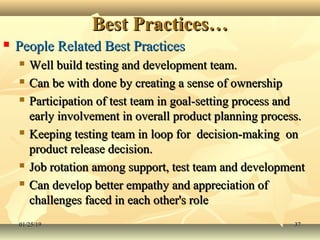
 People Related Best PracticesPeople Related Best Practices
 Well build testing and development team.Well build testing and development team.
 Can be with done by creating a sense of ownershipCan be with done by creating a sense of ownership
 Participation of test team in goal-setting process andParticipation of test team in goal-setting process and
early involvement in overall product planning process.early involvement in overall product planning process.
 Keeping testing team in loop for decision-making onKeeping testing team in loop for decision-making on
product release decision.product release decision.
 Job rotation among support, test team and developmentJob rotation among support, test team and development
 Can develop better empathy and appreciation ofCan develop better empathy and appreciation of
challenges faced in each other's rolechallenges faced in each other's role
01/25/1901/25/19 3737
Best Practices…Best Practices…
 Technology Related Best PracticesTechnology Related Best Practices
 Integrated TCDB, SCM and DR can help in betterIntegrated TCDB, SCM and DR can help in better
automation of testing activities.automation of testing activities.
 Automation tools will have long-term cost savingAutomation tools will have long-term cost saving
by reducing the manual labor required to run theby reducing the manual labor required to run the
test.test.
 Automation brings some programming into testingAutomation brings some programming into testing
process which engineers like.process which engineers like.
 In fact most of the tools have inbuilt TCDB andIn fact most of the tools have inbuilt TCDB and
DR.DR.
01/25/1901/25/19 3838
Test PolicyTest Policy
 Policy is made by senior managerPolicy is made by senior manager
 In case of product organization, the entireIn case of product organization, the entire
product is owned by organization and it isproduct is owned by organization and it is
responsible.responsible.
 In case of project organization, it offersIn case of project organization, it offers
development service to customer but does notdevelopment service to customer but does not
own the product.own the product.
01/25/1901/25/19 3939
Limitations of TestingLimitations of Testing
 Limitation in terms of techniques usedLimitation in terms of techniques used
 Budget availableBudget available
 Skills requirementSkills requirement
 Usage of SimulatorUsage of Simulator
 Duration of testingDuration of testing
01/25/1901/25/19 4040
ReferenceReference
 ““ Software Testing Principles and Practices”,Software Testing Principles and Practices”,
Srinivasan Desikan and Gopalaswamy RameshSrinivasan Desikan and Gopalaswamy Ramesh
 ““Software Testing Principle, Techniques andSoftware Testing Principle, Techniques and
Tools”, M G LimyeTools”, M G Limye
01/25/1901/25/19 4141

Test Planning

  • 1.
    MODULE-IVMODULE-IV Test PlanningTest Planning NamitaPandaNamita Panda School of Computer EngineeringSchool of Computer Engineering KIIT Deemed to be UniversityKIIT Deemed to be University
  • 2.
    IntroductionIntroduction  Testing isaTesting is a projectproject itself.itself.  It has to beIt has to be plannedplanned,, executedexecuted,, trackedtracked andand periodically reportedperiodically reported.. 01/25/1901/25/19 22
  • 3.
    Test PlanningTest Planning Preparing a Test PlanPreparing a Test Plan  What need to be testedWhat need to be tested  How the testing is going to be performedHow the testing is going to be performed  What resources are needed for testingWhat resources are needed for testing  What is the time lineWhat is the time line  Risk involved in all of the aboveRisk involved in all of the above 01/25/1901/25/19 33
  • 4.
    Test Planning…Test Planning… Scope ManagementScope Management  Understanding what constitutes release of aUnderstanding what constitutes release of a product (end-goal/ product-release perspective)product (end-goal/ product-release perspective)  Breaking down the release into featuresBreaking down the release into features  Prioritizing the features for testingPrioritizing the features for testing  Deciding which features will be tested and whichDeciding which features will be tested and which will not bewill not be  Gathering details to prepare for estimation ofGathering details to prepare for estimation of resources for testing.resources for testing. 01/25/1901/25/19 44
  • 5.
    Test Planning…Test Planning… Factors Influencing the PriorityFactors Influencing the Priority  Features that are new and critical for the releaseFeatures that are new and critical for the release - set the expectation of a customer- set the expectation of a customer - higher susceptibility and exposure to defects- higher susceptibility and exposure to defects - developer and tester go through a learning curve- developer and tester go through a learning curve 01/25/1901/25/19 55
  • 6.
    Test Planning…Test Planning… Factors Influencing the PriorityFactors Influencing the Priority  Features whose failure can be catastrophic - produce adverse business impact - recovery mechanism in a database 01/25/1901/25/19 66
  • 7.
    Test Planning…Test Planning… Factors Influencing the PriorityFactors Influencing the Priority  Features that are expected to be complex toFeatures that are expected to be complex to testtest -testing team should start the work on-testing team should start the work on these features early and line up appropriatethese features early and line up appropriate resource in timeresource in time 01/25/1901/25/19 77
  • 8.
    Test PlanningTest Planning Factors Influencing the PriorityFactors Influencing the Priority  Features which are extension of earlierFeatures which are extension of earlier features that have been defect prone.features that have been defect prone. 01/25/1901/25/19 88
  • 9.
    Test PlanningTest Planning Deciding Test Approach/StrategyDeciding Test Approach/Strategy  What type of testing would you use for testing the functionality?What type of testing would you use for testing the functionality?  What are the configuration or scenario for testing theWhat are the configuration or scenario for testing the functionality?functionality?  What integration testing would you do to ensure these featuresWhat integration testing would you do to ensure these features work together?work together?  What localization validation would be needed?What localization validation would be needed?  What non-functional tests would you need to do?What non-functional tests would you need to do? * Helps in estimation of size, effort and schedule.* Helps in estimation of size, effort and schedule. 01/25/1901/25/19 99
  • 10.
    Test Planning…Test Planning… Setting of criteria for testingSetting of criteria for testing Clear entry and exit criteria for differentClear entry and exit criteria for different phases of testingphases of testing Suspension CriteriaSuspension Criteria - Encountering more than a certain number- Encountering more than a certain number of defects, causing frequent stoppageof defects, causing frequent stoppage - show stopper( ex. Data base is not starting)- show stopper( ex. Data base is not starting) 01/25/1901/25/19 1010
  • 11.
    Test Planning…Test Planning… Identifying Responsibility, Staffing and TrainingIdentifying Responsibility, Staffing and Training NeedsNeeds  Ensure there is clear accountability for given taskEnsure there is clear accountability for given task  Clearly list the responsibility for various functions toClearly list the responsibility for various functions to various peoplevarious people  Complement each otherComplement each other  Supplement each other, so that no task is left unassignedSupplement each other, so that no task is left unassigned  Specify staffing needs by skill levelSpecify staffing needs by skill level  Identify training options for providing necessary skillIdentify training options for providing necessary skill 01/25/1901/25/19 1111
  • 12.
    Test Planning…Test Planning… Identifying Responsibility, Staffing andIdentifying Responsibility, Staffing and Training NeedsTraining Needs - Staffing is done based on estimation of effort- Staffing is done based on estimation of effort involved and the availability of time forinvolved and the availability of time for release.release. 01/25/1901/25/19 1212
  • 13.
    Test Planning…Test Planning… Identifying Test DeliverablesIdentifying Test Deliverables  The test plan itselfThe test plan itself  Test case design specificationTest case design specification  Test case, including any automation that isTest case, including any automation that is specified in the planspecified in the plan  Test logs produced by running the testsTest logs produced by running the tests  Test summary reportsTest summary reports * Maintaining the defect repository and updating the* Maintaining the defect repository and updating the status of the defectsstatus of the defects.. 01/25/1901/25/19 1313
  • 14.
    Test Planning…Test Planning… RiskRisk Identification:Identification:  Lack of availability of required hardware,Lack of availability of required hardware, software, data or toolsoftware, data or tool  Lack of skilled personnelLack of skilled personnel  Late delivery of softwareLate delivery of software  Delay in training the new toolDelay in training the new tool  Changes to the original requirementChanges to the original requirement 01/25/1901/25/19 1414
  • 15.
    Test Planning…Test Planning… Test Plan HierarchyTest Plan Hierarchy Master PlanMaster Plan Verification PlanVerification Plan Requirement V PlanRequirement V Plan Design V PlanDesign V Plan Code V PlanCode V Plan Validation PlanValidation Plan Unit Test PlanUnit Test Plan Integration Test PlanIntegration Test Plan System Test PlanSystem Test Plan Acceptance Test PlanAcceptance Test Plan 01/25/1901/25/19 1515
  • 16.
    Test Planning…Test Planning… Testing Tasks: Size and Effort EstimationTesting Tasks: Size and Effort Estimation  Depends upon reusability of test cases 01/25/1901/25/19 1616
  • 17.
    Test ManagementTest Management Choice of StandardsChoice of Standards Internal StandardInternal Standard Naming and Storage conventionNaming and Storage convention (Mapping)(Mapping) Document StandardDocument Standard Test Coding StandardsTest Coding Standards Test Reporting StandardsTest Reporting Standards 01/25/1901/25/19 1717
  • 18.
    Test Management…Test Management… Choice of StandardsChoice of Standards External StandardExternal Standard Acceptance test provided by the customerAcceptance test provided by the customer External Consortia.External Consortia. 01/25/1901/25/19 1818
  • 19.
    Test Management…Test Management… Test Infrastructure ManagementTest Infrastructure Management  A test case databaseA test case database (TCDB)(TCDB)  A defect repositoryA defect repository  Configuration Management repository & toolsConfiguration Management repository & tools 01/25/1901/25/19 1919
  • 20.
    Test Management…(TCDB)Test Management…(TCDB) EntityPurpose Attributes Test Case Record all the “static” information about the test Test ID Test Case Name Test Case Owner Associate files for the test Test case-Product cross- reference Provides a mapping between the tests and the corresponding product features; enable identification of tests for a given feature Test Case ID Module ID Test Case-Defect cross- reference Gives details of test cases introduced to test certain specific defects detected in the product Test Case ID Defect Reference# (Point to a record in the defect repository) 01/25/1901/25/19 2020
  • 21.
    Test Management…(DR)Test Management…(DR) EntityPurpose Attributes Defect detail Record all the information about the test Defect ID Defect Priority/ severity Defect description Affected products Any version information Environmental Info. Customer who encountered the problem Date and time of defect Defect test detail Provides detail of test cases for a given defect. Cross- reference the TCDB Defect ID Test Case ID 01/25/1901/25/19 2121
  • 22.
    Test Management…Test Management… Configuration ManagementConfiguration Management  Change to test files are made in a controlledChange to test files are made in a controlled fashion and only with proper approvalsfashion and only with proper approvals  Changes made by one test engineering areChanges made by one test engineering are not accidentally lost or overwritten by othernot accidentally lost or overwritten by other changes.changes.  Each change produces a distinct version ofEach change produces a distinct version of the file that is re-creatable at any point ofthe file that is re-creatable at any point of time.time. 01/25/1901/25/19 2222
  • 23.
    Test Management…Test Management… Test People ManagementTest People Management  DevelopersDevelopers  TestersTesters  Sales PersonSales Person  Hire, motivate and retain the right people.Hire, motivate and retain the right people.  Team building exercises should be ongoing and sustained,Team building exercises should be ongoing and sustained, rather than be done in one burst.rather than be done in one burst. 01/25/1901/25/19 2323
  • 24.
    Test ProcessTest Process Putting together and Baselining a Test PlanPutting together and Baselining a Test Plan  Organization arrives at a template used across theOrganization arrives at a template used across the board.board.  Plan is reviewed by a set of competent people.Plan is reviewed by a set of competent people.  Approved by competent authority (responsible forApproved by competent authority (responsible for testing)testing)  Test plan is base lined into configurationTest plan is base lined into configuration management repository.management repository.  Change in base plan – discuss with stake holdersChange in base plan – discuss with stake holders 01/25/1901/25/19 2424
  • 25.
    Test Process…Test Process… Test Case SpecificationTest Case Specification  Helps in preparing individual test plan.Helps in preparing individual test plan.  It should clearly identify:It should clearly identify:  The purpose of the test (what features)The purpose of the test (what features)  Items being tested, along with theirItems being tested, along with their version/release numberversion/release number  Environment that needs to be set up forEnvironment that needs to be set up for running the test case.(h/w, s/w, O/S, data base,running the test case.(h/w, s/w, O/S, data base, installation of right version)installation of right version) 01/25/1901/25/19 2525
  • 26.
    Test Process…Test Process… Test Case Specification…Test Case Specification…  Input data to be used for the test case. ( TechniquesInput data to be used for the test case. ( Techniques followed- equivalence class partitioning:: automationfollowed- equivalence class partitioning:: automation tools-data pool)tools-data pool)  Steps to be followed to execute the test(automation-Steps to be followed to execute the test(automation- script language of the tool/manual-detail instruction)script language of the tool/manual-detail instruction)  The expected results that are considered to beThe expected results that are considered to be “correct results.”(seen in the form of GUI, reports“correct results.”(seen in the form of GUI, reports and so on)and so on)  A step to compare the actual results produced withA step to compare the actual results produced with the expected results.the expected results. 01/25/1901/25/19 2626
  • 27.
    Test Process…Test Process… Update of Traceability MatrixUpdate of Traceability Matrix 01/25/1901/25/19 2727 Req. ID Description Prior ity Test Conditions Test Case IDs Phase of Testing BR-01 Inserting key numbered 123- 456 and turning it clockwise should facilitate locking H *Use key 123-456 Lock_001 Unit BR-02 Only key number 123-456 can be used to lock and unlock H *Use key 123-456 to lock *Use key 123-456 to unlock Lock_002 Lock_003 Unit BR-03 No other object can be used to unlock M *Use 789-001 *Use hairpin *Use screwdriver Lock_004 Lock_005 Lock_006 Unit …… … … … … …
  • 28.
    Test Process…Test Process… Identifying Possible Candidate for AutomationIdentifying Possible Candidate for Automation  Repetitive nature of the testRepetitive nature of the test  Effort involved in automationEffort involved in automation  Amount of manual intervention required for theAmount of manual intervention required for the test andtest and  Cost of automation toolCost of automation tool 01/25/1901/25/19 2828
  • 29.
    Test Process…Test Process… Developing and base lining Test CasesDeveloping and base lining Test Cases  Developed—specification and candidate forDeveloped—specification and candidate for automationautomation  Into a form which tools can execute.Into a form which tools can execute.  Test cases should capture the documentation forTest cases should capture the documentation for the changesthe changes  Test case should have the change historyTest case should have the change history documentationdocumentation 01/25/1901/25/19 2929
  • 30.
    Test Process…Test Process… Executing Test Cases and Keeping TraceabilityExecuting Test Cases and Keeping Traceability Matrix CurrentMatrix Current (Defect repository is updated)(Defect repository is updated)  Defect from earlier test cycles that are fixed in the currentDefect from earlier test cycles that are fixed in the current build andbuild and  New defects that get uncovered in the current run of the tests.New defects that get uncovered in the current run of the tests.  DR acts as the primary communication betweenDR acts as the primary communication between development team and test teamdevelopment team and test team  Stake holders may refer the DR to know the currentStake holders may refer the DR to know the current status of all defects.status of all defects. 01/25/1901/25/19 3030
  • 31.
    Test Process…Test Process… Recommending Product Release CriteriaRecommending Product Release Criteria  Purpose of testing- deciding fitness of a product for release.Purpose of testing- deciding fitness of a product for release.  Testing team to articulate the senior management and theTesting team to articulate the senior management and the product teamproduct team  What defect the product hasWhat defect the product has  What is impact/severity of each of the defectsWhat is impact/severity of each of the defects  What would be risks of releasing the product with theWhat would be risks of releasing the product with the existing defect.existing defect.  Then the senior management can then take a meaningfulThen the senior management can then take a meaningful business decision on whether to release a given version or not.business decision on whether to release a given version or not. 01/25/1901/25/19 3131
  • 32.
    Test Reporting…Test Reporting… Test incident reportTest incident report  A test incident report is an entry made in the defectA test incident report is an entry made in the defect repository.repository.  Each defect has a unique ID used to identify theEach defect has a unique ID used to identify the incident.incident. 01/25/1901/25/19 3232
  • 33.
    Test ReportingTest Reporting Test cycle reportTest cycle report  A test cycle entails planning and running certain tests inA test cycle entails planning and running certain tests in cycles, each cycle using a different build of the product.cycles, each cycle using a different build of the product.  Through various cycles, the product is expected to beThrough various cycles, the product is expected to be stabilized.stabilized.  A test cycle report givesA test cycle report gives  A summary of activities held during the cycle.A summary of activities held during the cycle.  Defect that are uncovered during the cycle.Defect that are uncovered during the cycle.  Progress of current cycle w.r.t. defect fixingProgress of current cycle w.r.t. defect fixing  Outstanding defects yet to be fixedOutstanding defects yet to be fixed  Any variation observed in effort or scheduleAny variation observed in effort or schedule 01/25/1901/25/19 3333
  • 34.
    Test Reporting...Test Reporting... Test Summary ReportTest Summary Report  Phase-wise test summary reportPhase-wise test summary report  Final test summary reportFinal test summary report  A summary report comprises ofA summary report comprises of  A summary of activitiesA summary of activities  Test that could not run(reason)Test that could not run(reason)  Modification to test specificationModification to test specification  Additional test that are runAdditional test that are run  Difference in time taken and effortDifference in time taken and effort  Summary of test that failedSummary of test that failed  Impact of defects not uncovered by testImpact of defects not uncovered by test  ““Fit for release” assessment and recommendation of releaseFit for release” assessment and recommendation of release 01/25/1901/25/19 3434
  • 35.
    Test Reporting…Test Reporting… Recommending Product ReleaseRecommending Product Release  Based on the test summary report decision is takenBased on the test summary report decision is taken on whether to release the product or not.on whether to release the product or not.  Release a product with zero defects- but marketRelease a product with zero defects- but market pressure- decision depend on senior managementpressure- decision depend on senior management after discussion with customer support team.after discussion with customer support team. 01/25/1901/25/19 3535
  • 36.
    Best PracticesBest Practices Process RelatedProcess Related  A strong process infrastructure and process culture isA strong process infrastructure and process culture is required for better predictability and consistency.required for better predictability and consistency.  Process model like CMMI provided a framework.Process model like CMMI provided a framework.  Consistent training to employee and way in which tasksConsistent training to employee and way in which tasks are executed.are executed. 01/25/1901/25/19 3636
  • 37.
    Best Practices…Best Practices… People Related Best PracticesPeople Related Best Practices  Well build testing and development team.Well build testing and development team.  Can be with done by creating a sense of ownershipCan be with done by creating a sense of ownership  Participation of test team in goal-setting process andParticipation of test team in goal-setting process and early involvement in overall product planning process.early involvement in overall product planning process.  Keeping testing team in loop for decision-making onKeeping testing team in loop for decision-making on product release decision.product release decision.  Job rotation among support, test team and developmentJob rotation among support, test team and development  Can develop better empathy and appreciation ofCan develop better empathy and appreciation of challenges faced in each other's rolechallenges faced in each other's role 01/25/1901/25/19 3737
  • 38.
    Best Practices…Best Practices… Technology Related Best PracticesTechnology Related Best Practices  Integrated TCDB, SCM and DR can help in betterIntegrated TCDB, SCM and DR can help in better automation of testing activities.automation of testing activities.  Automation tools will have long-term cost savingAutomation tools will have long-term cost saving by reducing the manual labor required to run theby reducing the manual labor required to run the test.test.  Automation brings some programming into testingAutomation brings some programming into testing process which engineers like.process which engineers like.  In fact most of the tools have inbuilt TCDB andIn fact most of the tools have inbuilt TCDB and DR.DR. 01/25/1901/25/19 3838
  • 39.
    Test PolicyTest Policy Policy is made by senior managerPolicy is made by senior manager  In case of product organization, the entireIn case of product organization, the entire product is owned by organization and it isproduct is owned by organization and it is responsible.responsible.  In case of project organization, it offersIn case of project organization, it offers development service to customer but does notdevelopment service to customer but does not own the product.own the product. 01/25/1901/25/19 3939
  • 40.
    Limitations of TestingLimitationsof Testing  Limitation in terms of techniques usedLimitation in terms of techniques used  Budget availableBudget available  Skills requirementSkills requirement  Usage of SimulatorUsage of Simulator  Duration of testingDuration of testing 01/25/1901/25/19 4040
  • 41.
    ReferenceReference  ““ SoftwareTesting Principles and Practices”,Software Testing Principles and Practices”, Srinivasan Desikan and Gopalaswamy RameshSrinivasan Desikan and Gopalaswamy Ramesh  ““Software Testing Principle, Techniques andSoftware Testing Principle, Techniques and Tools”, M G LimyeTools”, M G Limye 01/25/1901/25/19 4141