


Test Outsourcing in
Eastern Europe
Agenda
• What is outsourcing?
• The outsourcing market – facts and figures
• Marketplace of Eastern Europe (EE)
• Advantages of EE
• Future trends
Agenda
• What is outsourcing?
• The outsourcing market – facts and figures
• Marketplace of Eastern Europe (EE)
• Advantages of EE
• Future trends
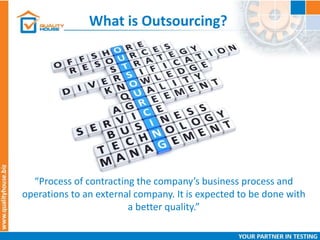
What is Outsourcing?
“Process of contracting the company’s business process and
operations to an external company. It is expected to be done with
a better quality.”
The outsourcing market
Why did it start?
• Cost cuttings
• Focus on the core business
What can be outsourced?
• Everything
• It does not happen due to security risks
Outsourcing models
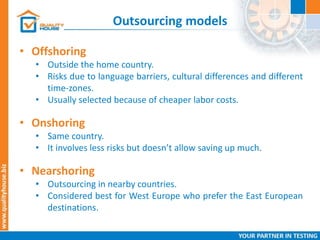
• Offshoring
• Outside the home country.
• Risks due to language barriers, cultural differences and different
time-zones.
• Usually selected because of cheaper labor costs.
• Onshoring
• Same country.
• It involves less risks but doesn’t allow saving up much.
• Nearshoring
• Outsourcing in nearby countries.
• Considered best for West Europe who prefer the East European
destinations.
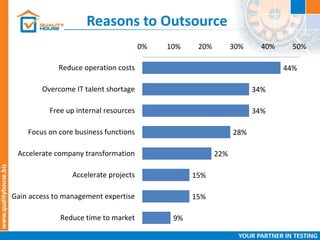
44%
34%
34%
28%
22%
15%
15%
9%
0% 10% 20% 30% 40% 50%
Reduce operation costs
Overcome IT talent shortage
Free up internal resources
Focus on core business functions
Accelerate company transformation
Accelerate projects
Gain access to management expertise
Reduce time to market
Reasons to Outsource
Risks
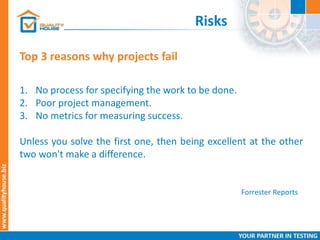
Top 3 reasons why projects fail
1. No process for specifying the work to be done.
2. Poor project management.
3. No metrics for measuring success.
Unless you solve the first one, then being excellent at the other
two won't make a difference.
Forrester Reports
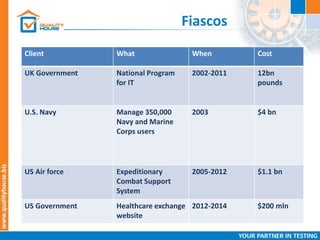
Fiascos
Client What When Cost
UK Government National Program
for IT
2002-2011 12bn
pounds
U.S. Navy Manage 350,000
Navy and Marine
Corps users
2003 $4 bn
US Air force Expeditionary
Combat Support
System
2005-2012 $1.1 bn
US Government Healthcare exchange
website
2012-2014 $200 mln
Success stories
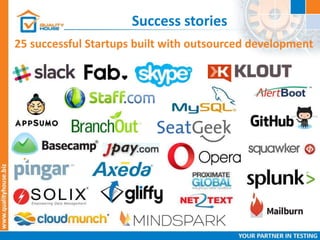
25 successful Startups built with outsourced development
Agenda
• What is outsourcing?
• The outsourcing market – facts and figures
• Marketplace of Eastern Europe (EE)
• Advantages of EE
• Future trends
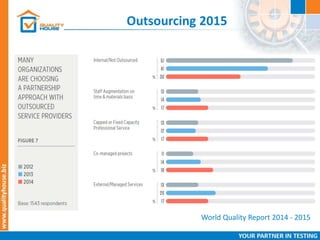
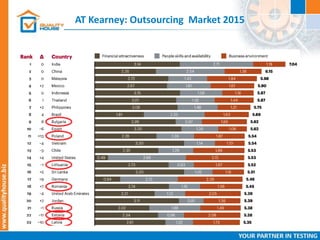
Outsourcing 2015
World Quality Report 2014 - 2015
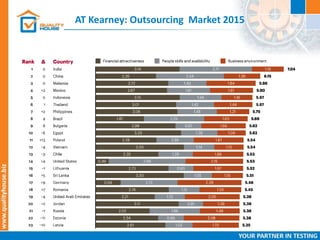
AT Kearney: Outsourcing Market 2015
Agenda
• What is outsourcing?
• The outsourcing market – facts and figures
• Marketplace of Eastern Europe (EE)
• Advantages of EE
• Future trends
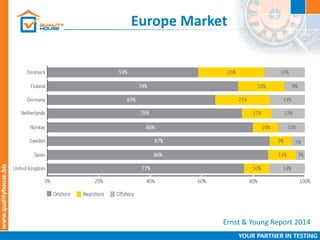
Europe Market
Ernst & Young Report 2014
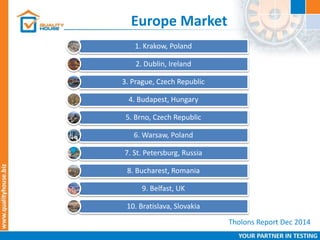
Europe Market
1. Krakow, Poland
2. Dublin, Ireland
3. Prague, Czech Republic
4. Budapest, Hungary
5. Brno, Czech Republic
6. Warsaw, Poland
7. St. Petersburg, Russia
8. Bucharest, Romania
9. Belfast, UK
10. Bratislava, Slovakia
Tholons Report Dec 2014
Examples: Poland
• Has Risen from 38th in 2009 to 11th now;
• Krakow in Top 10 Locations and #1 in Europe;
• More than 500 institutions of high education;
• IT business doubled in the last 5 years;
• Multilingual;
• Proximity to Western Europe;
• Still cost-competitive by several magnitudes;
• Considered with potential to become Global player;
Examples: Bulgaria
• Ranked 9th in the world and best in Europe;
• EOA Award „Offshoring Destination of The Year“ for 2015;
• Growth of Outsourcing since 2005 – 500%;
• Growth of IT employees since 2010 – 330%;
• Among Top 10 countries with fastest Internet worldwide (8th);
• 3rd worldwide by the number of certified IT professionals;
• Lowest Cost in Europe – both Salaries and Taxes;
Agenda
• What is outsourcing?
• The outsourcing market – facts and figures
• Marketplace of Eastern Europe (EE)
• Advantages of EE
• Future trends
Advantages of EE
"There's a lot more to it than just where
are the cheap people?'"
Rolf Jester
Gartner Vice President
Advantages of EE
Why a preferred destination?
• Education based on the Western system of theory and
philosophy - Creative thinking;
• Low cost – competitive salaries and taxes; low cost of living;
• Highly technical skills;
• Languages – Not only High level of English, but German,
French, Spanish, etc.;
• Reliable, existing infrastructure;
• Companies in Eastern Europe tend to engage in the business
model of their client;
Advantages of EE
• Reduced time differences – almost same working hours;
• Less cultural differences and common values shared;
• No “Yes, sir” attitude;
• Less employee turnover than India;
• The growing SME demand needs flexibility;
• For the countries in EU – advantage of the VAT system and the
well known EU rules and regulations.
Other very important benefits:
Agenda
• What is outsourcing?
• The outsourcing market – facts and figures
• Marketplace of Eastern Europe (EE)
• Advantages of EE
• Future trends
Future Trends
“It is expected that by the end 2015 top six EU markets
alone will need 250 000 extra employees with IT skills,
and this doesn’t cover the rapidly and instantly
expanding US job market.”
Source: computerweekly.com
Future Trends
• The shift away from “cheaper is better” - quality is again the
crucial differentiator.
• Therefore Nearshoring is gathering pace within higher cost
but with high-talent labor.
• Gartner: “This trend will result in outsourcing of IT services
overseas (India etc.) dropping by at least 15% through to
2016”.
Outsourcing moves into Strategic activities
Future Trends
Expansion of offshore providers in Europe
• Investing heavily in continental Europe:
• Wipro announced the addition of 500 FTEs in the Nordics alone
over the coming 3 years reaching > 4000 FTEs in Europe.
• Offshore providers are also on the acquisition trail:
• Cognizant acquired ValueSource NV in Belgium.
• Have already acquired six companies in Germany.
Future Trends
Expansion of nearshore providers in Europe
• Investing in Eastern Europe:
• Luxoft opened a new site in Bulgaria in 2015. Ambition to hire
up to 1000 FTEs.
• Already have labs in other EE countries like Romania.
• SoftServe also opened a R&D site in Bulgaria.
• EPAM has an office both in Romania and Bulgaria.
• Massive Marketing and Sales representation in Europe.
Future Trends
Freelance Outsourcing
• Physical location is irrelevant.
• SME companies now can take advantage of the talent.
• No need for cumbersome long-term agreements.
• No need of large volume requirements.
• New countries with talent but with strong operational risk are
now able to take part in the industry.
• Bigger talent pool than India, China and Mexico altogether.
• Russia and Ukraine lead by far. Romania follows.
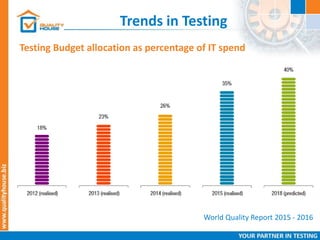
Trends in Testing
Testing Budget allocation as percentage of IT spend
World Quality Report 2015 - 2016
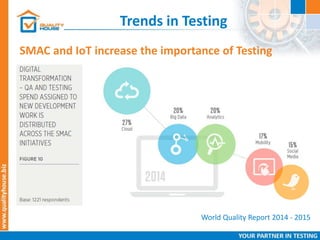
Trends in Testing
World Quality Report 2014 - 2015
SMAC and IoT increase the importance of Testing
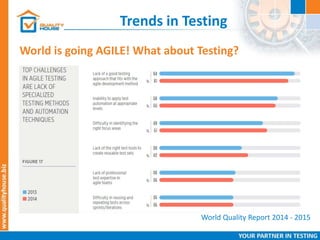
Trends in Testing
World Quality Report 2014 - 2015
World is going AGILE! What about Testing?
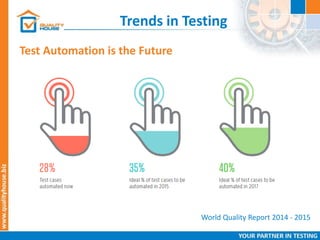
Trends in Testing
World Quality Report 2014 - 2015
Test Automation is the Future
Trends in Testing
• Contracting a single vendor to provide both development and
testing:
• can reduce supplier management costs, but
• it is unlikely to deliver the best business value.
• Using a independent provider for testing gives clear reassurance
of an independent auditor with no interest in:
• completing testing too quickly, or
• finding an encouragingly small number of defects.
Increased demand for independent testing supplier
Trends in Testing
• Skill level baselines must be demonstrated:
• If your skills fall behind, you become noncompetitive.
• Not acceptable in an outsourced world.
• Certifications become mandatory for outsourcing providers:
• Required in most of the tenders.
• ISTQB is closing on 500 000 Certified Testers:
• Agile Testing is out.
• Security and Test Automation in Beta.
• Working on Mobile and Usability testing.
Importance of Certifications grows
Questions?

Test Outsourcing in Eastern Europe

  • 1.
  • 2.
    Agenda • What isoutsourcing? • The outsourcing market – facts and figures • Marketplace of Eastern Europe (EE) • Advantages of EE • Future trends
  • 3.
    Agenda • What isoutsourcing? • The outsourcing market – facts and figures • Marketplace of Eastern Europe (EE) • Advantages of EE • Future trends
  • 4.
    What is Outsourcing? “Processof contracting the company’s business process and operations to an external company. It is expected to be done with a better quality.”
  • 5.
    The outsourcing market Whydid it start? • Cost cuttings • Focus on the core business What can be outsourced? • Everything • It does not happen due to security risks
  • 6.
    Outsourcing models • Offshoring •Outside the home country. • Risks due to language barriers, cultural differences and different time-zones. • Usually selected because of cheaper labor costs. • Onshoring • Same country. • It involves less risks but doesn’t allow saving up much. • Nearshoring • Outsourcing in nearby countries. • Considered best for West Europe who prefer the East European destinations.
  • 7.
    44% 34% 34% 28% 22% 15% 15% 9% 0% 10% 20%30% 40% 50% Reduce operation costs Overcome IT talent shortage Free up internal resources Focus on core business functions Accelerate company transformation Accelerate projects Gain access to management expertise Reduce time to market Reasons to Outsource
  • 8.
    Risks Top 3 reasonswhy projects fail 1. No process for specifying the work to be done. 2. Poor project management. 3. No metrics for measuring success. Unless you solve the first one, then being excellent at the other two won't make a difference. Forrester Reports
  • 9.
    Fiascos Client What WhenCost UK Government National Program for IT 2002-2011 12bn pounds U.S. Navy Manage 350,000 Navy and Marine Corps users 2003 $4 bn US Air force Expeditionary Combat Support System 2005-2012 $1.1 bn US Government Healthcare exchange website 2012-2014 $200 mln
  • 10.
    Success stories 25 successfulStartups built with outsourced development
  • 11.
    Agenda • What isoutsourcing? • The outsourcing market – facts and figures • Marketplace of Eastern Europe (EE) • Advantages of EE • Future trends
  • 12.
  • 13.
  • 14.
  • 15.
    Agenda • What isoutsourcing? • The outsourcing market – facts and figures • Marketplace of Eastern Europe (EE) • Advantages of EE • Future trends
  • 16.
    Europe Market Ernst &Young Report 2014
  • 17.
    Europe Market 1. Krakow,Poland 2. Dublin, Ireland 3. Prague, Czech Republic 4. Budapest, Hungary 5. Brno, Czech Republic 6. Warsaw, Poland 7. St. Petersburg, Russia 8. Bucharest, Romania 9. Belfast, UK 10. Bratislava, Slovakia Tholons Report Dec 2014
  • 18.
    Examples: Poland • HasRisen from 38th in 2009 to 11th now; • Krakow in Top 10 Locations and #1 in Europe; • More than 500 institutions of high education; • IT business doubled in the last 5 years; • Multilingual; • Proximity to Western Europe; • Still cost-competitive by several magnitudes; • Considered with potential to become Global player;
  • 19.
    Examples: Bulgaria • Ranked9th in the world and best in Europe; • EOA Award „Offshoring Destination of The Year“ for 2015; • Growth of Outsourcing since 2005 – 500%; • Growth of IT employees since 2010 – 330%; • Among Top 10 countries with fastest Internet worldwide (8th); • 3rd worldwide by the number of certified IT professionals; • Lowest Cost in Europe – both Salaries and Taxes;
  • 20.
    Agenda • What isoutsourcing? • The outsourcing market – facts and figures • Marketplace of Eastern Europe (EE) • Advantages of EE • Future trends
  • 21.
    Advantages of EE "There'sa lot more to it than just where are the cheap people?'" Rolf Jester Gartner Vice President
  • 22.
    Advantages of EE Whya preferred destination? • Education based on the Western system of theory and philosophy - Creative thinking; • Low cost – competitive salaries and taxes; low cost of living; • Highly technical skills; • Languages – Not only High level of English, but German, French, Spanish, etc.; • Reliable, existing infrastructure; • Companies in Eastern Europe tend to engage in the business model of their client;
  • 23.
    Advantages of EE •Reduced time differences – almost same working hours; • Less cultural differences and common values shared; • No “Yes, sir” attitude; • Less employee turnover than India; • The growing SME demand needs flexibility; • For the countries in EU – advantage of the VAT system and the well known EU rules and regulations. Other very important benefits:
  • 24.
    Agenda • What isoutsourcing? • The outsourcing market – facts and figures • Marketplace of Eastern Europe (EE) • Advantages of EE • Future trends
  • 25.
    Future Trends “It isexpected that by the end 2015 top six EU markets alone will need 250 000 extra employees with IT skills, and this doesn’t cover the rapidly and instantly expanding US job market.” Source: computerweekly.com
  • 26.
    Future Trends • Theshift away from “cheaper is better” - quality is again the crucial differentiator. • Therefore Nearshoring is gathering pace within higher cost but with high-talent labor. • Gartner: “This trend will result in outsourcing of IT services overseas (India etc.) dropping by at least 15% through to 2016”. Outsourcing moves into Strategic activities
  • 27.
    Future Trends Expansion ofoffshore providers in Europe • Investing heavily in continental Europe: • Wipro announced the addition of 500 FTEs in the Nordics alone over the coming 3 years reaching > 4000 FTEs in Europe. • Offshore providers are also on the acquisition trail: • Cognizant acquired ValueSource NV in Belgium. • Have already acquired six companies in Germany.
  • 28.
    Future Trends Expansion ofnearshore providers in Europe • Investing in Eastern Europe: • Luxoft opened a new site in Bulgaria in 2015. Ambition to hire up to 1000 FTEs. • Already have labs in other EE countries like Romania. • SoftServe also opened a R&D site in Bulgaria. • EPAM has an office both in Romania and Bulgaria. • Massive Marketing and Sales representation in Europe.
  • 29.
    Future Trends Freelance Outsourcing •Physical location is irrelevant. • SME companies now can take advantage of the talent. • No need for cumbersome long-term agreements. • No need of large volume requirements. • New countries with talent but with strong operational risk are now able to take part in the industry. • Bigger talent pool than India, China and Mexico altogether. • Russia and Ukraine lead by far. Romania follows.
  • 30.
    Trends in Testing TestingBudget allocation as percentage of IT spend World Quality Report 2015 - 2016
  • 31.
    Trends in Testing WorldQuality Report 2014 - 2015 SMAC and IoT increase the importance of Testing
  • 32.
    Trends in Testing WorldQuality Report 2014 - 2015 World is going AGILE! What about Testing?
  • 33.
    Trends in Testing WorldQuality Report 2014 - 2015 Test Automation is the Future
  • 34.
    Trends in Testing •Contracting a single vendor to provide both development and testing: • can reduce supplier management costs, but • it is unlikely to deliver the best business value. • Using a independent provider for testing gives clear reassurance of an independent auditor with no interest in: • completing testing too quickly, or • finding an encouragingly small number of defects. Increased demand for independent testing supplier
  • 35.
    Trends in Testing •Skill level baselines must be demonstrated: • If your skills fall behind, you become noncompetitive. • Not acceptable in an outsourced world. • Certifications become mandatory for outsourcing providers: • Required in most of the tenders. • ISTQB is closing on 500 000 Certified Testers: • Agile Testing is out. • Security and Test Automation in Beta. • Working on Mobile and Usability testing. Importance of Certifications grows
  • 36.

Editor's Notes

  • #5 What is outsourcing? It could be described as delegating the company’s day to day business process and operations to an external company. It is usually done with a better quality. The concept "outsourcing" came from American Glossary 'outside resourcing' and it dates back to at least 1981
  • #6 Imagine if NATO outsources the development of its software and there is a leak?
  • #7 Offshoring - outsourcing business processes from outside the home country to the third party or company that is set up as an offshore development center. This model is connected with risks due to language barriers, cultural differences and different time-zones . Usually selected because of cheaper labour costs. Onshoring - outsourcing business processes to any location in the same country as the buyer. It involves less risks but doesn’t allow saving up much. Nearshoring - outsourcing business processes to companies located in nearby countries. It is especially true for West European businesses who prefer the East European destinations. Nowadays nearshoring is considered to be a good alternative to offshoring and onshoring.
  • #9 https://www.projectsmart.co.uk/why-outsourcing-fails-even-with-good-project-management.php
  • #10 https://www.projectsmart.co.uk/why-outsourcing-fails-even-with-good-project-management.php
  • #11 http://www.entrepreneur.com/article/247462
  • #17 http://www.tholons.com/TholonsTop100/pdf/Tholons_Top_100_2014_Rankings_&_Report_Overview.pdf
  • #18 http://www.tholons.com/TholonsTop100/pdf/Tholons_Top_100_2014_Rankings_&_Report_Overview.pdf
  • #23 Education systems focused mainly on the engineering; Low cost – competitive salaries; low cost of living, especially when not outsourcing in the capitals of the countries; Highly skilled work force; Good level of English language knowledge. There are also many specialists with German, French, Spanish, etc. Companies in Eastern Europe tend to engage in the business model of their client; Time zone differences – actually the difference is a couple of hours and enables the both parties to have the same working hours; One of the biggest advantage to outsourcing in Eastern Europe: - reduced time differences – almost same working hours; - less cultural differences and common values shared; - no “Yes, culture” attitude; - reduces the view to the management of the project being outsourced – similar cultures definitely brings a sense of common goal; - the language skills of the population of Eastern Europe are pretty high – they not only have good English language knowledge skills, many speak as a second foreign language German, French, Spanish; "The education system is modelled on the Western system and is based on a model of theory and philosophy; a programmer likes to get deep into philosophy and principles of a system," Marovitz says. By contrast, the Indian education system is built on the British model, with a much greater focus on detailed practical application of an existing plan. India is therefore a great choice for the execution of very precise specifications, whereas Russia has the edge in creative thinking, in Marovitz' opinion.
  • #24 http://searchcio.techtarget.com/news/1342158/Gartner-picks-top-30-countries-for-offshore-IT-outsourcing
  • #26 http://searchcio.techtarget.com/news/1342158/Gartner-picks-top-30-countries-for-offshore-IT-outsourcing
  • #27 http://searchcio.techtarget.com/news/1342158/Gartner-picks-top-30-countries-for-offshore-IT-outsourcing
  • #28 http://www.computerweekly.com/blogs/outsourcing/2012/08/why-software-testing-is-increasingly-being-outsourced.html ; https://mycrowd.com/2014-mobile-software-qa-testing-update-trends/
  • #29 http://www.computerweekly.com/blogs/outsourcing/2012/08/why-software-testing-is-increasingly-being-outsourced.html ; https://mycrowd.com/2014-mobile-software-qa-testing-update-trends/
  • #30 http://www.computerweekly.com/blogs/outsourcing/2012/08/why-software-testing-is-increasingly-being-outsourced.html ; https://mycrowd.com/2014-mobile-software-qa-testing-update-trends/