Test bank for Big Java: Early Objects 6th Edition by Horstmann
Test bank for Big Java: Early Objects 6th Edition by Horstmann
Test bank for Big Java: Early Objects 6th Edition by Horstmann
Test bank for Big Java: Early Objects 6th Edition by Horstmann
Test bank for Big Java: Early Objects 6th Edition by Horstmann
1.
Visit https://testbankmall.com todownload the full version and
browse more test banks or solution manuals
Test bank for Big Java: Early Objects 6th Edition
by Horstmann
_____ Press the link below to begin your download _____
https://testbankmall.com/product/test-bank-for-big-java-
early-objects-6th-edition-by-horstmann/
Access testbankmall.com now to download high-quality
test banks or solution manuals
2.
We believe theseproducts will be a great fit for you. Click
the link to download now, or visit testbankmall.com
to discover even more!
Test Bank For Big Java: Early Objects 5th Edition
https://testbankmall.com/product/test-bank-for-big-java-early-
objects-5th-edition/
Solution Manual for Big C++: Late Objects 3rd Edition, Cay
S. Horstmann
https://testbankmall.com/product/solution-manual-for-big-c-late-
objects-3rd-edition-cay-s-horstmann/
Test Bank for (Chapter 1 – 17) Big C++: Late Objects, 3rd
Edition, Cay S. Horstmann
https://testbankmall.com/product/test-bank-for-chapter-1-17-big-c-
late-objects-3rd-edition-cay-s-horstmann/
Principles of Marketing Kotler 15th Edition Solutions
Manual
https://testbankmall.com/product/principles-of-marketing-kotler-15th-
edition-solutions-manual/
3.
Test bank forBiology: Life on Earth 9th 0321598474
https://testbankmall.com/product/test-bank-for-biology-life-on-
earth-9th-0321598474/
Focus on Nursing Pharmacology 7th Edition Test Bank
https://testbankmall.com/product/focus-on-nursing-pharmacology-7th-
edition-test-bank/
Precalculus Enhanced with Graphing Utilities 7th Edition
Sullivan Test Bank
https://testbankmall.com/product/precalculus-enhanced-with-graphing-
utilities-7th-edition-sullivan-test-bank/
Organizational Behavior Emerging Knowledge Global Reality
8th Edition McShane Test Bank
https://testbankmall.com/product/organizational-behavior-emerging-
knowledge-global-reality-8th-edition-mcshane-test-bank/
Test Bank for Essentials of Meteorology An Invitation to
the Atmosphere, 7th Edition
https://testbankmall.com/product/test-bank-for-essentials-of-
meteorology-an-invitation-to-the-atmosphere-7th-edition/
4.
Test Bank forSouth-Western Federal Taxation 2020:
Corporations, Partnerships, Estates and Trusts, 43rd
Edition, William A. Raabe
https://testbankmall.com/product/test-bank-for-south-western-federal-
taxation-2020-corporations-partnerships-estates-and-trusts-43rd-
edition-william-a-raabe/
5.
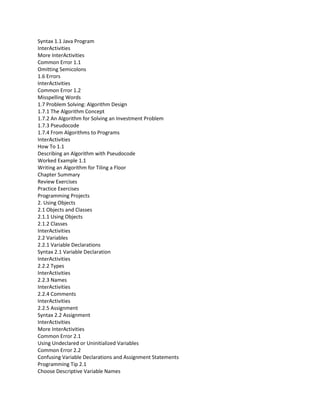
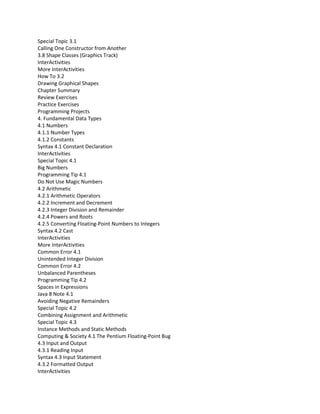
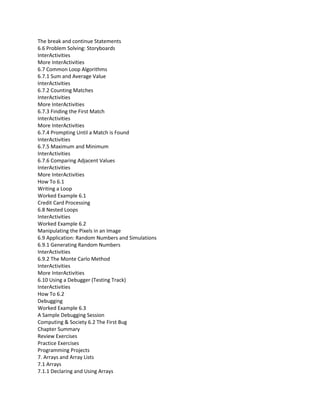
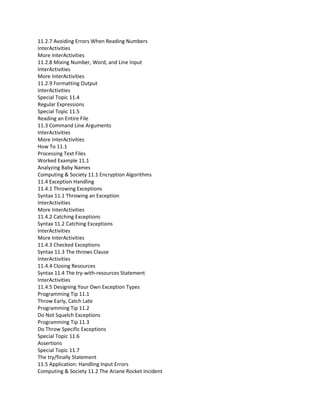
Syntax 1.1 JavaProgram
InterActivities
More InterActivities
Common Error 1.1
Omitting Semicolons
1.6 Errors
InterActivities
Common Error 1.2
Misspelling Words
1.7 Problem Solving: Algorithm Design
1.7.1 The Algorithm Concept
1.7.2 An Algorithm for Solving an Investment Problem
1.7.3 Pseudocode
1.7.4 From Algorithms to Programs
InterActivities
How To 1.1
Describing an Algorithm with Pseudocode
Worked Example 1.1
Writing an Algorithm for Tiling a Floor
Chapter Summary
Review Exercises
Practice Exercises
Programming Projects
2. Using Objects
2.1 Objects and Classes
2.1.1 Using Objects
2.1.2 Classes
InterActivities
2.2 Variables
2.2.1 Variable Declarations
Syntax 2.1 Variable Declaration
InterActivities
2.2.2 Types
InterActivities
2.2.3 Names
InterActivities
2.2.4 Comments
InterActivities
2.2.5 Assignment
Syntax 2.2 Assignment
InterActivities
More InterActivities
Common Error 2.1
Using Undeclared or Uninitialized Variables
Common Error 2.2
Confusing Variable Declarations and Assignment Statements
Programming Tip 2.1
Choose Descriptive Variable Names
6.
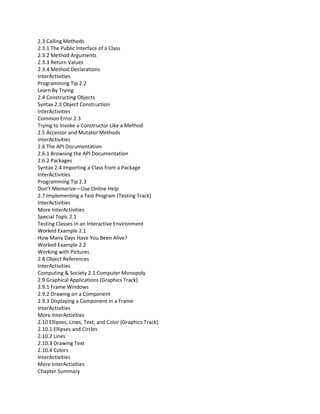
2.3 Calling Methods
2.3.1The Public Interface of a Class
2.3.2 Method Arguments
2.3.3 Return Values
2.3.4 Method Declarations
InterActivities
Programming Tip 2.2
Learn By Trying
2.4 Constructing Objects
Syntax 2.3 Object Construction
InterActivities
Common Error 2.3
Trying to Invoke a Constructor Like a Method
2.5 Accessor and Mutator Methods
InterActivities
2.6 The API Documentation
2.6.1 Browsing the API Documentation
2.6.2 Packages
Syntax 2.4 Importing a Class from a Package
InterActivities
Programming Tip 2.3
Don’t Memorize—Use Online Help
2.7 Implementing a Test Program (Testing Track)
InterActivities
More InterActivities
Special Topic 2.1
Testing Classes in an Interactive Environment
Worked Example 2.1
How Many Days Have You Been Alive?
Worked Example 2.2
Working with Pictures
2.8 Object References
InterActivities
Computing & Society 2.1 Computer Monopoly
2.9 Graphical Applications (Graphics Track)
2.9.1 Frame Windows
2.9.2 Drawing on a Component
2.9.3 Displaying a Component in a Frame
InterActivities
More InterActivities
2.10 Ellipses, Lines, Text, and Color (Graphics Track)
2.10.1 Ellipses and Circles
2.10.2 Lines
2.10.3 Drawing Text
2.10.4 Colors
InterActivities
More InterActivities
Chapter Summary
7.
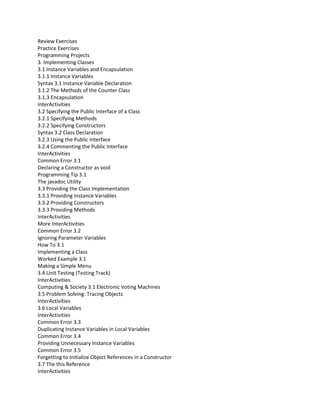
Review Exercises
Practice Exercises
ProgrammingProjects
3. Implementing Classes
3.1 Instance Variables and Encapsulation
3.1.1 Instance Variables
Syntax 3.1 Instance Variable Declaration
3.1.2 The Methods of the Counter Class
3.1.3 Encapsulation
InterActivities
3.2 Specifying the Public Interface of a Class
3.2.1 Specifying Methods
3.2.2 Specifying Constructors
Syntax 3.2 Class Declaration
3.2.3 Using the Public Interface
3.2.4 Commenting the Public Interface
InterActivities
Common Error 3.1
Declaring a Constructor as void
Programming Tip 3.1
The javadoc Utility
3.3 Providing the Class Implementation
3.3.1 Providing Instance Variables
3.3.2 Providing Constructors
3.3.3 Providing Methods
InterActivities
More InterActivities
Common Error 3.2
Ignoring Parameter Variables
How To 3.1
Implementing a Class
Worked Example 3.1
Making a Simple Menu
3.4 Unit Testing (Testing Track)
InterActivities
Computing & Society 3.1 Electronic Voting Machines
3.5 Problem Solving: Tracing Objects
InterActivities
3.6 Local Variables
InterActivities
Common Error 3.3
Duplicating Instance Variables in Local Variables
Common Error 3.4
Providing Unnecessary Instance Variables
Common Error 3.5
Forgetting to Initialize Object References in a Constructor
3.7 The this Reference
InterActivities
8.
Special Topic 3.1
CallingOne Constructor from Another
3.8 Shape Classes (Graphics Track)
InterActivities
More InterActivities
How To 3.2
Drawing Graphical Shapes
Chapter Summary
Review Exercises
Practice Exercises
Programming Projects
4. Fundamental Data Types
4.1 Numbers
4.1.1 Number Types
4.1.2 Constants
Syntax 4.1 Constant Declaration
InterActivities
Special Topic 4.1
Big Numbers
Programming Tip 4.1
Do Not Use Magic Numbers
4.2 Arithmetic
4.2.1 Arithmetic Operators
4.2.2 Increment and Decrement
4.2.3 Integer Division and Remainder
4.2.4 Powers and Roots
4.2.5 Converting Floating-Point Numbers to Integers
Syntax 4.2 Cast
InterActivities
More InterActivities
Common Error 4.1
Unintended Integer Division
Common Error 4.2
Unbalanced Parentheses
Programming Tip 4.2
Spaces in Expressions
Java 8 Note 4.1
Avoiding Negative Remainders
Special Topic 4.2
Combining Assignment and Arithmetic
Special Topic 4.3
Instance Methods and Static Methods
Computing & Society 4.1 The Pentium Floating-Point Bug
4.3 Input and Output
4.3.1 Reading Input
Syntax 4.3 Input Statement
4.3.2 Formatted Output
InterActivities
9.
More InterActivities
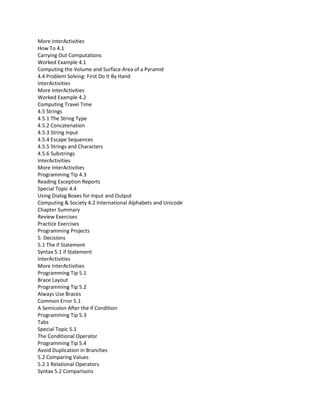
How To4.1
Carrying Out Computations
Worked Example 4.1
Computing the Volume and Surface Area of a Pyramid
4.4 Problem Solving: First Do It By Hand
InterActivities
More InterActivities
Worked Example 4.2
Computing Travel Time
4.5 Strings
4.5.1 The String Type
4.5.2 Concatenation
4.5.3 String Input
4.5.4 Escape Sequences
4.5.5 Strings and Characters
4.5.6 Substrings
InterActivities
More InterActivities
Programming Tip 4.3
Reading Exception Reports
Special Topic 4.4
Using Dialog Boxes for Input and Output
Computing & Society 4.2 International Alphabets and Unicode
Chapter Summary
Review Exercises
Practice Exercises
Programming Projects
5. Decisions
5.1 The if Statement
Syntax 5.1 if Statement
InterActivities
More InterActivities
Programming Tip 5.1
Brace Layout
Programming Tip 5.2
Always Use Braces
Common Error 5.1
A Semicolon After the if Condition
Programming Tip 5.3
Tabs
Special Topic 5.1
The Conditional Operator
Programming Tip 5.4
Avoid Duplication in Branches
5.2 Comparing Values
5.2.1 Relational Operators
Syntax 5.2 Comparisons
10.
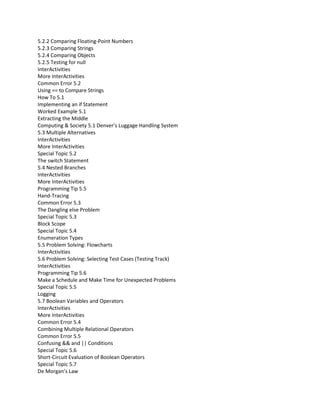
5.2.2 Comparing Floating-PointNumbers
5.2.3 Comparing Strings
5.2.4 Comparing Objects
5.2.5 Testing for null
InterActivities
More InterActivities
Common Error 5.2
Using == to Compare Strings
How To 5.1
Implementing an if Statement
Worked Example 5.1
Extracting the Middle
Computing & Society 5.1 Denver’s Luggage Handling System
5.3 Multiple Alternatives
InterActivities
More InterActivities
Special Topic 5.2
The switch Statement
5.4 Nested Branches
InterActivities
More InterActivities
Programming Tip 5.5
Hand-Tracing
Common Error 5.3
The Dangling else Problem
Special Topic 5.3
Block Scope
Special Topic 5.4
Enumeration Types
5.5 Problem Solving: Flowcharts
InterActivities
5.6 Problem Solving: Selecting Test Cases (Testing Track)
InterActivities
Programming Tip 5.6
Make a Schedule and Make Time for Unexpected Problems
Special Topic 5.5
Logging
5.7 Boolean Variables and Operators
InterActivities
More InterActivities
Common Error 5.4
Combining Multiple Relational Operators
Common Error 5.5
Confusing && and || Conditions
Special Topic 5.6
Short-Circuit Evaluation of Boolean Operators
Special Topic 5.7
De Morgan’s Law
11.
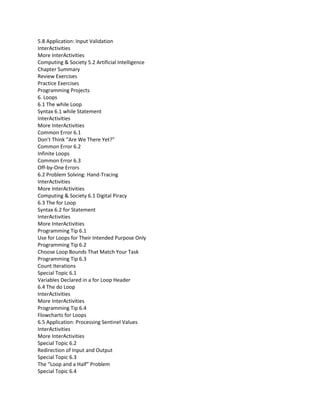
5.8 Application: InputValidation
InterActivities
More InterActivities
Computing & Society 5.2 Artificial Intelligence
Chapter Summary
Review Exercises
Practice Exercises
Programming Projects
6. Loops
6.1 The while Loop
Syntax 6.1 while Statement
InterActivities
More InterActivities
Common Error 6.1
Don’t Think “Are We There Yet?”
Common Error 6.2
Infinite Loops
Common Error 6.3
Off-by-One Errors
6.2 Problem Solving: Hand-Tracing
InterActivities
More InterActivities
Computing & Society 6.1 Digital Piracy
6.3 The for Loop
Syntax 6.2 for Statement
InterActivities
More InterActivities
Programming Tip 6.1
Use for Loops for Their Intended Purpose Only
Programming Tip 6.2
Choose Loop Bounds That Match Your Task
Programming Tip 6.3
Count Iterations
Special Topic 6.1
Variables Declared in a for Loop Header
6.4 The do Loop
InterActivities
More InterActivities
Programming Tip 6.4
Flowcharts for Loops
6.5 Application: Processing Sentinel Values
InterActivities
More InterActivities
Special Topic 6.2
Redirection of Input and Output
Special Topic 6.3
The “Loop and a Half” Problem
Special Topic 6.4
12.
The break andcontinue Statements
6.6 Problem Solving: Storyboards
InterActivities
More InterActivities
6.7 Common Loop Algorithms
6.7.1 Sum and Average Value
InterActivities
6.7.2 Counting Matches
InterActivities
More InterActivities
6.7.3 Finding the First Match
InterActivities
More InterActivities
6.7.4 Prompting Until a Match is Found
InterActivities
6.7.5 Maximum and Minimum
InterActivities
6.7.6 Comparing Adjacent Values
InterActivities
More InterActivities
How To 6.1
Writing a Loop
Worked Example 6.1
Credit Card Processing
6.8 Nested Loops
InterActivities
Worked Example 6.2
Manipulating the Pixels in an Image
6.9 Application: Random Numbers and Simulations
6.9.1 Generating Random Numbers
InterActivities
6.9.2 The Monte Carlo Method
InterActivities
More InterActivities
6.10 Using a Debugger (Testing Track)
InterActivities
How To 6.2
Debugging
Worked Example 6.3
A Sample Debugging Session
Computing & Society 6.2 The First Bug
Chapter Summary
Review Exercises
Practice Exercises
Programming Projects
7. Arrays and Array Lists
7.1 Arrays
7.1.1 Declaring and Using Arrays
13.
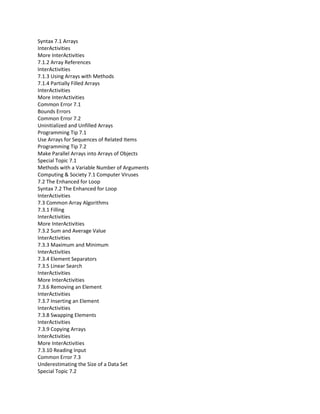
Syntax 7.1 Arrays
InterActivities
MoreInterActivities
7.1.2 Array References
InterActivities
7.1.3 Using Arrays with Methods
7.1.4 Partially Filled Arrays
InterActivities
More InterActivities
Common Error 7.1
Bounds Errors
Common Error 7.2
Uninitialized and Unfilled Arrays
Programming Tip 7.1
Use Arrays for Sequences of Related Items
Programming Tip 7.2
Make Parallel Arrays into Arrays of Objects
Special Topic 7.1
Methods with a Variable Number of Arguments
Computing & Society 7.1 Computer Viruses
7.2 The Enhanced for Loop
Syntax 7.2 The Enhanced for Loop
InterActivities
7.3 Common Array Algorithms
7.3.1 Filling
InterActivities
More InterActivities
7.3.2 Sum and Average Value
InterActivities
7.3.3 Maximum and Minimum
InterActivities
7.3.4 Element Separators
7.3.5 Linear Search
InterActivities
More InterActivities
7.3.6 Removing an Element
InterActivities
7.3.7 Inserting an Element
InterActivities
7.3.8 Swapping Elements
InterActivities
7.3.9 Copying Arrays
InterActivities
More InterActivities
7.3.10 Reading Input
Common Error 7.3
Underestimating the Size of a Data Set
Special Topic 7.2
14.
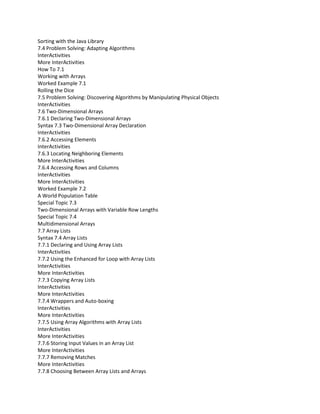
Sorting with theJava Library
7.4 Problem Solving: Adapting Algorithms
InterActivities
More InterActivities
How To 7.1
Working with Arrays
Worked Example 7.1
Rolling the Dice
7.5 Problem Solving: Discovering Algorithms by Manipulating Physical Objects
InterActivities
7.6 Two-Dimensional Arrays
7.6.1 Declaring Two-Dimensional Arrays
Syntax 7.3 Two-Dimensional Array Declaration
InterActivities
7.6.2 Accessing Elements
InterActivities
7.6.3 Locating Neighboring Elements
More InterActivities
7.6.4 Accessing Rows and Columns
InterActivities
More InterActivities
Worked Example 7.2
A World Population Table
Special Topic 7.3
Two-Dimensional Arrays with Variable Row Lengths
Special Topic 7.4
Multidimensional Arrays
7.7 Array Lists
Syntax 7.4 Array Lists
7.7.1 Declaring and Using Array Lists
InterActivities
7.7.2 Using the Enhanced for Loop with Array Lists
InterActivities
More InterActivities
7.7.3 Copying Array Lists
InterActivities
More InterActivities
7.7.4 Wrappers and Auto-boxing
InterActivities
More InterActivities
7.7.5 Using Array Algorithms with Array Lists
InterActivities
More InterActivities
7.7.6 Storing Input Values in an Array List
More InterActivities
7.7.7 Removing Matches
More InterActivities
7.7.8 Choosing Between Array Lists and Arrays
15.
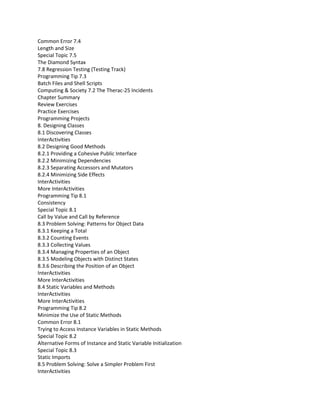
Common Error 7.4
Lengthand Size
Special Topic 7.5
The Diamond Syntax
7.8 Regression Testing (Testing Track)
Programming Tip 7.3
Batch Files and Shell Scripts
Computing & Society 7.2 The Therac-25 Incidents
Chapter Summary
Review Exercises
Practice Exercises
Programming Projects
8. Designing Classes
8.1 Discovering Classes
InterActivities
8.2 Designing Good Methods
8.2.1 Providing a Cohesive Public Interface
8.2.2 Minimizing Dependencies
8.2.3 Separating Accessors and Mutators
8.2.4 Minimizing Side Effects
InterActivities
More InterActivities
Programming Tip 8.1
Consistency
Special Topic 8.1
Call by Value and Call by Reference
8.3 Problem Solving: Patterns for Object Data
8.3.1 Keeping a Total
8.3.2 Counting Events
8.3.3 Collecting Values
8.3.4 Managing Properties of an Object
8.3.5 Modeling Objects with Distinct States
8.3.6 Describing the Position of an Object
InterActivities
More InterActivities
8.4 Static Variables and Methods
InterActivities
More InterActivities
Programming Tip 8.2
Minimize the Use of Static Methods
Common Error 8.1
Trying to Access Instance Variables in Static Methods
Special Topic 8.2
Alternative Forms of Instance and Static Variable Initialization
Special Topic 8.3
Static Imports
8.5 Problem Solving: Solve a Simpler Problem First
InterActivities
16.
8.6 Packages
8.6.1 OrganizingRelated Classes into Pack-ages
8.6.2 Importing Packages
8.6.3 Package Names
Syntax 8.1 Package Specification
8.6.4 Packages and Source Files
InterActivities
Common Error 8.2
Confusing Dots
Special Topic 8.4
Package Access
How To 8.1
Programming with Packages
8.7 Unit Test Frameworks (Testing Track)
InterActivities
More InterActivities
Computing & Society 8.1 Personal Computing
Chapter Summary
Review Exercises
Practice Exercises
Programming Projects
9. Inheritance
9.1 Inheritance Hierarchies
InterActivities
Programming Tip 9.1
Use a Single Class for Variation in Values, Inheritance for Variation in Behavior
9.2 Implementing Subclasses
Syntax 9.1 Subclass Declaration
InterActivities
More InterActivities
Common Error 9.1
Replicating Instance Variables from the Superclass
Common Error 9.2
Confusing Super- and Subclasses
9.3 Overriding Methods
Syntax 9.2 Calling a Superclass Method
InterActivities
More InterActivities
Common Error 9.3
Accidental Overloading
Common Error 9.4
Forgetting to Use super When Invoking a Superclass Method
Special Topic 9.1
Calling the Superclass Constructor
Syntax 9.3 Constructor with Superclass Initializer
9.4 Polymorphism
InterActivities
More InterActivities
17.
Special Topic 9.2
DynamicMethod Lookup and the Implicit Parameter
Special Topic 9.3
Abstract Classes
Special Topic 9.4
Final Methods and Classes
Special Topic 9.5
Protected Access
How To 9.1
Developing an Inheritance Hierarchy
Worked Example 9.1
Implementing an Employee Hierarchy for Payroll Processing
9.5 Object: The Cosmic Superclass
9.5.1 Overriding the toString Method
InterActivities
More InterActivities
9.5.2 The equals Method
InterActivities
More InterActivities
9.5.3 The instanceof Operator
Syntax 9.4 The instanceof Operator
InterActivities
Common Error 9.5
Don’t Use Type Tests
Special Topic 9.6
Inheritance and the toString Method
Special Topic 9.7
Inheritance and the equals Method
Computing & Society 9.1 Who Controls the Internet?
Chapter Summary
Review Exercises
Practice Exercises
Programming Projects
10. Interfaces
10.1 Using Interfaces for Algorithm Reuse
10.1.1 Discovering an Interface Type
10.1.2 Declaring an Interface Type
Syntax 10.1 Declaring an Interface
10.1.3 Implementing an Interface Type
Syntax 10.2 Implementing an Interface
10.1.4 Comparing Interfaces and Inheritance
InterActivities
More InterActivities
Common Error 10.1
Forgetting to Declare Implementing Methods as Public
Common Error 10.2
Trying to Instantiate an Interface
Special Topic 10.1
18.
Constants in Interfaces
Java8 Note 10.1
Static Methods in Interfaces
Java 8 Note 10.2
Default Methods
Java 8 Note 10.3
Conflicting Default Methods
10.2 Working with Interface Types
10.2.1 Converting from Classes to Interfaces
10.2.2 Invoking Methods on Interface Variables
10.2.3 Casting from Interfaces to Classes
InterActivities
More InterActivities
Worked Example 10.1
Investigating Number Sequences
10.3 The Comparable Interface
InterActivities
More InterActivities
Programming Tip 10.1
Comparing Integers and Floating-Point Numbers
Special Topic 10.2
The clone Method and the Cloneable Interface
10.4 Using Interfaces for Callbacks
InterActivities
Java 8 Note 10.4
Lambda Expressions
Special Topic 10.3
Generic Interface Types
10.5 Inner Classes
InterActivities
Special Topic 10.4
Anonymous Classes
10.6 Mock Objects (Testing Track)
InterActivities
10.7 Event Handling (Graphics Track)
10.7.1 Listening to Events
10.7.2 Using Inner Classes for Listeners
InterActivities
Common Error 10.3
Modifying Parameter Types in the Implementing Method
Common Error 10.4
Trying to Call Listener Methods
Java 8 Note 10.5
Lambda Expressions for Event Handling
10.8 Building Applications with Buttons (Graphics Track)
InterActivities
Common Error 10.5
Forgetting to Attach a Listener
19.
Programming Tip 10.2
Don’tUse a Container as a Listener
10.9 Processing Timer Events (Graphics Track)
InterActivities
Common Error 10.6
Forgetting to Repaint
10.10 Mouse Events (Graphics Track)
InterActivities
Special Topic 10.5
Keyboard Events
Special Topic 10.6
Event Adapters
Computing & Society 10.1 Open Source and Free Software
Chapter Summary
Review Exercises
Practice Exercises
Programming Projects
11. Input/Output and Exception Handling
11.1 Reading and Writing Text Files
InterActivities
More InterActivities
Common Error 11.1
Backslashes in File Names
Common Error 11.2
Constructing a Scanner with a String
Special Topic 11.1
Reading Web Pages
Special Topic 11.2
File Dialog Boxes
Special Topic 11.3
Character Encodings
11.2 Text Input and Output
11.2.1 Reading Words
InterActivities
11.2.2 Reading Characters
InterActivities
More InterActivities
11.2.3 Classifying Characters
InterActivities
More InterActivities
11.2.4 Reading Lines
InterActivities
11.2.5 Scanning a String
InterActivities
More InterActivities
11.2.6 Converting Strings to Numbers
InterActivities
More InterActivities
20.
11.2.7 Avoiding ErrorsWhen Reading Numbers
InterActivities
More InterActivities
11.2.8 Mixing Number, Word, and Line Input
InterActivities
More InterActivities
11.2.9 Formatting Output
InterActivities
Special Topic 11.4
Regular Expressions
Special Topic 11.5
Reading an Entire File
11.3 Command Line Arguments
InterActivities
More InterActivities
How To 11.1
Processing Text Files
Worked Example 11.1
Analyzing Baby Names
Computing & Society 11.1 Encryption Algorithms
11.4 Exception Handling
11.4.1 Throwing Exceptions
Syntax 11.1 Throwing an Exception
InterActivities
More InterActivities
11.4.2 Catching Exceptions
Syntax 11.2 Catching Exceptions
InterActivities
More InterActivities
11.4.3 Checked Exceptions
Syntax 11.3 The throws Clause
InterActivities
11.4.4 Closing Resources
Syntax 11.4 The try-with-resources Statement
InterActivities
11.4.5 Designing Your Own Exception Types
Programming Tip 11.1
Throw Early, Catch Late
Programming Tip 11.2
Do Not Squelch Exceptions
Programming Tip 11.3
Do Throw Specific Exceptions
Special Topic 11.6
Assertions
Special Topic 11.7
The try/finally Statement
11.5 Application: Handling Input Errors
Computing & Society 11.2 The Ariane Rocket Incident
21.
Chapter Summary
Review Exercises
PracticeExercises
Programming Projects
12. Object-Oriented Design
12.1 Classes and Their Responsibilities
12.1.1 Discovering Classes
12.1.2 The CRC Card Method
InterActivities
12.2 Relationships Between Classes
12.2.1 Dependency
12.2.2 Aggregation
12.2.3 Inheritance
InterActivities
How To 12.1
Using CRC Cards and UML Diagrams in Program Design
Special Topic 12.1
Attributes and Methods in UML Diagrams
Special Topic 12.2
Multiplicities
Special Topic 12.3
Aggregation, Association, and Composition
12.3 Application: Printing an Invoice
12.3.1 Requirements
12.3.2 CRC Cards
12.3.3 UML Diagrams
12.3.4 Method Documentation
12.3.5 Implementation
InterActivities
Computing & Society 12.1 Databases and Privacy
Worked Example 12.1
Simulating an Automatic Teller Machine
Chapter Summary
Review Exercises
Practice Exercises
Programming Projects
13. Recursion
13.1 Triangle Numbers
InterActivities
Common Error 13.1
Infinite Recursion
Common Error 13.2
Tracing Through Recursive Methods
How To 13.1
Thinking Recursively
Worked Example 13.1
Finding Files
13.2 Recursive Helper Methods
22.
InterActivities
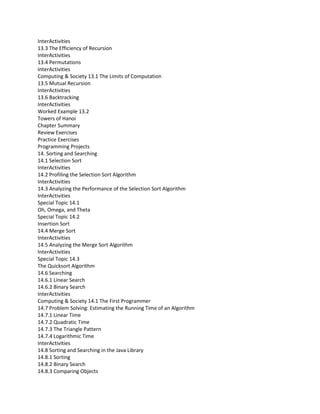
13.3 The Efficiencyof Recursion
InterActivities
13.4 Permutations
InterActivities
Computing & Society 13.1 The Limits of Computation
13.5 Mutual Recursion
InterActivities
13.6 Backtracking
InterActivities
Worked Example 13.2
Towers of Hanoi
Chapter Summary
Review Exercises
Practice Exercises
Programming Projects
14. Sorting and Searching
14.1 Selection Sort
InterActivities
14.2 Profiling the Selection Sort Algorithm
InterActivities
14.3 Analyzing the Performance of the Selection Sort Algorithm
InterActivities
Special Topic 14.1
Oh, Omega, and Theta
Special Topic 14.2
Insertion Sort
14.4 Merge Sort
InterActivities
14.5 Analyzing the Merge Sort Algorithm
InterActivities
Special Topic 14.3
The Quicksort Algorithm
14.6 Searching
14.6.1 Linear Search
14.6.2 Binary Search
InterActivities
Computing & Society 14.1 The First Programmer
14.7 Problem Solving: Estimating the Running Time of an Algorithm
14.7.1 Linear Time
14.7.2 Quadratic Time
14.7.3 The Triangle Pattern
14.7.4 Logarithmic Time
InterActivities
14.8 Sorting and Searching in the Java Library
14.8.1 Sorting
14.8.2 Binary Search
14.8.3 Comparing Objects
23.
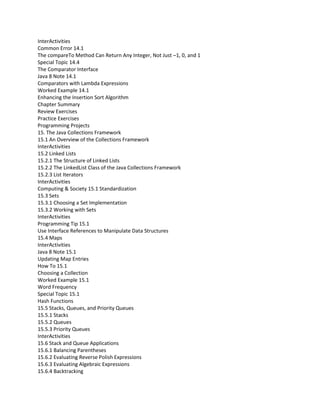
InterActivities
Common Error 14.1
ThecompareTo Method Can Return Any Integer, Not Just –1, 0, and 1
Special Topic 14.4
The Comparator Interface
Java 8 Note 14.1
Comparators with Lambda Expressions
Worked Example 14.1
Enhancing the Insertion Sort Algorithm
Chapter Summary
Review Exercises
Practice Exercises
Programming Projects
15. The Java Collections Framework
15.1 An Overview of the Collections Framework
InterActivities
15.2 Linked Lists
15.2.1 The Structure of Linked Lists
15.2.2 The LinkedList Class of the Java Collections Framework
15.2.3 List Iterators
InterActivities
Computing & Society 15.1 Standardization
15.3 Sets
15.3.1 Choosing a Set Implementation
15.3.2 Working with Sets
InterActivities
Programming Tip 15.1
Use Interface References to Manipulate Data Structures
15.4 Maps
InterActivities
Java 8 Note 15.1
Updating Map Entries
How To 15.1
Choosing a Collection
Worked Example 15.1
Word Frequency
Special Topic 15.1
Hash Functions
15.5 Stacks, Queues, and Priority Queues
15.5.1 Stacks
15.5.2 Queues
15.5.3 Priority Queues
InterActivities
15.6 Stack and Queue Applications
15.6.1 Balancing Parentheses
15.6.2 Evaluating Reverse Polish Expressions
15.6.3 Evaluating Algebraic Expressions
15.6.4 Backtracking
24.
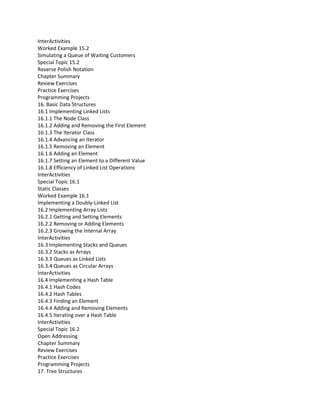
InterActivities
Worked Example 15.2
Simulatinga Queue of Waiting Customers
Special Topic 15.2
Reverse Polish Notation
Chapter Summary
Review Exercises
Practice Exercises
Programming Projects
16. Basic Data Structures
16.1 Implementing Linked Lists
16.1.1 The Node Class
16.1.2 Adding and Removing the First Element
16.1.3 The Iterator Class
16.1.4 Advancing an Iterator
16.1.5 Removing an Element
16.1.6 Adding an Element
16.1.7 Setting an Element to a Different Value
16.1.8 Efficiency of Linked List Operations
InterActivities
Special Topic 16.1
Static Classes
Worked Example 16.1
Implementing a Doubly-Linked List
16.2 Implementing Array Lists
16.2.1 Getting and Setting Elements
16.2.2 Removing or Adding Elements
16.2.3 Growing the Internal Array
InterActivities
16.3 Implementing Stacks and Queues
16.3.2 Stacks as Arrays
16.3.3 Queues as Linked Lists
16.3.4 Queues as Circular Arrays
InterActivities
16.4 Implementing a Hash Table
16.4.1 Hash Codes
16.4.2 Hash Tables
16.4.3 Finding an Element
16.4.4 Adding and Removing Elements
16.4.5 Iterating over a Hash Table
InterActivities
Special Topic 16.2
Open Addressing
Chapter Summary
Review Exercises
Practice Exercises
Programming Projects
17. Tree Structures
25.
17.1 Basic TreeConcepts
InterActivities
17.2 Binary Trees
17.2.1 Binary Tree Examples
17.2.2 Balanced Trees
17.2.3 A Binary Tree Implementation
InterActivities
Worked Example 17.1
Building a Huffman Tree
17.3 Binary Search Trees
17.3.1 The Binary Search Property
17.3.2 Insertion
17.3.3 Removal
17.3.4 Efficiency of the Operations
InterActivities
17.4 Tree Traversal
17.4.1 Inorder Traversal
17.4.2 Preorder and Postorder Traversals
17.4.3 The Visitor Pattern
17.4.4 Depth-First and Breadth-First Search
17.4.5 Tree Iterators
InterActivities
17.5 Red-Black Trees
17.5.1 Basic Properties of Red-Black Trees
17.5.2 Insertion
17.5.3 Removal
Worked Example 17.2
Implementing a Red-Black Tree
17.6 Heaps
17.7 The Heapsort Algorithm
Chapter Summary
Review Exercises
Practice Exercises
Programming Projects
18. Generic Classes
18.1 Generic Classes and Type Parameters
InterActivities
18.2 Implementing Generic Types
Syntax 18.1 Declaring a Generic Class
InterActivities
18.3 Generic Methods
Syntax 18.2 Declaring a Generic Method
InterActivities
18.4 Constraining Type Parameters
InterActivities
Common Error 18.1
Genericity and Inheritance
Common Error 18.2
26.
The Array StoreException
Special Topic 18.1
Wildcard Types
18.5 Type Erasure
InterActivities
Common Error 18.3
Using Generic Types in a Static Context
Special Topic 18.2
Reflection
Worked Example 18.1
Making a Generic Binary Search Tree Class
Chapter Summary
Review Exercises
Practice Exercises
Programming Projects
19. Stream Processing
19.1 The Stream Concept
InterActivities
19.2 Producing Streams
InterActivities
19.3 Collecting Results
InterActivities
Programming Tip 19.1
One Stream Operation Per Line
Special Topic 19.1
Infinite Streams
19.4 Transforming Streams
InterActivities
Common Error 19.1
Don’t Use a Terminated Stream
19.5 Lambda Expressions
Syntax 19.1 Lambda Expressions
InterActivities
Programming Tip 19.2
Keep Lambda Expressions Short
Special Topic 19.2
Method and Constructor References
Special Topic 19.3
Higher-Order Functions
Special Topic 19.4
Higher-Order Functions and Comparators
19.6 The Optional Type
InterActivities
Common Error 19.2
Optional Results Without Values
19.7 Other Terminal Operations
InterActivities
Common Error 19.3
27.
Don’t Apply Mutationsin Parallel Stream Operations
19.8 Primitive-Type Streams
19.8.1 Creating Primitive-Type Streams
19.8.2 Mapping a Primitive-Type Stream
19.8.3 Processing Primitive-Type Streams
InterActivities
19.9 Grouping Results
InterActivities
19.10 Common Algorithms Revisited
19.10.1 Filling
19.10.2 Sum, Average, Maximum, and Minimum
19.10.3 Counting Matches
19.10.4 Element Separators
19.10.5 Linear Search
19.10.6 Comparing Adjacent Values
InterActivities
How To 19.1
Working with Streams
Worked Example 19.1
Word Properties
Worked Example 19.2
A Movie Database
Chapter Summary
Review Exercises
Practice Exercises
Programming Projects
20. Graphical User Interfaces
20.1 Layout Management
20.1.1 Using Layout Managers
20.1.2 Achieving Complex Layouts
20.1.3 Using Inheritance to Customize Frames
Common Error 20.1
By Default, Components Have Zero Width and Height
Special Topic 20.1
Adding the main Method to the Frame Class
20.2 Processing Text Input
20.2.1 Text Fields
20.2.2 Text Areas
20.3 Choices
20.3.1 Radio Buttons
20.3.2 Check Boxes
20.3.3 Combo Boxes
How To 20.1
Laying Out a User Interface
Worked Example 20.1
Programming a Working Calculator
Programming Tip 20.1
Use a GUI Builder
28.
20.4 Menus
20.5 Exploringthe Swing Documentation
Chapter Summary
Review Exercises
Practice Exercises
Programming Projects
21. Advanced Input/Output
21.1 Readers, Writers, and Input/Output Streams
21.2 Binary Input and Output
Common Error 21.1
Negative byte Values
21.3 Random Access
21.4 Object Input and Output Streams
How To 21.1
Choosing a File Format
21.5 File and Directory Operations
21.5.1 Paths
21.5.2 Creating and Deleting Files and Directories
21.5.3 Useful File Operations
21.5.4 Visiting Directories
Chapter Summary
Review Exercises
Practice Exercises
Programming Projects
22. Multithreading
22.1 Running Threads
Programming Tip 22.1
Use the Runnable Interface
Special Topic 22.1
Thread Pools
22.2 Terminating Threads
Programming Tip 22.2
Check for Thread Interruptions in the run Method of a Thread
22.3 Race Conditions
22.4 Synchronizing Object Access
22.5 Avoiding Deadlocks
Common Error 22.1
Calling await Without Calling signalAll
Common Error 22.2
Calling signalAll Without Locking the Object
Special Topic 22.2
Object Locks and Synchronized Methods
Special Topic 22.3
The Java Memory Model
22.6 Application: Algorithm Animation
Chapter Summary
Review Exercises
Practice Exercises
29.
Programming Projects
23. InternetNetworking
23.1 The Internet Protocol
23.2 Application Level Protocols
23.3 A Client Program
23.4 A Server Program
How To 23.1
Designing Client/Server Programs
23.5 URL Connections
Programming Tip 23.1
Use High-Level Libraries
Chapter Summary
Review Exercises
Practice Exercises
Programming Projects
24. Relational Databases
24.1 Organizing Database Information
24.1.1 Database Tables
24.1.2 Linking Tables
24.1.3 Implementing Multi-Valued Relation-ships
Programming Tip 24.1
Stick with the Standard
Programming Tip 24.2
Avoid Unnecessary Data Replication
Programming Tip 24.3
Don’t Replicate Columns in a Table
Special Topic 24.1
Primary Keys and Indexes
24.2 Queries
24.2.1 Simple Queries
24.2.2 Selecting Columns
24.2.3 Selecting Subsets
24.2.4 Calculations
24.2.5 Joins
24.2.6 Updating and Deleting Data
Common Error 24.1
Joining Tables Without Specifying a Link Condition
24.3 Installing a Database
24.4 Database Programming in Java
24.4.1 Connecting to the Database
24.4.2 Executing SQL Statements
24.4.3 Analyzing Query Results
24.4.4 Result Set Metadata
Common Error 24.2
Constructing Queries from Arbitrary Strings
Programming Tip 24.4
Don’t Hardwire Database Connection Parameters into Your Program
Programming Tip 24.5
30.
Let the DatabaseDo the Work
24.5 Application: Entering an Invoice
Special Topic 24.2
Transactions
Special Topic 24.3
Object-Relational Mapping
Worked Example 24.1
Programming a Bank Database
Chapter Summary
Review Exercises
Practice Exercises
Programming Projects
25. XML
25.1 XML Tags and Documents
25.1.1 Advantages of XML
25.1.2 Differences Between XML and HTML
25.1.3 The Structure of an XML Document
How To 25.1
Designing an XML Document Format
Programming Tip 25.1
Prefer XML Elements over Attributes
Programming Tip 25.2
Avoid Children with Mixed Elements and Text
25.2 Parsing XML Documents
Common Error 25.1
XML Elements Describe Objects, Not Classes
25.3 Creating XML Documents
How To 25.2
Writing an XML Document
Special Topic 25.1
Grammars, Parsers, and Compilers
25.4 Validating XML Documents
25.4.1 Document Type Definitions
25.4.2 Specifying a DTD in an XML Document
25.4.3 Parsing and Validation
How To 25.3
Writing a DTD
Special Topic 25.2
Schema Languages
Special Topic 25.3
Other XML Technologies
Chapter Summary
Review Exercises
Practice Exercises
Programming Projects
26. Web Applications
26.1 The Architecture of a Web Application
26.2 The Architecture of a JSF Application
31.
26.2.1 JSF Pages
26.2.2Managed Beans
26.2.3 Separation of Presentation and Business Logic
26.2.4 Deploying a JSF Application
Special Topic 26.1
Session State and Cookies
26.3 JavaBeans Components
26.4 Navigation Between Pages
How To 26.1
Designing a Managed Bean
26.5 JSF Components
26.6 A Three-Tier Application
Special Topic 26.2
AJAX
Chapter Summary
Review Exercises
Practice Exercises
Programming Projects
APPENDIX A: THE BASIC LATIN AND LATIN-1 SUBSETS OF UNICODE
APPENDIX B: JAVA OPERATOR SUMMARY
APPENDIX C: JAVA RESERVED WORD SUMMARY
APPENDIX D: THE JAVA LIBRARY
Package java.awt
Package java.awt.event
Package java.awt.geom
Package java.io
Package java.lang
Package java.math
Package java.net
Package java.nio.file
Package java.sql
Package java.text
Package java.util
Package java.util.concurrent.locks
Package java.util.function
Package java.util.logging
Package java.util.stream
Package javax.sql
Package javax.swing
Package javax.swing.border
Package javax.swing.event
Package javax.swing.text
Package javax.xml.parsers
Package javax.xml.xpath
Package org.w3c.dom
Package org.w3c.dom.ls
APPENDIX E: JAVA LANGUAGE CODING GUIDELINES
Introduction
32.
Source Files
Classes
Methods
Variables andConstants
Control Flow
Lexical Issues
APPENDIX F: TOOL SUMMARY
The Java Compiler
The Java Virtual Machine Launcher
The JAR Tool
APPENDIX G: NUMBER SYSTEMS
Binary Numbers
Overflow and Roundoff Errors
Two’s Complement Integers
IEEE Floating-Point Numbers
Hexadecimal Numbers
Bit and Shift Operations
APPENDIX H: UML SUMMARY
CRC Cards
UML Diagrams
APPENDIX I: JAVA SYNTAX SUMMARY
Types
Variables
Expressions
Classes
Interfaces
Enumeration Types
Methods
Constructors
Statements
Exceptions
Packages
Generic Types and Methods
Comments
APPENDIX J: HTML SUMMARY
A Brief Introduction to HTML
Illustration Credits
Wiley End User License Agreement
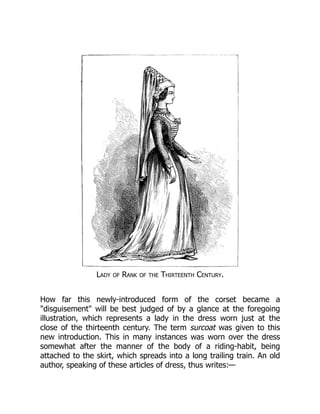
Lady of Rankof the Thirteenth Century.
How far this newly-introduced form of the corset became a
"disguisement" will be best judged of by a glance at the foregoing
illustration, which represents a lady in the dress worn just at the
close of the thirteenth century. The term surcoat was given to this
new introduction. This in many instances was worn over the dress
somewhat after the manner of the body of a riding-habit, being
attached to the skirt, which spreads into a long trailing train. An old
author, speaking of these articles of dress, thus writes:—
35.
"There came tome two women wearing surcoats, longer than they
were tall by about a yard, so that they were obliged to carry their
trains upon their arms to prevent their trailing upon the ground, and
they had sleeves to these surcoats reaching to the elbows."
The trains of these dresses at length reached such formidable
dimensions that Charles V. of France became so enraged as to cause
an edict to be issued hurling threats of excommunication at the
heads of all those who dared to wear a dress which terminated "like
the tail of a serpent."
Notwithstanding this tremendously alarming threat, a tailor was
found fully equal to the occasion, who, in spite of the terrors inspired
by candle, bell, and book, set to work (lion-hearted man that he was)
and made a magnificent surcoat for Madame du Gatinais, which not
only trailed far behind on the ground, but actually "took five yards of
Brussels net for sleeves, which also trailed." History, or even
tradition, fails to inform us what dreadful fate overtook this desperate
tailor after the performance of a feat so recklessly daring; but we can
scarcely fancy that his end could have been of the kind common to
tailors of less audacious depravity.
The bodies of these surcoats were very much stiffened, and so made
as to admit of being laced with extreme tightness. They were often
very richly ornamented with furs and costly needlework. As fashion
changed, dresses were made with open fronts, so as to be worn over
the surcoat without altogether concealing it. A portrait of Marie
d'Anjou, Queen of France, shows this arrangement of costume. The
waist appears very tightly laced, and the body of the surcoat much
resembles the modern bodice, but is made by stiffening and cut to
perform the part of a very strong and efficient corset. Until the
termination of the fourteenth century very little change appears to
have been made either in costume or the treatment of the figure, but
at the commencement of the fifteenth century, when such noble
families as the Medici, Este, and Visconti established fashions and
styles of costume for themselves, each house vied with the other in
the splendour of their apparel. The great masters of the period, by
36.
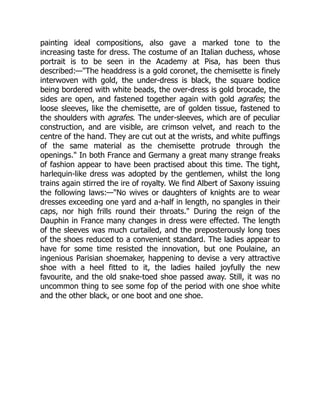
painting ideal compositions,also gave a marked tone to the
increasing taste for dress. The costume of an Italian duchess, whose
portrait is to be seen in the Academy at Pisa, has been thus
described:—"The headdress is a gold coronet, the chemisette is finely
interwoven with gold, the under-dress is black, the square bodice
being bordered with white beads, the over-dress is gold brocade, the
sides are open, and fastened together again with gold agrafes; the
loose sleeves, like the chemisette, are of golden tissue, fastened to
the shoulders with agrafes. The under-sleeves, which are of peculiar
construction, and are visible, are crimson velvet, and reach to the
centre of the hand. They are cut out at the wrists, and white puffings
of the same material as the chemisette protrude through the
openings." In both France and Germany a great many strange freaks
of fashion appear to have been practised about this time. The tight,
harlequin-like dress was adopted by the gentlemen, whilst the long
trains again stirred the ire of royalty. We find Albert of Saxony issuing
the following laws:—"No wives or daughters of knights are to wear
dresses exceeding one yard and a-half in length, no spangles in their
caps, nor high frills round their throats." During the reign of the
Dauphin in France many changes in dress were effected. The length
of the sleeves was much curtailed, and the preposterously long toes
of the shoes reduced to a convenient standard. The ladies appear to
have for some time resisted the innovation, but one Poulaine, an
ingenious Parisian shoemaker, happening to devise a very attractive
shoe with a heel fitted to it, the ladies hailed joyfully the new
favourite, and the old snake-toed shoe passed away. Still, it was no
uncommon thing to see some fop of the period with one shoe white
and the other black, or one boot and one shoe.
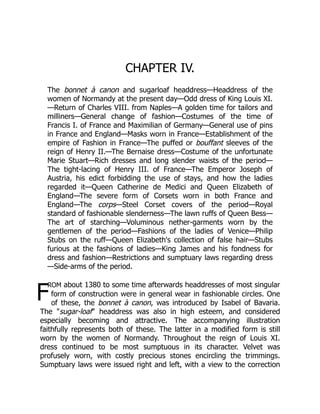
F
CHAPTER IV.
The bonnetà canon and sugarloaf headdress—Headdress of the
women of Normandy at the present day—Odd dress of King Louis XI.
—Return of Charles VIII. from Naples—A golden time for tailors and
milliners—General change of fashion—Costumes of the time of
Francis I. of France and Maximilian of Germany—General use of pins
in France and England—Masks worn in France—Establishment of the
empire of Fashion in France—The puffed or bouffant sleeves of the
reign of Henry II.—The Bernaise dress—Costume of the unfortunate
Marie Stuart—Rich dresses and long slender waists of the period—
The tight-lacing of Henry III. of France—The Emperor Joseph of
Austria, his edict forbidding the use of stays, and how the ladies
regarded it—Queen Catherine de Medici and Queen Elizabeth of
England—The severe form of Corsets worn in both France and
England—The corps—Steel Corset covers of the period—Royal
standard of fashionable slenderness—The lawn ruffs of Queen Bess—
The art of starching—Voluminous nether-garments worn by the
gentlemen of the period—Fashions of the ladies of Venice—Philip
Stubs on the ruff—Queen Elizabeth's collection of false hair—Stubs
furious at the fashions of ladies—King James and his fondness for
dress and fashion—Restrictions and sumptuary laws regarding dress
—Side-arms of the period.
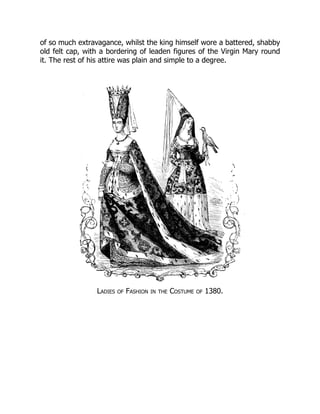
rom about 1380 to some time afterwards headdresses of most singular
form of construction were in general wear in fashionable circles. One
of these, the bonnet à canon, was introduced by Isabel of Bavaria.
The "sugar-loaf" headdress was also in high esteem, and considered
especially becoming and attractive. The accompanying illustration
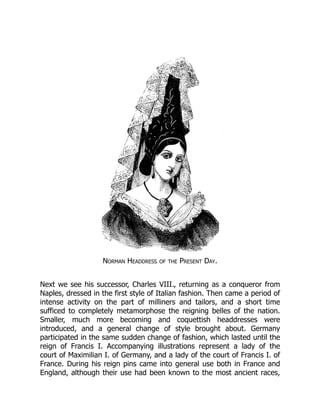
faithfully represents both of these. The latter in a modified form is still
worn by the women of Normandy. Throughout the reign of Louis XI.
dress continued to be most sumptuous in its character. Velvet was
profusely worn, with costly precious stones encircling the trimmings.
Sumptuary laws were issued right and left, with a view to the correction
42.
of so muchextravagance, whilst the king himself wore a battered, shabby
old felt cap, with a bordering of leaden figures of the Virgin Mary round
it. The rest of his attire was plain and simple to a degree.
Ladies of Fashion in the Costume of 1380.
43.
Norman Headdress ofthe Present Day.
Next we see his successor, Charles VIII., returning as a conqueror from
Naples, dressed in the first style of Italian fashion. Then came a period of
intense activity on the part of milliners and tailors, and a short time
sufficed to completely metamorphose the reigning belles of the nation.
Smaller, much more becoming and coquettish headdresses were
introduced, and a general change of style brought about. Germany
participated in the same sudden change of fashion, which lasted until the
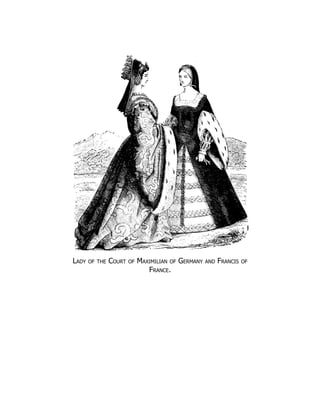
reign of Francis I. Accompanying illustrations represent a lady of the
court of Maximilian I. of Germany, and a lady of the court of Francis I. of
France. During his reign pins came into general use both in France and
England, although their use had been known to the most ancient races,
44.
numerous specimens havingbeen discovered in the excavations of
Thebes and other Old World cities. Ladies' masks or visors were also
introduced in France at this period, but they did not become general in
England until the reign of Queen Elizabeth. It was about this time that
France commenced the establishment of her own fashions and invented
for herself, and that the ladies of that nation became celebrated for the
taste and elegance of their raiment.
On Henry II. succeeding Charles this taste was steadily on the increase.
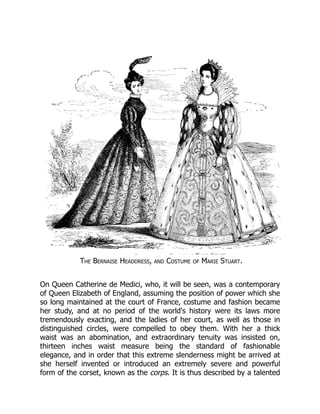
The bouffant, or puffed form of sleeve, was introduced, and a very pretty
and becoming style of headdress known as the Bernaise. The illustration
shows a lady wearing this, the feather being a mark of distinction. The
dress is made of rich brocade, and the waist exceedingly long (period,
1547.) The right-hand figure represents the unfortunate Marie Stuart
arrayed in a court dress of the period, 1559. On the head is a gold
coronet; her under-dress is gold brocade, with gold arabesque work over
it; the over-dress is velvet, trimmed with ermine; the girdle consisted of
costly strings of pearls; the sleeves are of gold-coloured silk, and the
puffings are separated from each other by an arrangement of precious
stones; the front of the dress is also profusely ornamented in the same
manner; the frill or ruff was made from costly lace from Venice or Genoa,
and was invented by this very charming but unfortunate lady; the form of
the waist is, as will be seen on reference to this illustration, long, and
shows by its contour the full influence of the tightly-laced corset beneath
the dress, which fits the figure with extraordinary accuracy.
At this time Fashion held such despotic sway throughout the continent of
Europe, that the Emperor Joseph of Austria, following out his
extraordinary penchant for the passing of edicts, and becoming alarmed
at the formidable lures laid out for the capture of mankind by the fair sex,
passed a law rigorously forbidding the use of the corset in all nunneries
and places where young females were educated; and no less a threat
than that of excommunication, and the loss of all the indulgences the
Church was capable of affording, hung over the heads of all those evil-
disposed damsels who persisted in a treasonable manner in the practice
of confining their waists with such evil instruments as stays. Royal
command, like an electric shock, startled the College of Physicians into
activity and zeal, and learned dissertations on the crying sin of tight
lacing were scattered broadcast amongst the ranks of the benighted and
45.
tight-laced ladies ofthe time, much as the advertisements of cheap
furnishing ironmongers are hurled into the West-End omnibuses of our
own day.
It is proverbial that gratuitous advice is rarely followed by the recipient.
Open defiance was in a very short time bid to the edicts of the emperor
and the erudite dissertations of the doctors. The corsets were, if possible,
laced tighter than ever, and without anything very particular happening to
the world at large in consequence.
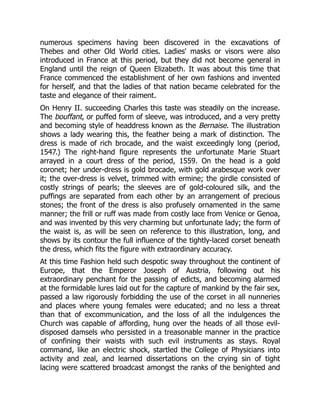
Lady of the Court of Charles VIII.,
1560.
46.
Lady of theCourt of Maximilian of Germany and Francis of
France.
The Bernaise Headdress,and Costume of Marie Stuart.
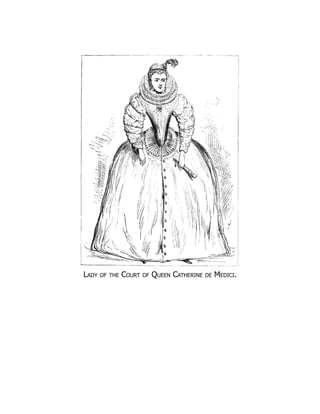
On Queen Catherine de Medici, who, it will be seen, was a contemporary
of Queen Elizabeth of England, assuming the position of power which she
so long maintained at the court of France, costume and fashion became
her study, and at no period of the world's history were its laws more
tremendously exacting, and the ladies of her court, as well as those in
distinguished circles, were compelled to obey them. With her a thick
waist was an abomination, and extraordinary tenuity was insisted on,
thirteen inches waist measure being the standard of fashionable
elegance, and in order that this extreme slenderness might be arrived at
she herself invented or introduced an extremely severe and powerful
form of the corset, known as the corps. It is thus described by a talented
50.
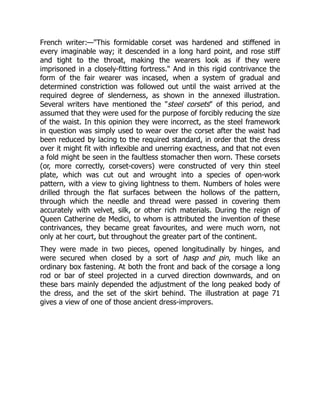
French writer:—"This formidablecorset was hardened and stiffened in
every imaginable way; it descended in a long hard point, and rose stiff
and tight to the throat, making the wearers look as if they were
imprisoned in a closely-fitting fortress." And in this rigid contrivance the
form of the fair wearer was incased, when a system of gradual and
determined constriction was followed out until the waist arrived at the
required degree of slenderness, as shown in the annexed illustration.
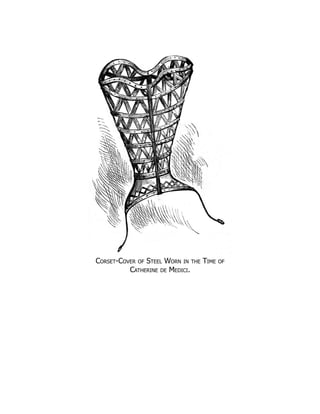
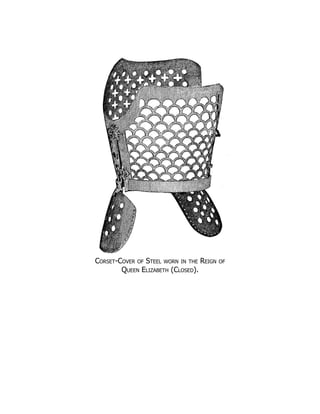
Several writers have mentioned the "steel corsets" of this period, and
assumed that they were used for the purpose of forcibly reducing the size
of the waist. In this opinion they were incorrect, as the steel framework
in question was simply used to wear over the corset after the waist had
been reduced by lacing to the required standard, in order that the dress
over it might fit with inflexible and unerring exactness, and that not even
a fold might be seen in the faultless stomacher then worn. These corsets
(or, more correctly, corset-covers) were constructed of very thin steel
plate, which was cut out and wrought into a species of open-work
pattern, with a view to giving lightness to them. Numbers of holes were
drilled through the flat surfaces between the hollows of the pattern,
through which the needle and thread were passed in covering them
accurately with velvet, silk, or other rich materials. During the reign of
Queen Catherine de Medici, to whom is attributed the invention of these
contrivances, they became great favourites, and were much worn, not
only at her court, but throughout the greater part of the continent.
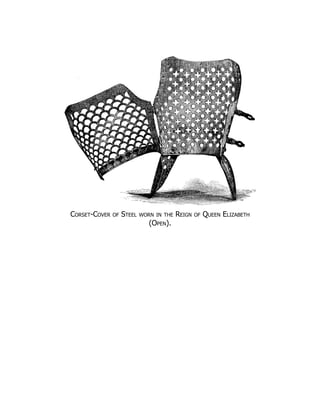
They were made in two pieces, opened longitudinally by hinges, and
were secured when closed by a sort of hasp and pin, much like an
ordinary box fastening. At both the front and back of the corsage a long
rod or bar of steel projected in a curved direction downwards, and on
these bars mainly depended the adjustment of the long peaked body of
the dress, and the set of the skirt behind. The illustration at page 71
gives a view of one of those ancient dress-improvers.
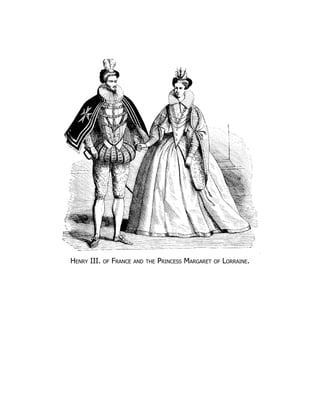
Henry III. ofFrance and the Princess Margaret of Lorraine.
53.
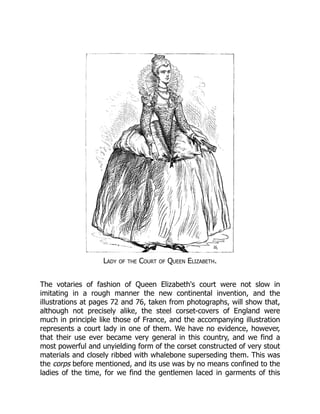
Lady of theCourt of Queen Elizabeth.
The votaries of fashion of Queen Elizabeth's court were not slow in
imitating in a rough manner the new continental invention, and the
illustrations at pages 72 and 76, taken from photographs, will show that,
although not precisely alike, the steel corset-covers of England were
much in principle like those of France, and the accompanying illustration
represents a court lady in one of them. We have no evidence, however,
that their use ever became very general in this country, and we find a
most powerful and unyielding form of the corset constructed of very stout
materials and closely ribbed with whalebone superseding them. This was
the corps before mentioned, and its use was by no means confined to the
ladies of the time, for we find the gentlemen laced in garments of this
54.
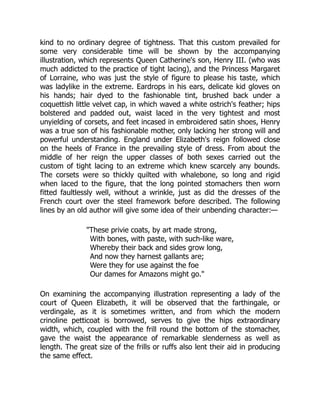
kind to noordinary degree of tightness. That this custom prevailed for
some very considerable time will be shown by the accompanying
illustration, which represents Queen Catherine's son, Henry III. (who was
much addicted to the practice of tight lacing), and the Princess Margaret
of Lorraine, who was just the style of figure to please his taste, which
was ladylike in the extreme. Eardrops in his ears, delicate kid gloves on
his hands; hair dyed to the fashionable tint, brushed back under a
coquettish little velvet cap, in which waved a white ostrich's feather; hips
bolstered and padded out, waist laced in the very tightest and most
unyielding of corsets, and feet incased in embroidered satin shoes, Henry
was a true son of his fashionable mother, only lacking her strong will and
powerful understanding. England under Elizabeth's reign followed close
on the heels of France in the prevailing style of dress. From about the
middle of her reign the upper classes of both sexes carried out the
custom of tight lacing to an extreme which knew scarcely any bounds.
The corsets were so thickly quilted with whalebone, so long and rigid
when laced to the figure, that the long pointed stomachers then worn
fitted faultlessly well, without a wrinkle, just as did the dresses of the
French court over the steel framework before described. The following
lines by an old author will give some idea of their unbending character:—
"These privie coats, by art made strong,
With bones, with paste, with such-like ware,
Whereby their back and sides grow long,
And now they harnest gallants are;
Were they for use against the foe
Our dames for Amazons might go."
On examining the accompanying illustration representing a lady of the
court of Queen Elizabeth, it will be observed that the farthingale, or
verdingale, as it is sometimes written, and from which the modern
crinoline petticoat is borrowed, serves to give the hips extraordinary
width, which, coupled with the frill round the bottom of the stomacher,
gave the waist the appearance of remarkable slenderness as well as
length. The great size of the frills or ruffs also lent their aid in producing
the same effect.
55.
It was inthe reign of Elizabeth that the wearing of lawn and cambric
commenced in this country; previously even royal personages had been
contented with fine holland as a material for their ruffs. When Queen
Bess had her first lawn ruffs there was no one in England who could
starch them, and she procured some Dutch women to perform the
operation. It is said that her first starcher was the wife of her coachman,
Guillan. Some years later one Mistress Dinghen Vauden Plasse, the wife
of a Flemish knight, established herself in London as a professed starcher.
She also gave lessons in the art, and many ladies sent their daughters
and kinswomen to learn of her. Her terms were five pounds for the
starching and twenty shillings additional for learning to "seeth" the
starch. Saffron was used with it to impart to it a yellow colour which was
much admired. The gentlemen of the period indulged in nether garments
so puffed out and voluminous that the legislature was compelled to take
the matter in hand. We read of "a man who, having been brought before
the judges for infringing the law made against these extensive articles of
clothing, pleaded the convenience of his pockets as an excuse for his
misdemeanour. They appeared, indeed, to have answered to him the
purposes both of wardrobe and linen cupboard, for from their ample
recesses he drew forth the following articles—viz., a pair of sheets, two
tablecloths, ten napkins, four shirts, a brush, a glass, a comb, besides
nightcaps and other useful things; his defence being—'Your worship may
understand that because I have no safer storehouse these pockets do
serve me for a roome to lay up my goodes in; and though it be a strait
prison, yet it is big enough for them.'" His discharge was granted, and his
clever defence well laughed at.
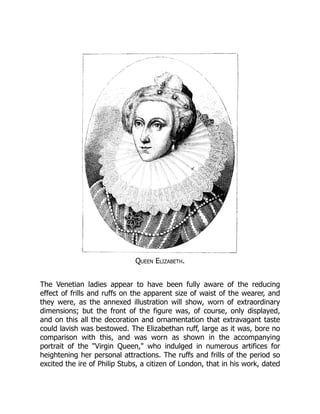
Queen Elizabeth.
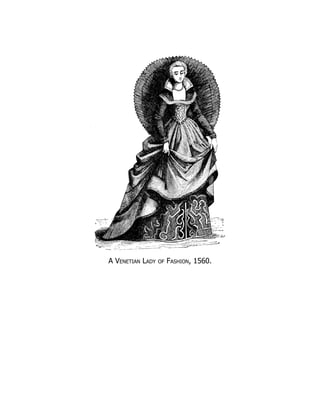
The Venetianladies appear to have been fully aware of the reducing
effect of frills and ruffs on the apparent size of waist of the wearer, and
they were, as the annexed illustration will show, worn of extraordinary
dimensions; but the front of the figure was, of course, only displayed,
and on this all the decoration and ornamentation that extravagant taste
could lavish was bestowed. The Elizabethan ruff, large as it was, bore no
comparison with this, and was worn as shown in the accompanying
portrait of the "Virgin Queen," who indulged in numerous artifices for
heightening her personal attractions. The ruffs and frills of the period so
excited the ire of Philip Stubs, a citizen of London, that in his work, dated
58.
1585, he thuslaunches out against them in the quaint language of the
time:—
"The women there vse great ruffes and neckerchers of holland, laune,
cameruke, and such clothe as the greatest threed shall not be so big as
the least haire that is, and lest they should fall downe they are smeared
and starched in the devil's liquor, I mean starche; after that dried with
great diligence, streaked, patted, and rubbed very nicely, and so applied
to their goodly necks, and withal vnderpropped with supportasses (as I
told you before), the stately arches of pride; beyond all this they have a
further fetche, nothing inferiour to the rest, as namely—three or four
degrees of minor ruffes placed gradation, one beneath another, and al
under the mayster deuilruffe. The skirtes, then, of these great ruffes are
long and wide, every way pleated and crested full curiously, God wot!
Then, last of all, they are either clogged with gold, silver, or silk lace of
stately price, wrought all over with needleworke, speckeled and sparkeled
here and there with the sunne, the mone, the starres, and many other
antiques strange to beholde. Some are wrought with open worke downe
to the midst of the ruffe, and further, some with close worke, some wyth
purled lace so cloied, and other gewgaws so pestered, as the ruffe is the
least parte of itselfe. Sometimes they are pinned upp to their eares,
sometimes they are suffered to hange over theyr shoulders, like
windemill sailes fluttering in the winde; and thus every one pleaseth her
selfe in her foolish devises."
In the matter of false hair her majesty Queen Elizabeth was a perfect
connoisseur, having, so it is said, eighty changes of various kinds always
on hand. The fashionable ladies, too, turned their attention to artificial
adornment of that kind with no ordinary energy, and poor old Stubs
appears almost beside himself with indignation on the subject, and thus
writes about it:—"The hair must of force be curled, frisled, and crisped,
laid out in wreaths and borders from one ear to another. And, lest it
should fall down, it is underpropped with forks, wires, and I cannot tell
what, rather like grim, stern monsters than chaste Christian matrons. At
their hair thus wreathed and crested are hanged bugles, ouches, rings,
gold and silver glasses, and such like childish gewgaws." The fashion of
painting the face also calls down his furious condemnation, and the
dresses come in for a fair share of his vituperation, and their length is
59.
evidently a sourceof excessive exasperation. We give his opinions in his
own odd, scolding words:—
"Their gownes be no less famous than the rest, for some are of silke,
some velvet, some of grograine, some of taffatie, some of scarlet, and
some of fine cloth of x., xx., or xl. shillings a yarde. But if the whole
gowne be not silke or velvet, then the same shall be layd with lace two or
three fingers broade all over the gowne, or els the most parte, or if not
so (as lace is not fine enough sometimes), then it must bee garded with
great gardes of velvet, every yard fower or sixe fingers broad at the least,
and edged with costly lace, and as these gownes be of divers and sundry
colours, so are they of divers fashions—chaunging with the moone—for
some be of new fashion, some of the olde, some of thys fashion, and
some of that; some with sleeves hanging downe to their skirtes, trailing
on the ground, and cast over their shoulders like cows' tailes; some have
sleeves muche shorter, cut vp the arme and poincted with silke ribbons,
very gallantly tied with true love's knottes (for so they call them); some
have capes reachyng downe to the midest of their backes, faced with
velvet, or els with some wrought silke taffatie at the least, and fringed
about very bravely (and to shut vp all in a worde), some are peerled and
rinsled downe the backe wonderfully, with more knackes than I can
declare. Then have they petticoates of the beste clothe that can be
bought, and of the fayrest dye that can be made. And sometimes they
are not of clothe neither, for that is thought too base, but of scarlet
grograine, taffatie, silke, and such like, fringed about the skirtes with silke
fringe of chaungeable colour, but whiche is more vayne, of whatsoever
their petticoates be yet must they have kirtles (for so they call them),
either of silke, velvett, grogaraine, taffatie, satten, or scarlet, bordered
with gardes, lace, fringe, and I cannot tell what besides."
History fails to enlighten us as to whether the irascible Stubs was blessed
with a stylish wife and a large family of fashionable daughters, but we
rather incline to the belief that he must have been a confirmed old
bachelor, as we cannot find that he was ever placed in a lunatic asylum, a
fate which would inevitably have befallen him if the fashions of the time
had been brought within the sphere of his own dwelling. It is somewhat
singular that, writing, as he did, in the most violent manner against
almost every article of personal adornment, and every artifice of
60.
fashionable life, thethen universal and extreme use of the corset should
have escaped censure at his hands.
King James, who succeeded Elizabeth, manifested an inordinate fondness
for dress. We read that—"Not only his courtiers, but all the youthful
portion of his subjects, were infected in a like manner, and the attire of a
fashionable gentleman in those days could scarcely have been exceeded
in fantastic device and profuse decoration. The hair was long and flowing,
falling upon the shoulders; the hat, made of silk, velvet, or beaver (the
latter being most esteemed), was high-crowned, narrow-brimmed, and
steeple-shaped. It was occasionally covered with gold and silver
embroidery, a lofty plume of feathers, and a hatband sparkling with gems
being frequently worn with it. It was customary to dye the beard of
various colours, according to the fancy of the wearer, and its shape also
differed with his profession. The most effeminate fashion at this time was
that of wearing jewelled rings in the ears, which was common among the
upper and middle ranks. Gems were also suspended to ribbons round the
neck, while the long 'lovelock' of hair so carefully cherished under the left
ear was adorned with roses of ribbons, and even real flowers. The ruff
had already been reduced by order of Queen Elizabeth, who enacted that
when reaching beyond 'a nayle of a yeard in depth' it should be clipped.
In the early part of her reign the doublet and hose had attained a
preposterous size, especially the nether garments, which were stuffed
and bolstered with wool and hair to such an extent that Strutt tells us, on
the authority of one of the Harleian manuscripts, that a scaffold was
erected round the interior of the Parliament House for the
accommodation of such members as wore them! This was taken down in
the eighth year of Elizabeth's reign, when this ridiculous fashion was laid
aside. The doublet was afterwards reduced in size, but still so hard-
quilted that the wearer could not stoop to the ground, and was incased
as in a coat of mail. In shape it was like a waistcoat, with a large cape,
and either close or very wide sleeves. These latter were termed Danish. A
cloak of the richest materials, embroidered in gold or silver, and faced
with foxskin, lambskin, or sable, was buttoned over the left shoulder.
None, however, under the rank of an earl were permitted to indulge in
sable facings. The hose were either of woven silk, velvet, or damask; the
garters were worn externally below the knee, made of gold, silver, or
velvet, and trimmed with a deep gold fringe. Red silk stockings, parti-
61.
coloured gaiters, andeven 'cross gartering' to represent the Scotch
tartan, were frequently seen. The shoes of this period were cork-soled,
and elevated their wearers at least two or three inches from the ground.
They were composed of velvet of various colours, worked in the precious
metals, and if fastened with strings, immense roses of ribbon were
attached to them, variously ornamented, and frequently of great value,
as may be seen in Howe's continuation of Stowe's Chronicle, where he
tells us 'men of rank wear garters and shoe-roses of more than five
pounds price.' The dress of a gentleman was not considered perfect
without a dagger and rapier. The former was worn at the back, and was
highly ornamented. The latter having superseded, about the middle of
Elizabeth's reign, the heavy two-handed sword, previously used in
England, was, indeed, chiefly worn as an ornament, the hilt and scabbard
being always profusely decorated."
63.
L
CHAPTER V.
Strange freaksof Louise de Lorraine—One of her adventures—
Her dress at a royal fête—Marie de Medici—The distended
dresses of her time—Hair-powder—Costume à la enfant—
Escapade of the young Louis—Low dresses of the period—The
court of Louis XIV. of France—High heels, slender waists, and
fancy costumes—The Siamese dress—Charles I. of England—
Patches introduced—Elaborate costumes of the period—
Puritanism, its effect on the fashions—Fashions in Cromwell's
time, and the general prevalence of the practice of tight-lacing—
The ladies of Augsburg described by Hoechstetterus.
ittle change appears to have taken place in the prevailing
fashions of England for some considerable time after this period.
In France two opposing influences sprang up. Henry III., as we
have seen, was the slave of fashion, and mainly occupied his time in
devising some new and extravagant article of raiment. His wife,
Louise de Lorraine, on the other hand, although exceedingly
handsome, was of a gloomy, stern, and ascetic disposition, dressing
more like a nun than the wife of so gay a husband. She caused
numerous sumptuary laws to be framed, in order to, if possible,
reduce the style of ladies' dress to a standard nearer her own; and
the following anecdote will serve to show the petty spirit in which her
powers were sought to be exercised.
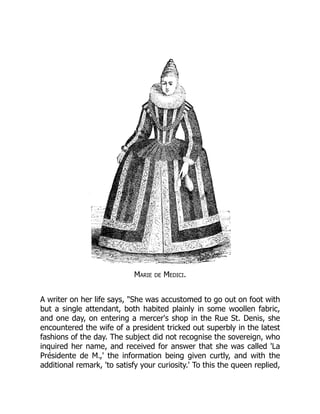
Marie de Medici.
Awriter on her life says, "She was accustomed to go out on foot with
but a single attendant, both habited plainly in some woollen fabric,
and one day, on entering a mercer's shop in the Rue St. Denis, she
encountered the wife of a president tricked out superbly in the latest
fashions of the day. The subject did not recognise the sovereign, who
inquired her name, and received for answer that she was called 'La
Présidente de M.,' the information being given curtly, and with the
additional remark, 'to satisfy your curiosity.' To this the queen replied,
66.
Welcome to ourwebsite – the perfect destination for book lovers and
knowledge seekers. We believe that every book holds a new world,
offering opportunities for learning, discovery, and personal growth.
That’s why we are dedicated to bringing you a diverse collection of
books, ranging from classic literature and specialized publications to
self-development guides and children's books.
More than just a book-buying platform, we strive to be a bridge
connecting you with timeless cultural and intellectual values. With an
elegant, user-friendly interface and a smart search system, you can
quickly find the books that best suit your interests. Additionally,
our special promotions and home delivery services help you save time
and fully enjoy the joy of reading.
Join us on a journey of knowledge exploration, passion nurturing, and
personal growth every day!
testbankmall.com