(eBook PDF) Starting Out with Java: From Control
Structures through Objects, 7th Edition download
https://ebookluna.com/product/ebook-pdf-starting-out-with-java-
from-control-structures-through-objects-7th-edition/
Download full version ebook from https://ebookluna.com
We believe these products will be a great fit for you. Click
the link to download now, or visit ebookluna.com
to discover even more!
(eBook PDF) Starting Out with Java: From Control Structures through Data
Structures 3rd Edition
https://ebookluna.com/product/ebook-pdf-starting-out-with-java-from-
control-structures-through-data-structures-3rd-edition/
(eBook PDF) Starting Out with Java: From Control Structures through Data
Structures 4th Edition
https://ebookluna.com/product/ebook-pdf-starting-out-with-java-from-
control-structures-through-data-structures-4th-edition/
(eBook PDF) Starting Out with C++: From Control Structures through Objects
8th Edition
https://ebookluna.com/product/ebook-pdf-starting-out-with-c-from-control-
structures-through-objects-8th-edition/
(eBook PDF) Starting Out with C++: From Control Structures through Objects,
Brief Version 8th Edition
https://ebookluna.com/product/ebook-pdf-starting-out-with-c-from-control-
structures-through-objects-brief-version-8th-edition/
(eBook PDF) Starting Out with C++ from Control Structures to Objects 9th
Edition
https://ebookluna.com/product/ebook-pdf-starting-out-with-c-from-control-
structures-to-objects-9th-edition/
(eBook PDF) Starting Out with Java: Early Objects 5th Edition
https://ebookluna.com/product/ebook-pdf-starting-out-with-java-early-
objects-5th-edition/
(eBook PDF) Starting Out with Java: Early Objects 5th Global Edition
https://ebookluna.com/product/ebook-pdf-starting-out-with-java-early-
objects-5th-global-edition/
(eBook PDF) Starting Out with Java Early Objects 6th Edition by Tony Gaddis
https://ebookluna.com/product/ebook-pdf-starting-out-with-java-early-
objects-6th-edition-by-tony-gaddis/
(eBook PDF) Starting Out with C++: Early Objects 9th Edition
https://ebookluna.com/product/ebook-pdf-starting-out-with-c-early-
objects-9th-edition/
Contents
1. Preface xxiii
1. Chapter 1 Introduction to Computers and Java 1
1. 1.1 Introduction 1
2. 1.2 Why Program? 1
3. 1.3 Computer Systems: Hardware and Software 2
1. Hardware 2
2. Software 5
4. 1.4 Programming Languages 6
1. What Is a Program? 6
2. A History of Java 8
5. 1.5 What Is a Program Made Of? 8
1. Language Elements 8
2. Lines and Statements 11
3. Variables 11
4. The Compiler and the Java Virtual Machine 12
5. Java Software Editions 13
6. Compiling and Running a Java Program 14
6. 1.6 The Programming Process 16
1. Software Engineering 18
7. 1.7 Object-Oriented Programming 19
1. Review Questions and Exercises 21
2. Programming Challenge 25
2. Chapter 2 Java Fundamentals 27
1. 2.1 The Parts of a Java Program 27
2. 2.2 The print and println Methods, and the Java API 33
3. 2.3 Variables and Literals 39
1. Displaying Multiple Items with the + Operator 40
2. Be Careful with Quotation Marks 41
3. More about Literals 42
4. Identifiers 42
5. Class Names 44
4. 2.4 Primitive Data Types 44
1. The Integer Data Types 46
2. Floating-Point Data Types 47
3. The boolean Data Type 50
4. The char Data Type 50
5. Variable Assignment and Initialization 52
6. Variables Hold Only One Value at a Time 53
5. 2.5 Arithmetic Operators 54
1. Integer Division 57
2. Operator Precedence 57
3. Grouping with Parentheses 59
4. The Math Class 62
6. 2.6 Combined Assignment Operators 63
7. 2.7 Conversion between Primitive Data Types 65
1. Mixed Integer Operations 67
2. Other Mixed Mathematical Expressions 68
8. 2.8 Creating Named Constants with final 69
9. 2.9 The String Class 70
1. Objects Are Created from Classes 71
2. The String Class 71
3. Primitive Type Variables and Class Type Variables 71
4. Creating a String Object 72
10. 2.10 Scope 76
11. 2.11 Comments 78
12. 2.12 Programming Style 83
13. 2.13 Reading Keyboard Input 85
1. Reading a Character 89
2. Mixing Calls to nextLine with Calls to Other Scanner Methods 89
14. 2.14 Dialog Boxes 93
1. Displaying Message Dialogs 93
2. Displaying Input Dialogs 94
3. An Example Program 94
4. Converting String Input to Numbers 96
15. 2.15 Common Errors to Avoid 99
1. Review Questions and Exercises 100
2. Programming Challenges 106
3. Chapter 3 Decision Structures 111
1. 3.1 The if Statement 111
1. Using Relational Operators to Form Conditions 113
2. Putting It All Together 114
3. Programming Style and the if Statement 117
4. Be Careful with Semicolons 117
5. Having Multiple Conditionally Executed Statements 118
6. Flags 118
7. Comparing Characters 119
2. 3.2 The if-else Statement 120
3. 3.3 Nested if Statements 122
4. 3.4 The if-else-if Statement 128
5. 3.5 Logical Operators 134
1. The Precedence of Logical Operators 139
2. Checking Numeric Ranges with Logical Operators 140
6. 3.6 Comparing String Objects 142
1. Ignoring Case in String Comparisons 146
7. 3.7 More about Variable Declaration and Scope 147
8. 3.8 The Conditional Operator (Optional) 149
9. 3.9 The switch Statement 150
10. 3.10 Displaying Formatted Output with System.out.printf and
String.format 160
1. Format Specifier Syntax 163
2. Precision 164
3. Specifying a Minimum Field Width 164
4. Flags 167
5. Formatting String Arguments 170
6. The String.format Method 172
11. 3.11 Common Errors to Avoid 174
1. Review Questions and Exercises 175
2. Programming Challenges 181
4. Chapter 4 Loops and Files 189
1. 4.1 The Increment and Decrement Operators 189
1. The Difference between Postfix and Prefix Modes 192
2. 4.2 The while Loop 193
1. The while Loop Is a Pretest Loop 196
2. Infinite Loops 196
3. Don’t Forget the Braces with a Block of Statements 197
4. Programming Style and the while Loop 198
3. 4.3 Using the while Loop for Input Validation 200
4. 4.4 The do-while Loop 204
5. 4.5 The for Loop 207
1. The for Loop Is a Pretest Loop 210
2. Avoid Modifying the Control Variable in the Body of the for Loop 211
3. Other Forms of the Update Expression 211
4. Declaring a Variable in the for Loop’s Initialization Expression 211
5. Creating a User Controlled for Loop 212
6. Using Multiple Statements in the Initialization and Update Expressions
213
6. 4.6 Running Totals and Sentinel Values 216
1. Using a Sentinel Value 219
7. 4.7 Nested Loops 221
8. 4.8 The break and continue Statements (Optional) 229
9. 4.9 Deciding Which Loop to Use 229
10. 4.10 Introduction to File Input and Output 230
1. Using the PrintWriter Class to Write Data to a File 230
2. Appending Data to a File 236
3. Specifying the File Location 237
4. Reading Data from a File 237
5. Reading Lines from a File with the nextLine Method 238
6. Adding a throws Clause to the Method Header 241
7. Checking for a File’s Existence 245
11. 4.11 Generating Random Numbers with the Random Class 249
12. 4.12 Common Errors to Avoid 255
1. Review Questions and Exercises 256
2. Programming Challenges 262
5. Chapter 5 Methods 269
1. 5.1 Introduction to Methods 269
1. void Methods and Value-Returning Methods 270
2. Defining a void Method 271
3. Calling a Method 272
4. Layered Method Calls 276
5. Using Documentation Comments with Methods 277
2. 5.2 Passing Arguments to a Method 279
1. Argument and Parameter Data Type Compatibility 281
2. Parameter Variable Scope 282
3. Passing Multiple Arguments 282
4. Arguments Are Passed by Value 284
5. Passing Object References to a Method 285
6. Using the @param Tag in Documentation Comments 288
3. 5.3 More about Local Variables 290
1. Local Variable Lifetime 292
2. Initializing Local Variables with Parameter Values 292
4. 5.4 Returning a Value from a Method 293
1. Defining a Value-Returning Method 293
2. Calling a Value-Returning Method 294
3. Using the @return Tag in Documentation Comments 296
4. Returning a boolean Value 300
5. Returning a Reference to an Object 300
5. 5.5 Problem Solving with Methods 302
1. Calling Methods That Throw Exceptions 305
6. 5.6 Common Errors to Avoid 305
1. Review Questions and Exercises 306
2. Programming Challenges 311
6. Chapter 6 A First Look at Classes 317
1. 6.1 Objects and Classes 317
1. Classes: Where Objects Come From 318
2. Classes in the Java API 319
3. Primitive Variables vs. Objects 321
2. 6.2 Writing a Simple Class, Step by Step 324
1. Accessor and Mutator Methods 338
2. The Importance of Data Hiding 338
3. Avoiding Stale Data 339
4. Showing Access Specification in UML Diagrams 339
5. Data Type and Parameter Notation in UML Diagrams 339
6. Layout of Class Members 340
3. 6.3 Instance Fields and Methods 341
4. 6.4 Constructors 346
1. Showing Constructors in a UML Diagram 348
2. Uninitialized Local Reference Variables 348
3. The Default Constructor 348
4. Writing Your Own No-Arg Constructor 349
5. The String Class Constructor 350
5. 6.5 Passing Objects as Arguments 358
6. 6.6 Overloading Methods and Constructors 370
1. The BankAccount Class 372
2. Overloaded Methods Make Classes More Useful 378
7. 6.7 Scope of Instance Fields 378
1. Shadowing 379
8. 6.8 Packages and import Statements 380
1. Explicit and Wildcard import Statements 380
2. The java.lang Package 381
3. Other API Packages 381
9. 6.9 Focus on Object-Oriented Design: Finding the Classes and Their
Responsibilities 382
1. Finding the Classes 382
2. Identifying a Class’s Responsibilities 385
3. This Is Only the Beginning 388
10. 6.10 Common Errors to Avoid 388
1. Review Questions and Exercises 389
2. Programming Challenges 394
7. Chapter 7 Arrays and the ArrayList Class 403
1. 7.1 Introduction to Arrays 403
1. Accessing Array Elements 405
2. Inputting and Outputting Array Contents 406
3. Java Performs Bounds Checking 409
4. Watch Out for Off-by-One Errors 410
5. Array Initialization 411
6. Alternate Array Declaration Notation 412
2. 7.2 Processing Array Elements 413
1. Array Length 415
2. The Enhanced for Loop 416
3. Letting the User Specify an Array’s Size 417
4. Reassigning Array Reference Variables 419
5. Copying Arrays 420
3. 7.3 Passing Arrays as Arguments to Methods 422
4. 7.4 Some Useful Array Algorithms and Operations 426
1. Comparing Arrays 426
2. Summing the Values in a Numeric Array 427
3. Getting the Average of the Values in a Numeric Array 428
4. Finding the Highest and Lowest Values in a Numeric Array 428
5. The SalesData Class 429
6. Partially Filled Arrays 437
7. Working with Arrays and Files 438
5. 7.5 Returning Arrays from Methods 439
6. 7.6 String Arrays 441
1. Calling String Methods from an Array Element 443
7. 7.7 Arrays of Objects 444
8. 7.8 The Sequential Search Algorithm 447
9. 7.9 Two-Dimensional Arrays 450
1. Initializing a Two-Dimensional Array 454
2. The length Field in a Two-Dimensional Array 455
3. Displaying All the Elements of a Two-Dimensional Array 457
4. Summing All the Elements of a Two-Dimensional Array 457
5. Summing the Rows of a Two-Dimensional Array 458
6. Summing the Columns of a Two-Dimensional Array 458
7. Passing Two-Dimensional Arrays to Methods 459
8. Ragged Arrays 461
10. 7.10 Arrays with Three or More Dimensions 462
11. 7.11 The Selection Sort and the Binary Search Algorithms 463
1. The Selection Sort Algorithm 463
2. The Binary Search Algorithm 466
12. 7.12 Command-Line Arguments and Variable-Length Argument Lists 468
1. Command-Line Arguments 469
2. Variable-Length Argument Lists 470
13. 7.13 The ArrayList Class 472
1. Creating and Using an ArrayList Object 473
2. Using the Enhanced for Loop with an ArrayList 474
3. The ArrayList Class’s toString method 475
4. Removing an Item from an ArrayList 476
5. Inserting an Item 477
6. Replacing an Item 478
7. Capacity 479
8. Storing Your Own Objects in an ArrayList 479
9. Using the Diamond Operator for Type Inference 480
14. 7.14 Common Errors to Avoid 481
1. Review Questions and Exercises 481
2. Programming Challenges 486
8. Chapter 8 A Second Look at Classes and Objects 493
1. 8.1 Static Class Members 493
1. A Quick Review of Instance Fields and Instance Methods 493
2. Static Members 494
3. Static Fields 494
4. Static Methods 497
2. 8.2 Passing Objects as Arguments to Methods 500
3. 8.3 Returning Objects from Methods 503
4. 8.4 The toString Method 505
5. 8.5 Writing an equals Method 509
6. 8.6 Methods That Copy Objects 512
1. Copy Constructors 514
7. 8.7 Aggregation 515
1. Aggregation in UML Diagrams 523
2. Security Issues with Aggregate Classes 523
3. Avoid Using null References 525
8. 8.8 The this Reference Variable 528
1. Using this to Overcome Shadowing 529
2. Using this to Call an Overloaded Constructor from Another
Constructor 530
9. 8.9 Enumerated Types 531
1. Enumerated Types Are Specialized Classes 532
2. Switching On an Enumerated Type 538
10. 8.10 Garbage Collection 540
1. The finalize Method 542
11. 8.11 Focus on Object-Oriented Design: Class Collaboration 542
1. Determining Class Collaborations with CRC Cards 545
12. 8.12 Common Errors to Avoid 546
1. Review Questions and Exercises 547
2. Programming Challenges 551
9. Chapter 9 Text Processing and More about Wrapper Classes 557
1. 9.1 Introduction to Wrapper Classes 557
2. 9.2 Character Testing and Conversion with the Character Class 558
1. Character Case Conversion 563
3. 9.3 More String Methods 566
1. Searching for Substrings 566
2. Extracting Substrings 572
3. Methods That Return a Modified String 576
4. The Static valueOf Methods 577
4. 9.4 The StringBuilder Class 579
1. The StringBuilder Constructors 580
2. Other StringBuilder Methods 581
3. The toString Method 584
5. 9.5 Tokenizing Strings 589
6. 9.6 Wrapper Classes for the Numeric Data Types 594
1. The Static toString Methods 594
2. The toBinaryString, toHexString, and toOctalString Methods 594
3. The MIN_VALUE and MAX_VALUE Constants 595
4. Autoboxing and Unboxing 595
7. 9.7 Focus on Problem Solving: The TestScoreReader Class 597
8. 9.8 Common Errors to Avoid 601
1. Review Questions and Exercises 601
2. Programming Challenges 605
10. Chapter 10 Inheritance 611
1. 10.1 What Is Inheritance? 611
1. Generalization and Specialization 611
2. Inheritance and the “Is a” Relationship 612
3. Inheritance in UML Diagrams 620
4. The Superclass’s Constructor 621
5. Inheritance Does Not Work in Reverse 623
2. 10.2 Calling the Superclass Constructor 624
1. When the Superclass Has No Default or No-Arg Constructors 630
2. Summary of Constructor Issues in Inheritance 631
3. 10.3 Overriding Superclass Methods 632
1. Overloading versus Overriding 637
2. Preventing a Method from Being Overridden 640
4. 10.4 Protected Members 641
1. Package Access 646
5. 10.5 Chains of Inheritance 647
1. Class Hierarchies 653
6. 10.6 The Object Class 653
7. 10.7 Polymorphism 655
1. Polymorphism and Dynamic Binding 656
Another Random Scribd Document
with Unrelated Content
Accordingly the whole party, accompanied by their new guide, set
out through Glenshiel at a late hour; but they had not proceeded
more than half-a-mile, when Glenaladale stopped short, and,
clapping his hand upon his side, declared that his purse, containing
40 guineas, which the prince had given him for defraying expenses,
was gone. Thinking that he had left it at their last resting place,
Glenaladale proposed to go back in quest of it, and desired the
prince to remain behind an adjacent hill till he returned; but Charles
was averse to the proposal, though the purse contained his whole
stock of money. Glenaladale, however, went back along with
Borodale’s son, and, on arriving at their last resting place, found the
purse, but its contents were gone. Recollecting that a little boy had
been at the place with a present of milk from a person whom
Glenaladale had visited, he supposed that the boy might have taken
away the purse, and he and his companion proceeded to the house
of Gilchrist M’Rath, the person alluded to, and found the boy, who,
as he had conjectured, had stolen the purse of gold. By means of
Gilchrist, the money was restored to Glenaladale, with the exception
of a trifle.
The temporary loss of the purse was a very fortunate occurrence
for Charles and his friends, as, during Glenaladale’s absence, an
officer and two privates passed close by the place where Charles
stood, having come by the very road he and his party had intended
to proceed. As they went in the direction taken by Glenaladale and
his companion, Charles grew very uneasy about his friends, lest they
should, on their return, meet with this party; but returning by a
different way, they rejoined the prince without interruption. Charles
was overjoyed at the return of his friend; and, with reference to his
late providential escape, observed, “Glenaladale, my hour, I see, is
not come; for I believe I should not be taken though I had a mind to
it.” The party now continued their journey. In passing over the field
of Glenshiel, the Glengarry man entertained Charles with an account
of the action which happened there in 1719. Charles, it is said, could
not help admiring the sagacity of his guide, who, though he had not
been in the battle, gave as circumstantial and accurate an account of
it as if he had been present.[1277]
Travelling all night, Charles and his friends arrived on the side of a
hill above Strathchluaine, where, fixing upon a secure place of
retreat, they reposed till near three o’clock in the afternoon of the
following day, viz., 28th of July. They then continued their journey
along the hill-side; but they had not travelled above a mile when
they heard the firing of small arms on the hill above them, which
they judged to proceed from some of the troops who were engaged
in their usual occupation of shooting the people who had fled to the
mountains with their cattle and effects. To avoid these bloodhounds
the party took a northern route, and ascended a high hill between
the Braes of Glenmoriston and Strathglass. They reached the summit
of this mountain at a late hour, and sought repose for the night in an
open cave, in which they could neither lie nor sleep. They had no
fuel, and as they were wet to the skin with a heavy rain which fell
during the whole of the day, they passed a most uncomfortable
night. Charles felt himself very cold, and he endeavoured to warm
himself by smoking a pipe.
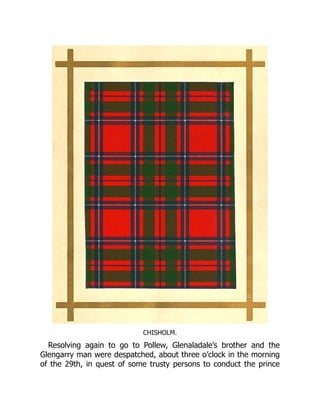
CHISHOLM.
Resolving again to go to Pollew, Glenaladale’s brother and the
Glengarry man were despatched, about three o’clock in the morning
of the 29th, in quest of some trusty persons to conduct the prince
thither, and were appointed to meet Charles and the rest of the
party on the top of a neighbouring hill. Charles and his friends set
off about five o’clock, and, after a walk of two hours, reached the
top of the appointed hill, where they met the guide, who stated that
he was directed by some proper persons he had found out, to desire
Glenaladale to repair to a hill in the Braes of Glenmoriston, called
Corambian, where they promised to come at an appointed hour with
some victuals. The persons alluded to were a party of seven men,
who, having been engaged in the insurrection, had formed
themselves into a sort of predatory fraternity; intending, perhaps, to
resume their former habits of industry when the persecutions of the
government ceased. These had taken up their abode in a romantic
cave on the side of Corambian, and seldom removed to any
considerable distance from their rocky den, unless compelled by the
necessity of providing for their immediate wants.
As directed, Charles and his friends proceeded to Corambian, and
when they came near the cave, Glenaladale and the guide went
forward, leaving Charles and the other two Macdonalds at a little
distance. All the inmates of the den were present except one, and
having killed a sheep that day, had just sat down to dinner.
Glenaladale said he was glad to see them so well provided, and they
invited him to sit down and share with them. He then said he had a
friend with him, outside, for whom he must beg the same favour.
Being asked by them who the friend was, he answered that it was
young Clanranald, his chief. Nobody could be more welcome, they
said, than the young chief; and they added, that they were willing to
purchase food for him at the point of their swords. Glenaladale then
left the cave and brought in Charles, who, being immediately
recognised by its residents, had every respect shown him by these
men, who fell on their knees before him. It is almost unnecessary to
add, that Charles, who had scarcely tasted food for forty-eight
hours, made ample amends for his long fast. After dinner, Charles’s
entertainers made up a bed for him of ferns and tops of heath, on
which he was soon lulled asleep by the gentle murmurs of a purling
stream that ran through the grotto close to his bedside.
The dress which Charles wore at this time is thus described by Mr.
Home, who obtained his information from Hugh Chisholm, one of
the seven persons who were in the cave at the time Charles resided
in it.[1278]
Upon his head he had a wretched yellow wig and a bonnet,
and about his neck a clouted handkerchief. He wore a coat of
coarse, dark-coloured cloth, a Stirling tartan vest, much worn, a
pretty good belted plaid, tartan hose, and Highland brogues tied
with thongs, so much worn that they would scarcely stick upon his
feet. His shirt, the only one he had, was of the colour of saffron. The
inhabitants of the cave had no change of dress to offer their guest;
but an incident occurred which enabled them to supply his wants.
Hearing that a detachment of government troops, under Lord
George Sackville, was marching from Fort-Augustus to Strathglass,
and knowing that they must pass at no great distance from their
abode, the robbers resolved to make an attempt upon their
baggage. For this purpose they placed themselves between two hills,
near the road to Strathglass, where, free from observation, they
awaited the detachment. It soon appeared, and after it had passed,
the Highlanders fired at some officers’ servants, who were a
considerable distance behind, and, rushing down upon them, seized
and carried off some portmanteaus, in which they found every thing
that Charles stood in need of.
The search for Charles, which had hitherto been pursued with the
most persevering assiduity, now began to slacken, in consequence of
an occurrence, which, it was supposed, rendered farther search
unnecessary. Among other persons who had joined Charles at
Edinburgh, there was a young man of respectable family, named
Roderick Mackenzie. He had served as one of the prince’s life-
guards. Being about the same age as Charles, tall and somewhat
slender, like the prince, and with features resembling, in some
degree, those of Charles, he might, with ordinary observers, who
had not been accustomed to see them together, have passed for the
prince. As he could not venture with safety to Edinburgh, where he
had two maiden sisters living, he fled to the Highlands after the
battle of Culloden, and, while skulking among the hills of
Glenmoriston, was surprised by a party of soldiers, about the middle
of July. Mackenzie endeavoured to escape; but being overtaken, he
turned round upon his pursuers, and, drawing his sword, bravely
defended himself. He was shot by one of the soldiers, and as he fell,
he exclaimed, “You have killed your prince! you have killed your
prince!” and immediately expired. Overjoyed at their supposed good
fortune, the soldiers cut off the young man’s head, and hurried to
Fort-Augustus with their prize. The Duke of Cumberland, convinced
that he had got the head of his relative, had it, it is said, packed up,
and ordering a post-chaise, went off to London, carrying the head
along with him. Shortly after his arrival, however, the deception,
which had been of essential service to Charles, was discovered.[1279]
Being pretty secure in Coiraghoth, as the cave was called, Charles
remained three days in this retreat, during which he recruited so
well that he considered himself able to encounter any hardships. The
whole party then shifted their quarters to another hill, about two
miles off, and took up their abode in another cave, on the 2d of
August. After staying four days in their new dwelling they were
again obliged to shift, in consequence of information they received,
that one Campbell, a steward of Lord Seaforth and captain of militia,
had pitched his camp at a little distance, to graze a large herd of
cattle. Leaving one of their party behind to watch Campbell’s
motions, they set off in a northerly direction, and travelled to the
heights of Strathglass. Charles was conducted to a sheep-cot, in
which a bed was made up for him, consisting of turf, with the grass-
side uppermost, and a pillow of the same. He remained in this hovel
three days, during which an express was sent to Pollew, to ascertain
whether a report which had reached him of some French vessels
having been seen off the coast, was correct. On the supposition that
the report would turn out to be well founded, the party followed the
express, and crossing along the moor, put up at another shieling for
the night, and about twelve o’clock, next day, August the 10th,
arrived at a place called Glencanna, and passing the day in a
neighbouring wood, repaired at night to a village hard by. About two
o’clock next morning they scrambled up a hill on the north side of
Glencanna, and sending off two of their number to forage for
provisions, they waited two days in a neighbouring shieling for the
return of their messenger from Pollew. The express arrived, and
brought notice that a French ship had been upon the coast, and had
landed two gentlemen, who had gone to Lochiel’s country in quest of
the prince. In expectation of meeting these gentlemen, Charles
resolved to retrace his steps.
Upon the 13th of August they crossed the water of Casina, and
passing near the house of young Chisholm, arrived at a place called
Fassanacoil in Strathglass, about two o’clock in the morning. They
concealed themselves in a thick wood, and some of the party were
despatched as scouts to the Braes of Glengarry and Lochaber, to
ascertain whether the search for the prince was over, and if the
troops had returned to their camp at Fort-Augustus. Having
ascertained on the return of their spies that the government troops
had returned to their head-quarters, the whole party left the wood,
where they had remained three days, and, on the morning of the
17th of August, set out through an unfrequented road, and again
reached the Braes of Glenmoriston. Passing the day on the top of a
hill, they continued their journey at night; but they had gone
scarcely a mile, when they received information that a strong party
of military were among the heights of Glengarry in quest of the
prince. They, therefore, stopped short in their journey till they should
ascertain the motions of the enemy, and passed the remainder of
the night in a shieling.
Charles being now extremely desirous of opening a
communication with his friends in Lochaber, which was by this time
almost free from troops, despatched two messengers on the
morning of the 18th of August to Loch Arkaig in quest of Cameron of
Clunes, to inform him that Glenaladale wished to meet him at a
convenient place. Another of the party was, at the same time, sent
to the Braes of Glengarry to ascertain if the troops were still in that
quarter. Having ascertained, by the return of this messenger, who
came back next day, that the roads were clear, Charles and his party,
consisting altogether of ten persons, set out in the afternoon of the
19th, and passing under the favour of a fog through Glenmoriston
and Glenlyne, arrived late at night in the Braes of Glengarry. The
river Garry was swollen to a great height by the heavy rains which
had fallen for some days; but some of the party having ascertained
that it was fordable, Charles and his friends waded across with the
water up to their middle. After passing the river, they proceeded
onward about a mile in a very dark night, and finding no covert,
remained on the side of the hill during the night, without shelter,
amid a torrent of rain. Next morning they continued their course
over hills and moors till they reached a height near a place called
Achnasalt, or Achnasual, where the messengers sent to Loch Arkaig
had been appointed to meet them. The rain having poured down
without intermission all night and during the day, the situation of
these forlorn wanderers had become very uncomfortable; and, to
add to their distress, their whole stock of provision was exhausted.
As none of the messengers had arrived, they were exceedingly
perplexed what to do; but they were soon relieved from their anxiety
by the appearance of Peter Grant, one of the most active of the
seven men, who brought notice from Cameron of Clunes that he
could not meet Glenaladale that night, but that he would visit him at
the appointed place of rendezvous next morning, and in the
meantime directed him to pass the night in a wood about two miles
distant. Before setting out for their new quarters, of which they
received a favourable report from two of the party, who were sent to
examine the place, Glenaladale, with the consent of the prince, sent
a messenger to Lochgarry, who lay concealed a few miles off,
acquainting him with their arrival at Achnasual, and requesting him
to meet them in the wood. After entering the wood, fortune threw a
buck in their way, which one of the party immediately shot. Having
kindled a fire, they roasted the flesh, and made a hearty meal, but
without bread or salt. Lochgarry joined them the same night.
At ten o’clock next morning, August the 15th, Cameron of Clunes
came to the wood, and conducted Charles to another forest at the
foot of Loch Arkaig, in which he lay all night. With the exception of
Hugh Chisholm and Peter Grant, all the Glenmoriston men took their
leave. Charles expressed a wish to go to Rannoch, or Badenoch,
where Lochiel and Cluny were; but upon Clunes informing him that
he could not pass without great danger, as all the ferries were
strictly guarded, he gave up his design, and, early next morning,
sent a messenger to Lochiel, desiring his attendance. Concluding
that Charles was to the north of the lakes, these chiefs had, about
this period, sent Dr. Cameron and the Rev. John Cameron by
different routes, to obtain information respecting the prince. On
arriving within a few miles of the place where Lochiel was, Charles’s
messenger met the Doctor and the two French officers who had
lately landed. As the messenger was desired to communicate no
information about Charles to any person but Lochiel himself, he
declined to answer any questions respecting the prince; but having
stated that he had business of the utmost importance with Lochiel,
the Doctor conducted him to his brother. Lochiel being unable, from
the state of his wounds, to travel to a distance, then sent his brother
to wait upon the prince, and to make his apology.
Dr. Cameron, accompanied by two servants, arrived at the foot of
Loch Arkaig on the 19th of August, and when near the place of
Charles’s concealment, he met Cameron of Clunes. At this time
Charles and one of Clunes’s sons were sleeping on the mountain,
and Peter Grant was keeping watch; but, nodding upon his post,
Grant did not observe the approach of the party till they were pretty
near. He instantly awaked Charles and his companion. Cameron and
Grant proposed that they should flee to the top of the mountain, but
Charles thought differently. He said he considered there was more
danger in attempting to escape than in remaining where they were;
and he proposed that they should take up a position behind some
stones, take aim, and fire upon the party when they came nearer. He
said that, as Grant and he were good marksmen, they would
certainly do some execution, and that he had in reserve a brace of
pocket pistols, which, for the first time, he produced. Fortunately,
however, before a single shot was fired, the person of Clunes was
recognised among the party. The joy of Charles and of young
Cameron, at the narrow escape which the friends of the one and the
father of the other had made, may be easily conceived. When
informed by Dr. Cameron that Lochiel was well, and almost
recovered of his wounds, the prince expressed the unbounded
satisfaction he felt by fervently returning thanks to God three times.
The appearance of Charles at this time was singular, and even
terrific. He was bare-footed, and his beard had grown to a great
length. He wore a dirty shirt, an old black tartan coat, a plaid, and a
philibeg, carried a musket in his hand, and wore a pistol and dirk by
his side. Had he not had one of the best and soundest constitutions
ever enjoyed by a prince, he must ere this have fallen a victim to the
numerous privations he had suffered; but his health remained
unimpaired, and his flow of spirits continued. His companions had
killed a cow on the present occasion, and when Dr. Cameron arrived
a part of it was preparing for dinner. Charles partook heartily of the
beef, which was seasoned by a supply of bread from Fort-Augustus,
a commodity to which he had been for some time unaccustomed.
Next day the party went to a wood called Torvuilt, opposite to
Achnacarry, where they held a council. Charles now proposed to go
south, and join Lochiel; but one of the party mentioning that he had
seen a paragraph in some newspapers, that had been brought from
Fort-Augustus, which stated that he and Lochiel had passed
Corryarrick with 30 men, he judged it advisable to defer his journey
for a few days, as a search might be made for him about that
mountain. In the meantime it was agreed that Dr. Cameron should
visit Lochaber to procure intelligence, and that Lochgarry should go
to the east end of Loch Lochy, and remain upon the isthmus
between the lakes, to watch the motions of the troops. They
accordingly left Charles the same day, and Cameron and Clunes,
after conducting the prince and his party to another hut in the
neighbourhood, also took leave.
Charles remained eight days in the neighbourhood of Achnacarry.
Having expressed a strong desire to see the French officers who had
landed at Pollew, they were brought to him. These gentlemen had
come from Dunkirk in a small vessel, with 60 others, who had
formed themselves into a company of volunteers under these two
officers. Two of the volunteers landed along with the officers, and
were taken prisoners. One of them, named Fitzgerald, a Spanish
officer, was hanged at Fort William, on the ground of having been a
spy in Flanders, and the other, a M. de Berard, a French officer, was
afterwards exchanged upon the cartel. The officers fell in with Mr.
Alexander Macleod, one of Charles’s aides-de-camp, to whom they
delivered some despatches they had brought over to the French
ambassador, and they continued to wander in Seaforth’s country till
Lochgarry, hearing that they had letters to the prince, sent a Captain
Macraw and his own servant to find them out and bring them to
Lochiel, as the prince could not be found. When brought to Lochiel,
he suspected them to be government spies. On Charles expressing
his wish to see these officers, the Rev. John Cameron, who had
lately joined, told him what his brother Lochiel thought of them, and
advised him to act with great caution. The prince confessed that it
appeared a very suspicious circumstance, that two men, without
knowing a word of Gaelic, and being perfect strangers in the
country, should have escaped so long if they were not really spies;
but as they had told Lochiel that they had never seen the prince, he
thought that he might see them safely by a stratagem, without being
known to them. He therefore wrote them a letter to this effect:—
that, in order to avoid falling into his enemies’ hands, he had been
under the necessity of retiring to a distant part of the country, where
he had no person with him except one Captain Drummond and a
servant, and, as he could not remove from the place of his
concealment without danger, he had sent Captain Drummond with
the letter; and as he could repose entire confidence in him, he
desired them to deliver any message they had to Drummond. This
letter the prince proposed to deliver himself, as Captain Drummond,
and the officers being sent for, were introduced to him under his
assumed name. He delivered them the letter, which they perused,
and he then obtained from them all the information they had to
communicate, which, as his affairs then stood, was of little
importance. They remained with him two days, and put many
questions about the prince’s health, his manner of living, &c.
Thinking the packet they had delivered to Mr. Macleod might be of
use, Charles sent for it; but as the letters were in cipher he could
make nothing of them, not having the key.
About this time Charles made a very narrow escape, under the
following circumstances. Information having been sent to the camp
at Fort-Augustus that Charles or some of his principal adherents
were in the neighbourhood of Loch Arkaig, a party was despatched
in quest of them. One of Clunes’s sons and Cameron the minister
had gone to the strath of Clunes to obtain intelligence, and had
entered a hut which Clunes had built for his family after his house
had been burnt. They had not, however, been half-an-hour within,
when a little girl came running into the house, in great haste, and
said that she saw some soldiers approaching. At first they thought
that the child was mistaken, as Lochgarry had promised to place a
guard between Fort-Augustus and Clunes, to give intelligence of the
approach of troops; but going out of the house, they found that the
girl was correct in her information. It was then about eight o’clock in
the morning, and the prince, with one of Clunes’s sons and Peter
Grant, was sleeping in a hut on the face of the hill on the other side
of the water of Kaig, about a mile from Clunes’s hut. Whilst old
Cameron, therefore, remained to watch the motions of this party,
one of his sons and the minister went off to arouse Charles. Crossing
the water under cover of the wood, they came within pistol-shot of
the soldiers, who proceeded down into the strath. When awaked and
informed of his danger, Charles, with great composure, called for his
gun, and, looking down the vale, saw a number of soldiers
demolishing Clunes’s hut and searching the adjacent woods.[1280]
Charles and his attendants immediately resolved to remove to a
distance, and to conceal their flight, ascended the hill along the
channel of a torrent which the winter rains had worn in the face of
the mountain. Clearing this hill without being seen, they proceeded
to another mountain, called Mullentagart, of a prodigious height, and
very steep and craggy. They remained all day on this hill without a
morsel of food. One of Clunes’s sons came to them about twelve
o’clock at night with some whisky, bread, and cheese, and told them
that his father would meet them at a certain place in the hills, at a
considerable distance, with provisions, and the young man returned
to let his father know that he might expect them. Charles and his
attendants set out for the appointed place at night, and travelled
through most dreadful ways, amongst rocks and stumps of trees,
which tore their clothes and limbs. Such were the difficulties they
encountered, that the guides proposed to halt and rest till the
morning, but Charles, though exceedingly exhausted, insisted on
going on, that they might not break their appointment with Clunes.
Worn out at last with fatigue and want of food, the prince was not
able to proceed farther without assistance. Though almost in the
same situation themselves, the Highlanders offered him their aid,
and two of them laying hold each of an arm, supported him till he
arrived at the end of this very laborious journey. They met Clunes
and his son, who had already killed a cow and dressed a part of it
for their use.
Charles remained in this remote place with his companions till the
arrival of Lochgarry and Dr. Cameron. They informed him that they
had been with Lochiel and Cluny, and that it had been concerted
among them that the prince should come to their asylum for some
time; and they added, that Cluny would meet his Royal Highness at
Auchnacarry, on a certain day, in order to conduct him to Badenoch.
Being also informed by them that the passes were not so strictly
guarded as formerly, Charles crossed Loch Arkaig, and took up his
abode in a fir wood belonging to Lochiel, on the west side of the
lake, to wait the arrival of Cluny. Impatient to see two such tried
friends as Lochiel and Cluny, Charles would not wait for Cluny’s
coming to Auchnacarry, but set out for Badenoch with such guides
as he had. Next day Charles arrived at a place called Corinauir, in
Badenoch, where he passed the night. Cluny had passed on to
Auchnacarry the same day by another way. Lochiel, who had skulked
in his own country about two months, had sought an asylum among
the Braes of Rannoch, where he was attended by Sir Stewart
Thriepland, an Edinburgh physician, for the cure of the wounds he
had received in his ancles. On the 20th of June they fell in with
Macpherson of Cluny, who conducted them to a more secure retreat
on Benalder, a hill of immense circumference, on his own property,
on the borders of Rannoch. Lochiel, who had since that time lived on
this mountain with his friend Cluny, was now residing in a small
miserable hovel on the side of the hill, at a place called Mellenauir, or
Millanuir, attended by Macpherson of Breakachie, Allan Cameron, his
principal servant, and two servants of Cluny.
Dr. Archibald Cameron, from rare print in the
Burney Collection in British Museum.
On the morning of the
30th of August, Charles,
accompanied by Lochgarry,
Dr. Cameron and two
servants, set out for
Mellenauir. They were all
armed, and on approaching
the hut they were mistaken
by Lochiel for a party of
militia, who, he supposed,
had been sent out in search
of him from a camp a few
miles off. From the lameness
in his feet, Lochiel was not in
a condition to attempt an
escape, but there seemed to
be little danger, as both parties were equal in point of numbers, and
the party in the hut had this advantage, that they could fire their
first volley without being observed, and as they had a considerable
quantity of fire arms, they could discharge another volley or two
before the advancing party could reload their pieces. The danger to
which Charles and his friends were now exposed was greater than
that which Dr. Cameron and Clunes had run, as, on the present
occasion, the party in the hut, resolving to receive their supposed
enemies with a general discharge of all the firearms, had actually
planted and levelled their pieces; but happily for Charles and his
friends, they were recognised just as Lochiel and his attendants
were about giving their fire. Upon making this fortunate discovery
Lochiel left the hut, and, though very lame, went forward to meet
the prince. On coming up to Charles, Lochiel was about to kneel, but
Charles prevented him, and clapping him on the shoulder, said, “Oh
no, my dear Lochiel, we do not know who may be looking from the
top of yonder hills, and if they see any such motions they will
immediately conclude that I am here.” Charles always considered
Lochiel as one of his best friends, and placed the greatest
confidence in him; and the generous chief showed, by his
unbounded attachment to the prince, that this confidence was not
misplaced. The meeting, therefore, of two such friends, after so
many perils and escapes, was extremely joyous.
After they had recovered from the first transports of their joy,
Lochiel conducted Charles into the hut, where the latter beheld a
sight to which his eyes had not been accustomed for many months.
Besides abundance of mutton, the hut contained an anchor of
whisky, of twenty Scotch pints, some good dried beef sausages, a
large well-cured bacon ham, and plenty of butter and cheese. On
entering the prince took a hearty dram, and drank to the health of
his friends. Some minced collops were then prepared for him with
butter in a large saucepan, which Lochiel and Cluny always carried
about with them, being the only fire-vessel they had. The pan was
set before Charles with a silver spoon. He took this repast with great
gusto, and was so delighted with this little change in his
circumstances, that he could not help exclaiming, with a cheerful
countenance, “Now, gentlemen, I live like a prince.” After dinner he
asked Lochiel if he had always fared so well during his retreat. “Yes,
Sir,” answered Lochiel; “for near three months past I have been
hereabout with my cousin Cluny; he has provided for me so well that
I have had plenty of such as you see, and I thank Heaven your Royal
Highness has got through so many dangers to take a part.” Finding,
on his arrival at Auchnacarry, that Charles had departed with his
friends for Badenoch, Cluny had retraced his steps, and he reached
Mellenauir two days after Charles’s arrival there. On entering the hut
Cluny would have kneeled before Charles, but the prince prevented
him, and giving him a kiss, said, “I am sorry, Cluny, you and your
regiment were not at Culloden: I did not hear till very lately that you
were so near us that day.”
The day after his return to Mellenauir, Cluny, thinking it time to
remove to another retreat, conducted the prince and his attendants
to a little shieling called Uiskchibra, about two miles farther into
Benalder. This hut was very bad and extremely smoky; but Charles
accommodated himself, as he had always done, to circumstances.
After passing two nights in this miserable abode, he was conducted
to a very extraordinary and romantic habitation, called the Cage,
which Cluny had fitted up for Charles’s reception. From the
description given by Cluny of this remarkable retreat, it will be seen
how well adapted it was for the purpose of concealment.
“It was,” says Donald Macpherson, “situated in the face of a very
rough, high, and rocky mountain, called Letternilichk, still a part of
Benalder, full of great stones and crevices, and some scattered wood
interspersed. The habitation called the Cage, in the face of that
mountain, was within a small thick bush of wood. There were first
some rows of trees laid down, in order to level a floor for the
habitation; and as the place was steep, this raised the lower side to
an equal height with the other; and these trees, in the way of joists
or planks, were levelled with earth and gravel. There were betwixt
the trees, growing naturally on their own roots, some stakes fixed in
the earth, which, with the trees, were interwoven with ropes, made
of heath and birch twigs, up to the top of the Cage, it being of a
round or rather oval shape; and the whole thatched and covered
over with fog. This whole fabric hung, as it were, by a large tree,
which reclined from the one end all along the roof to the other, and
which gave it the name of the Cage; and by chance there happened
to be two stones at a small distance from one another, in the side
next the precipice, resembling the pillars of a chimney, where the
fire was placed. The smoke had its vent out here, all along the face
of the rock, which was so much of the same colour, that one could
discover no difference in the clearest day. The Cage was no larger
than to contain six or seven persons; four of whom were frequently
employed playing at cards, one idle looking out, one baking, and
another firing bread and cooking.”[1281]
Charles’s deliverance was now nearer at hand than he or his
friends probably expected. Several small vessels had arrived on the
west coast, from time to time, to carry him off to France; but the
persons in charge of these not being able to find him had returned
home. Charles knew this, and now that he was able to keep up a
communication with his friends, he took care to provide against a
similar recurrence. He was at a considerable distance from the coast,
but matters were so concerted that, if a French vessel appeared, he
could easily get the intelligence. There were some of his partizans
skulking near the west coast, who, though they did not know where
he himself was, had instructions to convey the news to others who
were concealed in the interior, who would again communicate it to
persons in the knowledge of the prince’s place of retreat. For some
time Colonel Warren, of Dillon’s regiment, had been exerting himself
to induce the French government to fit out an expedition to rescue
Charles from his toils. He at last succeeded in procuring two vessels
of war, L’Heureux and La Princesse de Conti, with which he departed
from St. Malo about the end of August. In the event of his bringing
the prince safe away, the Chevalier de St. George had promised to
make him a Knight Baronet, a dignity which he afterwards conferred
upon him.[1282]
These vessels arrived in Lochnanuagh early in September, and
Captain Sheridan, a son of Sir Thomas Sheridan, and a Mr. O’Beirne,
a lieutenant in the French service, immediately landed and waited
upon Glenaladale, who, they were informed, knew where Charles
was. This faithful friend, happy at the prospect of escape which now
offered, set off the same night for the place where he expected to
find Charles, to communicate to him the agreeable intelligence; but
to his great sorrow he found the prince gone, and he could fall in
with no person who could give him the least information of his route.
Clunes, from whom Glenaladale expected to get tidings of Charles,
had, in consequence of the destruction of his hut, gone to another
quarter, and was not to be found. Whilst ruminating over his
disappointment, a poor woman accidentally came to the place where
he was, and he had the good fortune to ascertain from her the place
of Clunes’s retreat. Having found him out, he and Clunes instantly
despatched a messenger to Charles with the joyful intelligence; and
Glenaladale then returned to Lochnanuagh, to notify to Colonel
Warren that Charles might be speedily expected in that quarter.
The messenger arrived at Benalder on the 13th of September, on
which day Charles left his romantic abode, and, after taking leave of
Cluny, set off on his journey for the coast, accompanied by Lochiel
and others. He at the same time sent off confidential messengers in
different directions, to acquaint such of his friends as he could reach,
announcing the arrival of the ships, that they might have an
opportunity of joining him if inclined. As Charles and his friends
travelled only by night, they did not reach Borodale, the place of
embarkation, till the 19th. On the road Charles was joined by
Lochgarry, John Roy Stewart, Dr. Cameron, and other gentlemen
who intended to accompany him to France. Besides these, many
others had left their different hiding places on hearing of the arrival
of the French vessels, and had repaired to the coast of Moidart, also
waiting for the arrival of him for whose sake they had forfeited their
lives, intending to adopt the bitter alternative of bidding an eternal
adieu to their native land. The number of persons assembled was
about a hundred.
The career of Charles in the hereditary dominions of his ancestors
was now ended. Attended by seven persons only, he had, with
daring hardihood, landed about fourteen months before on the spot
where he was destined to depart as a fugitive, and, with a handful of
men, had raised the standard of insurrection and set the whole
power of the government at open defiance. The early part of his
progress had been brilliant. With a few thousand undisciplined
mountaineers, he had overrun land, in the face of three hostile
armies, had carried dismay to the capital. The retreat from Derby,
the merit of which belongs to Lord George Murray exclusively,
quieted for a time the apprehensions of the government; but the
defeat at Falkirk again convinced it that the succession settlement
was still in danger; and that, perhaps, at no distant day, the young
and daring adventurer might place the son of James II. upon the
throne from which his father had been expelled. Even after his
retreat to Inverness, the supporters of the house of Hanover could
have no assurance that the Duke of Cumberland’s army might not
share the fate of its predecessors, in which event the new dynasty
would probably have ceased to reign; but the triumphs of Charles
were at an end, and the fatal field of Culloden, after witnessing the
bravery of his troops, became the grave of his hopes. Then
commenced that series of extraordinary adventures and wonderful
escapes, of which some account has been given, and which could
scarcely have been credited had they not been authenticated beyond
the possibility of dispute. During the brilliant part of his career
Charles had displayed great moderation and forbearance; and
though his spirits sank when compelled to retreat, yet in the hour of
adversity, when beset with perils and exposed to privations which
few princes could have endured, he exhibited uncommon fortitude,
strength of mind, and cheerfulness.
In his wanderings Charles laid down a rule to himself, to which he
scrupulously adhered, never to intrust any person from whom he
was about to depart with the secret of his route, so that, with the
exception of the few friends who were about him for the time being,
none of those to whom he had been formerly indebted for his
preservation knew the place of his retreat. This was a wise
precaution, but was attended with this disadvantage, that it
prevented him from acquiring early information of the arrival of the
French vessels upon the coast. But no means he was able to take for
his own security could have saved him, had he not had a guarantee
in the incorruptible fidelity of the persons into whose hands he
committed himself. At the risk of their own destruction they
extended to him the aid of their protection, and relieved his
necessities. Many of these persons were of desperate fortunes, and
there were others in the lowest ranks of life; yet, among nearly 200
persons to whom Charles must have been known during the five
months he wandered as a fugitive, not one ever offered to betray
him, though they knew that a price of £30,000 was set upon his
head. History nowhere presents such a splendid instance of
disinterested attachment to an unfortunate family.
Accompanied by Lochiel, Lochgarry, John Roy Stewart, Dr.
Cameron, and a considerable number of other adherents, Charles
departed from Lochnanuagh on the 20th of September, and had a
favourable passage to the coast of France, where he landed on
Monday the 29th of September. He immediately proceeded to
Morlaix, whence he despatched Colonel Warren the same day to
Paris, to announce his arrival to the French court. He also sent at the
same time a letter to his brother Henry, to the same effect, and
enclosed a similar one to his father.
FOOTNOTES:
[1240] Lockhart Papers, vol. ii. p 541.
[1241] Macleod’s Narrative in Jacobite Memoirs.
[1242] Lockhart Papers, vol. ii. p. 541. Kirkconnel MS.
[1243] Kirkconnel MS.
[1244] Macleod’s Narrative.
[1245] Genuine and True Journal, p. 16.
[1246] O’Neil’s, Burke’s, and Macleod’s Narratives, in Jacobite Memoirs.
Macleod was taken prisoner a few days afterwards in Benbecula, by
Lieutenant Allan Macdonald, of Knock, in Sleat, in the island of Skye.
He was put on board the Furnace, and brought down to the cabin
before General Campbell, who examined him most minutely. The
general asked him if he had been along with the Pretender? “Yes,” said
Donald, “I was along with that young gentleman, and I winna deny it.”
“Do you know,” said the general, “what money was upon that
gentleman’s head?—No less a sum than thirty thousand pounds
sterling, which would have made you and your family happy for ever.”
“What then?” replied Donald, “what though I had gotten it? I could not
have enjoyed it for two days. Conscience would have gotten the better
of me; and although I could have gotten all England and Scotland for
my pains, I would not have allowed a hair of his body to be touched if
I could hinder it, since he threw himself upon my care.” Campbell
observed that he could not much blame him. Donald was sent to
London, but released on the 10th of June, 1747. When he arrived in
Leith from London, on his return to Skye, he had no money to carry
him thither; but his wants were supplied by the Rev. Robert
(afterwards bishop) Forbes, an episcopal clergyman in Leith, who set a
subscription on foot in that town, and in Edinburgh, “to make out,” as
the bishop says, “for honest Palinurus, if possible, a pound sterling, for
every week he had served the prince in distress; and,” continues the
worthy bishop, “I thank God I was so happy as to accomplish my
design directly.” In acknowledgment of his fidelity, Donald was
presented by Mr. John Walkinshaw of London, with a large silver snuff-
box, handsomely chased, and doubly gilt in the inside. Upon the lid of
this box there was the representation of an eight-oared boat, with
Donald at the helm, and the eight rowers making their way through a
very rough and tempestuous sea. The Long island is seen in the
distance upon one of the extremities of the lid, and the boat appears
to be just steering into Rossinish, the point of Benbecula where
Charles landed after leaving Lochnanuagh. On the other end of the lid
there was a landscape of the end of the isle of Skye, as it appears
opposite to the Long island, on which the sites of Dunvegan and
Gualtergill are marked. The clouds were represented as heavy and
lowering, and the rain descending; and above the clouds, i.e., near the
hinge, the following motto was engraved:—“Olim hæc meminisse
juvabit. Aprilis 26to, 1746.” Upon the bottom, and near the edge of
the lid, was this inscription,—“Quid Neptune, paras? Fatis agitamur
iniquis.” The following words were engraved on the bottom of the box:
—“Donald Macleod of Gualtergill, in the isle of Skye, the faithful
Palinurus, æt. 68, 1746.” Below which there was a representation of a
dove with an olive branch in its bill. Donald never put any snuff into
this box, and when asked the cause by Mr. Forbes, he exclaimed,
“Sneeshin in that box! Na, the diel a pickle sneeshin shall ever go into
it till the King be restored; and then, I trust in God, I’ll go to London,
and then I will put sneeshin in the box, and go to the Prince, and say,
‘Sir, will you take a sneeshin out o’ my box?’”—Jacobite Memoirs.
Burke, the other trust-worthy individual, who was a native of North
Uist, skulked about the hill of Eval, in his native island, for seven
weeks, living part of the time on sea-weed and limpets. He afterwards
took refuge in a cave, and, when the troubles had subsided, went to
Edinburgh, where, unheeded, he spent the remainder of his days as a
sedan-carrier or chairman.
[1247] Flora Macdonald’s Narrative. Home’s Works, vol. iii. App. No.
45.
[1248] Father of the well-known Marshal Macdonald, Duke of
Tarentum.
[1249] The letter by Armadale to his wife, was as follows:—“I have
sent your daughter from this country lest she should be any way
frightened with the troops lying here. She has got one Betty Burke, an
Irish girl, who, as she tells me, is a good spinster. If her spinning
pleases you, you may keep her till she spin all your lint; or, if you have
any wool to spin, you may employ her. I have sent Neil Mackechan
along with your daughter, and Betty Burke to take care of them.—I am
your dutiful husband,
“HUGH MACDONALD.”
“June 22, 1746.”
It has been suspected that Armadale was privy to his step-daughter’s
design.
[1250] Kirkconnel MS.
[1251] Soon after this occurrence, Lady Clanranald was taken prisoner,
and sent to London. On 1st November, Clanranald, and Boisdale his
brother were also apprehended, and shipped for London. They were
discharged in the month of June following.
[1252] A few days after parting with Charles, this trusty officer being
betrayed by a person in whom he had confided, was taken prisoner.
Being brought before Captain Ferguson, and refusing to give any
information about the prince, he was stripped, ordered to be put into a
rack, and to be whipt. When the last part of this order was about to be
executed, he was saved from the intended ignominy by a lieutenant of
the Scotch Fusileers, who, drawing his sword, threatened Ferguson
with his vengeance if he used an officer in such an infamous manner.
O’Neil says that, four days after he was taken, General Campbell sent
him word, upon his parole of honour, that if he had any money or
effects in the country, and would send them to him, they should be
safe; and that as he had always imagined that the word of honour was
as sacredly kept in the English army as in others, he went with a
detachment for his money and gold watch, which he had hid among
the rocks; that he sent to General Campbell by Captain Campbell of
Skipness, 450 guineas, his gold watch, broadsword and pistols; but
that although he repeatedly applied to him to return him his property,
he never obtained it!—O’Neil’s Narrative in Jacobite Memoirs.
[1253] Roy Macdonald’s Narrative among the Forbes Papers.
[1254] Genuine and True Journal, p. 29.
[1255] “Donald Macleod said the prince used to smoke a great deal of
tobacco; and as in his wanderings from place to place the pipes
behoved to break and turn into short cutties, he used to take quills,
and putting one into another, ‘and all,’ said Donald, ‘into the end of the
cutty, this served to make it long enough, and the tobacco to smoke
cool.’ Donald added, that he never knew, in all his life, any one better
at finding out a shift than the prince was, when he happened to be at
a pinch, and that the prince would sometimes sing them a song to
keep up their hearts.”—Jacobite Memoirs, p. 401.
[1256] Boswell’s Tour.
[1257] When Dr. Johnson visited Kingsburgh, in company with Mr.
Boswell, in 1774, he slept in the same bed that Charles had occupied
twenty-eight years before. “To see (says Boswell) Dr. Samuel Johnson
in that bed, in the isle of Skye, in the house of Miss Flora Macdonald,
struck me with such a group of ideas, as it is not easy for words to
describe, as they passed through the mind. He smiled and said, ‘I have
had no ambitious thoughts in it.’”—Tour to the Hebrides.
[1258] Donald Roy’s Narrative among the Forbes Papers.
[1259] Donald Roy’s Narrative.
[1260] Macleod’s Narrative.
[1261] Boswell’s Tour.
[1262] “John Mackenzie is alive (in 1774); I saw him at Raasay’s
house. About eighteen years ago he hurt one of his legs when
dancing, and being obliged to have it cut off, he now was going about
with a wooden leg. The story of his being a Member of Parliament is
not yet forgotten. I took him out a little way from the house, gave him
a shilling to drink Raasay’s health, and led him into a detail of the
particulars which I have just related. With less foundation, some
writers have traced the idea of a Parliament, and of the British
Constitution in rude and early times. I was curious to know if he had
really heard or understood any thing of that subject, which, had he
been a greater man, would probably have been eagerly maintained.
‘Why, John,’ said I, ‘did you think he should be controlled by a
Parliament?’ He answered, ‘I thought, Sir, there were many voices
against one.’”—Boswell.
[1263] Idem, p. 227. Jacobite Memoirs, p. 270.
[1264] Boswell’s Tour.
[1265] Jacobite Memoirs, p. 478.
[1266] Jacobite Memoirs, pp. 477–8.
[1267] Idem. p. 480.
[1268] Jacobite Memoirs, p. 482. Boswell, in his Tour, gives a different
version of this story. “After this (breakfast) there came in an old
woman, who, after the mode of ancient hospitality, brought warm
water, and washed Malcolm’s feet. He desired her to wash the feet of
the poor man who attended him. She at first seemed averse to this
from pride, as thinking him beneath her, and in the periphrastic
language of the Highlanders and the Irish, said warmly, ‘Though I
wash your father’s son’s feet, why should I wash his father’s son’s
feet?’ She was, however, persuaded to do it.”
[1269] The following is a copy of the note:—
“Sir,—I thank God I am in good health, and have got off as designed.
Remember me to all friends, and thank them for the trouble they have
been at.—I am, Sir, your humble servant.
“James Thomson.”
“Ellighiul, July 4th, 1746.”
[1270] This ‘cutty,’ as a small tobacco-pipe, almost worn to the stump,
is called in Scotland, was presented by Malcolm, when at London, to
Dr. Burton of York, a fellow-prisoner, who got a fine shagreen case
made for it.—Jacobite Memoirs, p. 487. Mr. Boswell gives the following
sketch of this worthy Highlander in his Tour to the Hebrides: “He was
now (1774) sixty-two years of age, hale and well proportioned, with a
manly countenance, tanned by the weather, yet having a ruddiness in
his cheeks, over a great part of which his rough beard extended. His
eye was quick and lively, yet his look was not fierce; but he appeared
at once firm and good-humoured. He wore a pair of brogues, tartan
hose which came up nearly to his knees, a purple camblet kilt, a black
waistcoat, a short green cloth coat bound with gold cord, a yellow
bushy wig, a large blue bonnet with a gold thread button. I never saw
a figure which gave a more perfect representation of a Highland
gentleman. I wished much to have a picture of him just as he was. I
found him frank and polite in the true sense of the word.”
[1271] True Journal, p. 47.
[1272] The subsequent history of the estimable Flora Macdonald may
be stated in a few words. After her return to Skye, she married, in
1750, young Macdonald of Kingsburgh, whom she accompanied to
North Carolina, America, probably in 1774. Young Kingsburgh joined
the Royal Highland Emigrant Regiment, embodied in 1775, but was
taken prisoner in 1776 and committed to Halifax gaol. He afterwards
served with the regiment in Canada, holding the rank of captain, and,
at the close of the war, returned to Scotland on half-pay. The vessel in
which Flora and her husband sailed was attacked by a French
privateer, and while Flora, with characteristic spirit, stood on deck,
animating the seamen, she was thrown down and had her arm broken.
The wanderers, however, arrived in Skye, and never afterwards left it.
Flora died on the 4th of March 1790, aged 68, and was interred in the
churchyard of Kilmuir, in a spot set apart for the graves of the
Kingsburgh family. Kingsburgh died on the 20th September 1795. Flora
had seven children—five sons and two daughters; the sons all became
officers in the army, and the daughters officers’ wives. Dr. Johnson and
Boswell visited Skye in the autumn of 1773, and were entertained at
Kingsburgh house by Flora and her husband. Flora, then aged about
51, is described by Johnson as a woman of middle stature, soft
features, gentle manners, and elegant presence; and by Boswell as “a
little woman, of a genteel appearance, and uncommonly mild and well-
bred.”—See Carruthers’ Edition of Boswell’s Tour to the Hebrides, p.
143.
[1273] Jacobite Memoirs, pp. 488–90, 492.
[1274] Jacobite Memoirs, p. 494.
[1275] Author of the Journal and Memoirs, printed among the
Lockhart papers, beginning at p. 579.
[1276] Mr. Home mentions an interview with one Macraw in the Braes
of Kintail, which is not even alluded to in the narrative of the prince’s
escape, drawn up by Glenaladale and others, and printed among the
Lockhart Papers. If such an interview took place, its omission can only
be fairly accounted for by supposing that the writer of that part of the
narrative (Captain Alexander Macdonald, a younger brother of the
Laird of Dallely,) was not aware of it. The following is Mr. Home’s
account of this affair:—
“After having crossed the line of posts, Glenaladale, thinking the West
Highlands a very unsafe place for Charles, resolved to conduct him to
the Ross-shire Highlands, amongst those Mackenzies who remained
loyal, and therefore were not visited with troops. These Mackenzies,
Glenaladale thought, would not betray Charles; and the person whom
he had pitched upon to confide in was Sir Alexander Mackenzie of
Coul. Charles and his attendants, setting out for Ross-shire on foot,
suffered greatly in their journey from want of provisions; and when
they came to the Braes of Kintail, inhabited by the Macraws, a
barbarous people, among whom there are but few gentlemen,
necessity obliged them to call at the house of one Christopher Macraw.
Glenaladale, leaving Charles and the French officer at some distance,
went to Macraw’s house, and told him that he and two of his friends
were like to perish for want of food, and desired him to furnish them
with some victuals, for which they would pay. Macraw insisted upon
knowing who his two friends were, which Glenaladale seemed
unwilling to tell. Macraw still insisted, and Glenaladale told him at last
that it was young Clan Ronald and a relation of his. Notwithstanding
the consequence of the persons, Macraw, though rich for an ordinary
Highlander, made Glenaladale pay very dear for some provisions he
gave him. Having received the money, he grew better humoured, and
desired Glenaladale and the other two to pass the night in his house,
which they did. In the course of the conversation they talked of the
times, and Macraw exclaimed against the Highlanders who had taken
arms with Charles, and said that they and those who still protected
him were fools and madmen; that they ought to deliver themselves
and their country from distress by giving him up, and taking the
reward which government had offered. That night a Macdonald who
had been in the rebel army came to Macraw’s house. At first sight he
knew Charles, and took an opportunity of warning Glenaladale to take
care that Christopher should not discover the quality of his guest.”
[1277] Kirkconnel MS.
[1278] Chisholm was at Edinburgh many years after the rebellion, and
was visited by several persons out of curiosity, some of whom gave
him money. In shaking hands with his benefactors he always gave the
left hand, and excused himself for offering that hand by stating that as
he had shaken hands at parting with the prince, he was resolved never
to give his right hand to any man till he saw the prince again.
[1279] Chambers’s Rebellion. Stewart’s Sketches, i. 59.
[1280] The party in question consisted of about two hundred of Lord
Loudon’s Highlanders, under Captain Grant of Knockando, Strathspey.
[1281] Appendix to Home’s Works, vol. iii. No. 46. Cluny himself had
several places of concealment on his estate. “He lived for nine years
chiefly in a cave, at a short distance from his house, which was burnt
to the ground by the king’s troops. This cave was in the front of a
woody precipice, the trees and shelving rocks completely concealing
the entrance. It was dug out by his own people, who worked by night,
and conveyed the stones and rubbish into a lake in the
neighbourhood, in order that no vestige of their labour might betray
the retreat of their master. In this sanctuary he lived secure,
occasionally visiting his friends by night, or when time had slackened
the rigour of the search. Upwards of one hundred persons knew where
he was concealed, and a reward of £1,000 was offered to any one who
should give information against him; and as it was known that he was
concealed on his estate, eighty men were constantly stationed there,
besides the parties occasionally marching into the country to
intimidate his tenantry, and induce them to disclose the place of his
concealment. But though the soldiers were animated with the hope of
the reward, and though a step of promotion to the officer who should
apprehend him was superadded, yet so true were his people, so strict
to their promise of secrecy, and so dexterous in conveying to him the
necessaries he required, in his long confinement, that not a trace of
him could be discovered, nor an individual found base enough to give
a hint to his detriment. At length, wearied out with this dreary and
hopeless state of existence, and taught to despair of pardon, he
escaped to France in 1755, and died there the following year.”—
Stewart’s Sketches, 3d Edition, vol. i. p. 62.
“The late Sir Hector Munro, then a lieutenant in the 34th regiment,
and from his zeal and knowledge of the country and the people,
intrusted with the command of a large party, continued two whole
years in Badenoch, for the purpose of discovering the chief’s retreat.
The unwearied vigilance of the clan could alone have saved him from
the diligence of this party. At night Cluny came from his retreat to vary
the monotony of his existence, by spending a few of the dark hours
convivially with his friends. On one occasion he had been suspected,
and got out by a back window just as the military were breaking open
the door. At another time, seeing the windows of a house kept close,
and several persons going to visit the family after dark, the
commander broke in at the window of the suspected chamber, with
two loaded pistols, and thus endangered the life of a lady newly
delivered of a child, on account of whose confinement these suspicious
circumstances had taken place. This shows that there was no want of
diligence on the part of the pursuers. Cluny himself became so
cautious, while living the life of an outlaw, that on parting with his
wife, or his most attached friends, he never told them to which of his
concealments he was going, or suffered any one to accompany him,—
thus enabling them, when questioned, to answer, that they knew not
where he was.”—Idem.
It may be here stated en passant that Cluny did not leave Scotland
from his “dreary and hopeless state of existence,” but in compliance
with a special request made to him by Prince Charles. See a letter
from the prince to Cluny, of 4th Sept., 1754, among the Stuart Papers.
[1282] Vide several letters from Colonel Warren to the Chevalier de St.
George and others, among Stuart Papers.
CHAPTER XXXVIII.
A.D. 1746–1747.
BRITISH SOVEREIGN:—George II., 1727–1760.
Commission of Oyer and Terminer—Trial of prisoners—Francis Townley—Jemmy
Dawson—Lords Kilmarnock, Cromarty, and Balmerino—Execution of these
noblemen—Other executions—Trials at Carlisle and York—Trial and execution of
Mr. Ratcliffe—Trial and execution of Lord Lovat—Act of Indemnity passed.
Whilst the issue of the contest remained doubtful, the government
took no steps to punish the prisoners who had fallen into their hands
at Carlisle; but after the decisive affair of Culloden, when there
appeared no chance of the Jacobite party ever having it in their
power to retaliate, the government resolved to vindicate the
authority of the law by making examples of some of the prisoners.
As it was intended to try the prisoners at different places for the
sake of convenience, an act was passed empowering his majesty to
try them in any county he might select.
On the 24th and 25th of June bills of indictment were found
against 36 of the prisoners taken at Carlisle, and against one David
Morgan, a barrister, who had been apprehended in Staffordshire.
The court then adjourned till the 3d of July, on which day the
prisoners were arraigned. Three only pleaded guilty. The rest applied
for a postponement of their trials on the ground that material
witnesses for their defence were at a considerable distance. The
court in consequence ruled that in cases where witnesses were in
England the trial should be put off to the 15th of July, and where
they were in Scotland, to the 25th of the same month.
The court accordingly met on the 15th of July, and proceeded with
the trial of Francis Townley, Esquire, before a grand jury, at the
court-house, Southwark. This unfortunate gentleman had been
colonel of the Manchester regiment. He was of a respectable family
in Lancashire. Obliged to retire to France in 1728, he had obtained a
commission from the King of France, and had served at the siege of
Philipsburgh under the Duke of Berwick, who lost his life before the
walls of that place. He continued sixteen years in the French service;
and after his return to England had received a commission to raise a
regiment. A plea was set up by his council, that holding a
commission in the French service he was entitled to the benefit of
the cartel as well as any other French officer, but this was overruled,
and he was found guilty. On the next and two following days
eighteen other persons, chiefly officers in the said regiment, were
brought to trial. Five were attainted by their own confession of high
treason, twelve on a verdict of high treason of levying war against
the king, and one was acquitted. These seventeen persons, along
with Townley, were all condemned to death, and nine of them,
including Townley, were selected for execution on the 30th. The rest
were reprieved for three weeks.
Kensington common was the place destined for the execution of
these unfortunate men, most of whom met their fate with fortitude
and resignation. The execution was accompanied with the disgusting
and barbarous details usual at that time in cases of treason.
Two singular and interesting circumstances occurred at this
execution. The one was the attendance of a younger brother of
Lieutenant Thomas Deacon’s, of the Manchester Regiment, and one
of those who had obtained a reprieve. At his own request he was
allowed to witness the execution of his brother in a coach under the
charge of a guard. The other was one of a very affecting description.
Hurried away by the impetuosity of youth, James Dawson, one of
the sufferers, the son of a Lancashire gentleman, had abandoned his
studies at St. John’s college, Cambridge, and had joined the Jacobite
standard. He and a young lady of good family and handsome fortune
were warmly attached to each other, and had Dawson been
acquitted, or, after condemnation, found mercy, the day of his
enlargement was to have been that of their marriage. When all
hopes of mercy were extinguished, the young lady resolved to
witness the execution of her lover, and so firm was her resolution,
that no persuasions of her friends could induce her to abandon her
determination. On the morning of the execution she accordingly
followed the sledges to the place of execution in a hackney coach,
accompanied by a gentleman nearly related to her, and one female
friend. She got near enough to see the fire kindled which was to
consume that heart she knew was so much devoted to her, and to
observe the other appalling preparations without committing any of
those extravagances her friends had apprehended. She had even the
fortitude to restrain her feelings while the executioner was pulling
the cap over the eyes of her lover; but when he was thrown off she
in an agony of grief drew back her head into the coach, and, crying
out, “My dear, I follow thee, I follow thee;—sweet Jesus, receive
both our souls together!” fell upon the neck of her female
companion, and instantly expired.[1283]
The principal witness against Townley, Deacon, Dawson, and
others, was Samuel Maddock, an ensign in the same regiment, who,
to save his own life, turned king’s evidence against his former
comrades.[1284]
The individuals next proceeded against were persons of a higher
grade. The Marquis of Tullibardine escaped the fate which awaited
him, having died of a lingering indisposition in the Tower on the 9th
of July; but on the 23d of that month the grand jury of the county of
Surrey found bills for high treason against the Earls of Kilmarnock,
and Cromarty, and Lord Balmerino. Lord-chancellor Hardwicke was
appointed Lord High Steward for the trial of these peers. The
indictments being certified, the house of lords fixed the 28th of July
for the day of trial. Accordingly, on the day appointed the three lords
proceeded from the Tower towards Westminster-hall, where the trial
was conducted with great pomp and ceremony.
After the indictments had been read, the Earls of Kilmarnock and
Cromarty pleaded “guilty,” and threw themselves entirely upon the
king’s mercy. Before pleading to his indictment, Lord Balmerino
stated that he was not at Carlisle at the time specified in the
indictment, being eleven miles off when that city was taken, and he
requested to know from his grace if it would avail him any thing to
prove that fact. Lord Hardwicke said that such a circumstance might,
or might not, be of use to him; but he informed him that it was
contrary to form to permit him to put any questions before pleading
to the indictment, by saying whether he was guilty or not guilty. His
grace desiring his lordship to plead, the intrepid[1285]
Balmerino
apparently not understanding the meaning of that legal term,
exclaimed, with great animation, “Plead! Why, I am pleading as fast
as I can.” The lord-high-steward having explained the import of the
phrase, the noble baron answered, “Not guilty.”
The trial then proceeded. Four witnesses were examined. One of
them proved that he saw Lord Balmerino ride into Carlisle on a bay
horse the day after it was taken by the Highlanders—that he saw
him afterwards ride up to the market-place with his sword drawn at
the head of his troop of horse, which was the second troop of
Charles’s body guards, and was called Elphinstone’s horse. Another
witness deponed that he saw his lordship ride into Manchester at the
head of his troop, and that he was there when the young Chevalier
was proclaimed regent. Two other witnesses proved that his lordship
was called colonel of his troop, that he always acted in that station,
gave orders on all occasions to his officers, and that he was in great
favour with Prince Charles. The evidence on the part of the crown
having been finished, the lord-high-steward asked the prisoner if he
had any thing to offer in his defence, or meant to call any witnesses.
His lordship replied that he had nothing to say, but to make an
exception to the indictment which was incorrect in charging him with
being at Carlisle at the time it was taken by the Highlanders. The
peers then resolved to take the opinion of the judges upon the point,
and these were unanimously of opinion, that, as an overt act of
treason and other acts of treason had been proved beyond
contradiction, there was no occasion to prove explicitly every thing
that was laid in the indictment; and that, of course, the prisoner’s
objection was not material. The peers then unanimously found Lord
Balmerino guilty of high treason, after which, the other two lords
were brought to the bar, and were informed by the lord-high-
steward, that if either of them had any thing to move in arrest of
judgment, they must come prepared on the Wednesday following at
eleven o’clock, and state their objections, otherwise sentence of
death would be awarded against them. The three lords were then
carried back to the Tower in coaches, and the axe, which was in the
coach with Lord Balmerino, had its edge pointed towards him.
The court accordingly met again on Wednesday the 30th of July,
when the lord-high-steward addressed the prisoners; and beginning
with Lord Kilmarnock, asked him if he had any thing to offer why
judgment of death should not be passed against him. His lordship
stated, that having, from a due sense of his folly, and the
heinousness of his crimes, acknowledged his guilt, he meant to offer
nothing in extenuation, but to throw himself entirely on the
compassion of the court, that it might intercede with his majesty for
his royal clemency. He then, in a somewhat humble speech, urged
several reasons why he should be treated with clemency, expressing
great contrition for having, somewhat against his own inclination,
joined in the “unnatural scheme.” He concluded by stating, that if
after what he had stated their lordships did not feel themselves
called upon to employ their interest with his majesty for his royal
clemency, that he would lay down his life with the utmost
resignation, and that his last moments should “be employed in
fervent prayer for the preservation of the illustrious house of
Hanover, and the peace and prosperity of Great Britain.”
The Earl of Cromarty began a most humiliating but pathetic
appeal, by declaring that he had been guilty of an offence which
merited the highest indignation of his majesty, their lordships, and
the public; and that it was from a conviction of his guilt that he had
not presumed to trouble their lordships with any defence. “Nothing
remains, my lords,” he continued, “but to throw myself, my life, and
fortune, upon your lordships’ compassion; but of these, my lords, as
to myself is the least part of my sufferings. I have involved an
affectionate wife, with an unborn infant, as parties of my guilt, to
share its penalties; I have involved my eldest son, whose infancy
Welcome to our website – the ideal destination for book lovers and
knowledge seekers. With a mission to inspire endlessly, we offer a
vast collection of books, ranging from classic literary works to
specialized publications, self-development books, and children's
literature. Each book is a new journey of discovery, expanding
knowledge and enriching the soul of the reade
Our website is not just a platform for buying books, but a bridge
connecting readers to the timeless values of culture and wisdom. With
an elegant, user-friendly interface and an intelligent search system,
we are committed to providing a quick and convenient shopping
experience. Additionally, our special promotions and home delivery
services ensure that you save time and fully enjoy the joy of reading.
Let us accompany you on the journey of exploring knowledge and
personal growth!
ebookluna.com

(eBook PDF) Starting Out with Java: From Control Structures through Objects, 7th Edition

  • 1.
    (eBook PDF) StartingOut with Java: From Control Structures through Objects, 7th Edition download https://ebookluna.com/product/ebook-pdf-starting-out-with-java- from-control-structures-through-objects-7th-edition/ Download full version ebook from https://ebookluna.com

  • 2.
    We believe theseproducts will be a great fit for you. Click the link to download now, or visit ebookluna.com to discover even more! (eBook PDF) Starting Out with Java: From Control Structures through Data Structures 3rd Edition https://ebookluna.com/product/ebook-pdf-starting-out-with-java-from- control-structures-through-data-structures-3rd-edition/ (eBook PDF) Starting Out with Java: From Control Structures through Data Structures 4th Edition https://ebookluna.com/product/ebook-pdf-starting-out-with-java-from- control-structures-through-data-structures-4th-edition/ (eBook PDF) Starting Out with C++: From Control Structures through Objects 8th Edition https://ebookluna.com/product/ebook-pdf-starting-out-with-c-from-control- structures-through-objects-8th-edition/ (eBook PDF) Starting Out with C++: From Control Structures through Objects, Brief Version 8th Edition https://ebookluna.com/product/ebook-pdf-starting-out-with-c-from-control- structures-through-objects-brief-version-8th-edition/
  • 3.
    (eBook PDF) StartingOut with C++ from Control Structures to Objects 9th Edition https://ebookluna.com/product/ebook-pdf-starting-out-with-c-from-control- structures-to-objects-9th-edition/ (eBook PDF) Starting Out with Java: Early Objects 5th Edition https://ebookluna.com/product/ebook-pdf-starting-out-with-java-early- objects-5th-edition/ (eBook PDF) Starting Out with Java: Early Objects 5th Global Edition https://ebookluna.com/product/ebook-pdf-starting-out-with-java-early- objects-5th-global-edition/ (eBook PDF) Starting Out with Java Early Objects 6th Edition by Tony Gaddis https://ebookluna.com/product/ebook-pdf-starting-out-with-java-early- objects-6th-edition-by-tony-gaddis/ (eBook PDF) Starting Out with C++: Early Objects 9th Edition https://ebookluna.com/product/ebook-pdf-starting-out-with-c-early- objects-9th-edition/
  • 6.
    Contents 1. Preface xxiii 1.Chapter 1 Introduction to Computers and Java 1 1. 1.1 Introduction 1 2. 1.2 Why Program? 1 3. 1.3 Computer Systems: Hardware and Software 2 1. Hardware 2 2. Software 5 4. 1.4 Programming Languages 6 1. What Is a Program? 6 2. A History of Java 8 5. 1.5 What Is a Program Made Of? 8 1. Language Elements 8 2. Lines and Statements 11 3. Variables 11 4. The Compiler and the Java Virtual Machine 12 5. Java Software Editions 13 6. Compiling and Running a Java Program 14 6. 1.6 The Programming Process 16 1. Software Engineering 18 7. 1.7 Object-Oriented Programming 19
  • 7.
    1. Review Questionsand Exercises 21 2. Programming Challenge 25 2. Chapter 2 Java Fundamentals 27 1. 2.1 The Parts of a Java Program 27 2. 2.2 The print and println Methods, and the Java API 33 3. 2.3 Variables and Literals 39 1. Displaying Multiple Items with the + Operator 40 2. Be Careful with Quotation Marks 41 3. More about Literals 42 4. Identifiers 42 5. Class Names 44 4. 2.4 Primitive Data Types 44 1. The Integer Data Types 46 2. Floating-Point Data Types 47 3. The boolean Data Type 50 4. The char Data Type 50 5. Variable Assignment and Initialization 52 6. Variables Hold Only One Value at a Time 53 5. 2.5 Arithmetic Operators 54 1. Integer Division 57 2. Operator Precedence 57 3. Grouping with Parentheses 59
  • 8.
    4. The MathClass 62 6. 2.6 Combined Assignment Operators 63 7. 2.7 Conversion between Primitive Data Types 65 1. Mixed Integer Operations 67 2. Other Mixed Mathematical Expressions 68 8. 2.8 Creating Named Constants with final 69 9. 2.9 The String Class 70 1. Objects Are Created from Classes 71 2. The String Class 71 3. Primitive Type Variables and Class Type Variables 71 4. Creating a String Object 72 10. 2.10 Scope 76 11. 2.11 Comments 78 12. 2.12 Programming Style 83 13. 2.13 Reading Keyboard Input 85 1. Reading a Character 89 2. Mixing Calls to nextLine with Calls to Other Scanner Methods 89 14. 2.14 Dialog Boxes 93 1. Displaying Message Dialogs 93 2. Displaying Input Dialogs 94 3. An Example Program 94 4. Converting String Input to Numbers 96
  • 9.
    15. 2.15 CommonErrors to Avoid 99 1. Review Questions and Exercises 100 2. Programming Challenges 106 3. Chapter 3 Decision Structures 111 1. 3.1 The if Statement 111 1. Using Relational Operators to Form Conditions 113 2. Putting It All Together 114 3. Programming Style and the if Statement 117 4. Be Careful with Semicolons 117 5. Having Multiple Conditionally Executed Statements 118 6. Flags 118 7. Comparing Characters 119 2. 3.2 The if-else Statement 120 3. 3.3 Nested if Statements 122 4. 3.4 The if-else-if Statement 128 5. 3.5 Logical Operators 134 1. The Precedence of Logical Operators 139 2. Checking Numeric Ranges with Logical Operators 140 6. 3.6 Comparing String Objects 142 1. Ignoring Case in String Comparisons 146 7. 3.7 More about Variable Declaration and Scope 147 8. 3.8 The Conditional Operator (Optional) 149
  • 10.
    9. 3.9 Theswitch Statement 150 10. 3.10 Displaying Formatted Output with System.out.printf and String.format 160 1. Format Specifier Syntax 163 2. Precision 164 3. Specifying a Minimum Field Width 164 4. Flags 167 5. Formatting String Arguments 170 6. The String.format Method 172 11. 3.11 Common Errors to Avoid 174 1. Review Questions and Exercises 175 2. Programming Challenges 181 4. Chapter 4 Loops and Files 189 1. 4.1 The Increment and Decrement Operators 189 1. The Difference between Postfix and Prefix Modes 192 2. 4.2 The while Loop 193 1. The while Loop Is a Pretest Loop 196 2. Infinite Loops 196 3. Don’t Forget the Braces with a Block of Statements 197 4. Programming Style and the while Loop 198 3. 4.3 Using the while Loop for Input Validation 200 4. 4.4 The do-while Loop 204
  • 11.
    5. 4.5 Thefor Loop 207 1. The for Loop Is a Pretest Loop 210 2. Avoid Modifying the Control Variable in the Body of the for Loop 211 3. Other Forms of the Update Expression 211 4. Declaring a Variable in the for Loop’s Initialization Expression 211 5. Creating a User Controlled for Loop 212 6. Using Multiple Statements in the Initialization and Update Expressions 213 6. 4.6 Running Totals and Sentinel Values 216 1. Using a Sentinel Value 219 7. 4.7 Nested Loops 221 8. 4.8 The break and continue Statements (Optional) 229 9. 4.9 Deciding Which Loop to Use 229 10. 4.10 Introduction to File Input and Output 230 1. Using the PrintWriter Class to Write Data to a File 230 2. Appending Data to a File 236 3. Specifying the File Location 237 4. Reading Data from a File 237 5. Reading Lines from a File with the nextLine Method 238 6. Adding a throws Clause to the Method Header 241 7. Checking for a File’s Existence 245 11. 4.11 Generating Random Numbers with the Random Class 249
  • 12.
    12. 4.12 CommonErrors to Avoid 255 1. Review Questions and Exercises 256 2. Programming Challenges 262 5. Chapter 5 Methods 269 1. 5.1 Introduction to Methods 269 1. void Methods and Value-Returning Methods 270 2. Defining a void Method 271 3. Calling a Method 272 4. Layered Method Calls 276 5. Using Documentation Comments with Methods 277 2. 5.2 Passing Arguments to a Method 279 1. Argument and Parameter Data Type Compatibility 281 2. Parameter Variable Scope 282 3. Passing Multiple Arguments 282 4. Arguments Are Passed by Value 284 5. Passing Object References to a Method 285 6. Using the @param Tag in Documentation Comments 288 3. 5.3 More about Local Variables 290 1. Local Variable Lifetime 292 2. Initializing Local Variables with Parameter Values 292 4. 5.4 Returning a Value from a Method 293 1. Defining a Value-Returning Method 293
  • 13.
    2. Calling aValue-Returning Method 294 3. Using the @return Tag in Documentation Comments 296 4. Returning a boolean Value 300 5. Returning a Reference to an Object 300 5. 5.5 Problem Solving with Methods 302 1. Calling Methods That Throw Exceptions 305 6. 5.6 Common Errors to Avoid 305 1. Review Questions and Exercises 306 2. Programming Challenges 311 6. Chapter 6 A First Look at Classes 317 1. 6.1 Objects and Classes 317 1. Classes: Where Objects Come From 318 2. Classes in the Java API 319 3. Primitive Variables vs. Objects 321 2. 6.2 Writing a Simple Class, Step by Step 324 1. Accessor and Mutator Methods 338 2. The Importance of Data Hiding 338 3. Avoiding Stale Data 339 4. Showing Access Specification in UML Diagrams 339 5. Data Type and Parameter Notation in UML Diagrams 339 6. Layout of Class Members 340 3. 6.3 Instance Fields and Methods 341
  • 14.
    4. 6.4 Constructors346 1. Showing Constructors in a UML Diagram 348 2. Uninitialized Local Reference Variables 348 3. The Default Constructor 348 4. Writing Your Own No-Arg Constructor 349 5. The String Class Constructor 350 5. 6.5 Passing Objects as Arguments 358 6. 6.6 Overloading Methods and Constructors 370 1. The BankAccount Class 372 2. Overloaded Methods Make Classes More Useful 378 7. 6.7 Scope of Instance Fields 378 1. Shadowing 379 8. 6.8 Packages and import Statements 380 1. Explicit and Wildcard import Statements 380 2. The java.lang Package 381 3. Other API Packages 381 9. 6.9 Focus on Object-Oriented Design: Finding the Classes and Their Responsibilities 382 1. Finding the Classes 382 2. Identifying a Class’s Responsibilities 385 3. This Is Only the Beginning 388 10. 6.10 Common Errors to Avoid 388
  • 15.
    1. Review Questionsand Exercises 389 2. Programming Challenges 394 7. Chapter 7 Arrays and the ArrayList Class 403 1. 7.1 Introduction to Arrays 403 1. Accessing Array Elements 405 2. Inputting and Outputting Array Contents 406 3. Java Performs Bounds Checking 409 4. Watch Out for Off-by-One Errors 410 5. Array Initialization 411 6. Alternate Array Declaration Notation 412 2. 7.2 Processing Array Elements 413 1. Array Length 415 2. The Enhanced for Loop 416 3. Letting the User Specify an Array’s Size 417 4. Reassigning Array Reference Variables 419 5. Copying Arrays 420 3. 7.3 Passing Arrays as Arguments to Methods 422 4. 7.4 Some Useful Array Algorithms and Operations 426 1. Comparing Arrays 426 2. Summing the Values in a Numeric Array 427 3. Getting the Average of the Values in a Numeric Array 428 4. Finding the Highest and Lowest Values in a Numeric Array 428
  • 16.
    5. The SalesDataClass 429 6. Partially Filled Arrays 437 7. Working with Arrays and Files 438 5. 7.5 Returning Arrays from Methods 439 6. 7.6 String Arrays 441 1. Calling String Methods from an Array Element 443 7. 7.7 Arrays of Objects 444 8. 7.8 The Sequential Search Algorithm 447 9. 7.9 Two-Dimensional Arrays 450 1. Initializing a Two-Dimensional Array 454 2. The length Field in a Two-Dimensional Array 455 3. Displaying All the Elements of a Two-Dimensional Array 457 4. Summing All the Elements of a Two-Dimensional Array 457 5. Summing the Rows of a Two-Dimensional Array 458 6. Summing the Columns of a Two-Dimensional Array 458 7. Passing Two-Dimensional Arrays to Methods 459 8. Ragged Arrays 461 10. 7.10 Arrays with Three or More Dimensions 462 11. 7.11 The Selection Sort and the Binary Search Algorithms 463 1. The Selection Sort Algorithm 463 2. The Binary Search Algorithm 466 12. 7.12 Command-Line Arguments and Variable-Length Argument Lists 468
  • 17.
    1. Command-Line Arguments469 2. Variable-Length Argument Lists 470 13. 7.13 The ArrayList Class 472 1. Creating and Using an ArrayList Object 473 2. Using the Enhanced for Loop with an ArrayList 474 3. The ArrayList Class’s toString method 475 4. Removing an Item from an ArrayList 476 5. Inserting an Item 477 6. Replacing an Item 478 7. Capacity 479 8. Storing Your Own Objects in an ArrayList 479 9. Using the Diamond Operator for Type Inference 480 14. 7.14 Common Errors to Avoid 481 1. Review Questions and Exercises 481 2. Programming Challenges 486 8. Chapter 8 A Second Look at Classes and Objects 493 1. 8.1 Static Class Members 493 1. A Quick Review of Instance Fields and Instance Methods 493 2. Static Members 494 3. Static Fields 494 4. Static Methods 497 2. 8.2 Passing Objects as Arguments to Methods 500
  • 18.
    3. 8.3 ReturningObjects from Methods 503 4. 8.4 The toString Method 505 5. 8.5 Writing an equals Method 509 6. 8.6 Methods That Copy Objects 512 1. Copy Constructors 514 7. 8.7 Aggregation 515 1. Aggregation in UML Diagrams 523 2. Security Issues with Aggregate Classes 523 3. Avoid Using null References 525 8. 8.8 The this Reference Variable 528 1. Using this to Overcome Shadowing 529 2. Using this to Call an Overloaded Constructor from Another Constructor 530 9. 8.9 Enumerated Types 531 1. Enumerated Types Are Specialized Classes 532 2. Switching On an Enumerated Type 538 10. 8.10 Garbage Collection 540 1. The finalize Method 542 11. 8.11 Focus on Object-Oriented Design: Class Collaboration 542 1. Determining Class Collaborations with CRC Cards 545 12. 8.12 Common Errors to Avoid 546 1. Review Questions and Exercises 547
  • 19.
    2. Programming Challenges551 9. Chapter 9 Text Processing and More about Wrapper Classes 557 1. 9.1 Introduction to Wrapper Classes 557 2. 9.2 Character Testing and Conversion with the Character Class 558 1. Character Case Conversion 563 3. 9.3 More String Methods 566 1. Searching for Substrings 566 2. Extracting Substrings 572 3. Methods That Return a Modified String 576 4. The Static valueOf Methods 577 4. 9.4 The StringBuilder Class 579 1. The StringBuilder Constructors 580 2. Other StringBuilder Methods 581 3. The toString Method 584 5. 9.5 Tokenizing Strings 589 6. 9.6 Wrapper Classes for the Numeric Data Types 594 1. The Static toString Methods 594 2. The toBinaryString, toHexString, and toOctalString Methods 594 3. The MIN_VALUE and MAX_VALUE Constants 595 4. Autoboxing and Unboxing 595 7. 9.7 Focus on Problem Solving: The TestScoreReader Class 597 8. 9.8 Common Errors to Avoid 601
  • 20.
    1. Review Questionsand Exercises 601 2. Programming Challenges 605 10. Chapter 10 Inheritance 611 1. 10.1 What Is Inheritance? 611 1. Generalization and Specialization 611 2. Inheritance and the “Is a” Relationship 612 3. Inheritance in UML Diagrams 620 4. The Superclass’s Constructor 621 5. Inheritance Does Not Work in Reverse 623 2. 10.2 Calling the Superclass Constructor 624 1. When the Superclass Has No Default or No-Arg Constructors 630 2. Summary of Constructor Issues in Inheritance 631 3. 10.3 Overriding Superclass Methods 632 1. Overloading versus Overriding 637 2. Preventing a Method from Being Overridden 640 4. 10.4 Protected Members 641 1. Package Access 646 5. 10.5 Chains of Inheritance 647 1. Class Hierarchies 653 6. 10.6 The Object Class 653 7. 10.7 Polymorphism 655 1. Polymorphism and Dynamic Binding 656
  • 21.
    Another Random ScribdDocument with Unrelated Content
  • 22.
    Accordingly the wholeparty, accompanied by their new guide, set out through Glenshiel at a late hour; but they had not proceeded more than half-a-mile, when Glenaladale stopped short, and, clapping his hand upon his side, declared that his purse, containing 40 guineas, which the prince had given him for defraying expenses, was gone. Thinking that he had left it at their last resting place, Glenaladale proposed to go back in quest of it, and desired the prince to remain behind an adjacent hill till he returned; but Charles was averse to the proposal, though the purse contained his whole stock of money. Glenaladale, however, went back along with Borodale’s son, and, on arriving at their last resting place, found the purse, but its contents were gone. Recollecting that a little boy had been at the place with a present of milk from a person whom Glenaladale had visited, he supposed that the boy might have taken away the purse, and he and his companion proceeded to the house of Gilchrist M’Rath, the person alluded to, and found the boy, who, as he had conjectured, had stolen the purse of gold. By means of Gilchrist, the money was restored to Glenaladale, with the exception of a trifle. The temporary loss of the purse was a very fortunate occurrence for Charles and his friends, as, during Glenaladale’s absence, an officer and two privates passed close by the place where Charles stood, having come by the very road he and his party had intended to proceed. As they went in the direction taken by Glenaladale and his companion, Charles grew very uneasy about his friends, lest they should, on their return, meet with this party; but returning by a different way, they rejoined the prince without interruption. Charles was overjoyed at the return of his friend; and, with reference to his late providential escape, observed, “Glenaladale, my hour, I see, is not come; for I believe I should not be taken though I had a mind to it.” The party now continued their journey. In passing over the field of Glenshiel, the Glengarry man entertained Charles with an account of the action which happened there in 1719. Charles, it is said, could not help admiring the sagacity of his guide, who, though he had not
  • 23.
    been in thebattle, gave as circumstantial and accurate an account of it as if he had been present.[1277] Travelling all night, Charles and his friends arrived on the side of a hill above Strathchluaine, where, fixing upon a secure place of retreat, they reposed till near three o’clock in the afternoon of the following day, viz., 28th of July. They then continued their journey along the hill-side; but they had not travelled above a mile when they heard the firing of small arms on the hill above them, which they judged to proceed from some of the troops who were engaged in their usual occupation of shooting the people who had fled to the mountains with their cattle and effects. To avoid these bloodhounds the party took a northern route, and ascended a high hill between the Braes of Glenmoriston and Strathglass. They reached the summit of this mountain at a late hour, and sought repose for the night in an open cave, in which they could neither lie nor sleep. They had no fuel, and as they were wet to the skin with a heavy rain which fell during the whole of the day, they passed a most uncomfortable night. Charles felt himself very cold, and he endeavoured to warm himself by smoking a pipe.
  • 24.
    CHISHOLM. Resolving again togo to Pollew, Glenaladale’s brother and the Glengarry man were despatched, about three o’clock in the morning of the 29th, in quest of some trusty persons to conduct the prince
  • 25.
    thither, and wereappointed to meet Charles and the rest of the party on the top of a neighbouring hill. Charles and his friends set off about five o’clock, and, after a walk of two hours, reached the top of the appointed hill, where they met the guide, who stated that he was directed by some proper persons he had found out, to desire Glenaladale to repair to a hill in the Braes of Glenmoriston, called Corambian, where they promised to come at an appointed hour with some victuals. The persons alluded to were a party of seven men, who, having been engaged in the insurrection, had formed themselves into a sort of predatory fraternity; intending, perhaps, to resume their former habits of industry when the persecutions of the government ceased. These had taken up their abode in a romantic cave on the side of Corambian, and seldom removed to any considerable distance from their rocky den, unless compelled by the necessity of providing for their immediate wants. As directed, Charles and his friends proceeded to Corambian, and when they came near the cave, Glenaladale and the guide went forward, leaving Charles and the other two Macdonalds at a little distance. All the inmates of the den were present except one, and having killed a sheep that day, had just sat down to dinner. Glenaladale said he was glad to see them so well provided, and they invited him to sit down and share with them. He then said he had a friend with him, outside, for whom he must beg the same favour. Being asked by them who the friend was, he answered that it was young Clanranald, his chief. Nobody could be more welcome, they said, than the young chief; and they added, that they were willing to purchase food for him at the point of their swords. Glenaladale then left the cave and brought in Charles, who, being immediately recognised by its residents, had every respect shown him by these men, who fell on their knees before him. It is almost unnecessary to add, that Charles, who had scarcely tasted food for forty-eight hours, made ample amends for his long fast. After dinner, Charles’s entertainers made up a bed for him of ferns and tops of heath, on which he was soon lulled asleep by the gentle murmurs of a purling stream that ran through the grotto close to his bedside.
  • 26.
    The dress whichCharles wore at this time is thus described by Mr. Home, who obtained his information from Hugh Chisholm, one of the seven persons who were in the cave at the time Charles resided in it.[1278] Upon his head he had a wretched yellow wig and a bonnet, and about his neck a clouted handkerchief. He wore a coat of coarse, dark-coloured cloth, a Stirling tartan vest, much worn, a pretty good belted plaid, tartan hose, and Highland brogues tied with thongs, so much worn that they would scarcely stick upon his feet. His shirt, the only one he had, was of the colour of saffron. The inhabitants of the cave had no change of dress to offer their guest; but an incident occurred which enabled them to supply his wants. Hearing that a detachment of government troops, under Lord George Sackville, was marching from Fort-Augustus to Strathglass, and knowing that they must pass at no great distance from their abode, the robbers resolved to make an attempt upon their baggage. For this purpose they placed themselves between two hills, near the road to Strathglass, where, free from observation, they awaited the detachment. It soon appeared, and after it had passed, the Highlanders fired at some officers’ servants, who were a considerable distance behind, and, rushing down upon them, seized and carried off some portmanteaus, in which they found every thing that Charles stood in need of. The search for Charles, which had hitherto been pursued with the most persevering assiduity, now began to slacken, in consequence of an occurrence, which, it was supposed, rendered farther search unnecessary. Among other persons who had joined Charles at Edinburgh, there was a young man of respectable family, named Roderick Mackenzie. He had served as one of the prince’s life- guards. Being about the same age as Charles, tall and somewhat slender, like the prince, and with features resembling, in some degree, those of Charles, he might, with ordinary observers, who had not been accustomed to see them together, have passed for the prince. As he could not venture with safety to Edinburgh, where he had two maiden sisters living, he fled to the Highlands after the battle of Culloden, and, while skulking among the hills of
  • 27.
    Glenmoriston, was surprisedby a party of soldiers, about the middle of July. Mackenzie endeavoured to escape; but being overtaken, he turned round upon his pursuers, and, drawing his sword, bravely defended himself. He was shot by one of the soldiers, and as he fell, he exclaimed, “You have killed your prince! you have killed your prince!” and immediately expired. Overjoyed at their supposed good fortune, the soldiers cut off the young man’s head, and hurried to Fort-Augustus with their prize. The Duke of Cumberland, convinced that he had got the head of his relative, had it, it is said, packed up, and ordering a post-chaise, went off to London, carrying the head along with him. Shortly after his arrival, however, the deception, which had been of essential service to Charles, was discovered.[1279] Being pretty secure in Coiraghoth, as the cave was called, Charles remained three days in this retreat, during which he recruited so well that he considered himself able to encounter any hardships. The whole party then shifted their quarters to another hill, about two miles off, and took up their abode in another cave, on the 2d of August. After staying four days in their new dwelling they were again obliged to shift, in consequence of information they received, that one Campbell, a steward of Lord Seaforth and captain of militia, had pitched his camp at a little distance, to graze a large herd of cattle. Leaving one of their party behind to watch Campbell’s motions, they set off in a northerly direction, and travelled to the heights of Strathglass. Charles was conducted to a sheep-cot, in which a bed was made up for him, consisting of turf, with the grass- side uppermost, and a pillow of the same. He remained in this hovel three days, during which an express was sent to Pollew, to ascertain whether a report which had reached him of some French vessels having been seen off the coast, was correct. On the supposition that the report would turn out to be well founded, the party followed the express, and crossing along the moor, put up at another shieling for the night, and about twelve o’clock, next day, August the 10th, arrived at a place called Glencanna, and passing the day in a neighbouring wood, repaired at night to a village hard by. About two o’clock next morning they scrambled up a hill on the north side of
  • 28.
    Glencanna, and sendingoff two of their number to forage for provisions, they waited two days in a neighbouring shieling for the return of their messenger from Pollew. The express arrived, and brought notice that a French ship had been upon the coast, and had landed two gentlemen, who had gone to Lochiel’s country in quest of the prince. In expectation of meeting these gentlemen, Charles resolved to retrace his steps. Upon the 13th of August they crossed the water of Casina, and passing near the house of young Chisholm, arrived at a place called Fassanacoil in Strathglass, about two o’clock in the morning. They concealed themselves in a thick wood, and some of the party were despatched as scouts to the Braes of Glengarry and Lochaber, to ascertain whether the search for the prince was over, and if the troops had returned to their camp at Fort-Augustus. Having ascertained on the return of their spies that the government troops had returned to their head-quarters, the whole party left the wood, where they had remained three days, and, on the morning of the 17th of August, set out through an unfrequented road, and again reached the Braes of Glenmoriston. Passing the day on the top of a hill, they continued their journey at night; but they had gone scarcely a mile, when they received information that a strong party of military were among the heights of Glengarry in quest of the prince. They, therefore, stopped short in their journey till they should ascertain the motions of the enemy, and passed the remainder of the night in a shieling. Charles being now extremely desirous of opening a communication with his friends in Lochaber, which was by this time almost free from troops, despatched two messengers on the morning of the 18th of August to Loch Arkaig in quest of Cameron of Clunes, to inform him that Glenaladale wished to meet him at a convenient place. Another of the party was, at the same time, sent to the Braes of Glengarry to ascertain if the troops were still in that quarter. Having ascertained, by the return of this messenger, who came back next day, that the roads were clear, Charles and his party, consisting altogether of ten persons, set out in the afternoon of the
  • 29.
    19th, and passingunder the favour of a fog through Glenmoriston and Glenlyne, arrived late at night in the Braes of Glengarry. The river Garry was swollen to a great height by the heavy rains which had fallen for some days; but some of the party having ascertained that it was fordable, Charles and his friends waded across with the water up to their middle. After passing the river, they proceeded onward about a mile in a very dark night, and finding no covert, remained on the side of the hill during the night, without shelter, amid a torrent of rain. Next morning they continued their course over hills and moors till they reached a height near a place called Achnasalt, or Achnasual, where the messengers sent to Loch Arkaig had been appointed to meet them. The rain having poured down without intermission all night and during the day, the situation of these forlorn wanderers had become very uncomfortable; and, to add to their distress, their whole stock of provision was exhausted. As none of the messengers had arrived, they were exceedingly perplexed what to do; but they were soon relieved from their anxiety by the appearance of Peter Grant, one of the most active of the seven men, who brought notice from Cameron of Clunes that he could not meet Glenaladale that night, but that he would visit him at the appointed place of rendezvous next morning, and in the meantime directed him to pass the night in a wood about two miles distant. Before setting out for their new quarters, of which they received a favourable report from two of the party, who were sent to examine the place, Glenaladale, with the consent of the prince, sent a messenger to Lochgarry, who lay concealed a few miles off, acquainting him with their arrival at Achnasual, and requesting him to meet them in the wood. After entering the wood, fortune threw a buck in their way, which one of the party immediately shot. Having kindled a fire, they roasted the flesh, and made a hearty meal, but without bread or salt. Lochgarry joined them the same night. At ten o’clock next morning, August the 15th, Cameron of Clunes came to the wood, and conducted Charles to another forest at the foot of Loch Arkaig, in which he lay all night. With the exception of Hugh Chisholm and Peter Grant, all the Glenmoriston men took their
  • 30.
    leave. Charles expresseda wish to go to Rannoch, or Badenoch, where Lochiel and Cluny were; but upon Clunes informing him that he could not pass without great danger, as all the ferries were strictly guarded, he gave up his design, and, early next morning, sent a messenger to Lochiel, desiring his attendance. Concluding that Charles was to the north of the lakes, these chiefs had, about this period, sent Dr. Cameron and the Rev. John Cameron by different routes, to obtain information respecting the prince. On arriving within a few miles of the place where Lochiel was, Charles’s messenger met the Doctor and the two French officers who had lately landed. As the messenger was desired to communicate no information about Charles to any person but Lochiel himself, he declined to answer any questions respecting the prince; but having stated that he had business of the utmost importance with Lochiel, the Doctor conducted him to his brother. Lochiel being unable, from the state of his wounds, to travel to a distance, then sent his brother to wait upon the prince, and to make his apology. Dr. Cameron, accompanied by two servants, arrived at the foot of Loch Arkaig on the 19th of August, and when near the place of Charles’s concealment, he met Cameron of Clunes. At this time Charles and one of Clunes’s sons were sleeping on the mountain, and Peter Grant was keeping watch; but, nodding upon his post, Grant did not observe the approach of the party till they were pretty near. He instantly awaked Charles and his companion. Cameron and Grant proposed that they should flee to the top of the mountain, but Charles thought differently. He said he considered there was more danger in attempting to escape than in remaining where they were; and he proposed that they should take up a position behind some stones, take aim, and fire upon the party when they came nearer. He said that, as Grant and he were good marksmen, they would certainly do some execution, and that he had in reserve a brace of pocket pistols, which, for the first time, he produced. Fortunately, however, before a single shot was fired, the person of Clunes was recognised among the party. The joy of Charles and of young Cameron, at the narrow escape which the friends of the one and the
  • 31.
    father of theother had made, may be easily conceived. When informed by Dr. Cameron that Lochiel was well, and almost recovered of his wounds, the prince expressed the unbounded satisfaction he felt by fervently returning thanks to God three times. The appearance of Charles at this time was singular, and even terrific. He was bare-footed, and his beard had grown to a great length. He wore a dirty shirt, an old black tartan coat, a plaid, and a philibeg, carried a musket in his hand, and wore a pistol and dirk by his side. Had he not had one of the best and soundest constitutions ever enjoyed by a prince, he must ere this have fallen a victim to the numerous privations he had suffered; but his health remained unimpaired, and his flow of spirits continued. His companions had killed a cow on the present occasion, and when Dr. Cameron arrived a part of it was preparing for dinner. Charles partook heartily of the beef, which was seasoned by a supply of bread from Fort-Augustus, a commodity to which he had been for some time unaccustomed. Next day the party went to a wood called Torvuilt, opposite to Achnacarry, where they held a council. Charles now proposed to go south, and join Lochiel; but one of the party mentioning that he had seen a paragraph in some newspapers, that had been brought from Fort-Augustus, which stated that he and Lochiel had passed Corryarrick with 30 men, he judged it advisable to defer his journey for a few days, as a search might be made for him about that mountain. In the meantime it was agreed that Dr. Cameron should visit Lochaber to procure intelligence, and that Lochgarry should go to the east end of Loch Lochy, and remain upon the isthmus between the lakes, to watch the motions of the troops. They accordingly left Charles the same day, and Cameron and Clunes, after conducting the prince and his party to another hut in the neighbourhood, also took leave. Charles remained eight days in the neighbourhood of Achnacarry. Having expressed a strong desire to see the French officers who had landed at Pollew, they were brought to him. These gentlemen had come from Dunkirk in a small vessel, with 60 others, who had formed themselves into a company of volunteers under these two
  • 32.
    officers. Two ofthe volunteers landed along with the officers, and were taken prisoners. One of them, named Fitzgerald, a Spanish officer, was hanged at Fort William, on the ground of having been a spy in Flanders, and the other, a M. de Berard, a French officer, was afterwards exchanged upon the cartel. The officers fell in with Mr. Alexander Macleod, one of Charles’s aides-de-camp, to whom they delivered some despatches they had brought over to the French ambassador, and they continued to wander in Seaforth’s country till Lochgarry, hearing that they had letters to the prince, sent a Captain Macraw and his own servant to find them out and bring them to Lochiel, as the prince could not be found. When brought to Lochiel, he suspected them to be government spies. On Charles expressing his wish to see these officers, the Rev. John Cameron, who had lately joined, told him what his brother Lochiel thought of them, and advised him to act with great caution. The prince confessed that it appeared a very suspicious circumstance, that two men, without knowing a word of Gaelic, and being perfect strangers in the country, should have escaped so long if they were not really spies; but as they had told Lochiel that they had never seen the prince, he thought that he might see them safely by a stratagem, without being known to them. He therefore wrote them a letter to this effect:— that, in order to avoid falling into his enemies’ hands, he had been under the necessity of retiring to a distant part of the country, where he had no person with him except one Captain Drummond and a servant, and, as he could not remove from the place of his concealment without danger, he had sent Captain Drummond with the letter; and as he could repose entire confidence in him, he desired them to deliver any message they had to Drummond. This letter the prince proposed to deliver himself, as Captain Drummond, and the officers being sent for, were introduced to him under his assumed name. He delivered them the letter, which they perused, and he then obtained from them all the information they had to communicate, which, as his affairs then stood, was of little importance. They remained with him two days, and put many questions about the prince’s health, his manner of living, &c. Thinking the packet they had delivered to Mr. Macleod might be of
  • 33.
    use, Charles sentfor it; but as the letters were in cipher he could make nothing of them, not having the key. About this time Charles made a very narrow escape, under the following circumstances. Information having been sent to the camp at Fort-Augustus that Charles or some of his principal adherents were in the neighbourhood of Loch Arkaig, a party was despatched in quest of them. One of Clunes’s sons and Cameron the minister had gone to the strath of Clunes to obtain intelligence, and had entered a hut which Clunes had built for his family after his house had been burnt. They had not, however, been half-an-hour within, when a little girl came running into the house, in great haste, and said that she saw some soldiers approaching. At first they thought that the child was mistaken, as Lochgarry had promised to place a guard between Fort-Augustus and Clunes, to give intelligence of the approach of troops; but going out of the house, they found that the girl was correct in her information. It was then about eight o’clock in the morning, and the prince, with one of Clunes’s sons and Peter Grant, was sleeping in a hut on the face of the hill on the other side of the water of Kaig, about a mile from Clunes’s hut. Whilst old Cameron, therefore, remained to watch the motions of this party, one of his sons and the minister went off to arouse Charles. Crossing the water under cover of the wood, they came within pistol-shot of the soldiers, who proceeded down into the strath. When awaked and informed of his danger, Charles, with great composure, called for his gun, and, looking down the vale, saw a number of soldiers demolishing Clunes’s hut and searching the adjacent woods.[1280] Charles and his attendants immediately resolved to remove to a distance, and to conceal their flight, ascended the hill along the channel of a torrent which the winter rains had worn in the face of the mountain. Clearing this hill without being seen, they proceeded to another mountain, called Mullentagart, of a prodigious height, and very steep and craggy. They remained all day on this hill without a morsel of food. One of Clunes’s sons came to them about twelve o’clock at night with some whisky, bread, and cheese, and told them that his father would meet them at a certain place in the hills, at a
  • 34.
    considerable distance, withprovisions, and the young man returned to let his father know that he might expect them. Charles and his attendants set out for the appointed place at night, and travelled through most dreadful ways, amongst rocks and stumps of trees, which tore their clothes and limbs. Such were the difficulties they encountered, that the guides proposed to halt and rest till the morning, but Charles, though exceedingly exhausted, insisted on going on, that they might not break their appointment with Clunes. Worn out at last with fatigue and want of food, the prince was not able to proceed farther without assistance. Though almost in the same situation themselves, the Highlanders offered him their aid, and two of them laying hold each of an arm, supported him till he arrived at the end of this very laborious journey. They met Clunes and his son, who had already killed a cow and dressed a part of it for their use. Charles remained in this remote place with his companions till the arrival of Lochgarry and Dr. Cameron. They informed him that they had been with Lochiel and Cluny, and that it had been concerted among them that the prince should come to their asylum for some time; and they added, that Cluny would meet his Royal Highness at Auchnacarry, on a certain day, in order to conduct him to Badenoch. Being also informed by them that the passes were not so strictly guarded as formerly, Charles crossed Loch Arkaig, and took up his abode in a fir wood belonging to Lochiel, on the west side of the lake, to wait the arrival of Cluny. Impatient to see two such tried friends as Lochiel and Cluny, Charles would not wait for Cluny’s coming to Auchnacarry, but set out for Badenoch with such guides as he had. Next day Charles arrived at a place called Corinauir, in Badenoch, where he passed the night. Cluny had passed on to Auchnacarry the same day by another way. Lochiel, who had skulked in his own country about two months, had sought an asylum among the Braes of Rannoch, where he was attended by Sir Stewart Thriepland, an Edinburgh physician, for the cure of the wounds he had received in his ancles. On the 20th of June they fell in with Macpherson of Cluny, who conducted them to a more secure retreat
  • 35.
    on Benalder, ahill of immense circumference, on his own property, on the borders of Rannoch. Lochiel, who had since that time lived on this mountain with his friend Cluny, was now residing in a small miserable hovel on the side of the hill, at a place called Mellenauir, or Millanuir, attended by Macpherson of Breakachie, Allan Cameron, his principal servant, and two servants of Cluny.
  • 36.
    Dr. Archibald Cameron,from rare print in the Burney Collection in British Museum. On the morning of the 30th of August, Charles, accompanied by Lochgarry, Dr. Cameron and two servants, set out for Mellenauir. They were all armed, and on approaching the hut they were mistaken by Lochiel for a party of militia, who, he supposed, had been sent out in search of him from a camp a few miles off. From the lameness in his feet, Lochiel was not in a condition to attempt an escape, but there seemed to be little danger, as both parties were equal in point of numbers, and the party in the hut had this advantage, that they could fire their first volley without being observed, and as they had a considerable quantity of fire arms, they could discharge another volley or two before the advancing party could reload their pieces. The danger to which Charles and his friends were now exposed was greater than that which Dr. Cameron and Clunes had run, as, on the present occasion, the party in the hut, resolving to receive their supposed enemies with a general discharge of all the firearms, had actually planted and levelled their pieces; but happily for Charles and his friends, they were recognised just as Lochiel and his attendants were about giving their fire. Upon making this fortunate discovery Lochiel left the hut, and, though very lame, went forward to meet the prince. On coming up to Charles, Lochiel was about to kneel, but Charles prevented him, and clapping him on the shoulder, said, “Oh no, my dear Lochiel, we do not know who may be looking from the top of yonder hills, and if they see any such motions they will immediately conclude that I am here.” Charles always considered Lochiel as one of his best friends, and placed the greatest
  • 37.
    confidence in him;and the generous chief showed, by his unbounded attachment to the prince, that this confidence was not misplaced. The meeting, therefore, of two such friends, after so many perils and escapes, was extremely joyous. After they had recovered from the first transports of their joy, Lochiel conducted Charles into the hut, where the latter beheld a sight to which his eyes had not been accustomed for many months. Besides abundance of mutton, the hut contained an anchor of whisky, of twenty Scotch pints, some good dried beef sausages, a large well-cured bacon ham, and plenty of butter and cheese. On entering the prince took a hearty dram, and drank to the health of his friends. Some minced collops were then prepared for him with butter in a large saucepan, which Lochiel and Cluny always carried about with them, being the only fire-vessel they had. The pan was set before Charles with a silver spoon. He took this repast with great gusto, and was so delighted with this little change in his circumstances, that he could not help exclaiming, with a cheerful countenance, “Now, gentlemen, I live like a prince.” After dinner he asked Lochiel if he had always fared so well during his retreat. “Yes, Sir,” answered Lochiel; “for near three months past I have been hereabout with my cousin Cluny; he has provided for me so well that I have had plenty of such as you see, and I thank Heaven your Royal Highness has got through so many dangers to take a part.” Finding, on his arrival at Auchnacarry, that Charles had departed with his friends for Badenoch, Cluny had retraced his steps, and he reached Mellenauir two days after Charles’s arrival there. On entering the hut Cluny would have kneeled before Charles, but the prince prevented him, and giving him a kiss, said, “I am sorry, Cluny, you and your regiment were not at Culloden: I did not hear till very lately that you were so near us that day.” The day after his return to Mellenauir, Cluny, thinking it time to remove to another retreat, conducted the prince and his attendants to a little shieling called Uiskchibra, about two miles farther into Benalder. This hut was very bad and extremely smoky; but Charles accommodated himself, as he had always done, to circumstances.
  • 38.
    After passing twonights in this miserable abode, he was conducted to a very extraordinary and romantic habitation, called the Cage, which Cluny had fitted up for Charles’s reception. From the description given by Cluny of this remarkable retreat, it will be seen how well adapted it was for the purpose of concealment. “It was,” says Donald Macpherson, “situated in the face of a very rough, high, and rocky mountain, called Letternilichk, still a part of Benalder, full of great stones and crevices, and some scattered wood interspersed. The habitation called the Cage, in the face of that mountain, was within a small thick bush of wood. There were first some rows of trees laid down, in order to level a floor for the habitation; and as the place was steep, this raised the lower side to an equal height with the other; and these trees, in the way of joists or planks, were levelled with earth and gravel. There were betwixt the trees, growing naturally on their own roots, some stakes fixed in the earth, which, with the trees, were interwoven with ropes, made of heath and birch twigs, up to the top of the Cage, it being of a round or rather oval shape; and the whole thatched and covered over with fog. This whole fabric hung, as it were, by a large tree, which reclined from the one end all along the roof to the other, and which gave it the name of the Cage; and by chance there happened to be two stones at a small distance from one another, in the side next the precipice, resembling the pillars of a chimney, where the fire was placed. The smoke had its vent out here, all along the face of the rock, which was so much of the same colour, that one could discover no difference in the clearest day. The Cage was no larger than to contain six or seven persons; four of whom were frequently employed playing at cards, one idle looking out, one baking, and another firing bread and cooking.”[1281] Charles’s deliverance was now nearer at hand than he or his friends probably expected. Several small vessels had arrived on the west coast, from time to time, to carry him off to France; but the persons in charge of these not being able to find him had returned home. Charles knew this, and now that he was able to keep up a communication with his friends, he took care to provide against a
  • 39.
    similar recurrence. Hewas at a considerable distance from the coast, but matters were so concerted that, if a French vessel appeared, he could easily get the intelligence. There were some of his partizans skulking near the west coast, who, though they did not know where he himself was, had instructions to convey the news to others who were concealed in the interior, who would again communicate it to persons in the knowledge of the prince’s place of retreat. For some time Colonel Warren, of Dillon’s regiment, had been exerting himself to induce the French government to fit out an expedition to rescue Charles from his toils. He at last succeeded in procuring two vessels of war, L’Heureux and La Princesse de Conti, with which he departed from St. Malo about the end of August. In the event of his bringing the prince safe away, the Chevalier de St. George had promised to make him a Knight Baronet, a dignity which he afterwards conferred upon him.[1282] These vessels arrived in Lochnanuagh early in September, and Captain Sheridan, a son of Sir Thomas Sheridan, and a Mr. O’Beirne, a lieutenant in the French service, immediately landed and waited upon Glenaladale, who, they were informed, knew where Charles was. This faithful friend, happy at the prospect of escape which now offered, set off the same night for the place where he expected to find Charles, to communicate to him the agreeable intelligence; but to his great sorrow he found the prince gone, and he could fall in with no person who could give him the least information of his route. Clunes, from whom Glenaladale expected to get tidings of Charles, had, in consequence of the destruction of his hut, gone to another quarter, and was not to be found. Whilst ruminating over his disappointment, a poor woman accidentally came to the place where he was, and he had the good fortune to ascertain from her the place of Clunes’s retreat. Having found him out, he and Clunes instantly despatched a messenger to Charles with the joyful intelligence; and Glenaladale then returned to Lochnanuagh, to notify to Colonel Warren that Charles might be speedily expected in that quarter. The messenger arrived at Benalder on the 13th of September, on which day Charles left his romantic abode, and, after taking leave of
  • 40.
    Cluny, set offon his journey for the coast, accompanied by Lochiel and others. He at the same time sent off confidential messengers in different directions, to acquaint such of his friends as he could reach, announcing the arrival of the ships, that they might have an opportunity of joining him if inclined. As Charles and his friends travelled only by night, they did not reach Borodale, the place of embarkation, till the 19th. On the road Charles was joined by Lochgarry, John Roy Stewart, Dr. Cameron, and other gentlemen who intended to accompany him to France. Besides these, many others had left their different hiding places on hearing of the arrival of the French vessels, and had repaired to the coast of Moidart, also waiting for the arrival of him for whose sake they had forfeited their lives, intending to adopt the bitter alternative of bidding an eternal adieu to their native land. The number of persons assembled was about a hundred. The career of Charles in the hereditary dominions of his ancestors was now ended. Attended by seven persons only, he had, with daring hardihood, landed about fourteen months before on the spot where he was destined to depart as a fugitive, and, with a handful of men, had raised the standard of insurrection and set the whole power of the government at open defiance. The early part of his progress had been brilliant. With a few thousand undisciplined mountaineers, he had overrun land, in the face of three hostile armies, had carried dismay to the capital. The retreat from Derby, the merit of which belongs to Lord George Murray exclusively, quieted for a time the apprehensions of the government; but the defeat at Falkirk again convinced it that the succession settlement was still in danger; and that, perhaps, at no distant day, the young and daring adventurer might place the son of James II. upon the throne from which his father had been expelled. Even after his retreat to Inverness, the supporters of the house of Hanover could have no assurance that the Duke of Cumberland’s army might not share the fate of its predecessors, in which event the new dynasty would probably have ceased to reign; but the triumphs of Charles were at an end, and the fatal field of Culloden, after witnessing the
  • 41.
    bravery of histroops, became the grave of his hopes. Then commenced that series of extraordinary adventures and wonderful escapes, of which some account has been given, and which could scarcely have been credited had they not been authenticated beyond the possibility of dispute. During the brilliant part of his career Charles had displayed great moderation and forbearance; and though his spirits sank when compelled to retreat, yet in the hour of adversity, when beset with perils and exposed to privations which few princes could have endured, he exhibited uncommon fortitude, strength of mind, and cheerfulness. In his wanderings Charles laid down a rule to himself, to which he scrupulously adhered, never to intrust any person from whom he was about to depart with the secret of his route, so that, with the exception of the few friends who were about him for the time being, none of those to whom he had been formerly indebted for his preservation knew the place of his retreat. This was a wise precaution, but was attended with this disadvantage, that it prevented him from acquiring early information of the arrival of the French vessels upon the coast. But no means he was able to take for his own security could have saved him, had he not had a guarantee in the incorruptible fidelity of the persons into whose hands he committed himself. At the risk of their own destruction they extended to him the aid of their protection, and relieved his necessities. Many of these persons were of desperate fortunes, and there were others in the lowest ranks of life; yet, among nearly 200 persons to whom Charles must have been known during the five months he wandered as a fugitive, not one ever offered to betray him, though they knew that a price of £30,000 was set upon his head. History nowhere presents such a splendid instance of disinterested attachment to an unfortunate family. Accompanied by Lochiel, Lochgarry, John Roy Stewart, Dr. Cameron, and a considerable number of other adherents, Charles departed from Lochnanuagh on the 20th of September, and had a favourable passage to the coast of France, where he landed on Monday the 29th of September. He immediately proceeded to
  • 42.
    Morlaix, whence hedespatched Colonel Warren the same day to Paris, to announce his arrival to the French court. He also sent at the same time a letter to his brother Henry, to the same effect, and enclosed a similar one to his father.
  • 43.
    FOOTNOTES: [1240] Lockhart Papers,vol. ii. p 541. [1241] Macleod’s Narrative in Jacobite Memoirs. [1242] Lockhart Papers, vol. ii. p. 541. Kirkconnel MS. [1243] Kirkconnel MS. [1244] Macleod’s Narrative. [1245] Genuine and True Journal, p. 16. [1246] O’Neil’s, Burke’s, and Macleod’s Narratives, in Jacobite Memoirs. Macleod was taken prisoner a few days afterwards in Benbecula, by Lieutenant Allan Macdonald, of Knock, in Sleat, in the island of Skye. He was put on board the Furnace, and brought down to the cabin before General Campbell, who examined him most minutely. The general asked him if he had been along with the Pretender? “Yes,” said Donald, “I was along with that young gentleman, and I winna deny it.” “Do you know,” said the general, “what money was upon that gentleman’s head?—No less a sum than thirty thousand pounds sterling, which would have made you and your family happy for ever.” “What then?” replied Donald, “what though I had gotten it? I could not have enjoyed it for two days. Conscience would have gotten the better of me; and although I could have gotten all England and Scotland for my pains, I would not have allowed a hair of his body to be touched if I could hinder it, since he threw himself upon my care.” Campbell observed that he could not much blame him. Donald was sent to London, but released on the 10th of June, 1747. When he arrived in Leith from London, on his return to Skye, he had no money to carry him thither; but his wants were supplied by the Rev. Robert (afterwards bishop) Forbes, an episcopal clergyman in Leith, who set a subscription on foot in that town, and in Edinburgh, “to make out,” as the bishop says, “for honest Palinurus, if possible, a pound sterling, for every week he had served the prince in distress; and,” continues the worthy bishop, “I thank God I was so happy as to accomplish my design directly.” In acknowledgment of his fidelity, Donald was presented by Mr. John Walkinshaw of London, with a large silver snuff- box, handsomely chased, and doubly gilt in the inside. Upon the lid of this box there was the representation of an eight-oared boat, with
  • 44.
    Donald at thehelm, and the eight rowers making their way through a very rough and tempestuous sea. The Long island is seen in the distance upon one of the extremities of the lid, and the boat appears to be just steering into Rossinish, the point of Benbecula where Charles landed after leaving Lochnanuagh. On the other end of the lid there was a landscape of the end of the isle of Skye, as it appears opposite to the Long island, on which the sites of Dunvegan and Gualtergill are marked. The clouds were represented as heavy and lowering, and the rain descending; and above the clouds, i.e., near the hinge, the following motto was engraved:—“Olim hæc meminisse juvabit. Aprilis 26to, 1746.” Upon the bottom, and near the edge of the lid, was this inscription,—“Quid Neptune, paras? Fatis agitamur iniquis.” The following words were engraved on the bottom of the box: —“Donald Macleod of Gualtergill, in the isle of Skye, the faithful Palinurus, æt. 68, 1746.” Below which there was a representation of a dove with an olive branch in its bill. Donald never put any snuff into this box, and when asked the cause by Mr. Forbes, he exclaimed, “Sneeshin in that box! Na, the diel a pickle sneeshin shall ever go into it till the King be restored; and then, I trust in God, I’ll go to London, and then I will put sneeshin in the box, and go to the Prince, and say, ‘Sir, will you take a sneeshin out o’ my box?’”—Jacobite Memoirs. Burke, the other trust-worthy individual, who was a native of North Uist, skulked about the hill of Eval, in his native island, for seven weeks, living part of the time on sea-weed and limpets. He afterwards took refuge in a cave, and, when the troubles had subsided, went to Edinburgh, where, unheeded, he spent the remainder of his days as a sedan-carrier or chairman. [1247] Flora Macdonald’s Narrative. Home’s Works, vol. iii. App. No. 45. [1248] Father of the well-known Marshal Macdonald, Duke of Tarentum. [1249] The letter by Armadale to his wife, was as follows:—“I have sent your daughter from this country lest she should be any way frightened with the troops lying here. She has got one Betty Burke, an Irish girl, who, as she tells me, is a good spinster. If her spinning pleases you, you may keep her till she spin all your lint; or, if you have any wool to spin, you may employ her. I have sent Neil Mackechan along with your daughter, and Betty Burke to take care of them.—I am your dutiful husband, “HUGH MACDONALD.”
  • 45.
    “June 22, 1746.” Ithas been suspected that Armadale was privy to his step-daughter’s design. [1250] Kirkconnel MS. [1251] Soon after this occurrence, Lady Clanranald was taken prisoner, and sent to London. On 1st November, Clanranald, and Boisdale his brother were also apprehended, and shipped for London. They were discharged in the month of June following. [1252] A few days after parting with Charles, this trusty officer being betrayed by a person in whom he had confided, was taken prisoner. Being brought before Captain Ferguson, and refusing to give any information about the prince, he was stripped, ordered to be put into a rack, and to be whipt. When the last part of this order was about to be executed, he was saved from the intended ignominy by a lieutenant of the Scotch Fusileers, who, drawing his sword, threatened Ferguson with his vengeance if he used an officer in such an infamous manner. O’Neil says that, four days after he was taken, General Campbell sent him word, upon his parole of honour, that if he had any money or effects in the country, and would send them to him, they should be safe; and that as he had always imagined that the word of honour was as sacredly kept in the English army as in others, he went with a detachment for his money and gold watch, which he had hid among the rocks; that he sent to General Campbell by Captain Campbell of Skipness, 450 guineas, his gold watch, broadsword and pistols; but that although he repeatedly applied to him to return him his property, he never obtained it!—O’Neil’s Narrative in Jacobite Memoirs. [1253] Roy Macdonald’s Narrative among the Forbes Papers. [1254] Genuine and True Journal, p. 29. [1255] “Donald Macleod said the prince used to smoke a great deal of tobacco; and as in his wanderings from place to place the pipes behoved to break and turn into short cutties, he used to take quills, and putting one into another, ‘and all,’ said Donald, ‘into the end of the cutty, this served to make it long enough, and the tobacco to smoke cool.’ Donald added, that he never knew, in all his life, any one better at finding out a shift than the prince was, when he happened to be at a pinch, and that the prince would sometimes sing them a song to keep up their hearts.”—Jacobite Memoirs, p. 401. [1256] Boswell’s Tour.
  • 46.
    [1257] When Dr.Johnson visited Kingsburgh, in company with Mr. Boswell, in 1774, he slept in the same bed that Charles had occupied twenty-eight years before. “To see (says Boswell) Dr. Samuel Johnson in that bed, in the isle of Skye, in the house of Miss Flora Macdonald, struck me with such a group of ideas, as it is not easy for words to describe, as they passed through the mind. He smiled and said, ‘I have had no ambitious thoughts in it.’”—Tour to the Hebrides. [1258] Donald Roy’s Narrative among the Forbes Papers. [1259] Donald Roy’s Narrative. [1260] Macleod’s Narrative. [1261] Boswell’s Tour. [1262] “John Mackenzie is alive (in 1774); I saw him at Raasay’s house. About eighteen years ago he hurt one of his legs when dancing, and being obliged to have it cut off, he now was going about with a wooden leg. The story of his being a Member of Parliament is not yet forgotten. I took him out a little way from the house, gave him a shilling to drink Raasay’s health, and led him into a detail of the particulars which I have just related. With less foundation, some writers have traced the idea of a Parliament, and of the British Constitution in rude and early times. I was curious to know if he had really heard or understood any thing of that subject, which, had he been a greater man, would probably have been eagerly maintained. ‘Why, John,’ said I, ‘did you think he should be controlled by a Parliament?’ He answered, ‘I thought, Sir, there were many voices against one.’”—Boswell. [1263] Idem, p. 227. Jacobite Memoirs, p. 270. [1264] Boswell’s Tour. [1265] Jacobite Memoirs, p. 478. [1266] Jacobite Memoirs, pp. 477–8. [1267] Idem. p. 480. [1268] Jacobite Memoirs, p. 482. Boswell, in his Tour, gives a different version of this story. “After this (breakfast) there came in an old woman, who, after the mode of ancient hospitality, brought warm water, and washed Malcolm’s feet. He desired her to wash the feet of the poor man who attended him. She at first seemed averse to this from pride, as thinking him beneath her, and in the periphrastic language of the Highlanders and the Irish, said warmly, ‘Though I
  • 47.
    wash your father’sson’s feet, why should I wash his father’s son’s feet?’ She was, however, persuaded to do it.” [1269] The following is a copy of the note:— “Sir,—I thank God I am in good health, and have got off as designed. Remember me to all friends, and thank them for the trouble they have been at.—I am, Sir, your humble servant. “James Thomson.” “Ellighiul, July 4th, 1746.” [1270] This ‘cutty,’ as a small tobacco-pipe, almost worn to the stump, is called in Scotland, was presented by Malcolm, when at London, to Dr. Burton of York, a fellow-prisoner, who got a fine shagreen case made for it.—Jacobite Memoirs, p. 487. Mr. Boswell gives the following sketch of this worthy Highlander in his Tour to the Hebrides: “He was now (1774) sixty-two years of age, hale and well proportioned, with a manly countenance, tanned by the weather, yet having a ruddiness in his cheeks, over a great part of which his rough beard extended. His eye was quick and lively, yet his look was not fierce; but he appeared at once firm and good-humoured. He wore a pair of brogues, tartan hose which came up nearly to his knees, a purple camblet kilt, a black waistcoat, a short green cloth coat bound with gold cord, a yellow bushy wig, a large blue bonnet with a gold thread button. I never saw a figure which gave a more perfect representation of a Highland gentleman. I wished much to have a picture of him just as he was. I found him frank and polite in the true sense of the word.” [1271] True Journal, p. 47. [1272] The subsequent history of the estimable Flora Macdonald may be stated in a few words. After her return to Skye, she married, in 1750, young Macdonald of Kingsburgh, whom she accompanied to North Carolina, America, probably in 1774. Young Kingsburgh joined the Royal Highland Emigrant Regiment, embodied in 1775, but was taken prisoner in 1776 and committed to Halifax gaol. He afterwards served with the regiment in Canada, holding the rank of captain, and, at the close of the war, returned to Scotland on half-pay. The vessel in which Flora and her husband sailed was attacked by a French privateer, and while Flora, with characteristic spirit, stood on deck, animating the seamen, she was thrown down and had her arm broken. The wanderers, however, arrived in Skye, and never afterwards left it. Flora died on the 4th of March 1790, aged 68, and was interred in the churchyard of Kilmuir, in a spot set apart for the graves of the Kingsburgh family. Kingsburgh died on the 20th September 1795. Flora
  • 48.
    had seven children—fivesons and two daughters; the sons all became officers in the army, and the daughters officers’ wives. Dr. Johnson and Boswell visited Skye in the autumn of 1773, and were entertained at Kingsburgh house by Flora and her husband. Flora, then aged about 51, is described by Johnson as a woman of middle stature, soft features, gentle manners, and elegant presence; and by Boswell as “a little woman, of a genteel appearance, and uncommonly mild and well- bred.”—See Carruthers’ Edition of Boswell’s Tour to the Hebrides, p. 143. [1273] Jacobite Memoirs, pp. 488–90, 492. [1274] Jacobite Memoirs, p. 494. [1275] Author of the Journal and Memoirs, printed among the Lockhart papers, beginning at p. 579. [1276] Mr. Home mentions an interview with one Macraw in the Braes of Kintail, which is not even alluded to in the narrative of the prince’s escape, drawn up by Glenaladale and others, and printed among the Lockhart Papers. If such an interview took place, its omission can only be fairly accounted for by supposing that the writer of that part of the narrative (Captain Alexander Macdonald, a younger brother of the Laird of Dallely,) was not aware of it. The following is Mr. Home’s account of this affair:— “After having crossed the line of posts, Glenaladale, thinking the West Highlands a very unsafe place for Charles, resolved to conduct him to the Ross-shire Highlands, amongst those Mackenzies who remained loyal, and therefore were not visited with troops. These Mackenzies, Glenaladale thought, would not betray Charles; and the person whom he had pitched upon to confide in was Sir Alexander Mackenzie of Coul. Charles and his attendants, setting out for Ross-shire on foot, suffered greatly in their journey from want of provisions; and when they came to the Braes of Kintail, inhabited by the Macraws, a barbarous people, among whom there are but few gentlemen, necessity obliged them to call at the house of one Christopher Macraw. Glenaladale, leaving Charles and the French officer at some distance, went to Macraw’s house, and told him that he and two of his friends were like to perish for want of food, and desired him to furnish them with some victuals, for which they would pay. Macraw insisted upon knowing who his two friends were, which Glenaladale seemed unwilling to tell. Macraw still insisted, and Glenaladale told him at last that it was young Clan Ronald and a relation of his. Notwithstanding the consequence of the persons, Macraw, though rich for an ordinary Highlander, made Glenaladale pay very dear for some provisions he
  • 49.
    gave him. Havingreceived the money, he grew better humoured, and desired Glenaladale and the other two to pass the night in his house, which they did. In the course of the conversation they talked of the times, and Macraw exclaimed against the Highlanders who had taken arms with Charles, and said that they and those who still protected him were fools and madmen; that they ought to deliver themselves and their country from distress by giving him up, and taking the reward which government had offered. That night a Macdonald who had been in the rebel army came to Macraw’s house. At first sight he knew Charles, and took an opportunity of warning Glenaladale to take care that Christopher should not discover the quality of his guest.” [1277] Kirkconnel MS. [1278] Chisholm was at Edinburgh many years after the rebellion, and was visited by several persons out of curiosity, some of whom gave him money. In shaking hands with his benefactors he always gave the left hand, and excused himself for offering that hand by stating that as he had shaken hands at parting with the prince, he was resolved never to give his right hand to any man till he saw the prince again. [1279] Chambers’s Rebellion. Stewart’s Sketches, i. 59. [1280] The party in question consisted of about two hundred of Lord Loudon’s Highlanders, under Captain Grant of Knockando, Strathspey. [1281] Appendix to Home’s Works, vol. iii. No. 46. Cluny himself had several places of concealment on his estate. “He lived for nine years chiefly in a cave, at a short distance from his house, which was burnt to the ground by the king’s troops. This cave was in the front of a woody precipice, the trees and shelving rocks completely concealing the entrance. It was dug out by his own people, who worked by night, and conveyed the stones and rubbish into a lake in the neighbourhood, in order that no vestige of their labour might betray the retreat of their master. In this sanctuary he lived secure, occasionally visiting his friends by night, or when time had slackened the rigour of the search. Upwards of one hundred persons knew where he was concealed, and a reward of £1,000 was offered to any one who should give information against him; and as it was known that he was concealed on his estate, eighty men were constantly stationed there, besides the parties occasionally marching into the country to intimidate his tenantry, and induce them to disclose the place of his concealment. But though the soldiers were animated with the hope of the reward, and though a step of promotion to the officer who should apprehend him was superadded, yet so true were his people, so strict to their promise of secrecy, and so dexterous in conveying to him the
  • 50.
    necessaries he required,in his long confinement, that not a trace of him could be discovered, nor an individual found base enough to give a hint to his detriment. At length, wearied out with this dreary and hopeless state of existence, and taught to despair of pardon, he escaped to France in 1755, and died there the following year.”— Stewart’s Sketches, 3d Edition, vol. i. p. 62. “The late Sir Hector Munro, then a lieutenant in the 34th regiment, and from his zeal and knowledge of the country and the people, intrusted with the command of a large party, continued two whole years in Badenoch, for the purpose of discovering the chief’s retreat. The unwearied vigilance of the clan could alone have saved him from the diligence of this party. At night Cluny came from his retreat to vary the monotony of his existence, by spending a few of the dark hours convivially with his friends. On one occasion he had been suspected, and got out by a back window just as the military were breaking open the door. At another time, seeing the windows of a house kept close, and several persons going to visit the family after dark, the commander broke in at the window of the suspected chamber, with two loaded pistols, and thus endangered the life of a lady newly delivered of a child, on account of whose confinement these suspicious circumstances had taken place. This shows that there was no want of diligence on the part of the pursuers. Cluny himself became so cautious, while living the life of an outlaw, that on parting with his wife, or his most attached friends, he never told them to which of his concealments he was going, or suffered any one to accompany him,— thus enabling them, when questioned, to answer, that they knew not where he was.”—Idem. It may be here stated en passant that Cluny did not leave Scotland from his “dreary and hopeless state of existence,” but in compliance with a special request made to him by Prince Charles. See a letter from the prince to Cluny, of 4th Sept., 1754, among the Stuart Papers. [1282] Vide several letters from Colonel Warren to the Chevalier de St. George and others, among Stuart Papers.
  • 52.
    CHAPTER XXXVIII. A.D. 1746–1747. BRITISHSOVEREIGN:—George II., 1727–1760. Commission of Oyer and Terminer—Trial of prisoners—Francis Townley—Jemmy Dawson—Lords Kilmarnock, Cromarty, and Balmerino—Execution of these noblemen—Other executions—Trials at Carlisle and York—Trial and execution of Mr. Ratcliffe—Trial and execution of Lord Lovat—Act of Indemnity passed. Whilst the issue of the contest remained doubtful, the government took no steps to punish the prisoners who had fallen into their hands at Carlisle; but after the decisive affair of Culloden, when there appeared no chance of the Jacobite party ever having it in their power to retaliate, the government resolved to vindicate the authority of the law by making examples of some of the prisoners. As it was intended to try the prisoners at different places for the sake of convenience, an act was passed empowering his majesty to try them in any county he might select. On the 24th and 25th of June bills of indictment were found against 36 of the prisoners taken at Carlisle, and against one David Morgan, a barrister, who had been apprehended in Staffordshire. The court then adjourned till the 3d of July, on which day the prisoners were arraigned. Three only pleaded guilty. The rest applied for a postponement of their trials on the ground that material witnesses for their defence were at a considerable distance. The court in consequence ruled that in cases where witnesses were in England the trial should be put off to the 15th of July, and where they were in Scotland, to the 25th of the same month. The court accordingly met on the 15th of July, and proceeded with the trial of Francis Townley, Esquire, before a grand jury, at the court-house, Southwark. This unfortunate gentleman had been
  • 53.
    colonel of theManchester regiment. He was of a respectable family in Lancashire. Obliged to retire to France in 1728, he had obtained a commission from the King of France, and had served at the siege of Philipsburgh under the Duke of Berwick, who lost his life before the walls of that place. He continued sixteen years in the French service; and after his return to England had received a commission to raise a regiment. A plea was set up by his council, that holding a commission in the French service he was entitled to the benefit of the cartel as well as any other French officer, but this was overruled, and he was found guilty. On the next and two following days eighteen other persons, chiefly officers in the said regiment, were brought to trial. Five were attainted by their own confession of high treason, twelve on a verdict of high treason of levying war against the king, and one was acquitted. These seventeen persons, along with Townley, were all condemned to death, and nine of them, including Townley, were selected for execution on the 30th. The rest were reprieved for three weeks. Kensington common was the place destined for the execution of these unfortunate men, most of whom met their fate with fortitude and resignation. The execution was accompanied with the disgusting and barbarous details usual at that time in cases of treason. Two singular and interesting circumstances occurred at this execution. The one was the attendance of a younger brother of Lieutenant Thomas Deacon’s, of the Manchester Regiment, and one of those who had obtained a reprieve. At his own request he was allowed to witness the execution of his brother in a coach under the charge of a guard. The other was one of a very affecting description. Hurried away by the impetuosity of youth, James Dawson, one of the sufferers, the son of a Lancashire gentleman, had abandoned his studies at St. John’s college, Cambridge, and had joined the Jacobite standard. He and a young lady of good family and handsome fortune were warmly attached to each other, and had Dawson been acquitted, or, after condemnation, found mercy, the day of his enlargement was to have been that of their marriage. When all hopes of mercy were extinguished, the young lady resolved to
  • 54.
    witness the executionof her lover, and so firm was her resolution, that no persuasions of her friends could induce her to abandon her determination. On the morning of the execution she accordingly followed the sledges to the place of execution in a hackney coach, accompanied by a gentleman nearly related to her, and one female friend. She got near enough to see the fire kindled which was to consume that heart she knew was so much devoted to her, and to observe the other appalling preparations without committing any of those extravagances her friends had apprehended. She had even the fortitude to restrain her feelings while the executioner was pulling the cap over the eyes of her lover; but when he was thrown off she in an agony of grief drew back her head into the coach, and, crying out, “My dear, I follow thee, I follow thee;—sweet Jesus, receive both our souls together!” fell upon the neck of her female companion, and instantly expired.[1283] The principal witness against Townley, Deacon, Dawson, and others, was Samuel Maddock, an ensign in the same regiment, who, to save his own life, turned king’s evidence against his former comrades.[1284] The individuals next proceeded against were persons of a higher grade. The Marquis of Tullibardine escaped the fate which awaited him, having died of a lingering indisposition in the Tower on the 9th of July; but on the 23d of that month the grand jury of the county of Surrey found bills for high treason against the Earls of Kilmarnock, and Cromarty, and Lord Balmerino. Lord-chancellor Hardwicke was appointed Lord High Steward for the trial of these peers. The indictments being certified, the house of lords fixed the 28th of July for the day of trial. Accordingly, on the day appointed the three lords proceeded from the Tower towards Westminster-hall, where the trial was conducted with great pomp and ceremony. After the indictments had been read, the Earls of Kilmarnock and Cromarty pleaded “guilty,” and threw themselves entirely upon the king’s mercy. Before pleading to his indictment, Lord Balmerino stated that he was not at Carlisle at the time specified in the
  • 55.
    indictment, being elevenmiles off when that city was taken, and he requested to know from his grace if it would avail him any thing to prove that fact. Lord Hardwicke said that such a circumstance might, or might not, be of use to him; but he informed him that it was contrary to form to permit him to put any questions before pleading to the indictment, by saying whether he was guilty or not guilty. His grace desiring his lordship to plead, the intrepid[1285] Balmerino apparently not understanding the meaning of that legal term, exclaimed, with great animation, “Plead! Why, I am pleading as fast as I can.” The lord-high-steward having explained the import of the phrase, the noble baron answered, “Not guilty.” The trial then proceeded. Four witnesses were examined. One of them proved that he saw Lord Balmerino ride into Carlisle on a bay horse the day after it was taken by the Highlanders—that he saw him afterwards ride up to the market-place with his sword drawn at the head of his troop of horse, which was the second troop of Charles’s body guards, and was called Elphinstone’s horse. Another witness deponed that he saw his lordship ride into Manchester at the head of his troop, and that he was there when the young Chevalier was proclaimed regent. Two other witnesses proved that his lordship was called colonel of his troop, that he always acted in that station, gave orders on all occasions to his officers, and that he was in great favour with Prince Charles. The evidence on the part of the crown having been finished, the lord-high-steward asked the prisoner if he had any thing to offer in his defence, or meant to call any witnesses. His lordship replied that he had nothing to say, but to make an exception to the indictment which was incorrect in charging him with being at Carlisle at the time it was taken by the Highlanders. The peers then resolved to take the opinion of the judges upon the point, and these were unanimously of opinion, that, as an overt act of treason and other acts of treason had been proved beyond contradiction, there was no occasion to prove explicitly every thing that was laid in the indictment; and that, of course, the prisoner’s objection was not material. The peers then unanimously found Lord Balmerino guilty of high treason, after which, the other two lords
  • 56.
    were brought tothe bar, and were informed by the lord-high- steward, that if either of them had any thing to move in arrest of judgment, they must come prepared on the Wednesday following at eleven o’clock, and state their objections, otherwise sentence of death would be awarded against them. The three lords were then carried back to the Tower in coaches, and the axe, which was in the coach with Lord Balmerino, had its edge pointed towards him. The court accordingly met again on Wednesday the 30th of July, when the lord-high-steward addressed the prisoners; and beginning with Lord Kilmarnock, asked him if he had any thing to offer why judgment of death should not be passed against him. His lordship stated, that having, from a due sense of his folly, and the heinousness of his crimes, acknowledged his guilt, he meant to offer nothing in extenuation, but to throw himself entirely on the compassion of the court, that it might intercede with his majesty for his royal clemency. He then, in a somewhat humble speech, urged several reasons why he should be treated with clemency, expressing great contrition for having, somewhat against his own inclination, joined in the “unnatural scheme.” He concluded by stating, that if after what he had stated their lordships did not feel themselves called upon to employ their interest with his majesty for his royal clemency, that he would lay down his life with the utmost resignation, and that his last moments should “be employed in fervent prayer for the preservation of the illustrious house of Hanover, and the peace and prosperity of Great Britain.” The Earl of Cromarty began a most humiliating but pathetic appeal, by declaring that he had been guilty of an offence which merited the highest indignation of his majesty, their lordships, and the public; and that it was from a conviction of his guilt that he had not presumed to trouble their lordships with any defence. “Nothing remains, my lords,” he continued, “but to throw myself, my life, and fortune, upon your lordships’ compassion; but of these, my lords, as to myself is the least part of my sufferings. I have involved an affectionate wife, with an unborn infant, as parties of my guilt, to share its penalties; I have involved my eldest son, whose infancy
  • 57.
    Welcome to ourwebsite – the ideal destination for book lovers and knowledge seekers. With a mission to inspire endlessly, we offer a vast collection of books, ranging from classic literary works to specialized publications, self-development books, and children's literature. Each book is a new journey of discovery, expanding knowledge and enriching the soul of the reade Our website is not just a platform for buying books, but a bridge connecting readers to the timeless values of culture and wisdom. With an elegant, user-friendly interface and an intelligent search system, we are committed to providing a quick and convenient shopping experience. Additionally, our special promotions and home delivery services ensure that you save time and fully enjoy the joy of reading. Let us accompany you on the journey of exploring knowledge and personal growth! ebookluna.com