Starting Out with C++: From Control Structures
through Objects 8th Edition, (Ebook PDF) pdf
download
https://ebookmass.com/product/starting-out-with-c-from-control-
structures-through-objects-8th-edition-ebook-pdf/
Explore and download more ebooks at ebookmass.com
We have selected some products that you may be interested in
Click the link to download now or visit ebookmass.com
for more options!.
Starting Out with Java: From Control Structures through
Objects 6th Edition, (Ebook PDF)
https://ebookmass.com/product/starting-out-with-java-from-control-
structures-through-objects-6th-edition-ebook-pdf/
Starting out with c++ From control structures through
objects Ninth Edition, Global Edition Tony Gaddis
https://ebookmass.com/product/starting-out-with-c-from-control-
structures-through-objects-ninth-edition-global-edition-tony-gaddis/
(eTextbook PDF) for Starting Out with Java: From Control
Structures through Objects, 7th Edition
https://ebookmass.com/product/etextbook-pdf-for-starting-out-with-
java-from-control-structures-through-objects-7th-edition/
Starting Out with Java: From Control Structures through
Data Structures 3rd Edition, (Ebook PDF)
https://ebookmass.com/product/starting-out-with-java-from-control-
structures-through-data-structures-3rd-edition-ebook-pdf/
(eTextbook PDF) for Starting out with Visual C# 5th
Edition
https://ebookmass.com/product/etextbook-pdf-for-starting-out-with-
visual-c-5th-edition/
Starting Out with Visual Basic - 8th Edition Tony Gaddis
https://ebookmass.com/product/starting-out-with-visual-basic-8th-
edition-tony-gaddis/
eTextbook 978-0134382609 Starting out with Visual C# (4th
Edition)
https://ebookmass.com/product/etextbook-978-0134382609-starting-out-
with-visual-c-4th-edition/
Starting Out With Python ( 5th International Edition )
Tony Gaddis
https://ebookmass.com/product/starting-out-with-python-5th-
international-edition-tony-gaddis/
Data Structures and Other Objects Using C++ 4th Edition
Edition Michael Main
https://ebookmass.com/product/data-structures-and-other-objects-
using-c-4th-edition-edition-michael-main/
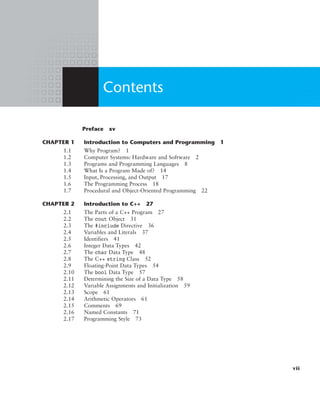
Preface xv
CHAPTER 1 Introduction to Computers and Programming 1
1.1 Why Program? 1
1.2 Computer Systems: Hardware and Software 2
1.3 Programs and Programming Languages 8
1.4 What Is a Program Made of? 14
1.5 Input, Processing, and Output 17
1.6 The Programming Process 18
1.7 Procedural and Object-Oriented Programming 22
CHAPTER 2 Introduction to C++ 27
2.1 The Parts of a C++ Program 27
2.2 The cout Object 31
2.3 The #include Directive 36
2.4 Variables and Literals 37
2.5 Identifiers 41
2.6 Integer Data Types 42
2.7 The char Data Type 48
2.8 The C++ string Class 52
2.9 Floating-Point Data Types 54
2.10 The bool Data Type 57
2.11 Determining the Size of a Data Type 58
2.12 Variable Assignments and Initialization 59
2.13 Scope 61
2.14 Arithmetic Operators 61
2.15 Comments 69
2.16 Named Constants 71
2.17 Programming Style 73
vii
Contents
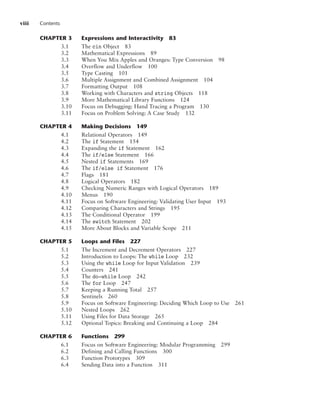
viii Contents
CHAPTER 3 Expressions and Interactivity 83
3.1 The cin Object 83
3.2 Mathematical Expressions 89
3.3 When You Mix Apples and Oranges: Type Conversion 98
3.4 Overflow and Underflow 100
3.5 Type Casting 101
3.6 Multiple Assignment and Combined Assignment 104
3.7 Formatting Output 108
3.8 Working with Characters and string Objects 118
3.9 More Mathematical Library Functions 124
3.10 Focus on Debugging: Hand Tracing a Program 130
3.11 Focus on Problem Solving: A Case Study 132
CHAPTER 4 Making Decisions 149
4.1 Relational Operators 149
4.2 The if Statement 154
4.3 Expanding the if Statement 162
4.4 The if/else Statement 166
4.5 Nested if Statements 169
4.6 The if/else if Statement 176
4.7 Flags 181
4.8 Logical Operators 182
4.9 Checking Numeric Ranges with Logical Operators 189
4.10 Menus 190
4.11 Focus on Software Engineering: Validating User Input 193
4.12 Comparing Characters and Strings 195
4.13 The Conditional Operator 199
4.14 The switch Statement 202
4.15 More About Blocks and Variable Scope 211
CHAPTER 5 Loops and Files 227
5.1 The Increment and Decrement Operators 227
5.2 Introduction to Loops: The while Loop 232
5.3 Using the while Loop for Input Validation 239
5.4 Counters 241
5.5 The do-while Loop 242
5.6 The for Loop 247
5.7 Keeping a Running Total 257
5.8 Sentinels 260
5.9 Focus on Software Engineering: Deciding Which Loop to Use 261
5.10 Nested Loops 262
5.11 Using Files for Data Storage 265
5.12 Optional Topics: Breaking and Continuing a Loop 284
CHAPTER 6 Functions 299
6.1 Focus on Software Engineering: Modular Programming 299
6.2 Defining and Calling Functions 300
6.3 Function Prototypes 309
6.4 Sending Data into a Function 311
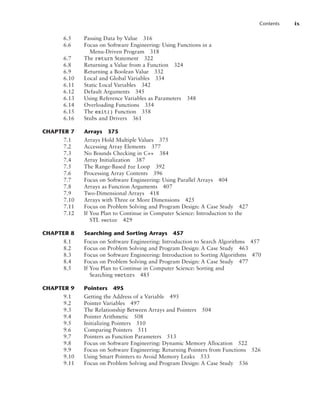
Contents ix
6.5 Passing Data by Value 316
6.6 Focus on Software Engineering: Using Functions in a
Menu-Driven Program 318
6.7 The return Statement 322
6.8 Returning a Value from a Function 324
6.9 Returning a Boolean Value 332
6.10 Local and Global Variables 334
6.11 Static Local Variables 342
6.12 Default Arguments 345
6.13 Using Reference Variables as Parameters 348
6.14 Overloading Functions 354
6.15 The exit() Function 358
6.16 Stubs and Drivers 361
CHAPTER 7 Arrays 375
7.1 Arrays Hold Multiple Values 375
7.2 Accessing Array Elements 377
7.3 No Bounds Checking in C++ 384
7.4 Array Initialization 387
7.5 The Range-Based for Loop 392
7.6 Processing Array Contents 396
7.7 Focus on Software Engineering: Using Parallel Arrays 404
7.8 Arrays as Function Arguments 407
7.9 Two-Dimensional Arrays 418
7.10 Arrays with Three or More Dimensions 425
7.11 Focus on Problem Solving and Program Design: A Case Study 427
7.12 If You Plan to Continue in Computer Science: Introduction to the
STL vector 429
CHAPTER 8 Searching and Sorting Arrays 457
8.1 Focus on Software Engineering: Introduction to Search Algorithms 457
8.2 Focus on Problem Solving and Program Design: A Case Study 463
8.3 Focus on Software Engineering: Introduction to Sorting Algorithms 470
8.4 Focus on Problem Solving and Program Design: A Case Study 477
8.5 If You Plan to Continue in Computer Science: Sorting and
Searching vectors 485
CHAPTER 9 Pointers 495
9.1 Getting the Address of a Variable 495
9.2 Pointer Variables 497
9.3 The Relationship Between Arrays and Pointers 504
9.4 Pointer Arithmetic 508
9.5 Initializing Pointers 510
9.6 Comparing Pointers 511
9.7 Pointers as Function Parameters 513
9.8 Focus on Software Engineering: Dynamic Memory Allocation 522
9.9 Focus on Software Engineering: Returning Pointers from Functions 526
9.10 Using Smart Pointers to Avoid Memory Leaks 533
9.11 Focus on Problem Solving and Program Design: A Case Study 536
x Contents
CHAPTER 10 Characters, C-Strings, and More About the string Class 547
10.1 Character Testing 547
10.2 Character Case Conversion 551
10.3 C-Strings 554
10.4 Library Functions for Working with C-Strings 558
10.5 C-String/Numeric Conversion Functions 569
10.6 Focus on Software Engineering: Writing Your Own
C-String-Handling Functions 575
10.7 More About the C++ string Class 581
10.8 Focus on Problem Solving and Program Design: A Case Study 590
CHAPTER 11 Structured Data 599
11.1 Abstract Data Types 599
11.2 Focus on Software Engineering: Combining Data into Structures 601
11.3 Accessing Structure Members 604
11.4 Initializing a Structure 608
11.5 Arrays of Structures 611
11.6 Focus on Software Engineering: Nested Structures 613
11.7 Structures as Function Arguments 617
11.8 Returning a Structure from a Function 620
11.9 Pointers to Structures 623
11.10 Focus on Software Engineering: When to Use ., When to Use ->,
and When to Use * 626
11.11 Unions 628
11.12 Enumerated Data Types 632
CHAPTER 12 Advanced File Operations 657
12.1 File Operations 657
12.2 File Output Formatting 663
12.3 Passing File Stream Objects to Functions 665
12.4 More Detailed Error Testing 667
12.5 Member Functions for Reading and Writing Files 670
12.6 Focus on Software Engineering: Working with Multiple Files 678
12.7 Binary Files 680
12.8 Creating Records with Structures 685
12.9 Random-Access Files 689
12.10 Opening a File for Both Input and Output 697
CHAPTER 13 Introduction to Classes 711
13.1 Procedural and Object-Oriented Programming 711
13.2 Introduction to Classes 718
13.3 Defining an Instance of a Class 723
13.4 Why Have Private Members? 736
13.5 Focus on Software Engineering: Separating Class Specification
from Implementation 737
13.6 Inline Member Functions 743
13.7 Constructors 746
13.8 Passing Arguments to Constructors 750
Contents xi
13.9 Destructors 758
13.10 Overloading Constructors 762
13.11 Private Member Functions 765
13.12 Arrays of Objects 767
13.13 Focus on Problem Solving and Program Design: An OOP Case Study 771
13.14 Focus on Object-Oriented Programming: Simulating Dice with Objects 778
13.15 Focus on Object-Oriented Programming: Creating an Abstract Array
Data Type 782
13.16 Focus on Object-Oriented Design: The Unified Modeling Language (UML) 785
13.17 Focus on Object-Oriented Design: Finding the Classes and Their
Responsibilities 788
CHAPTER 14 More About Classes 811
14.1 Instance and Static Members 811
14.2 Friends of Classes 819
14.3 Memberwise Assignment 824
14.4 Copy Constructors 825
14.5 Operator Overloading 831
14.6 Object Conversion 858
14.7 Aggregation 860
14.8 Focus on Object-Oriented Design: Class Collaborations 865
14.9 Focus on Object-Oriented Programming: Simulating the Game
of Cho-Han 869
CHAPTER 15 Inheritance, Polymorphism, and Virtual Functions 891
15.1 What Is Inheritance? 891
15.2 Protected Members and Class Access 900
15.3 Constructors and Destructors in Base and Derived Classes 906
15.4 Redefining Base Class Functions 918
15.5 Class Hierarchies 923
15.6 Polymorphism and Virtual Member Functions 929
15.7 Abstract Base Classes and Pure Virtual Functions 945
15.8 Multiple Inheritance 952
CHAPTER 16 Exceptions, Templates, and the Standard Template
Library (STL) 971
16.1 Exceptions 971
16.2 Function Templates 990
16.3 Focus on Software Engineering: Where to Start When Defining Templates 996
16.4 Class Templates 996
16.5 Introduction to the Standard Template Library (STL) 1005
CHAPTER 17 Linked Lists 1025
17.1 Introduction to the Linked List ADT 1025
17.2 Linked List Operations 1027
17.3 A Linked List Template 1043
17.4 Variations of the Linked List 1055
17.5 The STL list Container 1056
xii Contents
CHAPTER 18 Stacks and Queues 1063
18.1 Introduction to the Stack ADT 1063
18.2 Dynamic Stacks 1080
18.3 The STL stack Container 1091
18.4 Introduction to the Queue ADT 1093
18.5 Dynamic Queues 1105
18.6 The STL deque and queue Containers 1112
CHAPTER 19 Recursion 1121
19.1 Introduction to Recursion 1121
19.2 Solving Problems with Recursion 1125
19.3 Focus on Problem Solving and Program Design: The Recursive
gcd Function 1133
19.4 Focus on Problem Solving and Program Design: Solving Recursively
Defined Problems 1134
19.5 Focus on Problem Solving and Program Design: Recursive Linked List
Operations 1135
19.6 Focus on Problem Solving and Program Design: A Recursive Binary
Search Function 1139
19.7 The Towers of Hanoi 1141
19.8 Focus on Problem Solving and Program Design: The QuickSort Algorithm 1144
19.9 Exhaustive Algorithms 1148
19.10 Focus on Software Engineering: Recursion vs. Iteration 1151
CHAPTER 20 Binary Trees 1155
20.1 Definition and Applications of Binary Trees 1155
20.2 Binary Search Tree Operations 1158
20.3 Template Considerations for Binary Search Trees 1175
Appendix A: Getting Started with Alice 1185
Appendix B: The ASCII Character Set 1211
Appendix C: Operator Precedence and Associativity 1213
Quick References 1215
Index 1217
Credit 1237
Online The following appendices are available at www.pearsonhighered.com/gaddis.
Appendix D: Introduction to Flowcharting
Appendix E: Using UML in Class Design
Appendix F: Namespaces
Appendix G: Passing Command Line Arguments
Appendix H: Header File and Library Function Reference
Appendix I: Binary Numbers and Bitwise Operations
Appendix J: Multi-Source File Programs
Appendix K: Stream Member Functions for Formatting
Appendix L: Answers to Checkpoints
Appendix M: Solutions to Odd-Numbered Review Questions
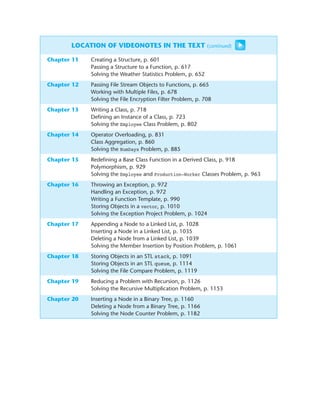
LOCATION OF VIDEONOTES IN THE TEXT
Chapter 1 Introduction to Flowcharting, p. 20
Designing a Program with Pseudocode, p. 20
Designing the Account Balance Program, p. 25
Predicting the Result of Problem 33, p. 26
Chapter 2 Using cout, p. 31
Variabe Definitions, p. 37
Assignment Statements and Simple Math Expressions, p. 62
Solving the Restaurant Bill Problem, p. 80
Chapter 3 Reading Input with cin, p. 83
Formatting Numbers with setprecision, p. 111
Solving the Stadium Seating Problem, p. 142
Chapter 4 The if Statement, p. 154
The if/else statement, p. 166
The if/else if Statement, p. 176
Solving the Time Calculator Problem, p. 221
Chapter 5 The while Loop, p. 232
The for Loop, p. 247
Reading Data from a File, p. 274
Solving the Calories Burned Problem, p. 293
Chapter 6 Functions and Arguments, p. 311
Value-Returnlng Functions, p. 324
Solving the Markup Problem, p. 366
Chapter 7 Accessing Array Elements With a Loop, p. 380
Passing an Array to a Function, p. 407
Solving the Chips and Salsa Problem, p. 448
Chapter 8 The Binary Search, p. 460
The Selection Sort, p. 474
Solving the Charge Account Validation Modification Problem, p. 492
Chapter 9 Dynamically Allocating an Array, p. 523
Solving the Pointer Rewrite Problem, p. 545
Chapter 10 Writing a C-String-Handling Function, p. 575
More About the string Class, p. 581
Solving the Backward String Problem, p. 594
(continued on the next page)
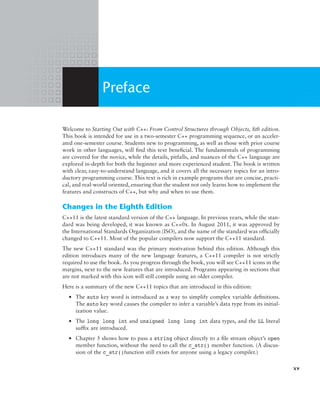
LOCATION OF VIDEONOTES IN THE TEXT (continued)
Chapter 11 Creating a Structure, p. 601
Passing a Structure to a Function, p. 617
Solving the Weather Statistics Problem, p. 652
Chapter 12 Passing File Stream Objects to Functions, p. 665
Working with Multiple Files, p. 678
Solving the File Encryption Filter Problem, p. 708
Chapter 13 Writing a Class, p. 718
Defining an Instance of a Class, p. 723
Solving the Employee Class Problem, p. 802
Chapter 14 Operator Overloading, p. 831
Class Aggregation, p. 860
Solving the NumDays Problem, p. 885
Chapter 15 Redefining a Base Class Function in a Derived Class, p. 918
Polymorphism, p. 929
Solving the Employee and Production-Worker Classes Problem, p. 963
Chapter 16 Throwing an Exception, p. 972
Handling an Exception, p. 972
Writing a Function Template, p. 990
Storing Objects in a vector, p. 1010
Solving the Exception Project Problem, p. 1024
Chapter 17 Appending a Node to a Linked List, p. 1028
Inserting a Node in a Linked List, p. 1035
Deleting a Node from a Linked List, p. 1039
Solving the Member Insertion by Position Problem, p. 1061
Chapter 18 Storing Objects in an STL stack, p. 1091
Storing Objects in an STL queue, p. 1114
Solving the File Compare Problem, p. 1119
Chapter 19 Reducing a Problem with Recursion, p. 1126
Solving the Recursive Multiplication Problem, p. 1153
Chapter 20 Inserting a Node in a Binary Tree, p. 1160
Deleting a Node from a Binary Tree, p. 1166
Solving the Node Counter Problem, p. 1182
Welcome to Starting Out with C++: From Control Structures through Objects, 8th edition.
This book is intended for use in a two-semester C++ programming sequence, or an acceler-
ated one-semester course. Students new to programming, as well as those with prior course
work in other languages, will find this text beneficial. The fundamentals of programming
are covered for the novice, while the details, pitfalls, and nuances of the C++ language are
explored in-depth for both the beginner and more experienced student. The book is written
with clear, easy-to-understand language, and it covers all the necessary topics for an intro-
ductory programming course. This text is rich in example programs that are concise, practi-
cal, and real-world oriented, ensuring that the student not only learns how to implement the
features and constructs of C++, but why and when to use them.
Changes in the Eighth Edition
C++11 is the latest standard version of the C++ language. In previous years, while the stan-
dard was being developed, it was known as C++0x. In August 2011, it was approved by
the International Standards Organization (ISO), and the name of the standard was officially
changed to C++11. Most of the popular compilers now support the C++11 standard.
The new C++11 standard was the primary motivation behind this edition. Although this
edition introduces many of the new language features, a C++11 compiler is not strictly
required to use the book. As you progress through the book, you will see C++11 icons in the
margins, next to the new features that are introduced. Programs appearing in sections that
are not marked with this icon will still compile using an older compiler.
Here is a summary of the new C++11 topics that are introduced in this edition:
● The auto key word is introduced as a way to simplify complex variable definitions.
The auto key word causes the compiler to infer a variable’s data type from its initial-
ization value.
● The long long int and unsigned long long int data types, and the LL literal
suffix are introduced.
● Chapter 5 shows how to pass a string object directly to a file stream object’s open
member function, without the need to call the c_str() member function. (A discus-
sion of the c_str()function still exists for anyone using a legacy compiler.)
Preface
xv
Visit https://ebookmass.com today to explore
a vast collection of ebooks across various
genres, available in popular formats like
PDF, EPUB, and MOBI, fully compatible with
all devices. Enjoy a seamless reading
experience and effortlessly download high-
quality materials in just a few simple steps.
Plus, don’t miss out on exciting offers that
let you access a wealth of knowledge at the
best prices!
xvi Preface
● The range-based for loop is introduced in Chapter 7. This new looping mechanism
automatically iterates over each element of an array, vector, or other collection,
without the need of a counter variable or a subscript.
● Chapter 7 shows how a vector can be initialized with an initialization list.
● The nullptr key word is introduced as the standard way of representing a null
pointer.
● Smart pointers are introduced in Chapter 9, with an example of dynamic memory
allocation using unique_ptr.
● Chapter 10 discusses the new, overloaded to_string functions for converting numeric
values to string objects.
● The string class’s new back() and front() member functions are included in
Chapter 10’s overview of the string class.
● Strongly typed enums are discussed in Chapter 11.
● Chapter 13 shows how to use the smart pointer unique_ptr to dynamically allocate
an object.
● Chapter 15 discusses the override key word and demonstrates how it can help prevent
subtle overriding errors.The final key word is discussed as a way of preventing a virtual
member function from being overridden.
In addition to the C++11 topics, the following general improvements were made:
● Several new programming problems have been added to the text, and many of the
existing programming problems have been modified to make them unique from previ-
ous editions.
● The discussion of early, historic computers in Chapter 1 is expanded.
● The discussion of literal values in Chapter 2 is improved.
● The introduction of the char data type in Chapter 2 is reorganized to use character
literals in variable assignments before using ASCII values in variable assignments.
● The discussion of random numbers in Chapter 3 is expanded and improved, with the
addition of a new In the Spotlight section.
● A new Focus on Object-Oriented Programming section has been added to Chapter 13,
showing how to write a class that simulates dice.
● A new Focus on Object-Oriented Programming section has been added to Chapter 14,
showing an object-oriented program that simulates the game of Cho-Han. The program
uses objects for the dealer, two players, and a pair of dice.
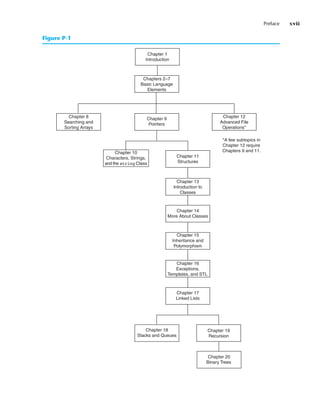
Organization of the Text
This text teaches C++ in a step-by-step fashion. Each chapter covers a major set of topics
and builds knowledge as the student progresses through the book. Although the chapters
can be easily taught in their existing sequence, some flexibility is provided. The diagram
shown in Figure P-1 suggests possible sequences of instruction.
Preface xvii
Chapter 8
Searching and
Sorting Arrays
Chapter 9
Pointers
Chapter 10
Characters, Strings,
and the string Class
Chapter 12
Advanced File
Operations*
Chapter 20
Binary Trees
Chapters 2–7
Basic Language
Elements
Chapter 11
Structures
Chapter 13
Introduction to
Classes
Chapter 14
More About Classes
Chapter 15
Inheritance and
Polymorphism
Chapter 16
Exceptions,
Templates, and STL
Chapter 17
Linked Lists
Chapter 18
Stacks and Queues
Chapter 19
Recursion
*A few subtopics in
Chapter 12 require
Chapters 9 and 11.
Chapter 1
Introduction
Figure P-1
xviii Preface
Chapter 1 covers fundamental hardware, software, and programming concepts. You may
choose to skip this chapter if the class has already mastered those topics. Chapters 2 through
7 cover basic C++ syntax, data types, expressions, selection structures, repetition structures,
functions, and arrays. Each of these chapters builds on the previous chapter and should be
covered in the order presented.
After Chapter 7 has been covered, you may proceed to Chapter 8, or jump to either Chapter
9 or Chapter 12. (If you jump to Chapter 12 at this point, you will need to postpone sections
12.7, 12.8, and 12.10 until Chapters 9 and 11 have been covered.)
After Chapter 9 has been covered, either of Chapters 10 or 11 may be covered. After Chap-
ter 11, you may cover Chapters 13 through 17 in sequence. Next you can proceed to either
Chapter 18 or Chapter 19. Finally, Chapter 20 may be covered.
This text’s approach starts with a firm foundation in structured, procedural programming
before delving fully into object-oriented programming and advanced data structures.
Brief Overview of Each Chapter
Chapter 1: Introduction to Computers and Programming
This chapter provides an introduction to the field of computer science and covers the fun-
damentals of programming, problem solving, and software design. The components of pro-
grams, such as key words, variables, operators, and punctuation are covered. The tools of
the trade, such as pseudocode, flow charts, and hierarchy charts are also presented.
Chapter 2: Introduction to C++
This chapter gets the student started in C++ by introducing data types, identifiers, vari-
able declarations, constants, comments, program output, simple arithmetic operations, and
C-strings. Programming style conventions are introduced and good programming style
is modeled here, as it is throughout the text. An optional section explains the difference
between ANSI standard and pre-standard C++ programs.
Chapter 3: Expressions and Interactivity
In this chapter the student learns to write programs that input and handle numeric, char-
acter, and string data. The use of arithmetic operators and the creation of mathematical
expressions are covered in greater detail, with emphasis on operator precedence. Debug-
ging is introduced, with a section on hand tracing a program. Sections are also included on
simple output formatting, on data type conversion and type casting, and on using library
functions that work with numbers.
Chapter 4: Making Decisions
Here the student learns about relational operators, relational expressions and how to con-
trol the flow of a program with the if, if/else, and if/else if statements. The condi-
tional operator and the switch statement are also covered. Crucial applications of these
constructs are covered, such as menu-driven programs and the validation of input.
Preface xix
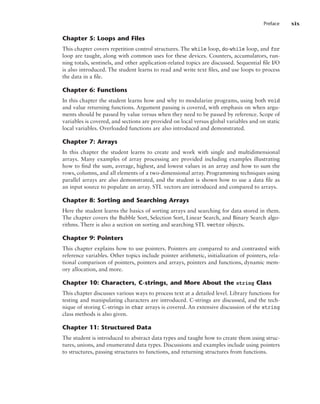
Chapter 5: Loops and Files
This chapter covers repetition control structures. The while loop, do-while loop, and for
loop are taught, along with common uses for these devices. Counters, accumulators, run-
ning totals, sentinels, and other application-related topics are discussed. Sequential file I/O
is also introduced. The student learns to read and write text files, and use loops to process
the data in a file.
Chapter 6: Functions
In this chapter the student learns how and why to modularize programs, using both void
and value returning functions. Argument passing is covered, with emphasis on when argu-
ments should be passed by value versus when they need to be passed by reference. Scope of
variables is covered, and sections are provided on local versus global variables and on static
local variables. Overloaded functions are also introduced and demonstrated.
Chapter 7: Arrays
In this chapter the student learns to create and work with single and multidimensional
arrays. Many examples of array processing are provided including examples illustrating
how to find the sum, average, highest, and lowest values in an array and how to sum the
rows, columns, and all elements of a two-dimensional array. Programming techniques using
parallel arrays are also demonstrated, and the student is shown how to use a data file as
an input source to populate an array. STL vectors are introduced and compared to arrays.
Chapter 8: Sorting and Searching Arrays
Here the student learns the basics of sorting arrays and searching for data stored in them.
The chapter covers the Bubble Sort, Selection Sort, Linear Search, and Binary Search algo-
rithms. There is also a section on sorting and searching STL vector objects.
Chapter 9: Pointers
This chapter explains how to use pointers. Pointers are compared to and contrasted with
reference variables. Other topics include pointer arithmetic, initialization of pointers, rela-
tional comparison of pointers, pointers and arrays, pointers and functions, dynamic mem-
ory allocation, and more.
Chapter 10: Characters, C-strings, and More About the string Class
This chapter discusses various ways to process text at a detailed level. Library functions for
testing and manipulating characters are introduced. C-strings are discussed, and the tech-
nique of storing C-strings in char arrays is covered. An extensive discussion of the string
class methods is also given.
Chapter 11: Structured Data
The student is introduced to abstract data types and taught how to create them using struc-
tures, unions, and enumerated data types. Discussions and examples include using pointers
to structures, passing structures to functions, and returning structures from functions.
xx Preface
Chapter 12: Advanced File Operations
This chapter covers sequential access, random access, text, and binary files. The various
modes for opening files are discussed, as well as the many methods for reading and writing
file contents. Advanced output formatting is also covered.
Chapter 13: Introduction to Classes
The student now shifts focus to the object-oriented paradigm. This chapter covers the fun-
damental concepts of classes. Member variables and functions are discussed. The student
learns about private and public access specifications, and reasons to use each. The topics of
constructors, overloaded constructors, and destructors are also presented. The chapter pres-
ents a section modeling classes with UML and how to find the classes in a particular problem.
Chapter 14: More About Classes
This chapter continues the study of classes. Static members, friends, memberwise assign-
ment, and copy constructors are discussed. The chapter also includes in-depth sections on
operator overloading, object conversion, and object aggregation. There is also a section on
class collaborations and the use of CRC cards.
Chapter 15: Inheritance, Polymorphism, and Virtual Functions
The study of classes continues in this chapter with the subjects of inheritance, polymor-
phism, and virtual member functions. The topics covered include base and derived class con-
structors and destructors, virtual member functions, base class pointers, static and dynamic
binding, multiple inheritance, and class hierarchies.
Chapter 16: Exceptions, Templates, and the Standard
Template Library (STL)
The student learns to develop enhanced error trapping techniques using exceptions. Discus-
sion then turns to function and class templates as a method for reusing code. Finally, the
student is introduced to the containers, iterators, and algorithms offered by the Standard
Template Library (STL).
Chapter 17: Linked Lists
This chapter introduces concepts and techniques needed to work with lists. A linked list
ADT is developed and the student is taught to code operations such as creating a linked list,
appending a node, traversing the list, searching for a node, inserting a node, deleting a node,
and destroying a list. A linked list class template is also demonstrated.
Chapter 18: Stacks and Queues
In this chapter the student learns to create and use static and dynamic stacks and queues. The
operations of stacks and queues are defined, and templates for each ADT are demonstrated.
Chapter 19: Recursion
This chapter discusses recursion and its use in problem solving. A visual trace of recursive
calls is provided, and recursive applications are discussed. Many recursive algorithms are
presented, including recursive functions for finding factorials, finding a greatest common
Preface xxi
denominator (GCD), performing a binary search, and sorting (QuickSort). The classic Tow-
ers of Hanoi example is also presented. For students who need more challenge, there is a
section on exhaustive algorithms.
Chapter 20: Binary Trees
This chapter covers the binary tree ADT and demonstrates many binary tree operations. The
student learns to traverse a tree, insert an element, delete an element, replace an element, test
for an element, and destroy a tree.
Appendix A: Getting Started with Alice
This appendix gives a quick introduction to Alice. Alice is free software that can be used to
teach fundamental programming concepts using 3D graphics.
Appendix B: ASCII Character Set
A list of the ASCII and Extended ASCII characters and their codes.
Appendix C: Operator Precedence and Associativity
A chart showing the C++ operators and their precedence.
The following appendices are available online at www.pearsonhighered.com/gaddis.
Appendix D: Introduction to Flowcharting
A brief introduction to flowcharting. This tutorial discusses sequence, selection, case, repeti-
tion, and module structures.
Appendix E: Using UML in Class Design
This appendix shows the student how to use the Unified Modeling Language to design
classes. Notation for showing access specification, data types, parameters, return values,
overloaded functions, composition, and inheritance are included.
Appendix F: Namespaces
This appendix explains namespaces and their purpose. Examples showing how to define a
namespace and access its members are given.
Appendix G: Passing Command Line Arguments
Teaches the student how to write a C++ program that accepts arguments from the command
line. This appendix will be useful to students working in a command line environment, such
as Unix, Linux, or the Windows command prompt.
Appendix H: Header File and Library Function Reference
This appendix provides a reference for the C++ library functions and header files discussed
in the book.
Appendix I: Binary Numbers and Bitwise Operations
A guide to the C++ bitwise operators, as well as a tutorial on the internal storage of integers.
xxii Preface
Appendix J: Multi-Source File Programs
Provides a tutorial on creating programs that consist of multiple source files. Function
header files, class specification files, and class implementation files are discussed.
Appendix K: Stream Member Functions for Formatting
Covers stream member functions for formatting such as setf.
Appendix L: Answers to Checkpoints
Students may test their own progress by comparing their answers to the checkpoint exer-
cises against this appendix. The answers to all Checkpoints are included.
Appendix M: Solutions to Odd-Numbered Review Questions
Another tool that students can use to gauge their progress.
Features of the Text
Concept Each major section of the text starts with a concept statement.
Statements This statement summarizes the ideas of the section.
Example Programs The text has hundreds of complete example programs, each
designed to highlight the topic currently being studied. In most
cases, these are practical, real-world examples. Source code for
these programs is provided so that students can run the programs
themselves.
Program Output After each example program there is a sample of its screen
output. This immediately shows the student how the program
should function.
In the Spotlight Each of these sections provides a programming problem and a
detailed, step-by-step analysis showing the student how to
solve it.
VideoNotes A series of online videos, developed specifically for this book, is
available for viewing at www.pearsonhighered.com/gaddis.
Icons appear throughout the text alerting the student to videos
about specific topics.
Checkpoints Checkpoints are questions placed throughout each chapter as
a self-test study aid. Answers for all Checkpoint questions can
be downloaded from the book’s Companion Web site at www.
pearsonhighered.com/gaddis. This allows students to check how
well they have learned a new topic.
Notes Notes appear at appropriate places throughout the text. They are
short explanations of interesting or often misunderstood points
relevant to the topic at hand.
Preface xxiii
Warnings Warnings are notes that caution the student about certain C++
features, programming techniques, or practices that can lead to
malfunctioning programs or lost data.
Case Studies Case studies that simulate real-world applications appear in
many chapters throughout the text. These case studies are de-
signed to highlight the major topics of the chapter in which they
appear.
Review Questions Each chapter presents a thorough and diverse set of review
and Exercises questions, such as fill-in-the-blank and short answer, that check
the student’s mastery of the basic material presented in the chap-
ter. These are followed by exercises requiring problem solving
and analysis, such as the Algorithm Workbench, Predict the Out-
put, and Find the Errors sections. Answers to the odd-numbered
review questions and review exercises can be downloaded from
the book’s Companion Web site at www.pearsonhighered.com/
gaddis.
Programming Each chapter offers a pool of programming exercises designed
Challenges to solidify the student’s knowledge of the topics currently being
studied. In most cases the assignments present real-world prob-
lems to be solved. When applicable, these exercises include input
validation rules.
Group Projects There are several group programming projects throughout the
text, intended to be constructed by a team of students. One
student might build the program’s user interface, while another
student writes the mathematical code, and another designs and
implements a class the program uses. This process is similar to
the way many professional programs are written and encourages
team work within the classroom.
Software Available for download from the book’s Companion Web site at
Development www.pearsonhighered.com/gaddis. This is an ongoing project
Project: that instructors can optionally assign to teams of students. It
Serendipity systematically develops a “real-world” software package: a
Booksellers point-of-sale program for the fictitious Serendipity Booksellers
organization. The Serendipity assignment for each chapter adds
more functionality to the software, using constructs and tech-
niques covered in that chapter. When complete, the program will
act as a cash register, manage an inventory database, and produce
a variety of reports.
C++ Quick For easy access, a quick reference guide to the C++ language is
Reference Guide printed on the last two pages of Appendix C in the book.
C++11 Throughout the text, new C++11 language features are
introduced. Look for the C++11 icon to find these new features.
11
11
xxiv Preface
Supplements
Student Online Resources
Many student resources are available for this book from the publisher. The following items
are available on the Gaddis Series Companion Web site at www.pearsonhighered.com/gaddis:
● The source code for each example program in the book
● Access to the book’s companion VideoNotes
● A full set of appendices, including answers to the Checkpoint questions and answers
to the odd-numbered review questions
● A collection of valuable Case Studies
● The complete Serendipity Booksellers Project
Integrated Development Environment (IDE) Resource Kits
Professors who adopt this text can order it for students with a kit containing five popular
C++ IDEs (Microsoft® Visual Studio Express Edition, Dev C++, NetBeans, Eclipse, and
CodeLite) and access to a Web site containing written and video tutorials for getting started
in each IDE. For ordering information, please contact your campus Pearson Education rep-
resentative or visit www.pearsonhighered.com/cs.
Online Practice and Assessment with MyProgrammingLab
MyProgrammingLab helps students fully grasp the logic, semantics, and syntax of pro-
gramming. Through practice exercises and immediate, personalized feedback, MyProgram-
mingLab improves the programming competence of beginning students who often struggle
with the basic concepts and paradigms of popular high-level programming languages.
A self-study and homework tool, a MyProgrammingLab course consists of hundreds of
small practice exercises organized around the structure of this textbook. For students, the
system automatically detects errors in the logic and syntax of their code submissions and
offers targeted hints that enable students to figure out what went wrong—and why. For
instructors, a comprehensive gradebook tracks correct and incorrect answers and stores the
code inputted by students for review.
MyProgrammingLab is offered to users of this book in partnership with Turing’s Craft, the
makers of the CodeLab interactive programming exercise system. For a full demonstration,
to see feedback from instructors and students, or to get started using MyProgrammingLab
in your course, visit www.myprogramminglab.com.
Instructor Resources
The following supplements are available to qualified instructors only:
• Answers to all Review Questions in the text
• Solutions for all Programming Challenges in the text
• PowerPoint presentation slides for every chapter
• Computerized test bank
Preface xxv
• Answers to all Student Lab Manual questions
• Solutions for all Student Lab Manual programs
Visit the Pearson Instructor Resource Center (www.pearsonhighered.com/irc) for
information on how to access instructor resources.
Textbook Web site
Student and instructor resources, including links to download Microsoft® Visual Studio
Express and other popular IDEs, for all the books in the Gaddis Starting Out With series
can be accessed at the following URL:
http://www.pearsonhighered.com/gaddis
Get this book the way you want it!
This book is part of Pearson Education’s custom database for Computer Science textbooks.
Use our online PubSelect system to select just the chapters you need from this, and other,
Pearson Education CS textbooks. You can edit the sequence to exactly match your course
organization and teaching approach. Visit www.pearsoncustom.com/cs for details.
Which Gaddis C++ book is right for you?
The Starting Out with C++ Series includes three books, one of which is sure to fit your course:
● Starting Out with C++: From Control Structures through Objects
● Starting Out with C++: Early Objects
● Starting Out with C++: Brief Version
The following chart will help you determine which book is right for your course.
■ FROM CONTROL STRUCTURES
THROUGH OBJECTS
■ BRIEF VERSION
■ EARLY OBJECTS
LATE INTRODUCTION OF OBJECTS
Classes are introduced in Chapter 13 of the stan-
dard text and Chapter 11 of the brief text, after
control structures, functions, arrays, and pointers.
Advanced OOP topics, such as inheritance and
polymorphism, are covered in the following two
chapters.
EARLIER INTRODUCTION OF OBJECTS
Classes are introduced in Chapter 7, after
control structures and functions, but before
arrays and pointers. Their use is then
integrated into the remainder of the text.
Advanced OOP topics, such as inheritance
and polymorphism, are covered in Chapters
11 and 15.
INTRODUCTION OF DATA STRUCTURES
AND RECURSION
Linked lists, stacks and queues, and binary trees
are introduced in the final chapters of the standard
text. Recursion is covered after stacks and queues,
but before binary trees. These topics are not
covered in the brief text, though it does have
appendices dealing with linked lists and recursion.
INTRODUCTION OF DATA STRUCTURES
AND RECURSION
Linked lists, stacks and queues, and binary
trees are introduced in the final chapters of
the text, after the chapter on recursion.
Visit https://ebookmass.com today to explore
a vast collection of ebooks across various
genres, available in popular formats like
PDF, EPUB, and MOBI, fully compatible with
all devices. Enjoy a seamless reading
experience and effortlessly download high-
quality materials in just a few simple steps.
Plus, don’t miss out on exciting offers that
let you access a wealth of knowledge at the
best prices!
Exploring the Variety of Random
Documents with Different Content
And there came a time when he spoke aloud, and called out hoarsely:
"Who's that? Who's whispering there? Who's calling Shadow Varne ...
Shadow Varne ... Shadow Varne...."
And in answer the ship's bell struck the hour of dawn.
BOOK II: THE ISLE OF PREY
—I—
THE SPELL OF THE MOONBEAMS
It was a night of white moonlight; a languorous night. It was a night of
impenetrable shadows, deep and black; and, where light and shadow met
and merged, the treetops were fringed against the sky in tracery as delicate
as a cameo. And there was fragrance in the air, exotic, exquisite, the
fragrance of growing things, of semi-tropical flowers and trees and shrubs.
And very faint and soft there fell upon the ear the gentle lapping of the
water on the shore, as though in her mother tenderness nature were
breathing a lullaby over her sea-cradled isle.
On a verandah of great length and spacious width, moon-streaked where
the light stole in through the row of ornamental columns that supported the
roof and through the interstices of vine-covered lattice work, checkering the
flooring in fanciful designs, a girl raised herself suddenly on her elbow
from a reclining chair, and, reaching out her hand, laid it impulsively on
that of another girl who sat in a chair beside her.
"Oh, Dora," she breathed, "it's just like fairyland!"
Dora Marlin smiled quietly.
"What a queer little creature you are, Polly!" she said. "You like it here,
don't you?"
"I love it!" said Polly Wickes.
"Fairyland!" Dora Marlin repeated the word. "Wouldn't it be wonderful
if there were a real fairyland just like the stories they used to read to us as
children?"
Polly Wickes nodded her head slowly.
"I suppose so," she said; "but I never had any fairy stories read to me
when I was a child, and so my fairyland has always been one of my own—
one of dreams. And this is fairyland because it's so beautiful, and because
being here doesn't seem as though one were living in the same world one
was born in at all."
"You poor child!" said Dora Marlin softly. "A land of dreams, then! Yes;
I know. These nights are like that sometimes, aren't they? They make you
dream any dream you want to have come true, and, while you dream wide
awake, you almost actually experience its fulfilment then and there. And so
it is nearly as good as a real fairyland, isn't it? And anyway, Polly, you look
like a really, truly fairy yourself to-night."
"No," said Polly Wickes. "You are the fairy. Fairies aren't supposed to be
dark; they have golden hair, and blue eyes, and—"
"A wand," interrupted Dora Marlin, with a mischievous little laugh.
"And if it weren't all just make-believe, and I was the fairy, I'd wave my
wand and have him appear instantly on the scene; but, as it is, I'm afraid he
won't come to-night after all, and it's getting late, and I think we'd better go
to bed."
"And I'm sure he will come, and anyway I couldn't go to bed," said Polly
Wickes earnestly. "And anyway I couldn't go to sleep. Just think, Dora, I
haven't seen him for nearly four years, and I'll have all the news, and hear
everything I want to know about mother. He said they'd leave the mainland
to-day, and it's only five hours across. I'm sure he'll still come. And, besides,
I'm certain I heard a motor boat a few minutes ago."
"Very likely," agreed Dora Marlin; "but that was probably one of our
own men out somewhere around the island. It's very late now, and in half an
hour it will be low tide, and they would hardly start at all if they knew they
wouldn't make Manwa by daylight. There are the reefs, and—"
"The reefs are charted," said Polly Wickes decisively. "I know he'll
come."
A little ripple of laughter came from Dora Marlin's chair.
"How old is Captain Newcombe, dear?" she inquired naïvely.
"Don't be a beast, Dora," said Polly Wickes severely. "He's very, very old
—at least he was when I saw him last."
"When you weren't much more than fourteen," observed Dora Marlin
judicially. "And when you're fourteen anybody over thirty is a regular
Methuselah. I know I used to think when I was a child that father was
terribly, terribly old, much older than he seems to-day when he really is an
old man; and I used to wonder then how he lived so long."
Polly Wickes' dark eyes grew serious.
"It doesn't apply to me," she said in a low tone. "I wasn't ever a child. I
was old when I was ten. I've told you all about myself, because I couldn't
have come here with you if I hadn't; and you know why I am so eager and
excited and so happy that guardy is coming. I owe him everything in the
world I've got; and he's been so good to mother. I—I don't know why. He
said when I was older I would understand. And he's such a wonderful man
himself, with such a splendid war record."
Dora Marlin rose from her chair, and placed her arm affectionately
around her companion's shoulders.
"Yes, dear," she said gently. "I know. I was only teasing. And you
wouldn't be Polly Wickes if you wanted to do anything else than just sit
here and wait until you were quite, quite sure that he wouldn't come to-
night. But as I'm already sure he won't because it's so late, I'm going to bed.
You don't mind, do you, dear? I want to see if father's all right, too. Poor old
dad!"
"Dora!" Polly Wickes was on her feet. "Oh, Dora, I'm so selfish! I—I
wish I could help. But I'm sure it's going to be all right. I don't think that
specialist was right at all. How could he be? Mr. Marlin is such a dear!"
Dora Marlin turned her head away, and for a moment she did not speak.
When she looked around again there was a bright, quick smile on her lips.
"I am counting a lot on Captain Newcombe's and Mr. Locke's visit," she
said. "I'm sure it will do father good. Good-night, dear—and if they do
come, telephone up to my room and I'll be down in a jiffy. Their rooms are
all ready for them, but they're sure to be famished, and—"
"I'll do nothing of the sort!" announced Polly Wickes. "The idea of
upsetting a household in the middle of the night! I'll send them back to their
yacht."
"You won't do anything of the kind!" said Dora Marlin.
"Yes, I will," said Polly Wickes.
"Well, he won't come anyway," said Dora Marlin.
"Yes, he will!"
"No, he won't!"
They both began to laugh.
"But I'll tell you what I'll do," said Polly Wickes. "After he's gone I'll
creep into bed with you and tell you all about it. Good-night, dear."
"Good-night, Polly fairy," said Dora Marlin.
Polly Wickes watched the white form weave itself in and out of the
checkered spots of moonlight along the verandah, and finally disappear
inside the house; then she threw herself down upon the reclining chair
again, her hands clasped behind her head, and lay there, strangely alert,
wide-eyed, staring out on the lawn.
She was quite sure he would come—even yet—because when they had
sent over to the mainland for the mail yesterday there had been a letter from
him saying he would arrive some time to-day.
How soft the night was!
Would he be changed; would he seem very different? Had what Dora
had said about the viewpoint from which age measures age been really
true? And if it were? She was the one who would seem changed—from a
little girl in pigtails to a woman, not a very old woman, but a woman.
Would he know her, recognise her again?
What a wonderful, glorious, dreamy night it was!
Dreams! Was she dreaming even now, dreaming wide awake, that she
was here; a dream that supplanted the squalour of narrow, ill-lighted streets,
of dark, creaking staircases, of lurking, hungry shapes, of stalking vice, of
homes that were single, airless rooms gaunt with poverty—a dream that
supplanted all that for this, where there was only a world of beautiful
things, and where even the airs that whispered through the trees were balmy
with some rare perfume that intoxicated the senses with untold joy?
She startled herself with a sharp little cry. Pictures, memories, vivid,
swift in succession, were flashing, unbidden, through her mind—a girl in
ragged clothes who sold flowers on the street corners, in the parks, a gutter-
snipe the London "bobbies" had called her so often that the term had lost
any personal meaning save that it classified the particular species of
outcasts to which she had belonged; a room that was reached through the
climbing of a smutty, dirty staircase in a tenement that moaned in its bitter
fight against dissolution in common with its human occupants, a room that
was scanty in its furnishings, where a single cot bed did service for two, and
a stagnant odour of salt fish was never absent; a woman that was grey-
haired, sharp-faced, of language and actions at times that challenged even
the license of Whitechapel, but one who loved, too; the smells from the
doors of pastry shops on the better streets that had made her cry because
they had made her more hungry than ever; the leer of men when she had
grown a few years older who thought a gutter-snipe both defenceless and
fair game.
She had never been a child.
Polly Wickes had turned in the reclining chair, and her face now was
buried in the cushion.
And then into her life had come—had come—this "guardy." He did not
leer at her; he was kind and courtly—like—like what she had thought a
good father might have been. But she had not understood the cataclysmic,
bewildering and stupendous change that had then taken place in her life,
and so she had asked her mother. She had always remembered the answer;
she always would.
"Never you mind, dearie," Mrs. Wickes had said. "Wot's wot is wot. 'E's
a gentleman is Captain Newcombe, a kind, rich gentleman, top 'ole 'e is. An'
if 'e's a-goin' to adopt yer, I ain't goin' to 'ave to worry any more abaht wot's
goin' into my mouth; an' though I ain't got religion, I says, as I says to 'im
when 'e asks me, thank Gawd, I says. An' if we're a-goin' to be separated for
a few years, dearie, wye it's a sacrifice as both of us 'as got to myke for each
other."
They had been separated for nearly four years. As fourteen understood it,
she had understood that she was to be taught to live in a different world, to
acquire the viewpoints of a different station in life, in order that she might
fit herself to take her place in that world and that station where her guardian
lived and moved. To-day she understood this in a much more mature way.
And she had tried to do her best—but she could never forget the old life no
matter how completely severed she might be from it, or how far from it she
might be removed even in a physical sense; though gradually, she was
conscious, the past had become less real, less poignant, and more like some
dream that came at times, and lingered hauntingly in her memory.
The hardest part of it all had been the separation from her mother, but
she would see her mother soon now, for Captain Newcombe had promised
that she should go back to England when her education was finished in
America. And her education was finished now—the last term was behind
her. Four years—her mother! Even if that separation had seemed necessary
and essential to her guardian, how wonderful and dear he had been even in
that respect. How happy he had made them both! Indeed, her greatest
happiness came from the knowledge that her mother, since those four years
began, had removed from the squalour and distress that she had previously
known all her life, and had lived since then in comfort and ease. Her mother
could not read or write, of course, but—
Polly Wickes caught her breath in a little, quick, half sob. Could not read
or write! It seemed to mean so much, to visualise so sharply that other
world, to—to bring the odour of salt fish, the nauseous smell of guttering
tallow candles. No, no; that was all long gone now, gone forever, for both
her mother and herself. What did it matter if her mother could not read or
write? It had not mattered. Even here guardy had filled the breach—written
the letters that her mother had dictated, and read to her mother the letters
that she, Polly, sent in her guardian's care. And her mother had told her how
happy she was, and how comfortable in a cosy little home on a pretty little
street in the suburbs.
Was it any wonder that she was beside herself with glad excitement to-
night, when at any moment now the one person in all the world who had
been so good to her, to whom she owed a debt of gratitude that she could
never even be able to express, much less repay, would—would actually,
really be here? For he would come! She was sure of it. After all, it wasn't so
very late, and—
She rose suddenly from the reclining chair, her heart pounding in
quickened, excited throbs, and ran lightly to the edge of the verandah. He
was here now. She had heard a footstep. She could not have been mistaken.
It was as though some one had stepped on loose gravel. She peered over the
balustrade, and her forehead puckered in a perplexed frown. There wasn't
any one in sight; and there wasn't any gravel on which a footstep could have
crunched. All around the house in this direction there was only the soft
velvet sward of the beautifully kept lawn. The driveway was at the other
side of the house. She had forgotten that. And yet it did not seem possible
she could have been mistaken. Imagination, fancy, could hardly have
reproduced so perfect an imitation of such a sound.
It was very strange! It was very strange that she should have—No; she
hadn't been mistaken! She had heard a footstep—but it had come from
under the verandah, and some one was there now. She leaned farther out
over the balustrade, and stared with widened eyes at a movement in the
hedge of tall, flowering bush that grew below her along the verandah's
length. A low rustle came now to her ears. Sheltered by the hedge, some one
was creeping cautiously, stealthily along there under the verandah.
Her hands tightened on the balustrade. What did it mean? No good, that
was certain. She was afraid. And suddenly the peace and quietness and
serenity of the night was gone. She was afraid. And it had always seemed so
safe here on this wonderful little island, so free from intrusion. There was
something snakelike in the way those bushes moved.
She watched them now, fascinated. Something bade her run into the
house and cry out an alarm; something held her there clinging to the
balustrade, her eyes fixed on that spot below her just a few yards along
from where she stood. She could make out a figure now, the figure of a man
crawling warily out through the hedge toward the lawn. And then
instinctively she caught her hand to her lips to smother an involuntary cry,
and drew quickly back from the edge of the balustrade. The figure was in
plain sight now on the lawn in the moonlight—a figure in a long dressing
gown; a figure without hat, whose silver hair caught the sheen of the soft
light and seemed somehow to give the suggestion of ghostlike whiteness to
the thin, strained face beneath.
It was Mr. Marlin.
For a moment Polly watched the other as he made his way across the
lawn in a diagonal direction toward the grove of trees that surrounded the
house. Fear was gone now, supplanted by a wave of pity. Poor Mr. Marlin!
The specialist had been right. Of course, he had been right! She had never
doubted it—nor had Dora. What she had said to Dora had been said out of
sympathy and love. They both understood that. It—it helped a little to keep
up Dora's courage; it kept hope alive. Mr. Marlin was so kindly, so lovable
and good. But he was an incurable monomaniac. And now he was out here
on the lawn in the middle of the night in his dressing gown. What was it
that he was after? Why had he stolen out from the house in such an
extraordinarily surreptitious way?
She turned and ran softly along the verandah, and down the steps to the
lawn, and stood still again, watching. There was no need of getting Dora out
of bed because in any case Mr. Marlin could certainly come to no harm;
and, besides, she, Polly, could tell Dora all about it in the morning. But, that
apart, she was not quite certain what she ought to do. The strange, draped
figure of the old man had disappeared amongst the trees now, apparently
having taken the path that led to the shore. Mechanically she started
forward, half running—then slowed her pace almost immediately to a
hesitating walk. Had she at all any right to spy on Mr. Marlin? It was not as
though any harm could come to him, or that he—
And then with a low, quick cry, her eyes wide, Polly Wickes stood
motionless in the centre of the lawn.
—II—
THE VOICE IN THE NIGHT
Captain Francis Newcombe, from the dock where he had been making
fast a line, surveyed for a moment the deck of the Talofa below. His eyes
rested speculatively on Howard Locke, who, with sleeves rolled up and
grimy to the elbows, was busy over the yacht's engine; then his glance
passed to Runnells on the forward deck of the little vessel, who was
assiduously engaged in making shipshape coils of a number of truant ropes.
Captain Francis Newcombe permitted a flicker to cross his lips. It was a
new experience for Runnells, this playing at sailorman—and Runnells had
earned ungrudging praise from Locke all the way down from New York.
Runnells had taken to the job even as a child takes to a new toy. Well, so
much the better! Runnells and Locke had hit it off together from the start.
Again, so much the better!
He lit a cigarette and stared shoreward along the dock. Manwa Island!
Well, in the moonlight at least it was a place of astounding beauty, and if its
appearance was any criterion of its material worth, it was a— He laughed
softly, and languidly exhaled a cloud of cigarette smoke. There was a lure
about the place—or was it the moonlight that, stealing with dreamy
treachery upon the senses, carried one away to a land of make-believe? That
stretch of sand there like a girdle between sea and shore, as fleecy as driven
snow; the restless shimmer of the moonbeams on the water like the play of
clustered diamonds in a platinum setting; the trees and open spaces etched
against myriad stars; the smell of semi-tropical growing things, just pure
fragrance that made the nostrils greedy with insatiable desire.
He drew his hand suddenly across his eyes.
"What a night!" he exclaimed aloud. "It's like the eyes and the lips of a
dream woman; like a goblet of wine of the vintage of the gods! No song of
the sirens could compare with this! I'm going ashore, Locke. What do you
say?"
Locke looked up with a grunt, as he swabbed his arms with a piece of
waste.
"I'm done in with this damned engine!" he said irritably. "It's too late to
go ashore. They'll all be asleep."
"I'm not going to ring the doorbell," said Captain Francis Newcombe
pleasantly. "I'm simply going to stroll in paradise. You don't mind, do you?"
"Go to it!" said Locke. "I'm going to bed."
"Right!" said Captain Francis Newcombe.
He turned and walked shoreward along the dock. Over his shoulder he
saw Runnells pause in the act of coiling rope to stare after him—and again
an ironical little flicker crossed his lips. Runnells was no doubt prompted to
call out and ask what this midnight excursion was all about, but Runnells in
the eyes of Howard Locke was a valet, and Runnells must therefore be
dumb. Runnells on occasions knew his place!
He nodded in a sort of self-commendatory fashion to himself, as,
reaching the shore, he started forward along a roadway that opened through
the trees. He was well satisfied with his decision to bring Runnells along on
the trip. "Captain Francis Newcombe and man" looked well, sounded well,
and was well—since Runnells, for once in his life, even though it was due
to no moral regeneration on the part of Runnells, but due entirely to
Runnells' belief that he was on an innocent holiday, could be made
exceedingly useful in bolstering up his master's social standing without
bagging any of the game!
"Blessed is he who expects little," murmured Captain Francis
Newcombe softly to himself, "for he shall receive—still less!"
He paused abruptly, and stared ahead of him. Curious road, this! Like a
great archway of trees! And all moon-flecked underfoot! Where did it lead?
To the house probably! This was Manwa Island—the home of the mad
millionaire! Queer freak of nature, these Florida Keys—if what he had been
able to read up about them was true. Almost a continuous bow of islands,
some fruitful, some barren, some big, some small—such a heterogeneous
mess!—stretching along off the coast, some near, some far, for two hundred
miles. Nothing but rocks on one; tropical fruits and verdure in profusion on
another! Well, the mad millionaire, if the night revealed anything, had
picked the gem of them all!
He walked on again. The road wound tortuously through what appeared
to be a glade of great extent. It seemed to beckon, to lure, to intrigue him
the farther he went, to promise something around each moon-flecked
turning. He laughed aloud softly. Promised what? Where was he going?
Why was he here ashore at all? Was it possible that he had no ulterior
motive in this stroll, that for once the sheer beauty of anything held him in
thrall? Well, even so, it at least afforded him a laugh at himself then. This
road, for instance, was like an enchanted pathway, and there was magic in
the night.
Or was it Polly?
Captain Francis Newcombe shook his head. Hardly! Not at this hour!
Thanks to the engine trouble that had delayed them, she would long since
have given up expecting him to-night, even though he had written her that
he would be here.
The house, then? A surreptitious inspection; an entry even?—there were
half a million dollars there! Again he shook his head. He was not so great a
fool as to invite disaster. To-morrow, and for days thereafter, he would be an
inmate of the house when he would have opportunities of that nature
without number, and without entailing any risk or suspicion—and time was
no object.
He smiled complacently to himself. Things were shaping up very well—
very well indeed. The seed so carefully planted years ago was to bear fruit
at last. The greatest coup of his life was just within his grasp; and, if he
were not utterly astray, that very coup in itself should prove but the stepping
stone to still greater ones. Polly! Yes, quite true! The future depended very
materially upon Polly. How amenable would she be to influence?—granting
always that the said influence be delicately and tactfully enough applied!
He fell to whistling very softly under his breath. He had plans for Polly.
And if they matured the future looked very bright—for himself. He
wondered what she was like—particularly as to character and disposition.
Was she affectionate, romantic—what? A great deal, a very great deal,
depended on that. Not in the present instance—Polly had fully served her
purpose in so far as a certain half million dollars in cash was concerned, and
being innocent of any connivance must remain so—but thereafter. England
was an exploited field; it had become dangerous; the net there was drawing
in. Oh, yes, he had had all that in mind on the day he had first sent Polly to
America, but only in a general way then, while to-day it had become
concrete. Locke would make a most admirable "open sesame" to the New
Land—if Locke married Polly. Polly, as Mrs. Locke, would step at once
into a social sphere than which there was no higher—or wealthier—and,
ipso facto, Captain Francis Newcombe would do likewise. And given a half
million as stake money, Captain Francis Newcombe, if he knew Captain
Francis Newcombe at all, would not fail in his opportunities! He had
expected Polly in due course to make a place for herself in social America;
that was what he had paid money for—but Howard Locke was a piece of
luck. Locke conserved time; Locke opened the safety vault of possibilities
immediately.
He frowned suddenly. Suppose Polly did not prove amenable?
Nonsense! Why shouldn't she—if the man weren't flung at her head! Locke
was the kind of chap a girl ought to like, and all girls were more or less
romantic, and the element of romance had just the right spice to it here—the
guardian she has not seen in years who is accompanied by a young man,
who, from any standpoint, whether of looks, physique, manner or position,
would measure up to the most exacting of young ladies' ideals! And to say
nothing of the magic spells that seemed to have their very home in this
garden isle—a veritable wooer's bower! There would be other moonlight
nights. Bah! There was nothing to it—save to put a few minor obstacles in
the way of the turtle doves!
Where the devil did this road lead to? Well, no matter! It was like a
tunnel, dreamy black with its walls of leaves, dreamy with its sweet-
smelling odours. In itself it was well worth while. It continued to invite
him. And he accepted the invitation. His thoughts roved farther afield now.
Locke ... the trip down on the fifty-foot Talofa ... not an incident to mar the
days—nothing since the night that shot had been fired on shipboard through
his cabin window.
His face for a moment grew dark—then cleared again. If, as through the
hours thereafter when he had sat there in the cabin, it had seemed as though
the shot had come from some ghostly visitor out of the past, there was no
reason now why it should bother him further; for, granting such a diagnosis
as true, Locke and the Talofa had thrown even so acute a stalker as a
supernatural spirit off the trail. As a matter of fact, it had probably been
some maniacal or drug-crazed idiot running for the moment amuck. To-
night, with these soft, whispering airs around him, and serenity and
loveliness everywhere in contrast with that night of storm, the incident did
not seem so virulent a thing anyway; it seemed to be smoothed over, to be
relegated definitely to where it belonged—to the realm of things ended and
done with. Certainly, since that night nothing had happened.
And yet, now, his lips tightened.
It was unfortunate he had not caught the man. He would have liked to
have seen the other's face; to have exchanged memory with memory—and
to have slammed forever shut that particular door of the bygone days if by
any chance he found he had been careless enough to have left one, in
passing, ajar.
He swore sharply under his breath; but the next moment shrugged his
shoulders. The incident was too immeasurably far removed from Manwa
Island to allow it to intrude itself upon him now. Why think of things such
as that when the very night itself here with its languor, its beauty, and—yes,
again—its magic, sought to bring to the senses the gift of delightful repose
and contentment? When the—
He stood suddenly still, and in sheer amazement rubbed his eyes. He had
come to the end of the tree-arched road, and it seemed as though he gazed
now on the imaginative painting of a master genius, daring, bold in its
conception, exquisite in its execution. Either that, or there was magic in the
night, and he had been transported bodily through enchantment into the
very land of the Arabian Nights!
A few yards away, he faced what looked in the moonlight like a great
marble balustrade, and rising above this, painted into a hue of softest white
against the night, towered what might well have been a caliph's palace. It
stretched away in lines unusual in their beauty and design; columns above
the balustrade; little domes like minarets against the sky line; quaint latticed
windows. And the effect of the whole was that of a mirage on a sea of
emerald green; for, sweeping away from the balustrade, wondrous in its
colour under the moonlight, was a wide expanse of lawn, level, unbroken
until the eye met again the horizon rim beyond in the wall of encircling
trees, a wall of inky blackness.
He moved forward out on to the lawn—and as suddenly halted again, as
there seemed to float into his line of vision from around the corner of the
balustrade, like some nymph of the moonlight, the slim, graceful figure of a
girl in white, clinging draperies, whose clustering masses of dark hair
crowned a face that in the soft light was amazingly beautiful. And he caught
his breath as he gazed. And the girl, with a low cry, stood still—and then
came running toward him.
"Oh, guardy! Guardy! Guardy!" she cried. "I knew you'd come! I knew
it!"
It was Polly's voice. It hadn't changed. Was the nymph Polly? She was
running with both hands outstretched. He caught them in his own as she
came up to him, and stared into her face almost unbelievingly. Polly! This
wasn't Polly! Polly's photographs were of a very pretty girl—this girl was
glorious! She stirred the pulses. Damn it, she made the blood leap!
She hung back now a little shyly, the colour coming and going in her
face.
He laughed. He meant it to be a laugh of one entirely in command both
of himself and the situation; but it sounded in his ears as a laugh forced,
unnatural, a poor effort to cover a suddenly routed composure.
"And is this all the welcome I get?" he demanded. He drew her closer to
him. Gad, why not take his rights? She was worth it!
She held up her cheek demurely.
"I—I wasn't quite sure," she said coyly. "One's deportment with one's
guardian wasn't in the school curriculum, you know—guardy!"
"Then I should have been more particular in my selection of the school,"
he said. It was strange, unaccountable! His voice seemed to rasp. He kissed
her—then held her off at arm's-length. Polly! This bewitching creature was
Polly! How the colour came and fled; and something glistened in the great,
dark eyes—like the dew glistening in the morning sunlight.
"Oh, guardy!" she murmured. "It's so good to see you!"
"You waited up for me, Polly?" he asked.
"Yes," she answered. "Dora was sure you wouldn't come to-night
because it was so late, and on account of it being low tide; but I was equally
sure you would."
"Of course, I would!" said Captain Francis Newcombe glibly. "And I'm
here. We're just in. I was afraid it was hopelessly late; but I didn't want to
disappoint you in case you might still be clinging to what must have seemed
a forlorn hope, and so I came ashore on the chance."
"Guardy," she said delightedly, "you're the only guardy in the world! But
what happened? You were to have left the mainland to-day, and it's only
five hours across."
"You'll have to ask Locke," he smiled. "That is, as to details—when he's
in a better humour. In a general way, however, the engine broke down.
We've been since one o'clock this afternoon getting over."
"Oh!" she exclaimed. "What perfectly wretched luck! And where's Mr.
Locke now? And—no—first, you must tell me about mother. Is she changed
any? Is she well, and quite, quite happy? And does she like her home? Is it
pretty? And how—"
"Good heavens, Polly!" expostulated Captain Francis Newcombe with
assumed helplessness. "What a volley!" But his mind was at work swiftly,
coldly, judicially. To preface his visit with the announcement of Mrs.
Wickes' untimely—or was it timely?—end, would create an atmosphere that
would not at all harmonise with his plans. Polly in mourning and
retirement! Locke! Impossible! Nor did it suit him to explain that Mrs.
Wickes was not her mother. He was not yet sure when that particular piece
of information might best be used to advantage. And so Captain Francis
Newcombe laughed disengagingly. "I can't possibly answer all those
questions to-night—we'd be here until daylight. The mother's quite all right,
Polly—quite all right. You can pump me dry to-morrow."
"Oh, I'm so glad—and so happy!" she cried. She clapped her hands
together. "All right, to-morrow! We'll talk all day long. Well, then, about
Mr. Locke—where is he? And how did you come to make such a trip? You
know, you just wrote that you were coming down from New York on his
yacht. Who is he? Tell me about him."
Locke! Damn it, the girl was incredibly beautiful—the figure of a young
goddess! What hair! Those lips! Fool! What was the matter with him? Polly
was only a tool to be used; not to turn his head just because she had proved
to be a bit of a feminine wonder. Fool! The downfall of every outstanding
figure in his profession had been traceable to a woman. It was a police
axiom. It did not apply to Shadow Varne! A girl—bah—the world was full
of them! And yet— His hand at his side clenched, while his lips smiled.
"That's something else for to-morrow," he said. "You'll meet him then,
and"—what was it he had said to himself a little while ago about slight
obstacles in the way of the turtle doves?—"I hope you'll like him, though
I've an idea that perhaps you won't."
"Why won't I?" demanded Polly instantly.
"Well, I don't know—upon my word, I don't," said Captain Francis
Newcombe with a quizzical grin. "He certainly isn't strikingly handsome;
and I've an idea he's anything but a ladies' man—though not altogether a
bad sort in spite of that, you know."
"Oh!" said Polly Wickes, with a little pout that might have meant
anything. "Well, who is he, then—and where did you meet him?"
"I met him at the club in London, and we chummed up on the way over.
It's quite simple. He was off for a holiday with no choice as to where he
went, whereas I wanted to come here—so we came down in his motor
cruiser. As to who he is, he's just young Howard Locke, the son of Howard
Locke, senior, the American financier."
"Oh!" said Polly Wickes again.
What a ravishing little pout! Where had the girl learned the trick? Was it
a trick? Those eyes were wonderfully frank, steady, ingenuous—
wonderfully deep and self-reliant. He wondered if he looked old in those
eyes? Young Locke! Fool again! Go on, tempt the gods! Ask her if thirty-
three fell within her own category of youth, or—
"Don't make a sound!" she cautioned suddenly. "Quick! Here!"
He found himself, obedient to the pressure on his arm, standing back
again within the shadows of the tree-arched road.
"What is it, Polly?" he asked in surprise.
"Look!" she whispered, and pointed out across the lawn.
A figure was emerging from the trees some hundred yards away, and, in
the open now, began to approach the house. Captain Francis Newcombe
stared. It was a bare-headed, white-haired old man in a dressing gown that
reached almost to his heels. The man walked quickly, but with a queer, bird-
like movement of his head which he cocked from side to side at almost
every step, darting furtive glances in all directions around him.
Captain Francis Newcombe felt the girl's hand tighten in a tense grip on
his arm. Rather curious, this! The figure was making for that hedge of
bushes that seemed to enclose the verandah from below. And now, reaching
the hedge, and pausing for an instant to look around him again in every
direction, the man parted the bushes and disappeared under the verandah.
"My word!" observed Captain Francis Newcombe tersely. "What's it
about? A thief in the night—or what? I'll see what the beggar's up to
anyway!"
He took a step forward, but Polly held him back.
"Keep quiet!" she breathed. "It's—it's only Mr. Marlin."
Captain Francis Newcombe whistled low under his breath.
"As bad as that, is he?"
Polly nodded her head.
"Yes," she said a little miserably. "I'm afraid so; though it's the first time
I ever saw anything like this."
"But what is he doing under the verandah there at this hour?" demanded
Captain Francis Newcombe.
Polly shook her head this time.
"I don't know," she said; "but I think there must be some way in and out
of the house under there, for I am certain he was in bed less than an hour
ago, because when Dora left me she was going to see that her father was all
right for the night, and if she hadn't found him in his room, I am sure she
would have been alarmed and would have come back to me. I—I saw him
come out of there a little while ago. I was sitting on the verandah waiting
for you. I started to follow him across the lawn, and then I thought I had no
right to do so, and then I saw you, and—and I forgot all about him."
Captain Francis Newcombe was a master of facial expression. He
became instantly grave and concerned.
"Well, I should say then," he stated thoughtfully, "that, from what I've
just seen, and from what you wrote in your letter about the fabulous sum of
money he keeps about him, he ought to have a good deal of medical
attention, and the money taken from him and put in some safe place. Don't
you know Miss Marlin well enough to suggest something like that?"
Polly Wickes shook her head quickly.
"Oh, you don't understand, guardy!" she said anxiously. "He has had
medical attention. The very best specialist from New York has been here
since I wrote you. And he says there is really absolutely nothing that can be
done. Mr. Marlin is just the dearest old man you ever knew. It's just on that
one subject, not so much money as finance, though I don't quite understand
the difference, that he is insane. If he were taken away from here and shut
up anywhere it would kill him. And, as Doctor Daemer said, what better
place could there be than this? And anyway Dora wouldn't hear of it. And as
for taking the money away from him, nobody knows where it is."
Captain Francis Newcombe was staring at the bushes that fringed the
verandah.
"Oh!" he said quietly. "That puts quite a different complexion on the
matter. I didn't understand. I gathered from your letter that the money was
more or less always in evidence. In fact, I think you said he showed it to
you—a half million dollars in cash."
"So he did," Polly answered; "but that's the only time I ever saw it; and I
don't think even Dora has ever seen it more than once or twice. He has got it
hidden somewhere, of course; but as it would be the very worst thing in the
world for him to get the idea into his head that any one was watching him in
an effort to discover his secret, Dora has been very careful to show no signs
of interest in it. Doctor Daemer warned her particularly that any suspicions
aroused in her father's mind would only accentuate the disease. Oh, guardy,
it's a terribly sad case; and insanity is such a horribly strange thing! He
never seems to—"
Polly was still talking. Captain Francis Newcombe inclined his head
from time to time in assumed interest. He was no longer listening. Polly, the
beauty of the night, his immediate surroundings, were, for the moment,
extraneous things. His mind was at work. Incredible luck! The problem that
had troubled him, that he had never really solved, that he had, indeed,
finally decided must be left to circumstances as he should find them here
and be then governed thereby, was now solved in a manner that far
exceeded anything he could possibly have hoped for. To obtain the actual
possession of the money from a fuddle-brained old idiot had never bothered
him—that was a very simple matter. But to get away with the money after
the robbery had been committed had not appeared so simple. Some one on
the island must be guilty. The circle would be none too wide. He must
emerge without a breath of suspicion having touched him. Not so simple!
There would have been a way, of course; wits and ingenuity would have
supplied it—but that had been the really intricate part of the undertaking.
And now—incredible luck! He had naturally assumed that the household
knew where the old madman kept his money; naturally assumed that there
would be a beastly fuss and uproar over its disappearance—but now there
would be nothing of the kind. It might take a few days to solve the old
fool's secret, but in the main that would be child's play; after that, if by any
unfortunate chance an accident happened to Mr. Jonathan P. Marlin, the
whereabouts of the money would forever remain a mystery—save to one
Captain Francis Newcombe. No one could, or would, be accused of having
taken it!
"... Guardy, you quite understand, don't you?" ended Polly Wickes.
Captain Francis Newcombe smiled at the upturned, serious face.
"Quite, Polly! Quite!" he answered earnestly. "Very fully, I might say. It
must be very hard indeed on Miss Marlin. I am so sorry for her. I wish there
were something we might do. Your being here must have been a blessing to
her."
The colour stole into Polly Wickes' cheeks.
"Guardy, you're a dear!" she whispered.
"Am I?" he said—and took possession of her hand.
What a soft, cool little palm it was! What an entrancing little figure!
Who would have dreamed that Polly would develop into so lovely—no, not
lovely—damn it, she was divine! Polly and a half million! Why Locke?
Curse Locke! The eyes and lips of a dream woman, he had said; a half
million—both his for the taking! Did he ask still more? He was not so sure
about Locke having her. No, it wasn't the night drugging his senses and
steeping his soul in fanciful possession of desires. It was real. If it pleased
him, he had only to take, to drink his fill to satiation of this goblet of the
gods. There was nothing to stay him. He had builded for it, and he was
entitled to it; it wasn't chance. Chance! There was strange laughter in his
heart. Chance was the playground of fools! Why shouldn't he laugh, aye,
and boastingly! Who was to deny him what he would; this woman if he
wanted her, the—
He stood suddenly like a man dazed and stunned. He let fall the girl's
hand. Was he mad, insane, his mind unbalanced; was reason gone? It had
come out of the night, a mocking thing, a voice that jeered and rocked with
wild mirth.
His eyes met Polly's. She was frightened, startled; her face had gone a
little white.
Imagination? As he had imagined that night in his cabin on board ship?
A voice of his own creation? No; it came again now, jarring, crashing,
jangling through the stillness of the night:
"Shadow Varne! Shadow Varne! Ha, ha! Ha, ha!" It rose and fell; now
almost a scream; now hoarse with wild, untrammelled laughter. "Shadow
Varne! Shadow Varne! Ha, ha! Ha, ha!" And then like a long, drawn-out
eerie call: "Shad-ow Va-arne!"
And then the soft whispering of the leaves through the trees, and no
other sound.
"What is it? What is it?" Polly cried out. "What a horrible voice!"
Captain Francis Newcombe's hand, hidden in his pocket, held a revolver.
To get rid of the girl now! The voice had come from the woods in the
direction of the shore. A voice! Shadow Varne! Who called Shadow Varne
here on this island where Shadow Varne had never been heard of? He was
cold as ice now; cold with a merciless fury battering at his heart. He did not
know—but he would know! And then—
"You run along into the house, Polly." He forced a cool sang-froid into
his voice. "It's probably nothing more than some of the negroes you spoke
of in your letter cat-calling out there on the water; or else some one with a
perverted sense of humour in the woods here trying to spoof us—and in that
case a lesson is needed. Quick now, Polly! It's time you were in bed
anyway. And say nothing about it—there's no use raising an alarm over
what probably amounts to nothing. I'll tell you all about it in the morning."
She was still staring at him in a frightened, startled way.
"But, guardy," she faltered, "you—"
Damn the girl! She was wasting precious moments! But he could not
explain that he had a personal interest in that cursed voice, could he?
He smiled reassuringly.
"I'll tell you all about it in the morning—if there's anything to tell," he
repeated. "Now, run along. Good-night, dear!"
"Good-night, guardy," she said hesitatingly.
He watched her start toward the house; then he swung quickly from the
road into the woods. He swore savagely to himself. She had kept him too
long. There was very little chance now of finding the owner of that voice.
Had there ever been? What did it matter, the moment or so it had taken to
get rid of Polly? The odds were all with the voice, and had been from the
start. He was not only metaphorically, but literally, stabbing in the dark.
What did it mean? Again he swore, and swore now through clenched teeth.
He knew well enough what it meant. It meant what he knew now that shot
through his cabin window had meant. It meant that he was known to some
one as he should be known to no one. It meant that of two men on this
island, there was room for only one; otherwise it promised disaster,
exposure—the end. A strangling, horrible end—on the end of a rope.
A door of the past ajar!
Who? Who?
He was making too much noise! Rather than stalking his game, he was
more likely to be stalked. He had been stalked—when that voice had cried
out. He halted—listened. Nothing! But it was somewhere in here that the
voice had come from. He could swear to that.
He worked forward again. Damn the trees and foliage! How could one
go quietly when one had to fight one's way through? And it was soggy and
wet underfoot—one's feet made squeaky, oozy noises.
He came out on the beach—a long, curving stretch of sand, glistening
white in the moonlight. He was amazed that he had travelled so far. How far
had he travelled? His mind, like his soul, was in a state of fury, of fear;
there was upon him a frenzy, the urge of self-preservation, to kill.
A structure of some kind, extending out into the sea, loomed up a
distance away over to the right. He stared at it. It was a boathouse; and its
ornate, exaggerated size stamped it at once as an adjunct to the mad
millionaire's mansion. But the voice had not come from the boathouse—it
had come from the woods back in here behind him.
Captain Francis Newcombe retraced his steps into the woods again, but
now with far greater caution than before; and presently, his revolver in his
hand, he sat down upon the stump of a tree. He held his hand up close
before his eyes. It was steady, without sign of tremor. That was better! He
was cooler now—no, cool; not cooler—quite himself. If he could not move
here in the woods without making a noise, neither could any one else. And
from the moment that voice had flung its threat and jeer through the night
there had been no sound in the underbrush. He had listened, straining his
ears for that very thing, even while he had manoeuvred to get Polly out of
the road without arousing suspicion anent himself in her mind. He was
listening now. It was the only chance. True, whoever it was might have
been close to the beach, or close to the road, and had already escaped, and
in that case he was done in; but on the other hand, the man, if it were a man
and not a devil, might very well have done what he, Captain Francis
Newcombe, was doing now, remained silent and motionless, secure in the
darkness. If that were so then, sooner or later, the other must make a move.
Silly? Impossible? A preposterous theory? Perhaps! But there was no
alternative hope of catching the other to-night. Why hadn't he adopted this
plan from the start? How sure was he after all that, covered by the noise he
himself had made, the other had not got away?
The minutes passed—five, ten of them. There was no sound. The silence
itself became heavy. It began to palpitate. It grew even clamorous,
thundering ghastly auguries, threats and gibes in his ears. And then it began
to take up a horrible sing-song refrain: "Who was it? Who was it? Who was
it?"
What would to-morrow bring? Shadow Varne! It was literally a death
sentence, wasn't it?—unless he could close forever those bawling lips! He
felt the grey come creeping into his face. He, who laughed at fear, who had
laughed at it all his life, save through that one night on board the ship, was
beginning to fight over again his battle for composure. Shadow Varne!
Shadow Varne! Hell itself seemed striving to shake his nerve.
Well, neither hell nor anything else could do it! There were those who
had learned that to their cost! And, it seemed, there was another now who
was yet to learn it! His teeth clamped suddenly together in a vicious snap,
and suddenly he was on his feet. Faintly there came the rustle of foliage—it
came again. He could not place its direction at first. It might be an animal.
No! The rustling ceased. Some one was running now on the road in the
direction of the dock—but a long way off.
He lunged and tore his way through trees and undergrowth, and broke
into the clear of the road. He raced madly along it. He could see nothing
ahead because of those infernal moon-flecked turnings that he had been fool
enough to rave over on his way to the house. Nothing! He drew up for a
second and listened. Nothing! He spurted on again. A game of blindman's-
buff—and he was blindfolded!
He came out into the clearing with the dock in sight. Again he stopped
and listened. Still nothing!
His lips tightened. It was futile. He would only be playing the fool to
grope further around in the darkness in what now could be but the most
aimless fashion, robbed even of a single possible objective. He could not
search the island! There was nothing left to do but go on board.
He started out along the dock—and then suddenly, as his eyes narrowed,
his stride became nonchalant, debonair. He fell to whistling softly a catchy
air from a recent musical comedy. Runnells had not gone to bed. Runnells
was stretched out on his back on the deck of the yacht smoking a pipe, his
head propped up on a coil of rope.
Captain Francis Newcombe dropped lightly from the wharf to the deck.
"Hello, Runnells," he observed, as he halted in front of the other, "the
artistry of the night got you, too? Well, I must say, it's too fine to waste all
of it at any rate in sleep."
"You're bloody well right, it is!" said Runnells. "Strike me pink, if it
ain't! I've heard of these here places from the time I was born, but I wouldn't
have believed it if I hadn't laid here smoking my pipe and saying to myself,
this here's you, Runnells, and that there's it. London! I can do without
London for a bit!"
"Quite so!" said Captain Francis Newcombe. He leaned over and ran his
fingers along the sole of Runnells' upturned boot.
Runnells sat up with a jerk.
"What the 'ell are you doing?" he ejaculated.
"Striking a match," said Captain Francis Newcombe, as he lighted a
cigarette. "You don't mind, do you? It saves the deck."
Runnells, with a grunt, returned his head to the comfort of the coiled
rope.
"Locke turned in?" inquired Captain Francis Newcombe casually.
"About ten minutes after you left," said Runnells. "That engine did him
down, if you ask me. I mixed him a peg, and he was off like a shot."
"Well, I don't know of anything better to do myself," said Captain
Francis Newcombe.
He turned and walked slowly toward the cabin companionway; but aft
by the rail he paused for a moment, and, flinging his cigarette overboard,
watched it as it struck the water, and listened as it made a tiny hiss—like a
serpent's hiss.
His face for an instant became distorted, then set in hard, deep lines.
Who was it?
The sole of Runnells' boot was dry—quite dry.
—III—
THE MAD MILLIONAIRE
"It's an amazing place!" said Howard Locke.
"Yes; isn't it?" said Polly Wickes. "But, come along; you haven't seen it
all yet."
"Is there more?" Howard Locke asked with pretended incredulity. "I've
seen a private power plant; an aquarium that contains more varieties of fish
than I ever imagined swam in the sea; a house as magnificent and spacious
as a palace; stables; gardens; flowers; bowers of Eden. More! Really?"
"I think guardy was right," observed Polly Wickes naïvely.
"Yes?" inquired Howard Locke.
Polly Wickes arched her eyebrows.
"He said you weren't a ladies' man."
"Oh!" said Howard Locke with a grin. "So he's been talking behind my
back, has he?"
"I'm afraid so," she admitted.
"And may I ask why you agree with him—why I am condemned?"
"Because," said Polly Wickes, "it would have been ever so much nicer,
instead of saying what you did, to have expressed delight that the tour of
inspection wasn't over—something about charming company, you know,
even if everything you saw bored you to death."
"Unfair!" Locke frowned with mock severity. "Most unfair! I was going
to say something like that, and now I can't because you'll swear you put the
words into my mouth and I simply parroted them."
"Sir," she said airily, "will you see the bungalows and the pickaninnies
next, or the boathouse?"
"I am contrite and humble," he said meekly.
Polly Wickes' laughter rippled out on the air.
"Come on, then!" she cried, and, turning, began to run along the path
through the grove of trees where they had been walking.
Locke followed. She ran like a young fawn! He stumbled once
awkwardly—and she turned and laughed at him. He felt the colour mount
into his cheeks—felt a tinge of chagrin. Was she vamping him; did she
know that if his eyes had been occupied with where he was going, and not
with her, he would not have stumbled? Or was she just a little sprite of
nature, full to overflowing with life, buoyant, and the more glorious for an
unconscious expression of the joy of living? Amazing, he had called what
he had seen on this island since he had been installed here as a guest that
morning, but most amazing of all was Newcombe's ward. Newcombe's
ward! It was rather strange! Who was she? How had a girl like this come to
be Captain Newcombe's ward? Newcombe had not been communicative
save only on the point that since she had gone to America to school
Newcombe had not see her. Rather strange, that, too! He was conscious that
she piqued him one moment, while the next found him possessed of a mad
desire to touch, for instance, those truant wisps of hair that now, as she
stood waiting for him on the edge of the shore, a little out of breath, the
colour glowing in her cheeks, she retrieved with deft little movements of
her fingers.
Her colour deepened suddenly.
"That's the boathouse over there," she said.
"I—I beg your pardon," said Locke in confusion. And then deliberately:
"No; I don't!"
Polly Wickes stared. Again the colour in her cheeks came and went
swiftly.
"Oh!" she gasped; then hurriedly: "Well, perhaps, that is better! Don't
you think those two little bridges from the rocks up to the boathouse are
awfully pretty?"
"Awfully!" laughed Locke.
"You're not looking at them at all," said Polly Wickes severely.
"Yes, I am," asserted Locke. "And just to prove it, I was going to ask
why that amazing structure—you see, I said amazing again—that looks
more like the home of a yacht club than a private boathouse, is built out into
the water like that, and requires those bridges at all? Is it on account of the
tide? I see there's no beach here."
"I'm sure I don't know," said Polly Wickes. "But they are pretty, aren't
they?—and the place does look like a clubhouse. And it looks more like one
inside—there's a lovely little lounging room with an open fireplace, and I
can't begin to tell you what else. Shall we go in?"
"Yes, rather!" said Locke.
He was studying the place now with a yachtsman's eye. It was built out
from the rocky shore a considerable distance, and rested on an outer series
of small concrete piers, placed a few feet apart; while, by stooping down, he
could see, beneath the overhang of the verandah, a massive centre pier,
wide and long, obviously the main foundation of the building. At the two
corners facing the shore were the little bridges, built in shape like a curving
ramp and ornamented with rustic railings, that she had referred to. These led
from a point well above high water mark on the shore to the verandah of the
boathouse itself.
"Mr. Marlin must be an enthusiast," he said, as he followed his guide
across one of the bridges.
Polly Wickes did not answer at once, and they began to make the circuit
of the verandah.
Howard Locke glanced at her. Her face had become suddenly sobered,
the dark eyes somehow deeper, a sensitive quiver now around the corners of
her lips. His glance lengthened into an unconscious stare. She could be
serious then—and, yes, equally attractive in that mood. It became her. He
wondered if she knew it became her? That was cynical on his part. Was he
trying to arm himself with cynicism? Well, it was easily pierced then, that
armour! It was a very wonderful face; not merely beautiful, but fine in the
sense of steadfastness, self-reliance and sincerity. He was a poor cynic!
Why not admit that she attracted him as no woman had ever attracted him
before?
They had reached the seaward side of the verandah. Here a short dock
was built out to meet a sort of sea-wall that gave protection to any craft that
might be berthed there—but the slip was empty of boats.
She looked up at him now, as she answered his observation.
"He was," she said slowly; "but all the boats are stowed away inside
now. Poor Mr. Marlin!" She turned away abruptly, her eyes suddenly moist.
"Let's go inside."
They found a cosy corner in the little lounging room of which she had
spoken, and seated themselves.
Locke picked up the thread of their conversation.
"You're very fond of him, aren't you, Miss Wickes?" he said gently.
"Yes," she said simply.
"It's a very strange case," said Howard Locke.
"And a very, very sad one," said Polly Wickes. "I don't know how much
Dora—Miss Marlin—has said to you, or perhaps even Mr. Marlin himself,
for he is sometimes just like—like anybody else, so I don't—"
"I hardly think it could be a case of trespassing on confidences in any
event," Locke interrupted quietly. "It's rather well known outside; that is, in
what might be called the financial world, you know. What I can't
understand, though, is that, having lost all his money, a place like this could
still be kept up."
Polly Wickes shook her head thoughtfully.
"Guardy was speaking about the same thing," she said; "but I don't think
it costs so very much now. You see, it is almost in a way self-supporting—
the vegetables, and fruit, and fuel and all that. And the servants all have
their little homes, and have lived on the island for years, and the wages are
not very high, and anyway Dora has a fortune in her own name—from her
mother, you know; and, besides, thank goodness, dear old Mr. Marlin hasn't
lost all his money anyway."
"Not lost it?" ejaculated Locke. "Why, that was the cause of his mind
breaking!"
Polly Wickes looked up in confusion.
"Oh, perhaps, I shouldn't have said that," she said nervously. "But—but,
after all, I don't see why I shouldn't, for you could not help but know about
it before very long. Indeed, I shouldn't be a bit surprised if Mr. Marlin
showed it to you himself, just as he did to me, for he seems to have taken a
great fancy to you. He hardly let you out of his sight this morning."
"He knows of my father in a business way," said Locke. "I suppose that's
it. Do you mean that he showed you a sum of money here on this island?"
"Yes," said Polly Wickes slowly, "after I had been here a little while; a
very large sum—half a million, he said."
"Good heavens!" exclaimed Locke. "That's hardly safe, is it? I know the
peculiar form his disease has taken is an antipathy to all investments, but
can't Miss Marlin persuade him to deposit it somewhere?"
"That's exactly what guardy said," nodded Polly Wickes. "But it's quite
useless. Dora has tried, but her father won't even tell her where he keeps it."
Welcome to our website – the perfect destination for book lovers and
knowledge seekers. We believe that every book holds a new world,
offering opportunities for learning, discovery, and personal growth.
That’s why we are dedicated to bringing you a diverse collection of
books, ranging from classic literature and specialized publications to
self-development guides and children's books.
More than just a book-buying platform, we strive to be a bridge
connecting you with timeless cultural and intellectual values. With an
elegant, user-friendly interface and a smart search system, you can
quickly find the books that best suit your interests. Additionally,
our special promotions and home delivery services help you save time
and fully enjoy the joy of reading.
Join us on a journey of knowledge exploration, passion nurturing, and
personal growth every day!
ebookmasss.com

Starting Out with C++: From Control Structures through Objects 8th Edition, (Ebook PDF)

  • 1.
    Starting Out withC++: From Control Structures through Objects 8th Edition, (Ebook PDF) pdf download https://ebookmass.com/product/starting-out-with-c-from-control- structures-through-objects-8th-edition-ebook-pdf/ Explore and download more ebooks at ebookmass.com

  • 2.
    We have selectedsome products that you may be interested in Click the link to download now or visit ebookmass.com for more options!. Starting Out with Java: From Control Structures through Objects 6th Edition, (Ebook PDF) https://ebookmass.com/product/starting-out-with-java-from-control- structures-through-objects-6th-edition-ebook-pdf/ Starting out with c++ From control structures through objects Ninth Edition, Global Edition Tony Gaddis https://ebookmass.com/product/starting-out-with-c-from-control- structures-through-objects-ninth-edition-global-edition-tony-gaddis/ (eTextbook PDF) for Starting Out with Java: From Control Structures through Objects, 7th Edition https://ebookmass.com/product/etextbook-pdf-for-starting-out-with- java-from-control-structures-through-objects-7th-edition/ Starting Out with Java: From Control Structures through Data Structures 3rd Edition, (Ebook PDF) https://ebookmass.com/product/starting-out-with-java-from-control- structures-through-data-structures-3rd-edition-ebook-pdf/
  • 3.
    (eTextbook PDF) forStarting out with Visual C# 5th Edition https://ebookmass.com/product/etextbook-pdf-for-starting-out-with- visual-c-5th-edition/ Starting Out with Visual Basic - 8th Edition Tony Gaddis https://ebookmass.com/product/starting-out-with-visual-basic-8th- edition-tony-gaddis/ eTextbook 978-0134382609 Starting out with Visual C# (4th Edition) https://ebookmass.com/product/etextbook-978-0134382609-starting-out- with-visual-c-4th-edition/ Starting Out With Python ( 5th International Edition ) Tony Gaddis https://ebookmass.com/product/starting-out-with-python-5th- international-edition-tony-gaddis/ Data Structures and Other Objects Using C++ 4th Edition Edition Michael Main https://ebookmass.com/product/data-structures-and-other-objects- using-c-4th-edition-edition-michael-main/
  • 6.
    Preface xv CHAPTER 1Introduction to Computers and Programming 1 1.1 Why Program? 1 1.2 Computer Systems: Hardware and Software 2 1.3 Programs and Programming Languages 8 1.4 What Is a Program Made of? 14 1.5 Input, Processing, and Output 17 1.6 The Programming Process 18 1.7 Procedural and Object-Oriented Programming 22 CHAPTER 2 Introduction to C++ 27 2.1 The Parts of a C++ Program 27 2.2 The cout Object 31 2.3 The #include Directive 36 2.4 Variables and Literals 37 2.5 Identifiers 41 2.6 Integer Data Types 42 2.7 The char Data Type 48 2.8 The C++ string Class 52 2.9 Floating-Point Data Types 54 2.10 The bool Data Type 57 2.11 Determining the Size of a Data Type 58 2.12 Variable Assignments and Initialization 59 2.13 Scope 61 2.14 Arithmetic Operators 61 2.15 Comments 69 2.16 Named Constants 71 2.17 Programming Style 73 vii Contents
  • 7.
    viii Contents CHAPTER 3Expressions and Interactivity 83 3.1 The cin Object 83 3.2 Mathematical Expressions 89 3.3 When You Mix Apples and Oranges: Type Conversion 98 3.4 Overflow and Underflow 100 3.5 Type Casting 101 3.6 Multiple Assignment and Combined Assignment 104 3.7 Formatting Output 108 3.8 Working with Characters and string Objects 118 3.9 More Mathematical Library Functions 124 3.10 Focus on Debugging: Hand Tracing a Program 130 3.11 Focus on Problem Solving: A Case Study 132 CHAPTER 4 Making Decisions 149 4.1 Relational Operators 149 4.2 The if Statement 154 4.3 Expanding the if Statement 162 4.4 The if/else Statement 166 4.5 Nested if Statements 169 4.6 The if/else if Statement 176 4.7 Flags 181 4.8 Logical Operators 182 4.9 Checking Numeric Ranges with Logical Operators 189 4.10 Menus 190 4.11 Focus on Software Engineering: Validating User Input 193 4.12 Comparing Characters and Strings 195 4.13 The Conditional Operator 199 4.14 The switch Statement 202 4.15 More About Blocks and Variable Scope 211 CHAPTER 5 Loops and Files 227 5.1 The Increment and Decrement Operators 227 5.2 Introduction to Loops: The while Loop 232 5.3 Using the while Loop for Input Validation 239 5.4 Counters 241 5.5 The do-while Loop 242 5.6 The for Loop 247 5.7 Keeping a Running Total 257 5.8 Sentinels 260 5.9 Focus on Software Engineering: Deciding Which Loop to Use 261 5.10 Nested Loops 262 5.11 Using Files for Data Storage 265 5.12 Optional Topics: Breaking and Continuing a Loop 284 CHAPTER 6 Functions 299 6.1 Focus on Software Engineering: Modular Programming 299 6.2 Defining and Calling Functions 300 6.3 Function Prototypes 309 6.4 Sending Data into a Function 311
  • 8.
    Contents ix 6.5 PassingData by Value 316 6.6 Focus on Software Engineering: Using Functions in a Menu-Driven Program 318 6.7 The return Statement 322 6.8 Returning a Value from a Function 324 6.9 Returning a Boolean Value 332 6.10 Local and Global Variables 334 6.11 Static Local Variables 342 6.12 Default Arguments 345 6.13 Using Reference Variables as Parameters 348 6.14 Overloading Functions 354 6.15 The exit() Function 358 6.16 Stubs and Drivers 361 CHAPTER 7 Arrays 375 7.1 Arrays Hold Multiple Values 375 7.2 Accessing Array Elements 377 7.3 No Bounds Checking in C++ 384 7.4 Array Initialization 387 7.5 The Range-Based for Loop 392 7.6 Processing Array Contents 396 7.7 Focus on Software Engineering: Using Parallel Arrays 404 7.8 Arrays as Function Arguments 407 7.9 Two-Dimensional Arrays 418 7.10 Arrays with Three or More Dimensions 425 7.11 Focus on Problem Solving and Program Design: A Case Study 427 7.12 If You Plan to Continue in Computer Science: Introduction to the STL vector 429 CHAPTER 8 Searching and Sorting Arrays 457 8.1 Focus on Software Engineering: Introduction to Search Algorithms 457 8.2 Focus on Problem Solving and Program Design: A Case Study 463 8.3 Focus on Software Engineering: Introduction to Sorting Algorithms 470 8.4 Focus on Problem Solving and Program Design: A Case Study 477 8.5 If You Plan to Continue in Computer Science: Sorting and Searching vectors 485 CHAPTER 9 Pointers 495 9.1 Getting the Address of a Variable 495 9.2 Pointer Variables 497 9.3 The Relationship Between Arrays and Pointers 504 9.4 Pointer Arithmetic 508 9.5 Initializing Pointers 510 9.6 Comparing Pointers 511 9.7 Pointers as Function Parameters 513 9.8 Focus on Software Engineering: Dynamic Memory Allocation 522 9.9 Focus on Software Engineering: Returning Pointers from Functions 526 9.10 Using Smart Pointers to Avoid Memory Leaks 533 9.11 Focus on Problem Solving and Program Design: A Case Study 536
  • 9.
    x Contents CHAPTER 10Characters, C-Strings, and More About the string Class 547 10.1 Character Testing 547 10.2 Character Case Conversion 551 10.3 C-Strings 554 10.4 Library Functions for Working with C-Strings 558 10.5 C-String/Numeric Conversion Functions 569 10.6 Focus on Software Engineering: Writing Your Own C-String-Handling Functions 575 10.7 More About the C++ string Class 581 10.8 Focus on Problem Solving and Program Design: A Case Study 590 CHAPTER 11 Structured Data 599 11.1 Abstract Data Types 599 11.2 Focus on Software Engineering: Combining Data into Structures 601 11.3 Accessing Structure Members 604 11.4 Initializing a Structure 608 11.5 Arrays of Structures 611 11.6 Focus on Software Engineering: Nested Structures 613 11.7 Structures as Function Arguments 617 11.8 Returning a Structure from a Function 620 11.9 Pointers to Structures 623 11.10 Focus on Software Engineering: When to Use ., When to Use ->, and When to Use * 626 11.11 Unions 628 11.12 Enumerated Data Types 632 CHAPTER 12 Advanced File Operations 657 12.1 File Operations 657 12.2 File Output Formatting 663 12.3 Passing File Stream Objects to Functions 665 12.4 More Detailed Error Testing 667 12.5 Member Functions for Reading and Writing Files 670 12.6 Focus on Software Engineering: Working with Multiple Files 678 12.7 Binary Files 680 12.8 Creating Records with Structures 685 12.9 Random-Access Files 689 12.10 Opening a File for Both Input and Output 697 CHAPTER 13 Introduction to Classes 711 13.1 Procedural and Object-Oriented Programming 711 13.2 Introduction to Classes 718 13.3 Defining an Instance of a Class 723 13.4 Why Have Private Members? 736 13.5 Focus on Software Engineering: Separating Class Specification from Implementation 737 13.6 Inline Member Functions 743 13.7 Constructors 746 13.8 Passing Arguments to Constructors 750
  • 10.
    Contents xi 13.9 Destructors758 13.10 Overloading Constructors 762 13.11 Private Member Functions 765 13.12 Arrays of Objects 767 13.13 Focus on Problem Solving and Program Design: An OOP Case Study 771 13.14 Focus on Object-Oriented Programming: Simulating Dice with Objects 778 13.15 Focus on Object-Oriented Programming: Creating an Abstract Array Data Type 782 13.16 Focus on Object-Oriented Design: The Unified Modeling Language (UML) 785 13.17 Focus on Object-Oriented Design: Finding the Classes and Their Responsibilities 788 CHAPTER 14 More About Classes 811 14.1 Instance and Static Members 811 14.2 Friends of Classes 819 14.3 Memberwise Assignment 824 14.4 Copy Constructors 825 14.5 Operator Overloading 831 14.6 Object Conversion 858 14.7 Aggregation 860 14.8 Focus on Object-Oriented Design: Class Collaborations 865 14.9 Focus on Object-Oriented Programming: Simulating the Game of Cho-Han 869 CHAPTER 15 Inheritance, Polymorphism, and Virtual Functions 891 15.1 What Is Inheritance? 891 15.2 Protected Members and Class Access 900 15.3 Constructors and Destructors in Base and Derived Classes 906 15.4 Redefining Base Class Functions 918 15.5 Class Hierarchies 923 15.6 Polymorphism and Virtual Member Functions 929 15.7 Abstract Base Classes and Pure Virtual Functions 945 15.8 Multiple Inheritance 952 CHAPTER 16 Exceptions, Templates, and the Standard Template Library (STL) 971 16.1 Exceptions 971 16.2 Function Templates 990 16.3 Focus on Software Engineering: Where to Start When Defining Templates 996 16.4 Class Templates 996 16.5 Introduction to the Standard Template Library (STL) 1005 CHAPTER 17 Linked Lists 1025 17.1 Introduction to the Linked List ADT 1025 17.2 Linked List Operations 1027 17.3 A Linked List Template 1043 17.4 Variations of the Linked List 1055 17.5 The STL list Container 1056
  • 11.
    xii Contents CHAPTER 18Stacks and Queues 1063 18.1 Introduction to the Stack ADT 1063 18.2 Dynamic Stacks 1080 18.3 The STL stack Container 1091 18.4 Introduction to the Queue ADT 1093 18.5 Dynamic Queues 1105 18.6 The STL deque and queue Containers 1112 CHAPTER 19 Recursion 1121 19.1 Introduction to Recursion 1121 19.2 Solving Problems with Recursion 1125 19.3 Focus on Problem Solving and Program Design: The Recursive gcd Function 1133 19.4 Focus on Problem Solving and Program Design: Solving Recursively Defined Problems 1134 19.5 Focus on Problem Solving and Program Design: Recursive Linked List Operations 1135 19.6 Focus on Problem Solving and Program Design: A Recursive Binary Search Function 1139 19.7 The Towers of Hanoi 1141 19.8 Focus on Problem Solving and Program Design: The QuickSort Algorithm 1144 19.9 Exhaustive Algorithms 1148 19.10 Focus on Software Engineering: Recursion vs. Iteration 1151 CHAPTER 20 Binary Trees 1155 20.1 Definition and Applications of Binary Trees 1155 20.2 Binary Search Tree Operations 1158 20.3 Template Considerations for Binary Search Trees 1175 Appendix A: Getting Started with Alice 1185 Appendix B: The ASCII Character Set 1211 Appendix C: Operator Precedence and Associativity 1213 Quick References 1215 Index 1217 Credit 1237 Online The following appendices are available at www.pearsonhighered.com/gaddis. Appendix D: Introduction to Flowcharting Appendix E: Using UML in Class Design Appendix F: Namespaces Appendix G: Passing Command Line Arguments Appendix H: Header File and Library Function Reference Appendix I: Binary Numbers and Bitwise Operations Appendix J: Multi-Source File Programs Appendix K: Stream Member Functions for Formatting Appendix L: Answers to Checkpoints Appendix M: Solutions to Odd-Numbered Review Questions
  • 12.
    LOCATION OF VIDEONOTESIN THE TEXT Chapter 1 Introduction to Flowcharting, p. 20 Designing a Program with Pseudocode, p. 20 Designing the Account Balance Program, p. 25 Predicting the Result of Problem 33, p. 26 Chapter 2 Using cout, p. 31 Variabe Definitions, p. 37 Assignment Statements and Simple Math Expressions, p. 62 Solving the Restaurant Bill Problem, p. 80 Chapter 3 Reading Input with cin, p. 83 Formatting Numbers with setprecision, p. 111 Solving the Stadium Seating Problem, p. 142 Chapter 4 The if Statement, p. 154 The if/else statement, p. 166 The if/else if Statement, p. 176 Solving the Time Calculator Problem, p. 221 Chapter 5 The while Loop, p. 232 The for Loop, p. 247 Reading Data from a File, p. 274 Solving the Calories Burned Problem, p. 293 Chapter 6 Functions and Arguments, p. 311 Value-Returnlng Functions, p. 324 Solving the Markup Problem, p. 366 Chapter 7 Accessing Array Elements With a Loop, p. 380 Passing an Array to a Function, p. 407 Solving the Chips and Salsa Problem, p. 448 Chapter 8 The Binary Search, p. 460 The Selection Sort, p. 474 Solving the Charge Account Validation Modification Problem, p. 492 Chapter 9 Dynamically Allocating an Array, p. 523 Solving the Pointer Rewrite Problem, p. 545 Chapter 10 Writing a C-String-Handling Function, p. 575 More About the string Class, p. 581 Solving the Backward String Problem, p. 594 (continued on the next page)
  • 13.
    LOCATION OF VIDEONOTESIN THE TEXT (continued) Chapter 11 Creating a Structure, p. 601 Passing a Structure to a Function, p. 617 Solving the Weather Statistics Problem, p. 652 Chapter 12 Passing File Stream Objects to Functions, p. 665 Working with Multiple Files, p. 678 Solving the File Encryption Filter Problem, p. 708 Chapter 13 Writing a Class, p. 718 Defining an Instance of a Class, p. 723 Solving the Employee Class Problem, p. 802 Chapter 14 Operator Overloading, p. 831 Class Aggregation, p. 860 Solving the NumDays Problem, p. 885 Chapter 15 Redefining a Base Class Function in a Derived Class, p. 918 Polymorphism, p. 929 Solving the Employee and Production-Worker Classes Problem, p. 963 Chapter 16 Throwing an Exception, p. 972 Handling an Exception, p. 972 Writing a Function Template, p. 990 Storing Objects in a vector, p. 1010 Solving the Exception Project Problem, p. 1024 Chapter 17 Appending a Node to a Linked List, p. 1028 Inserting a Node in a Linked List, p. 1035 Deleting a Node from a Linked List, p. 1039 Solving the Member Insertion by Position Problem, p. 1061 Chapter 18 Storing Objects in an STL stack, p. 1091 Storing Objects in an STL queue, p. 1114 Solving the File Compare Problem, p. 1119 Chapter 19 Reducing a Problem with Recursion, p. 1126 Solving the Recursive Multiplication Problem, p. 1153 Chapter 20 Inserting a Node in a Binary Tree, p. 1160 Deleting a Node from a Binary Tree, p. 1166 Solving the Node Counter Problem, p. 1182
  • 14.
    Welcome to StartingOut with C++: From Control Structures through Objects, 8th edition. This book is intended for use in a two-semester C++ programming sequence, or an acceler- ated one-semester course. Students new to programming, as well as those with prior course work in other languages, will find this text beneficial. The fundamentals of programming are covered for the novice, while the details, pitfalls, and nuances of the C++ language are explored in-depth for both the beginner and more experienced student. The book is written with clear, easy-to-understand language, and it covers all the necessary topics for an intro- ductory programming course. This text is rich in example programs that are concise, practi- cal, and real-world oriented, ensuring that the student not only learns how to implement the features and constructs of C++, but why and when to use them. Changes in the Eighth Edition C++11 is the latest standard version of the C++ language. In previous years, while the stan- dard was being developed, it was known as C++0x. In August 2011, it was approved by the International Standards Organization (ISO), and the name of the standard was officially changed to C++11. Most of the popular compilers now support the C++11 standard. The new C++11 standard was the primary motivation behind this edition. Although this edition introduces many of the new language features, a C++11 compiler is not strictly required to use the book. As you progress through the book, you will see C++11 icons in the margins, next to the new features that are introduced. Programs appearing in sections that are not marked with this icon will still compile using an older compiler. Here is a summary of the new C++11 topics that are introduced in this edition: ● The auto key word is introduced as a way to simplify complex variable definitions. The auto key word causes the compiler to infer a variable’s data type from its initial- ization value. ● The long long int and unsigned long long int data types, and the LL literal suffix are introduced. ● Chapter 5 shows how to pass a string object directly to a file stream object’s open member function, without the need to call the c_str() member function. (A discus- sion of the c_str()function still exists for anyone using a legacy compiler.) Preface xv
  • 15.
    Visit https://ebookmass.com todayto explore a vast collection of ebooks across various genres, available in popular formats like PDF, EPUB, and MOBI, fully compatible with all devices. Enjoy a seamless reading experience and effortlessly download high- quality materials in just a few simple steps. Plus, don’t miss out on exciting offers that let you access a wealth of knowledge at the best prices!
  • 16.
    xvi Preface ● Therange-based for loop is introduced in Chapter 7. This new looping mechanism automatically iterates over each element of an array, vector, or other collection, without the need of a counter variable or a subscript. ● Chapter 7 shows how a vector can be initialized with an initialization list. ● The nullptr key word is introduced as the standard way of representing a null pointer. ● Smart pointers are introduced in Chapter 9, with an example of dynamic memory allocation using unique_ptr. ● Chapter 10 discusses the new, overloaded to_string functions for converting numeric values to string objects. ● The string class’s new back() and front() member functions are included in Chapter 10’s overview of the string class. ● Strongly typed enums are discussed in Chapter 11. ● Chapter 13 shows how to use the smart pointer unique_ptr to dynamically allocate an object. ● Chapter 15 discusses the override key word and demonstrates how it can help prevent subtle overriding errors.The final key word is discussed as a way of preventing a virtual member function from being overridden. In addition to the C++11 topics, the following general improvements were made: ● Several new programming problems have been added to the text, and many of the existing programming problems have been modified to make them unique from previ- ous editions. ● The discussion of early, historic computers in Chapter 1 is expanded. ● The discussion of literal values in Chapter 2 is improved. ● The introduction of the char data type in Chapter 2 is reorganized to use character literals in variable assignments before using ASCII values in variable assignments. ● The discussion of random numbers in Chapter 3 is expanded and improved, with the addition of a new In the Spotlight section. ● A new Focus on Object-Oriented Programming section has been added to Chapter 13, showing how to write a class that simulates dice. ● A new Focus on Object-Oriented Programming section has been added to Chapter 14, showing an object-oriented program that simulates the game of Cho-Han. The program uses objects for the dealer, two players, and a pair of dice. Organization of the Text This text teaches C++ in a step-by-step fashion. Each chapter covers a major set of topics and builds knowledge as the student progresses through the book. Although the chapters can be easily taught in their existing sequence, some flexibility is provided. The diagram shown in Figure P-1 suggests possible sequences of instruction.
  • 17.
    Preface xvii Chapter 8 Searchingand Sorting Arrays Chapter 9 Pointers Chapter 10 Characters, Strings, and the string Class Chapter 12 Advanced File Operations* Chapter 20 Binary Trees Chapters 2–7 Basic Language Elements Chapter 11 Structures Chapter 13 Introduction to Classes Chapter 14 More About Classes Chapter 15 Inheritance and Polymorphism Chapter 16 Exceptions, Templates, and STL Chapter 17 Linked Lists Chapter 18 Stacks and Queues Chapter 19 Recursion *A few subtopics in Chapter 12 require Chapters 9 and 11. Chapter 1 Introduction Figure P-1
  • 18.
    xviii Preface Chapter 1covers fundamental hardware, software, and programming concepts. You may choose to skip this chapter if the class has already mastered those topics. Chapters 2 through 7 cover basic C++ syntax, data types, expressions, selection structures, repetition structures, functions, and arrays. Each of these chapters builds on the previous chapter and should be covered in the order presented. After Chapter 7 has been covered, you may proceed to Chapter 8, or jump to either Chapter 9 or Chapter 12. (If you jump to Chapter 12 at this point, you will need to postpone sections 12.7, 12.8, and 12.10 until Chapters 9 and 11 have been covered.) After Chapter 9 has been covered, either of Chapters 10 or 11 may be covered. After Chap- ter 11, you may cover Chapters 13 through 17 in sequence. Next you can proceed to either Chapter 18 or Chapter 19. Finally, Chapter 20 may be covered. This text’s approach starts with a firm foundation in structured, procedural programming before delving fully into object-oriented programming and advanced data structures. Brief Overview of Each Chapter Chapter 1: Introduction to Computers and Programming This chapter provides an introduction to the field of computer science and covers the fun- damentals of programming, problem solving, and software design. The components of pro- grams, such as key words, variables, operators, and punctuation are covered. The tools of the trade, such as pseudocode, flow charts, and hierarchy charts are also presented. Chapter 2: Introduction to C++ This chapter gets the student started in C++ by introducing data types, identifiers, vari- able declarations, constants, comments, program output, simple arithmetic operations, and C-strings. Programming style conventions are introduced and good programming style is modeled here, as it is throughout the text. An optional section explains the difference between ANSI standard and pre-standard C++ programs. Chapter 3: Expressions and Interactivity In this chapter the student learns to write programs that input and handle numeric, char- acter, and string data. The use of arithmetic operators and the creation of mathematical expressions are covered in greater detail, with emphasis on operator precedence. Debug- ging is introduced, with a section on hand tracing a program. Sections are also included on simple output formatting, on data type conversion and type casting, and on using library functions that work with numbers. Chapter 4: Making Decisions Here the student learns about relational operators, relational expressions and how to con- trol the flow of a program with the if, if/else, and if/else if statements. The condi- tional operator and the switch statement are also covered. Crucial applications of these constructs are covered, such as menu-driven programs and the validation of input.
  • 19.
    Preface xix Chapter 5:Loops and Files This chapter covers repetition control structures. The while loop, do-while loop, and for loop are taught, along with common uses for these devices. Counters, accumulators, run- ning totals, sentinels, and other application-related topics are discussed. Sequential file I/O is also introduced. The student learns to read and write text files, and use loops to process the data in a file. Chapter 6: Functions In this chapter the student learns how and why to modularize programs, using both void and value returning functions. Argument passing is covered, with emphasis on when argu- ments should be passed by value versus when they need to be passed by reference. Scope of variables is covered, and sections are provided on local versus global variables and on static local variables. Overloaded functions are also introduced and demonstrated. Chapter 7: Arrays In this chapter the student learns to create and work with single and multidimensional arrays. Many examples of array processing are provided including examples illustrating how to find the sum, average, highest, and lowest values in an array and how to sum the rows, columns, and all elements of a two-dimensional array. Programming techniques using parallel arrays are also demonstrated, and the student is shown how to use a data file as an input source to populate an array. STL vectors are introduced and compared to arrays. Chapter 8: Sorting and Searching Arrays Here the student learns the basics of sorting arrays and searching for data stored in them. The chapter covers the Bubble Sort, Selection Sort, Linear Search, and Binary Search algo- rithms. There is also a section on sorting and searching STL vector objects. Chapter 9: Pointers This chapter explains how to use pointers. Pointers are compared to and contrasted with reference variables. Other topics include pointer arithmetic, initialization of pointers, rela- tional comparison of pointers, pointers and arrays, pointers and functions, dynamic mem- ory allocation, and more. Chapter 10: Characters, C-strings, and More About the string Class This chapter discusses various ways to process text at a detailed level. Library functions for testing and manipulating characters are introduced. C-strings are discussed, and the tech- nique of storing C-strings in char arrays is covered. An extensive discussion of the string class methods is also given. Chapter 11: Structured Data The student is introduced to abstract data types and taught how to create them using struc- tures, unions, and enumerated data types. Discussions and examples include using pointers to structures, passing structures to functions, and returning structures from functions.
  • 20.
    xx Preface Chapter 12:Advanced File Operations This chapter covers sequential access, random access, text, and binary files. The various modes for opening files are discussed, as well as the many methods for reading and writing file contents. Advanced output formatting is also covered. Chapter 13: Introduction to Classes The student now shifts focus to the object-oriented paradigm. This chapter covers the fun- damental concepts of classes. Member variables and functions are discussed. The student learns about private and public access specifications, and reasons to use each. The topics of constructors, overloaded constructors, and destructors are also presented. The chapter pres- ents a section modeling classes with UML and how to find the classes in a particular problem. Chapter 14: More About Classes This chapter continues the study of classes. Static members, friends, memberwise assign- ment, and copy constructors are discussed. The chapter also includes in-depth sections on operator overloading, object conversion, and object aggregation. There is also a section on class collaborations and the use of CRC cards. Chapter 15: Inheritance, Polymorphism, and Virtual Functions The study of classes continues in this chapter with the subjects of inheritance, polymor- phism, and virtual member functions. The topics covered include base and derived class con- structors and destructors, virtual member functions, base class pointers, static and dynamic binding, multiple inheritance, and class hierarchies. Chapter 16: Exceptions, Templates, and the Standard Template Library (STL) The student learns to develop enhanced error trapping techniques using exceptions. Discus- sion then turns to function and class templates as a method for reusing code. Finally, the student is introduced to the containers, iterators, and algorithms offered by the Standard Template Library (STL). Chapter 17: Linked Lists This chapter introduces concepts and techniques needed to work with lists. A linked list ADT is developed and the student is taught to code operations such as creating a linked list, appending a node, traversing the list, searching for a node, inserting a node, deleting a node, and destroying a list. A linked list class template is also demonstrated. Chapter 18: Stacks and Queues In this chapter the student learns to create and use static and dynamic stacks and queues. The operations of stacks and queues are defined, and templates for each ADT are demonstrated. Chapter 19: Recursion This chapter discusses recursion and its use in problem solving. A visual trace of recursive calls is provided, and recursive applications are discussed. Many recursive algorithms are presented, including recursive functions for finding factorials, finding a greatest common
  • 21.
    Preface xxi denominator (GCD),performing a binary search, and sorting (QuickSort). The classic Tow- ers of Hanoi example is also presented. For students who need more challenge, there is a section on exhaustive algorithms. Chapter 20: Binary Trees This chapter covers the binary tree ADT and demonstrates many binary tree operations. The student learns to traverse a tree, insert an element, delete an element, replace an element, test for an element, and destroy a tree. Appendix A: Getting Started with Alice This appendix gives a quick introduction to Alice. Alice is free software that can be used to teach fundamental programming concepts using 3D graphics. Appendix B: ASCII Character Set A list of the ASCII and Extended ASCII characters and their codes. Appendix C: Operator Precedence and Associativity A chart showing the C++ operators and their precedence. The following appendices are available online at www.pearsonhighered.com/gaddis. Appendix D: Introduction to Flowcharting A brief introduction to flowcharting. This tutorial discusses sequence, selection, case, repeti- tion, and module structures. Appendix E: Using UML in Class Design This appendix shows the student how to use the Unified Modeling Language to design classes. Notation for showing access specification, data types, parameters, return values, overloaded functions, composition, and inheritance are included. Appendix F: Namespaces This appendix explains namespaces and their purpose. Examples showing how to define a namespace and access its members are given. Appendix G: Passing Command Line Arguments Teaches the student how to write a C++ program that accepts arguments from the command line. This appendix will be useful to students working in a command line environment, such as Unix, Linux, or the Windows command prompt. Appendix H: Header File and Library Function Reference This appendix provides a reference for the C++ library functions and header files discussed in the book. Appendix I: Binary Numbers and Bitwise Operations A guide to the C++ bitwise operators, as well as a tutorial on the internal storage of integers.
  • 22.
    xxii Preface Appendix J:Multi-Source File Programs Provides a tutorial on creating programs that consist of multiple source files. Function header files, class specification files, and class implementation files are discussed. Appendix K: Stream Member Functions for Formatting Covers stream member functions for formatting such as setf. Appendix L: Answers to Checkpoints Students may test their own progress by comparing their answers to the checkpoint exer- cises against this appendix. The answers to all Checkpoints are included. Appendix M: Solutions to Odd-Numbered Review Questions Another tool that students can use to gauge their progress. Features of the Text Concept Each major section of the text starts with a concept statement. Statements This statement summarizes the ideas of the section. Example Programs The text has hundreds of complete example programs, each designed to highlight the topic currently being studied. In most cases, these are practical, real-world examples. Source code for these programs is provided so that students can run the programs themselves. Program Output After each example program there is a sample of its screen output. This immediately shows the student how the program should function. In the Spotlight Each of these sections provides a programming problem and a detailed, step-by-step analysis showing the student how to solve it. VideoNotes A series of online videos, developed specifically for this book, is available for viewing at www.pearsonhighered.com/gaddis. Icons appear throughout the text alerting the student to videos about specific topics. Checkpoints Checkpoints are questions placed throughout each chapter as a self-test study aid. Answers for all Checkpoint questions can be downloaded from the book’s Companion Web site at www. pearsonhighered.com/gaddis. This allows students to check how well they have learned a new topic. Notes Notes appear at appropriate places throughout the text. They are short explanations of interesting or often misunderstood points relevant to the topic at hand.
  • 23.
    Preface xxiii Warnings Warningsare notes that caution the student about certain C++ features, programming techniques, or practices that can lead to malfunctioning programs or lost data. Case Studies Case studies that simulate real-world applications appear in many chapters throughout the text. These case studies are de- signed to highlight the major topics of the chapter in which they appear. Review Questions Each chapter presents a thorough and diverse set of review and Exercises questions, such as fill-in-the-blank and short answer, that check the student’s mastery of the basic material presented in the chap- ter. These are followed by exercises requiring problem solving and analysis, such as the Algorithm Workbench, Predict the Out- put, and Find the Errors sections. Answers to the odd-numbered review questions and review exercises can be downloaded from the book’s Companion Web site at www.pearsonhighered.com/ gaddis. Programming Each chapter offers a pool of programming exercises designed Challenges to solidify the student’s knowledge of the topics currently being studied. In most cases the assignments present real-world prob- lems to be solved. When applicable, these exercises include input validation rules. Group Projects There are several group programming projects throughout the text, intended to be constructed by a team of students. One student might build the program’s user interface, while another student writes the mathematical code, and another designs and implements a class the program uses. This process is similar to the way many professional programs are written and encourages team work within the classroom. Software Available for download from the book’s Companion Web site at Development www.pearsonhighered.com/gaddis. This is an ongoing project Project: that instructors can optionally assign to teams of students. It Serendipity systematically develops a “real-world” software package: a Booksellers point-of-sale program for the fictitious Serendipity Booksellers organization. The Serendipity assignment for each chapter adds more functionality to the software, using constructs and tech- niques covered in that chapter. When complete, the program will act as a cash register, manage an inventory database, and produce a variety of reports. C++ Quick For easy access, a quick reference guide to the C++ language is Reference Guide printed on the last two pages of Appendix C in the book. C++11 Throughout the text, new C++11 language features are introduced. Look for the C++11 icon to find these new features. 11 11
  • 24.
    xxiv Preface Supplements Student OnlineResources Many student resources are available for this book from the publisher. The following items are available on the Gaddis Series Companion Web site at www.pearsonhighered.com/gaddis: ● The source code for each example program in the book ● Access to the book’s companion VideoNotes ● A full set of appendices, including answers to the Checkpoint questions and answers to the odd-numbered review questions ● A collection of valuable Case Studies ● The complete Serendipity Booksellers Project Integrated Development Environment (IDE) Resource Kits Professors who adopt this text can order it for students with a kit containing five popular C++ IDEs (Microsoft® Visual Studio Express Edition, Dev C++, NetBeans, Eclipse, and CodeLite) and access to a Web site containing written and video tutorials for getting started in each IDE. For ordering information, please contact your campus Pearson Education rep- resentative or visit www.pearsonhighered.com/cs. Online Practice and Assessment with MyProgrammingLab MyProgrammingLab helps students fully grasp the logic, semantics, and syntax of pro- gramming. Through practice exercises and immediate, personalized feedback, MyProgram- mingLab improves the programming competence of beginning students who often struggle with the basic concepts and paradigms of popular high-level programming languages. A self-study and homework tool, a MyProgrammingLab course consists of hundreds of small practice exercises organized around the structure of this textbook. For students, the system automatically detects errors in the logic and syntax of their code submissions and offers targeted hints that enable students to figure out what went wrong—and why. For instructors, a comprehensive gradebook tracks correct and incorrect answers and stores the code inputted by students for review. MyProgrammingLab is offered to users of this book in partnership with Turing’s Craft, the makers of the CodeLab interactive programming exercise system. For a full demonstration, to see feedback from instructors and students, or to get started using MyProgrammingLab in your course, visit www.myprogramminglab.com. Instructor Resources The following supplements are available to qualified instructors only: • Answers to all Review Questions in the text • Solutions for all Programming Challenges in the text • PowerPoint presentation slides for every chapter • Computerized test bank
  • 25.
    Preface xxv • Answersto all Student Lab Manual questions • Solutions for all Student Lab Manual programs Visit the Pearson Instructor Resource Center (www.pearsonhighered.com/irc) for information on how to access instructor resources. Textbook Web site Student and instructor resources, including links to download Microsoft® Visual Studio Express and other popular IDEs, for all the books in the Gaddis Starting Out With series can be accessed at the following URL: http://www.pearsonhighered.com/gaddis Get this book the way you want it! This book is part of Pearson Education’s custom database for Computer Science textbooks. Use our online PubSelect system to select just the chapters you need from this, and other, Pearson Education CS textbooks. You can edit the sequence to exactly match your course organization and teaching approach. Visit www.pearsoncustom.com/cs for details. Which Gaddis C++ book is right for you? The Starting Out with C++ Series includes three books, one of which is sure to fit your course: ● Starting Out with C++: From Control Structures through Objects ● Starting Out with C++: Early Objects ● Starting Out with C++: Brief Version The following chart will help you determine which book is right for your course. ■ FROM CONTROL STRUCTURES THROUGH OBJECTS ■ BRIEF VERSION ■ EARLY OBJECTS LATE INTRODUCTION OF OBJECTS Classes are introduced in Chapter 13 of the stan- dard text and Chapter 11 of the brief text, after control structures, functions, arrays, and pointers. Advanced OOP topics, such as inheritance and polymorphism, are covered in the following two chapters. EARLIER INTRODUCTION OF OBJECTS Classes are introduced in Chapter 7, after control structures and functions, but before arrays and pointers. Their use is then integrated into the remainder of the text. Advanced OOP topics, such as inheritance and polymorphism, are covered in Chapters 11 and 15. INTRODUCTION OF DATA STRUCTURES AND RECURSION Linked lists, stacks and queues, and binary trees are introduced in the final chapters of the standard text. Recursion is covered after stacks and queues, but before binary trees. These topics are not covered in the brief text, though it does have appendices dealing with linked lists and recursion. INTRODUCTION OF DATA STRUCTURES AND RECURSION Linked lists, stacks and queues, and binary trees are introduced in the final chapters of the text, after the chapter on recursion.
  • 26.
    Visit https://ebookmass.com todayto explore a vast collection of ebooks across various genres, available in popular formats like PDF, EPUB, and MOBI, fully compatible with all devices. Enjoy a seamless reading experience and effortlessly download high- quality materials in just a few simple steps. Plus, don’t miss out on exciting offers that let you access a wealth of knowledge at the best prices!
  • 27.
    Exploring the Varietyof Random Documents with Different Content
  • 28.
    And there camea time when he spoke aloud, and called out hoarsely: "Who's that? Who's whispering there? Who's calling Shadow Varne ... Shadow Varne ... Shadow Varne...." And in answer the ship's bell struck the hour of dawn.
  • 29.
    BOOK II: THEISLE OF PREY —I— THE SPELL OF THE MOONBEAMS It was a night of white moonlight; a languorous night. It was a night of impenetrable shadows, deep and black; and, where light and shadow met and merged, the treetops were fringed against the sky in tracery as delicate as a cameo. And there was fragrance in the air, exotic, exquisite, the fragrance of growing things, of semi-tropical flowers and trees and shrubs. And very faint and soft there fell upon the ear the gentle lapping of the water on the shore, as though in her mother tenderness nature were breathing a lullaby over her sea-cradled isle. On a verandah of great length and spacious width, moon-streaked where the light stole in through the row of ornamental columns that supported the roof and through the interstices of vine-covered lattice work, checkering the flooring in fanciful designs, a girl raised herself suddenly on her elbow from a reclining chair, and, reaching out her hand, laid it impulsively on that of another girl who sat in a chair beside her. "Oh, Dora," she breathed, "it's just like fairyland!" Dora Marlin smiled quietly. "What a queer little creature you are, Polly!" she said. "You like it here, don't you?" "I love it!" said Polly Wickes.
  • 30.
    "Fairyland!" Dora Marlinrepeated the word. "Wouldn't it be wonderful if there were a real fairyland just like the stories they used to read to us as children?" Polly Wickes nodded her head slowly. "I suppose so," she said; "but I never had any fairy stories read to me when I was a child, and so my fairyland has always been one of my own— one of dreams. And this is fairyland because it's so beautiful, and because being here doesn't seem as though one were living in the same world one was born in at all." "You poor child!" said Dora Marlin softly. "A land of dreams, then! Yes; I know. These nights are like that sometimes, aren't they? They make you dream any dream you want to have come true, and, while you dream wide awake, you almost actually experience its fulfilment then and there. And so it is nearly as good as a real fairyland, isn't it? And anyway, Polly, you look like a really, truly fairy yourself to-night." "No," said Polly Wickes. "You are the fairy. Fairies aren't supposed to be dark; they have golden hair, and blue eyes, and—" "A wand," interrupted Dora Marlin, with a mischievous little laugh. "And if it weren't all just make-believe, and I was the fairy, I'd wave my wand and have him appear instantly on the scene; but, as it is, I'm afraid he won't come to-night after all, and it's getting late, and I think we'd better go to bed." "And I'm sure he will come, and anyway I couldn't go to bed," said Polly Wickes earnestly. "And anyway I couldn't go to sleep. Just think, Dora, I haven't seen him for nearly four years, and I'll have all the news, and hear everything I want to know about mother. He said they'd leave the mainland to-day, and it's only five hours across. I'm sure he'll still come. And, besides, I'm certain I heard a motor boat a few minutes ago." "Very likely," agreed Dora Marlin; "but that was probably one of our own men out somewhere around the island. It's very late now, and in half an
  • 31.
    hour it willbe low tide, and they would hardly start at all if they knew they wouldn't make Manwa by daylight. There are the reefs, and—" "The reefs are charted," said Polly Wickes decisively. "I know he'll come." A little ripple of laughter came from Dora Marlin's chair. "How old is Captain Newcombe, dear?" she inquired naïvely. "Don't be a beast, Dora," said Polly Wickes severely. "He's very, very old —at least he was when I saw him last." "When you weren't much more than fourteen," observed Dora Marlin judicially. "And when you're fourteen anybody over thirty is a regular Methuselah. I know I used to think when I was a child that father was terribly, terribly old, much older than he seems to-day when he really is an old man; and I used to wonder then how he lived so long." Polly Wickes' dark eyes grew serious. "It doesn't apply to me," she said in a low tone. "I wasn't ever a child. I was old when I was ten. I've told you all about myself, because I couldn't have come here with you if I hadn't; and you know why I am so eager and excited and so happy that guardy is coming. I owe him everything in the world I've got; and he's been so good to mother. I—I don't know why. He said when I was older I would understand. And he's such a wonderful man himself, with such a splendid war record." Dora Marlin rose from her chair, and placed her arm affectionately around her companion's shoulders. "Yes, dear," she said gently. "I know. I was only teasing. And you wouldn't be Polly Wickes if you wanted to do anything else than just sit here and wait until you were quite, quite sure that he wouldn't come to- night. But as I'm already sure he won't because it's so late, I'm going to bed. You don't mind, do you, dear? I want to see if father's all right, too. Poor old dad!"
  • 32.
    "Dora!" Polly Wickeswas on her feet. "Oh, Dora, I'm so selfish! I—I wish I could help. But I'm sure it's going to be all right. I don't think that specialist was right at all. How could he be? Mr. Marlin is such a dear!" Dora Marlin turned her head away, and for a moment she did not speak. When she looked around again there was a bright, quick smile on her lips. "I am counting a lot on Captain Newcombe's and Mr. Locke's visit," she said. "I'm sure it will do father good. Good-night, dear—and if they do come, telephone up to my room and I'll be down in a jiffy. Their rooms are all ready for them, but they're sure to be famished, and—" "I'll do nothing of the sort!" announced Polly Wickes. "The idea of upsetting a household in the middle of the night! I'll send them back to their yacht." "You won't do anything of the kind!" said Dora Marlin. "Yes, I will," said Polly Wickes. "Well, he won't come anyway," said Dora Marlin. "Yes, he will!" "No, he won't!" They both began to laugh. "But I'll tell you what I'll do," said Polly Wickes. "After he's gone I'll creep into bed with you and tell you all about it. Good-night, dear." "Good-night, Polly fairy," said Dora Marlin. Polly Wickes watched the white form weave itself in and out of the checkered spots of moonlight along the verandah, and finally disappear inside the house; then she threw herself down upon the reclining chair again, her hands clasped behind her head, and lay there, strangely alert, wide-eyed, staring out on the lawn.
  • 33.
    She was quitesure he would come—even yet—because when they had sent over to the mainland for the mail yesterday there had been a letter from him saying he would arrive some time to-day. How soft the night was! Would he be changed; would he seem very different? Had what Dora had said about the viewpoint from which age measures age been really true? And if it were? She was the one who would seem changed—from a little girl in pigtails to a woman, not a very old woman, but a woman. Would he know her, recognise her again? What a wonderful, glorious, dreamy night it was! Dreams! Was she dreaming even now, dreaming wide awake, that she was here; a dream that supplanted the squalour of narrow, ill-lighted streets, of dark, creaking staircases, of lurking, hungry shapes, of stalking vice, of homes that were single, airless rooms gaunt with poverty—a dream that supplanted all that for this, where there was only a world of beautiful things, and where even the airs that whispered through the trees were balmy with some rare perfume that intoxicated the senses with untold joy? She startled herself with a sharp little cry. Pictures, memories, vivid, swift in succession, were flashing, unbidden, through her mind—a girl in ragged clothes who sold flowers on the street corners, in the parks, a gutter- snipe the London "bobbies" had called her so often that the term had lost any personal meaning save that it classified the particular species of outcasts to which she had belonged; a room that was reached through the climbing of a smutty, dirty staircase in a tenement that moaned in its bitter fight against dissolution in common with its human occupants, a room that was scanty in its furnishings, where a single cot bed did service for two, and a stagnant odour of salt fish was never absent; a woman that was grey- haired, sharp-faced, of language and actions at times that challenged even the license of Whitechapel, but one who loved, too; the smells from the doors of pastry shops on the better streets that had made her cry because they had made her more hungry than ever; the leer of men when she had grown a few years older who thought a gutter-snipe both defenceless and fair game.
  • 34.
    She had neverbeen a child. Polly Wickes had turned in the reclining chair, and her face now was buried in the cushion. And then into her life had come—had come—this "guardy." He did not leer at her; he was kind and courtly—like—like what she had thought a good father might have been. But she had not understood the cataclysmic, bewildering and stupendous change that had then taken place in her life, and so she had asked her mother. She had always remembered the answer; she always would. "Never you mind, dearie," Mrs. Wickes had said. "Wot's wot is wot. 'E's a gentleman is Captain Newcombe, a kind, rich gentleman, top 'ole 'e is. An' if 'e's a-goin' to adopt yer, I ain't goin' to 'ave to worry any more abaht wot's goin' into my mouth; an' though I ain't got religion, I says, as I says to 'im when 'e asks me, thank Gawd, I says. An' if we're a-goin' to be separated for a few years, dearie, wye it's a sacrifice as both of us 'as got to myke for each other." They had been separated for nearly four years. As fourteen understood it, she had understood that she was to be taught to live in a different world, to acquire the viewpoints of a different station in life, in order that she might fit herself to take her place in that world and that station where her guardian lived and moved. To-day she understood this in a much more mature way. And she had tried to do her best—but she could never forget the old life no matter how completely severed she might be from it, or how far from it she might be removed even in a physical sense; though gradually, she was conscious, the past had become less real, less poignant, and more like some dream that came at times, and lingered hauntingly in her memory. The hardest part of it all had been the separation from her mother, but she would see her mother soon now, for Captain Newcombe had promised that she should go back to England when her education was finished in America. And her education was finished now—the last term was behind her. Four years—her mother! Even if that separation had seemed necessary and essential to her guardian, how wonderful and dear he had been even in that respect. How happy he had made them both! Indeed, her greatest
  • 35.
    happiness came fromthe knowledge that her mother, since those four years began, had removed from the squalour and distress that she had previously known all her life, and had lived since then in comfort and ease. Her mother could not read or write, of course, but— Polly Wickes caught her breath in a little, quick, half sob. Could not read or write! It seemed to mean so much, to visualise so sharply that other world, to—to bring the odour of salt fish, the nauseous smell of guttering tallow candles. No, no; that was all long gone now, gone forever, for both her mother and herself. What did it matter if her mother could not read or write? It had not mattered. Even here guardy had filled the breach—written the letters that her mother had dictated, and read to her mother the letters that she, Polly, sent in her guardian's care. And her mother had told her how happy she was, and how comfortable in a cosy little home on a pretty little street in the suburbs. Was it any wonder that she was beside herself with glad excitement to- night, when at any moment now the one person in all the world who had been so good to her, to whom she owed a debt of gratitude that she could never even be able to express, much less repay, would—would actually, really be here? For he would come! She was sure of it. After all, it wasn't so very late, and— She rose suddenly from the reclining chair, her heart pounding in quickened, excited throbs, and ran lightly to the edge of the verandah. He was here now. She had heard a footstep. She could not have been mistaken. It was as though some one had stepped on loose gravel. She peered over the balustrade, and her forehead puckered in a perplexed frown. There wasn't any one in sight; and there wasn't any gravel on which a footstep could have crunched. All around the house in this direction there was only the soft velvet sward of the beautifully kept lawn. The driveway was at the other side of the house. She had forgotten that. And yet it did not seem possible she could have been mistaken. Imagination, fancy, could hardly have reproduced so perfect an imitation of such a sound. It was very strange! It was very strange that she should have—No; she hadn't been mistaken! She had heard a footstep—but it had come from under the verandah, and some one was there now. She leaned farther out
  • 36.
    over the balustrade,and stared with widened eyes at a movement in the hedge of tall, flowering bush that grew below her along the verandah's length. A low rustle came now to her ears. Sheltered by the hedge, some one was creeping cautiously, stealthily along there under the verandah. Her hands tightened on the balustrade. What did it mean? No good, that was certain. She was afraid. And suddenly the peace and quietness and serenity of the night was gone. She was afraid. And it had always seemed so safe here on this wonderful little island, so free from intrusion. There was something snakelike in the way those bushes moved. She watched them now, fascinated. Something bade her run into the house and cry out an alarm; something held her there clinging to the balustrade, her eyes fixed on that spot below her just a few yards along from where she stood. She could make out a figure now, the figure of a man crawling warily out through the hedge toward the lawn. And then instinctively she caught her hand to her lips to smother an involuntary cry, and drew quickly back from the edge of the balustrade. The figure was in plain sight now on the lawn in the moonlight—a figure in a long dressing gown; a figure without hat, whose silver hair caught the sheen of the soft light and seemed somehow to give the suggestion of ghostlike whiteness to the thin, strained face beneath. It was Mr. Marlin. For a moment Polly watched the other as he made his way across the lawn in a diagonal direction toward the grove of trees that surrounded the house. Fear was gone now, supplanted by a wave of pity. Poor Mr. Marlin! The specialist had been right. Of course, he had been right! She had never doubted it—nor had Dora. What she had said to Dora had been said out of sympathy and love. They both understood that. It—it helped a little to keep up Dora's courage; it kept hope alive. Mr. Marlin was so kindly, so lovable and good. But he was an incurable monomaniac. And now he was out here on the lawn in the middle of the night in his dressing gown. What was it that he was after? Why had he stolen out from the house in such an extraordinarily surreptitious way?
  • 37.
    She turned andran softly along the verandah, and down the steps to the lawn, and stood still again, watching. There was no need of getting Dora out of bed because in any case Mr. Marlin could certainly come to no harm; and, besides, she, Polly, could tell Dora all about it in the morning. But, that apart, she was not quite certain what she ought to do. The strange, draped figure of the old man had disappeared amongst the trees now, apparently having taken the path that led to the shore. Mechanically she started forward, half running—then slowed her pace almost immediately to a hesitating walk. Had she at all any right to spy on Mr. Marlin? It was not as though any harm could come to him, or that he— And then with a low, quick cry, her eyes wide, Polly Wickes stood motionless in the centre of the lawn. —II— THE VOICE IN THE NIGHT Captain Francis Newcombe, from the dock where he had been making fast a line, surveyed for a moment the deck of the Talofa below. His eyes rested speculatively on Howard Locke, who, with sleeves rolled up and grimy to the elbows, was busy over the yacht's engine; then his glance passed to Runnells on the forward deck of the little vessel, who was assiduously engaged in making shipshape coils of a number of truant ropes. Captain Francis Newcombe permitted a flicker to cross his lips. It was a new experience for Runnells, this playing at sailorman—and Runnells had earned ungrudging praise from Locke all the way down from New York. Runnells had taken to the job even as a child takes to a new toy. Well, so much the better! Runnells and Locke had hit it off together from the start. Again, so much the better! He lit a cigarette and stared shoreward along the dock. Manwa Island! Well, in the moonlight at least it was a place of astounding beauty, and if its
  • 38.
    appearance was anycriterion of its material worth, it was a— He laughed softly, and languidly exhaled a cloud of cigarette smoke. There was a lure about the place—or was it the moonlight that, stealing with dreamy treachery upon the senses, carried one away to a land of make-believe? That stretch of sand there like a girdle between sea and shore, as fleecy as driven snow; the restless shimmer of the moonbeams on the water like the play of clustered diamonds in a platinum setting; the trees and open spaces etched against myriad stars; the smell of semi-tropical growing things, just pure fragrance that made the nostrils greedy with insatiable desire. He drew his hand suddenly across his eyes. "What a night!" he exclaimed aloud. "It's like the eyes and the lips of a dream woman; like a goblet of wine of the vintage of the gods! No song of the sirens could compare with this! I'm going ashore, Locke. What do you say?" Locke looked up with a grunt, as he swabbed his arms with a piece of waste. "I'm done in with this damned engine!" he said irritably. "It's too late to go ashore. They'll all be asleep." "I'm not going to ring the doorbell," said Captain Francis Newcombe pleasantly. "I'm simply going to stroll in paradise. You don't mind, do you?" "Go to it!" said Locke. "I'm going to bed." "Right!" said Captain Francis Newcombe. He turned and walked shoreward along the dock. Over his shoulder he saw Runnells pause in the act of coiling rope to stare after him—and again an ironical little flicker crossed his lips. Runnells was no doubt prompted to call out and ask what this midnight excursion was all about, but Runnells in the eyes of Howard Locke was a valet, and Runnells must therefore be dumb. Runnells on occasions knew his place!
  • 39.
    He nodded ina sort of self-commendatory fashion to himself, as, reaching the shore, he started forward along a roadway that opened through the trees. He was well satisfied with his decision to bring Runnells along on the trip. "Captain Francis Newcombe and man" looked well, sounded well, and was well—since Runnells, for once in his life, even though it was due to no moral regeneration on the part of Runnells, but due entirely to Runnells' belief that he was on an innocent holiday, could be made exceedingly useful in bolstering up his master's social standing without bagging any of the game! "Blessed is he who expects little," murmured Captain Francis Newcombe softly to himself, "for he shall receive—still less!" He paused abruptly, and stared ahead of him. Curious road, this! Like a great archway of trees! And all moon-flecked underfoot! Where did it lead? To the house probably! This was Manwa Island—the home of the mad millionaire! Queer freak of nature, these Florida Keys—if what he had been able to read up about them was true. Almost a continuous bow of islands, some fruitful, some barren, some big, some small—such a heterogeneous mess!—stretching along off the coast, some near, some far, for two hundred miles. Nothing but rocks on one; tropical fruits and verdure in profusion on another! Well, the mad millionaire, if the night revealed anything, had picked the gem of them all! He walked on again. The road wound tortuously through what appeared to be a glade of great extent. It seemed to beckon, to lure, to intrigue him the farther he went, to promise something around each moon-flecked turning. He laughed aloud softly. Promised what? Where was he going? Why was he here ashore at all? Was it possible that he had no ulterior motive in this stroll, that for once the sheer beauty of anything held him in thrall? Well, even so, it at least afforded him a laugh at himself then. This road, for instance, was like an enchanted pathway, and there was magic in the night. Or was it Polly? Captain Francis Newcombe shook his head. Hardly! Not at this hour! Thanks to the engine trouble that had delayed them, she would long since
  • 40.
    have given upexpecting him to-night, even though he had written her that he would be here. The house, then? A surreptitious inspection; an entry even?—there were half a million dollars there! Again he shook his head. He was not so great a fool as to invite disaster. To-morrow, and for days thereafter, he would be an inmate of the house when he would have opportunities of that nature without number, and without entailing any risk or suspicion—and time was no object. He smiled complacently to himself. Things were shaping up very well— very well indeed. The seed so carefully planted years ago was to bear fruit at last. The greatest coup of his life was just within his grasp; and, if he were not utterly astray, that very coup in itself should prove but the stepping stone to still greater ones. Polly! Yes, quite true! The future depended very materially upon Polly. How amenable would she be to influence?—granting always that the said influence be delicately and tactfully enough applied! He fell to whistling very softly under his breath. He had plans for Polly. And if they matured the future looked very bright—for himself. He wondered what she was like—particularly as to character and disposition. Was she affectionate, romantic—what? A great deal, a very great deal, depended on that. Not in the present instance—Polly had fully served her purpose in so far as a certain half million dollars in cash was concerned, and being innocent of any connivance must remain so—but thereafter. England was an exploited field; it had become dangerous; the net there was drawing in. Oh, yes, he had had all that in mind on the day he had first sent Polly to America, but only in a general way then, while to-day it had become concrete. Locke would make a most admirable "open sesame" to the New Land—if Locke married Polly. Polly, as Mrs. Locke, would step at once into a social sphere than which there was no higher—or wealthier—and, ipso facto, Captain Francis Newcombe would do likewise. And given a half million as stake money, Captain Francis Newcombe, if he knew Captain Francis Newcombe at all, would not fail in his opportunities! He had expected Polly in due course to make a place for herself in social America; that was what he had paid money for—but Howard Locke was a piece of
  • 41.
    luck. Locke conservedtime; Locke opened the safety vault of possibilities immediately. He frowned suddenly. Suppose Polly did not prove amenable? Nonsense! Why shouldn't she—if the man weren't flung at her head! Locke was the kind of chap a girl ought to like, and all girls were more or less romantic, and the element of romance had just the right spice to it here—the guardian she has not seen in years who is accompanied by a young man, who, from any standpoint, whether of looks, physique, manner or position, would measure up to the most exacting of young ladies' ideals! And to say nothing of the magic spells that seemed to have their very home in this garden isle—a veritable wooer's bower! There would be other moonlight nights. Bah! There was nothing to it—save to put a few minor obstacles in the way of the turtle doves! Where the devil did this road lead to? Well, no matter! It was like a tunnel, dreamy black with its walls of leaves, dreamy with its sweet- smelling odours. In itself it was well worth while. It continued to invite him. And he accepted the invitation. His thoughts roved farther afield now. Locke ... the trip down on the fifty-foot Talofa ... not an incident to mar the days—nothing since the night that shot had been fired on shipboard through his cabin window. His face for a moment grew dark—then cleared again. If, as through the hours thereafter when he had sat there in the cabin, it had seemed as though the shot had come from some ghostly visitor out of the past, there was no reason now why it should bother him further; for, granting such a diagnosis as true, Locke and the Talofa had thrown even so acute a stalker as a supernatural spirit off the trail. As a matter of fact, it had probably been some maniacal or drug-crazed idiot running for the moment amuck. To- night, with these soft, whispering airs around him, and serenity and loveliness everywhere in contrast with that night of storm, the incident did not seem so virulent a thing anyway; it seemed to be smoothed over, to be relegated definitely to where it belonged—to the realm of things ended and done with. Certainly, since that night nothing had happened. And yet, now, his lips tightened.
  • 42.
    It was unfortunatehe had not caught the man. He would have liked to have seen the other's face; to have exchanged memory with memory—and to have slammed forever shut that particular door of the bygone days if by any chance he found he had been careless enough to have left one, in passing, ajar. He swore sharply under his breath; but the next moment shrugged his shoulders. The incident was too immeasurably far removed from Manwa Island to allow it to intrude itself upon him now. Why think of things such as that when the very night itself here with its languor, its beauty, and—yes, again—its magic, sought to bring to the senses the gift of delightful repose and contentment? When the— He stood suddenly still, and in sheer amazement rubbed his eyes. He had come to the end of the tree-arched road, and it seemed as though he gazed now on the imaginative painting of a master genius, daring, bold in its conception, exquisite in its execution. Either that, or there was magic in the night, and he had been transported bodily through enchantment into the very land of the Arabian Nights! A few yards away, he faced what looked in the moonlight like a great marble balustrade, and rising above this, painted into a hue of softest white against the night, towered what might well have been a caliph's palace. It stretched away in lines unusual in their beauty and design; columns above the balustrade; little domes like minarets against the sky line; quaint latticed windows. And the effect of the whole was that of a mirage on a sea of emerald green; for, sweeping away from the balustrade, wondrous in its colour under the moonlight, was a wide expanse of lawn, level, unbroken until the eye met again the horizon rim beyond in the wall of encircling trees, a wall of inky blackness. He moved forward out on to the lawn—and as suddenly halted again, as there seemed to float into his line of vision from around the corner of the balustrade, like some nymph of the moonlight, the slim, graceful figure of a girl in white, clinging draperies, whose clustering masses of dark hair crowned a face that in the soft light was amazingly beautiful. And he caught his breath as he gazed. And the girl, with a low cry, stood still—and then came running toward him.
  • 43.
    "Oh, guardy! Guardy!Guardy!" she cried. "I knew you'd come! I knew it!" It was Polly's voice. It hadn't changed. Was the nymph Polly? She was running with both hands outstretched. He caught them in his own as she came up to him, and stared into her face almost unbelievingly. Polly! This wasn't Polly! Polly's photographs were of a very pretty girl—this girl was glorious! She stirred the pulses. Damn it, she made the blood leap! She hung back now a little shyly, the colour coming and going in her face. He laughed. He meant it to be a laugh of one entirely in command both of himself and the situation; but it sounded in his ears as a laugh forced, unnatural, a poor effort to cover a suddenly routed composure. "And is this all the welcome I get?" he demanded. He drew her closer to him. Gad, why not take his rights? She was worth it! She held up her cheek demurely. "I—I wasn't quite sure," she said coyly. "One's deportment with one's guardian wasn't in the school curriculum, you know—guardy!" "Then I should have been more particular in my selection of the school," he said. It was strange, unaccountable! His voice seemed to rasp. He kissed her—then held her off at arm's-length. Polly! This bewitching creature was Polly! How the colour came and fled; and something glistened in the great, dark eyes—like the dew glistening in the morning sunlight. "Oh, guardy!" she murmured. "It's so good to see you!" "You waited up for me, Polly?" he asked. "Yes," she answered. "Dora was sure you wouldn't come to-night because it was so late, and on account of it being low tide; but I was equally sure you would."
  • 44.
    "Of course, Iwould!" said Captain Francis Newcombe glibly. "And I'm here. We're just in. I was afraid it was hopelessly late; but I didn't want to disappoint you in case you might still be clinging to what must have seemed a forlorn hope, and so I came ashore on the chance." "Guardy," she said delightedly, "you're the only guardy in the world! But what happened? You were to have left the mainland to-day, and it's only five hours across." "You'll have to ask Locke," he smiled. "That is, as to details—when he's in a better humour. In a general way, however, the engine broke down. We've been since one o'clock this afternoon getting over." "Oh!" she exclaimed. "What perfectly wretched luck! And where's Mr. Locke now? And—no—first, you must tell me about mother. Is she changed any? Is she well, and quite, quite happy? And does she like her home? Is it pretty? And how—" "Good heavens, Polly!" expostulated Captain Francis Newcombe with assumed helplessness. "What a volley!" But his mind was at work swiftly, coldly, judicially. To preface his visit with the announcement of Mrs. Wickes' untimely—or was it timely?—end, would create an atmosphere that would not at all harmonise with his plans. Polly in mourning and retirement! Locke! Impossible! Nor did it suit him to explain that Mrs. Wickes was not her mother. He was not yet sure when that particular piece of information might best be used to advantage. And so Captain Francis Newcombe laughed disengagingly. "I can't possibly answer all those questions to-night—we'd be here until daylight. The mother's quite all right, Polly—quite all right. You can pump me dry to-morrow." "Oh, I'm so glad—and so happy!" she cried. She clapped her hands together. "All right, to-morrow! We'll talk all day long. Well, then, about Mr. Locke—where is he? And how did you come to make such a trip? You know, you just wrote that you were coming down from New York on his yacht. Who is he? Tell me about him." Locke! Damn it, the girl was incredibly beautiful—the figure of a young goddess! What hair! Those lips! Fool! What was the matter with him? Polly
  • 45.
    was only atool to be used; not to turn his head just because she had proved to be a bit of a feminine wonder. Fool! The downfall of every outstanding figure in his profession had been traceable to a woman. It was a police axiom. It did not apply to Shadow Varne! A girl—bah—the world was full of them! And yet— His hand at his side clenched, while his lips smiled. "That's something else for to-morrow," he said. "You'll meet him then, and"—what was it he had said to himself a little while ago about slight obstacles in the way of the turtle doves?—"I hope you'll like him, though I've an idea that perhaps you won't." "Why won't I?" demanded Polly instantly. "Well, I don't know—upon my word, I don't," said Captain Francis Newcombe with a quizzical grin. "He certainly isn't strikingly handsome; and I've an idea he's anything but a ladies' man—though not altogether a bad sort in spite of that, you know." "Oh!" said Polly Wickes, with a little pout that might have meant anything. "Well, who is he, then—and where did you meet him?" "I met him at the club in London, and we chummed up on the way over. It's quite simple. He was off for a holiday with no choice as to where he went, whereas I wanted to come here—so we came down in his motor cruiser. As to who he is, he's just young Howard Locke, the son of Howard Locke, senior, the American financier." "Oh!" said Polly Wickes again. What a ravishing little pout! Where had the girl learned the trick? Was it a trick? Those eyes were wonderfully frank, steady, ingenuous— wonderfully deep and self-reliant. He wondered if he looked old in those eyes? Young Locke! Fool again! Go on, tempt the gods! Ask her if thirty- three fell within her own category of youth, or— "Don't make a sound!" she cautioned suddenly. "Quick! Here!"
  • 46.
    He found himself,obedient to the pressure on his arm, standing back again within the shadows of the tree-arched road. "What is it, Polly?" he asked in surprise. "Look!" she whispered, and pointed out across the lawn. A figure was emerging from the trees some hundred yards away, and, in the open now, began to approach the house. Captain Francis Newcombe stared. It was a bare-headed, white-haired old man in a dressing gown that reached almost to his heels. The man walked quickly, but with a queer, bird- like movement of his head which he cocked from side to side at almost every step, darting furtive glances in all directions around him. Captain Francis Newcombe felt the girl's hand tighten in a tense grip on his arm. Rather curious, this! The figure was making for that hedge of bushes that seemed to enclose the verandah from below. And now, reaching the hedge, and pausing for an instant to look around him again in every direction, the man parted the bushes and disappeared under the verandah. "My word!" observed Captain Francis Newcombe tersely. "What's it about? A thief in the night—or what? I'll see what the beggar's up to anyway!" He took a step forward, but Polly held him back. "Keep quiet!" she breathed. "It's—it's only Mr. Marlin." Captain Francis Newcombe whistled low under his breath. "As bad as that, is he?" Polly nodded her head. "Yes," she said a little miserably. "I'm afraid so; though it's the first time I ever saw anything like this." "But what is he doing under the verandah there at this hour?" demanded Captain Francis Newcombe.
  • 47.
    Polly shook herhead this time. "I don't know," she said; "but I think there must be some way in and out of the house under there, for I am certain he was in bed less than an hour ago, because when Dora left me she was going to see that her father was all right for the night, and if she hadn't found him in his room, I am sure she would have been alarmed and would have come back to me. I—I saw him come out of there a little while ago. I was sitting on the verandah waiting for you. I started to follow him across the lawn, and then I thought I had no right to do so, and then I saw you, and—and I forgot all about him." Captain Francis Newcombe was a master of facial expression. He became instantly grave and concerned. "Well, I should say then," he stated thoughtfully, "that, from what I've just seen, and from what you wrote in your letter about the fabulous sum of money he keeps about him, he ought to have a good deal of medical attention, and the money taken from him and put in some safe place. Don't you know Miss Marlin well enough to suggest something like that?" Polly Wickes shook her head quickly. "Oh, you don't understand, guardy!" she said anxiously. "He has had medical attention. The very best specialist from New York has been here since I wrote you. And he says there is really absolutely nothing that can be done. Mr. Marlin is just the dearest old man you ever knew. It's just on that one subject, not so much money as finance, though I don't quite understand the difference, that he is insane. If he were taken away from here and shut up anywhere it would kill him. And, as Doctor Daemer said, what better place could there be than this? And anyway Dora wouldn't hear of it. And as for taking the money away from him, nobody knows where it is." Captain Francis Newcombe was staring at the bushes that fringed the verandah. "Oh!" he said quietly. "That puts quite a different complexion on the matter. I didn't understand. I gathered from your letter that the money was
  • 48.
    more or lessalways in evidence. In fact, I think you said he showed it to you—a half million dollars in cash." "So he did," Polly answered; "but that's the only time I ever saw it; and I don't think even Dora has ever seen it more than once or twice. He has got it hidden somewhere, of course; but as it would be the very worst thing in the world for him to get the idea into his head that any one was watching him in an effort to discover his secret, Dora has been very careful to show no signs of interest in it. Doctor Daemer warned her particularly that any suspicions aroused in her father's mind would only accentuate the disease. Oh, guardy, it's a terribly sad case; and insanity is such a horribly strange thing! He never seems to—" Polly was still talking. Captain Francis Newcombe inclined his head from time to time in assumed interest. He was no longer listening. Polly, the beauty of the night, his immediate surroundings, were, for the moment, extraneous things. His mind was at work. Incredible luck! The problem that had troubled him, that he had never really solved, that he had, indeed, finally decided must be left to circumstances as he should find them here and be then governed thereby, was now solved in a manner that far exceeded anything he could possibly have hoped for. To obtain the actual possession of the money from a fuddle-brained old idiot had never bothered him—that was a very simple matter. But to get away with the money after the robbery had been committed had not appeared so simple. Some one on the island must be guilty. The circle would be none too wide. He must emerge without a breath of suspicion having touched him. Not so simple! There would have been a way, of course; wits and ingenuity would have supplied it—but that had been the really intricate part of the undertaking. And now—incredible luck! He had naturally assumed that the household knew where the old madman kept his money; naturally assumed that there would be a beastly fuss and uproar over its disappearance—but now there would be nothing of the kind. It might take a few days to solve the old fool's secret, but in the main that would be child's play; after that, if by any unfortunate chance an accident happened to Mr. Jonathan P. Marlin, the whereabouts of the money would forever remain a mystery—save to one Captain Francis Newcombe. No one could, or would, be accused of having taken it!
  • 49.
    "... Guardy, youquite understand, don't you?" ended Polly Wickes. Captain Francis Newcombe smiled at the upturned, serious face. "Quite, Polly! Quite!" he answered earnestly. "Very fully, I might say. It must be very hard indeed on Miss Marlin. I am so sorry for her. I wish there were something we might do. Your being here must have been a blessing to her." The colour stole into Polly Wickes' cheeks. "Guardy, you're a dear!" she whispered. "Am I?" he said—and took possession of her hand. What a soft, cool little palm it was! What an entrancing little figure! Who would have dreamed that Polly would develop into so lovely—no, not lovely—damn it, she was divine! Polly and a half million! Why Locke? Curse Locke! The eyes and lips of a dream woman, he had said; a half million—both his for the taking! Did he ask still more? He was not so sure about Locke having her. No, it wasn't the night drugging his senses and steeping his soul in fanciful possession of desires. It was real. If it pleased him, he had only to take, to drink his fill to satiation of this goblet of the gods. There was nothing to stay him. He had builded for it, and he was entitled to it; it wasn't chance. Chance! There was strange laughter in his heart. Chance was the playground of fools! Why shouldn't he laugh, aye, and boastingly! Who was to deny him what he would; this woman if he wanted her, the— He stood suddenly like a man dazed and stunned. He let fall the girl's hand. Was he mad, insane, his mind unbalanced; was reason gone? It had come out of the night, a mocking thing, a voice that jeered and rocked with wild mirth. His eyes met Polly's. She was frightened, startled; her face had gone a little white.
  • 50.
    Imagination? As hehad imagined that night in his cabin on board ship? A voice of his own creation? No; it came again now, jarring, crashing, jangling through the stillness of the night: "Shadow Varne! Shadow Varne! Ha, ha! Ha, ha!" It rose and fell; now almost a scream; now hoarse with wild, untrammelled laughter. "Shadow Varne! Shadow Varne! Ha, ha! Ha, ha!" And then like a long, drawn-out eerie call: "Shad-ow Va-arne!" And then the soft whispering of the leaves through the trees, and no other sound. "What is it? What is it?" Polly cried out. "What a horrible voice!" Captain Francis Newcombe's hand, hidden in his pocket, held a revolver. To get rid of the girl now! The voice had come from the woods in the direction of the shore. A voice! Shadow Varne! Who called Shadow Varne here on this island where Shadow Varne had never been heard of? He was cold as ice now; cold with a merciless fury battering at his heart. He did not know—but he would know! And then— "You run along into the house, Polly." He forced a cool sang-froid into his voice. "It's probably nothing more than some of the negroes you spoke of in your letter cat-calling out there on the water; or else some one with a perverted sense of humour in the woods here trying to spoof us—and in that case a lesson is needed. Quick now, Polly! It's time you were in bed anyway. And say nothing about it—there's no use raising an alarm over what probably amounts to nothing. I'll tell you all about it in the morning." She was still staring at him in a frightened, startled way. "But, guardy," she faltered, "you—" Damn the girl! She was wasting precious moments! But he could not explain that he had a personal interest in that cursed voice, could he? He smiled reassuringly.
  • 51.
    "I'll tell youall about it in the morning—if there's anything to tell," he repeated. "Now, run along. Good-night, dear!" "Good-night, guardy," she said hesitatingly. He watched her start toward the house; then he swung quickly from the road into the woods. He swore savagely to himself. She had kept him too long. There was very little chance now of finding the owner of that voice. Had there ever been? What did it matter, the moment or so it had taken to get rid of Polly? The odds were all with the voice, and had been from the start. He was not only metaphorically, but literally, stabbing in the dark. What did it mean? Again he swore, and swore now through clenched teeth. He knew well enough what it meant. It meant what he knew now that shot through his cabin window had meant. It meant that he was known to some one as he should be known to no one. It meant that of two men on this island, there was room for only one; otherwise it promised disaster, exposure—the end. A strangling, horrible end—on the end of a rope. A door of the past ajar! Who? Who? He was making too much noise! Rather than stalking his game, he was more likely to be stalked. He had been stalked—when that voice had cried out. He halted—listened. Nothing! But it was somewhere in here that the voice had come from. He could swear to that. He worked forward again. Damn the trees and foliage! How could one go quietly when one had to fight one's way through? And it was soggy and wet underfoot—one's feet made squeaky, oozy noises. He came out on the beach—a long, curving stretch of sand, glistening white in the moonlight. He was amazed that he had travelled so far. How far had he travelled? His mind, like his soul, was in a state of fury, of fear; there was upon him a frenzy, the urge of self-preservation, to kill. A structure of some kind, extending out into the sea, loomed up a distance away over to the right. He stared at it. It was a boathouse; and its
  • 52.
    ornate, exaggerated sizestamped it at once as an adjunct to the mad millionaire's mansion. But the voice had not come from the boathouse—it had come from the woods back in here behind him. Captain Francis Newcombe retraced his steps into the woods again, but now with far greater caution than before; and presently, his revolver in his hand, he sat down upon the stump of a tree. He held his hand up close before his eyes. It was steady, without sign of tremor. That was better! He was cooler now—no, cool; not cooler—quite himself. If he could not move here in the woods without making a noise, neither could any one else. And from the moment that voice had flung its threat and jeer through the night there had been no sound in the underbrush. He had listened, straining his ears for that very thing, even while he had manoeuvred to get Polly out of the road without arousing suspicion anent himself in her mind. He was listening now. It was the only chance. True, whoever it was might have been close to the beach, or close to the road, and had already escaped, and in that case he was done in; but on the other hand, the man, if it were a man and not a devil, might very well have done what he, Captain Francis Newcombe, was doing now, remained silent and motionless, secure in the darkness. If that were so then, sooner or later, the other must make a move. Silly? Impossible? A preposterous theory? Perhaps! But there was no alternative hope of catching the other to-night. Why hadn't he adopted this plan from the start? How sure was he after all that, covered by the noise he himself had made, the other had not got away? The minutes passed—five, ten of them. There was no sound. The silence itself became heavy. It began to palpitate. It grew even clamorous, thundering ghastly auguries, threats and gibes in his ears. And then it began to take up a horrible sing-song refrain: "Who was it? Who was it? Who was it?" What would to-morrow bring? Shadow Varne! It was literally a death sentence, wasn't it?—unless he could close forever those bawling lips! He felt the grey come creeping into his face. He, who laughed at fear, who had laughed at it all his life, save through that one night on board the ship, was beginning to fight over again his battle for composure. Shadow Varne! Shadow Varne! Hell itself seemed striving to shake his nerve.
  • 53.
    Well, neither hellnor anything else could do it! There were those who had learned that to their cost! And, it seemed, there was another now who was yet to learn it! His teeth clamped suddenly together in a vicious snap, and suddenly he was on his feet. Faintly there came the rustle of foliage—it came again. He could not place its direction at first. It might be an animal. No! The rustling ceased. Some one was running now on the road in the direction of the dock—but a long way off. He lunged and tore his way through trees and undergrowth, and broke into the clear of the road. He raced madly along it. He could see nothing ahead because of those infernal moon-flecked turnings that he had been fool enough to rave over on his way to the house. Nothing! He drew up for a second and listened. Nothing! He spurted on again. A game of blindman's- buff—and he was blindfolded! He came out into the clearing with the dock in sight. Again he stopped and listened. Still nothing! His lips tightened. It was futile. He would only be playing the fool to grope further around in the darkness in what now could be but the most aimless fashion, robbed even of a single possible objective. He could not search the island! There was nothing left to do but go on board. He started out along the dock—and then suddenly, as his eyes narrowed, his stride became nonchalant, debonair. He fell to whistling softly a catchy air from a recent musical comedy. Runnells had not gone to bed. Runnells was stretched out on his back on the deck of the yacht smoking a pipe, his head propped up on a coil of rope. Captain Francis Newcombe dropped lightly from the wharf to the deck. "Hello, Runnells," he observed, as he halted in front of the other, "the artistry of the night got you, too? Well, I must say, it's too fine to waste all of it at any rate in sleep." "You're bloody well right, it is!" said Runnells. "Strike me pink, if it ain't! I've heard of these here places from the time I was born, but I wouldn't have believed it if I hadn't laid here smoking my pipe and saying to myself,
  • 54.
    this here's you,Runnells, and that there's it. London! I can do without London for a bit!" "Quite so!" said Captain Francis Newcombe. He leaned over and ran his fingers along the sole of Runnells' upturned boot. Runnells sat up with a jerk. "What the 'ell are you doing?" he ejaculated. "Striking a match," said Captain Francis Newcombe, as he lighted a cigarette. "You don't mind, do you? It saves the deck." Runnells, with a grunt, returned his head to the comfort of the coiled rope. "Locke turned in?" inquired Captain Francis Newcombe casually. "About ten minutes after you left," said Runnells. "That engine did him down, if you ask me. I mixed him a peg, and he was off like a shot." "Well, I don't know of anything better to do myself," said Captain Francis Newcombe. He turned and walked slowly toward the cabin companionway; but aft by the rail he paused for a moment, and, flinging his cigarette overboard, watched it as it struck the water, and listened as it made a tiny hiss—like a serpent's hiss. His face for an instant became distorted, then set in hard, deep lines. Who was it? The sole of Runnells' boot was dry—quite dry.
  • 55.
    —III— THE MAD MILLIONAIRE "It'san amazing place!" said Howard Locke. "Yes; isn't it?" said Polly Wickes. "But, come along; you haven't seen it all yet." "Is there more?" Howard Locke asked with pretended incredulity. "I've seen a private power plant; an aquarium that contains more varieties of fish than I ever imagined swam in the sea; a house as magnificent and spacious as a palace; stables; gardens; flowers; bowers of Eden. More! Really?" "I think guardy was right," observed Polly Wickes naïvely. "Yes?" inquired Howard Locke. Polly Wickes arched her eyebrows. "He said you weren't a ladies' man." "Oh!" said Howard Locke with a grin. "So he's been talking behind my back, has he?" "I'm afraid so," she admitted. "And may I ask why you agree with him—why I am condemned?" "Because," said Polly Wickes, "it would have been ever so much nicer, instead of saying what you did, to have expressed delight that the tour of inspection wasn't over—something about charming company, you know, even if everything you saw bored you to death." "Unfair!" Locke frowned with mock severity. "Most unfair! I was going to say something like that, and now I can't because you'll swear you put the words into my mouth and I simply parroted them."
  • 56.
    "Sir," she saidairily, "will you see the bungalows and the pickaninnies next, or the boathouse?" "I am contrite and humble," he said meekly. Polly Wickes' laughter rippled out on the air. "Come on, then!" she cried, and, turning, began to run along the path through the grove of trees where they had been walking. Locke followed. She ran like a young fawn! He stumbled once awkwardly—and she turned and laughed at him. He felt the colour mount into his cheeks—felt a tinge of chagrin. Was she vamping him; did she know that if his eyes had been occupied with where he was going, and not with her, he would not have stumbled? Or was she just a little sprite of nature, full to overflowing with life, buoyant, and the more glorious for an unconscious expression of the joy of living? Amazing, he had called what he had seen on this island since he had been installed here as a guest that morning, but most amazing of all was Newcombe's ward. Newcombe's ward! It was rather strange! Who was she? How had a girl like this come to be Captain Newcombe's ward? Newcombe had not been communicative save only on the point that since she had gone to America to school Newcombe had not see her. Rather strange, that, too! He was conscious that she piqued him one moment, while the next found him possessed of a mad desire to touch, for instance, those truant wisps of hair that now, as she stood waiting for him on the edge of the shore, a little out of breath, the colour glowing in her cheeks, she retrieved with deft little movements of her fingers. Her colour deepened suddenly. "That's the boathouse over there," she said. "I—I beg your pardon," said Locke in confusion. And then deliberately: "No; I don't!" Polly Wickes stared. Again the colour in her cheeks came and went swiftly.
  • 57.
    "Oh!" she gasped;then hurriedly: "Well, perhaps, that is better! Don't you think those two little bridges from the rocks up to the boathouse are awfully pretty?" "Awfully!" laughed Locke. "You're not looking at them at all," said Polly Wickes severely. "Yes, I am," asserted Locke. "And just to prove it, I was going to ask why that amazing structure—you see, I said amazing again—that looks more like the home of a yacht club than a private boathouse, is built out into the water like that, and requires those bridges at all? Is it on account of the tide? I see there's no beach here." "I'm sure I don't know," said Polly Wickes. "But they are pretty, aren't they?—and the place does look like a clubhouse. And it looks more like one inside—there's a lovely little lounging room with an open fireplace, and I can't begin to tell you what else. Shall we go in?" "Yes, rather!" said Locke. He was studying the place now with a yachtsman's eye. It was built out from the rocky shore a considerable distance, and rested on an outer series of small concrete piers, placed a few feet apart; while, by stooping down, he could see, beneath the overhang of the verandah, a massive centre pier, wide and long, obviously the main foundation of the building. At the two corners facing the shore were the little bridges, built in shape like a curving ramp and ornamented with rustic railings, that she had referred to. These led from a point well above high water mark on the shore to the verandah of the boathouse itself. "Mr. Marlin must be an enthusiast," he said, as he followed his guide across one of the bridges. Polly Wickes did not answer at once, and they began to make the circuit of the verandah.
  • 58.
    Howard Locke glancedat her. Her face had become suddenly sobered, the dark eyes somehow deeper, a sensitive quiver now around the corners of her lips. His glance lengthened into an unconscious stare. She could be serious then—and, yes, equally attractive in that mood. It became her. He wondered if she knew it became her? That was cynical on his part. Was he trying to arm himself with cynicism? Well, it was easily pierced then, that armour! It was a very wonderful face; not merely beautiful, but fine in the sense of steadfastness, self-reliance and sincerity. He was a poor cynic! Why not admit that she attracted him as no woman had ever attracted him before? They had reached the seaward side of the verandah. Here a short dock was built out to meet a sort of sea-wall that gave protection to any craft that might be berthed there—but the slip was empty of boats. She looked up at him now, as she answered his observation. "He was," she said slowly; "but all the boats are stowed away inside now. Poor Mr. Marlin!" She turned away abruptly, her eyes suddenly moist. "Let's go inside." They found a cosy corner in the little lounging room of which she had spoken, and seated themselves. Locke picked up the thread of their conversation. "You're very fond of him, aren't you, Miss Wickes?" he said gently. "Yes," she said simply. "It's a very strange case," said Howard Locke. "And a very, very sad one," said Polly Wickes. "I don't know how much Dora—Miss Marlin—has said to you, or perhaps even Mr. Marlin himself, for he is sometimes just like—like anybody else, so I don't—" "I hardly think it could be a case of trespassing on confidences in any event," Locke interrupted quietly. "It's rather well known outside; that is, in
  • 59.
    what might becalled the financial world, you know. What I can't understand, though, is that, having lost all his money, a place like this could still be kept up." Polly Wickes shook her head thoughtfully. "Guardy was speaking about the same thing," she said; "but I don't think it costs so very much now. You see, it is almost in a way self-supporting— the vegetables, and fruit, and fuel and all that. And the servants all have their little homes, and have lived on the island for years, and the wages are not very high, and anyway Dora has a fortune in her own name—from her mother, you know; and, besides, thank goodness, dear old Mr. Marlin hasn't lost all his money anyway." "Not lost it?" ejaculated Locke. "Why, that was the cause of his mind breaking!" Polly Wickes looked up in confusion. "Oh, perhaps, I shouldn't have said that," she said nervously. "But—but, after all, I don't see why I shouldn't, for you could not help but know about it before very long. Indeed, I shouldn't be a bit surprised if Mr. Marlin showed it to you himself, just as he did to me, for he seems to have taken a great fancy to you. He hardly let you out of his sight this morning." "He knows of my father in a business way," said Locke. "I suppose that's it. Do you mean that he showed you a sum of money here on this island?" "Yes," said Polly Wickes slowly, "after I had been here a little while; a very large sum—half a million, he said." "Good heavens!" exclaimed Locke. "That's hardly safe, is it? I know the peculiar form his disease has taken is an antipathy to all investments, but can't Miss Marlin persuade him to deposit it somewhere?" "That's exactly what guardy said," nodded Polly Wickes. "But it's quite useless. Dora has tried, but her father won't even tell her where he keeps it."
  • 60.
    Welcome to ourwebsite – the perfect destination for book lovers and knowledge seekers. We believe that every book holds a new world, offering opportunities for learning, discovery, and personal growth. That’s why we are dedicated to bringing you a diverse collection of books, ranging from classic literature and specialized publications to self-development guides and children's books. More than just a book-buying platform, we strive to be a bridge connecting you with timeless cultural and intellectual values. With an elegant, user-friendly interface and a smart search system, you can quickly find the books that best suit your interests. Additionally, our special promotions and home delivery services help you save time and fully enjoy the joy of reading. Join us on a journey of knowledge exploration, passion nurturing, and personal growth every day! ebookmasss.com