HOMEWORK
Read pages 500-510 in Glencoe.
Read pages 64-69, 72-81 in Inside Earth
Epicenter Lab is due on Monday
http://www.classzone.com/books/earth_scienc
e/terc/content/visualizations/es1009/es1009pa
ge01.cfm?chapter_no=visualization
Earthquake waves traveling through the Earth.
http://www.pbs.org/wnet/savageearth/animations/earthquakes/main.html
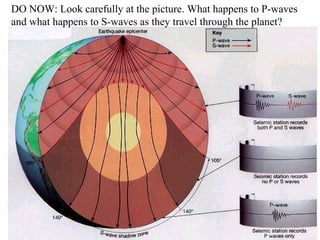
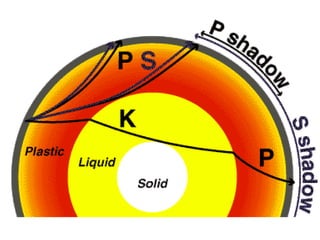
DO NOW: Look carefully at the picture. What happens to P-waves
and what happens to S-waves as they travel through the planet?
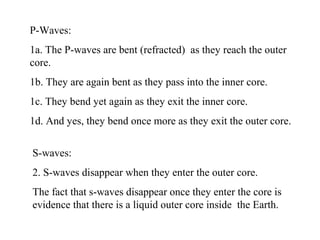
P-Waves:
1a. The P-waves are bent (refracted) as they reach the outer
core.
1b. They are again bent as they pass into the inner core.
1c. They bend yet again as they exit the inner core.
1d. And yes, they bend once more as they exit the outer core.
S-waves:
2. S-waves disappear when they enter the outer core.
The fact that s-waves disappear once they enter the core is
evidence that there is a liquid outer core inside the Earth.
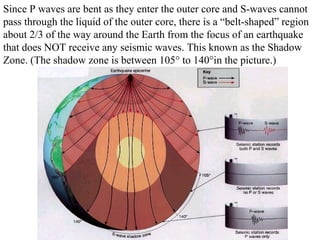
Since P waves are bent as they enter the outer core and S-waves cannot
pass through the liquid of the outer core, there is a “belt-shaped” region
about 2/3 of the way around the Earth from the focus of an earthquake
that does NOT receive any seismic waves. This known as the Shadow
Zone. (The shadow zone is between 105° to 140°in the picture.)
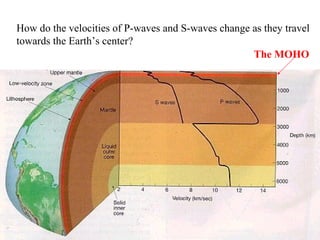
How do the velocities of P-waves and S-waves change as they travel
towards the Earth’s center?
The MOHO
3. Both S-waves and P-waves initially increase in speed as they go down
through the ground. At around 2,900 kilometers in depth, S-waves
disappear and P-waves have a sudden drop in speed. Then, the P-wave
velocity increases through the outer core and levels off in the inner core.
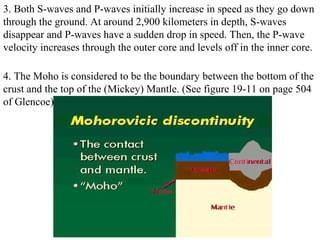
4. The Moho is considered to be the boundary between the bottom of the
crust and the top of the (Mickey) Mantle. (See figure 19-11 on page 504
of Glencoe)
5. Seismic wave analysis has led scientists to believe that:
a. the Earth has a liquid outer core - because S-waves are not
transmitted through the center of the Earth. S-waves cannot be
transmitted through fluids. Both P waves and S waves can pass
through solid material, but only P waves can travel through liquid
material. S waves cannot pass through liquids.
B. the Earth has a solid inner core - because P-waves speed up and level
off at the inner core.
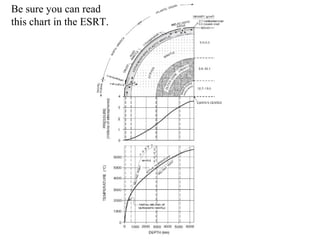
Be sure you can read
this chart in the ESRT.
Turn to page 10 in the ESRT:
1. From what depth to what depth is the lithosphere?
0 to about 100 km
2. At what depths does the asthenosphere begin and end?
About 100 to about 600 km
3. From what depth to what depth is the outer core?
About 2900 to about 5100 km
4. Within the asthenosphere, is the actual temperature of the rocks higher
or lower than the melting point of the rocks found there? What does this
mean?
The actual temp. is higher, which means that the rocks are partially
melted.
5. Within the stiffer mantle, is the actual temperature of the rocks higher
or lower that the melting point of the rocks?
The actual temperature is lower than the melting point, so the rocks are
solid in the mantle.
6. With regard to actual temperature and melting point of the material in
the outer core, what is going on?
The actual temp is higher and the material is liquid.
7. With regard to actual temperature and melting point of the material in
the inner core, what is going on?
The actual temp is lower than the melting point and the inner core is
solid.
8. What is the actual temperature and the melting point at a depth of
3000 km? What is the pressure at this depth?
Actual temp = 5000° C, melting point = 4500° C and the pressure = 1.5
million atmospheres. The material is melted/liquid here.
AIM:
How do we measure earthquake
strength, types of damage, methods
of detection and safety measures?
1. Measuring earthquakes:
a. Richter scale - numerical scale rating earthquake strength
b. Moment-magnitude scale - numerical scale that is more exact than
the Richter scale
c. Mercalli scale - verbal scale measuring damage (page 507 in old
book) http://www.abag.ca.gov/bayarea/eqmaps/doc/mmi.html
2. Earthquake intensity is dependent on earthquake magnitude
(size)and this is dependent on the size of the seismic waves generated
at the focus. The focus may be shallow (near the surface),
intermediate, or deep.
Q. What depth of focus is likely to produce a catastrophic e’quake?
3. Most catastrophic e’quakes are shallow focus.
4. Causes of earthquake damage:
A. soil liquefaction - occurs when seismic waves shake soft soil that is
saturated with water - turning it into mud. Buildings sink unequally into
the mud and get pulled apart. Houses/buildings built into solid rock are
more e’quake resistant.
B. tsunamis - are waves generated by undersea e’quakes that suddenly
displace (move) a mass of ocean water. Tsunamis may devastate seaside
towns. A tsunami can reach speeds of 400 mph and heights of as much as
a six-story building.
C. Fires and Floods: Much earthquake damage is a result of fires and
floods caused when water, sewage and gas pipes in the ground are
broken and leak. One spark from a broken electric wire can ignite gas
leaking from a broken gas pipe.
6. Monitoring for Earthquakes:
a. creepmeters
b. laser-ranging devices
c. tiltmeters
d. satellite measurement of elevation changes
6. Earthquake Safety:
Immediate actions:
Q. Look inside this room - where do you think is the safest place during
an earthquake? Why?
1. Get under a strong table or desk, or stand inside a door frame.
2. Shut off gas, electricity and water lines ASAP if possible.
Long term precautions:
3. Secure “less stable” furniture to walls or floor.
4. Install gas cut-off switches.
5. Reinforce structurally weak parts of your house.
6. Don’t place cribs or beds under windows or mirrors.
7. Secure furniture, bookcases to walls or floors.
http://www.geology.sdsu.edu/how_volcanoes_work/
Krakatau eruption

Test

  • 1.
    HOMEWORK Read pages 500-510in Glencoe. Read pages 64-69, 72-81 in Inside Earth Epicenter Lab is due on Monday
  • 2.
  • 3.
    DO NOW: Lookcarefully at the picture. What happens to P-waves and what happens to S-waves as they travel through the planet?
  • 5.
    P-Waves: 1a. The P-wavesare bent (refracted) as they reach the outer core. 1b. They are again bent as they pass into the inner core. 1c. They bend yet again as they exit the inner core. 1d. And yes, they bend once more as they exit the outer core. S-waves: 2. S-waves disappear when they enter the outer core. The fact that s-waves disappear once they enter the core is evidence that there is a liquid outer core inside the Earth.
  • 6.
    Since P wavesare bent as they enter the outer core and S-waves cannot pass through the liquid of the outer core, there is a “belt-shaped” region about 2/3 of the way around the Earth from the focus of an earthquake that does NOT receive any seismic waves. This known as the Shadow Zone. (The shadow zone is between 105° to 140°in the picture.)
  • 7.
    How do thevelocities of P-waves and S-waves change as they travel towards the Earth’s center? The MOHO
  • 8.
    3. Both S-wavesand P-waves initially increase in speed as they go down through the ground. At around 2,900 kilometers in depth, S-waves disappear and P-waves have a sudden drop in speed. Then, the P-wave velocity increases through the outer core and levels off in the inner core. 4. The Moho is considered to be the boundary between the bottom of the crust and the top of the (Mickey) Mantle. (See figure 19-11 on page 504 of Glencoe)
  • 9.
    5. Seismic waveanalysis has led scientists to believe that: a. the Earth has a liquid outer core - because S-waves are not transmitted through the center of the Earth. S-waves cannot be transmitted through fluids. Both P waves and S waves can pass through solid material, but only P waves can travel through liquid material. S waves cannot pass through liquids. B. the Earth has a solid inner core - because P-waves speed up and level off at the inner core.
  • 10.
    Be sure youcan read this chart in the ESRT.
  • 11.
    Turn to page10 in the ESRT: 1. From what depth to what depth is the lithosphere? 0 to about 100 km 2. At what depths does the asthenosphere begin and end? About 100 to about 600 km 3. From what depth to what depth is the outer core? About 2900 to about 5100 km 4. Within the asthenosphere, is the actual temperature of the rocks higher or lower than the melting point of the rocks found there? What does this mean? The actual temp. is higher, which means that the rocks are partially melted.
  • 12.
    5. Within thestiffer mantle, is the actual temperature of the rocks higher or lower that the melting point of the rocks? The actual temperature is lower than the melting point, so the rocks are solid in the mantle. 6. With regard to actual temperature and melting point of the material in the outer core, what is going on? The actual temp is higher and the material is liquid. 7. With regard to actual temperature and melting point of the material in the inner core, what is going on? The actual temp is lower than the melting point and the inner core is solid. 8. What is the actual temperature and the melting point at a depth of 3000 km? What is the pressure at this depth? Actual temp = 5000° C, melting point = 4500° C and the pressure = 1.5 million atmospheres. The material is melted/liquid here.
  • 13.
    AIM: How do wemeasure earthquake strength, types of damage, methods of detection and safety measures?
  • 14.
    1. Measuring earthquakes: a.Richter scale - numerical scale rating earthquake strength b. Moment-magnitude scale - numerical scale that is more exact than the Richter scale c. Mercalli scale - verbal scale measuring damage (page 507 in old book) http://www.abag.ca.gov/bayarea/eqmaps/doc/mmi.html 2. Earthquake intensity is dependent on earthquake magnitude (size)and this is dependent on the size of the seismic waves generated at the focus. The focus may be shallow (near the surface), intermediate, or deep. Q. What depth of focus is likely to produce a catastrophic e’quake? 3. Most catastrophic e’quakes are shallow focus.
  • 15.
    4. Causes ofearthquake damage: A. soil liquefaction - occurs when seismic waves shake soft soil that is saturated with water - turning it into mud. Buildings sink unequally into the mud and get pulled apart. Houses/buildings built into solid rock are more e’quake resistant. B. tsunamis - are waves generated by undersea e’quakes that suddenly displace (move) a mass of ocean water. Tsunamis may devastate seaside towns. A tsunami can reach speeds of 400 mph and heights of as much as a six-story building. C. Fires and Floods: Much earthquake damage is a result of fires and floods caused when water, sewage and gas pipes in the ground are broken and leak. One spark from a broken electric wire can ignite gas leaking from a broken gas pipe.
  • 16.
    6. Monitoring forEarthquakes: a. creepmeters b. laser-ranging devices c. tiltmeters d. satellite measurement of elevation changes
  • 17.
    6. Earthquake Safety: Immediateactions: Q. Look inside this room - where do you think is the safest place during an earthquake? Why? 1. Get under a strong table or desk, or stand inside a door frame. 2. Shut off gas, electricity and water lines ASAP if possible. Long term precautions: 3. Secure “less stable” furniture to walls or floor. 4. Install gas cut-off switches. 5. Reinforce structurally weak parts of your house. 6. Don’t place cribs or beds under windows or mirrors. 7. Secure furniture, bookcases to walls or floors.
  • 18.